 Location :
Orlando, FL, USA
Location :
Orlando, FL, USA +1 (407) 714-1616
 info@biz4group.com

- Learn how to develop an AI automotive CRM software development that fits real dealership, OEM, and mobility workflows.
- Leverage automation, prediction, and scale through automotive CRM software development with AI, improving lead handling, and customer engagement.
- Use AI driven CRM systems to centralize data and personalize journeys by building customer relationship management software for automotive use cases.
- Automotive CRM adoption is accelerating as AI improves response times, conversion rates, and lifecycle visibility across multi location operations.
- The cost to build an AI automotive CRM typically ranges between 35,000 and 250,000+ USD, depending on scope, scale, and AI depth.
- A phased roadmap, right tech stack, and clear monetization plan help reduce risk and support long term growth.
In the fast-moving world of automotive retail and service, dealerships and OEMs are managing more leads, more channels, and higher customer expectations than ever before. Buyers expect instant responses, personalized journeys, and consistent follow ups across every touchpoint. If you are looking to develop an AI automotive CRM software development strategy that actually moves the needle, you are likely asking questions like:
- AI automotive CRM software development
- how to build a CRM for car dealerships using AI
- AI CRM for auto sales and customer follow ups
- can AI improve lead management in car dealerships
- automotive CRM with AI features
Well, here’s what the market says about it:
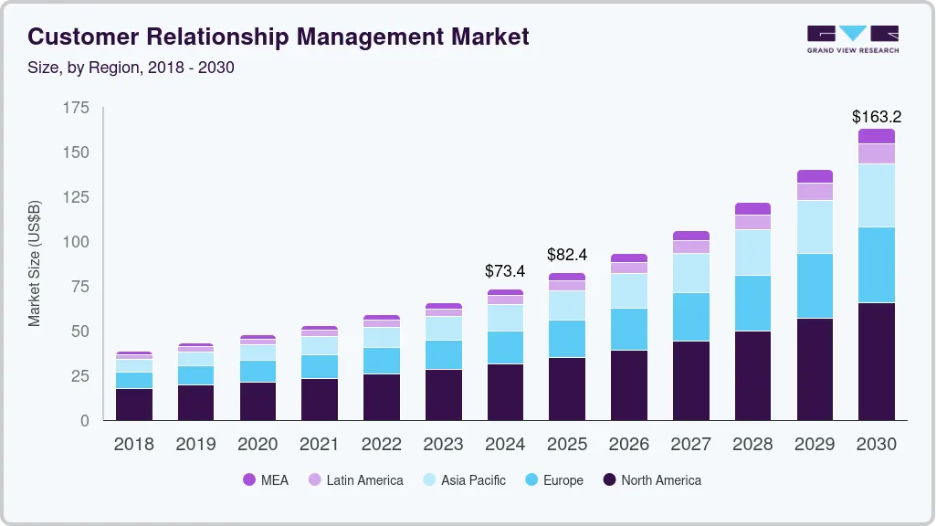
- The global CRM market size is forecasted to reach a valuation of USD 163+ billion by 2030.
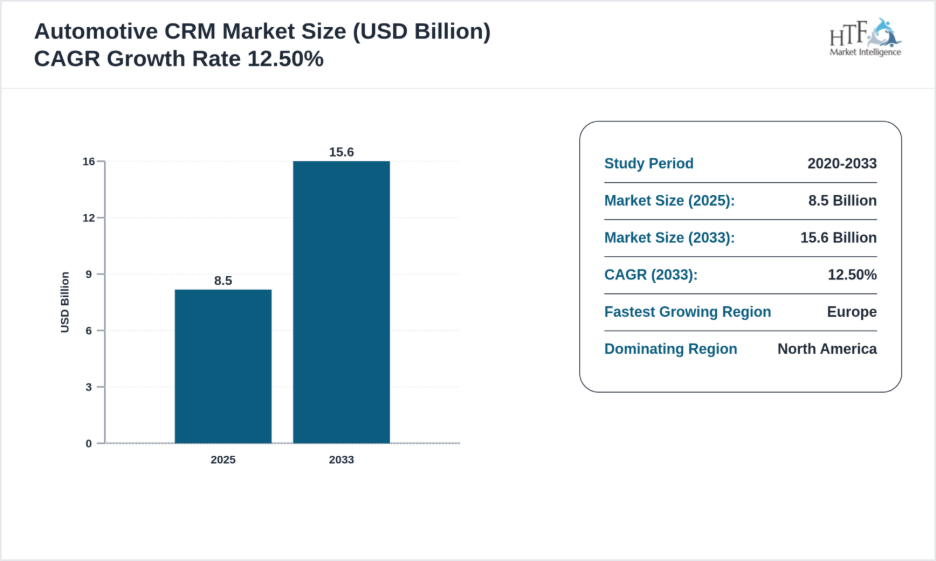
- In parallel, the Automotive CRM market is all set to reach a staggering 15+ Billion by 2033, according to reports by HTF Market Insights.
Across dealerships and OEM networks, the real challenge is the inability to act the data accumulated fast enough. Leads slip through cracks, follow ups depend on manual effort, and sales teams work across disconnected systems. This is where AI automotive CRM software development becomes a practical necessity rather than a technology experiment, often prompting engagement with an experienced AI development company.
For decision makers evaluating next steps, clarity on how to develop AI powered automotive CRM systems becomes the foundation for building scalable platforms that support long term growth, operational visibility, and measurable sales performance.
What Is AI Automotive CRM Software?
AI automotive CRM software is a purpose-built platform designed to manage automotive customer relationships using intelligence at scale. When leaders develop an AI automotive CRM software development strategy, the goal is to connect sales, service, and engagement into one adaptive system.
- Centralizes customer, lead, and vehicle interaction data
- Applies intelligence to prioritize leads and follow ups
- Supports sales and after sales workflows in real time
- Enables personalization across automotive customer journeys
- Scales securely with dealership and OEM operations
It helps automotive organizations in aligning data, workflows, and intelligence, often supported through structured AI integration services to ensure seamless system adoption and long-term usability.
Still Managing Leads Manually?
See how teams develop an AI automotive CRM software development roadmap that actually fits dealer and OEM workflows.
Plan My AI Automotive CRMHow AI Automotive CRM Software Works
To develop an AI automotive CRM software development approach that works in real settings, teams need to see how data turns into daily actions. The system connects information, intelligence, and execution across automotive sales and service.
1. Data Collection and Unification
Customer data comes from websites, showrooms, service visits, and campaigns. The platform brings this information into one place. This creates a clear and reliable view of every customer interaction.
2. Intelligence and Decision Layer
The system analyzes customer behavior, engagement signals, and sales activity. It identifies which leads need attention and what actions should happen next. AI chatbot integration with CRM supports faster and more consistent responses.
3. Execution Across Sales and Service
Insights guide tasks across sales and service teams without manual coordination. Follow ups, alerts, and responses happen within existing workflows. This is how teams create AI driven automotive CRM platforms that scale with demand.
|
Layer |
Role In The System |
Business Impact |
|---|---|---|
|
Data Layer |
Brings customer data together |
Clear customer visibility |
|
Intelligence Layer |
Analyzes behavior and intent |
Better decision timing |
|
Execution Layer |
Triggers actions and follow ups |
Higher efficiency |
As usage grows, the same setup helps organizations build AI automotive CRM solutions for dealerships while preparing teams for deeper customer engagement in the next section.
Why Invest in Automotive CRM Software Development With AI?
To develop an AI automotive CRM software development strategy that delivers results, leaders need to address everyday problems in sales and customer management. The value becomes clear when these problems start slowing teams down.
1. Better Lead Focus for Sales Teams
Sales teams handle many leads but often lack clarity on what to act on first. Automotive CRM software development with AI helps identify priority leads and timely actions. This improves follow-ups and reduces wasted effort inside the CRM.
2. Clearer Customer Engagement
Customers expect timely and relevant communication at every stage. When teams build customer relationship management software for automotive, they gain a clear view of customer activity and intent. Some organizations rely on AI consulting services at this stage to keep engagement consistent.
3. Growth Without Process Breakdowns
As businesses expand, manual processes become harder to manage. Custom AI automotive CRM development supports growth while keeping workflows stable. This approach fits well with existing enterprise AI solutions used across the organization.
Over time, this investment helps teams work with more clarity and prepares the foundation for practical use cases that follow in the next section.
Key Use Cases of AI Automotive CRM Solutions for Dealerships, OEMs, And Mobility Brands
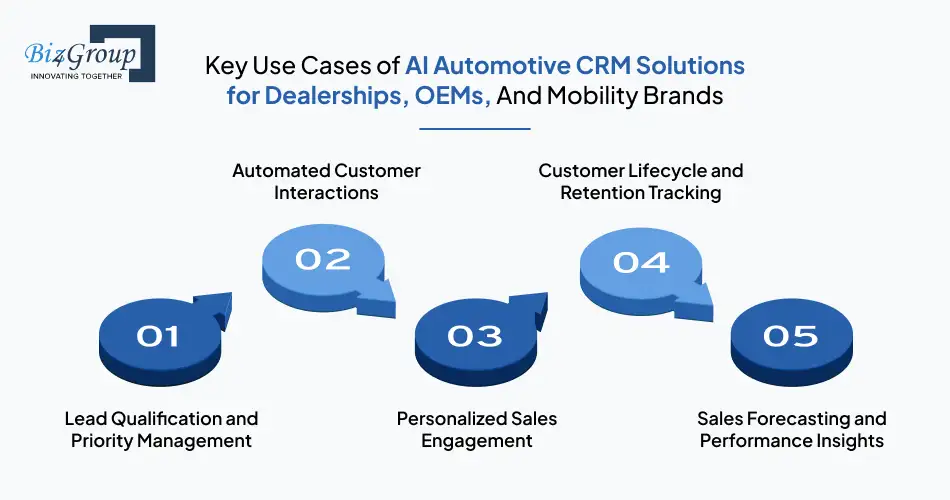
When leaders choose to develop an AI automotive CRM software development strategy, the value appears in daily sales execution and customer handling. These use cases highlight where AI driven CRM platforms create measurable operational impact, starting with lead handling and extending across the customer lifecycle.
1. Lead Qualification and Priority Management
Automotive teams manage large lead volumes with mixed intent levels. When organizations develop intelligent automotive CRM applications, the system evaluates engagement signals to rank leads and guide timely follow ups. This sharpens sales focus and reduces missed opportunities.
- Example: Leads with repeated inventory views and finance page visits are prioritized for immediate outreach.
2. Automated Customer Interactions
Routine questions slow sales and service teams. CRM platforms supported by AI chatbot integration manage common inquiries while preserving context. This improves response speed and consistency across channels.
- Example: Customers receive instant updates on vehicle availability or service status.
3. Personalized Sales Engagement
One size communication weakens buyer interest. Teams that create AI enabled automotive sales CRM systems align outreach with customer behavior, inquiry type, and journey stage. This improves relevance without adding manual work.
- Example: A prospect receives model recommendations based on recent searches and budget range.
4. Customer Lifecycle and Retention Tracking
Post sale engagement is often fragmented across systems. With focused AI automotive customer management software development, teams maintain a single view of customer activity across sales and service. This clarity supports long term relationship management.
- Example: Service visits trigger timely follow ups for upgrades or ownership support.
5. Sales Forecasting and Performance Insights
Traditional forecasting often relies on static reports. AI enabled CRM platforms apply AI model development to analyze pipeline activity and customer behavior trends. This supports more accurate planning and decision making.
- Example: Conversion patterns highlight which models or locations are likely to close faster.
|
Use Case Area |
Primary Focus |
Business Outcome |
|---|---|---|
|
Lead Management |
Intent based prioritization |
Faster conversions |
|
Sales Engagement |
Context driven outreach |
Higher response rates |
|
Lifecycle Tracking |
Unified customer view |
Better retention |
|
Automation |
Faster responses |
Lower manual effort |
|
Forecasting |
Predictive insights |
Improved planning |
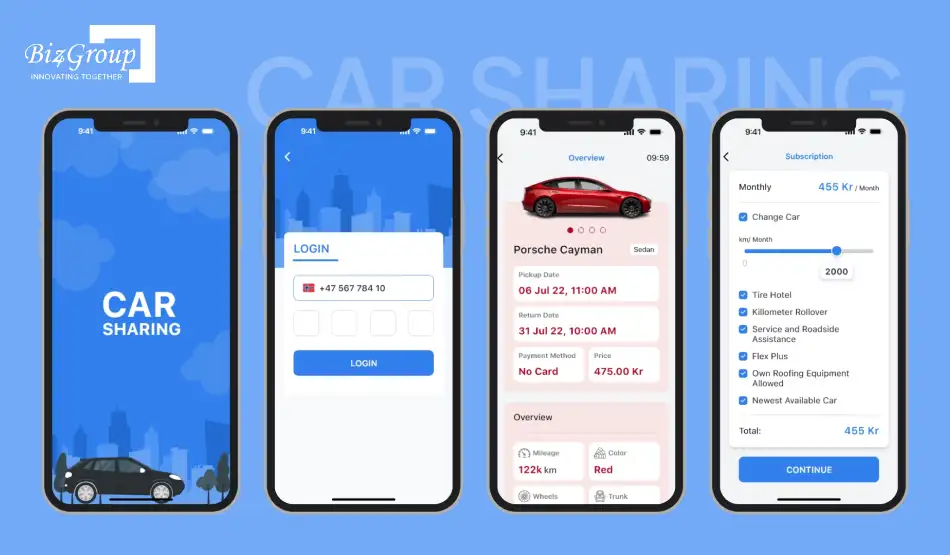
Biz4Group has built an advanced AI powered car sharing platform designed to manage vehicle availability, user interactions, and operational workflows at scale. The platform combines real time data, automation, and customer insights, making it highly relevant to AI automotive CRM software development where unified customer engagement and lifecycle tracking are critical.
Together, these use cases show how AI automotive customer management software development delivers practical value today while naturally setting the stage for the feature capabilities discussed next.
What If Your CRM Worked Like Your Sales Team?
Build smarter pipelines with automotive CRM software development with AI designed for real automotive operations.
Design My AI Automotive CRMMust Have Features in AI Automotive CRM Software Development
To develop an AI automotive CRM software development platform that works in real automotive environments, teams need a clear set of core capabilities. These features form the operational backbone that supports sales, service, and customer engagement at scale:
|
Core Feature |
What It Enables |
Why It Matters |
|---|---|---|
|
Centralized Customer Profiles |
Unified view of leads, buyers, and service customers |
Eliminates data silos |
|
Lead Capture And Tracking |
Intake from digital and offline channels |
Prevents missed opportunities |
|
Intelligent Lead Scoring |
Priority based on behavior and intent |
Improves response timing |
|
Sales Pipeline Visibility |
Clear deal stages and movement |
Supports predictable outcomes |
|
Automated Follow Ups |
Timely tasks and reminders |
Reduces manual workload |
|
Multichannel Communication |
Email, SMS, and in platform messaging |
Maintains consistent outreach |
|
Service Interaction Tracking |
Sales and service history in one place |
Supports long term relationships |
|
Reporting And Dashboards |
Performance and activity insights |
Enables data driven decisions |
|
Role Based Access Control |
Permissions by team and function |
Maintains operational control |
|
CRM Integration Layer |
Connectivity with dealer systems |
Ensures workflow continuity |
Together, these essentials help organizations build AI automotive CRM systems for dealers and OEMs with consistency and control, often supported by structured AI automation services that prepare teams for more advanced capabilities discussed next.
Advanced Features in Custom AI Automotive CRM Development
Once teams develop an AI automotive CRM software development foundation, advanced features help move beyond efficiency into measurable growth and smarter decisions. These capabilities focus on prediction, personalization, and automation that operate at scale, as outlined below.
1. Predictive Lead Intent Modeling
Advanced systems analyze historical and real time behavior to predict buying intent. Predictive analytics allow teams to focus effort where conversion likelihood is highest. Many platforms make AI automotive CRM software for lead management more accurate over time.
2. AI Driven Sales And Service Recommendations
The platform suggests next best actions across sales and service journeys. Recommendations are based on patterns across similar customers and outcomes. This helps create AI driven CRM platforms for automotive sales and service with consistent execution.
3. Conversational Intelligence For Customer Interactions
Natural language systems manage complex customer conversations across channels. Responses stay relevant by using customer context and interaction history. This capability is often aligned with AI conversation app frameworks.
4. Customer Lifecycle And Churn Prediction
Advanced models identify signals that indicate disengagement or drop off risk. Teams can act before revenue or loyalty is lost. This intelligence supports long term planning tied to the AI automotive CRM software development cost and roadmap.
5. Embedded Intelligence Across Interfaces
Insights surface directly inside workflows used by sales and service teams. This removes the need to switch tools or reports. Many organizations rely on a custom software development company to tailor this experience.
Together, these advanced capabilities support long term optimization and planning while reinforcing clarity around the AI automotive CRM software development cost and roadmap as teams prepare for structured implementation steps ahead.
Step By Step Process to Develop AI Powered Automotive CRM Systems
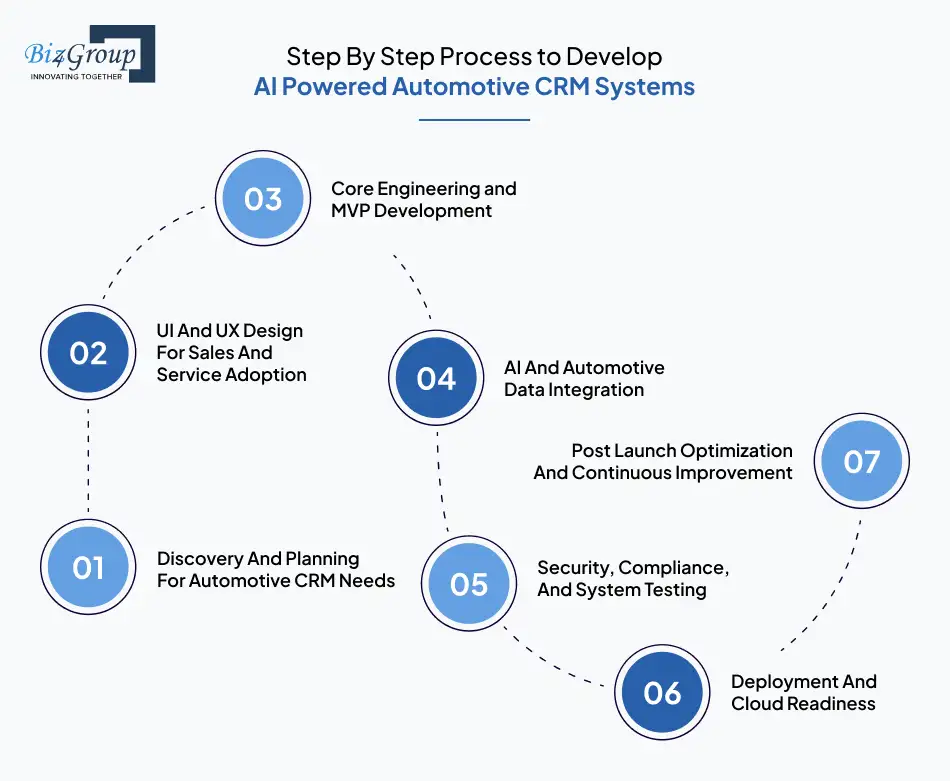
To develop an AI automotive CRM software development roadmap that delivers real value, teams must follow a structured process aligned with automotive sales, service, and customer engagement realities. Each step below reflects how scalable CRM platforms are built for long term use.
1. Discovery And Planning For Automotive CRM Needs
This step defines how dealerships, OEMs, and mobility brands currently manage leads, customers, and service interactions. Clear discovery ensures the CRM supports real workflows instead of forcing teams to adapt to generic systems.
- Identify gaps in lead handling and follow ups
- Map sales and service workflows that need support
- Define success metrics tied to revenue and retention
- Align scope with business priorities
2. UI And UX Design For Sales And Service Adoption
Strong adoption depends on usability. CRM interfaces must help sales and service teams act quickly while maintaining full customer context across touchpoints, locations, and roles. It’s recommended that you collaborate with an experienced UI/UX design partner for the best outcome.
- Design interfaces based on dealership workflows
- Test usability with sales managers and advisors
- Support role-based dashboards
- Ensure consistent experience across devices
Also read: Top 15 UI/UX Design Companies in USA: 2026 Guide
3. Core Engineering and MVP Development
MVP development services help validate value early without overbuilding. For automotive CRM, this stage focuses on lead capture, pipeline tracking, and basic automation to prove operational impact.
- Build lead intake and pipeline modules
- Enable task and follow up automation
- Design modular backend services
- Prepare architecture for future intelligence
Also Read: Top 12+ MVP Development Companies to Launch Your Startup in 2026
4. AI And Automotive Data Integration
This step enables intelligence across the platform. Clean data integration allows teams to create AI powered automotive CRM platforms for growth by learning from customer behavior, sales activity, and service history.
- Integrate website, showroom, and service data
- Train AI models on automotive interaction patterns
- Create feedback loops for continuous learning
- Balance generic and domain specific logic
5. Security, Compliance, And System Testing
Enterprise readiness requires strong security and testing practices. Automotive CRM systems must protect customer data while remaining reliable during high demand periods.
- Apply access controls by role and function
- Validate compliance with data regulations
- Stress test system performance
- Simulate real sales and service journeys
Also Read: Software Testing Companies in USA
6. Deployment And Cloud Readiness
Deployment planning ensures the platform supports scale. This stage prepares the system to develop AI automotive CRM systems for enterprise use across multiple locations and teams.
- Configure scalable cloud infrastructure
- Enable monitoring and performance tracking
- Support controlled feature rollouts
- Prepare onboarding documentation
7. Post Launch Optimization And Continuous Improvement
CRM platforms improve over time through data and feedback. Ongoing optimization helps teams manage costs, performance, and adoption while aligning outcomes with the AI automotive CRM development cost estimate defined earlier.
- Collect feedback from active users
- Retrain models with fresh data
- Introduce advanced capabilities gradually
- Track adoption and ROI metrics
Following this process helps organizations deliver reliable AI automotive CRM solutions for dealerships, OEMs, and mobility brands, while maintaining control, scalability, and long-term operational clarity.
Generic CRM Or Automotive Built?
Understand why leaders choose to build customer relationship management software for automotive use cases instead of forcing fit.
Explore Custom AI CRMChoosing The Right Stack for Automotive CRM Software Development With AI
An AI automotive CRM must support real-time lead flows, seamless integrations with dealer systems, and AI driven decision making. The stack below reflects the core technology layers required to keep sales, service, and customer data connected across dealerships, OEMs, and mobility brands:
|
Label |
Preferred Technologies |
Why It Matters |
|---|---|---|
|
Frontend Framework |
ReactJS, VueJS |
Sales teams rely on fast and responsive dashboards for lead and customer views, which is why modern automotive CRM interfaces are often built using ReactJS development. |
|
Server-Side Rendering & SEO |
NextJS, NuxtJS |
Data heavy CRM portals benefit from server-side rendering for speed and stability, making NextJS development a practical choice. |
|
Backend Framework |
NodeJS, Python |
Core CRM workflows, real time updates, and data handling are supported through NodeJS development, while Python development enables reliable data processing and backend logic. |
|
REST APIs, GraphQL |
Automotive CRM platforms depend on APIs to connect websites, dealer systems, and third-party tools, making a structured API layer essential for scalable integrations. |
|
|
AI & Data Processing |
ML Frameworks, Data Pipelines |
This layer supports lead scoring, behavior analysis, and learning loops that power intelligent CRM decisions. |
|
Database Layer |
PostgreSQL, MongoDB |
Automotive CRM systems manage structured sales data and unstructured interaction data across multiple locations and teams. |
|
Integration Layer |
Webhooks, Middleware |
Real time syncing between CRM, marketing tools, and dealer platforms keeps customer context accurate and up to date. |
|
Cloud Infrastructure |
AWS, Azure |
Cloud environments support demand spikes from campaigns and launches while maintaining consistent CRM availability. |
|
Security & Access Control |
OAuth, RBAC |
Automotive customer and transaction data requires strict access control and role-based permissions. |
|
Monitoring & Analytics |
Logs, Dashboards |
Continuous visibility into usage and system health helps teams maintain performance at scale. |
A complete stack like this ensures the platform can handle integrations, intelligence, and scale together. Now, let's get into a clearer discussion around cost expectations when teams plan to develop an AI automotive CRM software development roadmap in the next section.
AI Automotive CRM Development Cost Estimate by Scale
The cost to develop an AI automotive CRM software development platform typically falls between 35,000 and 250,000+ USD, depending on scope and scale. This is a ballpark figure, not a fixed quote, shaped by features, integrations, AI depth, and long-term goals.
|
Build Level |
Typical Scope |
Estimated Cost Range |
|---|---|---|
|
MVP-level AI Automotive CRM |
Lead capture, basic pipeline, simple scoring, core dashboards |
35,000 to 60,000 |
|
Mid-Level AI Automotive CRM |
Advanced workflows, automation, integrations, reporting |
60,000 to 120,000 |
|
Enterprise-Grade AI Automotive CRM |
Multi location support, AI models, security, scalability |
120,000 to 250,000+ |
|
AI Capability Depth |
Rule based logic to predictive intelligence |
Cost varies by complexity |
|
Integrations |
Dealer systems, marketing tools, data sources |
Impacts total effort |
|
UX And Adoption |
Role based views and usability design |
Affects rollout success |
|
Maintenance And Scaling |
Model updates and feature expansion |
Ongoing investment |
Cost planning becomes easier when teams align requirements early and avoid overbuilding. Many organizations work with a trusted software development company in Florida to balance scope, timelines, and investment without compromising future scalability.
As expectations grow, understanding how teams develop AI powered automotive CRM systems helps frame not just cost, but how revenue models and monetization strategies take shape in the next section.
Thinking Beyond Basic Automation?
Create scalable platforms when you create AI driven automotive CRM platforms aligned with growth and data maturity.
Build AI CRM For GrowthHow AI Automotive CRM Solutions Generate Revenue
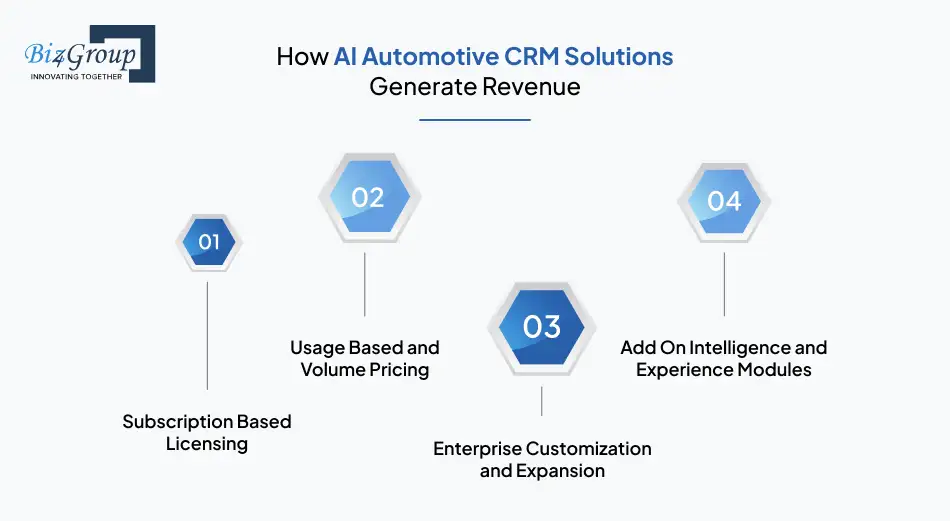
When leaders develop an AI automotive CRM software development strategy, revenue planning depends on how the platform delivers repeatable value across sales, service, and customer engagement. The strongest models align pricing with usage, scale, and long term adoption.
1. Subscription Based Licensing
Recurring subscriptions are one of the most common approaches, priced by users, locations, or feature tiers. This model fits well when teams build AI automotive CRM solutions for dealerships that want predictable costs and steady access to platform improvements.
- Example: Dealer groups subscribe monthly based on active users, with higher tiers unlocking automation and reporting features.
2. Usage Based and Volume Pricing
Some platforms scale revenue based on activity levels such as leads processed, workflows triggered, or customer interactions handled. This approach supports teams that create AI driven automotive CRM platforms designed to grow alongside sales demand.
- Example: Costs increase during seasonal spikes when lead volume and follow ups rise across locations.
At this stage, product teams often plan how to integrate AI into an app without disrupting existing sales and service workflows, ensuring monetization scales smoothly with real usage.
3. Enterprise Customization and Expansion
OEMs and large mobility brands usually require deeper customization and phased rollouts. Here, automotive CRM software development with AI supports higher contract value through tailored workflows, governance controls, and region-specific configurations.
- Example: An OEM licenses the core platform and adds regions, analytics layers, and compliance features over time.
As platforms mature, experience focused enhancements like AI assistant app design become monetizable upgrades that improve engagement without changing the core system.
4. Add On Intelligence and Experience Modules
Advanced capabilities are often packaged as optional add ons once the core CRM is stable. Teams that build customer relationship management software for automotive use this model to monetize deeper insights and personalization.
- Example: A premium module offers advanced recommendations and predictive insights for sales managers.
To support sustained growth, some organizations later choose to hire AI developers as usage expands and customer demands become more complex.
With revenue paths clearly defined, following proven development practices becomes essential to maintain performance and reliability as the platform scales further.
Best Practices for Custom AI Automotive CRM Development
To develop an AI automotive CRM software development approach that delivers long term value, teams need disciplined practices that balance speed, accuracy, and adoption. These principles help avoid rework and ensure the platform supports real automotive sales and service needs.
1. Design Around Automotive Workflows First
Successful platforms start with how dealerships and OEM teams actually work. When teams develop intelligent automotive CRM applications, they align features with lead handling, follow ups, and service coordination. This prevents low adoption caused by forcing users into rigid processes.
2. Treat AI As A Support Layer, Not A Black Box
AI should guide decisions, not confuse users. Clear explanations and visible logic build trust in recommendations. Many teams apply generative AI carefully to enhance insights while keeping outcomes understandable and actionable for sales managers.
3. Build With Scalability And Change In Mind
Automotive CRM platforms evolve as markets and buyer behavior shift. Modular architecture and clean data pipelines make updates easier. This mindset supports teams that create AI enabled automotive sales CRM systems without breaking existing workflows.
Strong foundations also depend on choosing the right partners for business app development using AI, ensuring the platform stays reliable as usage grows. These practices naturally prepare teams to address the challenges that emerge during real world deployment.
Plan Cost Before You Commit
Get clarity on scope, scale, and outcomes before you develop AI powered automotive CRM systems.
Estimate My AI CRM CostChallenges In AI Automotive CRM Software Development And Solutions
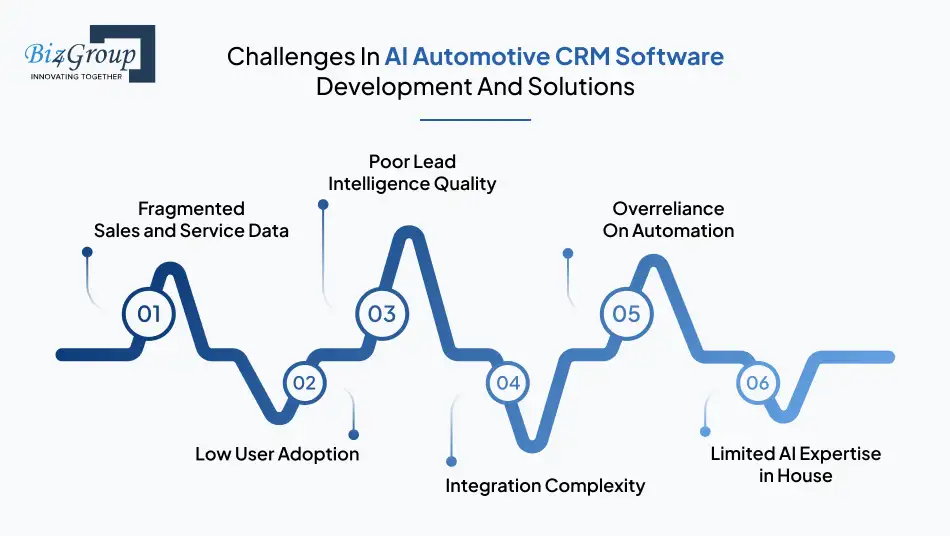
When organizations develop an AI automotive CRM software development initiative, hurdles usually appear around data, adoption, and execution. Understanding these challenges early helps leaders avoid delays and cost overruns while keeping the platform aligned with real automotive workflows:
|
Top Challenges |
How To Solve Them |
|---|---|
|
Fragmented Sales and Service Data |
Start with data unification across websites, showrooms, and service systems before layering AI logic. |
|
Low User Adoption |
Design workflows around how sales and service teams actually work, not how tools expect them to work. |
|
Poor Lead Intelligence Quality |
Train models on clean, relevant automotive data and refine them using real interaction feedback. |
|
Integration Complexity |
Use a modular integration layer that connects CRM with dealer systems and marketing tools gradually. |
|
Overreliance On Automation |
Keep human oversight in decision making so that AI supports teams instead of replacing judgment. |
|
Limited AI Expertise in House |
Partnering with an AI chatbot development company helps accelerate delivery without long learning curves. |
Addressing these hurdles with a structured approach ensures AI automotive customer management software development remains practical, scalable, and ready for the future directions explored next.
The Future of AI Automotive CRM Software Development
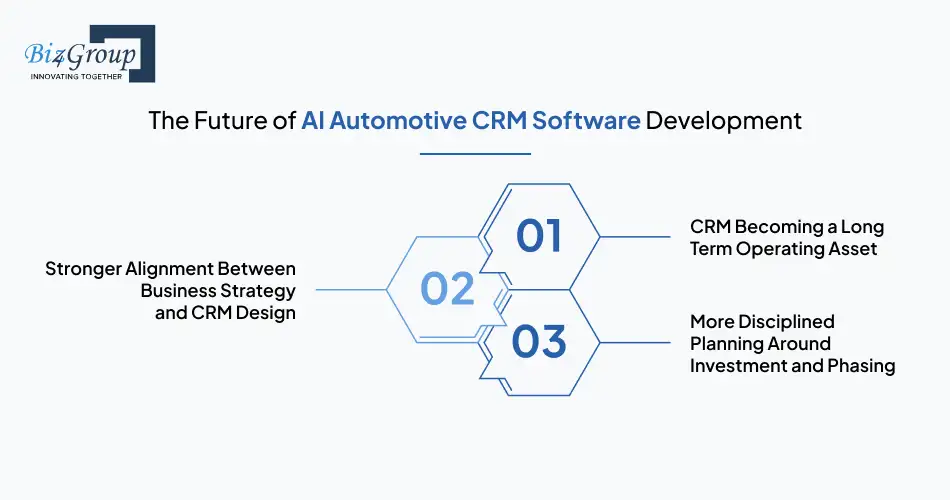
As automotive organizations rethink growth and ownership models, leaders who develop an AI automotive CRM software development strategy are preparing for platforms that evolve with markets, regulations, and customer expectations. The future is shaped less by features and more by how these systems are governed and scaled.
1. CRM Becoming a Long Term Operating Asset
AI automotive CRM platforms will be treated as core business infrastructure, not sales tools. Decisions around ownership, customization, and control will matter more than speed of launch. This shift influences how teams create AI driven CRM platforms for automotive sales and service with longevity in mind.
2. Stronger Alignment Between Business Strategy and CRM Design
CRM roadmaps will increasingly reflect business priorities such as expansion, brand consistency, and partner ecosystems. Architecture decisions will be made earlier to support multi-region growth. This mindset helps organizations build AI automotive CRM systems for dealers and OEMs without repeated rebuilding.
3. More Disciplined Planning Around Investment and Phasing
Future implementations will follow phased rollouts tied to measurable outcomes. Leaders will plan features, integrations, and scale together instead of incrementally reacting. This approach brings structure to decisions around the AI automotive CRM software development cost and roadmap.
As this evolution continues, execution choices and partner selection, including collaboration with a capable AI chatbot development company, become strategic decisions rather than delivery details.
Why Choose Biz4Group for AI Automotive CRM Software Development?
Building AI automotive CRM software demands an understanding of how automotive sales, service, and mobility ecosystems actually operate. Biz4Group brings that perspective through hands on experience helping clients develop an AI automotive CRM software development approach that aligns with real business workflows.
Our work on real world automotive and mobility solutions, including AI powered car sharing platforms, reflects how customer engagement, asset utilization, and operational intelligence intersect in production environments. That experience directly showcases how we approach AI automotive CRM software development for dealers, OEMs, and mobility brands.
Why teams work with Biz4Group:
- Proven experience building AI based automotive and mobility platforms
- Deep understanding of customer lifecycle, usage data, and engagement flows
- Ability to design scalable systems aligned with business growth goals
- End to end delivery as an AI app development company, from strategy to deployment
Biz4Group focuses on building CRM platforms that are practical, scalable, and ready for real automotive operations, not experimental systems that stall after launch.
Ready For A CRM That Scales With You?
See how teams build AI automotive CRM solutions for dealerships without disrupting sales or service teams.
Start My AI Automotive CRMClosing Insights On Automotive CRM Software Development With AI
Automotive CRM is no longer a back-office system. It sits at the center of how leads are handled, how customers are remembered, and how growth decisions are made. When teams choose to build AI software that understands automotive sales cycles, ownership journeys, and operational pressure, CRM shifts from record keeping to revenue intelligence.
The difference lies in execution. Working with an experienced AI product development company turns strategy into a platform that actually gets used, trusted, and scaled across real automotive operations.
Are you planning to create an AI automotive CRM that connects the full customer lifecycle? Talk To Our AI CRM Experts.
FAQs On AI Automotive CRM Software Development
1. How Is AI Automotive CRM Different From Traditional Automotive CRM Systems?
Traditional CRMs focus on storing customer data, while AI based platforms focus on using that data in real time. With AI automotive CRM software development, systems can analyze behavior, predict intent, and guide actions instead of relying on manual rules and static workflows.
2. Can AI Automotive CRM Software Scale Across Multiple Dealerships Or Regions?
Yes, modern platforms are designed to support multi location operations with centralized visibility and localized workflows. Organizations that build AI automotive CRM systems for dealers and OEMs can manage data, users, and performance consistently across regions without duplicating systems.
3. How Long Does It Take To Build An AI Automotive CRM Platform?
Timelines vary based on scope, integrations, and AI depth. A focused MVP can be delivered faster, while enterprise platforms take longer. Teams that develop AI powered automotive CRM systems often follow phased rollouts to validate value early and scale features over time.
4. What Data Sources Are Typically Used In AI Automotive CRM Platforms?
AI automotive CRMs combine data from websites, sales pipelines, service records, campaigns, and customer interactions. With AI automotive customer management software development, these inputs are unified to create a continuous customer view that supports better decision making.
5. How Much Does It Cost To Build An AI Automotive CRM Software?
The cost typically ranges from 35,000 to 250,000+ USD, depending on features, integrations, and scale. A clear AI automotive CRM development cost estimate depends on whether the platform is an MVP, mid level system, or enterprise solution.
6. Can AI Automotive CRM Be Customized For Both Sales And Service Teams?
Yes, modern platforms are designed to support the full customer lifecycle. Teams that create AI driven CRM platforms for automotive sales and service can align workflows, data, and insights across both functions without maintaining separate systems.
