Location :
Orlando, FL, USA
Location :
Orlando, FL, USA +1 (407) 714-1616
 info@biz4group.com


















Imagine a digital system that doesn’t wait for instructions but instead, understands your business goals, learns from real-time feedback, and takes independent actions to get the job done.
Read More

The world is moving faster than ever, and every business is trying to keep up. Security needs are rising. Customers expect instant access. Teams want automation that actually works. In the middle of all this, one innovation has quietly become the backbone of modern authentication.
Facial recognition.
And right now is the perfect time to develop an AI face recognition app that feels effortless, secure, and built for real-world business challenges.
Think about the moments when people unlock a phone, check in at an office, verify identity for a financial service, or walk through a secure door.
No passwords. No waiting. No friction.
That experience is what today’s users want from every brand they interact with. This is pushing companies of all sizes toward AI face recognition app development.
The technology behind it has matured. Accuracy is sharper. Processing is faster. Models are lighter. You no longer need a giant team or a massive budget to build AI face recognition app experiences that feel premium and intuitive. You simply need a clear roadmap and a smart approach.
If you want to develop a high-accuracy AI face recognition application that strengthens trust, reduces operational overhead, and enhances user experience, you are reading at the right moment.
So, without any delays, let’s begin with the basics.
Face recognition is about identifying or confirming a person’s identity by analyzing their facial features. It uses a picture or video of a face and matches it against a database.
That might sound the same as detection. But there are subtle, important differences:
|
Term |
What It Does |
Typical Use Case |
|
Face detection |
Finds a face in an image or video |
Triggering face scan when someone stands in front of a camera |
|
Face recognition |
Matches a detected face to a known identity |
Unlocking an app, verifying employee access |
Understanding these distinctions is crucial before you decide to build AI face recognition app solutions for your business.
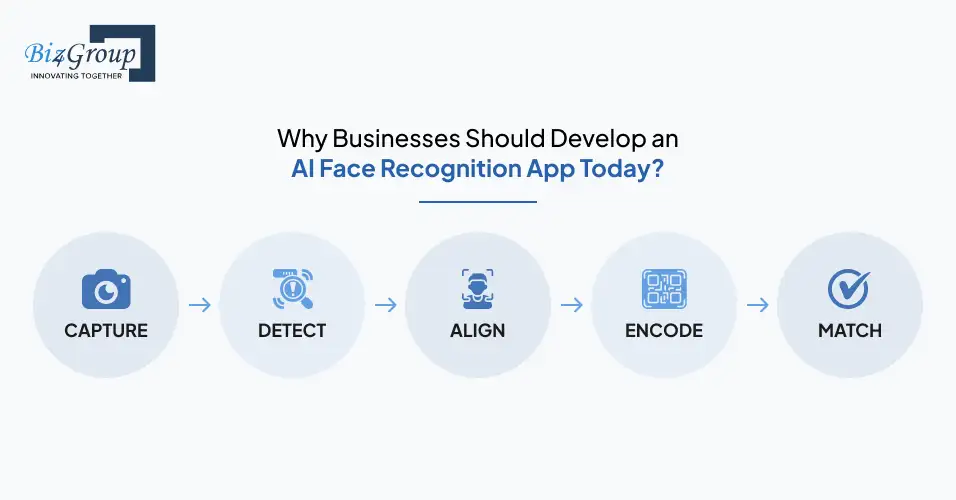
Now, how does an AI face recognition app work? Here is the simple flow when you build AI face recognition app functionality:
Behind the scenes, the app may use modern AI models and embeddings. This allows the solution to adapt as your user base grows.
Before you start building, these are the building blocks you must plan for:
These are not optional. They form the foundation for a face recognition app that works reliably and safely.
Facial recognition is no longer speculative technology. Many businesses have adopted it for authentication, security, and streamlined user experience. The global facial recognition market is projected to reach USD 15.84 billion by 2030 at a CAGR of 14.9%.
Demand rose sharply after remote work and remote services proliferated. Companies need secure, touch-free, and scalable solutions for identity and access control. That shift has driven renewed interest in AI face recognition app development across sectors.
Here is why investing in a custom face recognition solution makes sense for modern businesses:
Investing now to build AI face recognition app functionality sets the stage for secure, scalable, user-friendly systems that grow with your needs. If you are ready for a stable, modern, high-accuracy authentication or verification solution, this is the time to act.
Also read: Top 20 facial recognition software in 2026
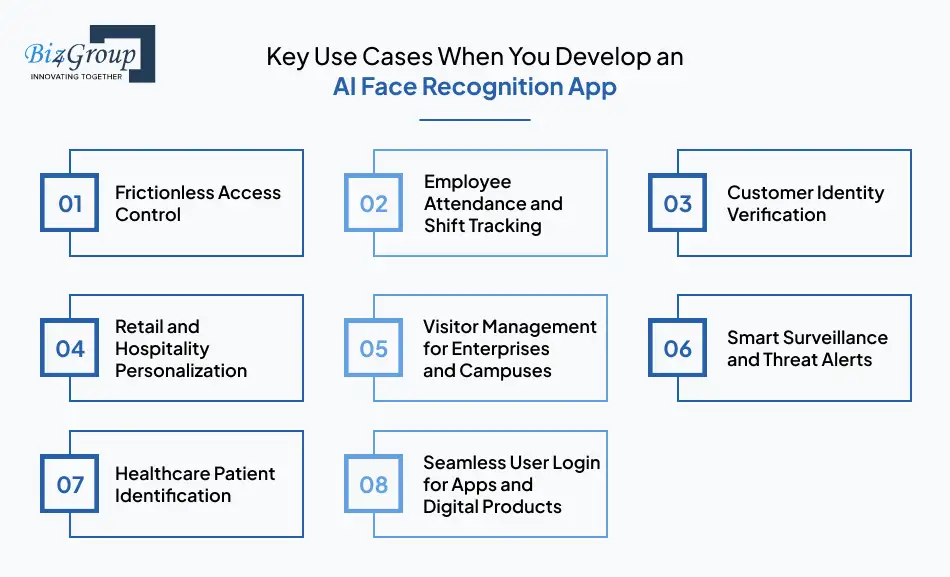
Every business adopts new tech for a reason. When teams explore AI face recognition app development, they usually start with real problems they want to solve and processes they want to simplify.
Many offices and facilities rely on outdated card-based access. When you build AI face recognition app features for entry management, you create a simple walk-in experience for authorized users. This works well for corporate workplaces, co-working hubs, warehouses, labs and data centers.
Instead of fingerprint devices that need constant cleaning and maintenance, face-based attendance feels cleaner and faster. The system records time logs and creates reliable attendance reports. Operations teams prefer this approach because it reduces manual corrections and disputes.
Banks, fintech platforms, healthcare portals and insurance companies use facial verification to confirm identity during sign-ups or transactions. This supports stronger compliance and lowers the time it takes to verify a customer.
When you develop a high-accuracy AI face recognition application for customer-facing environments, you open the door to more personalized experiences. Stores, hotels and entertainment venues can identify returning customers and offer tailored recommendations, loyalty benefits or faster check-ins.
Manual visitor registration slows down busy reception areas. A face recognition workflow can speed up check-ins, maintain a secure visitor log and reduce the queue at the front desk. Large campuses and multi-building environments benefit the most, as the system keeps a consistent identity flow across all entry points.
Security teams use facial analytics to detect known threats or spot suspicious activity. This supports faster decision-making and more precise monitoring. When paired with liveness checks and responsible data handling, it becomes a reliable tool for risk-sensitive sectors like transportation, critical infrastructure and logistics.
Hospitals often manage huge volumes of patient records. A face recognition app solution development approach helps streamline patient identification across departments and prevents mix-ups. This also improves appointment flow and reduces administrative load.
Businesses that develop smart facial analytics applications use them for quick sign-ins without passwords. This cuts down on forgotten passwords and support tickets. It also adds a modern layer of convenience that users appreciate.
These use cases show why the development of AI face recognition app solutions continues to grow. Each example highlights how the technology solves a real-world challenge and improves daily operations. When implemented with strong accuracy and secured data practices, it becomes a dependable tool across industries.
Brands using face recognition in workflows see up to 40% faster user verification. Why let your system stay in the past?
Build Smart with Biz4GroupHere are the non-negotiables features to include when businesses move forward with AI face recognition app development. These are absolute basics but just as important.
| Feature | Why It Matters | What It Enables |
|---|---|---|
|
Accurate face detection |
This helps the system identify faces in different lighting and angles. |
A reliable first step for every verification attempt. |
|
Fast face recognition engine |
This determines how quickly the system can match a face to its identity. |
Smooth access, reduced waiting time and stronger user experience. |
|
Secure face embedding model |
This converts each face into a unique encrypted representation. |
Strong accuracy and privacy-safe identity storage. |
|
Liveness detection |
This prevents the system from accepting photos, videos or masks. |
Protection against spoofing and fraudulent access attempts. |
|
Encrypted face database |
This protects stored embeddings against unauthorized access. |
A safer environment for sensitive biometric information. |
|
Role-based access control |
This limits system access to authenticated staff. |
Safe internal use and strong data governance. |
|
Scalable backend architecture |
This supports consistent performance as your user base grows. |
Smooth handling of large traffic across organizations. |
|
Cloud or hybrid infrastructure |
This provides flexible deployment options based on security needs. |
Scalability and improved reliability for distributed teams. |
|
Audit and activity logs |
This records user actions and system events in real time. |
Compliance support and easier monitoring for security teams. |
|
Cross-platform user interface |
This ensures a clean and simple flow for mobile and web users. |
Easy onboarding and smooth adoption across business teams. |
These features form the foundation of a strong and dependable solution when organizations build AI face recognition app systems for daily operations. As we move ahead, the next section will cover advanced features that help companies push the system beyond the basics.
Once the essentials are in place, businesses often look for features that elevate accuracy, improve speed or unlock new possibilities. These advanced capabilities help create a stronger and more future-ready AI product that stands well in competitive markets.
People’s faces change over time. Adaptive learning helps the system update embeddings as users age or change their appearance, while keeping accuracy strong. This allows the app to stay reliable for long-term identity verification without constant manual updates.
This feature considers environmental factors like location, time or user behavior to improve decision making. It reduces unnecessary false alerts and adds smart filtering, especially for enterprise and security use cases.
This allows the app to track and recognize multiple people at the same moment. It helps in surveillance, event monitoring, fleet operations and smart retail settings where many faces appear together.
Modern systems need to maintain accuracy even when users wear masks, glasses or headgear. This improves usability in healthcare, manufacturing, logistics and high-traffic environments.
Advanced threat detection identifies digitally altered faces or manipulated media. It helps security teams stay ahead of new risks, especially in finance and identity-sensitive sectors.
This lets the system process data at the nearest server location instead of sending everything to a single central region. It reduces latency and creates faster response times for global user bases.
A dedicated dashboard gives teams access to insights like verification success rates, peak usage periods, match times and compliance metrics. This supports smarter decisions and easy system monitoring for operations teams.
These advanced features help organizations build intelligent, dependable and scalable solutions. They add value beyond basic identity checks and give companies strategic control over the performance and usability of their AI face recognition applications.
When teams plan the full stack for face recognition projects, they focus on tools that support accuracy, speed and scalability. This section outlines the core building blocks you need for smooth AI face recognition app development.
| Layer | Purpose | Common Tools and Frameworks |
|---|---|---|
|
Frontend development |
React, React Native, Flutter, Swift, Kotlin |
|
|
Backend development |
Handles business logic, processing, identity workflows and communication between modules |
|
|
AI and facial recognition models |
Power the detection, encoding and matching process |
TensorFlow, PyTorch, FaceNet, InsightFace, MediaPipe, OpenCV |
|
Database and storage |
Stores need strong performance to handle frequent reads and writes |
PostgreSQL, MongoDB, Redis, DynamoDB, Firebase |
|
Embedding and feature extraction |
Converts each face into a compact numerical form that can be compared later |
ArcFace, MobileFaceNet, DeepFace libraries |
|
Cloud and hosting options |
Manage deployment, scaling and cross-region performance |
AWS, Google Cloud, Azure, DigitalOcean |
|
DevOps and workflow tools |
Support quick releases, model updates and continuous improvements |
Docker, Kubernetes, GitHub Actions, Jenkins |
|
Testing and QA tools |
Ensure the system works well for different skin tones, lighting conditions and device types |
BrowserStack, Locust, PyTest, JMeter |
|
Analytics and monitoring |
Track system performance, match quality and infrastructure health |
Grafana, Kibana, Prometheus, Mixpanel |
This tech stack gives development teams a practical and reliable base to build AI face recognition app solutions that perform well in real business environments. Each part supports smooth functionality, steady growth and strong user experience without unnecessary complications.
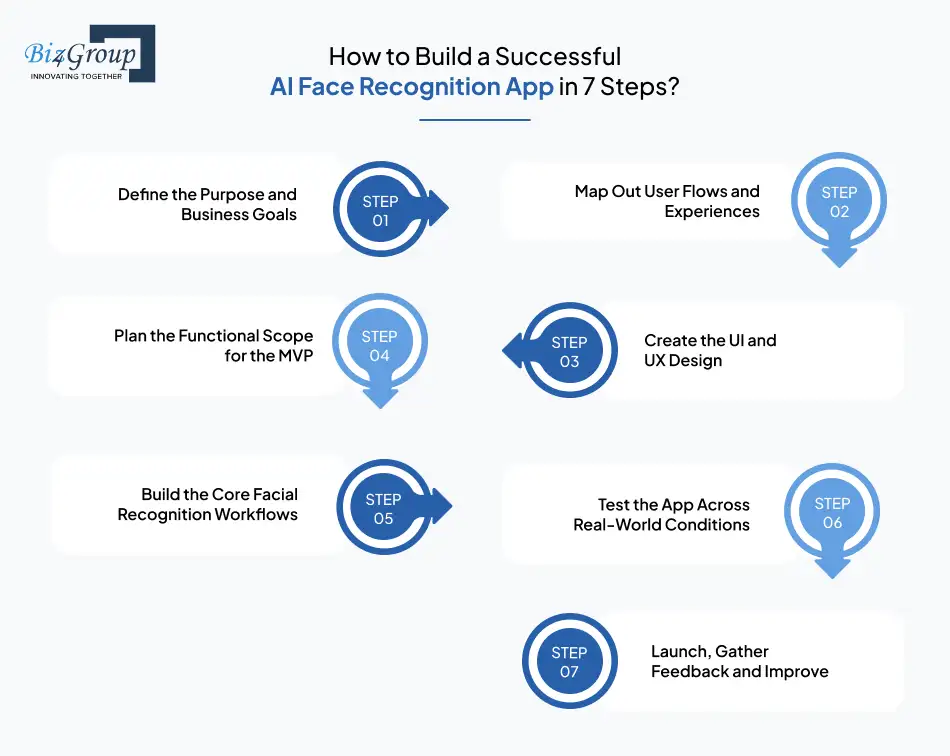
Creating an AI face recognition product becomes far more manageable when the journey is broken into steady, intentional steps. This approach helps teams stay focused, avoid unnecessary complexity and move confidently from a raw idea to a working solution.
Every strong project starts with clarity. This step helps identify who will use the app, what problem it will solve and where the face recognition workflow fits into daily operations.
Teams usually explore points like:
This step prevents unwanted features and keeps the project aligned with real business needs.
A well-structured user journey helps the product feel easy from the first interaction. This stage focuses on how people move through the system during verification, onboarding or access. You identify:
This gives the design team space to build clean and intuitive screens.
UI and UX design shape how the product feels. Good design makes the verification process smooth for both technical and non-technical users. An experienced UI/UX design company works on:
This step ensures that even a complex technology feels friendly to new users.
Also read: Top 15 UI/UX design companies in USA
Before building the full version, teams develop a minimum viable product. This keeps development focused on the essentials and helps validate real user behavior early.
An MVP usually includes:
Also read: Top 12+ MVP development companies in USA
This step focuses on the main identity processes. The development team integrates all recognition tasks into reliable business logic that supports fast and accurate matching. This includes:
Once these workflows are stable, the product starts taking shape.
Testing ensures that the product works consistently for different faces, lighting conditions and movements. Teams focus on:
Real users and beta testers help validate the user experience and spot friction points.
After finishing internal testing, the app goes live for the first group of users. Early feedback reveals what needs refinement. Businesses track:
Continuous updates keep the product fresh and useful while preparing it for future expansion.
A clear process keeps your project grounded, predictable and moving in the right direction. With the right flow in place, the path from idea to a working face recognition product becomes far more manageable and aligned with real business goals.
Most successful AI apps begin with a solid MVP. Yours could be live in as little as 2-3 weeks.
Contact Biz4Group NowEvery facial recognition product carries responsibilities that go beyond performance alone. Businesses handle sensitive biometric information, so they must approach this stage with care and clarity. A strong compliance plan builds trust, strengthens adoption and gives your product more credibility when scaling across industries.
Responsible practices protect both users and businesses. When companies follow these ethical and regulatory standards, they send a clear message that security and fairness matter as much as performance. This creates stronger trust and positions the product for wider adoption across regulated and enterprise-grade markets.
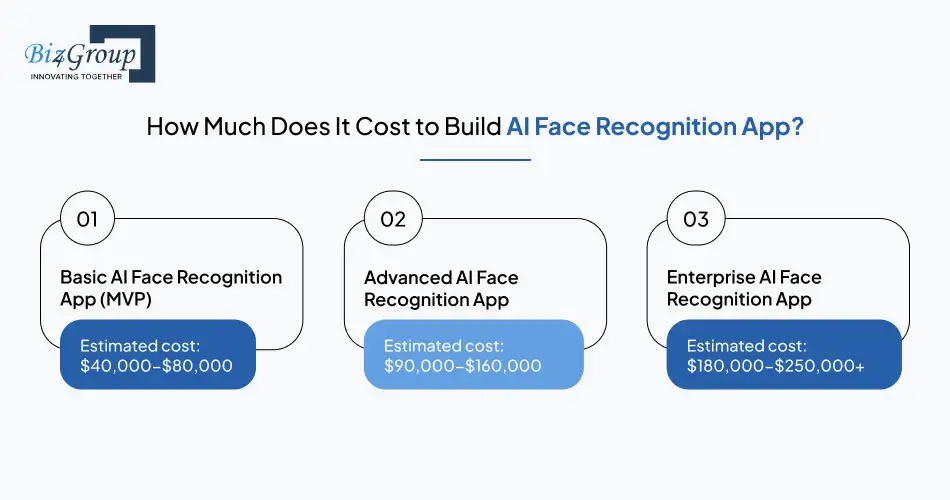
Developing a face recognition app is not just about “building a few screens and adding AI.” The real cost comes from the layers beneath, like dataset quality, multi-platform support, engineering hours, and performance expectations. Depending on how ambitious the product vision is, the investment generally sits between $40,000-$250,000+, covering everything from a lean MVP to a fully scaled enterprise ecosystem.
| Version | What It Includes | Approx Cost |
|---|---|---|
|
Basic AI Face Recognition App (MVP) |
Basic detection, core recognition module, simple UI, single platform |
$40,000-$80,000 |
|
Advanced AI Face Recognition App |
Multiple recognition modes, dashboards, analytics, multi-platform rollout |
$90,000-$160,000 |
|
Enterprise AI Face Recognition App |
Large-scale datasets, workflow automation, deep integrations |
$180,000-$250,000+ |
A structured breakdown helps teams map their budget to the features and performance standards they expect, ensuring the investment aligns with long-term product goals.
The total investment depends on several major components that directly influence development, training, and deployment time. Understanding these core cost drivers gives a clearer picture of where the budget goes and why certain choices significantly shift overall pricing.
| Cost Driver | How It Impacts Cost | Cost Influence Range |
|---|---|---|
|
Feature Complexity |
Every additional module increases engineering hours, real-time scanning or gesture recognition take longer to implement. |
+$5,000-$50,000 |
|
AI Model Training |
Training AI models and dataset size add to the time and cost. |
+$10,000-$60,000 |
|
Platform Count |
Expanding from one platform to a multi-platform rollout can multiply build effort. |
+$5,000-$40,000 per added platform |
|
Team Expertise |
Senior AI engineers and full stack developers speed up delivery but increase cost. |
+$20,000-$100,000 |
|
Third-Party APIs |
Using external services for recognition or monitoring incurs annual licensing fees. |
+$500-$5,000 a year |
|
Integrations |
Connecting the app with HR, CRM, ERP, or visitor management tools adds additional work. |
+$5,000-$40,000 |
|
Testing & Optimization |
Accuracy refinement across lighting, angles, and diverse skin tones takes specialized testing cycles. |
+$3,000-$20,000 |
These cost drivers collectively shape the development budget. The more refined and feature-heavy the app, the higher the investment.
Beyond predictable development tasks, AI-driven applications often bring follow-up costs that surface later in the product lifecycle. These hidden expenses are crucial to plan for, as they impact long-term stability.
Continuous dataset growth improves recognition accuracy across different lighting conditions, angles, and face variations. Costs typically range $2,000-$10,000 per cycle, depending on volume and labeling precision.
Real-time inference, video processing, or high-frequency lookups increase cloud GPU usage. Monthly cloud spend often ranges between $200-$2,000, depending on traffic and load.
Ongoing updates, bug fixes, UI improvements, and model retraining require dedicated hours. Most teams allocate 15%-25% of the total project cost annually.
Supporting higher user traffic, faster response times, or multi-region availability requires infrastructure upgrades. These updates can cost $5,000-$40,000 depending on performance needs.
After launch, teams often request more controls like filters, logs, workflow automations, or role-based access. These expansions typically cost $3,000-$25,000.
Hidden costs are natural parts of maintaining a reliable AI product. Planning ahead for these ensures smoother scaling, predictable budgets, and long-term accuracy across growing user bases.
Brands save up to 25% with proper planning. Get clarity.
Request a Custom QuoteBusinesses often reach a crossroads when they decide to develop an AI face recognition app. Both paths have strong advantages, and both come with trade-offs.
This table breaks down what each route offers so teams can evaluate the right fit for their goals, budgets, and timelines.
| Decision Factor | Build (Custom Development) | Buy (Ready-Made Solution) |
|---|---|---|
|
Control & Ownership |
Full code ownership, architecture control, tailored datasets, custom workflows. |
Limited control. Customizations depend on vendor flexibility. |
|
Accuracy Customization |
High-accuracy AI face recognition application through custom datasets, tuning, and continuous retraining. |
Pre-trained accuracy. Works well for common use cases but limited in niche or enterprise-specific needs. |
|
Scalability |
Designed to scale based on long-term plans. Easy to extend features across new business units. |
Dependent on vendor’s scaling capacity and pricing tiers. |
|
Security & Data Handling |
In-house control over data pipelines, storage, access rules, and compliance standards. |
Vendor-managed security. Sensitive data may leave your environment if not hosted on-prem. |
|
Integration Flexibility |
Seamless integration with CRM, HRMS, access control systems, and internal tools. |
Vendor APIs may limit integration depth. Custom integration often costs extra. |
|
Cost Structure |
Higher upfront cost with long-term savings through ownership. |
Lower upfront cost but ongoing subscription fees. |
|
Speed of Launch |
Longer timeline due to full cycle development of AI face recognition app components. |
Fastest go-live option. Ideal for pilot programs. |
|
Maintenance |
Continuous updates and retraining handled by your team or tech partner. |
Vendor handles updates, model enhancements, and new features. |
|
Compliance & Data Residency |
Custom implementation makes it easier to meet region-specific rules. |
Vendor may not support region-specific compliance requirements. |
|
Differentiation |
Strong competitive advantage through unique features and full control. |
Limited differentiation as features are shared across customers. |
Build When
Your business needs deep integrations, region-specific compliance, or a unique user experience.
This is ideal for enterprises, security platforms, access control systems, and consumer apps that need to stand out with a custom AI face recognition app.
Buy When
You want quick deployment, limited customization, predictable monthly costs, or a simple implementation.
This works well for early pilots, small teams, or organizations testing face recognition for the first time without large investments.
Hybrid When
You want speed and control together. Start with a ready-made solution for pilot use. Gradually transition to custom development as the product matures, accuracy demands increase, or integrations expand.
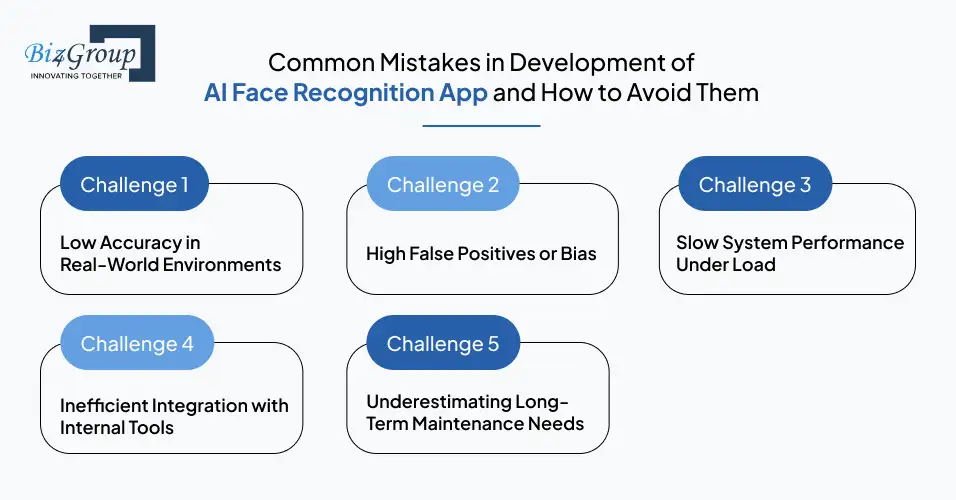 p>Every product journey brings its own set of obstacles, and facial recognition sits in a category that demands security and thoughtful planning. Below are the most common challenges businesses encounter when they develop an AI face recognition app, along with clear ways to navigate them.
Models may perform well in controlled test settings yet struggle with lighting changes, angles, or movement. This leads to mismatches, slow verification, and inconsistent results that impact user trust.
How to solve it:
Biometric systems can overfit to certain age groups, genders, or skin tones if the training data lacks variation. This leads to unfair results and operational risks.
How to solve it:
Real-time matching and verification can slow down when user traffic spikes. This affects onboarding experiences and physical access systems.
How to solve it:
If the solution does not connect smoothly with CRMs, HR systems, or access control hardware, teams lose time and repeat manual work.
How to solve it:
Facial recognition is not a build-once-and-leave product. Models age, data grows, and accuracy expectations rise.
How to solve it:
These challenges may feel heavy on paper, but they become manageable with the right strategy and strong engineering decisions. When teams anticipate these risks early, they build smoother products, protect user trust, and deliver systems that perform reliably in demanding real-world scenarios.
From bias reduction to real-time performance, we’ve solved these for 200+ products.
Talk to Our ExpertsThe face recognition industry continues to evolve as businesses adopt faster, smarter, and more adaptive systems. Below are the trends shaping the next generation of solutions and guiding how companies develop an AI face recognition app with long-term market relevance.
More systems are shifting from cloud-only processing to on-device inference. This reduces latency, improves privacy, and supports offline environments. It also helps businesses roll out face recognition tools in locations with unreliable internet, which expands real-world use cases.
Future applications will not rely on faces alone. They will combine voice, gait analysis, and behavioral patterns. This multi-layered approach strengthens verification and supports more sensitive environments like banking and healthcare.
Models are beginning to adjust in real time to lighting, angle, and user patterns. This lets products offer smoother verification for returning users. These adaptive capabilities also help businesses maintain accuracy without extensive retraining cycles.
Consumer apps are beginning to integrate advanced facial analytics for profile verification, fraud control, and personalized experiences. This opens new categories for startups that want to build AI face recognition app products for lifestyle, entertainment, and digital identity tools.
Liveness detection is evolving with camera depth sensing, skin texture analysis, and micro-movement tracking. These upgrades help systems stay ahead of presentation attacks and support industries with strict verification rules.
More companies are using federated learning to improve models without moving user data to centralized servers. This allows model upgrades while preserving privacy. It also reduces compliance friction across regions with strict data regulations.
These trends show how facial recognition is becoming faster, safer, and more adaptable across industries. Businesses that invest early in these advancements stay ahead of the curve and build products with longer market life. Forward-thinking strategies help ensure the app grows with technology rather than getting outdated within a few years.
Biz4Group LLC has earned a strong reputation in the USA as a software development partner trusted by enterprises, funded startups, and innovation teams. Our work reflects a clear philosophy. Build products that solve real business problems, scale with confidence, and deliver measurable outcomes. We help companies develop an AI face recognition app with secure architecture, modern design, and seamless performance in real-world environments.
Our teams specialize in advanced AI app development for face recognition, computer vision products, predictive systems, and enterprise AI solutions. We understand what it takes to bring transformational ideas to market. This includes shaping the product vision, refining the user experience, selecting the right AI frameworks, training and tuning models, and building frontend experiences that feel smooth and intuitive.
By combining innovation with clarity, we support both fast-moving startups and large organizations that want dependable engineering. Years of experience across identity management, access control, FinTech, eCommerce, and smart security give us a rich understanding of how facial recognition performs across different industries. This helps us build reliable products that stand strong even under heavy user loads and demanding compliance requirements.
Our clients rely on us not only for engineering excellence but for strategic guidance that helps them move faster with confidence. When businesses choose to work with us, they gain AI developers who are invested in results, not just deliverables.
If your organization wants to develop a high-accuracy AI face recognition application or build a complete digital ecosystem around it, our teams are ready to guide you from concept to launch.
Developing an AI face recognition app gives businesses a strong pathway to improve verification, optimize operations, and deliver faster user experiences across digital and physical environments. The growing demand across industries shows how quickly organizations are moving toward automated identity workflows and smart analytics that support long-term digital transformation.
As technology advances, the opportunity to innovate grows even stronger. Businesses can now take advantage of improved on-device recognition, multi-modal biometrics, and adaptive learning. These upgrades help create reliable systems that perform well in real-world scenarios.
Biz4Group LLC supports organizations through every stage of this journey. Our expertise in computer vision, scalable architecture, and AI engineering helps teams bring powerful ideas to life. Whether the goal is to launch an MVP, build a custom enterprise solution, or integrate facial analytics into an existing platform, we design solutions that deliver measurable impact and long-term growth.
Let’s create it together. Connect with Biz4Group LLC and bring your face recognition product to life with confidence.
AI face recognition apps today can reach 95–99% accuracy under ideal conditions. However, accuracy can vary based on lighting, camera quality, dataset diversity, and the model’s training methodology.
Yes, many advanced models use infrared imaging, noise-reduction algorithms, and enhanced contrast processing to recognize faces even in dim environments. But performance still may not match daylight accuracy.
Modern solutions use liveness detection, like blinking, depth sensing, micro-expressions, or 3D mapping, to prevent spoofing through photos or videos. This dramatically reduces risks of fake identity attacks.
Not always. Some apps support on-device recognition, which boosts privacy and speed. Others rely on cloud processing for more complex or large-scale matches. Hybrid models are becoming increasingly common.
Extremely scalable. Cloud-native systems can handle millions of face matches via API-based architectures. The performance depends on server load balancing, database optimization, and inference speed of the ML model.
Yes. Most solutions offer REST APIs, SDKs, and plug-ins that allow seamless integration with CRMs, access control systems, customer apps, and digital onboarding flows without requiring a full infrastructure overhaul.

with Biz4Group today!
Our website require some cookies to function properly. Read our privacy policy to know more.