Location :
Orlando, FL, USA
Location :
Orlando, FL, USA +1 (407) 714-1616
 info@biz4group.com


















Imagine a digital system that doesn’t wait for instructions but instead, understands your business goals, learns from real-time feedback, and takes independent actions to get the job done.
Read More
Voice has quietly become one of the most valuable data sources inside modern products. Customer calls, meetings, podcasts, clinical notes, interviews. They all hold insight, but only if machines can understand them at scale. That realization is pushing leaders to explore automatic speech recognition system development like Whisper AI, not as an experiment, but as a serious product capability. Beyond buzzwords and every custom software development company promise, the real questions start surfacing.
Here's what the market data has to say about it:
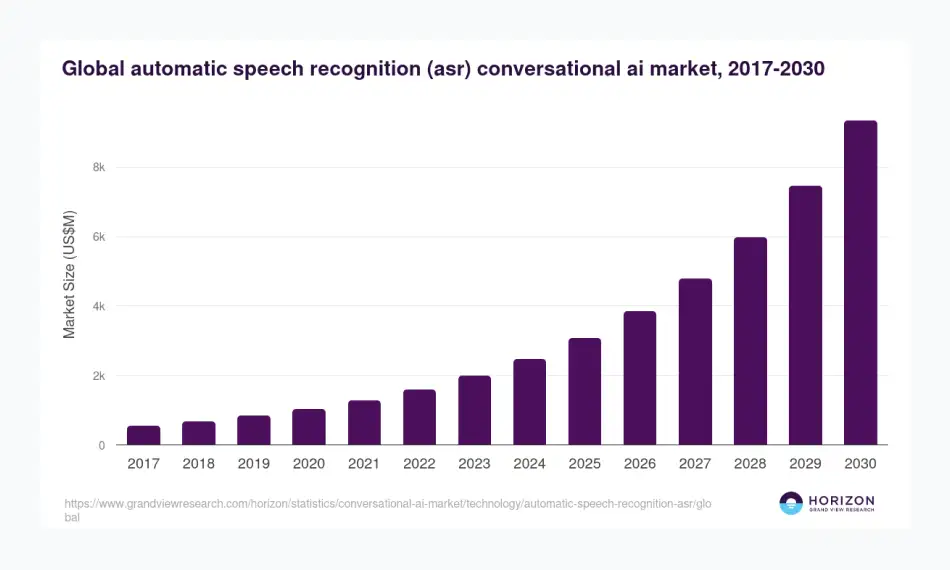
The global automatic speech recognition market is projected to cross USD 9.3 billion by 2030, growing at nearly 25 percent annually as enterprises operationalize voice data.
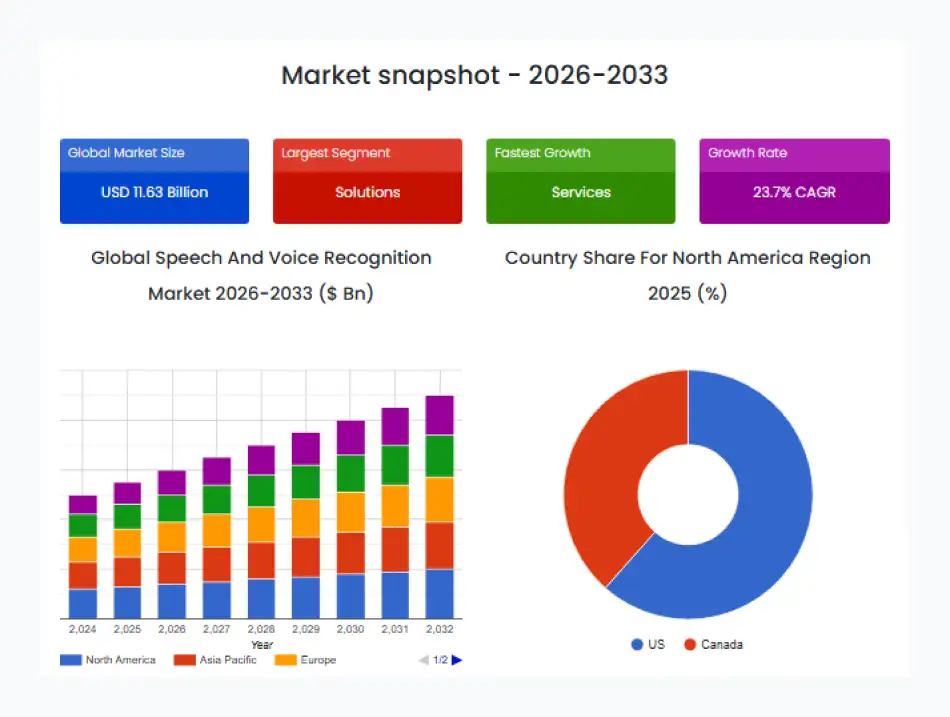
At the same time, the broader speech and voice recognition market is expected to approach USD 97.6 billion by 2033, driven by adoption across healthcare, customer experience, media, and enterprise platforms.
What makes this decision complex is that voice sits at the intersection of experience, infrastructure, and trust. Accuracy shapes adoption. Latency influences perception. Compliance defines architecture. One rushed decision can quietly turn into years of technical debt. This is exactly why teams looking to develop ASR systems like Whisper AI tend to slow down early and ask several questions before committing.
If you are evaluating automatic speech recognition software development, you are likely trying to build a speech recognition system with AI that aligns with real workflows, real users, and real scale. Understanding how organizations approach this journey is the first step toward turning voice from raw audio into a dependable business capability.
The questions are big, but they all trace back to one core idea. Everything becomes clearer once you understand what Whisper AI is and why so many teams model their ASR systems around it.
Whisper AI is an open-source speech recognition model built by OpenAI to convert spoken language into accurate, usable text across languages, accents, and environments. It has become a reference standard for teams exploring production-ready ASR systems.
Core Features of Whisper AI
Whisper AI gained traction because it works at scale. It moved speech recognition from lab-grade experiments to something teams could trust in real workflows, which is why it became a baseline for modern ASR platforms.
What Makes Whisper AI Widely Adopted
For teams evaluating automatic speech recognition system development like Whisper AI, these signals matter. They show what happens when accuracy, scale, and usability are treated as core product requirements, not optional upgrades.
Investing in automatic speech recognition system development like Whisper AI is about making voice usable at scale. When spoken input turns into reliable text, teams stop guessing and start building smarter workflows around real conversations.
Calls, meetings, and recordings already exist inside your business. ASR helps convert them into searchable text that teams can review, share, and analyze. This often starts when leaders decide to integrate AI into an app that already handles voice-heavy interactions.
ASR removes the need for people to manually transcribe or document conversations. Teams that build AI speech recognition platform like Whisper AI usually do it to save time in customer support, compliance reviews and internal reporting.
Voice is how users already communicate. ASR makes it easier to capture intent without forcing people to type everything. That is why it fits well within enterprise AI solutions focused on efficiency and clarity.
Owning your ASR system gives you control over accuracy, data handling and future changes. As needs evolve, teams can adjust models, workflows and integrations without waiting on third-party limitations.
For organizations looking to create automatic speech recognition solutions like Whisper AI, these benefits tend to show up early. And once voice data becomes reliable, the next step is figuring out where it can drive the most impact.
Explore how automatic speech recognition system development like Whisper AI can turn everyday conversations into structured, usable data.
Explore ASR Possibilities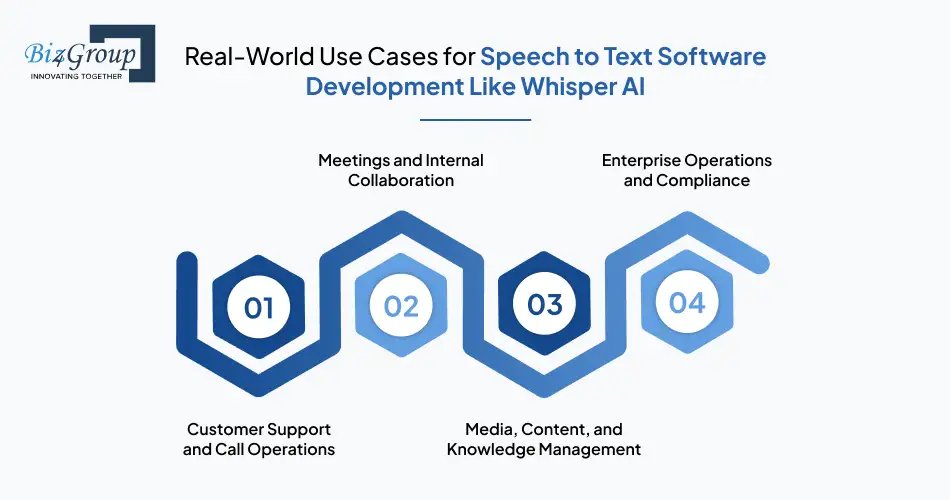
Most businesses already deal with voice every day. Calls, meetings, recordings, and interviews are everywhere. What changes with automatic speech recognition system development like Whisper AI is how easily that voice turns into usable information, which shows up clearly in the use cases below.
Support teams spend hours listening to calls for quality checks and issue tracking. Speech to text removes that manual effort by turning conversations into searchable transcripts that teams can review faster. This often supports broader AI integration services initiatives.
Notes are often incomplete or delayed. ASR captures conversations as they happen, making it easier for teams to stay aligned without extra follow-ups. Many teams explore this while working with AI consulting services on internal productivity tools.
Audio and video content is valuable, but hard to reuse without text. This is where teams start with speech to text software development like Whisper AI to speed up editing, indexing, and content reuse, often as part of broader business app development using AI efforts.
Industries with strict rules need records they can trust. ASR helps convert spoken interactions into structured text that supports audits and reviews. This is commonly delivered through custom ASR system development services built for specific compliance needs.
Quick Summary of ASR Use Cases
|
Area |
Why ASR Is Used |
Business Impact |
|---|---|---|
|
Customer Support |
Faster call reviews |
Better service quality |
|
Internal Meetings |
Automatic documentation |
Improved alignment |
|
Media and Content |
Faster content processing |
Higher reuse |
|
Compliance |
Reliable records |
Reduced risk |
For teams that build ASR application like Whisper AI for businesses, these use cases usually come first. As adoption grows, the focus naturally shifts toward the features needed to support accuracy, scale, and long-term reliability, which is where the next set of decisions begins.
Building a reliable ASR product is less about adding bells and whistles and more about getting the fundamentals right. Automatic speech recognition system development like Whisper AI works when core capabilities are strong enough to support real business usage at scale.
|
Core Feature |
Why It Is Foundational |
|---|---|
|
High Transcription Accuracy |
The system must consistently convert speech to text users can trust |
|
Multilingual Language Support |
Essential for products serving diverse or global audiences |
|
Real-Time Transcription |
Required for live calls, meetings, and interactive use cases |
|
Batch Audio Processing |
Necessary to handle recorded files at scale |
|
Noise and Accent Robustness |
Ensures usability across real-world audio conditions |
|
Scalable Processing Architecture |
Allows the system to grow without performance breakdowns |
|
Secure Data Handling |
Protects sensitive audio and transcript data by default |
|
Integration Readiness |
Enables the ASR engine to plug into existing platforms and workflows |
|
Deployment Flexibility |
Supports cloud, on-premise, or hybrid environments based on business needs |
These capabilities form the baseline teams rely on when they create voice recognition platforms with AI like Whisper AI. Once these foundations are stable, teams can safely layer on advanced functionality that supports automation, analytics, and experiences such as AI voice chatbot workflows, which is where the next phase of ASR development usually begins.
Once the basics work well, teams start adding features that make ASR more useful in daily operations. Automatic speech recognition system development like Whisper AI moves beyond transcription when systems help users understand and act on conversations.
Advanced ASR systems can tell who is speaking in a conversation. This makes transcripts easier to read and review. It is especially helpful for meetings, interviews, and support calls.
Standard models do not cover every use case. Many teams improve accuracy by adjusting models for specific terms and workflows through focused AI model development.
Knowing what was said is useful. Knowing how it was said is better. Adding AI sentiment analysis tools helps teams understand customer mood and urgency from transcripts.
Advanced systems include timestamps, speaker tags, and clean formatting. This makes transcripts easier to search and reuse across tools and reports.
ASR often supports features that respond in real time. This includes building experiences such as an AI voice chatbot assistant that listens and reacts instantly.
These capabilities are what separate basic transcription from Whisper AI like ASR system development built for real use. As teams grow confidence in their ASR foundation, the focus naturally shifts toward how these features are designed and implemented at scale.
From Theory to Practice: A Voice AI Platform in Action
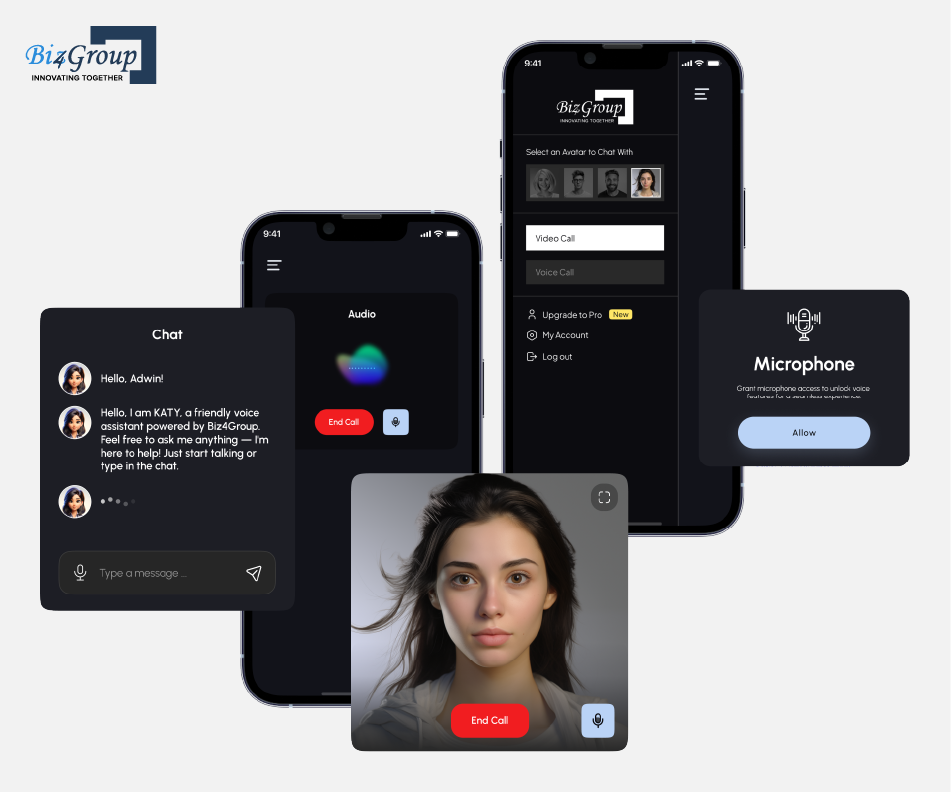
is an avatar based AI voice and video companion built by Biz4Group that enables real time conversations with emotional awareness and contextual understanding. It combines speech recognition, speaker handling, and natural dialogue flow to deliver human-like interactions across voice driven experiences. This directly aligns with how automatic speech recognition system development like Whisper AI moves from transcription to real engagement.
See how teams build AI speech recognition platform like Whisper AI that supports real workflows, not just text output.
See What ASR Can Enable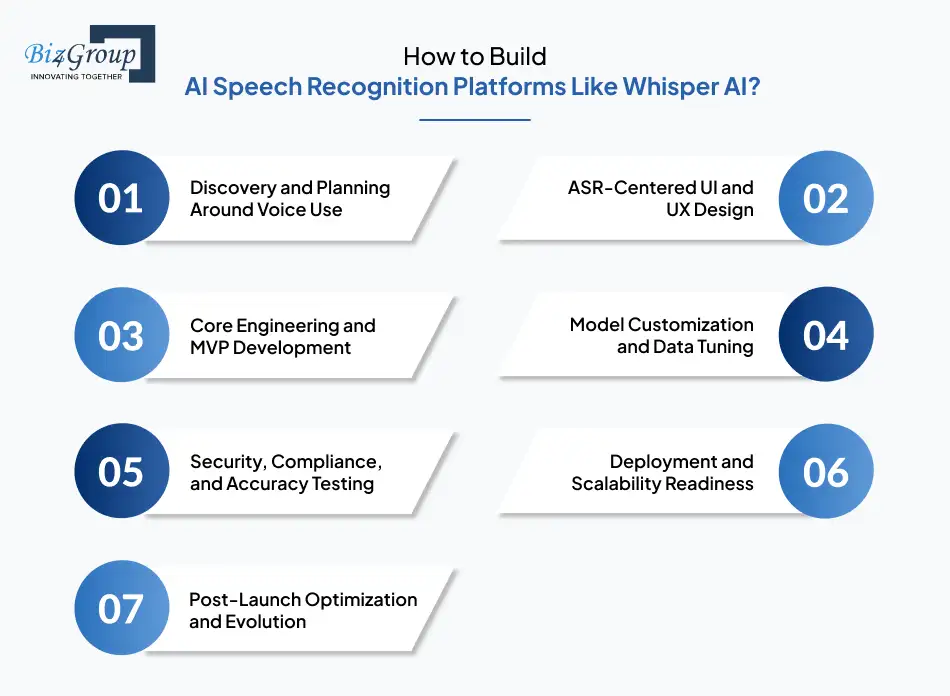
Building voice technology is not about rushing into models or frameworks. automatic speech recognition system development like Whisper AI works when teams first align on why they need ASR, how it will be used, and what success actually looks like in their business.
Most teams begin by stepping back and asking where voice fits into their operations. This is usually the phase where leaders explore how voice data can reduce manual work or unlock insights, long before asking how to develop an automatic speech recognition system like Whisper AI in technical terms.
Even accurate transcripts fall flat if users struggle to work with them. The experience with a seasoned UI/UX design company needs to feel simple and obvious, especially when teams are reviewing conversations at scale.
This is often where teams lean on custom ASR system development services to balance usability with technical constraints.
Also Read: Top 15 UI/UX Design Companies in USA: 2026 Guide
Rather than building a full platform upfront, most teams start small. MVP development services helps validate transcription quality using real audio, not ideal samples, and shows whether the system can hold up in daily use.
This stage is where teams learn whether ASR can realistically support workflows like customer call reviews or make ASR software for customer service automation without adding friction.
Also Read: Top 12+ MVP Development Companies to Launch Your Startup in 2026
Off-the-shelf accuracy rarely survives real environments. Accents, industry language, and speaking styles all affect results, which is why customization becomes unavoidable once usage grows.
This is also where timelines become clearer, especially when stakeholders ask how long does it take to build an ASR system that performs consistently.
Voice data often contains sensitive details. Security and testing are not optional steps but part of building trust in the system.
Also Read: 15+ Software Testing Companies in USA in 2026
ASR usage rarely grows slowly. One rollout can multiply usage overnight, so the system must scale without degrading accuracy or response time.
Once live, ASR systems start teaching you where they fall short. Continuous improvement is what turns a feature into a long-term capability.
With the process clear, teams often reach a practical decision point. Choosing the best company to develop automatic speech recognition systems becomes less about promises and more about who can support accuracy, scale, and evolution over time.
Get clarity on scope, timelines, and automatic speech recognition development cost estimate before committing to development.
Get a Build Readiness CheckBuilding an ASR platform means dealing with audio uploads, long transcription jobs, and clean output delivery. The stack below reflects what teams usually rely on when building Whisper-style systems that work reliably in real environments.
|
Label |
Preferred Technologies |
Why It Matters |
|---|---|---|
|
Frontend Framework |
ReactJS, Tailwind CSS |
Users need smooth transcript views and easy playback. Many teams choose ReactJS development to build responsive interfaces for reviewing audio and text together. |
|
Server-Side Rendering & SEO |
NextJS, Vercel |
Faster loads help when transcripts are large. NextJS development supports better performance and structure for ASR dashboards. |
|
Backend Framework |
NodeJS, Python |
ASR systems handle uploads, queues, and model calls. NodeJS development manages concurrent requests well, while Python development supports speech processing logic. |
|
API Development Layer |
REST APIs, GraphQL |
ASR systems rarely work alone. APIs allow transcripts, status updates, and exports to connect with other tools and products. |
|
AI & Data Processing |
PyTorch, ONNX |
These frameworks help run Whisper-style models efficiently at scale without adding unnecessary latency. |
|
Audio Processing |
FFmpeg, Librosa |
Clean audio improves transcription results. These tools normalize files before they reach the speech model. |
|
Background Jobs & Queues |
Redis, BullMQ |
Transcription takes time. Queues help process jobs without slowing down the user experience. |
|
Storage and File Management |
AWS S3, Cloud Storage |
Audio files and transcripts can be large. Scalable storage keeps everything accessible and organized. |
|
Security and Access Control |
OAuth, IAM |
Voice data can be sensitive. These layers control who can upload, access, and download transcripts. |
|
Monitoring & Observability |
Prometheus, Grafana |
Monitoring helps teams catch slowdowns or failures before users notice. |
Choosing the right stack reduces friction as the system grows. When done right, automatic speech recognition system development like Whisper AI becomes easier to scale, maintain, and evolve without constant rework.
The cost of building an ASR platform can vary widely based on scope and expectations. For most teams, automatic speech recognition system development like Whisper AI typically falls between USD 15,000 and USD 100,000 plus, which should be treated as a ballpark figure rather than a fixed quote.
|
Project Level |
Typical Cost Range |
What’s Usually Included |
|---|---|---|
|
MVP-level ASR System Like Whisper AI |
USD 15,000 to USD 30,000 |
Basic transcription, limited language support, simple UI, and core backend setup built during MVP software development phase. |
|
Mid-Level ASR System Like Whisper AI |
USD 30,000 to USD 60,000 |
Better accuracy tuning, scalable infrastructure, integrations, and improved transcript management |
|
Enterprise-grade ASR System Like Whisper AI |
USD 60,000 to USD 100,000 plus |
High accuracy customization, strong security, advanced processing, and production-ready scalability |
Several factors influence the final number. These include audio quality expectations, number of supported languages, real-time versus batch processing, and compliance needs. Teams also see cost differences based on whether they reuse existing models or invest in deeper customization. This is why most leaders look for an automatic speech recognition development cost estimate early, even before locking features.
Another cost driver is how quickly you want to move. Faster timelines often require larger teams or parallel development, which can increase spend. Some organizations also budget extra for experimentation, especially when building an AI agent POC before committing to full-scale rollout.
Once cost expectations are clear, the next logical question usually shifts from how much it costs to how the system can generate value over time and pay for itself in real use.
Avoid common pitfalls while you develop ASR systems like Whisper AI that scale smoothly and stay reliable over time.
Talk Through the Risks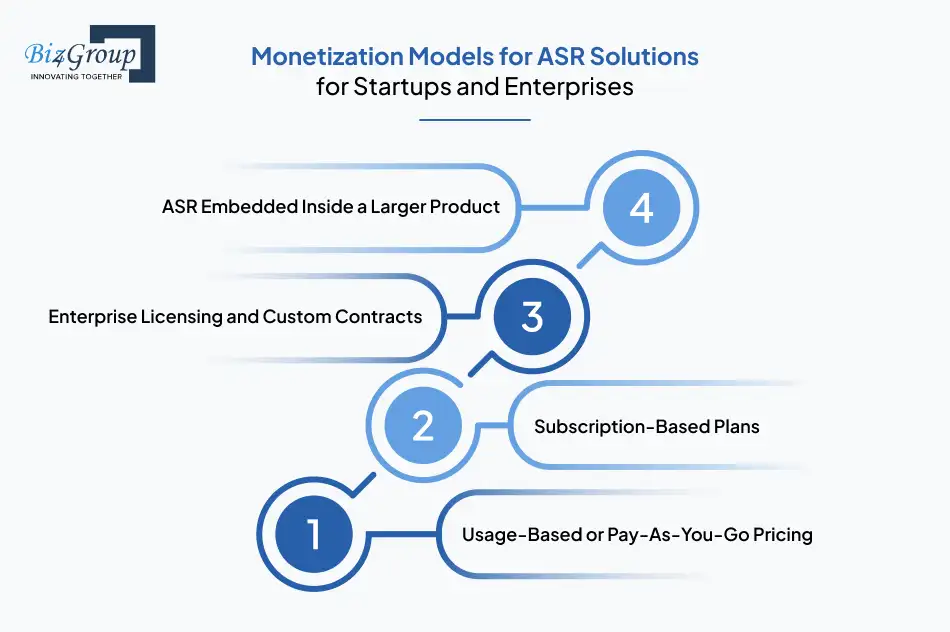
Once voice transcription is working well, the next step is figuring out how it generates revenue. Automatic speech recognition system development like Whisper AI supports different pricing models, depending on who uses the product and how often they rely on voice features.
This model is simple and flexible. Customers pay based on how much audio they process, which works well when usage changes from month to month. Many teams choose this while they develop ASR systems like Whisper AI for varied customer needs.
Subscriptions make sense when ASR becomes part of daily work. They give customers predictable costs and help providers plan revenue more easily, especially in tools designed around an AI conversation app.
Larger companies often prefer custom pricing with long-term agreements. These setups usually include dedicated infrastructure and support, especially when voice data feeds into internal systems.
Some teams do not sell ASR on its own. Instead, it improves another product, making it more useful and easier to retain customers. This approach is common for platforms built by an AI chatbot development company.
Over time, pricing becomes clearer as real usage patterns emerge. Teams working on automatic speech recognition software development often refine monetization once adoption grows and they decide whether to scale internally or hire AI developers to support expansion.
Getting ASR right is less about features and more about discipline. Automatic speech recognition system development like Whisper AI works when teams focus on how voice is actually used, not how it looks in demos. The practices below reflect what matters in real builds.
Do not try to solve every speech problem at once. Pick one primary use case such as calls or meetings and optimize for that. Teams that create automatic speech recognition solutions like Whisper AI see better results when they narrow focus early.
First, get clean and reliable text. Only then add analysis or automation layers. This separation keeps systems stable as usage grows in speech to text software development like Whisper AI projects and supports future generative AI agents cleanly.
Even strong models make mistakes. Build simple ways for users to review and correct transcripts instead of hiding errors. This is critical when you build ASR application like Whisper AI for businesses where trust matters.
Voice data often includes private or regulated information. Treat storage and access seriously from day one. This level of care is expected from a professional software development company in Florida working with enterprise teams.
ASR is not a one-time setup. Accents, language, and usage patterns change. Systems that support conversational AI agent workflows need regular tuning to stay accurate and useful.
Strong ASR systems are built with patience and clarity. Once these practices are in place, teams usually turn their attention to the challenges that show up when real users and real scale enter the picture.
Prepare now for AI speech processing software development like Whisper AI that fits future products, not past use cases.
Plan for Future-Ready ASRBuilding ASR is not complicated on paper. The real challenges appear once people start using it. Automatic speech recognition system development like Whisper AI brings a few common hurdles that teams need to plan for early:
|
Top Challenges |
How to Solve Them |
|---|---|
|
Accuracy Drops With Real Audio |
Train and test models using actual calls and recordings, not clean demo files. Real-world audio helps expose issues early. |
|
Accent and Language Differences |
Start with the most common accents and languages. Expand slowly as confidence and data improve. |
|
High Processing Costs |
Improve how audio is processed and batch jobs are handled. This keeps costs under control as you build AI software for larger usage. |
|
Slow Performance at Scale |
Use background queues and parallel processing so long files do not block the system during peak times. |
|
Data Privacy Concerns |
Add access controls and encryption from the start. These are often part of custom ASR system development services for enterprise use. |
|
Low User Trust in Results |
Make it easy for users to review and correct transcripts so they stay confident in the output. |
These challenges are manageable with the right approach. Once teams handle them well, the focus usually moves toward how ASR will evolve and what new capabilities may become possible next.
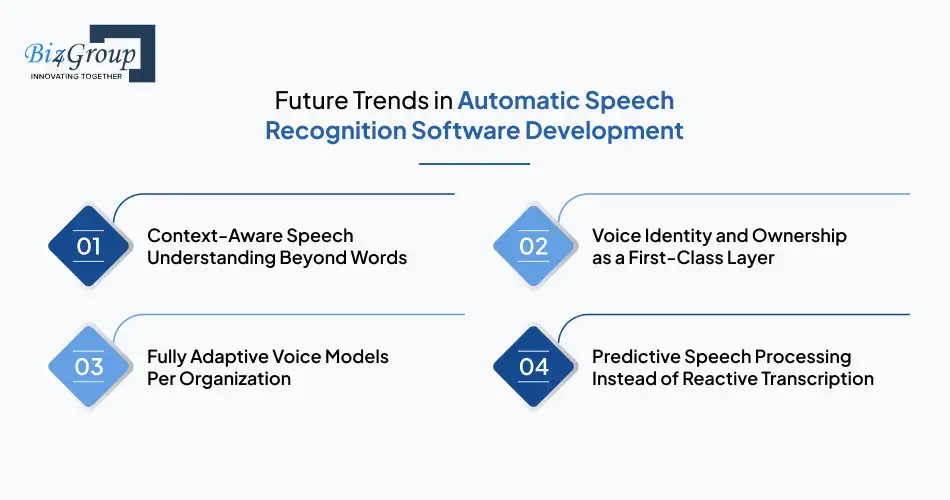
ASR is past the early adoption phase. What comes next is not wider usage, but deeper evolution. Automatic speech recognition system development like Whisper AI is moving toward capabilities that are not standard today, but are actively being explored for the next generation of voice systems.
Future ASR systems will not stop at transcription. They will understand conversation context across sessions, speakers, and time. This will allow teams to develop AI powered speech recognition software like Whisper AI that interprets meaning across entire workflows, not isolated audio files.
Future systems will treat voice identity as a controlled asset. This includes consent-based voice modeling and strict ownership rules around voice usage. Adjacent innovations like an AI voice cloning app will exist within tightly governed frameworks rather than open experimentation.
Instead of one model per product, ASR will adapt continuously to each organization. These systems will learn from internal language, acronyms, and speaking patterns automatically. This shift will redefine how teams create voice recognition platforms with AI like Whisper AI without manual retraining cycles.
ASR systems will begin anticipating outcomes rather than just recording speech via predictive analytics. This includes predicting follow-up actions, detecting escalation risks, or surfacing insights before conversations end. These capabilities will shape the next phase of AI speech processing software development like Whisper AI.
As these capabilities mature, ASR development will demand stronger governance, deeper expertise, and long-term thinking. Teams that partner early with experienced builders like the top AI development companies in Florida, will be better positioned to adopt these advances responsibly.
Automatic speech recognition system development like Whisper AI demands real-world thinking, especially when audio quality varies and users depend on accurate output every day.
Biz4Group has worked on AI voice platforms where speech is central to the experience, not an add-on. Projects like AI Wizard show how voice, context, and interaction come together in a production setting. That hands-on exposure shapes how we approach build ASR application like Whisper AI for businesses, with fewer assumptions and more practical decisions.
What working with Biz4Group feels like:
As an AI development company, Biz4Group works as a technical partner that understands what happens after launch. The focus stays on building ASR systems that continue to perform when real users, real data, and real expectations enter the picture.
Discuss how you can build ASR application like Whisper AI for businesses with the right balance of accuracy, cost, and scale.
Start the ASR ConversationBuilding ASR is all about making voice usable, reliable, and valuable in real situations. From planning and features to cost, monetization, and future readiness, automatic speech recognition system development like Whisper AI works best when every decision is grounded in actual use, not assumptions.
When ASR is treated as a long-term capability rather than a quick feature, it becomes easier to scale, easier to trust, and easier to evolve. That is where the right approach, the right expectations, and the right product development services make all the difference.
Explore how automatic speech recognition system development like Whisper AI fits your real-world use case. Get in touch!
Yes, it is possible to design ASR systems that run in private or restricted environments. Many teams exploring develop ASR systems like Whisper AI look at offline or private deployments to meet data control, latency, or compliance requirements.
Modern ASR platforms are designed to evolve after launch. With the right architecture, teams working on AI speech processing software development like Whisper AI can continuously improve accuracy, add languages, or adapt to new audio patterns over time.
Value often appears sooner than expected when ASR replaces manual effort. Teams that build ASR application like Whisper AI for businesses usually start seeing impact once transcripts are actively used in workflows, reviews, or reporting.
Yes, ASR can scale across company sizes when built correctly. Many ASR solutions for startups and enterprises begin small and expand gradually, adapting infrastructure, security, and features as usage grows.
Ongoing maintenance usually requires a mix of backend, data, and ML skills. Teams focused on automatic speech recognition software development often support internal teams with monitoring, retraining, and performance optimization as usage evolves.
Costs usually fall between USD 15,000 and USD 100,000 plus, depending on scope and scale. This automatic speech recognition development cost estimate varies based on features, accuracy needs, and deployment complexity rather than a fixed formula.

with Biz4Group today!
Our website require some cookies to function properly. Read our privacy policy to know more.