 Location :
Orlando, FL, USA
Location :
Orlando, FL, USA +1 (407) 714-1616
 info@biz4group.com

- Medical research generative AI chatbot development enables faster literature review, dataset exploration, and research insights through AI-powered conversational systems.
- Organizations adopt generative AI chatbot development for medical research to support clinical research workflows, knowledge access, and data analysis.
- Successful custom medical research AI chatbot development requires RAG architecture, domain-trained AI models, secure data pipelines, and integrations.
- The cost of medical research generative AI chatbot development for organizations typically ranges from $15,000 to $150,000+, depending on features and compliance needs.
- To develop enterprise grade generative AI chatbots for medical research teams, partnering with Biz4Group ensures secure and scalable solutions.
Are you feeling the pressure to keep your research teams productive without increasing budgets? You’re not alone. In 2025, 85% of healthcare organizations reported moderate or high ROI from integrating advanced AI tools into workflows.
At the same time, 22% of healthcare organizations have implemented domain-specific AI solutions, a sevenfold increase over the previous year.
The message is clear. AI adoption is accelerating. Research teams that rely only on manual processes will struggle to keep up.
If you’re leading R&D or innovation, you’re likely asking:
- How do we reduce literature review time?
- How do we analyze clinical data faster without hiring more staff?
- How do we develop generative AI chatbot for medical research that teams can trust?
This is where medical research generative AI chatbot development becomes essential.
When implemented correctly, generative AI chatbot development for medical research helps teams summarize studies, query datasets, and retrieve knowledge instantly. It also enables organizations to build AI chatbot solutions for medical research organizations that scale securely.
If you’re weighing internal capability versus external support, partnering with a specialized generative AI development company can reduce risk and speed up deployment.
The real question is simple.
How do you turn growing data volume into structured, reliable intelligence?
Let’s break down what medical research generative AI chatbot development really means and why it matters now.
What Is Medical Research Generative AI Chatbot Development and Why Is It Mission Critical Today?
Let’s define it clearly.
Medical research generative AI chatbot development is the process of building AI-powered conversational systems specifically designed to support medical and clinical research activities. These systems use large language models, domain-trained data, and secure integrations to help researchers analyze literature, explore datasets, and retrieve validated insights.
When you develop generative AI chatbot for medical research, you are creating a research assistant that can:
- Interpret complex medical terminology
- Summarize peer-reviewed studies
- Query structured and unstructured research data
- Provide responses grounded in trusted sources
- Operate within regulated healthcare environments
This is very different from a general-purpose chatbot. Generative AI chatbot development for medical research requires domain customization, compliance alignment, secure infrastructure, and integration with internal research systems.
Organizations that aim to create generative AI chatbot for healthcare research often work with a specialized AI healthcare software development company to ensure regulatory and technical standards are met.
Now, why is it mission critical today? Because research demands are increasing while resources remain limited.
Here’s why medical research generative AI chatbot development has become essential:
- Medical literature is expanding faster than teams can manually review
- Clinical trial data volumes are growing significantly
- HIPAA Compliance requirements demand traceable, auditable systems
- Time-to-insight directly impacts competitive advantage
- Scaling research output without scaling headcount is now a priority
For organizations planning medical research generative AI chatbot development for organizations, this is not about experimentation. It is about building structured intelligence that supports faster, compliant, and more efficient research operations.
Next, let’s look at where this creates measurable impact through real-world use cases.
Ready to Turn Research Overload into Instant Insights?
Your researchers should focus on discoveries, not endless document reviews. Let's build a smarter system through medical research generative AI chatbot development.
Contact Our AI ExpertsWhere Can You Create Real Impact? High-Value Use Cases for Generative AI Chatbot Development for Medical Research
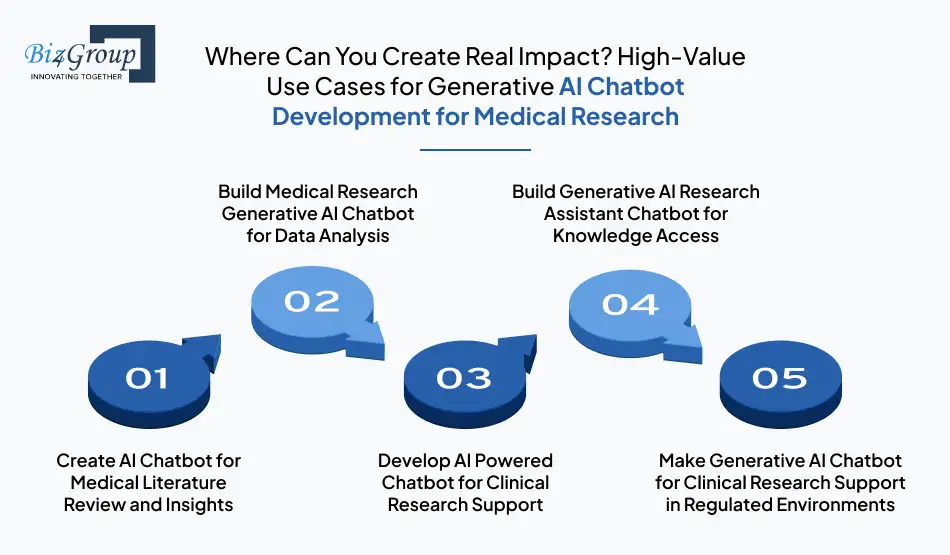
Once you invest in medical research generative AI chatbot development, the next question is practical - Where does it actually move the needle?
Below are the most impactful use cases where organizations are seeing measurable gains.
1. Create AI Chatbot for Medical Literature Review and Insights
Medical researchers spend hours reviewing journal articles, meta-analyses, and clinical findings. When you create AI chatbot for medical literature review and insights, you give teams the ability to ask direct research questions and receive summarized, source-backed responses in seconds. Instead of manually screening dozens of PDFs, researchers can extract key findings conversationally.
Benefits:
- Reduces literature review time significantly
- Surfaces relevant studies faster
- Provides structured summaries with citations
- Improves research decision speed
Many organizations extend this further by building a generative AI research intelligence platform that centralizes literature, internal data, and clinical documentation into a single intelligent interface.
2. Build Medical Research Generative AI Chatbot for Data Analysis
Clinical research produces massive datasets from trials, registries, and real-world evidence sources. When you build medical research generative AI chatbot for data analysis, researchers can query datasets in plain language instead of relying solely on technical query tools. This makes complex data more accessible to non-technical stakeholders.
Benefits:
- Enables conversational access to structured datasets
- Speeds up hypothesis validation
- Reduces dependency on data engineering teams
- Improves cross-functional collaboration
3. Develop AI Powered Chatbot for Clinical Research Support
Clinical research teams frequently need answers related to protocols, eligibility criteria, compliance documentation, and study timelines. When you develop AI powered chatbot for clinical research, you create an internal assistant that retrieves accurate, contextual information instantly. This reduces operational friction across research teams.
Benefits:
- Centralizes study-related knowledge
- Reduces internal back-and-forth communication
- Improves protocol clarity
- Supports faster trial execution
4. Build Generative AI Research Assistant Chatbot for Knowledge Access
Large organizations often struggle with fragmented knowledge across departments. When you build generative AI research assistant chatbot, you connect internal documents, research archives, and shared knowledge bases into a single conversational interface. This transforms static repositories into active intelligence systems.
Benefits:
- Improves knowledge discoverability
- Preserves institutional expertise
- Reduces repetitive questions
- Strengthens collaboration across teams
5. Make Generative AI Chatbot for Clinical Research Support in Regulated Environments
Compliance and traceability are non-negotiable in healthcare research. When organizations make generative AI chatbot for clinical research support, the system can retrieve regulatory documentation, maintain audit trails, and operate within secure access controls. This ensures innovation does not compromise governance.
Benefits:
- Enhances compliance readiness
- Maintains secure data handling
- Provides auditable interaction logs
- Reduces regulatory risk
For organizations investing in medical research generative AI chatbot development for organizations, these use cases are not theoretical. They represent real operational leverage.
To understand how medical research generative AI chatbot development works in practice, it helps to look at a real implementation.
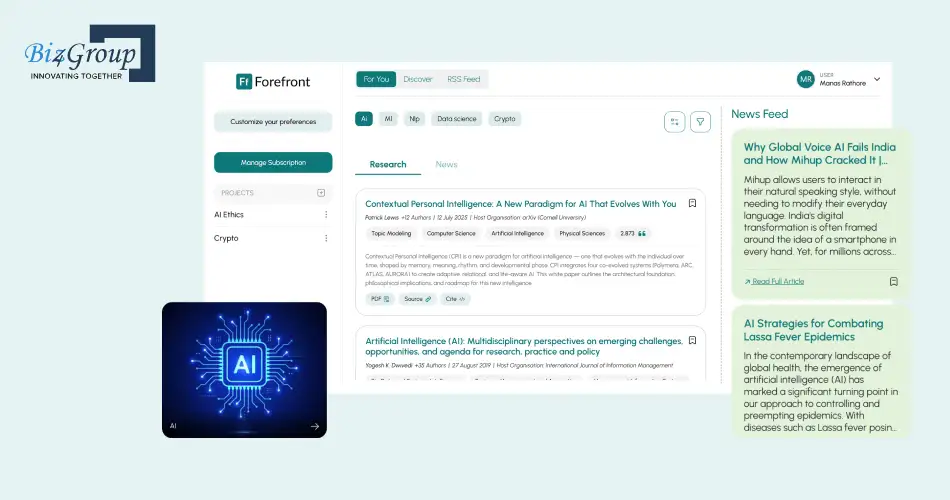
One strong example is Forefront AI Research Platform, a research intelligence platform developed by Biz4Group. The platform was designed to help researchers, students, and professionals manage the overwhelming volume of academic research and extract insights faster.
Researchers today face a common challenge. Thousands of new papers are published regularly, and staying updated across multiple sources becomes difficult. Forefront addresses this by bringing discovery, organization, and AI-powered research tools into one unified workspace.
The platform aggregates research content from more than 250 million academic papers and trusted research sources, delivering personalized updates and AI-assisted analysis tools in a single interface.
This type of system closely aligns with the goals of medical research generative AI chatbot development. Instead of manually scanning journals or switching between multiple tools, researchers can access insights, summaries, and organized research content in one place.
Key Features of the Forefront Platform
- Personalized research feeds that deliver relevant papers and academic updates based on user interests
- AI-powered research tools that allow users to analyze papers, chat with PDFs, and generate summaries
- Centralized research hub for saving, organizing, and managing research projects
- Access to massive academic datasets aggregated from trusted platforms like Semantic Scholar, OpenAlex, and Europe PMC
- Citation export tools that integrate with reference managers such as Zotero and Mendeley for streamlined research workflows
Platforms like Forefront demonstrate how generative AI chatbot development for medical research can evolve beyond simple Q&A systems. They become full research intelligence environments that help professionals discover knowledge, interpret findings, and manage research efficiently.
For organizations planning medical research generative AI chatbot development for organizations, solutions like this highlight what modern AI-driven research platforms can achieve when data aggregation, conversational AI, and research workflow tools are combined effectively.
Next, let’s examine the core features your chatbot must include to support these outcomes reliably.
What Core Features Should Every Custom Medical Research AI Chatbot Development Include?
If you are investing in medical research generative AI chatbot development, features are not optional add-ons. They define whether your system becomes a trusted research asset or just another tool your teams ignore.
When organizations pursue custom medical research AI chatbot development, these are the non-negotiable capabilities that must be built in from day one.
1. Domain-Specific Language Understanding
Medical research involves complex terminology, clinical language, and regulatory phrasing. Your chatbot must be trained or fine-tune LLM’s on biomedical datasets to accurately interpret context. Generic models often misinterpret nuanced medical terms. Strong domain grounding ensures researchers receive precise and relevant responses.
2. Retrieval-Augmented Generation Architecture
A reliable system should not rely solely on pre-trained knowledge. It must retrieve information from approved sources such as internal databases, clinical repositories, and peer-reviewed literature before generating responses. This approach reduces hallucinations and improves traceability, which is critical in generative AI chatbot development for medical research.
3. Secure Data Ingestion and Storage
Research data often includes sensitive clinical and proprietary information. Your chatbot must operate within encrypted environments with strict access controls. When organizations build secure generative AI chatbot system for healthcare research, secure pipelines, protected APIs, and controlled data access become foundational requirements.
4. Role-Based Access Control
Not every user should see every dataset. A strong access control framework ensures that researchers, compliance officers, and executives only access information aligned with their roles. This is essential when scaling medical research generative AI chatbot development for organizations across departments.
5. Audit Trails and Response Traceability
In regulated research environments, every output must be defensible. The chatbot should log interactions, track document sources, and maintain clear response histories. This feature supports compliance readiness and strengthens trust among research and regulatory teams.
6. Integration with Research Systems
Your chatbot cannot operate in isolation. It must connect seamlessly with clinical trial management systems, document repositories, EHR platforms, and analytics tools. Many organizations leverage specialized AI integration services to ensure their chatbot becomes part of a unified research ecosystem rather than a disconnected tool.
7. Explainability and Source Referencing
Researchers need to understand how conclusions are generated. The chatbot must cite references, link to source documents, and clarify reasoning when summarizing data. This builds credibility and reduces hesitation in adopting AI-driven workflows.
8. Scalable and Modular Architecture
As research initiatives expand, your system must scale without performance degradation. Modular architecture allows you to upgrade models, integrate new datasets, and support additional teams without rebuilding the platform from scratch. This ensures long-term sustainability of your medical research generative AI chatbot development strategy.
Without these core features, even the most advanced interface will struggle to deliver consistent value.
Now, let’s explore the advanced capabilities that separate basic research chatbots from enterprise-grade systems.
What Advanced AI Capabilities Turn a Research Chatbot into an Enterprise-Grade System?
Once the foundational features are in place, the next step is adding intelligence layers that elevate the system from a helpful tool to a true research co-pilot. Organizations that develop enterprise grade generative AI chatbots for medical research teams focus heavily on advanced AI capabilities. These features expand the chatbot’s ability to reason over data, automate workflows, and support complex research environments.
Below are the advanced capabilities commonly included in medical research generative AI chatbot development initiatives.
|
Advanced Feature |
What It Does |
Why It Matters for Medical Research |
|---|---|---|
|
Multimodal Data Processing |
Enables the chatbot to analyze multiple data formats including PDFs, research papers, tables, clinical datasets, and images. |
Researchers can interact with diverse medical data sources through a single conversational interface. |
|
AI Agents for Autonomous Research Tasks |
Uses specialized AI agents that can retrieve documents, run queries, summarize findings, and deliver insights automatically. Organizations increasingly incorporate AI agent frameworks to enable these autonomous capabilities. |
Reduces manual research workload and automates repetitive investigation tasks. |
|
Agentic AI Workflow Orchestration |
Advanced systems leverage agentic AI development to coordinate multiple AI agents that collaborate on tasks such as literature search, data extraction, and insight generation. |
Enables complex research workflows to run with minimal human intervention. |
|
Predictive Insight Generation |
AI models analyze historical datasets and research findings to identify patterns and generate hypotheses. |
Helps researchers explore potential correlations and accelerate early-stage discovery. |
|
Automated Research Summarization |
The system can automatically summarize long research papers, clinical trial results, or internal documentation. |
Saves hours of manual reading and helps teams quickly understand key findings. |
|
Conversational Data Exploration |
Researchers can query clinical datasets or research repositories using natural language. |
Makes complex data accessible even to non-technical researchers. |
|
Cross-System Intelligence Integration |
Chatbots integrate with EHR systems, research databases, document management tools, and analytics platforms using advanced AI integration services. |
Ensures the chatbot becomes part of the research ecosystem rather than a standalone tool. |
|
Intelligent Workflow Automation |
Research activities such as document classification, tagging, and data extraction can be automated through AI automation services. |
Reduces administrative workload and improves operational efficiency. |
|
Scalable Enterprise Infrastructure |
Advanced systems are built as enterprise AI solutions capable of supporting multiple research teams and massive datasets securely. |
Ensures long-term scalability and reliability for research organizations. |
When organizations create medical research chatbot platforms using generative AI, these advanced capabilities determine whether the system simply answers questions or actively supports research workflows.
Next, we will walk through the step-by-step process to develop a generative AI chatbot for medical research, covering everything from planning to deployment.
Thinking About Building a Smarter Research Assistant?
The right features can turn a simple chatbot into a powerful research co-pilot. Let's design a system tailored for your medical research workflows.
Talk to Our AI TeamHow to Develop a Generative AI Chatbot for Medical Research: Step-by-Step Execution Framework
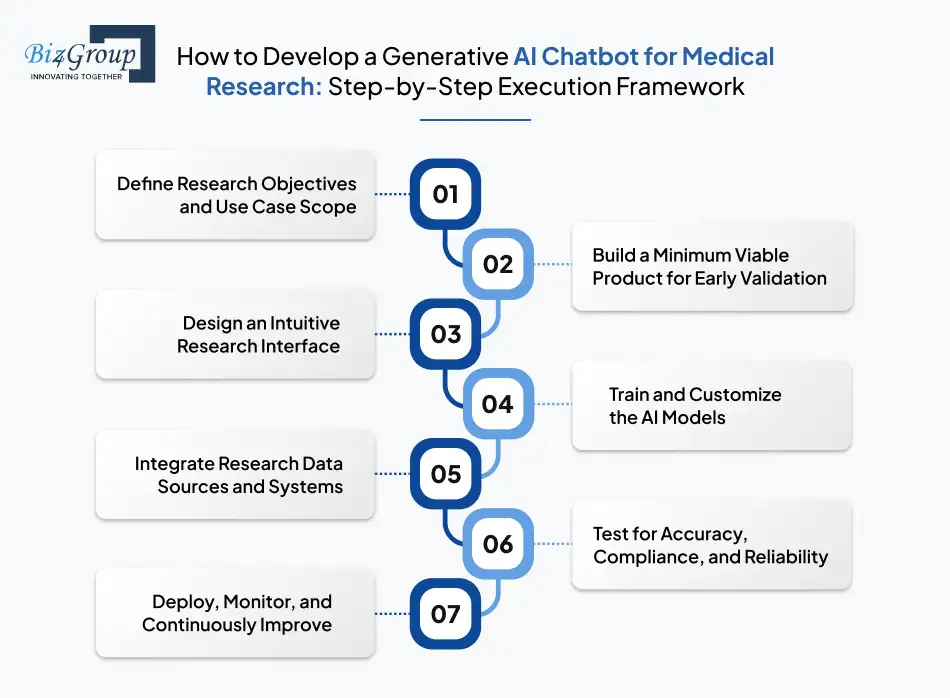
Building a reliable system for medical research generative AI chatbot development requires a structured approach. Research environments are data-heavy, highly regulated, and complex. That means every stage must be carefully planned when organizations develop generative AI chatbot for medical research.
Below is a practical framework organizations follow when planning generative AI chatbot application development for healthcare research.
1. Define Research Objectives and Use Case Scope
Every successful medical research generative AI chatbot development project begins with clear goals. Before writing code, you need to identify what problem the system will solve. This could involve literature analysis, dataset exploration, clinical trial support, or knowledge retrieval. Defining the scope early helps organizations build AI chatbot solutions for medical research organizations that align with real research workflows.
Key focus areas:
- Identify the research problems the chatbot will address
- Define user groups such as scientists, analysts, and research coordinators
- Map the datasets and medical literature sources required
- Align chatbot capabilities with organizational research objectives
2. Build a Minimum Viable Product for Early Validation
Instead of building a full-scale system immediately, many teams start with a prototype. This early version allows organizations to test the concept before investing heavily in development. A structured MVP development approach helps validate how well the system performs in real research environments.
Key focus areas:
- Develop core chatbot functionality for research queries
- Integrate a limited dataset for testing
- Conduct pilot testing with selected research teams
- Refine capabilities based on user feedback
3. Design an Intuitive Research Interface
Researchers need a system that feels natural and easy to use. If interaction becomes complicated, adoption drops quickly. This is why conversational design and usability play a crucial role in custom medical research AI chatbot development. Working with experienced UI/UX design specialists ensures the chatbot interface supports real research workflows.
Key focus areas:
- Design conversational interfaces for complex research queries
- Ensure easy navigation across research documents and datasets
- Display references and supporting evidence clearly
- Optimize usability for research teams
4. Train and Customize the AI Models
Generic AI models rarely perform well in specialized domains. During this stage, the chatbot is trained using biomedical datasets, clinical trial documentation, and scientific literature. This customization is essential when organizations create generative AI chatbot for healthcare research that can understand medical terminology and context.
Key focus areas:
- Fine-tune models using medical and clinical research data
- Implement retrieval systems connected to verified sources
- Train the system on internal research documentation
- Establish evaluation frameworks to test response accuracy
5. Integrate Research Data Sources and Systems
The chatbot becomes significantly more powerful once it connects to existing research systems. Integration allows researchers to access multiple datasets and knowledge repositories through one interface. This stage is crucial when organizations create medical research chatbot platforms using generative AI that support multiple departments.
Key focus areas:
- Connect research databases and document repositories
- Integrate clinical trial management platforms
- Enable secure API connections with internal tools
- Ensure encrypted data pipelines for sensitive research data
6. Test for Accuracy, Compliance, and Reliability
Medical research systems must meet strict accuracy and compliance standards. Before deployment, the chatbot must go through extensive validation to ensure safe and reliable outputs. This stage is especially important when organizations develop compliant generative AI chatbots for medical research.
Key focus areas:
- Validate responses using trusted medical sources
- Conduct regulatory and security assessments
- Evaluate hallucination risks and model bias
- Test usability with real research teams
7. Deploy, Monitor, and Continuously Improve
After validation, the chatbot can be deployed within the research environment. However, deployment is only the beginning. Continuous monitoring and improvement ensure the system remains accurate and useful. Organizations that develop enterprise grade generative AI chatbots for medical research teams treat their systems as evolving platforms rather than static tools.
Key focus areas:
- Monitor system performance and research adoption
- Continuously update models with new research datasets
- Improve functionality based on user feedback
- Expand capabilities to support additional research workflows
Following this development framework allows organizations to successfully build a secure generative AI chatbot system for healthcare research while minimizing risk and ensuring long-term scalability.
Next, we will explore the technology stack required to build generative AI chatbot solutions for medical research organizations.
What Technology Stack Powers Medical Research Generative AI Chatbot Development?
Successful medical research generative AI chatbot development depends on a layered technology architecture. Each layer handles a specific responsibility, from user interaction to AI processing and secure data management. Organizations that build AI chatbot solutions for medical research organizations typically combine modern AI frameworks, cloud infrastructure, and scalable application architecture to support AI chatbot software development for medical research.
Below is a complete technology stack commonly used to create medical research chatbot platforms using generative AI.
|
Technology Layer |
Tools & Technologies |
Role in Medical Research Chatbot Development |
|---|---|---|
|
Frontend Interface |
React, Next.js, Vue.js, Flutter |
The frontend allows researchers to interact with the chatbot through dashboards, chat interfaces, and document viewers. Strong UI design ensures scientists can query research data easily. |
|
Backend Application Layer |
The backend manages chatbot logic, API requests, authentication, and interaction between AI models and research data sources. |
|
|
Conversational AI Engine |
LangChain, LlamaIndex, Semantic Kernel |
These frameworks orchestrate prompt management, conversation flow, and context handling in generative AI chatbot application development for healthcare research. |
|
AI Models / LLMs |
GPT models, Llama, Claude, BioGPT, Med-PaLM |
These models power natural language understanding and generation in medical research generative AI chatbot development. |
|
NLP Processing |
SpaCy, Hugging Face Transformers, NLTK |
NLP frameworks help interpret medical terminology, scientific language, and research questions. |
|
Vector Databases |
Pinecone, Weaviate, Chroma, FAISS |
Vector databases store document embeddings and enable semantic search across research literature. |
|
Retrieval-Augmented Generation (RAG) |
LangChain RAG pipelines, LlamaIndex retrieval modules |
RAG allows the chatbot to retrieve verified research documents before generating answers, improving reliability. |
|
Data Storage |
PostgreSQL, MongoDB, Elasticsearch |
Stores research datasets, clinical records, internal documentation, and metadata. |
|
Cloud Infrastructure |
AWS, Azure, Google Cloud |
Cloud platforms provide scalable computing power and storage for enterprise-level medical research generative AI chatbot development for organizations. |
|
Integration Layer |
REST APIs, GraphQL, FHIR APIs combined with AI integration services |
Enables the chatbot to connect with clinical systems, research databases, and enterprise platforms. |
|
Workflow Automation |
Data ingestion pipelines and AI automation |
Automates document ingestion, indexing, research summarization, and knowledge updates. |
|
Security & Compliance |
IAM tools, encryption protocols, audit logging systems |
Ensures organizations can build secure generative AI chatbot system for healthcare research while maintaining compliance requirements. |
|
Custom Development Layer |
Python microservices and scalable custom software architecture |
Allows organizations to tailor the chatbot to their research workflows and internal infrastructure. |
For organizations planning medical research generative AI chatbot development for organizations, choosing the right stack ensures scalability, security, and long-term maintainability.
Next, let’s break down the cost of building a generative AI chatbot for medical research and what factors influence the investment.
What Does Medical Research Generative AI Chatbot Development Cost?
Before organizations begin medical research generative AI chatbot development, one of the first questions leadership teams ask is simple. What will it cost?
The short answer is that the cost can vary significantly depending on scope, features, integrations, and compliance requirements. In most cases, the investment to develop generative AI chatbot for medical research typically ranges between $15,000 and $150,000+.
Smaller pilot projects or prototypes fall toward the lower end of this range. Enterprise platforms designed to build AI chatbot solutions for medical research organizations with advanced capabilities, integrations, and compliance infrastructure can move well beyond that.
If you want a deeper breakdown of pricing structures, this guide on AI medical chatbot development cost explains how healthcare AI projects are typically priced.
Now let’s break down what actually drives the cost.
Feature-Based Cost Breakdown in Medical Research Generative AI Chatbot Development
The largest cost driver in generative AI chatbot application development for healthcare research is the set of features you plan to implement. Each feature adds development complexity, infrastructure requirements, and testing effort.
|
Feature Category |
Description |
Estimated Cost Range |
|---|---|---|
|
Core chatbot functionality that answers research questions using trained models. Includes basic prompt handling and response generation. |
$15,000 – $25,000 |
|
|
Medical Literature Summarization |
Ability to summarize journal articles, clinical papers, and research documentation. |
$10,000 – $20,000 |
|
Research Dataset Querying |
Conversational data analysis capability that allows researchers to query structured datasets. |
$15,000 – $30,000 |
|
Retrieval-Augmented Generation (RAG) |
Integration with research databases and document repositories to retrieve verified sources before generating answers. |
$15,000 – $25,000 |
|
Clinical Research Support Tools |
Protocol lookup, eligibility query handling, and clinical trial knowledge retrieval features. |
$10,000 – $20,000 |
|
Multimodal Research Processing |
Ability to analyze PDFs, datasets, tables, and research documents. |
$10,000 – $25,000 |
|
Secure Infrastructure and Compliance |
Encryption, audit logs, and secure access systems required to build a secure generative AI chatbot system for healthcare research. |
$10,000 – $30,000 |
|
Enterprise Integrations |
Integration with EHRs, research databases, document repositories, and analytics platforms. |
$10,000 – $25,000 |
For organizations planning medical research generative AI chatbot development for organizations, the final cost usually depends on how many of these capabilities are included.
Factors Affecting the Cost of Medical Research Generative AI Chatbot Development
Several factors influence the total investment when organizations develop enterprise grade generative AI chatbots for medical research teams.
Key cost drivers include:
- Scope and complexity of chatbot features
- Volume and type of research data integrated into the system
- Custom AI model training and fine-tuning requirements
- Number of integrations with existing research systems
- Security and regulatory compliance requirements
- UI complexity and conversational experience design
- Scalability requirements for large research teams
The more advanced the functionality, the higher the development cost.
Hidden Costs in Generative AI Chatbot Development for Medical Research
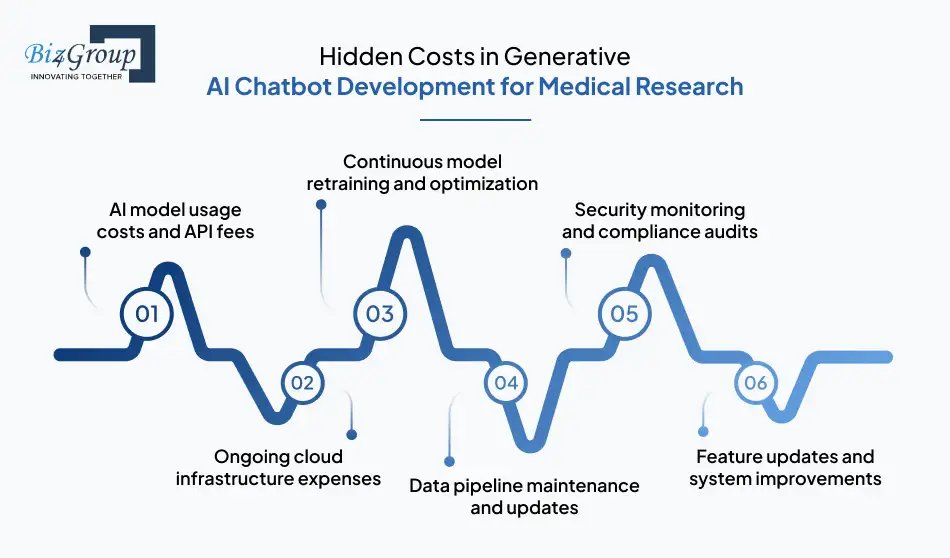
Many organizations underestimate long-term expenses associated with generative AI chatbot development for medical research. Development is only one part of the total cost.
Common hidden costs include:
- AI model usage costs and API fees
- Ongoing cloud infrastructure expenses
- Continuous model retraining and optimization
- Data pipeline maintenance and updates
- Security monitoring and compliance audits
- Feature updates and system improvements
Planning for these costs early helps prevent budget overruns.
Cost Optimization Strategies for Medical Research Generative AI Chatbot Development
The good news is that organizations can significantly reduce development costs while still building powerful systems.
Teams that strategically approach medical research generative AI chatbot development often apply the following strategies:
- Start with a custom MVP to validate research use cases
- Use pre-trained AI models instead of building from scratch
- Prioritize high-impact features first
- Implement modular architecture for gradual expansion
- Use cloud infrastructure to scale resources as needed
This approach allows organizations to develop compliant generative AI chatbots for medical research while keeping budgets under control.
Understanding the cost structure helps decision-makers plan realistic budgets and investment timelines.
Next, let’s examine the biggest challenges organizations face in medical research generative AI chatbot development and how to solve them effectively.
Wondering What Your AI Research Assistant Might Cost?
Every project is different, but the right architecture can control costs while maximizing impact. Let's estimate your medical research generative AI chatbot development investment.
Get a Cost EstimateWhat Challenges Do Organizations Face in Medical Research Generative AI Chatbot Development and How Can You Solve Them?
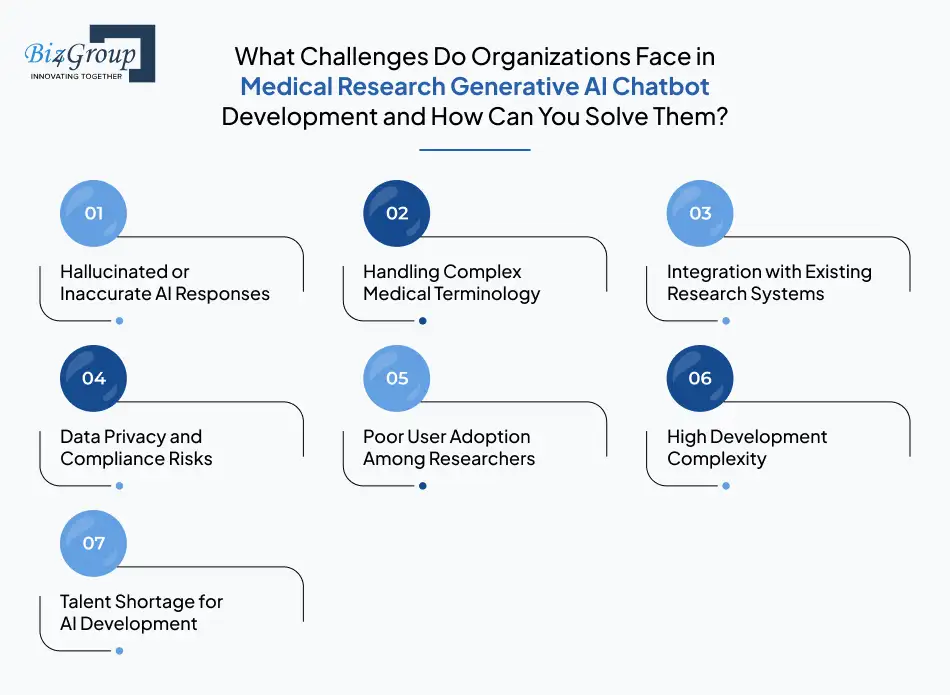
While the benefits of medical research generative AI chatbot development are significant, implementation is not without obstacles. Healthcare research environments are complex, regulated, and data-intensive. Organizations that plan to develop generative AI chatbot for medical research must address several technical, operational, and compliance challenges.
The good news is that most of these challenges can be mitigated with the right development strategy, infrastructure planning, and expert guidance.
Below are the most common challenges in generative AI chatbot development for medical research and practical ways to solve them.
|
Challenge |
Why It Happens |
How to Solve It |
|---|---|---|
|
Hallucinated or Inaccurate AI Responses |
Generative AI models sometimes produce confident but incorrect outputs when they rely solely on training data without verified sources. |
Implement retrieval-augmented generation (RAG) so the chatbot pulls information from trusted research databases before generating responses. Add validation layers and source citations. |
|
Handling Complex Medical Terminology |
Generic AI models are not trained deeply on biomedical language, which can cause misunderstanding of research questions. |
Use domain-specific model fine-tuning and curated medical datasets. This is essential in custom medical research AI chatbot development to ensure scientific accuracy. |
|
Integration with Existing Research Systems |
Research environments often use multiple disconnected systems such as clinical trial platforms, document repositories, and analytics tools. |
Build strong API architecture and system integrations. Many organizations rely on experienced AI chatbot development company partners to connect AI platforms with existing infrastructure. |
|
Data Privacy and Compliance Risks |
Medical research often involves sensitive patient data and proprietary research findings. Improper AI implementation can create compliance risks. |
Implement encrypted data pipelines, strict access control, and detailed audit trails when you build a secure generative AI chatbot system for healthcare research. |
|
Poor User Adoption Among Researchers |
Researchers may hesitate to trust AI tools if outputs lack transparency or if the interface is difficult to use. |
Focus on explainability, source referencing, and intuitive interaction design. Training sessions and pilot programs can also improve adoption. |
|
High Development Complexity |
Building enterprise-level systems that support large datasets, AI models, and research integrations requires significant technical expertise. |
Organizations often collaborate with an experienced AI development company that understands both healthcare regulations and AI architecture. |
|
Talent Shortage for AI Development |
Specialized AI engineers, data scientists, and healthcare technologists are in high demand and difficult to recruit. |
Many companies address this challenge by choosing to hire AI developers with healthcare AI experience who can accelerate development timelines. |
For organizations pursuing medical research generative AI chatbot development for organizations, understanding these challenges early allows you to design systems that are scalable, compliant, and reliable.
With the right architecture, expertise, and governance framework, these obstacles become manageable and the benefits of generative AI chatbot application development for healthcare research can be realized at scale.
Start Your Medical Research Generative AI Chatbot Development with Biz4Group LLC
If you are planning medical research generative AI chatbot development, the right development partner can make a major difference in how quickly and successfully your system goes live.
At Biz4Group LLC, we help organizations build AI chatbot solutions for medical research organizations that are secure, scalable, and tailored for regulated healthcare environments. Our team combines AI expertise, healthcare domain knowledge, and enterprise-grade engineering to deliver reliable research intelligence systems.
One example is Forefront, an AI-powered research intelligence platform developed by Biz4Group. The platform enables researchers to explore academic literature, organize research findings, and interact with scientific content using conversational AI. Solutions like Forefront demonstrate how generative AI chatbot development for medical research can transform large volumes of research data into accessible insights.
Whether you want to build a research assistant, automate literature analysis, or launch a full research intelligence platform, our team can help you turn the idea into a scalable AI product.
As an experienced AI chatbot development company, we design systems that integrate seamlessly with research databases, clinical tools, and enterprise infrastructure. Our team also specializes in building scalable AI product solutions that evolve as your research needs grow.
If you're ready to accelerate innovation, Biz4Group can help you bring your medical research generative AI chatbot development vision to life.
Ready to Build an AI Research Platform That Actually Delivers?
Our team has already built platforms like Forefront that transform research workflows. Let's create your next-generation AI research assistant.
Contact UsWrapping Up!
The future of research will belong to organizations that can turn massive volumes of scientific data into actionable intelligence. That is exactly what medical research generative AI chatbot development enables. From accelerating literature review to enabling conversational data analysis, these systems help researchers move faster without compromising accuracy or compliance.
When organizations invest in generative AI chatbot development for medical research, they are not just deploying another tool. They are building intelligent infrastructure that supports discovery, improves collaboration, and unlocks faster insights across research teams.
At Biz4Group, we specialize in designing scalable AI systems that work in real-world healthcare environments. As one of the top AI chatbot development companies for healthcare in USA, we help organizations build secure, enterprise-grade AI solutions tailored for research and innovation.
Ready to turn research complexity into intelligent discovery.
FAQ
1. What is medical research generative AI chatbot development?
Medical research generative AI chatbot development involves building AI-powered conversational systems that help researchers analyze scientific literature, explore datasets, and retrieve research insights quickly. These systems use large language models, retrieval systems, and biomedical datasets to generate contextual responses grounded in verified sources. Many organizations develop generative AI chatbot for medical research to support literature reviews, clinical trial analysis, and research knowledge management.
2. How can generative AI chatbot development for medical research improve research productivity?
Generative AI chatbot development for medical research helps research teams process large volumes of information much faster than manual methods. These systems can summarize studies, analyze datasets, and retrieve relevant clinical findings in seconds. AI tools also assist researchers in accessing relevant clinical trials and studies to support evidence-based decisions.
3. How do you develop a generative AI chatbot for medical research?
To develop generative AI chatbot for medical research, organizations typically follow a structured process. This includes defining research use cases, training models with biomedical data, integrating research databases, and implementing compliance safeguards.
4. What technologies are used in AI chatbot software development for medical research?
AI chatbot software development for medical research typically combines multiple technologies such as large language models, natural language processing frameworks, vector databases, and retrieval-augmented generation pipelines. These technologies allow organizations to build medical research generative AI chatbot for data analysis and research insights.
5. How much does medical research generative AI chatbot development cost?
The cost of medical research generative AI chatbot development for organizations varies based on features, integrations, and compliance requirements. Most projects range between $15,000 and $150,000+ depending on complexity.
6. How do organizations build secure generative AI chatbot systems for healthcare research?
To build a secure generative AI chatbot system for healthcare research, organizations must implement strong security and governance frameworks. Healthcare research often involves sensitive clinical data, which requires strict compliance with regulations such as HIPAA and other data protection standards.
7. What challenges arise when developing enterprise grade generative AI chatbots for medical research teams?
When organizations develop enterprise grade generative AI chatbots for medical research teams, they often face challenges related to data quality, model accuracy, compliance requirements, and system integration. Despite these challenges, generative AI is rapidly transforming healthcare. Studies suggest AI technologies could unlock up to $1 trillion in annual value across the healthcare sector, highlighting the massive potential for research innovation.
