 Location :
Orlando, FL, USA
Location :
Orlando, FL, USA +1 (407) 714-1616
 info@biz4group.com

- Generative AI in research intelligence platform development helps organizations turn massive volumes of data into clear, timely, and decision-ready insights.
- Industry wide use cases of generative AI in research intelligence platform span retail, finance, education, insurance, HR, and competitive intelligence.
- A generative AI-based research intelligence platform scales research operations without scaling teams or complexity.
- Organizations that build generative AI-powered research platform solutions see faster decisionsand stronger strategic alignment.
- Addressing risks early through thoughtful design enables reliable custom generative AI research platform development services.
- Biz4Group LLC is the trusted USA based partner that designs and builds scalable generative AI research intelligence platforms aligned with real business outcomes.
Research teams today are drowning in information but starving for clarity. Reports pile up. Data lives in silos. Insights arrive too late to steer strategy.
As of 2025, 78% of companies worldwide have adopted AI technologies for business functions, and 71% of these organizations are using generative AI weekly to tackle real work problems.
Establishing real intelligence from oceans of data requires systems that can interpret context, spot patterns, and deliver actionable insight quickly. That is why generative AI in research intelligence platform development matters now more than ever. Leaders who build platforms that do this well gain an edge in decision speed and accuracy.
The old way of working meant analysts spending hours gathering reports, tagging them, and trying to pull together conclusions manually. That workflow is slow, costly, and brittle. Today, teams want tools that empower them to develop research intelligence platform using generative AI so they can focus on strategy, not data wrangling.
In this blog we will explore how generative AI is used for research intelligence platform development in ways that move business forward. You will learn:
- What it takes to get this right
- Where the biggest value lies
- How modern intelligence platforms can transform decision making in enterprises large and small
So, without further ado, let’s begin with the basics.
Role of Generative AI in Transforming Research Intelligence Platforms
Research intelligence platforms were once built to store information. Today, they are expected to think, connect, and guide decisions. This shift has been driven by generative AI, which changes how intelligence is created, not only how it is presented.
At its core, generative AI works across the entire research lifecycle. It reads vast volumes of structured and unstructured data, understands context, and produces meaningful outputs that feel natural to the user.
This capability forms the foundation of modern generative AI research intelligence platform development, where platforms actively assist researchers rather than wait for instructions.
Traditional AI vs Generative AI in Research Platforms
Not all AI delivers the same value. Understanding the difference helps clarify why generative AI is reshaping research intelligence.
| Aspect | Traditional or Predictive AI | Generative AI |
|---|---|---|
|
Primary function |
Classification and prediction |
Synthesis and creation |
|
Data handling |
Structured datasets |
Structured and unstructured data |
|
Output |
Scores, forecasts, alerts |
Summaries, insights, narratives |
|
User interaction |
Dashboards and filters |
Conversational and query based |
|
Adaptability |
Rule driven |
Context aware and evolving |
Traditional models answer predefined questions.
Generative models help users discover the questions worth asking.
Key Ways in Which Generative AI Transforms Research Intelligence Platforms
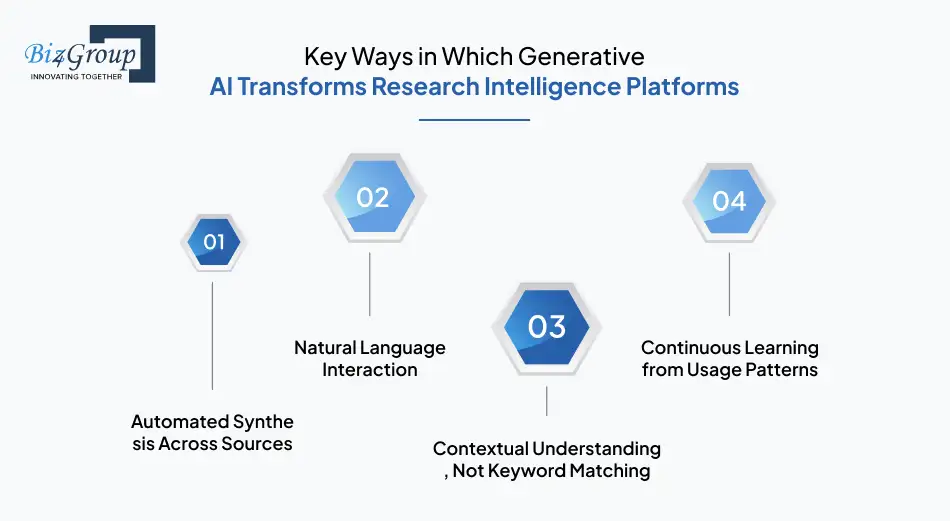
Generative AI introduces a different way of thinking about intelligence delivery. Instead of static reports, platforms evolve into dynamic research environments.
1. Automated Synthesis Across Sources
Research data comes from papers, news, internal reports, market feeds, and competitive signals. Generative AI combines these inputs into coherent insights, eliminating manual cross referencing.
2. Natural Language Interaction
Users can ask questions in plain language and receive contextual answers. This removes dependency on complex filters and training. Platforms described in research intelligence platform development discussions now prioritize conversation over navigation.
3. Contextual Understanding, Not Keyword Matching
Generative AI understands intent, tone, and relevance. It can distinguish between surface level mentions and meaningful insights. This capability directly impacts the accuracy of outputs and reduces noise for decision makers.
4. Continuous Learning from Usage Patterns
As users interact with the platform, generative AI adapts. It learns which insights matter and which formats work best. This learning loop plays a major role in shaping platforms where long term scalability matters.
From Static Tools to Living Intelligence Systems
Older platforms focused on organizing knowledge. Generative AI shifts the focus to interpreting knowledge. That difference changes how platforms are architected, funded, and measured.
Modern teams no longer ask for tools that store research. They expect platforms that:
- Highlight emerging themes before they become trends
- Explain why a signal matters, not only what changed
- Reduce analysis time without reducing depth
- Support executives, analysts, and strategists equally
This is the transformation that defines how generative AI is used for research intelligence platform development today. It is not about adding AI features. It is about redesigning the platform around intelligence itself.
In the next section, we will look at the tangible business impact this transformation creates.
Static Research Costs More Than You Think!
Teams using intelligent research platforms cut insight turnaround time by up to 60%.
Build a Smarter Research Platform with Biz4GroupBusiness Benefits of Research Intelligence Software Development with Generative AI
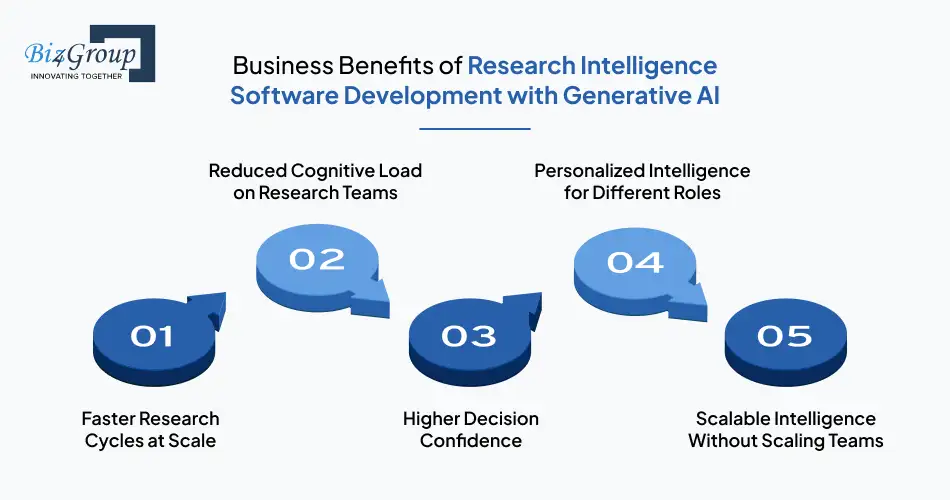
The impact of generative AI shows up quickly once research intelligence platforms move into daily workflows. The benefits are operational, strategic, and deeply practical. They go beyond cost savings and focus on how teams think and act.
1. Faster Research Cycles at Scale
Speed matters in research. Generative AI shortens the path from question to insight.
- Large volumes of content are reviewed in minutes
- Summaries replace hours of manual reading
- Cross source analysis happens continuously
Teams that invest in research intelligence software development with generative AI move faster without sacrificing depth.
2. Reduced Cognitive Load on Research Teams
Researchers spend less time collecting information and more time interpreting it.
Shorter days. Sharper focus.
- Automated synthesis reduces repetitive tasks
- Contextual summaries eliminate back and forth review
- Insight generation becomes collaborative, not exhausting
This shift makes it easier to develop research intelligence platform using generative AI that supports people instead of overwhelming them.
3. Higher Decision Confidence
Decisions improve when insights are timely and complete.
Generative AI connects fragmented signals into clear narratives. It highlights why trends matter. It explains what changed and what may come next.
That clarity strengthens leadership confidence and improves alignment across teams using a generative AI-based research intelligence platform.
4. Personalized Intelligence for Different Roles
Executives, analysts, and strategy teams need different views of the same data. Generative AI adapts outputs by role and context.
- Executives receive concise summaries
- Analysts access detailed reasoning
- Strategy teams explore scenarios and implications
This personalization is a key reason enterprises create intelligent research platforms with generative AI rather than relying on generic tools.
5. Scalable Intelligence Without Scaling Teams
Research demand grows faster than headcount.
Generative AI absorbs volume while maintaining quality. Platforms expand their coverage without adding proportional complexity. That scalability becomes advantageous for organizations that develop research intelligence platform with generative AI for enterprises operating across markets and regions.
The business impact is clear. Generative AI reshapes how research intelligence platforms support people, decisions, and growth. Next, we will explore real use cases across industries to show how this impact takes shape in everyday work.
Use Cases of Generative AI in Research Intelligence Platform Across Industries
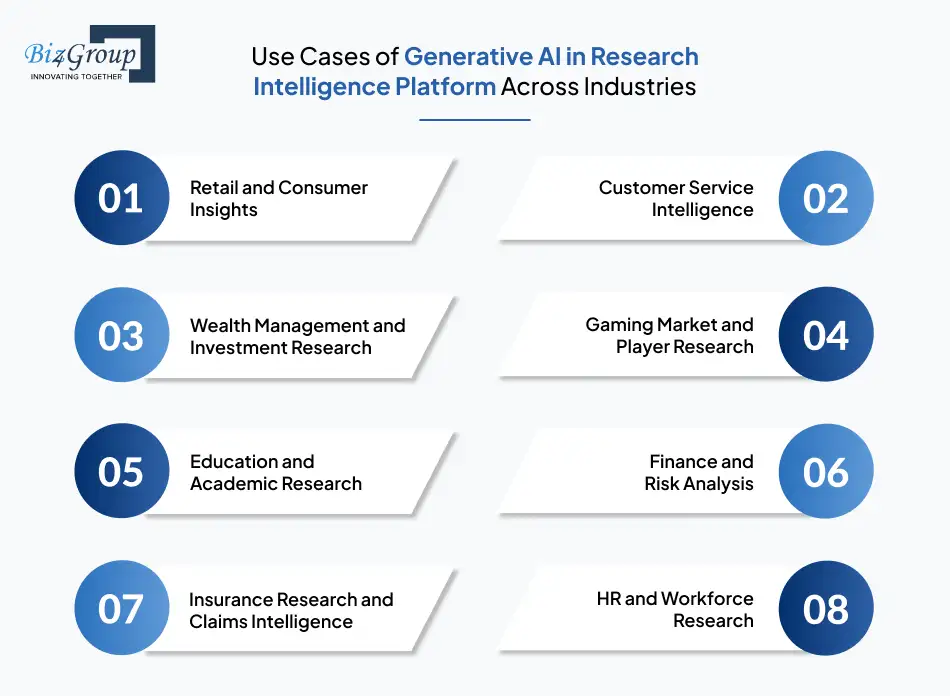
Generative AI changes how research intelligence platforms serve different industries. The core capability stays the same. The context and outcomes shift based on business needs.
Below are the most common and high value use cases seen in enterprise adoption.
1. Retail and Consumer Insights
Retail teams deal with fast moving trends, changing customer behavior, and intense competition.
A generative AI-based research intelligence platform helps retail leaders analyze product trends, pricing movements, and customer sentiment across channels. It connects market signals into clear recommendations, which explains the growing role of generative AI in retail intelligence strategies.
2. Customer Service Intelligence
Support teams generate massive volumes of qualitative data every day.
Generative AI synthesizes customer conversations, identifies recurring issues, and highlights service gaps. Research intelligence platforms built for this purpose give leaders visibility into experience trends and operational risks, reinforcing the value of generative AI in customer service.
3. Wealth Management and Investment Research
Financial advisors and analysts rely on timely insights.
Generative AI aggregates market reports, portfolio performance data, and regulatory updates into actionable intelligence. Firms using generative AI development in this space increasingly explore generative AI wealth management models to improve advisory decisions.
4. Gaming Market and Player Research
Gaming studios analyze player behavior, content trends, and competitor launches.
Research intelligence platforms powered by generative AI interpret community feedback, gameplay metrics, and industry news. This approach supports studios experimenting with generative AI in gaming research workflows.
5. Education and Academic Research
Academic institutions and EdTech platforms manage growing research output.
Generative AI organizes papers, identifies emerging topics, and summarizes findings. This use case closely aligns with how generative AI in education strengthens knowledge discovery and insight sharing.
6. Finance and Risk Analysis
Finance teams monitor markets, regulations, and macroeconomic signals.
Generative AI helps synthesize complex datasets into decision ready insights. Many enterprises now rely on research intelligence software development with generative AI to support generative AI in finance use cases such as forecasting and risk evaluation.
7. Insurance Research and Claims Intelligence
Insurance organizations analyze policies, claims data, and compliance updates.
Generative AI surfaces risk patterns and regulatory changes faster. This capability drives adoption of generative AI in insurance within research intelligence platforms.
8. HR and Workforce Research
HR teams study workforce trends, attrition signals, and policy impacts.
Generative AI transforms fragmented people data into strategic insights, which supports the expanding role of generative AI in HR research initiatives.
These examples show how use cases of generative AI in research intelligence platform development vary by industry while delivering consistent value. Next, we will explore how it feels when you translate these use cases into a scalable platform.
Also read: Top 12 Generative AI Use Cases
Workforce Signals Appear Months Before Attrition!
Nearly 70% of workforce issues can be predicted early when research intelligence connects people data at scale.
Book a Strategy Call TodayForefront: An AI-Powered Research Intelligence Platform
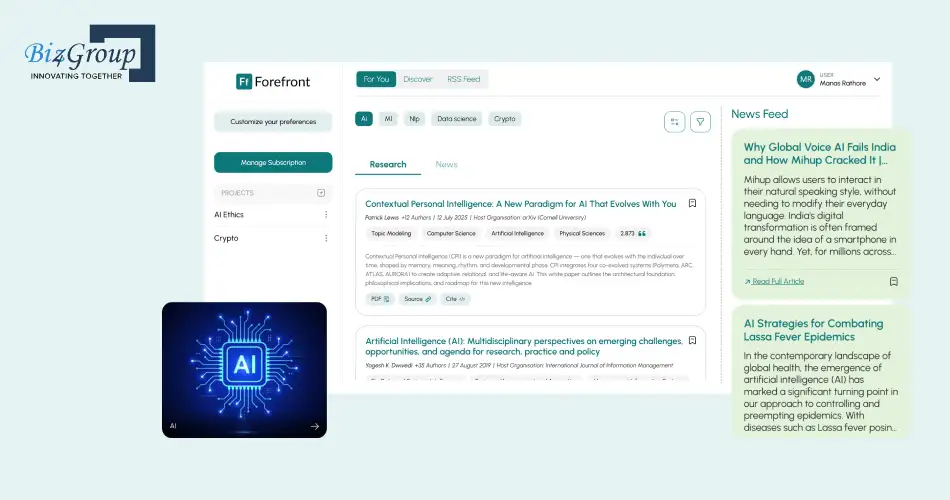
Forefront reflects what modern research intelligence platforms are expected to deliver.
Speed. Relevance. Clarity.
Built by Biz4Group, it demonstrates how generative AI-based research intelligence platform concepts translate into a real, production ready system.
Researchers today face a simple problem. Too much information. Too little time. Forefront addresses this by bringing discovery, analysis, and organization into one focused workspace. It pulls data from more than 250 million research papers and trusted academic sources, then curates it into a personalized research feed.
What makes Forefront stand out is how intelligence flows through the platform.
- Personalized content feeds shaped by user interests
- AI-powered summaries that reduce reading time
- Chat-based interaction with PDFs for faster insight extraction
- Centralized collections for managing ongoing research
The platform architecture aligns closely with proven approaches in AI research intelligence platform development, where intelligence adapts to the user instead of forcing rigid workflows.
Forefront highlights the importance of thoughtful engineering decisions. Managing strict API limits, ranking relevance across massive datasets, and maintaining performance at scale were all addressed during development.
From concept to execution, Forefront showcases how a capable AI development company can turn complex research challenges into intuitive, scalable platforms that support real decision making.
Also read: How much does it cost to develop AI research intelligence platform?
How to Build Generative AI Based Research Intelligence System in 7 Steps?
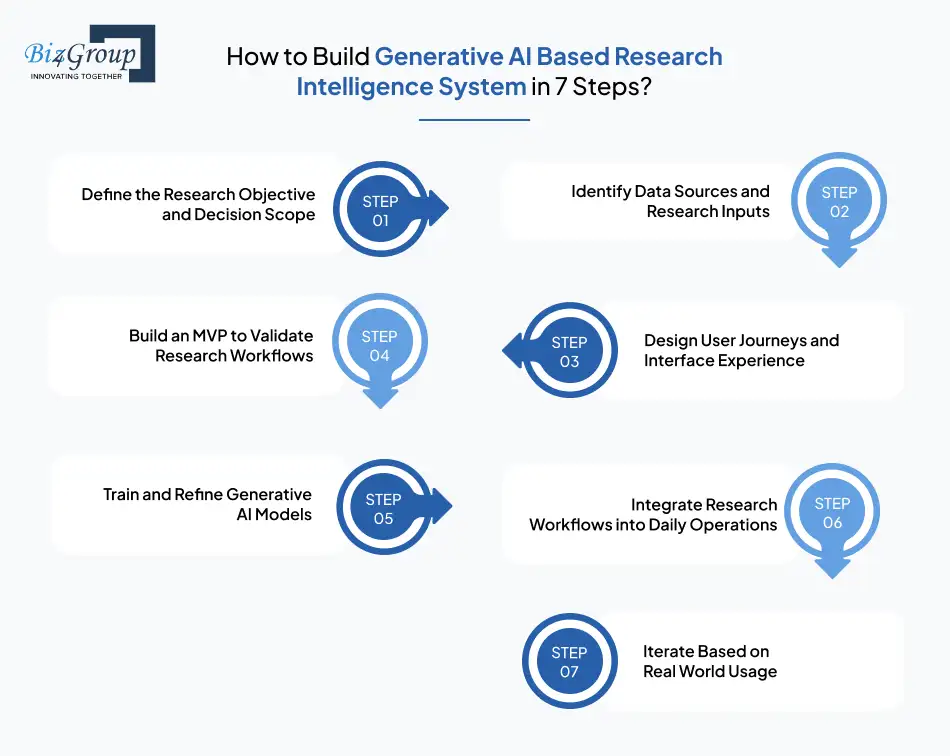
Building a research intelligence platform with generative AI requires clarity before complexity. The process works best when business goals guide every decision.
Below is a proven seven step approach used in successful generative AI research intelligence platform development initiatives.
Step 1. Define the Research Objective and Decision Scope
Every platform starts with a question. What decisions will this platform support?
- Strategy and market planning
- Competitive intelligence
- Academic or product research
Clear scope prevents feature overload and ensures the platform delivers value from day one.
Step 2. Identify Data Sources and Research Inputs
Research intelligence platforms thrive on diverse data. This step focuses on selecting sources that matter.
- Internal documents and reports
- Industry publications and databases
- News, forums, and public datasets
The goal is relevance, not volume.
Step 3. Design User Journeys and Interface Experience
Intelligence only works when people use it. An experienced UI/UX design company shapes adoption, trust, and daily usage. Key considerations include:
- Simple navigation
- Natural language interaction
- Role based views for executives and analysts
Also read: Top 15 UI/UX design companies in USA
Step 4. Build an MVP to Validate Research Workflows
Developing an MVP reduces risk and accelerates learning. Instead of building everything at once, teams launch a focused version that solves one core problem well. An MVP helps:
- Validate data relevance
- Refine AI outputs
- Collect real user feedback
Also read: Top 12+ MVP development companies in USA
Step 5. Train and Refine Generative AI Models
Once workflows are validated, AI models are tuned using domain specific data. This phase focuses on:
- Improving summarization quality
- Enhancing contextual understanding
- Reducing irrelevant outputs
Continuous refinement ensures insights improve with usage.
Step 6. Integrate Research Workflows into Daily Operations
The platform must fit into how teams already work.
This step aligns intelligence delivery with existing research processes, dashboards, and reporting rhythms. Smooth integration drives adoption across departments.
Step 7. Iterate Based on Real World Usage
Research needs evolve. Successful platforms treat launch as the beginning, not the end.
Usage data, feedback, and new research goals guide ongoing improvements. This iterative approach defines how teams develop research intelligence platform using generative AI that stays relevant over time.
Next, we will look at the technology foundation and compliance considerations that support these platforms at enterprise scale.
A Working MVP in Weeks, Not Months
With Biz4Group, your functional research intelligence MVP can be ready in as little as 2-3 weeks.
Get in TouchTechnology and Governance Behind Generative AI Based Research Intelligence Platforms
Once the process is clear, execution depends on the right technology foundation. A research intelligence platform must stay flexible, scalable, and enterprise ready from the start.
Below is a typical tech stack used to develop research intelligence platform with generative AI for enterprises. The stack may vary by use case, data volume, and security needs, but the structure remains consistent.
Typical Tech Stack for Research Intelligence Platforms
| Platform Layer | Purpose | Tools or Frameworks |
|---|---|---|
|
Frontend |
User interaction and visualization |
React, Next.js, Vue |
|
Backend |
Business logic and APIs |
Node.js, Python, FastAPI |
|
Data Ingestion |
Collect and process research data |
Apache Kafka, Airflow |
|
Data Storage |
Store structured and unstructured data |
PostgreSQL, MongoDB, ElasticSearch |
|
AI and ML Layer |
Insight generation and summarization |
OpenAI models, custom LLMs, LangChain |
|
Analytics Layer |
Trend analysis and reporting |
Python, Pandas, Spark |
|
Cloud Infrastructure |
Scalability and performance |
AWS, Azure, GCP |
This setup supports teams looking to build generative AI powered research platform solutions that handle large volumes of data while keeping response times low.
Security, Regulatory, and Ethical Considerations
Technology alone does not make a platform enterprise ready. Governance matters just as much, especially when intelligence drives decisions.
Key considerations include:
- Role-based access control to protect sensitive research
- Data encryption at rest and in transit
- Audit trails for research queries and outputs
- Compliance with GDPR, SOC 2, and industry specific regulations
- Clear data ownership and usage policies
- Bias monitoring and transparency in AI outputs
- Human oversight for critical decision support use cases
Enterprises investing in generative AI solutions for enterprise research intelligence platform development treat trust as a feature, not an afterthought.
With the right tech stack and governance in place, research intelligence platforms can scale confidently. Next, we will examine the challenges and risks organizations must plan for to protect these returns over the long-term.
Challenges and Risks in Custom Generative AI Research Platform Development
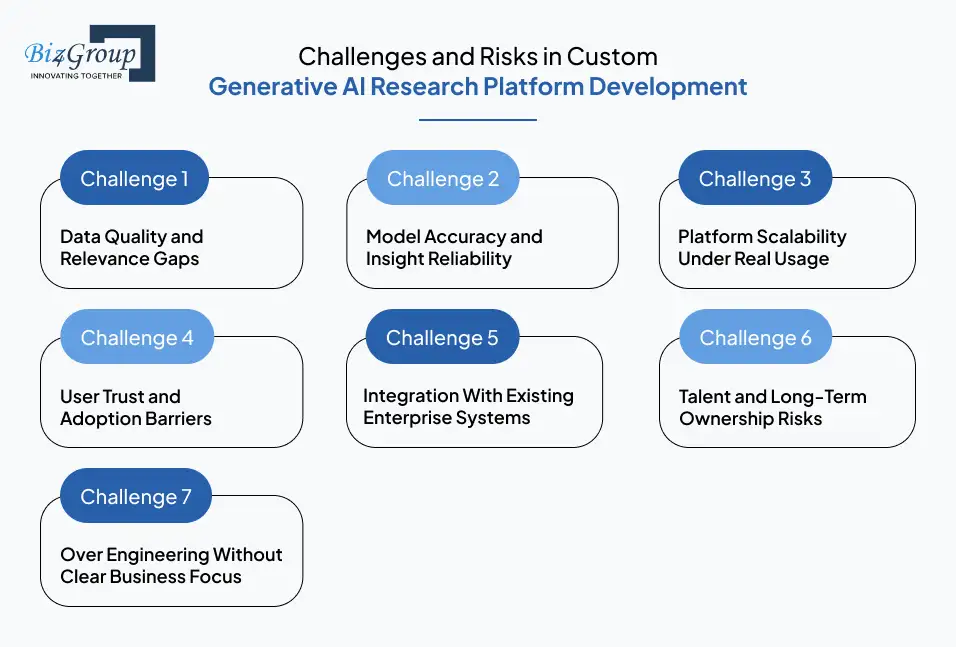
Every innovation brings tradeoffs. Organizations that invest in custom generative AI research platform development services succeed when they address risks early and systematically.
Below are the most common challenges seen in real implementations, along with proven solutions and best practices.
Challenge 1: Data Quality and Relevance Gaps
Poor inputs lead to weak insights. Research data often comes from fragmented, inconsistent, or outdated sources.
Best practices
- Prioritize high trust data sources over raw volume
- Apply relevance scoring before insight generation
- Continuously audit and refresh datasets
Challenge 2: Model Accuracy and Insight Reliability
Generative models can produce confident sounding outputs that require validation.
Best practices
- Use human review for high impact insights
- Fine tune models with domain specific datasets
- Combine generative outputs with rule based validation
Challenge 3: Platform Scalability Under Real Usage
Research platforms face unpredictable demand spikes. Poor architecture leads to slow responses and degraded experience.
Best practices
- Design for scale from the start, not after launch
- Load test MVPs before expanding scope
- Support long term growth with AI automation
Challenge 4: User Trust and Adoption Barriers
Even strong platforms fail if users do not trust or understand them.
Best practices
- Invest in intuitive interfaces
- Offer transparent explanations behind insights
- Introduce conversational layers through an AI chatbot development company
Challenge 5: Integration With Existing Enterprise Systems
Disconnected platforms reduce value and slow adoption.
Best practices
- Align research workflows with existing tools
- Use modular integration patterns early
- Work with a capable software development company that understands enterprise ecosystems
Challenge 6: Talent and Long-Term Ownership Risks
Generative AI platforms require continuous refinement. Skill gaps can stall progress.
Best practices
- Build cross functional teams early
- Partner strategically or hire AI developers with platform experience
- Treat the platform as a living AI product, not a one-time build
Challenge 7: Over Engineering Without Clear Business Focus
Complexity grows fast when platforms chase features instead of outcomes.
Best practices
- Anchor development to specific decision use cases
- Validate assumptions through phased delivery
- Follow structured guidance when teams build a generative AI solution at scale
Organizations that acknowledge these risks upfront build stronger platforms and protect long-term value. In the next section, we will explain why Biz4Group stands out as a trusted partner for enterprises looking to develop and scale generative AI research intelligence platforms.
AI Failures Rarely Happen Overnight
Over half of enterprise AI initiatives stall due to overlooked risks in data, adoption, and governance.
Talk to Biz4Group's ExpertsWhy Biz4Group LLC Is the Best Company to Develop Generative AI Research Intelligence Platform in the USA?
Biz4Group LLC is a US-based software development company built for one purpose. Turning complex ideas into scalable, high impact software products that businesses rely on every day.
We understand how research intelligence platforms must function inside real organizations, where decisions carry financial weight and timelines matter. That is why our work in enterprise AI solutions focuses on clarity, scalability, and long-term value, not surface level experimentation.
Generative AI research intelligence platforms demand more than model integration. They require deep experience in data flows, user behavior, decision workflows, and enterprise readiness.
Biz4Group brings a strong execution mindset. Our teams combine architecture planning, applied AI expertise, and seamless AI integration to ensure platforms fit naturally into existing ecosystems.
As a seasoned generative AI development company, we help organizations move confidently from concept to production without losing momentum.
Why Businesses Choose Biz4Group LLC
- Proven experience building AI-powered platforms for real world use
- Strong understanding of enterprise research and intelligence workflows
- Custom solutions designed around business goals, not generic templates
- Clear communication between strategy, design, and engineering teams
- Scalable architectures that grow with data, users, and complexity
Businesses partner with Biz4Group because we think like product owners, not vendors. We ask the right questions early. We challenge assumptions when needed. And we stay focused on outcomes long after launch.
When organizations invest in generative AI research intelligence platforms, they look for a partner who understands both ambition and accountability. Biz4Group brings that balance.
Let’s turn your vision into reality. Let’s talk.
Wrapping Up
Research intelligence has entered a new phase. Volume is no longer the challenge. Meaning is. Generative AI enables research platforms to move beyond collecting information and into shaping understanding. By synthesizing data, identifying patterns, and delivering insights in real time, these platforms help organizations think faster and act with confidence.
As enterprises adopt generative AI in research intelligence platform development, the focus shifts from reports to decisions. Platforms become living systems that adapt to users, evolve with data, and support strategy across departments. It defines how intelligence will be created and consumed moving forward.
Biz4Group LLC helps businesses navigate this shift with clarity and precision. As a trusted AI development company, we design and build research intelligence platforms that align technology with real business outcomes. From architecture to execution, our teams deliver platforms that scale, perform, and earn trust.
Ready to turn research into a strategic advantage?
Contact Biz4Group today and build your generative AI research intelligence platform with clarity.
FAQs
Can generative AI research intelligence platforms work with proprietary internal data?
Yes. These platforms can be designed to securely analyze internal documents, reports, and knowledge bases alongside external data, while maintaining strict access controls and data isolation.
How much time does it take to build a generative AI research intelligence platform?
Most platforms typically take 8-12 weeks. At Biz4Group, reusable components and proven architecture allow teams to deliver a functional MVP in as little as 2-3 weeks, helping businesses validate ideas early while keeping development time and costs under control.
What type of organizations benefit most from generative AI research intelligence platforms?
Organizations that rely on continuous research such as consulting firms, investment teams, product driven enterprises, academic institutions, and strategy departments see the strongest value due to their high insight demand.
Do generative AI research platforms require constant model retraining?
Not always. Many platforms rely on periodic tuning and prompt optimization rather than frequent retraining, which keeps maintenance effort manageable while improving output quality over time.
How customizable are generative AI research intelligence platforms?
Customization is one of their biggest strengths. Platforms can be tailored by industry, role, research domain, and decision type, allowing different teams to extract insights in ways that fit their workflows.
Can these platforms support multilingual research and global datasets?
Yes. Modern generative AI models handle multiple languages and regional data sources, making them suitable for organizations operating across markets and geographies.
How do organizations prevent misinformation in AI-generated research insights?
Most platforms apply layered controls such as source validation, confidence scoring, and human review for high impact insights. These measures help maintain reliability and trust.
