 Location :
Orlando, FL, USA
Location :
Orlando, FL, USA +1 (407) 714-1616
 info@biz4group.com

- Develop a social fitness app like Strava by integrating real-time tracking, social engagement features, and personalized fitness goals to keep users motivated.
- The fitness community app development like Strava requires leveraging AI-powered fitness apps to provide smart recommendations and enhance user interaction.
- The fitness app market in USA is set to reach around USD 10 billion by 2033, with AI apps increasing in demand for personal wellness tracking.
- Key features of apps like Strava include GPS integration, workout analytics, community interaction, and challenges for engagement.
- Cost to develop a social fitness app like Strava typically ranges from $25,000 to $150,000+, depending on features, complexity, and platform integration.
- Custom fitness app development services like Strava offers tailored solutions for startups and enterprises to build scalable apps.
Every product leader eventually reaches this moment. Growth is steady, users are active, but engagement still feels transactional. You start wondering what would happen if fitness data turned into conversations, competition, and community. That curiosity is often what pushes teams to develop a social fitness app like Strava, where tracking workouts is only the starting point and long-term engagement becomes the real product.
Just below are the questions every tech leader should ponder before jumping into this journey:
- How to develop a social fitness app like Strava
- How to build a fitness tracking social app
- What are the features needed for a Strava like fitness app
- Can AI be used in social fitness apps
- What's the cost to create a social fitness tracking app
According to a report by Grand View Research, the fitness app market in the USA is forecasted to hit a valuation of around USD 10 billion by 2033, expanding at a CAGR of 10.0%.
For most decision makers, this idea goes beyond fitness. It is about retention and defensibility. Communities reduce churn. Shared goals create habit. Activity data becomes a reason to return, not just a record to store. Many teams explore this shift by working with an AI fitness software development company to design experiences where motivation and technology reinforce each other.
That mindset explains why founders increasingly choose to develop AI workout app platforms built around connection and progress. As expectations evolve, interest in social fitness app development like Strava continues to grow among leaders focused on building products with long term staying power.
You may have so many more questions in your mind – this blog is going to answer them all!
So, let's get started.
What is Strava and Why is it Popular?
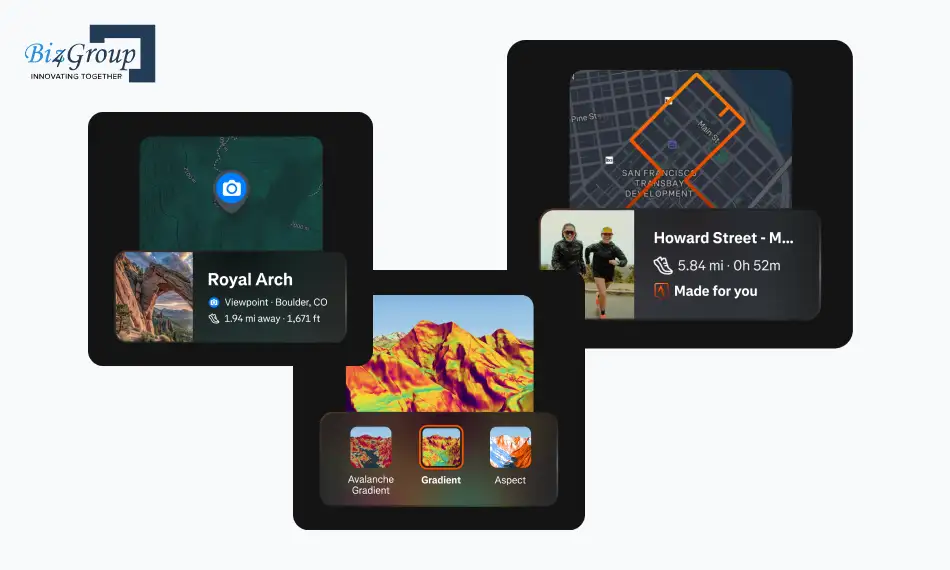
To develop a social fitness app like Strava means creating a platform where workout tracking and social interaction work together, turning individual activities into shared experiences that keep users motivated, consistent, and engaged over time.
At a functional level, it allows users to:
- Track running, cycling, and training activities accurately
- Enable social feeds for following friends and athletes
- Support challenges, leaderboards, and progress sharing
- Visualize workout data in clear, user-friendly formats
- Build great health routines by encouraging daily usage
Why Is It Popular?
Its popularity comes from how naturally fitness becomes social. Users stay longer because progress is visible, motivation is shared, and achievements feel acknowledged. Many platforms strengthen this experience through enterprise AI solutions that personalize insights without disrupting the social flow.
For founders aiming to create AI powered fitness apps like Strava, these AI apps offer a proven way to build retention first products that users return to willingly, not out of obligation.
How Social Fitness Applications Like Strava Actually Work
Before you develop a social fitness app like Strava, it's important to know about it's core functionality. You are about to design a system where data, community, and motivation constantly feed into each other. The mechanics look simple on the surface, but the flow underneath is deliberate and tightly connected to user behavior.
1. Activity Capture and Data Flow
Users record workouts through GPS, sensors, or connected devices. That raw data is processed instantly and converted into distance, pace, effort, and progress metrics. This is where fitness community app development like Strava begins to feel tangible for the user.
2. Social Layer and Interaction Logic
Every activity becomes shareable within a feed where peers can react and engage. Comments, kudos, and comparisons introduce light competition without forcing it. Many teams rely on AI consulting services here to fine tune engagement patterns and social signals.
3. Insights, Personalization, and Motivation Loops
Performance trends are analyzed over time to surface meaningful insights. Personalized nudges, challenges, and reminders keep users active without feeling intrusive. Behind the scenes, teams often integrate AI into an app to support smarter recommendations and adaptive experiences.
|
System Layer |
What It Handles |
Why It Matters |
|
Data Capture |
GPS and sensor inputs |
Accurate activity tracking |
|
Social Engine |
Feeds, kudos, comments |
Community driven engagement |
|
Intelligence Layer |
Trends and recommendations |
Sustained motivation |
|
Platform Logic |
Notifications and challenges |
Habit formation |
Together, these elements create a product that feels alive. This structure explains why companies that build workout tracking and social fitness app like Strava start thinking more about outcomes as they move into the next stage of planning.
Turn Your Fitness Ideas into Reality
Develop a social fitness app like Strava with engaging features that keep users coming back. Learn how to build a community-driven platform today.
Start Building Your Fitness AppWhy Businesses Invest in Developing Social Fitness Applications Like Strava?
For many founders and tech leaders, the decision to develop a social fitness app like Strava is less about entering fitness and more about building a product users return to by choice. The reasons become clearer once you look past surface level features:
1. Community Driven Retention and Lower Churn
Social interaction creates accountability that solo tracking cannot match. Users stay active because peers notice progress and milestones feel shared. This dynamic is a core driver behind custom social fitness app development like Strava.
2. Data That Compounds in Value Over Time
Every workout adds context to the user profile, making insights richer with each session. Teams that develop athlete tracking and social app like Strava often pair this with AI integration services to turn raw activity data into long term engagement signals.
3. Multiple Growth and Expansion Paths
Once a community forms, it becomes easier to layer challenges, programs, and partnerships. Many platforms eventually create fitness challenge and community platform like Strava experiences supported by business app development using AI to scale without losing relevance.
4. Monetization Without Disrupting User Trust
Social fitness platforms allow revenue to grow alongside engagement rather than against it. Subscriptions, premium insights, and partner programs feel additive when users already see value in staying active and connected.
Taken together, these factors explain why social fitness products mature into ecosystems rather than one off apps, naturally setting the stage for real world use cases and audience specific applications that follow next.
Real-World Use Cases of Social Fitness App Development Like Strava
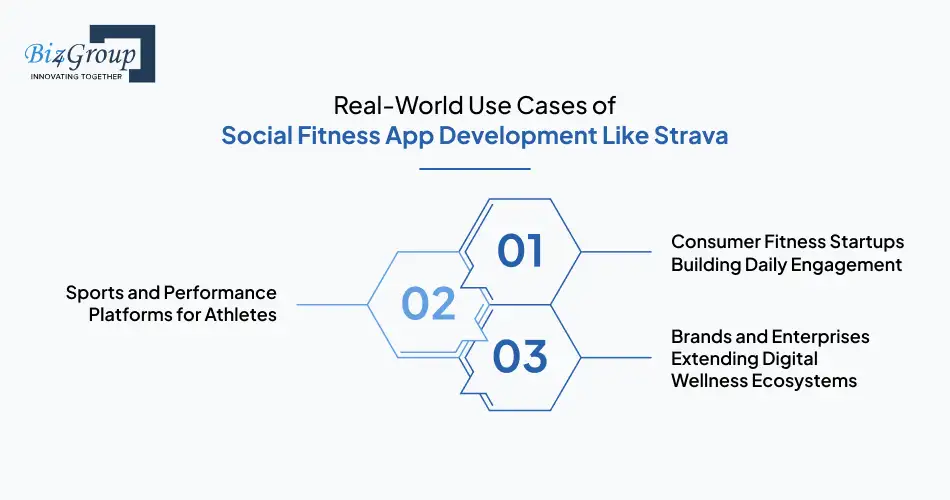
When teams decide to develop a social fitness app like Strava, they are usually solving a very specific business problem, not chasing a trend. These use cases reflect where adoption sticks, budgets get approved, and products justify long term investment.
1. Consumer Fitness Startups Building Daily Engagement
Startups use social mechanics to turn passive tracking into repeat behavior. Visibility into peer activity creates light pressure to stay consistent. This approach often anchors broader fitness app software development like Strava efforts from day one.
- Example: A running app using peer comparisons and weekly mileage goals to increase daily active users.
2. Sports and Performance Platforms for Athletes
Athlete focused platforms emphasize performance history, peer benchmarking, and competitive context. Social layers help athletes validate progress beyond raw numbers. Teams often hire AI developers to fine tune insights and progression logic.
- Example: A cycling platform comparing segment performance within skill-based groups
3. Brands and Enterprises Extending Digital Wellness Ecosystems
Organizations build social fitness apps to keep users engaged between physical touchpoints. Community challenges make wellness feel optional rather than enforced.
Many rely on AI integration services along with AI assistant app design to align user motivation with business goals.
- Example: A company-wide fitness challenge tied to team-based leaderboards and rewards
|
Use Case |
Core Focus |
Why It Works |
|
Fitness Startups |
Habit formation |
Social accountability |
|
Athlete Platforms |
Performance context |
Peer comparison |
|
Enterprises |
Wellness adoption |
Voluntary participation |
Across all these scenarios, success depends on designing interaction first. Teams that build a fitness tracking and social app like Strava focus on how users motivate each other, not just how data is stored.
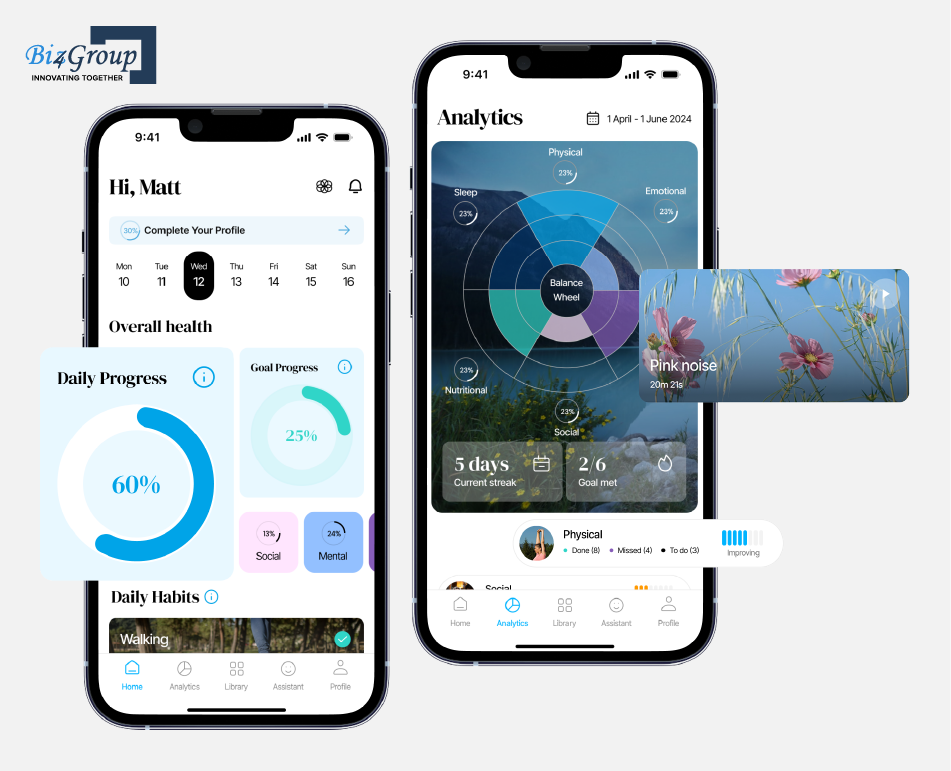
Quantum Fit is an AI-powered personal development platform developed by Biz4Group, that brings physical activity, wellness habits, and progress tracking into a single mobile experience. Built to support long-term user engagement across fitness and lifestyle dimensions, it reflects how structured data, motivation loops, and personalization come together in platforms that resemble the foundations of a social fitness ecosystem.
This clarity around the above-listed use cases makes it easier to define the core capabilities required for companies looking to develop social fitness applications like Strava for startups and brands - with the right balance of engagement and scale.
Core Features for Social Fitness App Development Like Strava
When product teams set out to develop a social fitness app like Strava, the difference between a short-lived app and a lasting platform comes down to the fundamentals. These core features form the backbone of daily usage and meaningful engagement:
|
Core Feature |
What It Enables |
Why It Matters |
|
Activity Tracking |
Records runs, rides, and workouts |
Establishes accurate performance data |
|
GPS and Mapping |
Visual route capture |
Builds trust in workout authenticity |
|
Social Feed |
Shares activities with peers |
Encourages interaction and motivation |
|
Kudos and Comments |
Lightweight social feedback |
Reinforces consistency |
|
Challenges and Goals |
Time bound participation |
Drives repeat engagement |
|
Leaderboards |
Performance comparison |
Adds friendly competition |
|
User Profiles |
Personal fitness history |
Creates identity within the community |
|
Clubs and Groups |
Interest based communities |
Strengthens retention |
|
Notifications |
Timely updates and nudges |
Keeps users engaged |
|
Data Insights |
Activity summaries and trends |
Helps users track progress |
From an execution standpoint, teams often work with a custom software development company to ensure these features scale reliably without friction or data gaps.
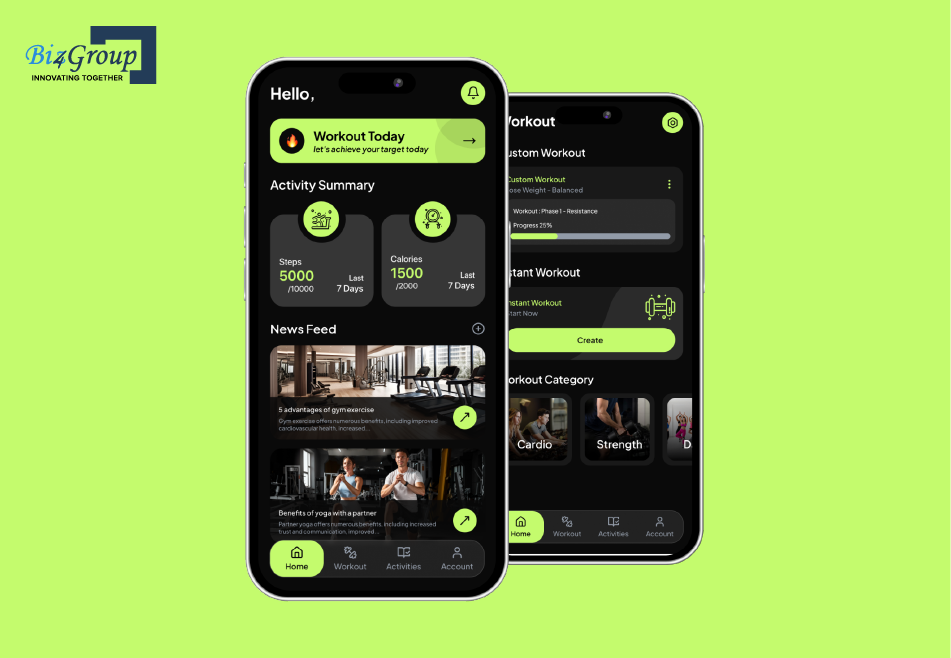
The AI Workout App focuses on intelligent workout guidance using image analysis and personalized recommendations. It demonstrates how real-time feedback, user progression, and adaptive training logic can be implemented at scale. These elements closely align with the technical and experiential challenges teams face when building socially connected, performance-driven fitness platforms.
Once the above-mentioned essentials are in place, custom fitness app development services like Strava naturally shift focus toward deeper personalization and smarter experiences, which leads directly into the next layer of advanced capabilities.
Transform the Way People Train
Harness the power of fitness app software development like Strava to create a social fitness app that tracks, motivates, and connects.
Get Started with Custom Fitness App DevelopmentNext-Level Features for Custom Social Fitness App Development Like Strava
To develop a social fitness app like Strava, advanced features are what separate a usable product from a habit forming one. These capabilities deepen engagement, strengthen community loops, and push users to return even when motivation dips.
1. Adaptive Training Intelligence
Advanced platforms move beyond static plans and adjust workouts based on performance trends, recovery patterns, and consistency. This relies on continuous AI model development rather than preset rules. Users feel coached, not programmed.
2. Social Competition With Context
Leaderboards evolve to factor in terrain, effort, and personal benchmarks. This makes challenges feel fair and motivating across skill levels. Many teams use generative AI to personalize competitive narratives without overwhelming users.
3. Smart Community Interaction
Social feeds become more than activity logs by surfacing meaningful interactions. Features like contextual comments and guided encouragement are often powered through an AI conversation app layer. Engagement feels natural instead of noisy.
4. Predictive Performance Insights
Advanced apps identify early signs of fatigue, plateaus, or overtraining. These insights support smarter pacing decisions and reduce burnout via predictive analytics. This is a key differentiator in fitness app development solutions like Strava for startups and enterprises.
5. Cross Activity Intelligence
Data from running, cycling, strength, and recovery syncs into a unified performance view. This holistic intelligence encourages balanced training rather than isolated metrics. It supports long term retention and user trust.
As these features come together, complexity rises quickly. That is why many founders evaluate the best company to develop a social fitness app like Strava before scaling beyond core functionality, ensuring the product remains stable, engaging, and ready for growth.
How to Build Social Fitness Applications Like Strava: Step by Step Process
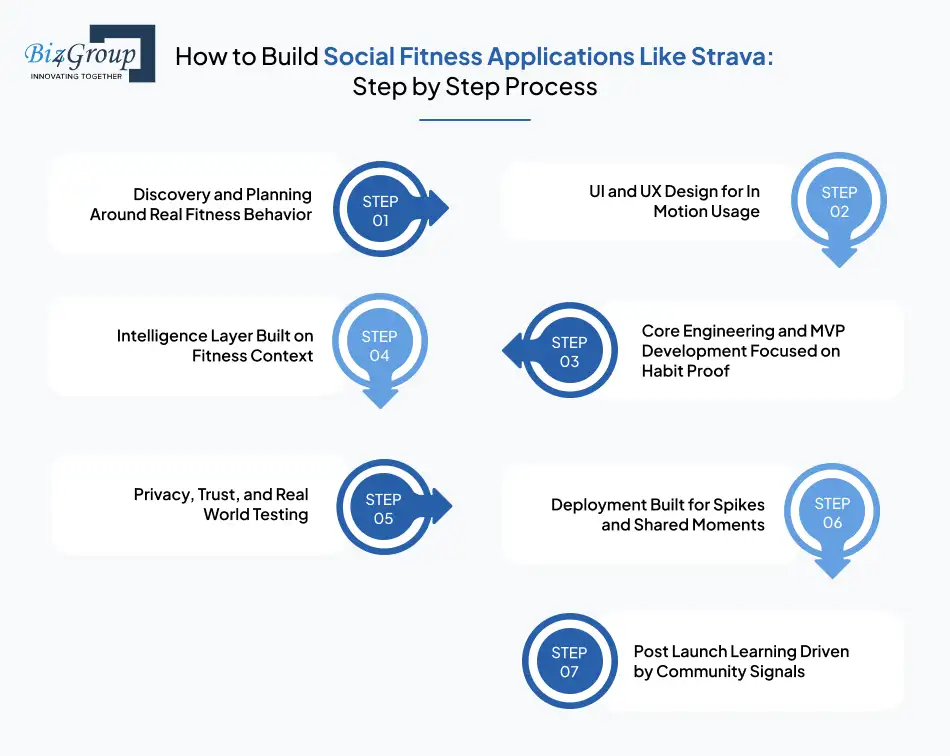
If you have decided to develop a social fitness app like Strava, know that you are not just building a tracker. You are planning to shape how users move, share progress, and stay accountable over time. That goal requires a process rooted in real fitness behavior, not assumptions.
1. Discovery and Planning Around Real Fitness Behavior
This step focuses on understanding how people actually train and interact socially. Some users thrive on competition, others prefer quiet consistency. Getting this wrong leads to churn, even with great technology.
- Identify which activities users return to week after week
- Understand when users want recognition versus privacy
- Decide whether performance or community is the primary hook
- Define engagement metrics tied to workouts and social interaction
This clarity sets the foundation for social fitness app development like Strava that feels intentional rather than stitched together.
2. UI and UX Design for In Motion Usage
Fitness apps are often used while users are tired, outdoors, or mid workout. When you create AI powered fitness apps like Strava, the design must support movement first and attention second. It's recommended that you partner with a seasoned UI/UX design company for the best results.
- Design start and stop flows that work without friction
- Make social feedback visible but not distracting
- Keep summaries motivating and easy to scan
- Ensure consistency across phones, watches, and tablets
Strong UI decisions directly impact how often users return to log activities.
Also Read: Top 15 UI/UX Design Companies in USA: 2026 Guide
3. Core Engineering and MVP Development Focused on Habit Proof
MVP development services in this category are not about feature breadth. They are about proving that users will track, share, and repeat the behavior naturally.
- Build reliable GPS tracking and activity uploads first
- Launch a simple feed before advanced community layers
- Store data in a way that supports long term trends
- Design services so new sports can be added easily
This approach helps teams validate demand before they develop fitness tracking apps like Strava at scale.
Also Read: Top 12+ MVP Development Companies to Launch Your Startup in 2026
4. Intelligence Layer Built on Fitness Context
Once the basics work, intelligence adds meaning. Users want to understand effort, improvement, and consistency, not just numbers. So when you choose to build social fitness applications like Strava, remember to make them intelligent via AI.
- Train AI models via activity frequency and progression patterns
- Highlight streaks and training consistency
- Introduce nudges tied to personal behavior
- Keep insights transparent and easy to understand
This is where teams begin to create AI powered fitness apps like Strava that feel supportive rather than intrusive.
5. Privacy, Trust, and Real World Testing
When you develop fitness tracking apps like Strava, sensitive data including location and routines matters a lot. Trust influences whether users share openly or disengage.
- Give users granular control over activity visibility
- Test GPS accuracy across environments
- Simulate social edge cases like muted connections
- Log activity changes clearly for transparency
Testing here protects both users and the long term credibility of the platform.
Also Read: Software Testing Companies in USA
6. Deployment Built for Spikes and Shared Moments
Usage rarely grows evenly. It surges around weekends, challenges, and seasonal goals. Infrastructure must support excitement without slowing down your social fitness app development like Strava.
- Scale ingestion during peak workout hours
- Monitor feed and interaction latency
- Release updates without disrupting active sessions
- Simplify onboarding to convert first time users quickly
This stability is critical as teams build social fitness applications like Strava for growing audiences.
7. Post Launch Learning Driven by Community Signals
After launch, the product begins to reveal how people really engage. The best teams treat this as a feedback loop, not a finish line.
- Study which activities spark the most interaction
- Refine challenges users actually complete
- Expand community tools where organic engagement appears
- Measure retention by activity type and social usage
Following this process supports fitness community app development like Strava that evolves with users. Now let's discuss what prepares the ground for the technology required for building such apps.
Create Engaging Features That Matter
Build workout tracking and social fitness apps like Strava with the right features to boost retention. Let's help you design the perfect user experience.
Build My Fitness App TodayTechnology Stack Used to Develop a Social Fitness App Like Strava
There's a lot that goes into build a social fitness app like Strava - the tech stack has to support live activity ingestion, social visibility, and third-party integrations at scale. Missing even one layer creates bottlenecks that users feel immediately.
|
Label |
Preferred Technologies |
Why It Matters |
|
Frontend Framework |
ReactJS, SwiftUI |
Activity feeds, stats, and post-workout summaries require fast, predictable UI flows, commonly achieved through ReactJS development |
|
Server-Side Rendering & SEO |
NextJS, Vercel |
Public athlete profiles and challenge pages gain visibility and load consistency with NextJS development |
|
Backend Framework |
Real time feeds and notifications rely on NodeJS development, while activity analysis and processing workflows are handled using Python development |
|
|
API Development |
REST, GraphQL |
Clean APIs allow mobile apps, wearables, and third parties to exchange activity and social data reliably |
|
AI & Data Processing |
TensorFlow, PyTorch |
Training models on activity patterns enables smarter insights without slowing core systems |
|
Mobile Applications |
Native responsiveness matters when users interact during active workouts |
|
|
GPS and Mapping |
Mapbox, Google Maps APIs |
Route accuracy and elevation data directly affect user trust |
|
Wearable Integration |
Apple Health, Google Fit |
Cross-platform app development expands tracking beyond manual input |
|
Authentication & Identity |
OAuth 2.0, JWT |
Secure identity management is critical for social visibility controls |
|
Notifications & Messaging |
Firebase, OneSignal |
Timely kudos, challenge alerts, and reminders sustain engagement |
|
Databases |
PostgreSQL, MongoDB |
Activity history and social interactions need both relational and flexible storage |
|
Cloud Infrastructure |
AWS, GCP |
Challenges and weekend usage spikes demand elastic scaling |
|
Analytics & Monitoring |
Firebase, Mixpanel |
Engagement patterns guide feature and community decisions |
With this technology foundation in place, teams can support accuracy, scale, and real time social interaction from day one. This clarity makes it easier to plan investment, timelines, and growth when you develop a social fitness app like Strava at a production ready level.
Cost to Develop a Social Fitness App Like Strava
For those planning to develop a social fitness app like Strava, cost usually becomes the first reality check. Most projects fall in the $25,000 to $150,000+ range, which should be treated as a ballpark figure. Final investment depends on scope, depth of social features, and long-term scalability goals.
|
Cost Tier |
What It Typically Covers |
Estimated Range |
|
MVP-level Social Fitness App Like Strava |
Core activity tracking, basic social feed, profiles, limited challenges |
$25,000 to $45,000 |
|
Mid-Level Social Fitness App Like Strava |
Stable tracking, richer social interactions, leaderboards, notifications |
$45,000 to $90,000 |
|
Enterprise-grade Social Fitness App Like Strava |
Scalable architecture, complex community features, analytics, integrations |
$90,000 to $150,000+ |
|
Post Launch Support |
Bug fixes, optimization, minor feature upgrades |
Ongoing |
Costs rise when teams expand into personalization, integrations, or automation. Many products that evolve beyond tracking often introduce business app development using AI later in the roadmap, which adds value but also increases investment over time.
Understanding these ranges helps founders plan realistically before they build workout tracking and social fitness app like Strava. Next, let's discuss how the platform will generate revenue and sustain itself long term.
Ready to Build Your Social Fitness App?
Follow our step-by-step guide to develop a social fitness app like Strava. It's time to bring your vision to life with expert development and support.
Start My Project NowHow to Generate Revenue from Social Fitness Applications Like Strava?
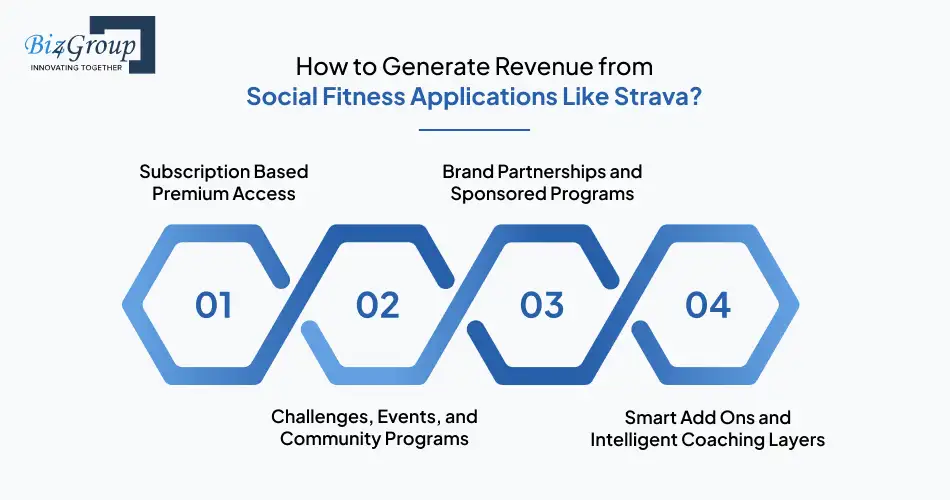
When founders develop a social fitness app like Strava, monetization works best when it grows alongside engagement, not against it. The models below show how revenue fits naturally into how users already train, compete, and stay consistent.
1. Subscription Based Premium Access
Subscriptions unlock deeper insights, long term performance history, and richer progress views. Power users who train regularly are more willing to pay for clarity and continuity. This model fits well with custom social fitness app development like Strava, where value increases over time.
Examples:
- Monthly plans offering advanced analytics and historical comparisons
- Annual subscriptions with extended performance summaries
2. Challenges, Events, and Community Programs
Time-bound challenges introduce urgency without pressure. When social energy is high, paid access feels like participation rather than purchase. This approach is common when teams create fitness challenge and community platform like Strava experiences.
Examples:
- Entry based seasonal challenges with rankings and rewards
- Limited access community events with digital recognition
Supported by scalable coordination through AI automation services
3. Brand Partnerships and Sponsored Programs
Brands value authentic access to engaged athletes, not passive audiences. Sponsored programs work when they align with training goals and community identity. This model performs well when teams develop athlete tracking and social app like Strava for focused segments.
Examples:
- Sponsored endurance challenges tied to product launches
- Brand funded rewards for top contributors
Often managed using targeted flows enabled by AI chatbot integration
4. Smart Add Ons and Intelligent Coaching Layers
As platforms mature, optional upgrades enhance planning and consistency. These features feel additive when they respect user rhythm and intent. Many teams partner with an AI product development company to introduce them without disrupting the core experience.
Examples:
- Paid access to adaptive training prompts
- Optional coaching guidance triggered by activity patterns
Over time, platforms expand beyond tracking alone and evolve into broader wellness ecosystems. This progression explains why monetization strategies pair naturally with custom social fitness app development like Strava, setting the stage for best practices that protect trust while scaling revenue.
Common Challenges in Social Fitness App Development Like Strava and Solutions
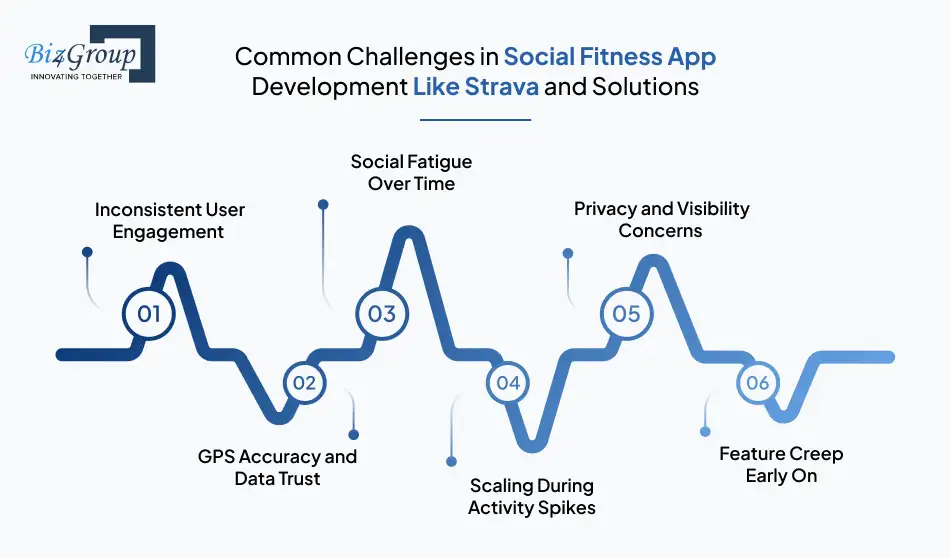
When teams set out to develop a social fitness app like Strava, the hurdles are rarely technical alone. Most challenges sit at the intersection of behavior, data trust, and scale. Understanding them early makes execution far more predictable.
|
Top Challenges |
How to Solve Them |
|
Inconsistent User Engagement |
Design social loops that reward consistency, not just peak performance, and measure engagement beyond daily logins |
|
GPS Accuracy and Data Trust |
Test tracking across environments and devices, and communicate confidence levels clearly to users |
|
Social Fatigue Over Time |
Rotate challenges, refresh goals, and allow users to control visibility without penalty |
|
Scaling During Activity Spikes |
Architect systems to absorb weekend and seasonal surges without latency |
|
Privacy and Visibility Concerns |
Offer granular sharing controls and default settings that respect user comfort |
|
Feature Creep Early On |
Validate behavior before expanding scope instead of rushing to build an AI app without proven engagement |
Addressing these hurdles thoughtfully prevents short term wins from becoming long term liabilities. Teams that plan for these realities during fitness app software development like Strava are better positioned to evolve features and adapt to changing user expectations smoothly.
Best Practices for Custom Fitness App Development Services Like Strava
To develop a social fitness app like Strava, teams need more than solid engineering. The products that last are shaped by behavioral insight, technical restraint, and long term thinking, which becomes clear in the practices below.
1. Design for Consistency Before Performance
Most users are not elite athletes, and their motivation fluctuates. Design flows that reward showing up, not just hitting records. Many teams learn this while working with a software development company in Florida that sees these usage patterns repeatedly.
2. Build Social Features That Feel Optional
Social pressure works best when it stays lightweight and respectful. Users should decide when to share, compete, or stay private. This balance is critical when teams aim to build a fitness tracking and social app like Strava without creating fatigue.
3. Introduce Intelligence Only After Trust Is Earned
Advanced logic should support behavior, not distract from it. Rushing intelligence too early often backfires. Teams planning to develop AI lifestyle fitness app capabilities benefit from first validating trust and engagement.
4. Plan for Constant Evolution with Time
Strong platforms grow alongside users and usage patterns. Early assumptions rarely survive real data. This is where founders begin to understand how to create a fitness app with AI-enabled features based on behavior, not theory.
Following these practices helps teams avoid short lived engagement and focus on durability. This mindset enables companies to create community-driven fitness apps like Strava that are ready for future expansion without forcing it.
Know Your Budget, Build Smart
Create AI-powered fitness apps like Strava and get the most value out of your investment. From MVPs to full-feature apps, we have the right solutions for every budget.
Get a Free Cost EstimateWhat the Future Holds for Community Driven Fitness Apps Like Strava
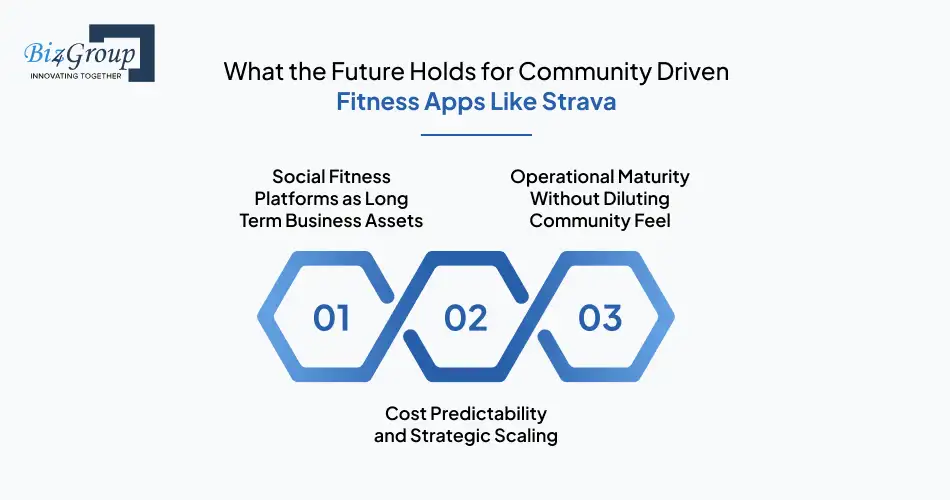
If you seek to develop a social fitness app like Strava, know that the future conversation is shifting away from feature depth and moving toward how these platforms sustain relevance, ownership, and long-term value. Here's how that shift is already visible:
1. Social Fitness Platforms as Long Term Business Assets
These apps are no longer side products. They are becoming owned engagement channels that compound value over years. This mindset often influences how organizations plan to build AI software that supports longevity rather than rapid experimentation.
2. Cost Predictability and Strategic Scaling
Future ready teams will prioritize predictable growth over aggressive expansion. Modular rollouts and phased investments will matter more than speed. As a result, AI workout app development cost is increasingly treated as a strategic planning metric, not a late-stage concern.
3. Operational Maturity Without Diluting Community Feel
As platforms grow, operational demands increase without users wanting a corporate experience. Many teams quietly rely on support from an AI chatbot development company to manage scale while keeping interactions human and unobtrusive.
Together, these shifts suggest a more disciplined, long view of product growth. This is why future planning increasingly aligns with custom fitness app development services like Strava.
Why Partner with Biz4Group LLC to Develop a Social Fitness App Like Strava?
Choosing a development partner matters just as much as choosing the idea. When teams work with Biz4Group, they are not starting from theory. They are building on real products already delivered in the fitness and wellness space.
Biz4Group brings hands-on experience from platforms like Quantum Fit, where long-term engagement, habit building, and progress tracking were central to the product strategy, and the AI Workout App, which focused on intelligent guidance, adaptive workouts, and real-time feedback. These projects mirror the same behavioral and technical challenges involved in social fitness platforms.
What sets Biz4Group apart:
- Proven delivery of AI-driven fitness and workout platforms
- Deep understanding of engagement loops, not just feature lists
- Experience designing scalable architectures for active user communities
- Business-first execution focused on retention, not experimentation
As an AI development company, Biz4Group approaches social fitness products with a balance of technical depth and product clarity. The goal is simple: help founders and teams build platforms that users return to consistently, grow sustainably, and trust over time.
Tackle Development Challenges with Ease
With the right strategies, you can easily create community-driven fitness apps like Strava that stand out. Let's build it with you.
Let's Discuss Your App Development PlanFinal Thoughts on How to Develop a Social Fitness App Like Strava
Building a social fitness platform is not about chasing metrics or copying features. It is about understanding why people show up, why they share progress, and why they come back tomorrow. When those signals align, tracking turns into habit and habit turns into community.
To develop a social fitness app like Strava successfully, teams need clarity across behavior, technology, cost, and growth. The strongest products balance structure with flexibility and motivation with trust, without forcing either.
Working with the right partner makes that balance easier to achieve. An experienced AI app development company brings perspective beyond code, while teams often evaluate top AI development companies in Florida for their ability to deliver scalable products with real user traction.
Build with intention, stay close to user behavior, and let the platform grow naturally. That is how social fitness apps move from launch to longevity.
Thinking About Building Your Own Social Fitness App like Strava?
Talk through your idea, roadmap, and risks with our team that has built real fitness products before.
Talk through your ideaFAQs on Social Fitness App Development Like Strava
1. How long does it take to build a social fitness app like Strava?
Most teams take 3 to 6 months to launch a usable version, depending on scope and readiness. Timelines vary based on activity types, social depth, and integrations planned while approaching fitness community app development like Strava with a phased rollout mindset.
2. Do social fitness apps need a community from day one to succeed?
Not necessarily. Early traction often comes from a focused user segment before wider expansion. What matters is designing interaction paths that scale naturally as usage grows, which is why many teams build social fitness applications like Strava with progressive community layers.
3. Can a Strava-like app work for niche sports or smaller audiences?
Yes. Many successful platforms start by serving one activity or niche extremely well. This focus helps validate engagement faster and refine features before expansion, a common approach when teams develop social fitness applications like Strava for startups and brands targeting specific user groups.
4. How do social fitness apps keep users engaged long term?
Long-term engagement comes from habit loops, visibility, and shared progress rather than constant feature updates. Platforms that create community driven fitness apps like Strava emphasize consistency and recognition over complexity to keep users returning organically.
5. Is it necessary to include AI features from the beginning?
AI is not required at launch. Many products succeed by focusing first on clean tracking and social interaction. Intelligence layers are often introduced later as usage patterns become clearer, especially when teams create AI powered fitness apps like Strava as part of a phased roadmap.
6. How much does it cost to develop a social fitness app like Strava?
The typical cost ranges between $25,000 and $150,000, depending on feature depth, platform support, and scalability requirements. This range reflects common investments made by teams that build workout tracking and social fitness app like Strava with MVP to mid-level scope.
