 Location :
Orlando, FL, USA
Location :
Orlando, FL, USA +1 (407) 714-1616
 info@biz4group.com

- AI legal document analyzers tool reduces manual contract review by identifying clauses, summarizing documents, and highlighting risks while allowing legal professionals to retain full decision authority.
- Effective AI legal document analyzer tool development begins with workflow clarity and realistic scope planning, so the platform fits existing legal operations instead of changing how teams already work.
- A strong solution includes structured document ingestion, contextual analysis, secure permissions, and scalable infrastructure that supports growing legal workloads without adding operational complexity.
- Development cost usually ranges from $30,000 to $200,000+, depending on platform maturity, automation depth, integrations required, and enterprise-level security expectations.
- Organizations investing in Custom AI legal document analyzer development gain better control over workflows, integrations, and future scalability as legal requirements and document volumes expand over time.
- At Biz4Group LLC, we focus on practical Legal Tech delivery, helping businesses build usable platforms that support real legal workflows and produce measurable operational improvements.
What happens when legal teams spend more time reading documents than making legal decisions? That question is quietly reshaping how modern legal operations function today.
Legal work has always depended on deep document analysis, yet the volume of contracts, compliance files, and regulatory paperwork continues to grow faster than human review capacity. Businesses are no longer asking whether automation belongs in legal workflows. They are asking how quickly they can implement it through AI legal document analyzer tool development.
Market momentum explains why
- The AI software market in the legal industry is projected to reach USD 2.67 billion in 2026 and grow to USD 4.42 billion by 2031, expanding at a steady 10.53% CAGR as firms seek faster and more accurate document handling.
- At the same time, enterprise legal teams face mounting cost pressure and increasing regulatory complexity, pushing organizations toward intelligent document analysis platforms instead of manual review models.
Businesses investing in legal document analysis AI software development are typically aiming to:
- Reduce contract review turnaround time without expanding legal teams
- Minimize compliance risks hidden inside lengthy agreements
- Standardize legal workflows across departments and regions
- Turn unstructured legal documents into searchable business intelligence
This shift often begins when businesses partner with a custom software development company that understands how legal processes operate in real environments. As adoption matures, organizations gradually introduce advanced capabilities through AI integration services, allowing legal teams to enhance document analysis while keeping current tools and workflows intact.
This guide will help you understand strategies, features, costs, and execution steps involved in building enterprise-grade AI legal document analyzer platforms.
Understanding an AI Legal Document Analyzer Tool
Legal teams deal with growing document volumes that demand speed without sacrificing accuracy. Before discussing development or features, it is important to understand what this tool actually does and how it operates inside real legal workflows.
An AI legal document analyzer tool is software designed to read, interpret, and organize legal documents automatically. Instead of manual review, it identifies clauses, summarizes content, and highlights risks within seconds. Businesses investing in AI legal document analyzer tool development use these platforms to reduce review effort while improving consistency across contracts, policies, and compliance documents.
How Does AI Legal Document Analyzer Tool Work
- Document Upload and Ingestion: The system accepts contracts, agreements, or policies in multiple digital formats.
- Text Recognition and Structuring: Documents are converted into structured text that software can understand and organize.
- Contextual Content Analysis: The platform analyzes meaning and relationships between clauses, obligations, and legal terms.
- Clause Identification and Classification: Important sections like liability or termination clauses are detected and grouped with AI automation.
- Risk Detection and Insight Generation: Potential compliance gaps or unusual wording patterns are flagged for legal review.
- Searchable Knowledge Creation: Processed documents become part of a centralized legal intelligence repository.
Modern legal platforms succeed when analysis feels natural to daily work, not like an added technical layer. The goal is to build AI software that understands document context clearly and support faster legal evaluation without adding complexity to daily review tasks.
Why Are Businesses Investing in Development of AI Legal Document Analyzer Tool
Legal departments are no longer isolated support functions; they directly influence operational speed and risk exposure. Businesses invest in structured legal technology to ensure document-heavy processes remain reliable, scalable, and aligned with modern organizational growth demands.
Let’s first understand how market direction is shaping investment priorities across legal operations today.
- Across the United States and broader North America, AI-driven legal document automation adoption is accelerating rapidly. The AI in legal document automation market is projected to grow by USD 2.25 billion between 2025 and 2029, expanding at a 30.9% CAGR.
- North America alone will contribute 37.9% of total market growth, signaling strong enterprise investment momentum.
These trends reflect clear business motivations grounded in operational realities rather than experimentation.
Pain Points Solved by AI Legal Document Analyzer Tool
|
Business Pain Point |
How The Tool Addresses It |
|---|---|
|
Increasing contract complexity |
Automatically identifies clauses and organizes obligations clearly |
|
Manual legal review dependency |
Reduces repetitive reading through automated document analysis |
|
Compliance oversight challenges |
Flags compliance risks using structured rule-based evaluation |
|
Disconnected document systems |
Centralizes documents into searchable legal intelligence repositories |
|
Organizational expansion |
Scales document analysis without proportional team expansion |
1. Controlling Rising Legal Operational Costs
Businesses invest when legal expenses increase faster than operational output. Manual contract reviews require continuous human effort, making costs difficult to predict as document volume grows.
- Expanding workloads demand additional review resources
- External legal dependency increases recurring expenses
- Budget planning becomes difficult without process standardization
AI legal document analyzer tool development helps organizations move toward stable and predictable legal operating models.
2, Managing Organizational Risk with Greater Consistency
Investment decisions often focus on reducing exposure created by inconsistent document evaluation. As contracts multiply, maintaining uniform review standards becomes challenging through manual oversight alone.
- Different reviewers interpret clauses differently
- Oversights introduce financial and compliance risks
- Governance requires dependable evaluation frameworks
Many organizations adopt enterprise AI solutions when risk management must remain consistent across growing legal ecosystems.
3. Supporting Business Growth Without Expanding Legal Headcount
Businesses invest to ensure legal operations scale alongside organizational expansion. Growth increases agreements, partnerships, and compliance responsibilities that cannot rely solely on hiring more reviewers.
- Expansion multiplies document handling requirements
- Hiring alone does not solve workflow inefficiencies
- Leadership seeks scalable operational structures
AI legal document analyzer system development enables organizations to prepare legal infrastructure for sustained growth demands.
4. Maintaining Business Execution Speed
Investment becomes necessary when legal review timelines begin affecting operational momentum. Contracts influence procurement, onboarding, and partnerships, making legal delays a business concern rather than a departmental issue.
- Slow approvals impact cross-functional execution
- Operational teams depend on timely legal validation
- Delays create friction across departments
Organizations aligning digital transformation initiatives often integrate legal modernization alongside business app development using AI to maintain execution continuity.
5. Building Structured Legal Intelligence for Decision Making
Businesses invest when leadership requires clearer visibility into obligations and risks tied to agreements. Legal documents contain critical information that influences planning and governance decisions.
- Executives need reliable insight into contractual exposure
- Historical agreements guide future negotiations
- Structured information strengthens organizational oversight
AI legal analytics tool development supports investment in systems that organize legal knowledge into dependable decision inputs.
Investment in legal technology reflects practical business reasoning rooted in cost control, risk governance, scalability, and operational alignment. Organizations investing strategically ensure legal operations remain dependable as business complexity and document volumes continue growing.
Also Read: Legal AI App Development
Still reviewing contracts the old way?
If legal review speed is slowing business execution, it may be time to rethink how documents are analyzed and managed.
Talk to Our ExpertsReal-World Use Cases of AI Legal Document Analyzer Tools for Law Firms and Enterprises
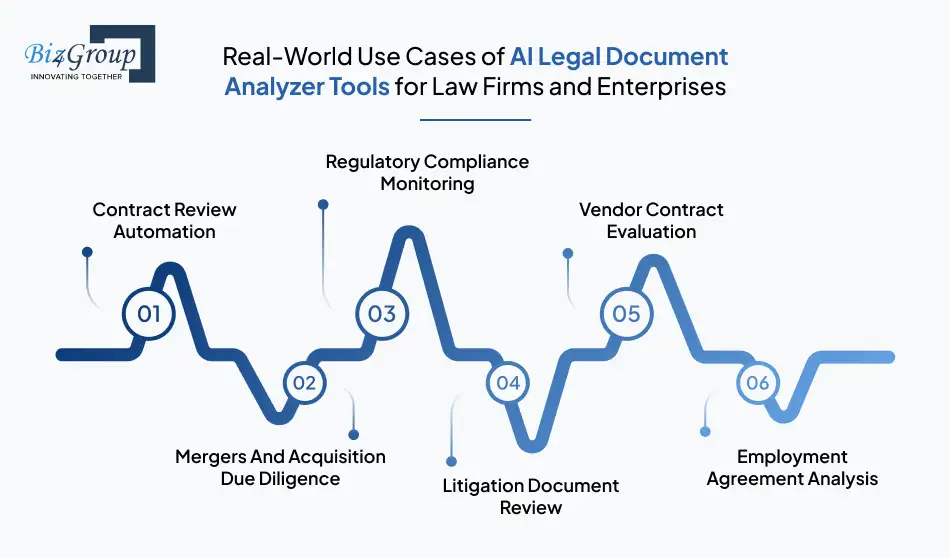
Legal teams adopt document analyzers to handle specific workflows where manual review slows progress. These tools support practical legal tasks performed daily across law firms and enterprises managing large volumes of contractual and regulatory documents.
1. Contract Review Automation
Law firms analyze contracts before execution using automated review systems. The tool identifies obligations, highlights unusual clauses, and summarizes agreements clearly, allowing lawyers to focus on negotiation decisions instead of repetitive reading work.
2. Mergers And Acquisition Due Diligence
During acquisitions, legal teams examine thousands of agreements within strict timelines. Automated analysis organizes documents, extracts liabilities, and presents structured summaries, helping professionals evaluate transaction risks without extending review cycles unnecessarily.
3. Regulatory Compliance Monitoring
Enterprises review policies and contracts against regulatory requirements through automated analysis workflows. The system detects missing provisions and compliance gaps early, helping organizations maintain oversight while managing evolving legal obligations across jurisdictions.
4. Litigation Document Review
Litigation teams process extensive case materials through intelligent document analysis. Files are summarized, key facts are extracted, and evidence becomes easier to navigate, supporting faster preparation when working with large volumes of legal records using generative AI capabilities.
5. Vendor Contract Evaluation
Corporate legal departments review vendor agreements to track service commitments and renewal risks. Organizations investing in AI legal document analyzer tool development for businesses often standardize procurement reviews to maintain consistency across departments.
6. Employment Agreement Analysis
HR and legal teams analyze employment contracts and NDAs to maintain policy consistency. Teams that carefully select the best AI model aligned with legal language patterns achieve reliable reviews across hiring documentation and internal governance processes.
These use cases demonstrate how AI legal document analyzer tool development directly supports operational legal workflows. Law firms and enterprises implement these systems to manage document-heavy responsibilities with improved clarity, consistency, and execution speed.
Custom vs Off the Shelf AI Legal Document Analyzer Tool Development
Organizations approaching AI legal document analyzer tool development often reach a practical decision point early. They must determine whether to adopt an existing solution or invest in building a platform tailored to their legal workflows and operational expectations.
1. Off-the-Shelf AI Legal Document Analyzer Tools
Off-the-shelf solutions are prebuilt platforms designed for immediate deployment. Vendors provide standard features such as clause detection, document summaries, and search capabilities that work across common legal document formats.
These tools help organizations start automation quickly without long development timelines. Legal teams can upload contracts, analyze documents, and generate insights with minimal setup. This approach works well when document structures remain predictable, and internal workflows do not require deep customization.
Key characteristics of off-the-shelf platforms include:
- Faster implementation with minimal technical involvement
- Predefined document analysis logic built for general legal use
- Lower upfront investment compared to custom builds
- Vendor-managed updates and maintenance responsibilities
- Standard integrations designed for common enterprise systems
However, predefined systems follow generalized logic built for broad industry usage. As legal operations mature, teams often notice limitations around workflow alignment, reporting flexibility, and integration with internal systems already used by procurement, compliance, or HR departments.
Additional practical considerations often include:
- Dependence on vendor release cycles for new capabilities
- Limited control over how documents are interpreted or categorized
- Adjusting internal processes to match platform constraints
For organizations experimenting with automation or managing moderate document volumes, off-the-shelf adoption can still provide a stable starting point before larger technology investments.
2. Custom AI Legal Document Analyzer Development
Custom AI legal document analyzer development focuses on building software around how legal teams actually work rather than adapting workflows to existing tools. The platform is designed to reflect organizational policies, review logic, and approval structures from the beginning.
When businesses create AI legal document analysis platforms tailored to internal operations, they gain flexibility over document classification rules, risk scoring methods, and reporting visibility. Legal teams can define how agreements are evaluated instead of relying on generic interpretations.
Custom development typically enables organizations to:
- Configure clause detection based on internal legal standards
- Align document analysis with approval and governance workflows
- Build reporting dashboards suited to leadership requirements
- Integrate analysis directly into existing operational systems
Custom solutions also allow deeper system connectivity. Document analysis can align with procurement systems, compliance dashboards, or contract lifecycle platforms already used inside the organization. In some enterprise environments, document workflows extend further through AI chatbot integration, allowing internal teams to query agreements conversationally without manually searching archives.
Ownership becomes another important factor. Organizations control data handling practices, security configurations, and feature evolution timelines. This level of control becomes valuable when legal processes directly influence regulated operations or large-scale contractual ecosystems.
Businesses pursuing this route often focus on long-term adaptability, which commonly involves:
- Maintaining ownership of legal data and analysis logic
- Expanding features as regulatory requirements evolve
- Supporting organization-specific workflows without compromise
Companies planning long-term legal modernization initiatives often hire AI developers who understand both software engineering and legal workflow behavior, ensuring the analyzer evolves alongside business growth rather than remaining a fixed tool.
A clearer comparison helps visualize how both approaches differ in practical business scenarios.
|
Aspect |
Off-the-Shelf AI Legal Document Analyzer Tools |
Custom AI Legal Document Analyzer Development |
|---|---|---|
|
Deployment Time |
Quick setup with ready-to-use features |
Requires planned development and testing time |
|
Workflow Fit |
Designed for general legal use cases |
Built around organization-specific workflows |
|
Customization |
Limited configuration options |
Fully adaptable to internal requirements |
|
Integration Flexibility |
Standard integrations only |
Deep integration with existing business systems |
|
Control & Ownership |
Vendor-controlled platform updates |
Full ownership of data and feature evolution |
|
Scalability |
Suitable for predictable workloads |
Scales with complex and growing legal operations |
The choice between custom and off-the-shelf solutions ultimately reflects how central legal document analysis is to business operations. Organizations that align development decisions with workflow realities build systems that remain useful as legal complexity continues to grow.
Also Read: Why Should Businesses Choose Custom AI Software Development Over Off the Shelf Product Solutions?
Build around your workflow or adapt to someone else's?
Let's discuss what makes more sense for your legal operations before you commit to the wrong approach.
Get Strategic GuidanceKey Features Required to Build AI Legal Document Analysis Software
Building effective legal analysis software begins with understanding what legal teams actually expect during daily document review. Successful AI legal document analyzer tool development focuses on practical capabilities that simplify evaluation, reduce manual effort, and improve decision clarity.
|
Feature |
Why It Matters in Legal Workflows |
|---|---|
|
Document Upload and Multi-Format Support |
Allows users to analyze contracts, agreements, and policies without format restrictions. |
|
Intelligent Text Extraction |
Converts complex legal files into readable structured content for consistent analysis. |
|
Clause Identification |
Detects important clauses such as liability, termination, and payment terms automatically. |
|
Context-Based Document Understanding |
Helps the system interpret meaning instead of only matching keywords. |
|
Risk Highlighting and Alerts |
Flags unusual language or missing provisions that require legal attention. |
|
Smart Search and Retrieval |
Enables teams to locate obligations or clauses instantly across large document libraries. |
|
Document Summarization |
Provides quick overviews so reviewers understand agreements without reading every page. |
|
Workflow And Approval Routing |
Supports internal review flows aligned with organizational legal processes. |
|
Integration With Existing Applications |
Many organizations integrate AI into an app already used by legal or compliance teams to avoid workflow disruption. |
|
Audit Trail and Activity Tracking |
Maintains visibility into document reviews for accountability and governance needs. |
|
Custom Rule Configuration |
Helps teams build AI tool for legal document review based on internal legal standards. |
|
Secure Access and Permission Control |
Ensures sensitive legal information remains accessible only to authorized users. |
These features collectively create a foundation that supports consistent document handling while keeping legal workflows structured and manageable for both technical and non-technical users. A well-planned feature set ensures teams can develop AI contract and legal document analyzer platforms that remain practical, scalable, and aligned with real legal operations rather than becoming isolated technical tools.
Also Read: How to Build an AI Legal Consultation Platform
Advanced Features in an AI Powered Legal Document Analyzer
As organizations move beyond basic automation, AI legal document analyzer tool development begins focusing on deeper intelligence that supports legal strategy, not just document reading. Advanced capabilities help teams extract insights, anticipate risks, and improve long-term decision accuracy.
|
Advanced Feature |
Practical Value for Legal Teams |
|---|---|
|
Semantic Clause Comparison |
Compares clauses across multiple agreements to identify deviations from approved legal standards. |
|
Obligation Tracking and Monitoring |
Automatically tracks commitments, renewal dates, and responsibilities hidden inside contracts. |
|
Predictive Risk Scoring |
Uses historical outcomes and predictive analysis to highlight agreements that may introduce future risk exposure. |
|
Legal Knowledge Graph Creation |
Connects related entities, obligations, and clauses to build structured legal intelligence over time. |
|
Negotiation Insight Suggestions |
Identifies commonly negotiated clauses and suggests areas requiring legal attention during reviews. |
|
Cross-Document Relationship Mapping |
Links related agreements, amendments, and policies for clearer legal context during evaluation. |
|
Natural Language Query Interface |
Allows teams to ask questions in plain language instead of manually searching documents. |
|
Continuous Learning from Reviews |
Improves analysis accuracy based on reviewer feedback and approval patterns. |
|
Enterprise Workflow Intelligence |
Helps organizations build an AI app that aligns document insights with procurement, compliance, or operational workflows. |
|
Regulatory Change Impact Detection |
Detects documents affected by evolving regulations and highlights areas requiring updates. |
These advanced capabilities help organizations develop AI legal document analyzer tool platforms that evolve alongside legal operations. Businesses that build AI legal document analysis software with forward-looking intelligence create systems that support decision-making rather than simply automating document review.
Step-by-Step Process to Develop an AI Legal Document Analyzer Tool
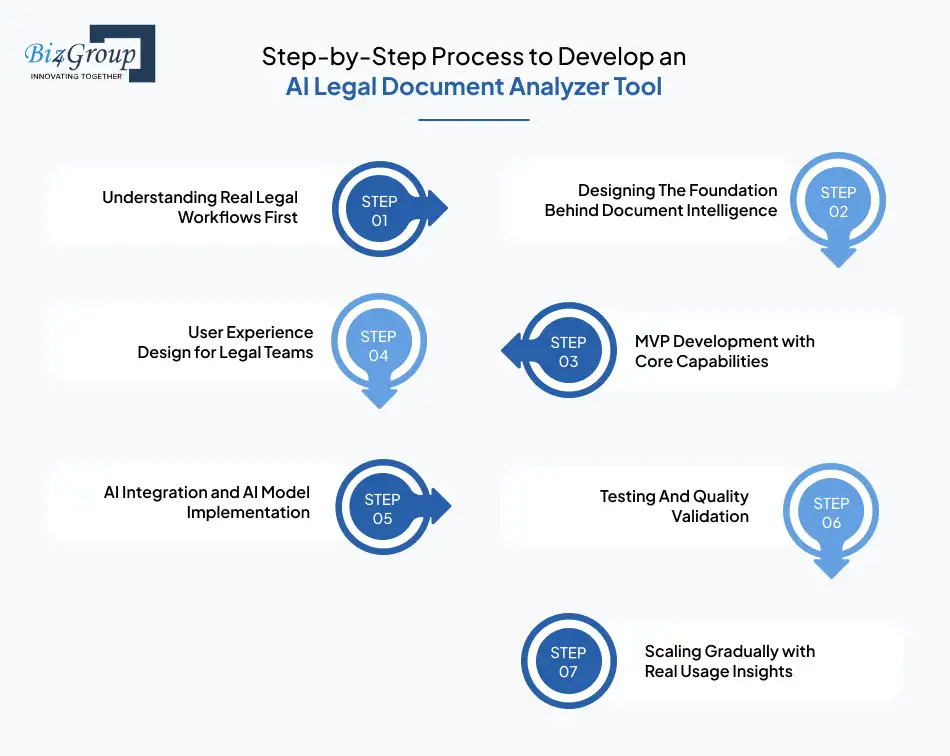
Successful AI legal document analyzer tool development follows a structured path that aligns technology decisions with real legal workflows. A clear process helps organizations reduce risk, validate usability early, and build systems that remain practical as adoption grows.
1. Understanding Real Legal Workflows First
- Workflow Mapping: Understand how legal teams review contracts, identify clauses, and approve documents daily. Mapping real activities prevents building features that look useful but fail during actual legal operations.
- Stakeholder Alignment: Discussions with legal, compliance, and operations teams reveal bottlenecks affecting document handling accuracy. Early clarity ensures development reflects operational expectations rather than assumptions.
- Scope Definition: Defining realistic feature boundaries keeps early development focused. Clear scope helps teams build AI legal document analyzer for law firms without introducing unnecessary complexity during initial phases.
2. Designing The Foundation Behind Document Intelligence
- Data Organization: Documents, clauses, risks, and metadata must follow structured relationships. Proper planning ensures analyzed documents remain searchable and usable as legal repositories expand over time.
- Access Control Planning: Permission layers define who reviews, edits, or approves documents. Structured access supports governance while protecting sensitive agreements handled across departments.
- Scalability Preparation: Early architectural decisions support future expansion. Planning ahead helps organizations build scalable AI legal document analysis tool infrastructure without rebuilding systems when document volume increases.
3. MVP Development with Core Capabilities
- Core Feature Focus: Initial releases prioritize document upload, clause detection, and summaries instead of full-scale automation. MVP software development validates real usage before investing in advanced capabilities.
- Iterative Validation: MVP development allows legal teams to test workflows in controlled environments. Feedback gathered during early usage shapes improvements grounded in real reviewer behavior.
- Adoption Readiness: Early deployment ensures teams become comfortable with automated analysis gradually. This reduces resistance and encourages long-term adoption across legal departments.
Also Read: Top 12+ MVP Development Companies
4. User Experience Design for Legal Teams
- Interface Simplicity: Clear layouts help users analyze documents without technical learning curves. Working with an UI/UX design company ensures reviewers focus on legal decisions instead of navigating complex screens.
- Workflow Continuity: Interfaces mirror familiar legal review processes. Maintaining consistency helps teams transition from manual review to digital workflows without disrupting daily responsibilities.
- Decision Visibility: Dashboards highlight risks, clauses, and summaries clearly. Structured presentation supports faster evaluation and improves confidence during document approvals.
Also Read: Top UI/UX design companies in USA
5. AI Integration and AI Model Implementation
- AI Model Integration: Teams integrate AI models carefully into defined workflows rather than forcing automation everywhere. Controlled implementation ensures analysis enhances legal judgment instead of replacing it.
- Context Training: Trained AI models learn legal language patterns using curated datasets. Continuous refinement improves accuracy as reviewers interact with analyzed documents over time.
- Workflow Alignment: Automation operates alongside human review stages. Balanced integration keeps legal professionals in control while improving efficiency across document-heavy tasks.
Also Read: How to Integrate AI into an App: Process and Cost
6. Testing And Quality Validation
- Scenario Testing: Realistic document scenarios validate clause extraction, summaries, and risk identification accuracy. Testing ensures software performs reliably across diverse legal document structures.
- Performance Validation: Stability checks confirm consistent operation across users and workloads. Many organizations collaborate with a trusted software testing company to verify reliability before deployment.
- Security Checks: Validation ensures sensitive legal data remains protected throughout processing, storage, and access workflows. Strong testing prevents operational risks after launch.
7. Scaling Gradually with Real Usage Insights
- Phased Rollout: Gradual deployment allows teams to monitor adoption patterns and address usability challenges early. Controlled rollout reduces disruption across legal operations.
- Performance Monitoring: Usage insights help refine workflows and improve analysis accuracy continuously. Monitoring ensures the platform evolves alongside changing legal requirements.
- Ongoing Enhancement: Regular updates introduce improvements based on feedback and operational learning, helping the analyzer remain relevant as organizational needs grow.
A structured development journey transforms legal requirements into dependable software systems. Organizations that follow disciplined execution stages develop AI legal document analyzer tools that balance usability, scalability, and accuracy while supporting long-term legal operational efficiency.
You have a vision but unsure where development begins
We help translate legal workflow ideas into structured execution plans that teams can realistically adopt.
Start the ConversationTechnology Stack for AI Legal Document Analyzer System Development
A strong technical foundation ensures your platform handles complex legal documents reliably as usage grows. During AI legal document analyzer tool development, teams depend on thoughtful full stack development choices that support document intelligence, secure processing, and scalable legal workflows.
|
Architecture Layer |
Technology Used |
Purpose |
|---|---|---|
|
Frontend Legal Workspace |
React.js |
Builds responsive dashboards and document viewers through structured ReactJS development, allowing legal teams to review clauses and risks without interface delays. |
|
Server Rendering & Routing |
Next.js |
Improves loading speed and secure navigation using NextJS development, which helps manage large document interfaces and authenticated legal sessions smoothly. |
|
Backend Workflow Engine |
Node.js |
Manages document uploads, permissions, and processing workflows through scalable NodeJS development, ensuring stable handling of concurrent legal review activities. |
|
AI Processing & NLP Layer |
Python (spaCy, Transformers, LangChain) |
Powers clause extraction, summarization, and contextual understanding using python development, enabling accurate interpretation of legal language patterns. |
|
Document Parsing & OCR Layer |
AWS Textract / Azure Document Intelligence + PDFPlumber |
Extracts structured text from scanned contracts and complex PDFs while preserving layout and clause positioning required for legal analysis. |
|
AI Model Orchestration |
LLM APIs + Embedding Pipelines |
Helps integrate AI models that analyze legal context, generate summaries, and support intelligent document queries using trained legal datasets. |
|
Semantic Search & Retrieval |
Vector Database (Pinecone / pgvector) + Elasticsearch |
Enables contextual search across agreements, allowing users to locate obligations or clauses beyond simple keyword matching. |
|
Secure Document Storage |
AWS S3 with KMS Encryption |
Stores sensitive contracts securely while maintaining encrypted access and version tracking aligned with legal compliance expectations. |
|
Data & Metadata Database |
PostgreSQL |
Maintains structured information such as clauses, document history, approvals, and user activity required for legal governance. |
|
Integration & Communication Layer |
REST / GraphQL APIs |
Supports secure system connectivity through structured API development, allowing integration with contract lifecycle, compliance, or enterprise tools. |
|
Background Processing & Queues |
RabbitMQ / Temporal |
Handles asynchronous tasks like document ingestion and large-scale analysis without slowing user interactions. |
|
Monitoring & Audit Logging |
Prometheus, Grafana, OpenTelemetry |
Tracks performance, processing accuracy, and user actions to maintain operational transparency required in regulated legal environments. |
A refined technology stack helps organizations develop enterprise grade AI legal document analyzer platform solutions that remain reliable under real legal workloads. Well-aligned infrastructure also supports custom AI legal document analyzer software growth alongside broader web development and mobile app development initiatives.
Security and Compliance Requirements for AI Legal Document Analyzer Development
Security becomes a foundational requirement once organizations move into AI legal document analyzer tool development. Legal documents contain sensitive obligations and confidential data, so protection measures must be built into the system from the beginning rather than added later.
1. Protecting Legal Data Through Encryption
Legal platforms handle contracts, agreements, and regulatory documents that require strict confidentiality. Strong data protection ensures information remains secure during upload, processing, and storage.
Key practices include:
- Encrypting documents both during transfer and while stored in databases
- Securing file access through authenticated sessions instead of public links
- Preventing unauthorized downloads or data exposure through permission controls
- Using managed encryption keys to maintain ownership over sensitive legal information
These controls help organizations maintain trust while ensuring documents remain protected throughout analysis workflows.
2. Structured Access Control Across Legal Roles
Not every user should see or modify every legal document. Access structures must reflect organizational responsibilities and approval hierarchies.
Effective permission management typically involves:
- Defining access levels for legal teams, executives, and operational users
- Restricting editing or approval rights based on organizational roles
- Maintaining controlled visibility for confidential agreements
- Recording access activity to prevent misuse or accidental exposure
Many organizations implementing AI legal document analyzer development services design permissions early to avoid governance issues after adoption grows.
3. Meeting Regulatory and Legal Compliance Expectations
Legal technology must align with regulatory expectations across jurisdictions where organizations operate. Compliance is not only a legal obligation but also a requirement for enterprise adoption.
Important compliance considerations include:
- Supporting data privacy regulations such as GDPR or regional privacy frameworks
- Maintaining audit-ready document handling practices
- Ensuring secure retention and deletion policies for legal records
- Providing traceability for document analysis decisions when required
Teams often involve AI consulting services during planning stages to ensure compliance requirements are reflected directly within system architecture.
4. Securing AI Models During Legal Analysis
AI models processing legal documents must operate within controlled environments. Security risks often emerge when training data or model behavior lacks oversight.
Responsible implementation focuses on:
- Preventing sensitive documents from being reused as uncontrolled training data
- Isolating processing environments for confidential legal analysis
- Monitoring outputs to avoid unintended data exposure
- Maintaining transparency around how models interpret legal content
Organizations investing in AI model development establish governance rules that define how models learn and interact with legal datasets safely.
5. Maintaining Auditability Across Legal Workflows
Legal operations require clear visibility into who accessed documents and how decisions were made. Auditability ensures accountability across automated workflows.
Strong monitoring practices include:
- Tracking document uploads, edits, and analysis actions
- Maintaining version history for agreements and revisions
- Logging system activity for compliance verification
- Generating audit trails that support internal or regulatory reviews
These capabilities help organizations create AI powered legal document analyzer platforms that remain dependable in regulated environments where accountability is essential.
Security and compliance define the long-term success of legal technology platforms. Organizations that embed governance, protection, and monitoring into development foundations build systems that safeguard sensitive information while supporting confident and scalable legal operations.
Security shouldn't be an afterthought
Let's evaluate how your platform can protect legal data while staying compliant from day one.
Discuss Your RequirementsCost Breakdown for AI Legal Document Analyzer Tool Development
The investment expectations help organizations plan realistically before starting AI legal document analyzer tool development. Depending on scope, complexity, and intelligence level, overall development costs typically range between $30,000 and $200,000+ for enterprise-ready legal platforms.
|
Development Level |
Estimated Cost Range |
What This Typically Covers |
|---|---|---|
|
MVP Level AI Legal Document Analyzer Tool |
$30,000 – $60,000 |
Core document upload, clause detection, summaries, basic dashboards, and limited workflow automation suitable for early validation and controlled internal adoption. |
|
Mid-Level AI Legal Document Analyzer Tool |
$60,000 – $120,000 |
Advanced document analysis, workflow management, integrations with internal systems, improved search capabilities, and stronger security controls supporting growing operational usage. |
|
Advanced Level AI Legal Document Analyzer Tool |
$120,000 – $200,000+ |
Enterprise scalability, intelligent risk detection, automation workflows, analytics dashboards, compliance features, and infrastructure designed for large document ecosystems. |
Cost expectations become clearer once businesses understand what drives development complexity.
What Actually Shapes Development Investment
- Document complexity directly impacts development effort. Highly structured agreements require less processing logic, while diverse contract formats demand additional parsing, validation workflows, and testing across multiple real legal scenarios.
- AI capability depth influences pricing significantly. Basic automation costs less, whereas advanced intelligence requires training workflows, evaluation cycles, and higher AI integrations costs across analysis pipelines.
- Integration requirements increase development scope. Connecting legal analyzers with procurement systems, compliance tools, or enterprise platforms adds coordination effort and expands overall implementation timelines.
- Security and compliance expectations affect architecture planning. Strong governance, audit tracking, and encrypted storage introduce additional development layers necessary for enterprise legal environments handling sensitive contractual data.
- Data preparation effort plays a major role in custom AI legal document analyzer development. Cleaning, structuring, and validating legal datasets requires time before meaningful automation results can be achieved.
Once cost drivers are understood, teams can focus on controlling investment without limiting long-term value.
Practical Ways to Control Development Spending
- Start With MVP Scope: Launching with essential document analysis capabilities reduces early investment risk. Teams validate workflows first before expanding automation, helping manage the cost to build AI software more predictably over time.
- Prioritize High Impact Features: Focus development around workflows that consume the most legal effort. Targeted automation delivers measurable value early without increasing unnecessary feature complexity.
- Use Scalable Architecture Early: Planning infrastructure for gradual growth prevents expensive rebuilds later. Early architectural discipline supports smoother AI legal document analyzer system development as adoption expands.
- Leverage Existing Data Sources: Using available contracts and internal repositories accelerates training readiness. Reduced data preparation effort shortens development timelines while improving system relevance from initial deployment stages.
- Iterate Through Real Usage: Continuous improvements based on legal team feedback prevent overbuilding. Incremental releases help organizations refine functionality while controlling long-term development expenses.
Development cost reflects how deeply organizations want automation embedded into legal operations. Businesses that align investment with workflow priorities build sustainable platforms that deliver measurable efficiency without creating unnecessary technical or financial complexity.
Also Read: How Much Does It Cost to Build a Legal AI Chatbot?
Monetization Models for AI Legal Document Analyzer Platforms
Revenue planning becomes important once organizations move beyond AI legal document analyzer tool development and begin positioning the platform as a scalable product. Monetization strategies should align with how legal teams actually use document analysis in daily operations.
1. Subscription-Based Access Model
Many platforms generate predictable revenue through recurring subscriptions. Legal teams prefer stable pricing because document review remains an ongoing operational activity rather than a one-time requirement. Common subscription structures include:
- Monthly or annual pricing based on number of users
- Tiered plans aligned with feature access levels
- Enterprise licensing for organization-wide adoption
- Usage limits tied to document volume or storage capacity
This model works well for businesses planning to develop enterprise grade AI legal document analyzer platform solutions serving long-term clients.
2. Usage-Based Pricing Structure
Some organizations monetize based on how frequently the system processes documents. This approach aligns pricing with actual value delivered during document analysis. Typical usage metrics may include:
- Number of documents analyzed per month
- Volume of pages processed through the platform
- AI processing requests generated by users
- Advanced analysis actions such as risk evaluation or summaries
Usage-based pricing helps customers start small while scaling investment alongside operational growth.
3. Enterprise Licensing Model
Large organizations often prefer negotiated licensing agreements instead of standard pricing plans. Enterprise contracts provide flexibility while supporting large-scale adoption across departments. Enterprise licensing usually involves:
- Custom pricing based on organizational size
- Dedicated infrastructure or private deployment environments
- Advanced security and governance configurations
- Priority support and onboarding assistance
This model is commonly adopted when offering custom AI legal document analyzer software tailored to complex legal ecosystems.
4. Feature-Based Premium Add-Ons
Platforms can introduce additional revenue streams by offering advanced capabilities as optional upgrades rather than including everything in the base product. Examples of premium add-ons include:
- Advanced analytics dashboards
- Compliance monitoring features
- Automated reporting tools
- Integration capabilities with enterprise systems
This structure allows businesses to maintain accessible entry pricing while monetizing advanced functionality separately.
5. White-Label Deployment Opportunities
Some companies monetize by allowing partners or legal service providers to deploy the platform under their own brand identity. This expands market reach without direct customer acquisition costs. White-label monetization often includes:
- Custom branding and interface configuration
- Partner-managed client onboarding
- Revenue sharing or licensing agreements
- Deployment support for regional markets or niche legal sectors
This approach works particularly well for organizations building platforms intended for broader industry distribution.
Effective monetization reflects how legal teams derive value from document intelligence over time. Platforms that align pricing with real usage patterns create sustainable revenue streams while supporting long-term adoption across evolving legal operations.
Also Read: 65+ Software Ideas for Entrepreneurs and Small Businesses
Great product idea, but how will it generate real revenue?
We help align platform capabilities with pricing models that support sustainable growth.
Plan Your Monetization StrategyChallenges Businesses Face When Developing AI Legal Document Analysis Platforms
Organizations entering AI legal document analyzer tool development often discover that the real difficulty lies in aligning technology with legal workflows. Success depends on addressing operational realities early rather than treating development as a purely technical initiative.
|
Challenge |
Solution |
|---|---|
|
Legal documents lack consistent formatting across departments and jurisdictions. |
Establish standardized document ingestion rules and train systems gradually using curated legal datasets to improve analysis accuracy over time. |
|
Poorly structured historical contracts reduce automation reliability during legal document analysis AI software development. |
Clean and categorize legacy documents before implementation so the platform learns from reliable and well-organized legal content. |
|
Legal teams struggle to trust automated outputs during early adoption stages. |
Design workflows where automation supports review decisions, similar to an AI assistant app that enhances professional judgment instead of replacing it. |
|
Expectations for immediate accuracy create pressure on early platform versions. |
Introduce phased releases with human validation loops that allow continuous improvement while maintaining confidence in analysis results. |
|
AI Integration with existing enterprise tools becomes more complex than expected. |
Plan AI integrations early and prioritize essential system connections before expanding into broader organizational workflows. |
|
Security and compliance requirements increase development effort unexpectedly. |
Build governance, access control, and audit tracking into architecture from the beginning rather than adding protections after deployment. |
|
Scaling document processing causes performance slowdowns as adoption grows. |
Use scalable infrastructure and background processing workflows designed to handle increasing document volume efficiently. |
|
Misalignment between software design and daily legal workflows reduces usage. |
Involve legal stakeholders throughout development to ensure the platform reflects real review behavior and practical operational needs. |
Challenges during development often reveal gaps between technology assumptions and legal reality. Organizations that address workflow behavior, data readiness, and adoption expectations early build platforms that evolve into dependable systems for ongoing legal operations.
How to Choose the Right Team for AI Legal Document Analyzer Tool Development
The success of AI legal document analyzer tool development depends heavily on the people building it. A capable team understands legal workflows, practical software execution, and long-term scalability instead of focusing only on technical delivery.
1. Proven Understanding of Legal Workflows
A strong development team recognizes that legal software must reflect how professionals actually review documents. Without workflow awareness, even well-built platforms struggle with adoption.
Look for teams that:
- Demonstrate experience working with contract-heavy or compliance-driven systems
- Understand clause review, approvals, and document lifecycle processes
- Ask operational questions before proposing technical solutions
- Translate legal requirements into practical system behavior
Teams familiar with legal environments build AI tool for legal document review platforms that feel natural rather than disruptive.
2. Practical Experience with AI Product Development
Experience matters more than theoretical knowledge when building document intelligence platforms. Real-world delivery shows whether a team can handle evolving requirements and iterative improvements.
Indicators of strong capability include:
- Delivered AI-driven platforms used in production environments
- Clear explanation of development stages and validation processes
- Ability to demonstrate measurable outcomes from past projects
- Structured collaboration between engineers, designers, and analysts
Working with an experienced AI product development company often reduces risk because proven delivery practices guide project execution.
3. Ability To Translate Business Goals into Product Decisions
Legal technology must solve operational problems, not just introduce automation. The right team connects development decisions with measurable business outcomes.
The team you choose should be able to:
- Align feature planning with efficiency or risk management goals
- Recommend phased releases instead of building everything at once
- Prioritize usability alongside system intelligence
- Focus on long-term product sustainability rather than short-term delivery
This alignment ensures organizations can develop AI contract and legal document analyzer platforms that support real decision-making workflows.
4. Transparent Communication And Collaborative Process
Clear communication prevents misunderstandings during development. Legal stakeholders often come from non-technical backgrounds, so collaboration must remain simple and structured.
Effective teams typically:
- Provide regular progress updates in understandable language
- Involve stakeholders during validation and feedback cycles
- Explain trade-offs without technical complexity
- Maintain consistent project visibility across stages
Strong communication builds confidence and helps teams adapt quickly as requirements evolve.
5. Long-Term Support and Product Evolution Capability
Legal platforms continue evolving after launch. Regulations change, document types expand, and workflows mature over time.
Reliable partners demonstrate readiness to:
- Provide ongoing improvements and performance optimization
- Support scaling as document volume increases
- Introduce enhancements based on real usage insights
- Maintain stability during future upgrades
Long-term collaboration ensures the platform remains useful as organizational legal operations grow.
The right AI development company contributes far beyond coding expertise. Organizations that prioritize workflow understanding, communication clarity, and long-term product thinking build legal analysis platforms that remain effective, adaptable, and aligned with evolving business needs.
The right team changes everything. Are you asking the right questions yet?
Let's talk through your goals and help you validate the development path before you move forward.
Connect with UsWhy Choose Biz4Group for AI Legal Document Analyzer Tool Development
When organizations begin AI legal document analyzer tool development, the real priority is working with a team that understands how legal operations function in practice. Biz4Group LLC’s focus remains on building systems that align with real workflows rather than introducing unnecessary complexity.
- As a legal software development company, we design platforms around how legal teams review, manage, and evaluate documents within evolving legal Tech
- Our work in AI legal document analyzer tool development for businesses centers on supporting contract-heavy operations where accuracy, consistency, and usability directly influence daily execution.
- We approach automation carefully, ensuring solutions such as a legal AI agent assist professionals by simplifying analysis while keeping decision control firmly with legal teams.
- Our delivery experience reflects standards expected from teams often recognized among top AI development companies in Florida working on enterprise-grade software initiatives.
- We maintain a transparent portfolio so organizations can understand how similar platforms progressed from early concepts into dependable operational systems.
- Emphasis remains on structured execution, usability, and workflow alignment instead of feature expansion that can complicate adoption for legal teams.
- We work collaboratively throughout development, allowing feedback to shape the platform as legal processes evolve and operational needs expand over time.
Portfolio Spotlight: PDF Consultant AI

Here’s a practical example of how these principles translate into an actual document intelligence platform by Biz4Group LLC:
- PDF Consultant AI is a document analysis platform built to help professionals work through lengthy PDFs without manual scanning.
- The system allows users to upload complex documents, ask contextual questions, and receive precise answers grounded in the file content.
- Instead of replacing workflows, the solution improves how users interact with information, reflecting the same structured approach required when developing legal document analyzer platforms.
Biz4Group LLC believes successful legal platforms emerge through collaboration, practical understanding, and disciplined execution. By aligning development decisions with real operational needs, we help organizations build systems that remain valuable long after initial deployment.
Wrapping Up
AI legal document analyzer tool development is no longer only about automation. It reflects how organizations rethink legal work itself. When built thoughtfully, these platforms reduce review friction and help teams focus on judgment instead of repetitive reading. Working with an experienced software development company in Florida often helps translate operational needs into systems that remain usable long after launch.
Finding the best company to develop AI legal document analyzer tool means looking beyond features and timelines. The real value comes from teams that understand how legal workflows evolve, and design solutions that adapt alongside business growth and regulatory change.
Organizations that plan carefully can build scalable AI legal document analysis tool platforms that grow with document complexity rather than becoming another disconnected system. If you are evaluating how this fits into your legal operations, we can talk through your goals and help you define a practical path forward.
FAQ's
1. What is involved in AI legal document analyzer tool development for businesses?
AI legal document analyzer tool development typically includes workflow analysis, document processing setup, clause identification capabilities, security planning, and system integration to ensure the platform supports real legal review and compliance operations.
2. How long does it take to develop an AI legal document analyzer tool?
The timeline depends on complexity and scope. A basic platform may take a few months, while enterprise-level AI Legal Document Analyzer System Development can extend longer due to integrations, compliance requirements, and advanced document intelligence capabilities.
3. What features should businesses prioritize when they build AI legal document analysis software?
Organizations usually focus on clause detection, document summarization, risk identification, searchable repositories, and workflow automation. These features help teams build AI tool for legal document review platforms that improve consistency without disrupting existing legal processes.
4. How does custom AI legal document analyzer development differ from ready-made solutions?
Custom AI legal document analyzer development allows organizations to align analysis logic with internal policies, approval workflows, and compliance standards, while off-the-shelf tools typically follow generalized document evaluation models.
5. What technologies are commonly used in legal document analysis AI software development?
Most platforms combine document parsing tools, natural language processing models, secure cloud infrastructure, and search systems to create AI powered legal document analyzer solutions capable of handling large volumes of contracts and agreements.
6. How do organizations build scalable AI legal document analysis tool platforms for long-term use?
Scalability comes from structured architecture, phased deployment, secure data handling, and continuous improvement based on legal team feedback. This approach helps organizations develop enterprise grade AI legal document analyzer platform solutions that grow alongside business operations.
