 Location :
Orlando, FL, USA
Location :
Orlando, FL, USA +1 (407) 714-1616
 info@biz4group.com

- Generative AI development companies in the Canada are helping businesses move beyond experiments and build intelligent systems that support real operations at scale.
- These partners design solutions that automate workflows, improve decision-making, personalize user experiences, and make complex processes easier to manage.
- When evaluating generative AI development companies, organizations should look closely at technical depth, governance practices, and proven experience working with enterprise systems.
- It is also important to choose partners who provide clear delivery models, long-term support, and the ability to evolve AI capabilities over time.
- Biz4Group LLC emphasizes production-ready generative AI architectures that integrate with enterprise data, follow governance standards, and support long-term scalability and optimization.
The businesses across the Canada are looking at technology differently today. Digital systems no longer support tools, rather they drive productivity, customer experience, and operational stability. In this environment, generative AI has become one of the most important capabilities under evaluation.
According to McKinsey’s The State of AI global survey, 78 percent of organizations now report using generative AI in at least one business function, a figure that demonstrates how widespread adoption has become across industries. Companies now expect generative AI to help them:
- streamline workflows and reduce manual effort
- support data-driven decision making
- personalize digital experiences at scale
- improve operational visibility across departments
This shift also changes how leaders think about implementation. Instead of asking whether AI is relevant, U.S. organizations want partners who understand risk, governance, performance, and long-term integration. Working with experienced Generative AI Development Companies in the Canada helps ensure systems are built for scalability instead of short-term experimentation.
This guide highlights market trends, selection criteria, and the Top generative AI development companies in the Canada that are helping organizations adopt it responsibly. It is designed to support executives, founders, and technology leaders who want straightforward guidance as they plan their next phase of digital transformation.
Why US-Based Generative AI Development Companies Lead?
When U.S. organizations evaluate partners for generative AI adoption, many prefer working with firms headquartered within the country. As generative AI moves deeper into core business workflows, leaders prioritize partners that can operate within established governance frameworks while supporting scale and long-term reliability.
According to Grand View Research, the global generative AI market is projected to grow at a CAGR of over 40%, reaching more than USD 300 billion by the early 2030s. This rapid expansion reflects how quickly generative AI is transitioning from experimental pilots into production systems that support real operational use cases.
For many decision-makers, partnering with experienced Generative AI Development Companies in the Canada offers clear advantages:
- stronger alignment with U.S. compliance expectations and data privacy controls
- proven experience integrating generative AI with enterprise systems and cloud environments
- predictable delivery models supported by governed engineering standards
- faster collaboration cycles enabled by shared work culture and time-zone alignment
- clearer intellectual property protection under U.S. commercial frameworks
These strengths become essential as generative AI platforms are expected to scale, support regulated data, and remain reliable under increasing workloads. When AI systems begin influencing business decisions, customer interactions, and internal operations, organizations look beyond experimentation and focus on production-ready environments.
Build AI With Enterprise-Grade Standards
Work with Generative AI Development Companies in the Canada that understand compliance, IP protection, and real-world delivery.
Explore AI Partnership OptionsThe Rise of Generative AI in the Canada
Generative AI has accelerated rapidly across the country because American businesses now view it as a strategic capability rather than a short-term experiment. As adoption increases, more leaders are evaluating Generative AI Development Companies in the Canada to support long-term implementation instead of running isolated pilots.
1. Rapid adoption across industries
Generative AI is now used in healthcare, financial services, retail, logistics, manufacturing, and technology. Research shows that U.S. companies see generative AI as essential to digital transformation, not an optional innovation.
2. Innovation supported by a strong technology ecosystem
The Canada has one of the most advanced generative AI innovation environments in the world. Continuous breakthroughs from research labs, universities, and enterprise technology firms make it easier for organizations to move from prototype to production.
3. Clear productivity gains drive executive confidence
Generative AI adoption increased because the benefits are measurable. Teams automate repetitive documentation, accelerate research, draft content faster, and resolve internal queries with less manual effort.
4. Growing comfort with generative AI-powered workflows
Employees across different departments are becoming comfortable working alongside AI tools. Generative features are now embedded into platforms they use daily, which reduces resistance and increases usage.
5. Shift from pilots to production systems
Most organizations begin with small pilot projects. Once they see measurable success, they scale those solutions into real production environments. This transition often leads businesses to partner with experienced companies that specialize in building scalable, secure generative AI platforms capable of operating inside enterprise environments:
6. Generative AI increasingly embedded into business applications
Rather than building standalone tools, product and engineering teams now focus on how to integrate AI into existing applications to enhance features, automate processes, and improve user experiences without replacing core systems:
7. Rising focus on model quality and governance
As adoption expands, organizations are placing greater emphasis on accuracy, reliability, and responsibility for generative AI usage. Many teams invest in structured AI model development practices to ensure models are trained, governed, and monitored properly:
Therefore, the rise of generative AI in Canada is driven by outcomes. Businesses adopt it because it reduces effort, speeds work and improves decision quality. The role of Generative AI Development Companies in the Canada becomes increasingly important, not just to build tools, but to ensure those tools operate safely, responsibly, and at enterprise scale.
Also Read: Top 12 Generative AI Use Cases Transforming Modern Businesses
Find Practical AI Use Cases for Your Business
Identify automation, personalization, and decision-support opportunities that actually move the needle.
Discover My AI OpportunitiesEvaluation Criteria for the Top Generative AI Development Companies in Canada
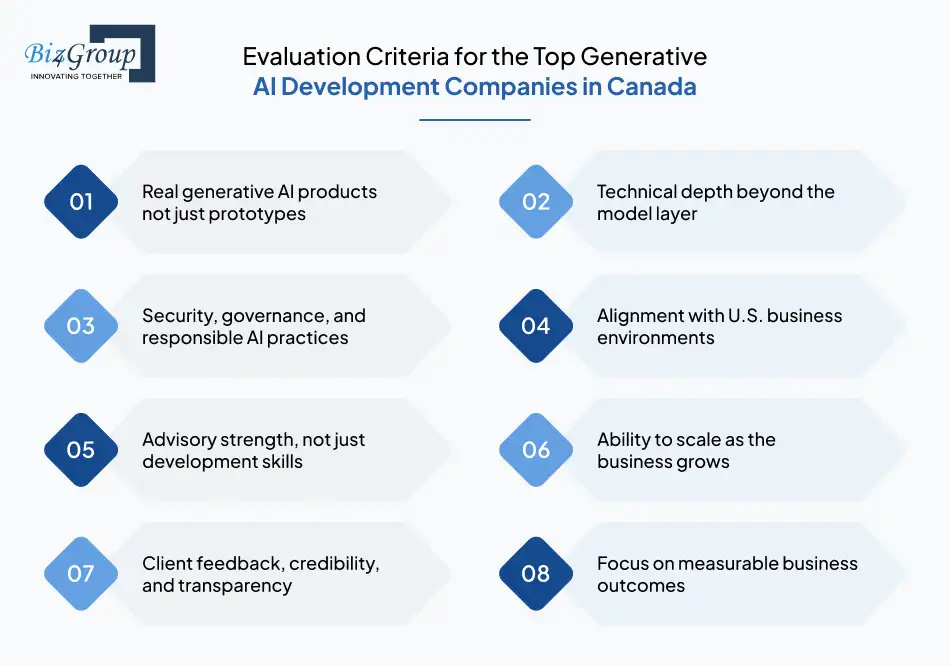
When ranking the Top Generative AI Development Companies in Canada, we focused on one simple question:
Which partners are most capable of delivering real, secure, scalable business outcomes, not just experiments?
To answer that, we used a structured evaluation framework designed for executives, innovation leaders, and decision-makers who expect accountability from technology partners. Every company was reviewed against the criteria below:
1. Real generative AI products not just prototypes
We prioritized companies with working, production-ready generative AI solutions, not only research demos. We assessed:
- evidence of live deployments
- documented case studies
- real customer outcomes
- diverse use cases across industries
Companies that consistently moved projects from concept to functioning systems ranked higher than those still in experimental stages.
Also Read: How to Build a Generative AI Solution from Designing to Deployment?
2. Technical depth beyond the model layer
Successful generative AI requires strong foundations, data management, application architecture, integrations, and scalability. We evaluated whether firms demonstrated depth in:
- LLMs integration and customization
- secure and governed data pipelines
- resilient application architecture
- performance optimization
- scalable cloud environments
Partners with capability across the entire stack show maturity and readiness for enterprise-grade work. For context, firms that manage the full lifecycle of generative AI delivery from planning through deployment demonstrate the operational strength expected from a seasoned AI development company.
3. Security, governance, and responsible AI practices
Generative AI can introduce risk if deployed without structure. We reviewed how each company handles:
- data security and encryption controls
- user access governance
- model monitoring and auditability
- compliance awareness (SOC 2, HIPAA, GDPR where relevant
4. Alignment with U.S. business environments
We prioritized partners who understand how American enterprises operate, including:
- transparency in contracts and IP ownership
- realistic SLAs and long-term support expectations
- industry-specific regulatory considerations
- enterprise procurement processes
This alignment is a key trait of leading generative AI firms in the Canada, they build solutions designed for real operational environments, not theoretical use cases.
5. Advisory strength, not just development skills
Strong generative AI programs begin with strategy, not code. We assessed whether companies provide consultative support such as:
- identifying high-impact generative AI opportunities
- feasibility and risk assessments
- roadmap development
- internal adoption guidance
Firms that combine execution with guidance help organizations implement generative AI more responsibly and successfully, which is why many rely on experienced AI consulting services during planning.
6. Ability to scale as the business grows
We evaluated whether each company could support scaling generative AI systems over time by reviewing:
- architecture designed for growth
- reliable sprint and delivery frameworks
- post-launch optimization and enhancements
- capacity to handle larger workloads and user bases
This capability matters when choosing Generative AI development service providers in Canada who must remain relevant beyond the first release.
7. Client feedback, credibility, and transparency
We analyzed public reviews, testimonials, and references, focusing on recurring themes like:
- communication clarity
- reliability and responsiveness
- delivery consistency
- honesty about technical challenges
Companies trusted for collaboration and accountability scored higher than firms known mainly for marketing claims.
8. Focus on measurable business outcomes
Finally, we favored companies that treat generative AI as strategic business drivers and not just a technical project. We ranked partners higher when they:
- connected generative AI to revenue enablement
- improved operational efficiency
- increased workforce productivity
- helped leadership measure ROI transparently
This reflects how U.S. organizations evaluate technology investments.
Also Read: How to Build a Generative AI Solution from Designing to Deployment
Shortlist Trusted generative AI Development Partners
Compare providers based on governance, scalability, and measurable ROI — not hype.
Build My Vendor ShortlistTop 10 Generative AI Development Companies in Canada in 2026
Generative AI is starting to shape core business systems, which means choosing the right partner matters more than ever. Some vendors build quick demos, while others understand security, governance, reliability, and how AI should scale over time.
The ones featured here are the Top-rated generative AI companies in the Canada that have delivered working, real-world solutions. Each of these brings a different strength from automation and personalization to enterprise-grade architecture. This overview helps leaders see where they fit, and which partner is likely to support their long-term roadmap.
|
Company name |
Hourly Rate |
Core focus |
Best fit for |
|---|---|---|---|
|
Biz4Group LLC |
$50-$99/hr |
Generative AI assistants, enterprise knowledge platforms, workflow automation |
Businesses building secure, scalable, production-ready generative AI systems |
|
DevFortress |
$50–99/hr |
AI-driven knowledge management, RAG, GenAI system integration |
Regulated teams moving GenAI from pilot to production |
|
Pieoneers |
$100–149/hr |
LLM-based product features, conversational interfaces, GenAI APIs |
Product teams embedding GenAI into live applications |
|
Massive Insights |
Custom |
Custom AI agents for decision workflows and analysis |
Data-heavy organizations needing agent-driven GenAI |
|
Dedicatted |
$50–99/hr |
AI copilots, agentic GenAI, LLM orchestration |
Enterprises building copilots and agent workflows |
|
Wizard Labs |
$100–149/hr |
LLM fine-tuning and constrained generative AI use cases |
Teams needing precise, task-bound GenAI behavior |
|
Synergy Labs |
$50–99/hr |
LLM-driven assistants embedded in applications |
Companies adding GenAI features during product build |
|
Architech |
$50–99/hr |
Text generation and conversational AI in applications |
Enterprises embedding GenAI into existing platforms |
|
Cloudnonic Corp. |
$25–49/hr |
Generative AI within custom software projects |
Cost-sensitive teams adding basic GenAI features |
|
Datarockets |
$50–99/hr |
Language-based generative AI in software products |
Product companies building text-driven GenAI features |
1. Biz4Group LLC
Website: https://www.biz4group.com/
Headquarters: Canada
Hourly Rate: $50 - $99/hr
Minimum Project Size: USD 10,000+
Clutch Review: 4.9/5
Biz4Group LLC is recognized as one of the top generative AI development company in the Canada, serving organizations that want production-ready AI systems rather than short-term experiments. The company blends strong engineering discipline with business-focused strategy, helping teams adopt AI responsibly, securely, and at scale.
Services: Biz4Group delivers a broad ecosystem of generative AI and software capabilities, including:
- Development of custom LLM-powered applications using GPT-based and open-source models
- Design and deployment of generative AI chatbots and virtual assistants for customer support and internal operations
- Implementation of RAG-based knowledge systems that connect LLMs with enterprise data sources
- Integration of generative AI into existing web, mobile, and cloud platforms
This makes them a strong fit for organizations that need both consulting guidance and hands-on implementation from the same partner.
Industries Served:
We have applied AI where it directly improves operations. Below are industries they actively support, along with real projects that demonstrate execution maturity.
- Insurance: Insurance teams depend on accuracy and fast access to policy knowledge. We build AI systems that help agents retrieve contextual answers quickly instead of relying solely on manuals or supervisors.
Example: Insurance AI
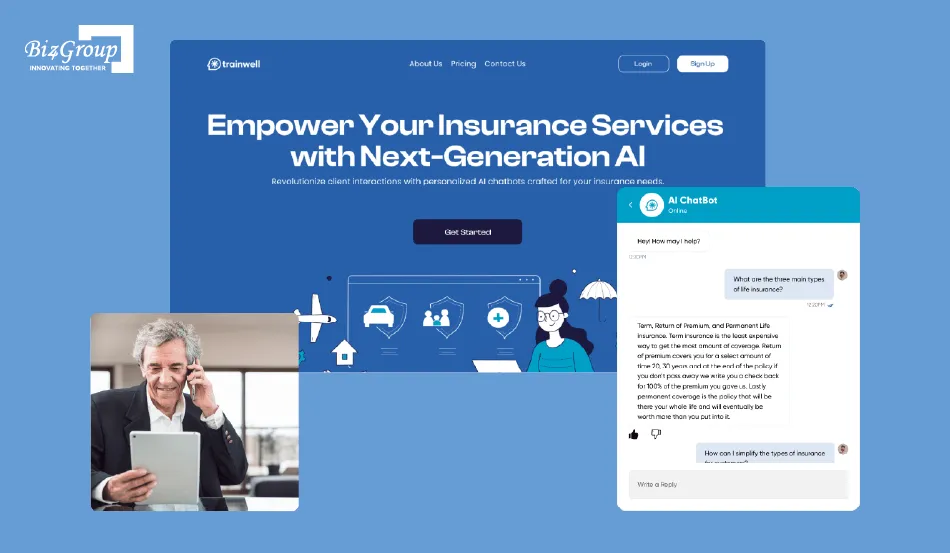
- The Insurance AI uses generative AI to support insurance agents with instant, context-aware responses during training and daily operations. Built on large language models, the system understands complex policy documentation and delivers accurate answers through a conversational interface.
- By reducing dependence on manual training and improving knowledge access, the solution streamlines agent onboarding, enhances productivity, and ensures consistent, up-to-date information across insurance workflows.
- Healthcare & Wellness: Healthcare and wellness organizations often struggle to translate complex biological data into guidance that people can understand. We at Biz4Group LLC develop systems that support personalization and engagement on a scale.
Example 1: Dr. Ara

- The DR•ARA solution uses generative AI to automate medical record summarization and enhance clinical decision support. By processing unstructured clinical data, the system generates concise diagnostic summaries and actionable insights, reducing manual review time for healthcare professionals.
- Its AI-powered interface supports more efficient patient assessments and care coordination. The use of LLMs enables accurate extraction and contextual interpretation of complex medical information.
Example 2: Truman
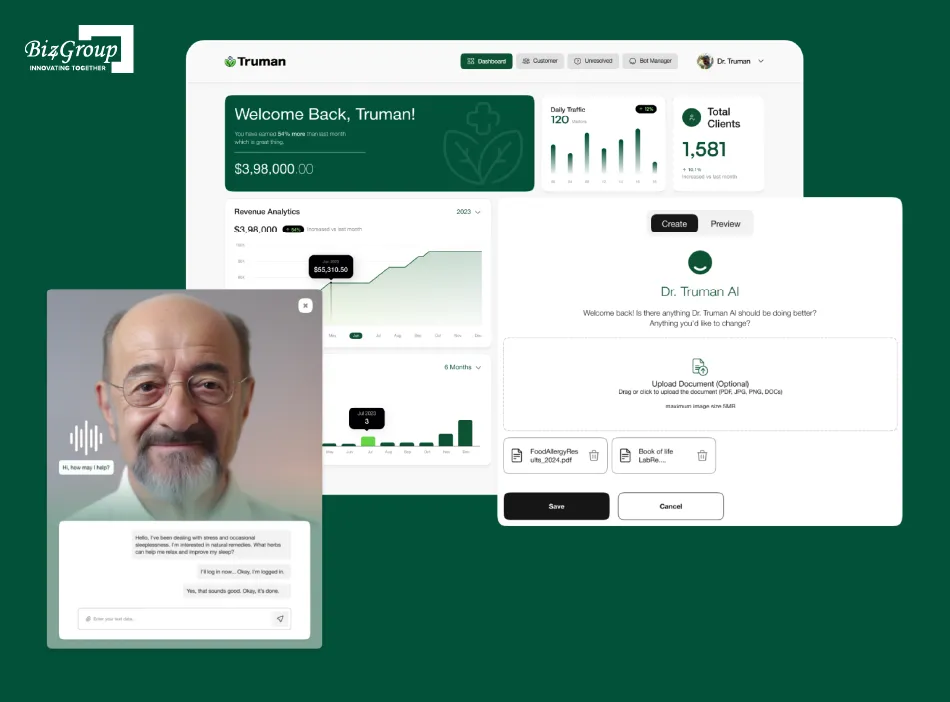
- Generative AI was used to build an intelligent conversational assistant that understands user queries and provides accurate, context-aware responses within the platform.
- The system integrates large language models to automate routine interactions, guide users through tasks, and deliver personalized recommendations.
- By embedding generative AI into the interface, the solution enhances user engagement, reduces manual support overhead, and enables real-time, dynamic communication tailored to individual needs.
- Real Estate: Real estate decisions rely heavily on conversations, context, and timing. Biz4Group LLC creates AI-powered assistants that function like digital guides through the buying journey.
Example: Homer AI
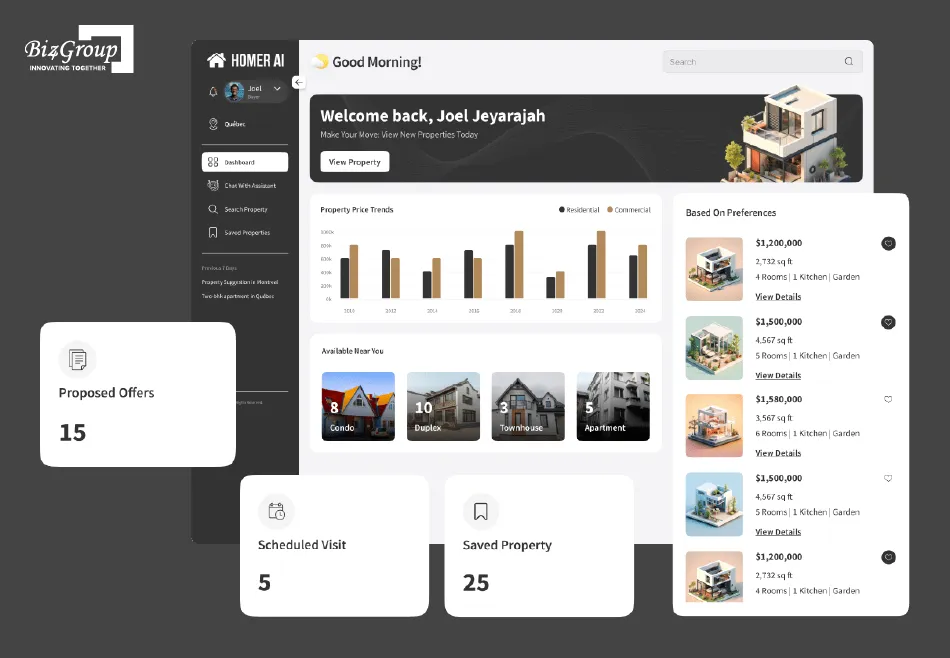
- The platform integrates large language models to power an AI assistant that understands natural language prompts and generates relevant, personalized outputs. Generative AI is embedded into the core workflow to automate content creation, interpret user intent, and deliver real-time responses.
- This integration reduces manual effort, enables faster ideation, and supports consistent, high-quality output by allowing users to interact with the system conversationally while leveraging AI-driven text generation capabilities.
- Judiciary & Legal: Courts operate within demanding schedules and complex documentation systems. At our organization we build AI-enabled platforms that bring structure and automation to everyday operations.
Example: Court Calendar
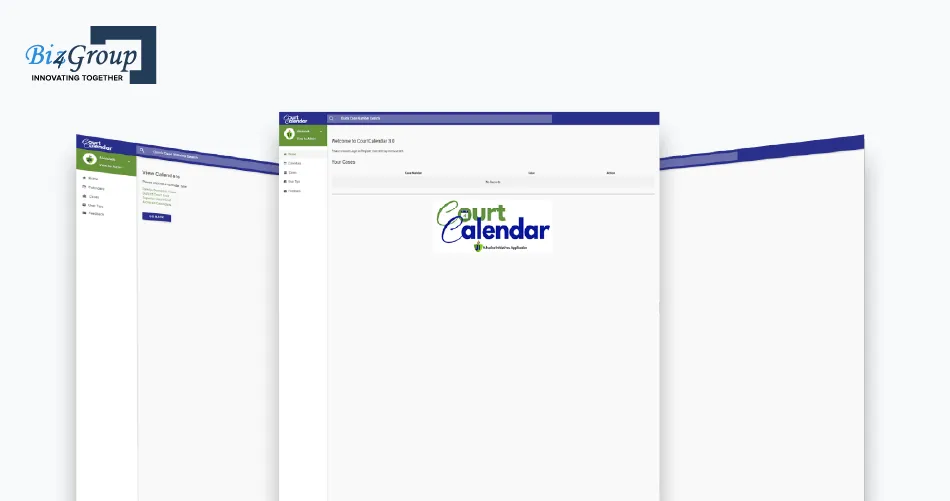
- It incorporates generative AI to automate extraction and summarize legal text and data from court schedules and related documents. By leveraging large language models, the system interprets natural language content, generates concise summaries, and provides contextual insights for users.
- This integration reduces manual review effort, enhances searchability of legal information, and supports efficient calendar management by transforming unstructured legal content into structured, actionable outputs.
- Management and HR: Recruitment teams face data overload. Biz4Group LLC develops AI-assisted tools that analyze resumes, summarize candidate information, and route applicants through hiring workflows, making evaluation more consistent and efficient.
Example: DrHR
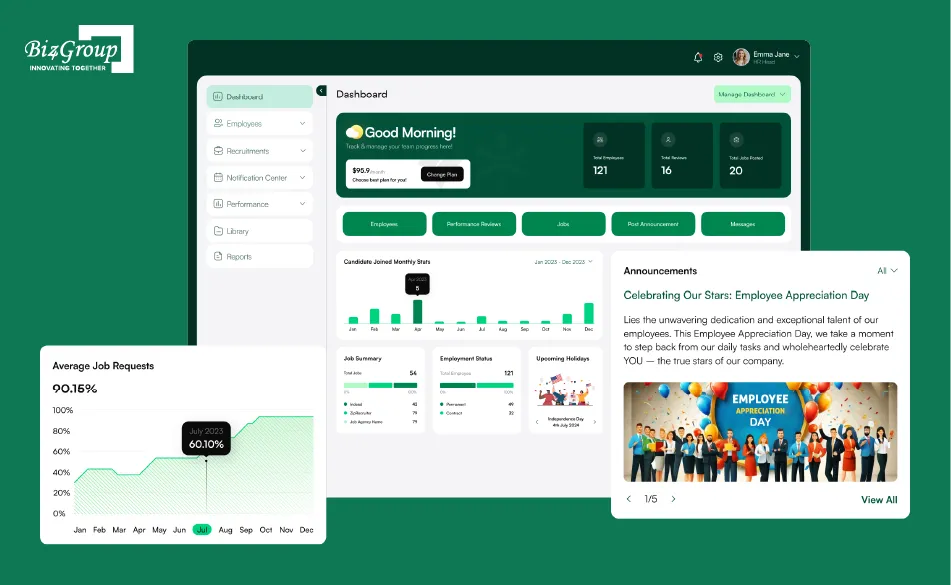
- DrHR leverages large language models to automate HR task handling, including understanding employee queries and generating accurate, context-aware responses. Generative AI is integrated into the interface to interpret natural language input, assist with policy explanations, and streamline routine HR workflows.
- This reduces manual effort for HR teams, enables faster access to information, and enhances the consistency and quality of responses provided to employees through conversational AI.
- Enterprise Operations: In enterprise environments, teams need quick access to insights and fewer manual workflows. Biz4Group LLC builds AI systems that embed intelligence directly into core tools and platforms, helping organizations streamline internal operations without replacing existing infrastructure.
Example: Custom Enterprise AI Agent
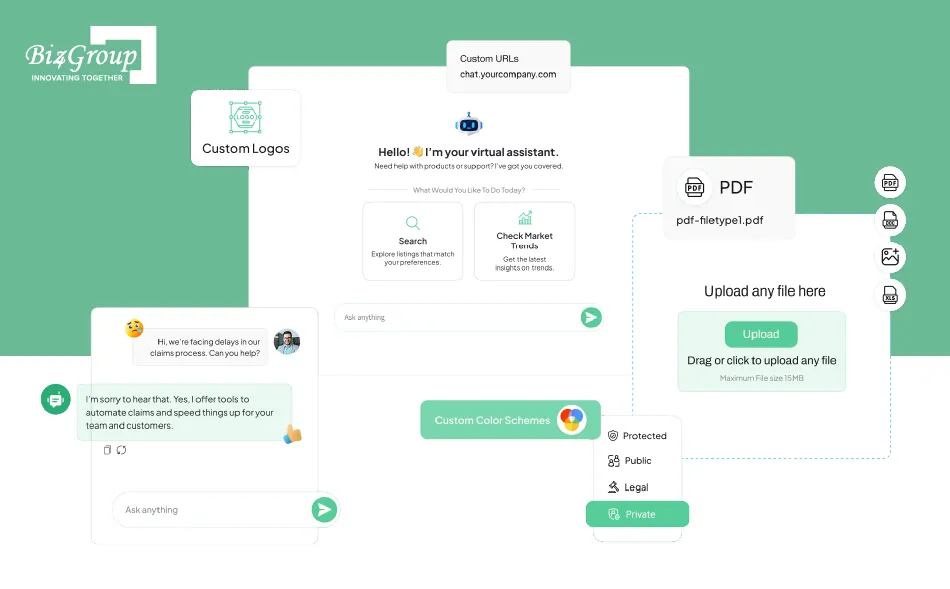
- It embeds large language models to power an AI agent capable of understanding and responding to complex enterprise queries. Generative AI is integrated with internal data sources and systems to generate accurate, context-aware answers, automate routine interactions, and surface actionable insights.
- This enables users to interact naturally with organizational knowledge, reduces manual support overhead, and enhances productivity by delivering intelligent, real-time responses tailored to business needs.
Strengths: Organizations consistently choose us for:
- deep experience integrating AI into real business systems
- strong governance and scalability planning
- transparent communication and structured delivery
- practical, measurable outcomes instead of hype
- balanced expertise across AI engineering and product strategy
This combination allows us to operate as a strategic AI partner, not just a development vendor. It focuses on turning AI concepts into dependable, production-grade systems. Their portfolio shows a mix of generative AI solutions and broader AI-driven platforms built for industries that demand reliability.
For business organizations seeking reliable generative AI development companies in the Canada, Biz4Group represents a partner capable of both technical execution and long-term guidance.
2. DevFortress
Headquarters: Toronto, Canada
Hourly Rate: $50 - $99 / hr
Minimum Project Size: $25,000+
DevFortress delivers practical generative AI solutions tailored to enterprise workflows. The company specializes in implementing GenAI systems that support AI-driven knowledge management, retrieval-augmented generation (RAG) for internal search, intelligent automation, and context-aware content generation tied directly to business data.
Industries served: eCommerce, Financial services, Government, Legal
DevFortress helps organizations design secure, production-ready GenAI architectures that integrate with existing platforms and governance frameworks. This execution-focused approach positions DevFortress among Canadian generative AI development companies capable of moving AI projects from pilot to dependable operational systems.
Strengths:
- Builds bespoke generative AI solutions grounded in business data
- AI-driven knowledge management and domain-specific model workflows
- Architectures designed for data privacy, access control, and governance
- Integration of GenAI into existing enterprise systems and production environments
3. Pieoneers
Headquarters: Vancouver, Canada
Hourly Rate: $100 - $149 / hr
Minimum Project Size: $50,000+
Pieoneers focuses on integrating generative AI capabilities into digital products through large language model–based features. The company works on implementing conversational interfaces, AI agents, and content generation functions using GenAI APIs within existing applications. These implementations are designed to operate inside defined product environments rather than standalone tools.
Their generative AI work emphasizes embedding LLM-driven functionality into live software products, with attention to prompt structure, interaction flows, and application-level logic. Pieoneers supports teams in adding GenAI features that function within established product rules and user interactions, keeping generated outputs aligned with how the product is used.
Industries served: Medical, Education, Information technology, Manufacturing.
Strengths:
- Integration of LLM-based conversational and agent features within product interfaces
- Experience implementing content generation features inside application workflows
- Focus on GenAI behavior shaped by product context and user interactions
4. Massive Insights
Headquarters: Toronto, Canada
Hourly Rate: custom
Minimum Project Size: $25,000+
Massive Insights works on the custom development of AI agents designed to support generative AI–driven decision workflows and business interactions. The company builds GenAI systems where large language models are used to reason over data, generate structured outputs, and assist users through agent-based interfaces. These AI agents are designed to operate within defined business contexts rather than open-ended chat tools.
Its generative AI work focuses on designing agent logic, prompt structures, and orchestration layers that allow LLMs to support analysis, content generation, and decision support tied to organizational data.
Industries served: Telecommunications, Consumer products & services, Hospitality & leisure, Medical
Strengths:
- Custom development of AI agents using large language models
- Experience designing GenAI workflows for decision and analysis use cases
- Focus on controlled, task-oriented generative outputs within business systems
5. Dedicatted
Headquarters: Toronto, Canada
Hourly Rate: $50 - $99 / hr
Minimum Project Size: $25,000+
Dedicatted offers focused generative AI services and agentic AI solutions designed to extend large language model capabilities into enterprise workflows. Its approach includes the development of bespoke GenAI components and agentic workflows that support intelligent assistance, autonomous task handling, and interaction with business data.
Dedicatted’s generative AI portfolio covers plug-and-play model integrations as well as more tailored implementations of LLM-driven agents that operate within defined system boundaries. It emphasizes secure deployment and integration of generative models into broader software environments.
Industries served: Financial service, Automotive, Medical, ECommerce, Legal, Manufacturing, Retail
Strengths:
- Custom generative AI components and AI copilots using large language models
- Agentic AI solutions that orchestrate LLM-based tasks
- Integration of GenAI into existing enterprise systems
6. Wizard Labs
Headquarters: Vancouver, Canada
Hourly Rate: $100 - $149 / hr
Minimum Project Size: $25,000+
Wizard Labs works on generative AI development involving large language models used for text generation and language-based functionality within software systems. The company’s work includes applying LLMs through fine-tuning and configuration to support specific generative use cases inside applications, rather than open-ended model experimentation. It treats generative AI as a software component that must operate within predefined constraints and system behavior.
Industries served: Consumer products & services, Information technology, Medical, Advertising & marketing, Education, Telecommunications
Strengths:
- Experience working with large language models for generative use cases
- Fine-tuning and applied LLM workflows
- Focus on constrained, task-specific generative model behavior
7. Synergy Labs
Headquarters: Toronto, Canada
Hourly Rate: $50 - $99 / hr
Minimum Project Size: $25,000+
Synergy Labs includes generative AI as part of its AI infusion services, where language-based models are applied within application development projects. The company references the use of generative AI and LLM-driven chat interfaces to build AI-powered assistants that operate within product design and build workflows. These implementations focus on adding text-based generative functionality into applications rather than standalone AI systems.
Synergy Labs positions generative AI as a feature layer within digital products, implemented alongside existing application logic during development.
Industries served: Food & Beverage, Hospitality & leisure, Information technology, Legal, Real estate, eCommerce
Strengths:
- Implementation of generative AI as part of applied AI and LLM integration services
- Custom model development support indicating tailored generative capabilities
- End-to-end integration of AI features from design through build and evolve phases
8. Architech
Headquarters: Toronto, Canada
Hourly Rate: $50 - $99 / hr
Minimum Project Size: $25,000+
Architech references generative AI within its AI-powered application services, where generative models are used to support text generation and conversational interactions inside software applications. The company lists generative AI and conversational AI as part of its application-focused capabilities, indicating use of language models to generate responses and support natural language interactions.
Generative AI is positioned as a component embedded into applications, where model outputs are produced within defined interaction flows rather than deployed as independent systems.
Industries served: Financial services, Medical, Telecommunications, Information technology, Manufacturing, Energy & natural resources, Retail
Strengths:
- Use of generative AI models for text-based output within applications
- Implementation of conversational interfaces driven by language models
- Application-level embedding of generative AI features
9. Cloudnonic Corp.
Headquarters: Kitchener, Canada
Hourly Rate: $25 - $49 / hr
Minimum Project Size: $10,000+
Cloudnonic Corp. is identified as independent firm directories offering generative AI development alongside custom software and application work. The company blends generative AI use into broader application development engagements, where model-based outputs support features within digital products. This includes implementations where language models and generation techniques are applied as components of software functionality rather than standalone AI systems.
Industries Served: Information technology
Strengths:
- Verified involvement in generative AI development services as reported in client directories
- Application of model-based capabilities within custom software projects
- Demonstrated delivery in technologically diverse development contexts with AI components
10. Datarockets
Headquarters: Toronto, Canada
Hourly Rate: $50 - $99 / hr
Minimum Project Size: $50,000+
Datarockets works on implementing generative AI features within custom software products, with a focus on language-based generation. Its generative AI involvement centers on using language models to produce text outputs that support conversational interactions and text-driven functionality inside applications.
Generative AI is applied at the application level, where generated responses or text content are delivered as part of defined product flows. These implementations focus on embedding text generation capabilities directly into software features rather than positioning generative AI as a standalone product.
Industries Served: Financial services, Automotive, Education, Information technology, Medical, eCommerce
Strengths:
- End-to-end generative AI development process from business analysis to deployment optimization
- Expertise in data preparation and model fine-tuning for context-aware GenAI performance
- Focus on optimizing AI pipelines for cost, speed, and efficiency
Get Guidance Choosing the Right AI Partner
Align capabilities, budget, and roadmap before committing.
Request Partner RecommendationCost Breakdown for Generative AI Projects
When teams in the U.S. start exploring generative AI, the first concern is usually cost as the challenge is that no two projects are the same. Pricing shifts based on data readiness, integrations, model tuning needs, and how much ongoing improvement is expected. That’s why experienced Generative AI development companies in the Canada encourage businesses to think about cost as a series of stages rather than a single number.
Below is a practical way to understand where budgets usually go, and why.
1. Planning and Architecture- defining the right problem first
Strong partners begin by understanding what the generative AI actually needs to accomplish. This includes aligning technology choices with business goals instead of jumping straight into development. This phase includes:
- mapping workflows and user expectations
- reviewing existing systems and data access
- identifying risks, security needs, and governance gaps
- outlining architecture and choosing appropriate generative AI components
This phase prevents rework, reduces risk, and gives leadership clarity on scope before committing budget.
2. Data readiness- preparing information generative AI can safely use
Generative AI only works well when the data behind it is structured, accurate, and protected. For many U.S. businesses, this becomes one of the largest cost drivers. Teams invest in:
- consolidating data from different tools
- removing duplicate or outdated records
- putting access controls around sensitive information
- building pipelines that reliably feed information to the AI system
This stage determines how dependable, compliant, and scalable the final solution will be.
3. Model customization- adapting generative AI to the business context
Pre-built AI models are powerful, but they rarely understand industry nuances on their own. Most production systems require some tuning, so responses stay useful and aligned with the company's reality. This usually includes:
- teaching generative AI industry terminology and rules
- setting guardrails to control accuracy and tone
- testing outputs with real scenarios
- refining performance through iteration
The more specialized the business, the more important this layer becomes.
4. Application development- turning generative AI into something people use
Generative AI needs a functional interface, whether that means a chatbot, dashboard, internal assistant, or embedded feature inside existing software. Teams focus on:
- designing simple, intuitive user experiences
- building web or mobile interfaces
- Connecting generative AI into CRMs, ERPs, or internal tools
- testing reliability under real workloads
Generative AI only delivers value when it works inside everyday systems. That’s why mature partners emphasize structured AI integration services to make everything operate seamlessly across tools and departments.
5. Continuous improvement- AI never stops evolving
Unlike traditional software, generative AI evolves over time. Models improve as new data arrives and as users interact with them. Because of that, some portions of the cost are ongoing. Teams usually budget for:
- monitoring accuracy and performance
- refining prompts and workflows
- improving security controls as policies evolve
- adding new features after real-world validation
Therefore, many U.S. companies reduce risk by starting with a smaller, high-impact project, measuring results, and expanding from there. For businesses exploring this approach, it often aligns with disciplined MVP software development, where the goal is to launch something useful and then refine it through real feedback.
Also Read: How to Build an AI PoC That Reduces Risk and Validates ROI
Estimate Your Generative AI Budget
Plan a phased rollout, avoid overruns, and invest where impact is measurable.
Get a Cost EstimateGovernance, Risk, and Compliance in Generative AI
️As generative AI becomes part of daily business operations, governance matters as much as innovation. For many U.S. organizations, the risks are no longer limited to technical performance. They include privacy exposure, legal liability, security vulnerabilities, and reputational risks if AI systems behave unpredictably.
This is one reason leaders lean on mature Generative AI Development Companies in the Canada that understand enterprise environments and build AI safely, not just quickly. Below are the core governance areas U.S. decision-makers should evaluate before approving any generative AI rollout.
1. Data privacy and ownership
Organizations must ensure customer and employee information never enter environments where unauthorized users can access, store, or reuse it. That means controlling how data travels, how long it stays accessible, and whether any internal information feeds back into model-training pipelines.
When generative AI learns real operational data, protections must prevent sensitive content from being exposed or retained beyond approved boundaries. Personal data should be anonymized wherever possible, particularly in industries like healthcare, finance, legal services, and enterprise systems where penalties are severe.
Contracts must also define ownership of generative AI outputs and how they can be reused. These safeguards are a defining characteristic of responsible generative AI development companies in the Canada, because they directly protect businesses from lawsuits and regulatory violations.
2. Security controls
Generative AI can unintentionally open new security risks if not designed correctly. Interactive systems may reveal internal context or accept malicious prompts disguised as legitimate requests. Therefore, generative AI needs the same level of control as core enterprise infrastructure including authenticated access, encrypted environments, logging, and continuous monitoring.
The most dependable generative AI solution providers in the Canada treat AI as production infrastructure, not as an isolated experiment. Building this mindset helps prevent security shortcuts that often appear when organizations rush to implementation.
3. Bias and accuracy
Generative models sometimes produce biased or inaccurate responses because they mirror historical training data. Rolling these systems into business workflows without testing can create customer confusion, brand damage, and poor decisions.
Responsible generative AI deployment requires continuous evaluation, structured testing, and clear corrective workflows. In practice, this means generative AI should support decision-making, not replace it entirely. Leaders working with experienced generative AI consulting and development companies often gain stronger controls around model validation and human oversight.
4. Regulatory alignment
U.S. regulations around generative AI continue to evolve across financial services, healthcare, employment law, and education. Systems that launch without considering explainability, audit trails, or data residence often require expensive retrofits later, and sometimes face penalties.
Forward-thinking organizations build governance into their generative AI roadmap early. This approach reflects the discipline seen among top generative AI development companies in the Canada, where compliance, documentation, and transparency are built into delivery methods rather than bolted on afterward.
5. Governance framework
Generative AI grows and changes with use, which means governance cannot be static. A structured governance framework defines who approves generative AI use-cases, how updates move from testing to production, and which teams remain accountable for risk monitoring.
As generative AI expands across departments, this governance layer separates sustainable programs from uncontrolled experimentation.
|
Area |
Why it Matters |
What Mature Teams Put in Place |
|---|---|---|
|
Data Privacy & Ownership |
Prevents exposure and legal penalties |
Controlled access, anonymization, clear IP rule |
|
Security Controls |
Reduces cyber risk and misuse |
Authentication, encryption, monitoring |
|
Bias and accuracy |
Protects users and brand trust |
Testing, validation, human oversight |
|
Regulatory Alignment |
Avoids rework and compliance risk |
Documentation and explainable systems |
|
Governance framework |
Keeps generative AI predictable as it grows |
Approval workflows and accountability |
Generative AI delivers powerful opportunities, but unmanaged AI can introduce significant operational and legal risk. The most reliable leading generative AI firms in the Canada approach governance as part of the engineering process. They build generative AI systems that are secure, compliant, auditable, and ready for enterprise scale, instead of experimental tools that eventually create problems.
Also Read: Generative AI Agents: Types, Trends, and Real-World Examples
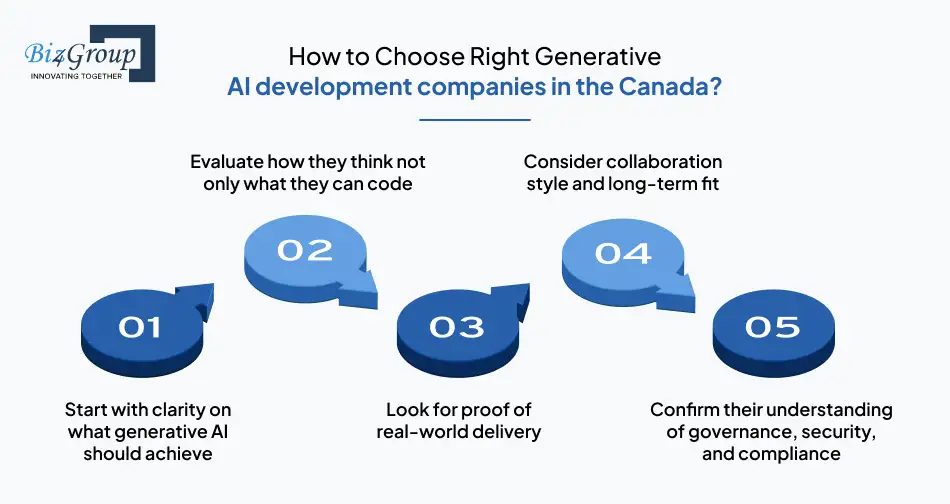
How to Choose Right Generative AI development companies in the Canada?
With so many Generative AI Development Companies in the Canada, the challenge isn’t finding options; it’s choosing a partner that can convert ideas into real outcomes. On the surface, many teams sound similar; they mention models, automation, integrations, and innovation. But once a project begins, differences in maturity, communication style, and delivery discipline become clear very quickly.
The right partner behaves less like a contractor and more like a strategic generative AI development company that understands governance, business workflows, and measurable results, not just technical execution.
1. Start with clarity on what generative AI should achieve
Before comparing proposals, leadership teams should define what AI is expected to do; automate processes, improve decision support, personalize experiences, enhance internal productivity, or power entirely new digital capabilities.
Clear intent filters vendors chasing hype and brings focus to outcomes that matter. Partners who belong among the top generative AI development companies in the Canada encourage this clarity instead of rushing into development.
2. Evaluate how they think not only what they can code
Technology skill is essential, but the ability to structure ambiguous ideas is what keeps generative AI projects on track. Notice whether a potential partner asks strategic questions, explains trade-offs honestly, and avoids promising shortcuts that could create future risks.
This is what separates execution-only vendors from true generative AI consulting and development companies, teams who align technology decisions with long-term business value.
3. Look for proof of real-world delivery
Many firms can talk convincingly about generative AI, but only a few can show working systems adopted by real users. When evaluating candidates, look for projects that demonstrate measurable improvement, ongoing support, and responsible scaling.
Teams that operate like a AI product development company focus on lifecycle delivery, planning for monitoring, iteration, and reliability long after launch.
4. Consider collaboration style and long-term fit
Generative AI evolves. Models improve, governance expectations shift, and new use cases emerge. That means the partner you select should be able to work alongside your teams — not just during implementation, but through growth and refinement.
For organizations planning to scale gradually, it can be helpful to work with a partner that allows you to hire AI developers as your roadmap expands, without committing to full-time teams prematurely. This keeps progress steady while maintaining budget flexibility.
5. Confirm their understanding of governance, security, and compliance
Innovation that ignores risk creates problems later. A dependable partner treats data privacy, audit trails, explainability, and responsible use as core requirements, not optional add-ons. This mindset is common among the leading generative AI firms in the Canada, where reliability matters as much as innovation.
Therefore, partnering with a generative AI company is less about flashy demos and more about alignment, which is technical, strategic, and cultural. The teams that stand out among the top-rated generative AI companies in the Canada are the ones that help organizations deploy responsibly, scale it gradually, and turn it into a long-term capability rather than a short-term experiment.
Turn generative AI Strategy into Real Business Outcomes
Work with a partner that designs secure, scalable generative AI — not experiments.
Book a Strategy DiscussionFinal Thoughts
Generative AI is moving beyond experimentation and becoming part of how U.S. companies operate, innovate, and compete. The most capable Generative AI Development Companies in the Canada are not only delivering applications rather they are helping organizations build intelligent systems that learn, adapt, and support decision-making over time.
What separates ordinary vendors from the best generative AI companies in the Canada is their ability to balance innovation with structure. A responsible AI app development company focuses on governance, integration, reliability, and responsible adoption before writing code. That discipline allows generative AI initiatives to scale across teams instead of stopping after the pilot phase.
For leaders across industries, working with forward-thinking generative AI solution providers in the Canada means gaining a partner who understands business realities as much as technical detail. Connect with us because engaging an experienced generative AI company ensures that systems are planned for scalability, governed correctly, and capable of evolving alongside organizational needs.
Frequently Asked Questions (FAQ’s)
1. What do Generative AI Development Companies in the Canada build?
Generative AI firms design and deploy systems that create content, automate workflows, analyze data, power chat assistants, summarize knowledge, and support decisions. Unlike traditional software, these systems learn from data and improve over time, which is why governance, security, and reliability matter so much.
2. How are the top generative AI development companies in the Canada different from standard development vendors?
Top-tier partners in the Canada combine generative AI engineering with strategy, risk controls, and lifecycle support. They don’t just deliver models instead they integrate generative AI safely into business processes, ensure compliance, and plan for scaling.
3. Which industries benefit most from working with enterprise generative AI development companies in the Canada?
Enterprises in healthcare, finance, insurance, retail, logistics, manufacturing, and SaaS see strong returns. These industries rely on knowledge, automation, and customer interaction in all areas where generative AI improves speed, accuracy, and experience without increasing headcounts.
4. What should I look for when choosing among the best generative AI development companies in the Canada?
You should look for proven case studies, strong data security practices, clear communication frameworks, ongoing support, and realistic timelines. Mature vendors explain risks honestly and build generative AI as a long-term capability, not a short-term feature.
5. Do generative AI solution providers in the Canada support compliance and data privacy?
Yes, reputable providers take compliance seriously. They implement access controls, anonymization, encryption, audit logs, and clear IP policies. This is especially important in regulated industries where generative AI must operate under strict security expectations.
6. How do I know if my project fits generative AI companies in the Canada for business use cases?
If your organization handles repetitive knowledge tasks, large volumes of content, complex workflows, or decision-heavy operations, generative AI likely has measurable value. A good partner will validate feasibility upfront instead of rushing into development.
