 Location :
Orlando, FL, USA
Location :
Orlando, FL, USA +1 (407) 714-1616
 info@biz4group.com

- Healthcare HR software development supports hiring, onboarding, compliance, and documentation across medical facilities.
- Facilities develop healthcare HR software to replace manual processes, avoid credentialing errors, and improve HR accuracy across hospitals, clinics, and care centers.
- Advanced capabilities help teams create a medical HR management system with automation, smart routing, sentiment insights, and integrated data flows.
- The process covers workflow mapping, UX design, MVP planning, integrations, testing, and phased rollout for stronger healthcare HRIS development outcomes.
- Cost ranges from $25,000 to $150,000+ depending on features, custom workflows, integrations, and multi location requirements.
- Biz4Group LLC brings expertise, strong engineering practices, and proven healthcare HR software experience to help you build the right solution.
Have you ever wondered how much time and money healthcare organizations lose every year due to manual HR tasks, staffing gaps, and compliance problems? A recent industry report revealed that healthcare facilities spend nearly half their administrative hours on avoidable manual HR processes.
It is no surprise that more hospitals, clinics, and care centers have started exploring healthcare HR software development to bring order to chaos.
Healthcare is one of the most regulated and labor-intensive industries. HR teams handle credentialing, onboarding, compliance updates, and constant hiring. Many organizations now plan to develop healthcare HR software because traditional HR tools rarely match the speed and complexity of medical environments.
Those who want to create a medical HR management system are usually trying to fix real pain. New staff walk in without complete documents. Credentials expire without alerts. Compliance audits often feel like a never-ending exercise. When these problems build up, they slow down patient care and create avoidable risk. That is when leaders begin to explore healthcare HR software development intentionally.
This guide will help you understand how to develop healthcare HR software that supports real world healthcare challenges and sets a strong foundation for long term growth.
Why Healthcare HR Software Development Matters Today?
Healthcare environments operate with constant movement. New hires arrive, credential renewals pop up, compliance rules change, and audits appear with little warning. Leaders who decide to develop healthcare HR software often reach that decision after feeling stretched thin for too long.
Healthcare employment is growing at a pace that puts pressure on HR teams. The United States is expected to add more than 2 million new healthcare jobs between 2022 and 2032 according to the Bureau of Labor Statistics.
More workers means higher demand for structured hiring, onboarding, and compliance processes.
The Pain Points Healthcare HR Teams Face Today
Below is a quick snapshot of the challenges that motivate organizations to develop healthcare HR software.
|
Pain Point |
Description |
|
Manual Documentation |
Staff spend long hours collecting documents, verifying certificates, and following up with new hires. |
|
Compliance Pressure |
Every expired license, missing training, or outdated certificate increases risk during audits. |
|
Unpredictable Staffing |
Shift changes, last minute call outs, and skill-based assignments are difficult to manage manually. |
|
Fragmented Systems |
Payroll, scheduling, credentialing, and onboarding often live in separate tools with no connection. |
|
High Turnover |
Constant hiring requires a smooth and structured recruitment flow. |
These issues slow down HR teams and create unnecessary burdens for clinical leadership.
The Benefits of Building Healthcare HR Software Today
Organizations that create a medical HR management system begin to see clear improvements. They experience reduced administrative load, better accuracy, more predictable staffing, and faster hiring cycles.
Here are a few advantages that matter most:
- Automated alerts help avoid credentialing and training lapses
- Structured onboarding reduces the time required to make a new hire productive
- Centralized employee records support more confident decision making
- Digital workflows lower the cost of paperwork and manual rework
- Improved visibility helps managers balance shift coverage with skill requirements
Healthcare HR software development is a response to real staffing shortages, compliance demands, and operational challenges. When hospitals and clinics decide to develop healthcare HR software, they build stability for their workforce and peace of mind for their leadership.
Also read: Healthcare workforce management software development guide
Use Cases for Healthcare HR Software Development in Hospitals and Clinics
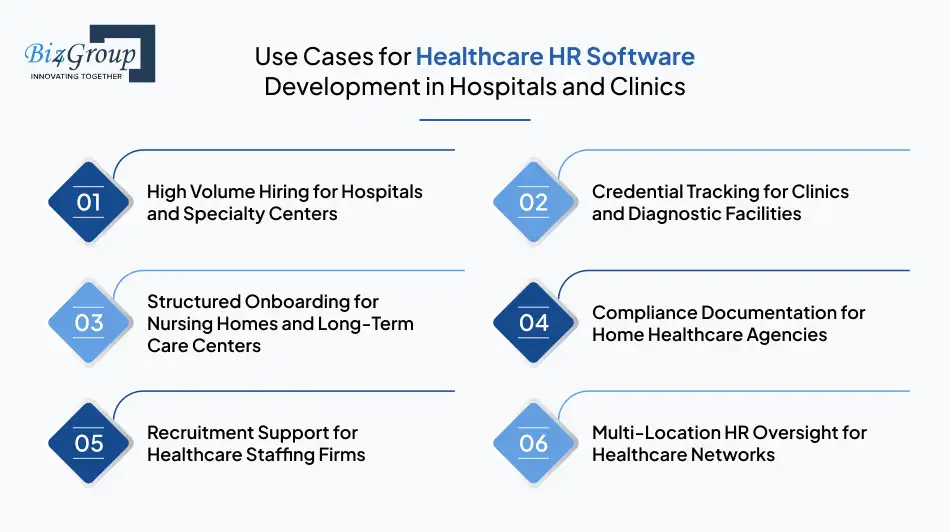
Healthcare organizations explore healthcare HR software development for many reasons. Each facility type deals with different HR complexities, but all share the need for smoother hiring, accurate credentialing, and structured compliance.
1. High Volume Hiring for Hospitals and Specialty Centers
Large hospitals handle continuous recruitment for nurses, technicians, therapists, and administrative staff. They need a system that can manage job postings, applications, resume reviews, and interview coordination without bottlenecks. Creating a medical HR management system helps streamline high volume hiring.
2. Credential Tracking for Clinics and Diagnostic Facilities
Clinics often deal with multiple practitioners who must maintain licenses and certifications. Manual tracking leads to missed renewals and audit stress. Healthcare HR software development helps build automated reminders and centralized credential logs that reduce risk.
3. Structured Onboarding for Nursing Homes and Long-Term Care Centers
Facilities with rotating staff and multiple job roles require clear onboarding paths. Each role has training, documentation, and policy acknowledgements that must be completed accurately. When organizations develop healthcare HR software, they give themselves a predictable onboarding flow that supports better retention and faster new hire readiness.
4. Compliance Documentation for Home Healthcare Agencies
Home healthcare agencies operate under strict regulatory expectations. They maintain field staff records, background checks, training logs, and visit compliance. Hospital HR software development helps these agencies maintain consistent and error-free documentation across all workers.
5. Recruitment Support for Healthcare Staffing Firms
Staffing firms must evaluate large applicant pools, verify credentials quickly, and place talent across various facilities. When these firms build healthcare onboarding and staffing software, they gain the ability to process candidates faster and deliver reliable staff to client sites without manual delays.
Also read: AI healthcare staffing app development guide
6. Multi-Location HR Oversight for Healthcare Networks
Health systems with multiple clinics or hospitals require a unified HR view. Creating a medical HR management system helps these networks maintain standard hiring practices, track credentials across sites, and support consistent HR processes no matter how large the organization grows.
Each use case reflects a different operational need, but the outcome is the same. When healthcare teams develop healthcare HR software tailored to their environment, they gain real clarity, stronger control, and smoother HR operations.
Ready to Fix Those HR Bottlenecks
Hospitals lose hours every week to manual HR tasks. Why let that continue when a smarter system can take over?
Build Smart with Biz4GroupImportant Features for Healthcare HR Software Development
Below is a structured table that highlights the essential capabilities every healthcare organization needs when they decide to develop healthcare HR software or create a medical HR management system.
|
Feature |
What It Is |
What It Does |
|
Applicant Tracking |
A centralized hiring module designed for healthcare roles |
Collects applications, organizes resumes, manages interview steps, and supports high volume hiring without manual oversight |
|
Credential Management |
A structured system for licenses, certificates, and professional validations |
Tracks renewals, sends alerts, stores verification documents, and helps avoid compliance issues |
|
Onboarding Workflows |
Guided pathways for new hires based on role and department |
Collects documents, runs background checks, shares training materials, and ensures every new staff member completes required steps |
|
Document Management |
A digital repository for HR and employee records |
Stores contracts, policies, certificates, and forms in one place with access control |
|
Training and Certification Tracking |
A module for education records and mandatory training cycles |
Monitors completion of required courses and supports audit readiness |
|
Employee Data Management |
A unified employee profile system |
Records personal information, job details, history, pay updates, and HR notes |
|
Payroll Integration |
A connector between HR data and payroll tools |
Transfers worked hours, pay rates, bonuses, and leaves so payroll stays accurate |
|
Leave and Attendance Tracking |
A system for managing leave requests and workday attendance |
Helps staff request time off and allows HR to track approvals and balances |
|
Compliance Logs |
A dedicated module for regulatory documentation |
Captures policy acknowledgements, training evidence, and audit trails |
These features form the base of strong healthcare HR software development. Each one supports a key part of HR operations and helps healthcare teams stay organized as their workforce grows.
Advanced Features in Healthcare HR Software Development That Improve Automation
Advanced features add a different level of speed and intelligence to HR processes. They help healthcare organizations move from reactive administration to proactive decision making.
1. AI-Enhanced Resume Processing
Healthcare hiring involves screening large volumes of resumes for skill match, certifications, past hospital experience, and specialty training. An AI supported resume processor identifies relevant details quickly and organizes profiles so recruiters save time and move candidates forward without unnecessary delays.
2. Intelligent Role Based Onboarding
Recent insights show that AI can automate 70% of healthcare administrative tasks, which explains why automated onboarding has become a priority for forward looking HR teams. Different positions require different documentation and training sequences. Each new hire receives the correct forms, tasks, policy acknowledgements, and training modules.
3. Automated Policy Interpretation
Policies in healthcare change often and staff frequently have questions. An automated interpretation tool scans internal policies and generates precise answers for employees. This reduces repetitive HR queries and helps teams manage policy communication with accuracy.
4. Smart Compliance Monitoring
Compliance rules in healthcare are layered and time bound. A smart compliance monitor reviews credentials, document validity, training cycles, and policy deadlines continuously. Alerts surface early, and administrators gain clarity without manual tracking.
5. Advanced Integration Engine
Many healthcare HR platforms need to exchange data with payroll systems, background check services, training portals, or communication tools. An advanced integration engine ensures smooth data movement between all connected systems.
Also read: How to integrate AI with EHR/EMR systems?
6. Employee Sentiment Insights
Workforce sentiment often predicts turnover or training needs. A sentiment module gathers feedback from surveys and internal communication channels. HR teams can identify engagement patterns and respond before issues escalate.
7. Intelligent Shift Readiness Indicators
Even though this is not workforce management, HR still handles shift readiness based on credentials, training, and document status. A shift readiness indicator simply validates whether an employee is eligible to work based on HR criteria.
Advanced capabilities transform healthcare HR software development into a strategic investment instead of a basic digital record keeper. When organizations add these features, they build systems that reduce manual effort, promote compliance, and support decision making with clarity.
Want HR Tasks to Run Themselves?
Healthcare admin work is rising fast and automation can cut nearly 70% of it. Your platform can be part of that change.
Book a Strategy Call NowWhat Is the Process of Creating Healthcare HR Software?

Every strong product starts with a clear plan. Healthcare HR software development works the same way. If you know the steps, you can reduce risk, manage expectations, and keep everyone aligned from the first workshop to the final rollout.
Step 1. Understand Your HR Reality and Define Goals
Before a single screen is designed, you need a clear picture of your world. HR leaders, department heads, and compliance teams should talk through current pain.
At this stage, you capture measurable goals. For example, you may want to cut hiring cycle time, reduce manual document handling, or reach a specific standard of audit readiness. This clarity guides every decision in your healthcare HR software development journey.
Step 2. Map Workflows Across Facilities and Roles
Next, your team maps how HR tasks actually move today. Each facility type has its own pattern.
You walk through each process step by step. From job requisition to offer, from first interview to day one, from license upload to renewal reminders. This mapping exercise exposes bottlenecks and exceptions.
Step 3. Design Role Based UX And UI For Real Users
You design simple, role-based journeys for each group. HR should access detailed records. Managers need quick views and approvals. Staff want guided onboarding and simple updates. Good UX and UI design company makes healthcare HR software development feel smooth because people feel comfortable using the system from day one.
Also read: Top 15 UI/UX design companies in USA
Step 4. Prioritize Features and Define Your MVP
Feature wishlists grow fast. If you try to build everything at once, the project slows down and costs rise without delivering value. This is where developing a minimum viable product, or MVP, becomes useful.
You create a focused first release that covers the most important HR operations. For example, applicant tracking, onboarding workflows, employee records, and credential tracking.
Also read: Top 12+ MVP development companies in USA
Step 5. Plan Integrations with Existing HR Tools
Most healthcare organizations already use some HR and business tools. There might be payroll platforms, background check services, or learning systems in place.
In this step, you decide which tools will stay and what data needs to move between them. You define how your new system will connect to those services so that HR teams avoid duplicate entry.
Step 6. Build, Review, And Refine in Short Cycles
With workflows, UX, MVP scope, and AI integration services ready, your product team can begin the build. Development works best in short cycles.
HR leaders review early versions and share feedback. Small changes happen while the product is still flexible. This keeps healthcare HR software development aligned with real expectations.
Step 7. Test With Real Scenarios and Real HR Data
Testing is more than checking if buttons work. In healthcare environments, it means walking through real HR scenarios with sample or anonymized data. You run through hiring flows, onboarding paths, document uploads, approvals, and credential renewal cases.
The goal is simple. You want to see whether the product handles daily HR operations without confusion.
Step 8. Roll Out in Phases and Train Your Teams
Once the system passes testing and user review, it is time to launch. A phased rollout often works best. You may start with one facility or a limited set of HR functions, then expand once users are comfortable.
Training sessions, short playbooks, and friendly support channels help people feel confident. Feedback loops remain open so that your team can schedule improvements in the next release.
When you break the work into these eight steps, the picture becomes clearer. You understand what is the process of creating healthcare HR software in practical terms. From first idea to full rollout, each stage reduces risk and increases value.
Curious How Fast You Can Get an MVP?
Most firms wait months for results. Biz4Group delivers MVPs in 2 to 3 weeks. Don’t wait.
Contact Biz4Group TodayTech Stack and Compliance Requirements for Healthcare HRIS Development
Strong healthcare HR software development depends on two pillars. The first is a reliable full stack approach that supports speed, scalability, and smooth integrations. The second is a commitment to regulatory and ethical guardrails that protect patient affiliated data and employee information.
Tech Stack Overview
A healthcare HRIS product runs best when its architecture is flexible, clean, and future friendly. This is not a fixed recipe but a helpful starting point for hospitals, clinics, and healthcare networks evaluating their options.
|
Layer |
Purpose |
Common Frameworks or Tools |
|
Frontend |
Builds the user interface for HR teams, employees, and managers |
React.js, Angular, Vue |
|
Backend |
Handles business logic, automation, and integrations |
|
|
Mobile |
Supports employees who update documents or complete onboarding on phones |
React Native, Flutter, Swift |
|
Database |
Stores employee records, credentials, documents, and logs |
MongoDB, PostgreSQL, MySQL |
|
Cloud Hosting |
Provides scalability and uptime for healthcare environments |
AWS, Google Cloud, Azure |
|
Integrations |
Connects to payroll, background checks, learning tools, or communication apps |
REST APIs, GraphQL, Webhooks |
|
Testing Tools |
Ensures reliability of features and workflows |
Jest, Cypress, Selenium |
Each combination allows your team to develop healthcare HR software that performs well, integrates easily, and adapts to new requirements as your organization grows.
Compliance and Ethical Requirements
Healthcare HR operations involve sensitive staff data that requires strict handling. When you move toward healthcare HRIS development, these guidelines help you protect your organization and build trust with your workforce.
- HIPAA requirements when employee records contain any protected health information
- State privacy laws that govern personal employee details
- Secure storage of documents and credentials with controlled access rights
- Clear audit logs for every HR action including uploads, updates, approvals, and training completions
- Encrypted communication between modules and connected systems
- Validation procedures for background check data and license records
- Ethical handling of employee information with transparent communication on how data is used
- Role based permissions to prevent unauthorized access in multi facility environments
When you combine the right tech stack with rigorous compliance practices, you lay the foundation for healthcare HR software development that supports daily operations without exposing your organization to regulatory risk.
Also read: HIPAA compliant AI app development guide
Cost Breakdown for Healthcare HR Software Development
Budget planning plays a major role in every healthcare HR software development project. Organizations usually spend $25,000-$150,000+ based on scope, integrations, compliance complexity, and the size of their HR operations. Costs increase gradually as platforms evolve from a minimum viable version into an enterprise AI solution.
|
Build Stage |
What It Includes |
Estimated Range |
|
MVP |
Core hiring module, onboarding workflows, employee profiles, credential tracking |
$25,000-$40,000 |
|
Advanced Level |
AI automation services, custom workflows, role-based dashboards, integrations with payroll or communication tools |
$45,000-$85,000 |
|
Enterprise Level |
Multi facility support, advanced analytics, complex integrations, heavy customization, compliance automation |
$90,000-$150,000+ |
This breakdown gives you a realistic starting point. Now let us look at what influences these numbers and how to plan with clarity.
Cost Drivers in Healthcare HR Software Development
Each of these drivers affects both timeline and budget, which is why early planning helps keep your investment stable as you develop healthcare HR software.
|
Cost Driver |
Explanation |
Typical Impact |
|
Features Scope |
More modules raise design, development, and testing effort. |
$8,000-$60,000 based on scale |
|
Integrations |
Connecting with payroll, background checks, or HR tools varies in complexity. |
$5,000-$30,000 per integration |
|
Compliance Needs |
Strict documentation and access controls add engineering time. |
$4,000-$15,000 |
|
User Roles |
More personas require more screens and flows. |
$3,000-$12,000 |
|
Data Migration |
Moving staff records and documents safely affects effort. |
$2,000-$10,000 |
|
Custom Workflows |
Healthcare HR paths differ across facilities. |
$5,000-$25,000 |
|
UI and UX Depth |
Custom dashboards and tailored journeys require dedicated design work. |
$3,000-$18,000 |
|
Multi Location Support |
Networks need centralized and local controls. |
$10,000-$50,000 |
These cost drivers help decision makers compare budgets against goals and decide which stage to begin with.
Hidden Costs You Should Expect
Hidden expenses usually appear when teams are new to healthcare HRIS development or when they underestimate long term usage patterns.
- Ongoing Maintenance and Improvements
Once your MVP or advanced version goes live, your HR team will request enhancements. Healthcare rules also evolve over time. Each update requires some development effort.
Typical ongoing costs range from $500-$3,000 per month based on volume and complexity.
- Infrastructure And Hosting
Most organizations choose cloud hosting for reliability and uptime. Hosting expenses depend on the number of users, data volume, and access patterns.
Budget ranges usually fall within $150-$800 per month for mid-sized healthcare setups.
- Third Party Verifications
Background checks, license lookups, document validations, and training portals often have their own service fees. These are small individually but add up across departments.
Most facilities spend $1-$5 per verification depending on the provider.
- Training And Change Management
Teams need a little time and support to adopt the new platform. You may run workshops, create guides, or schedule onboarding sessions across locations.
Average training efforts cost $2,000-$8,000 based on organization size and number of user groups.
- Data Storage Growth
Documents, certificates, training files, and HR logs grow steadily. Growth leads to higher storage usage.
Expect to allocate $50-$300 per month for storage expansions as your employee base grows.
Understanding these costs helps leaders plan healthcare HR software development with confidence. Clear cost visibility supports better decision making and gives your organization the roadmap needed to build a stable and scalable medical HR platform.
Want a Clear Estimate Before You Commit?
Costs shift with features, but a quick conversation gives you a number so you can plan without confusion.
Get a Custom Cost QuoteShould You Buy or Build Healthcare HR Software?
Teams often reach a point where they must decide whether to buy an existing HR system or move ahead with healthcare HR software development tailored to their facility. The table below offers a straightforward comparison to guide your decision.
|
Category |
Build |
Buy |
|
Customization |
Complete control over features and workflows tailored to your organization |
Limited to what the vendor supports with add ons and configuration options |
|
Compliance Fit |
Custom compliance rules, forms, and approval paths designed for your exact needs |
Standard compliance features based on general regulations rather than organization specifics |
|
Scalability |
Grows naturally with your hiring volume, facility expansion, and workflow changes |
Restricted by vendor plans and upgrade tiers |
|
Integration Ability |
Deep integration possible with payroll, background checks, training portals, or communication apps |
Integrations depend on vendor partnerships and supported tools |
|
Ownership |
Full control over code, data, and product direction |
Vendor controls feature releases and long term roadmap |
|
Initial Cost |
Higher upfront investment during development |
Lower upfront cost with subscription based pricing |
|
Long Term Cost |
Predictable with planned updates and no vendor price jumps |
Increases as user count rises and features require added subscriptions |
|
Competitive Advantage |
Strong differentiation and workflow efficiency unique to your team |
Similar experience to other organizations using the same tool |
|
Data Control |
Complete data ownership with internal policies for access and retention |
Shared responsibility model depending on the vendor’s storage and encryption methods |
|
User Experience |
Designed specifically for HR, managers, and employees in your environment |
Generic UX suited for multiple industries rather than healthcare focused scenarios |
The gist is:
Choose build, if you need a platform tailored to unique HR workflows, strict compliance rules, or multi facility processes that commercial systems cannot fully support.
Choose buy, if you want a ready-made system for basic hiring, onboarding, and record keeping without deep customization.
Choose hybrid, if you want to license an existing system and extend it with custom features, add ons, or integrations. This approach works well when your core needs match a vendor solution, but your specialty workflows need personal attention.
Challenges in Healthcare HR Software Development and How to Mitigate Them

Strong products emerge when teams understand what can go wrong and prepare for it early. Healthcare HR software development carries unique challenges because HR operations in hospitals and clinics must stay accurate, compliant, and workflow friendly.
Challenge 1: Incomplete Understanding of HR Workflows
Hospitals, clinics, and home care agencies each follow different HR sequences. If these differences are not understood upfront, teams risk creating a system that does not match real tasks.
Solutions
- Run discovery workshops with HR, compliance, and department heads
- Document hiring, onboarding, and credential flows in detail
- Test early prototypes with real HR use cases
Challenge 2: Low User Adoption Among HR Teams and Staff
New systems can feel overwhelming for users who are used to manual processes. If the experience feels confusing, the platform may sit unused even after a full rollout.
Solutions
- Design role-based journeys for HR, managers, and employees
- Offer simple dashboards that show tasks rather than menus
- Provide structured onboarding sessions with hands on guidance
Challenge 3: Misalignment With Compliance Requirements
Healthcare HR involves extensive documentation. Missing forms, forgotten renewals, or unsecured data can put facilities at risk. Compliance needs must be built intentionally during healthcare HRIS development.
Solutions
- Build compliance checks into workflows rather than adding them later
- Use automatic reminders for training and credential renewals
- Maintain audit logs for all changes and actions
Challenge 4: Unstructured Employee Data During Migration
Employee files, certificates, and HR documents are often stored across drives, spreadsheets, and old systems. Poorly handled migration can lead to missing or mismatched records.
Solutions
- Audit all existing HR data sources
- Define rules for cleaning duplicates and outdated files
- Use batch import tools designed for large document sets
Challenge 5: Difficulty Scaling Across Multiple Locations
Healthcare networks with multiple facilities struggle to maintain consistency if the system is not built for shared and local control.
Solutions
- Add separate permission groups for each facility
- Create centralized reporting for leadership
- Test performance across rising user loads early in the build
Challenges are part of every healthcare HR software development effort, but none of them are deal breakers. With thoughtful planning and steady communication, each problem becomes manageable.
Want a Team That Solves These Problems Daily?
Complex workflows, compliance rules, and HR gaps need experienced hands. Lucky for you, we do this every day.
Talk to Our ExpertsFuture Trends in Healthcare HR Software Development and Healthcare HRIS Systems
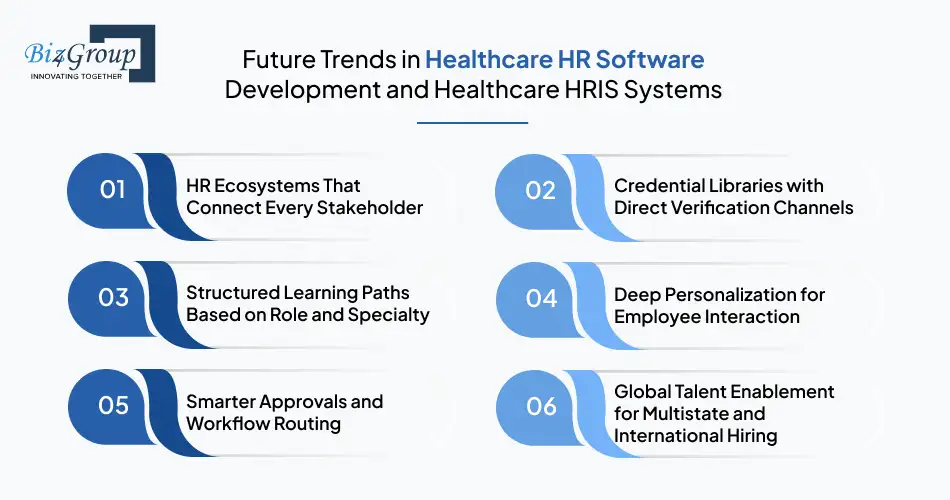
Healthcare HR operations continue to evolve as organizations adopt new staffing models and expand their digital ecosystems. These trends are shaping how leaders approach healthcare HR software development and plan long term HRIS strategies for hospitals, clinics, and care networks.
1. HR Ecosystems That Connect Every Stakeholder
Future platforms will not operate as isolated systems. Instead, they will function as ecosystems that connect HR teams, department managers, employees, credentialing boards, and external service providers. This shift helps teams develop healthcare HR software that reduces back and forth communication.
2. Credential Libraries with Direct Verification Channels
Credential management is one of the most time sensitive HR responsibilities in healthcare. Next generation HRIS platforms will use direct verification channels with licensing boards and certification authorities. This improves accuracy and makes renewal tracking easier.
3. Structured Learning Paths Based on Role and Specialty
Training needs differ for nurses, technicians, lab specialists, and administrative staff. Future healthcare HR software development will focus on structured, automated learning paths that align training modules with employee roles. HR teams will assign, track, and verify completion with fewer manual steps.
4. Deep Personalization for Employee Interaction
HR systems will move toward more personalized experiences where employees see tailored tasks, reminders, and support prompts. This trend will improve engagement by giving staff the information they need at the right moment.
5. Smarter Approvals and Workflow Routing
Approvals in healthcare HR can involve multiple people. Future platforms will use intelligent routing to identify the correct reviewer based on department, role, shift type, or credential category. This eliminates delays caused by manual forwarding.
6. Global Talent Enablement for Multistate and International Hiring
Healthcare organizations increasingly hire across regions. HR systems will add features that support multistate compliance, international credential checks, and cross border documentation requirements.
These trends will influence how facilities approach healthcare HR software development in the years ahead. Hospitals, clinics, and care centers that embrace these innovations early will gain smoother workflows, faster decision making, and stronger readiness for a competitive healthcare landscape.
Why is Biz4Group LLC the Preferred Partner for Healthcare HR Software Development in the USA?
Healthcare organizations across the USA look for development partners who understand both technology and the daily realities of HR operations. Biz4Group LLC fits that need with experience, clarity, and dedication. We are a USA-based software development company that supports healthcare systems, clinics, nursing homes, and medical staffing firms with tailored digital solutions.
We help organizations develop healthcare HR software that solves hiring slowdowns, compliance pressure, documentation challenges, and multi role HR workflows. Our work spans custom HRIS platforms, onboarding systems, credentialing tools, and end-to-end HR software development projects. As an AI development company, we follow a collaborative approach that makes the development process smooth from discovery to launch.
Why Businesses Choose Us
Organizations select Biz4Group LLC because they want to hire healthcare AI app developers that respects healthcare regulations and builds systems that protect employee data.
- A portfolio of healthcare AI solutions and compliance heavy platforms
- Strong design capabilities that create clean and practical user journeys
- Structured processes that keep development timelines predictable
- Deep understanding of integrations with payroll, communication tools, and background check services
- Strong testing and quality standards that support confident rollouts
- Long-term partnerships for enhancements, improvements, and maintenance
Our solutions reflect real HR challenges and support administrators, managers, and staff through intuitive features that fit their roles.
Portfolio Spotlight: AI-Powered HRMS Redefining Workforce Management
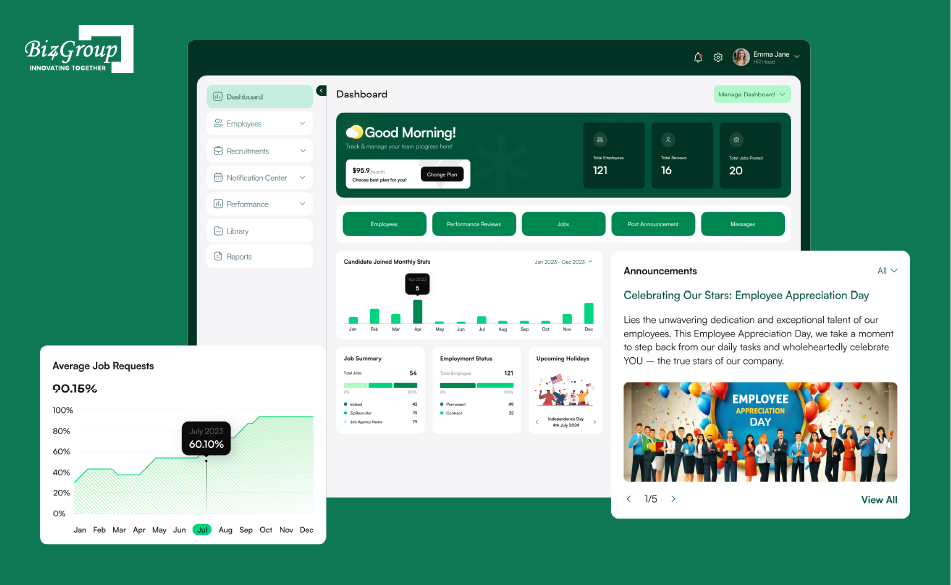
One of our standout accomplishments in healthcare HR technology is a modern HR management system designed to enhance hiring, onboarding, performance tracking, and compliance.
Here is what made this project a high impact solution.
- AI enhanced resume parsing that organizes candidate details for faster screening
- Intelligent onboarding workflows that guide new hires with accuracy
- Automated performance review tools that keep evaluations on track
- Centralized document storage with role-based access
- Integrations with Slack, Zoom, Google Calendar, DocuSign, ZipRecruiter, and Indeed
- Structured dashboards that make information easier to interpret
The project also presented unique challenges. High AI usage created rising token costs and real time communication needed to stay fast. Our team:
- Reduced AI consumption through fine tuning and reuse strategies
- Implemented scalable event driven microservices
- Designed secure conversational modules that handled HR questions instantly
The result was an HR system that delivered measurable improvements in productivity, accountability, and HR responsiveness.
Biz4Group LLC brings clarity, craftsmanship, and deep industry understanding to healthcare HR software development. We take pride in building systems that make hiring faster, onboarding more structured, and HR operations more efficient. When organizations hire our AI developers, they gain a team that treats every product as an investment in their success.
So, don’t think much and let our team guide you through the next steps. Connect with Biz4Group LLC today.
Wrapping Up
Healthcare organizations handle an incredible amount of HR activity every day. Hiring, credential checks, onboarding, documentation, and compliance demand accuracy and structure. This guide walked through every part of healthcare HR software development so you can understand how these systems come together and how they improve daily operations.
As healthcare continues to expand and regulations become more detailed, many hospitals, clinics, and care centers move toward custom solutions. Creating a medical HR management system that fits your workflows allows your team to stay ahead of changing requirements.
Biz4Group LLC has spent years helping healthcare organizations across the USA build platforms that support their goals. Our AI app development experience with custom HRIS solutions, onboarding systems, credentialing platforms, and multi facility HR workflows gives you a reliable partner backed by practical expertise. We take pride in developing AI products that feel intuitive, perform well, and match the operational reality of busy healthcare environments.
If you are ready to explore a platform that improves HR outcomes and strengthens your organization, talk to Biz4Group LLC today. Your custom healthcare HR system is one conversation away.
FAQs
How long does it usually take to build a healthcare specific HR platform?
Timelines depend on the depth of your features, but most projects in the industry take 3-8 months from discovery to launch. However, Biz4Group takes a different approach. Our team can deliver a working MVP in 2-3 weeks because we use reusable components that shorten development cycles and reduce overall project cost without compromising quality.
Can a healthcare HR system support temporary and contract workforce records?
Yes. Your platform can be designed to maintain profiles for full time, part time, contract, and temporary staff. The system can also handle unique document sets, role permissions, and update cycles for each group so every worker type stays organized under one structure.
Can the system support role-based training paths?
Yes. Many healthcare organizations build structured training flows that match the responsibilities of each job type. Your system can assign, monitor, and validate completion records for different roles. This helps HR teams keep track of development activities without manual work.
What format of documents can be stored or uploaded in the system?
Most platforms support PDFs, images, spreadsheets, and text files. The system can also scan uploaded files for completeness or collect metadata for compliance tracking. Document types and storage limits can be customized based on internal policies.
Can a healthcare HR system help with internal communication?
Platforms often include features like announcement boards, reminders, and automated alerts for tasks. These tools keep HR teams, managers, and employees informed about updates or pending actions. Communication features can be tuned to match your facility’s culture and workflow.
Can a healthcare HR system support different job posting strategies?
Yes. You can build modules that create, publish, and track job postings across multiple channels. Posts can be shared on your career page or external job boards depending on your hiring strategy. The system can also track performance so HR teams understand which channels bring better candidates.
