 Location :
Orlando, FL, USA
Location :
Orlando, FL, USA +1 (407) 714-1616
 info@biz4group.com

- AI video therapy platform development combines secure video, AI, and healthcare systems built for HIPAA-compliant therapy workflows.
- A HIPAA-compliant AI video therapy platform requires encryption, audit logs, and secure data handling beyond video sessions.
- Core features include video calls, scheduling, patient portals, AI documentation, EHR integration, and secure messaging.
- Advanced AI features like summaries and recommendations improve care but increase complexity and compliance needs.
- Costs range from $40,000 to $300,000+, and many teams work with Biz4Group, a leading AI healthcare software development company, for execution.
What happens when mental healthcare becomes the biggest driver of telehealth adoption, but your infrastructure was never designed for therapy workflows, AI processing, security controls, or healthcare compliance?
And perhaps the bigger question: What happens if your platform scales successfully, but fails security reviews, enterprise procurement, or compliance audits later?
These are no longer hypothetical concerns. Behavioral healthcare is rapidly becoming the center of virtual care delivery.
According to the latest market research, behavioral health now accounts for 65.6% of total telehealth volume in the United States, making it the largest category driving virtual care adoption today.
At the same time, healthcare organizations are aggressively investing in AI infrastructure. Recent healthcare surveys show that 75% of U.S. health systems are already using or actively implementing AI technologies across clinical and operational workflows.
This shift is exactly why companies are investing heavily in AI video therapy platform development.
But building therapy infrastructure is different from launching a standard video platform.
You are building systems that process therapy sessions, protected health information, clinical documentation, AI workflows, sensitive conversations, patient trust, and regulatory requirements simultaneously.
Many teams underestimate how quickly complexity compounds.
We've seen companies begin with a simple objective: "We want to develop HIPAA-compliant AI video therapy platform infrastructure with secure video consultations and AI capabilities."
Then reality introduces harder questions.
- How do you create an AI video therapy platform with HIPAA compliance without slowing down product delivery?
- Is encrypted video enough when AI is processing therapy sessions?
- Where should sensitive transcripts, notes, and recommendations live?
- How do you build HIPAA-compliant telehealth video therapy platform architecture that remains secure as patient volume increases?
- What controls are required if you want to create AI telehealth video therapy system with encryption and compliance built into the foundation rather than added later?
Teams often discover these problems after architecture decisions have already been made.
Unfortunately, changing video infrastructure, security controls, AI pipelines, or compliance workflows later becomes significantly more expensive.
That is why building secure healthcare products requires more than simply assembling APIs and infrastructure.
Whether you're building custom systems or evaluating approaches for HIPAA-compliant AI healthcare software, early technical decisions directly influence security, compliance, scalability, and long-term development costs.
So before discussing architecture, compliance requirements, security controls, or technical requirements, there is a more important question to answer first.
What exactly makes AI video therapy platforms fundamentally different from traditional telehealth systems, and why are so many teams underestimating the complexity involved?
What Is AI Video Therapy Platform Development, and Why Is It More Complex Than Traditional Telehealth?
At first glance, an AI video therapy platform may look similar to any telehealth application. Users schedule appointments, join virtual sessions, speak with providers, and receive care remotely.
The reality is much broader.
AI video therapy platform development involves building healthcare systems that combine secure video infrastructure, AI capabilities, clinical workflows, patient engagement tools, compliance controls, and healthcare data management into one connected ecosystem.
These platforms do much more than enable virtual appointments. They support therapy workflows before, during, and after sessions while continuously managing sensitive healthcare information.
When companies develop HIPAA-compliant AI video therapy platform infrastructure, they are usually building systems capable of supporting:
- Secure therapy consultations through video sessions
- AI-generated documentation and therapy notes
- Real-time transcription workflows
- Scheduling, billing, and patient management systems
- Secure messaging and communication channels
- Compliance workflows for protected health information
- Clinical reporting and operational dashboards
As healthcare organizations push for more intelligent workflows, many are increasingly combining therapy platforms with automation systems similar to an AI telehealth automation system, where workflows extend beyond video calls and support broader healthcare operations.
So, How is an AI Video Therapy Platform Different from Traditional Telehealth?
This is where many founders and product teams underestimate complexity. Traditional telehealth platforms primarily focus on enabling virtual consultations. AI therapy platforms operate as much larger healthcare ecosystems.
|
Traditional Telehealth Platform |
AI Video Therapy Platform |
|---|---|
|
Primarily focused on video consultations |
Supports therapy workflows across the full patient journey |
|
Limited interaction data generated during sessions |
Continuously processes transcripts, notes, behavioral data, and AI outputs |
|
Shorter patient interactions |
Longer and more frequent therapy sessions |
|
Simpler compliance scope |
Higher security and compliance requirements |
|
Lower dependence on AI workflows |
Heavy reliance on AI processing pipelines |
|
Basic documentation workflows |
Automated notes, summaries, recommendations, and analytics |
This difference becomes important because every additional workflow creates new technical requirements.
Why Does Building AI Video Therapy Platforms Become Complicated So Quickly?
The difficulty does not come from video infrastructure alone. The complexity comes from combining healthcare regulations, AI systems, security controls, and therapy workflows inside the same product.
When organizations create AI video therapy platform with HIPAA compliance, they often discover challenges in areas such as:
- Managing highly sensitive patient conversations, where therapy sessions generate significantly more personal data than standard consultations
- Protecting AI workflows, since transcripts, summaries, recommendations, and models may interact with protected health information
- Supporting complex healthcare operations, where therapists, administrators, patients, caregivers, and clinical teams require different workflows and permissions
- Building security beyond video encryption, because messaging systems, storage layers, audit logs, analytics tools, and AI pipelines also require protection
- Scaling infrastructure safely, since growth increases compliance responsibilities, infrastructure complexity, and operational risk
This is why successful teams approach to build HIPAA-compliant telehealth video therapy platform projects as healthcare infrastructure initiatives rather than standard software products.
Now that the differences are clearer, the next question becomes: How do these platforms actually work behind the scenes, and where does sensitive healthcare data move across the system?
Still thinking if AI therapy platforms are worth building in 2026?
Behavioral health now drives most telehealth usage, and AI adoption is accelerating faster than most architectures are ready for.
Talk to Our Healthcare AI ExpertsHow Does a HIPAA-Compliant AI Video Therapy Platform Actually Work Behind the Scenes?
Building video infrastructure is only one part of AI video therapy platform development.
When companies develop HIPAA-compliant AI video therapy platform solutions, they are building multiple systems that work together simultaneously. Authentication systems verify users, video infrastructure powers sessions, AI processes healthcare information, and security layers continuously protect sensitive patient data across the platform.
Understanding how these layers interact makes it easier to understand why healthcare architecture decisions become critical early.
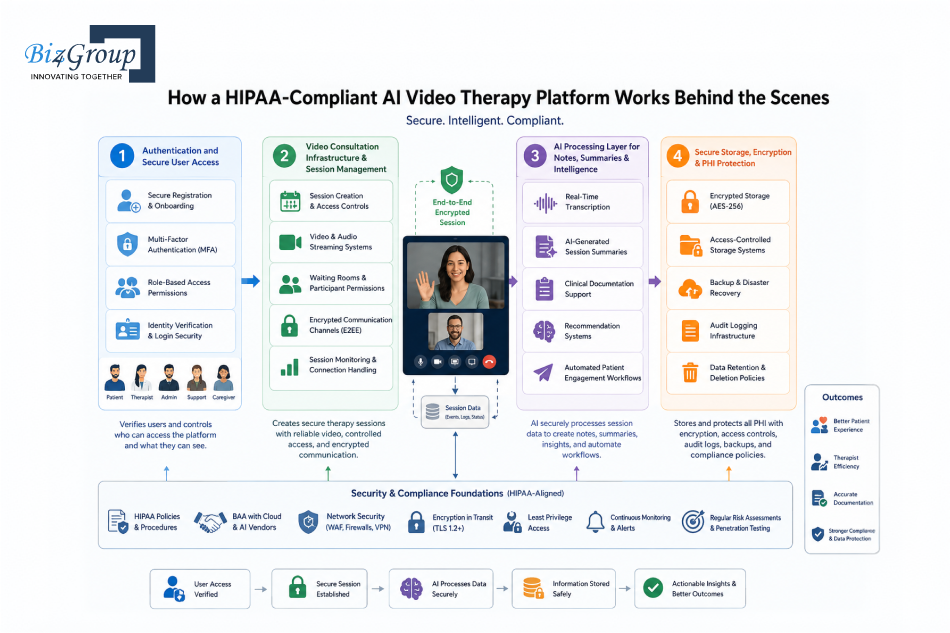
1. Authentication and Secure User Access
Every therapy session starts with verifying who can access the platform and what information they should see. Authentication becomes especially important because therapy platforms involve patients, therapists, administrators, support staff, and sometimes caregivers, all requiring different access levels. Weak access management can expose protected health information long before a video session even begins.
Most platforms typically manage:
- Secure registration and onboarding workflows
- Multi-factor authentication (MFA)
- Role-based access permissions
- Identity verification and login security
When teams say, "we are evaluating telehealth architecture and want to build a HIPAA-compliant AI video therapy system with proper data governance and security controls," authentication usually becomes one of the first architectural decisions.
2. Video Consultation Infrastructure and Session Management
After users are authenticated, the platform must create secure therapy sessions while maintaining privacy, reliability, and user experience. This layer manages session creation, participant permissions, media delivery, encryption, and connection management. Teams often underestimate how quickly session management becomes difficult when dealing with waiting rooms, reconnect scenarios, therapist schedules, and secure access simultaneously.
This infrastructure typically includes:
- Session creation and access controls
- Video and audio streaming systems
- Waiting rooms and participant permissions
- Encrypted communication channels
- Session monitoring and connection handling
Reliable session infrastructure directly influences patient trust and therapist experience.
3. AI Processing Layer for Notes, Summaries, and Intelligence
This layer transforms video platforms into intelligent healthcare systems. AI may process conversations during or after sessions to generate documentation, create summaries, automate repetitive workflows, or support therapists with additional insights. This is also where many companies building create compliant AI mental health video platform solutions face their biggest security questions because sensitive healthcare information may pass through multiple AI workflows.
Common AI capabilities include:
- Real-time transcription workflows
- AI-generated session summaries
- Clinical documentation support
- Recommendation systems
- Automated patient engagement workflows
Organizations increasingly combine these workflows with systems similar to an AI therapy recommendations app where intelligence extends beyond live sessions.
4. Secure Storage, Encryption, and PHI Protection
Therapy platforms continue generating sensitive healthcare data long after sessions end. Video recordings, transcripts, notes, messages, audit logs, and documents require secure handling because protecting stored healthcare information is equally important as protecting live communication.
Most developing secure AI video therapy healthcare platform projects typically require:
- Encryption for stored healthcare information
- Access-controlled storage systems
- Backup and disaster recovery workflows
- Audit logging infrastructure
- Data retention and deletion policies
Teams frequently underestimate how quickly storage complexity increases once transcripts, AI outputs, and documentation workflows begin scaling.
How Patient Data Travels Across the Platform
One common misconception in AI video therapy platform development is assuming video sessions are the primary security concern. In reality, sensitive information constantly moves across multiple services throughout the platform.
A simplified workflow often looks like:
Patient Login → Authentication Layer → Video Session → AI Processing → Secure Storage → Clinical Dashboard
Throughout this workflow, platforms continuously manage:
- Protected health information movement
- Encryption and security controls
- Consent management workflows
- Audit logging requirements
- Retention and deletion processes
The difficult part is rarely adding video or AI independently.
The difficult part is building systems where every layer works together without creating security gaps, compliance risks, or operational complexity.
Now that the workflow is clearer, the next question becomes even more important: Who actually needs to build AI video therapy platforms, and where are these systems creating the biggest impact?
Who Actually Needs to Build HIPAA-Compliant AI Video Therapy Platforms Today?
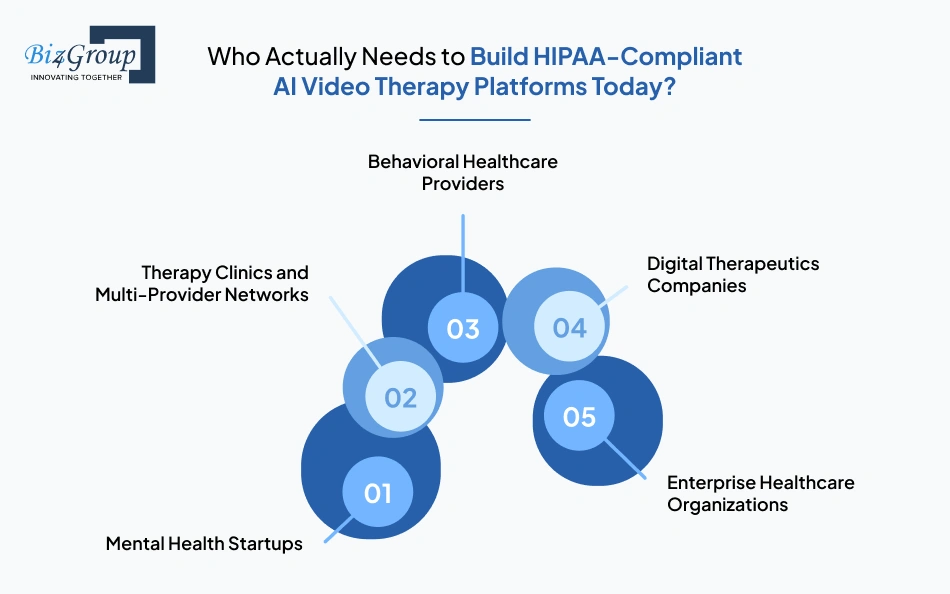
The demand for AI video therapy platform development extends far beyond virtual therapy startups.
Healthcare organizations across different segments are increasingly investing in intelligent therapy infrastructure because therapy workflows create recurring appointments, documentation burden, operational complexity, and large volumes of sensitive healthcare information.
The question is not whether organizations need digital therapy infrastructure anymore, it is where these systems create the most value.
1. Mental Health Startups
Mental health startups often focus on delivering accessible therapy experiences while controlling operational costs during growth. As patient volumes increase, documentation, therapist workloads, and patient engagement quickly become difficult to manage manually. This is why many startups looking to develop HIPAA-compliant AI video therapy platform solutions increasingly combine video consultations with automation, documentation support, and AI-assisted workflows.
How this looks in practice:
Companies like BetterHelp and Talkspace scaled virtual therapy delivery by building digital-first care experiences around remote therapy access.
2. Therapy Clinics and Multi-Provider Networks
As therapy organizations expand across locations and providers, scheduling recurring sessions, managing therapist availability, and maintaining documentation consistency become operational challenges. Organizations looking to build HIPAA-compliant telehealth video therapy platform infrastructure often focus on improving therapist productivity while simplifying patient management.
How this looks in practice:
Large provider networks such as LifeStance Health use virtual care infrastructure to support coordination across multiple therapists, locations, and patient workflows.
3. Behavioral Healthcare Providers
Behavioral healthcare organizations increasingly rely on virtual care to improve accessibility for patients facing geographic, scheduling, or transportation barriers. For providers planning to build secure HIPAA video consultation platform integrating AI, digital infrastructure helps reduce operational burden while supporting long-term patient engagement.
How this looks in practice:
Organizations such as Acadia Healthcare continue expanding virtual behavioral health programs as remote care becomes a larger part of treatment delivery.
4. Digital Therapeutics Companies
Digital therapeutics companies typically require more than scheduled therapy sessions. Many focus on continuous engagement, treatment adherence, behavioral interventions, and ongoing patient support between appointments. This is where companies increasingly develop AI-powered video therapy platform for healthcare products that combine therapy sessions with intelligent patient engagement systems.
How this looks in practice:
Companies like Pear Therapeutics helped demonstrate how software-driven behavioral care can extend beyond traditional therapy sessions.
5. Enterprise Healthcare Organizations
Large healthcare organizations face additional complexity because therapy platforms must integrate with existing systems, security requirements, procurement processes, and compliance workflows. For enterprise teams evaluating developing secure AI video therapy healthcare platform strategies, scalability, governance, and interoperability often become equally important as product functionality.
How this looks in practice:
Healthcare organizations including Mayo Clinic and Cleveland Clinic continue expanding virtual care programs as healthcare infrastructure increasingly moves toward digital delivery.
Wondering What AI Looks Like in Real Therapy Workflows? Here's One Example We Built
A good example of how AI is increasingly shaping behavioral healthcare experiences is this AI-powered eLearning platform for therapy students developed by Biz4Group.
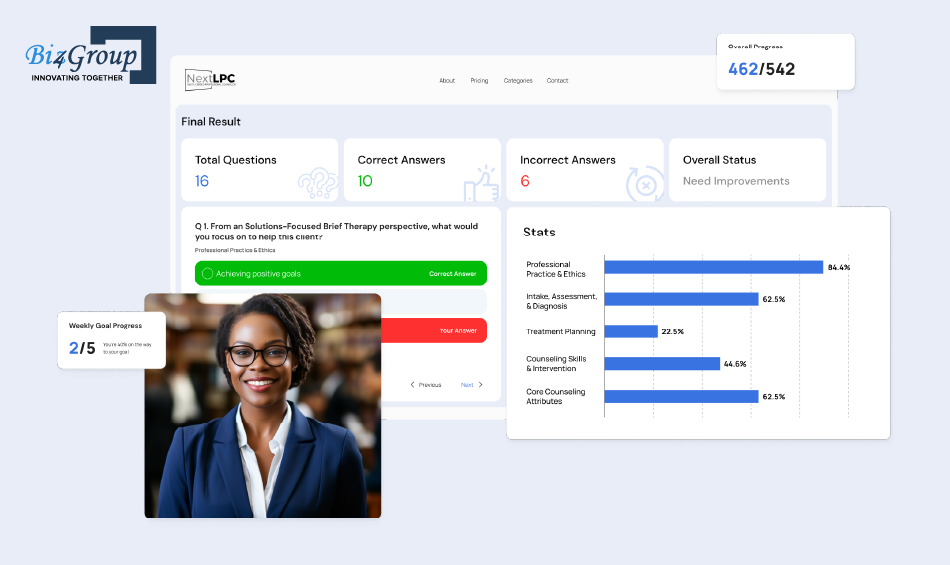
The platform, called NextLPC, was designed to support psychotherapy students through AI-powered virtual learning experiences. Rather than relying only on traditional learning methods, the platform uses intelligent avatars and interactive training workflows to simulate therapy education in a more engaging way.
While this platform is built for therapy education rather than patient consultations, it highlights something important.
Building AI systems around therapy workflows requires much more than simply adding conversational AI or video infrastructure. It requires secure workflows, intelligent interactions, personalized experiences, and scalable architecture capable of supporting sensitive behavioral health use cases.
Key highlights of the platform include:
- AI-powered avatars that interact with psychotherapy students for guided learning experiences
- Interactive case study narratives designed around therapy education workflows
- Adaptive quizzes that personalize learning experiences based on user interactions
- Centralized dashboards for managing learning progress and engagement metrics
- Scalable AI architecture designed to support large numbers of learners simultaneously
Projects like these demonstrate why organizations building AI video therapy platform development solutions increasingly focus on architecture, workflow design, security, and AI integration from the beginning rather than treating them as later additions.
Although these organizations serve different healthcare models, they share one challenge.
Once AI starts processing therapy conversations, documentation, behavioral information, and patient records, compliance requirements become much more complicated.
So before discussing technical requirements, there is one important question: What does compliance actually mean when you're building AI-powered therapy platforms?
Think Video Encryption Alone Makes You Compliant? Here's What HIPAA Actually Requires
Many teams assume compliance starts and ends with encrypted video sessions.
It doesn't.
When you develop HIPAA-compliant AI video therapy platform infrastructure, compliance extends across AI workflows, patient records, storage systems, third-party vendors, audit logs, and every place where sensitive healthcare information moves.
The challenge is not simply securing video. The challenge is protecting the entire healthcare workflow.
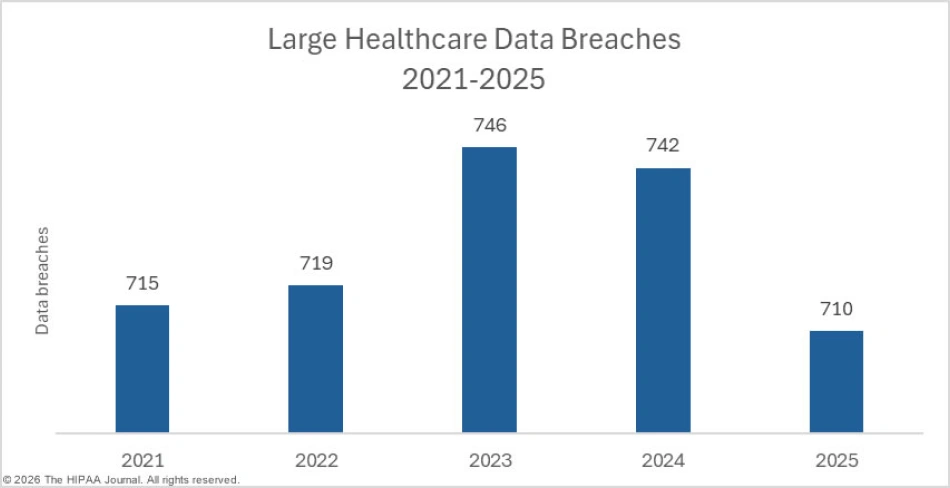
Healthcare organizations are learning this the hard way. More than 700 healthcare breaches affecting 500+ individuals were reported annually in recent years, with healthcare continuing to remain one of the most targeted industries for sensitive data attacks.
1. Is HIPAA Compliance Just About Encrypting Video Calls?
Encrypted video sessions are important, but they only protect one part of the workflow. Therapy platforms generate transcripts, AI-generated summaries, session metadata, messages, documents, and patient records that also require protection. Organizations trying to create HIPAA-compliant AI video consultation platform with BAA agreements and compliance controls quickly discover that protecting healthcare data goes far beyond video infrastructure.
2. What HIPAA Rules Actually Affect AI Video Therapy Platforms?
For therapy platforms, the most important HIPAA requirements generally focus on protecting patient privacy, securing healthcare information, controlling access, and responding properly when incidents occur. This means organizations building create AI telehealth video therapy system with encryption and compliance requirements must think about Privacy Rules, Security Rules, breach notifications, vendor management, and Business Associate Agreements from the beginning rather than treating compliance as a final checklist.
Organizations building secure healthcare systems often approach compliance similarly to broader approaches used in HIPAA compliant AI healthcare application development, where compliance decisions directly influence product architecture.
3. Where Does Compliance Become Difficult for AI Video Therapy Platforms?
Compliance complexity increases the moment AI begins interacting with therapy workflows. When companies create compliant AI mental health video platform solutions, patient information may move through transcription engines, recommendation systems, documentation workflows, analytics tools, and third-party services. Every additional workflow creates additional security and governance responsibilities.
4. What Happens If Compliance Is Considered Too Late?
Many organizations begin with infrastructure decisions first and compliance discussions later. Unfortunately, rebuilding storage architecture, changing vendors, redesigning security controls, or modifying AI workflows after launch becomes significantly more expensive. Teams that want to build HIPAA-compliant telehealth software for therapy sessions usually benefit from treating compliance as an architectural decision rather than a legal task.
Understanding compliance is important. Understanding where technical implementation fails is even more important.
So, the next question becomes: What are the technical requirements most developers still miss while building AI video therapy platforms?
Think your platform is HIPAA-compliant… or just partially secure?
Most failures happen beyond encryption, inside workflows, vendors, and AI systems.
Get a Compliance Architecture ReviewBuilding a Secure AI Video Therapy Platform? Here Are the 14 Technical Requirements Most Teams Miss
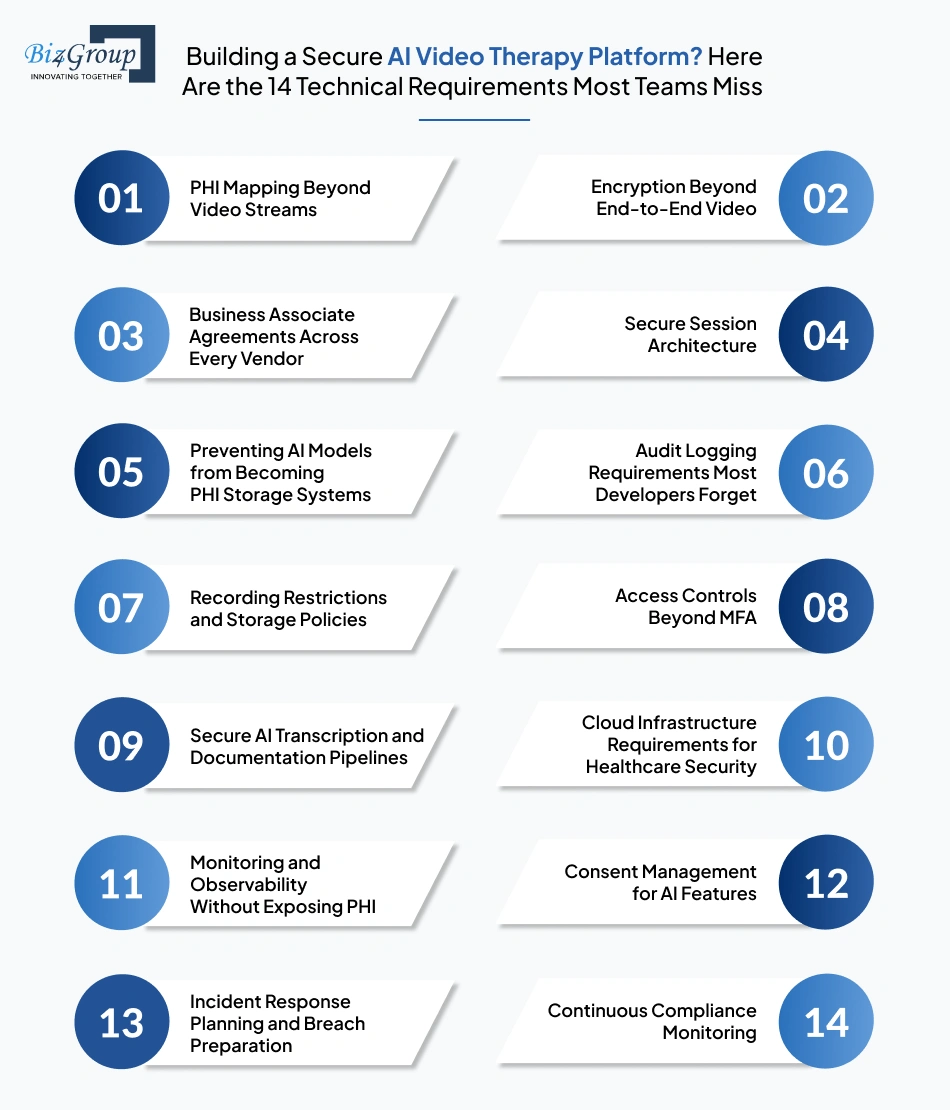
Many teams assume the difficult part of AI video therapy platform development is building video functionality.
The reality is different.
Most complexity appears when therapy workflows, AI systems, patient information, compliance requirements, and third-party infrastructure begin interacting with each other.
Healthcare organizations continue experiencing some of the highest breach costs across industries, with recent research showing the average healthcare breach now costs $7.42 million per incident, making security and architecture decisions increasingly important during development rather than after launch.
The following requirements are frequently overlooked during early planning and often become expensive to fix later.
1. PHI Mapping Beyond Video Streams
Many teams' starting AI video therapy platform development focus heavily on securing live sessions while overlooking how much sensitive information exists outside the video call itself.
Therapy workflows continuously generate transcripts, therapist notes, uploaded documents, AI-generated outputs, recurring appointment data, chat messages, and behavioral information. If patient information movement is unclear early, security gaps usually appear much later during audits, scaling efforts, or enterprise reviews.
Most organizations begin mapping:
- Session data and communication channels
- AI-generated outputs and documentation workflows
- File sharing and messaging systems
- Analytics, logs, and notification services
Patient information rarely stays inside one workflow. Understanding movement becomes just as important as protecting storage.
2. Encryption Beyond End-to-End Video
Once patient information starts moving across multiple services, protecting video sessions alone is no longer enough.
Many teams looking to develop HIPAA-compliant AI video therapy platforms initially focus on encrypted sessions before realizing healthcare data also moves through databases, APIs, storage systems, AI services, analytics platforms, and messaging workflows.
Security planning generally includes:
- Encryption during transmission
- Encryption for stored healthcare information
- Secure communication between services
- Key rotation and management workflows
Protecting healthcare systems means protecting every layer touching patient information, not only the video stream.
3. Business Associate Agreements Across Every Vendor
Compliance problems often appear where teams least expect them.
Cloud providers, AI vendors, transcription services, monitoring tools, analytics platforms, and communication systems may all interact with healthcare information. Teams trying to create HIPAA-compliant AI video consultation platforms with BAA agreements and compliance controls frequently discover vendor risks during procurement rather than development.
Vendor evaluations typically include:
- Cloud and infrastructure providers
- AI and transcription vendors
- Monitoring and analytics services
- Communication and storage platforms
Choosing technology before reviewing vendor responsibilities usually creates expensive rework later.
4. Secure Session Architecture
Therapy sessions involve much more than generating meeting links.
Secure sessions require participant verification, reconnect workflows, therapist permissions, waiting rooms, session expiration policies, and access management. As therapy platforms scale across therapists, patients, and recurring appointments, session management quickly becomes an operational challenge rather than only a technical one.
Secure session design usually includes:
- Short-lived access links and tokens
- Waiting rooms and participant validation
- Session expiration controls
- Permission management during sessions
Therapy conversations contain highly sensitive information. Session access should be treated like healthcare infrastructure rather than meeting links.
5. Preventing AI Models from Becoming PHI Storage Systems
AI capabilities create some of the most difficult architectural decisions during AI video therapy platform development.
As organizations build intelligent therapy workflows, conversations increasingly move through transcription pipelines, recommendation systems, summaries, and language models. Without clear boundaries, AI workflows can unintentionally become long-term storage systems for healthcare information.
Healthcare organizations continue expanding AI adoption rapidly, but recent healthcare surveys show that security and governance remain among the largest barriers preventing broader AI implementation.
Teams usually evaluate:
- What information AI systems can access
- Whether prompts or outputs are retained
- Retention policies for AI workflows
- Separation between models and patient records
The challenge is rarely building AI features. The challenge is controlling how sensitive information moves through them.
6. Audit Logging Requirements Most Developers Forget
Logging often receives attention only after compliance conversations begin.
Unfortunately, therapy platforms generate activity across sessions, patient records, messaging systems, AI workflows, scheduling systems, and administrative actions. Teams usually discover logging gaps during investigations when critical events cannot be reconstructed.
Logging strategies commonly include:
- Authentication activity
- Access history and record modifications
- Administrative actions
- Security-related events
Audit logs are not only useful during reviews. They become essential during investigations, disputes, or unauthorized access events.
7. Recording Restrictions and Storage Policies
Recording therapy sessions appears straightforward until organizations begin evaluating consent workflows, retention policies, storage requirements, and long-term security responsibilities.
Teams building secure therapy infrastructure frequently enable recording features early and later discover recordings create additional operational complexity, larger storage requirements, and greater compliance exposure.
Before enabling recording workflows, teams usually evaluate:
- Consent requirements
- Encryption for stored recordings
- Retention and deletion policies
- Access permissions for recordings
Many organizations eventually discover that recording everything creates significantly more operational burden than expected.
8. Access Controls Beyond MFA
Authentication helps verify users, but therapy platforms usually require much deeper permission management.
Patients, therapists, administrators, support teams, and external partners often interact with the same system while requiring completely different access levels. Teams working on building HIPAA-compliant AI telehealth platforms often discover permission management becomes increasingly difficult as organizations grow.
Access management strategies commonly include:
- Role-based permissions
- Least-privilege access controls
- Administrative restrictions
- Monitoring privileged accounts
Strong access controls reduce unnecessary exposure by limiting who can view, modify, or export sensitive healthcare information.
9. Secure AI Transcription and Documentation Pipelines
Documentation automation helps reduce therapist workload, but it also creates additional security responsibilities.
Organizations involved in developing AI-powered video therapy platforms for healthcare frequently discover that transcripts, summaries, and generated notes continue creating sensitive healthcare information long after therapy sessions end.
Teams typically evaluate:
- Where transcripts are processed
- Storage policies for generated documentation
- Access controls for notes and summaries
- Security around AI-generated outputs
As therapy platforms continue expanding intelligent workflows, many organizations also build systems similar to a mental health AI assistant to extend engagement outside live sessions.
10. Cloud Infrastructure Requirements for Healthcare Security
Infrastructure decisions become significantly harder to change after patient data, therapy workflows, and AI systems begin scaling.
Organizations focused on developing secure AI video therapy healthcare platforms generally prioritize scalability, resilience, and security together because redesigning infrastructure later creates operational risk and additional cost.
Infrastructure planning commonly includes:
- Environment isolation
- Secure database architecture
- Backup and disaster recovery planning
- Infrastructure monitoring
Building infrastructure correctly early usually costs less than rebuilding after growth.
11. Monitoring and Observability Without Exposing PHI
Monitoring systems improve reliability, but they can also create unexpected security risks.
Logs, debugging tools, analytics platforms, and error monitoring systems sometimes collect sensitive healthcare information during normal operations. Many teams only discover this problem when investigating incidents or reviewing compliance requirements.
Observability strategies often include:
- Reviewing what enters logs and analytics tools
- Redacting sensitive information automatically
- Restricting monitoring access permissions
- Creating security-focused alert workflows
Monitoring should improve visibility without increasing exposure.
12. Consent Management for AI Features
As therapy platforms become more intelligent, consent workflows become more complicated.
Organizations attempting to create AI telehealth video therapy systems with encryption and compliance requirements often discover users want greater visibility into how conversations, summaries, recommendations, and documentation are processed.
Consent management usually addresses:
- AI-generated summaries and documentation
- Recording permissions
- Data processing preferences
- Information sharing permissions
Clear consent workflows improve both compliance outcomes and patient trust.
13. Incident Response Planning and Breach Preparation
Security incidents rarely happen at convenient times.
Vendor outages, access problems, infrastructure failures, or unauthorized access attempts can happen regardless of architecture quality. The difference usually depends on how quickly organizations can respond.
Teams commonly prepare for:
- Incident escalation workflows
- Investigation procedures
- Backup and recovery strategies
- Ownership during security events
Response planning reduces operational disruption when systems fail unexpectedly.
14. Continuous Compliance Monitoring
One of the biggest misconceptions in healthcare software is assuming compliance becomes complete after launch.
AI workflows evolve, vendors change, infrastructure grows, and new features introduce additional risks. Teams trying to build HIPAA-compliant telehealth software for therapy sessions often discover maintaining compliance requires significantly more effort than achieving it initially.
Long-term monitoring commonly includes:
- Security reviews and assessments
- Vendor evaluations
- Infrastructure audits
- Policy and workflow updates
Building compliant systems is difficult.
Maintaining compliance while continuing to scale is usually a harder challenge.
After reviewing these technical requirements, one thing becomes clear: Secure infrastructure alone does not create successful therapy platforms.
The next question becomes: What features should actually exist inside an AI video therapy platform to create meaningful user experiences?
Want to Build an AI Video Therapy Platform? These Core Features Are Non-Negotiable
Building a successful platform requires more than video sessions and AI capabilities.
Organizations investing in AI video therapy platform development quickly realize that therapy workflows depend on secure communication, patient engagement, operational efficiency, and clinical workflows working together.
These are the features most platforms require from day one.
1. Secure Video Consultations
Secure video infrastructure forms the foundation when companies develop HIPAA-compliant AI video therapy platform solutions. Therapy sessions require encrypted communication, stable connections, participant controls, and session privacy because user trust depends heavily on secure experiences.
2. Appointment Scheduling and Calendar Management
Organizations trying to build HIPAA-compliant telehealth video therapy platform solutions quickly discover therapy workflows rely heavily on recurring appointments and therapist availability. AI Appointment scheduling systems reduce operational overhead while improving patient retention and engagement.
3. Secure Messaging and Communication Tools
Patients rarely interact only during therapy sessions. Secure communication channels allow providers and patients to exchange reminders, updates, documents, and follow-up information while maintaining privacy and reducing dependence on unsecured communication methods.
4. Patient Portals and Self-Service Access
Modern patients expect more control over healthcare experiences. Self-service portals allow patients to manage appointments, update information, access documents, and communicate with providers without increasing administrative workload.
5. Clinical Documentation and Notes Management
Documentation consumes a large portion of therapist time. Companies building develop AI-powered video therapy platform for healthcare products increasingly prioritize documentation workflows that simplify note creation, organize records, and reduce repetitive work.
6. EHR and Healthcare System Integrations
Organizations creating secure AI video therapy healthcare platform solutions rarely operate independently. Integrations with EHRs, billing systems, payment workflows, and healthcare infrastructure become increasingly important as organizations scale.
7. Therapist and Administrative Dashboards
Therapists, administrators, and operational teams require different workflows. Dashboards improve visibility into schedules, patient management, operational metrics, compliance workflows, and platform performance.
8. Billing, Payments, and Insurance Management
Payment workflows directly influence both patient experience and operational efficiency. Organizations building therapy platforms frequently manage recurring appointments, subscriptions, reimbursements, and insurance workflows simultaneously.
9. User Management and Role-Based Access Controls
Organizations trying to create AI telehealth video therapy system with encryption and compliance requirements need strong access management from the beginning. Different users require different permissions, making role-based access essential for both security and scalability.
These features create the foundation.
The next question becomes: Which advanced capabilities actually separate modern AI therapy platforms from standard telehealth products?
Are you building features or a real therapy experience?
Video calls are easy. Patient trust, workflows, and engagement systems are what actually matter.
Contact UsWant Your AI Video Therapy Platform to Stand Out? These Advanced Features Create Competitive Advantage
Core features help platforms function. Advanced capabilities are what improve therapist productivity, increase patient engagement, reduce operational burden, and create stronger competitive positioning.
Organizations investing in AI video therapy platform development increasingly use AI capabilities to move beyond virtual sessions and create more intelligent therapy experiences.
|
Advanced Feature |
What It Does |
Why It Matters |
|---|---|---|
|
AI Session Summaries |
Automatically generates structured notes and summaries from therapy sessions |
Reduces documentation workload and allows therapists to spend more time with patients rather than paperwork |
|
Emotion and Sentiment Detection |
Analyzes behavioral signals, communication patterns, or emotional indicators during interactions |
Helps providers identify patterns that may otherwise be difficult to recognize consistently |
|
AI Clinical Documentation |
Creates therapy notes, clinical records, and structured documentation automatically |
Organizations trying to develop AI-powered video therapy platform for healthcare solutions often prioritize documentation automation to improve efficiency |
|
Predictive Risk Monitoring |
Identifies behavioral trends, engagement patterns, or risk indicators using historical information |
Supports earlier intervention and improves long-term patient monitoring |
|
Personalized Therapy Recommendations |
Generates personalized recommendations based on patient history and behavioral information |
Many companies increasingly invest in solutions similar to an AI therapy recommendations app to improve patient engagement |
|
Voice Intelligence and Speech Analytics |
Extracts insights from conversations, speaking patterns, or communication behaviors |
Supports providers by surfacing additional information without increasing manual workload |
|
AI-Powered Patient Engagement Systems |
Automates reminders, follow-ups, check-ins, and communication workflows |
Improves patient retention and reduces operational burden |
|
Virtual Mental Health Assistants |
Provides patients with AI-supported guidance between therapy sessions |
Organizations increasingly explore solutions similar to a mental health AI assistant to extend support outside appointments |
|
Multilingual Therapy Support |
Enables therapy experiences across multiple languages and communication styles |
Improves accessibility while supporting broader patient populations |
|
Real-Time Transcription and Translation |
Converts conversations into searchable documentation while supporting multilingual interactions |
Helps teams create compliant AI mental health video platform experiences for more diverse user groups |
|
AI-Based Therapist Matching |
Recommends therapists based on patient preferences, conditions, and historical patterns |
Improves patient experience and increases long-term retention |
|
Continuous Patient Monitoring |
Tracks engagement, session frequency, behavioral trends, and wellness indicators |
Supports long-term care models rather than isolated appointments |
Not every platform requires all advanced capabilities.
The real question becomes: How do you actually build these features while maintaining security, compliance, and scalability?
Planning AI Video Therapy Platform Development? Here’s the Step-by-Step Process
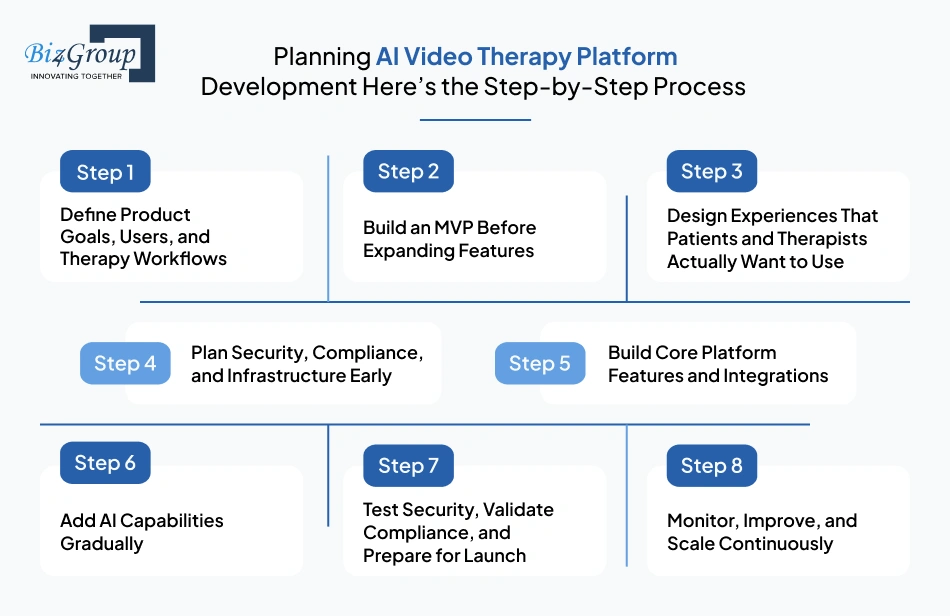
Building secure healthcare infrastructure is rarely only a development problem.
Organizations investing in AI video therapy platform development quickly discover that product decisions, compliance requirements, healthcare workflows, security architecture, and AI implementation all influence each other.
If you are thinking: "We are evaluating telehealth architecture and want to build a HIPAA-compliant AI video therapy system with proper data governance and security controls," this is usually how successful teams approach development.
Step 1: Define Product Goals, Users, and Therapy Workflows
Before building anything, teams must understand exactly who the platform serves and how therapy workflows operate. Decisions around patients, therapists, administrators, and operational teams influence infrastructure complexity much earlier than most organizations expect.
Most teams typically define:
- User personas and therapy workflows
- Business objectives and product goals
- Compliance expectations
- Patient experience requirements
Step 2: Build an MVP Before Expanding Features
Many organizations trying to develop HIPAA-compliant AI video therapy platforms initially attempt to build every feature at once and quickly discover costs increase rapidly. Starting with an MVP reduces risk by validating workflows before larger investments. Teams often follow approaches similar to modern MVP development strategies where essential workflows receive priority first.
Typical activities include:
- Defining essential features
- Prioritizing high-impact workflows
- Creating phased release plans
- Estimating development scope
Step 3: Design Experiences That Patients and Therapists Actually Want to Use
Healthcare products fail when users avoid them. Therapy platforms require experiences that feel simple for patients while supporting more complex workflows for therapists and operational teams. Organizations building secure AI video therapy healthcare platforms increasingly prioritize usability early because poor experiences create lower adoption regardless of technical quality.
This stage usually includes:
- Wireframes and workflows
- Accessibility planning
- Interface prototypes
- Workflow validation
Many organizations approach this stage similarly to modern UI/UX design processes where usability directly influences product outcomes.
Step 4: Plan Security, Compliance, and Infrastructure Early
Security architecture becomes increasingly difficult to change once development accelerates. Organizations trying to build HIPAA-compliant telehealth video therapy platforms usually make infrastructure decisions early because redesigning storage systems, databases, access controls, or cloud architecture later creates expensive delays.
This stage commonly includes:
- Cloud architecture planning
- Security controls
- Database and storage decisions
- Compliance workflows
Step 5: Build Core Platform Features and Integrations
After architecture planning, development shifts toward creating working healthcare workflows. Teams building AI video therapy platforms with HIPAA compliance typically focus on creating secure communication systems while integrating operational tools needed for therapy workflows.
Development usually includes:
- Video consultation systems
- Authentication workflows
- Scheduling and billing systems
- EHR integrations
Step 6: Add AI Capabilities Gradually
AI capabilities work better when core workflows already function reliably.
Organizations asking: "We are a healthtech company and want to develop a secure AI video therapy platform with end-to-end encryption and HIPAA compliance standards" often discover introducing AI gradually reduces risk and simplifies validation.
AI implementation frequently includes:
- Transcription workflows
- Documentation automation
- Recommendation systems
- Intelligent engagement workflows
Step 7: Test Security, Validate Compliance, and Prepare for Launch
Healthcare platforms require more validation than traditional software products. Security issues discovered after onboarding patients become significantly more expensive to fix. Teams planning to create AI telehealth video therapy systems with encryption and compliance generally spend significant time validating infrastructure before launch.
Teams typically perform:
- Security assessments
- Infrastructure testing
- Compliance reviews
- Production readiness validation
Step 8: Monitor, Improve, and Scale Continuously
Launching healthcare products rarely marks the end of development. As patient volumes increase, organizations continue improving workflows, expanding AI capabilities, strengthening security controls, and optimizing operations.
Post-launch activities generally include:
- Performance monitoring
- Workflow optimization
- Infrastructure scaling
- Expanding AI capabilities
Building secure therapy infrastructure is one challenge. Selecting technologies capable of supporting long-term growth is another.
So, the next question becomes: Which technologies actually power modern AI video therapy platforms?
Choosing a Tech Stack for AI Video Therapy Platform Development? Here’s What Most Teams Use
Selecting technologies for AI video therapy platform development is rarely about choosing the newest frameworks.
Technology decisions influence scalability, compliance, AI capabilities, infrastructure costs, and long-term maintenance. Teams evaluating architecture often discover that the best stack depends less on trends and more on therapy workflows, patient volume, AI complexity, and integration requirements.
The table below highlights technologies commonly used when organizations develop HIPAA-compliant AI video therapy platforms and build secure healthcare infrastructure.
|
Layer |
Recommended Technologies |
Why Teams Use It |
|---|---|---|
|
Frontend Development |
React.js, Next.js |
Modern frontend frameworks help create fast and scalable user experiences while supporting complex therapy workflows. Many organizations rely on solutions similar to React JS development services and a Next JS development company approach for scalable healthcare interfaces. |
|
Backend Development |
Node.js, Python |
Backend systems power scheduling, authentication, AI workflows, integrations, and healthcare infrastructure. Organizations often combine solutions similar to a Node JS development company approach with services from a Python development company to support AI-heavy workflows. |
|
React Native, Flutter |
Therapy platforms frequently require mobile accessibility because patients and therapists increasingly expect flexible access across devices. |
|
|
Database Layer |
PostgreSQL, MongoDB |
Therapy platforms generate structured and unstructured healthcare information, making flexible and scalable storage systems important. |
|
Cloud Infrastructure |
AWS, Azure, Google Cloud |
Cloud providers support secure infrastructure, scalability, disaster recovery, and healthcare-focused security controls required for compliant systems. |
|
Video Infrastructure |
WebRTC, Twilio, Vonage, Agora |
Video technologies power secure communication, session management, and real-time interactions required for therapy sessions. |
|
Authentication & Security |
OAuth 2.0, MFA, Role-Based Access Control |
Security layers help organizations build HIPAA-compliant telehealth video therapy platforms with stronger access controls and user management. |
|
AI / Machine Learning Layer |
OpenAI, LangChain, TensorFlow, PyTorch |
AI systems support transcription, documentation automation, recommendations, analytics, and intelligent healthcare workflows. |
|
Data Storage & Encryption |
AES-256, TLS 1.3, Secure Object Storage |
Organizations trying to create AI telehealth video therapy systems with encryption and compliance require security controls beyond video sessions. |
|
Analytics & Monitoring |
Datadog, Grafana, New Relic |
Monitoring tools help teams maintain reliability while identifying infrastructure issues before they impact users. |
|
Healthcare Integrations |
FHIR APIs, HL7, EHR Integrations |
Integration layers allow therapy platforms to connect with broader healthcare ecosystems and clinical workflows. |
Technology decisions influence much more than development speed. The frameworks, cloud providers, AI infrastructure, and security architecture you choose today directly affect scalability, maintenance costs, compliance complexity, and future product expansion.
This is exactly why many organizations evaluating AI video therapy platform development eventually ask a more practical question: How much does building a secure, compliant, AI-powered therapy platform actually cost in 2026?
How Much Does AI Video Therapy Platform Development Cost in 2026?
One of the first questions organizations ask during AI video therapy platform development is:
"How much will this actually cost?"
The short answer is: Most companies planning to develop HIPAA-compliant AI video therapy platforms typically spend anywhere between $40,000 and $300,000+, depending on features, AI complexity, compliance requirements, integrations, infrastructure choices, and development approach.
The difficult part is that two platforms with similar features can have very different costs depending on security requirements, AI workflows, and healthcare infrastructure decisions.
Organizations evaluating broader healthcare products often compare pricing with adjacent solutions such as an AI telemedicine app or estimate infrastructure requirements similarly to projects involving AI wellness app development cost.
AI Video Therapy Platform Development Cost Breakdown by Features
|
Feature / Component |
Estimated Cost Range |
Why Costs Vary |
|---|---|---|
|
Secure Authentication & User Management |
$5,000 to $20,000 |
Depends on MFA, permissions, access management complexity |
|
Video Consultation Infrastructure |
$10,000 to $40,000+ |
Influenced by scalability, session volume, vendor choices |
|
Scheduling & Calendar Systems |
$3,000 to $15,000 |
Recurring workflows and therapist management increase complexity |
|
Secure Messaging Systems |
$5,000 to $20,000 |
Compliance controls and encryption increase effort |
|
AI Transcription & Documentation |
$10,000 to $50,000+ |
Model selection and workflow complexity significantly impact cost |
|
AI Recommendations & Personalization |
$15,000 to $60,000+ |
Depends on intelligence level and data complexity |
|
EHR Integrations |
$10,000 to $50,000+ |
Integration complexity varies significantly |
|
Billing & Insurance Workflows |
$8,000 to $30,000+ |
Insurance workflows usually increase effort |
|
Security, Compliance & Audit Infrastructure |
$15,000 to $75,000+ |
Security requirements create significant variation |
|
Analytics & Reporting Systems |
$5,000 to $25,000 |
Dashboard complexity influences pricing |
|
Testing, Compliance Validation & Deployment |
$10,000 to $40,000+ |
Security testing and healthcare validation increase costs |
What Factors Increase AI Video Therapy Platform Development Costs?
Organizations trying to create AI video therapy platform with HIPAA compliance frequently discover costs increase because of architecture and compliance decisions rather than features alone.
Common cost drivers include:
- AI complexity and automation requirements
- Compliance requirements and security controls
- Healthcare integrations and third-party vendors
- Number of user roles and workflows
- Infrastructure scalability requirements
- Real-time AI processing and transcription workflows
- Custom development versus reusable infrastructure
What Hidden Costs Do Teams Usually Miss While Building Secure AI Video Therapy Platforms?
Many organizations budget for development while underestimating long-term operational costs.
Common hidden costs include:
- Cloud infrastructure growth as patient volume increases
- AI inference and model usage expenses
- Security audits and compliance reviews
- Infrastructure monitoring and operational support
- Third-party vendor licensing costs
- Continuous compliance maintenance
- Ongoing feature improvements and updates
These costs frequently become visible after launch rather than during planning.
How Can You Optimize Costs While Building HIPAA-Compliant AI Video Therapy Platforms?
Reducing cost usually does not mean reducing functionality. Organizations building secure healthcare infrastructure often reduce cost by improving prioritization.
Common optimization strategies include:
- Start with core workflows before advanced AI capabilities
- Prioritize MVP releases before scaling features
- Reuse compliant infrastructure where possible
- Introduce AI capabilities gradually
- Select integrations carefully instead of overbuilding
- Use automation strategically for repetitive workflows
Many organizations use approaches similar to modern AI automation services and AI integration services to reduce development effort while maintaining scalability.
Build vs Buy: Which Approach Works Better for AI Video Therapy Platform Development?
|
Build Custom Platform |
Buy Existing Solution |
|---|---|
|
Higher upfront investment |
Lower initial investment |
|
Greater flexibility and customization |
Faster implementation |
|
Better control over compliance architecture |
Limited customization options |
|
Easier differentiation and competitive advantage |
Vendor dependency increases |
|
More control over AI workflows and infrastructure |
Scaling may become expensive later |
|
Longer development timelines |
Faster launch timelines |
Organizations looking to build HIPAA-compliant telehealth video therapy platforms usually choose different approaches depending on growth plans, customization requirements, and compliance needs.
The cost question is important.
The more important question is: What challenges usually make AI video therapy projects difficult, and how can organizations avoid them early?
Planning a budget but unsure what actually drives it?
AI, compliance, and integrations can change costs far more than most teams expect.
Get a Custom Cost EstimateWhat Challenges Do Teams Face in AI Video Therapy Platform Development?
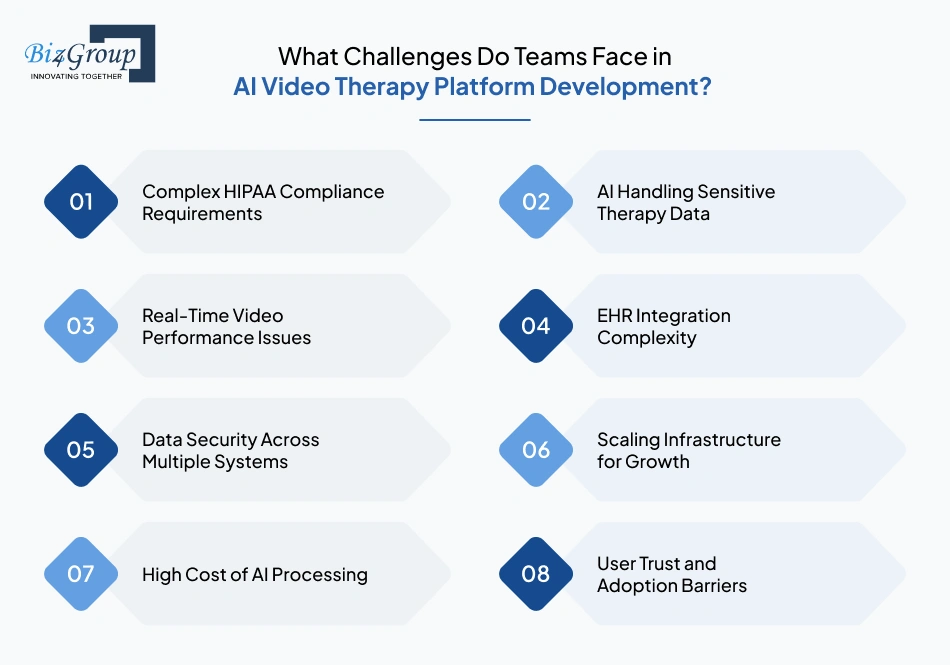
Even well-planned AI video therapy platform development projects face challenges that are usually not visible during early planning.
Most issues appear when organizations start scaling users, adding AI workflows, integrating healthcare systems, and handling compliance requirements in real time.
Healthcare platforms also operate under stricter risk conditions compared to traditional software. Even small architectural mistakes can impact security, compliance readiness, and patient trust.
Below are the most common challenges teams face when they build HIPAA-compliant AI video therapy platforms, along with practical ways to handle them.
|
Challenge |
Why It Happens |
How to Solve It |
|---|---|---|
|
Complex HIPAA Compliance Requirements |
Many teams assume compliance is only about encryption, but in reality it includes data movement, vendor access, AI processing, and audit readiness |
Design compliance as part of architecture from the beginning when you develop HIPAA-compliant AI video therapy platform systems |
|
AI Handling Sensitive Therapy Data |
AI workflows often interact with transcripts, notes, and behavioral data, which increases risk of unintended PHI exposure |
Define strict AI boundaries and ensure controlled access to healthcare data pipelines |
|
Real-Time Video Performance Issues |
Therapy sessions require stable, low-latency communication across regions and devices |
Use optimized WebRTC infrastructure and scalable cloud video services |
|
EHR Integration Complexity |
Healthcare systems often rely on fragmented or legacy EHR systems that are difficult to unify |
Plan integrations early using standardized APIs like FHIR and HL7 |
|
Data Security Across Multiple Systems |
Patient data flows through video, storage, AI, analytics, and communication layers |
Implement end-to-end encryption, access control policies, and audit logging |
|
Scaling Infrastructure for Growth |
Therapy platforms often grow rapidly once adopted by clinics and healthcare providers |
Build cloud-native, modular systems with autoscaling architecture |
|
High Cost of AI Processing |
AI features like transcription and summarization can become expensive at scale |
Optimize usage patterns and apply AI selectively based on workflow needs |
|
User Trust and Adoption Barriers |
Therapists and patients may hesitate to rely on AI-driven healthcare workflows initially |
Focus on UX clarity and gradual AI introduction supported by transparency |
Why These Challenges Are Often Misunderstood
Most organizations do not fail because of missing features.
They struggle when:
- compliance is treated as a final step
- AI systems are introduced without governance
- infrastructure is not designed for healthcare scale
- integration complexity is underestimated early
This is why experienced teams often prefer working with an AI development company that understands both healthcare workflows and scalable system design.
Building AI video therapy platform development solutions is not just a software task.
It is a combination of healthcare engineering, compliance architecture, and AI system design.
Why Biz4Group Is a Trusted Choice for AI Video Therapy Platform Development
Choosing the right partner for AI video therapy platform development is not just about engineering capability. It is about working with a team that understands healthcare workflows, HIPAA compliance, AI integration, and scalable system design together.
Biz4Group has been working in healthcare and AI product engineering space, building platforms that combine secure architecture with intelligent user experiences. One example is the NextLPC AI-powered eLearning platform for therapy students, where AI-driven learning workflows were designed to simulate real therapy education environments while maintaining structured, secure, and scalable architecture.
This reflects the same foundation required when organizations aim to build HIPAA-compliant AI video therapy platforms, where compliance, usability, and AI intelligence must work together rather than as separate systems.
What sets this approach apart is not just feature development, but system-level thinking around:
- Secure healthcare-grade architecture for sensitive workflows
- AI integration designed with controlled data handling
- Scalable backend systems built for real-world usage
- UX design focused on therapists and patient experience
- Compliance-aware engineering decisions from the start
Many organizations searching for an experienced AI healthcare software development company often look for teams that can handle both compliance and AI complexity without compromising scalability or user experience.
This becomes especially important when teams are evaluating requirements like: "We are a healthtech company looking for a development partner to build a secure AI video therapy platform with HIPAA compliance, AI-driven features, real-time video consultation capabilities, and scalable healthcare architecture for enterprise deployment in the US market."
For organizations trying to develop HIPAA-compliant AI video therapy platform solutions, choosing a partner with proven healthcare AI execution experience can significantly reduce risks related to architecture decisions, compliance gaps, and long-term scalability challenges.
In healthcare technology, execution quality directly impacts compliance, trust, and adoption. That is where real-world experience in building AI-driven healthcare systems becomes critical rather than optional.
Still comparing partners or ready to start building?
The right team decides whether your platform scales securely or struggles later.
Let's TalkWrapping Up!
Building a healthcare platform today goes far beyond adding video and AI features. It requires a structured approach to security, compliance, scalability, and user experience from the very beginning.
In AI video therapy platform development, success depends on how well architecture decisions support HIPAA compliance, AI workflows, and real-time clinical interactions without creating operational risks later.
Most failures in this space come from poor early decisions, not lack of features.
Biz4Group brings experience in building healthcare-focused AI solutions that combine secure infrastructure, intelligent systems, and scalable product design. From concept to deployment, the focus remains on building platforms that are compliant, efficient, and ready for real-world healthcare use.
For teams planning to develop HIPAA-compliant AI video therapy platforms, the right engineering partner can make the difference between a working product and a scalable healthcare system.
Build smart. Scale secure. Launch with confidence.
FAQ
1. What is AI video therapy platform development?
AI video therapy platform development is the process of building healthcare systems that combine secure video consultations, AI capabilities, and therapy workflows under HIPAA compliance. It includes patient engagement tools, clinical documentation, and secure handling of sensitive healthcare data.
2. How do I develop a HIPAA-compliant AI video therapy platform?
To develop HIPAA-compliant AI video therapy platform, you need secure system architecture, encrypted video communication, access control systems, audit logs, and proper data governance. Compliance must be embedded into the platform design rather than added later.
3. What features are required in a HIPAA-compliant telehealth video therapy platform?
A HIPAA-compliant telehealth video therapy platform typically includes secure video consultations, appointment scheduling, patient portals, AI-powered documentation, encrypted messaging, and integration with EHR systems for healthcare workflows.
4. How much does it cost to build an AI video therapy platform in the USA?
The cost to build an AI video therapy platform in the USA usually ranges from $40,000 to $300,000+, depending on AI complexity, compliance requirements, integrations, security architecture, and scalability. Enterprise-grade systems with advanced AI increase overall investment.
5. Why is building secure AI video therapy healthcare platform difficult?
Building a secure AI video therapy healthcare platform is complex because it involves handling protected health information, real-time video infrastructure, AI processing of therapy sessions, and strict HIPAA compliance requirements across multiple systems.
6. Which technologies are used for AI video therapy platform development?
Most AI video therapy platform development projects use React or Next.js for frontend, Node.js or Python for backend, WebRTC for video streaming, cloud infrastructure like AWS or Azure, and AI models for transcription, recommendations, and automation.
7. How do companies ensure compliance in AI-powered video therapy platforms?
Companies building AI-powered video therapy platforms for healthcare ensure compliance through HIPAA safeguards, Business Associate Agreements (BAA), encryption standards, audit logging, role-based access controls, and continuous security monitoring.
