 Location :
Orlando, FL, USA
Location :
Orlando, FL, USA +1 (407) 714-1616
 info@biz4group.com

- AI therapy recommendations app development helps organizations deliver personalized mental health guidance at scale with intelligent, data driven support.
- Businesses can develop AI therapy recommendations app solutions for clinics, universities, athletes, seniors and wellness platforms through tailored use cases.
- To make an AI therapy recommendation mobile app successful, teams include essential features such as profiling, assessments, dashboards and automated recommendations.
- Advanced personalization comes from developing an AI engine for personalized therapist and treatment recommendations that adapts to user behavior.
- Understanding the steps to create a personalized therapy recommendation app using AI helps teams plan MVP scope, workflows, UI design and recommendation logic.
- Costs range from $15,000-$150,000, influenced by complexity, integrations, analytics, maintenance and long term scaling needs.
- Biz4Group LLC builds intelligent, reliable and high performing AI mental health solutions backed by proven expertise and real world project success.
Many mental health providers are noticing something interesting. According to the World Health Organization, 1 in every 7 people lives with a mental health condition. This growing need has created an opening for businesses that want to lead digital wellness. If you are exploring AI therapy recommendations app development, this is the time when bold ideas gain the most traction.
Organizations across wellness, healthcare and education are beginning to develop AI therapy recommendations app solutions that offer personalized support at a pace traditional systems cannot match. People want guidance that feels approachable. Providers want systems that reduce burnout. When both sides win, adoption rises naturally.
Many teams that plan to make an AI therapy recommendation mobile app eventually realize that older workflows slow them down more than they help. They start looking for smarter ways to scale care without losing that human touch. Learning the steps to create a personalized therapy recommendation app using AI becomes the turning point where the entire vision opens up.
This guide will help you understand how AI therapy recommendations app development works and how it can help you build something that brings long term value to your users and to your business.
Why Scroll Through 6,000 Words When You Can Talk to a Human?
A quick call can answer more than an entire blog ever will.
Get in TouchWhat Is an AI Therapy Recommendations App?
An AI therapy recommendations app is a digital solution that helps people receive personalized mental health guidance based on their behaviors, preferences and emotional patterns.
These apps combine intelligent algorithms with human-centered design, and serve as a strong foundation for teams planning to build an AI therapeutic app tailored to individual needs.
What It Truly Is
- A digital companion built to offer personalized mental health recommendations.
- A tool that identifies patterns in behavior, emotions and habits.
- A system that guides users toward therapeutic exercises such as CBT, DBT or mindfulness.
- A platform that supports professional therapists by using AI automation services for early triage and routine follow ups.
What It Is Not
- A replacement for licensed therapists.
- A diagnostic tool.
- An automated system that provides identical advice to every user.
- A generic wellness app with surface level insights.
To help you see how these systems operate, here is a simple breakdown of the core components that guide the flow of an intelligent recommendation engine.
|
Core Component |
Role in the Experience |
How It Supports Personalization |
|
User Profiling |
Captures preferences, emotions and goals |
Helps tailor therapy suggestions |
|
Behavioral Insights Engine |
Studies patterns from check ins and reflections |
Improves relevance over time |
|
Modular Content Library |
Stores exercises, CBT prompts and therapeutic flows |
Matches the right content to the right user |
|
Recommendation Logic |
Aligns user behavior with suitable activities |
Delivers timely and appropriate suggestions |
|
Progress Interpretation Layer |
Analyzes growth, setbacks and routines |
Adjusts future recommendations |
When created with care, they bring clarity to the user journey and value to the provider. This is why the development of AI therapy recommendations app solutions is becoming a priority for organizations that want smarter and more actionable mental health support systems.
Why Build an AI Therapy Recommendations App Today in AI Therapy Recommendations App Development?
The rise in mental health needs has reached a point where traditional systems struggle to keep up. And this is the moment when organizations start exploring ways to develop AI therapy recommendations app solutions that support real care without adding pressure to existing teams.
The demand is clear. According to the World Health Organization, anxiety and depression increased by 25% in the pandemic’s first year. The world now looks for digital tools that can offer timely and consistent support.
Pain Points That AI Therapy Recommendation Apps Help Solve
Providers across many sectors share similar challenges.
- Long waiting times for users who need immediate guidance.
- Repetitive check ins and small tasks that reduce therapist availability.
- Difficulty maintaining consistent engagement between sessions.
- Limited visibility into a user’s emotional patterns.
- Scaling challenges when user numbers rise faster than staff capacity.
- Gaps in early intervention.
- High operational costs for manual triage workflows.
Business Benefits of Investing in This Technology
When companies make an AI therapy recommendation mobile app, they create space for stronger service models, better user outcomes and long term growth.
- Scalable support that continues working even during peak demand.
- Better onboarding with structured user assessments.
- Higher engagement through personalized pathways and timely nudges.
- Lower administrative load for therapists and care teams.
- Stronger differentiation in a competitive wellness and mental health market.
- Clearer progress insights for both users and providers.
- Opportunities to expand into corporate wellness, insurance wellness programs and academic mental health ecosystems.
When you know how to create AI therapy recommendations app solutions the right way, you build something that supports users at scale and strengthens your long term position in the mental health technology space.
Use Cases of AI Therapy Recommendations App Development for Modern Organizations
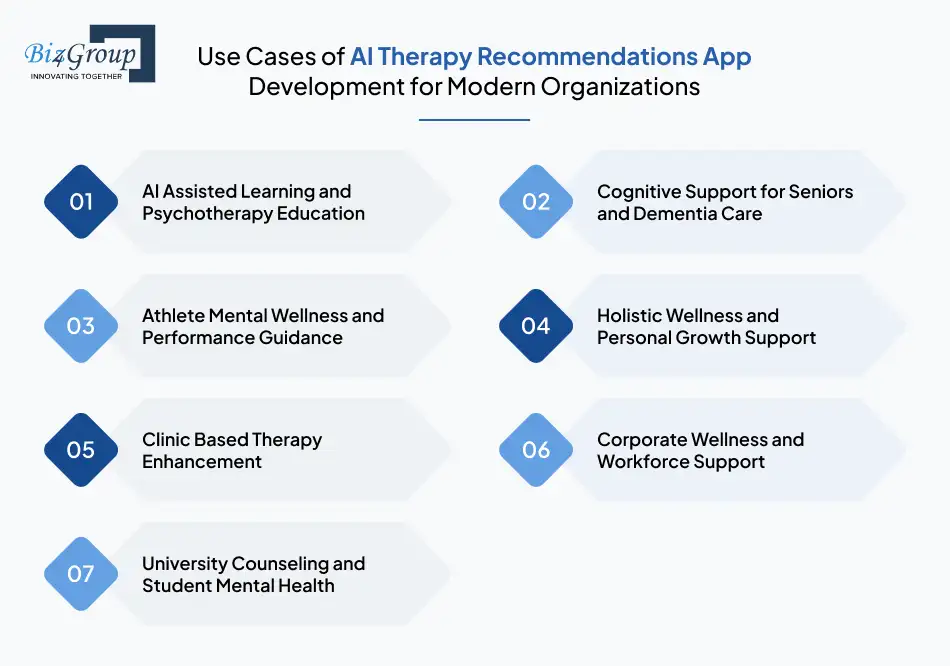
AI therapy recommendations app development is helping organizations reshape how mental health support is delivered. These apps create personalized experiences that guide users with clarity and consistency.
1. AI Assisted Learning and Psychotherapy Education
Training future therapists requires immersive learning that helps students understand emotional patterns, case studies and real-world scenarios. An AI powered recommendation app can analyze a student’s responses, identify gaps and suggest tailored exercises.
Project Spotlight: AI Avatar-Based Therapy Tutor Platform
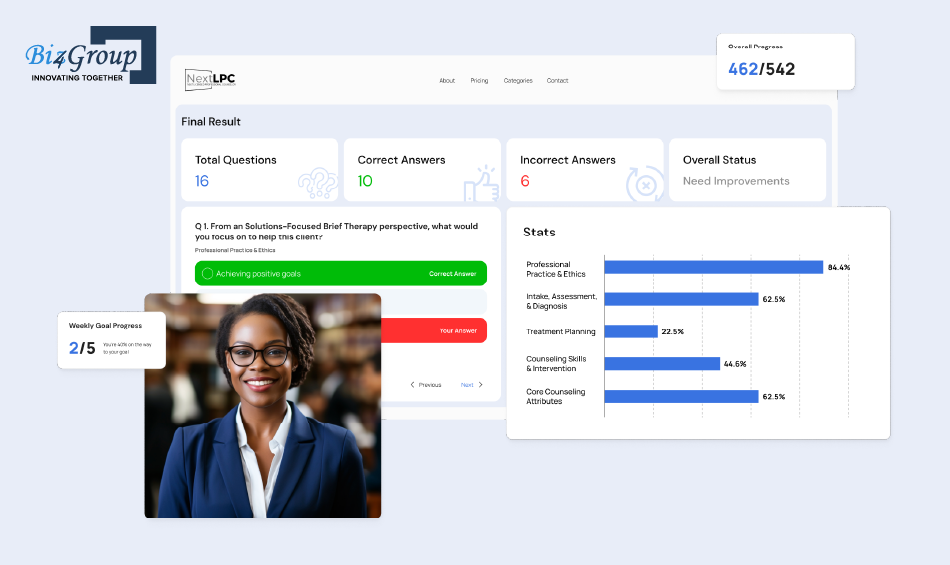
This self assessment platform powered by advanced AI avatars is a strong example of how intelligent systems support training use cases.
- AI avatars modeled after real therapists help students explore psychological case studies.
- A dashboard gives students detailed progress insights.
- Voice assistance encourages participation in any preferred language.
- Assessments are personalized and results are clearly displayed to support ongoing learning.
This project demonstrates how universities and therapy education programs can make an AI therapy recommendation mobile app that enriches learning through realistic simulation.
Also read: AI in psychotherapy assessment
2. Cognitive Support for Seniors and Dementia Care
Apps with personalized therapy suggestions are useful for individuals facing memory challenges. These apps can track daily activities, prompt self-reflections and recommend cognitive support exercises tailored to the user’s routine.
Project Spotlight: AI Solution for Dementia Patients
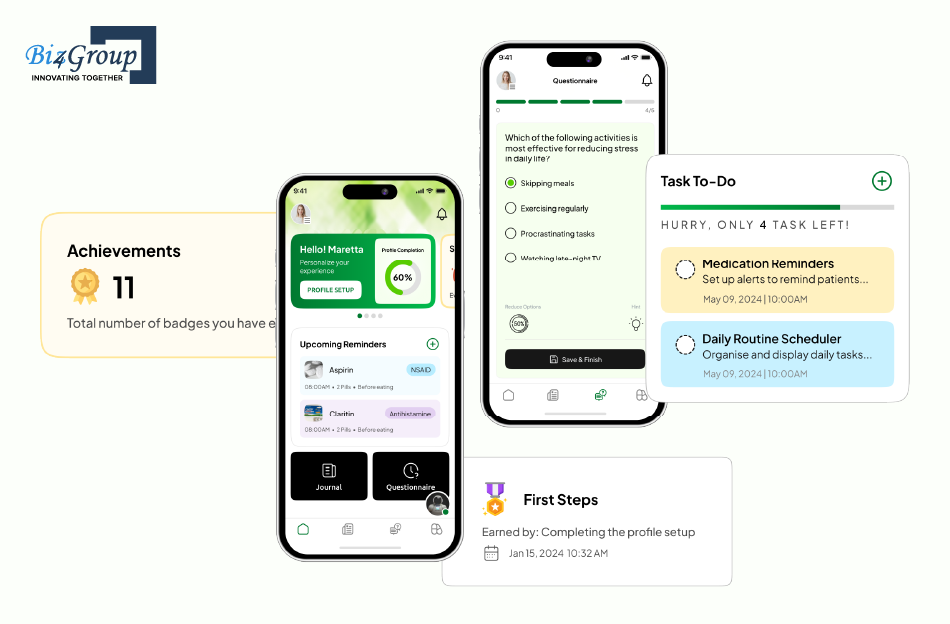
This project, for dementia patients, shows how AI guided care can enhance cognitive support.
- Daily quizzes based on personal memories and profile details maintain mental activity.
- Journaling tools and voice to text options help users express their feelings easily.
- Medication reminders keep patients on track.
- Emotional checkpoint chatbots help caregivers understand the patient’s emotional state.
This project illustrates how to create AI therapy recommendations app features that deliver meaningful, compassionate and personalized senior care support.
Also read: How much does it cost to build AI cognitive memory app?
3. Athlete Mental Wellness and Performance Guidance
Athletes deal with high pressure environments that impact both physical and mental well-being. A personalized therapy recommendations AI app development project for sports teams can introduce emotional tracking, stress pattern recognition and recovery-based suggestions.
Project Spotlight: AI-Powered Athletic Health Solution

This AI-driven application for athletes is a strong example of personalized health insight and predictive recommendation capabilities.
- Blood report uploads generate detailed, data driven insights.
- Recommendations cover diet, sleep, hydration and training plans.
- Real time monitoring helps athletes refine their routines.
- Private consultation flows deliver professional level guidance.
This project shows how providers can develop an AI therapy recommendations app that moves beyond generic advice and delivers accurate, actionable recommendations.
Also read: AI physiotherapy app development guide
4. Holistic Wellness and Personal Growth Support
Wellness brands look for ways to engage users beyond general tips. AI can study habits, emotional triggers and progress patterns, then recommend the right activities at the right time.
Project Spotlight: AI-Powered Personal Development Mobile App
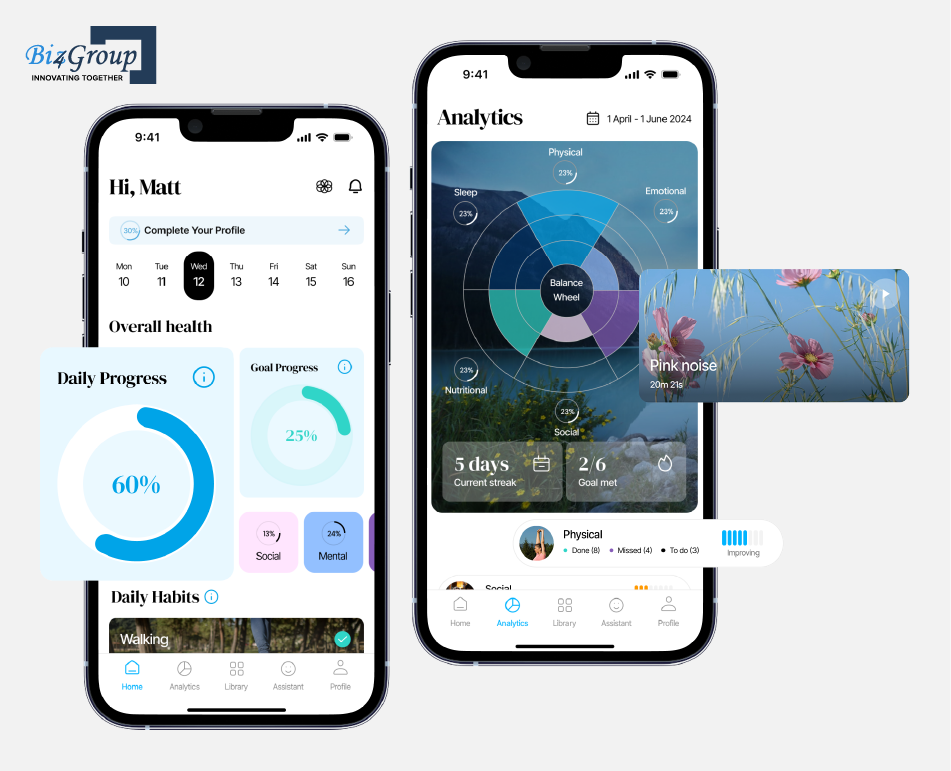
As a seasoned AI chatbot development company, Biz4Group LLC created this personal development app that brings together personalized recommendations and holistic well being.
- AI powered goal setting helps users form healthy routines.
- Insights and analytics highlight strengths and areas for improvement.
- A supportive chatbot offers motivation, guidance and educational content.
- The platform covers multiple dimensions of personal growth for long term transformation.
This project highlights how companies can develop an AI therapy recommendations app that supports both mental and emotional wellness while offering a strong user engagement model.
Also read: How to build an AI personal development app?
5. Clinic Based Therapy Enhancement
Mental health clinics use recommendation apps to streamline user assessments, support therapy between sessions and personalize treatment plans. The system captures meaningful patterns and suggests relevant exercises that therapists can integrate into care plans.
Also read: How to develop an AI avatar for clinical management?
6. Corporate Wellness and Workforce Support
Organizations want employees to access helpful tools that reduce stress, improve clarity and support mental well being. An AI powered recommendation app offers private self help exercises, burnout insights and behavior patterns. Companies gain a stronger, healthier and more stable workforce.
Also read: How to build AI mental health app for corporate wellness?
7. University Counseling and Student Mental Health
Students experience academic pressure, social stress and emotional changes. A personalized therapy app can guide them with reminders, emotional check ins, CBT based suggestions and early intervention support.
Also read: AI mental health app development guide
When companies understand the potential and learn how to develop AI therapy recommendations app solutions that meet their unique goals, they gain tools that are scalable, supportive and meaningful to the communities they serve.
Ready to Build Something Users Actually Stick With?
Apps with personalized recommendations see up to 3X higher engagement than generic wellness tools.
Build Smart with Biz4GroupImportant Features for AI Therapy Recommendations App Development
A high performing therapy recommendation platform begins with a clear set of foundational features. These features ensure that users receive personalized guidance while providers maintain a structured and reliable workflow. The goal is not to overwhelm the app with extras but to build a set of essentials that support meaningful engagement.
|
Feature |
Description |
User Value |
|
User Onboarding and Profiling |
Captures personal details, goals and behavioral patterns |
Creates a strong base for personalized recommendations |
|
Allows users to log daily emotions and triggers |
Helps identify trends that influence mental well being |
|
|
Journaling and Reflections |
Encourages users to write or record thoughts |
Supports self awareness and progress monitoring |
|
Assessments and Questionnaires |
Structured evaluations for mental health insights |
Helps the system tailor therapeutic suggestions |
|
Personalized Content Library |
Therapy exercises including CBT, DBT and mindfulness |
Delivers targeted activities that match user needs |
|
In App Recommendations |
Automated guidance based on user data patterns |
Offers direction at the right time |
|
Progress Dashboard |
Shows goals, activity history and mental health shifts |
Gives transparency and motivation for continued engagement |
|
Notifications and Nudges |
Timely alerts that keep users on track |
Improves adherence and engagement |
|
Secure Login and Permissions |
Multi level authentication and access controls |
Protects sensitive personal information |
|
In App Support and Help Center |
Provides guidance for using the app |
Builds user trust and reduces confusion |
These features form the structural foundation of an effective solution. Once these elements are established, organizations can expand into advanced capabilities that enhance personalization and long term value.
Advanced Features to Consider in AI Therapy Recommendations App Development
Advanced features add depth, intelligence and long-term value to a mental health platform. These capabilities help the system understand users on a deeper level and deliver guidance that feels natural and relevant.
1. Context Aware Recommendation Logic
An intelligent app can interpret not only what a user inputs but the context behind those inputs. The system studies patterns in timing, tone, frequency and behavior. This allows the platform to adapt suggestions based on situational shifts rather than only static entries.
2. Adaptive Session Flow Personalization
Therapeutic journeys often change from week to week. Instead of presenting the same structure to every user, the app can analyze engagement patterns and adjust session flows. If a user responds better to reflective exercises, the system can highlight more of those. If they show signs of disengagement, the app can shorten flows or simplify steps. This helps the experience feel human and responsive.
3. Cross Interaction Intelligence
Users interact with different parts of an app including assessments, journaling, emotional check ins and self-guided tasks. Cross interaction intelligence studies how these touchpoints relate to each other. It helps identify subtle correlations such as a user’s stress pattern increasing on days when their task completion rate drops.
4. Multi Pathway Coping Recommendations
Different users need different coping strategies. Multi pathway engines offer custom routes for breathing exercises, grounding methods, reframing prompts or micro reflections. The platform recognizes which coping style works best and routes users to the right path.
5. Intelligent Crisis Sensitivity Detection
Analyzes sentiments, writing patterns and frequency changes to identify when a user may need additional support. It does not diagnose but detects notable shifts. When these shifts appear, the system can offer safe next steps. This ability improves user safety and strengthens trust in the product.
6. Personalized Learning Moments
These are small, well-timed insights based on what the system learns about the user. Instead of long lessons, the app offers short knowledge drops that explain why certain emotions or behaviors appear. Users feel informed without feeling overwhelmed.
Advanced capabilities like these make recommendation engines more refined and helpful. When companies decide to develop an AI therapy recommendations app with these features, they position themselves ahead of competitors who rely on standard solutions.
Also read: Role of AI agents in therapy and diagnosis
Users Love Apps That Feel One Step Ahead.
Businesses adding advanced AI features grow their user retention by 40% faster.
Get a Strategy CallRecommended Tech Stack for AI Therapy Recommendations App Development
When a team begins full stack development for an intelligent recommendation system, the right blend of technologies becomes essential. The goal is to ensure smooth performance, fast response times, strong security and an environment that can support continuous growth over time.
|
Layer |
Technologies |
Why These Work Well |
|
Frontend |
React Native, Flutter, Next.js |
Creates responsive interfaces for mobile and web with strong performance |
|
Backend |
Supports scalable logic processing and seamless integration of AI components |
|
|
AI and Machine Learning |
TensorFlow, PyTorch, OpenAI models, HuggingFace pipelines |
Powers intelligent recommendation logic and language understanding |
|
Databases |
PostgreSQL, MongoDB |
Handles structured and unstructured data with stability and high availability |
|
Cloud and Hosting |
AWS Amplify, AWS S3, Firebase, Azure |
Offers reliable storage, fast deployment and strong data protection features |
|
DevOps |
Docker, Kubernetes, GitHub Actions |
Ensures smooth releases and consistent performance across environments |
|
Authentication and Security |
OAuth2.0, JWT, Bcrypt |
Protects user identity, access and personal information |
|
Analytics |
Mixpanel, Google Analytics, OpenSearch |
Tracks user behavior and system metrics for continuous improvement |
|
Integrations |
REST APIs, Webhooks, Wearable SDKs, Calendar APIs |
Enables connectivity to third party services and real time data sources |
A tech stack shaped with care forms the backbone of a strong digital product. When applied to AI therapy recommendations app development, it supports stable user experiences and intelligent insights that feel natural and helpful.
Step by Step Process for AI Therapy Recommendations App Development
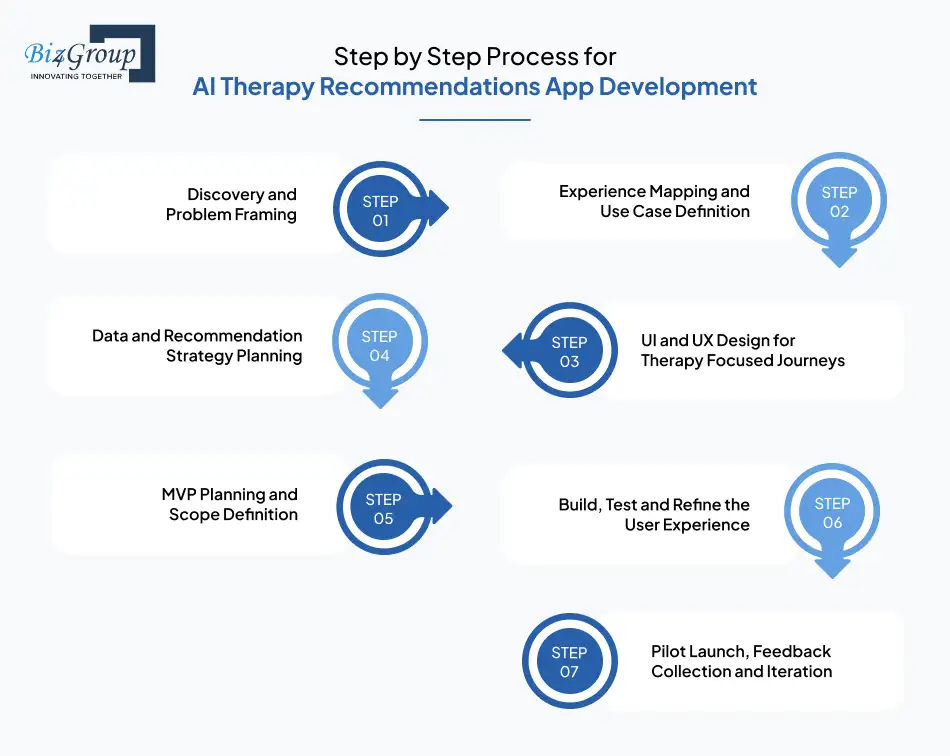
When leaders ask what is the process of developing AI therapy recommendations app solutions, they often imagine something complex and impossible to navigate. In reality, the journey becomes far more manageable when you break it into clear, human-centered steps.
Step 1. Discovery and Problem Framing
Everything begins with clarity. In this first stage, your team defines who the app is for, what problems it solves and how success will be measured. You explore questions such as:
- Which user groups need the most help.
- What gaps exist in current mental health support.
- How AI can complement, not replace, human care.
This step sets the foundation for any serious plan to develop AI therapy recommendations app solutions.
Step 2. Experience Mapping and Use Case Definition
Once the core problem is understood, you map out use cases. You identify the main scenarios where the user interacts with the app and where recommendations are most valuable.
Typical flows include onboarding, daily check ins, reflection moments and progress reviews. By the end of this step, you have a clear view of how people will live with the app in their day-to-day life.
Step 3. UI and UX Design for Therapy Focused Journeys
Design plays a vital role in personalized therapy recommendations AI app development. The tone, layout and micro interactions need to feel calm and safe. In this step, a UI/UX design company crafts wireframes and clickable prototypes. They pay attention to:
- Ease of navigation for stressed or tired users.
- Gentle visual cues instead of overwhelming graphics.
- Language that feels supportive and non judgmental.
Also read: Top 15 UI/UX design companies in USA
Step 4. Data and Recommendation Strategy Planning
Before any line of code is written, you plan how the recommendation engine will think. This is where you shape the logic behind personalized suggestions. You define:
- What data the app will collect.
- How user journeys translate into meaningful signals.
- What types of content or actions can be recommended.
This step guides anyone who wants to build an AI therapy recommendation application with predictive analytics that feels grounded and responsible.
Step 5. MVP Planning and Scope Definition
Leaders who ask about steps to create a personalized therapy recommendation app using AI often make one classic mistake. They try to launch every feature at once.
Developing an MVP prevents that problem. Here you decide which small set of features delivers real value from day one. The scope might include onboarding, mood tracking, journaling, and a basic recommendation engine.
You focus on learning from early users and validating that the concept works in real life. This makes future investment smarter and reduces wasted effort.
Also read: Top 12+ MVP development companies in USA
Step 6. Build, Test and Refine the User Experience
In this step, the team brings the planned flows to life and tests them with real people. The focus stays on stability, clarity and comfort.
You run usability tests to see whether users understand where to tap, what to do next and how to interpret their progress. Feedback from therapists and clinical advisors is especially valuable. Their input ensures that the experience aligns with real therapeutic practices.
Step 7. Pilot Launch, Feedback Collection and Iteration
Once the initial version is ready, you release it to a controlled audience. This might be one clinic, one corporate partner or a limited user group. You study engagement patterns, completion rates and feedback. Then you improve the product based on real behavior rather than assumptions.
At this stage, AI therapy recommendations app development becomes an ongoing practice rather than a one time project. The app learns. Your team learns. The users benefit from a product that becomes more helpful over time.
Also read: How to build a smart supplement recommendation app using AI?
Want This Entire Process Done Without the Guesswork?
We turn complex AI roadmaps into launch-ready MVPs in 2–3 weeks. Yes, weeks.
Contact Biz4Group NowSecurity and Compliance Requirements in AI Therapy Recommendations App Development
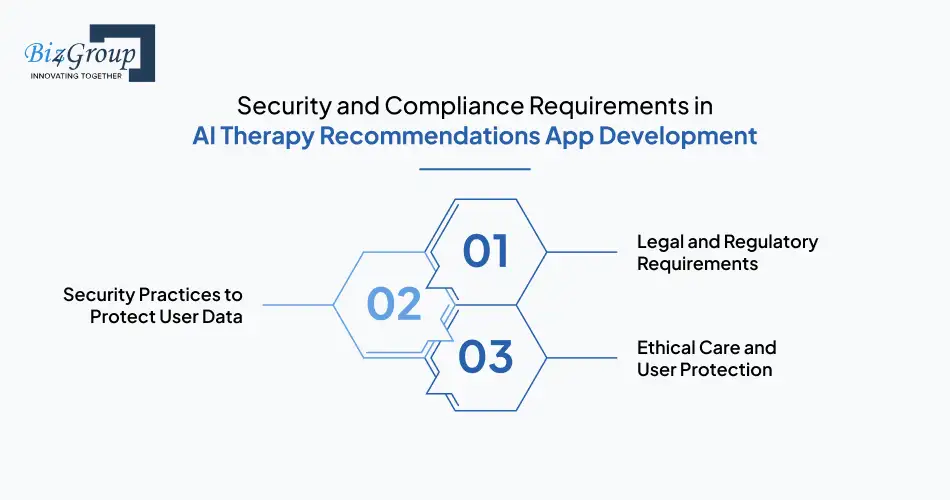
When organizations begin the development of AI therapy recommendations app solutions, security and ethical responsibility become top priorities. Mental health data carries emotional weight and legal obligations, so every decision needs careful thought.
Legal and Regulatory Requirements
- Compliance with HIPAA for handling protected health information in the United States.
- Alignment with GDPR for serving users in European regions and for global data protection needs.
- Clear consent collection practices that explain what data is gathered and how it is used.
- Adherence to local telehealth regulations when the app supports clinician facing features.
- Transparent user rights that include easy access to data export or deletion requests.
Security Practices to Protect User Data
- Encrypted data storage to safeguard sensitive records at rest.
- Secure data transmission through trusted protocols.
- Continuous monitoring to track suspicious activity and maintain platform integrity.
- Access controls that limit sensitive information to authorized users only.
- Regular audits to evaluate system reliability and close security gaps.
Ethical Care and User Protection
- Clear boundaries that prevent the app from presenting itself as a replacement for licensed professionals.
- Limits on what the recommendation engine can suggest to avoid misleading or unsafe advice.
- Crisis support pathways that guide users to human help when high risk language patterns appear.
- Bias prevention practices that evaluate whether recommendations serve users from diverse backgrounds.
- Plain language disclosures that explain how AI supports the user without creating unrealistic expectations.
Organizations that follow these principles gain more trust from their users. They also build a safer and more responsible foundation for long term AI therapy recommendations app development.
Also read: HIPAA compliant AI app development guide
Cost Breakdown for AI Therapy Recommendations App Development
The cost of building an intelligent therapy recommendation platform varies widely based on complexity, scope and long term goals. On average, AI therapy recommendations app development can range from $15,000-$150,000+ depending on whether the project focuses on a simple MVP or a comprehensive enterprise level system.
|
Project Level |
Estimated Cost Range |
What You Receive |
|
MVP |
$15,000-$40,000 |
Essential features such as onboarding, mood tracking, journaling, and a basic recommendation flow |
|
Advanced Level |
$40,000-$90,000 |
Enhanced analytics, adaptive recommendations, personalized pathways and cross interaction logic |
|
Enterprise Level |
$90,000-$150,000+ |
Fully scalable architecture, advanced AI modeling, integrations, dashboards, multi team workflows and customization |
These ranges help organizations plan ahead and understand what type of product they can expect at each tier. The following sections explain the cost components in more detail so you can make informed decisions.
Cost Drivers in AI Therapy Recommendations App Development
The total investment depends heavily on several core factors. Each cost driver has a direct influence on budget and timeline.
|
Cost Driver |
What It Involves |
Cost Impact |
|
App Complexity |
Number of features, flows and interaction depth |
$5,000-$50,000+ depending on feature count |
|
Recommendation Engine Style |
Basic rule based logic or advanced adaptive intelligence |
$8,000-$40,000+ depending on sophistication |
|
UI and UX Design Depth |
Simple layouts or detailed therapeutic journeys |
$3,000-$20,000+ depending on customization |
|
Platform Choice |
Android, iOS or cross platform builds |
$5,000-$30,000+ depending on support needed |
|
Integrations |
Wearables, calendars, assessments or APIs |
$2,000-$25,000+ depending on number of integrations |
|
Analytics and Reporting |
User dashboards or provider analytics |
$3,000-$18,000+ depending on detail |
|
Content and Exercise Library |
CBT, DBT, mindfulness or custom modules |
$1,500-$10,000+ depending on volume |
|
Team Expertise |
General developers or AI focused product teams |
Overall project can rise by 20%-60% |
|
Testing and Iteration |
User testing, QA and improvements |
$2,000-$15,000 depending on cycles |
These drivers paint the picture of how budgets evolve. Each decision affects long term scalability and user satisfaction, so they are worth evaluating with care.
Hidden Costs Many Teams Miss in AI Therapy Recommendations App Development
While planning to develop AI therapy recommendations app solutions, many organizations focus only on the initial build cost. Real world projects often include hidden expenses that influence yearly budgets. Understanding these costs early helps prevent surprise overruns and improves long term financial planning.
- Ongoing AI Usage and Token Costs
Intelligent recommendations rely on model interactions. As the user base grows, model queries increase.
- Light usage may add $50-$100 per month.
- Active apps may reach $200-$500 per month.
- High volume enterprise products can cross $1,000+ per month.
This cost scales with user engagement and should be planned for from day one.
- Cloud Hosting and Storage
Platforms handling mood logs, reflections and progress histories need stable hosting.
- Small scale projects often average $30-$80 per month.
- Mid level apps may require $100-$300 per month.
- Enterprise systems handling heavy data can exceed $500 per month.
Storage expands with user data, content libraries and backup systems.
- Maintenance and Continuous Improvements
A recommendation engine thrives when updated frequently. Maintenance often covers bug fixes, feature adjustments, and new content pathways. Expect annual maintenance to run at 15%-25% of the initial build cost.
- User Support and Operational Load
Support teams assist users who face technical or emotional concerns.
- Small apps may spend $100-$200 monthly.
- Larger apps may allocate $300-$800 monthly.
Operational support ensures a smooth user experience.
- Legal and Compliance Upkeep
Regulations around mental health and digital wellness evolve frequently. Legal reviews and compliance updates may add $1,000-$5,000+ yearly depending on app scale and target markets.
- Content Expansion and Therapy Modules
Therapeutic content needs regular growth to maintain relevance. New modules can cost $500-$3,000 depending on complexity and volume.
Understanding these hidden costs ensures that when you plan to make an AI therapy recommendation mobile app or expand into advanced levels, your product evolves smoothly without financial strain.
Challenges and Risks in AI Therapy Recommendations App Development
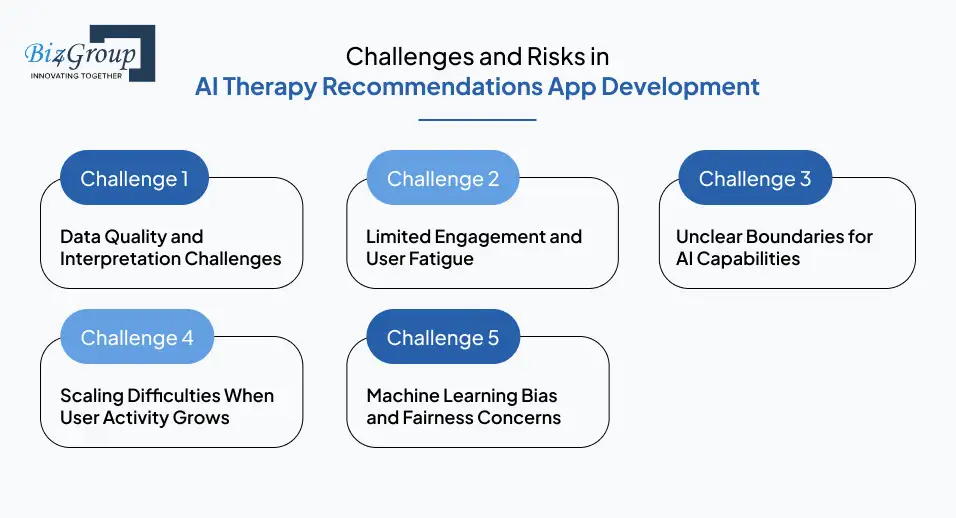
Every organization that begins the development of AI therapy recommendations app solutions encounters a unique mix of obstacles. Some challenges are technical. Others relate to user behavior, clinical expectations or long term maintenance.
Challenge 1: Data Quality and Interpretation Challenges
The accuracy of any recommendation engine depends on the quality of the information it receives. Many users provide incomplete or inconsistent entries. This creates uncertainty in the system’s ability to understand patterns and suggest meaningful activities.
To address this challenge, teams must design simple and intuitive check in flows that encourage steady participation. When done well, engagement rises and model decisions become more reliable.
Challenge 2: Limited Engagement and User Fatigue
Human behavior is unpredictable. Some users complete their daily check ins while others lose interest after a few sessions. Low engagement affects the app’s intelligence and reduces long term retention.
To reduce this risk, product teams introduce supportive nudges, micro reflections and encouraging moments. These small shifts help build stronger habits and keep users connected to their goals.
Challenge 3: Unclear Boundaries for AI Capabilities
Users may assume that intelligent suggestions can replace licensed therapy or diagnose mental health conditions. This misunderstanding creates risk for both users and organizations.
Clear communication helps solve this. The app needs clean guardrails, disclaimers and flows that guide users to real human help when emotional intensity rises.
Challenge 4: Scaling Difficulties When User Activity Grows
As the platform welcomes more users, recommendation requests and data inputs increase. If the architecture is not prepared for this growth, performance slows and the experience suffers.
Teams can mitigate this by planning early for load balancing, optimized data flows and structured content delivery. This ensures smooth operation even during peak activity.
Challenge 5: Machine Learning Bias and Fairness Concerns
If the dataset used for recommendation logic lacks diversity, the system may overlook certain user groups or misinterpret their emotional patterns. This raises ethical and reputational concerns.
A fair system requires diverse content samples, varied user testing and regular audits to ensure that recommendations remain supportive for all identities and backgrounds.
These challenges are common but manageable when acknowledged early. By recognizing them ahead of time, your organization gains the confidence to move through AI therapy recommendations app development with a plan for an AI product that users can rely.
Challenges Are Real. The Right Team Makes Them Boring.
Most AI mental health projects fail from avoidable mistakes. Ours don’t, because we’ve solved them hundreds of times already.
Talk to Our ExpertsFuture Trends in AI Therapy Recommendations App Development
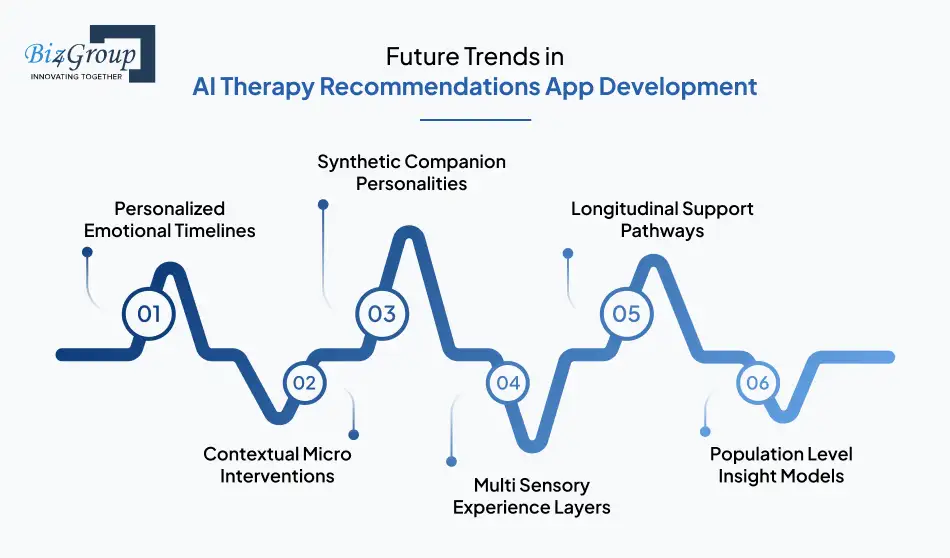
The next chapter of digital mental health will introduce capabilities that feel more intuitive, more responsive and more human. These trends reflect forward looking shifts that will influence how organizations plan, build and scale intelligent therapy support platforms.
1. Personalized Emotional Timelines
The future will allow users to view emotional journeys with more detail and clarity. Instead of simple mood charts, apps will form long form emotional timelines that interpret how stress, thoughts and actions evolve across weeks and months. These timelines will help individuals understand deeper behavioral arcs and will support therapists with richer insights during reviews.
2. Contextual Micro Interventions
Therapeutic support will move toward smaller and timely actions that respond instantly to user behavior. Instead of long exercises, users may receive short practical suggestions based on their recent emotional pattern or activity. These moments provide early support before challenges escalate and help users stay grounded throughout the day.
3. Synthetic Companion Personalities
AI companions will grow more natural, stable and personalized. Users will choose from multiple supportive communication styles, creating a relationship that feels familiar. This trend strengthens comfort and emotional safety, especially for individuals who want a consistent guidance style that matches their personality.
4. Multi Sensory Experience Layers
Future applications will begin to include sound based cues, guided visualization elements and gentle emotional grounding moments that combine different sensory inputs. These elements create a richer environment for therapeutic support. Users receive guidance through multiple channels, which improves connection and attention.
5. Longitudinal Support Pathways
Instead of single sessions or short exercises, future solutions will help users navigate multi week or multi month therapeutic paths. These longer support journeys become more adaptive over time. The app offers encouragement and structured guidance that progresses steadily, helping the user gain continuity in their emotional development.
6. Population Level Insight Models
Organizations will gain access to large scale insight models that highlight emotional trends within various groups. These insights help clinics, universities, corporate wellness teams and health networks understand the challenges their communities face. This approach strengthens strategic planning and helps decision makers support their groups with informed care strategies.
The future of AI therapy recommendations app development will continue to evolve with thoughtful innovation. These trends point to a shift toward deeper personalization, richer experiences and stronger emotional understanding.
Why Biz4Group LLC Is the Leading Partner for AI Therapy Recommendations App Development in the USA?
Biz4Group LLC has spent many years helping organizations build digital experiences that create real value. We are a USA based software development company with a strong focus on AI development.
Our teams work closely with healthcare innovators and wellness brands to deliver platforms that people trust. When companies begin exploring AI therapy recommendations app development, they look for a partner who understands both the emotional weight of mental health care and the technical depth required to deliver reliable solutions. That is where we excel.
We approach every project with a blend of strategy, engineering strength and real empathy for the end user. Our teams have built intelligent mental health platforms, AI healthcare solutions, and personalized recommendation engines across multiple industries. We understand the sensitivity of mental health data, the importance of user comfort and the precision needed to build recommendation systems that feel thoughtful rather than automated.
Our work reflects long-term vision, strong attention to detail and a commitment to helping our clients build products that stand out in a crowded market.
Why Businesses Choose Us
- We combine deep AI app development expertise with a strong understanding of mental health and wellness user journeys.
- Clients trust us because we deliver stable, high quality platforms designed for real world use.
- Our teams move quickly without losing focus on craftsmanship or user safety.
- We have proven experience building intelligent learning systems, cognitive support apps and high scale recommendation engines.
- Organizations appreciate that we offer strategy, design, engineering and long term product growth under one roof.
- We focus on products that not only function well but also feel supportive, calm and human centered.
- Our approach reflects transparency, clear communication and a genuine dedication to our clients’ long-term success.
Biz4Group LLC has earned a reputation for solving complex problems with clarity and care. When you partner with us, you gain AI developers that understands both the technical complexity and the emotional responsibility of building mental health technology. We help you shape a product that supports users, strengthens your brand and stands steady as you scale.
If your business is ready to build a meaningful, scalable and intelligent therapy recommendation platform, our team is ready to help. You can take the first step now and speak with experts who understand exactly what it takes to turn your vision into a powerful product.
Wrapping Up
AI therapy recommendations app development has emerged as one of the most meaningful opportunities in the digital wellness space. Organizations across healthcare, education, fitness, corporate wellness and senior care are leaning toward smart, personalized support systems that help users understand their emotional patterns and improve their daily lives. With the right blend of intelligence, thoughtful design and structured recommendations, these apps can deliver timely guidance and help people build habits that create real change.
Biz4Group LLC has spent years helping organizations across the USA bring enterprise AI solutions to life. Our team knows how to combine AI, strategy, design and human-centered thinking to create platforms that people rely on. When businesses look for a partner who understands the emotional and technical sides of digital mental health, they turn to us because we take the responsibility seriously and deliver solutions that stand out.
Reach out today and let’s create a product your users will trust and remember.
FAQs
How accurate are therapy recommendations generated by an AI powered app?
AI recommendations reach high accuracy when trained on strong data and supported by thoughtful behavioral patterns. Accuracy improves as users interact more consistently, and validation from mental health professionals makes the system even more reliable.
How long does it usually take to build a complete AI therapy recommendation platform?
Most companies need 6-7 weeks to build an MVP. Biz4Group can deliver one in 2-3 weeks because we use reusable components that reduce development time and cost. Full scale platforms take longer depending on complexity and feedback cycles.
Can an AI therapy recommendation app work without constant internet access?
Certain features like journaling can work offline. Recommendation engines and updated content require online access since they rely on real time logic and refreshed insights.
How customizable can the therapeutic content be in these apps?
Content can be tailored to match your preferred therapeutic methods, brand voice or cultural requirements. Teams can also add original modules, prompts or multilingual content.
Can a therapy recommendation app integrate with wearable devices?
Yes. Apps can connect to wearables to interpret sleep, stress or activity patterns. This extra context allows the system to shape more relevant wellness suggestions.
Are parental or guardian controls possible for younger users?
Parental modes can be added to provide high level insights without exposing private user details. This keeps the experience supportive while still offering oversight.
