 Location :
Orlando, FL, USA
Location :
Orlando, FL, USA +1 (407) 714-1616
 info@biz4group.com

- Phone calls play a critical role in real estate because they often represent high-intent moments where speed, clarity, and trust matter most.
- Real estate AI IVR systems for customer experience work best when they reduce caller effort early, not when they try to automate every possible request.
- Calls improve when intent is captured first, routing is accurate, and escalation to a human is clear and fast.
- AI IVR systems for real estate customer service help reduce missed calls, long wait times, and unnecessary transfers during peak and after-hours periods.
- Measuring success requires looking at drop-off rates, resolution time, and transfer frequency together, not in isolation.
- Real estate AI IVR solutions for enhanced customer experience are most effective when designed around real call scenarios instead of internal team structures.
In real estate, phone calls are how the first high-intent interaction with a buyer, seller, or tenant happens. Researchers claim that callers form trust judgments within the first 20 to 30 seconds of a call. Within that time, the speed, clarity, and direction of response directly affect how your professionalism is perceived. This is why real estate AI IVR systems for customer experience are getting more and more popular as a front-line experience.
Phone experience matters because callers expect to be heard right away and guided without any hassles or delays. When this does not happen, confidence drops down and follow-up rates take a hit. Many firms now rely on AI IVR systems for real estate customer service to reduce uncertainty early in the interaction but keep access to a human, in case it's ever needed for a complex situation.
Traditional call handling depends on manual routing, shared lines, and availability of agents. These setups often fail during peak calling hours, after-hours, or in cases where number of calls suddenly spike. Missed calls, long wait times, and repeated transfers increase caller effort and lead to higher lost calls. From the customer’s perspective, the overall experience becomes very exhausting and sometimes even disappointing.
As expectations rise, companies are redesigning the structure of how calls are handled with the help of real estate AI software development. Structured call intake helps callers talk about the right things faster and with less repetition. This shift is making real estate AI IVR solutions for better tenant communication a top choice for customer experience improvement.
What "Good CX" Means in Real Estate Phone Interactions
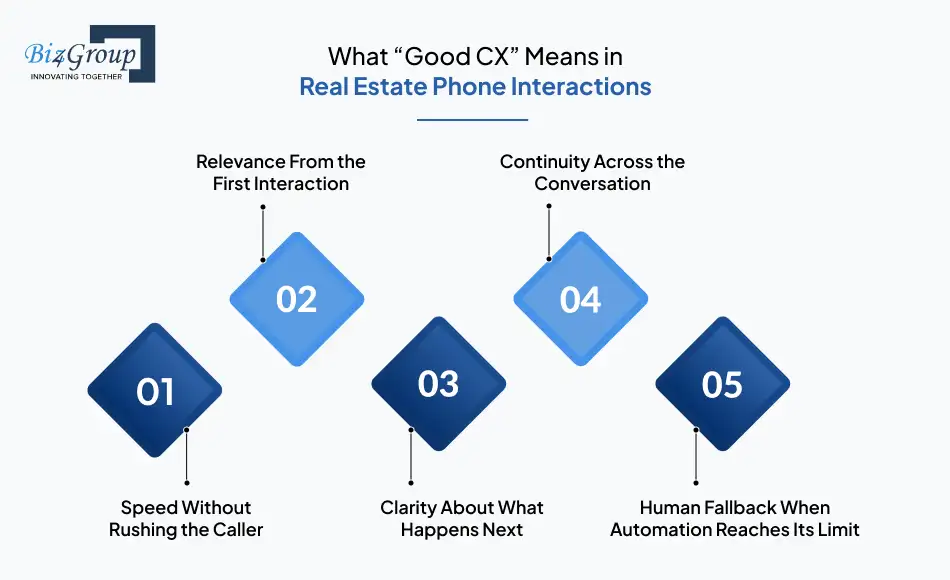
Customer experience on a real estate call is considered 'good' when the caller puts in minimum effort, gets answers quick, and is routed to the right person. When the same factors are not taken care of properly, the lost call rate increases. Now, the type of enquires that are made in real estate, are very time-sensitive, which means there's a lot of trust factor involved. This is the reason why real estate AI IVR systems for customer experience focus the most on 'first-interaction' clarity.
Let's talk about the core components that define what 'good CX' means for real estate phone interactions:
1. Speed Without Rushing the Caller
Good CX means understanding the caller immediately, while at the same time, allowing them to explain their need without pressure. Most callers expect the agent to pick up their call within 30 to 60 seconds. Delays beyond that limit increase the chances of call abandonment.
For example, a buyer calling about a new listing expects quick confirmation - that a particular property is available, and so is the guidance on the next steps. A system that answers instantly and directs the conversation based on the right intent reduces wait time without rushing through the conversation.
Several firms make use of real estate AI IVR systems for 24/7 customer support to ensure that calls are attended immediately, even outside office hours. The goal is maximum responsiveness, but not at the cost of clarity.
2. Relevance From the First Interaction
Relevance means being directed to the correct person or information without repeating any details. Repetition is one of the most troublesome frustrations in phone support.
Consider a tenant calling about a maintenance issue in their property. If they first explain the issue to a general receptionist and then repeat it to a property manager, it takes twice the effort and time. Structured call intake reduces that repetition by capturing intent right at the beginning of the call.
This is where using AI IVR systems to automate property inquiries becomes meaningful. When designed properly, the system gathers key information once and routes accurately every single time.
3. Clarity About What Happens Next
Good CX reduces uncertainty. Callers should always know what will happen next, whether they are being transferred to someone other agent, placed on hold for a while, or being connected to an agent.
For example, if a seller calls to request a property valuation, the system should clearly say: “You will now be connected to a listing specialist.” Clear transitions reduce confusion and prevent call drop in the middle of routing proces.
Clarity is often overlooked, but it directly affects your professionalism towards the callers.
4. Continuity Across the Conversation
Continuity means the system keeps the context maintained throughout the call. When callers have to restate their property address or reason for calling, frustration shoots up.
For example, a repeat buyer who inquired about a specific listing around a week ago now expects that information to carry forward in the next call. Maintaining context improves the speed of resolution and reduces the overall mental effort.
Organizations that build real estate AI software often focus on this continuity layer because it directly affects caller satisfaction.
5. Human Fallback When Automation Reaches Its Limit
No system, no matter how advanced it claims to be, can resolve 'all' inquiries. Good CX includes immediate access to a human when the automation layer is unable understand or resolve the request.
For example, a complex commercial lease negotiation inquiry should escalate quickly instead of forcing the caller through multiple prompts that lead nowhere. The ability to transfer without making the caller wait define whether automation feels helpful or obstructive.
When supported by enterprise AI solutions, IVR enhances experience rather than replacing personal interaction.
Turn Call Friction Into Better Conversations
Design real estate AI IVR systems for customer experience that help callers reach answers faster without added complexity.
Explore IVR Experience DesignTraditional IVR vs AI Powered IVR Software for Real Estate Customer Support
Traditional IVR and AI-powered IVR interpret caller intent and route calls very differently. Traditional IVR uses fixed menus and keypad inputs, while AI-powered IVR uses natural language processing (NLP) to respond dynamically. This difference directly affects call speed, routing accuracy, and query resolution. As call volumes rise, real estate AI IVR systems for customer experience are increasingly being judged on the basis of how well they reduce caller effort during the first interaction.
Here's a quick comparison of traditional IVR and AI-powered IVR:
|
Dimension |
Traditional IVR |
AI-Powered IVR |
|---|---|---|
|
Interaction Style |
Menu-based with numbered options |
Conversational, based on spoken words/intent |
|
Caller Effort |
Higher, because of manual navigation and repetition |
Lower, because of direct and automatic intent capture |
|
Context Handling |
No memory beyond current menu step |
Retains context throughout the interaction |
|
Routing Accuracy |
Depends on correct menu selection |
Improves with intent recognition |
|
Adaptability |
Static unless manually updated |
Improves with time via AI model development |
|
Real-Life Example |
A buyer presses multiple options to reach sales |
A buyer speaks about the listing address and is routed directly |
|
Error Recovery |
Limited, often through looped menus |
Redirects or escalates to a human agent |
|
After-Hours Handling |
Basic voicemail or fixed routing |
Consistent response with a clear process |
How This Difference Looks Like in Real Life
In a traditional IVR setup, a tenant calling about a lease issue may select multiple menu options before reaching the correct department. If the tenant selects the wrong option, the call is transferred or restarted. With AI-powered IVR, the tenant states the issue in plain language and is routed correctly on the first attempt. This shift reduces call duration and repetition.
From an business POV, AI-powered IVR aligns with how teams integrate AI into an app to improve user interaction by minimizing the steps in the whole process. The system adapts to how callers speak, not how a menu is designed.
The core difference between traditional and AI-powered IVR is interaction quality and mode. Systems that rely on static menus are limited in flexibility, while AI-powered systems adjust to real-time conversations. This is why real estate IVR system solutions to improve customer experience using AI are being chosen to support consistent routing, and faster resolution as call expectations continue to rise.
How Real Estate AI IVR Solutions for Enhanced Customer Experience Improve Calls
“Great things are done by a series of small things brought together.” - Vincent Van Gogh
Real estate call experience improves when intent is understood early and handled with mastery. This is why real estate AI IVR systems for customer experience focus on structuring calls well around why someone is calling instead of who answers first.
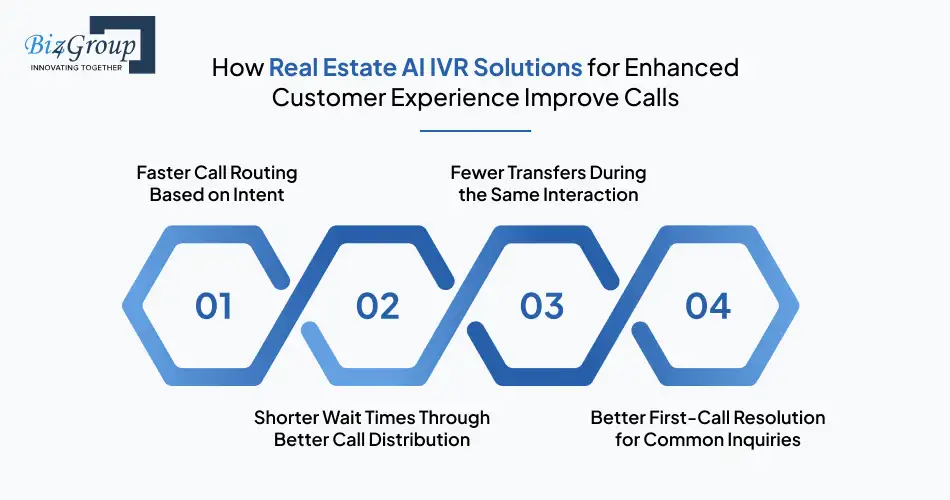
The improvement comes from four practical mechanisms that reduce caller effort and increase resolution speed:
1. Faster Call Routing Based on Intent
Intent-based routing reduces the time callers spend figuring out how to communicate their way ahead. Instead of guessing which option to select, callers can simply state why they are calling and are routed accordingly.
- Example: a buyer calling about a specific listing can be routed directly to a sales agent who is familiar with that property, instead of the reception or general front desk. This approach is common in real estate customer service IVR integrating AI, where routing logic captures caller intent and moves ahead naturally with the conversation.
Operational effect:
- Fewer routing errors
- Reduced time spent navigating menus
- Quicker resolution
2. Shorter Wait Times Through Better Call Distribution
Wait times decrease when calls are scattered according to availability and relevance. Industry benchmarks show that average wait time drops when callers are routed correctly on the very first attempt, even if total call volume stays the same.
- Example: During a scheduled event, multiple buyers may call at the same time. Instead of queuing all calls to one line, calls can be distributed across all the available agents. Firms exploring AI integration services often target this specific improvement to stabilize service quality that helps them manage demand spikes better.
Operational effect:
- Reduced queue length
- Lower call drop rate during peak hours
- Smooth call handling across teams
3. Fewer Transfers During the Same Interaction
Transfers break the flow and cause frustration in the conversation during the call. Each transfer adds more time and forces callers to re-explain their situation.
- Example: A tenant calling about a lease renewal is transferred between leasing and property management. When intent is captured at the start of the call, that transfer can be easily avoided. This is one of the clearest benefits of using AI IVR systems to improve customer experience via AI automation services.
Operational effect:
- Shorter total call duration
- Reduced repetition of information
- Lower call transfer rates
4. Better First-Call Resolution for Common Inquiries
First-call resolution improves when predictable questions are handled instantly or routed correctly. Research shows that resolving an issue in one interaction helps with relevant follow-ups and also cuts down the number of repeat calls.
- Example: A seller calling to confirm listing requirements can receive clear next steps or be connected to the right specialist without delay. Teams that build real estate AI software often prioritize this outcome because it lowers repeat call volume while improving experience.
Operational effect:
- Reduced repeat call issues
- Higher single-interaction call completion
- Better use of human agents’ time
Overall, these improvements work together to reduce effort. When designed correctly, AI IVR software to improve customer experience helps callers reach answers faster, with fewer steps, less uncertainty and frustration.
Make Every Real Estate Call Easier to Complete
Use AI IVR systems for real estate customer service to reduce wait times, transfers, and repeated explanations.
Talk to an AI CX SpecialistCall Scenarios Shaped by Real Estate AI IVR Solutions for Better Tenant Communication
The urgency, expectations, and tolerance for each call varies, depending on why someone is calling. This is where real estate AI IVR systems for customer experience prove to be the most helpful, by showcasing how different call types can be handled instead of forcing every caller through the same path. In many firms, this layer functions as an AI conversation app that makes an interaction more meaningful.
The scenarios below highlight where call experience changes most noticeably.
1. New Buyer Inquiries Driven by Urgency and Timing
Buyer calls are mostly very time-sensitive. If a buyer is calling about a new listing, he'd expect confirmation within minutes. For example, a buyer calling shortly after a listing goes live wants to know if the property is still available and what the next step should be. When the call is routed quickly and the purpose is understood immediately, time and effort is saved, and caller satisfaction is maintained.
What improves in this scenario:
- Faster acknowledgment during peak time
- Reduced delays caused by general call queues
- Next steps are suggested early in the conversation
This is a common driver behind real estate AI IVR solutions for enhanced customer experience, especially in competitive markets.
2. Seller Inquiries Focused on Confidence and Credibility
Seller calls are usually less urgent in nature but are more evaluative in nature. The caller is often assessing professionalism, not just availability. Early call experience has an impact on whether the seller would proceed with a valuation or listing discussion. For example, a homeowner calling to ask about selling their property expects a structured and confident response. Clear routing and predictable transfer shows organization and reliability.
What improves in this scenario:
- More consistent first impressions
- Minimum transfers before reaching specialists
- Stronger perceived professionalism
This scenario is often prioritized in workflows designed for AI for real estate agents, where call handling directly affects conversion quality.
3. Existing Client Support That Depends on Continuity
Calls from existing clients rely a lot on historical trends or pre-established context. These callers expect the system to recognize their history and avoid repetition of information. For example, a tenant following up on a previously reported issue prefers continuity across all interactions. When prior details are maintained and used well, resolution is a lot faster and frustration is reduced.
What improves in this scenario:
- No repeated explanation
- Faster recognition of existing issues
- Smoother follow-ups across calls
This is where 24/7 IVR systems for real estate customer service with AI help maintain consistency beyond standard office hours.
4. Agent Connection Requests That Value Speed Over Structure
Some calls may seem simple at first, but are high-intent. Requests to speak with a specific agent prioritize speed over navigation. For example, a buyer asking for a particular agent expects either a direct connection or a clear alternative immediately. Long menus or delays at this stage often result in call drops.
What improves in this scenario:
- Faster escalation to specific agents
- Fewer unnecessary prompts
- Clear fallback when agents are unavailable
This is a key reason customer focused AI IVR software for real estate companies treats agent requests using generative AI.
Why These Scenarios Matter
Each scenario talks about different demands that are made during the calls. Buyer urgency, seller trust, client continuity, and agent access cannot be streamlined with a single call flow. Experience improves when call structure is complex and dynamic, for quick gathering of intent.
How Real Estate AI IVR Tools to Enhance Customer Satisfaction Are Evaluated
The performance of IVR in real estate is calculated by measuring how well it reduces caller effort while maintaining routing accuracy and resolution quality. Small issues can lead to increased lost and repeat calls. This is why real estate AI IVR systems for customer experience are assessed using experience-centered metrics. Here are the four metrics that matter most:
1. Drop-Off Rate as a Signal of Friction
Drop-off rate measures the percentage of callers who disconnect before reaching a meaningful outcome like routing or resolution.
|
Evaluation Area |
What It Indicates |
Practical Thresholds |
|---|---|---|
|
Early hang-ups |
Entry-point friction |
Above 8–10% suggests wait or prompt confusion |
|
Mid-flow exits |
Menu complexity |
Spikes after option selection indicate unclear navigation |
|
After-hours exits |
Poor guidance |
High rate signals lack of next-step clarity |
In real estate environments, higher drop-off rates typically mean issues during the first 60-90 seconds of interaction. Teams investing in business app development using AI often begin by optimizing entry-point clarity before expanding automation.
2. Time to Resolution as a Measure of Effort
Time taken to resolve queries highlights how long it takes for a caller to fully complete their request, including transfers and follow-ups.
|
Evaluation Area |
What It Indicates |
Practical Thresholds |
|---|---|---|
|
Simple inquiries |
Flow efficiency |
Under 3–5 minutes is common benchmark |
|
Multi-step issues |
Routing structure |
Excess time signals unnecessary handoffs |
|
Repeat callers |
Context retention |
High duration indicates continuity gaps |
Shorter resolution window means fewer steps and less repetition. Deployments of AI powered IVR software for real estate customer support aim specifically to minimize resolution time as much as possible without removing human escalation.
3. Transfer Rate as a Routing Accuracy Indicator
Transfer rate measures how frequently calls are handed from one agent or department to another before resolution.
|
Evaluation Area |
What It Indicates |
Practical Thresholds |
|---|---|---|
|
Single transfers |
Minor misrouting |
Acceptable when tied to specialization |
|
Multiple transfers |
Intent capture failure |
More than 1 transfer per call is a red flag |
|
Circular transfers |
Structural mismatch |
Indicates routing logic tied to org chart |
High transfer rates usually mean that calls are being routed by departments instead of caller intent. This issue often pops up during broader initiatives in AI in real estate development, where workflow design directly affects call routing logic.
Call Containment Rate When Paired with Satisfaction
This rate measures the percentage of calls that are resolved without human involvement.
|
Evaluation Area |
What It Indicates |
Practical Thresholds |
|---|---|---|
|
Simple FAQs |
Automation success |
Healthy when paired with positive feedback |
|
Complex inquiries |
Escalation design |
High containment with complaints is a warning sign |
|
After-hours handling |
Coverage strength |
Effective when guidance is actionable |
Containment is only a positive signal when callers have clear access to human support. Organizations that implement generative AI in real estate often measure containment rates to ensure automation assists.
Build Phone Experiences Around Real Caller Intent
Create structured call flows with real estate AI IVR solutions for enhanced customer experience, not rigid menus.
See How Intent-Based IVR WorksCommon CX Mistakes in Customer Focused AI IVR Software for Real Estate Companies
Most of the IVR-related customer experience problems come from basic design mistakes. In real estate, calls involve urgency, follow-ups, or decisions in progress. When call handling increases the effort or confusion, trust drops rapidly. This is why real estate AI IVR systems for customer experience must be reviewed from a caller’s point of view, and not only from an business efficiency perspective.
1. Over-Automation Removes Choice From the Caller
Over-automation happens when callers are forced to follow fixed paths with no choice to break the loop. Not every real estate call fits a preset option. When callers cannot explain their situation clearly, automation becomes a huge blocker. This often happens as a result of call behavior that’s not tested enough.
2. Too Many Steps Before Reaching Value
Long call flows increase drop-offs. Callers expect progress early, usually within the first minute. When they have to deal with multiple prompts before they reach actual help, their patience usually runs out. This issue is common in AI IVR systems for real estate customer service where speed matters way more than structure.
3. No Human Agent Redirection Available
Automation also fails when callers cannot reach a person after it stops working. A hidden or delayed human option causes frustration. Callers abandon calls when they feel stuck. This problem often appears when teams hire AI developers but do not clearly define when automation should step aside.
4. Poor Voice and Language Design
Words, tone, and pacing shape how callers understand instructions. Long sentences and technical terms often confuse callers. Simple language works better across different caller types. These issues become clearer in AI IVR systems for small vs large real estate firms, where expectations vary by audience.
The best part is, most of the IVR CX problems are avoidable. Over-automation, long flows, poor escalation, and unclear language all increase effort. Fixing these issues early helps ensure that AI IVR systems for small vs large real estate firms support clarity, speed, and trust instead of adding friction.
Support Tenants and Buyers Without Missing Calls
Implement real estate AI IVR systems for 24/7 customer support that stay consistent across peak and after-hours traffic.
Plan My 24/7 Call SupportHow AI/IVR Systems for 24/7 Customer Support Should Be Designed for CX
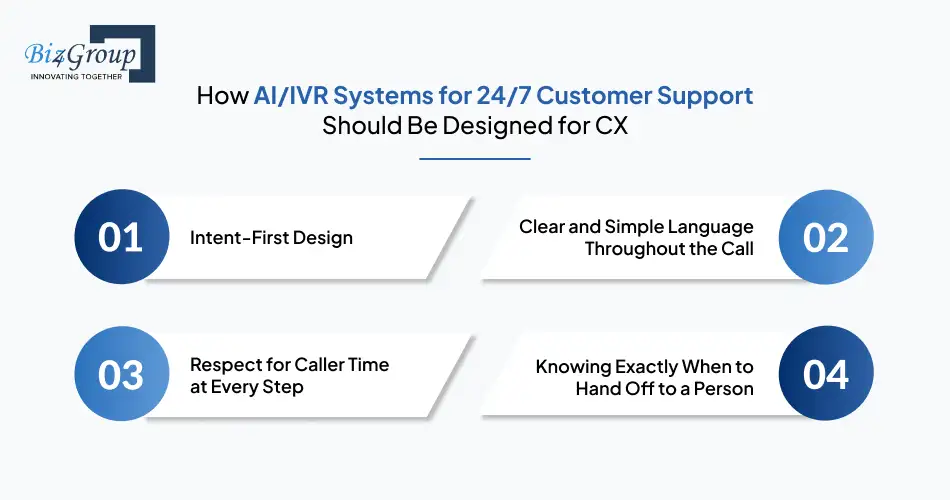
Designing IVR for customer experience means deciding what the system should hear, say, skip, or escalate. In real estate, callers reach out at different times and with different levels of priority. This is why real estate AI IVR systems for customer experience must be designed around real caller behavior, especially when support has to run 24/7.
1. Intent-First Design
IVR should sort calls by the core purpose, not by department name call-outs. Callers describe problems, and when they do, the routing shall follow the same intent.
- Example: A tenant says they are calling about a broken appliance at their apartment and is routed to maintenance. The caller shall not be asked to choose between leasing, support, or operations.
This approach improves routing accuracy in real estate AI IVR solutions for better tenant communication.
2. Clear and Simple Language Throughout the Call
IVR prompts should use everyday language that matches how callers speak. Techincal terms and workflows often slow down responses and increase the chances of error. Simple phrasing keeps the interaction moving smooth.
- Example: “Say the property address” instead of “Provide asset identification details.” The caller responds without guessing what the system is trying to ask for.
Teams exploring real estate AI apps ideas often find language clarity has the fastest impact.
3. Respect for Caller Time at Every Step
IVR should avoid asking for information that does not affect the next action. Every question must have a clear purpose. Unused inputs waste time and increase the chances of offending the caller sometimes.
- Example: If a buyer has asked for the listing ID before being routed to sales, the system shall not collect other details that are not immediately required for it.
This principle is often central when teams evaluate how to use AI for real estate in live call environments.
4. Knowing Exactly When to Hand Off to a Person
IVR must stop when the request stops being predictable. Delaying escalation damages trust. Clear rules prevent callers from being stuck.
- Example: A seller asking about pricing strategy is transferred after one clarification.The system shall not try to handle a negotiation that's beyond it's knowledge and transfer it to the next system/person/agent.
This balance is critical for real estate AI IVR systems for 24/7 customer support, where automation and human support must align.
A good IVR design is what you get from clear decisions about intent, language, time, and escalation. When these are handled deliberately, 24/7 systems stay super-helpful. This is how real estate AI IVR systems for 24/7 customer support work without sounding scripted.
Scale Call Handling Without Losing Clarity
Adopt scalable AI IVR solutions for real estate customer experience that grow with your portfolio and call volume.
Discuss Scalability OptionsWhy Choose Biz4Group to Build Real Estate AI IVR Systems for Customer Experience?
Biz4Group is an AI app development company that builds IVR systems focused on clear call flow and real caller needs. We help real estate teams reduce missed calls, shorten routing time, and avoid unnecessary transfers. Our work aligns with how real estate AI IVR systems for customer experience are used in daily operations.
Portfolio highlight: AI Wizard
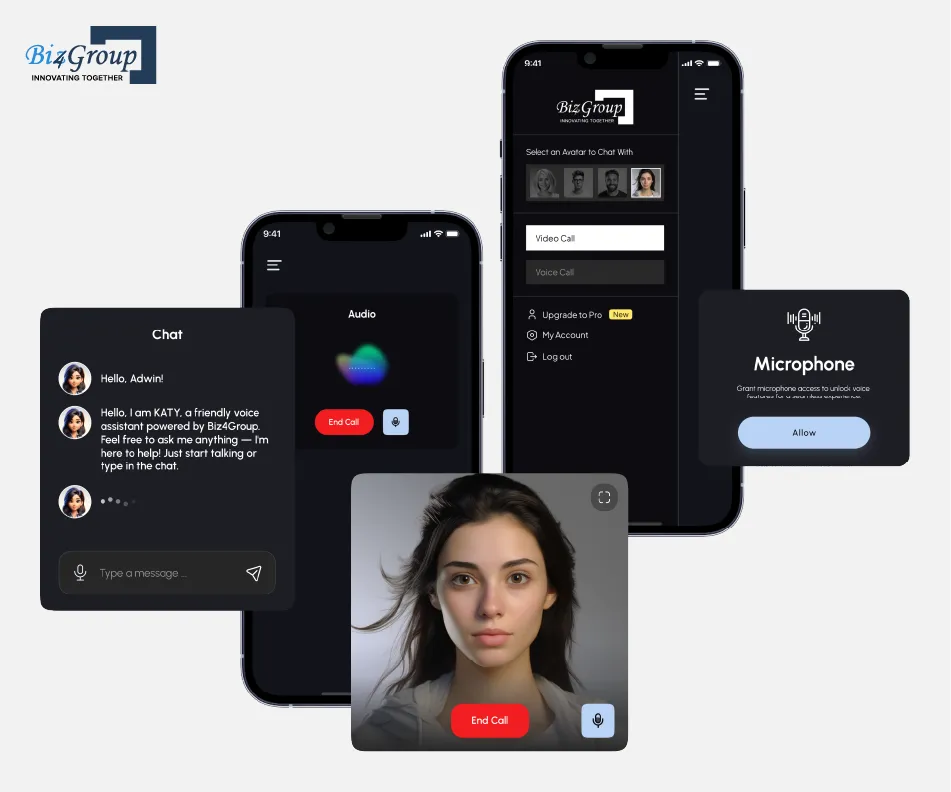
AI Wizard is a conversational AI product built to understand intent and keep context during interactions. These same capabilities apply to real estate IVR, where knowing why someone is calling and understanding their intent helps improve overall routing, escalation, and resolution process.
Biz4Group applies practical AI design to help real estate companies create IVR experiences that are simple, reliable, and easy for callers to use.
Turn Call Metrics Into Actionable CX Signals
Improve outcomes using real estate AI IVR tools to enhance customer satisfaction, not just automate calls.
Review My IVR PerformanceConclusion: What Real Estate Leaders Should Know About AI IVR Systems for Customer Experience
Real estate calls equal to someone needing attention 'now'. A buyer is deciding whether to act. A seller wants clarity. A tenant is already frustrated. When the first call feels slow or confusing, people don't bother to explain why they left. They simply hang up and try somewhere else.
The IVR systems that work in real estate are usually the ones that make the call feel easier than expected for the caller. They understand why someone is calling, move the conversation forward without overexplaining, and clearly signal what will happen next. When things stop being straightforward, they hand the call to a person without resistance.
This is where real estate AI IVR systems for customer experience get tricky. Automation is treated as the outcome instead of the support layer. Escalation gets delayed because no one wants to 'break the flow'. These problems often show up when IVR decisions are made without grounding them in real call behavior, even when supported by strong product development services.
For real estate leaders, the takeaway is simple. IVR should be reviewed the same way you review any customer-facing experience. Does it reduce effort or add steps? Does it help callers decide or slow them down? When IVR is approached with the right set of questions, with guidance from AI consulting services, it starts feeling like actual support. And that is when callers stay on the line instead of looking for another option.
Frequently Asked Questions
1. What do AI IVR systems actually help with in real estate customer service?
AI IVR systems help route calls correctly by understanding why someone is calling. They reduce missed calls, long waits, and repeated explanations. This is why AI IVR systems for real estate customer service are used to keep call handling consistent during busy periods.
2. How do AI IVR systems improve communication with tenants?
AI IVR systems collect the reason for the call at the start and route it to the right team. This helps tenants report issues or ask questions without delays. Many teams use real estate AI IVR solutions for better tenant communication to avoid confusion and repeated transfers.
3. Can AI IVR systems handle real estate calls outside business hours?
Yes, AI IVR systems can answer and guide calls at any time. They provide instructions, capture details, and escalate urgent issues when needed. This makes real estate AI IVR systems for 24/7 customer support useful for properties with after-hours needs.
4. How do real estate teams know if an AI IVR system is working well?
Teams track drop-off rates, resolution time, and transfer rates. When these improve, callers are reaching answers faster with less effort. These metrics are commonly used to evaluate AI IVR systems to improve customer experience.
5. Are AI IVR systems practical for both small and large real estate companies?
Yes, AI IVR systems scale based on call volume and complexity. Small teams use them to avoid missed calls, while larger teams use them for consistency. This is why AI IVR systems for small vs large real estate firms are chosen based on structure, not company size.
6. What signs show that AI IVR is improving customer satisfaction?
Fewer abandoned calls, fewer transfers, and faster resolutions are strong signals. Positive caller feedback also matters. These outcomes are often tracked when measuring real estate AI IVR tools to enhance customer satisfaction.
