 Location :
Orlando, FL, USA
Location :
Orlando, FL, USA +1 (407) 714-1616
 info@biz4group.com
- Choosing between Human-Like AI Avatars vs. Stylized Avatars for Mental Health App depends on user comfort, emotional readiness, and more.
- Research shows strong growth in avatar-driven mental wellness tech, with global demand rising as users seek safer, more emotionally intelligent digital options.
- Many teams evaluate differences between human-like and stylized AI avatars for mental health app design to decide which style improves trust and clarity.
- Development costs vary widely, typically ranging from $8,000 to $50,000+ depending on realism, expression detail, and AI behavioral complexity.
- Hybrid strategies blend realism and stylization for better flexibility, especially when building adaptive features or supporting diverse user personalities.
- User experience teams often explore AI avatar design for mental health app decisions early, ensuring the visual tone aligns with therapeutic goals and emotional needs.
Imagine a user, perhaps anxious, isolated, or overwhelmed, opening a mental health app late at night and hoping for support. What greets them first is not a counselor but an avatar, which instantly raises several important questions for every tech team debating about developing Human-Like AI Avatars vs. Stylized Avatars for Mental Health App experiences:
- Do mental health apps work better with real-looking avatars or cartoon ones?
- Are realistic AI avatars creepy or comforting for mental health support?
- Which avatar type makes people open up more in therapy apps?
- Is a stylized avatar safer for mental health apps than a human-like one?
- What’s cheaper to build: realistic avatars or stylized, less-detailed ones?
The global AI avatar market including avatars for mental-health apps is projected to grow to USD 110.9 billion by 2034.
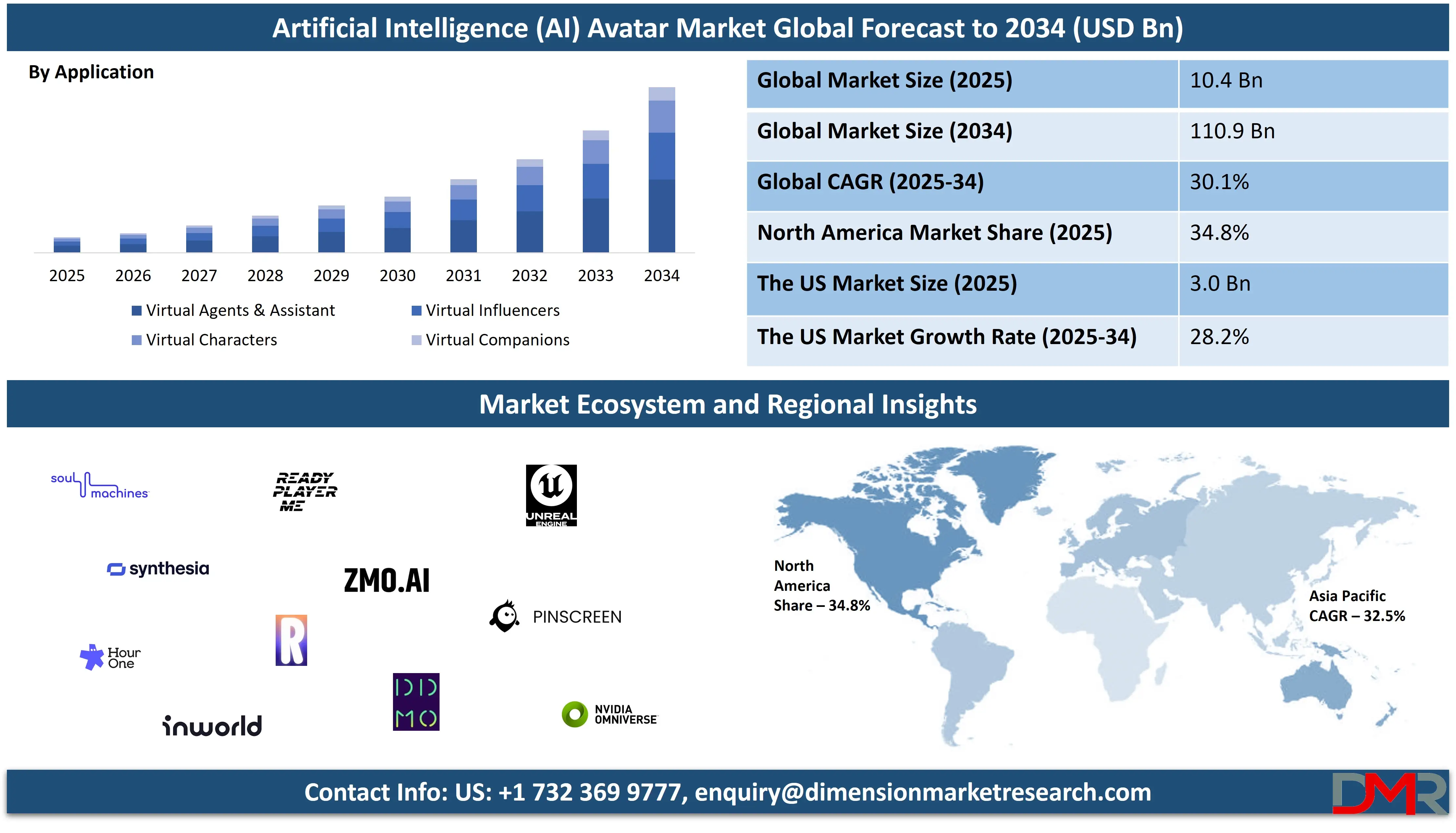
As demand rises, many founders and product teams are questioning how AI avatar style affects emotional safety in therapy apps, especially as AI-driven mental health platforms continue to scale.
In this blog, we’ll compare human-like AI avatars and stylized avatars through the lens of user psychology, product design, and long-term platform thinking. Many teams grounding their product roadmap rely on AI mental health app development as they shape their next phase of functionality.
These decisions are rarely made in isolation. Companies that monitor shifts in digital experience trends often review patterns highlighted by top AI avatar development companies in USA to better understand how the avatar ecosystem is evolving. This context sets the stage for choosing the right approach for your own mental health app.
So let’s dive right into it!
Why AI Avatar Design for Mental Health App Engagement Matters?
Users often sense within seconds whether a mental health app feels safe and supportive, and that response is deeply influenced by how they experience Human-Like AI Avatars vs. Stylized Avatars for Mental Health App interactions during their first moments of engagement. This makes avatar design a foundational engagement driver when you plan to build an AI app that supports real emotional needs.
1. Avatar Style Influences User Trust From the First Interaction
Human-like AI avatars can create a sense of presence that feels supportive, while stylized avatars reduce pressure for users who fear judgment. This trust window directly affects whether a user stays in the session or leaves early.
2. Emotional Safety Is Shaped by How Relatable or Non-Intimidating the Avatar Feels
A realistic face may feel calming to one user and overwhelming to another. Cartoon-style avatars lower emotional barriers, making it easier for anxious users to open up, which is why stylized AI avatars for wellness platforms often resonate with sensitive users.
3. Engagement Depends on How Clearly the Avatar Conveys Empathy and Intention
Human-like avatars express nuanced emotional cues, while stylized avatars offer simpler, more predictable expressions. These differences affect how users interpret empathy, which directly influences session completion and ongoing retention.
Understanding how these elements shape trust, safety, and emotional comfort helps product teams prepare for a deeper look at the benefits and limitations of each avatar approach.
Human-Like AI Avatars in Mental Health Apps: Benefits and Limitations
Human-like AI avatars are digital characters designed to resemble real people in appearance, expressions, and behavior, helping users feel they are interacting with something emotionally present. This realism plays a major role in how users evaluate Human-Like AI Avatars vs. Stylized Avatars for Mental Health App experiences.
Benefits of Human-like AI Avatars in Mental Health Apps
Human-like avatars can significantly influence how users interpret support, empathy, and emotional closeness inside mental health apps, which is why understanding their benefits becomes essential when designing sensitive and trust-centered user experiences.
1. Stronger Sense of Presence
Human-like avatars create a feeling of being accompanied by a supportive figure, which increases trust and makes early interactions feel more personal for users who value realism.
2. Richer Emotional Expression
Nuanced facial cues and micro-expressions help convey empathy more effectively, improving the perception of understanding, comfort, and guidance during therapy-style conversations.
3. Higher Engagement for Realism Seekers
Some users respond better to relatable, human-like visuals, which can strengthen continuity across sessions and improve long-term retention when emotional authenticity matters.
Limitations of Human-like AI Avatars in Mental Health Apps
Human-like avatars also introduce specific challenges that can influence user comfort and development complexity, making it important to evaluate their limitations before finalizing your mental health app's visual and emotional direction.
1. Risk of the Uncanny Valley
If the avatar feels almost real but not quite right, users may experience discomfort, which can undermine the emotional safety they need in mental health interactions.
2. Higher Design and Development Complexity
Creating realistic avatars requires more advanced capabilities, often involving teams experienced in AI model development to deliver smooth and consistent behavior.
3. Not Ideal for Every User Type
Some individuals feel judged or overwhelmed by realistic faces, which is why teams sometimes explore AI assistant app designs, when deciding whether stylized AI avatars for wellness platforms might better fit their audience.
Human-like AI avatars offer powerful emotional depth, but they also demand balance, thoughtful execution, and careful alignment with user comfort. As you explore these dynamics, the next step is understanding how stylized avatars approach engagement differently.
Design AI Avatars Users Actually Connect With
Create meaningful wellness experiences by choosing the right balance in Human-Like AI Avatars vs. Stylized Avatars for Mental Health App design.
Start Building Emotionally Aware AvatarsStylized AI Avatars for Wellness Platforms: Benefits and Limitations
Stylized AI avatars use simplified, character-like visuals that feel friendly, approachable, and less intense than realistic faces, making them especially helpful for sensitive users. This design approach plays a major role in Human-Like AI Avatars vs. Stylized Avatars for Mental Health App experiences.
Benefits of Stylized AI Avatars for Wellness Platforms
Stylized avatars help reduce emotional pressure, create safer interaction spaces, and support users who prefer gentle visual environments, which is why understanding their specific benefits is important for mental health app design.
1. Lower Emotional Pressure for Anxious Users
Simplified features help users feel less judged and more at ease during vulnerable conversations, making stylized characters ideal for individuals who struggle with intense or realistic facial expressions.
2. Approachable and Universally Friendly Visuals
Cartoon-style designs are often interpreted as warm and non-threatening, which encourages hesitant users to open up without feeling overwhelmed by human-like emotional cues or hyper-realistic details.
3. High Flexibility and Easy Customization
Stylized avatars allow faster visual adjustments and creative variations, often aligning well with workflows supported by teams familiar with AI integration services when tailoring app experiences.
Limitations of Stylized AI Avatars for Wellness Platforms
Despite their advantages, stylized avatars also introduce limitations that affect emotional nuance, depth of expression, and user expectations, making these considerations essential when balancing visual comfort with long-term engagement goals.
1. Reduced Emotional Detail and Subtlety
Stylized avatars often rely on simplified expressions, which can limit the emotional depth needed for complex mental health conversations that benefit from nuanced non-verbal cues.
2. Perceived as Less Serious in Therapeutic Settings
Some users may associate cartoon-style designs with entertainment rather than care, which can reduce perceived credibility during structured mental health sessions or guided therapeutic activities.
3. Not Always Suitable for Users Expecting Realism
Individuals seeking human-like emotional presence may disengage more quickly, prompting teams to explore concepts of AI mental health assistant development when evaluating differences between human-like and stylized AI avatars for mental health app experiences.
Stylized AI avatars can create safe, low-pressure environments that help users relax and engage, yet their impact varies depending on emotional needs and expectations. This sets the stage for comparing how each avatar type shapes user psychology and interaction depth.
Give Your Mental Health App the AI Avatar It Deserves
Build smarter, safer engagement flows using insights from realistic AI avatars vs. cartoon-style avatars for mental health app design research.
Enhance My App's User ExperienceUser Psychology Behind Realistic AI Avatars vs. Cartoon-Style Avatars for Mental Health
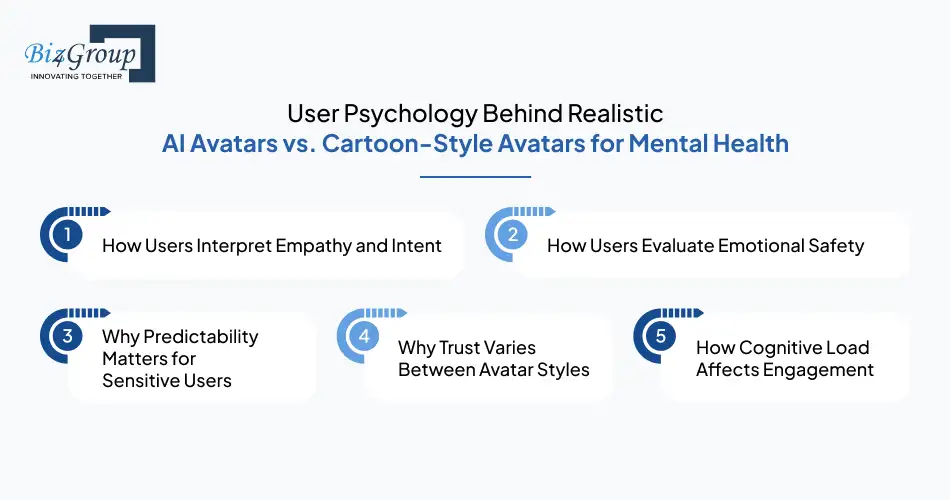
User psychology in mental health apps is shaped by how people respond to visual cues, emotional clarity, and perceived safety during digital interactions. These responses strongly influence how users engage with Human-Like AI Avatars vs. Stylized Avatars for Mental Health App experiences.
|
Factor |
Realistic AI Avatars |
Stylized AI Avatars |
|---|---|---|
|
Emotional Safety |
Can feel intense for sensitive users. |
Creates a calm, low-pressure environment. |
|
Trust Perception |
Mimics real human presence and cues. |
Feels friendly and non-judgmental. |
|
Empathy Cues |
Shows subtle emotional detail. |
Offers clear, simplified expressions. |
|
Predictability |
Emotional shifts may vary. |
Consistent and easy to interpret. |
|
Cognitive Load |
Higher visual complexity to process. |
Light, easy for stressed users to engage with. |
1. How Users Interpret Empathy and Intent
Realistic avatars express subtle emotional shifts, but stylized characters provide clearer patterns. These distinctions become important when interaction behavior is supported by workflows shaped by AI automation services in mental health environments.
2. How Users Evaluate Emotional Safety
Many anxious users gravitate toward visuals that feel predictable and gentle. Stylized avatars often lower pressure, while realistic faces may trigger discomfort for individuals sensitive to intense expressions or direct emotional cues.
3. Why Predictability Matters for Sensitive Users
Consistent expressions reduce misinterpretation and help users stay grounded. Stylized avatars excel here, while realistic avatars require precise emotional mapping, similar to the considerations seen in AI chatbot integration for stability across sessions.
4. Why Trust Varies Between Avatar Styles
Human-like avatars build trust through familiar social signals, while simplified characters feel more approachable to others. These differences help explain why some users prefer stylized avatars in therapy chatbots, especially during emotionally charged conversations.
5. How Cognitive Load Affects Engagement
Simpler visuals reduce processing demands, allowing users to focus on their thoughts instead of decoding complex facial cues. This insight often influences decisions made by organizations that choose to hire AI developers for mental health products requiring emotion-aware experiences.
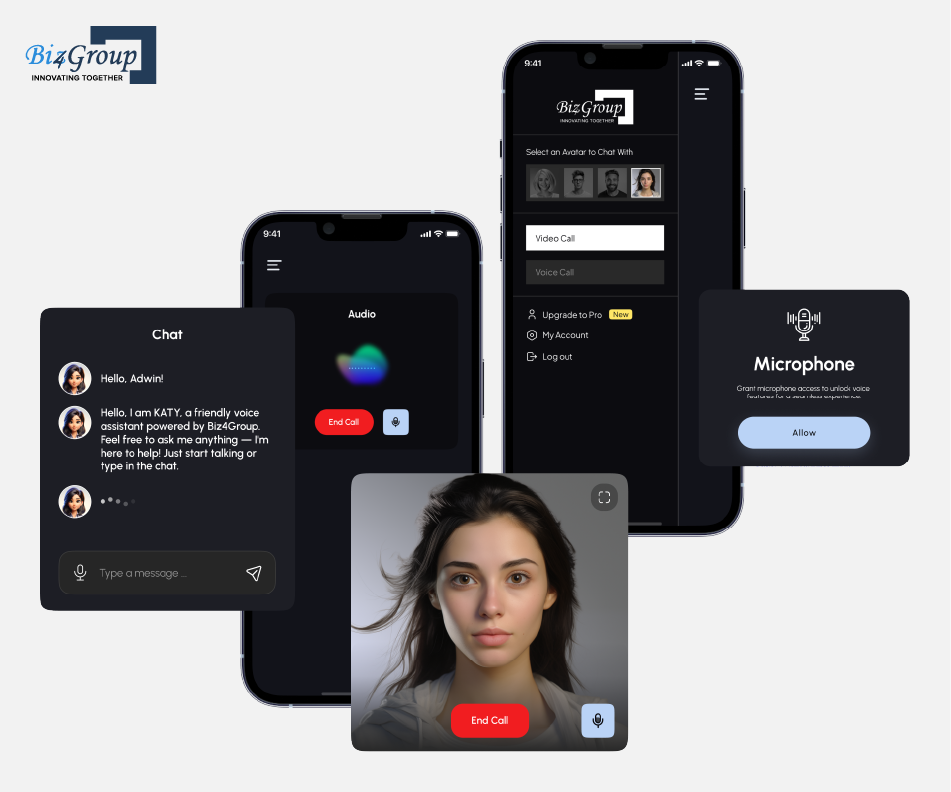
AI Wizard is an avatar-based AI companion developed by Biz4Group, that interacts through voice and video calls to offer empathetic, always-present support. Built to feel like a friendly presence rather than a clinical tool, it highlights how avatar style directly affects emotional comfort. This makes it a valuable reference when comparing human-like and stylized companions in mental health apps.
Understanding these psychological tendencies helps product teams differentiate the differences between human-like and stylized AI avatars for mental health app experiences. These insights naturally guide which avatar style aligns best with emerging use cases and user expectations.
Top Use Cases Comparing Human-Like and Stylized AI Avatars in Mental Health Apps
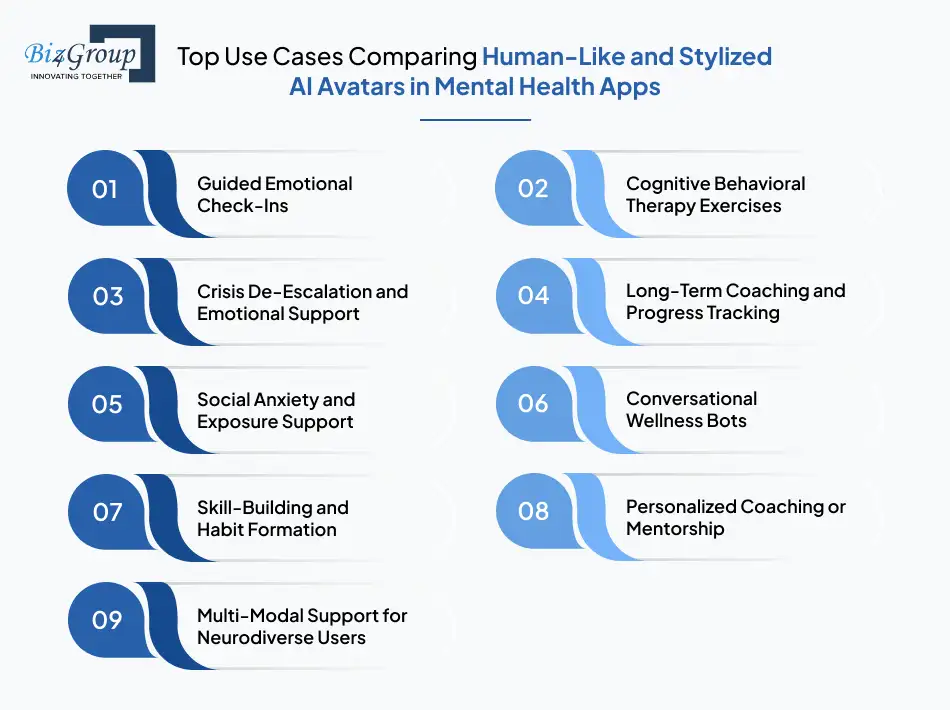
Different mental health interactions demand different emotional tempos, which is why teams evaluate Human-Like AI Avatars vs. Stylized Avatars for Mental Health App performance based on how each style influences comfort, attention, and therapeutic engagement across various scenarios. These differences become clear when looking at real use cases.
1. Guided Emotional Check-Ins
Short, everyday reflections work best with avatars that feel gentle and non-intrusive. Stylized designs help anxious users start without hesitation, while human-like avatars support deeper emotional clarity during intentional check-ins in AI avatar design for mental health app scenarios.
- Example: A quick morning mood rating feels less intense with a soft stylized avatar.
2. Cognitive Behavioral Therapy Exercises
CBT requires focus without emotional overload. Realistic avatars provide empathetic direction for users who want guidance, while stylized characters reduce pressure for those uncomfortable with expressive realism in realistic AI avatars vs. cartoon-style avatars for mental health app tasks.
- Example: Restructuring negative thoughts feels easier with a calm stylized character.
3. Crisis De-Escalation and Emotional Support
In high-stress moments, perceived intensity matters. Realistic avatars comfort users seeking human presence, while stylized characters soften emotional impact for those sensitive to facial expression detail. Many teams refine these interactions while working alongside an AI consulting services partner during early design stages.
- Example: A grounding exercise feels safer when guided by a minimal, friendly avatar.
4. Long-Term Coaching and Progress Tracking
Ongoing engagement requires consistency and rapport. Human-like avatars help users who value relationship-style continuity, while stylized avatars suit those preferring neutral, friendly guidance. These distinctions often influence planning for organizations preparing to integrate AI into an app with evolving mental wellness features.
- Example: Weekly progress reflections feel stable with a familiar human-like avatar.
5. Social Anxiety and Exposure Support
Exposure-based tasks must match user readiness. Realistic avatars replicate social cues for advanced practice, while stylized characters help beginners ease into early-stage anxiety tasks and answer questions such as Are stylized avatars more effective for mental wellness engagement?
- Example: Practicing a short introduction feels easier with a simple, friendly avatar.
6. Conversational Wellness Bots
Conversational flows rely on tone matching. Human-like avatars strengthen perceived empathy, while stylized avatars create a laid-back atmosphere ideal for casual wellness moments. These emotional nuances often appear in product discussions managed by an AI product development company working on avatar-driven interfaces.
- Example: A nighttime journaling prompt feels more relaxed when delivered by a stylized character.
7. Skill-Building and Habit Formation
Habit loops thrive on predictability and emotional tone. Some users respond better to accountability signals from realistic avatars, while stylized characters encourage routine by keeping interactions light. These behaviors shape thinking around the best avatar type for mental health AI applications.
- Example: Completing a daily gratitude note feels more doable with a friendly stylized companion.
8. Personalized Coaching or Mentorship
Users seeking expert-like guidance may connect better with realistic avatars, while beginners benefit from stylized designs that reduce intimidation. These patterns often influence how teams collaborate with a custom software development company for personalization-heavy coaching environments.
- Example: A goal-setting session feels more structured with a human-like coaching avatar.
9. Multi-Modal Support for Neurodiverse Users
Neurodivergent users often require predictable visual patterns. Stylized avatars offer stable signals, while realistic avatars help users who prefer mature emotional depth, highlighting differences between human-like and stylized AI avatars for mental health app interactions in diverse user groups.
- Example: A sensory-friendly breathing routine works better with a simple, low-stimulation avatar.
|
Use Case |
Best Fit: Human-Like Avatars |
Best Fit: Stylized Avatars |
|---|---|---|
|
Emotional Check-Ins |
Emotional clarity |
Low-pressure tone |
|
CBT Exercises |
Guided empathy |
Calm simplicity |
|
Crisis Support |
Human presence |
Reduced intensity |
|
Coaching & Tracking |
Relational continuity |
Friendly approachability |
|
Social Anxiety Tasks |
Real-world simulation |
Low-stakes exposure |
|
Wellness Conversations |
Nuanced warmth |
Relaxed interaction |
|
Habit Formation |
Accountability |
Gentle encouragement |
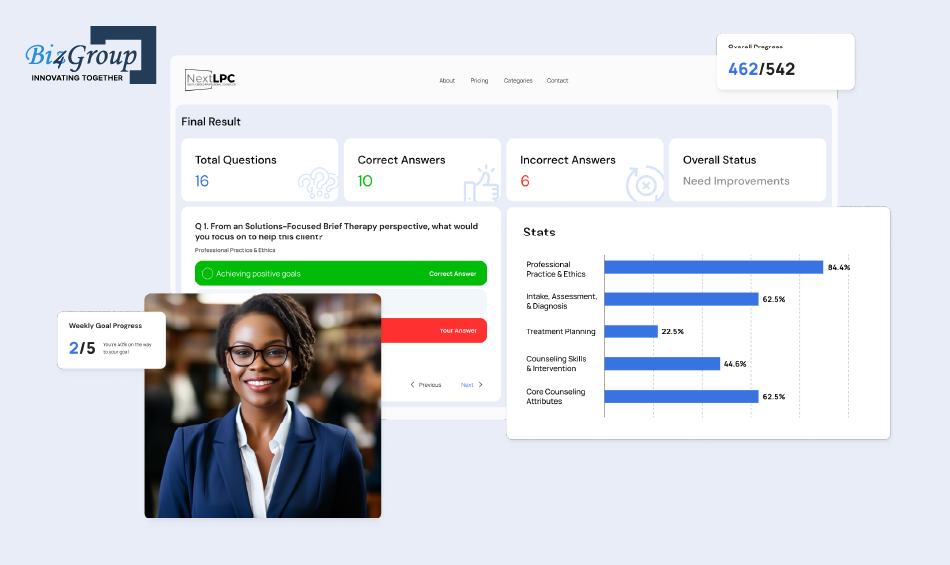
NextLPC is an AI-powered learning platform where advanced avatars act as therapy tutors, guiding students through case studies and exam preparation with engaging, human-like interaction. This platform shows how AI avatar realism influences understanding and confidence. Its structured educational setting reinforces the importance of choosing the right avatar style for mental health training and support.
By mapping these scenarios to user needs, teams gain a sharper understanding of Human-Like AI Avatars vs. Stylized Avatars for Mental Health App behavior, naturally setting the stage for evaluating the deeper factors that influence these design decisions.
Create AI Avatars That Respect User Emotions
Craft ethical, adaptive AI characters that elevate trust and strengthen wellness journeys.
Build Ethical AI Avatars TodayKey Factors When Choosing Human-Like vs. Stylized AI Avatars for Mental Health Apps
Selecting the right avatar style depends on emotional expectations, user comfort, cultural context, and how each interaction supports overall therapeutic outcomes. These considerations help teams in understanding differences between human-like and stylized AI avatars for mental health app behavior across varied use cases:
1. Target Demographics
Different age groups interpret avatar realism differently, which shapes how comfortable they feel during early interactions. A younger audience may prefer playful visuals, while adults often value emotional depth in realistic AI avatars vs. cartoon-style avatars for mental health app experiences.
2. Emotional Intensity
Some users need gentle visual environments during high-stress moments, while others depend on expressive cues to feel understood. These decisions occasionally draw from design patterns explored in AI virtual mental health coach experiences.
3. Brand Identity and UX Ecosystem
Your interface tone and visual ecosystem must align with avatar style to avoid emotional dissonance. A stylized avatar often blends smoothly into soft, minimal ecosystems that support calm mental wellness flows.
4. Personalization and Customizability
Stylized avatars allow broad appearance variations without uncanny results, while realistic avatars require more precision. These personalization layers sometimes evolve through systems built by a software development company in Florida working on mental wellness features.
5. Technical Constraints and Performance
Realistic avatars demand heavier rendering and processing power, while stylized characters maintain visual stability on lower-spec devices. Performance sensitivity becomes crucial for global rollouts where user hardware varies widely.
6. Emotional Expression Range and Clarity
Human-like avatars support micro-expressions that strengthen empathy, while stylized avatars help reduce misinterpretation with clear, minimal cues. These distinctions influence the best avatar type for mental health AI applications when designing sensitive emotional flows.
7. Cultural Adaptability and Global Accessibility
Eye contact, expression intensity, and emotional nuance carry different meanings worldwide. Companies hire mental health AI app developers to build stylized avatars that adapt more universally, reducing miscommunication across culturally diverse user bases.
8. Consistency With AI Voice and Behavior
Your AI’s tone should align with the avatar’s personality. Warm, human-like voices pair naturally with realistic avatars, while light conversational voices complement stylized designs often used in AI avatar design for mental health app environments.
9. Privacy Perception and User Boundaries
Some users prefer avatars that feel less observational during sensitive moments. A stylized avatar often offers comfortable emotional distance. This concern becomes essential in long-term planning influenced by mental health AI chatbot development cost for scaled deployments.
10. Therapeutic Relationship Style
Structured coaching benefits from realistic avatars that resemble mentors, while journaling, grounding, or anxiety reduction often feel more approachable with stylized companions. These choices reflect user preferences explored in why some users prefer stylized avatars in therapy chatbots during emotional processing.
Understanding these factors brings clarity to how each avatar style supports emotional readiness and therapeutic alignment. Now let’s explore how avatar style affects emotional safety in therapy apps in the next stage of your decision-making process.
Turn Your AI Avatar Vision Into a Working Product
From stylized companions to expressive human-like guides, we can help bring your ideas to life.
Start My AI Avatar ProjectEthical Factors Around Human-Like and Stylized AI Avatars in Therapy Apps
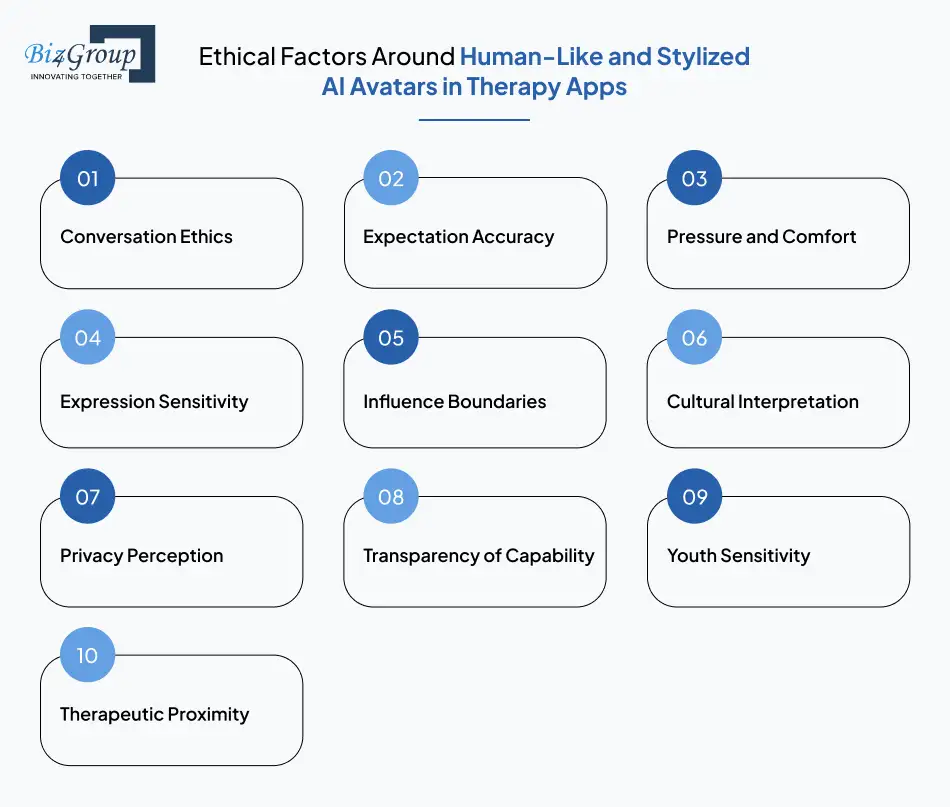
Ethical clarity becomes essential when designing Human-Like AI Avatars vs. Stylized Avatars for Mental Health App, because the way users interpret realism or simplicity directly impacts trust, disclosure, and emotional safety. The following considerations help ensure avatar design respects the user’s emotional and cognitive boundaries.
1. Conversation Ethics
Frameworks used inside an AI conversation app sometimes influence how designers manage pauses, gaze direction, or listening cues so the avatar never appears to offer real therapeutic authority.
2. Expectation Accuracy
Users may assume realistic avatars understand emotion more deeply than they actually can. Clear messaging avoids misinterpretation and ensures expectations stay aligned with actual system ability.
3. Pressure and Comfort
A stylized avatar reduces emotional pressure for users who feel overwhelmed by intense expressions, especially during early therapeutic interactions requiring gentle pacing.
4. Expression Sensitivity
Expression detail must match user comfort. Overly precise micro-expressions can feel intrusive, while minimal cues reduce confusion in realistic AI avatars vs. cartoon-style avatars for mental health app situations.
5. Influence Boundaries
Encouragement should feel voluntary rather than persuasive. This aligns with governance practices seen across enterprise AI solutions, where user autonomy is central.
6. Cultural Interpretation
Eye contact and emotional intensity carry different meanings worldwide. Stylized avatars tend to adapt more universally and reduce cultural mismatch across a wider audience base.
7. Privacy Perception
A highly realistic avatar can feel as if it is “watching,” while stylized characters provide emotional distance that supports safer disclosure in sensitive sessions.
8. Transparency of Capability
Users benefit from clarity about whether an avatar displays simulated empathy or functional guidance. This becomes especially important in systems influenced by methodologies used to build AI software.
9. Youth Sensitivity
Younger users may anthropomorphize realistic avatars too quickly. Stylized designs help maintain healthy emotional boundaries during early developmental stages.
10. Therapeutic Proximity
Gaze, timing, and posture should avoid mimicking real therapist behavior too precisely, especially in wellness tasks influenced by how avatar style affects emotional safety in therapy apps.
Keeping these ethical elements in focus ensures each interaction stays emotionally secure and trustworthy. Having said that, there are also hybrid avatar approaches that you can choose to blend realism and simplicity for more flexible mental wellness experiences.
Build Your Mental Wellness App With Confidence
Use proven strategies, from persona design to AI behavior modeling, to deliver supportive digital experiences.
Launch My Mental Health AI AppHybrid Avatar Strategies for Mental Wellness Platforms
Blending realism with simplicity allows mental wellness apps to meet diverse emotional needs without committing to a single visual style. Many teams exploring Human-Like AI Avatars vs. Stylized Avatars for Mental Health App use hybrid approaches that balance comfort, expressiveness, and therapeutic depth in different scenarios.
|
Hybrid Strategy |
How It Works |
When It Helps Most |
|---|---|---|
|
Realistic Avatar for Deep Support, Stylized for Daily Check-Ins |
Users interact with a warm, human-like avatar for emotional work and a softer stylized character for lighter routines. |
Ideal for users who switch between reflection and low-pressure wellness tasks. |
|
Stylized Default with Optional Realistic Mode |
App provides a simple avatar by default and allows users to enable a realistic option when ready for deeper engagement. |
Supports gradual emotional readiness and reduces initial user hesitation. |
|
Context-Based Avatar Switching |
Avatar style shifts depending on session type, using stylized characters for journaling and realistic ones for structured guidance. |
Works for apps offering CBT, grounding, journaling, and coaching flows. |
|
Voice-Driven Realistic Head Plus Stylized Body |
Realistic facial expressions pair with a simplified body to reduce intensity while preserving empathy cues. |
Helpful when emotional expression is needed without full visual realism. |
|
Generative Personalization Mix |
Users adjust expression complexity, eye intensity, and visual detail through modular settings. |
Serves neurodiverse users or anyone needing precise emotional control. |
Hybrid design often emerges from experiments carried out by an AI development company, when teams test how emotional tone changes across different avatar combinations. Some platforms also borrow incremental rollout ideas from business app development using AI to introduce hybrid modes without overwhelming users.
In more advanced products, personalization expands even further when teams create mental health AI agent systems capable of adjusting avatar style dynamically based on user signals.
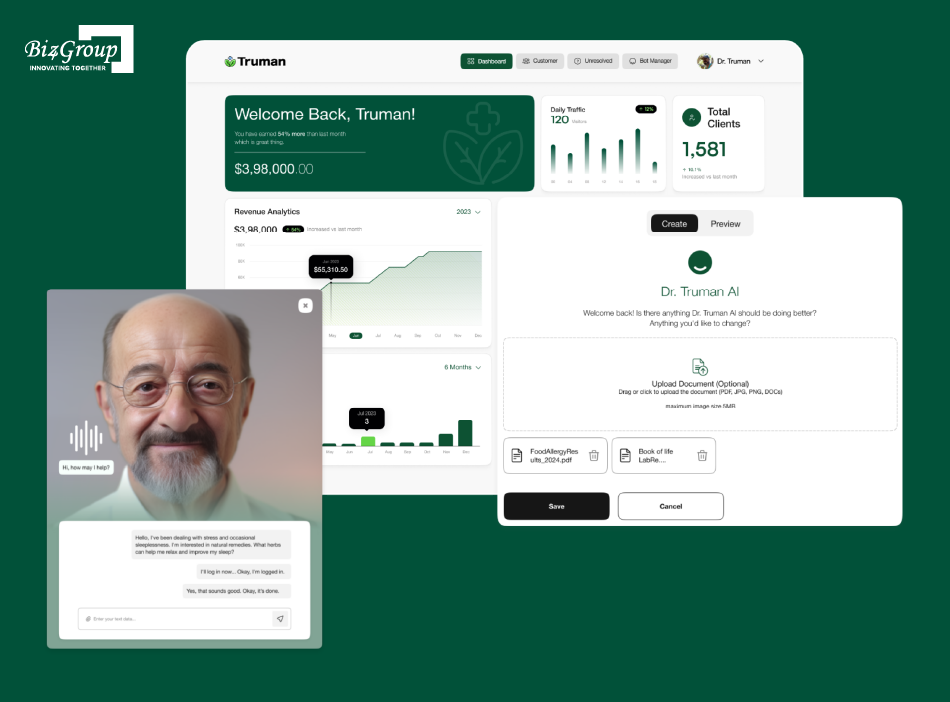
Truman is an AI-enabled wellness platform build by Biz4Group, offering personalized supplement recommendations, health tracking, and data-driven lifestyle guidance. Designed to simplify daily wellbeing through tailored insights, Truman shows how AI-driven interfaces can support mental health behaviorally. Its personalized approach aligns naturally with the challenge of choosing avatar styles that feel supportive and trustworthy in wellness-focused apps.
These blended strategies give mental wellness platforms more flexibility, naturally preparing the groundwork for choosing which avatar type best supports real therapeutic engagement in the next stage of your decision-making.
How To Choose the Best Avatar Type for Mental Health AI Applications?
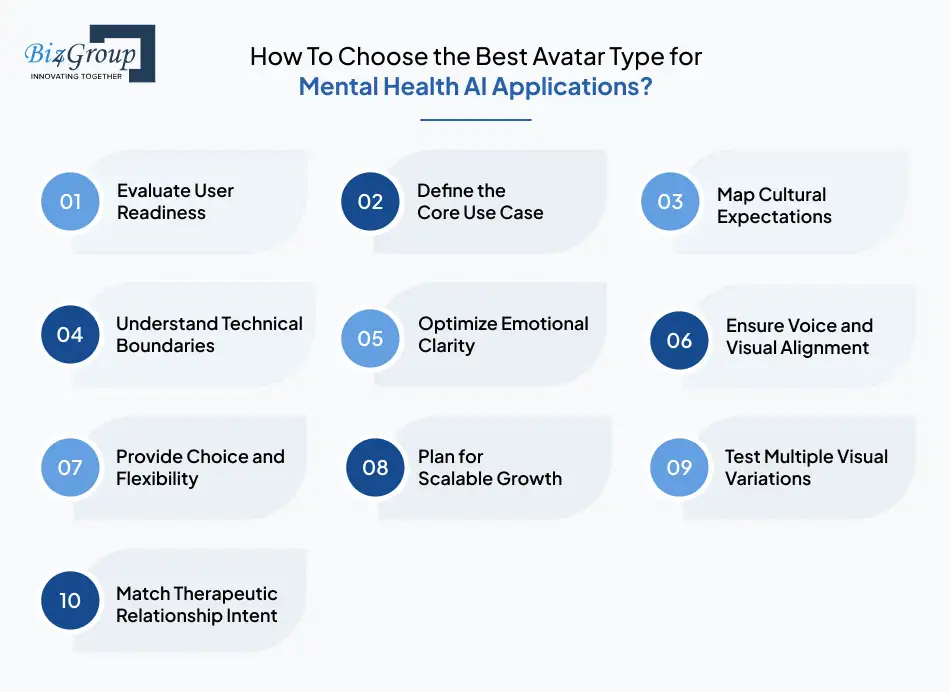
Choosing the right avatar style means understanding how users relate to visuals, how therapeutic tasks differ, and how emotional comfort shapes long-term engagement. When comparing Human-Like AI Avatars vs. Stylized Avatars for Mental Health App, these refined selection factors help teams make confident and user-centered design decisions:
1. Evaluate User Readiness
Determine whether users feel more at ease with simple visuals or are comfortable engaging with human-like expression depth. This ensures the avatar meets users where they are emotionally without adding friction to early interactions.
2. Define the Core Use Case
Identify whether the primary workflow emphasizes reflection, coaching, or lightweight self-check-ins. Matching avatar style to the app’s dominant therapeutic activity ensures consistency and minimizes emotional mismatch.
3. Map Cultural Expectations
Different regions interpret expression intensity, eye contact, and facial detail differently. Selecting a style that feels neutral across cultures creates a safer baseline, especially in AI avatar design for mental health app experiences serving global users.
4. Understand Technical Boundaries
Device capability affects visual stability, loading speed, and animation quality. Stylized avatars offer smooth performance across most hardware, while realistic designs may require optimization for higher fidelity.
5. Optimize Emotional Clarity
Choose the avatar style that communicates emotion cleanly without overwhelming users. Simplified cues work for many wellness tasks, while detailed expressions can support more structured emotional work when used thoughtfully.
6. Ensure Voice and Visual Alignment
Speech tone should naturally match avatar appearance to maintain psychological coherence. This alignment is often refined when teams collaborate with an AI chatbot development company responsible for conversational flow design.
7. Provide Choice and Flexibility
Allow users to adjust visual complexity or switch to a gentler style when needed. This flexibility respects changing comfort levels and supports long-term engagement throughout their wellness journey.
8. Plan for Scalable Growth
If the app will expand into adaptive or behavior-responsive features, choose an avatar style that can evolve alongside the product. This becomes easier when future enhancements are supported by generative AI capabilities.
9. Test Multiple Visual Variations
Early prototyping with different avatar styles reveals how users react emotionally in real tasks. Many teams draw inspiration from projects that build a personal avatar chatbot to validate comfort and trust levels quickly.
10. Match Therapeutic Relationship Intent
Select the avatar type that reflects how users should feel during sessions. Mentor-style flows benefit from realistic visuals, while gentle supportive tasks align well with stylized companions that feel approachable and safe.
These refined decision points help teams choose an avatar style with clarity and confidence, naturally setting up the conversation around what makes the right development partner essential to executing that vision.
Why Biz4Group is the Ideal Partner for AI Avatar Design for Mental Health Apps?
Designing the right avatar experience requires an understanding of psychology, therapeutic sensitivity, and user behavior across different emotional states. As an experienced AI app development company, Biz4Group has already delivered AI solutions that mirror these exact needs in real mental wellness environments.
We have built platforms like Truman, which uses personalized AI guidance for holistic wellbeing, AI Wizard, which delivers avatar-driven emotional support, and NextLPC, which uses advanced AI tutors to train future therapists. These products demonstrate our ability to design expressive, supportive, and trust-driven interactions that directly align with mental health use cases.
What Makes Biz4Group the Right Choice
- Expertise in building AI systems that balance emotional nuance with user comfort across both human-like and stylized avatar formats.
- Proven capability in handling complex behavioral flows, from guided wellness experiences to structured therapeutic learning.
- Deep understanding of mental health UX through real-world projects that map emotional needs to responsible AI design.
- Strong foundations in data security, transparency, and user safety within sensitive mental wellness ecosystems.
- Scalable engineering practices tailored to long-term growth, especially for teams exploring AI in mental health and future avatar evolution.
Biz4Group blends deep technical expertise with meaningful experience in wellness-focused AI, making it an ideal partner for teams ready to build avatar-driven mental health experiences that are safe, empathetic, and effective.
Design the Avatar Experience Users Remember
Whether you need stylized comfort or life-like expression, your app deserves an avatar that feels right.
Create My AI Avatar ExperienceFinal Thoughts on Avatar Style and Mental Health App Design
In the end, choosing between human-like and stylized avatars is a lot like choosing the right therapist chair. Some users want the plush, human-feeling option, while others feel safer with something soft, simple, and non-intimidating.
The real win comes from designing with empathy, psychology, and flexibility so your platform can support every emotional moment users walk in with. And if you ever explore how to create an AI avatar for business, you will find the same principles apply: clarity, comfort, and user trust always lead the way.
Mental health apps work best when avatars feel like companions rather than characters, which is why thoughtful design choices today become long-term engagement wins tomorrow.
FAQs
1. What makes an avatar feel emotionally safe for users in a mental health app?
Emotional safety depends on predictable expressions and a non-judgmental visual tone. Simplified cues often feel more stable, which is why designers frequently explore how avatar style affects emotional safety in therapy apps when selecting between realistic and stylized options.
2. Do human-like avatars improve how users open up during digital therapy sessions?
Some users respond more comfortably to familiar social cues, which is why human-like AI avatars in mental health apps can encourage deeper self-disclosure. Others prefer simplified visuals that reduce pressure and emotional intensity, depending on their comfort levels.
3. Can switching between avatar styles improve long-term engagement in wellness apps?
Yes. Many users appreciate having the freedom to switch styles, especially in platforms that rely on stylized AI avatars for wellness platforms, which are known to keep daily interactions light and approachable throughout longer mental wellness journeys.
4. How much does it cost to develop AI avatars for mental health applications?
Building therapeutic AI avatars typically ranges from $8,000 to $50,000+, depending on animation quality, emotional behavior, and personalization depth. This cost also varies based on whether you need features tied to why some users prefer stylized avatars in therapy chatbots or more advanced realism.
5. Are stylized avatars better for users with social anxiety?
Often, yes. Their soft and simplified visuals reduce social pressure, which is why many teams evaluate are stylized avatars more effective for mental wellness engagement? when supporting users who need a gentler emotional environment.
6. What data should mental health apps avoid collecting through AI avatars?
Apps should avoid gathering unnecessary emotional inference or biometric data without explicit consent. This is especially important when evaluating do human-like AI avatars improve trust in mental health apps?, since realism can create assumptions about data sensitivity.
