 Location :
Orlando, FL, USA
Location :
Orlando, FL, USA +1 (407) 714-1616
 info@biz4group.com

- The average Insurance AI Chatbot development cost ranges from $10,000 to $100,000+ based on chatbot complexity, AI capabilities, enterprise integrations, compliance requirements, and deployment scale.
- Businesses evaluating the cost to develop an Insurance AI Chatbot should consider factors such as policy management automation, claims processing workflows, CRM integration, multilingual support, analytics, and cloud infrastructure.
- The cost of developing AI chatbot for insurance customer support and claims management increases significantly when implementing generative AI, voice support, real time policy lookup, fraud detection, and advanced conversational AI features.
- Key factors influencing Insurance AI Chatbot pricing include AI model selection, chatbot architecture, UI/UX design, backend integrations, security compliance, maintenance, and scalability requirements.
- Hidden expenses such as AI training, data preparation, API usage fees, cloud hosting, cybersecurity implementation, and ongoing optimization can substantially impact the final insurance chatbot development budget.
- Insurance companies can reduce AI chatbot development costs by starting with an MVP, using pre built NLP platforms, prioritizing high ROI features, and implementing integrations in phases.
- AI powered insurance chatbots help insurers automate customer support, accelerate claims handling, improve policy servicing, reduce operational costs, and enhance customer engagement across digital channels.
- Partnering with an experienced AI chatbot development company like Biz4Group helps businesses optimize Insurance AI Chatbot development costs while ensuring scalability, compliance readiness, faster deployment, and long term operational efficiency.
How much should an insurance company invest to build an AI chatbot that can automate customer support, simplify policy management, and improve claims communication without creating unexpected long term technology costs?
As customer expectations continue to rise, insurers are rapidly adopting AI powered and generative AI powered chatbots to deliver faster responses, personalized policy assistance, and 24/7 service across digital channels. Understanding the Insurance AI Chatbot Development Cost is now essential for insurers planning scalable digital transformation initiatives.
Many businesses begin with a practical question: “we are a startup in the insurance sector and want to estimate the cost of developing an AI chatbot for policy management and customer service automation.” In most cases, development costs range from $10,000 to $100,000+ depending on chatbot complexity, AI capabilities, compliance requirements, cloud infrastructure, and integrations with policy administration, billing, CRM, and claims management systems.
Companies evaluating insurance claims chatbot development cost should also consider workflow automation, multilingual support, analytics, and data security requirements.
Modern insurers increasingly use AI chatbots to reduce customer support workloads, automate policy servicing, accelerate claims response times, and improve operational efficiency. However, pricing can vary significantly based on feature depth, deployment model, and enterprise integration needs.
This guide explains the complete cost to develop an Insurance AI Chatbot in 2026 using a practical and structured approach designed for insurance carriers, MGAs, brokerages, and insurtech startups.
You will learn the major cost factors, feature based pricing, hidden expenses, development timelines, and cost optimization strategies needed to confidently estimate development costs and choose the right AI chatbot strategy for long term insurance operations.
Why Business Should Think of Investing in Insurance AI Chatbot?
Is investing in Insurance AI chatbot development truly worth it in 2026? For most insurers, brokerages, MGAs, and insurtech startups, the answer is yes. AI powered chatbots are no longer limited to answering FAQs. They now help insurers automate claims workflows, improve customer engagement, reduce operational costs, and deliver personalized policy support at scale.
The insurance industry is witnessing rapid adoption of conversational AI technologies. According to recent market research, the global Insurance Chatbot Market is projected to grow from USD 1.21 billion in 2026 to nearly USD 3.04 billion by 2030 at a CAGR of 25.8%.
At the same time, the broader AI in Insurance Market is expected to grow from USD 13.45 billion in 2026 to USD 154.39 billion by 2034, showing how aggressively insurers are investing in automation, AI driven customer service, and intelligent claims management systems.
For businesses asking, “I want to build an AI insurance chatbot for claims and policy management and need a clear cost breakdown before investing,” these market trends clearly indicate that AI chatbot adoption is becoming a long term competitive advantage rather than an experimental initiative.
Here are the biggest reasons insurers are investing in AI chatbot solutions today:
1. Better Customer Experience and 24/7 Support
Modern policyholders expect instant responses across websites, mobile apps, and messaging platforms. AI chatbots can answer questions related to policies, renewals, billing, and claims without requiring customers to wait for human agents. This improves customer satisfaction while reducing support delays.
Businesses researching AI insurance customer support chatbot cost often prioritize customer retention and faster response times as the primary return on investment.
2. Reduced Operational Costs
Insurance companies handle thousands of repetitive service requests every day. AI chatbots automate routine conversations such as premium inquiries, policy updates, payment reminders, and claim status tracking.
This reduces call center dependency, lowers staffing pressure, and allows human agents to focus on complex customer interactions.
3. Faster Claims Processing
Claims management is one of the most resource intensive insurance operations. AI chatbots can collect claim details, guide users through document uploads, validate information, and connect with backend systems for faster processing.
This helps insurers reduce turnaround time, improve accuracy, and minimize manual administrative work.
4. Lead Generation and Policy Upselling
AI chatbots can act as intelligent digital sales assistants. They help qualify leads, recommend policies based on customer needs, and suggest relevant add ons or upgrades during conversations.
Instead of losing website visitors, insurers can convert conversations into high intent sales opportunities.
5. Scalability During High Demand Periods
Unlike traditional support teams, AI chatbots can handle thousands of simultaneous conversations without increasing operational costs proportionally. This is especially valuable during policy renewal cycles, disaster related claims spikes, or seasonal demand surges.
6. Personalized Customer Interactions
Modern conversational AI systems analyze customer behavior, interaction history, and policy preferences to deliver more personalized recommendations and support experiences.
Companies exploring conversational AI for insurance cost estimation are increasingly prioritizing personalization because it improves customer engagement and long term retention.
7. Fraud Detection and Compliance Support
Advanced AI chatbots can help insurers identify suspicious activity patterns, verify user identities, and support compliance workflows through automated rule based validation.
When integrated properly with fraud detection systems and insurance databases, chatbots can reduce risk exposure while improving operational transparency.
8. Long Term Competitive Advantage
The conversational AI market itself is projected to reach USD 68.52 billion by 2033, driven by enterprise adoption across industries including insurance, healthcare, banking, and retail.
Insurers investing early in AI driven automation are better positioned to improve operational efficiency, enhance customer loyalty, and scale digital services faster than competitors.
That’s why insurers across the globe are increasingly investing in AI powered insurance chatbots to streamline operations, reduce service costs, accelerate claims support, and deliver smarter customer experiences at scale.
Also Read: Is Fraud Hurting Your Insurance Business? AI Can Detect and Prevent 90% of Fraudulent Claims
What Is the Average Cost to Build an Insurance AI Chatbot?
The average Insurance AI Chatbot development cost typically ranges between $10,000 and $100,000+ depending on chatbot complexity, AI capabilities, compliance requirements, integrations, and deployment scale. A basic chatbot designed for FAQs and policy assistance costs significantly less than an enterprise grade AI assistant integrated with claims management, underwriting, CRM, and billing systems.
For insurers evaluating digital transformation initiatives, understanding the cost breakdown of building AI chatbot for insurance customer support and claims is essential before selecting a technology stack or development partner.
Businesses often begin with a practical concern such as: “I want to find a vendor that can build an AI insurance chatbot and provide a detailed cost estimate.” In reality, the final budget depends on multiple variables including conversational AI features, third party integrations, cloud infrastructure, multilingual support, AI model training, and long term maintenance requirements.
Here is a general pricing overview based on chatbot sophistication:
|
Type of Insurance AI Chatbot |
Features Included |
Estimated Development Cost |
|---|---|---|
|
Basic Insurance AI Chatbot |
FAQ handling, policy inquiries, scripted conversations, limited integrations |
$10,000 – $25,000 |
|
Medium Insurance AI Chatbot |
NLP powered conversations, CRM integration, claim status tracking, policy lookup |
$25,000 – $60,000 |
|
Advanced Insurance AI Chatbot |
Generative AI, voice support, claims automation, underwriting workflows, analytics, enterprise integrations |
$60,000 – $100,000+ |
Insurance AI Chatbot Development Cost Estimator
A simple way to estimate development cost is by using this formula:
Total Cost = (Hourly Development Rate × Total Development Hours) + Integration Costs + AI Training & Data Preparation + Maintenance Costs
Example Cost Calculation
|
Cost Component |
Estimated Value |
|---|---|
|
Hourly Development Rate |
$50/hour |
|
Total Development Hours |
800 hours |
|
Integration Costs |
$5,000 |
|
AI Training & Data Preparation |
$7,000 |
|
Ongoing Maintenance |
$3,000 |
Final Estimated Cost
Total Cost = (50 × 800) + 5,000 + 7,000 + 3,000
Total Cost = $55,000
This example represents a medium complexity of Insurance AI Chatbot with CRM and policy system integration capabilities.
Businesses can use this framework alongside an Insurance AI chabot development cost calculator to estimate project budgets more accurately before initiating vendor discussions or technical planning.
That’s why insurers should evaluate feature requirements, integration scope, AI sophistication, and long-term operational goals carefully before finalizing the chatbot development budget.
Want a clear estimate for your AI Insurance chatbot?
Discover the exact AI Insurance Chatbot Development Cost tailored to your project needs.
Request a Free QuoteTop Factors Influencing AI Insurance AI Chatbot Development Cost
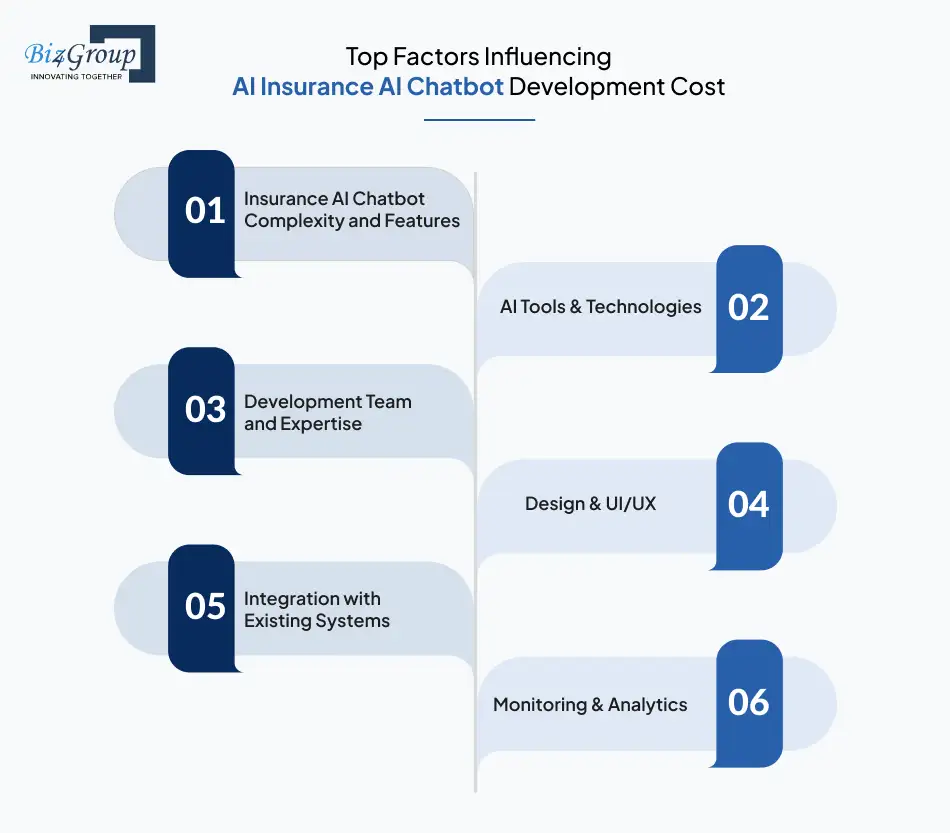
Planning an insurance AI chatbot without understanding the major cost drivers can lead to budget overruns, delayed deployment, and poor ROI. Businesses often start with a practical concern: “we want to automate insurance queries but need to understand development cost and ROI before proceeding.” The reality is that chatbot pricing depends on several technical, operational, and business decisions.
A proper cost breakdown of insurance chatbot integrating AI helps insurers understand where development resources are allocated and which features directly influence long term scalability, compliance, and operational efficiency in 2026.
Below are the most important factors that impact the development pricing of insurance AI chatbot solutions.
1. Insurance AI Chatbot Complexity and Features
The complexity of features is one of the biggest cost drivers in AI chatbot development.
A basic insurance chatbot that handles FAQs, policy information, and simple scripted responses usually costs between $10,000 and $25,000. These chatbots require limited AI training and minimal integrations.
A medium complexity chatbot with NLP capabilities, policy lookup, multilingual support, claims tracking, and personalized recommendations may cost between $30,000 and $60,000. Development becomes more expensive because of advanced conversation flows, AI training, and backend integrations.
An enterprise AI insurance chatbot with voice support, generative AI, adaptive learning, sentiment analysis, fraud detection, and predictive recommendations can cost $70,000 to $100,000+. These systems require sophisticated AI architecture, deeper testing, and enterprise level scalability.
2. AI Tools & Technologies
The technologies powering your chatbot directly affect overall development costs.
Using pre built AI platforms such as Google Dialogflow or Microsoft Azure Cognitive Services can reduce initial development expenses. In many cases, businesses spend around $5,000 to $15,000 for moderate AI implementation using existing NLP services.
However, custom AI model training, large language model fine tuning, proprietary machine learning pipelines, and domain specific insurance datasets can add $15,000 to $30,000+ to the total project budget.
Recurring API usage fees, token consumption costs, cloud hosting, and AI infrastructure should also be considered when estimating AI chatbot solutions cost for insurance workflows.
3. Development Team and Expertise
The experience level of the development team significantly impacts project quality, scalability, and delivery timelines.
Small freelance teams or limited internal resources may reduce upfront costs to $10,000 to $25,000, but they often increase long term maintenance risks and deployment delays.
Partnering with an experienced AI development company typically costs $30,000 to $50,000+ because it involves solution architects, AI engineers, UI/UX designers, QA specialists, and insurance domain experts.
Experienced teams usually deliver better security, scalable architecture, faster deployment, and stronger compliance readiness.
4. Design & UI/UX
The chatbot interface plays a major role in customer adoption and engagement.
A basic text based interface with minimal branding may cost around $3,000 to $7,000. This setup is suitable for simple customer support automation.
A more advanced interface with custom branding, interactive workflows, guided forms, smart prompts, and responsive mobile experiences can increase costs to $8,000 to $15,000.
Well designed chatbot experiences improve customer satisfaction, reduce drop offs, and increase successful policy or claims completion rates. Many insurers report noticeable reductions in customer support workload after deploying AI powered chatbot solutions.
Also Read: Top UI/UX Design Companies in USA
5. Integration with Existing Systems
System integration is often one of the most technically challenging stages of chatbot development.
Simple API integrations with CRM systems or modern policy management platforms may cost between $5,000 and $10,000.
However, many insurers still rely on legacy infrastructure that requires middleware development, secure data synchronization, and compliance validation. Integrating with underwriting, claims management, billing, and policy administration systems can add $15,000 to $25,000+ to the project budget.
Real time integrations are essential for chatbots that provide live policy updates, payment status, and claims information.
6. Monitoring & Analytics
Post deployment monitoring and analytics are critical for improving chatbot performance and measuring ROI.
Basic dashboards with user activity tracking and chatbot performance reports may cost around $2,000 to $5,000.
Advanced analytics with predictive insights, customer behavior analysis, automated alerts, and conversion tracking can increase costs to $6,000 to $10,000+.
These tools help insurers optimize conversations, identify customer pain points, and continuously improve chatbot accuracy and engagement.
7. Compliance, Security, and Data Protection
Insurance businesses handle highly sensitive customer and financial information, making compliance and cybersecurity essential.
Implementing secure authentication, encrypted communication, access control, audit logging, and compliance workflows for regulations such as HIPAA, GDPR, or regional insurance standards can significantly increase development costs.
While these features raise initial investment, they reduce legal risks, improve customer trust, and strengthen long term operational reliability.
That’s why understanding these cost drivers is essential for insurers planning scalable, secure, and ROI focused enterprise AI chatbot implementations that support long term digital transformation goals.
Also Read: AI Insurance Software Development: What Every InsurTech Needs to Know
Cost to Develop an AI Chatbot for Insurance: Complete Timeline and Phase-Wise Breakdown
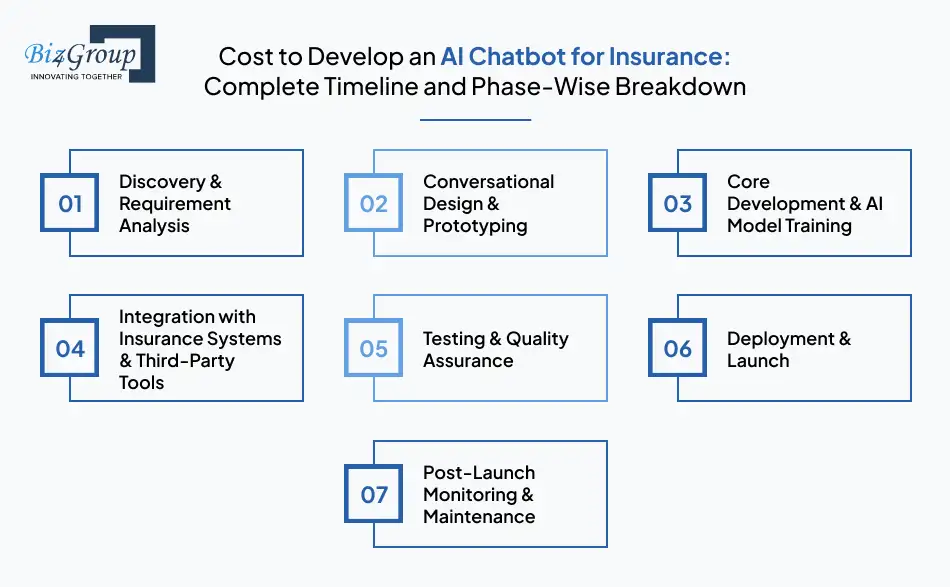
Building a chatbot for the insurance industry requires a structured approach rather than a single development sprint. Each stage affects the budget of AI Insurance Chatbot development differently and plays a role in shaping the overall AI Insurance chatbot cost. Understanding the process helps insurers plan investments wisely and control the cost of building AI Chatbot for Insurance from idea to launch.
Below is a detailed look at the timeline and cost allocation for each phase.
1. Discovery & Requirement Analysis
Timeline: 1 – 2 weeks
This initial stage sets the foundation for your chatbot. The development team works closely with stakeholders to understand your business goals, target audience, and compliance needs such as data privacy and insurance regulations. They analyze key workflows, such as how claims are submitted, how policies are renewed, and what type of customer queries occur most frequently. The result is a clear project roadmap and technical strategy.
Estimated Cost: $2,000 – $5,000
This cost within the custom Insurance AI Chatbot development cost includes requirement workshops, process mapping, and feasibility studies to ensure the solution aligns with your business objectives and technology stack. Investing here prevents costly rework later.
2. Conversational Design & Prototyping
Timeline: 2 – 3 weeks
Once goals are clear, designers build conversation flows and intent maps to guide how the chatbot responds. Prototypes or wireframes are created to visualize user interactions before any coding begins. This step focuses on making the bot natural, human-like, and capable of providing quick answers to complex insurance questions. A strong conversational design reduces abandonment and improves customer satisfaction.
Estimated Cost: $3,000 – $8,000
This part of the AI Chatbot Development Cost for Insurance covers crafting the chatbot persona, writing sample dialogues, and creating interactive prototypes that your team can test before full development.
Also Read: A Guide to Conversational AI Agent Development: From Idea to Deployment
3. Core Development & AI Model Training
Timeline: 4 – 8 weeks
This is the most intensive phase of the project. Developers build the backend infrastructure, connect APIs, and integrate NLP engines. AI models are trained with insurance-specific language such as “deductible,” “endorsement,” and “first notice of loss.” If your chatbot includes features like premium calculation, claims tracking, or multi-language support, more AI fine-tuning and coding are required. This phase also involves setting up databases, implementing security measures, and ensuring compliance with insurance data regulations.
Estimated Cost: $20,000 – $50,000
This is where the bulk of the AI Insurance chatbot cost goes because it includes custom coding, AI training, machine learning optimization, and building advanced functionalities that make your chatbot smarter and more efficient.
4. Integration with Insurance Systems & Third-Party Tools
Timeline: 2 – 4 weeks
A successful chatbot is powerful only when it connects seamlessly with your existing digital ecosystem. This stage involves linking the chatbot to policy administration systems, CRMs, billing engines, claims portals, and sometimes legacy insurance platforms. The goal is to let customers check policy status, submit claims, or update details without switching platforms. Integration must also maintain strict security and compliance standards.
Estimated Cost: $5,000 – $20,000
This stage is critical in the budget of AI Insurance Chatbot development, especially if your back-office systems are outdated or lack modern APIs. Complex integration requires extra middleware development and testing to ensure smooth data exchange.
5. Testing & Quality Assurance
Timeline: 1 – 2 weeks
Thorough testing ensures the chatbot works correctly before going live. QA engineers test conversation accuracy, system integration, data security, and user experience across multiple channels (web, mobile, WhatsApp, etc.). They also check for compliance issues to avoid regulatory risks. This phase reduces user frustration and prevents expensive fixes after launch.
Estimated Cost: $3,000 – $7,000
This part of the cost of building AI Chatbot for Insurance is essential to ensure your chatbot delivers consistent, safe, and compliant service to policyholders.
6. Deployment & Launch
Timeline: 1 week
Once tested, the chatbot is deployed to your chosen platforms such as websites, mobile apps, or social messaging channels. The development team configures hosting, monitors early interactions, and resolves any initial performance issues. This step sets the stage for a smooth public rollout.
Estimated Cost: $2,000 – $5,000
This portion of the AI Chatbot Development Cost for Insurance includes launch support, server configuration, and ensuring the chatbot is ready to handle real customer queries from day one.
7. Post-Launch Monitoring & Maintenance
Timeline: Ongoing
After deployment, the chatbot requires continuous improvement. AI models need retraining as new user queries appear. Analytics and monitoring tools track performance metrics, helping you refine responses, reduce drop-offs, and increase conversions. Security patches and compliance updates are also part of this stage.
Estimated Cost: $2,000 – $10,000 annually
Including this in the budget of AI Insurance Chatbot development ensures the bot remains reliable, updated, and aligned with evolving customer expectations and regulations.
Understanding these stages and their cost impact helps insurers forecast a realistic custom Insurance AI Chatbot development cost and confidently plan long-term investments.
Also Read: Insurance AI Agent Development: A Complete Guide
Confused about what it costs to create an AI Insurance chatbot?
Schedule a quick call with our specialists to plan your budget effectively.
Book a ConsultationHidden Factors Affecting AI Insurance Chatbot Development Cost
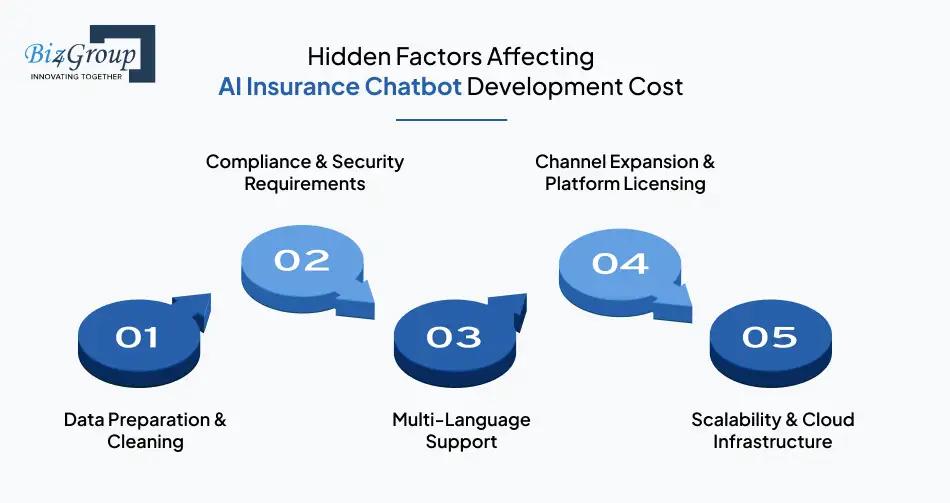
Even with a clear plan, unexpected elements can increase the AI Insurance chatbot cost. Many insurers overlook these less obvious contributors, which can stretch the budget of AI Insurance Chatbot development beyond initial projections. Knowing them early helps you prepare for a realistic custom Insurance AI Chatbot development cost.
1. Data Preparation & Cleaning
AI chatbots need well-structured, domain-specific data to respond accurately. If your existing policy, claims, and customer data is scattered or unstructured, extra time is needed to clean, label, and organize it.
Estimated Additional Cost: $3,000 – $10,000
This covers manual data cleaning, tagging intents, and preparing insurance FAQs or claim scenarios for model training.
2. Compliance & Security Requirements
Insurance is a highly regulated sector. Implementing data encryption, user consent flows, and compliance with laws like HIPAA or GDPR can add cost. If your business requires third-party audits or penetration testing, expenses can rise.
Estimated Additional Cost: $5,000 – $15,000
This ensures the chatbot meets industry regulations and protects sensitive customer information.
3. Multi-Language Support
Expanding your chatbot to support multiple languages beyond English requires additional NLP training and translation adaptation. Each added language increases development and testing effort.
Estimated Additional Cost: $2,000 – $8,000 per language
This covers translation, intent mapping, and retraining AI models for accuracy in each language.
4. Channel Expansion & Platform Licensing
Launching your chatbot on multiple channels such as WhatsApp, Facebook Messenger, or custom mobile apps requires separate configurations and sometimes platform fees.
Estimated Additional Cost: $2,000 – $7,000 per channel
This includes setup, API licenses, and additional testing to ensure smooth cross-platform performance.
5. Scalability & Cloud Infrastructure
If you plan to handle thousands of concurrent users or integrate with complex insurance ecosystems, you may need to invest in scalable cloud hosting and load balancing. Advanced analytics tools also add infrastructure needs.
Estimated Additional Cost: $3,000 – $12,000
These expenses cover cloud service fees, auto-scaling setup, and performance optimization to keep the chatbot stable under heavy load.
Accounting for these hidden factors early helps avoid cost surprises and keeps your AI Insurance chatbot cost aligned with your initial plan. When estimating the budget of AI Insurance Chatbot development, include these extras to achieve a smooth and fully compliant deployment.
How to Reduce AI Insurance Chatbot Development Cost without Compromising Quality?
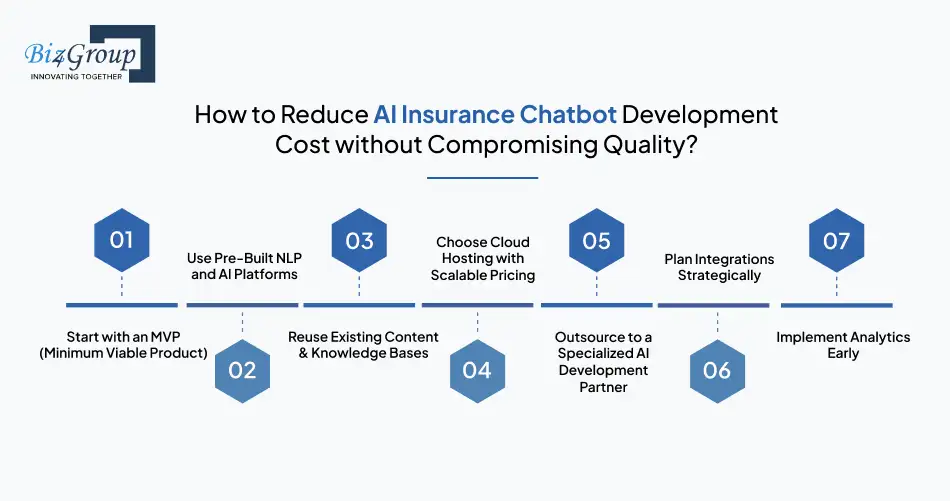
Reducing the cost of Insurance AI chatbot development does not mean sacrificing performance, security, or customer experience. With the right planning strategy, insurers can significantly optimize development expenses while still building scalable and high quality AI solutions.
Many insurance businesses reach a point where they ask: “we are struggling with high customer support costs in insurance and want to understand if AI chatbot development can reduce expenses”. In many cases, the answer is yes. AI powered automation can reduce repetitive support workloads, improve operational efficiency, and lower long term service costs when implemented strategically.
Below are the most effective ways to reduce AI Insurance chatbot development costs without compromising quality.
1. Start with an MVP (Minimum Viable Product)
Instead of building a feature-heavy chatbot from day one, start with an MVP development that focuses on core use cases such as answering FAQs or checking claim status. Once users engage and feedback is gathered, add more advanced features gradually.
Potential Savings: 20% – 35% of total cost
For example, if the estimated custom Insurance AI Chatbot development cost is $50,000, starting with an MVP can reduce initial spending by $10,000 – $17,500.
Also Read: Top MVP Development Companies in USA
2. Use Pre-Built NLP and AI Platforms
Leveraging platforms like Google Dialogflow, IBM Watson, or Microsoft Azure Bot Framework reduces the need for custom NLP model training. These tools already have strong natural language understanding capabilities and cut development time.
Potential Savings: $5,000 – $15,000
This is especially valuable if your bot does not require very domain-specific custom AI.
3. Reuse Existing Content & Knowledge Bases
Instead of creating all conversation flows and FAQs from scratch, repurpose policy documents, claims guides, and help-center articles you already have. This lowers the cost of training data preparation.
Potential Savings: 10% – 20% of data preparation costs
For a $10,000 data preparation budget, this could mean saving $1,000 – $2,000.
4. Choose Cloud Hosting with Scalable Pricing
Opt for cloud providers with flexible pricing models that scale with user demand. Avoid over-provisioning expensive infrastructure in the early stages when usage may be low.
Potential Savings: $2,000 – $8,000 annually
Gradual scaling helps keep the AI Chatbot Development Cost for Insurance sustainable long term.
5. Outsource to a Specialized AI Development Partner
Hiring an experienced chatbot development company can seem expensive upfront but reduces long-term costs. Specialists avoid common mistakes, build compliant solutions faster, and provide ready-made frameworks.
Potential Savings: 15% – 25% of rework or unexpected fixes
For example, a $60,000 project could save $9,000 – $15,000 by avoiding delays and rebuilds.
6. Plan Integrations Strategically
Integrate only the most critical systems initially, such as CRM or claims portals. Add other complex systems later when the bot proves ROI.
Potential Savings: $5,000 – $20,000
Phased integration helps you launch quickly and spread costs over time.
7. Implement Analytics Early
Adding analytics dashboards early allows you to measure usage and ROI, so you can drop underused features and focus on what drives value.
Potential Savings: 5% – 10% of future upgrade expenses
If upgrades would have cost $10,000 later, analytics could save $500 – $1,000 by showing what not to build.
By making smart build-versus-buy decisions, prioritizing essential features, and leveraging scalable tools, insurers can reduce the AI Insurance chatbot cost by up to 25% – 40% overall while still achieving a secure, efficient, and customer-friendly solution.
Also Read: A Guide to AI Insurance App Development: Experience Insights by Biz4Group
How Biz4Group Optimize Your AI Insurance Chatbot Development Cost?
At Biz4Group, we focus on helping insurance businesses create intelligent, customer-centric chatbots within a practical budget while still delivering enterprise-grade functionality. As a trusted AI chatbot development company, we combine deep domain expertise with modern AI frameworks to build scalable, secure, and cost-efficient solutions. By leveraging our proven development processes, we lower the overall AI Insurance chatbot cost and ensure faster go-to-market timelines for insurers of all sizes.
Our approach goes beyond coding. We analyze your operational workflows, customer pain points, and compliance needs, then design a solution that maximizes automation while keeping costs predictable. This process also aligns with our broader capabilities in AI Insurance Software Development, giving insurers a single partner for both chatbot innovation and long-term digital transformation.
Here is one notable project that showcases our work in the insurance domain:
Transforming Insurance Training with AI: Meet Insurance AI
We developed an advanced AI-powered chatbot, named Insurance AI, for a senior insurance leader responsible for training and supporting their team. This solution helps agents quickly access policy details, underwriting guidelines, and claims information in real time. Designed with a limited budget, it demonstrates how cutting-edge Generative AI can be integrated into insurance operations efficiently and cost-effectively.
View the full case study
These projects highlight how Biz4Group reduces the development cost of AI Insurance chatbots while maintaining performance, security, and innovation. If you want to estimate the average cost to develop your AI Insurance chatbot, our AI experts are ready to provide a tailored quote and help you plan smarter.
Transform your insurance business with AI.
Build a smart, secure, and cost-efficient chatbot that delights customers and reduces operational costs.
Start Your ProjectConclusion
From this above discussion, it is clear that estimating the Insurance AI Chatbot development cost requires a detailed understanding of features, AI capabilities, integrations, compliance requirements, and long term operational goals. Whether you are planning a simple customer support assistant or an advanced chatbot for claims automation and policy management, the final budget depends on the complexity and scalability of the solution.
Many businesses today search for answers like, “we are looking for companies that develop AI insurance chatbots and want to compare pricing and cost structures in USA.” The best approach is to evaluate development partners based on insurance domain expertise, AI technology capabilities, integration experience, security standards, and post deployment support rather than choosing only by price.
A well planned chatbot strategy can help insurers reduce support costs, improve customer engagement, accelerate claims handling, and increase operational efficiency over time. Starting with an MVP, prioritizing essential features, and scaling gradually can also help optimize investment without compromising quality.
Ready to estimate your Insurance AI Chatbot development cost?
Connect with Biz4Group’s AI experts today and book a personalized consultation to discuss your chatbot requirements, pricing expectations, and development roadmap.
FAQs
1. How much does it cost to build an AI Insurance chatbot in 2026?
The average Insurance AI Chatbot development cost typically ranges from $10,000 to $100,000+ depending on chatbot complexity, AI features, integrations, compliance requirements, and deployment scale. Basic FAQ chatbots cost less, while enterprise level chatbots with claims automation, voice AI, and policy management integrations require higher investment.
2. How long does it take to develop an Insurance AI chatbot?
Most Insurance AI chatbot projects take around 2 to 6 weeks for planning, UI/UX design, AI training, development, integrations, testing, and deployment. Enterprise grade chatbots with legacy system integrations and advanced AI workflows may require additional development time.
3. What factors affect the cost of Insurance AI chatbot development the most?
The biggest cost factors include chatbot complexity, AI model selection, CRM and policy system integrations, security requirements, cloud infrastructure, multilingual support, analytics, and ongoing maintenance. Advanced features such as generative AI, voice support, and claims automation also increase development costs.
4. Is it better to build a custom Insurance AI chatbot or use a pre built platform?
Pre built chatbot platforms reduce initial costs and deployment time, making them suitable for basic automation needs. However, custom Insurance AI chatbot development offers greater scalability, better compliance control, personalized workflows, and deeper integration with insurance systems.
5. Can AI Insurance chatbots automate claims processing and policy management?
Yes. Modern AI chatbots can automate several insurance workflows including claim registration, policy renewals, payment reminders, document collection, policy recommendations, and claim status updates when integrated with backend insurance systems.
6. How can small insurance businesses reduce AI chatbot development costs?
Small insurance firms can reduce costs by starting with an MVP, using pre trained NLP platforms, prioritizing essential features, and implementing integrations gradually. This approach helps control upfront investment while maintaining future scalability.
7. Do Insurance AI chatbots require ongoing maintenance and support?
Yes. AI chatbots require continuous monitoring, security updates, AI model retraining, compliance checks, cloud optimization, and performance improvements. Ongoing maintenance costs usually range between $2,000 and $10,000 annually depending on chatbot complexity and usage volume.
8. Can Insurance AI chatbots support multilingual customer interactions?
Absolutely. AI powered insurance chatbots can support multiple languages for customer service, policy guidance, and claims assistance. However, multilingual capabilities may increase development costs because of additional NLP training, localization, translations, and testing requirements.
9. What is the ROI of investing in an AI Insurance chatbot?
Insurance AI chatbots help reduce repetitive customer support workload, improve response times, automate claims workflows, and enhance customer satisfaction. Many insurers achieve long term ROI through lower operational costs, increased efficiency, and improved customer retention.
10. How do I choose the right AI Insurance chatbot development company?
Businesses should evaluate chatbot development companies based on insurance industry expertise, AI capabilities, integration experience, security standards, scalability, post launch support, and transparent pricing models. Choosing an experienced partner helps reduce long term technical and operational risks.
