 Location :
Orlando, FL, USA
Location :
Orlando, FL, USA +1 (407) 714-1616
 info@biz4group.com
- Most mental health apps fail reimbursement due to weak platform architecture, not clinical outcomes.
- Infrastructure gaps like missing documentation, audit trails, and poor workflows block mental health app insurance reimbursement.
- Payers assess clinical evidence, compliance, workflow integration, and outcome reporting for digital mental health app payer reimbursement.
- Transforming a consumer app into a reimbursable digital therapeutic requires robust mental health app reimbursement platform development.
- Biz4Group expertise ensures your platform meets payer standards and secures mental health app insurance reimbursement success.
You built a clinically effective mental health app. Users engage with it. Outcomes look promising. Maybe clinicians even support it.
So why are payers still saying no?
The answer surprises many founders: insurance reimbursement rarely fails because your product lacks clinical value. More often, mental health app insurance reimbursement fails because the platform itself was never designed for reimbursement workflows.
Behavioral health demand continues to grow rapidly. In the U.S., nearly 1 in 5 adults experience a mental illness each year, while provider shortages continue to widen access gaps. At the same time, digital health spending keeps increasing as payers search for scalable behavioral care solutions. Yet despite this demand, most mental health apps still struggle to secure reimbursement because reimbursement requires infrastructure, not just engagement metrics.
Ask yourself:
- Can your platform generate structured clinical documentation?
- Can it support provider workflows?
- Can it produce evidence that payers can validate?
- Can it survive security reviews, compliance assessments, and vendor evaluations?
If the answer is unclear, you are not alone.
Many founders begin by building consumer experiences first and reimbursement capabilities later. Unfortunately, mental health app insurance reimbursement failure often starts long before payers review clinical outcomes.
This is where mental health app insurance reimbursement platform architecture becomes the deciding factor.
Payers are not simply evaluating whether your product works. They evaluate whether your platform can operationalize care delivery, support reimbursement workflows, maintain regulatory compliance, generate evidence, and integrate into healthcare ecosystems.
Throughout this guide, we'll break down why digital mental health app payer reimbursement becomes difficult, what infrastructure gaps cause products to fail, and how teams can move from consumer wellness products toward reimbursement-ready platforms.
We'll also connect these concepts to real-world product decisions, including AI mental health app development and the technical foundations behind scalable healthcare products.
Why Does Mental Health App Insurance Reimbursement Fail Before Payers Even Look at Clinical Outcomes?
Many founders assume reimbursement decisions begin with clinical effectiveness. In reality, most products never even reach that stage. Before payers assess outcomes, they first determine whether your product fits within reimbursement frameworks, care delivery models, and operational requirements.
This is where many mental health app insurance reimbursement failure stories begin.
1. Consumer-First Product Positioning
Many founders build products around engagement, retention, and user experience because consumer adoption feels like the obvious first milestone. The problem is that payer systems evaluate products differently. If your product is positioned primarily as a wellness or self-help tool, reimbursement discussions become much harder regardless of clinical value.
2. Clinical Validation Without Reimbursement Strategy
Strong outcomes matter, but evidence alone rarely creates reimbursement opportunities. Many teams invest heavily in proving efficacy while delaying conversations around reimbursement pathways, care models, and commercialization strategies. This disconnect is one of the biggest reasons mental health app fails to transition from consumer product to reimbursable healthcare solution.
3. Misalignment Between Product Goals and Payer Expectations
Founders often optimize products for patients while payers evaluate entirely different priorities. Payers look for scalable care delivery, measurable outcomes, cost reduction, and operational feasibility. If those expectations are not considered early, even promising products struggle during digital mental health app payer reimbursement discussions.
4. Building Features Before Defining the Reimbursement Pathway
Many teams start development before answering an important question: "How will this product ultimately get paid for?"
Without defining reimbursement goals early, teams often spend years building products that require expensive redesigns later. This is why reimbursement planning should happen alongside product strategy, especially in projects involving healthcare software product development where technical decisions directly influence commercial viability.
5. Treating Reimbursement as a Post-Launch Problem
A common assumption is that reimbursement can be solved after gaining traction. Unfortunately, reimbursement readiness is not something that gets added at the end. Products designed without reimbursement considerations often discover too late that core assumptions, workflows, and business models no longer align with payer expectations.
This explains why many digital mental health app payer reimbursement efforts fail long before clinical reviewers ever see the product.
Understanding why reimbursement fails early leads to a bigger question: what hidden gaps inside your platform are preventing reimbursement approval in the first place?
The Hidden Infrastructure Problems Behind Mental Health App Insurance Reimbursement Failure
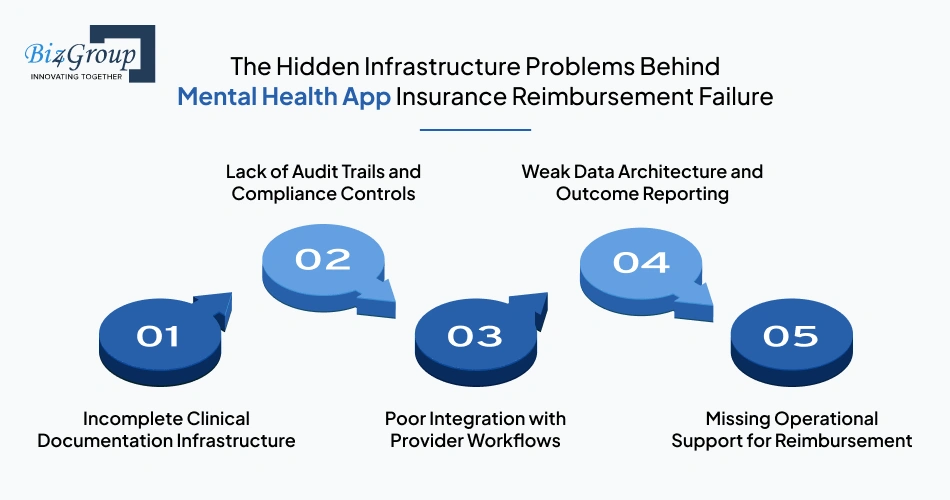
Even before clinical outcomes are assessed, your platform can silently block reimbursement. Most founders are surprised when their product appears strong but mental health app insurance reimbursement failure often happens because the platform lacks the operational and documentation infrastructure payers need. Many leading digital health companies have run into these same barriers, showing that reimbursement is not about product quality alone.
1. Incomplete Clinical Documentation Infrastructure
Payers will not reimburse products that cannot generate structured, verifiable clinical records. This goes beyond basic logs into formal medical documentation that fits billing frameworks. Without this, payers have no reliable way to validate treatment claims or link them to billable services, which is a frequent reason mental health app fails before review even begins.
Examples:
Pear Therapeutics, despite having FDA-authorized digital therapeutics mental health reimbursement, struggled to achieve durable reimbursement because its platforms lacked seamless documentation pathways tied to clinician oversight. About half of prescriptions were not paid by insurers, contributing to financial collapse.
2. Lack of Audit Trails and Compliance Controls
Insurance reimbursement processes demand clear audit trails and strict compliance with data protection laws. When platforms lack robust security structures, including traceability of clinical actions and access controls, payers flag the product as risky. This is a common contributor to digital mental health app payer reimbursement issues that founders overlook early on.
Examples:
Industry analyses consistently show that many mental health apps insurance reimbursement attempts fail because they cannot meet audit requirements under HIPAA and payer vendor risk frameworks. These gaps make payers reluctant to adopt them as reimbursable services.
3. Poor Integration with Provider Workflows
Payers care about how your solution integrates with existing clinical workflows and electronic health systems. If your platform cannot plug into care delivery routines, documentation systems, or provider tools, it signals disruption instead of enhancement. That makes reimbursement adoption slower and more expensive, often resulting in mental health app insurance reimbursement failure before outcomes are even reviewed.
Examples:
In Germany's DiGA system, real-world experience shows that even formally approved digital mental health platform reimbursement architecture products struggled with reimbursement uptake when physicians were unprepared to integrate them into daily practice. Adoption lagged because tools did not fit naturally into existing workflows.
4. Weak Data Architecture and Outcome Reporting
Insurance payment decisions depend on standardized outcomes, not raw metrics. If a platform cannot produce structured reports that link patient progress to specific reimbursable activities, reimbursement discussions never gain traction. Without this infrastructure, your mental health app reimbursement platform development becomes a data silo rather than a clinical tool payers can pay for.
Examples:
Industry research highlights that while many digital mental health app payer reimbursement products show clinical potential, they are reimbursed only when paired with human services or integrated into broader healthcare activities. Stand-alone apps without standardized reporting are rarely reimbursed.
5. Missing Operational Support for Reimbursement
Payers do not reimburse products that cannot support claims, auditing, or evidence generation. Even if your product is clinically effective, lacking operational capabilities to support submission, billing, and compliance workflows means reimbursement requests stall early. Solutions built with AI medical claim processing software principles can address this challenge.
Examples:
Across digital therapeutics markets, the absence of clear reimbursement pathways and supportive infrastructure led many early products to depend on employer or direct pay models rather than formal insurance payments. This reflects a deeper industry pattern where reimbursement obstacles are operational, not clinical.
Now that you understand the hidden infrastructure gaps blocking reimbursement, the next step is to see exactly what payers evaluate when deciding whether to approve your mental health app for coverage.
What Do Payers Actually Evaluate During Digital Mental Health App Payer Reimbursement Reviews
Before a payer considers clinical outcomes or financial value, they evaluate whether your platform can support real-world delivery, documentation, compliance, and evidence reporting. These capabilities are what separate apps that get reimbursed from those that do not, and they are central to solving why mental health app fails reimbursement.
1. Clinical Evidence Structure and Reporting
Payers require structured clinical evidence that ties patient outcomes directly to documented care activities. Simply showing outcome statistics is not enough. Your platform must collect, standardize, and export clinical data in ways that payers can verify and link to reimbursable events.
- Standardized measurement of patient outcomes
- Integration of clinical metrics into reports
- Evidence aligned with payer evaluation criteria
2. Security, Compliance, and Verification
Insurance providers will judge your platform based on whether it can handle sensitive health data securely and in compliance with laws. Platforms without clear audit logging, user role separation, and compliance processes are viewed as operational risks. This is a fundamental aspect of mental health app insurance reimbursement success.
- Complete audit logging and tracking
- Role-based user access controls
- Regulatory compliance documentation (HIPAA, SOC 2)
3. Integration into Clinical Workflows
Payers need to know your app will function as part of larger care systems, not in isolation. If your solution cannot integrate with clinician workflows, scheduling systems, or electronic health records, it is far less likely to be reimbursed because it disrupts existing care delivery processes.
- EHR and health system connectivity
- Clinician access for monitoring and intervention
- Alignment with care delivery standards
4. Reimbursement-Specific Data and Metrics
Payers expect platforms to produce data that clearly supports reimbursement decisions. This includes structured outcome reporting and data exports that inform claims adjudication. Platforms without these capabilities struggle in mental health app reimbursement platform development because they cannot show payers what they need to see.
- Exportable clinical summaries
- Claims-ready outcome metrics
- Standardized reporting formats
5. Operational Scalability and Support
Even when a clinical product shows value, payers evaluate whether the platform can support reimbursement workflows at scale. This includes data management at population level, payer communication protocols, and reporting aligned with insurance claims processes. Platforms that cannot demonstrate this tend to fail early, contributing to digital therapeutics mental health reimbursement challenges.
- Population-level outcome aggregation
- Support for payer reporting processes
- Claims preparation and tracking capabilities
Now that you know what payers look for during reimbursement reviews, it's time to see how the design of your platform itself, well before claims, can make the difference between a consumer app and a reimbursable digital therapeutic.
Consumer Mental Health App vs Reimbursable Digital Therapeutic: Why Architecture Changes Everything
Not all mental health apps are created equal. Many founders build engaging wellness apps that users love, but payers will not reimburse them because the underlying platform lacks the infrastructure needed for clinical and operational validation. Understanding the differences between a consumer mental health app and a reimbursable digital therapeutic is critical for planning your product's reimbursement pathway.
Aspect |
Consumer Mental Health App |
Reimbursable Digital Therapeutic |
Key Impact on Reimbursement |
|---|---|---|---|
Purpose & Claims |
Focused on engagement and habit tracking |
Clinically validated interventions with measurable outcomes |
Payers require clinical claims supported by evidence for mental health app insurance reimbursement |
Clinical Evidence |
Optional or anecdotal data |
Structured, verifiable patient outcome tracking |
Supports digital mental health app payer reimbursement and aligns with regulatory expectations |
Platform Architecture |
Simple UI/UX, basic data storage |
Robust mental health app reimbursement platform development with audit trails, EHR integration, and analytics |
Architecture determines if the product is eligible for digital therapeutics mental health reimbursement |
Compliance & Security |
Standard privacy settings |
HIPAA-compliant, role-based access, full audit logging |
Critical for payer trust and approval |
Provider Workflow Integration |
Limited or no integration |
Embedded in clinician workflows, treatment planning, and care coordination |
Enhances reimbursement readiness and operational scalability |
Outcome Reporting |
Basic dashboards or charts |
Exportable, standardized clinical reports tied to interventions |
Allows payers to validate impact and justify reimbursement |
Operational Support |
Direct-to-consumer only |
Claims-ready infrastructure, population-level reporting |
Supports mental health app insurance reimbursement platform architecture and long-term sustainability |
By comparing these two types of products, it becomes clear why so many apps fail reimbursement despite strong user engagement. Payers evaluate the platform, not just the interface or features. Even excellent consumer apps often fall short because they lack the clinical infrastructure and reporting capabilities that payers require.
This distinction also explains why founders frequently ask: "How do I transform a consumer wellness app into a reimbursable digital therapeutic?" The answer lies in the platform architecture, documentation, and integration with clinical workflows.
Understanding these differences sets the stage for the next critical discussion: the exact platform architecture required for mental health app reimbursement success and how to design your product so it meets payer expectations from day one.
Also Read: How to Design an AI App: A 6-Step Guide for Seamless User Experience
The Platform Architecture Required for Mental Health App Insurance Reimbursement Platform Architecture
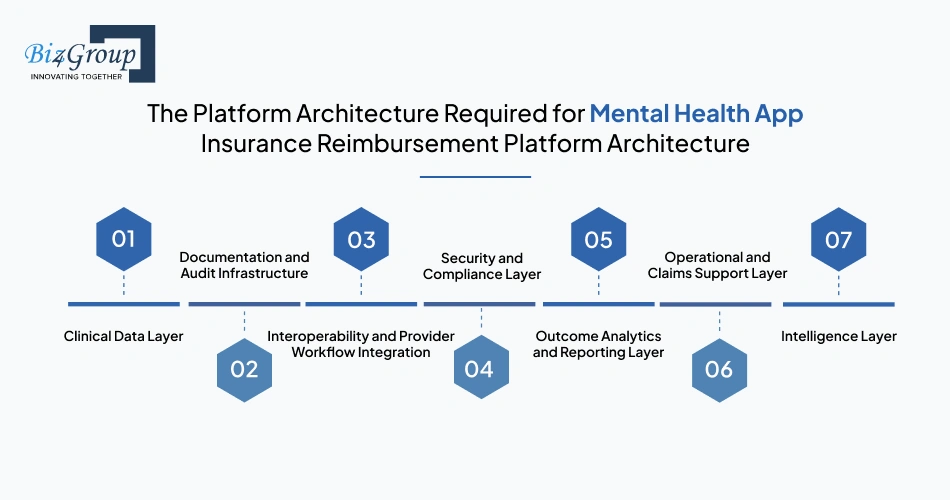
To move a mental health app from a consumer product to a reimbursable digital therapeutic, your platform's architecture must align with payer requirements. Proper mental health app insurance reimbursement platform architecture ensures clinical evidence is credible, compliance is verified, workflows integrate smoothly, and operational processes scale reliably. Without these elements, even apps with excellent outcomes can fail mental health app insurance reimbursement.
1. Clinical Data Layer
This layer captures structured patient information and measurable outcomes. Payers rely on this data to validate your app's clinical effectiveness and determine reimbursement eligibility.
- Standardized tracking of patient outcomes
- Longitudinal data for continuous care
- Integration of clinician inputs for verification
2. Documentation and Audit Infrastructure
Structured documentation and audit trails demonstrate accountability. Platforms that cannot maintain full records or enforce access controls often fail digital mental health app payer reimbursement reviews.
- Automated clinical notes and activity logs
- Complete audit trails for all clinical and operational actions
- Compliance with HIPAA and payer policies
3. Interoperability and Provider Workflow Integration
Payers evaluate how your platform fits into clinical workflows. Seamless integration with EHR systems and care routines signals operational readiness.
- Integration with EHR and scheduling systems
- Dashboards for clinicians to track patient progress
- Multi-provider collaboration support
4. Security and Compliance Layer
Robust security and compliance measures are critical for reimbursement approval. Platforms lacking these elements are high-risk and often rejected.
- Role-based access control for patient data
- Encrypted storage and transmission
- Routine compliance audits and reporting
5. Outcome Analytics and Reporting Layer
Payers expect structured reports linking interventions to measurable outcomes. Without this, even clinically effective apps may fail mental health app reimbursement platform development reviews.
- Exportable clinical summaries for payer evaluation
- Visual dashboards highlighting patient progress
- Metrics aligned with reimbursable CPT codes
6. Operational and Claims Support Layer
Even clinically validated apps require operational infrastructure to support reimbursement. Platforms that cannot manage claims, generate reports, and communicate with payers struggle to succeed.
- Claims-ready infrastructure
- Population-level outcome aggregation
- Integration with payer reporting channels
7. Intelligence Layer
Advanced monitoring, predictive analytics, and risk detection enhance your platform's value and improve reimbursement potential.
- AI-driven adherence monitoring
- Predictive analytics for clinical risk
- Automated outcome and claims reporting
With a robust mental health app insurance reimbursement platform architecture, your product becomes fully reimbursement-ready. Next, we will discuss how to solve the challenges that typically prevent apps from achieving payer approval and turn architecture into actionable success.
How to Solve the Challenges Preventing Mental Health App Insurance Reimbursement
Many founders build strong clinical apps but stumble when it comes to payer approval. The key is to address platform, workflow, and compliance challenges systematically. The table below highlights common obstacles, the impact on reimbursement, and actionable solutions.
Challenge |
Impact on Mental Health App Insurance Reimbursement |
Solution / Action Steps |
|---|---|---|
Incomplete Clinical Documentation |
Payers cannot verify outcomes; reimbursement fails early |
Implement structured clinical data capture, longitudinal patient tracking, and clinician input validation. Ensure your mental health app reimbursement platform development supports exportable reports. |
Weak Audit Trails & Compliance |
Fails HIPAA or payer audits, causing rejection |
Add full audit logging, role-based access control, and routine compliance checks. Build documentation processes aligned with digital mental health platform reimbursement architecture. |
Poor Integration with Provider Workflows |
Disrupts care delivery; low adoption by clinicians |
Integrate with EHR systems, provide clinician dashboards, and align your app with treatment scheduling and care planning workflows. |
Lack of Standardized Outcome Reporting |
Payers cannot quantify effectiveness |
Develop outcome analytics dashboards, exportable clinical summaries, and metrics aligned with reimbursable CPT codes for digital mental health app payer reimbursement. |
Operational Limitations |
Cannot manage claims or scale across populations |
Build claims-ready infrastructure, population-level reporting, and payer communication layers. Consider AI medical claim processing software to automate and optimize workflows. |
Limited Intelligence & Predictive Analytics |
Misses opportunities to demonstrate clinical impact |
Add AI-driven adherence monitoring, predictive analytics for risk, and automated outcome reporting to strengthen the reimbursement case. |
Addressing these challenges systematically transforms your platform from a consumer app into a reimbursement-ready digital therapeutic. Next, we will explore why founders choose Biz4Group to implement these solutions and achieve payer approval successfully.
Why Do Founders Choose Biz4Group for Mental Health App Reimbursement Platform Development
At Biz4Group, we understand that building a reimbursement-ready mental health platform requires both clinical insight and robust technology. With a vast portfolio of successful digital health projects, we consistently deliver solutions that meet payer standards, integrate with clinical workflows, and support operational scalability.
Our expertise is recognized across the industry. We hold a 4.9 Clutch rating and have been ranked among the top mental health app development companies in the USA. Founders choose us because we combine deep healthcare knowledge with cutting-edge platform architecture, ensuring your product is not just functional but fully reimbursement-ready.
Partnering with Biz4Group means your app is built with the technical rigor and regulatory awareness required for mental health app insurance reimbursement platform architecture, giving you confidence to navigate payer evaluations successfully. For founders looking for guidance on selecting the right partner, we explain how to choose a top mental health app development company in the USA as part of building a reimbursable platform.
Wrapping Up!
Building a mental health app that achieves insurance reimbursement is not just about clinical validation. It requires a carefully designed mental health app insurance reimbursement platform architecture that supports structured clinical data, audit trails, workflow integration, and outcome reporting. Founders who understand these requirements can transform consumer wellness apps into fully reimbursable digital therapeutics, avoiding costly delays and rework.
At Biz4Group, we have extensive experience helping founders navigate the complexities of mental health app reimbursement platform development. Our vast portfolio, 4.9 Clutch rating, and recognition as one of the top companies in the USA demonstrate our ability to deliver scalable, compliant, and payer-ready solutions. We ensure your platform meets technical, operational, and regulatory standards so your app is positioned for success from day one.
Partner with Biz4Group to build a platform that not only improves patient outcomes but also secures sustainable reimbursement and long-term growth.
FAQ
1. What is the main reason many mental health apps fail to get insurance reimbursement?
Many apps fail reimbursement because they were built as wellness tools rather than clinically compliant systems with structured evidence and operational infrastructure. Payers look for documentation, outcomes tracking, and workflow integration before they consider coverage.
2. Can a mental health app get reimbursed without FDA clearance or clinical evidence?
In most cases, payers require structured clinical outcomes, validated protocols, or FDA‑cleared digital therapeutics before considering reimbursement. Without this evidence, mental health app insurance reimbursement is unlikely.
3. How do payers evaluate digital mental health services for reimbursement?
Payers evaluate whether your platform can produce verifiable clinical evidence, comply with regulations, integrate with care workflows, and generate claims‑ready reports. These criteria are central to digital mental health app payer reimbursement decisions.
4. What coding standards must be met for mental health app reimbursement?
Payers use payment frameworks like CPT and HCPCS codes to process claims. Apps that align their clinical documentation and reporting with these standards improve their chance for reimbursement.
5. Is it possible to transform a consumer mental health app into a reimbursable digital therapeutic?
Yes. Founders must redesign the platform to include structured clinical data, compliance features, interoperable workflows, standardized outcomes, and payer‑ready reporting to support mental health app reimbursement platform development.
6. Do all insurers reimburse digital therapeutics for mental health conditions?
Reimbursement policies vary widely. Some insurers are beginning to cover FDA‑cleared digital therapeutics, while others limit payments to structured clinical services tied to established coding practices.
7. How long does it typically take to achieve payer reimbursement for a mental health app?
There is no set timeline, but moving from a consumer product to a reimbursement-ready platform often takes several stages of development and validation. For a minimal viable product (MVP), this can take 2 to 4 weeks, while building a full enterprise-ready platform typically requires 6 to 8 weeks of development, payer engagement, and operational setup to satisfy the evidence and workflow criteria required for mental health app insurance reimbursement.
