Location :
Orlando, FL, USA
Location :
Orlando, FL, USA +1 (407) 714-1616
 info@biz4group.com
 AI Summary Powered by Biz4AI
- The mental health app market is projected to reach $9.45 billion in 2026, and buyers now expect real clinical grounding, not just a calming interface.
- A genuine mental health app development company in USA must show verifiable healthcare delivery history and HIPAA compliant architecture, not just claim it.
- Any AI features should be clinically grounded, built alongside real therapeutic logic rather than generic prompt engineering.
- Companies were scored using a stated methodology, weighted toward proven delivery history and compliance depth over marketing claims.
- 10 verified, US-based firms, including Biz4Group, are compared side by side on specialization, compliance credentials, and cost drivers.
- The right mental health app development company in USA is the one that can prove its work, not just describe it.
You are building a mental health app. Before you sign with anyone, here's a number worth sitting with first.
A scoping review published in the Journal of Medical Internet Research tracked over 525,000 users across 18 studies and found that a median of 70% of users abandon a mental health app within the first 100 days. Not because the idea was bad. Because the app itself could not hold up once someone actually needed it to.
So, now the real question worth asking is, why does that happen so often?
Usually because the app was built like any other app, when it needed to be built like something people would trust with their worst days.
Your users are not tracking steps or comparing calorie counts. They are opening up about a panic attack at 2 AM. They are logging a relapse. They are typing something they have never said out loud to another person. That is not a problem you fix with a nicer onboarding screen. It is a trust problem, and it gets solved at the development stage, by choosing a mental health app development company that actually understands what happens on the other side of the screen.
We have sat across the table from founders who learned this the expensive way, after their first build already shipped. We would rather you learn it here, before you sign anything.
Here's where it helps to zoom out for a second. How big is this market actually getting, and why should that change how you pick a partner?
The global mental health apps market is projected to reach USD 9.45 billion in 2026, growing at a 14.76% CAGR, according to Mordor Intelligence. North America alone pulled in over 37% of that global revenue in 2025, helped along by new CMS reimbursement codes that now pay out for digital therapy sessions. Insurance is no longer distant maybe. It is already happening, and it only pays out for apps that can prove they are clinically sound.
Which brings us to what we actually want to help you avoid. Signing with a company that talks a good game about healthcare experience but has never shipped anything HIPAA governed, clinically reviewed, or built to survive a real compliance audit, let alone hold onto a user long enough to matter.
This guide walks you through exactly how to find the best mental health app development company in USA for what you are building. Maybe that is a therapy scheduling platform. Maybe it is an AI supported journaling app. Maybe it is a full teletherapy solution with live sessions and provider dashboards. Whatever it is, we will show you what separates a genuine healthcare grade mental health application development company from a generalist dev shop wearing a healthcare badge, what your build should actually cost, and which companies are earning their reputation in 2026, not just claiming one.
Before any of that, it helps to know what a strong outcome even looks like. A short list of the best mental health apps to explore shows exactly what kind of product survives past that 100 day mark and gives you something concrete to hand your development partner as a starting reference.
Let's start with what is actually changing in this space right now, because it shapes almost every decision you make after this.
What Trends Are Shaping Mental Health App Development in the USA Right Now?
The mental health app you would have built two years ago is already outdated. Here's what's actually reshaping this space, and why it matters if you're building right now.
1. Teletherapy Stopped Being a Feature and Became the Product
A few years ago, video calling was just something you bolted onto an app. Now it's often the whole point. Founders are building entire platforms around live sessions, secure messaging, and scheduling, because that's what users and insurers actually want to pay for. Every teletherapy build we've been part of confirms the same thing, the moment scheduling or session security feels like an afterthought, users notice immediately and trust drops. If teletherapy isn't core to your build, you're probably building the wrong thing, and that's exactly the kind of gap a genuine mental health therapy app development company should catch before you write a single line of code.
2. AI Companions Are Becoming Genuine First Responders
People are talking to AI chatbots at 2 AM when no therapist is awake to answer. A 2025 systematic review in JMIR Mental Health found Wysa users who engaged at least twice a week saw depression scores (PHQ-9) drop by more than 5 points, and Youper users across a study of 4,517 people averaged a 3.6 point reduction. That's not just comforting; that's measurable. This is part of a much bigger shift in the rise of AI companions for mental wellness, and it only works when it's built by a team that understands emotional nuance, not just conversational flow. Worth being clear on one thing though, this is augmentation, not replacement. If you're weighing how far AI should actually go here, it's worth reading whether AI will replace therapists before you scope your feature set.
3. AR and VR Are Turning Therapy into an Experience
Imagine treating a phobia by actually walking through it in a safe, simulated space, instead of just talking about it. That's where AR and VR are heading in mental health, from guided exposure therapy to immersive relaxation environments. It's still early, but the founders moving first here are going to own a category almost nobody else is building in yet.
4. AI Avatars Are Becoming the Face of Digital Care
A static chatbot feels like a FAQ page. An avatar that responds with expression, tone, and presence feels like something closer to being heard. We've seen this firsthand building mental health AI avatar products ourselves, avatar-based support changes how long users stick around, because it finally feels like talking to someone instead of typing into a box.
5. Insurance Is Finally Willing to Pay, But Only for the Real Thing
This is the shift most founders miss. Medicare and major insurers have started reimbursing FDA-cleared digital therapeutics, which means an app that can prove clinical results can actually get paid for by insurance now, not just downloaded for free. That's exactly why we keep hearing versions of this question from founders: "I am running a digital therapeutics startup and I want to build a mental health app that can eventually bill insurance using the new CMS reimbursement codes for FDA-cleared digital therapeutics, and I want to know whether the development companies I am evaluating have actually built toward this pathway before."
Fair question, and most development shops can't answer it honestly. FDA clearance and HIPAA compliance are two completely different regulatory tracks, so ask any custom mental health app development services in USA provider you're considering whether they've actually built toward FDA submission requirements, not just compliance checkboxes.
6. Wearables Are Turning Guesswork into Real Signal
A user typing "I feel fine" into a mood tracker isn't always telling the whole story. Their smartwatch, tracking sleep and heart rate, often knows better. Mental health apps are starting to pull that data in directly, catching a rough patch before the user even notices it themselves.
None of these trends matter much if the team building your app doesn't know how to translate them into something safe, compliant, and genuinely useful. So, the real question isn't which of these trends to chase. It's how you find a mental health app development company in USA that can actually build for where this industry is headed, not where it used to be. That's exactly what we'll walk through next.
Ready to build something that actually helps people sleep better (literally)?
Let's turn your mental health app idea into a secure, scalable solution with the brains and heart it deserves.
Talk to Our ExpertsWhat Should You Look for in a Mental Health App Development Company in the USA?
A polished pitch deck can make almost any dev shop sound healthcare-ready. Here's how to actually tell the difference before you sign anything.
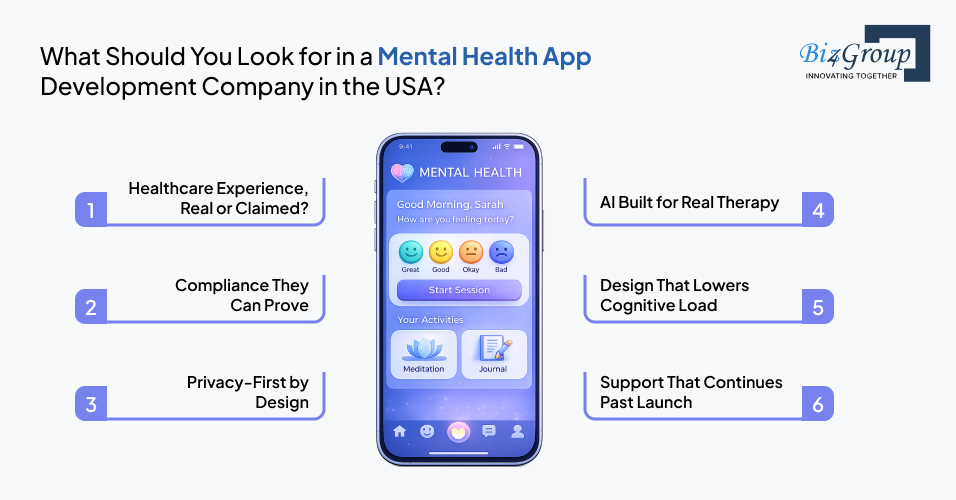
1. Do They Actually Understand Healthcare, or Just Claim To?
Building apps and building for healthcare are not the same skill. Your mental health app development company needs to understand clinical workflows, therapeutic logic, and how behavioral health compliance actually works in practice, not just in a sales call. We've sat in enough discovery calls to know the difference shows up fast, ask about a real clinical workflow and a healthcare-fluent team gets specific, everyone else gets vague.
Ask directly: have they worked with real care providers? Do they understand HIPAA at a structural level, not just as a checkbox? If the answer is vague, keep looking.
2. Can They Prove Their Compliance Claims, or Just State Them?
Mental health data carries legal weight most app categories never touch. This is precisely the concern behind a question we hear constantly from founders building a HIPAA compliant mental health app development company shortlist: "I am running a digital health startup and I want to hire a mental health app development company in the USA but I do not know how to verify whether a company actually understands HIPAA, 42 CFR Part 2, and FDA SaMD requirements versus one that just claims healthcare experience on their website."
Fair concern, and the fix is simple. Ask for a specific project where they handled 42 CFR Part 2 protected substance use data or built toward FDA Software as a Medical Device requirements. A real answer comes with a name and detail. A rehearsed answer comes with a shrug. If AI is part of your build, this is also where it's worth checking whether their team has real experience with HIPAA compliant AI app development for healthcare specifically, since AI features add a layer of compliance risk that standard mental health application development services don't carry.
3. Is Their Data Architecture Actually Built for Privacy, or Just Marketed That Way?
This is a separate question from compliance paperwork, and just as important. We hear it phrased almost exactly this way: "I am running a mental health startup and I want to make sure the development company we hire builds our app with a genuine privacy-first architecture because our users will be sharing deeply personal mental health data and I cannot risk a breach or a misuse that destroys user trust before we even scale."
Ask how data is encrypted at rest and in transit, who inside the company can access raw user data, and whether they've handled a security audit start to finish. HIPAA, HITECH, and SOC 2 experience should be something a genuine USA-based mental health app development company can walk you through in detail, not something they just list on a slide.
4. Can Their AI Actually Support Real Therapy, or Just Sound Like It Can?
Smart triaging, sentiment-based nudges, and personalized CBT modules only matter if they're built on something clinically real. This is exactly where founders trip up, and where a question like this becomes critical: "I am running a mental health nonprofit and I want to build a CBT and DBT-based therapy app and I need a development company that has actually worked with licensed clinicians and understands evidence-based therapeutic frameworks, rather than just building a generic wellness app with a mindfulness label."
That distinction matters more than it sounds. A mindfulness app and a CBT or DBT-grounded therapy tool are built on entirely different logic. We've seen this trip up teams that were technically strong but had never sat with a clinician to shape therapeutic content, the app looked right and still felt wrong to real users. Ask whether their team has worked alongside licensed clinicians to shape the content itself, not just the interface around it, and whether they've built anything like a mental health AI assistant grounded in an actual therapeutic framework rather than generic prompt engineering.
5. Does the Design Actually Reduce Cognitive Load, or Just Look Calm?
Mental wellness apps need to be intuitive and comfortable, not just visually soft. A pastel color palette does not equal accessible design. Look for a mental health therapy app development company that designs with accessibility, emotional pacing, and cognitive load in mind, because for this category, first impressions affect outcomes, not just engagement.
What Happens After Launch, When It Actually Counts?
Building the app is maybe 60% of the job. The rest is continuous updates, data monitoring, and real user feedback loops. A serious custom mental health app development services in USA provider, and ideally one positioned as the right mental health app development company in USA for your specific build, should already have analytics dashboards, A/B testing capability, and a concrete plan for post-launch iteration, not a vague promise to stay in touch.
How Did We Evaluate These Mental Health App Development Companies in the USA?
We didn't rank the companies below based on reputation alone. Each mental health app development company was scored against the same six factors covered above, with heavier weight given to two of them, given what's actually at stake in this category.
- Real healthcare delivery history, not just claimed experience, weighted highest
- Verifiable compliance work, including HIPAA, 42 CFR Part 2, and FDA SaMD where relevant, weighted highest
- Data architecture and privacy practices, not just stated policy
- Clinical grounding behind any AI features, not just chatbot polish
- Design quality specific to mental health users, not general app UX
- Post-launch support model and long-term iteration plan
Delivery history mattered most for a specific reason. We kept coming back to a question founders raise often, and it's a fair one: "I am running a healthcare startup and we are building a mental health app and I want to know whether the development companies we are evaluating have real experience building crisis detection and escalation protocols, because I cannot launch a product that misses a user in a genuine mental health emergency."
That's not a feature you can fake in a portfolio. A mental health app development services provider in USA either has shipped something with a real safety protocol behind it, or they haven't. So, wherever a firm below had shipped a product handling that kind of risk, it counted more than a case study that just looked polished. This same rubric is what separates a best mental health app development company in USA from one that simply markets itself as one.
What Is the Right Process for Choosing a Mental Health App Development Company in the USA?
Building a mental health app isn't like building just another mobile product. This one can genuinely affect someone's wellbeing, so the process of finding the right mental health app development company in USA deserves the same rigor. Here's the five-step path that actually holds up.
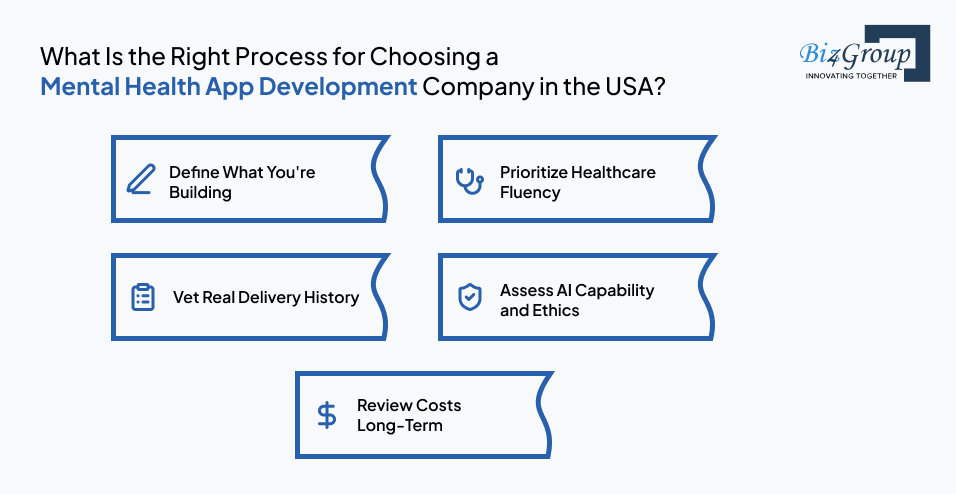
Step 1: Define What You're Actually Building, Before You Talk to Anyone
A mood tracker, a therapy scheduling tool, and an AI-powered chatbot need completely different teams behind them. Get specific here before a single vendor conversation happens. The clearer your scope, the easier it becomes to spot a mental health application development company that's genuinely equipped versus one that's guessing along with you. A good reference point while you're scoping is a rundown of top mental health app features worth considering for 2026.
- List your core use case in one sentence before anything else
- Decide early whether AI, teletherapy, or both are must-haves at launch
- Separate your MVP scope from your version 2.0 wishlist
Step 2: Prioritize Healthcare Fluency Over General Tech Talent
Not every skilled developer understands HIPAA, HL7, or CBT frameworks, and that gap shows up fast once real clinical content enters the picture. You need a mental health app development services provider in USA fluent in both code and clinical logic, not one learning healthcare on your dime. The best partners already know what not to do, like overwhelming a user with alerts or skipping privacy-first design from day one.
- Ask for examples of past healthcare-specific compliance work, not general app work
- Confirm they've handled sensitive personal data before, not just PII in general
- Check whether their team includes or consults with anyone clinically trained
Step 3: Vet Real Delivery History, Not Just a Polished Portfolio
Portfolios can be dressed up. Shipping history can't. What you actually want to see is proof a mental health app development company in USA has delivered something with real complexity behind it, like symptom tracking, therapist dashboards, or secure teletherapy infrastructure. If their past work resembles something like the development of a mental health app like BetterHelp, that's a strong signal they understand the operational weight of a real teletherapy platform, not just the surface UI.
- Ask for a technical walkthrough of one past project, not just screenshots
- Confirm they've handled live video, scheduling, or provider-side tools before
- Ask what broke during a past build, and how they fixed it
Step 4: Assess Their AI Capabilities and Ethics Together, Not Separately
AI in mental health isn't just a feature, it's a responsibility. A poorly implemented chatbot can genuinely harm a vulnerable user, so this step isn't optional even if AI feels like a "nice to have" in your roadmap. A strong custom mental health app development services in USA partner can speak to both technical capability and the ethical guardrails they build around it.
- Ask how they handle a user expressing crisis-level distress inside the AI flow
- Confirm they've built or integrated any clinically validated AI features before
- Ask what happens when the AI is uncertain, not just when it performs well
Step 5: Review Costs with a Long-Term Lens, Not Just the Lowest Quote
This is exactly where most founders get stuck, and it's a fair place to get stuck. We hear a version of this constantly: "I am a founder trying to build a HIPAA compliant mental health app and I keep getting quotes ranging from $30,000 to $400,000 from different development companies, and I want to understand what actually drives that range so I can tell which companies are giving me a realistic estimate versus a lowball to win the contract."
That spread usually comes down to a few specific factors, not vendor markup. Compliance depth, clinical content review, AI complexity, and whether teletherapy or EHR integration is involved all shift the number significantly. If a quote comes in far below what similar competitors are charging for the same scope, that's usually a sign something like security testing or compliance work is being skipped, not saved on. This is ultimately the step where a HIPAA compliant mental health app development company either earns your trust or loses it.
- Ask what's included in HIPAA compliance work specifically, not just "yes we do HIPAA"
- Ask whether the quote includes security audits and post-launch maintenance
- Ask for a line-item breakdown, not just a single lump-sum number
Follow this process and you'll walk into every vendor conversation already knowing what a real answer sounds like versus a rehearsed one. That puts you in a much stronger position for the next decision, actually picking a name off a list. So, here's where we get specific about who's actually earning a spot on that list in 2026, and why.
Which Are the Top Mental Health App Development Companies in the USA for 2026?
Reputation alone didn't earn any of these ten a spot on this list. Each one is scored against the criteria and methodology laid out above, with real, verifiable delivery history behind every entry, not just a polished pitch. Here's who's actually earning trust in this space right now, starting with the firm we can speak to most directly.
1. Biz4Group, Orlando, Florida
Website: https://www.biz4group.com/
Hourly Rate: $50 - $99 / hr
Clutch Review: 4.9/5
Biz4Group has built its reputation as a mental health app development company in USA by shipping across the categories that matter most in this space, not just one. Its portfolio includes teletherapy platforms, AI-powered mood tracking tools, and clinically grounded chatbot development, delivered for real clients including Cultiv8, Quantum Fit, AI Wizard, and CogniHelp, each covered in more depth in the case study section below. For teams weighing how deep to take AI specifically, Biz4Group's own breakdown of AI mental health app development is worth reading alongside this guide, since it goes further into what clinically sound AI implementation actually requires.
That range is exactly what separates a genuine best mental health app development company in USA from a firm that's only ever built one type of product and calls it expertise. Most companies further down this list specialize in a single mental health app category, wellness, teletherapy, or AI companions, but rarely all three. Biz4Group has shipped consumer-facing wellness tools and clinically-oriented builds grounded in real therapeutic logic, which is a harder range to earn than it sounds.
What actually separates Biz4Group in this category:
- HIPAA compliant architecture built in from day one, not retrofitted after an MVP is already live
- Clinically grounded AI features, including CBT-informed chatbots and mood analysis models built alongside real therapeutic logic, not generic prompt engineering
- AI avatar and AI companion development, a category most generalist mental health application development services providers on this list haven't touched at all
- Teletherapy and secure video infrastructure, including scheduling, provider dashboards, and encrypted session handling
- Post-launch iteration support, including analytics dashboards and structured feedback loops, rather than a one-time handoff
Twenty-plus years in software delivery and 700+ completed projects overall back this up, but it's the mental health specific portfolio above, not company size alone, that earns Biz4Group the top spot on this list.
2. Arkenea, United States
Arkenea builds exclusively for healthcare, which shows up directly in how they approach a mental health app development company brief. When a behavioral health provider needed to move to virtual care, Arkenea built a secure teletherapy platform in 24 weeks. That platform now handles over 5,000 therapy sessions weekly at 99.9% uptime, with AI-driven mood monitoring and treatment adherence features added since launch.
What sets them apart:
- Deep EHR and clinical workflow integration, built for intake flows, risk assessment questions, and provider dashboards
- Healthcare-only focus, meaning every engineer on staff has worked inside regulated health data before, not learned it on your project
- Strong fit for clinical-grade platforms, less suited to consumer wellness apps chasing gamification
3. Folio3, San Mateo, California
Folio3's mental health portfolio spans AI-powered behavioral health apps, gamified cognitive training platforms, and CBT-based digital therapeutics, a genuinely wider range than most firms attempt in this category. That range matters for a mental health application development company evaluation, since it signals the team can shift between clinical rigor and consumer engagement design depending on what the product actually needs.
What sets them apart:
- Range across sub-categories, from clinical CBT tools to emotion regulation apps, rather than one specialty
- In-house ML engineering, relevant if your roadmap includes AI features beyond a basic chatbot wrapper
- California-based team, with over a decade of healthcare-adjacent delivery history
4. Topflight Apps, Irvine, California
Topflight writes and thinks about clinical evidence the way a genuine best mental health app development company in USA should, citing real trial data from Wysa and MindShift CBT rather than treating "evidence-based" as a marketing phrase. Their healthcare client roster includes Stanford Medicine and Merck, which is a meaningfully high bar for a development partner to clear.
What sets them apart:
- Evidence literacy, the team can speak specifically to what clinical validation actually requires, not just HIPAA basics
- Enterprise healthcare trust, working with institutions like Stanford Medicine signals a level of scrutiny most agencies never face
- HIPAA-compliant AI integration, positioned specifically for founders converting an AI prototype into a compliant product
5. Attract Group, Las Vegas, Nevada
Attract Group's real project history includes a confidential mental wellness platform built for U.S. first responders with peer support features, and RAE Health, a platform empowering patients with substance use disorders through just-in-time interventions. Both are genuinely high-stakes categories within mental health, not adjacent wellness features.
What sets them apart:
- Crisis-adjacent product experience, having built for populations where timing and escalation genuinely matter
- Peer support and community architecture, a specific technical pattern not every dev shop has implemented
- Direct experience with substance use disorder platforms, a category requiring distinct clinical sensitivity from general mental wellness
6. Taction Software, Chicago, Illinois
Taction Software builds specifically for behavioral health organizations, describing their own work as developing "HIPAA-secure mobile apps for therapy, telepsychiatry, and community-based support" for a mental health app development company in USA search that's often dominated by generalists. They hold ISO 27001 and SOC 2 Type II certifications and build toward FDA-ready software architecture for SaMD-classified products.
What sets them apart:
- Named behavioral health service line, not a general healthcare page with mental health mentioned in passing
- Consent-sensitive workflow design, built specifically for therapy and telepsychiatry data handling
- FDA-ready architecture experience, relevant if your roadmap includes a path toward SaMD classification
7. Orangesoft, San Francisco, California
Orangesoft has one of the most explicitly mental-health-specific service breakdowns of any firm on this list, covering telepsychiatry applications, mindfulness and meditation apps, stress and anxiety management apps, self-help and CBT apps, addiction recovery apps, peer support apps, and crisis management apps as named, distinct categories. That level of specificity is rare, and it's a strong signal for anyone searching custom mental health app development services in USA.
What sets them apart:
- Category-level specialization, rather than treating "mental health app" as one generic bucket
- HIPAA and FDA compliance experience, demonstrated through a real virtual hospital MVP built to both standards
- 14+ years in healthcare-specific development, with over 300 total projects delivered
8. Glorium Technologies, Houston, Texas
Glorium has been named to the Inc. 5000 fastest-growing private companies list four times, and holds ISO 13485 certification, the medical device software standard, with mental health platforms representing a genuine core competency rather than a side offering. For a founder evaluating a mental health app development company against real credentials rather than claims, that certification is worth checking for specifically.
What sets them apart:
- ISO 13485 certification, relevant if your app could be classified as a medical device
- Sustained growth recognition, four consecutive Inc. 5000 honors signal real client retention, not a one-time spike
- 150+ products delivered, with mental health platforms named as one of their established specialties
9. Dogtown Media, Venice, California
Dogtown Media built a cross-platform app and web portal for a sleep health study involving insomniacs, developed for the National Sleep Foundation, a real named client working directly in a mental-health-adjacent clinical space. They also describe combining machine learning and AI specifically to build mental health applications as part of their core healthcare practice.
What sets them apart:
- Named clinical research client, the National Sleep Foundation project, not just a generic healthcare claim
- Machine learning specialization, directly applied to mental health product features rather than bolted on afterward
- HIPAA-compliant healthcare architecture, a stated priority across their mHealth practice
10. Fingent, White Plains, New York
Fingent brings over two decades of custom software development experience to healthcare clients, with a demonstrated ability to translate complex clinical and population health workflows into working software, evidenced by their population health management platform built with Casenet's Advanced Solutions Group. Their mental health specific portfolio is less publicly documented than the other firms on this list, so this entry is best suited to founders prioritizing broad enterprise software depth over a specialized behavioral health track record.
What sets them apart:
- Two decades of enterprise software delivery, with Fortune 500 clients across regulated industries
- Population health platform experience, relevant for apps needing to aggregate and act on patient-level data at scale
- Broad technical range, including AI, AR/VR, and data analytics capability alongside core app development
Ten names, ten different strengths, and that's exactly the point. The right mental health app development company in USA for a teletherapy platform looks different from the right one for an AI companion app or a crisis support tool. Reading through the "What to Look For" criteria and the methodology above should already be narrowing your list.
To make that narrowing easier, here's how these ten actually stack up side by side.
Found a favorite, or still mentally stuck?
If the list gave you clarity or confusion, our team can help you validate, scope, and build your app without the guesswork.
Book a Free ConsultationHow Do These Top Mental Health App Development Companies in the USA Compare?
Reading ten full write-ups is useful once. Comparing them side by side is what actually helps when you're down to a shortlist. Here's how these mental health app development services providers in USA options stack up on the factors that matter most from the criteria above.
|
Company |
HQ |
Best For |
Mental Health Specialization |
Compliance Credentials |
|---|---|---|---|---|
|
Biz4Group |
Orlando, FL |
Range across teletherapy, AI companions, and wellness apps |
AI avatars, CBT-informed chatbots, teletherapy |
HIPAA-compliant architecture built in from day one |
|
Arkenea |
United States |
Clinical-grade platforms needing EHR integration |
Telepsychiatry, provider dashboards, risk assessment flows |
Healthcare-only delivery model |
|
Folio3 |
San Mateo, CA |
Founders needing both clinical and consumer-facing range |
AI behavioral health, gamified cognitive training, CBT tools |
In-house ML engineering for AI features |
|
Topflight Apps |
Irvine, CA |
Founders who need evidence-based design taken seriously |
Cites real Wysa and MindShift CBT trial data |
Trusted by Stanford Medicine and Merck |
|
Attract Group |
Las Vegas, NV |
Crisis-adjacent and substance use disorder platforms |
First responder peer support, substance use disorder tools |
Real crisis-adjacent delivery history |
|
Taction Software |
Chicago, IL |
Behavioral health orgs needing FDA-ready architecture |
Named therapy and telepsychiatry service line |
ISO 27001, SOC 2 Type II |
|
Orangesoft |
San Francisco, CA |
Founders wanting category-specific specialization |
Telepsychiatry, CBT apps, crisis management, addiction recovery, and mindfulness apps in the vein of what made Calm and Headspace category leaders |
HIPAA and FDA-compliant MVP delivery |
|
Glorium Technologies |
Houston, TX |
Apps with potential medical device classification |
Mental health platforms as a named core competency |
ISO 13485 certified |
|
Dogtown Media |
Venice, CA |
AI-driven mental health features |
ML-built mental health app work, National Sleep Foundation project |
HIPAA-compliant healthcare architecture |
|
Fingent |
White Plains, NY |
Broad enterprise software depth over niche specialization |
Population health platform experience |
Two decades of regulated-industry delivery |
A pattern worth noticing: the companies with the most specific, named mental health work (Taction Software, Orangesoft, Arkenea) tend to be smaller, more focused shops, while broader range often comes from firms like Biz4Group and Folio3 that work across several categories at once. Neither is automatically the right mental health app development company in USA for every founder. It depends on whether your app fits neatly into one category, or whether you need a mental health application development company comfortable moving between several as your roadmap grows.
Why Choose a USA-Based Mental Health App Development Company Over an Offshore Team?
Your choice of development partner here isn't just technical. When the product handles someone's emotional data, it's a strategic decision with real downstream consequences. Here's what a USA-based mental health app development company actually gives you that an offshore software development or non-specialized team usually can't.
1. They Live Inside US Compliance, Not Just Reference It
We covered HIPAA and HITECH depth in the criteria above, so we won't repeat that argument here. What's different from a US vs. offshore lens specifically is state-level nuance. New York's SHIELD Act, California's CMIA, and HIPAA itself all layer differently depending on where your users are, and a team physically operating under these laws day to day tends to catch that layering faster than a team that's only read about it.
2. Product Decisions Get Made in Real Time, Not Overnight
Therapy journaling flows, crisis escalation logic, what gets encrypted and when, these are exactly the kind of decisions that shouldn't wait 12 hours for a time zone to align. A same-timezone mental health app development company in USA means those calls happen in the same working day, not the next one.
3. Local Integration Advantages Add Up Fast
A US-based team tends to have direct familiarity with US insurance APIs, EHR systems like Epic and Cerner, and the kind of state-by-state telehealth licensure rules that don't show up in a generic offshore team's prior project list. If your roadmap includes partnerships with US wellness brands or hospital groups, that local fluency compounds.
4. "Built in the USA" Is a Real Trust Signal, Not Just a Marketing Line
For users, it's reassurance that their most personal data isn't routed through jurisdictions with different privacy protections. For investors, US-based development is often read as a proxy for tighter IP control and cleaner compliance posture during due diligence. Neither guarantees quality on its own, but both genuinely affect how your app is perceived by the people you need to trust it.
If you're weighing design decisions specifically, mental health app design done well often comes down to exactly this kind of domain fluency, not just aesthetic polish. And if you're earlier in the process than choosing a developer, our mental health solutions tips for entrepreneurs is worth reading before you get this far.
Choosing a top mental health app development company in USA ultimately comes down to risk reduction as much as talent. The right partner understands US healthcare culture because they're operating inside it, not researching it from a distance.
What Do Biz4Group's Real Mental Health App Projects Reveal About the Right Development Partner?
Choosing a mental health app development company in USA isn't just about a timeline or a quote. It's about whether the team understands what's actually at stake, whether that's someone's spiritual practice, their cognitive health, or their day-to-day emotional state. Here's what that's looked like across four real projects Biz4Group has built.
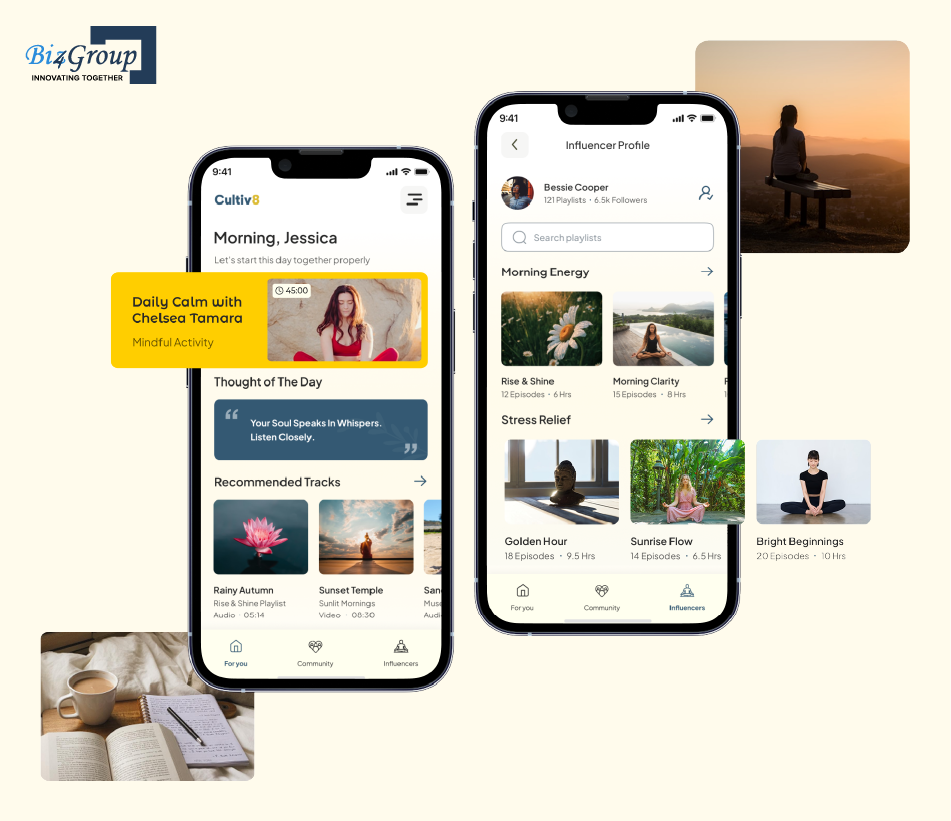
Case Study 1: Cultiv8: A Digital Platform for Spiritual Exploration
Cultiv8 gives users room to explore spiritual practices and traditions at their own pace, without pressure to follow any single tradition or measure themselves against anyone else. It combines a meditation timer with customizable music, a personal journal for reflecting on emotional and spiritual growth, and community forums where users connect with others on similar journeys. A recommendation engine adapts content to each user's interests over time, so the experience doesn't feel generic. If mood tracking or journaling is core to what you're building, our breakdown of mental health journaling app development covers the architecture decisions that matter most for that specific feature, and it's exactly the kind of depth worth expecting from any serious mental health app development company.
Case Study 2: Quantum Fit: An AI-Powered Personal Development App
Quantum Fit helps users work on six connected areas of wellbeing at once, physical, mental, spiritual, nutritional, social, and sleep, through a single AI-driven interface. A ChatGPT-4o powered chatbot handles personalized goal setting, habit suggestions, and motivational check-ins. The real technical challenge here was cost, not capability: AI token costs escalate fast once personalization scales to real users, so the Biz4Group team built a token management strategy with caching for repeated requests, keeping the app financially sustainable without cutting into the quality of the AI experience.
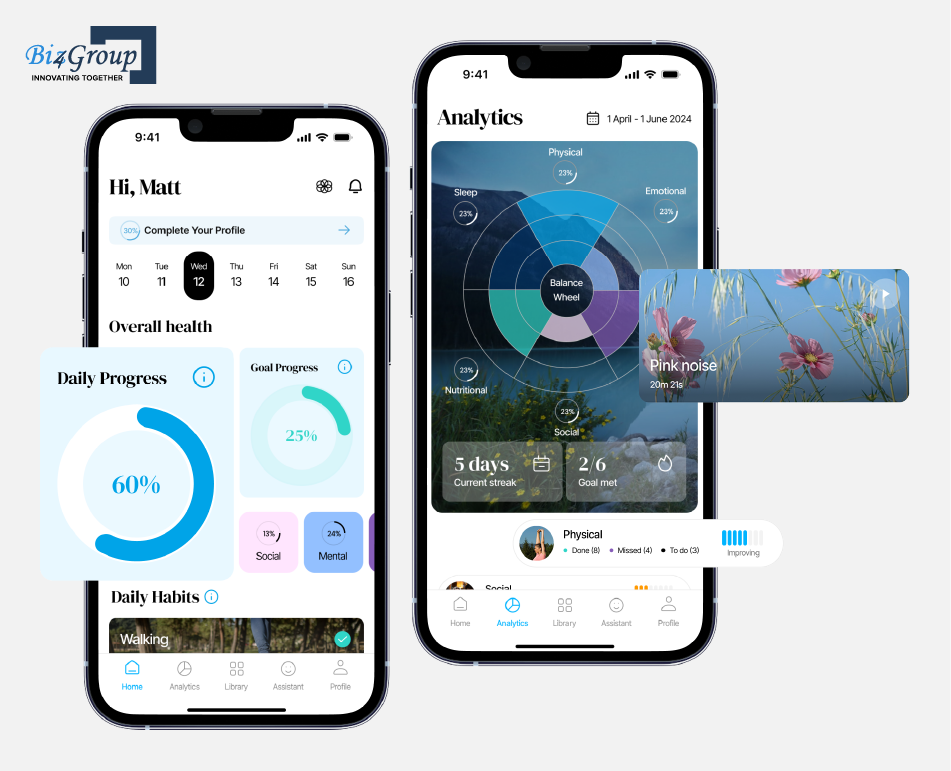
Case Study 3: AI Wizard: An Avatar-Based AI Companion
AI Wizard pairs D-ID's avatar technology with ChatGPT and Whisper AI to hold real voice and video conversations, complete with facial expressions and gestures that respond in real time. It's built as a companion for moments of boredom, loneliness, or simply needing to talk something through, with users able to customize their avatar's appearance. Using D-ID as an external integration partner also kept development costs down, a practical tradeoff worth knowing about if AI companion features are part of your own roadmap for a mental health application development company brief.
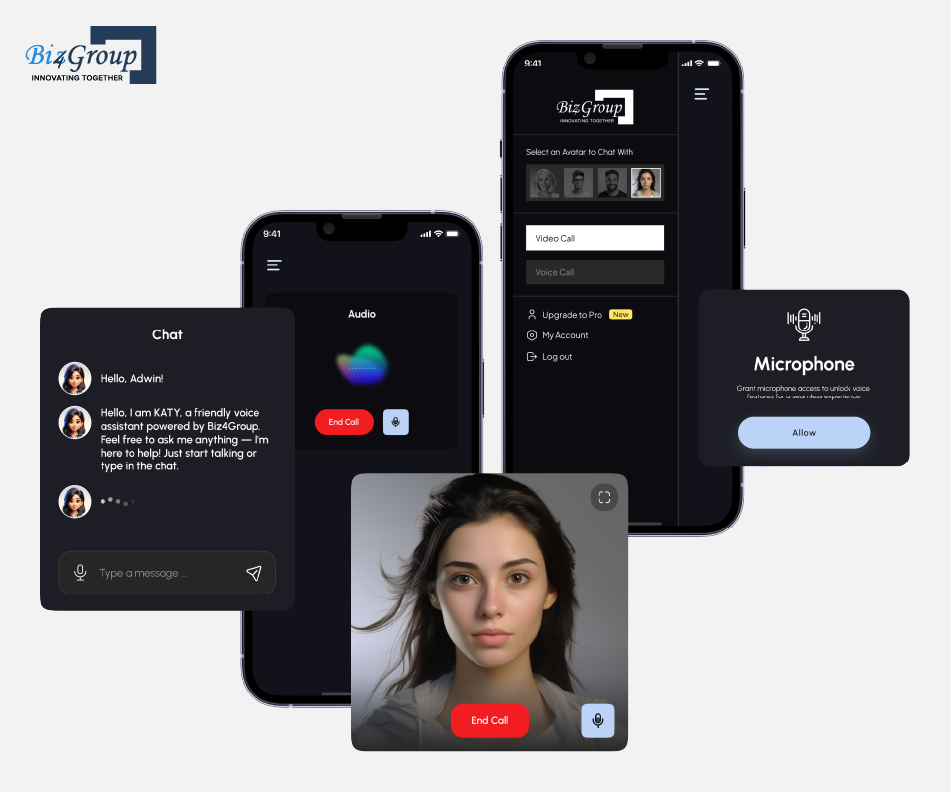
Case Study 4: CogniHelp: Support for Dementia Patients and Their Caregivers
CogniHelp helps early to mid-stage dementia patients stay oriented through daily journaling, brainstorming quizzes built from their own life details, and voice-to-text journaling for days when typing feels like too much. A machine learning model tracks cognitive performance over time using quiz results and journal entries, giving caregivers a real, data-backed view of change rather than a guess. The app also includes an "Emotional Checkpoints" feature, a GPT-4 powered chatbot that reads emotional signals from patient interactions and shares that data with caregivers to help adjust care plans. Worth being precise here: this is ongoing emotional monitoring for caregivers, not the same as a real-time crisis escalation system. If you're building toward genuine crisis detection and intervention, that's a distinct technical and clinical requirement worth asking any custom mental health app development services in USA provider about directly, rather than assuming a feature like this one covers it.
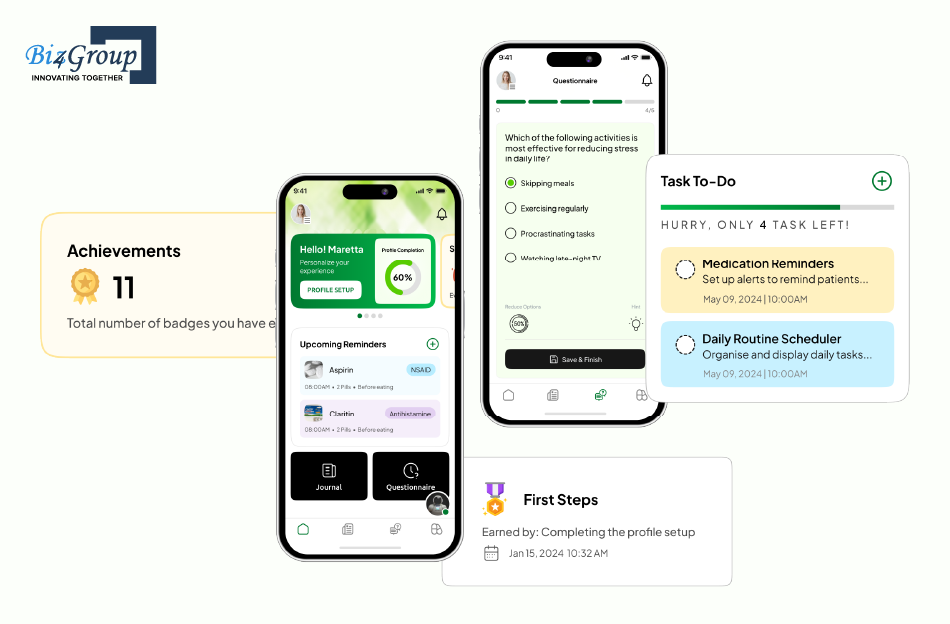
What These Four Projects Actually Have in Common
None of these were built from a template. A spiritual exploration app, a six-dimension personal development platform, an AI companion, and a dementia support tool don't share a single playbook, and each required a different balance of technical complexity and emotional design. That range is worth being honest about too: the right test isn't whether Biz4Group, or any best mental health app development company in USA, has built your exact app before, it's whether the thinking behind these four holds up against the criteria laid out earlier in this guide.
Need a development partner who won't ghost you after launch?
From MVP to post-launch support, we've got the tech and therapy touch to get your app to market (and keep it growing).
Schedule a Tech CallReady to Choose the Right Mental Health App Development Company in the USA?
A mental health app development company in USA earns that title through what it can show, not what it claims. That's the standard this whole guide has been built around: real criteria you can actually check, a methodology you can hold any firm to, and honest answers to the questions founders are genuinely asking right now, not the ones easiest to market around.
Apply that same standard evenly to every name on your shortlist, Biz4Group included. Two decades in software development doesn't earn a partner your trust on its own. What earns it is whether that experience actually translates into the specific, verifiable things this guide told you to check for: real compliance depth, clinical grounding behind any AI feature, and a team that can explain a hard tradeoff instead of glossing over it.
If you take one thing from this guide, let it be this. The best mental health app development company in USA for your build is the one willing to be evaluated this closely, not the one asking you to take their word for it.
Let's build something worth trusting with someone's hardest days.
FAQs
How long does it actually take to build a mental health app?
It depends entirely on scope. A focused MVP with mood tracking and journaling typically takes 2 to 4 weeks. A mid-tier builds with AI features, and teletherapy usually runs 4 to 6 weeks. A full clinical grade platform with EHR integration can take 6 to 8 weeks. Any mental health app development company in USA giving you a firm timeline before understanding your compliance scope is guessing, not estimating.
How do I actually choose the best mental health app development company in USA?
Go back to the criteria that matter most, real healthcare delivery history, verifiable compliance work, clinical grounding behind any AI features, and a design team that understands emotional pacing, not just visuals. A genuine best mental health app development company in USA will walk you through specific past projects when you ask, not just list certifications on a slide.
Can AI actually replace a therapist with a mental health app?
No, and any team telling you otherwise should raise a flag. AI can handle triage, mood pattern detection, and support between sessions, but licensed human oversight still matters for diagnosis and crisis situations. The best mental health application development services build AI as a support layer with clear escalation paths, not a replacement for real care.
What keeps users coming back to a mental health app after the first week?
Retention in this category rarely comes from more features. It comes from making the app feel worth returning to on a hard day, not just a good one. Mechanics like streaks, small milestones, and progress visualization genuinely help here when they're built thoughtfully rather than bolted on. Our breakdown of mental health gamification as the future of self care apps goes deeper into what actually works versus what just looks good in a pitch deck.
Do I need FDA approval, or is HIPAA compliance enough?
HIPAA covers how you handle protected health information. FDA clearance is a separate question entirely, and it only applies if your app makes diagnostic or treatment claims classifying it as Software as a Medical Device. Most HIPAA compliant mental health app development company builds never touch FDA territory, but if your roadmap includes insurance reimbursement tied to digital therapeutics, that distinction matters early, not after launch.
What's the single biggest mistake founders make when building a mental health app?
Treating compliance and clinical validation as things to add later. Retrofitting HIPAA architecture after launch costs far more than building it in from day one and shipping a CBT or DBT feature without a licensed clinician involved tends to produce something that looks right and feels wrong to real users. Both mistakes are avoidable with the right mental health app development company from the start.
What does it cost to build a mental health app, and why do quotes vary so much?
The honest answer is that cost tracks directly with compliance depth, AI complexity, and whether teletherapy or EHR integration is involved, not just app size. We cover exactly what drives that range earlier in this guide, in the section on choosing the right development partner, since it's the same question nearly every founder asks once they start collecting quotes.