 Location :
Orlando, FL, USA
Location :
Orlando, FL, USA +1 (407) 714-1616
 info@biz4group.com

 AI Summary Powered by Biz4AI
- Angular vs React vs Vue JS isn't about choosing a universal winner. The best frontend framework depends on your business goals, team, and long-term roadmap.
- React is the top choice for most web and AI applications, offering a strong ecosystem, easier hiring, and excellent scalability.
- Angular is best for enterprise applications, while Vue is ideal for startups and teams that value rapid, low-complexity development.
- AI applications don't require a specific frontend framework. React, Angular, and Vue can all support AI features effectively.
- Only migrate frameworks if it delivers measurable business value, such as easier hiring, lower maintenance, or better scalability.
- Biz4Group LLC helps businesses choose the right frontend technology and build scalable web and AI applications aligned with their long-term goals.
Should you build your next application with React/Vue/Angular?
It sounds like a straightforward question until you start researching the difference between Angular and React and Vue. One article says React is the obvious choice because of its ecosystem. Another argues Angular is the winner when it comes to Angular vs React for enterprise application. Then someone tells you Vue offers the best developer experience. Before long, you're looking at conflicting advice, benchmark charts, opinion pieces, and endless debates that still don't tell you which framework is actually right for your project.
If you've landed here, you're probably trying to answer questions like:
- Which is the best frontend framework for a new web or AI application in 2026?
- Does the Angular vs React vs Vue performance comparison actually matter in production?
- Should a startup make the same framework choice as an enterprise team?
- How much should hiring, scalability, and long-term maintenance influence the decision?
- Is React development still the safest long-term bet, or are Angular and Vue better suited for certain projects?
The reality is that there isn't a universally "best" framework for ending the debate between React vs Vue vs Angular for enterprise, but there is a best choice for your product, your team, and your business goals. The decision isn't just about rendering speed or syntax. It's about how quickly your team can build, how easily new developers can contribute, how well the application will evolve over time, and whether the technology will still serve you well three or five years from now. Those are the questions that matter, and they're the ones every experienced AI development company should be helping clients answer before a single line of production code is written.
What Are React, Angular, and Vue?
If React, Angular, and Vue can all build modern web applications, why are teams still debating which one to choose? Because they approach frontend development differently. The technology you pick influences how your application is structured, how developers work together, and how easily the codebase evolves as your product grows. Before comparing performance or scalability, it's worth understanding what each one is designed to do.
React as a Component-Based UI Library
One of the biggest misconceptions about React front end is that it's a complete framework. It isn't. React is a UI library built around reusable components.
So why is it often the first choice for startups and large tech companies alike?
Because it gives developers the freedom to choose the tools and architecture that best fit the project. That flexibility makes React particularly well suited for fast-moving products, including generative AI app development, where requirements change frequently.
Angular as a Full-Featured Application Framework
If React gives developers more freedom, does Angular limit it? Not really.
Angular takes a different approach by including many core features out of the box, such as routing, forms, dependency injection, and testing support. Instead of assembling your own toolkit, you work within a well-defined structure. That's one reason Angular remains a popular choice for enterprise software developed by large engineering teams.
Vue as a Progressive Frontend Framework
Vue sits comfortably between React and Angular. It's designed to be easy to learn while still supporting complex, production-ready applications. Teams can start small and gradually scale their projects without changing frameworks. This balance has made Vue a popular choice for startups, MVPs, and internal business applications where development speed is a priority.
How All Three Solve the Same Frontend Problem Differently
So, if all three are capable choices, what are you actually deciding between? You're deciding how you want to build your application. Some teams value flexibility, others prefer built-in conventions, and many look for a balance between the two. That difference is easier to see when you compare them side by side.
Aspect |
React |
Angular |
Vue |
|---|---|---|---|
What It Is |
Component-based UI library |
Full-featured frontend framework |
Progressive frontend framework |
Development Philosophy |
Flexible and unopinionated |
Structured and opinionated |
Simple, flexible, and incremental |
Learning Curve |
Moderate |
Steeper |
Beginner-friendly |
Project Structure |
Defined by the development team |
Guided by the framework |
Flexible with sensible defaults |
Ideal For |
SaaS products, AI applications, and customer-facing platforms |
Enterprise software and large engineering teams |
Startups, MVPs, and internal business applications |
Customization |
High |
Moderate |
High |
Ecosystem |
Extensive third-party ecosystem |
Comprehensive built-in tooling |
Lightweight with a growing ecosystem |
No framework is objectively better than the others. Each solves the same frontend challenges through a different philosophy. Understanding that difference makes it much easier to evaluate their architecture, performance, scalability, and long-term fit in the sections that follow.
What Has Changed in React, Angular, and Vue in 2026?
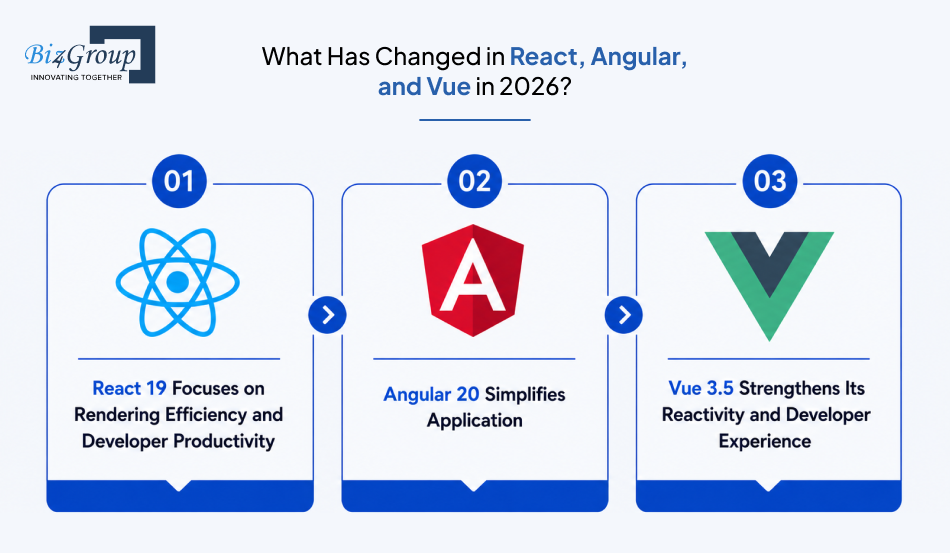
React, Angular, and Vue have all evolved in 2026, each framework has focused on refining its strengths. React 19 improves rendering efficiency and developer workflows, Angular 20 simplifies application architecture with Signals, and Vue 3.5 enhances its reactivity system and overall developer experience. These updates don't completely reshape the React Angular Vue comparison, but they do make each framework more capable for modern web and AI applications.
React 19 Focuses on Rendering Efficiency and Developer Productivity
React 19 builds on React's strengths rather than reinventing them. Features like Server Components, improved Actions, better asset loading, and enhanced hydration help developers build applications with less boilerplate and better performance. If you're building a product that evolves rapidly, these improvements make React an even stronger option because teams can spend less time managing framework complexity and more time shipping features. That's one reason many companies continue to choose React when they build AI software alongside modern web applications.
Angular 20 Simplifies Application Architecture With Signals
Angular has steadily reduced much of the complexity developers once associated with the framework. Signals provide a simpler and more predictable way to manage reactive state, reducing the need for heavier patterns in many applications. Combined with Angular's continued focus on standalone components and modern tooling, the framework now feels more approachable while still delivering the structure that enterprise teams value.
Vue 3.5 Strengthens Its Reactivity and Developer Experience
Vue 3.5 continues to improve one of its biggest strengths, its intuitive developer experience. The latest updates make reactivity more efficient, improve TypeScript support, and refine the overall development workflow. If you've wondered whether Vue is still keeping pace with React and Angular, the answer is yes. It continues to mature without sacrificing the simplicity that attracts many startups and growing product teams.
Why These Updates Matter for Modern Web and AI Applications?
It's easy to look at version updates and assume they only matter to developers. In reality, they influence how quickly teams can build, maintain, and scale products. So instead of asking, "Which framework added the most features?" a better question is, "Which improvements actually benefit my application?"
The latest updates across React, Angular, and Vue help teams by:
- Reducing development effort through simpler APIs and improved developer tooling.
- Improving rendering efficiency for faster, more responsive user experiences.
- Making large applications easier to maintain as products and teams grow.
- Supporting modern application development, including platforms that rely on AI integration services to deliver intelligent user experiences.
- Helping engineering teams spend more time building customer value instead of managing framework complexity.
The gap between these frameworks is smaller than it was a few years ago. In 2026, the decision is all about choosing the framework whose direction aligns with your product, your team, and the way you want to build software over the long term.
Not Sure Which Framework Fits Your Roadmap?
Get expert guidance on choosing between React, Angular, and Vue based on your product goals, team, and growth plans.
Talk to a Frontend ExpertHow Do React, Angular, and Vue Differ in Their Architecture?
React, Angular, and Vue differ in their architecture by taking three distinct approaches to application development. React gives developers the freedom to assemble their own architecture, Angular provides a predefined structure with built-in conventions, and Vue strikes a balance between flexibility and simplicity. If you've been asking, "Does architecture really matter if all three frameworks can build the same application?" The answer is yes. The architectural choices you make today directly affect how easily your application can grow, adapt, and be maintained over time.
Architecture Aspect |
React |
Angular |
Vue |
|---|---|---|---|
Core Philosophy |
Flexible UI library |
Opinionated frontend framework |
Progressive frontend framework |
Project Structure |
Chosen by the development team |
Defined by Angular conventions |
Flexible with recommended patterns |
State Management |
External libraries or built-in React features |
Built into the Angular ecosystem |
Built-in reactivity with optional state libraries |
Dependency Management |
Developer chooses supporting libraries |
Many core capabilities included by default |
Lightweight core with optional additions |
Code Organization |
Component-driven and highly customizable |
Structured modules and standardized architecture |
Component-driven with gradual scalability |
Best Suited For |
Teams that value flexibility |
Organizations that prioritize consistency |
Teams looking for balance between simplicity and structure |
The biggest architectural decisions rarely affect your first release. They affect every release that comes after it. As your application grows, new developers join the team, or you begin adding advanced capabilities through AI consulting services, a well-suited architecture becomes much easier to maintain than one that only seemed convenient at the start. That's why architecture deserves just as much attention as performance or developer experience when choosing a frontend framework.
How Do React, Angular, and Vue Compare in Real-World Performance?
In real-world projects, React, Angular, and Vue deliver more similar performance than most people expect. If you're choosing a frontend framework based purely on speed, you're unlikely to notice a meaningful difference unless your application has very specific performance requirements. In production environments, factors like application architecture, rendering strategy, code quality, and developer expertise have a much greater impact than the framework itself.
So if you're asking:
"What does the front end React vs Angular vs Vue comparison actually look like in terms of real performance numbers in 2026, not just theoretical benchmark tests but actual differences in load time, time to interactive, and Core Web Vitals scores that would affect a production web app with real users, and how much of the performance difference actually comes from the framework versus how well your developers know it?"
The answer is that most performance differences come from implementation rather than the framework. Well-built React, Angular, and Vue applications can all achieve excellent load times, Time to Interactive (TTI), and Core Web Vitals. In practice, an experienced development team can often outperform a poorly implemented application built with a theoretically faster framework.
All Three Frameworks Deliver Comparable Runtime Performance for Most Applications
If you've seen benchmark charts claiming one framework is dramatically faster than the others, take them with caution. Those tests usually measure isolated scenarios instead of real applications. In production, React, Angular, and Vue all deliver excellent runtime performance when applications are designed well. Unless you're building an unusually complex interface, users are unlikely to notice which framework powers the frontend.
Rendering Strategy Influences Perceived Responsiveness
Ever wondered why two applications built with the same framework can feel completely different? Rendering strategy is often the reason. Techniques such as client-side rendering, server-side rendering, streaming, and selective hydration have a much bigger influence on perceived responsiveness than the choice between React, Angular, and Vue. A thoughtfully rendered application usually feels faster, even when raw benchmark numbers are similar.
Server-Side Rendering Affects Loading and SEO Outcomes
If organic search visibility and fast initial page loads matter to your business, server-side rendering deserves close attention. React, Angular, and Vue all support server-side rendering through their respective ecosystems, helping pages load faster while making content easier for search engines to process. For content-rich websites and SaaS platforms, the rendering approach often has a greater SEO impact than the frontend framework itself.
Core Web Vitals Depend More on Implementation Than Framework Choice
Can one framework guarantee better Core Web Vitals? Not really. Metrics such as Largest Contentful Paint (LCP), Interaction to Next Paint (INP), and Cumulative Layout Shift (CLS) are influenced far more by image optimization, JavaScript delivery, caching, network performance, and frontend best practices than by React, Angular, or Vue alone. Choosing the right framework helps, but following good performance practices matters even more.
AI Features Shift Performance Bottlenecks Beyond the Frontend
As AI capabilities become part of everyday applications, performance challenges are changing. Instead of asking, "Which frontend framework is fastest?" a better question is, "Where is my application actually spending time?"
For modern AI-powered products, performance often depends on factors such as:
- API response times between the frontend and AI services.
- Model inference latency when generating responses or predictions.
- Streaming responses for features like an AI conversation app.
- Efficient state management while handling real-time AI interactions.
- Smart caching and background processing to reduce unnecessary requests.
For many AI-powered applications, the frontend framework is no longer the primary performance bottleneck. Once React, Angular, or Vue renders the interface efficiently, the biggest opportunities for improving user experience usually come from optimizing backend services, AI response times, and the overall application architecture. That's why successful teams measure end-to-end performance instead of focusing solely on frontend benchmarks.
How Do React, Angular, and Vue Affect Developer Productivity?
Developer productivity comes down to one simple question: how quickly can your team turn ideas into working features? React, Angular, and Vue can all help teams build great applications, but they influence the day-to-day development experience in different ways. Some reduce decision-making, some give you more freedom, and some make it easier for new developers to get started. The right choice depends just as much on your team as it does on the framework.
React Offers Flexibility With Greater Architectural Responsibility
One reason React remains so popular is that it rarely tells you how to build your application. That freedom is great when your team knows exactly what it wants, but it also means more decisions along the way. Which state management library should you use? How should you organize the project? React leaves those choices to you.
Example: A startup building a new SaaS platform can tailor its React stack around its exact needs instead of working within a predefined project structure.
Angular Accelerates Consistency Through Built-In Conventions
What if your team doesn't want to spend time debating project structure every time a new feature is added? That's where Angular stands out. Many of the architectural decisions have already been made, so developers can focus more on building features than deciding how the project should be organized.
Example: A large enterprise team with dozens of developers can work on the same Angular application while following a consistent structure across every module.
Vue Reduces Onboarding Friction With an Approachable Design
If your biggest concern is getting developers productive quickly, Vue deserves serious consideration. Its syntax is easy to follow, the learning curve is gentle, and new team members usually feel comfortable navigating a Vue project much sooner than they would with a more opinionated framework.
Example: A growing startup hiring its first frontend developers can onboard new team members faster because Vue is generally easier to pick up and contribute to.
AI Coding Assistants Are Changing the Productivity Conversation
A few years ago, a framework's learning curve had a much bigger impact on productivity. Today, that's changing. AI coding assistants can explain unfamiliar code, generate components, suggest fixes, and even help developers understand framework-specific patterns as they work. Does that mean React, Angular, and Vue are now equally productive? Not quite, but the gap is definitely smaller than it used to be.
Here's where AI is making the biggest difference:
- A React developer can generate a new component instead of writing repetitive boilerplate from scratch.
- An Angular developer can ask AI to explain dependency injection or Signals without digging through documentation.
- A Vue developer can quickly understand an unfamiliar codebase before making changes.
- Teams can review, refactor, and test code faster with AI-assisted suggestions.
- Companies investing in AI automation services can use these tools to shorten development cycles while letting engineers spend more time solving business problems instead of repetitive coding tasks.
The biggest productivity advantage no longer comes from choosing the "fastest" framework. It comes from how effectively your team works with it. When developers combine solid engineering practices with AI-assisted workflows, React, Angular, and Vue all become capable of delivering features faster than they could just a few years ago.
Which Frontend Framework Is the Best Fit for Different Types of Web and AI Apps?
Different applications place different demands on a frontend framework. A SaaS product that evolves every week, an enterprise platform used by thousands of employees, and an internal AI tool built for a single team don't have the same priorities. That's why React, Angular, and Vue each shine in different situations. But what if you're not choosing a framework for just one project? What if you're selecting a standard that your entire team will use for years?
One of the most common queries that Biz4Group LLC has come across is:
"I manage a US software development agency and we need to pick one primary frontend framework to standardize our team on so we can build a reusable component library, streamline onboarding, and not have every client project use a different stack, we do a mix of marketing sites SaaS dashboards and enterprise internal tools, which framework makes the most sense as a default choice for an agency doing that variety of work?"
Here's the answer:
- For an agency with that mix of work, React is usually the strongest default choice. It comfortably supports marketing websites, SaaS products, enterprise dashboards, and AI-powered applications while giving your team access to the largest ecosystem, mature component libraries, and a broad hiring pool.
- If enterprise platforms make up most of your work, Angular is worth considering. If your projects are primarily smaller products and MVPs, Vue can also be an excellent fit.
- For agencies that handle a wide variety of client work, React offers the greatest versatility.
React Fits Product-Focused SaaS and AI Applications
React has earned its reputation because it adapts well as products evolve. Whether you're launching a SaaS platform today or expanding it with AI-powered features next year, React's component-based architecture makes it easier to keep adding functionality without constantly restructuring the frontend. It's also the framework you'll encounter most often if you hire AI developers, making it easier to grow your engineering team as your product scales.
Angular Excels in Large Enterprise and AI Platforms
Angular is designed for projects where consistency matters as much as speed. If dozens of developers are contributing to the same application over several years, its built-in conventions help everyone work within the same structure. That's one reason Angular continues to be a popular choice for enterprise platforms, especially those with complex workflows, strict compliance requirements, and multiple development teams.
Vue Works Well for Lean Teams, MVPs, and Internal AI Tools
Need to launch quickly without overwhelming your developers? Vue is often the easiest framework to get moving with. Its clean syntax and approachable learning curve help smaller teams build and iterate faster, making it a strong fit for MVPs, internal dashboards, admin portals, and lightweight AI tools where development speed is a competitive advantage.
There's a reason React, Angular, and Vue continue to dominate frontend development instead of one replacing the others. Each solves a different set of business problems. The more closely your framework matches the products your team builds every day, the more value you'll get from it long after the first version goes live.
Choose the Right Frontend Framework From Day One
Stop guessing between Angular vs React vs Vue. Build scalable web and AI applications with a framework that fits your business goals.
Plan My ProjectHow Does Frontend Framework Choice Influence Long-Term Scalability?
Framework choice influences long-term scalability by determining how easy it is to keep building on your application as it grows. Launching a product is one thing. Supporting years of new features, onboarding more developers, and maintaining a larger codebase is another. React, Angular, and Vue can all scale successfully, but each makes that journey a little different.
Scalability Factor |
React |
Angular |
Vue |
|---|---|---|---|
Team Growth |
Flexible, but relies on team-defined conventions |
Built-in conventions keep large teams aligned |
Easy to manage for small and mid-sized teams |
Growing Codebase |
Scales well with strong architectural decisions |
Designed for long-term maintainability |
Scales steadily with clear project organization |
Feature Expansion |
Easy to extend through its vast ecosystem |
Predictable as applications become more complex |
Supports gradual growth without unnecessary complexity |
Long-Term Maintenance |
Depends on coding standards and project discipline |
Consistent structure simplifies maintenance |
Straightforward for most product teams |
Best Fit at Scale |
SaaS platforms and evolving digital products |
Enterprise platforms with multiple development teams |
Startups, growing products, and internal applications |
AI Applications Introduce New Scalability Considerations Beyond the Frontend
Imagine your AI feature suddenly becomes popular. Are you more likely to run into problems because of React, Angular, or Vue? Probably not. In most AI applications, the frontend keeps up just fine. The real challenge is everything happening behind it, from AI requests and model responses to the infrastructure needed to support thousands of users at the same time.
As AI adoption grows, teams need to think about:
- Handling large volumes of AI requests without slowing the overall application.
- Streaming responses so users see results as they're generated instead of waiting for everything to finish.
- Reducing unnecessary AI calls with effective caching and request management.
- Scaling AI services independently from the frontend as demand increases.
- Keeping infrastructure costs predictable as usage continues to grow.
For traditional web applications, scalability often means supporting more users and more features. AI applications add another layer to that challenge because every interaction can trigger additional processing behind the scenes. That's why choosing React, Angular, or Vue is only part of the scalability conversation. The applications that scale best are the ones built with the entire system in mind, not just the frontend.
How Does Frontend Framework Choice Affect Hiring and Team Growth?
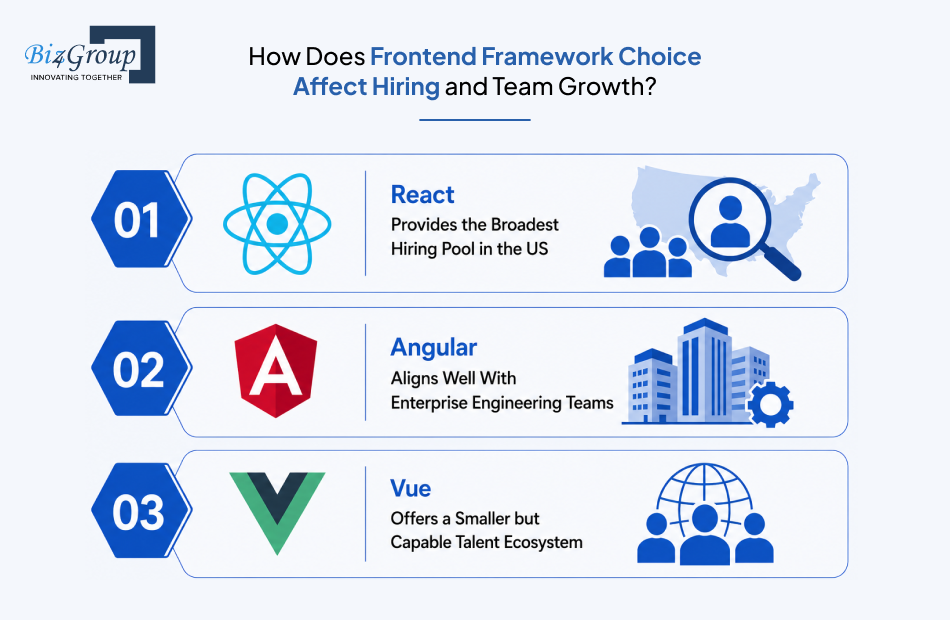
Your frontend framework can influence how easy it is to hire developers and grow your engineering team. Some frameworks give you access to a much larger talent pool, while others are more common in specific industries or company sizes. If you're planning beyond your first few hires, this decision can affect recruitment, onboarding, and even how quickly new developers become productive.
One question comes up again and again from developers planning their careers:
"I am a self-taught developer who knows basic JavaScript and I want to learn one frontend framework deeply enough to get hired at a US tech company, I know React has the most job postings but Angular pays better at enterprise companies and Vue is supposed to be easier to learn, which one should I invest the next six months learning and what is the realistic job market difference between them for a junior developer in the US in 2026?"
If you're starting from scratch and your goal is to maximize job opportunities, React is still the safest investment. It consistently appears in more US job postings than Angular or Vue, giving junior developers a wider range of companies to apply to. Angular is a smart choice if you're targeting enterprise careers, while Vue is easier to learn but offers a smaller hiring market in comparison.
React Provides the Broadest Hiring Pool in the US
Imagine you need to hire five frontend developers over the next year. Which framework makes that easiest? In most cases, it's React. Its popularity means you'll find more candidates, spend less time recruiting, and have an easier time replacing developers as your team grows.
- Easier to recruit from a large US talent pool.
- Widely adopted by startups, SaaS companies, agencies, and product businesses.
- Makes team expansion simpler as projects become larger.
Angular Aligns Well With Enterprise Engineering Teams
If most of your clients are large enterprises, Angular starts looking much more attractive. Many enterprise developers already work with Angular, and its structured development style fits naturally into organizations with established engineering processes and larger teams.
- Commonly used in enterprise software environments.
- Familiar development patterns reduce onboarding time within large teams.
- Well suited for organizations building complex internal platforms.
Vue Offers a Smaller but Capable Talent Ecosystem
Does Vue's smaller community make it a risky choice? Not necessarily. It simply means you'll have a smaller hiring pool to choose from. For startups and smaller product teams that already prefer Vue, finding experienced developers is still very achievable, just not on the same scale as React.
- Smaller but active developer community.
- Easier for many JavaScript developers to learn.
- Popular among startups and lean product teams.
AI Product Development Increases Demand for Frontend Expertise
Here's something many teams don't realize when they start adding AI features: the frontend suddenly becomes much more important. Users don't judge an AI product by the quality of the model alone. They judge how natural, responsive, and reliable the entire experience feels. If you're planning to integrate AI into an app, your frontend developers become just as important as your AI engineers because they're responsible for turning AI capabilities into a smooth user experience.
Traditional Frontend Skills |
Skills Becoming More Valuable in AI Products |
|---|---|
Building responsive interfaces |
Working with AI APIs and model responses |
Managing application state |
Handling streaming AI responses in real time |
Creating reusable UI components |
Designing conversational and AI-assisted user experiences |
Optimizing frontend performance |
Managing asynchronous AI workflows gracefully |
Integrating backend APIs |
Collaborating closely with AI and backend engineers |
The companies building the next generation of AI products aren't looking for frontend developers who only know React, Angular, or Vue. They're looking for engineers who can use those frameworks to create great AI experiences. That shift is changing hiring expectations far more than any individual framework ever could.
How Should You Choose Between React, Angular, and Vue?
Choose the framework that gives your business the best chance of succeeding over the next few years, not the one that's trending today. React, Angular, and Vue are all mature frontend technologies, but the right choice depends on what you're building, who is building it, and how you expect the product to evolve. A decision that's right for a startup shipping features every week may not be the right one for a large enterprise platform.
Here's a situation many engineering leaders run into before a project even begins:
"We are starting a new SaaS web app project and our development team is split between React and Angular, half the team knows React well and half came from enterprise Angular backgrounds, I need to make a final call on which framework we should standardize on before we start writing any production code and I want a real honest comparison of the long-term trade-offs not just a blog post that says it depends."
- If you're building a modern SaaS product, React is usually the stronger long-term choice, especially if rapid feature delivery, hiring flexibility, and access to a larger ecosystem are priorities.
- Angular becomes the better option when your product is expected to follow strict architectural standards, involve multiple enterprise teams, or remain under long-term corporate maintenance.
In this situation, the decision shouldn't be based on which framework individual developers already know. It should be based on where you expect the product to be three to five years from now.
Match the Framework to Business Objectives Before Technical Preferences
It's easy for framework discussions to become technical debates, but your customers won't care whether your application was built with React, Angular, or Vue. They'll care about how quickly new features arrive and how reliable the product feels. Start by asking what the business needs to achieve, then choose the framework that best supports those goals instead of choosing a framework first and hoping it fits later.
Align the Framework With Team Size and Engineering Expertise
Will your team stay the same size for years, or do you expect it to grow? That answer matters. Smaller teams often benefit from React's flexibility or Vue's simplicity, while larger engineering organizations usually appreciate Angular's consistency. The framework should make collaboration easier, not force your developers to work around it.
Consider AI Requirements Alongside Long-Term Maintenance
If AI is already part of your roadmap, don't treat it as something you'll figure out later. Whether you're planning to add intelligent search, chat, recommendations, or AI model development, the frontend should be able to evolve without becoming difficult to maintain. A framework that supports steady feature growth today is far more valuable than one that only helps you launch quickly.
Use a Decision Matrix to Validate the Final Choice
If you're still torn between React, Angular, and Vue, stop comparing individual features and look at the bigger picture. A simple decision matrix makes it easier to see which framework aligns most closely with your project's priorities instead of relying on personal preference.
Decision Factor |
React |
Angular |
Vue |
|---|---|---|---|
Fast feature delivery |
★★★★★ |
★★★★☆ |
★★★★★ |
Large enterprise projects |
★★★★☆ |
★★★★★ |
★★★☆☆ |
Learning curve |
★★★★☆ |
★★★☆☆ |
★★★★★ |
Hiring availability (US) |
★★★★★ |
★★★★☆ |
★★★☆☆ |
Flexibility |
★★★★★ |
★★★☆☆ |
★★★★☆ |
Built-in structure |
★★★☆☆ |
★★★★★ |
★★★★☆ |
AI ecosystem and integrations |
★★★★★ |
★★★★☆ |
★★★★☆ |
Long-term maintainability |
★★★★☆ |
★★★★★ |
★★★★☆ |
No decision matrix can choose a framework for you, but it can stop the conversation from becoming a matter of opinion. When you evaluate React, Angular, and Vue against the priorities that actually matter to your business, the right choice is usually much clearer. That's a far more reliable approach than following trends or picking whichever framework your team happens to be most familiar with today.
What Mistakes Do Teams Make When Choosing a Frontend Framework?
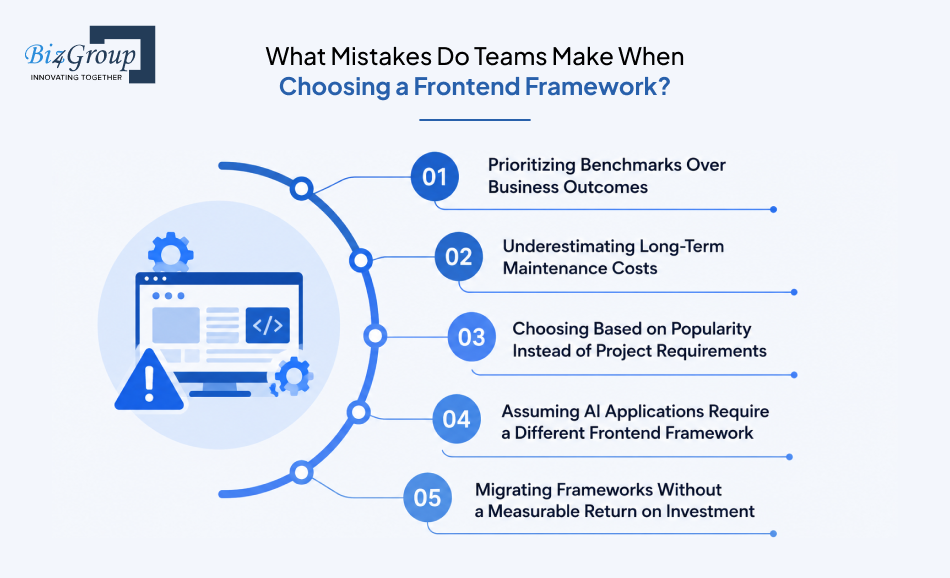
Most teams don't regret the framework they choose, they regret the reasons they chose it. React, Angular, and Vue are all capable of powering successful applications, but projects often run into problems when decisions are driven by hype, isolated benchmarks, or short-term thinking instead of long-term business goals.
A question like this comes up more often than you might think:
"Our team built our web app in Vue two years ago and now we are wondering if we made a mistake because we are struggling to hire Vue developers in the US and most of the resources and community help online is for React, can you help me understand whether it is worth migrating to React at this point or if Vue is still a solid enough choice that we should stay with it and what would a migration actually involve?"
If your Vue application is stable, maintainable, and meeting business goals, don't assume migrating to React is automatically the right move. A migration is a major engineering investment that often takes months and introduces new risks. Before considering it, compare the expected business benefits against the cost, disruption, and opportunity cost of rebuilding a working frontend. In many cases, continuing to improve the existing Vue application delivers a much better return on investment.
1. Prioritizing Benchmarks Over Business Outcomes
It's easy to get caught up in benchmark comparisons, but your users won't notice a framework that's 5% faster if the product still solves their problem well. Ask yourself, "Will this decision improve the experience for our customers?" If the answer is no, benchmark numbers probably shouldn't drive your framework choice.
2. Underestimating Long-Term Maintenance Costs
Launching a product is only the beginning. The real work starts when new features, bug fixes, and additional developers enter the picture. A framework that feels productive today can become expensive tomorrow if your team struggles to maintain it over the long term.
3. Choosing Based on Popularity Instead of Project Requirements
React may dominate the frontend landscape, but that doesn't automatically make it the best choice for every project. Popularity can be a useful signal, not a decision-making strategy. Your application's complexity, team structure, and business goals should always carry more weight than download statistics or social media discussions.
4. Assuming AI Applications Require a Different Frontend Framework
Planning to build AI software doesn't mean you need a completely different frontend framework. React, Angular, and Vue can all support AI-powered applications. In most cases, AI capabilities are added through APIs and backend services, so the success of the product depends far more on the overall architecture than on replacing your frontend technology.
5. Migrating Frameworks Without a Measurable Return on Investment
Framework migrations can make sense, but only when they solve a real business problem. If the migration won't improve hiring, reduce maintenance costs, accelerate development, or support future product goals, it's worth asking whether those engineering resources could deliver more value elsewhere.
The best frontend decisions are usually the least emotional ones. Teams that evaluate React, Angular, and Vue through the lens of business impact instead of trends are far less likely to revisit the same decision a few years later. Before changing frameworks, make sure you're solving the problem that's actually slowing your product down, not the one that's easiest to blame.
Which Front-End Technology Should You Choose in 2026?
If you're choosing a frontend framework in 2026, don't look for a universal winner because there isn't one. React, Angular, and Vue have all matured into reliable technologies, but they excel for different reasons. The best choice is the one that aligns with the products you build, the developers you hire, and the direction your business is heading over the next few years.
Choose React for Ecosystem Breadth, AI Innovation, and Hiring Flexibility
If your team builds customer-facing products, SaaS platforms, or modern AI-powered applications, React remains the strongest all-around choice. Its ecosystem is unmatched, hiring is easier in the US market, and most new frontend tools and AI integrations arrive in the React ecosystem first. For many companies, that translates into faster development and fewer limitations as products evolve.
Example: A SaaS company planning to expand into AI-powered features over the next year is likely to benefit from React's extensive ecosystem and readily available developer talent.
Choose Angular for Structured Enterprise Development
Angular is the better fit when consistency matters more than flexibility. Its opinionated architecture helps large engineering teams follow the same development patterns, making complex applications easier to maintain over many years. If your projects involve multiple teams, strict governance, or enterprise-scale systems, Angular continues to be an excellent choice.
Example: A financial institution building an internal platform used across multiple departments can benefit from Angular's standardized project structure and long-term maintainability.
Choose Vue for Rapid Development With Lower Complexity
Vue is ideal for teams that want to move quickly without introducing unnecessary complexity. Its approachable learning curve and clean syntax make it easier to onboard developers and deliver features sooner, especially for startups, MVPs, and internal business applications. It also remains a practical choice for companies focused on business app development using AI, where fast iteration is often more valuable than extensive framework conventions.
Example: A startup validating a new product idea can build and refine its MVP faster with Vue before investing in larger engineering teams.
Default to the Framework That Best Matches Your Business, Team, and Product Strategy
After comparing React, Angular, and Vue from every angle, one thing becomes clear: your long-term success depends far more on choosing the right fit than choosing the most popular framework.
Before making the final decision, ask yourself:
- What types of products will we be building over the next three to five years?
- How quickly do we expect our engineering team to grow?
- Which framework can we hire for most confidently in our target market?
- Will our roadmap include AI-powered features or enterprise-scale requirements?
- Which framework will still make sense after the excitement of the initial launch has passed?
React, Angular, and Vue have each earned their place because they solve different business challenges exceptionally well. Choose the framework that supports your team's strengths, your product roadmap, and your long-term goals, and you'll be far less likely to question that decision a few years from now.
Still Deciding Between React, Angular, and Vue?
Get expert guidance on selecting the best frontend framework for your web or AI application before you invest in development.
Talk to Our AI & Web Development ExpertsThe Right Frontend Choice Starts With the Right Priorities
By now, you've probably realized that the React or Angular or Vue debate doesn't have a one-size-fits-all answer. React is a strong choice for teams that value flexibility, hiring ease, and a thriving ecosystem. Angular shines in structured enterprise environments, while Vue helps smaller teams move quickly without unnecessary complexity.
The best framework is the one that supports your product roadmap, your team's strengths, and the way you plan to grow over time. If you're still weighing the options or need help turning your ideas into a scalable web or AI application, partnering with a team that offers end-to-end product development services can help you make the right technical decisions before development begins, saving time, cost, and unnecessary rework later.
Need a second opinion on your project? Reach out to our team for a consultation, and we'll help you choose the frontend technology that best fits your business goals, technical requirements, and long-term growth plans.
Frequently Asked Questions
1. Which frontend framework is best for new web applications in 2026?
For most new web applications, React is the best all-around choice because of its large ecosystem, strong hiring market, and excellent support for modern web and AI development. Angular is better suited for large enterprise applications, while Vue is ideal for smaller teams that want to build products quickly.
2. Is React better than Angular for AI-powered applications?
In most cases, yes. React has a larger ecosystem for AI-related libraries, UI components, and community resources. That said, AI features usually run on backend services or APIs, so both React and Angular can support AI applications successfully.
3. Should I choose React, Angular, or Vue for a SaaS product?
React is typically the safest choice for SaaS products because it offers flexibility, easier hiring, and a mature ecosystem. Angular is a strong option for enterprise SaaS platforms with large engineering teams, while Vue works well for startups and MVPs that need rapid development.
4. Is Vue still worth learning in 2026?
Yes. Vue remains a modern, reliable frontend framework with a great developer experience. While it has a smaller job market than React, it's still a solid choice for many startups, internal business applications, and small to mid-sized development teams.
5. Does Angular have a future in 2026?
Absolutely. Angular continues to be actively maintained and widely used by enterprises. If you're building large, long-term applications that benefit from a structured framework, Angular remains one of the strongest choices available.
6. Does an AI application require a specific frontend framework?
No. AI applications don't require React, Angular, or Vue specifically. The AI capabilities usually come from APIs, machine learning models, or backend services. Your frontend framework simply provides the interface that users interact with.
7. Is it worth migrating from Vue or Angular to React?
Only if the migration solves a real business problem. If hiring, maintenance, scalability, or your product roadmap is being limited by your current framework, a migration may be justified. Otherwise, improving your existing application is often a better investment than rebuilding it.
8. Which frontend framework is easiest to hire developers for in the US?
React has the largest talent pool in the US, making it the easiest framework to hire for. Angular also has a strong presence in enterprise organizations, while Vue developers are available but generally less common than React developers.
