 Location :
Orlando, FL, USA
Location :
Orlando, FL, USA +1 (407) 714-1616
 info@biz4group.com

- Cost of enterprise AI is often underestimated because budgets focus on development while ignoring lifecycle expenses, governance, and long-term operational impact.
- Total cost of enterprise AI adoption spans readiness, deployment, rollout, and ongoing maintenance, typically ranging from $40,000 to $200,000+ for large organizations.
- Why enterprise AI projects go over budget often comes down to flawed ROI assumptions, underestimated operational costs, and delayed financial oversight.
- Enterprise AI budgeting and cost planning works best when CFOs treat AI as a multi-year financial program with phased funding and regular cost reviews.
- Reducing enterprise AI costs without sacrificing ROI requires disciplined cost management strategies tied to usage, performance, and business value.
- Biz4Group LLC helps enterprises design, deploy, and scale AI solutions with cost control, transparency, and long-term financial accountability built in.
Have you ever approved an AI initiative that looked financially sound, only to realize months later that the numbers no longer added up? That moment usually arrives quietly, after contracts are signed and teams are committed.
According to a McKinsey Global Survey, only 23% of organizations report seeing significant bottom-line impact from AI initiatives, despite rising investments.
This gap explains why conversations around the cost of enterprise AI often start too late, when course correction becomes expensive.
For most CFOs and finance leaders, the challenge begins with the enterprise AI implementation cost presented during approvals. Early estimates often focus on development and tooling only. On paper, the spend looks controlled. In practice, costs surface gradually across departments, timelines stretch, and financial forecasts lose accuracy. What felt like a calculated investment begins to behave like an open-ended commitment.
Then come enterprise AI operational costs that rarely feature in boardroom decks. Infrastructure scaling, compliance checks, and support workloads compound month after month. These expenses do not spike dramatically. They accumulate quietly. Over time, they reshape margins, staffing plans, and long-term budgets in ways that finance teams never modeled at the start.
This leads many executives to ask a blunt question. How much does it cost to implement AI enterprise wide when all variables are accounted for? This article unpacks that answer with clarity.
Short On Time?
Most CFOs discover the full cost of enterprise AI only after deployment. Skip the surprises.
Get a Realistic Cost EstimateWhy Does the Cost of Enterprise AI Go Over Budget?
At the proposal stage, enterprise AI initiatives often appear controlled and predictable. Budgets highlight model development, cloud credits, or a fixed implementation fee. What remains understated are the layers that sit outside the core build. This creates an illusion where the cost of enterprise AI feels manageable and contained.
How Vendors Underprice Early Enterprise AI Implementation Cost
Many enterprise AI proposals are structured to reduce friction during approval. Vendors emphasize quick pilots and proof-of-concepts, knowing they lower resistance. The challenge emerges after success is proven.
Common pricing patterns include:
- Lower initial fees tied only to development
- Deferred infrastructure and scaling expenses
- Excluded costs for security, compliance, and internal enablement
- Usage-based pricing that escalates with adoption
These approaches shift risk downstream. Once AI is embedded into workflows, reversing direction becomes difficult. At that point, enterprise AI development and deployment costs rise faster than anticipated, often without a clear ceiling.
The Gap Between Pilot Success and Enterprise Reality
A pilot works in isolation. Enterprise systems do not.
When AI moves beyond a controlled environment, complexity multiplies. Data sources increase. Users expand. Governance expectations tighten. Integration touches mission-critical systems.
IBM reports that nearly 54% of AI projects stall between pilot and production due to unanticipated complexity and costs. This transition phase explains why enterprise AI projects go over budget even when early results look promising.
What looked like a technical milestone becomes a financial inflection point.
What CFOs Typically Miss During Early Cost Evaluation
Early enterprise AI investment analysis often excludes costs that sit outside IT budgets. These omissions compound over time.
The most commonly missed factors include:
- Internal staffing time diverted to AI adoption
- Data governance and audit preparation
- Training and productivity loss during rollout
- Ongoing model monitoring and retraining
- Contractual constraints tied to long-term vendors
Individually, each cost feels manageable. Collectively, they reshape the total cost of enterprise AI adoption and erode projected returns.
The illusion survives because AI spending rarely appears in one place. Costs distribute across departments, timelines, and operational layers. Finance teams see fragments, not the full picture.
Until AI is treated as a long-term financial commitment rather than a technology initiative, budgeting gaps will persist.
Total Cost of Enterprise AI Adoption Across the Full Enterprise Lifecycle
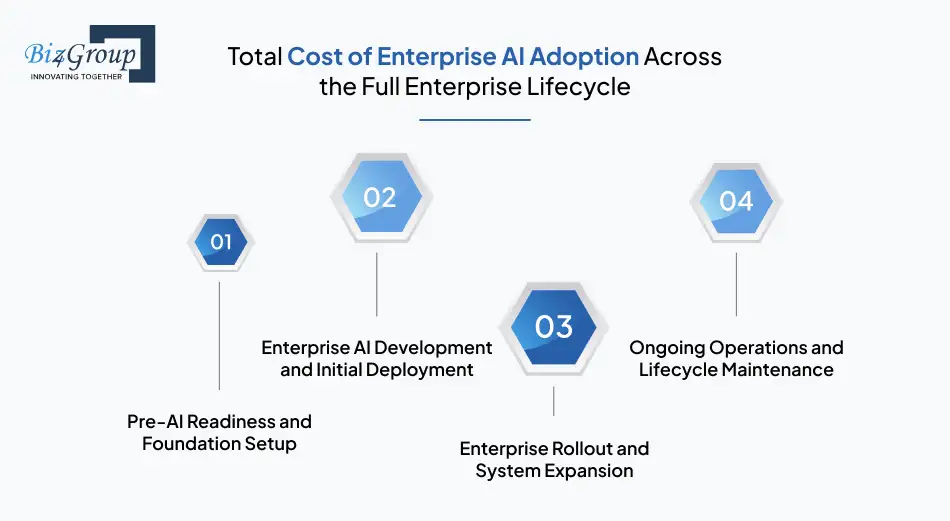
Most enterprises enter AI initiatives expecting contained budgets, yet the total cost of enterprise AI adoption typically falls between $40,000 and $200,000+, depending on scope, maturity, and scale. This range reflects a full lifecycle view rather than a narrow development estimate.
When CFOs evaluate enterprise AI cost through this lens, financial planning becomes clearer and surprises become fewer.
1. Pre-AI Readiness and Foundation Setup
The first phase focuses on preparing the organization to support AI. This includes data assessment, architecture planning, and aligning AI use cases with business objectives. For mid-to-large enterprises, this phase alone can account for $8,000 to $20,000.
While this spend does not produce immediate outputs, it directly influences how efficiently AI progresses through later stages. Skipping or rushing this step often inflates enterprise AI implementation cost later.
2. Enterprise AI Development and Initial Deployment
This is where most budgets are concentrated and where decision-makers feel confident about cost visibility. Building models, developing workflows, and deploying AI into controlled environments generally costs between $15,000 and $60,000.
These enterprise AI development and deployment costs typically include engineering, testing, and initial cloud infrastructure. At this stage, AI still operates within defined boundaries, which is why costs appear stable.
3. Enterprise Rollout and System Expansion
As AI moves beyond pilot environments, expenses increase steadily. Expanding access across departments, handling larger datasets, and supporting concurrent users introduces new layers of spend. Enterprises often allocate $10,000 to $50,000 during this phase.
This portion of the enterprise AI cost reflects scale, reliability, and availability rather than innovation. CFOs often underestimate this transition, assuming earlier cost patterns will continue.
4. Ongoing Operations and Lifecycle Maintenance
Once AI becomes embedded into daily operations, costs shift from project-based to recurring. Model updates, infrastructure tuning, performance monitoring, and support functions typically require $7,000 to $30,000 annually.
These enterprise AI operational costs rarely attract attention upfront, yet they define the long-term financial footprint of AI initiatives.
Project Spotlight: A Documentary AI
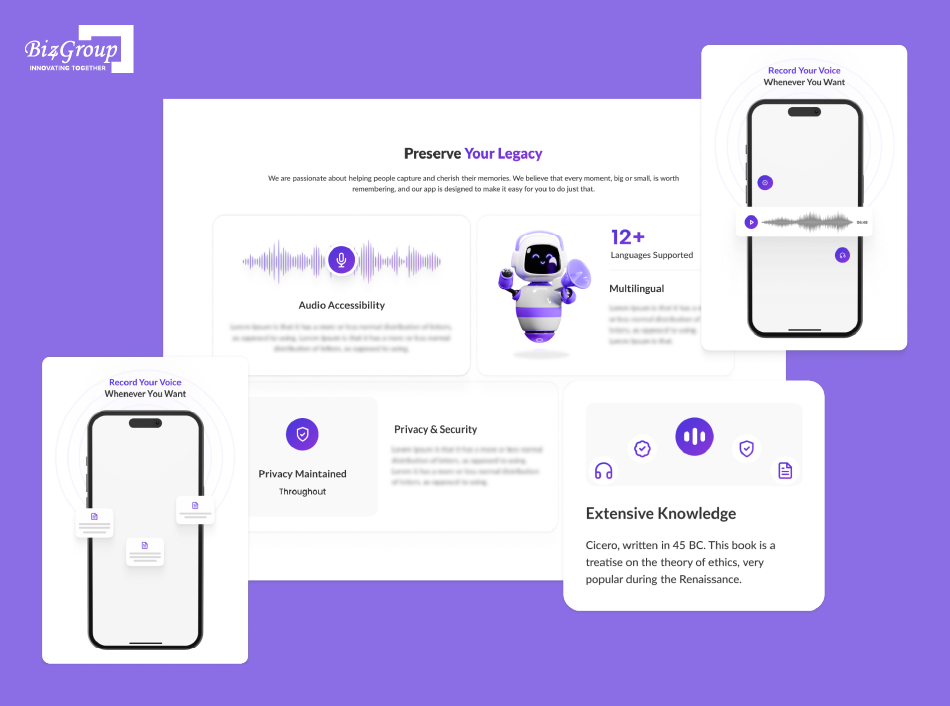
This documentary AI stands out as a compelling example of enterprise AI lifecycle planning done right. Built to preserve human stories through conversational AI, the platform required careful cost management across development, scaling, and long-term operations.
What makes this project impressive from a financial perspective:
- The architecture was designed to support long-term data growth without exponential infrastructure costs
- Privacy and security controls were embedded early to avoid retrofitting expenses
- AI inference and storage needs were planned around predictable usage patterns
- Subscription-based access aligned operational costs with revenue flow
By treating AI as a living system rather than a one-time build, this project demonstrates how enterprises can manage the cost of enterprise AI without sacrificing vision or scalability.
Also read: A guide to enterprise AI agent development
Think $40K Covers It All?
Most AI budgets miss operational, compliance, and governance costs. See the full picture before you commit.
Talk to Our AI Cost ExpertsKey Drivers Behind Enterprise AI Implementation Cost and Budget Expansion
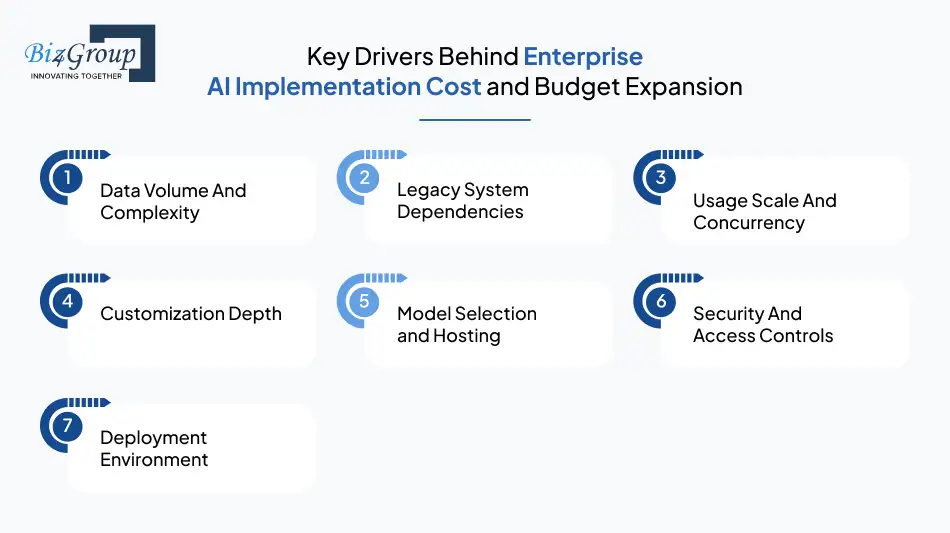
Before hidden costs and governance gaps enter the picture, several core forces already shape the cost of enterprise. These drivers exist in every organization, regardless of industry or maturity level. Understanding them early helps CFOs anticipate why enterprise AI cost rarely stays flat as adoption grows.
|
Cost Driver |
How It Impacts Enterprise AI Cost |
Estimated Cost Range |
|
Data Volume And Complexity |
Larger and more fragmented datasets increase processing, storage, and validation effort across AI systems |
$5,000 to $25,000 |
|
Legacy System Dependencies |
Older ERP, CRM, and internal tools require custom connectors and ongoing maintenance |
$6,000 to $30,000 |
|
Usage Scale And Concurrency |
More users, real-time responses, and parallel workloads raise infrastructure demand |
$4,000 to $20,000 annually |
|
Customization Depth |
Highly tailored AI logic, workflows, and outputs require additional engineering cycles |
$5,000 to $35,000 |
|
Model Selection and Hosting |
Choice between proprietary APIs, private models, or hybrid setups affects recurring spend |
$3,000 to $18,000 annually |
|
Security And Access Controls |
Role-based access, encryption layers, and enterprise-grade authentication add overhead |
$2,500 to $12,000 |
|
Deployment Environment |
Multi-region availability and high uptime requirements raise operational baselines |
$4,000 to $15,000 annually |
From a finance perspective, these drivers explain why the enterprise AI implementation cost presented during approvals often diverges from actual spend. This is where enterprise AI budgeting and cost planning either gains discipline or loses control. CFOs who map these drivers early gain leverage over future spend.
Hidden Costs of Enterprise AI Projects CFOs Discover Too Late
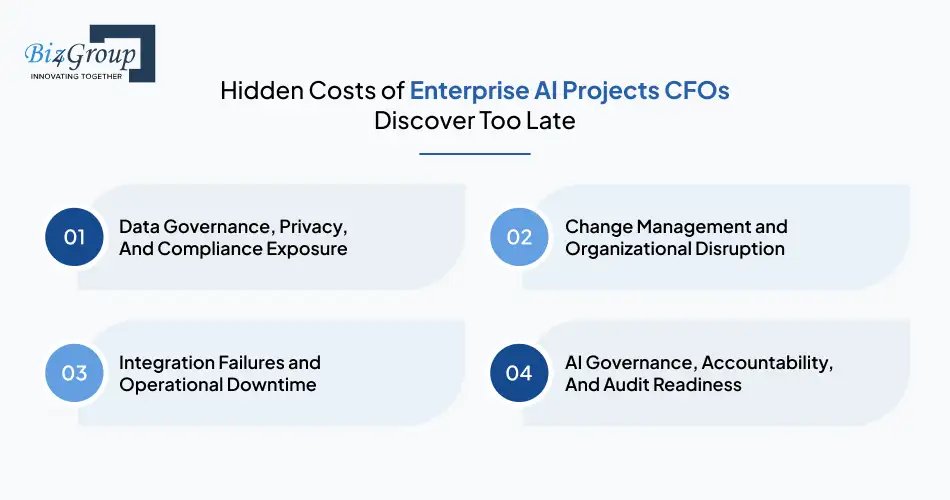
Hidden costs rarely announce themselves upfront. They surface gradually, often after enterprise AI systems are already embedded into workflows and business decisions. By then, reversing course becomes difficult.
These costs explain why the cost of enterprise AI frequently exceeds projections, even when core development appears well-managed.
1. Data Governance, Privacy, And Compliance Exposure
As AI systems begin handling sensitive enterprise data, compliance requirements intensify. Regulatory alignment, audit preparation, data lineage tracking, and access controls introduce recurring expenses.
For large organizations, these enterprise AI operational costs often range between $6,000 and $25,000 annually. CFOs usually encounter these expenses after deployment, once legal, risk, and compliance teams become involved.
2. Change Management and Organizational Disruption
AI adoption alters workflows, roles, and accountability structures. Training teams, redesigning processes, and managing resistance consume time and capital. Productivity dips during transition periods are rarely reflected in enterprise AI budgeting and cost planning.
Organizations often absorb $8,000 to $30,000 in indirect costs tied to training efforts, temporary inefficiencies, and internal support requirements.
3. Integration Failures and Operational Downtime
AI systems that touch revenue, HR, or customer operations introduce operational risk. Integration delays, unexpected system conflicts, and downtime lead to remediation expenses and lost productivity.
Enterprises frequently spend $5,000 to $20,000 addressing post-deployment integration issues that were not anticipated during enterprise AI investment analysis.
Also read: The complete guide to AI integration costs
4. AI Governance, Accountability, And Audit Readiness
Once AI outputs influence hiring, pricing, compliance, or decision-making, governance expectations rise sharply. Establishing accountability frameworks, monitoring model behavior, and preparing for audits add persistent overhead.
Many organizations allocate $4,000 to $18,000 annually to governance functions after deployment.
Project Spotlight: AI-Powered HRMS Redefining Workforce Management
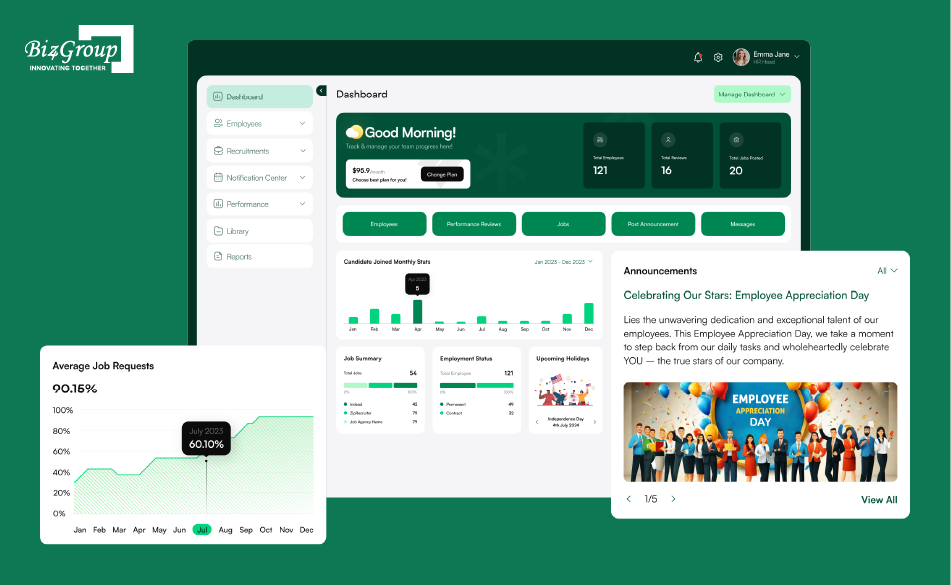
This AI-powered HRMS provides a clear example of how hidden costs can be anticipated and controlled when AI systems are designed with financial discipline from the start.
- The platform relied heavily on AI for resume parsing, job creation, and conversational support, creating early exposure to rising token-based costs
- Biz4Group LLC optimized enterprise AI operational costs by fine-tuning open-source models for repetitive tasks instead of relying solely on external APIs
- An intelligent caching layer reused prior AI responses, reducing unnecessary inference calls and stabilizing monthly expenses
- The Ask DrHR chatbot was deployed using a serverless architecture, allowing it to scale independently without inflating core system costs
By addressing governance, performance, and scalability early, this project avoided the financial shock many enterprises experience after AI adoption accelerates. As we move forward, the next section explores the enterprise AI ROI and cost evaluation trap CFOs fall into.
Also read: How much does it cost to develop enterprise AI chatbot?
What's Quietly Draining Your AI Budget?
Hidden costs don't announce themselves. They compound over time. Address them before they reshape your margins.
Audit Your AI SpendEnterprise AI ROI And Cost Evaluation and the Trap CFOs Fall Into
At the heart of many AI disappointments lies a flawed enterprise AI ROI and cost evaluation approach. CFOs approve initiatives based on early efficiency signals, yet those signals rarely reflect the full financial picture. What looks like value creation in the first few months can quietly transform into margin pressure over time.
The issue is not poor judgment. It is incomplete measurement.
Where CFOs Miscalculate Enterprise AI ROI
Early ROI assessments often focus on visible improvements while overlooking financial leakage elsewhere. Common missteps include:
- Measuring time saved without assigning financial value to redeployed labor
- Counting pilot performance gains while ignoring enterprise AI operational costs
- Evaluating isolated use cases instead of cross-department impact
- Assuming cost curves remain flat after initial success
According to Boston Consulting Group, only 26% of AI initiatives move beyond pilots and deliver sustained financial returns. This disconnect highlights why enterprise AI investment analysis must evolve as systems scale.
The Short-Term Win That Creates Long-Term Cost Exposure
Many AI programs demonstrate quick wins through automation or decision support. These gains create confidence and momentum. However, as adoption expands, usage increases, and dependencies deepen, cost structures change.
What CFOs often overlook:
- Rising inference and infrastructure expenses tied to higher usage
- Support and governance overhead as AI influences critical decisions
- Incremental spend required to maintain accuracy and reliability
Without revisiting cost assumptions, enterprises continue investing based on outdated ROI models. This is one of the most common reasons why enterprise AI projects go over budget despite early success.
When ROI Metrics Stop Reflecting Reality
ROI frameworks designed for software licenses or automation tools do not translate cleanly to AI. AI systems evolve. Their value and cost profiles shift over time. Treating AI as a static investment leads to distorted financial reporting.
Effective enterprise AI cost management strategies require CFOs to reassess ROI at defined milestones, not only at launch. Without this discipline, leadership teams remain unaware of diminishing returns until budgets are already strained.
Project Spotlight: Transforming Insurance Training with AI
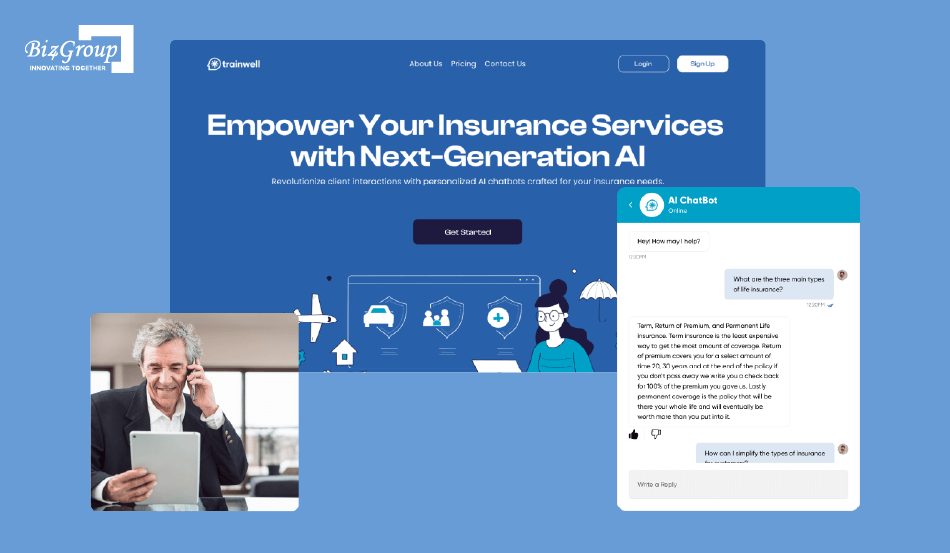
Insurance AI illustrates how enterprise AI ROI and cost evaluation can succeed when financial discipline is built into the design.
- The chatbot replaced recurring live training sessions, reducing ongoing operational spend
- AI responses scaled without proportional increases in staffing or infrastructure
- Feedback-driven model updates improved accuracy without costly redevelopment cycles
- AI integration services allowed deployment without disrupting existing systems
By aligning AI usage with measurable cost reduction and continuous improvement, Insurance AI delivered sustained value rather than short-lived gains. It demonstrates that ROI emerges from cost-aware execution, not early performance metrics alone.
Enterprise AI Budgeting and Cost Planning CFOs Should Follow from Day One
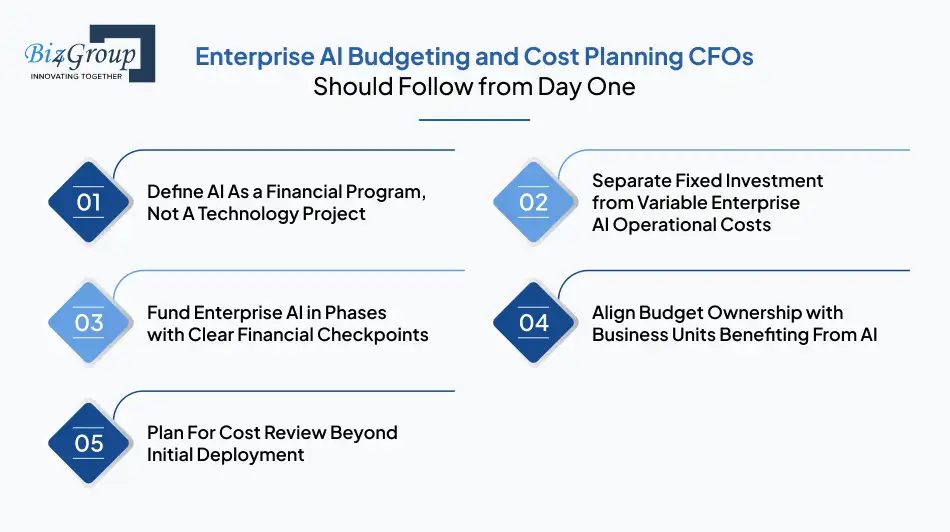
Strong enterprise AI outcomes are rarely the result of aggressive spending. They come from disciplined financial planning that treats AI as a long-term operating commitment rather than a one-time initiative.
CFOs who succeed with enterprise AI budgeting and cost planning follow a structured approach that evolves with scale.
1. Define AI As a Financial Program, Not A Technology Project
The first budgeting error occurs when AI spend is isolated within IT or innovation budgets. Enterprise AI cost should be governed as a financial program with clear ownership. This includes forecasting multi-year commitments and aligning AI initiatives with measurable business outcomes rather than experimentation goals.
2. Separate Fixed Investment from Variable Enterprise AI Operational Costs
CFOs should distinguish between one-time enterprise AI development and deployment costs and recurring operational spend. Fixed costs such as model development and integration are easier to control. Variable costs such as inference usage, infrastructure scaling, and monitoring fluctuate with adoption. Treating both under a single budget line obscures financial exposure.
3. Fund Enterprise AI in Phases with Clear Financial Checkpoints
Rather than approving full budgets upfront, finance leaders should release funding in stages. Each phase should validate assumptions tied to cost, performance, and adoption. This approach reduces the risk of sunk costs and improves enterprise AI investment analysis accuracy as real usage data becomes available.
4. Align Budget Ownership with Business Units Benefiting From AI
When AI delivers value across departments, shared ownership prevents cost concentration and improves accountability. Allocating enterprise AI cost based on usage and impact creates transparency and discourages uncontrolled expansion. CFOs gain clearer insight into which initiatives justify continued investment.
5. Plan For Cost Review Beyond Initial Deployment
Budgeting should not stop once AI systems go live. Regular financial reviews help recalibrate forecasts as enterprise AI operational costs evolve. CFOs who revisit assumptions quarterly are better positioned to manage long-term spend and avoid budget drift.
Enterprise AI budgeting works best when finance teams remain involved throughout the lifecycle, not only at approval. In the next section, we examine enterprise AI cost management strategies and reducing enterprise AI costs without sacrificing ROI, focusing on how organizations can maintain momentum while keeping spending in check.
Is Your AI Budget Built to Survive Scale?
Early success doesn't guarantee long-term control. Build financial discipline into your AI roadmap.
Plan with Biz4GroupEnterprise AI Cost Management Strategies and Reducing Enterprise AI Costs Without Sacrificing ROI
Once AI systems are live, cost discipline determines whether value compounds or erodes. Effective enterprise AI cost management strategies focus on structural decisions rather than short-term cuts.
The table below outlines proven approaches CFOs use to control enterprise AI cost while preserving long-term returns.
|
Cost Management Strategy |
How It Controls Enterprise AI Cost |
Impact |
|
Right-Sizing AI Use Cases |
Prioritizes high-impact workflows over broad experimentation |
20% to 35% reduction in total cost of enterprise AI adoption |
|
Hybrid Build and Buy Model |
Balances custom development with reusable AI components |
15% to 30% lower enterprise AI development and deployment costs |
|
Usage-Based Cost Monitoring |
Tracks inference and infrastructure spend against business value |
10% to 25% reduction in enterprise AI operational costs |
|
Model Optimization and Caching |
Reduces repeated inference and redundant computations |
25% to 40% savings on recurring AI processing expenses |
|
Scalable Architecture Design |
Prevents cost spikes during adoption and peak usage |
Stabilizes long-term enterprise AI cost growth |
|
Vendor Cost Governance |
Renegotiates pricing and avoids long-term dependency traps |
10% to 20% reduction in annual renewal expenses |
|
Periodic ROI Reassessment |
Aligns funding with performance and adoption metrics |
Improves enterprise AI ROI and cost evaluation accuracy |
These strategies work best when applied early and reviewed continuously. Enterprises that treat AI cost management as an ongoing discipline rather than a corrective measure maintain stronger financial control and higher confidence at the executive level.
Why Enterprises Across the USA Trust Biz4Group LLC For Cost-Efficient AI
Biz4Group LLC is a USA-based software development company trusted by enterprises, innovators, and fast-growing organizations to build AI systems that scale without spiraling costs. We work at the intersection of business strategy, engineering discipline, and financial accountability. That balance allows us to deliver enterprise AI solutions that perform in real environments, not controlled demos.
Our strength lies in understanding how enterprise AI cost behaves over time. We design systems that account for enterprise AI operational costs, governance expectations, and long-term optimization. This approach helps CFOs and executive teams maintain control over enterprise AI budgeting and cost planning while still moving forward with confidence.
Biz4Group LLC brings deep experience across AI development, intelligent automation, and generative AI development. Our teams build with cost-awareness at the core. From selecting the right models to designing scalable infrastructures, every decision is made with the total cost of enterprise AI adoption in mind.
We also understand the realities of large organizations. Legacy systems, compliance obligations, and cross-platform functionalities are built into our delivery approach. By aligning AI implementation with business workflows, security standards, and financial oversight, we help enterprises avoid the hidden costs of enterprise AI projects that emerge after deployment.
Why Businesses Choose Biz4Group LLC In The USA
- Proven experience delivering enterprise AI solutions that scale without runaway costs
- Strong focus on enterprise AI cost management strategies from design to deployment
- Transparent pricing and realistic cost projections aligned with financial planning
- Deep expertise in integrating AI with complex enterprise systems
- Governance-ready architectures built to support compliance and audit needs
- A collaborative approach that aligns CFO, CIO, and business stakeholders
Our clients value clarity. They know where their investment goes, how value is measured, and when course corrections are needed. That level of visibility turns AI from a financial risk into a strategic advantage.
In a landscape where many vendors sell ambition without accountability, Biz4Group LLC stands out for execution discipline. We help enterprises adopt AI with confidence, knowing that budgets remain aligned with outcomes and growth plans.
We’d love to help you, too. Share your ideas with Biz4Group LLC. Let’s talk.
Wrapping Up
Enterprise AI delivers value when ambition is matched with financial discipline. The cost of enterprise AI rarely breaks budgets overnight. It builds gradually through underestimated implementation scope, expanding operational demands, and overlooked governance responsibilities. CFOs who understand this pattern early gain the ability to guide AI investments with confidence rather than react to overruns later.
When finance leaders treat enterprise AI as a long-term operating commitment, budgeting becomes more accurate and ROI expectations become realistic. Clear lifecycle planning, continuous cost evaluation, and structured governance transform AI from a risky expense into a controlled growth driver.
Biz4Group LLC works with enterprises that want clarity, control, and accountability in their AI journey. Our experience across UI/UX design, MVP development, web and AI app development, and optimization allows us to help organizations manage cost without slowing innovation. We bring structure to enterprise AI budgeting, transparency to cost planning, and discipline to execution.
If your enterprise is evaluating new AI initiatives or reassessing existing ones, now is the right time to bring financial clarity into the conversation.
Connect with Biz4Group LLC and build enterprise AI that delivers measurable value without budget surprises.
FAQs
Can enterprise AI costs be capitalized, or should they be treated as operating expenses?
Enterprise AI spend often includes both. Development and integration activities may qualify for capitalization, while infrastructure usage, model monitoring, and support are usually operational expenses. CFOs should align accounting treatment with internal financial policies and long-term usage expectations.
How do enterprises forecast AI costs when usage grows unpredictably?
The most reliable approach involves scenario-based forecasting. CFOs model low, medium, and high adoption scenarios, then link AI usage metrics directly to financial thresholds. This allows enterprises to adjust spending as demand changes without financial shock.
Does enterprise AI require a dedicated financial governance model?
Yes. Enterprises that succeed with AI typically establish a financial governance framework that tracks spend by use case, department, and outcome. This model improves accountability and prevents cost dilution across business units.
How do enterprises decide which AI initiatives should move beyond pilot stage?
AI initiatives advance when they show measurable business alignment, predictable cost behavior, and stakeholder readiness. CFOs often look for consistent usage patterns, clear ownership, and stable financial assumptions before approving broader rollout.
Are enterprise AI costs higher for regulated industries?
Industries such as healthcare, finance, and insurance often face higher costs due to compliance, audit readiness, and data protection requirements. These industries benefit most from early governance planning to avoid retroactive compliance expenses.
What signals indicate that an enterprise AI program should be paused or restructured?
Common signals include rising operational spend without proportional value, declining user engagement, unclear ownership, and difficulty explaining ROI to leadership. Addressing these signals early helps enterprises avoid prolonged financial drain.
How does enterprise AI consulting help control long-term costs?
Enterprise AI consulting provides structured planning, realistic forecasting, and execution discipline. It helps organizations align AI initiatives with financial objectives, reduce trial-and-error spending, and establish sustainable cost controls from the start.
