 Location :
Orlando, FL, USA
Location :
Orlando, FL, USA +1 (407) 714-1616
 info@biz4group.com

- Real estate AI IVR system development automates property inquiries, call routing, and lead capture using AI driven voice workflows designed for real estate operations.
- Businesses that build real estate IVR call management systems reduce missed calls, handle higher inquiry volumes, and support agents with structured call data.
- Modern implementations rely on real estate IVR software development integrating AI, combining speech recognition, intent detection, and CRM integration.
- A large share of real estate phone inquiries is repetitive and time sensitive, making voice automation a strong fit for operational efficiency.
- Development costs typically range between 15,000 and 150,000 USD, depending on system scale, AI depth, and integration requirements.
- Well-designed AI IVR systems scale with business growth and support 24/7 call handling without proportional increases in staffing.
Real estate businesses receive a large number of calls about property availability, pricing, site visits, rentals, and support requests. When these calls are handled manually, responses can be slow, information may vary between agents, and some inquiries may go unanswered. Real estate AI IVR system development focuses on automating these calls so inquiries are handled consistently and without delays.
A real estate AI IVR system is an automated voice response system that answers property related calls using speech recognition and intent detection. Instead of pressing numbers on a keypad, callers can speak naturally, and the system identifies what they need and responds or routes the call accordingly.
Traditional IVR systems follow fixed call menus. AI based IVR systems go a step further by understanding common real estate questions such as property type, location, or pricing range. Businesses already working with real estate AI software development often apply the same logic to phone interactions to keep customer communication aligned across channels.
As call volumes grow, many organizations rely on real estate AI IVR system development services to support round the clock availability without adding more staff. For an AI development company, the priority is building systems that recognize intent accurately, follow defined workflows, and connect smoothly with existing tools. This guide explains how these systems work and what factors matter when planning development.
Understanding Real Estate IVR Software
Real estate IVR software is used to handle incoming property related calls through automated voice responses. In many real estate businesses, phone calls are a primary way customers ask about listings, rentals, and services. An IVR system answers these calls, gathers basic information, and routes the call or provides recorded responses.
Functionally, real estate IVR software sits between the phone network and internal business systems. Callers speak or use keypad input, and the system matches that input to predefined actions such as sharing property details, capturing contact information, or forwarding the call to an agent. In real estate AI IVR system development, AI improves how spoken input is understood and classified.
Unlike traditional IVR systems that depend only on fixed menus, AI enabled IVR systems can understand natural speech. This makes it easier to handle different ways callers ask similar questions. Teams that build real estate AI software often use IVR to reduce manual call handling and keep phone interactions consistent.
Turn Calls Into Structured Leads
Design a system that answers every inquiry and routes it with intent.
Start real estate AI IVR system developmentWorkflow of Real Estate AI IVR System Explained
The workflow of a real estate AI IVR system follows a clear and repeatable sequence to manage high call volumes. In many real estate operations, 50 to 70 percent of incoming calls are routine inquiries related to listings, pricing, availability, or basic support. Real estate AI IVR system development focuses on automating these calls so they are answered, understood, and handled without delays.
1. Call Initiation and System Pickup
When a caller dials the business number, the IVR system answers the call immediately. This removes waiting time and ensures calls are handled even outside working hours. The system plays a short prompt asking the caller to describe their request.
2. Speech Capture and Intent Recognition
The caller responds using natural speech. The system converts speech into text and identifies the purpose of the call. Common intents include property search, pricing inquiry, appointment scheduling, or agent connection. This step is central to real estate IVR software development integrating AI, where correct intent detection determines the next action.
3. Action Selection and Information Handling
After identifying intent, the system follows predefined rules. It may provide recorded information, collect caller details, retrieve property data, or prepare the call for transfer. Simple requests are handled automatically, while complex requests move to the next step.
4. Call Routing or Resolution
If human support is required, the call is routed to the appropriate agent or department based on intent and availability. In many real estate setups, 30 to 50 percent of calls are fully resolved without agent involvement. Teams using AI automation services focus on optimizing this balance between automation and human support.
5. Data Logging and Follow Up
Call details such as caller input, intent type, and call duration are stored in connected systems. This data supports reporting, follow ups, and future workflow improvements.
|
Workflow Step |
Purpose |
Outcome |
|---|---|---|
|
Call Pickup |
Answer calls instantly |
No wait time |
|
Intent Recognition |
Understand caller request |
Correct call handling |
|
Action Handling |
Provide information or collect data |
Reduced agent effort |
|
Call Routing |
Transfer complex calls |
Faster resolution |
|
Data Logging |
Store call details |
Better tracking and follow up |
In practice, businesses that develop IVR system for real estate businesses using AI leverage this workflow to keep call handling predictable and scalable. Each step is designed to reduce manual work while maintaining clear and consistent communication with callers.
Why Invest in Real Estate AI IVR System Development?
Real estate is a call driven industry where calls follow fixed patterns and can be handled through automation. Real estate AI IVR system development offers a way to improve how these calls are managed while creating systems that scale with demand.
Why these AI systems attracts investment:
- Clear automation fit: Property inquiries, scheduling requests, and basic information calls are structured by nature. This makes it practical to build real estate IVR call management systems that handle a large portion of calls without manual effort.
- Scalable operating model: Once deployed, IVR systems can handle growing call volumes with minimal additional cost. Businesses that create IVR solutions for real estate companies benefit from predictable operating expenses as demand increases.
- Stable market demand: Brokerages, property managers, and real estate platforms rely on phone communication every day. This creates steady, long term demand for AI real estate IVR software development across different segments of the market.
- Expansion through integration: IVR systems connect with CRM tools, listing systems, and analytics platforms. Teams providing AI integration services often expand these deployments into broader operational workflows.
- Enterprise adoption path: As real estate firms modernize operations, IVR systems often become part of larger enterprise AI solutions, increasing long term value and contract depth.
From an investor perspective, AI real estate IVR software development represents infrastructure focused technology with repeat usage, scalable economics, and clear alignment with ongoing digital transformation in real estate.
Make Phone Inquiries Work at Scale
Build automation that handles volume without losing context or data.
Explore real estate IVR software development integrating AIBenefits of Real Estate AI IVR System for Business
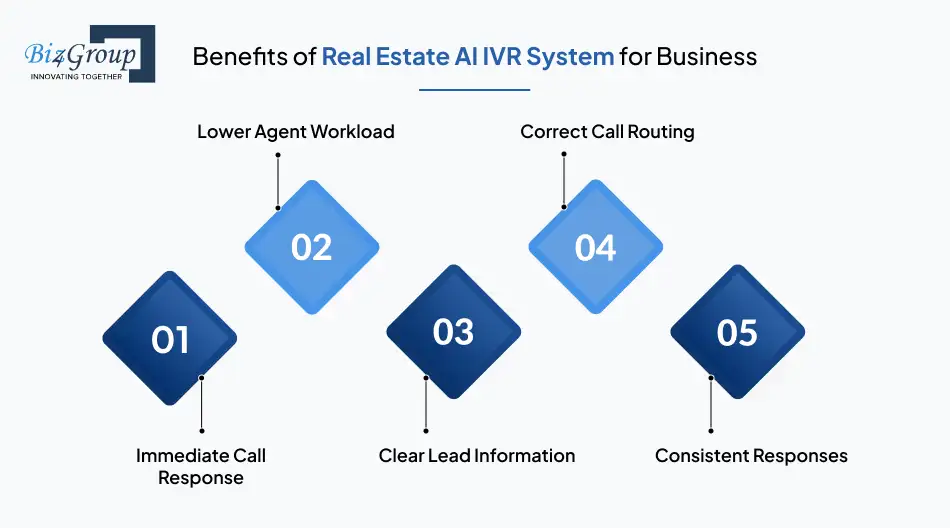
Handling customer calls manually takes time plus creates delays for real estate businesses. Real estate AI IVR system development helps businesses manage these calls in a simple and structured way, thus making day-to-day activities easier.
Here are the top benefits that real estate businesses enjoy with an AI IVR system:
1. Immediate Call Response
IVR systems answer calls as soon as they come in. This helps reduce missed calls during busy hours or after office hours. Many teams build AI automated IVR systems for real estate to keep phone lines available at all times.
2. Lower Agent Workload
Basic questions about listings or availability are handled automatically. This reduces the number of calls that need agent support. Businesses using custom real estate AI IVR system development can assign agents to more important tasks.
3. Clear Lead Information
The system collects caller details in a standard format. This makes follow up easier and avoids missing information. Structured data also helps teams review call activity and response patterns.
4. Correct Call Routing
Calls are sent to the right team based on the caller’s request. This reduces call transfers and saves time for both callers and staff. Clear routing rules help keep call handling efficient and predictable.
5. Consistent Responses
Every caller receives the same information based on set rules. This avoids confusion and keeps communication clear. Teams that build AI software often use IVR systems to maintain consistency across voice interactions.
In daily operations, businesses that develop AI voice response systems for real estate benefit from faster call handling, reduced manual work, and better control over customer communication.
Core Features of Real Estate AI IVR System Development
A real estate AI IVR system is designed to manage high volumes of inbound calls with predictable and consistent handling. Real estate AI IVR system development focuses on a defined set of core features that allow these calls to be answered, routed, and recorded without manual intervention.
|
Core Feature |
Description |
|---|---|
|
Call Auto Answer |
Automatically answers incoming calls to eliminate wait time and missed inquiries |
|
Speech To Text Processing |
Converts caller speech into text for system interpretation |
|
Intent Recognition |
Identifies the purpose of the call, such as property inquiry or appointment request |
|
Predefined Call Flows |
Uses rule-based workflows to guide each call step by step |
|
Rule Based Property Information Playback |
Shares basic property details such as availability or pricing range |
|
Lead Data Capture |
Collects caller name, contact details, and inquiry type |
|
Call Routing Logic |
Routes calls to the correct team or agent when escalation is required |
|
Agent Escalation Handling |
Transfers complex or urgent calls to human agents |
|
Call Logging and Reporting |
Stores call data for tracking, review, and operational analysis |
These features form the functional baseline of most IVR implementations and are required for reliable call automation. Teams involved in AI model development typically focus on improving speech accuracy and intent detection within this core layer over time.
In practice, businesses that create IVR platforms for property inquiries using AI rely on these core features to manage calls efficiently, maintain consistent communication, and support growth without increasing call handling overhead.
Advanced Features in Custom Real Estate AI IVR System Development
After a basic IVR system is in place, advanced features are added to handle more complex calls and improve outcomes. These features focus on better understanding of callers, cleaner data flow, and improved handoff to sales or support teams. Real estate AI IVR system development at this stage is about improving accuracy and efficiency rather than basic automation.
1. Context Based Call Handling
The system remembers earlier inputs during the same call. This allows callers to ask follow up questions without repeating information. It makes longer conversations smoother and easier to complete.
2. Intelligent Lead Qualification
The IVR asks follow up questions based on earlier answers. For example, budget or timeline questions may change based on caller intent. This approach is commonly used to build AI IVR software for real estate lead management.
3. CRM And Property Data Sync
Call details are synced with CRM and listing systems during or after the call. This ensures agents see updated information before contacting the lead. It is a common requirement in AI IVR system application development for real estate.
4. Smart Call Routing Logic
Calls are routed based on factors such as inquiry type, agent availability, or predefined priorities. This reduces unnecessary transfers and speeds up resolution for callers.
5. Multi Language and Accent Support
The system can recognize different languages and speech patterns. This helps businesses serve callers from different regions more effectively as call volume grows.
6. Call Analytics and Reporting
Advanced IVR systems track call patterns, drop offs, and common requests. Teams use this data to adjust call flows and improve performance over time.
7. Voice And Chat Alignment
The IVR follows the same response logic used in chat or messaging tools. Teams building an AI conversation app often apply the same rules to keep communication consistent across channels.
Businesses using real estate IVR system development for property inquiries adopt these advanced features to improve lead quality, reduce call handling time, and support more complex real estate operations as they scale.
Portfolio Spotlight:
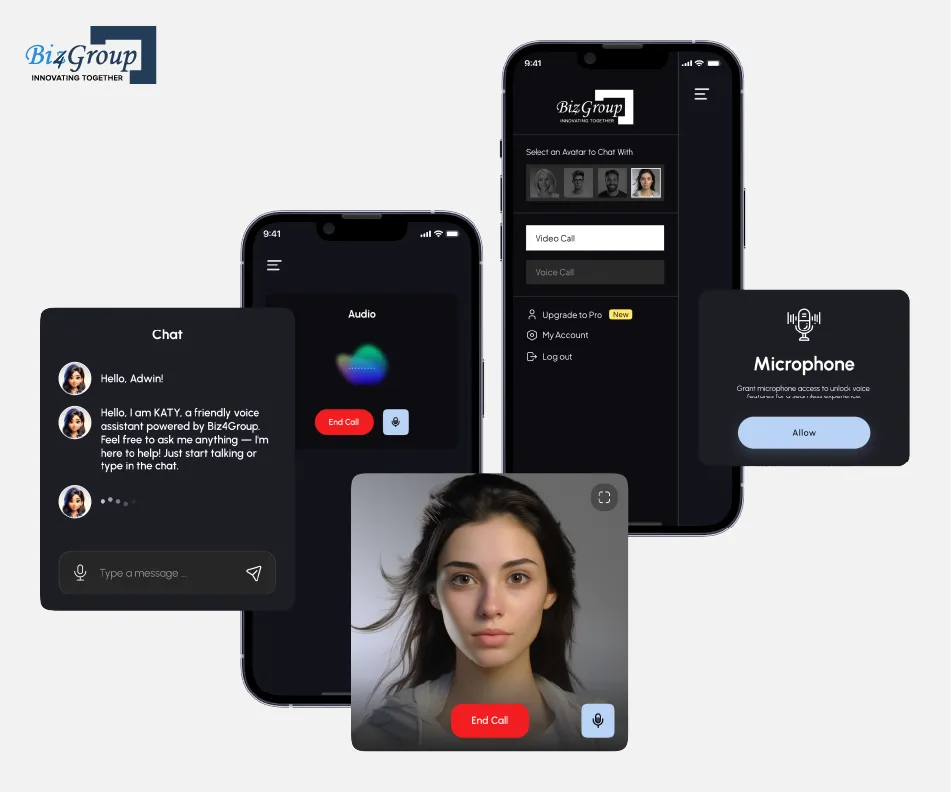
AI Wizard is an avatar-based AI platform designed by Biz4Group, for handling real-time voice and video conversations using natural language understanding. It combines speech recognition, conversational logic, and response orchestration to deliver human-like interactions at scale.
The platform demonstrates how voice-driven AI systems can manage intent detection, session flow, and contextual responses - capabilities that directly translate into modern IVR systems for handling real estate inquiries and lead conversations.
Build Once. Scale Across Teams.
Create voice systems that grow with call volume and business size.
Plan to develop scalable IVR systems for real estate businessesHow to Develop IVR System for Real Estate Businesses Using AI
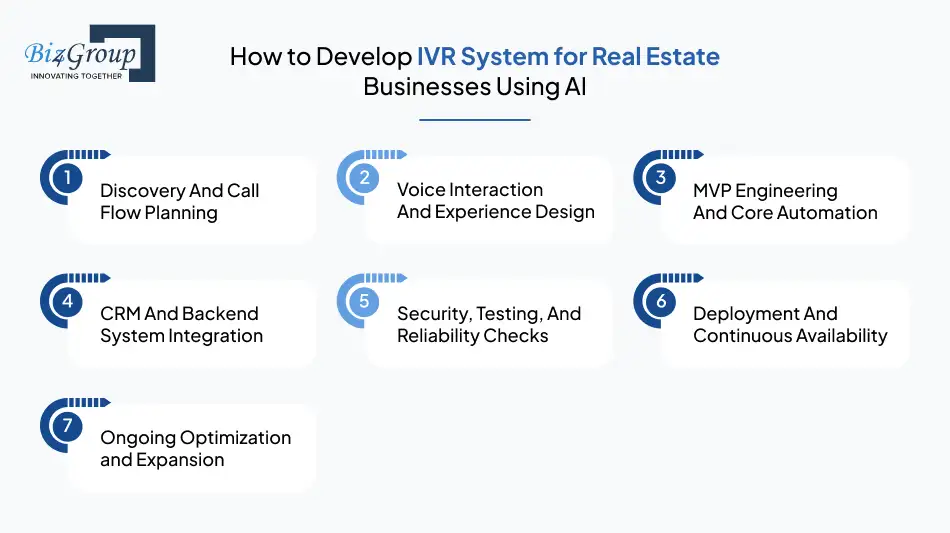
An AI driven IVR system for real estate works best when it is built around real call behavior rather than assumptions. Real estate AI IVR system development should follow a phased process that starts simple, avoids overengineering, and improves based on actual call data.
1. Discovery And Call Flow Planning
This step focuses on understanding why callers reach out and what usually happens during those conversations. Real estate teams review call recordings and logs to identify which interactions are repetitive and suitable for automation.
- Identify the most common inquiry types
- Separate automated calls from agent handled ones
- Define clear success metrics
2. Voice Interaction And Experience Design
In an AI IVR system, voice prompts matter for callers, but the UI/UX design matters more for the business running it. This step focuses on designing dashboards and controls that allow business owners to view call data, manage flows, and make changes without technical effort.
For business users, the UI shows call volumes, inquiry types, missed calls, and lead details in a clear layout. Owners and managers can review call recordings, see how callers move through flows, and adjust prompts or routing rules based on real usage. On the caller side, the experience is kept simple, since interaction usually ends once the caller starts speaking.
- Design dashboards to view calls, leads, and intent breakdowns
- Provide simple tools to edit call flows and prompts
- Make reports easy to read for non technical users
Also Read: Top 15 UI/UX Design Companies in USA: 2026 Guide
3. MVP Engineering And Core Automation
Development begins with MVP development services that handle essential call flows. This approach allows teams to validate performance before expanding features and capacity.
- Enable call answering and intent detection
- Capture basic caller information
- Design for future growth
This phase supports teams that plan to develop scalable IVR systems for real estate businesses without introducing complexity too early.
Also Read: Top 12+ MVP Development Companies to Launch Your Startup in 2026
4. CRM And Backend System Integration
Once the system handles calls reliably, it is connected to internal tools so call details are not lost. Training of AI models ensures follow-ups are based on accurate and complete information.
- Sync call data with CRM systems
- Link inquiries to listings or properties
- Reduce manual data entry
This integration step is essential to develop IVR systems integrated with real estate CRM.
5. Security, Testing, And Reliability Checks
Before going live, the system is tested under realistic conditions. The focus is on stability, data handling, and consistent call outcomes.
- Test peak call volumes
- Validate data access controls
- Review complete call journeys
Also Read: 15+ Software Testing Companies in USA in 2026
6. Deployment And Continuous Availability
The system is deployed on infrastructure that can handle call spikes without downtime. Monitoring tools help track system health and call success.
- Set up scalable hosting
- Monitor performance metrics
- Ensure always on availability
This enables teams to build real estate AI IVR solutions for 24 7 customer support without expanding staff.
7. Ongoing Optimization and Expansion
After launch, call data is reviewed to improve prompts and routing logic. Changes are made gradually to avoid disrupting live operations.
- Adjust flows based on real usage
- Improve intent accuracy over time
- Add automation where it makes sense
Many organizations follow this process to create automated IVR solutions for real estate call centers that remain effective as call patterns evolve.
For companies planning long term automation, working with the best AI company to develop real estate IVR systems helps ensure the solution stays reliable, adaptable, and aligned with real estate operations.
Move Beyond Basic Call Routing
Add intelligence to how calls are answered, qualified, and escalated.
Build AI IVR system application development for real estateTechnology Stack Used in Real Estate IVR Software Development Integrating AI
A real estate AI IVR system relies on a layered technology stack that supports voice handling, conversation logic, data flow, and system reliability. Real estate AI IVR system development typically uses stable and proven components because voice systems are customer facing and operate continuously.
|
Technology Layer |
Purpose In IVR System |
Common Tools And Components |
|---|---|---|
|
Telephony Infrastructure |
Handles inbound and outbound calls |
SIP, VoIP gateways, cloud telephony |
|
Speech To Text Engine |
Converts caller speech into text |
Cloud speech recognition services |
|
Text To Speech Engine |
Converts system responses into voice |
Neural TTS engines, voice synthesis APIs |
|
Intent Processing Layer |
Identifies caller intent from text |
NLP models, intent classifiers |
|
Conversation State Management |
Maintains context during multi-step calls |
Session managers, state machines |
|
Call Flow Engine |
Controls routing and decision logic |
Rule based workflow engines |
|
Backend Services |
Manages business logic and APIs |
Node.js, Python, REST services |
|
CRM Integration Layer |
Syncs call and lead data |
CRM APIs, middleware services |
|
Data Storage |
Stores call logs and lead details |
SQL or NoSQL databases |
|
Analytics And Reporting |
Tracks call outcomes and usage |
Dashboards, reporting tools |
|
Monitoring And Alerting |
Detects failures and performance issues |
Logs, alerts, uptime monitors |
|
Security And Access Control |
Protects call data and system access |
Role based access, encryption |
|
Model Improvement Pipeline |
Retrains models using call data |
Feedback loops, training workflows |
|
Cloud Infrastructure |
Ensures scalability and uptime |
AWS, Azure, or GCP services |
|
Admin Dashboard UI |
Allows business control and oversight |
Web based admin interfaces |
This stack ensures the IVR system can handle real estate call volumes reliably while giving business users full visibility and control. Teams working in AI in real estate development often prioritize the admin dashboard and monitoring layers, since these directly affect daily operations and decision making.
In practice, companies offering custom AI real estate IVR system development services select technologies based on call load, integration needs, and long term maintenance rather than experimental tooling.
Cost of Real Estate AI IVR System Development by Scale
The cost of building an AI driven IVR system depends mainly on system scope, call volume, and integration depth. Real estate AI IVR system development typically falls within a range of 15,000 to 150,000 USD, based on whether the system is built as a basic automation layer or as a fully integrated, enterprise grade solution.
|
Development Scale |
Typical Cost Range (USD) |
What Is Included |
|---|---|---|
|
MVP-level Real Estate AI IVR System |
15,000 – 30,000 |
Call auto answer, basic speech recognition, fixed call flows, simple routing, limited reporting |
|
Mid-level Real Estate AI IVR System |
30,000 – 70,000 |
AI based intent recognition, CRM integration, lead capture, admin dashboard, analytics |
|
Enterprise-grade Real Estate AI IVR System |
70,000 – 150,000 |
Custom AI models, multi level call logic, real time CRM sync, monitoring, security controls, scalability |
Lower cost setups focus on validating call automation and reducing missed calls. These are often used by teams exploring early automation or testing how to build AI real estate app MVPs. Mid-level systems add stronger AI handling and business visibility, while enterprise deployments focus on reliability, scale, and deeper integrations.
Several factors influence cost across all tiers, including call volume, number of automated scenarios, CRM complexity, and ongoing model tuning. Businesses serving multiple regions or operating large call centers usually require higher investment to maintain performance and uptime.
In practice, the final budget depends on whether the system is designed for limited automation or long term operational use. This range applies to real estate IVR solutions for small and large firms, with flexibility to scale features and cost as business needs evolve.
Revenue Opportunities from AI IVR System Application Development for Real Estate
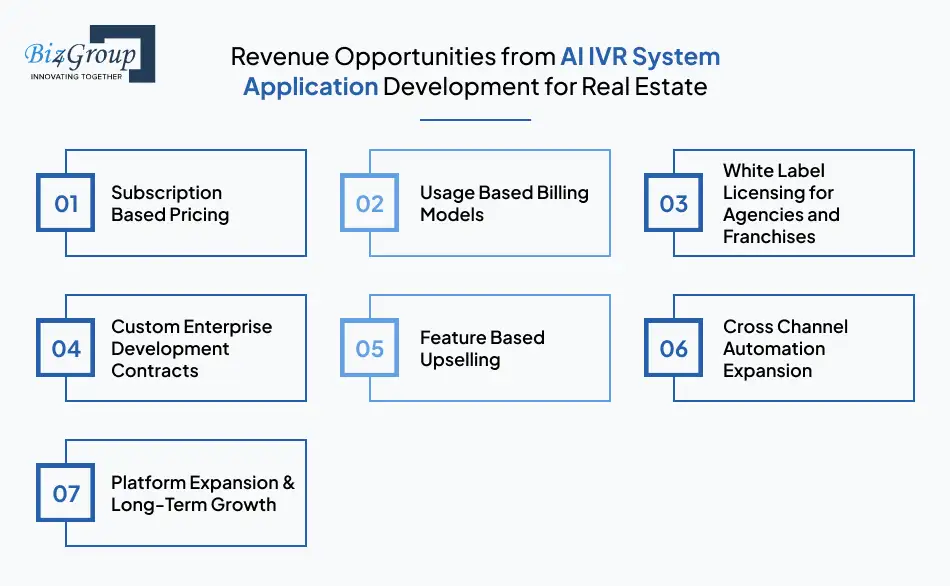
Revenue from AI IVR systems depends on how the solution is packaged and scaled across different real estate clients. Real estate AI IVR system development supports multiple monetization paths because the same core system can serve brokerages, property managers, and platforms with controlled customization.
1. Subscription Based Pricing
Most IVR platforms use monthly or annual subscription plans. Pricing is commonly based on call volume, number of phone lines, or locations supported. This model is widely used in real estate IVR software development integrating AI and provides predictable recurring revenue.
2. Usage Based Billing Models
Some providers charge based on calls handled or minutes consumed. This aligns revenue with actual customer activity and works well in markets with seasonal demand or fluctuating call volumes.
3. White Label Licensing for Agencies and Franchises
IVR systems can be rebranded and resold by brokerages, franchises, or proptech platforms. White labeling allows providers to scale faster without managing every end customer directly and is often bundled with real estate AI IVR system development services.
4. Custom Enterprise Development Contracts
Large firms often require tailored workflows, reporting, and integrations. These projects generate higher one-time fees and ongoing support revenue, especially when clients want to integrate AI into an app they already use for operations.
5. Feature Based Upselling
Advanced analytics, deeper CRM automation, or custom call logic can be offered as paid add ons. This tiered approach allows revenue expansion over time without rebuilding the base system.
6. Cross Channel Automation Expansion
IVR logic can be reused across chat or messaging tools. Teams building an AI conversation app often apply the same intent handling rules across channels, increasing overall product value.
7. Platform Expansion and Long-Term Growth
As customers grow, they add more locations, numbers, or automation scenarios. Many providers position IVR as part of business app development using AI, allowing account value to increase as client operations expand.
|
Monetization Channel |
How Revenue Is Generated |
Typical Buyer Type |
|---|---|---|
|
Subscription Plans |
Monthly or annual platform fees |
Brokerages, property managers |
|
Usage Based Billing |
Per call or per minute pricing |
Seasonal or high volume firms |
|
White Label Licensing |
Licensing and branding fees |
Agencies, franchises, platforms |
|
Custom Enterprise Builds |
One time setup plus support fees |
Large real estate firms |
|
Feature Add Ons |
Paid upgrades and modules |
Growing mid size businesses |
|
Cross Channel Expansion |
Extended automation scope |
Proptech platforms |
|
Account Expansion |
Increased usage over time |
Multi location firms |
Together, these models support scalable growth for providers offering real estate AI IVR system development services and clear paths on how to scale an AI IVR systems for real estate operations.
Turn IVR Into a Lead Engine
Capture, qualify, and route callers automatically, 24/7.
Build AI IVR software for real estate lead managementBest Practices for Real Estate AI IVR System Development
Effective AI IVR systems in real estate follow a few clear rules that reduce errors, improve call handling, and keep systems easy to manage over time. Real estate AI IVR system development works best when decisions are based on real call behavior, not assumptions or generic IVR templates.
1. Start With Real Call Data, Not Assumptions
Most real estate calls fall into a small number of repeat categories such as property inquiries, scheduling, and follow ups. Reviewing call logs before design helps teams decide what should be automated first. This is essential when teams develop IVR system for real estate businesses using AI that actually reflects how customers speak.
2. Keep Call Flows Short and Direct
Long menus and complex prompts increase call drop offs. Best performing IVR systems guide callers in two or three steps whenever possible. Clear prompts improve completion rates and reduce transfers in systems built to build real estate IVR call management systems.
3. Design For Business Control and Visibility
The admin interface matters as much as the call experience. Business users should be able to review calls, see inquiry trends, and update flows without technical help. This is especially important for teams exploring how to use AI for real estate operations at scale.
4. Balance Automation with Human Handoffs
Not every call should be automated end to end. Clear rules should define when a call moves to an agent. This keeps customer experience consistent and avoids frustration, especially for complex or high value inquiries.
5. Train AI Models Using Domain Specific Language
Real estate terminology varies by region and market. AI models should be trained using real property terms, locations, and pricing patterns. Teams planning to implement generative AI in real estate often start with narrow, well defined vocabularies.
6. Plan For Growth from the Start
Even small deployments should be built with scaling in mind. Systems should support higher call volumes, more properties, and additional workflows without redesign. This approach helps teams create IVR solutions for real estate companies that remain usable as the business grows.
7. Review And Improve Regularly After Launch
IVR performance improves over time when call data is reviewed consistently. Tracking missed intents, drop offs, and routing errors helps teams refine prompts and logic. Many teams hire AI developers periodically to tune models and workflows based on real usage.
Following these best practices helps real estate businesses avoid overcomplex systems and focus on reliability, clarity, and long-term usability.
Challenges in Real Estate AI IVR System Development and Solutions
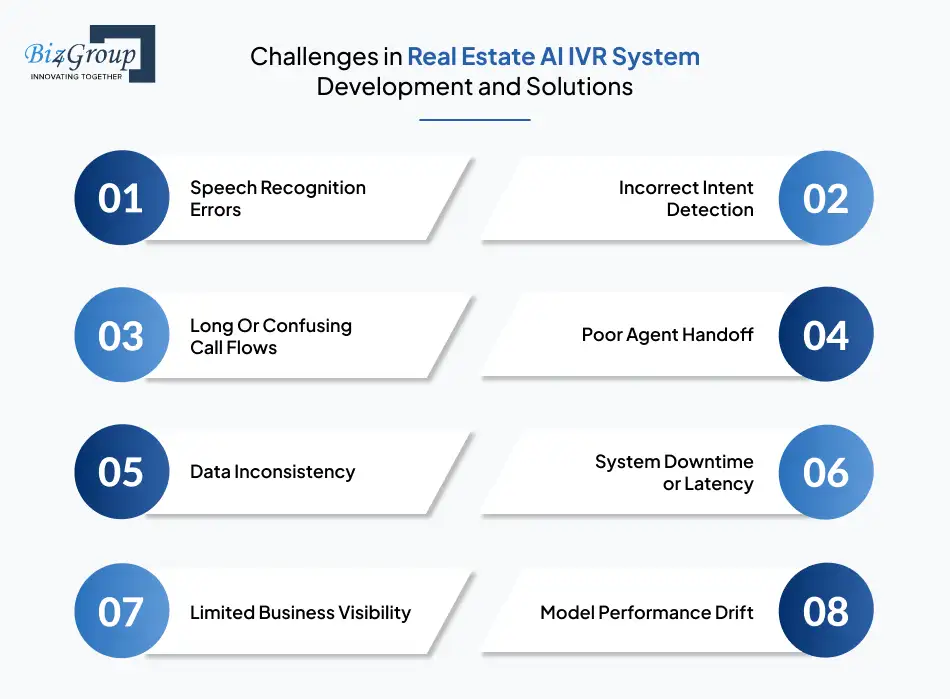
Building an AI driven IVR system for real estate involves practical challenges related to voice accuracy, call behavior, and system reliability. Real estate AI IVR system development often faces issues that are less visible at the planning stage but become clear once real callers interact with the system at scale.
|
Common Challenge |
Why It Occurs |
Practical Solution |
|---|---|---|
|
Speech Recognition Errors |
Callers use varied accents, pacing, and phrasing |
Train models on real call recordings and regional speech patterns |
|
Incorrect Intent Detection |
Property inquiries can be phrased in many ways |
Limit early intent categories and refine them over time |
|
Long Or Confusing Call Flows |
Overdesigned menus increase drop offs |
Keep flows short and reduce decision steps |
|
Poor Agent Handoff |
Lack of clear escalation rules |
Define strict conditions for agent transfer |
|
Data Inconsistency |
Call data not synced properly with internal systems |
Use structured data mapping and validation |
|
System Downtime or Latency |
High call load or weak infrastructure |
Deploy on scalable cloud environments |
|
Limited Business Visibility |
Owners cannot track call outcomes easily |
Provide clear dashboards and reporting tools |
|
Model Performance Drift |
Caller behavior changes over time |
Review call logs and retrain models regularly |
Many of these challenges can be managed by starting with controlled automation and expanding gradually. Teams experimenting with generative AI often begin with narrow use cases to avoid unpredictable responses in live voice environments.
When addressed early, these challenges do not block adoption but instead shape better system design. With proper planning and iteration, AI real estate IVR software development can deliver stable call automation while maintaining clarity and control for both callers and business teams.
Future of Real Estate AI IVR System Development
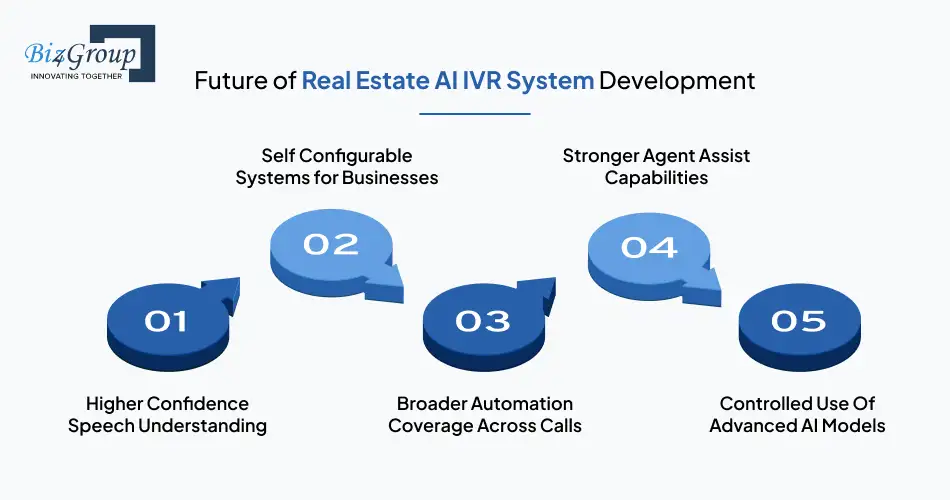
The future of voice automation in real estate is driven by rising call volumes, faster response expectations, and steady improvements in AI accuracy. Real estate AI IVR system development is shifting toward systems that require less manual setup, cover more call scenarios, and give business teams clearer control and visibility.
1. Higher Confidence Speech Understanding
Future IVR systems will understand longer and less structured speech with fewer errors. This will allow businesses to develop AI voice response systems for real estate that handle complex property questions without frequent fallbacks or agent transfers.
2. Self Configurable Systems for Businesses
IVR platforms will offer easier configuration tools for business owners. Call flows, rules, and priorities will be adjusted through simple dashboards, supporting faster rollout of custom real estate AI IVR system development without technical dependency.
3. Broader Automation Coverage Across Calls
Automation will handle a larger share of inbound calls end to end. As intent accuracy improves, more companies will build AI automated IVR systems for real estate that manage inquiries, follow ups, and routine updates consistently.
4. Stronger Agent Assist Capabilities
Future IVR systems will support agents by sharing call summaries, intent details, and history before live conversations begin. This will improve efficiency and response quality for AI for real estate agents handling high inquiry volumes.
5. Controlled Use Of Advanced AI Models
Advanced AI techniques will be applied with strict controls to maintain reliability. Teams experimenting with generative AI agents will focus on predictable, rule-bound responses rather than open-ended voice conversations.
Over time, businesses that develop AI voice response systems for real estate will focus less on basic automation and more on accuracy, control, and smooth alignment with everyday real estate operations.
Design IVR Around Your Business Logic
Avoid generic setups. Build workflows that match how your teams operate.
Start custom real estate AI IVR system developmentWhy Choose Biz4Group LLC for Custom Real Estate AI IVR System Development?
Biz4Group LLC is an AI app development company that builds AI systems that operate in live, high-interaction environments where accuracy, context handling, and system control matter. Its experience developing platforms like AI Wizard, which manages real-time voice conversations, intent flow, and session state, directly informs how real estate IVR systems are designed and optimized.
Rather than treating IVR as a telephony add-on, Biz4Group LLC approaches it as a data and workflow layer that business teams actively use. This perspective comes from years of building AI platforms where business users rely on dashboards, logs, and controls to manage real interactions at scale.
What differentiates Biz4Group in this space:
- Proven delivery of voice-driven AI platforms with real users, not demos
- Strong focus on admin interfaces and business visibility, not just caller flows
- Experience building systems where AI decisions must be explainable
- Practical understanding of how conversational logic behaves under real traffic
As a custom software development company with deep voice and AI experience, Biz4Group designs IVR systems that fit real estate operations instead of forcing generic patterns.
Final Thoughts on Real Estate AI IVR System Development
Real estate IVR systems have moved far beyond “press 1 to continue.” Today, they sit at the intersection of voice, data, and daily operations. When built correctly, they do more than answer calls. They capture intent, support agents, and give business owners clear visibility into what customers actually want. That is the real value of real estate AI IVR system development.
The difference between a system that helps and one that frustrates usually comes down to design discipline. Clear call flows, strong admin interfaces, reliable AI behavior, and room to scale matter more than flashy features. This is where structured product development services and well-scoped AI consulting services play a critical role, helping teams avoid overengineering while still building for the future.
In the end, the goal is simple. Fewer missed calls. Better qualified leads. Clearer data. And an IVR system that works quietly in the background while the business moves forward.
Build a Smarter Call Experience
Start designing an AI IVR system that fits how your real estate business actually works.
FAQs on Real Estate AI IVR System Development
1. How long does it take to develop a real estate AI IVR system?
Development timelines depend on scope and complexity. A basic IVR setup can take 6–8 weeks, while systems with AI intent detection, CRM integration, and analytics typically take 3–5 months. Enterprise-grade solutions may take longer due to testing and integrations.
2. Can an AI IVR system work alongside human agents instead of replacing them?
Yes. Most real estate IVR systems are designed to support agents, not replace them. The IVR handles repetitive calls and gathers context, then routes qualified inquiries to agents with relevant information, improving response quality and efficiency.
3. What type of real estate businesses benefit most from AI IVR systems?
AI IVR systems are useful for brokerages, property management firms, real estate call centers, and proptech platforms that receive frequent phone inquiries. Businesses with high call volume or limited after-hours coverage benefit the most.
4. How accurate are AI IVR systems in understanding property-related questions?
Accuracy depends on training data and system design. When trained on real estate-specific language and refined over time, AI IVR systems can reliably understand common property inquiries, scheduling requests, and basic qualification questions.
5. Can a real estate AI IVR system be updated after launch?
Yes. Most systems are designed to be updated regularly. Call flows, prompts, and AI models can be adjusted based on real call data, allowing the IVR to improve accuracy and handle new inquiry types as business needs change.
6. How much does real estate AI IVR system development cost?
The cost typically ranges between 15,000 and 150,000 USD, depending on system scale, AI capabilities, integrations, and call volume. Basic systems fall at the lower end, while enterprise-level deployments with advanced features are at the higher end.
