 Location :
Orlando, FL, USA
Location :
Orlando, FL, USA +1 (407) 714-1616
 info@biz4group.com
 AI Summary Powered by Biz4AI
- Learn how to choose a generative AI development company using a practical evaluation framework that helps you compare vendors based on business fit, delivery capability, and long-term value.
- Ask the right questions during vendor discussions to uncover product strategy, delivery maturity, and partnership potential before making a decision.
- Follow a step-by-step selection process to shortlist providers, validate your idea, and confidently choose the right generative AI development agency for your business goals.
- Watch for common red flags such as one-size-fits-all proposals, unclear pricing, and limited proof of real-world AI implementations.
- With proven experience delivering enterprise AI products across industries, Biz4Group LLC helps businesses transform innovative ideas into scalable, production-ready generative AI solutions.
Would you trust a company that promises "AI expertise" but struggles to explain how it handles hallucinations, secures your data, or measures model performance in production?
That question sits at the heart of how to choose a generative AI development company today. Selecting the right partner has become one of the most important decisions for businesses investing in enterprise AI. The company you choose can influence your project's success, security, scalability, and long-term return on investment.
According to McKinsey's The State of AI 2025 report, 78% of organizations now use AI in at least one business function, highlighting how rapidly AI has become part of mainstream business strategy.
Finding the right partner, however, is far more challenging than comparing portfolios or pricing. Every generative AI development agency claims to have deep expertise, yet only a handful have successfully delivered enterprise-grade AI products that perform reliably in production.
Many business leaders also ask, "How can I find trusted generative AI platforms?" The answer begins with evaluating the team behind the technology, not the technology alone. But need not worry as this guide will help you evaluate vendors with confidence. You'll learn what separates experienced partners from general software firms, which questions deserve clear answers, and the warning signs that should never be ignored before signing a contract.
Why Is Choosing a Generative AI Development Company Different from Hiring a Software Development Firm?
Traditional software follows predefined rules. Generative AI learns patterns, interprets context, and produces new outputs. That difference changes everything from architecture and security to deployment and long-term maintenance.
A capable software development company may build excellent enterprise applications. However, building production-ready AI products requires expertise that extends beyond software engineering. It demands experience with large language models, knowledge retrieval, prompt engineering, evaluation frameworks, governance, and continuous optimization.
This is why businesses looking for generative AI development solutions should evaluate vendors differently than they would for a conventional software project.
Traditional Software vs Generative AI Projects
The table below highlights why the evaluation criteria change.
|
Evaluation Area |
Traditional Software Vendor |
Generative AI Development Partner |
|---|---|---|
|
Core Focus |
Business logic and application development |
Building intelligent systems that learn, generate, and adapt |
|
Primary Technology |
Web, mobile, cloud, APIs |
LLMs, RAG, vector databases, AI agents, orchestration frameworks |
|
Success Metric |
Feature completion |
Business outcomes, response quality, model accuracy, user adoption |
|
Testing |
Functional and regression testing |
AI evaluation, hallucination testing, prompt validation, human review |
|
Maintenance |
Bug fixes and feature updates |
Model monitoring, prompt optimization, knowledge updates, performance evaluation |
|
Data Strategy |
Application databases |
Enterprise knowledge bases, embeddings, retrieval pipelines, secure data access |
The takeaway is clear. A vendor that excels at software delivery may still lack the expertise required to build reliable enterprise AI systems.
Enterprise AI Requires Expertise Beyond Model Integration
Connecting an API to an application has become relatively straightforward. Building an enterprise-grade AI solution that employees or customers can trust is considerably more complex.
A capable partner should demonstrate experience with areas such as:
- Selecting the right large language model for the use case
- Building Retrieval Augmented Generation (RAG) pipelines for accurate responses
- Creating secure knowledge bases from enterprise data
- Designing guardrails that improve response quality
- Integrating AI into existing business systems
- Optimizing performance and operating costs over time
This level of execution separates experienced AI teams from companies that have recently expanded into the market.
Businesses planning enterprise-wide adoption often combine AI with existing digital ecosystems through AI integration services, allowing intelligent capabilities to work seamlessly across business applications instead of operating as standalone tools.
Data Quality Determines AI Success
Many organizations assume that choosing the most advanced language model guarantees better results.
In practice, the opposite is often true.
Enterprise AI systems perform best when they have access to structured, reliable, and well-governed business data. Without that foundation, even the most capable model can produce incomplete or misleading responses.
That is why experienced teams spend significant time understanding:
- Where enterprise knowledge lives
- Which information should be indexed
- How information should be retrieved
- Who should have access to sensitive data
Strong data architecture often has a greater impact on business outcomes than model selection itself.
AI Systems Continue to Learn After Launch
Traditional software generally becomes more stable after release. Generative AI products improve through continuous observation and refinement.
Successful deployments typically include:
- Prompt optimization
- User feedback analysis
- Output evaluation
- Model updates
- Knowledge base expansion
- Performance monitoring
When these practices are absent, AI quality gradually declines as business requirements evolve.
This ongoing lifecycle is one reason many organizations prefer working with a generative AI development service provider that offers long-term optimization instead of treating deployment as the finish line.
Real-World Example of Enterprise AI Execution by Biz4Group
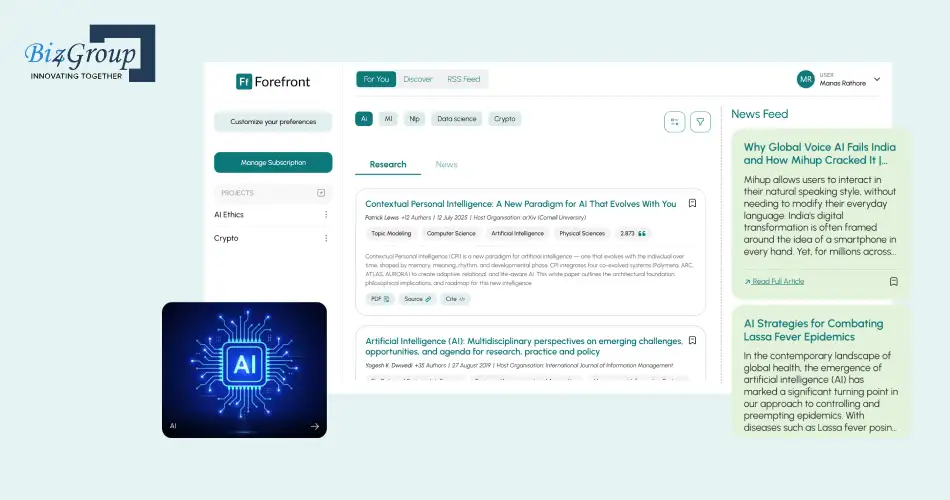
Choosing the right partner becomes much easier when you look beyond demos and examine production deployments.
One example is Forefront, an AI research intelligence platform developed by Biz4Group for researchers, students, and academic professionals. The platform was engineered to solve a far more complex challenge. It brings together research discovery, content organization, and AI-assisted analysis within a single workspace.
What makes this project noteworthy is the engineering complexity behind it.
|
Business Challenge |
How Biz4Group Solved It |
|---|---|
|
Research scattered across multiple platforms |
Unified content from more than 250 million research papers and trusted academic sources into one personalized experience |
|
Finding relevant research quickly |
Built a machine learning relevance engine that prioritizes high-value papers based on user interests |
|
Understanding lengthy academic documents |
Enabled AI-powered PDF conversations, intelligent summaries, and content generation to reduce research time |
|
Managing citation workflows |
Integrated seamless exports to Zotero, Mendeley, RIS, and BibTeX formats |
|
Working within strict API limitations |
Designed a resilient architecture that handled rate limits efficiently while maintaining a consistent user experience |
The result is a production-ready research ecosystem that combines intelligent retrieval, scalable backend architecture, and practical AI capabilities into a single product. Businesses exploring AI product development services can learn from this approach when planning enterprise-grade AI initiatives.
The client experience reinforces the technical outcome.
"I chose Biz4Group after struggling to find a team with the right mix of AI expertise, experience, and fair pricing. Their impressive development team integrated multiple research databases into a single, powerful tool, turning my rough ideas into a well-designed product that already exceeds my expectations!"
Ed Stott Founder, Forefront Intelligence
Hiring a software vendor and selecting a generative AI development service provider involve two very different decisions. One focuses on delivering applications. The other focuses on delivering intelligent systems that continue to improve, adapt, and create measurable business value long after deployment.
Also read: How generative AI is transforming research intelligence platform development
What Criteria Should You Use to Evaluate a Generative AI Development Company?
You should evaluate a generative AI development company against clear business and delivery criteria, not marketing claims or feature lists. A structured evaluation framework makes it easier to compare vendors objectively, involve key stakeholders in the decision, and identify the partner best suited to your business goals.
Instead of asking, "Who has the best AI?", ask, "Who is best equipped to deliver the outcome we need?"
Generative AI Development Company Evaluation Scorecard
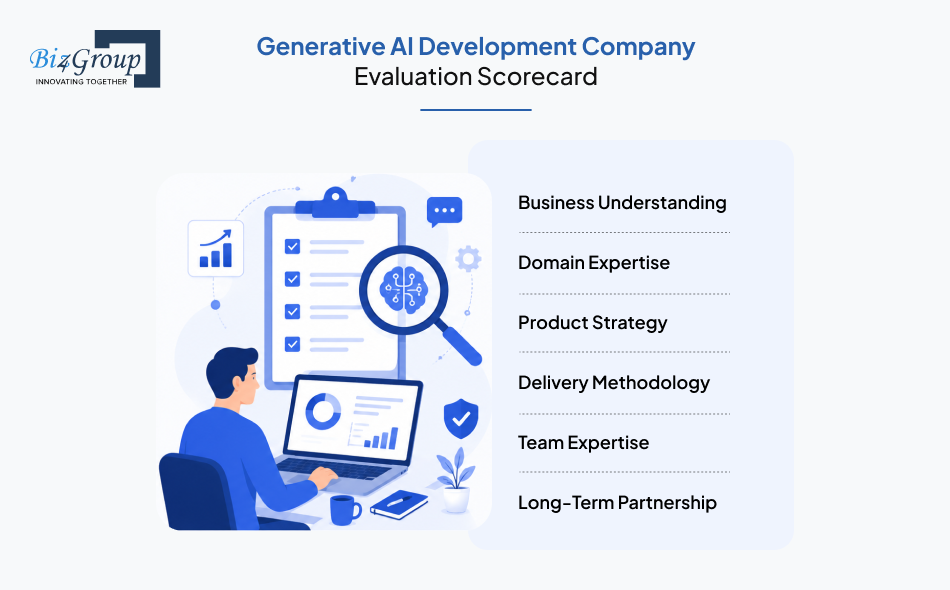
The scorecard below helps you assess each vendor using the same criteria. It also creates a consistent benchmark when comparing multiple providers.
|
Evaluation Area |
What to Verify |
Why It Matters |
|---|---|---|
|
Business understanding |
Do they understand your objectives, users, and success metrics? |
A solution aligned with business goals delivers greater long-term value. |
|
Domain experience |
Have they solved similar business challenges before? |
Relevant experience reduces the learning curve and project uncertainty. |
|
Product strategy |
Can they recommend the right approach instead of simply building requested features? |
Strong product thinking often improves outcomes while reducing unnecessary complexity. |
|
Delivery methodology |
Is the development process transparent, structured, and measurable? |
Predictable execution leads to better collaboration and fewer surprises. |
|
Team composition |
Will experienced AI specialists be involved throughout the engagement? |
The right expertise has a direct impact on delivery quality. |
|
Long-term partnership |
Can they support future enhancements as your product evolves? |
AI initiatives often grow over time rather than ending after the first release. |
Rather than assigning equal importance to every category, weigh them based on your project's priorities. A research platform, customer support assistant, and internal productivity tool all have different evaluation needs.
Questions to Ask Before Shortlisting a Vendor
The right questions often reveal how a team thinks, collaborates, and approaches problem-solving. These conversations should help you evaluate whether the vendor understands your business as well as your technical requirements.
|
Question to Ask |
Why It Matters |
|---|---|
|
How would you approach our use case if you were starting from scratch? |
Reveals strategic thinking instead of template-driven recommendations. |
|
What assumptions would you validate before development begins? |
Shows whether the team prioritizes discovery and risk reduction. |
|
How will business stakeholders stay involved throughout the project? |
Clarifies communication, transparency, and decision-making processes. |
|
Which deliverables can we expect at each milestone? |
Helps establish accountability and measurable progress. |
|
How do you handle changes in project scope or business priorities? |
Indicates the team's flexibility and planning maturity. |
|
What documentation and knowledge transfer do you provide? |
Ensures your internal team can confidently manage the solution after delivery. |
Many buyers also search for answers to questions like:
- How do I compare two generative AI development companies?
- What should I look for before hiring an AI development partner?
- How can I evaluate generative AI development services beyond pricing?
Using a standardized evaluation framework makes these decisions far more objective.
Look Beyond Technical Capability
A technically sound product still needs to deliver a seamless user experience and support real business workflows. That's why mature organizations often evaluate product strategy, usability, and engineering together instead of treating them as separate decisions. For customer-facing solutions, reliable UI/UX design services can be just as important as AI implementation.
This balanced perspective is one reason experienced partners, including Biz4Group, emphasize business outcomes alongside technical execution instead of positioning AI as the solution to every challenge.
Once you've established the right evaluation criteria, the next step is applying them through a structured selection process. That's exactly what we'll cover next.
Also read: Top 15 UI/UX design companies in USA
Will Your AI Investment Actually Pay Off?
Every AI project looks promising on paper. Let's see what yours could return.
Calculate My AI ROIHow Do You Choose the Right Generative AI Development Company?
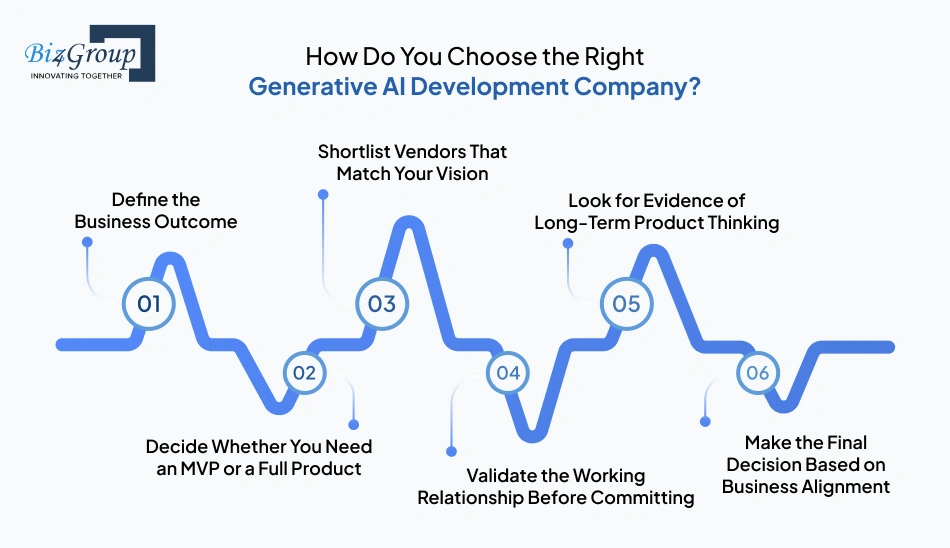
Choosing the right generative AI development company becomes much easier when you follow a structured decision process instead of comparing vendors all at once. Breaking the journey into clear stages helps reduce uncertainty, align stakeholders, and ensure every decision supports your business objectives.
When exploring generative AI application development company options for a new product, the framework below can help you make a confident decision.
Step 1. Define the Business Outcome
Start with the business problem, not the technology.
A clear objective creates better conversations with potential vendors and prevents projects from expanding beyond their original purpose.
Ask yourself:
- What measurable outcome are we trying to achieve?
- Who will use the solution?
- How will success be measured six months after launch?
Many organizations searching for custom generative AI development services provider capabilities already know they want AI. Fewer know exactly what business value they expect it to deliver.
Step 2. Decide Whether You Need an MVP or a Full Product
Not every idea should begin with enterprise-scale development. For new concepts or uncertain markets, validating assumptions through strong MVP development services often reduces investment risk while generating valuable user feedback.
If your idea still needs validation, exploring an MVP-first strategy before committing to full-scale development can accelerate learning and improve future product decisions.
CEOs often wonder, "Should I build an MVP before investing in AI?" In many cases, yes. Testing real user behavior often provides better insights than expanding features based on assumptions.
Also read: Top 12+ MVP development companies in USA
Step 3. Shortlist Vendors That Match Your Vision
Now that your requirements are defined, narrow your options based on business fit. A practical shortlist usually includes three to five vendors with experience delivering products similar to your own.
When reviewing candidates, consider:
- Industry familiarity
- Product mindset
- Collaboration style
- Delivery capacity
- Long-term compatibility
Step 4. Validate the Working Relationship Before Committing
The discovery phase often reveals more than a proposal document. Use workshops, roadmap discussions, or small planning engagements to understand how the team approaches collaboration, decision-making, and problem solving.
This stage also answers common buyer questions such as:
- How do I know if an AI development partner is the right fit?
- What happens before AI development begins?
- How involved should my internal team be during the project?
Strong partnerships are built through shared planning, not simply signed contracts.
Step 5. Look for Evidence of Long-Term Product Thinking
Successful AI products continue improving after launch because user expectations, business priorities, and data evolve over time. That is why your final decision should favor a partner capable of supporting continuous product growth instead of one-time implementation.
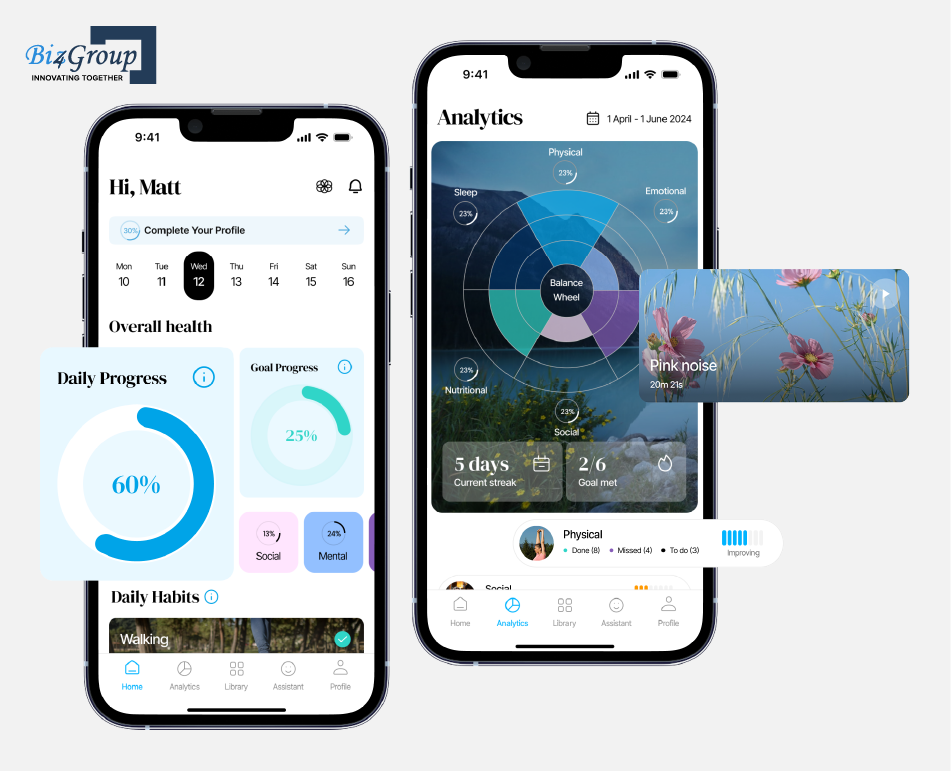
A strong example is Quantum Fit, an AI fitness platform developed by Biz4Group. Rather than delivering a static recommendation engine, the team designed an intelligent experience that continuously adapts to each user's fitness journey.
The platform combines personalized workout recommendations, nutrition guidance, and conversational coaching while refining suggestions based on individual progress and engagement.
Behind the scenes, the solution required careful optimization to balance AI performance with operating costs, ensuring personalized experiences remained scalable as user activity increased.
This type of long-term engineering reflects the mindset businesses should look for when evaluating a generative AI software development partner. Building an AI product is one milestone. Sustaining its business value over time is another.
Step 6. Make the Final Decision Based on Business Alignment
The final selection should feel like the logical outcome of your evaluation process, not a compromise driven by cost or timelines.
Before signing an agreement, confirm that the chosen partner aligns with your:
|
Decision Area |
Final Check |
|---|---|
|
Business vision |
Shared understanding of success |
|
Product roadmap |
Clear priorities for initial and future releases |
|
Team collaboration |
Defined communication model and responsibilities |
|
Commercial expectations |
Transparent scope, timelines, and engagement model |
|
Growth strategy |
Ability to support future enhancements |
Teams that approach vendor selection with this level of discipline are more likely to build AI products that continue delivering measurable value long after launch.
This is also why organizations evaluating a generative AI development company such as Biz4Group often focus on strategic partnership potential alongside technical expertise, recognizing that successful AI initiatives depend on long-term collaboration as much as strong engineering.
Still Deciding? Let's Make It Easy.
A 15-minute call today can save months of costly mistakes.
Call an AI ExpertWhich Red Flags Should You Watch for When Evaluating AI Vendors?
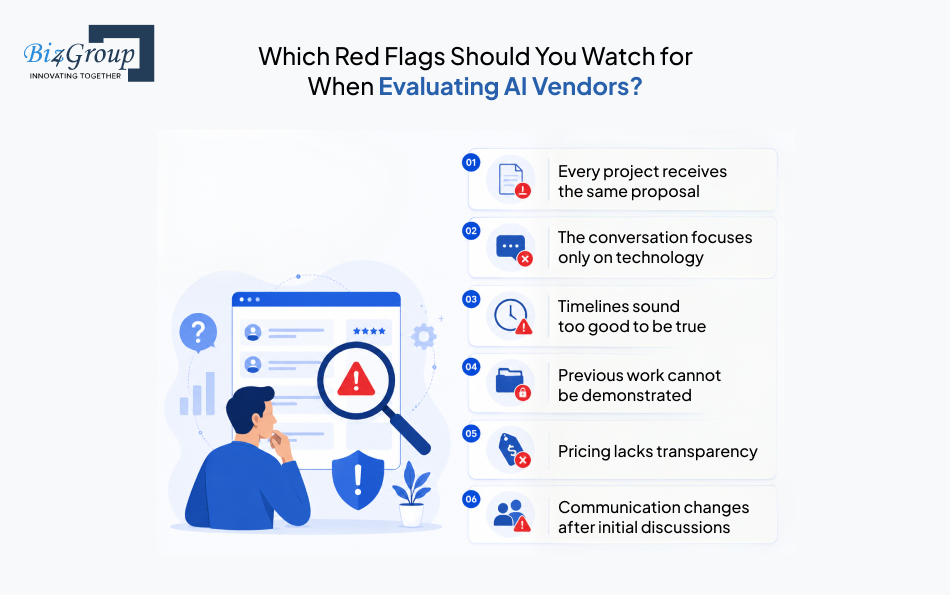
The biggest red flags are vague promises, unrealistic commitments, and an inability to explain how the solution will create measurable business value. A trustworthy partner welcomes detailed discussions and provides clear, evidence-based answers throughout the buying process.
If something feels rushed or unclear during the sales process, it usually becomes a larger challenge during execution.
|
Red Flag |
Why It Should Concern You |
|---|---|
|
Every project receives the same proposal |
Your business deserves a tailored approach, not a recycled solution. |
|
The conversation focuses only on technology |
Strong partners begin with business outcomes, users, and workflows. |
|
Timelines sound too good to be true |
Unrealistic delivery commitments often lead to compromised quality. |
|
Previous work cannot be demonstrated |
Established vendors should be able to discuss real projects and measurable outcomes. |
|
Pricing lacks transparency |
Hidden assumptions frequently become unexpected costs later. |
|
Communication changes after initial discussions |
Consistency during pre-sales often reflects the collaboration you'll receive throughout the engagement. |
Questions Worth Asking Yourself
Sometimes the warning signs become obvious when you pause and evaluate the conversation.
- Which company stands out for having the best generative AI services in IT services? Focus on demonstrated business outcomes instead of marketing language.
- How do I choose a generative AI provider for multilingual support? Ask for examples involving multilingual users, localization strategies, and language-specific testing.
- How do I choose generative AI development services for marketing automation? Hire AI developers who understand customer journeys, campaign workflows, and measurable marketing KPIs along with all the AI capabilities.
These questions help shift the conversation from vendor promises to business impact.
A Strong Project Portfolio Should Show Breadth
An experienced generative AI app development company should be able to demonstrate work across different business scenarios rather than showcasing multiple versions of the same solution.
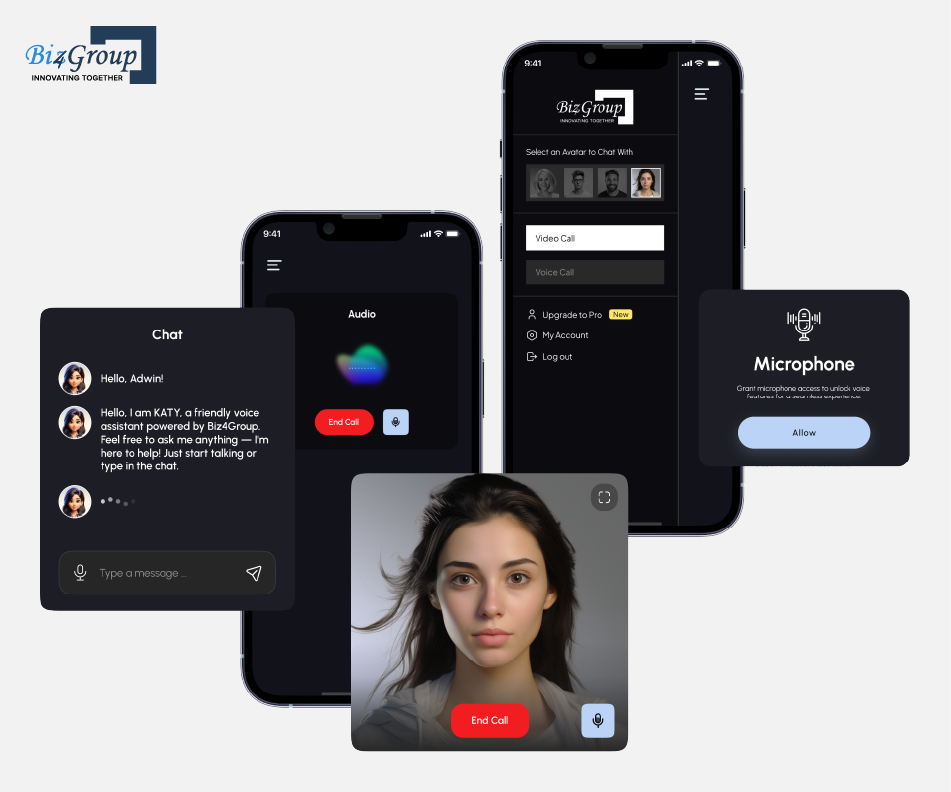
For example, Biz4Group's AI Wizard project combined conversational AI with voice interactions, avatar experiences, and cross-platform accessibility. Delivering this type of application required careful planning around user engagement, personalization, and continuous feature evolution rather than treating AI as a standalone capability.
That breadth of experience often becomes more valuable than a long list of similar chatbot projects.
If your initiative extends into intelligent workflows or conversational experiences, exploring how organizations build generative AI agents can provide useful context before selecting a development partner.
Sometimes, the clearest sign you've found the right partner is surprisingly simple. They spend more time understanding your business than selling their technology.
Also read: Top 10+ generative AI development companies in USA
Final Thoughts
Choosing the right AI partner has become a strategic business decision. The most successful organizations evaluate expertise, delivery capabilities, product thinking, and long-term collaboration before making a commitment. If you're wondering, "how can I find trusted generative AI platforms?", the answer often starts with selecting a partner that understands your business challenges as well as the technology itself.
This framework is designed to help you make that decision with confidence. From comparing vendors against objective criteria to identifying warning signs and following a structured selection process, every step reduces uncertainty and increases the likelihood of building a solution that delivers measurable business value. For generative AI development services company in USA options, taking a framework-first approach will always outperform choosing based on popularity or pricing alone.
If you're looking for an experienced AI development company, Biz4Group combines strategic consulting, product engineering, and enterprise AI expertise to help organizations turn ambitious ideas into scalable AI products. Our team focuses on creating solutions that solve real business problems while remaining adaptable for future growth. If your roadmap also includes innovation initiatives such as generative AI for product design, our specialists can help you identify practical opportunities and build products that are ready for real-world adoption.
Ready to move from evaluation to execution? Let's discuss your vision, explore the right AI strategy for your business, and build a solution that gives long-term ROI.
FAQs
1. Should you choose a specialized generative AI company or a full-service AI development company?
The right choice depends on your project's complexity and long-term goals. A specialized generative AI development company associative team can be a great fit for focused LLM or content generation initiatives, while a full-service AI partner is often better suited for enterprise projects that require system integrations, automation, analytics, and future scalability. Consider both your current requirements and where your AI roadmap is headed over the next few years.
2. Can a generative AI solution be integrated with existing business systems?
Yes. Modern AI applications are commonly integrated with CRMs, ERPs, document management systems, customer support platforms, and internal databases. Choosing a partner with strong integration experience helps ensure your AI solution works seamlessly within existing business workflows instead of operating as an isolated application.
3. What industries benefit the most from generative AI development solutions?
Generative AI is delivering measurable value across healthcare, finance, education, retail, manufacturing, legal services, logistics, and media. Organizations use generative AI development solutions to improve customer experiences, automate repetitive workflows, generate content, enhance knowledge management, and support better decision-making.
4. How much does it cost to build a custom generative AI solution?
The cost usually ranges from $20,000-$250,000+. It varies depending on project complexity, AI capabilities, integrations, infrastructure, and ongoing maintenance requirements. A simple AI assistant costs significantly less than an enterprise platform with custom workflows and multiple integrations. Reviewing a detailed cost breakdown before planning your budget can help set realistic expectations.
5. What should I do before contacting a generative AI development company?
Prepare a clear summary of your business challenge, target users, expected outcomes, existing technology stack, and budget expectations. Having this information ready helps potential partners recommend the most suitable approach and enables more productive discovery discussions from the very first meeting.
