Location :
Orlando, FL, USA
 +1 (407) 714-1616
 info@biz4group.com


 AI Summary Powered by Biz4AI
- Sweepstakes casino platform development means building a dual-currency casino platform that runs under promotional sweepstakes law, with wallets, games, KYC, redemption, and state controls.
- As of October 20, 2026, nine states ban sweepstakes casinos by statute and Oklahoma’s ban starts November 1, so every build needs state-level switches.
- Blask puts the US sweepstakes casino market at $7.2 billion, and demand moved to open states after the bans instead of disappearing.
- Ban-ready sweepstakes casino software needs a jurisdiction rules engine, unbundled coin packages, tiered redemption checks, and backup payment rails.
- A lean MVP costs about $20,000 to $25,000 and takes 2 to 4 weeks to build, while growth and enterprise platforms cost more.
- Biz4Group LLC has built a social casino with 800+ games and a game aggregator with a 99.8% transaction success rate, so wallet, KYC, and state-control design starts from live experience.
Regulatory note: This guide is for business and technology planning, not legal advice. Sweepstakes rules change often and differ by state. Confirm your model, state list, and promotion rules with qualified gaming counsel. Cost figures are Biz4Group planning estimates, not quotes. Players must meet each state’s minimum age. If you or someone you know needs help, call 1-800-GAMBLER. Information last verified October 30, 2026.
How we wrote this guide: We checked 2026 state actions against a law firm summary, a 50-state tracker, and market data. Then we added what Biz4Group has learned building casino platforms.
What happens to your launch plan when a state signs a ban three weeks before your go-live date?
That question is no longer hypothetical. Sweepstakes casino platform development now runs on a moving legal clock. As of October 20, 2026, nine states ban sweepstakes casinos by statute and Oklahoma’s ban starts November 1. Yet the segment keeps growing. Blask puts the US segment at $7.2 billion, with demand rising almost 20% outside the banned states in the first half of 2026.
So how do sweepstakes casinos work, and how do you build a dual-currency sweepstakes casino platform for US operators without betting your budget on one state map? This guide covers the model, the law, the features, the costs, and the architecture that survives bans. It also shows how the right sweepstakes casino software keeps your options open.
What Is a Sweepstakes Casino Platform and How Do Sweepstakes Casinos Work?
A sweepstakes casino platform is software that runs casino-style games on two virtual currencies. Gold Coins are for play and carry no cash value. Sweeps Coins can be redeemed for prizes. Operators say this setup follows promotional sweepstakes law because players can get Sweeps Coins for free.
That second currency is the main difference between a sweepstakes casino and a social casino, which offers play currency with no prizes.
So how do sweepstakes casinos work in practice? One player session runs like this:
- The player signs up and passes an age check.
- The platform grants free Gold Coins for play.
- The player collects Sweeps Coins through a free route such as a mail-in or online entry, or receives them bundled with a Gold Coin purchase.
- The player uses either currency on slots and table games.
- The player asks to redeem Sweeps Coins.
- The platform checks identity, location, balance, and fraud signals.
- The platform pays the prize and records every step in the ledger.
That free route has a name. It is the alternative method of entry, or AMOE. It keeps “no purchase necessary” true, and yes, a postcard can carry real legal weight here.
Our guide on how social casinos make money covers the revenue side of this model. On the build side, Biz4Group has built a two-coin wallet with age checks before coins can be bought or redeemed.
Are Sweepstakes Casinos Legal in the US in 2026?
It depends on the state. Sweepstakes casino laws differ by state, and most states have no ban. But the list of banning states keeps growing.
Here is where the map stood on October 20, 2026.
|
Status |
States |
Count |
|---|---|---|
|
Banned by statute |
California, Connecticut, Indiana, Louisiana, Maine, Montana, New Jersey, New York, Tennessee |
9 |
|
Ban signed, not yet active |
Oklahoma (effective November 1, 2026) |
1 |
|
Blocked under existing gambling law |
Idaho, Michigan, Nevada, Washington |
4 |
|
Regulator or attorney general action |
Arizona, Delaware, Florida, Illinois, Iowa, Maryland, Minnesota, Mississippi, Pennsylvania, West Virginia |
10 |
|
No statewide ban |
26 states plus D.C. |
26 plus D.C. |
Source. Gambling.com 50-state guide, last updated October 20, 2026
Several 2026 laws are already live. Tennessee’s took effect May 22, Indiana’s July 1, Maine’s July 14, and Louisiana’s August 1. Pending bills matter too. D.C.’s B26-0656 would legalize online casinos and ban sweepstakes casinos together, and it remains under Council review.
Several of these states offer a licensed route. Connecticut, New Jersey, and Pennsylvania all run licensed online casinos. Our New Jersey iGaming build guide shows what that route demands. The Pennsylvania casino platform guide does the same for its market. The Connecticut iGaming guide covers the third licensed market. For sports betting rules, our state-by-state betting laws guide maps the rest.
Why Are States Banning Sweepstakes Casinos While the Market Still Grows?
Regulators see unlicensed gambling, and licensed operators back the bans. Yet players keep playing, so demand moves to states without bans.
The legal argument is simple. Gambling law in most states rests on payment, chance, and a prize. Sweeps Coins add the prize. Operators say no purchase is needed because free routes exist. Regulators answer that bundling Sweeps Coins with purchases means players pay for a chance at a prize.
The American Gaming Association backed the bans too. It argued that sweepstakes casinos match licensed products but pay no gaming tax and skip the same checks, according to Blask.
Here is what the data says.
Myth
A state ban ends demand.
Reality
Blask found demand
fell by more than half in each of the four banned states it tracks, and Tennessee dropped 59%. Over
the same period, its index rose almost 20% across the rest of the country in the first half of
2026.
Myth
Banned players move to licensed
casinos.
Reality
Blask saw demand for casinos and bookmakers in those four
states fall about 18% over the same period.
Myth
Bans only hit operators.
Reality
New York’s law
also covers financial institutions and geolocation providers, per Gambling.com. Louisiana and
Oklahoma name platform providers and suppliers, per InfoLawGroup.
Myth
Open states are safe states.
Reality
Florida has no
ban, yet its attorney general filed two lawsuits on August 19, 2026 that also name payment
processors. Illinois sent cease-and-desist letters to more than 60 operators on February 5, 2026.
So, what should builders do? Plan for the map to change, then build for it.
Bans Arrive Faster Than Your Launch Plan
Will your platform survive the next state ban, or become a cautionary tale?
Stress-Test My PlatformWhat Does a Ban-Ready Sweepstakes Casino Platform Look Like?
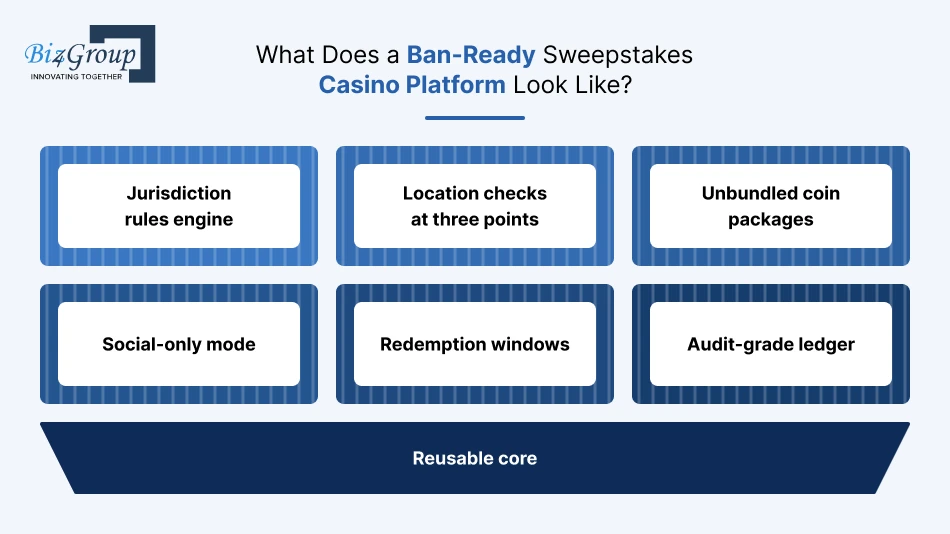
A ban-ready platform treats each state rule as a setting, not as code. Operators can switch features, coin packages, and payouts by state without a rebuild. Seven pieces make that work.
- Jurisdiction rules engine
Every state gets an allow, restrict, or block setting. Admins change it without a code release. - Location checks at three points
Run them at login, purchase, and redemption. Our geofencing guide explains why accuracy at the border matters. - Unbundled coin packages
Maine’s law bans bundling redeemable coins with purchases of non-redeemable coins, according to Sweepsy. Your store should sell Gold Coins alone wherever the law requires it. - Social-only mode
Where prize play ends, Gold Coin play with no redeemable prizes can continue. Gambling.com notes this for Oklahoma and California. - Redemption windows
Players need time to cash out before a deadline. The platform must open and close redemption by state. - Audit-grade ledger
Every balance change needs a record you can defend. Our player account management guide shows how. - Reusable core
Accounts, wallet, KYC, and reporting should carry over if you pursue a licensed path later.
On Biz4Group’s social casino build, location restrictions across US states were part of the brief from day one. That habit shapes every build we scope.
Which Features Does Sweepstakes Casino Software Need at Launch?
Sweepstakes casino software development should start with six things. You need accounts with age checks, a dual-currency wallet, licensed game content, free-entry handling, redemption with review, and state controls. Everything else can follow.
|
Feature |
Launch MVP |
After Traction |
|---|---|---|
|
Accounts and age verification |
Yes |
Social login, richer profiles |
|
Dual-currency wallet and ledger |
Yes |
Loyalty and VIP balances |
|
Game lobby |
One aggregator, basic filters |
More providers, tournaments |
|
Free entry (AMOE) handling |
Yes |
Automated fraud scoring for mail-in volume |
|
Redemption with manual review |
Yes |
Tiered automation |
|
State rule controls |
Yes |
Per-state analytics |
|
Admin panel and reports |
Core reports |
Finance and audit tooling |
|
Player apps |
Responsive web |
Native iOS and Android |
|
AI recommendations |
Not yet |
Add once player data builds |
Web first keeps launch costs sane. Our mobile casino app guide covers when a native sweepstakes casino app earns its price. For site structure and legal pages, see our guide on how to create a casino website.
Biz4Group paired a wallet with an AI recommendation engine on its social casino build. That is a layer you can add after launch, once player data builds up.
How Does a Dual-Currency Wallet Work in Sweepstakes Casino Software?
A dual-currency wallet keeps two balances and records every change as a ledger entry. Gold Coins carry no cash value. Sweeps Coins can be redeemed, so they need tighter records.
Why keep the two balances apart?
They follow different legal treatment and feed
different reports. Mixing them creates audit pain.
Can staff edit a balance by hand?
No. A balance is the sum of ledger entries.
Corrections post as new entries.
What should every Sweeps Coin record carry?
Its source. Did it come from a free
entry, a bonus, or a bundle with a purchase? Source tags matter because bundling is exactly what
Maine’s law targets.
What happens when a payout fails?
Funds move to a pending balance. The platform
then retries safely or posts a reversal.
Where does a PAM fit?
It owns identity, wallet, limits, and history. Every
other system reads from it. You can see how our AI-powered PAM demo pre-checks identity, payment destination,
bonus terms, and risk signals on a withdrawal.
At Biz4Group, we built one balance for real currency and one for fun currency, plus full transaction history.
How Do You Add Games to a Sweepstakes Casino Platform?
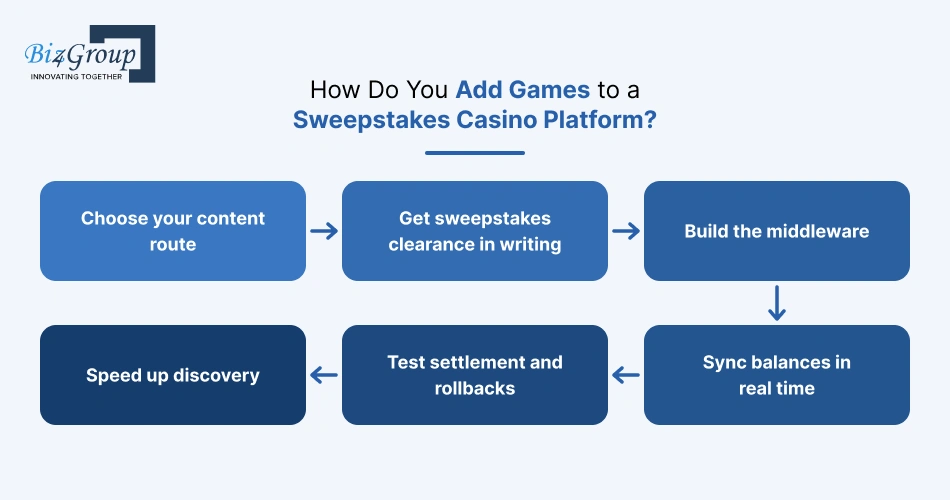
Most operators license games through aggregators and connect them through a middleware layer. The middleware turns each provider’s data into one format your wallet understands. Follow six steps.
- Choose your content route
An aggregator gives breadth. A direct studio deal gives control. - Get sweepstakes clearance in writing
Ask each studio whether its titles are cleared for sweepstakes play. - Build the middleware
Providers use different APIs, game protocols, and balance calls. Normalize them early. - Sync balances in real time
WebSockets keep game state, balances, and transactions aligned. - Test settlement and rollbacks
A dropped round must never create or lose a coin. - Speed up discovery
Filters by theme, popularity, and provider help players find games fast.
Want the deeper integration view? Our casino game aggregator platform guide walks through the chain. Biz4Group has used this pattern on live platforms, and two of them are below.
Stackr, a Social Casino with Two-Coin Wallets and 800+ Games
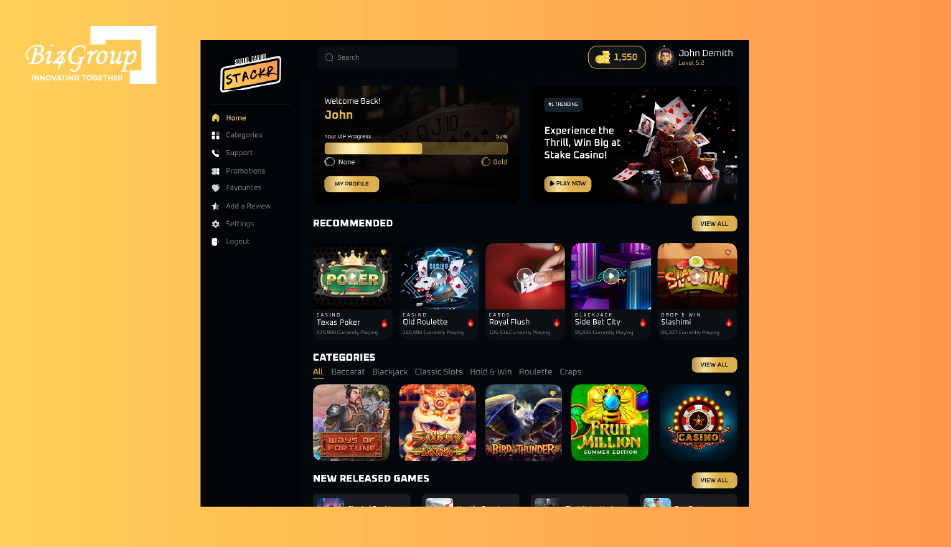
Stackr is a social casino platform that Biz4Group built with more than 800 games. Our team connected third-party games through APIs and aggregators. Players choose from slots, tables, instant wins, and more.
A two-coin wallet keeps real currency and fun currency apart. The build also covers location restrictions across US states and an AI recommendation engine that suggests games each player is likely to enjoy. A VIP progress bar rewards loyalty, and players can redeem for brand vouchers with up to a 20% bonus.
JuicySlots, a Casino Aggregator with Middleware and Live Balances

JuicySlots is a casino platform that aggregates games from several third-party casinos into one lobby. Each source used its own APIs, game protocols, and interaction models. So Biz4Group built a middleware layer that standardizes the data.
Players filter games by theme, popularity, or provider, buy coins, and redeem funds with live balance updates. Horizontal scaling and load balancing support thousands of concurrent users. The project page reports 47% higher player engagement, 3x faster game discovery, a 99.8% transaction success rate, and 40% lower user drop-offs.
How Do Redemptions, KYC, and Payments Work Together?
They work as one pipeline. A redemption request passes balance, identity, location, fraud, and payout checks before money moves.
Picture a player who wins and taps Redeem. Here is what should happen next.
First, the platform holds the Sweeps Coins. The player cannot spend them twice.
Next comes sweepstakes casino KYC. At Biz4Group, we built age verification into both buying and redeeming coins. That way age is checked before any coin changes hands.
Then the platform checks location against the rules engine. A blocked state stops the request.
Fraud screening follows. Duplicate accounts, mismatched names, and odd device patterns all need flags. Our AI integration services can add model-based scoring after launch.
Finally, the payout runs. Biz4Group has built gift card and voucher redemption and real cash redemption, each through its own integration.
Payments deserve extra worry. Sweepstakes casino payment processors sit inside the reach of the laws and lawsuits covered earlier. So, plan two rails for deposits and two for payouts. Biz4Group’s aggregator build supports several payment options, including cards and PayPal.
Player protection belongs in this pipeline too. Our responsible gambling monitoring guide explains limits and alerts.
Payment Partners Do Not Wait Politely
Who covers your payouts when your processor walks away on short notice?
Map My Payment BackupShould You Build, Buy, or White-Label a Sweepstakes Casino Platform?
A white-label sweepstakes casino wins on speed. A custom build wins on control. A hybrid often fits best. In a hybrid, you license games and payments and build the wallet, state rules, and redemption yourself.
White-label
Best for testing a market fast. Watch for vendor control over state
switches, wallet rules, and roadmap. One vendor decision can change your whole business.
Custom build
Best for operators who want to own state logic, data, and the
player experience. Watch for the upfront bill and a longer path to launch.
Hybrid
Best for teams that want speed and control. Watch for integration work
between licensed parts and your own core.
Our custom vs white-label casino guide compares the two paths in depth. The iGaming platform development guide covers the wider decision.
How Much Does Sweepstakes Casino Platform Development Cost?
Sweepstakes casino platform development cost starts around $20,000 to $25,000 for a lean MVP. Growth builds run about $40,000 to $90,000. Enterprise platforms start near $100,000 and can pass $200,000.
|
Tier |
Typical Cost |
Build Time |
What You Get |
|---|---|---|---|
|
Launch MVP |
$20,000 to $25,000+ |
2 to 4 weeks |
Accounts and age checks, dual-currency wallet, one game aggregator, state controls, manual redemption review, admin panel |
|
Growth |
$40,000 to $90,000 |
2 to 4 months |
Several game providers, tiered KYC, two payment rails, bonus engine, finance and audit reports |
|
Enterprise |
$100,000 to $200,000+ |
4 to 8 months |
Multi-brand support, advanced fraud scoring, native apps, per-state analytics, full audit tooling |
These are Biz4Group planning estimates, not quotes. Game licensing, legal work, and processor fees sit outside them.
AI-heavy builds cost more. Our AI social casino cost guide puts them at $50,000 to $220,000+ because they add personalization, multiplayer, and custom games. A licensed online casino costs far more to start. Our online casino startup cost guide shows a typical range of $200,000 to $1.2 million.
What Drives Sweepstakes Casino Software Cost?
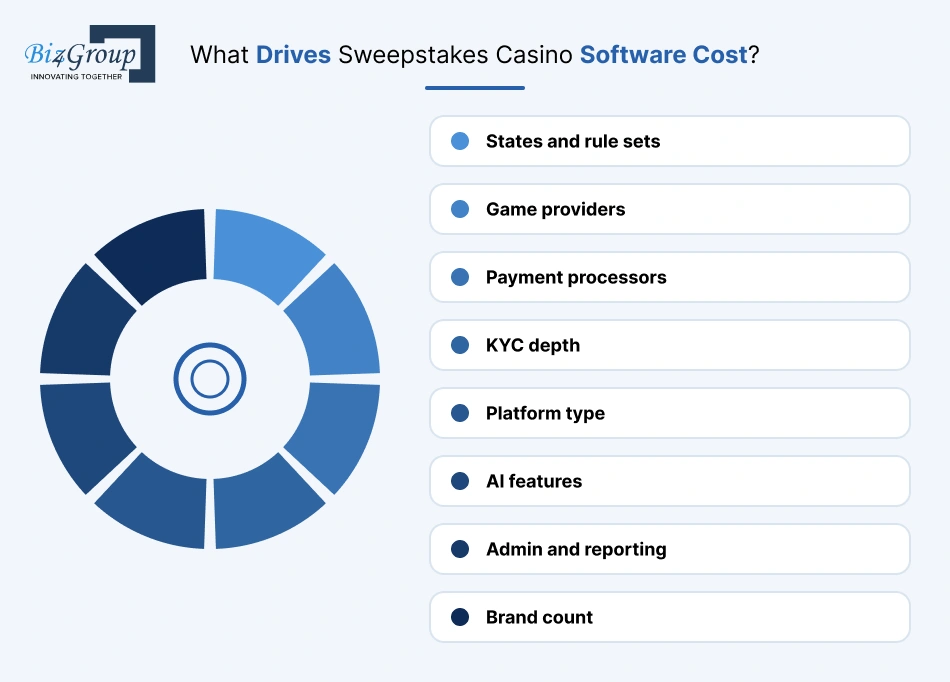
Scope drives cost. Eight factors move the number most.
- States and rule sets: Each state adds logic and testing.
- Game providers: Every integration adds middleware work.
- Payment processors: Backups add setup but cut risk.
- KYC depth: More tiers and vendors raise the price.
- Platform type: Native apps cost more than responsive web.
- AI features: Fraud scoring and recommendations add build and retraining cost.
- Admin and reporting: Audit tooling takes real engineering time.
- Brand count: Multi-brand support needs tenant-level controls.
Which Hidden Costs Should You Budget For?
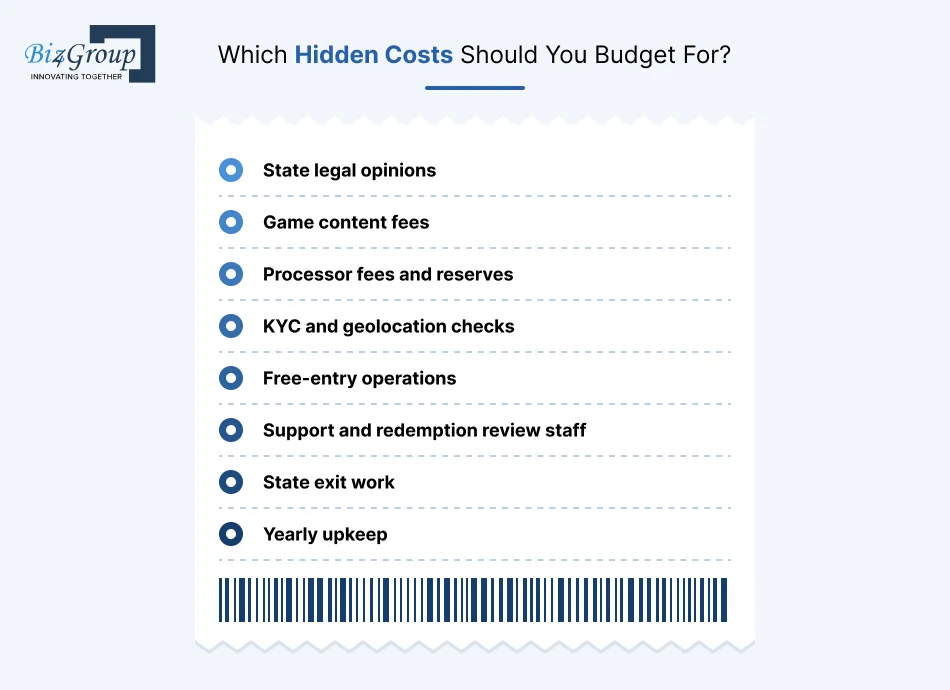
Budget for legal, content, payments, and operations. These costs rarely appear in a first quote.
|
Hidden Cost |
What Drives It |
|---|---|
|
State legal opinions |
Each new state needs its own review |
|
Game content fees |
Revenue share or license fees per provider |
|
Processor fees and reserves |
Risk rating, chargebacks, and volume |
|
KYC and geolocation checks |
Per-check fees that grow with players |
|
Free-entry operations |
Handling mail-in and online requests |
|
Support and redemption review staff |
Player volume and fraud rates |
|
State exit work |
Notices, redemption windows, and data archiving |
|
Yearly upkeep |
Usually 15% to 20% of build cost |
Our iGaming platform cost guide shows how these lines stack across a whole platform. For the wallet and account layer alone, see our player account management cost guide.
How Long Does It Take to Build a Sweepstakes Casino Platform?
A lean MVP takes 2 to 4 weeks of build time. Growth and enterprise builds take months. Legal review, game contracts, and payment onboarding run beside the build and often set your real launch date.
Here is how to build a sweepstakes casino MVP in four weeks. Smaller scopes finish sooner.
- Week 1: Accounts, age checks, admin panel, and the dual-currency ledger.
- Week 2: One aggregator integration and the player lobby.
- Week 3: Redemption flow, KYC hooks, and state controls.
- Week 4: Load tests, rollback tests, and a go-live checklist.
Our MVP development services team keeps this pace by reusing proven components across projects.
Three steps sit outside the build clock. Counsel signs off on your model. Studios clear their titles. Processors approve your account. None of them follow your sprint calendar.
A $20K Launch Starts Sooner Than Expected
Why sit through months of planning when an MVP can take two to four weeks?
Get My MVP EstimateWhat Should You Do Before a State Ban Takes Effect?
Sweepstakes casino compliance starts with a dated exit plan. Stop bundled sales, open a redemption window, tell players, and keep records. Oklahoma’s ban on November 1, 2026 is the next live test.
Oklahoma’s SB 1589 became law through a veto override. It makes violations a felony and applies to operators, geolocation providers, suppliers, and platform providers, per InfoLawGroup. Use this checklist for any state.
- Pull the effective date and scope from the statute with counsel.
- Set the state to restricted weeks before the deadline.
- Stop bundled coin packages first.
- Open a redemption window and notify players clearly.
- Clear pending KYC cases so players can cash out.
- Move eligible players to Gold Coin play only, where the law allows it.
- Archive ledger and audit records.
- Brief your support team with approved answers.
Keep a watch list too. Pennsylvania’s HB 2801 is pending. D.C.’s B26-0656 is under review. Virginia’s bills stay eligible in the 2027 session, per Sweepsy.
We design admin tools so a state exit is a settings change, not an emergency. Confirm all dates and scope with gaming counsel.
How Do You Choose a Sweepstakes Casino Platform Development Partner?
Choose a sweepstakes casino development company that has shipped wallets, redemption flows, and state controls in live US products and can show them to you. Ask these questions.
|
Question |
Strong Answer |
Red Flag |
|---|---|---|
|
Have you built a dual-currency wallet? |
Live demo, ledger design, reconciliation method |
Slides only |
|
How do you handle state rule changes? |
Admin settings and a tested exit flow |
“We will patch it” |
|
Who owns the code and data? |
You do, with documented exports |
Vendor lock-in |
|
How do you integrate games? |
Middleware, aggregators, rollback tests |
Hardcoded per provider |
|
What if a processor leaves? |
A second rail is ready |
One processor only |
|
Can you show US projects? |
Live platforms with reported results |
Vague client names |
|
Who decides the legal approach? |
Your counsel, with assumptions documented |
Legal promises from the vendor |
Biz4Group answers these with live work. The two builds covered earlier run real wallets, real integrations, and real transaction volume.
Ready to Build Before Your Rivals Do?
Will you be the operator who planned for bans, or the one who explained them?
Book My Strategy CallTo Summarize Everything on Sweepstakes Casino Platform Development
Treat state rules as settings and build the wallet with care. Plan two payment rails. Launch lean, then add depth as data builds. Keep counsel close, and write exit plans before you need them.
The sweepstakes market is still large, but the rules change quickly. The operators who treat bans as a design input will outlast the ones who treat them as bad news.
If you want to build something solid, Biz4Group LLC is ready to help. Our iGaming team can walk you through wallet design, state controls, and a launch plan that fits your goals. Reach out when you are ready, and we will take it from there.
FAQs
1. What penalties can operators face in a banned state?
Penalties vary by state. Indiana allows civil penalties up to $100,000. Maine sets fines from $10,000 to $100,000 and requires revoking any state gaming license the violator holds. Louisiana allows fines up to $100,000 and up to five years in prison, and its racketeering law adds more exposure. Oklahoma makes it a felony with fines from $500 to $2,000 and possible jail time, per InfoLawGroup. New York fines run $10,000 to $100,000 per violation, per Gambling.com. Ask counsel how each law applies to your role.
2. What tech stack works best for sweepstakes casino software?
There is no single best stack. Pick one your team can scale, secure, and audit. Biz4Group built its game aggregator on Next.js, Node.js, PostgreSQL, OAuth 2.0, and AWS, and its social casino on React, Express, Node.js, MongoDB, and AWS. Both run on AWS for scalable hosting.
3. Can a sweepstakes casino platform move to licensed online casino play later?
Yes, but it needs a licensed partner or its own license, plus state testing and taxes. In Pennsylvania, online casino brands operate under a licensed casino’s certificate, and online slots face a 54% tax rate. Our Pennsylvania sportsbook and casino guide shows what the licensed path involves.
4. Is running a sweepstakes casino profitable?
It can be, but the math is demanding. Sweepsy reports that the number of sweepstakes brands is at an all-time high, so competition for players is heavy. Track cost per player, the ratio of redemptions to purchases, processor fees, and your state mix. A model that works across ten states can fail quickly if two of them close.
5. Should a sweepstakes casino offer spending limits and self-exclusion?
Yes. Licensed markets require these tools, and sweepstakes players benefit from them too. Add purchase limits, time-outs, and self-exclusion at launch. They reduce harm and complaints, and they show regulators you take player care seriously.
6. What minimum age should a sweepstakes casino set?
Set it by state. Licensed gambling in most US states requires players to be 21. Some sweepstakes operators also set higher ages in certain states, such as Nebraska, according to Gambling.com. Apply the strictest age any state you serve requires, and verify it before purchase and redemption.