Location :
Orlando, FL, USA
Location :
Orlando, FL, USA +1 (407) 714-1616
 info@biz4group.com

 AI Summary Powered by Biz4AI
- A PA sports betting app earns more when it also runs an online casino. Pennsylvania’s online casino operators made $2.78 billion in 2025 and $245.7 million in August 2026 alone, about 4.6 times sports wagering’s $602 million.
- PA online sports betting is growing through better margins. Fiscal 2025/26 revenue rose 35.95% while total wagers fell.
- Pennsylvania taxes sports wagering at 36%, online slots at 54%, and online table games and poker at 16%, so your product mix shapes your profit.
- A combined platform needs one account and wallet, shared compliance, game aggregation, a bonus engine that tracks deductions, and revenue reporting by tax rate.
- A July 2026 state study recommended banning in-game wagers and credit card deposits, requiring betting limits, and curbing VIP programs, so build those controls in now.
- Biz4Group LLC builds sportsbook and casino products on one shared core and runs its own AI for iGaming platform for players, payments, KYC, games and bonuses.
Regulatory note. This guide is for business and technology planning, not legal advice. Confirm certificate, tax and product rules with the Pennsylvania Gaming Control Board and qualified Pennsylvania gaming counsel. Information last verified October 14, 2026.
Picture a bettor in Pittsburgh whose Steelers parlay settles at halftime. What does your app show them next?
If the answer is “nothing until the next game,” your PA sports betting app is missing out on most of the money in Pennsylvania’s market.
The numbers make the case. In 2025, Pennsylvania’s online casino operators earned $2.78 billion in revenue, up 27.22%. Sports wagering earned $602 million. PA online sports betting is growing too. In fiscal year 2025/26, sports wagering revenue rose 35.95% while handle fell.
So, should a PA sports betting app also run an online casino? For most brands, yes. This guide covers how to build a PA sports betting app with an online casino on one platform... the market math, the tax rules for each product, the architecture, and the rule changes coming next.
At Biz4Group LLC, we build betting and casino products on a shared core, so we’re writing this from the architecture up.
How Big Is PA Online Sports Betting Compared with Online Casino?
Online casino is the bigger business by far. In 2025, Pennsylvania’s online casino operators earned about 4.6 times what sports wagering did, even though bettors placed $8.8 billion in sports wagers. The state also collected more than five times as much tax from online casino as from sports wagering in fiscal 2025/26.
|
Metric |
Online Casino |
Sports Wagering |
|---|---|---|
|
2025 revenue |
$2.78 billion (up 27.22%) |
$602.5 million (up 17.97%) |
|
Fiscal 2025/26 revenue |
$2.93 billion (up 18.42%) |
$662.9 million (up 35.95%) |
|
Fiscal 2025/26 tax paid |
$1.34 billion |
$238.7 million |
|
Tax rate |
54% slots, 16% tables and poker |
36% |
Source. PGCB 2025 year-end report and fiscal 2025/26 report
Look closely at the sports column. Handle fell from $8.72 billion to $8.45 billion between fiscal years, yet revenue jumped almost 36%. Sportsbooks kept a larger share of each bet. That’s a margin story, and margins can shift back.
Online casino revenue is steadier because it doesn’t depend on the sports calendar. That steady base is what a combined app is built on.
Why Should a PA Sports Betting App Also Run an Online Casino?
A combined app earns from the same player all week, spreads acquisition costs across two products, and is less exposed to swings in sports betting margins. Three reasons stand out.
1. Casino revenue keeps coming in between games. Sports betting rises and falls with the schedule, while slots and table games are available every hour of every day. In July 2026, Pennsylvania’s online slots alone earned $199.2 million, almost four times the $51.8 million from sports wagering that month. Quiet weeks in sports are still busy weeks in casino.
2. You pay to acquire a player once and earn from two products. Getting a new bettor to sign up is expensive in a competitive market. A shared account lets that same customer try casino games without signing up again. Our guide to how to build a mobile casino app covers the casino side of that experience.
3. Sportsbook-only brands have struggled to hold on. Mid-size sportsbooks have left the market. Betfred, for one, closed its Pennsylvania online sportsbook in July 2025 after failing to build enough market share. A second revenue stream gives a brand more time to grow.
Together, these three reasons explain why Pennsylvania’s biggest brands treat casino and sportsbook as one business.
Who Can Run a Sportsbook and Online Casino in Pennsylvania?
Both products are tied to licensed Pennsylvania casinos. Here’s how the main authorizations fit together.
|
Authorization |
What It Allows |
Key Rule |
|---|---|---|
|
Sports wagering certificate |
Retail and online sports betting for a licensed casino |
One sports wagering website and one mobile app per certificate under 58 Pa. Code § 1401a.5 |
|
Sports wagering operator |
Runs the sportsbook for a certificate holder |
A holder may use two operators, one for retail and one for online |
|
Interactive gaming certificate |
Online slots, table games and poker |
Held by licensed casinos under Title 4 |
|
Interactive gaming operator |
Runs the online casino for a certificate holder |
Licensed separately by the PGCB |
So, every Pennsylvania iGaming and sportsbook brand you see in an app store operates under a casino’s certificate. Your platform plan should start with that partner.
How Does the Pennsylvania Sports Betting Tax Work Across Sportsbook and Casino?
Pennsylvania taxes each product differently. Sports wagering pays 34% to the state plus a 2% local tax, online slots pay 54%, and online table games and poker pay 16%. Operators can also deduct promotional play that meets PGCB conditions, so the tax on total gaming activity is often lower than the headline rates suggest.
Three common assumptions get in the way of good planning.
Myth A 36% tax means a sportsbook keeps 64 cents of every revenue dollar. Reality Qualifying promotional play comes off the taxable amount first. Your bonus engine has to track which promotions qualify, one by one.
Myth Online casino always earns better margins than the sportsbook. Reality Online slots carry the highest tax rate in the state at 54%. Table games pay 16%. Your product mix decides your margin as much as player volume does.
Myth The deduction rules are fixed once you launch. Reality The PGCB decides which promotional wagers qualify and has changed those rules before. Since May 1, 2025, promotional wagers on live dealer games can qualify, provided operators meet requirements such as unrestricted cash payouts.
Here’s how product mix changes the tax bill. Take $1 million in gross gaming revenue before any promotional deductions.
- All online slots: about $540,000 in tax
- All sports wagering: about $360,000
- All online table games: about $160,000
- A mix of 50% slots, 30% sports and 20% tables: about $410,000
Biz4Group illustration based on Pennsylvania’s statutory rates.
States keep trying new ways to tax betting. Our Illinois sports betting license guide shows how a per-wager tax changed the economics there.
Two Products, Three Tax Rates. Does Your Model Account for All of Them?
Get a margin model that separates slots, tables, poker and sports before you commit to a build.
Model My PA MarginsWhat Does a Pennsylvania Sportsbook and Casino Platform Need?
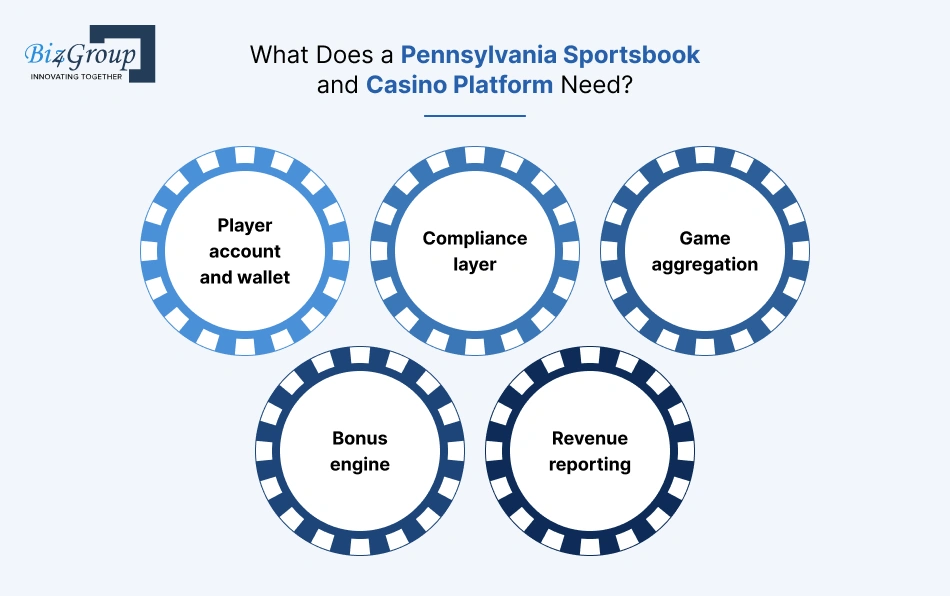
A Pennsylvania sportsbook and casino platform needs five layers working together. These are one player account and wallet, one compliance layer, game aggregation, a bonus engine that tracks deductions, and revenue reporting by tax rate. On every combined build, our default at Biz4Group is to run all five on one shared core, not two separate systems connected later.
|
Layer |
What It Does |
Why It Matters in Pennsylvania |
|---|---|---|
|
Player account and wallet |
One login and one balance across sportsbook and casino |
Lets players move between products without signing up twice |
|
Compliance layer |
KYC, age checks, geolocation and self-exclusion shared by both products |
Online sports wagering must use geolocation to confirm players are in Pennsylvania |
|
Game aggregation |
Connects slots and table games from licensed suppliers |
Games go through the PGCB’s gaming laboratory for testing before launch |
|
Bonus engine |
Issues and tracks promotions across products |
Deduction eligibility varies by promotion and product |
|
Revenue reporting |
Splits revenue into slots, tables, poker and sports |
Each line carries a different tax rate |
One Account and One Wallet
The shared wallet is the heart of a combined app. A bettor who wins a parlay should be able to open a blackjack table in the same session without moving funds or logging in again.
Getting there means separating player identity and balances from each product’s game logic. A multi-tenant AI sports betting platform handles this well, because the account layer serves every product from one place.
One Compliance Layer for Both Products
Duplicate compliance means twice as many places for a mistake. One layer should verify identity, confirm age, check location and apply self-exclusion to both products at the same moment.
Location deserves extra care because Pennsylvania borders six states. Our guide to geofencing in sports betting apps explains why small errors near a state line cause big problems.
A Bonus Engine That Knows the Tax Rules
A promotion that crosses products, such as a free spin for placing a parlay, affects two tax rates at once. The engine has to tag every promotional dollar by product and track whether it qualifies for deduction.
Personalization can also help here. AI integration services can match each offer to the player most likely to use it, which keeps promotional spending efficient.
Stackr: Wallets, Games and Personalization in One Platform
Stackr is a social casino platform Biz4Group built with more than 800 games. Our team integrated content from providers including Betsoft, Pragmatic Play, Booming Games, EvoPlay and Habanero through third-party aggregators.
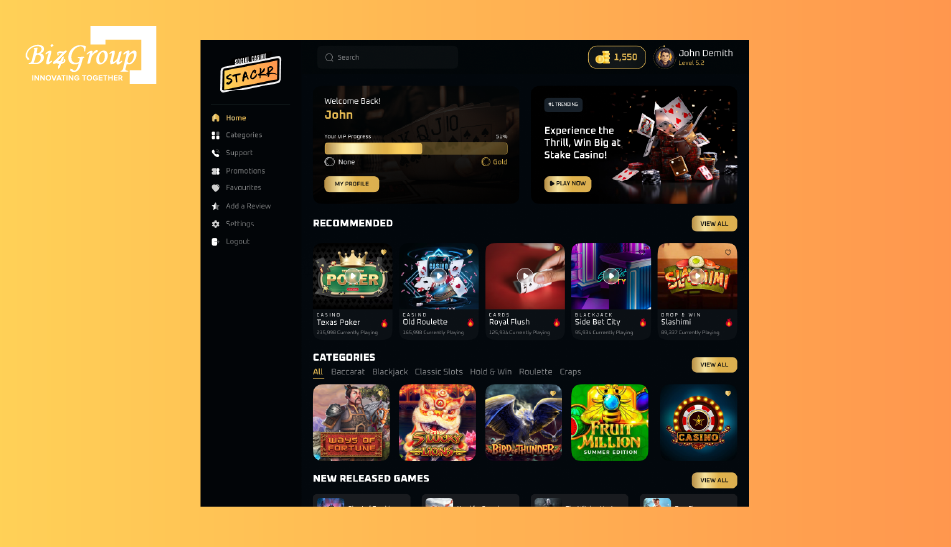
The platform runs a two-currency wallet, an AI recommendation engine that suggests games based on player behavior, AgeChecker verification, card payment processing and location restrictions across US states. It also keeps detailed records of gaming activity and transaction history, along with VIP progress tracking and win and loss analytics.
These are the same building blocks a combined Pennsylvania app needs on its casino side. To see the business model behind Stackr, read how social casinos make money.
Want One Wallet Across Sportsbook and Casino?
We’ll show you what a shared-core architecture looks like for your PA brand, layer by layer.
See the ArchitectureHow Do PA Sports Betting Apps Turn Bettors Into Casino Players?
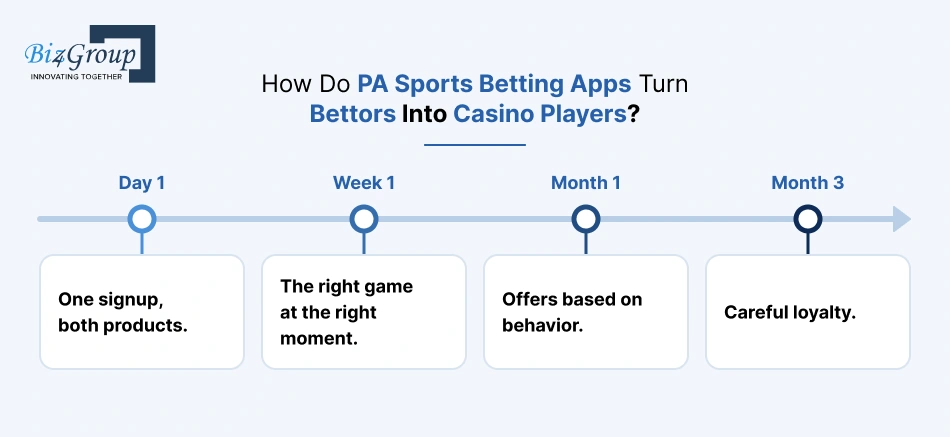
Good PA sports betting apps cross-sell with timing and relevance. They suggest casino games when a bettor is between games, match offers to how that person actually plays, and keep every responsible gaming limit active across both products.
Here’s how that plays out over a player’s first three months.
Day 1. One signup, both products. The player creates one account, passes one KYC check and sets one group of deposit limits. Both products are ready to use, but the sportsbook comes first because that’s why they joined.
Week 1. The right game at the right moment. Halftime, rain delays and the gap between afternoon and evening games are natural moments to suggest a casino game. Showing a quick table game during a break feels helpful. Showing one in the middle of a live game feels like a distraction.
Month 1. Offers based on behavior. By now you know whether the player prefers big parlays or small single bets, slots or tables. A personalized bet recommendation agent can use that history to match offers to each player.
Month 3. Careful loyalty. Loyalty programs reward your best players, but Pennsylvania lawmakers are watching them closely. The July 2026 Joint State Government Commission study recommended curbing VIP programs, so build tiers you can adjust or switch off.
Across all four stages, one principle holds. Limits and self-exclusion follow the player across both products.
Quick Start Bets. The Player View Cross-Selling Needs
Quick Start Bets is a sports data platform Biz4Group built that brings together real-time odds, player analytics, historical statistics and centralized dashboards on low-latency infrastructure. The hard part was keeping odds, analytics and dashboards synchronized at all times.
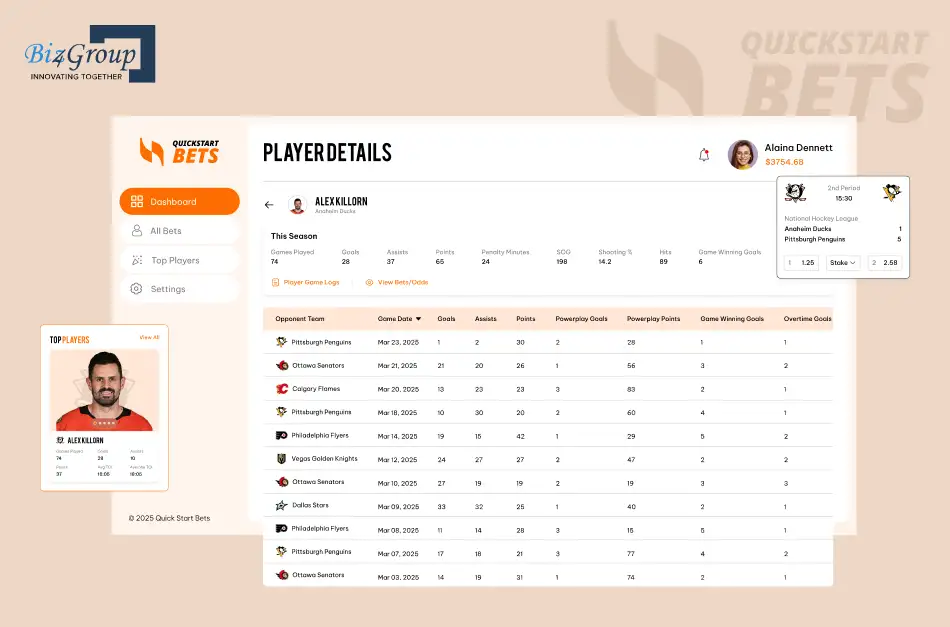
Cross-selling depends on that kind of single, live view of each player. You can’t suggest the right casino game at halftime if your sportsbook data arrives late. Many teams also explain why top US betting apps rely on multiple sports data providers to keep that view reliable.
What Rule Changes Could Reshape Pennsylvania iGaming and Sports Betting?
The clearest signal is the July 2026 state study. It recommended banning in-game wagers and credit card deposits, requiring players to set their own limits, curbing VIP programs and tightening advertising rules. A state lawmaker has said a bill targeting in-game micro-bets is being drafted. None of these changes is law yet, so build the controls now.
Here’s the watch list, with what each item means for your platform.
- In-game wagers The study suggested prohibiting them. Your sportsbook should be able to switch off live markets by type without a code release. Our comparison of live betting vs. pre-match sportsbook development shows where those controls belong.
- Credit card deposits The study recommended banning them for online accounts. Your cashier should be able to switch funding methods on or off without a rebuild.
- Required betting limits The study proposed requiring players to set their own deposit and spending limits. Make limit-setting part of onboarding, not a buried setting.
- VIP programs The study recommended curbing programs whose rewards depend on deposits, losses or betting volume. Loyalty tiers, hosts and rewards should all be adjustable.
- Advertising The recommendations covered marketing near schools and colleges, misleading terms like “risk-free,” and marketing to self-excluded players. Your CRM should be able to restrict channels, audiences and wording.
Pennsylvania isn’t banning online gambling, but it’s clearly tightening how it’s offered. Platforms built with adjustable controls will handle that more easily.
What Does PA Sports Betting App Development Cost in 2026?
PA sports betting app development for a combined sportsbook and casino usually falls in Biz4Group’s enterprise tier ($100K to $150K+) or the highly bespoke tier ($150K to $350K+). A sportsbook-only build can start in the growth tier ($40K to $120K+). Licensing, data feeds and game content are separate costs.
|
Scope Area |
Sportsbook Only |
Sportsbook Plus Online Casino |
|---|---|---|
|
Player account and wallet |
Serves one product |
Shared across both products |
|
Compliance |
Covers betting flows |
One layer covering both products |
|
Content |
Odds and sports data feeds |
Adds game aggregation and supplier integrations |
|
Bonus engine |
Sports promotions |
Promotions across products, with deduction tracking |
|
Reporting |
One tax rate |
Four revenue lines with three tax rates |
|
Typical tier |
Growth to enterprise |
Enterprise to highly bespoke |
The biggest cost driver is usually the wallet and account layer. Getting it right once is cheaper than connecting two systems later. Our sports betting app development cost guide explains what each tier includes.
Sportsbook Now, Casino Later? Or Both on Day One?
Get a scoped estimate for both paths and see the real difference in cost.
Compare My Build OptionsHow Do You Choose a Partner for PA Online Sports Betting Platform Development?
Choose a partner that has built both betting and casino products and can show a shared wallet working in a live demo. Experience with only one vertical usually means the second product gets added on later.
Whoever you talk to, ask for three proof points.
A working shared wallet Watch a balance move from a sportsbook win into a casino game in one session.
A history of game integrations Ask which providers they’ve connected and how they handled content updates.
Bonus reporting split by product Ask to see a report that separates promotional play by product and tax rate.
Our guide on how to choose the right AI sports betting development company gives you a longer checklist.
If you’re still deciding between licensing technology and owning it, our build vs. buy a sportsbook platform framework scores 12 criteria side by side.
Is a PA Sports Betting App Without an Online Casino Still Worth Building?
It can be, but the numbers are much harder to make work. Sports wagering grew fast in fiscal 2025/26, yet online casino still earned more than four times as much in revenue. A PA sports betting app built on a shared core gives you room for both.
Pennsylvania rewards operators that look at the whole player, not only the bet slip. The sportsbook brings people in, the casino keeps revenue steady, and one platform lets the two support each other.
Share your sportsbook roadmap with our sports betting app development team. We’ll map where a casino layer fits and what it would take to build it.
FAQs
1. Is online poker legal in Pennsylvania?
Yes. Pennsylvania licenses online poker as part of interactive gaming, alongside online slots and table games. Poker is taxed at 16% of revenue and must be offered through a licensed casino’s interactive gaming certificate.
2. How old do you have to be to gamble online in Pennsylvania?
You must be 21 or older to open an online gambling account in Pennsylvania. Operators must verify each player’s age and identity before allowing real-money play.
3. How long does it take to launch a PA sports betting app?
It depends on your casino partner, your licensing path and how much of the platform you build from scratch. A focused sports betting app MVP can be ready in about 2-4 weeks, while PGCB reviews and lab testing set the final launch date.
4. Can a Pennsylvania online casino offer live dealer games?
Yes. Live dealer table games are part of Pennsylvania’s online casino market and are streamed from studios that go through PGCB testing. Several Pennsylvania online casinos offer live blackjack, roulette and baccarat alongside their digital table games.
5. Can you add an online casino to an existing PA sportsbook?
Yes, if your casino partner holds an interactive gaming certificate and the PGCB approves the arrangement. On the technical side, the easier path is a platform that can support both products. Our guide on moving from a white-label to a custom sportsbook covers the move to a more flexible stack.
6. Does Pennsylvania have a self-exclusion program for online gambling?
Yes. The PGCB runs an online self-exclusion program covering both sports wagering and casino games. Players can choose a 1-year, 5-year or lifetime ban, and operators must refuse their wagers and stop sending them promotional material. It’s separate from the program for land-based casinos.
Sources
- PGCB, 2025 Year-End Revenue Report (January 21, 2026)
- PGCB, Fiscal Year 2025/26 Revenue Report
- PGCB, July 2026 Revenue Report (August 19, 2026)
- PGCB, Sports Wagering Tax FAQ
- PGCB, Industry Guidance on Live Dealer Promotional Play
- PGCB, Letter on Live Gaming Studio Testing
- PGCB, Online Self-Exclusion Program
- Joint State Government Commission, Sports Betting and Related Interactive Gambling in Pennsylvania (July 2026)
- 58 Pa. Code § 1401a.5, Conduct of sports wagering generally
- Pennsylvania General Assembly, Title 4, Amusements
Cost ranges and tax illustrations are Biz4Group planning estimates and calculations, not official figures.