 Location :
Orlando, FL, USA
 +1 (407) 714-1616
 info@biz4group.com


 AI Summary Powered by Biz4AI
- AI IVR development companies in USA fall into four types: contact center platform vendors, communications API providers, conversation AI specialists, and custom development firms.
- Platform vendors are fastest to start and limit you most. Custom firms take longer and fit you best.
- Judge any company on the same scorecard: proof on live calls, integrations, language and accuracy testing, compliance handling, data ownership and support after launch.
- Ask for references you can call and a paid pilot before a full build.
- Red flags: a demo with no live-call evidence, no answer on who owns the data, one price for everything, and no plan for when the AI is unsure.
- Costs and build-vs-buy are covered on their own pages; this page is about who builds it.
AI IVR development companies in USA all say the same things on their websites: natural conversations, fast integration, enterprise-ready. The line that actually separates them never makes the homepage. It is the answer to a simple question: what does your AI do when it does not understand the caller?
This page is a buyer's guide, not a ranking. It sorts the market into four types, gives you one scorecard to hold every company against, and lists the red flags and questions that save you from an expensive second attempt.
One note on honesty: Biz4Group LLC, an AI product development company based in USA, which publishes this page, builds AI IVR systems, so there is a section near the end that says where it fits. Weigh the rest accordingly, and check everything against what companies show you. The bigger picture sits in the AI IVR for real estate hub.
What types of AI IVR development companies are there?
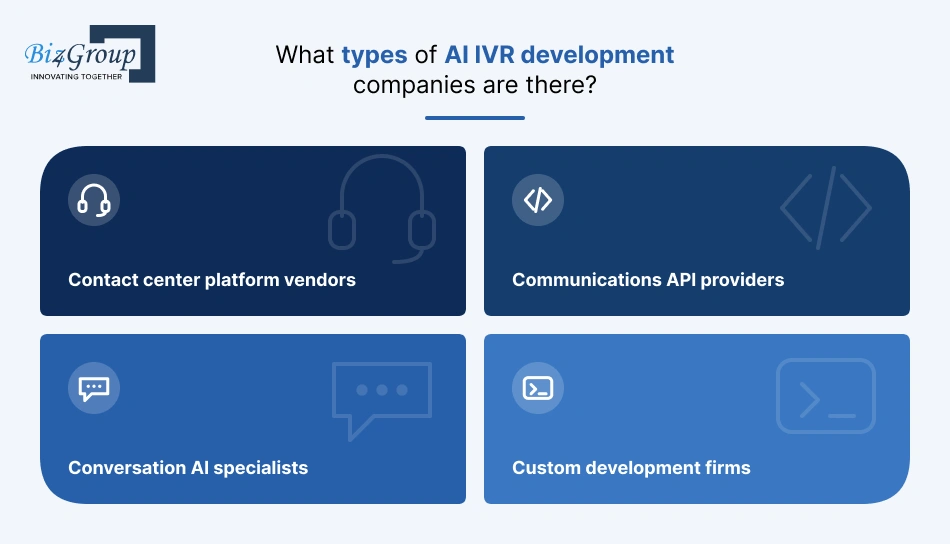
Four, and with AI IVR vendors the type tells you more than the brand does. Most companies you will meet are one of these.
|
Type |
What they sell |
Starts fast? |
Fits you closely? |
Best when |
Watch for |
|---|---|---|---|---|---|
|
Contact center platform vendors |
A full phone and support platform with AI features built in |
Yes |
Limited |
You also need a new phone system |
Your call flow bends to their product |
|
Communications API providers |
Building blocks for voice, speech and messaging |
Medium |
High, with developers |
You have engineers who will build and maintain it |
Everything beyond the blocks is your problem |
|
Conversation AI specialists |
A ready-made voice agent product, configured for you |
Yes |
Medium |
Your calls are common and your needs are standard |
Customizing beyond their templates |
|
Custom development firms |
A system designed and built around your calls and your systems |
Slowest |
Highest |
You have unusual flows, compliance needs or integrations |
Quality varies a lot, so vetting matters most here |
There is no best type, only a best type for your calls. The choice between an AI IVR platform and a custom build has its own page in the decision guide; this one starts after you have decided that someone else will build it.
Why does the type matter more than the name?
Because each type fails in a different way. A platform fails by being a poor fit. An API kit fails by leaving you with half a project. A specialist fails when your calls are not the calls they were built for, and a custom firm fails by being slower, or by being less good than its pitch.
Knowing the failure mode tells you what to test first. If you are looking at a platform, test how far you can bend the flow. If it is a custom firm, test how they handle the first ten bad calls.
What should every AI IVR company be able to show you?
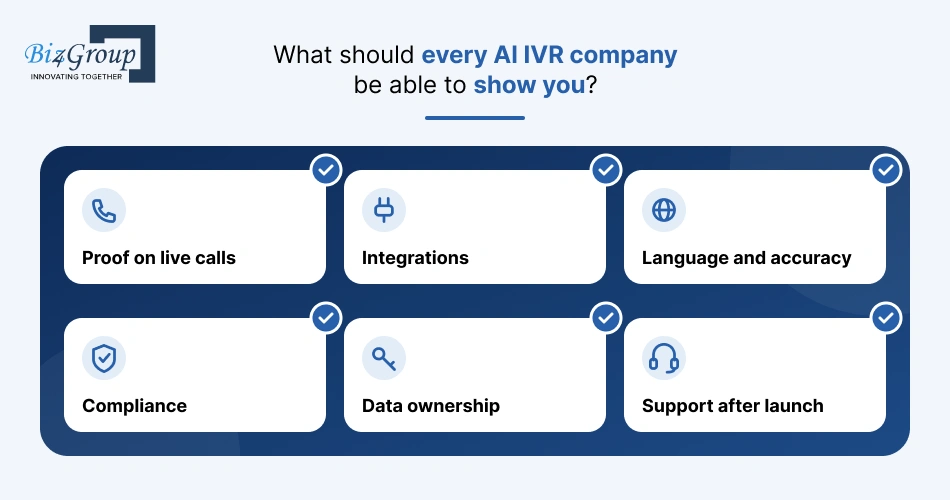
The same six things, whatever the type. Use this as a scorecard: rate each from 1 to 5 as you go, and write down the evidence next to the number.
|
Criterion |
What good looks like |
How to check |
|---|---|---|
|
Proof on live calls |
Real calls handled in production, with something you can hear or read |
Ask for a recorded sample or a reference call, not a slide |
|
Integrations |
Your CRM, calendar and phone system, named and demonstrated |
Ask them to show a call landing in a CRM like yours |
|
Language and accuracy |
A test plan for your callers, accents and noise |
Ask how they test each language and how often |
|
Compliance |
A clear answer on recording, disclosure and data handling |
Ask who writes the disclosure wording and who reviews it |
|
Data ownership |
You own transcripts, recordings and prompts, and can leave with them |
Read the contract clause, not the sales deck |
|
Support after launch |
Someone watches real calls and fixes what the AI gets wrong |
Ask what happens in week two and month three |
The last row is where most disappointment starts, because a system that works at launch and drifts afterwards looks like a good purchase for about a quarter.
Want a builder who passes the scorecard?
Biz4Group designs and builds AI IVR systems around your calls, your CRM and your compliance needs.
Build My AI IVRWhat red flags should you watch for?
Anything that sounds good in a demo and cannot be shown on a real call. These are the ones that tend to show up before a project goes sideways.
|
Red flag |
Why it matters |
What to do |
|---|---|---|
|
The demo is scripted and never fails |
Real callers interrupt, mumble and change their minds |
Ask to hear a call that went wrong, and what changed afterwards |
|
"We support every language" |
Support and tested are different words |
Ask which languages ran with real callers, and how they test the rest |
|
One price for everything |
Scope is rarely that tidy |
Ask what is included, and what triggers extra cost |
|
No answer on data ownership |
You may not be able to leave |
Get the clause in writing before the pilot |
|
No plan for "I did not understand that" |
This is where callers hang up |
Ask what the caller hears the second and third time |
|
Compliance is "handled" |
By whom, and how? |
Ask who writes the wording, and who reviews it |
|
References are all the same industry |
Your calls may differ |
Ask for one reference with calls like yours |
What should you ask on the first call?
Questions that make a prospective AI IVR partner explain how it works, not what it offers. Pick five or six:
- What does your AI say when it cannot understand the caller, and what happens after the third try?
- How do you move a caller to a person, and what does the person see on screen?
- Show me a call landing in a CRM like ours. What is written, and what is not?
- How do you test accents, background noise and poor phone lines?
- What do you review in the first month after launch, and who does it?
- If we leave, what do we take with us?
The third question is the one most worth pushing on. How a call becomes a clean record is a project of its own, and the CRM integration guide shows what a good answer looks like.
How do references and a pilot work?
Call two references and run a small paid pilot before committing to a full build. References tell you how the company behaves when something breaks. A pilot tells you how the system behaves on your calls.
For the reference call, skip "were you happy?" and ask:
- What went wrong in the first month, and how fast was it fixed?
- What did you have to do that you did not expect to?
- Would you hire them again for something bigger?
For the pilot, pick one call type, write down what success means before you start (calls answered, calls handed to a person, records written correctly), and listen to a sample of real calls each week. A company confident in its work will agree to this. One that resists is telling you something.
How much a pilot or a full build costs belongs to the cost pillar, which is where those numbers live.
Prefer to start with a small pilot?
Biz4Group scopes and runs a pilot on one call type, with success measures set up front.
Start a Pilot With Biz4GroupDo compliance and language claims hold up?
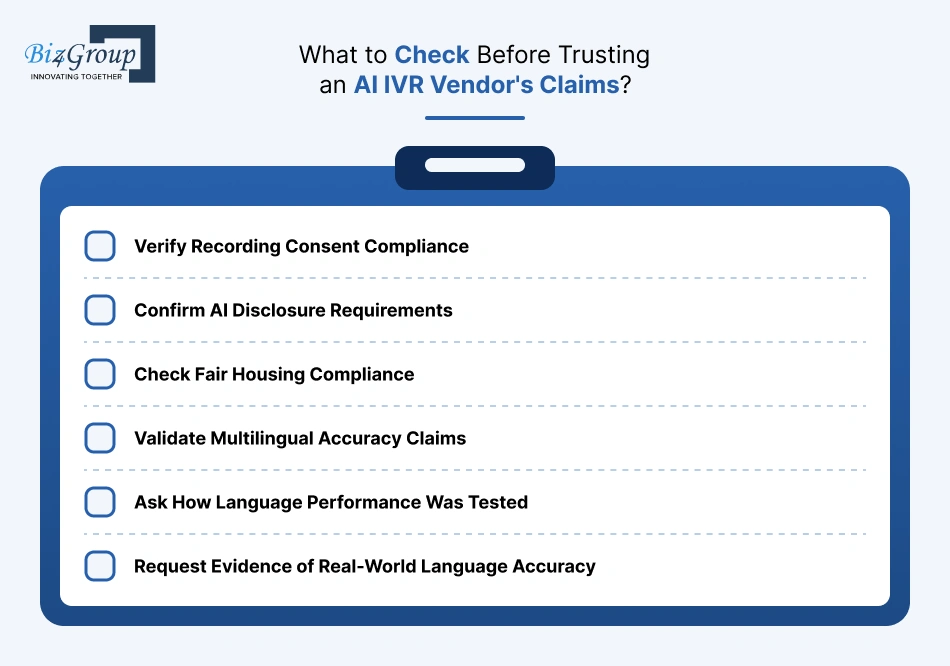
Only if the company can show how. Recording consent, AI disclosure and fair housing questions are legal ones, and a development company should know where its job ends and your attorney's begins. The recording and disclosure rules lay out what to ask them.
Language is the other claim that tends to be inflated. A company that says it covers many languages should be able to tell you how each was tested. What good testing looks like is in the multilingual AI IVR guide.
Where does Biz4Group LLC fit?
In the custom AI IVR development type, and with the same scorecard applied to it. Biz4Group is an AI IVR software development company that builds AI products around client workflows, including voice and IVR work, so judge it the way you would judge anyone: ask for the evidence.
One IVR project it can point to is a healthcare TPA IVR platform. It answers calls around the clock, handles eligibility checks, claim status and benefits questions, supports English and Spanish with live translation, and escalates unresolved calls to a person with a summary. That is a feature description, not a results claim, and the portfolio page does not state outcomes. Ask any company, this one included, to show you outcomes on calls like yours.

If your team needs developers to extend what you already have, rather than a full build, the options include AI integration services.
Ready for an AI IVR that holds up on real calls?
Biz4Group takes it from the first call flow to a live launch.
Talk to Biz4GroupSo, how do you hire a builder without hiring a bad one?
The way you would hire a contractor: everyone's photos look great, so you ask to see the house six months after move-in. Use the four types to narrow the field, the scorecard to compare, and a small paid pilot to settle it. Biz4Group LLC is happy to be held to the same test: it designs, builds and launches AI IVR systems end to end, and the team will walk you through how it would handle your toughest call type.
FAQs
1. Does the company need to be in my state?
No. Being US-based helps with time zones and support hours, but a reference who runs calls like yours tells you more than a map does.
2. Is a bigger company the safer choice?
Not automatically. Size says little about your calls. Ask who will actually work on your project, and whether you can meet them before you sign.
3. How long should vetting take?
Long enough to hear real calls and speak to two references. Rushed vetting is where most regrets begin, so do not let a sales deadline set your pace.
4. Can we switch companies later?
Yes, if you keep the right things: your transcripts and recordings, the call flows, the prompts, and documentation of how the integrations work. Put those in the contract at the start, because they are hard to ask for at the end.
5. Do we need a technical person to judge this?
To ask the questions, no. Bring someone from operations who knows your calls, and ask a developer, internal or independent, to read the integration plan before you sign.
