Location :
Orlando, FL, USA
Location :
Orlando, FL, USA +1 (407) 714-1616
 info@biz4group.com


















Imagine a digital system that doesn’t wait for instructions but instead, understands your business goals, learns from real-time feedback, and takes independent actions to get the job done.
Read More

 AI Summary Powered by Biz4AI
Many property management companies start with off-the-shelf platforms and get good value from them for years. But as portfolios expand, teams grow, and operations become more complex, those same platforms can start feeling restrictive. Processes that once worked smoothly suddenly require workarounds. Teams begin switching between multiple tools. Reporting becomes harder to customize. New automation requirements don't always fit neatly into the software's existing framework.
At some point, the conversation shifts from "How do we get more out of our current platform?" to "Do we need something built specifically for our business?"
That's one of the biggest reasons organizations are investing in AI property management software development. Instead of adapting business processes around the limitations of a platform, they're looking for technology that adapts to the way they actually operate.
Of course, deciding to build custom software is only half the challenge.
The bigger challenge is figuring out who should build it.
A quick search will reveal dozens of companies that claim expertise in AI, real estate technology, and custom software development. But those aren't necessarily the same thing. Building a property management platform requires more than technical skills. It requires an understanding of how tenant management, maintenance operations, lease administration, financial reporting, and property workflows function in the real world.
And that's often where the difference between vendors becomes clear.
Biz4Group LLC, through its experience in delivering AI and custom software solutions, found that property management platforms are often far more complex than they appear on the surface. They bring together operations, finance, tenant experience, compliance, reporting, and third-party integrations into a single system. In many cases, the success of a project depends less on the sophistication of the AI and more on whether the development team understands the day-to-day workflows the software is expected to support.
That's why choosing a development partner isn't simply about finding a company that can write code. It's about finding a team that understands both the technology and the operational challenges the technology is meant to solve.
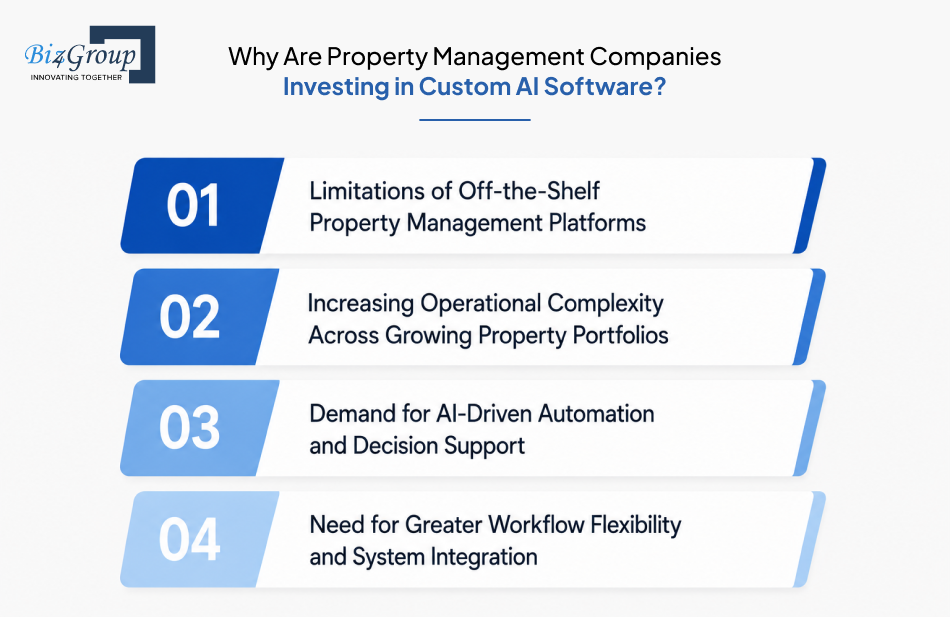
The primary reason property management companies are investing in custom AI software is to gain more control over how their business operates. Custom solutions can streamline complex workflows, eliminate disconnected systems, and support automation strategies that are difficult to achieve with standardized software products.
Off-the-shelf platforms are designed to serve a broad market, which means they often prioritize standardization over flexibility. While this works well for many businesses initially, limitations start becoming more visible as operational requirements become more specific.
A common question property managers ask is: Why not simply add more tools instead of building a custom platform?
Because every additional tool creates another data source, another integration to maintain, and another workflow for teams to navigate. Over time, this can increase complexity rather than reduce it.
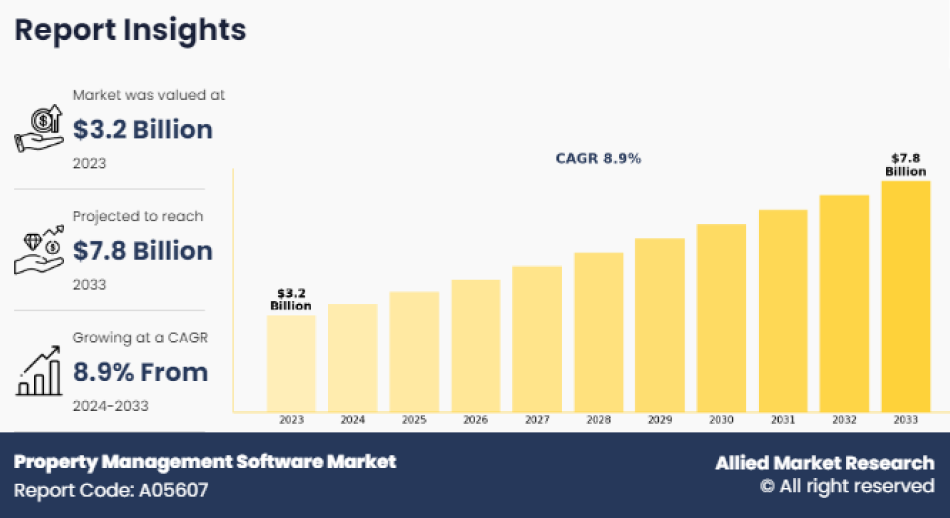
The market itself reflects this shift. According to Allied Market Research, the global property management software market is expected to reach around $7.8 billion by 2033, driven in part by growing demand for AI-enabled and customizable solutions.
As property portfolios grow, operational complexity tends to grow even faster. More properties typically mean more tenants, maintenance requests, lease renewals, vendors, compliance obligations, and reporting requirements.
At what point does this become a technology problem rather than a staffing problem?
Usually when teams spend more time coordinating information than acting on it. If employees are constantly switching between systems, manually updating records, or relying on spreadsheets to fill workflow gaps, the issue often lies in the technology stack rather than the size of the team.
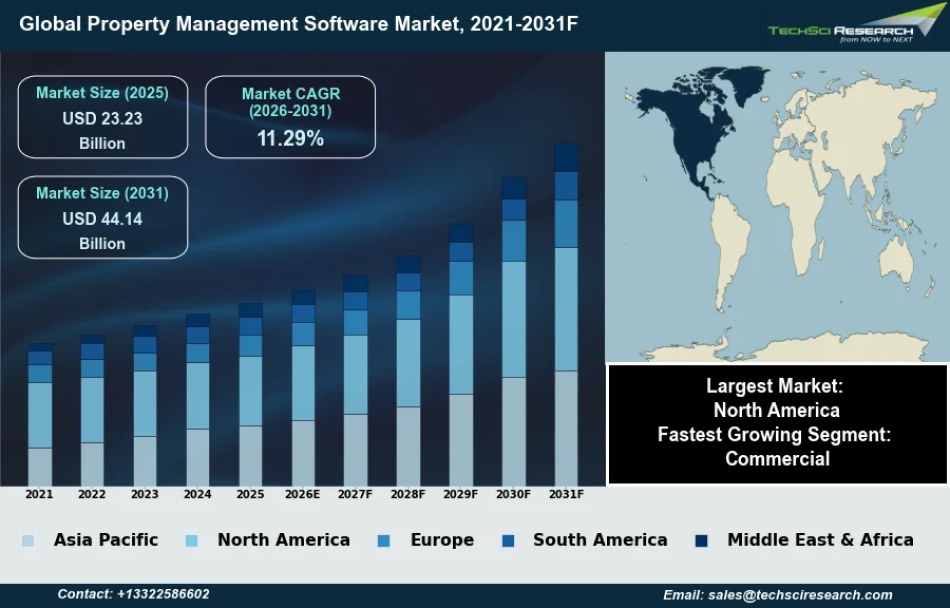
This challenge is particularly relevant in North America, which remains the largest market for property management software due to the increasing need for scalable portfolio management and operational efficiency.
Property managers are under growing pressure to do more with the same resources. That's one reason AI is moving from an experimental technology to a practical business tool.
Tasks such as tenant screening, maintenance prioritization, lease document analysis, communication management, and operational reporting can all benefit from AI-driven automation and decision support.
But is AI adoption actually happening across the real estate industry?
The answer is yes. A report by the National Association of Realtors found that 66% of real estate professionals adopt new technology primarily to save time.
This trend is encouraging many organizations to explore custom platforms and AI automation services that are tailored to their own business processes rather than relying solely on pre-packaged functionality.
Property management operations rarely run on a single system. Most organizations depend on accounting platforms, payment gateways, CRM systems, maintenance tools, communication platforms, and reporting solutions working together.
The challenge is that many legacy systems were never designed to exchange information seamlessly.
Can a property management platform create value if it doesn't integrate with the rest of the business?
In most cases, no. Even the most advanced platform becomes less effective when critical information remains scattered across disconnected systems.
This is one of the main reasons organizations evaluating AI property management software development companies USA increasingly prioritize integration capabilities alongside AI functionality. Research on enterprise AI solutions consistently highlights compatibility with existing workflows and systems as a major factor in successful implementation.
As property management operations continue to evolve, businesses are looking for technology that can adapt alongside them. Custom AI-powered platforms provide a way to support growth, simplify operations, and create a more connected technology ecosystem without being constrained by the limitations of standardized software.
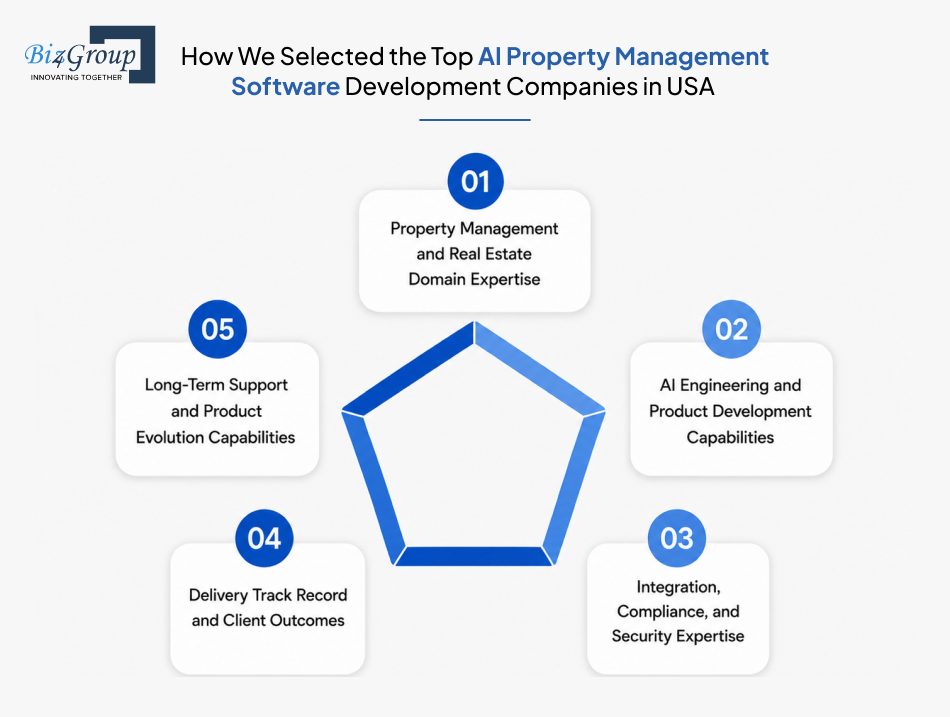
Not every company that offers AI development services is equipped to build property management software. To identify the top AI property management software development companies in USA, we looked beyond marketing claims and evaluated each firm based on five factors that directly influence project success: industry expertise, AI capabilities, technical depth, delivery experience, and long-term support.
One of the first questions worth asking is:
Does the company understand property management, or do they simply understand software development?
There's a big difference.
The companies on this list demonstrate experience with real estate and property management workflows such as tenant management, lease administration, maintenance operations, rent collection, reporting, and portfolio management. This is particularly important for businesses looking to build real estate AI software, where domain knowledge often impacts project outcomes as much as technical expertise.
AI has become a broad term, so we focused on companies that can move beyond basic automation and support real-world AI implementation.
When evaluating vendors, we looked for experience in areas such as predictive analytics, intelligent document processing, conversational AI, workflow automation, and AI model development. The goal was to identify companies capable of building practical AI-powered solutions rather than simply integrating pre-built tools.
Property management platforms rarely operate in isolation. They often need to connect with accounting systems, payment processors, CRM platforms, communication tools, and third-party data sources.
For this reason, we assessed each company's ability to handle:
Strong integration capabilities are often just as important as the software itself because disconnected systems can create operational bottlenecks long after launch.
A polished website doesn't necessarily translate into successful project delivery.
We prioritized companies with evidence of delivering custom software solutions, measurable client outcomes, and relevant industry experience. Whenever possible, we reviewed case studies, client portfolios, and publicly available project information to understand how these firms approach complex software initiatives.
Launching a platform is only the beginning. Property management systems typically evolve as business requirements change, new regulations emerge, and AI capabilities mature.
That's why we also considered each company's ability to provide ongoing support, platform enhancements, maintenance, and future product development services. Organizations investing in custom software are ultimately looking for a long-term technology partner, not just a development vendor.
Together, these criteria provide a practical framework for evaluating AI property management system development companies in USA and identifying partners capable of supporting both current operational needs and future growth.
See how leading AI property management software development companies USA approach AI, integrations, scalability, and property management workflows.
Talk Through Your OptionsThe top AI property management software development companies in USA combine property management expertise, AI engineering capabilities, and experience building scalable software products. Companies such as Suffescom Solutions, AppMakers USA, Wve Labs, Biz4Group LLC, and Saritasa are helping businesses build custom property management platforms, streamline real estate operations, and adopt AI-driven solutions. The firms below represent some of the most notable providers in this space.
Company |
Location |
Clutch Rating |
|---|---|---|
Suffescom Solutions |
New York, NY |
4.9/5 |
AppMakers USA |
Los Angeles, CA |
4.9/5 |
Wve Labs |
Costa Mesa, CA |
5.0/5 |
Biz4Group LLC |
Orlando, FL |
4.9/5 |
Saritasa |
Newport Beach, CA |
4.8/5 |
Atomic Object |
Grand Rapids, MI |
4.9/5 |
BairesDev |
San Francisco, CA |
4.9/5 |
Chetu |
Clearwater, FL |
4.3/5 |
Vention |
New York, NY |
4.9/5 |
Goji Labs |
Los Angeles, CA |
5.0/5 |
Suffescom Solutions is known for developing custom software products across industries such as real estate, healthcare, fintech, and on-demand services. Within the real estate sector, the company focuses on helping businesses build tailored digital platforms that align with their operational requirements, offering an alternative to standardized software solutions.
Property Management Expertise: Property Management Apps, Tenant Management Systems, Rental Listing Platforms, Lease Management Solutions, Real Estate Management Apps, Property Valuation Systems, Enterprise Real Estate Platforms
Best Fit For: Mid-sized property management companies, proptech startups, real estate enterprises, and organizations seeking custom AI-powered property management solutions.
AppMakers USA specializes in custom application development with a strong emphasis on strategy, discovery, and product planning before development begins. Rather than focusing solely on coding, the company positions itself around helping businesses validate ideas, define requirements, and build software solutions aligned with specific operational goals, including those in real estate and property management.
Property Management Expertise: Property Management Applications, Tenant Portals, Rental Management Platforms, Lease Administration Systems, Property Operations Software, Maintenance Management Solutions, Real Estate Mobile Apps
Best Fit For: Property management businesses, startups, and organizations seeking a consultative development approach before committing to a full-scale platform build.
Wve Labs is a product development company known for helping startups and enterprises transform business concepts into market-ready digital products. Its approach combines product strategy, UI/UX design, mobile development, and custom software engineering, making it a strong option for companies building new property management products rather than simply modernizing existing systems.
Property Management Expertise: Property Management Platforms, Rental Property Applications, Tenant Experience Portals, Property Listing Solutions, Maintenance Request Systems, Lease Tracking Platforms, Real Estate Mobile Applications
Best Fit For: Proptech startups, early-stage ventures, and companies developing new AI-powered property management products from the ground up.
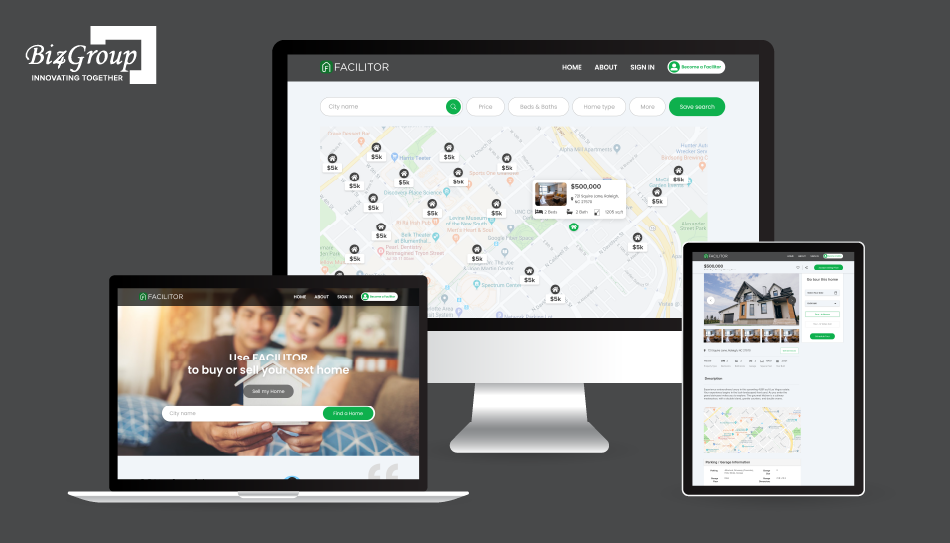
Biz4Group LLC has established a strong reputation in AI, IoT, and custom software development, with extensive experience building business-critical platforms across multiple industries. The company has delivered solutions involving workflow automation, predictive analytics, AI-powered applications, and enterprise platforms, making it particularly relevant for organizations looking to introduce advanced AI capabilities into property management operations.
Property Management Expertise: Property Management Software, Tenant Management Systems, Lease Management Platforms, Smart Building Solutions, Maintenance Automation Systems, Property Analytics Dashboards, Real Estate CRM Solutions
Best Fit For: Mid-sized to enterprise property management companies, proptech startups, and organizations seeking AI-driven operational automation and intelligent property management platforms.
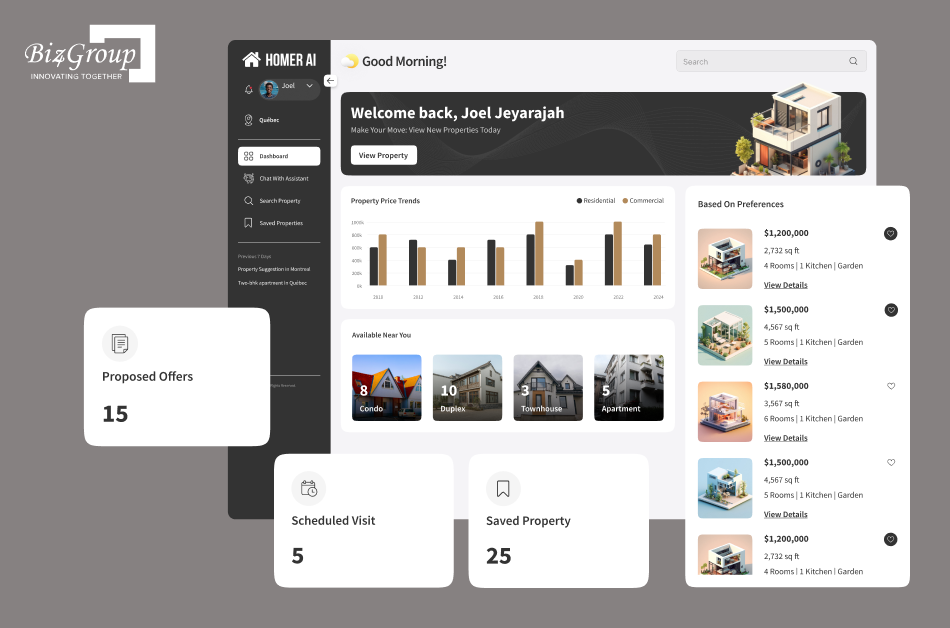
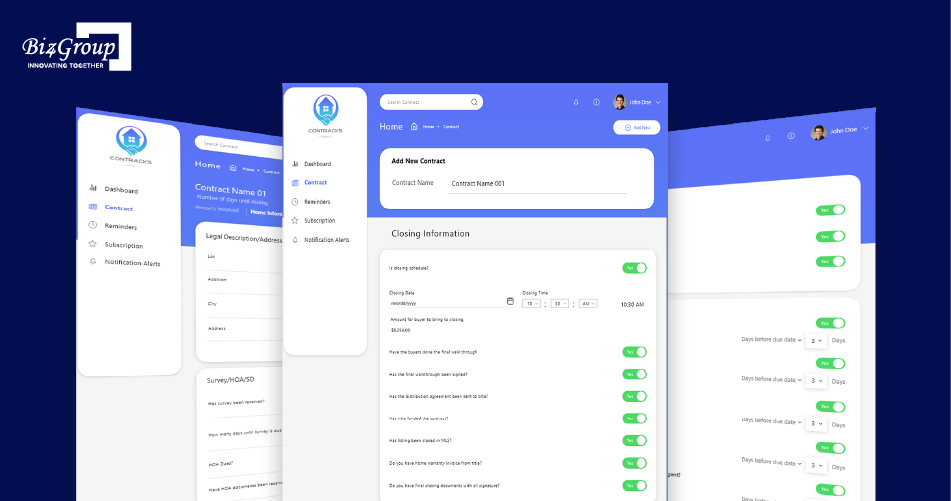
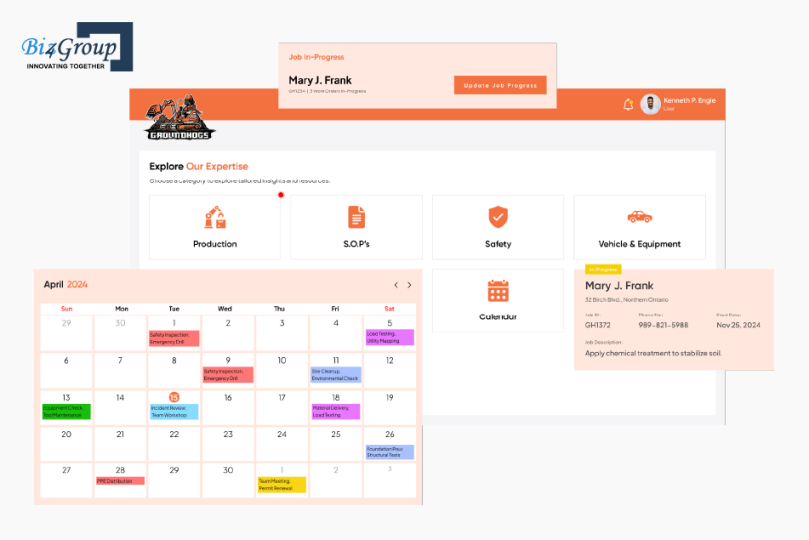
Relevant Case Studies:
Saritasa is a custom software development firm recognized for building complex enterprise applications, mobile solutions, and emerging technology products. The company is particularly known for its work with technologies such as AI, AR/VR, IoT, and business process automation, helping organizations digitize and streamline operational workflows across industries, including real estate.
Property Management Expertise: Property Management Platforms, Facility Management Systems, Tenant Portals, Lease Administration Software, Asset Management Solutions, Property Inspection Applications, Real Estate Operations Platforms
Best Fit For: Established property management firms, commercial real estate operators, and enterprises requiring highly customized software ecosystems with advanced technology integrations.
Atomic Object is a US-based software consultancy that operates through small, cross-functional product teams focused on solving complex business problems. Rather than offering packaged solutions, the company is known for its custom software approach, working closely with clients to design, build, and refine digital products that align with long-term operational goals.
Property Management Expertise: Property Operations Software, Tenant Experience Platforms, Asset Management Systems, Lease Administration Tools, Maintenance Tracking Solutions, Reporting Dashboards, Custom Real Estate Applications
Best Fit For: Mid-market organizations, established property operators, and companies seeking a highly collaborative product development partner.
BairesDev has built one of the largest nearshore software engineering networks in the Americas, giving clients access to specialized development talent across AI, cloud, data engineering, and enterprise software. The company's scale allows it to support both greenfield product development and large modernization initiatives requiring dedicated engineering teams.
Property Management Expertise: Property Management Platforms, Rental Management Systems, Tenant Portals, Property Analytics Solutions, Lease Management Applications, Maintenance Management Systems, Real Estate SaaS Platforms
Best Fit For: Large property management organizations, proptech companies, and enterprises requiring rapid team scaling or long-term engineering support.
Chetu distinguishes itself through its industry-focused development model, maintaining dedicated teams for sectors such as real estate, healthcare, finance, and logistics. The company has extensive experience building software that integrates with existing business systems, which is often a key requirement for property management organizations operating across multiple platforms.
Property Management Expertise: HOA Management Software, Property Accounting Systems, Lease Tracking Platforms, Tenant Management Solutions, Vendor Management Systems, Property Inspection Applications, Real Estate ERP Integrations
Best Fit For: Property management companies seeking custom software that integrates with existing accounting, CRM, ERP, and operational systems.
Vention focuses on helping technology-driven businesses build engineering teams and accelerate software delivery. The company has worked with startups, scale-ups, and enterprise organizations across AI, SaaS, fintech, and real estate, providing access to specialized technical talent for both product development and platform expansion initiatives.
Property Management Expertise: Property Management SaaS Platforms, Tenant Engagement Systems, Lease Administration Software, Property Data Platforms, Maintenance Automation Tools, Real Estate Analytics Solutions, Portfolio Management Applications
Best Fit For: Fast-growing proptech startups, technology-first real estate businesses, and organizations requiring flexible engineering capacity.
Goji Labs is a product strategy and software development firm that places significant emphasis on user experience, product validation, and digital transformation. The company frequently works with startups and innovation-focused organizations, helping them move from concept to launch through a structured product development process.
Property Management Expertise: Property Management Applications, Tenant Self-Service Portals, Rental Marketplace Platforms, Lease Management Systems, Property Operations Tools, Maintenance Request Platforms, Real Estate Mobile Applications
Best Fit For: Startups, emerging proptech companies, and organizations building customer-facing property management products with a strong focus on usability and user adoption.
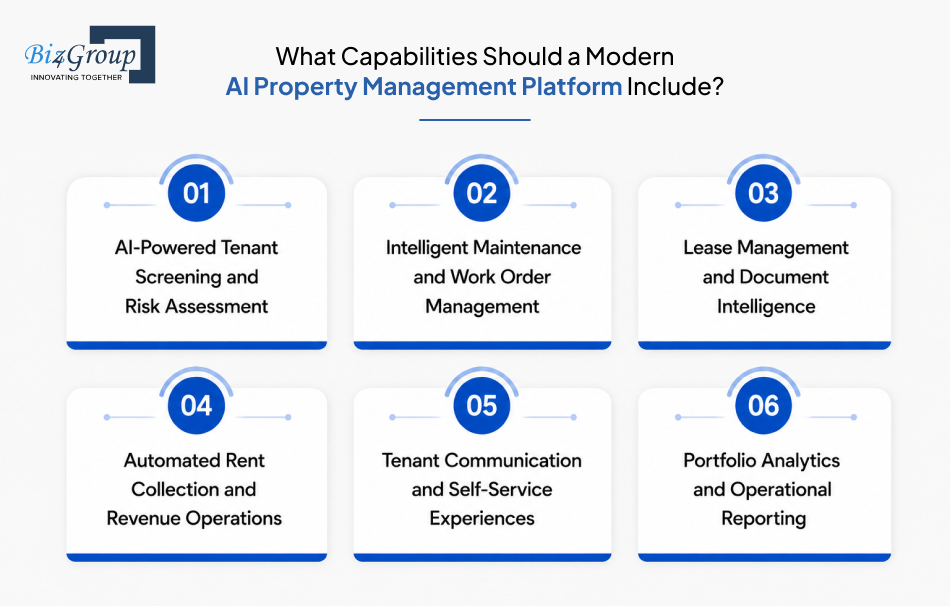
The most effective AI-powered property management platforms typically include six core capabilities: tenant screening and risk assessment, maintenance management, lease intelligence, rent collection automation, tenant self-service experiences, and portfolio analytics. Together, these capabilities help property managers reduce manual work, improve decision-making, and operate more efficiently across residential, commercial, and multifamily portfolios.
Capability |
Why It Matters |
|---|---|
AI-Powered Tenant Screening and Risk Assessment |
Helps evaluate applicants more consistently by analyzing rental history, income, credit information, and other risk factors, reducing the time spent on manual reviews. |
Intelligent Maintenance and Work Order Management |
Automates maintenance workflows, prioritizes requests, tracks work orders, and helps identify recurring issues before they become costly problems. |
Lease Management and Document Intelligence |
Extracts key information from lease documents, tracks renewal dates, and simplifies document management without requiring manual data entry. |
Automated Rent Collection and Revenue Operations |
Streamlines payment collection, automated reminders, revenue tracking, and delinquency management to improve financial operations. |
Enables tenants to submit requests, access information, and receive updates through digital channels without relying on constant staff intervention. |
|
Portfolio Analytics and Operational Reporting |
Consolidates operational, financial, and occupancy data into dashboards and reports that support faster business decisions. |
A common question during custom property management software development discussions is: Do organizations need all of these capabilities from the beginning?
Usually not.
Most property management companies start by solving their biggest operational bottlenecks first, whether that's maintenance management, tenant communication, or reporting. Additional capabilities can then be added as business requirements evolve. This phased approach is often recommended by leading AI property management software development companies in USA because it allows organizations to realize value sooner while reducing implementation risk.
Organizations looking to build AI software for property management often find that prioritizing a few high-impact capabilities initially leads to better adoption and faster business outcomes than trying to launch every feature at once.
Ultimately, the right platform is not the one with the longest feature list. It's the one that aligns its capabilities with the operational needs of the business and supports growth without creating additional complexity.
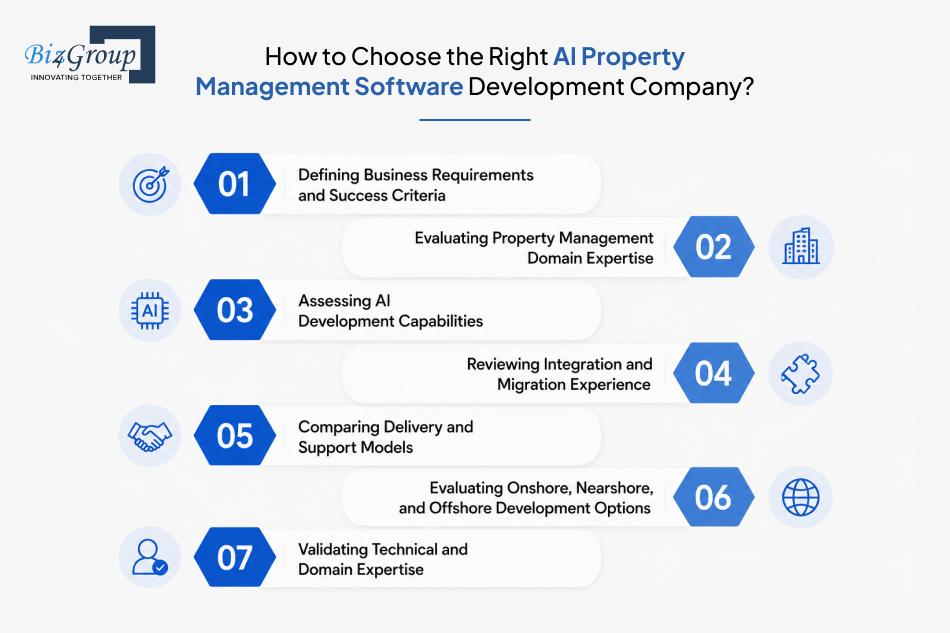
The right AI property management software development company should have a combination of property management expertise, proven AI capabilities, integration experience, and a delivery model that aligns with your business goals. Evaluating vendors against these factors can help reduce project risk and improve the chances of building a platform that delivers long-term value.
Before speaking with vendors, get clear on what you're trying to achieve.
Are you looking to improve tenant screening? Reduce maintenance response times? Consolidate multiple systems into a single platform? The answer matters because different development companies bring different strengths.
A good starting point is to define measurable outcomes. Instead of saying, "We want an AI-powered platform," identify specific goals such as reducing manual workload, improving reporting visibility, or increasing operational efficiency.
One of the most common mistakes buyers make is assuming that software expertise automatically translates into property management expertise. It doesn't.
A company may be highly capable from a technical standpoint but still struggle to design effective solutions if it doesn't understand tenant workflows, lease management, maintenance operations, or rent collection processes.
This often leads to an important question: "I am running a property management company and I want to hire a development company to build AI software for tenant screening and maintenance requests but I do not know what criteria I should actually use to evaluate which company has real AI expertise versus one that is just adding AI as a buzzword."
The simplest way to evaluate this is to ask for evidence, not promises. Request examples of AI solutions they've already delivered, ask how those solutions were used in production, and look for measurable business outcomes. Companies with genuine expertise can explain the problem they solved, how the AI was implemented, and what results it produced.
Not all AI capabilities are created equal. Some vendors focus primarily on integrating third-party AI tools, while others have experience with custom workflows, predictive analytics, intelligent automation, and generative AI applications.
A practical question to ask is: Can they explain when AI is actually necessary and when traditional software is the better option?
Teams that understand this distinction are often better positioned to deliver effective product development services that solve real business problems rather than adding unnecessary complexity.
Even the best property management platform can create problems if it doesn't work well with the systems already running your business.
Most organizations rely on accounting software, payment gateways, CRM platforms, communication tools, and reporting systems. Moving data between these systems is often one of the most challenging parts of a software project.
That's why it's important to evaluate a company's experience with:
A vendor's ability to handle integrations can have a significant impact on adoption, usability, and long-term success.
The way a project is structured can be just as important as the technology itself.
Some companies offer fixed-price engagements, while others provide dedicated teams or long-term product partnerships. Each model has advantages depending on the project's scope and level of uncertainty.
This is particularly relevant for startups and growing businesses asking: "I am running a property management startup and I want to know how long it actually takes to build AI property management software with a development company and what engagement model, like fixed price versus dedicated team, works best for a project at our stage."
The timeline depends on complexity, but most custom AI property management platforms take several months to build. For startups, dedicated teams are often a better fit because requirements tend to evolve throughout the project. Fixed-price models work best when the scope is clearly defined and unlikely to change significantly.
Location can influence cost, communication, project visibility, and collaboration.
Many buyers eventually ask: "I am running a property management business and I am trying to decide whether to hire a US based AI property management software development company or work with an offshore team and I want to understand the real tradeoffs in cost, communication, and quality before making this decision."
The tradeoff is usually straightforward. US-based teams often provide stronger business alignment, easier communication, and greater familiarity with local regulations and market expectations. Offshore teams can reduce development costs but may require more structured communication and project management. Nearshore teams typically offer a balance between the two.
The right choice depends less on geography and more on the complexity of the project, the level of collaboration required, and the expertise of the team.
Before making a final decision, verify everything.
Case studies, client references, technical discussions, discovery workshops, and product demonstrations can provide valuable insight into how a company actually works.
A simple validation checklist includes:
The best AI property management software development companies in USA typically demonstrate both technical depth and industry knowledge. When those two qualities come together, the chances of building a successful platform increase significantly.
Choosing a development partner ultimately comes down to one question: can this team understand your business well enough to build technology that genuinely improves it? The companies that can answer that question with evidence, rather than marketing claims, are usually the ones worth shortlisting.
Custom AI-powered property management systems can automate repetitive tasks, improve response times, and increase operational efficiency across growing portfolios.
See What's Possible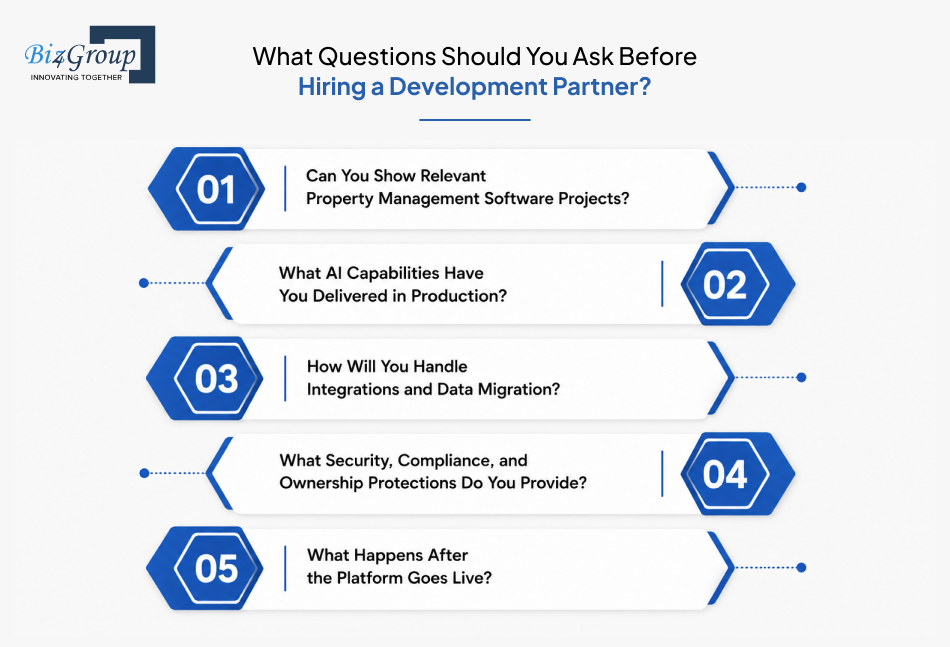
The questions you ask during vendor evaluation can reveal whether a company has genuine property management expertise or simply strong sales messaging. Focus on questions that help validate experience, technical capabilities, delivery processes, and long-term support commitments.
Past projects are often the quickest way to assess whether a company's experience aligns with your goals. A vendor that has worked on property management platforms should be able to explain the workflows involved, the challenges they solved, the integrations they implemented, and the outcomes achieved.
Consider this scenario: "We are a proptech startup and I want to find a software development company in the USA that has actually built AI property management products before and I need to know what questions to ask to verify their past work is relevant to what we are trying to build."
The answer is simple: ask what property management processes the software supported, which users it was designed for, what AI capabilities were included, and whether the platform is still actively used. Relevant experience is usually reflected in the details, not the marketing materials.
There's a major difference between experimenting with AI and successfully deploying it in a live environment.
Ask for examples of AI features that are actively being used by customers today. This could include predictive maintenance, intelligent document processing, workflow automation, or an AI conversation app used for tenant interactions. Production experience often reveals far more about a company's capabilities than discussions about future possibilities.
Most property management businesses already have data spread across multiple systems. Replacing or modernizing a platform often requires moving that data while maintaining business continuity.
A strong development partner should be able to explain how they approach data migration, system integrations, risk mitigation, and testing. If the migration strategy feels like an afterthought, that's usually a sign to dig deeper before proceeding.
Property management software handles sensitive information ranging from tenant records and lease agreements to financial data and operational reports.
Beyond security controls, it's important to clarify who owns the source code, how data is protected, and what rights your organization retains after project completion. This becomes particularly important for companies investing in AI in real estate development, where proprietary workflows and business data can become valuable competitive assets.
Launching a platform is an important milestone, but it's rarely the end of the journey.
Business requirements change, integrations evolve, and new opportunities for automation emerge over time. Ask what support services are available after launch, how issues are handled, what maintenance is included, and how future enhancements are managed. The strongest development partners plan for long-term product growth rather than treating deployment as the final deliverable.
The quality of a vendor's answers often matters as much as the answers themselves. Companies with relevant experience tend to provide specific examples, clear processes, and realistic expectations, while less experienced vendors often rely on broad statements that are difficult to verify.
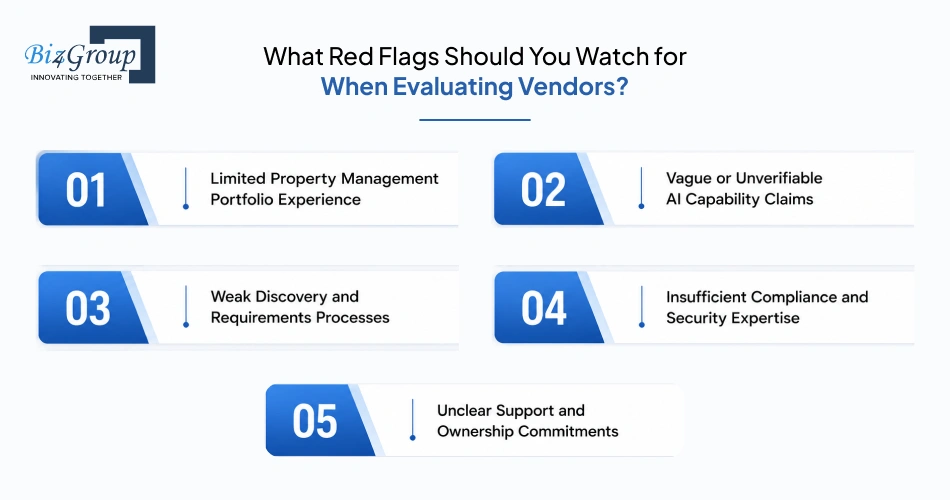
The most common red flags when evaluating AI property management software development companies USA include limited property management experience, unverifiable AI claims, weak discovery processes, insufficient compliance expertise, and unclear support commitments.
Red Flag |
Why It's a Challenge |
What It Can Lead To |
|---|---|---|
Limited Property Management Portfolio Experience |
The vendor lacks proven experience with property management workflows, operational processes, and industry-specific requirements. |
Longer onboarding, more revisions, and solutions that fail to align with real-world property operations. |
Vague or Unverifiable AI Capability Claims |
AI expertise is difficult to validate without production examples, measurable outcomes, or relevant case studies. |
Unrealistic expectations, weak implementations, and costly rework after launch. |
Weak Discovery and Requirements Processes |
The vendor attempts to estimate scope, cost, or timelines before fully understanding business needs. |
Scope creep, budget overruns, missed requirements, and delivery delays. |
Insufficient Compliance and Security Expertise |
Property management software often handles sensitive tenant, financial, and legal data that requires careful protection. |
Compliance risks, security vulnerabilities, and increased exposure to data breaches. |
Unclear Support and Ownership Commitments |
Responsibilities related to maintenance, upgrades, source code ownership, and future enhancements are not clearly defined. |
Vendor dependency, unexpected costs, and limitations when scaling or modifying the platform later. |
A useful rule of thumb is this: if a vendor struggles to provide specific examples, clear processes, or direct answers to important questions, investigate further before moving ahead.
Connect with a team experienced in AI property management system development companies and custom proptech platforms built for long-term growth.
Schedule a Call With Our AI ExpertsA proptech startup building a new SaaS product has very different requirements than a property management firm trying to unify tenant communication, maintenance operations, reporting, and accounting across thousands of units. The right choice depends on your business model, portfolio complexity, integration requirements, and long-term goals.
That's why the smartest buyers focus less on vendor rankings and more on vendor fit.
The companies that consistently deliver successful projects are usually the ones that understand both the technology and the operational realities behind property management. That becomes even more important for organizations investing in real estate AI software development, where business workflows often matter just as much as the AI itself.
If you're still defining requirements, evaluating vendors, or validating a project roadmap, Biz4Group's AI consulting services team can help you assess options, identify risks, and build a practical path forward before development begins.
Have a property management software idea or modernization initiative in mind? Let's discuss what you're trying to achieve and determine whether a custom AI solution is the right fit for your business.
A good indicator is when teams regularly rely on spreadsheets, manual workarounds, or multiple disconnected systems to complete routine tasks. If operational inefficiencies are increasing as your portfolio grows, it may be time to evaluate a custom solution.
Yes. Many organizations start with a few high-impact capabilities such as tenant screening, maintenance automation, or reporting and then expand the platform over time. This approach reduces upfront investment and allows teams to validate requirements before adding new features.
Most projects require a dedicated business stakeholder who can provide requirements, review deliverables, and make decisions throughout development. Involving operations, finance, and property management teams early also helps ensure the platform reflects real-world workflows.
The answer depends on business requirements. Existing platforms often make sense for standardized operations, while proprietary software becomes more attractive when unique workflows, competitive differentiation, advanced automation, or specialized integrations are business priorities.
Both are important, but technical expertise alone is rarely enough. Property management software supports highly specific workflows involving tenants, leases, maintenance, accounting, and compliance. Vendors that understand these processes can often deliver more effective solutions with fewer revisions and misunderstandings.
Focus on scalability, integration flexibility, and modular architecture. A platform should be able to accommodate new AI capabilities, third-party integrations, reporting requirements, and operational processes without requiring a complete rebuild every time the business evolves.

Our website require some cookies to function properly. Read our privacy policy to know more.