Location :
Orlando, FL, USA
Location :
Orlando, FL, USA +1 (407) 714-1616
 info@biz4group.com


















Imagine a digital system that doesn’t wait for instructions but instead, understands your business goals, learns from real-time feedback, and takes independent actions to get the job done.
Read More

How many suspicious claims slip through your system because your fraud tools react too late? Insurance fraud no longer looks obvious. It hides inside legitimate behavior, spreads across channels, and adapts faster than traditional detection models.
The Coalition Against Insurance Fraud estimates that fraud drains $308.6 billion annually from the US insurance industry. That reality has pushed insurers to rethink their foundations, starting with agentic AI development for insurance fraud detection.
Rules based engines once felt reliable. Today, they feel rigid. Fraud patterns change weekly, sometimes daily. Static logic cannot keep up. That is why businesses are investing in agentic AI development for insurance fraud detection systems that observe, reason, and respond in real-time. These systems connect signals, question anomalies, and escalate risks with context.
The shift is not about replacing teams. It is about empowering them. When insurers develop agentic AI solutions for insurance fraud detection, investigators spend less time chasing noise and more time validating real threats.
Claims move faster. Customers feel trusted. Compliance teams gain clearer audit trails.
The operational ripple effect is hard to ignore.
Providers that choose to build agentic AI fraud detection platform for insurers today position themselves ahead of the curve. Those who delay, risk falling behind systems that learn, decide, and improve every single day.
Agentic AI changes how fraud detection behaves inside insurance operations. Instead of waiting for rules to trigger alerts, these systems think in sequences.
They observe. They decide. They act. All within guardrails defined by insurers.
At its core, agentic AI development for insurance fraud detection focuses on autonomy with accountability. Each AI agent has a role. One agent reviews claim intake signals. Another analyzes behavioral patterns. A third evaluates risk escalation paths. Together, they work like a coordinated investigation unit.
Traditional systems follow instructions. Agentic systems follow intent.
|
Aspect |
Traditional Fraud Tools |
Agentic AI Systems |
|---|---|---|
|
Core Approach |
Follow predefined rules and instructions |
Operate on intent and desired outcomes |
|
Adaptability |
Depend on historical fraud patterns |
Continuously adapt to new and emerging fraud behaviors |
|
Context Awareness |
Analyze transactions in isolation |
Reason across behavior, timing, and relationships |
|
Handling Anomalies |
Flag known patterns only |
Question anomalies and investigate contextually |
|
Workflow Design |
Function as siloed tools |
Collaborate across end-to-end workflows |
|
Fraud Readiness |
Reactive to known threats |
Proactive against evolving fraud tactics |
Agentic AI development for insurance fraud detection systems relies on a few foundational building blocks.
This structure mirrors how insurers already operate. The difference is speed and consistency.
Agentic AI does not look for a single red flag. It looks for patterns that do not add up.
This layered reasoning explains why studies show AI can detect and prevent up to 90% of fraudulent claims when designed correctly and deployed with the right controls.
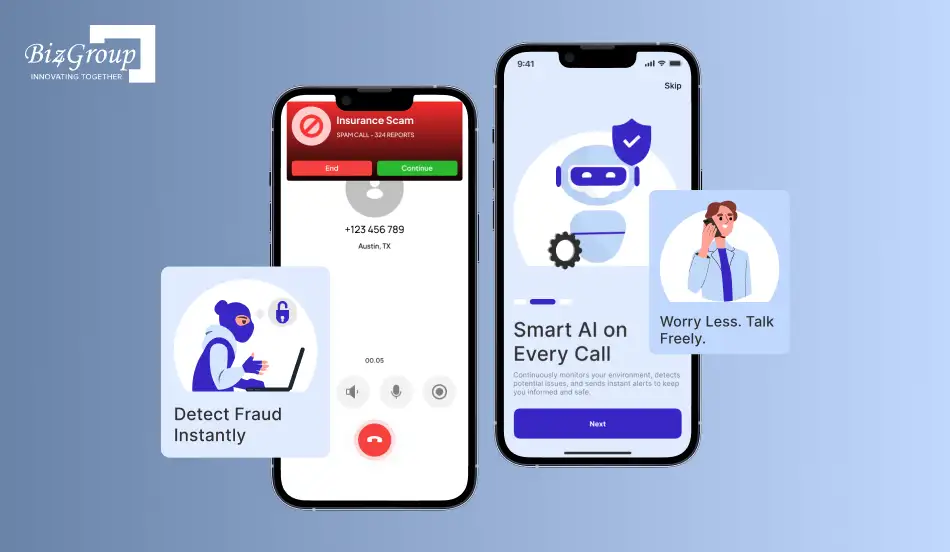
Biz4Group applied these principles while building a real-time AI Fraud Call Detection App. The system:
It uses multiple decision layers to balance speed, accuracy, and cost.
The takeaway for insurers is clear. Agentic AI can operate in high pressure environments where decisions matter in seconds, not days. When designed correctly, it supports investigators instead of overwhelming them.
Static rules cannot keep up with fraud that learns every day. Agentic AI can.
Build Smart with Biz4GroupInsurance fraud is not slowing down. It is getting smarter, more automated, and harder to catch with legacy tools. The problem shows up in every line of business from auto to health, life to property.
The numbers back it up. Insurance fraud drains an estimated $308.6 billion annually in the U.S. alone, driving up premiums and reducing profitability for carriers.
Around 10% of property and casualty claims are fraudulent, translating to nearly $122 billion in losses every year for that single segment of insurance.
Traditional fraud detection tools often miss sophisticated schemes and generate high false positive rates. Insurers pay for that gap in three ways:
A 2025 fraud trends report found fraud linked to identity theft alone could rise by 49% by year’s end, pushing more complex fraud patterns into the mainstream.
Agentic AI development for insurance fraud detection delivers value across operations. Below is a snapshot of key business benefits:
|
Benefit |
What It Means for Insurers |
|---|---|
|
Faster Detection |
Agents analyze behavior and identify suspicious patterns instantly |
|
Improved Accuracy |
Reduces false positives that waste investigator time |
|
Lower Costs |
Less manual review and fewer payouts on fraudulent claims |
|
Better Customer Trust |
Genuine claims process faster and with less friction |
|
Scalable Workflows |
Detect fraud at scale without adding headcount |
Another important point is that agentic AI can support existing fraud ecosystems instead of replacing them. You can integrate these systems into your current workflows, using them to triage cases, prioritize high-risk claims, and suggest next steps for human investigators.
To build this right, insurers must think beyond algorithms. They need to consider data quality, integration into claims systems, investigator feedback loops, and scalable architecture that grows with volume.
Also read: A guide to building a scalable agentic AI workflow automation system
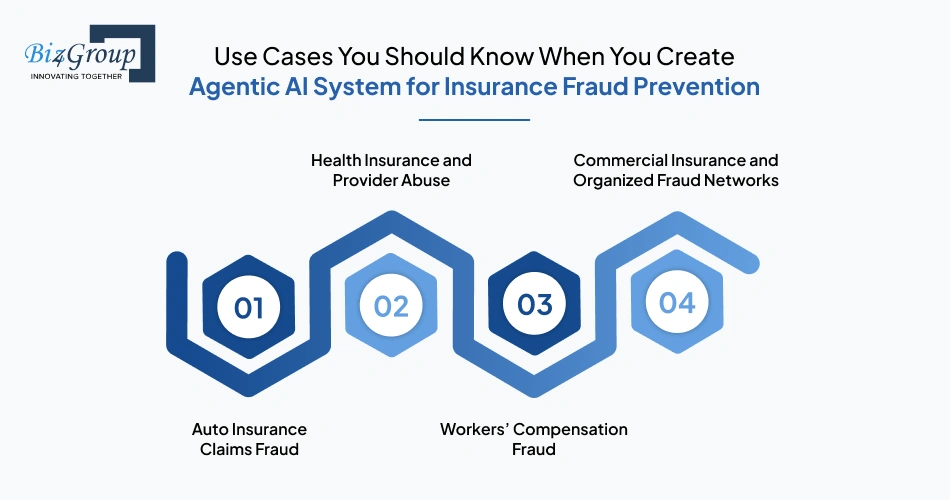
Agentic AI shows its real value when it moves from theory into day-to-day insurance workflows. Fraud rarely looks the same twice. It changes by product line, customer behavior, and external triggers.
That is exactly why insurers develop agentic AI solutions for insurance fraud detection that can adapt across multiple use cases without constant reprogramming.
Auto insurance remains one of the most fraud prone segments. Agentic AI development for insurance fraud detection systems helps insurers identify staged accidents, inflated repair bills, and duplicate claims by analyzing behavioral patterns, historical claims, and third-party data together.
Instead of flagging every anomaly, the system builds context before escalating risk.
Health insurance fraud often hides inside legitimate looking claims. Autonomous AI agents review billing patterns, treatment frequency, and provider behavior over time. When insurers build AI-driven fraud detection tools for insurance companies, these agents continuously monitor for abnormal trends rather than isolated events.
Document heavy workflows benefit even more when paired with intelligent validation layers like those used in advanced AI document fraud detection software.
Workers' compensation fraud often involves subtle inconsistencies. Agentic AI systems correlate claim timelines, medical reports, employment data, and behavioral signals. This approach allows insurers to create scalable agentic AI solutions for insurance fraud prevention without overwhelming investigators with low-risk alerts.
Commercial fraud rarely operates in isolation. Agentic AI development for insurance fraud detection enables network level analysis across policies, businesses, and claims. Autonomous agents surface hidden relationships and coordinated behavior that rule based systems fail to catch.
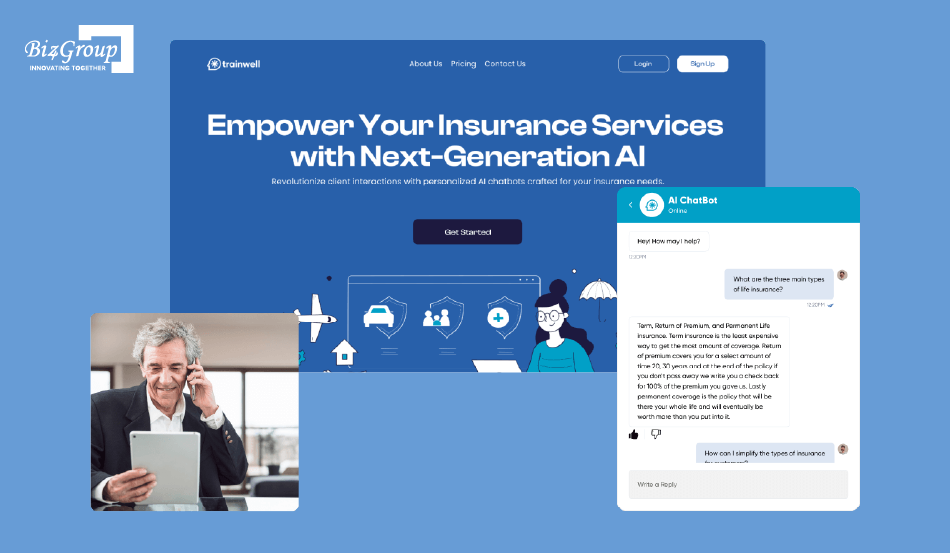
Biz4Group built Insurance AI, an intelligent insurance focused AI solution designed to support insurance teams with speed, accuracy, and continuous learning.
This same foundation supports insurers aiming to develop autonomous AI systems for insurance fraud detection that assist teams rather than disrupt them.
Insurance leaders exploring insurance AI agent development often start here. They modernize internal workflows first, then extend intelligence into fraud detection and claims automation through insurance AI automation software development.
Insurers using adaptive AI spot cross claim fraud up to 3x faster across auto, health, and commercial lines.
Book a Strategy Call TodayStrong results in agentic AI development for insurance fraud detection do not come from a single model or rule engine. They come from a thoughtfully designed platform where intelligence, governance, and usability work together. Insurers that invest in the right features upfront see faster adoption, better accuracy, and measurable operational gains.
Below are the essential features insurers should prioritize when they build AI-driven fraud detection tools for insurance companies.
|
Feature |
What It Does |
Why It Matters for Insurers |
|---|---|---|
|
Autonomous Claim Triage |
Evaluates incoming claims and assigns risk levels automatically |
Reduces manual review workload and speeds up claim processing |
|
Multi Agent Risk Scoring |
Uses multiple AI agents to analyze behavior, history, and context |
Improves accuracy and reduces false positives |
|
Explainable Decision Logs |
Records how and why each decision was made |
Supports audits, compliance, and investigator trust |
|
Human Review Workflows |
Routes high risk cases to investigators with full context |
Keeps humans in control of final outcomes |
|
Cross Claim and Policy Analysis |
Detects patterns across claims, policies, and entities |
Identifies organized and repeat fraud |
|
Document and Data Validation |
Reviews claims documents for inconsistencies and anomalies |
Strengthens fraud detection in document heavy workflows |
|
Real Time Alerts and Escalation |
Notifies teams instantly when risk thresholds are crossed |
Enables faster response to active fraud |
|
Integration Ready Architecture |
Connects with core insurance systems and third-party data |
Simplifies deployment and scaling |
|
Feedback and Learning Loop |
Learns from investigator decisions and outcomes |
Improves performance over time without retraining from scratch |
These features work best when designed as part of a broader ecosystem that supports AI integration across claims, underwriting, and investigations. When done right, insurance fraud detection software development with agentic AI becomes a living system. It adapts, learns, and strengthens with every claim it reviews.
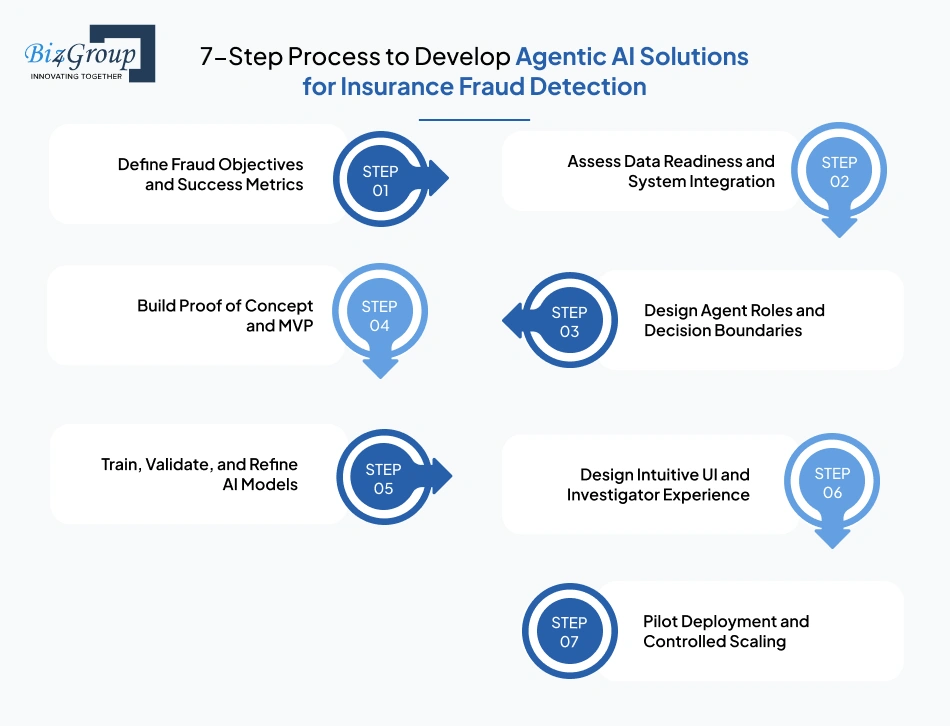
Building a reliable agentic AI platform for insurance fraud detection requires more than strong models. It demands structure, clarity, and a phased approach that reduces risk while delivering value early.
Below is a proven seven step process insurers follow to develop agentic AI systems they can trust and scale.
Every successful agentic AI development for insurance fraud detection initiative starts with clarity. Insurers need to define what fraud means within their business context. That includes identifying high risk claim types, common fraud patterns, and acceptable false positive thresholds.
Clear KPIs guide agent behavior. Without the foundation, even the most advanced system struggles to deliver meaningful results.
Data fuels agentic AI systems. Insurers must evaluate the quality, availability, and consistency of claims data, policy data, and third-party sources. Gaps here often become the biggest roadblock later.
Integration planning happens early. Systems should connect smoothly with core platforms through reliable AI integration services. This ensures autonomous agents operate within existing workflows instead of creating parallel processes.
Agentic AI development for insurance fraud detection systems depends on clearly defined roles. One agent may handle intake validation. Another may focus on behavioral analysis. A third may assess network level risk.
Decision boundaries matter just as much. Agents need clear thresholds for escalation and human review. This structure allows insurers to develop autonomous AI systems for insurance fraud detection while maintaining accountability.
Before scaling, insurers should validate assumptions. A focused proof of concept reduces risk and surfaces integration challenges early. This stage helps teams test real data, workflows, and decision logic.
Many insurers rely on agentic AI POC development and MVP development services to move quickly without over committing resources. The goal is learning, not perfection.
Also read: Top 12+ MVP development companies in USA
Training involves more than feeding data into models. Insurers must validate outcomes against real investigation decisions and historical cases. This ensures accuracy aligns with business expectations.
Continuous refinement is key. Feedback from investigators feeds into learning loops, allowing agents to improve without disrupting live operations.
Even the smartest system fails if users resist it. UI and UX design play a critical role in adoption. Investigators need clear explanations, intuitive dashboards, and easy access to context.
A seasoned UI/UX design company helps insurers create interfaces that support trust and efficiency. A strong experience reduces training time and improves decision confidence.
Also read: Top 15 UI/UX design companies in USA
Pilot deployments test systems under real conditions. Insurers monitor performance, adjust thresholds, and fine tune workflows before full scale rollout.
Scaling follows proven results. Infrastructure expands. Agents take on more tasks. Over time, insurers build agentic AI platforms that evolve alongside fraud tactics and business growth.
Building an effective agentic AI platform for insurance fraud detection is a journey, not a one-time deployment. When done right, agentic AI development for insurance fraud detection becomes a long-term capability that strengthens operations, protects customers, and supports smarter decision making at scale.
Structured pilots help insurers reduce AI rollout risks by over 40% before scaling.
Launch Your Fraud AI Pilot in 2-3 Weeks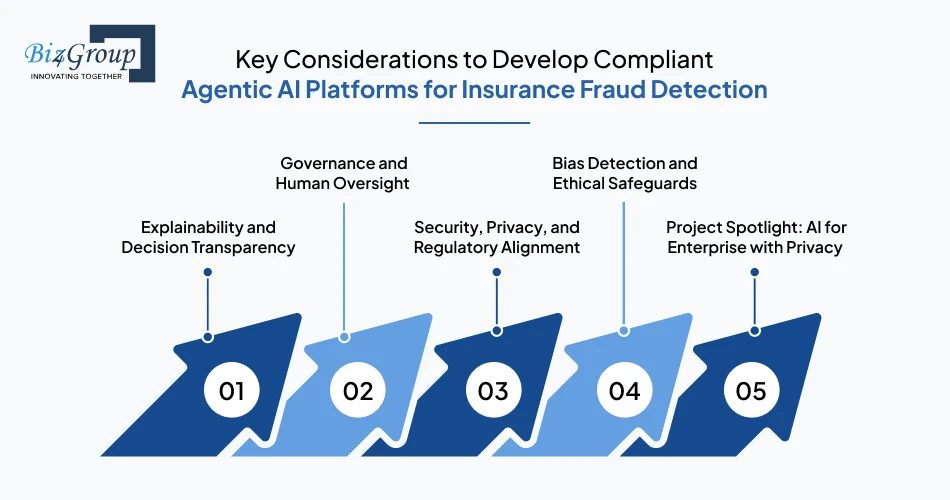
Trust decides whether agentic AI succeeds or fails inside insurance organizations. Fraud detection systems influence payouts, investigations, and customer outcomes. That makes transparency, governance, and compliance non-negotiable when insurers develop agentic AI solutions for insurance fraud detection.
Below are the core pillars insurers must build into their platforms from day one.
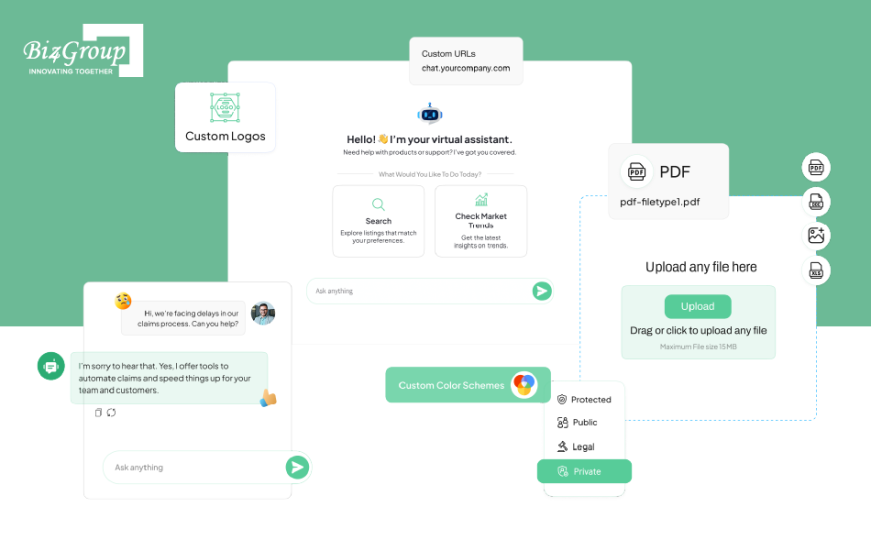
Biz4Group’s custom enterprise AI agent project demonstrates how privacy-first, compliant AI systems are built for regulated industries. The solution was designed to automate workflows while maintaining strict security and compliance standards.
These principles apply directly when insurers aim to develop compliant agentic AI platforms for insurance fraud detection. The same architecture supports secure integrations, scalable workflows, and audit ready operations.
Organizations exploring how to build agentic AI systems often start by strengthening governance and security. That approach reduces risk and accelerates adoption across business units.
When insurers plan agentic AI development for insurance fraud detection, cost is one of the first questions that comes up.
The honest answer is that pricing varies widely based on scope, data complexity, and compliance requirements. On average, organizations can expect an initial investment range of $30,000-$150,000+, depending on how far they want to go and how fast.
To make this more concrete, here is a high-level view of how costs typically evolve from an MVP to a full-scale enterprise platform.
|
Stage |
What It Covers |
Typical Investment Range |
|---|---|---|
|
MVP |
Core agents, limited data sources, pilot workflows |
$30,000-$60,000 |
|
Advanced |
Multi agent orchestration, integrations, explainability |
$60,000-$100,000 |
|
Enterprise |
Full compliance, scalability, advanced governance |
$100,000-$150,000+ |
These ranges reflect common scenarios for insurers aiming to build agentic AI fraud detection platforms that deliver measurable value without unnecessary complexity early on.
Several factors influence how much insurers ultimately spend. Understanding these upfront helps teams plan smarter and avoid surprises.
|
Cost Driver |
Why It Impacts Budget |
Typical Cost Impact |
|---|---|---|
|
Data Complexity |
More sources and unstructured data increase effort |
$5,000-$25,000 |
|
Agent Architecture |
Number of agents and orchestration logic |
$10,000-$40,000 |
|
Model Training and Validation |
Accuracy, bias testing, and tuning |
$8,000-$30,000 |
|
System Integrations |
Connecting claims, policy, and third-party systems |
$7,000-$35,000 |
|
Compliance and Security |
Audit trails, encryption, access controls |
$10,000-$30,000 |
|
UI and Investigator Tools |
Dashboards and explainability interfaces |
$5,000-$20,000 |
Each of these elements compounds as the platform scales. That is why insurers often start small, then expand once value is proven.
Many budgets miss secondary costs that surface after deployment. Planning for these early keeps projects on track.
Data Preparation and Cleanup
Historical claims data often needs normalization and enrichment before agents can reason effectively. This work can add $5,000-$15,000 depending on data quality.
Change Management and Training
Investigators and claims teams need onboarding and support. Training programs and internal enablement can add $3,000-$10,000.
Ongoing Model Monitoring
Fraud patterns shift. Continuous monitoring, tuning, and bias checks may cost $2,000-$8,000 annually.
Infrastructure Scaling
As claim volume grows, compute and storage costs increase. Cloud expansion can add $5,000-$20,000 per year at scale.
Regulatory Adjustments
New compliance requirements often require system updates. These changes typically range from $3,000-$12,000 over time.
These costs are manageable when anticipated. They become disruptive when ignored.
Cost control does not mean cutting corners. It means making smarter design decisions.
Many insurers also review agentic AI development cost benchmarks to align expectations and phase investments more strategically.
Agentic AI development for insurance fraud detection is an investment, not a line item. When budgets align with clear objectives, governance, and phased execution, insurers see strong ROI and long-term operational gains. The key is building a platform that grows with the business, adapts to fraud evolution, and delivers value well beyond the initial spend.
Also read: How much does it cost to develop Agentic AI?
Many insurers recover their AI investment within 6-12 months by cutting false claims and manual reviews.
Get Your Cost BreakdownROI is where agentic AI moves from innovation talk to boardroom relevance. Insurance leaders want proof that investments in agentic AI development for insurance fraud detection translate into measurable financial and operational gains. The good news is that ROI becomes visible faster than many expect when the right metrics are tracked from day one.
The key is to measure impact across operations, finance, and customer experience instead of relying on a single success indicator.
Most insurers evaluate agentic AI fraud detection solution development using a combination of quantitative and operational metrics.
|
ROI Metric |
What Changes After Implementation |
Business Impact |
|---|---|---|
|
False Positive Reduction |
Fewer low risk claims flagged |
Lower investigation costs |
|
Investigation Cycle Time |
Faster claim reviews |
Improved operational efficiency |
|
Fraud Loss Reduction |
Fewer fraudulent payouts |
Direct savings on loss ratios |
|
Investigator Productivity |
More cases handled per analyst |
Better use of skilled resources |
|
Claim Processing Speed |
Faster approvals for genuine claims |
Improved customer satisfaction |
These improvements compound over time as autonomous agents learn from outcomes and investigator feedback.
Agentic AI development for insurance fraud detection systems often delivers ROI in two phases.
The first phase focuses on operational savings. Reduced manual reviews and faster case resolution typically show results within the first few months.
The second phase is strategic. As detection accuracy improves, insurers see sustained reductions in fraud losses and stronger compliance confidence. This is where true value emerges. Platforms designed as part of broader enterprise AI solutions integrate smoothly with claims, underwriting, and analytics systems, amplifying returns across departments.
Insurers that see the strongest ROI follow a structured measurement approach.
|
Phase |
What to Measure |
Why It Matters |
|---|---|---|
|
Baseline |
Pre AI fraud rates and costs |
Establishes clear comparison |
|
Pilot |
Accuracy and investigator feedback |
Validates assumptions |
|
Scale |
Cost savings and loss reduction |
Confirms business value |
|
Ongoing |
Model performance and drift |
Protects long term ROI |
This discipline ensures agentic AI does not become a static tool. It remains a living system that improves outcomes year after year.
Agentic AI development for insurance fraud detection pays off when insurers treat it as a capability, not a feature. The strongest returns come from aligning technology with people, process, and governance. When done right, ROI shows up not only on balance sheets but also in faster decisions, stronger trust, and a more resilient fraud prevention strategy.
One of the most common questions insurance leaders ask is whether to buy an off-the-shelf fraud tool or invest in custom agentic AI development for insurance fraud detection. The right choice depends on control, scalability, and compliance needs.
The table below outlines how buying and building compare across key decision factors.
|
Decision Factor |
Buy Off-the-Shelf Solution |
Build Custom Agentic AI Platform |
|---|---|---|
|
Speed to Deploy |
Fast initial setup |
Phased rollout with learning curve |
|
Customization |
Limited to vendor features |
Fully tailored to business workflows |
|
Fraud Logic Control |
Vendor defined models and rules |
Insurer controlled decision logic |
|
Scalability |
Bound by product limitations |
Scales with business growth |
|
Explainability |
Often limited or opaque |
Built in transparency and auditability |
|
Compliance Flexibility |
Generic compliance coverage |
Designed for insurer specific regulations |
|
Integration |
Fixed connectors |
Deep integration with core systems |
|
Long Term Cost |
Subscription based, recurring |
Higher upfront, lower long-term cost |
|
Competitive Differentiation |
Minimal |
High |
Buy when
Build when
Choose a hybrid approach when
Also read: Top 14 agentic AI development companies in USA
The real question is not buy or build. It is how long you plan to compete.
Talk to an Agentic AI Expert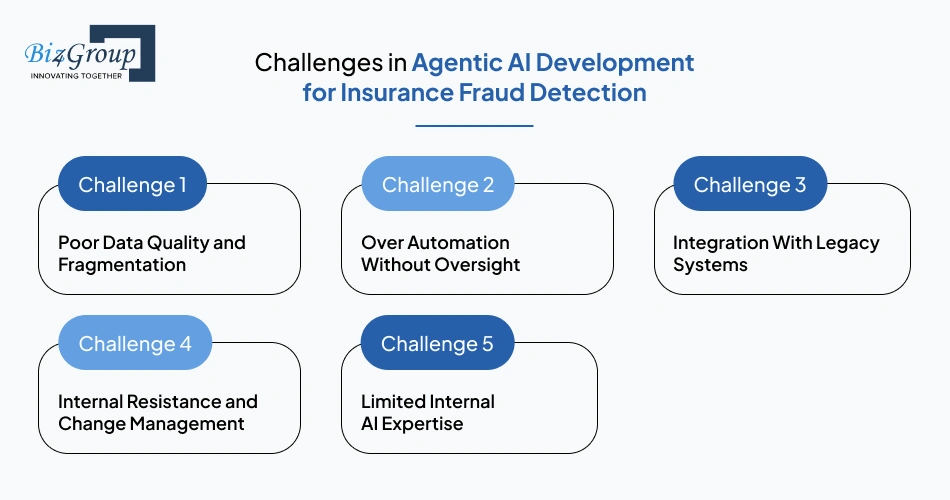
Agentic AI delivers strong results when implemented thoughtfully. When rushed or poorly governed, it can create friction. Understanding common challenges early helps insurers avoid setbacks and build agentic AI development for insurance fraud detection systems that scale with confidence.
Insurance data often lives across multiple systems. Inconsistent formats, missing fields, and outdated records limit how effectively agents reason and collaborate.
How to Mitigate
Autonomy without guardrails erodes trust quickly. Teams may hesitate to rely on systems that appear to act independently without explanation.
How to Mitigate
This balance aligns well with how insurers approach AI automation across claims and investigations.
Many insurers rely on older core platforms that were not designed for intelligent automation. Integration complexity can slow deployment.
How to Mitigate
Investigators and claims teams may see agentic AI as a threat rather than support. Adoption suffers when users are not included early.
How to Mitigate
Building and managing autonomous systems requires specialized skills that many insurers lack internally.
How to Mitigate
Addressing these challenges early transforms agentic AI from a risky experiment into a trusted fraud detection capability. Insurers that plan for complexity upfront move faster and achieve stronger outcomes.
Biz4Group LLC is an experienced agentic AI development company that designs and builds advanced software products for businesses that want to lead their markets, not follow them. Our focus goes beyond writing code. We engineer intelligent systems that solve real operational problems, especially in regulated industries like insurance where trust, compliance, and accuracy matter every day.
As a full service software development company in the USA, we bring strategy, architecture, design, and engineering together under one roof. Our clients trust us because we do not sell shortcuts. We build solutions that last, adapt, and grow as business needs evolve. When insurers work with Biz4Group, they gain a partner that understands both the technology and the responsibility that comes with deploying AI in high stakes environments.
Our work spans autonomous agents, secure data pipelines, explainable decision frameworks, and enterprise integrations that fit seamlessly into existing ecosystems.
Businesses choose Biz4Group because we consistently deliver where it matters most.
Clients often tell us that working with Biz4Group feels less like outsourcing and more like extending their internal team. We take the time to understand goals, constraints, and long term vision. That approach leads to smarter decisions, faster execution, and solutions that teams actually trust and adopt.
Choosing a technology partner is a strategic decision. It shapes not only what you build, but how well it performs under pressure and how easily it adapts to change. Biz4Group LLC has earned its reputation by delivering intelligent systems that perform in the real world, not just in demos.
Let’s build something phenomenal for you. Let's talk.
Agentic AI development for insurance fraud detection is reshaping how insurers protect revenue, customers, and trust. Fraud has become adaptive and coordinated, which makes static tools and rigid rules increasingly ineffective. Autonomous AI systems that reason, learn, and collaborate within defined guardrails give insurers the ability to respond with the same speed and intelligence as modern fraud networks.
What makes agentic AI powerful is not autonomy alone. It is the balance between independent decision making and human oversight. When designed correctly, these systems reduce false claims, accelerate investigations, and strengthen compliance without disrupting existing workflows.
This is where Biz4Group LLC stands apart. As a trusted software development company, we help insurers design and build agentic AI fraud detection platforms that are transparent, secure, and scalable. Our experience across AI agents, enterprise systems, and regulated environments allows us to turn complex requirements into reliable solutions that deliver measurable business outcomes.
If you are ready to move beyond reactive fraud prevention and build a system your teams can trust, let us talk. Partner with Biz4Group LLC and start building an agentic AI fraud detection platform that works for your business today.
Yes. Agentic AI platforms are designed to consume signals from external data providers such as identity verification services, repair networks, medical billing systems, and public records. These external inputs help agents build richer context and improve fraud detection accuracy.
When designed properly, it often reduces scrutiny. Regulators focus on transparency, fairness, and auditability. Agentic AI systems that log decisions, document reasoning, and maintain clear oversight tend to support regulatory reviews rather than complicate them.
Agentic AI does not rely on fixed patterns alone. It evaluates behavior, relationships, and context. When new tactics appear, agents identify anomalies and escalate them for review. Over time, feedback from these investigations helps the system adapt to emerging threats.
Customization depends on business rules, product mix, and regulatory environment. Most insurers customize agent roles, escalation thresholds, and reporting views rather than core intelligence. This approach keeps systems flexible without overengineering.
When deployed correctly, customers experience fewer delays and fewer unnecessary investigations. Legitimate claims move faster, while suspicious cases are handled quietly in the background. This improves satisfaction without signaling distrust.
Insurers should look for experience in regulated industries, a clear approach to governance, and the ability to build explainable systems. Long term support, security practices, and proven delivery models matter as much as technical capability.

with Biz4Group today!
Our website require some cookies to function properly. Read our privacy policy to know more.