Location :
Orlando, FL, USA
Location :
Orlando, FL, USA +1 (407) 714-1616
 info@biz4group.com


















Imagine a digital system that doesn’t wait for instructions but instead, understands your business goals, learns from real-time feedback, and takes independent actions to get the job done.
Read More

 AI Summary Powered by Biz4AI
How much growth is your accounting firm losing to work that should already be automated?
Many CPA firms are not struggling because of a lack of clients. They are struggling with the operational workload that sits behind every engagement. Document requests, client follow-ups, approval cycles, task tracking, and billing activities consume valuable time that could otherwise be spent on client service and revenue-generating work.
The impact is difficult to ignore:
As these inefficiencies grow, firms are looking for ways to streamline operations without continuously increasing headcount. This is where AI accounting practice management software is starting to deliver measurable value. Professionals using AI report saving an average of five hours per week, giving teams more time to focus on higher-value accounting and advisory work.
As a result, interest in AI accounting practice management software development is growing rapidly among CPA firms, software development companies, and accounting technology startups.
Many decision-makers find themselves asking:
"We run a mid-sized CPA firm in the US, completely buried in manual workflows, client follow-ups, document chasing, and billing. We want to build a custom practice management software that uses AI to automate all of this. But we have no idea what features to include, what architecture should look like, or how much something like this would cost to develop."
If you’re also thinking along the same lines, then let's dive in for deeper insights.
During AI accounting firm practice management software development, the first question is not what features to build. It is understanding what this platform actually does and the role it plays inside modern CPA firms.
AI accounting practice management software is a business operations platform designed for accounting firms, CPA practices, and bookkeeping businesses. It combines practice management capabilities with artificial intelligence to help firms coordinate work, manage operational processes, and make routine decisions more efficiently.
Rather than functioning as a standalone AI tool, it embeds intelligence directly into day-to-day accounting operations to reduce manual effort and improve how work moves across the firm.
Core Purpose of AI Accounting Practice Management Software
If you have used traditional practice management software before, you might be wondering what actually changes when AI enters the picture. The differences go far beyond adding a chatbot or a few automation features. Take a look:
|
Area |
Traditional Practice Management Software |
AI Accounting Practice Management Software |
|---|---|---|
|
Workflow Management |
Teams manually monitor tasks, deadlines, and workloads. |
Work is prioritized dynamically with greater visibility into bottlenecks and upcoming deadlines. |
|
Document Handling |
Documents must be organized, reviewed, and routed manually. |
Files are automatically categorized, processed, and directed to the appropriate workflow. |
|
Client Communication |
Staff members spend time sending reminders and follow-ups. |
Routine communication is triggered automatically based on workflow activity. |
|
Task Assignment |
Managers distribute work based on manual planning. |
Workloads are balanced using real-time capacity and deadline data. |
|
Reporting & Insights |
Primarily focused on tracking completed work. |
Provides forward-looking insights that support planning and operational decisions. |
|
Team Focus |
Significant time is spent on administrative coordination. |
More time is available for client service, advisory work, and review activities. |
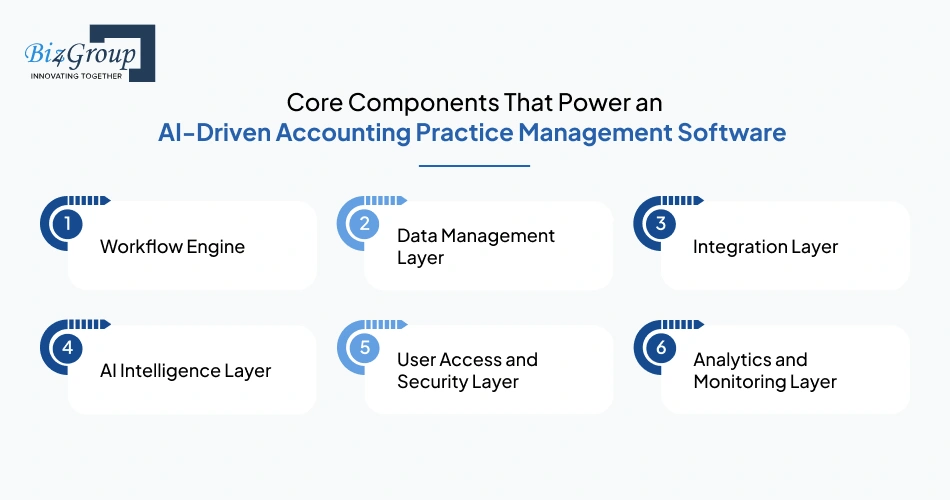
Behind every AI-driven accounting practice management platform is a collection of core system components that work together to support workflows, data movement, automation, and decision-making. While users interact with dashboards and day-to-day processes, these underlying layers are responsible for keeping the platform connected, secure, and scalable.
Together, these components create the foundation that allows an AI-powered accounting practice management platform to operate efficiently while supporting future growth and additional capabilities.
The operational gaps are usually larger than they appear until workflows start slowing growth
See What Your Platform NeedsUnderstanding how these platforms work is only part of the decision. The next question is often much harder: should you build your own solution or invest in an existing one? For organizations considering CPA firm practice management software development, the answer depends on far more than budget alone. Take a look:
Off-the-shelf accounting practice management platforms are pre-built software solutions designed to serve the common operational needs of accounting firms.
For example: platforms such as Karbon, TaxDome, Canopy, and Financial Cents provide ready-to-use features for workflow management, client communication, document handling, and billing without requiring a custom development investment.
These solutions typically make sense when:
Custom accounting practice management software is a platform built around the specific operational requirements of a firm rather than adapting business processes to fit pre-built software. It provides complete control over features, workflows, integrations, scalability, and AI capabilities.
Custom development typically delivers better ROI when:
Also Read: How to Select the Best AI Model for Your Use Case?
When a firm's operational requirements extend beyond the capabilities of standard platforms, a custom-built solution can provide significantly greater long-term value.
Not every accounting firm should build a custom platform, and not every firm should rely on off-the-shelf software. The right choice depends on factors such as workflow complexity, growth plans, integration requirements, and long-term technology goals.
The framework below can help determine which approach is likely to deliver the best value for your firm.
|
If Your Firm... |
Recommended Approach |
|---|---|
|
Has fewer than 10 employees and relatively standard workflows |
Buy |
|
Needs a solution implemented quickly with minimal disruption |
Buy |
|
Primarily wants to improve efficiency using existing best-practice processes |
Buy |
|
Can operate effectively within the feature set offered by platforms such as Karbon, TaxDome, or Canopy |
Buy |
|
Has limited budget or resources to manage a software development project |
Buy |
|
Relies on a small number of business applications with straightforward integration requirements |
Buy |
|
Has highly specialized workflows that do not fit existing platforms |
Build |
|
Uses multiple disconnected systems that create operational bottlenecks |
Build |
|
Requires custom workflow automation across departments, service lines, or engagement types |
Build |
|
Wants AI capabilities tailored to firm-specific processes and data |
Build |
|
Plans to implement custom AI model development initiatives as part of long-term digital transformation efforts |
Build |
|
Requires trained AI models that can support firm-specific document processing, workflow decisions, or operational intelligence |
Build |
|
Expects significant growth in clients, staff, service offerings, or locations |
Build |
|
Views technology as a strategic competitive advantage rather than a supporting operational tool |
Build |
Quick Decision Rule
|
Primary Objective |
Recommended Approach |
|---|---|
|
Improve operational efficiency using proven software |
Buy |
|
Create firm-specific workflows, automation, and AI capabilities |
Build |
|
Own and continuously evolve the technology platform as the business grows |
Build |
Building an AI-powered accounting practice management platform requires expertise across software architecture, workflow automation, AI implementation, integrations, and compliance. This is why many CPA firms choose to work with a custom software development company that can guide the project from planning to deployment. For example, Biz4Group LLC an AI development company in USA, helps businesses develop custom software solutions tailored to specific operational and business requirements.
Why Biz4Group LLC?
The right approach ultimately depends on your firm's goals, operational complexity, and long-term technology strategy. Regardless of whether you buy or build, the growing demand for accounting software for modern CPA firms in USA is being driven by a much larger shift in how accounting operations are managed and scaled.
The wrong technology decision can create years of operational friction and unnecessary costs
Discuss Your Best-Fit ApproachAdministrative workload has become one of the biggest barriers to growth for accounting firms. As client expectations, compliance demands, and operational complexity increase, AI practice management software for accounting firms improves efficiency without adding more administrative overhead.
Below we have listed the top operational benefits that AI accounting practice management software development offers:
AI reduces the manual effort required to coordinate recurring tasks, track deadlines, assign work, and manage engagement progress. This helps firms keep work moving consistently across teams while reducing the administrative workload associated with day-to-day practice management.
By automating document classification, data extraction, and workflow routing, AI can significantly reduce the time required to complete routine engagements. Many firms report a 50–70% reduction in tax preparation time for standard returns when automation is applied effectively.
AI helps eliminate delays caused by manual reviews, approval bottlenecks, and fragmented workflows. With better process visibility and automated task coordination, firms can achieve up to a 30% faster month-end close while maintaining operational accuracy.
When professionals spend less time on administrative activities, they can dedicate more attention to advisory services and client-facing work. Firms that successfully adopt AI are reporting up to a 25% increase in advisory revenue by expanding their capacity for higher-value services.
AI provides greater visibility into workloads, deadlines, and team capacity. This allows firms to distribute work more effectively, reduce resource imbalances, and improve overall operational productivity without proportionally increasing staffing requirements.
Standardized workflows and automated process execution help reduce variability across engagements. This creates more predictable operations, improves accountability, and ensures critical tasks are completed consistently across different teams and service lines.
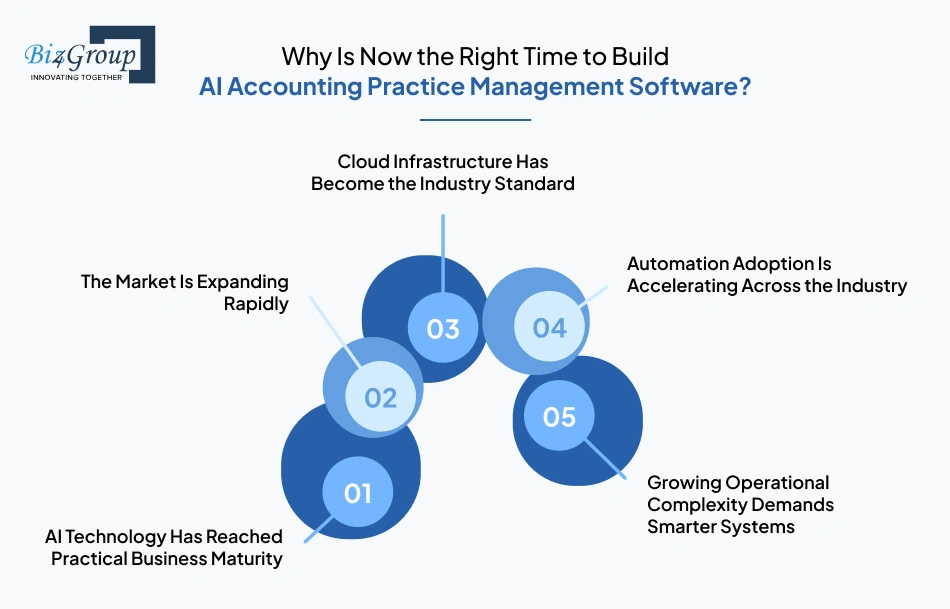
AI is no longer limited to experimentation or isolated use cases. Modern AI technologies can now support document processing, workflow automation, task routing, and operational decision-making at a level that makes implementation viable for accounting firms of different sizes.
The AI in accounting market is projected to grow from USD 10.87 billion in 2026 to USD 68.75 billion by 2032, reflecting a 44.6% CAGR. This level of growth signals increasing investment, innovation, and adoption across the accounting technology ecosystem.
Building and deploying modern accounting platforms is significantly easier than it was a few years ago. With cloud-based accounting software accounting for approximately 68% of the market, firms now have access to scalable infrastructure that supports AI-driven operations.
Firms are no longer evaluating whether automation should be part of their operations. Nearly 95% of organizations adopted automation technologies within the past year, making automation an increasingly important requirement rather than a future consideration.
Accounting firms are managing larger volumes of data, client interactions, compliance requirements, and recurring workflows than ever before. Building an AI-powered practice management platform now allows firms to create operational systems that can scale alongside future business growth.
As accounting operations continue to evolve, firms that invest early in AI accounting workflow automation software will be better positioned to improve efficiency, scalability, and long-term operational performance.
Manual processes rarely become easier as client volume and operational complexity increase
Map Your Automation RoadmapAn effective platform is not defined by the number of features it offers but by how well those features support accounting operations. The following form the foundation of an AI-powered accounting practice management system designed for modern firms.
These accounting practice management software features help firms manage engagements, deadlines, assignments, and recurring work without relying on manual coordination.
|
Feature |
Purpose |
|---|---|
|
Task Management |
Organize and track work across engagements |
|
Recurring Task Automation |
Automatically generate recurring accounting tasks |
|
Workflow Templates |
Standardize common processes and service workflows |
|
Deadline Tracking |
Monitor filing, compliance, and engagement deadlines |
|
Team Workload Management |
Distribute work across team members |
|
Capacity Planning |
Track resource availability and workload allocation |
|
Approval Workflows |
Manage review and approval processes |
|
Engagement Tracking |
Monitor engagement progress from start to completion |
Strong client management capabilities remain essential regardless of whether the platform is intended for enterprise firms or AI practice management software for small accounting firms.
|
Feature |
Purpose |
|---|---|
|
Client Database |
Maintain centralized client records |
|
Client Onboarding |
Manage new client intake processes |
|
Contact Management |
Store and organize client communication details |
|
Client Segmentation |
Group clients based on service types or requirements |
|
Engagement History |
Maintain records of previous engagements |
|
Relationship Tracking |
Support ongoing client management activities |
These features provide a secure environment for information exchange and collaboration between firms and clients.
|
Feature |
Purpose |
|---|---|
|
Secure Client Portal |
Provide controlled client access to information |
|
Document Sharing |
Exchange files securely with clients |
|
File Request Management |
Request and track required documents |
|
E-Signature Integration |
Manage digital approvals and signatures |
|
Messaging Center |
Centralize communication within the platform |
|
Client Notifications |
Keep clients informed about tasks and deadlines |
AI capabilities should support operational processes rather than function as standalone tools.
|
Feature |
Purpose |
|---|---|
|
Document Classification |
Categorize uploaded documents automatically |
|
Data Extraction |
Capture relevant information from documents |
|
Workflow Routing |
Direct work to appropriate users or teams |
|
Follow-Up Automation |
Trigger reminders for pending actions |
|
Exception Detection |
Identify missing information and process gaps |
|
Smart Task Recommendations |
Suggest next actions based on workflow status |
|
Support workload forecasting and operational planning |
For firms evaluating accounting firm CRM software development, these capabilities help centralize client and business relationship data.
|
Feature |
Purpose |
|---|---|
|
Lead Management |
Track prospective clients |
|
Opportunity Tracking |
Monitor potential business opportunities |
|
Proposal Management |
Manage proposal and engagement workflows |
|
Client Communication History |
Maintain interaction records |
|
Referral Tracking |
Track referral sources and outcomes |
|
Account Management |
Manage long-term client relationships |
These features support revenue operations and financial administration.
|
Feature |
Purpose |
|---|---|
|
Time Tracking |
Record billable and non-billable hours |
|
Invoice Generation |
Create and manage invoices |
|
Payment Tracking |
Monitor payment status and collections |
|
Retainer Management |
Manage prepaid service agreements |
|
Revenue Reporting |
Track firm revenue performance |
|
Expense Tracking |
Record engagement-related expenses |
Also Read: AI Payment Fraud Detection Software Development Guide
Management teams need visibility into operational and business performance.
|
Feature |
Purpose |
|---|---|
|
Performance Dashboards |
Monitor firm-wide metrics |
|
Utilization Reporting |
Track team productivity and workload |
|
Profitability Reporting |
Measure engagement and client profitability |
|
Work Status Reporting |
Monitor task and engagement progress |
|
Capacity Reports |
Assess resource availability |
|
Operational Analytics |
Evaluate process efficiency and performance |
An accounting practice management platform should act as the operational hub of the firm by connecting the systems used across accounting, tax, communication, payments, and document management.
|
Integration Type |
Purpose |
|---|---|
|
QuickBooks Integration |
Synchronize client accounting data and financial records |
|
Xero Integration |
Connect bookkeeping and accounting workflows |
|
Tax Software Integration |
Exchange tax returns, filing information, and engagement data |
|
Payroll Software Integration |
Access payroll-related records and processing information |
|
Banking & Financial Institution Integration |
Retrieve transaction and account information when required |
|
Synchronize client records, communication history, and engagement information |
|
|
Email Platform Integration |
Connect client communications with operational workflows |
|
E-Signature Platform Integration |
Manage engagement letters, approvals, and signed documents |
|
Payment Gateway Integration |
Support invoicing, payment collection, and payment tracking |
|
Cloud Document Storage Integration |
Centralize access to client and engagement documents |
|
ERP Integration |
Connect accounting operations with broader business systems |
|
Business Intelligence Integration |
Support advanced reporting and operational analytics |
Also Read: Artificial Intelligence in CRM: Use Cases & Roadmap
A well-planned feature set ensures every component serves a specific operational purpose. These capabilities provide the foundation for successful accounting practice management software development while preparing firms for deeper workflow automation, AI adoption, and long-term scalability.
The real challenge is identifying what deserves investment and what can wait
Validate Your Feature Strategy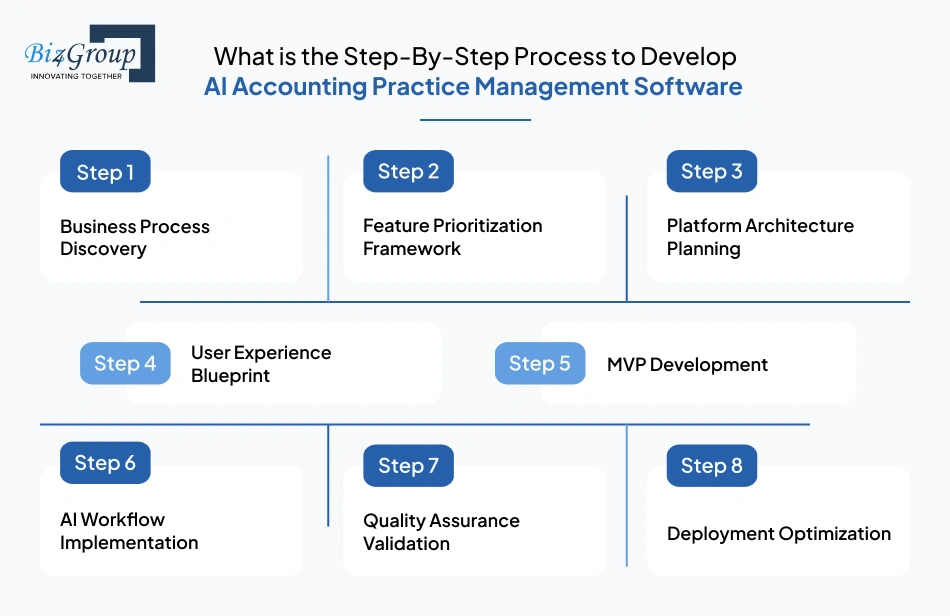
A successful platform is not built by starting with code. The process begins with understanding how the firm operates today, what needs to be improved, and how technology can support future growth.
The following roadmap outlines the key stages required to develop accounting practice management platform solutions that align with real accounting workflows.
The first step is understanding how the accounting firm currently operates. This stage focuses on identifying operational gaps, workflow bottlenecks, manual processes, and areas where automation can create measurable value. The objective is to document how work moves across the firm before defining any software requirements.
Key activities include:
The outcome of this stage is a detailed workflow map that serves as the foundation for the entire project.
Once operational requirements are documented, the next step is determining what should be included in the platform. Rather than attempting to build everything at once, features should be prioritized based on business impact, user needs, and implementation complexity.
Typical priorities include:
This stage defines the minimum viable feature set while establishing a roadmap for future releases.
Architecture planning establishes the technical foundation of the platform. The goal is to define how different system components will interact, how data will move through the platform, and how future growth will be supported.
Areas that require planning include:
This stage helps prevent scalability and performance challenges later in the project lifecycle.
Also Read: Adopt An API-First Architecture for Business Agility
A strong user experience is critical because accounting professionals interact with the platform daily. This stage focuses on designing workflows that feel intuitive while reducing unnecessary steps and navigation complexity.
The design process typically includes:
Many organizations work with a specialized UI/UX design company during this phase to ensure the platform supports real-world accounting workflows effectively.
Also Read: Top UI/UX Design Companies in USA
With requirements, architecture, and designs finalized, development begins with an MVP. The objective is to release a functional version of the platform containing the highest-priority features while minimizing development risk.
The MVP commonly includes:
Many firms begin with MVP development services to validate business assumptions before investing in advanced functionality and large-scale automation initiatives.
Also Read: Top MVP Development Companies in USA
After the core platform is operational, AI capabilities can be introduced into targeted workflows. The focus should remain on solving operational challenges rather than adding AI features without a defined purpose.
Implementation activities may include:
This stage may also require teams to integrate AI models into existing workflows while maintaining human oversight through human-in-the-loop AI for accounting practice management. The result is a more intelligent system that supports CPA firm workflow automation without removing accountability.
Before deployment, the platform must undergo comprehensive testing to ensure reliability, security, and usability. This stage focuses on identifying issues before they impact users or business operations.
Testing activities generally include:
Many organizations collaborate with experienced software testing companies to verify that the platform performs consistently across real-world accounting scenarios.
Also Read: Top AI Software Development Companies in USA 2025
The final stage focuses on launching the platform and supporting user adoption. Deployment should be treated as the beginning of continuous improvement rather than the end of the project.
Key activities include:
As usage data becomes available, firms can refine workflows, expand automation capabilities, and support broader accounting firm digital transformation software initiatives through future releases.
A successful AI accounting practice management software development project follows a structured roadmap that aligns technology decisions with operational requirements. Each stage builds on the previous one, helping firms reduce risk while delivering a platform designed for long-term scalability and adoption.
Technology decisions become much easier once the platform requirements are clear. If you’re a software developer, and an accounting firm client wants you to build a practice management platform for them from scratch with AI built in. You are puzzled with what tech stack should you use for something like this in 2026 as they want workflow automation, a client portal, document management, time tracking, and AI to flag overdue tasks and missing documents.
Well, the following stack is a practical starting point for most modern accounting practice management platforms.
|
Architecture Layer |
Recommended Tools |
Purpose |
|---|---|---|
|
Frontend Application |
React, Next.js |
ReactJS development and NextJS development support responsive dashboards, client portals, workflow screens, and document management interfaces |
|
Backend Services |
Node.js, Python |
NodeJS development handles business logic and Python development allows AI processing, workflow automation, and background operations |
|
Database Layer |
PostgreSQL |
Store client records, engagement data, billing information, workflow data, and operational records |
|
Document Storage |
Amazon S3 |
Securely store accounting documents, engagement files, client uploads, and supporting records |
|
Authentication Layer |
Auth0, AWS Cognito |
Manage user authentication, access control, permissions, and account security |
|
Workflow Engine |
Temporal, Camunda |
Coordinate recurring tasks, approvals, deadline management, and end-to-end accounting practice automation |
|
AI Services Layer |
OpenAI API, Azure OpenAI |
Power document analysis, task recommendations, AI natural language processing for accounting, and workflow intelligence |
|
AI Processing Framework |
LangChain, LlamaIndex |
Manage AI workflows, document retrieval, business context handling, and AI-driven client relationship management for CPAs |
|
Integration Layer |
REST API, GraphQL API |
Connect accounting software, tax platforms, payment gateways, ERP systems, and third-party business applications |
|
AI Monitoring Layer |
Evidently AI, Langfuse |
Monitor model performance, support AI accountability and oversight in accounting software, and track AI-generated outputs |
|
Analytics Layer |
Power BI, Metabase |
Generate operational reports, productivity dashboards, workload insights, and performance analytics |
|
Notification Services |
SendGrid, Twilio |
Deliver email alerts, reminders, client notifications, and workflow communications |
|
AI Compliance Layer |
Human Review Workflows |
Support AI anomaly detection in accounting, exception management, approval controls, and regulatory oversight |
|
Cloud Infrastructure |
AWS, Microsoft Azure |
Host applications, databases, AI services, storage systems, and enterprise workloads securely |
This technology stack provides a practical foundation for firms that want to build AI accounting practice management software capable of supporting workflow automation, document management, client collaboration, AI-powered decision support, and long-term operational growth.
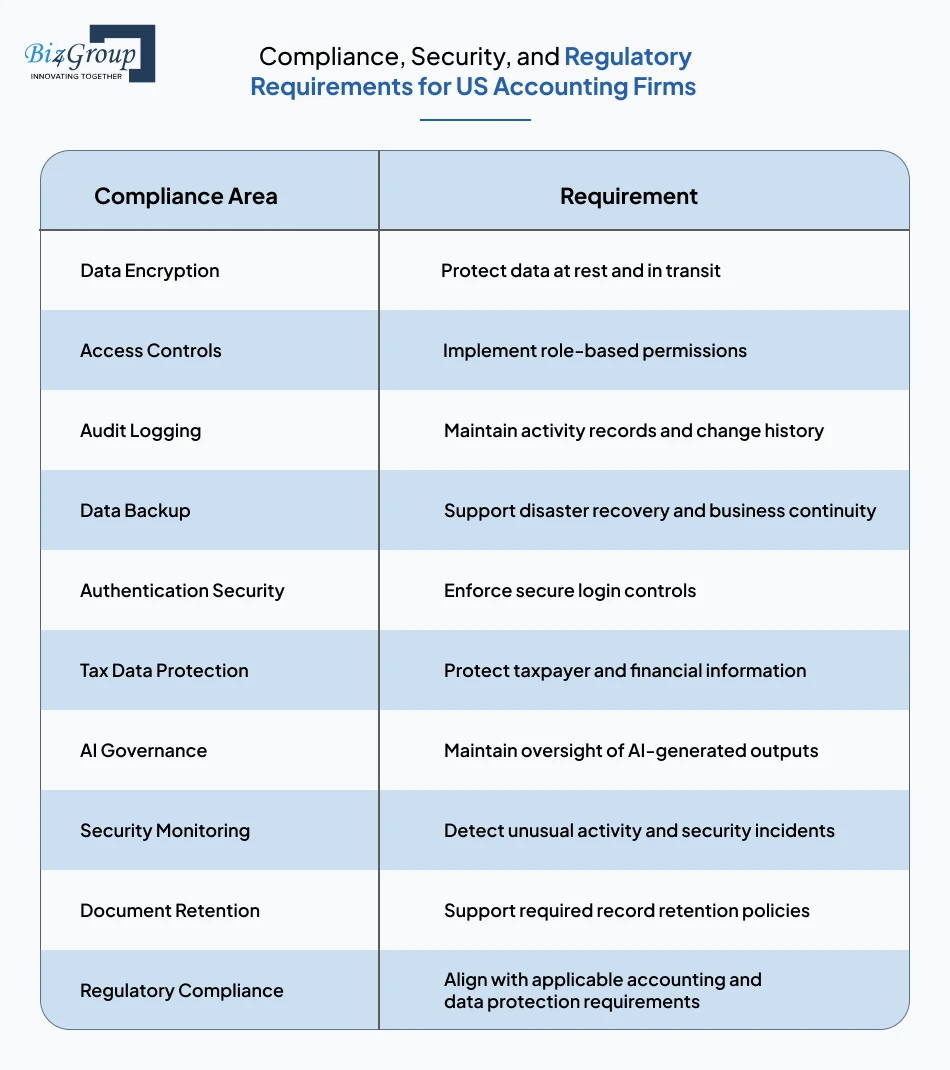
Client records, financial data, tax documents, and internal workflows all contain sensitive information. Whether the goal is accounting task management software development or a complete practice management platform, compliance and security requirements must be considered from the beginning. The areas below require particular attention.
Accounting platforms should protect sensitive client information through data encryption, secure storage practices, regular backups, and continuous monitoring. Strong security controls form the foundation of accounting software compliance and security USA requirements.
Not every employee should have access to every record. Role-based permissions help restrict access based on responsibilities, ensuring sensitive financial, client, and operational data remains available only to authorized users.
Every significant action should be recorded within the platform. Detailed logs help firms track changes, monitor user activity, investigate incidents, and support AI audit trail and compliance management for accountants.
SOC 2 readiness demonstrates that appropriate controls exist for security, availability, and data protection. Many firms evaluating practice management software for solo CPAs and large firms increasingly expect vendors to align with these standards.
Systems handling tax information should support secure document storage, controlled access, data retention requirements, and protection of taxpayer information. These measures help firms maintain regulatory compliance while reducing unnecessary operational risk.
AI capabilities should operate within clearly defined controls. Human review processes, monitoring mechanisms, and accountability measures help ensure AI-generated outputs remain reliable, particularly when reducing manual workload in accounting firms with AI.
|
Compliance Area |
Requirement |
|---|---|
|
Data Encryption |
Protect data at rest and in transit |
|
Access Controls |
Implement role-based permissions |
|
Audit Logging |
Maintain activity records and change history |
|
Data Backup |
Support disaster recovery and business continuity |
|
Authentication Security |
Enforce secure login controls |
|
Tax Data Protection |
Protect taxpayer and financial information |
|
AI Governance |
Maintain oversight of AI-generated outputs |
|
Security Monitoring |
Detect unusual activity and security incidents |
|
Document Retention |
Support required record retention policies |
|
Regulatory Compliance |
Align with applicable accounting and data protection requirements |
Compliance, security, and governance requirements directly influence how accounting platforms are designed, deployed, and maintained. Firms investing in scalable accounting software for growing CPA firms should treat these requirements as operational necessities that support long-term trust, security, and reliability.
Security issues are expensive to fix once the platform is already in production
Review Your Compliance ReadinessProject costs can vary significantly depending on platform complexity, AI capabilities, integrations, workflow requirements, and scalability goals. For most firms, AI accounting practice management software development typically falls between $30,000 and $200,000+.
The table below provides a practical cost breakdown based on development scope.
|
Development Level |
Estimated Cost Range |
Scope |
|---|---|---|
|
MVP Level AI Accounting Practice Management Software |
$30,000 – $60,000 |
Core workflow management, client portal, document management, basic billing, task tracking, user management, limited AI automation, and AI integration services |
|
Mid-Level AI Accounting Practice Management Software |
$60,000 – $100,000 |
Advanced workflows, reporting dashboards, software to manage accounting firm staff and workload, third-party integrations, expanded AI capabilities, enhanced security controls |
|
Advanced Level AI Accounting Practice Management Software |
$100,000 – $200,000+ |
Custom AI workflows, intelligent document processing for accounting firms, complex integrations, enterprise reporting, multi-tenant architecture, advanced compliance controls |
Development costs ultimately depend on platform complexity, AI requirements, integration needs, and scalability goals. Understanding these variables helps firms budget more accurately for AI-powered tax workflow software development while aligning technology investments with long-term business requirements.
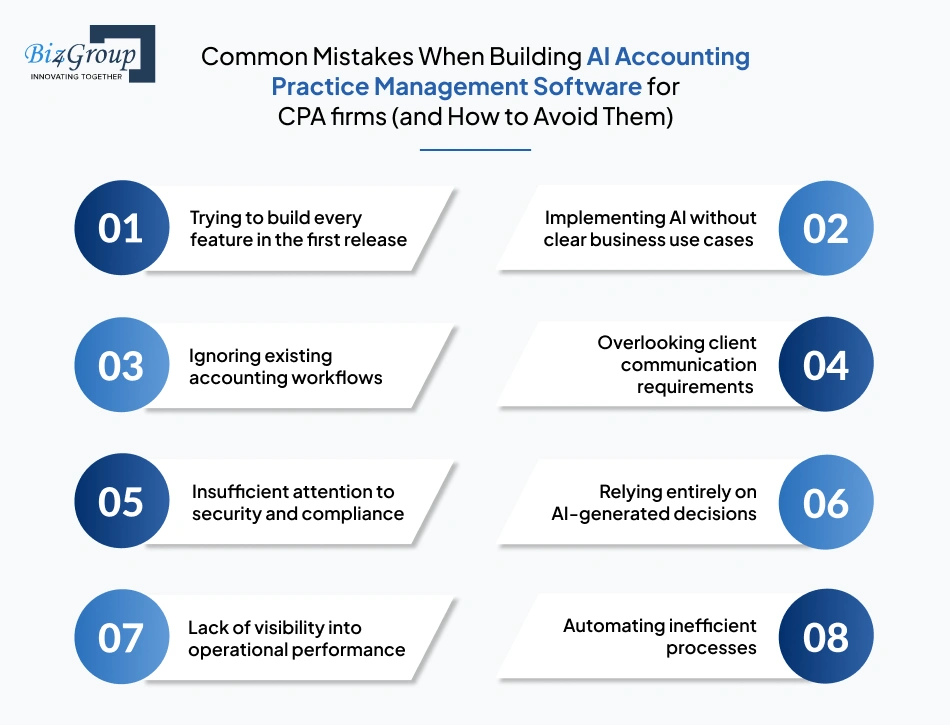
Many firms invest in custom accounting software for CPA firms with clear business goals in mind. However, project success often depends less on technology and more on avoiding common planning, implementation, and operational mistakes. The table below highlights several issues that frequently impact development outcomes.
|
Common Mistake |
How to Avoid It |
|---|---|
|
Trying to build every feature in the first release |
Start with AI MVP software development focused on core workflows, then expand based on user feedback and operational priorities. |
|
Implementing AI without clear business use cases |
Define specific problems AI should solve before development begins. Engaging with AI consulting company early can help identify practical opportunities. |
|
Ignoring existing accounting workflows |
Map current firm processes before designing the platform to ensure technology supports real operational requirements. |
|
Overlooking client communication requirements |
Include capabilities such as client communication automation for CPAs during planning rather than treating them as future enhancements. |
|
Insufficient attention to security and compliance |
Establish accounting software, data security and compliance requirements during architecture planning rather than after development begins. |
|
Relying entirely on AI-generated decisions |
Maintain human oversight for critical workflows and review processes. Many firms hire AI developers with accounting domain experience to implement appropriate controls. |
|
Lack of visibility into operational performance |
Include reporting capabilities such as an accounting firm performance dashboard to support ongoing monitoring and decision-making. |
|
Automating inefficient processes |
Review and improve workflows before introducing recurring task automation for accountants or other automation initiatives. |
Also Read: Cost to Hire an AI Software Developer in 2026
Successful accounting firm practice management software projects are rarely defined by the number of features included. Clear requirements, practical AI implementation, strong security controls, and phased execution often have a much greater impact on long-term adoption and business value.
Many software mistakes become obvious only after time, budget, and momentum are lost
Talk Through Your Project PlanThe decision to invest in a custom platform is rarely about adding more software to the firm. It is about creating an operational foundation that can support growth, improve consistency, reduce administrative friction, and help teams focus on higher-value work.
For many firms, the real question is no longer whether operational processes should become more automated. The question is how those processes should be designed, managed, and scaled over the coming years. That is why AI accounting practice management software development is becoming an increasingly important consideration for firms planning long-term operational improvements.
Every firm has different requirements, priorities, and growth objectives. Taking the time to evaluate those requirements early can make the difference between implementing another software tool and building a platform that genuinely supports the business.
Considering a custom solution for your firm? Connect with us to discuss your goals, operational challenges, and the type of platform that would make the greatest impact.
Yes. Most modern platforms are designed to connect with accounting software, tax applications, document storage systems, payment platforms, and business tools. This allows firms to improve operations without replacing their entire technology ecosystem.
Custom platforms are typically most valuable for firms with complex workflows, multiple service lines, large client volumes, or operational requirements that cannot be efficiently managed through standard off-the-shelf solutions.
Timelines depend on project scope, feature requirements, integrations, and AI functionality. A basic MVP may take 2-4 weeks, while more advanced platforms with custom workflows and AI capabilities can require 3–7 months or longer.
Most projects fall between $30,000 and $200,000+, depending on platform complexity, workflow automation requirements, AI capabilities, compliance requirements, integrations, and long-term scalability goals.
Success is typically measured through operational metrics such as reduced administrative workload, faster engagement completion, improved deadline management, higher staff productivity, stronger client retention, and increased capacity for advisory services.
A well-planned platform can be designed to accommodate new service lines, additional users, future integrations, evolving compliance requirements, and expanded AI capabilities without requiring a complete redevelopment effort.

Our website require some cookies to function properly. Read our privacy policy to know more.