 Location :
Orlando, FL, USA
Location :
Orlando, FL, USA +1 (407) 714-1616
 info@biz4group.com

- AI audiology software development enables intelligent diagnostics, automation, and remote hearing care for modern healthcare providers.
- You can develop AI audiology software solutions for diagnostics, management, and enterprise platforms with built-in compliance and security.
- A clear roadmap from strategy to MVP ensures successful custom AI audiology software development and faster ROI.
- Costs range from $30,000 to $250,000+. An MVP takes 2 to 4 weeks, while enterprise solutions require 6 to 8 weeks.
- The future includes agentic AI, predictive analytics, and real-time adaptation. With Biz4Group, you build secure, scalable systems ready for growth.
Have you noticed how quickly hearing care is becoming part of larger digital health conversations?
Patients expect faster answers, clinicians want tools that reduce manual work and healthcare leaders like you need systems that scale without adding operational complexity.
The market signals are clear.
- The global AI in healthcare market reached $36.67 billion, with North America leading adoption.
- Hearing aid adoption in the US has also climbed to nearly 39% among adults reporting hearing difficulty.
Demand is growing. Expectations are rising. The real question is, can your current systems keep pace?
This is where AI audiology software development becomes more than a technical upgrade. It becomes a strategic move.
Instead of relying on disconnected tools and manual interpretation, forward-thinking organizations are investing in intelligent platforms that improve diagnostic accuracy, streamline workflows, and support remote hearing care. Many are planning to build AI powered audiology platforms that integrate diagnostics, patient monitoring, and analytics into one cohesive system.
Some healthcare leaders begin by strengthening their digital foundation through broader AI medical software development initiatives before expanding into audiology-specific innovation. Others move directly toward AI audiology software development for healthcare businesses to create differentiated, future-ready hearing care solutions.
Here, we will break down what AI audiology software truly involves, what types of systems you can build, and how to approach development with clarity and confidence.
What Is AI Audiology Software Development and Why Has It Become Essential in Modern Healthcare?
Let’s define it clearly.
AI audiology software development is the process of designing and building intelligent software systems that use machine learning, data modeling, and automation to support hearing diagnostics, device optimization, patient management, and clinical decision-making.
It goes beyond digital recordkeeping; it involves creating platforms that can:
- Analyze audiograms automatically
- Detect patterns in hearing loss progression
- Recommend fitting adjustments
- Generate predictive insights from patient data
- Automate reporting and compliance documentation
When you develop AI based audiology applications, you are building software that assists clinicians with data-driven insights instead of relying solely on manual interpretation.
For many organizations, this falls under broader AI medical software development initiatives where intelligent systems improve both care quality and operational performance.
Why Has It Become Essential?
It is no longer optional. Here is why.
- Growing patient demand: An aging population means higher volumes of hearing assessments and follow-ups. Manual systems simply do not scale efficiently.
- Clinical efficiency pressure: Audiologists face documentation overload. Intelligent automation reduces repetitive tasks and shortens evaluation time.
- Higher diagnostic expectations: Data-assisted interpretation improves consistency and reduces variability between providers.
- Operational scalability requirements: Multi-location clinics and hospitals need centralized visibility across teams, performance, and outcomes.
- Strategic differentiation: Organizations investing in AI audiology software development for healthcare businesses are building smarter, more responsive care ecosystems.
If you are planning to build AI powered audiology platforms, understanding the different solution categories available will shape your architecture, compliance planning, and long-term investment strategy.
Before you commit resources, it is important to understand the different types of AI audiology solutions available and how each serves a distinct business objective.
If intelligent systems are shaping the future, why rely on outdated workflows?
Let's discuss how AI audiology software development can elevate your clinical and operational outcomes.
Contact Our ExpertsWhat Types of AI Audiology Software Development Solutions Can You Build Today?
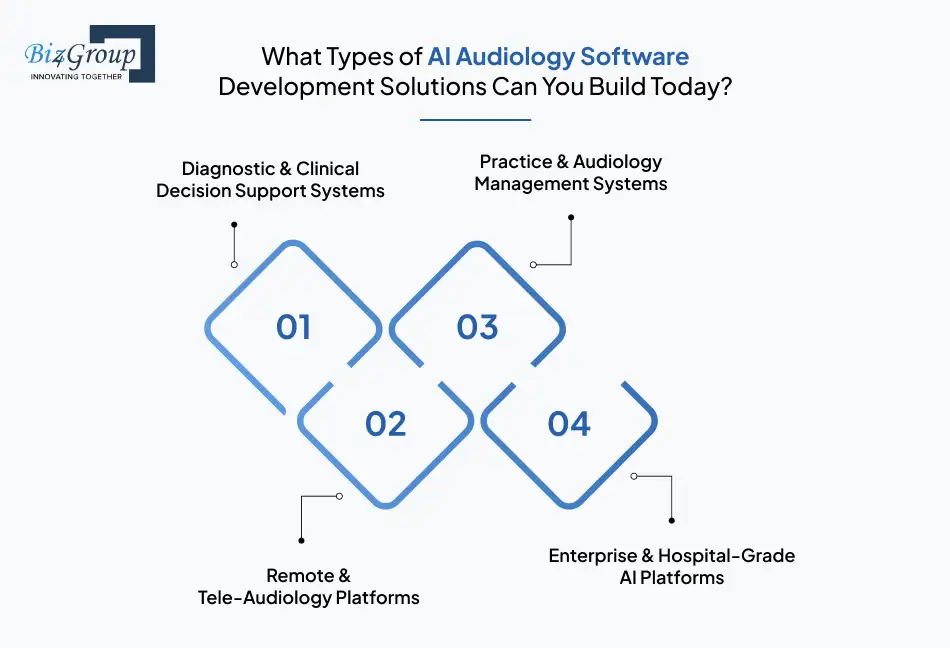
Not every organization needs the same system - some clinics need diagnostic intelligence. Hospitals may require enterprise-wide visibility, and digital health startups often focus on remote-first platforms.
Your goals will determine the architecture, compliance scope, and investment level. Below are the core solution categories most healthcare leaders consider when planning AI audiology software development for healthcare businesses.
1. Diagnostic & Clinical Decision Support Systems
These platforms focus on improving accuracy and speed during hearing evaluations. If your priority is to create AI audiology diagnostic software, this is where you start. They assist clinicians by analyzing audiograms, identifying anomalies, and suggesting evidence-based recommendations.
Key capabilities include:
- Automated audiogram interpretation
- Pattern detection in hearing loss progression
- AI-assisted hearing aid fitting adjustments
- Clinical documentation automation
Organizations pursuing broader intelligent healthcare systems often align with structured AI medical software development initiatives to ensure compliance and scalability.
2. Remote & Tele-Audiology Platforms
If your strategy includes expanding access beyond physical clinics, you may need to create AI audiology software for remote hearing assessments. These platforms allow patients to complete hearing tests, device calibrations, or follow-ups from home while clinicians receive structured data insights.
Core features typically include:
- At-home hearing test modules
- Real-time data transmission
- AI-driven preliminary result analysis
- Secure clinician dashboards
Many providers combine this approach with broader AI remote patient monitoring strategies to maintain continuous engagement and track long-term hearing health.
Also Read: How to Develop an AI-Based Telehealth Automation System: Step-by-Step Guide
3. Practice & Audiology Management Systems
For clinics looking to improve efficiency, the focus shifts toward creating AI audiology management software that optimizes operations. These systems reduce administrative burden and improve performance visibility across teams.
Common components include:
- Intelligent appointment scheduling
- Automated billing and coding support
- Patient communication workflows
- Performance analytics across locations
When you build AI hearing care software systems at this level, you are strengthening both patient experience and operational margins.
4. Enterprise & Hospital-Grade AI Platforms
Large healthcare networks often require fully integrated, scalable ecosystems. This is where developing an enterprise grade AI audiology software solution becomes relevant. These platforms connect multiple clinics, integrate with EHR systems, and provide centralized analytics.
Advanced capabilities may include:
- Multi-location data aggregation
- Compliance-ready audit trails
- Predictive population-level insights
- Secure API integrations
Organizations building at this scale typically treat it as part of broader AI driven audiology platform development aligned with enterprise transformation goals.
Each of these categories solves a different problem. Now the real question is not whether you need AI - It is which type of system aligns with your clinical model, patient demographics, and long-term growth strategy.
Selecting the right solution type is only half the equation, because in healthcare, how you build it matters just as much as what you build.
How Do You Ensure HIPAA Compliant AI Audiology Software Development Without Regulatory Risk?
In healthcare, innovation without compliance is liability. When you invest in AI audiology software development, regulatory readiness cannot be an afterthought. Whether you are building diagnostic tools, management systems, or remote platforms, your solution must meet strict privacy, security, and medical standards from day one.
Let’s break down the core compliance pillars you need to address.
1. HIPAA and Patient Data Protection
If your system processes protected health information, it must meet strict federal privacy and security standards. HIPAA compliant AI audiology software development requires encryption at rest and in transit, strong access controls, audit logging, and secure infrastructure design. Beyond technical safeguards, your development approach must align with established HIPAA compliant standards to ensure patient data privacy, breach prevention, and regulatory readiness throughout the entire software lifecycle.
2. FDA Considerations for AI Diagnostic Systems
If your platform provides diagnostic recommendations or influences clinical decisions, it may fall under FDA medical device regulations. This is especially relevant when you create AI audiology diagnostic software that directly impacts patient care pathways. You must determine whether your system qualifies as Software as a Medical Device and prepare for validation, documentation, and possible regulatory submissions. Ignoring this step can delay launches or expose your organization to legal exposure.
3. Data Security and Infrastructure Controls
Beyond compliance paperwork, your infrastructure must be architected for resilience. When you build secure AI audiology software with compliance features, that includes secure APIs, role-based permissions, intrusion detection systems, and continuous monitoring. Cloud configuration mistakes are one of the most common causes of healthcare breaches. A properly designed security architecture protects both patient trust and your brand reputation.
4. Model Transparency and Auditability
Healthcare AI cannot operate as a black box. Clinicians need to understand how conclusions are generated, especially when recommendations affect treatment plans. This means maintaining version control over models, logging prediction outputs, and enabling traceability for audits. For organizations pursuing AI audiology software development for healthcare businesses, explainability is not optional. It directly influences adoption and regulatory acceptance.
5. Risk Management and Ongoing Compliance Monitoring
Compliance is not a one-time milestone. Regulations evolve, and AI models change over time. You need processes for periodic security reviews, bias assessments, model performance validation, and documentation updates. This is especially important when you develop scalable AI audiology platforms for hospitals that operate across multiple jurisdictions and regulatory environments.
Strong compliance foundations do more than reduce risk. They build credibility with clinicians, protect patient trust, and position your platform for long-term scalability in a highly regulated healthcare market.
Up next, we will examine the features that separate average systems from truly competitive AI audiology platforms.
What Features Define High-Performing AI Audiology Software Development Solutions?
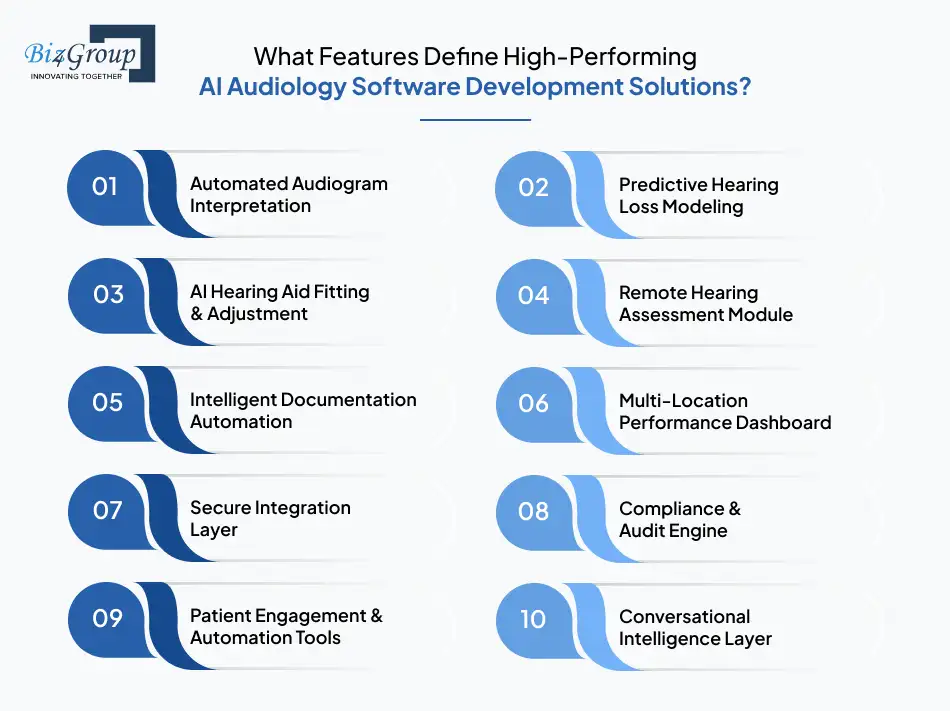
When healthcare leaders invest in AI audiology software development, the goal is not just digitization. It is clinical precision, workflow efficiency, and scalable infrastructure that supports long-term growth.
Whether you plan to build AI hearing care software systems for clinics or develop enterprise grade AI audiology software solutions for hospital networks, the feature architecture determines real-world impact.
Below is a breakdown of the essential capabilities your platform should include.
|
Feature |
What It Does |
Why It Matters for Your Organization |
|---|---|---|
|
Automated Audiogram Interpretation |
Uses trained models to analyze thresholds, asymmetry patterns, masking inconsistencies, and abnormal responses in real time. |
If you aim to create AI audiology diagnostic software, this capability improves accuracy, reduces variability between clinicians, and speeds up decision-making. |
|
Predictive Hearing Loss Modeling |
Evaluates historical patient data and environmental exposure trends to forecast progression risks. |
Helps you move from reactive treatment to proactive care planning, strengthening patient retention and outcome tracking. |
|
AI Hearing Aid Fitting & Adjustment |
Continuously adapts device calibration based on acoustic environments and user feedback loops. |
Critical for AI hearing aid fitting and adjustment software development, reducing repeat visits and improving personalization. |
|
Remote Hearing Assessment Module |
Enables structured at-home testing with validation algorithms that flag unreliable responses. |
Essential when you create AI audiology software for remote hearing assessments, expanding access while maintaining clinical confidence. |
|
Auto-generates structured clinical reports directly from diagnostic results. |
Reduces paperwork burden and supports standardized workflows across providers. |
|
|
Multi-Location Performance Dashboard |
Aggregates operational, financial, and clinical metrics across facilities. |
Important when you develop scalable AI audiology platforms for hospitals, providing centralized leadership visibility. |
|
Secure Integration Layer |
Connects with EHR systems, billing tools, and external APIs through encrypted channels. |
Enables seamless interoperability for AI driven audiology platform development without creating data silos. |
|
Compliance & Audit Engine |
Tracks access logs, model outputs, data modifications, and system events. |
Supports build secure AI audiology software with compliance features, reducing regulatory exposure. |
|
Patient Engagement & Automation Tools |
Sends reminders, care recommendations, and follow-ups automatically. |
Improves adherence and reduces missed appointments while enhancing satisfaction. |
|
Conversational Intelligence Layer |
Embeds an assistant similar to an AI chatbot to handle appointment coordination and basic patient queries. |
Minimizes administrative workload while improving communication efficiency. |
The most successful platforms do not try to implement everything at once. Instead, organizations prioritize features based on their business model. A specialty clinic may focus on diagnostics and engagement. A multi-state network may prioritize analytics and compliance architecture.
Feature selection is strategic. Once that blueprint is clear, the next step is execution through a structured development roadmap.
Are Your Features Just Digital… or Truly Intelligent?
Great platforms do more than automate. They optimize, predict, and scale. Let's turn your feature list into a competitive advantage.
Start the Conversation8 Steps on How to Develop AI Audiology Software Development Solutions
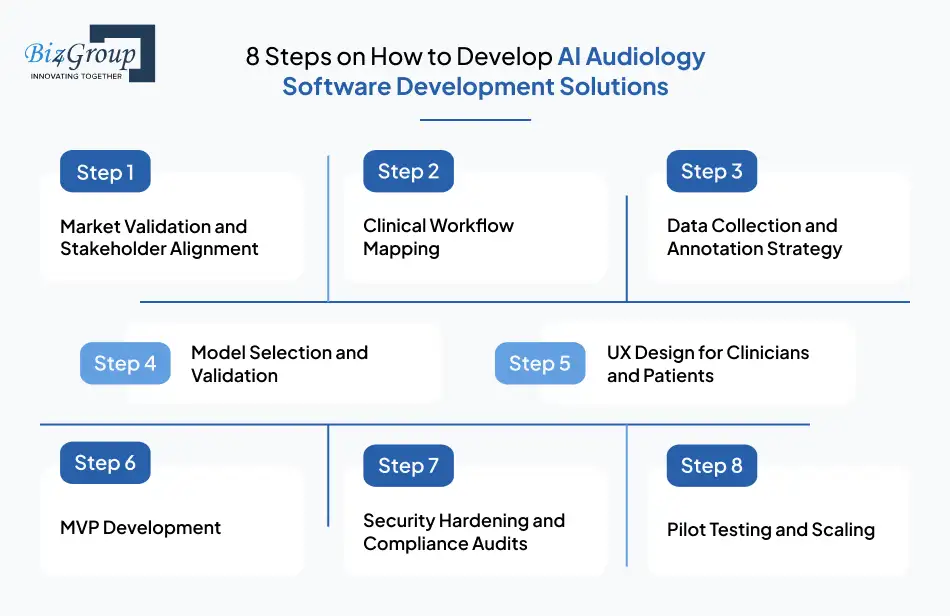
If you plan to develop AI audiology software solutions, execution must follow a structured path. Skipping steps often leads to compliance risks, poor adoption, or costly rebuilds.
Below is the disciplined roadmap healthcare leaders follow when pursuing custom AI audiology software development.
Step 1: Market Validation and Stakeholder Alignment
Before investing in development, validate demand and internal readiness. Speak with audiologists, administrators, and technical teams to identify real pain points. This step ensures your AI audiology software development for healthcare businesses aligns with clinical and financial goals.
Key actions:
- Conduct stakeholder workshops
- Define measurable business KPIs
- Assess competitive landscape
Step 2: Clinical Workflow Mapping
Your system must support, not disrupt, and how care is delivered. Mapping workflows reveals inefficiencies and integration gaps before development begins. Strong UI/UX design ensures the platform feels intuitive for both clinicians and patients.
Key actions:
- Document end-to-end patient journeys
- Identify manual bottlenecks
- Define automation opportunities
Step 3: Data Collection and Annotation Strategy
If you aim to develop AI based audiology applications, data quality determines model accuracy. You need structured audiograms, historical patient records, and properly labeled datasets for training.
Key actions:
- Define compliant data acquisition methods
- Implement anonymization protocols
- Establish data labeling standards
Step 4: Model Selection and Validation
Choosing the right AI model impacts performance and explainability. When you create AI audiology diagnostic software, validation must include clinical accuracy testing, bias assessment, and performance benchmarking.
Key actions:
- Select suitable AI models
- Run validation against clinical benchmarks
- Document explainability outputs
Step 5: UX Design for Clinicians and Patients
Adoption depends heavily on usability. Whether you build AI hearing care software systems for clinics or hospitals, dashboards must simplify complex data and reduce cognitive load.
Key actions:
- Prototype clinician dashboards
- Design patient-facing modules
- Conduct usability testing
Step 6: MVP Development
A phased launch minimizes risk. Structured MVP development allows you to test core functionality before scaling. This is critical when pursuing AI-driven audiology platform development to avoid large upfront costs without validation.
Key actions:
- Build core diagnostic or workflow modules
- Launch in controlled environments
- Gather structured feedback
Step 7: Security Hardening and Compliance Audits
Healthcare systems must meet strict regulatory standards. When you build secure AI audiology software with compliance features, this stage includes penetration testing, encryption validation, and regulatory documentation.
Key actions:
- Conduct security audits
- Validate HIPAA safeguards
- Prepare compliance documentation
Step 8: Pilot Testing and Scaling
Before enterprise rollout, conduct structured pilots. If your goal is to develop scalable AI audiology platforms for hospitals, scaling should follow performance validation and clinician feedback loops.
Key actions:
- Monitor model performance
- Track workflow efficiency improvements
- Plan phased multi-location deployment
Following these eight steps reduces risk, improves adoption, and protects your long-term investment.
With development clarified, the next critical decision involves choosing the right technology stack to support scalability, performance, and regulatory alignment.
What Tech Stack Powers Scalable AI Audiology Software Development?
Once your roadmap is clear, technology decisions determine performance, security, and long-term flexibility.
The right stack allows you to develop AI audiology software solutions that are secure, interoperable, and scalable across clinics or hospital networks. Poor architectural choices can create integration bottlenecks, performance limitations, and compliance risks later.
Below is a structured overview of the core technology layers used in modern audiology platforms.
|
Layer |
Technologies Commonly Used |
Why It Matters |
|---|---|---|
|
AI & Machine Learning Frameworks |
TensorFlow, PyTorch, Scikit-learn |
These frameworks power automated audiogram interpretation, predictive modeling, and intelligent hearing aid adjustments. They allow continuous model improvement as new clinical data becomes available. |
|
Backend Development |
The backend manages data processing, authentication, business logic, and secure API communication. A stable backend is essential when you develop enterprise grade AI audiology software solutions. |
|
|
Frontend Development |
React, Angular, Vue.js |
Modern frontend frameworks create responsive clinician dashboards and intuitive patient portals, improving usability and adoption. |
|
Swift (iOS), Kotlin (Android), Flutter |
Important when you create AI audiology software for remote hearing assessments, allowing patients to complete guided tests from home securely. |
|
|
Cloud Infrastructure |
AWS, Microsoft Azure, Google Cloud |
Cloud platforms provide scalable storage, AI model training capabilities, and HIPAA-ready configurations when properly implemented. |
|
Data Storage & Management |
PostgreSQL, MongoDB, Secure Data Lakes |
Structured and unstructured data storage must support encryption, audit logging, and high availability for clinical-grade reliability. |
|
Integration & API Layer |
REST APIs, FHIR, HL7 Standards |
Ensures seamless interoperability with EHR systems and hospital IT environments. Strong integration is critical when you develop scalable AI audiology platforms for hospitals. |
|
Security & Compliance Controls |
Identity access management, encryption modules, audit monitoring tools |
Protects patient data and strengthens regulatory readiness across all system layers. |
|
Automation & Deployment |
Docker, Kubernetes, CI/CD pipelines |
Enables reliable updates, model retraining, and environment scaling without downtime. Many organizations align this layer with broader AI automation services to streamline operational efficiency. |
Your technology stack should reflect your growth vision. A single-location clinic may prioritize rapid deployment and usability. A hospital network planning AI audiology software development for healthcare businesses at scale will require deeper integration layers, redundancy planning, and stronger security controls.
With the technical foundation clarified, the next question most leaders ask is practical: what does it cost to build and maintain a system like this in the US healthcare market?
What Is the Real Cost of AI Audiology Software Development in 2026?
Let’s address the question every healthcare leader eventually asks.
What does AI audiology software development actually cost?
In the US market, the typical investment ranges between $30,000 to $250,000+, depending on the scope, AI complexity, integrations, and enterprise requirements. The final number varies based on whether you are building a focused diagnostic tool or a fully integrated platform across multiple locations.
A smaller clinic launching a limited AI module for audiogram interpretation or workflow automation will sit closer to the lower end of the range. In contrast, organizations planning to develop enterprise grade AI audiology software solutions with advanced analytics, compliance architecture, and multi-location integrations should expect a significantly higher investment.
Cost also reflects ambition.
If your goal is to develop AI audiology software solutions that support remote assessments, predictive modeling, and scalable infrastructure, the investment aligns with long-term growth potential and operational efficiency.
Rather than viewing cost in isolation, it is more strategic to evaluate it in terms of diagnostic accuracy improvements, clinician time savings, and patient retention gains.
Cost should never be viewed in isolation. The better question is this: what measurable value will your platform generate in diagnostic speed, patient retention, and operational efficiency?
With cost clarity in place, the next challenge becomes identifying the real obstacles organizations face during implementation and how to solve them strategically.
Wondering If the Investment Is Worth It?
The right architecture delivers ROI far beyond the initial build. Let's map your budget to measurable outcomes and scalable growth.
Talk to Our TeamWhat Challenges Can Derail AI Audiology Software Development and How Do You Solve Them?
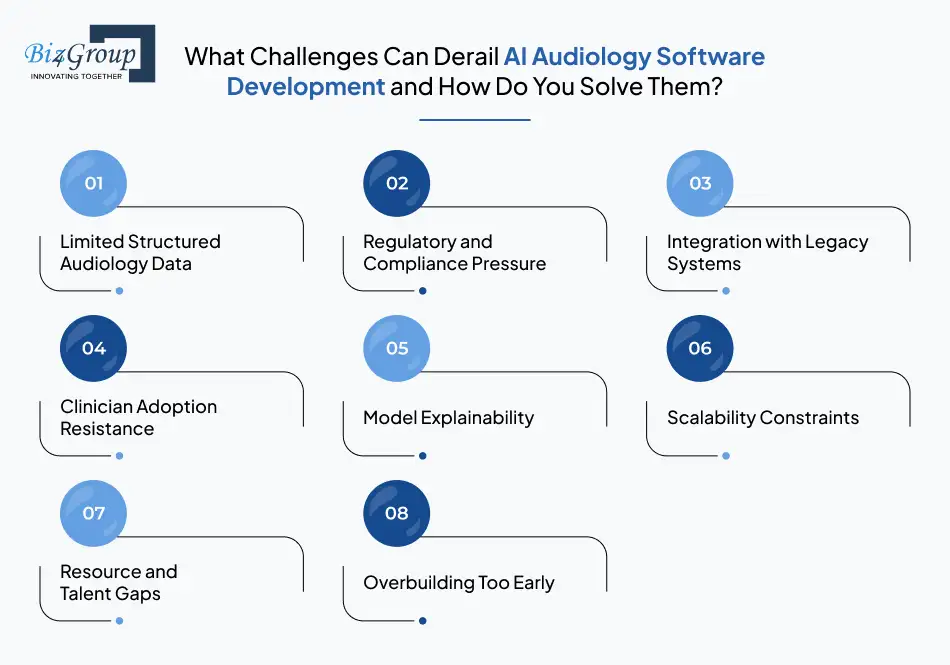
Even with a clear roadmap and budget, execution brings friction. Organizations investing in AI audiology software development for healthcare businesses often discover that technical complexity, compliance demands, and human factors can slow progress. Whether you plan to develop AI audiology software solutions for a single clinic or develop enterprise grade AI audiology software solutions for a hospital network, anticipating these barriers early protects your investment.
Below is a simplified breakdown of the most common challenges and how to address them strategically.
|
Challenge |
Why It Matters |
Practical Solution |
|---|---|---|
|
Limited Structured Audiology Data |
Incomplete or inconsistent datasets reduce accuracy when you develop AI based audiology applications. Poor data leads to unreliable predictions and longer validation cycles. |
Establish standardized data capture early. Work with an experienced AI development company to clean, label, and structure historical datasets before model training. |
|
Regulatory and Compliance Pressure |
Healthcare regulations demand encryption, audit logging, and traceability. Non-compliance can delay deployment or trigger penalties. |
Integrate compliance frameworks during architecture design. Build security and documentation into the system from day one rather than retrofitting later. |
|
Integration with Legacy Systems |
Older EHR and billing platforms may not support modern APIs, slowing down interoperability. |
Use modular API architecture and phased integration. Treat interoperability as a core requirement when you build secure AI audiology software with compliance features. |
|
Clinician Adoption Resistance |
Even well-built platforms fail if providers do not trust or understand them. |
Focus on intuitive workflows and structured training. Platforms designed like scalable custom software solutions see higher adoption rates. |
|
Model Explainability |
Healthcare professionals need transparency when AI influences diagnostic outcomes. |
Incorporate explainable AI layers and clear reporting dashboards when you create AI audiology diagnostic software to build trust and accountability. |
|
Scalability Constraints |
As usage grows, performance bottlenecks can appear, especially in multi-location environments. |
Design cloud architecture with expansion in mind. Align system planning with broader enterprise AI solutions strategies to support long-term scaling. |
|
Resource and Talent Gaps |
AI expertise is limited and hiring full-time specialists can increase cost and delay timelines. |
Some organizations choose to hire AI developers selectively for critical phases while keeping core oversight internal. |
|
Overbuilding Too Early |
Attempting to launch every feature at once increases cost and slows delivery. |
Follow a phased product roadmap. Treat the platform as an evolving AI product rather than a one-time deployment. |
Every challenge in AI audiology software development has a solution when approached methodically. The organizations that succeed are not the ones that avoid complexity. They are the ones that plan for it.
With risks addressed, the final strategic question becomes forward-looking: where is intelligent hearing care heading next, and how can you position your organization ahead of that curve?
What Is the Real Future Scope of AI Audiology Software Development?
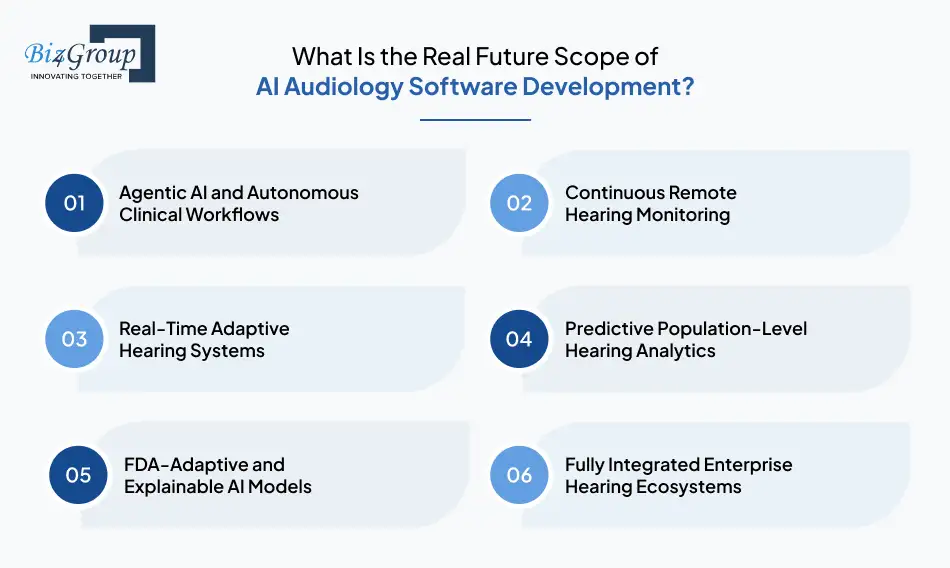
The next phase of hearing care innovation will not be about adding features. It will be about building adaptive, intelligent ecosystems that continuously learn and operate at scale.
Organizations investing in AI audiology software development for healthcare businesses today are positioning themselves for predictive, autonomous, and fully integrated care models.
Here is where the industry is realistically heading.
1. Agentic AI and Autonomous Clinical Workflows
Future platforms will embed semi-autonomous systems capable of initiating actions within defined guardrails. With advancements in agentic AI development, AI systems will monitor patient data, flag anomalies, schedule follow-ups, and assist with care planning without constant manual input. For organizations that develop AI audiology software solutions, this shifts workflows from reactive management to intelligent orchestration.
2. Continuous Remote Hearing Monitoring
The future is not episodic testing. It is ongoing monitoring. Platforms will increasingly integrate wearable sensors and device telemetry to track real-world hearing performance continuously. When you create AI audiology software for remote hearing assessments, this enables long-term patient monitoring rather than isolated evaluations. Integration with broader AI remote patient monitoring ecosystems will allow hearing care to become part of holistic digital health tracking.
3. Real-Time Adaptive Hearing Systems
AI will move from post-visit analysis to real-time adaptation. Edge-enabled systems will analyze acoustic environments instantly and adjust hearing aid configurations dynamically. Organizations that build AI hearing care software systems integrated with smart devices will deliver personalization that evolves throughout the day. This reduces clinic visits while improving user satisfaction and retention.
4. Predictive Population-Level Hearing Analytics
Beyond individual patients, future systems will analyze aggregated datasets to detect broader hearing health trends across demographics and geographies. By leveraging advanced AI healthcare analytics, healthcare networks can forecast demand, optimize staffing, and identify risk clusters early. This elevates AI-driven audiology platform development from a clinical tool to a strategic decision engine.
5. FDA-Adaptive and Explainable AI Models
Regulatory bodies are increasingly shaping how clinical AI evolves. Future platforms will incorporate explainable model layers, structured audit logs, and continuous validation pipelines to meet evolving FDA expectations. When you create AI audiology diagnostic software, regulatory adaptability will become a competitive advantage. Transparency will be as important as accuracy.
6. Fully Integrated Enterprise Hearing Ecosystems
Audiology will no longer operate as a siloed specialty. Future-ready organizations will align hearing care platforms with broader enterprise AI solutions strategies, connecting audiology data with cardiology, neurology, and general health systems. This integration allows coordinated care models and unified patient intelligence across departments.
The future scope of AI audiology software development is practical, measurable, and data-driven. It is about autonomous workflows, continuous monitoring, real-time personalization, predictive analytics, and regulatory-ready AI systems.
The real opportunity is not just building smarter software. It is building infrastructure that evolves with healthcare itself.
Why Choose Biz4Group for AI Audiology Software Development?
Choosing the right partner for AI audiology software development directly affects your compliance posture, scalability, and long-term return on investment.
You are not just building a tool. You are investing in infrastructure that may support diagnostics, remote care, analytics, and enterprise growth. That requires a team that understands both healthcare regulations and advanced AI engineering.
Biz4Group is recognized among the top AI healthcare software development companies in USA, with proven expertise in building secure and scalable digital health platforms.
Here is why organizations trust this partnership when they develop AI audiology software solutions:
- Experience delivering custom AI software development in healthcare environments
- Strong foundation in compliance-driven architecture and secure data systems
- Capability to build AI powered audiology platforms that scale across clinics and hospitals
- Expertise in turning complex requirements into enterprise-ready AI audiology software development for healthcare businesses
- Long-term optimization support beyond initial deployment
Whether you plan to create AI audiology diagnostic software for a focused clinical need, the right development partner reduces risk while accelerating time to market.
The difference is not just in code quality. It is in understanding how healthcare innovation actually succeeds in real-world environments.
Looking for a Partner Who Actually Understands Healthcare AI?
Building in healthcare is different. Compliance, scalability, and precision matter. With Biz4Group, your AI audiology software development journey is structured for long-term success.
Contact Biz4Group TodayWrapping Up!
Hearing care is entering a new era defined by predictive intelligence, real-time adaptation, and connected digital ecosystems. What was once limited to manual testing and device calibration is now evolving into intelligent platforms capable of continuous monitoring, automated insights, and scalable clinical support.
AI audiology software development is no longer a forward-looking experiment. It has become a strategic initiative for healthcare organizations seeking stronger diagnostics, operational efficiency, and long-term competitive positioning. Whether your goal is to develop AI audiology software solutions for specialized clinics or to develop enterprise grade AI audiology software solutions across hospital networks, the difference between success and stagnation lies in disciplined execution and future-ready architecture.
This transformation demands more than technical capability. It requires healthcare expertise, regulatory understanding, and enterprise-level system design. Biz4Group brings that combination to the table, delivering secure and scalable platforms built for real-world clinical environments. From custom AI audiology software development to large-scale AI driven audiology platform development, the focus remains on measurable outcomes, compliance integrity, and sustainable growth.
The technology is ready. The market demand is growing. The competitive landscape is shifting.
The only question that remains is this: will your organization shape the future of intelligent hearing care, or follow those who do?
FAQ
1. What is AI audiology software development and how does it differ from traditional audiology systems?
AI audiology software development involves building intelligent platforms that use machine learning to analyze hearing data, automate workflows, and assist with diagnostics. Unlike traditional systems that simply record and store data, AI-powered platforms interpret patterns, generate insights, and support decision-making. This allows healthcare organizations to develop AI audiology software solutions that improve both clinical precision and operational efficiency.
2. What benefits does AI audiology software development for healthcare businesses provide?
Organizations investing in AI audiology software development for healthcare businesses gain faster diagnostic processing, improved patient engagement, reduced administrative workload, and scalable digital infrastructure. When you build AI-powered audiology platforms, you enable predictive care models, automated documentation, and data-driven operational visibility across locations.
3. How much does custom AI audiology software development cost?
The cost of custom AI audiology software development typically ranges between $30,000 to $250,000+ in the US market. The final investment depends on AI model complexity, compliance requirements, integration depth, and scalability goals. A focused diagnostic module may sit at the lower end, while organizations that develop enterprise grade AI audiology software solutions with multi-location support and analytics will fall on the higher end.
4. How long does it take to develop AI audiology software solutions?
Timelines vary based on scope and feature depth. An MVP version focused on core functionality can typically be delivered within 2 to 4 weeks. A full enterprise implementation designed to develop scalable AI audiology platforms for hospitals generally requires 6 to 8 weeks, depending on integrations and compliance validation requirements.
5. Is AI audiology software development compliant with healthcare regulations?
Yes, but compliance must be built into the architecture from the beginning. When you build secure AI audiology software with compliance features, you must address data encryption, audit logging, access control, and regulatory documentation. Systems that create AI audiology diagnostic software may also require validation aligned with FDA expectations depending on functionality.
6. Should we hire internally or partner with an AI healthcare software development company?
The decision depends on your internal AI expertise and timeline. Many healthcare organizations partner with an AI healthcare software development company to accelerate execution, ensure compliance alignment, and reduce hiring overhead. This approach is particularly effective when planning large-scale AI-driven audiology platform development initiatives.
7. Will AI replace audiologists if AI audiology software becomes mainstream?
No. AI enhances audiologists’ capabilities rather than replacing them. By automating routine tasks and providing data-driven insights, clinicians can focus on complex cases, rehabilitation, and patient counseling; roles that require human judgment and empathy.
