Location :
Orlando, FL, USA
Location :
Orlando, FL, USA +1 (407) 714-1616
 info@biz4group.com









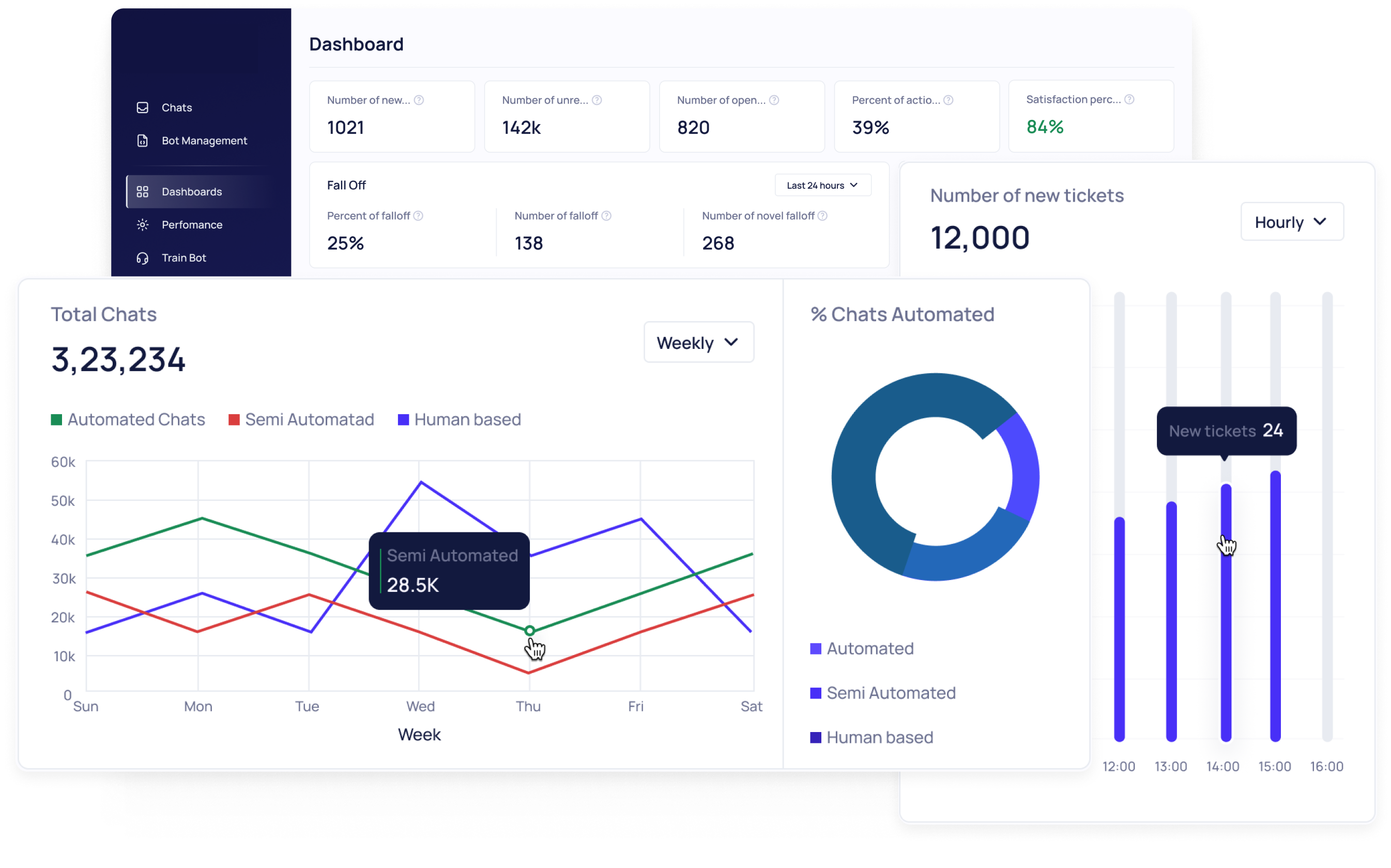









Imagine a digital system that doesn’t wait for instructions but instead, understands your business goals, learns from real-time feedback, and takes independent actions to get the job done.
Read More

Have you noticed how cars feel like they are becoming computers on wheels? That’s not an accident. The AI automotive software development market is exploding right now. According to industry forecasts, the global automotive artificial intelligence market is growing sharply, with estimates showing it will reach about USD 5.2 billion in 2025. This reflects a near 40 percent year-over-year growth as vehicle makers adopt smarter systems and connected features across their product lines.
In the US alone, the automotive AI sector is projected to expand from roughly USD 1.6 billion in 2025 to over USD 14.1 billion by 2034, driven by predictive maintenance, fleet solutions, and semi-autonomous systems.
Let’s be real. You are likely feeling the pressure to keep pace too. Maybe your competitors are talking about smarter diagnostics. Maybe your customers expect seamless connectivity. Or maybe operating costs are creeping up on you because maintenance and fleet decisions are still reactive instead of proactive.
So, you might ask yourself: Is this something my business truly needs to invest in now? Or is this just another buzzword on a slide deck?
This guide will answer that question with clarity.
Because when you think about it, the difference between traditional automotive systems and advanced AI-driven automotive software systems is the difference between reacting to issues and preventing them altogether. Traditional systems tend to wait for problems to occur. They rely on rule-based logic and fixed condition triggers. That approach worked for a long time, but it falls short if your goal is predictive insights, continuous optimization, or personalized experiences for drivers and fleet managers.
Right here your digital transformation can begin. With the right custom software development company at your side, the shift toward intelligent platforms becomes a strategic investment, not an overwhelming project. You do not have to figure it out alone.
In the sections that follow, we will break down what this shift really means. You will learn:
By the end of this guide, you will not just understand the “why” of AI automotive software development. You will know exactly what steps to take next to future-proof your business.
Let’s get started.
You do not need a massive roadmap to begin. A focused conversation can quickly clarify if AI automotive software development fits your goals right now.
Talk to Biz4GroupLet’s get clear on what this really means for you.
AI automotive software is built to learn from data, adapt to changing conditions, and improve decisions over time. In AI automotive software development, intelligence is embedded directly into the software, not layered on as a feature. These systems analyze vehicle data, driving behavior, operational signals, and environmental inputs to make real-time decisions that get better with use.
Instead of manually coding every scenario, teams create AI driven automotive software systems that evolve. As more data flows in, the software becomes more accurate, more efficient, and more valuable across vehicles, fleets, and regions.
Most businesses do not need to replace their existing platforms to make this shift. AI works best when it connects with what you already use. Vehicle systems, enterprise tools, and operational platforms all become smarter when supported by strong AI integration services. The result is intelligence layered into your operations, not disruption.
Here is how AI-driven automotive software fundamentally differs at a system level.
|
Aspect |
Traditional Automotive Systems |
AI Automotive Software Systems |
|
Core logic |
Fixed rules and conditions |
Learning models that adapt over time |
|
Decision-making |
Reactive |
Predictive and proactive |
|
Scalability |
Limited by manual configuration |
Designed to scale across vehicles and fleets |
|
Personalization |
Static workflows |
Behavior-driven intelligence |
|
System improvement |
Manual updates required |
Continuous improvement through data |
|
Business impact |
Operational support |
Strategic optimization and growth |
This shift explains why more organizations now invest in automotive software development with AI. It allows them to develop AI automotive software solutions that stay relevant as vehicles, customer expectations, and mobility models continue to evolve.
With this foundation in place, it becomes easier to understand the specific AI automotive software solutions that are already delivering measurable value across the automotive ecosystem.
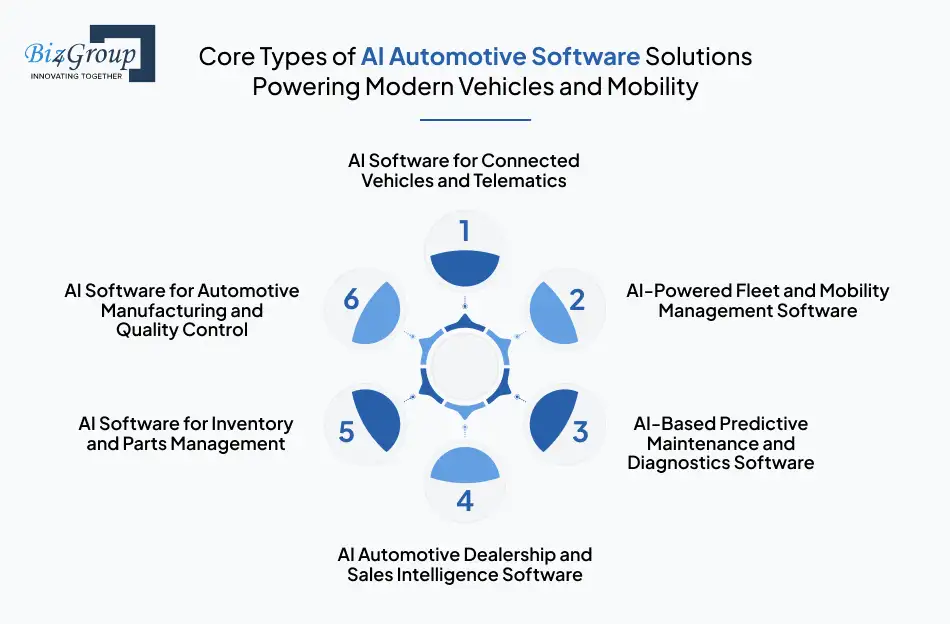
Once you understand what AI automotive software development makes possible, the next question usually follows fast - Where exactly does AI fit into your automotive business?
The answer depends on what you are trying to optimize. Operations, customer experience, fleet efficiency, or manufacturing. Below are the most common and high-impact types of AI automotive software solutions for manufacturers, dealers, and startups, explained clearly and practically.
This category focuses on turning vehicle data into intelligence. Sensors, GPS, and onboard systems continuously stream information that AI models analyze in real time.
Instead of static dashboards, these platforms learn driving patterns, detect anomalies, and adapt insights automatically as conditions change.
Key benefits
For example, many mobility platforms combine connected vehicle intelligence with AI transportation software to improve routing decisions, utilization rates, and real-time operational planning.
Fleet-focused AI systems are designed to optimize how vehicles are deployed, maintained, and scheduled at scale. They analyze usage data, maintenance logs, fuel patterns, and external factors to guide decisions.
This is a core area where businesses build AI automotive software for fleet and mobility management to reduce waste and improve reliability.
Key benefits
For example, organizations that build AI automotive software for fleet management often integrate predictive insights directly into dispatch and logistics workflows to keep operations running smoothly.
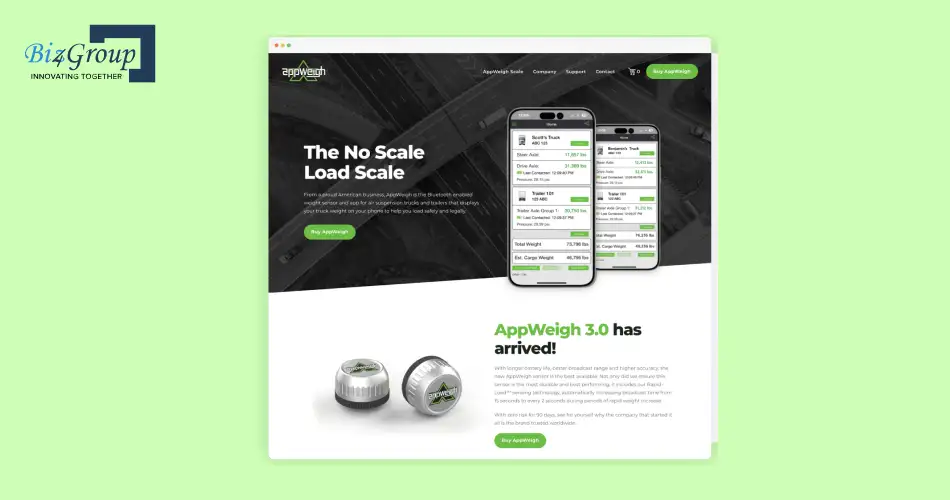
One of the best examples of Advanced IoT Fleet Management Solution for a company Appweigh. Built by Biz4Group LLC, it is a custom vehicle management platform built to optimize operational workflows across fleet environments. It uses real-time data to support smarter decisions related to load management and vehicle usage. operational workflows across fleet environments. It uses real-time data to support smarter decisions related to load management and vehicle usage.
Key highlights
By integrating systems like Appweigh into your fleet workflow, you see how AI based automotive application development can shift fleet management from manual tasks to automated, intelligent insights.
These systems continuously monitor vehicle health and identify early warning signs before failures occur. AI models analyze historical and real-time data to predict component wear and potential breakdowns.
This shifts maintenance from reactive to proactive.
Key benefits
For example, predictive maintenance platforms are often paired with AI vehicle damage detection software to give operators a complete view of both mechanical and visible vehicle issues.

Boat Butler was developed to give operators clear visibility into vehicle and equipment health using real-time operational data. The platform helps users understand when maintenance is actually needed, not just when schedules say it is. This allows teams to plan service proactively and keep assets ready for use.
Key highlights
Boat Butler is a strong example of how AI automotive software development can turn maintenance into a strategic advantage. It shows how Biz4Group LLC approaches predictive systems with a focus on usability, reliability, and real operational value, not just algorithms.
This type of software focuses on improving how dealerships manage leads, inventory, pricing, and customer interactions. AI analyzes browsing behavior, inquiry patterns, and sales data to guide smarter decisions.
It helps dealerships move from generic sales processes to personalized engagement.
Key benefits
For example, platforms built for AI automotive dealership management use customer intent data to optimize follow-ups, promotions, and pricing strategies.
Inventory-focused AI systems forecast demand for vehicles, parts, and accessories using historical trends and real-time signals. This reduces overstocking and shortages across supply chains.
It is especially useful when companies develop AI automotive software for digital transformation across dealer networks and manufacturing units.
Key benefits
For example, automotive businesses often integrate AI platforms with AI inventory management to align parts availability with real operational demand.

AMxTD is designed to help automotive businesses track parts movement, plan orders, and forecast demand more precisely. It reduces guesswork by using data patterns to inform inventory decisions, making supply operations more efficient and less costly.
Key highlights
AMxTD demonstrates how custom AI automotive software development can transform traditional inventory headaches into automated, insight-driven processes. With visibility and predictive intelligence in place, you can focus on growth instead of constantly reacting to supply mismatches.
In manufacturing environments, AI is used to monitor production lines, detect defects, and optimize processes using computer vision and analytics.
These systems support consistency and scalability without increasing manual inspection effort.
Key benefits
For example, manufacturers applying AI within manufacturing software use real-time insights to maintain quality standards while scaling output.
Each of these solution types solves a specific problem. The real impact appears when they work together as part of a unified strategy. That is how organizations develop scalable AI automotive platforms for enterprises instead of isolated tools.
Once the solution types are clear, the natural question becomes outcomes.
What measurable business benefits do these systems actually deliver?
That is where we turn next.
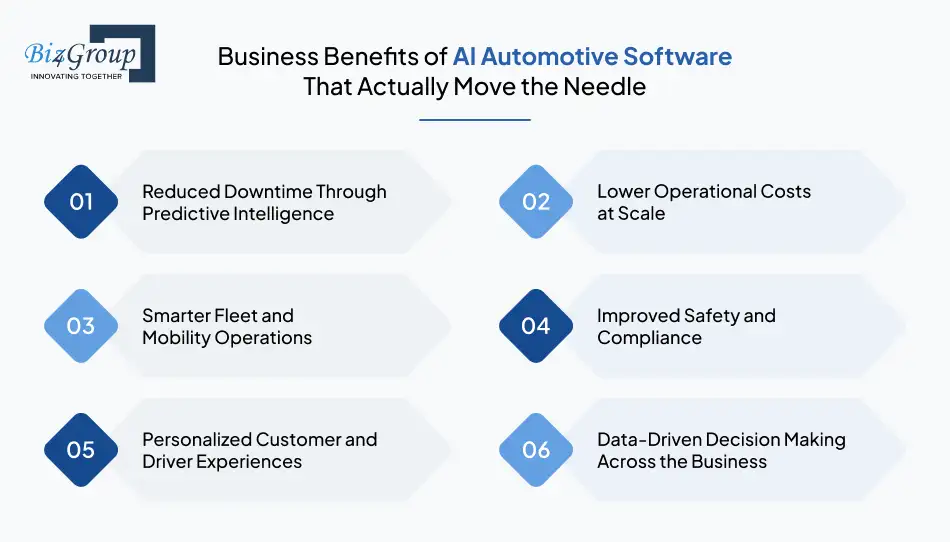
When leaders invest in AI automotive software development, they are not chasing innovation for the sake of it. They are solving very real operational and revenue challenges. Below are the core benefits businesses see when they develop AI automotive software solutions with a clear strategy.
Unplanned downtime is expensive and frustrating. AI-driven systems analyze vehicle and operational data continuously to detect early warning signs before failures occur. Instead of reacting after a breakdown, you act ahead of time. This is one of the fastest ways businesses see value when they build AI powered automotive applications.
Manual processes and reactive decisions quietly drain budgets. AI helps automate decisions around routing, maintenance scheduling, fuel usage, and asset utilization. When companies create AI enabled automotive solutions, they reduce waste without increasing headcount or operational complexity.
Managing fleets gets harder as they grow. AI systems bring clarity by learning usage patterns, identifying inefficiencies, and recommending better allocation strategies. This is why organizations build AI automotive software for fleet and mobility management to maintain control while scaling operations.
Safety incidents and compliance gaps carry financial and reputational risk. AI-driven monitoring helps identify risky driving behavior, mechanical issues, and operational anomalies early. As businesses develop automotive AI systems for vehicles, safety becomes proactive rather than reactive.
Customers expect more than generic interactions. AI analyzes behavior and preferences to personalize experiences across vehicles, apps, and dealership interactions. This is a key advantage when companies create AI automotive software solutions for mobility startups and modern dealerships competing on experience.
Raw data is useless without insight. AI transforms massive data streams into clear recommendations leaders can act on quickly. That is why enterprises develop scalable AI automotive platforms for enterprises to support long-term digital transformation, not just individual use cases.
Each of these benefits compounds over time. The longer AI systems run, the more value they unlock.
Now that the business impact is clear, the next step is understanding what actually makes these systems work. That brings us to the key features that define effective AI automotive software.
Not all AI automotive platforms deliver the same results. The systems that succeed share a common set of core features that support scalability, accuracy, and real business impact.
If you are planning AI automotive software development, these are not nice-to-haves. They are essential.
|
Feature |
What It Does |
Why It Matters for Your Business |
|---|---|---|
|
Real-Time Data Processing |
Ingests and analyzes data from vehicles, sensors, apps, and external systems instantly |
Enables faster decisions, early alerts, and real-time optimization |
|
Machine Learning Models |
Learns patterns from historical and live data to improve predictions over time |
Helps you move from reactive actions to predictive intelligence |
|
Forecasts failures, demand, and performance trends |
Reduces downtime, lowers costs, and improves planning accuracy |
|
|
Edge and Cloud Intelligence |
Runs AI models both inside vehicles and in the cloud |
Balances speed, reliability, and scalability across environments |
|
Vehicle and System Integration Layer |
Connects AI with telematics, ERP, CRM, and legacy automotive systems |
Ensures AI fits into your existing operations without disruption |
|
Scalable Architecture |
Supports growth across vehicles, fleets, regions, and use cases |
Makes it easier to develop scalable AI automotive platforms for enterprises |
|
Security and Data Governance |
Protects sensitive vehicle, customer, and operational data |
Maintains trust, compliance, and long-term platform stability |
|
Explainable AI Logic |
Makes AI decisions transparent and auditable |
Builds confidence for compliance, safety, and leadership buy-in |
|
Continuous Learning Pipeline |
Retrains models using new data automatically |
Keeps performance accurate as conditions change |
|
User-Friendly Dashboards |
Presents insights clearly to drivers, operators, and managers |
Ensures adoption across technical and non-technical teams |
When these features come together, you are no longer just collecting data. You are building intelligence into every part of your operation. This foundation is what allows teams to build intelligent automotive platforms that deliver value today and remain flexible for what comes next.
With the features defined, the natural question becomes practical. How do you actually bring this kind of system to life?
Also Read: AI Car Wash App Development: Features, Steps and Cost
Not every feature drives ROI. We help you prioritize the AI automotive software features that solve real operational problems.
Get Expert Guidance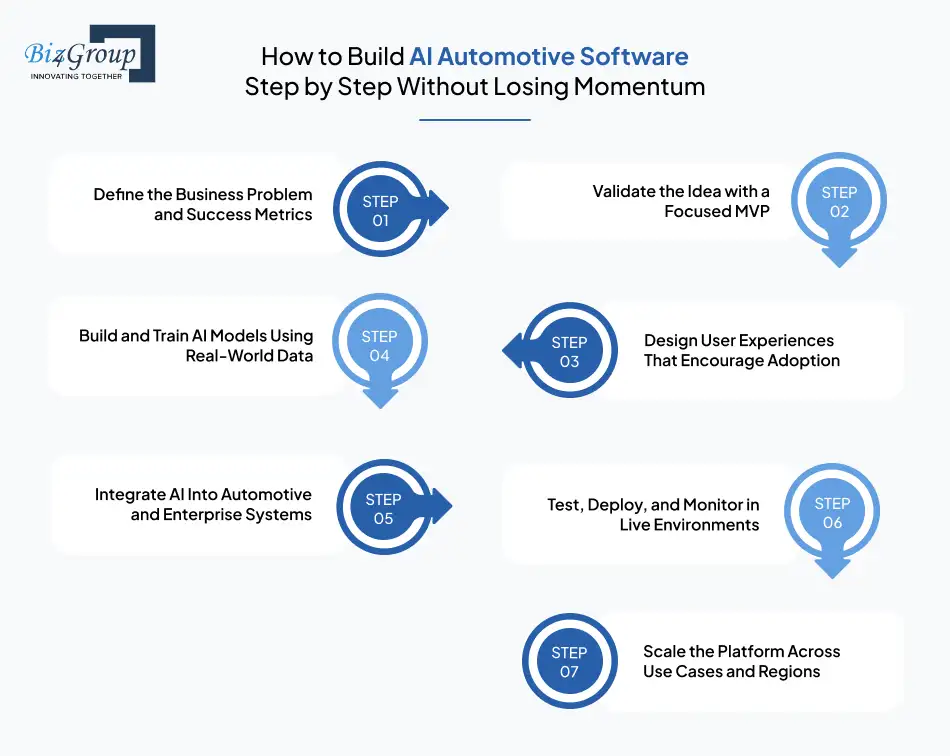
Building AI automotive software development the right way is less about rushing into code and more about following a structure that protects your time, budget, and outcomes. When done well, you can develop AI automotive software solutions that scale with your business instead of slowing it down.
Below is a practical, business-first approach teams follow to build AI powered automotive applications that deliver value early and grow over time.
AI only works when it solves a real problem. Start by identifying where intelligence can create impact, whether that is predictive maintenance, fleet optimization, or customer experience. This clarity ensures you are not building technology for its own sake when you create AI enabled automotive solutions.
What to focus on
Before committing to a full-scale platform, validate assumptions with a smaller release. This reduces risk and helps confirm that your data and workflows support AI use cases. Many teams start with MVP development to test feasibility when they develop AI automotive software for digital transformation.
What to focus on
AI insights are only useful if people act on them. Clean interfaces help users trust recommendations and make faster decisions. Strong UI/UX design plays a critical role when you build intelligent automotive platforms for operators, managers, and executives.
What to focus on
This is where intelligence is created. Models learn from vehicle data, operational patterns, and historical records to predict outcomes and automate decisions. Reliable AI model development is essential when you develop automotive AI systems for vehicles that must perform under real-world conditions.
What to focus on
AI must work seamlessly with vehicle platforms, telematics systems, and enterprise tools. Integration is what turns models into usable software. This step is critical when teams make AI automotive software for connected vehicles and fleet platforms.
What to focus on
AI performance must be validated in real-world scenarios. This includes accuracy, latency, and reliability across different operating conditions. Ongoing monitoring ensures your AI based automotive application development remains effective as data evolves.
What to focus on
Once validated, AI platforms can expand across fleets, regions, and business units. This is where long-term ROI compounds. Organizations that plan early can develop scalable AI automotive platforms for enterprises without reworking their core architecture.
What to focus on
Following these steps helps you create AI automotive software solutions for mobility startups, enterprises, and fleet operators in a controlled, scalable way.
With the process clear, the next decision becomes technical. Which tools and technologies should you rely on to support this build?
Once you decide to build AI automotive software, the technology choices you make will shape performance, scalability, and long-term cost. A strong stack keeps systems flexible as vehicles, fleets, and data volumes grow.
Below is a practical view of the tech stack commonly used in AI automotive software development, explained layer by layer.
|
Layer |
Tools and Technologies |
What This Layer Does |
|---|---|---|
|
Frontend Layer |
Delivers fast, responsive dashboards for drivers, fleet managers, and executives. Focuses on usability, real-time insights, and role-based views. |
|
|
React Native, Flutter |
Enables mobile access for drivers, operators, and technicians to receive alerts, updates, and insights on the go. |
|
|
Backend Layer |
Handles business logic, data processing, authentication, and integration with vehicle and enterprise systems. |
|
|
AI and ML Layer |
TensorFlow, PyTorch, Scikit-learn |
Powers predictive models, pattern detection, and intelligent decision-making across automotive use cases. |
|
Data Processing Layer |
Apache Kafka, Spark, Airflow |
Manages real-time data streams from vehicles, sensors, and external sources while supporting batch and streaming analytics. |
|
Database Layer |
PostgreSQL, MongoDB, Redis |
Stores structured and unstructured data such as vehicle logs, user data, and operational metrics. |
|
Cloud Infrastructure |
AWS, Google Cloud, Microsoft Azure |
Supports scalable deployment, storage, compute resources, and global availability for automotive platforms. |
|
Edge Computing |
NVIDIA Jetson, Edge TPU |
Enables low-latency processing directly inside vehicles or devices where real-time decisions are critical. |
|
Integration Layer |
REST APIs, GraphQL, WebSockets |
Connects AI systems with telematics, ERP, CRM, and third-party automotive platforms. |
|
Security and Compliance |
OAuth, JWT, Encryption Protocols |
Protects sensitive vehicle, customer, and operational data while supporting compliance requirements. |
|
Monitoring and DevOps |
Docker, Kubernetes, Prometheus |
Ensure system reliability, smooth updates, performance monitoring, and continuous scaling. |
This stack allows teams to develop scalable AI automotive platforms for enterprises while keeping flexibility for future features and integrations. The exact combination may vary based on use cases like fleet management, predictive maintenance, or connected vehicles, but these layers form a reliable foundation.
With the technology stack clear, the next concern most leaders have is cost. Understanding where budgets go and what influences pricing is the next critical step.
If cost is the first question on your mind, you are not alone. Almost every founder, CTO, or operations leader asks the same thing before committing to AI automotive software development.
On average, the AI automotive software development cost estimate ranges from $40,000 to $300,000+. The wide range exists for a reason. Cost depends heavily on features, data complexity, integrations, scalability needs, and whether you are building a pilot or an enterprise rollout.
The key is understanding where the money actually goes so you can invest wisely when you develop AI automotive software solutions.
Different features contribute differently to overall cost. Here is a realistic breakdown based on common implementations in AI-based automotive application development.
|
Feature Area |
Estimated Cost Range |
What Drives the Cost |
|---|---|---|
|
Connected Vehicle Data Ingestion |
$8,000 to $25,000 |
Sensor integration, real-time data pipelines, telemetry volume |
|
AI Models and Predictive Analytics |
$12,000 to $50,000 |
Model complexity, training data size, accuracy requirements |
|
Fleet and Mobility Intelligence |
$10,000 to $40,000 |
Optimization logic, real-time decision systems, integrations |
|
Predictive Maintenance Features |
$8,000 to $30,000 |
Historical data quality, failure prediction depth |
|
Dashboards and User Interfaces |
$6,000 to $20,000 |
Role-based views, real-time updates, UX complexity |
|
System Integrations |
$5,000 to $25,000 |
ERP, CRM, telematics, and third-party platforms |
|
Security and Compliance Layer |
$4,000 to $15,000 |
Data encryption, access control, compliance needs |
|
Scalability and Cloud Infrastructure |
$6,000 to $35,000 |
Traffic volume, geographic scale, uptime requirements |
This is why cost planning matters early when you build AI powered automotive applications rather than adding features blindly.
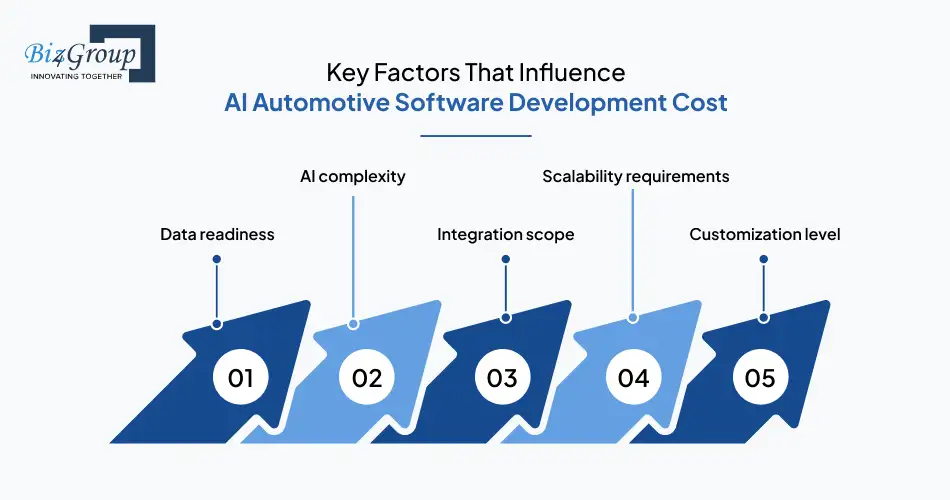
Several variables directly impact how much you spend when you develop AI automotive software for digital transformation.
Working with experienced teams that offer AI automation services helps reduce unnecessary manual effort and keeps costs predictable.
Even well-planned projects can face unexpected expenses if these areas are ignored during AI automotive software development.
Teams that plan early for enterprises AI integration avoid these surprises.
You do not need to overspend to build something effective. Smart planning makes a real difference when you create AI enabled automotive solutions.
There is no single fixed price for AI automotive software development services. The real goal is aligning cost with business impact. A well-designed system pays for itself through efficiency, safety, and scalability. When done right, teams do not just build software. They create enterprise AI solutions that grow with their operations and deliver long-term ROI.
With cost clarity in place, the final step is addressing risks. Understanding the challenges and knowing how to overcome them is what separates successful AI projects from stalled ones.
From $40,000 pilots to $300,000+ enterprise platforms, the right structure makes all the difference in long-term value.
Request a Cost Breakdown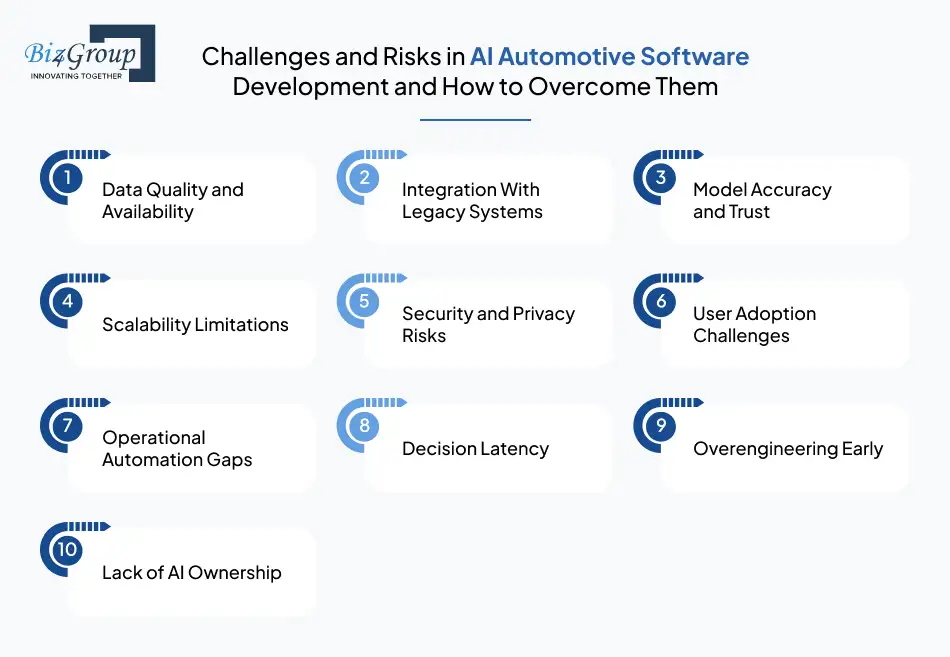
Even with a solid strategy, AI automotive software development comes with its own set of challenges. Knowing where projects usually struggle helps you plan smarter and avoid costly setbacks.
Below is a clear view of the most common risks teams face when they develop AI automotive software solutions, along with practical ways to address them.
|
Challenge Area |
Risk to Your Business |
How to Overcome It |
|---|---|---|
|
Data Quality and Availability |
Inaccurate predictions and unreliable AI outcomes |
Invest early in data governance, validation pipelines, and structured data collection |
|
Integration With Legacy Systems |
Delays, data silos, and operational friction |
Use modular architecture and phased rollouts supported by proven integration frameworks |
|
Model Accuracy and Trust |
Teams ignore AI recommendations |
Apply explainable models and clear logic visualization so users understand decisions |
|
Scalability Limitations |
Performance drops as fleets or users grow |
Design cloud-native systems that support enterprise AI solutions from day one |
|
Security and Privacy Risks |
Exposure of sensitive vehicle and customer data |
Implement strong encryption, access control, and regular security audits |
|
User Adoption Challenges |
Low ROI due to poor usage |
Pair AI logic with intuitive interfaces and contextual guidance |
|
Operational Automation Gaps |
Manual work continues despite AI investment |
Introduce intelligent workflows using AI automation services to remove repetitive tasks |
|
Decision Latency |
Delayed actions in real-time environments |
Combine edge processing with cloud intelligence for faster response times |
|
Overengineering Early |
Budget overruns and delayed launches |
Start lean and scale features based on real usage patterns |
|
Lack of AI Ownership |
Projects stall after deployment |
Assign clear ownership and ongoing optimization responsibility |
One challenge that often gets overlooked is communication between systems and users. Intelligent alerts, conversational interfaces, and guided actions can dramatically improve adoption. Many platforms address this by integrating conversational layers built with support from an AI chatbot development company, making insights easier to act on.
Others introduce autonomous decision logic using an AI agent to handle routine decisions without human intervention, especially in fleet and mobility workflows.
When these risks are addressed proactively, teams can build AI automotive software that performs reliably in real-world conditions, not just in controlled environments.
The pace of change in AI automotive software development is only accelerating. What feels advanced today will soon become baseline. The real advantage will come from how early and how thoughtfully you prepare.
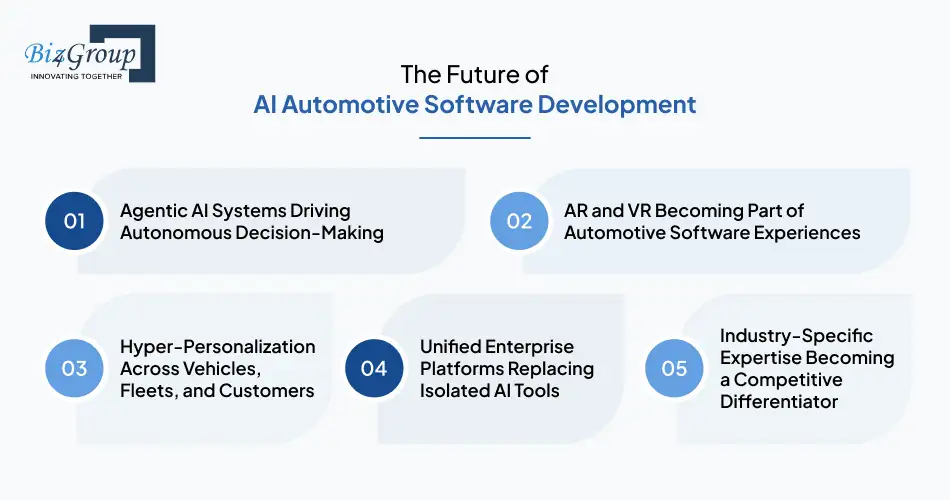
Below are the key shifts shaping the future of automotive software development with AI, explained in practical terms.
AI systems are evolving from insight generators to action-oriented decision engines. Agentic systems do not just analyze data. They execute decisions within defined boundaries.
This means software that automatically schedules maintenance, reroutes fleets, adjusts pricing, or resolves operational issues without waiting for human input. Many organizations exploring this direction invest in agentic AI development to reduce manual dependency and increase response speed. This shift is critical for enterprises looking to develop scalable AI automotive platforms for enterprises.
AR and VR are becoming practical tools in automotive environments. AR supports real-time overlays for diagnostics, maintenance guidance, and driver assistance. VR is increasingly used for training, simulation, and design validation. When combined with AI-driven insights, these technologies reduce errors and accelerate learning. As companies build AI powered automotive applications, immersive interfaces will play a bigger role in usability and adoption.
Future automotive platforms will adapt continuously to users. Vehicle settings, service alerts, routing preferences, and customer interactions will all be personalized based on behavior and context. This level of intelligence depends on advanced learning pipelines built into software architectures. Teams that create AI enabled automotive solutions early will have a clear advantage in customer experience and operational efficiency.
Standalone AI tools will gradually give way to unified platforms. Automotive businesses want intelligence to flow across fleets, dealerships, manufacturing, and customer systems. This is where enterprise AI solutions become strategic assets rather than experimental projects. Companies that develop AI automotive software for digital transformation focus on long-term integration, governance, and scalability.
As adoption increases, expectations rise. Generic platforms will struggle to meet complex automotive requirements around safety, compliance, and scale. Decision-makers increasingly evaluate vendors by studying the top AI automotive software development companies in USA and prioritizing partners with proven domain expertise.
The future favors teams that understand automotive realities as deeply as AI technology.
Choosing the right partner can make or break your AI automotive software development initiative. You are not just building software. You are building intelligence into critical automotive operations, often at scale. That requires a team that understands AI, automotive workflows, and enterprise-grade delivery equally well.
This is where Biz4Group LLC stands out.
Biz4Group is a US-based AI development company with hands-on experience building AI-driven automotive, fleet, and mobility solutions that work in real-world conditions. Our approach is not about experimentation. It is about solving operational problems with measurable outcomes.
What makes Biz4Group the right fit for automotive AI projects is our ability to translate complex requirements into scalable, production-ready systems. We combine domain understanding with strong engineering practices to help you develop AI automotive software solutions that grow with your business.
Our experience spans multiple high-impact automotive and mobility use cases, including:
These projects reflect how we approach custom AI automotive software development. Start with the business problem. Design for real users. Build systems that integrate cleanly with existing platforms. Scale without rework.
If you are looking to build AI powered automotive applications, modernize fleet operations, or drive digital transformation across automotive systems, partnering with Biz4Group LLC gives you more than development support. It gives you a long-term technology partner invested in your success.
When you are ready to move from planning to execution, the right partnership makes all the difference.
Partner with a US-based AI development company that has delivered real automotive, fleet, and mobility solutions at scale.
Start Your AI Project with Biz4GroupAI is no longer a future concept for the automotive industry. It is already shaping how vehicles are built, managed, serviced, and scaled. Companies investing in AI automotive software development today are gaining tighter control over operations, reducing inefficiencies, and creating smarter experiences across fleets, dealerships, and mobility platforms.
What truly matters is how these systems are built. Successful teams focus on practical use cases, scalable architecture, and measurable outcomes. They develop AI automotive software solutions that integrate smoothly with existing systems and grow as business needs evolve. This approach turns AI from a technical experiment into a reliable business asset.
Biz4Group LLC brings that execution-first mindset. As a US-based AI development company, Biz4Group has delivered real-world automotive and mobility platforms across fleet management, predictive maintenance, and inventory intelligence. Our work reflects a deep understanding of how to build AI-powered automotive applications that perform in production environments, not just demos.
If your goal is to create AI enabled automotive solutions that support long-term growth, efficiency, and digital transformation, the right partner makes all the difference.
AI automotive software refers to intelligent systems that learn from data, adapt over time, and make informed decisions. Traditional automotive systems follow static logic and predefined rules. AI systems instead process vehicle, fleet, and operational data to predict outcomes, optimize decisions, and personalize experiences in real time. This shift supports smarter diagnostics, fleet management, and connected vehicle use cases that go beyond legacy systems.
Investment in AI automotive software development varies significantly based on scope, complexity, and scale. A typical range is $40,000 to $300,000+, depending on features like real-time data processing, predictive analytics, mobility management, and integration complexity. Higher-end enterprise solutions naturally fall towards the top of this range due to scalability, advanced AI models, and robust security.
Development time depends on the feature set and data maturity. Basic solutions may take 3 to 4 weeks, while complex, AI-driven platforms with predictive, real-time, and scalable capabilities typically take 6 to 8 weeks. Time is influenced by data preparation, AI model training, integrations, testing, and compliance verification.
AI’s impact in automotive spans multiple areas, such as:
These use cases improve efficiency, reduce costs, and elevate customer experiences.
Yes, data readiness is essential. Good quality, well-structured vehicle and operational data improves AI model accuracy and accelerates development. Without clean data, training models may produce unreliable predictions and increase development costs. Most successful teams begin with a data assessment and governance strategy.
The tech stack for AI automotive software development typically includes:
These technologies support responsive dashboards, predictive models, and scalable backend systems.
Choose a partner with deep experience in both automotive workflows and AI systems. Look for these traits:
Working with an experienced AI development company ensures your vision becomes operational software that scales with business needs rather than a stalled experiment.

with Biz4Group today!
Our website require some cookies to function properly. Read our privacy policy to know more.