 Location :
Orlando, FL, USA
Location :
Orlando, FL, USA +1 (407) 714-1616
 info@biz4group.com
-
AI Conversation App Development is revolutionizing how businesses interact with users.
-
Understanding how to build AI conversation app ensures a structured, successful product launch.
-
Prioritizing user-centric features enhances engagement and app usability.
-
A trusted AI app development company like Biz4Group accelerates time-to-market and quality.
-
Choosing the right tech stack is critical for performance, scalability, and security.
-
Biz4Group is the ideal partner for AI Conversation App Development with a proven track record.
In September 2023, the landscape of AI Conversation App Development transformed dramatically. OpenAI’s update introduced voice and image capabilities to ChatGPT, revolutionizing how users interact with conversational AI. Imagine having a real-time voice chat with your AI assistant while traveling—or taking a picture of a landmark and instantly learning about its history through a live conversation.
At home, the experience becomes just as practical. You can snap a photo of your pantry or fridge and ask your AI assistant what to cook, including follow-up questions about recipes, ingredients, and substitutions.
These kinds of interactive, multimodal experiences are no longer futuristic—they’re here, and they’re shaping how businesses think about how to build AI conversation apps that are smart, intuitive, and engaging.
At Biz4Group, we specialize in conversation AI app development, creating scalable and intelligent solutions like AI Wizard—our very own AI conversation partner. In this guide, we’ll share key insights from our experience, including:
- How modern AI conversation apps are reshaping user expectations
- What technologies and frameworks power these apps
- Best practices for designing natural, user-friendly conversations
- Key features to consider for long-term success
Whether you're exploring the idea or actively planning development, this guide will help you understand what goes into building next-gen conversational AI apps.
What is an AI Conversation App?
An AI conversation app or an enterprise AI chatbot solution, is a software application, meant to facilitate human-like conversations. It utilizes artificial intelligence. Besides, it leverages NLP, and machine learning algorithms in a way that mimics human communication. Such apps are used in various contexts, like customer service, virtual assistants, mental health support, etc.
Why Businesses Should Invest in Developing AI Conversation App?
In 2025, investing in AI Conversation App Development is not just a trend—it's a strategic imperative. With the global conversational AI market projected to grow from $14.79 billion in 2025 to $61.69 billion by 2032, at a CAGR of 22.6% , businesses are recognizing the transformative potential of conversational AI.

Here's why your business should consider developing an AI conversation app:
- Enhanced Customer Engagement: AI conversation apps provide real-time, personalized interactions, improving customer satisfaction and loyalty.
- Operational Efficiency: Automating routine inquiries reduces the workload on human agents, leading to cost savings and faster response times.
- Scalability: AI apps can handle multiple conversations simultaneously, ensuring consistent service during peak times.
- Data-Driven Insights: These apps collect valuable data on customer preferences and behaviors, informing business strategies.
- Competitive Advantage: Early adoption positions your brand as innovative, meeting the growing consumer demand for instant, AI-driven communication.
As technology continues to evolve, integrating AI into your conversational app platform can lead to significant growth and customer satisfaction.
Build Smarter Conversations. Faster.
Let Biz4Group turn your AI vision into a polished, high-performing app—designed for real impact.
Let’s Build Your AI AppMust-Have Features to Consider for AI Conversation App Development
To build a successful AI conversation app that genuinely helps and engages users, you must focus on features that enhance interaction, responsiveness, and personalization.
Below are 10 essential user-centric features to consider during AI conversation app development.
| Feature | Purpose |
|---|---|
|
Natural Language Understanding (NLU) |
Helps the app interpret user intent and context accurately, ensuring meaningful responses. |
|
Multi-Platform Support |
Allows users to engage through web, mobile, or messaging apps, offering seamless accessibility. |
|
Voice Interaction |
Enables hands-free communication, enhancing user convenience especially on the go. |
|
Visual Input Interpretation |
Let's users upload images and get context-aware insights, making interactions more dynamic. |
|
Personalization Engine |
Adapts responses based on user preferences and behavior to offer tailored experiences. |
|
Real-Time Response |
Ensures immediate and smooth communication for better user engagement. |
|
Conversation Memory |
Remembers past interactions to keep conversations contextually rich and continuous. |
|
Multilingual Support |
Caters to global users by supporting multiple languages for wider adoption. |
|
User Analytics Dashboard |
Provides insights into usage patterns and preferences to continually enhance the experience. |
|
Privacy and Data Security |
Protects user data and builds trust with compliance to data privacy standards. |
Also Read: Get Ultimate Insights on AI Companion App, built by Biz4Group – Features and Benefits
A Step-by-Step Process to Build AI Conversation App
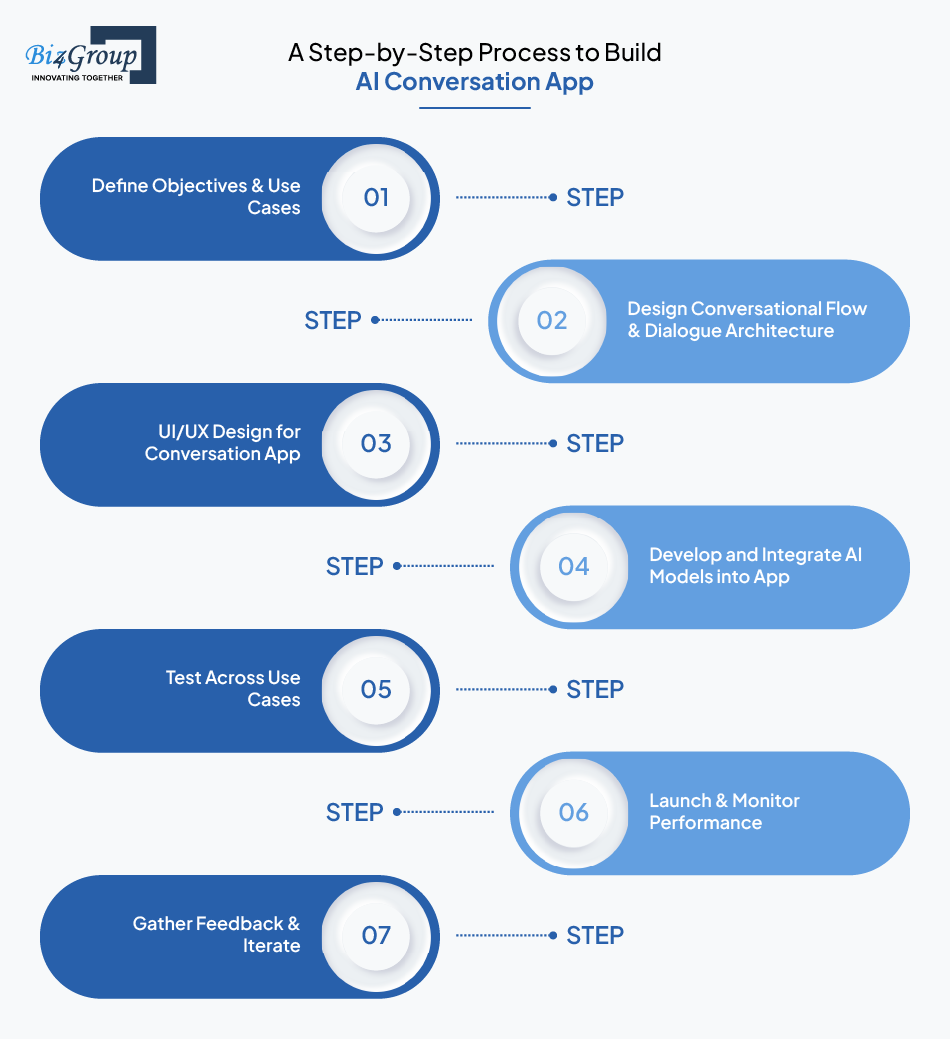
Creating a successful AI conversation app requires more than just integrating a chatbot framework. It involves a well-thought-out strategy, human-centric design, and robust engineering.
Whether you're a startup or an established brand, understanding the development process of AI Conversation App helps you deliver real value to users while staying competitive. Here's a detailed roadmap followed by leading AI development companies like Biz4Group.
Step 1: Define Objectives & Use Cases
Before writing a single line of code, define your app’s purpose. What problems will it solve? Who is your target audience? Will it act as a customer service agent, personal assistant, or product guide?
You should also define measurable KPIs—such as reducing customer support calls or increasing user engagement. A focused start ensures that your AI Conversation App Development journey stays aligned with business outcomes.
Step 2: Design Conversational Flow & Dialogue Architecture
Create a structured dialogue system that can manage real-life scenarios smoothly. Design for intent recognition, fallback responses, and context awareness to ensure seamless user interactions.
Tools like Voiceflow or Botpress—popular conversational application platform options—can help visually map dialogue branches, making it easier to plan natural, adaptive, and intuitive user journeys, even when conversations take unexpected turns.
Step 3: UI/UX Design for Conversation App
Collaborate with an expert UI/UX design company to craft interfaces that are simple, intuitive, and visually aligned with your brand.
Design elements such as message bubbles, voice buttons, image upload tools, and visual cues should make the experience seamless. Focus on accessibility, responsiveness, and multilingual readiness.
Step 4: Develop and Integrate AI Models into App
Train your conversational engine using custom datasets, predefined FAQs, or historical user inputs. Implement features like intent classification, named entity recognition, and sentiment analysis.
Simultaneously, integrate backend services (like CRMs, databases, or third-party APIs) to provide real-time, dynamic responses that enhance the user’s experience.
Step 5: Test Across Use Cases
Perform end-to-end testing under real-world conditions. Cover usability, performance, voice and language variations, error handling, and scalability.
Special attention should be paid to NLP accuracy and how the system handles ambiguous queries or user interruptions.
Step 6: Launch & Monitor Performance
Release your app on the most relevant channels—mobile apps, websites, or messaging platforms. Use tools like Firebase, Amplitude, or custom dashboards to track user interactions, pain points, and popular queries.
Monitor KPIs and use insights to adapt rapidly. This phase often uncovers challenges in AI conversational app development, such as misinterpreting user intent or lag in response times, which can then be addressed through continuous optimization.
Step 7: Gather Feedback & Iterate
Post-launch, continuous improvement is essential. Collect real user feedback and usage data to update conversational logic, improve UI elements, and refine AI accuracy.
Following an agile approach ensures your app stays relevant and keeps evolving with user expectations.
Don’t Just Plan. Launch with Confidence.
We don’t just consult—we design, develop, and deploy AI solutions that scale.
Start Your AI Project NowCost Estimation of AI Conversation App Development
When planning an AI conversation app, one of the most important considerations is the cost of development. Depending on the complexity of the features, the size of your user base, and the technology involved, the cost can vary significantly.
On average, the cost of AI Conversation App Development ranges between $20,000 to $200,000+. Here's how the range breaks down:
- $20,000 – $50,000: Basic chatbot or voice assistant with limited functionality, simple UI, and third-party AI integration (e.g., Dialogflow).
- $50,000 – $100,000: Mid-range apps with custom conversational flows, multilingual support, voice/image inputs, and backend integration.
- $100,000 – $200,000+: Enterprise-grade apps with advanced NLP, real-time analytics, context memory, deep personalization, and high-end security.
The development timeline typically spans 4 to 6 months, depending on:
- Scope of features and complexity
- Custom model training vs. third-party AI integration
- Collaboration with a skilled AI development company and UI/UX design company
- Time for testing, feedback, and iterative improvements
Investing in quality development ensures your app is scalable, user-friendly, and ready for future AI innovations.
Also Read: AI App Development Cost in 2025
Tools and Tech Stack Required to Develop AI Conversation App
Selecting the right tools and technology stack is critical to building a scalable, efficient, and intelligent AI conversation app. From AI engines to front-end frameworks, each component plays a role in the app's performance and user experience.
Here’s a breakdown of the essential tools and technologies used in AI Conversation App Development.
| Category | Tools & Technologies | Purpose |
|---|---|---|
|
AI/NLP Engines |
OpenAI GPT, Google Dialogflow, Rasa, IBM Watson |
To understand, process, and generate human-like text or conversation. |
|
Programming Languages |
Python, JavaScript, TypeScript |
To write application logic, build algorithms, and integrate services. |
|
Frontend Frameworks |
React, Flutter, Swift, Kotlin |
To build responsive and user-friendly interfaces across web and mobile platforms. |
|
Backend Technologies |
Node.js, Python (Django/Flask), Java (Spring Boot) |
To handle server-side logic, APIs, and connect with databases and AI models. |
|
Cloud Services |
AWS, Google Cloud Platform, Microsoft Azure |
To host the application, manage storage, and scale infrastructure. |
|
Database Systems |
MongoDB, PostgreSQL, Firebase, MySQL |
To store structured and unstructured data including user interactions and preferences. |
|
Voice & Speech Recognition |
Google Speech-to-Text, Amazon Transcribe, Whisper |
To convert spoken language into text and support voice-based interactions. |
|
Image Recognition |
Google Vision AI, Amazon Rekognition, OpenCV |
To process and understand visual input such as photos or scanned documents. |
|
Testing Tools |
Postman, Selenium, Jest, Cypress |
To ensure the app is functional, bug-free, and performs well across platforms. |
|
Analytics & Monitoring |
Firebase Analytics, Mixpanel, Datadog, Google Analytics |
To track user behavior, monitor performance, and gather actionable insights. |
Monetization Strategies for AI Conversation App
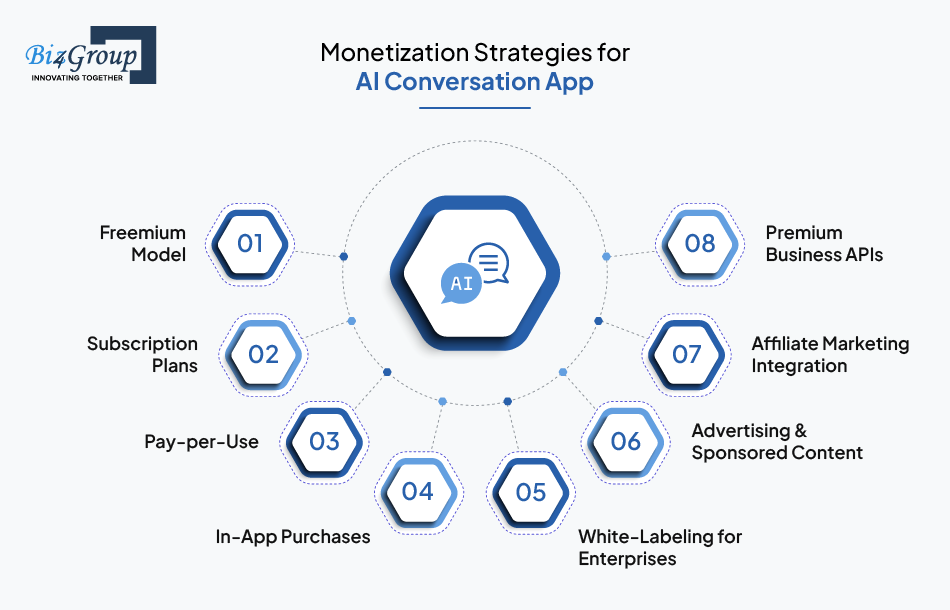
Building an innovative AI conversation app is only part of the journey—turning it into a sustainable revenue stream is the next key milestone. With conversational AI becoming mainstream across industries, there are several effective monetization models to choose from.
Below are proven strategies used by successful products and recommended by leading top AI development companies.
1. Freemium Model
Offer the core functionality of your app for free while reserving advanced features—such as extended conversation history, premium voice models, or deeper personalization—for paid users. This strategy helps attract a large user base quickly while gradually converting free users into paying customers.
2. Subscription Plans
Implement tiered subscription models (monthly or annually) for individual users, teams, or businesses. Each tier can unlock new features, integration support, or usage limits. This model ensures predictable recurring revenue and promotes customer retention through ongoing value delivery.
3. Pay-per-Use
Charge users based on specific usage metrics—such as the number of API calls, conversations, or processed images/audio files. This model works well for enterprise clients or developers integrating your app into their workflows, and scales with actual consumption.
4. In-App Purchases
Enable users to purchase value-added services within the app, such as personality upgrades, specialized response styles, language packs, or access to curated knowledge databases. This strategy boosts revenue by allowing microtransactions without locking essential features.
5. White-Labeling for Enterprises
License your platform as a white-label solution that other businesses can rebrand and deploy for their own use. This approach is ideal for startups and AI Conversation App Development firms targeting clients who want an out-of-the-box conversational interface without investing in R&D.
6. Advertising & Sponsored Content
Integrate subtle, relevant advertisements or sponsored content within user conversations or interfaces. For example, a travel chatbot could promote hotel bookings or flight deals. This works especially well in apps with high engagement and consumer interaction volume.
7. Affiliate Marketing Integration
Include affiliate-based promotions—such as product suggestions or service referrals—within the conversational flow. For every user that makes a purchase via the app's recommendation, your business earns a commission, creating a passive revenue channel.
8. Premium Business APIs
Offer external developers or partner businesses access to your AI model or chatbot as an API with usage-based pricing. This expands your app’s utility while opening new B2B monetization opportunities.
By combining two or more of these monetization models, your AI conversation app can serve multiple user segments, scale effectively, and generate long-term revenue.
How Biz4Group Can Help in Your AI Conversation App Development Journey?
We hope our AI Conversation App Development Guide has offered you deep insights into the world of building smart, scalable, and user-focused AI applications. From understanding key features and tech stacks to exploring monetization models, we’ve outlined everything you need to begin your journey confidently.
But when it comes to execution, having the right technology partner can make all the difference—and that’s where Biz4Group steps in.
As a leading AI app development company, we specialize in building intelligent, intuitive, and high-performing conversational AI apps tailored to your business needs. Whether you're launching a customer-facing chatbot, a voice-enabled assistant, or a multimodal AI interface, we have the technical expertise and strategic mindset to bring your vision to life.
Here’s what makes Biz4Group your ideal partner for AI Conversation App Development:
- Proven Experience: We’ve delivered numerous successful AI projects across industries including healthcare, retail, logistics, and enterprise solutions.
- Custom-Built Solutions: No one-size-fits-all templates. We design AI apps based on your unique goals, user behavior, and business model.
- Full-Cycle Development: From UI/UX design to AI model training, backend integration, and post-launch support—we handle it all.
- Latest Tech Expertise: Our team is skilled in the most advanced AI tools and frameworks, ensuring your app is future-ready.
Partnering with Biz4Group means gaining a dedicated team that’s invested in your success. If you're ready to turn your AI app ideas into reality, we’d love to hear more about your goals.
Turn Your Idea Into a Revenue-Driving AI App
From conversational design to monetization—we’ve built AI apps that users love and businesses profit from.
Book a Free Growth SessionConclusion
AI conversation apps are revolutionizing how businesses interact with users—offering smarter, faster, and more personalized communication. From selecting the right features to leveraging the best tech stack, every step in the development process plays a vital role in delivering a powerful user experience.
This guide has walked you through key strategies, tools, and insights to help you understand what it takes building conversational ai applications. Whether you're looking to enhance customer support, automate workflows, or engage users in new ways, the opportunities are endless.
At Biz4Group, we combine innovation with expertise to bring your ideas to life through scalable and intelligent solutions.
Ready to get started? Book an appointment with our AI experts today and turn your vision into a market-ready app
FAQ
1. What industries can benefit from AI conversation apps?
Virtually every industry—from eCommerce and healthcare to travel and education—can benefit. These apps improve customer engagement, automate routine tasks, and provide real-time support across various channels.
2. How secure is user data in an AI conversation app?
Data security is a top priority. We follow best practices including encryption, compliance with GDPR/HIPAA standards, and regular security audits to ensure user information is protected.
3. Can I integrate my AI conversation app with other tools or platforms?
Yes, integration is a key part of modern AI apps. Whether it's CRM systems, eCommerce platforms, or third-party APIs, we ensure seamless connectivity to maximize your app’s functionality.
4. Can I update or train the AI after the app is launched?
Yes, continuous learning is a core strength of conversational AI. You can retrain the model, update conversations, and fine-tune user interactions based on real-time feedback and performance analytics.
5. Is voice interaction necessary, or can my app be text-only?
Voice interaction is optional and depends on your target audience and use case. Many apps start with text-based interfaces and later scale up to include voice or image inputs for enhanced usability.
