Location :
Orlando, FL, USA
Location :
Orlando, FL, USA +1 (407) 714-1616
 info@biz4group.com

- AI drug discovery software development helps pharmaceutical companies reduce timelines, improve success rates, and make data-driven research decisions.
- Businesses are actively looking to develop AI drug discovery software to overcome high R&D costs, failed trials, and fragmented data challenges.
- A structured approach to develop AI tools for drug discovery and research ensures better accuracy, usability, and long-term scalability.
- The cost to create AI-based pharmaceutical research software typically ranges from $25,000 - $200,000+ depending on features, data complexity, and scale.
- Partnering with experts like Biz4Group LLC ensures successful AI drug discovery software development services, delivering scalable, high-impact solutions tailored to pharma and biotech needs.
Why does it still take over a decade to bring a single drug to market when technology has advanced so rapidly in every other industry? According to Deloitte, the average return on R&D investment for pharma companies has dropped to around 1.2% in recent years. Rising costs, long timelines, and repeated trial failures are pushing companies to rethink how they approach AI drug discovery software development.
Pharmaceutical leaders are actively exploring how to develop AI drug discovery software that can process massive datasets, predict outcomes faster, and reduce dependency on traditional trial-and-error methods.
A 2025 report from PwC highlights that AI adoption in life sciences is accelerating as companies seek faster time-to-market and improved success rates. This shift reflects a deeper change in how innovation is approached across the industry.
That said, building effective systems is not straightforward. Many organizations attempt to build AI drug discovery platform solutions but struggle with fragmented data, unclear workflows, and integration challenges. The gap between experimentation and scalable implementation often leads to stalled projects and missed opportunities.
So how do you successfully build AI-powered drug discovery systems with predictive modeling that deliver real outcomes? That is exactly what this guide covers. Get ready for a clear and actionable view of what it takes to succeed in AI-driven drug discovery today.
Understanding the Basics of AI Drug Discovery Software Development
Drug discovery has always been data-heavy. The difference today lies in how that data is used.
AI drug discovery software development refers to building intelligent systems that analyze biological data, predict drug behavior, and automate research workflows. These platforms combine machine learning, large datasets, and computational models to support faster and more accurate decision-making in pharmaceutical research.
Instead of relying on linear experimentation, companies are now developing drug discovery software using AI to simulate outcomes, identify patterns, and prioritize high-potential compounds early in the process.
How is AI Changing the Drug Discovery Process?
Traditional methods follow a step-by-step path. AI introduces parallel processing and predictive insights.
Here is a simple comparison:
|
Aspect |
Traditional Drug Discovery |
AI-Driven Drug Discovery |
|---|---|---|
|
Timeline |
10 to 15 years |
Significantly reduced timelines |
|
Cost |
Extremely high |
Optimized through automation |
|
Data usage |
Limited and siloed |
Large-scale integrated datasets |
|
Success rate |
Low |
Improved with predictive modeling |
|
Approach |
Trial and error |
Data-driven predictions |
This shift allows organizations to move from reactive research to proactive discovery.
Core Components of AI Drug Discovery Software
To develop AI drug discovery software, you need a structured system. Key components include:
- Data Ingestion Layer
Collects data from clinical trials, genomics, research papers, and chemical databases. - AI and Machine Learning Models
These models identify patterns, predict molecular interactions, and optimize drug candidates. - Data Processing and Pipelines
Clean, normalize, and prepare raw data for analysis. - Visualization Dashboards
Present insights in a way researchers and decision-makers can act on quickly. - Automation Engines
Reduce manual effort through intelligent workflows powered by AI automation services.
What Role Does AI Actually Play?
AI acts as the intelligence layer across the entire system.
- It predicts how molecules behave before lab testing
- It identifies hidden relationships in biological data
- It reduces the number of failed experiments
- It accelerates hypothesis testing
Where Does This Fit in the Bigger Picture?
AI drug discovery software does not exist in isolation. It is part of a broader ecosystem of digital healthcare innovation. Organizations building scalable platforms often combine it with:
- AI integration services to connect with legacy systems
- Advanced analytics engines
- Cloud-based infrastructure
- Modern enterprise AI solutions for scalability
This interconnected approach ensures the system evolves with growing data and research demands.
Quick Recap
If you are wondering what makes this approach valuable, here is the short answer:
- Faster discovery cycles
- Better decision-making
- Reduced R&D costs
- Higher probability of success
In simple terms, AI transforms drug discovery from a slow, uncertain process into a more predictable and scalable system.
Why Businesses Should Develop AI Drug Discovery Software Today?
Pharma leaders are facing a tough reality. Costs are rising, timelines are stretching, and success rates are not improving at the same pace. This is exactly why more organizations are choosing to develop AI drug discovery software right now instead of waiting.
The shift is not experimental anymore. It is strategic.
Market Demand is Growing Faster Than Expected
AI adoption in drug discovery is accelerating across pharma, biotech, and research organizations.
According to Precedence Research, the global AI in drug discovery market is projected to surpass $9.1 billion by 2032, growing at a strong CAGR.
Another 2025 report by PR Newswire highlights that 87% of professionals in life sciences companies report using AI for work-related research tasks.
What does this mean for you?
- Businesses are already moving
- Investors are backing AI-led innovation
- Early adopters are gaining a measurable edge
The Real Pain Points Driving This Shift
Before jumping into benefits, it helps to look at what teams are trying to fix.
|
Challenge |
Impact on Business |
Why AI Solves It |
|---|---|---|
|
Long discovery cycles |
Delays revenue generation |
Predictive models reduce trial phases |
|
High R&D costs |
Budget overruns |
Automation cuts manual effort |
|
Low success rates |
Failed investments |
Data-driven predictions improve outcomes |
|
Data silos |
Inefficient research |
Unified AI systems integrate datasets |
|
Manual workflows |
Slower productivity |
Intelligent systems streamline operations |
Many organizations exploring how to build AI drug discovery platform solutions are doing so because these problems directly affect growth and competitiveness.
Business Benefits That Go Beyond Efficiency
When companies create AI drug discovery solutions, the impact is not limited to faster research. It influences the entire business model.
Here is a clearer breakdown:
|
Benefit |
What It Means in Practice |
Business Outcome |
|---|---|---|
|
Faster time-to-market |
Identify viable compounds early |
Earlier revenue realization |
|
Cost optimization |
Reduce failed experiments |
Better R&D budget utilization |
|
Smarter decision-making |
Use predictive insights |
Higher success probability |
|
Scalable research |
Handle large datasets |
Support multiple drug pipelines |
|
Competitive positioning |
Innovate faster than peers |
Stronger market presence |
ROI Perspective: What Do You Actually Gain?
Let’s address the most important question decision-makers ask... Is the investment worth it?
Short answer: Yes, if done right.
|
Investment Area |
Traditional Model |
AI-Driven Model |
|---|---|---|
|
Discovery cost |
High due to trial failures |
Reduced with predictive filtering |
|
Time to candidate selection |
Years |
Months in many cases |
|
Resource utilization |
Fragmented teams |
Centralized intelligent systems |
|
Long-term ROI |
Uncertain |
More predictable outcomes |
Companies that invest early in AI also explore advanced approaches like agentic AI development to enable systems that can independently analyze, learn, and optimize research workflows over time.
For organizations planning to build AI-powered drug discovery systems, the current moment offers a rare advantage. The technology is mature enough to deliver results, yet still early enough to create a strong edge.
Businesses at this stage also ask, “We want to build AI-based drug discovery software to reduce research time and costs, how can we get started?”
The answer often lies in identifying the right use case first and partnering with a team that understands both AI and pharmaceutical workflows. Let’s talk about the use cases first.
How Long Can You Afford to Wait?
AI is already reducing drug discovery timelines by up to 30%. The real risk now is not starting.
Build Smart with Biz4GroupReal-World Use Cases to Create AI Drug Discovery Solutions
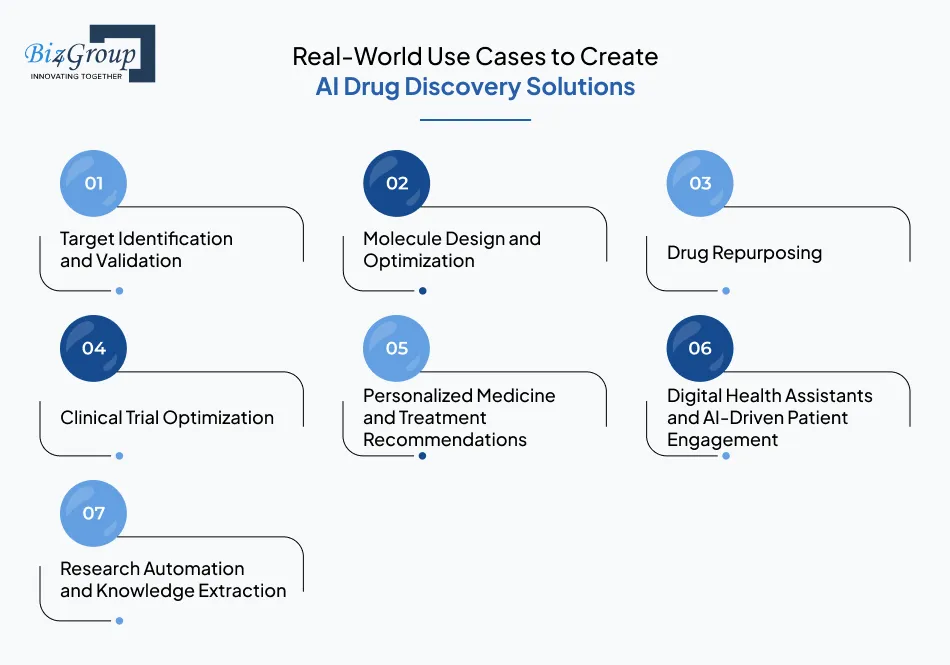
The real impact of AI becomes evident when you see how it performs in real-world environments. Organizations that create AI drug discovery solutions are transforming different stages of research into faster, more data-driven processes.
Below are the most relevant and widely adopted use cases.
1. Target Identification and Validation
Drug discovery begins with identifying the right biological targets. This step often determines the success or failure of the entire pipeline.
AI models process genomic datasets, protein interactions, and disease pathways to identify targets that are more likely to respond to treatment. This reduces early-stage uncertainty and helps teams focus on high-value research directions.
Companies that develop AI tools for drug discovery and research often prioritize this use case to build a strong foundation for downstream processes.
2. Molecule Design and Optimization
Designing molecules is one of the most time-intensive parts of drug discovery. AI changes how this step is approached.
With predictive analytics, systems can generate and test thousands of molecular structures virtually. This helps researchers refine compounds before moving into lab testing, saving both time and resources.
This is where building AI-powered drug discovery software with predictive modeling plays a critical role in improving efficiency and reducing failed experiments.
3. Drug Repurposing
Drug repurposing focuses on finding new uses for existing drugs. AI accelerates this by analyzing clinical data, patient records, and published research.
Instead of starting from zero, organizations can identify alternative applications for approved compounds. This significantly reduces development timelines and regulatory hurdles.
It is one of the fastest ways to extract additional value from existing pharmaceutical assets.
4. Clinical Trial Optimization
Clinical trials are complex, expensive, and often unpredictable. AI helps bring structure and predictability to this stage.
By analyzing patient data and historical trial outcomes, AI systems can identify suitable candidates, predict potential risks, and optimize trial design. This leads to better outcomes and reduced failure rates.
Advanced implementations aligned with agentic AI in healthcare are enabling adaptive systems that evolve during trials based on real-time insights.
5. Personalized Medicine and Treatment Recommendations
Personalized medicine is one of the most practical and fast-growing applications of AI in healthcare.
AI systems analyze user-specific data such as symptoms, health history, and lifestyle factors to recommend tailored treatments or supplements. This approach improves patient outcomes and enhances engagement.
AI-Powered Chatbot for Personalized Supplement Recommendations
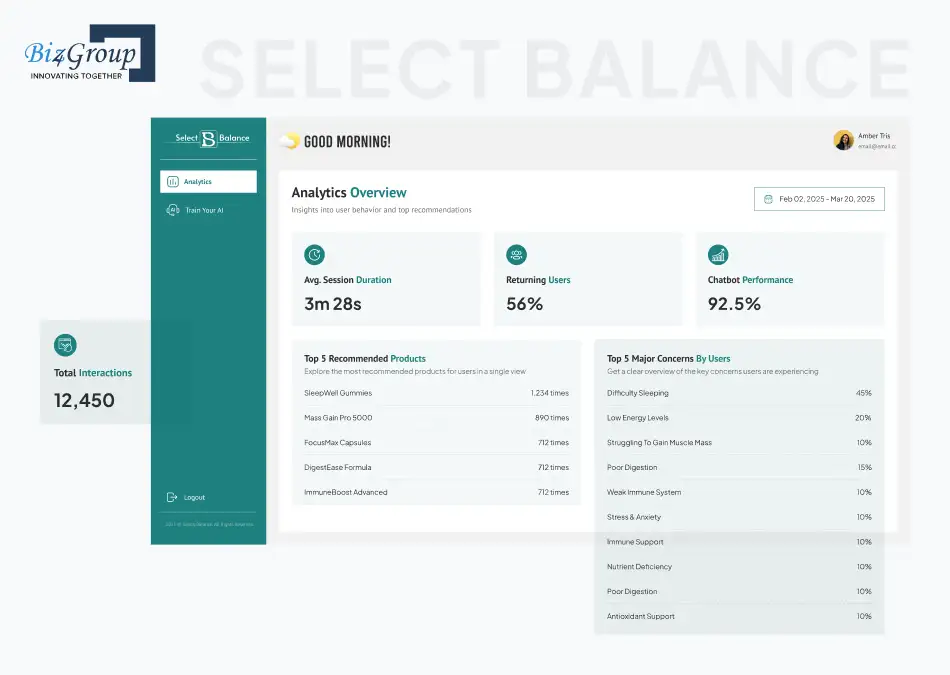
This use case was implemented through a conversational AI system designed to simplify supplement selection. Biz4Group built an AI chatbot for personalized supplement recommendation that:
- Interacts through quizzes and natural conversations
- Maps user inputs to health concerns like digestion, immunity, and energy
- Delivers real-time product recommendations using a PostgreSQL-backed system
- Enables continuous updates through an admin panel for keyword mapping and training
This solution highlights how an experienced AI chatbot development company can power intelligent recommendation engines in healthcare.
Also read: AI supplement recommendation chatbot development guide
6. Digital Health Assistants and AI-Driven Patient Engagement
Beyond research, AI is also redefining how patients interact with healthcare systems.
AI-driven assistants provide continuous health guidance, track patient data, and create a more engaging experience. These systems bridge the gap between clinical research and real-world patient care.
AI Avatar for Personalized Wellness and Health Guidance
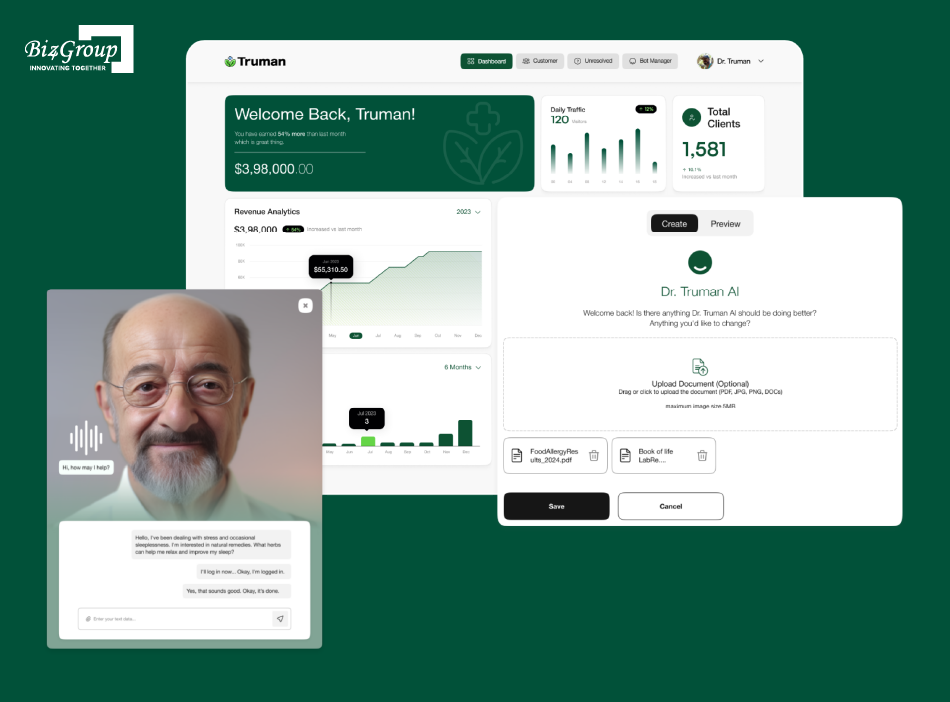
In this implementation, the focus was on creating an interactive and human-like healthcare experience. Biz4Group developed an AI avatar for personalized wellness.
- AI-powered avatar capable of real-time health consultations
- Chatbot functionality for personalized recommendations
- Users can upload medical reports and track health history
- eCommerce features for seamless product discovery and purchase
Also read: Healthcare AI avatar development guide
7. Research Automation and Knowledge Extraction
Pharmaceutical research involves processing vast amounts of unstructured data. AI simplifies this process.
It can extract insights from research papers, clinical reports, and experimental datasets in seconds. This reduces manual effort and allows researchers to focus on decision-making rather than data gathering.
Closing Note on Use Cases
Each of these use cases demonstrates how AI is being applied across the drug discovery lifecycle. Organizations that build AI drug discovery platform solutions around these applications are better equipped to scale, innovate, and stay ahead.
Key Features of Custom AI Drug Discovery Software Development
When organizations build AI-powered drug discovery systems, features define how effective and scalable the platform becomes. The right set of capabilities ensures faster insights, better predictions, and seamless research workflows.
Below is a breakdown of essential features included in custom AI drug discovery software development.
|
Feature |
What It Is |
What It Does |
|
Predictive Modeling Engine |
AI models trained on biological and chemical data |
Predicts molecule behavior, toxicity, and success probability |
|
Molecular Simulation Tools |
Computational tools for virtual compound testing |
Reduces dependency on physical lab experiments |
|
Data Integration Layer |
System that connects multiple data sources |
Combines clinical, genomic, and research data into one platform |
|
AI Recommendation Engine |
Intelligent system for suggesting compounds or treatments |
Identifies high-potential drug candidates based on patterns |
|
Natural Language Processing (NLP) |
AI that processes research papers and clinical notes |
Extracts insights from unstructured medical data |
|
Workflow Automation Engine |
Rule-based and AI-driven automation system |
Streamlines repetitive research tasks and reduces manual effort |
|
Visualization Dashboard |
Interactive interface for data interpretation |
Helps researchers and stakeholders make faster decisions |
|
Real-Time Data Processing |
Continuous data ingestion and analysis capability |
Enables instant insights and adaptive research workflows |
|
Generative AI Models |
Advanced AI models for molecule creation |
Designs new drug candidates with optimized properties |
|
API and Integration Framework |
Middleware connecting external tools and systems |
Ensures seamless communication across platforms |
Why These Features Matter
Each feature contributes to a larger goal. Helping organizations create AI-based pharmaceutical research software that is not only intelligent but also practical and scalable.
When combined effectively, these capabilities allow teams to:
- Accelerate discovery timelines
- Improve research accuracy
- Optimize resource utilization
In short, features are what turn a concept into a high-performing AI-driven drug discovery platform.
Also read: How to develop an AI telemedicine app?
Are Your Features Saving Time or Wasting It?
Teams using the right AI features process thousands of compounds in minutes, not months. The difference is in what you build.
Book a Strategy Call TodayTools and Frameworks Required for Building AI Drug Discovery Platforms for Pharma
A strong foundation determines how well your system performs under real-world research conditions. When organizations build AI-powered drug discovery systems, they need a well-structured architecture supported by a reliable and scalable tech stack.
Let’s break this into two parts. Architecture and technology stack.
AI Drug Discovery System Architecture
To develop AI drug discovery software, the architecture should support large-scale data processing, continuous learning, and seamless interaction between components.
Key layers typically include:
- Data Ingestion Layer
Collects structured and unstructured data from clinical trials, research databases, lab systems, and external APIs. - Data Processing Layer
Cleans, transforms, and prepares datasets for AI model training and analysis. - Model Layer
Houses machine learning and deep learning models that perform prediction, classification, and molecular analysis. - Experimentation Layer
Allows researchers to run simulations, test hypotheses, and refine models in controlled environments. - API Layer
Acts as a bridge between backend intelligence and frontend applications, enabling smooth data exchange. - Application Layer
Interfaces used by researchers, analysts, and stakeholders to interact with the system and interpret results. - Orchestration Layer
Manages workflows, schedules tasks, and ensures different components work in sync.
This layered approach helps organizations build AI drug discovery platform solutions that are modular, scalable, and easier to evolve over time.
Technology Stack for AI Drug Discovery Software Development
Choosing the right tools is critical when you create AI drug discovery solutions. The tech stack should support high-performance computing, data-intensive operations, and rapid experimentation.
|
Layer |
Tools and Frameworks |
Purpose |
|---|---|---|
|
Frontend |
React, Angular, Vue.js |
Build interactive dashboards and visualization interfaces |
|
Backend |
Node.js, Python (Django, Flask), Java (Spring Boot) |
Handle business logic, APIs, and system orchestration |
|
Database |
PostgreSQL, MongoDB, Neo4j |
Store structured, unstructured, and graph-based biological data |
|
AI/ML Frameworks |
TensorFlow, PyTorch, Scikit-learn |
Train and deploy predictive and deep learning models |
|
Data Processing |
Apache Spark, Hadoop, Pandas |
Process and analyze large-scale datasets efficiently |
|
Cloud Platforms |
AWS, Microsoft Azure, Google Cloud |
Provide scalable infrastructure and computing power |
|
MLOps Tools |
MLflow, Kubeflow, SageMaker |
Manage model lifecycle, versioning, and deployment |
|
Visualization Tools |
Tableau, Power BI, D3.js |
Present insights through interactive data visualizations |
|
API Management |
GraphQL, REST, FastAPI |
Enable seamless communication between system components |
|
Containerization |
Docker, Kubernetes |
Support deployment, scaling, and system reliability |
The right architecture and tools can make or break your platform. A well-planned stack ensures that your system can handle growing datasets, evolving models, and complex research workflows without friction.
However, even with the best technology in place, building these systems comes with its own set of challenges. Let’s explore those next.
Challenges in AI Drug Discovery Software Development (and How to Solve Them)
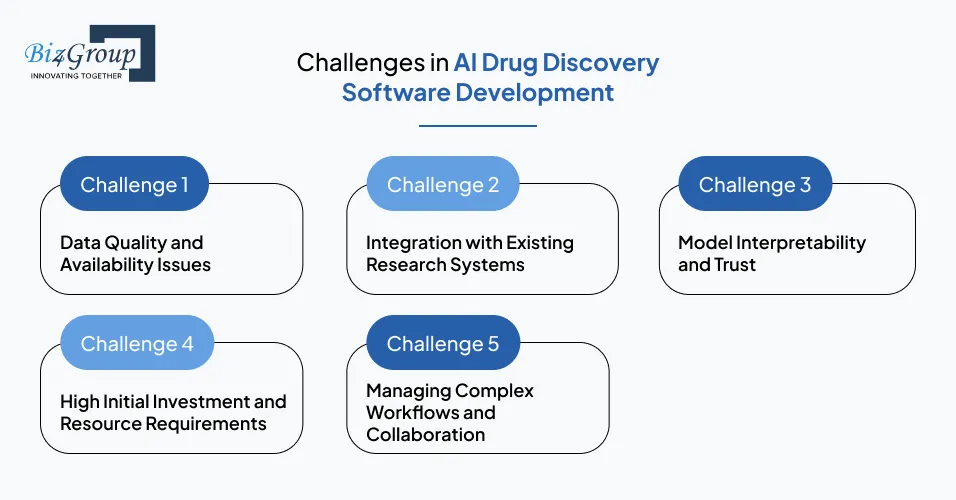
While the benefits are compelling, organizations that build AI-powered drug discovery systems often face practical challenges during development and deployment. Understanding these early helps in planning better and avoiding costly setbacks.
Challenge 1. Data Quality and Availability Issues
AI models rely heavily on data. In drug discovery, data often comes from multiple sources with inconsistencies, missing values, or limited accessibility. Poor data quality leads to inaccurate predictions, which can impact the entire research pipeline.
How to address this challenge:
- Establish strong data preprocessing and validation pipelines
- Use standardized data formats across systems
- Invest in curated datasets and domain-specific data sources
- Continuously monitor and refine data inputs
Challenge 2. Integration with Existing Research Systems
Many pharmaceutical companies operate on legacy systems that were not designed for AI integration. Connecting modern AI models with older infrastructure becomes complex and time-consuming.
This is where many organizations pause and ask, “We are evaluating vendors that can develop AI drug discovery platforms with integration into our existing research systems.” The ability to handle integrations effectively often becomes the deciding factor when choosing a development partner.
How to address this challenge:
- Use modular architecture with API-driven integrations
- Gradually modernize legacy systems instead of full replacement
- Implement middleware solutions for smoother data flow
- Work with experts in AI product development to ensure seamless system design
Challenge 3. Model Interpretability and Trust
AI models, especially deep learning systems, often act as black boxes. In drug discovery, decisions need to be explainable for researchers and stakeholders. Lack of transparency can slow adoption and reduce trust in AI-driven outcomes.
How to address this challenge:
- Use explainable AI techniques for better model transparency
- Provide clear visualization of model outputs
- Combine AI insights with domain expertise
- Document model behavior and decision logic
Challenge 4. High Initial Investment and Resource Requirements
Building advanced AI systems requires skilled talent, infrastructure, and time. This creates a high entry barrier, especially for startups and mid-sized companies. Organizations planning to create AI-based pharmaceutical research software often struggle with balancing cost and capability.
How to address this challenge:
- Start with focused use cases and scale gradually
- Build an MVP before full-scale development
- Optimize cloud infrastructure for cost efficiency
- Collaborate with teams or hire AI developers with relevant experience
Also read: Top 15 AI healthcare software development companies in USA
Challenge 5. Managing Complex Workflows and Collaboration
Drug discovery involves multiple teams including researchers, data scientists, and clinicians. Coordinating workflows across these roles becomes challenging without a unified system. Disconnected processes reduce efficiency and delay outcomes.
How to address this challenge:
- Implement centralized platforms for collaboration
- Automate repetitive workflows where possible
- Ensure real-time data access across teams
Every challenge in AI drug discovery presents an opportunity to build smarter systems. The key lies in approaching development with the right strategy, tools, and expertise.
Now that we have addressed the roadblocks, let’s move to the actual process of building AI drug discovery software step-by-step.
High Investment or High Returns?
AI-led drug discovery can improve R&D productivity by up to 40%. The right approach turns challenges into measurable ROI.
Maximize Your ROI with Biz4GroupHow to Develop AI Drug Discovery Software Step-by-Step?
Building a successful AI platform requires clarity, structure, and the ability to align business goals with execution.
Many decision-makers often ask, “I am exploring how to build AI drug discovery software using machine learning and large datasets, what are the key steps involved?”
We have an answer.
Here is a clear, practical roadmap to help you move from idea to deployment while ensuring your approach to AI drug discovery software development delivers real results.
Step 1. Define the Problem and Use Case
Every successful product starts with clarity.
Identify what you want to solve. It could be target identification, molecule design, or clinical trial optimization. Avoid trying to solve everything at once.
A focused approach helps teams develop AI drug discovery software that delivers measurable outcomes from the start.
Step 2. Data Collection and Preparation
Once the objective is clear, the next step is gathering relevant data.
This includes clinical datasets, research papers, genomic data, and experimental results. The goal is to create a reliable dataset that reflects real-world scenarios.
Clean and well-structured data directly impacts model performance and accuracy.
Step 3. Design User Experience and Interfaces
A powerful system still needs to be usable.
Researchers, analysts, and stakeholders must be able to interact with the platform easily. This is where a thoughtful UI/UX design company plays a critical role in simplifying complex workflows.
Well-designed interfaces ensure faster adoption and better decision-making.
Also read: Top 15 UI/UX design companies in USA
Step 4. Build and Train AI Models
This is where the intelligence of the system is developed.
Models are trained using historical and real-time data to predict outcomes, identify patterns, and generate insights. The focus should be on accuracy, adaptability, and continuous learning.
Organizations looking to build AI drug discovery platform solutions must ensure their models align with the defined use case and business goals.
Step 5. Develop an MVP Before Full-Scale Deployment
Launching a full product without validation can be risky.
Start with a Minimum Viable Product to test core functionalities, gather feedback, and refine the system. This approach reduces risk and improves efficiency.
Working with teams that specialize in MVP development services helps accelerate this phase.
Also read: Top 12+ MVP development companies in USA
Step 6. Testing, Validation, and Iteration
Before scaling, the system must be thoroughly tested.
Validate model accuracy, system performance, and usability. Identify gaps and refine continuously based on feedback and real-world usage.
This iterative approach ensures that your building AI-powered drug discovery software with predictive modeling delivers consistent and reliable results.
Step 7. Deployment and Continuous Improvement
Once validated, the platform can be deployed across teams and integrated into existing workflows.
However, development does not stop here. Continuous monitoring, updates, and improvements are essential to keep the system aligned with evolving data and research needs.
Organizations that create AI drug discovery solutions successfully treat deployment as the beginning of long-term optimization.
A structured approach reduces uncertainty and increases the chances of success. Each step plays a role in turning an idea into a scalable, high-impact solution.
Also read: How to build an AI pharmacy app?
Planning Is Done. What’s Next?
Over 60% of AI projects fail due to poor execution. The ones that succeed move fast and build right.
Call Our AI ExpertsCompliance Standards for Developing Drug Discovery Software Using AI
When organizations develop AI drug discovery software, compliance becomes a critical factor in ensuring reliability, safety, and approval readiness. Regulatory frameworks guide how data is handled, how models are validated, and how outcomes are documented.
Below are the key compliance areas to consider while building AI-driven drug discovery solutions:
- FDA Guidelines for AI in Drug Development
Ensure adherence to evolving guidelines from the U.S. Food and Drug Administration for AI and machine learning in pharmaceutical research and drug approval processes. - Good Machine Learning Practices (GMLP)
Follow standardized practices for developing, training, and validating AI models to ensure consistency, reproducibility, and transparency. - HIPAA Compliance for Health Data
Protect patient-related data by aligning with healthcare privacy regulations when handling clinical or personal health information. - GDPR for Data Protection (if operating globally)
Maintain strict data privacy and consent management practices when dealing with user data across regions like the European Union. - Data Traceability and Auditability
Maintain detailed logs of data sources, model training processes, and decision-making pathways for regulatory audits. - Clinical Validation Requirements
Ensure that AI-generated predictions and insights are validated through clinical testing and real-world evidence. - Ethical AI Standards
Avoid bias in datasets and models while ensuring fairness and accountability in decision-making. - Interoperability Standards
Align with healthcare data standards to ensure smooth data exchange between systems and research platforms. - Documentation and Reporting
Maintain comprehensive documentation for models, datasets, and workflows to support regulatory submissions and approvals. - Continuous Monitoring and Updates
Regularly monitor system performance and update models to stay compliant with evolving regulations and scientific advancements.
Compliance is not a one-time task. It is an ongoing responsibility that evolves alongside technology and regulations.
Organizations that build AI drug discovery platform solutions with compliance in mind from the beginning are better positioned to scale, gain approvals, and establish long-term credibility in the pharmaceutical ecosystem.
Also read: HIPAA-compliant AI healthcare software development guide
How Much Does It Cost to Create AI-Based Pharmaceutical Research Software?
The cost of AI drug discovery software development varies widely based on scope, complexity, and data requirements. On average, businesses can expect an investment ranging between $25,000 - $200,000+.
Here is a quick breakdown based on development stages:
|
Level |
Scope |
Estimated Cost |
|---|---|---|
|
MVP |
Basic features, limited dataset, single use case |
$25,000 - $60,000 |
|
Advanced |
Multiple features, predictive models, integrations |
$60,000 - $120,000 |
|
Enterprise |
Full-scale platform, automation, scalability |
$120,000 - $200,000+ |
This range gives a starting point. The actual investment depends on how you plan to create AI-based pharmaceutical research software and the depth of functionality required.
Key Cost Drivers in AI Drug Discovery Software Development
Several factors directly influence the cost when organizations build AI-powered drug discovery systems. Understanding these helps in planning budgets more effectively.
|
Cost Driver |
What It Involves |
Estimated Cost Impact |
|---|---|---|
|
Data Acquisition |
Sourcing clinical, genomic, and research datasets |
$5,000 - $40,000 |
|
AI Model Development |
Training, testing, and optimizing ML models |
$15,000 - $70,000 |
|
Software Development |
Backend, frontend, APIs, workflows |
$20,000 - $80,000 |
|
Integrations |
Connecting external tools and databases |
$5,000 - $25,000 |
|
Cloud Infrastructure |
Storage, compute power, scaling |
$3,000 - $20,000 annually |
|
Testing and Validation |
Performance testing and refinement |
$5,000 - $15,000 |
|
Maintenance and Updates |
Ongoing improvements and monitoring |
$2,000 - $10,000 per month |
Each of these components plays a role in shaping the final cost. Skipping or underestimating any of them can lead to delays or rework later.
Hidden Costs You Should Plan For
Beyond the obvious expenses, there are hidden costs that often catch teams off guard while they develop AI drug discovery software.
First, data preparation can take more time than expected. Cleaning and structuring datasets may add $5,000 - $15,000 depending on complexity.
Second, model retraining is an ongoing requirement. As new data comes in, models need updates, which can cost $3,000 - $10,000 per cycle.
Third, third-party tools and licensing fees can increase expenses. Depending on the tools used, this may add $2,000 - $12,000 annually.
Fourth, UI and usability improvements are often underestimated. Enhancing user experience post-launch can require $5,000 - $20,000.
Fifth, scaling infrastructure to handle larger datasets and users may increase cloud costs by 20% - 40% over time.
Planning for these ensures that your building AI-powered drug discovery software with predictive modeling remains sustainable.
How to Optimize Development Costs
Managing costs does not mean compromising quality. It means making smarter decisions while you create AI drug discovery solutions.
- Start with a focused use case to avoid unnecessary feature development
- Build an MVP before scaling to reduce initial investment
- Use open-source frameworks where possible to cut licensing costs
- Optimize cloud usage to prevent overspending on infrastructure
- Partner with experienced teams to avoid costly mistakes and delays
Cost plays a crucial role in decision-making, but it should always be evaluated alongside long-term value. Organizations that invest strategically in AI drug discovery software development services often see better ROI through faster research cycles, reduced failures, and improved innovation outcomes.
Now that you understand the investment required, let’s explore what the future holds for AI in drug discovery.
Also read: True cost of implementing AI in healthcare
Is Cost the Concern or the Outcome?
Companies that adopt AI early see faster time-to-market and significantly lower failure rates. Waiting has its own price.
Get Your Cost EstimateFuture Trends in AI Drug Discovery Software Development Services
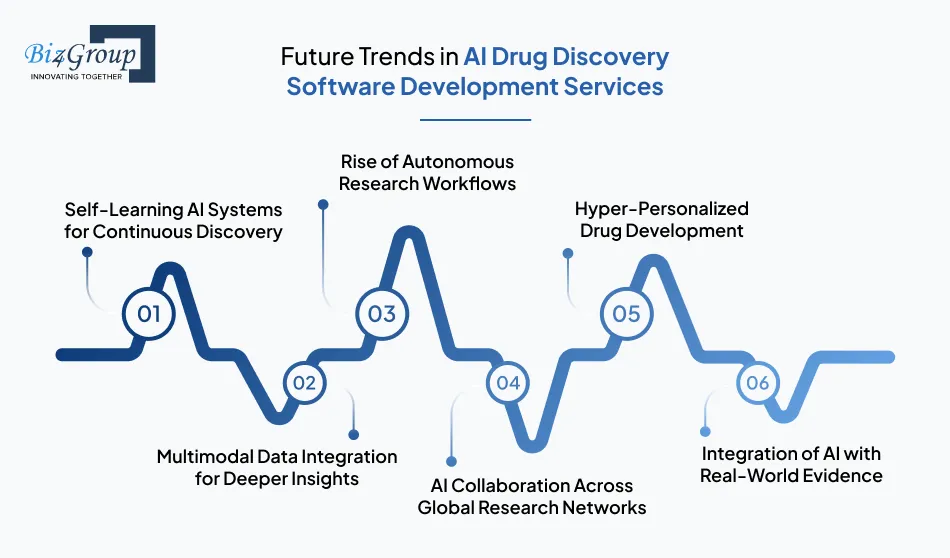
The pace of innovation in pharma is accelerating, and AI is at the center of it. Organizations investing in AI drug discovery software development services today are not only solving current challenges but also preparing for a future where research becomes faster, smarter, and more autonomous.
Here are the key trends shaping what comes next.
1. Self-Learning AI Systems for Continuous Discovery
AI models are evolving from static systems to adaptive ones.
Future platforms will continuously learn from new datasets, clinical outcomes, and research findings without requiring constant retraining. This shift will allow companies to develop AI drug discovery software that improves over time and becomes more accurate with usage.
2. Multimodal Data Integration for Deeper Insights
Drug discovery is no longer limited to one type of data.
AI systems are now combining genomics, proteomics, clinical data, and even smart wearable device inputs to generate deeper insights. This approach enables organizations to create AI drug discovery solutions that provide a more complete understanding of diseases and treatment responses.
3. Rise of Autonomous Research Workflows
AI is moving toward handling entire research workflows independently.
From hypothesis generation to simulation and analysis, future systems will reduce human intervention significantly. This is where companies looking to build AI-powered drug discovery systems will benefit from faster experimentation cycles and reduced operational overhead.
4. AI Collaboration Across Global Research Networks
Collaboration is becoming more data-driven and less location-dependent.
AI platforms are enabling real-time collaboration between pharmaceutical companies, research institutions, and biotech startups across the globe. This trend is encouraging organizations to build AI drug discovery platform ecosystems that support shared knowledge and distributed innovation.
5. Hyper-Personalized Drug Development
The focus is shifting from generalized treatments to highly targeted therapies.
AI is making it possible to design drugs tailored to specific patient groups based on genetic and lifestyle data. This advancement is pushing companies to create AI-based pharmaceutical research software that aligns closely with personalized healthcare models.
6. Integration of AI with Real-World Evidence
Future drug discovery platforms will rely more on real-world data.
Patient records, treatment outcomes, and post-market surveillance data will play a larger role in refining drug development strategies. This will help organizations make more informed decisions and improve long-term success rates.
Also read: How to seamlessly integrate AI models into development workflow?
The future of drug discovery is not about replacing scientists. It is about empowering them with better tools, faster insights, and smarter systems.
We’ve heard many leaders asking, “We need a development partner to create AI-driven drug discovery solutions with predictive modeling and data analysis. Who can deliver this at scale?”
This is where choosing the right technology partner makes all the difference. And here is one of your best options.
Also read: How to build an AI medical software?
Biz4Group LLC: Your Trusted Partner in the USA for Building AI-Powered Drug Discovery Systems
When organizations decide to invest in AI drug discovery software development, the biggest decision is about choosing the right partner who understands both AI and the complexities of pharmaceutical innovation.
Biz4Group LLC stands at that intersection.
We are a USA-based AI healthcare software development company with deep expertise in building intelligent, scalable, and domain-specific solutions. Our work spans across healthcare, life sciences, and advanced AI systems, where precision and reliability matter most. From early-stage ideation to full-scale deployment, we help businesses develop AI drug discovery software that aligns with real-world research needs and delivers measurable outcomes.
What sets us apart as an AI development company is our ability to translate complex scientific workflows into practical, high-performing platforms. Our team combines technical depth with industry understanding to create solutions that are both innovative and usable. We do not approach projects as vendors. We work as long-term partners who are invested in your success.
Why Businesses Choose Biz4Group LLC
Companies across pharma, biotech, and healthcare consistently choose Biz4Group because we bring more than development capabilities to the table.
- Proven expertise in building advanced AI systems for healthcare industry
- Ability to design and deliver end-to-end platforms, from concept to deployment
- Focus on building scalable, future-ready systems tailored to business goals
- Experience in creating intelligent solutions powered by predictive modeling and real-time data processing
- Dedicated teams that understand both technology and research workflows
- Transparent communication and agile development approach
Organizations that want to create AI drug discovery solutions often ask, “We are looking for companies that specialize in AI drug discovery software development with experience in pharma and biotech. Who can truly deliver?”
This is exactly where our expertise becomes valuable.
We have successfully delivered AI-driven platforms that go beyond basic functionality. Our solutions are designed to solve real problems, like improving decision-making, accelerating research, or creating better user experiences.
At Biz4Group, we believe that building AI systems is not about adding features. It is about creating meaningful impact. That philosophy drives how we approach every project and every client partnership.
So, if you are ready to build AI-powered drug discovery systems that deliver real results, now is the time to take the next step. Let’s connect and turn your vision into a high-impact AI solution.
To Summarize...
Drug discovery is at a turning point. Traditional methods are no longer enough to keep up with rising costs, longer timelines, and increasing complexity. This is where AI drug discovery software development steps in as a practical solution. By combining data, predictive modeling, and automation, organizations can move faster, make smarter decisions, and reduce the risk of failed outcomes.
From use cases and features to cost and challenges, one thing is clear. Companies that build AI-powered drug discovery systems today are positioning themselves for long-term success. The shift toward AI is not optional anymore. It is becoming a core part of how modern pharmaceutical research operates and evolves.
This is where partnering with the right team becomes critical. As a trusted software development company in USA, Biz4Group brings the expertise, experience, and strategic approach needed to turn complex ideas into scalable, high-performing solutions. Whether you are starting from scratch or enhancing an existing system, having the right partner can accelerate your journey significantly.
If you are ready to take your next step in AI-driven innovation, let’s make it happen. Build smarter, move faster, and lead the future of drug discovery with confidence.
FAQs
1. What types of companies should invest in AI drug discovery software?
AI-driven drug discovery is not limited to large pharmaceutical firms. It is equally valuable for biotech startups, clinical research organizations, healthcare innovators, and even academic research labs. Any organization working with complex biological data or looking to accelerate research can benefit from investing in AI-powered systems.
2. Do you need in-house AI expertise to build drug discovery software?
Not necessarily. While having internal expertise helps, many companies partner with experienced development firms to bridge the gap. This allows them to access specialized talent, reduce hiring overhead, and speed up execution without building large internal teams.
3. Can AI drug discovery software integrate with existing lab systems?
Yes, modern platforms are designed to work with existing research tools and databases. With the right approach, AI systems can connect with lab management software, clinical data systems, and third-party tools, ensuring continuity without disrupting current workflows.
4. How long does it take to develop AI drug discovery software?
Most platforms take several months to develop depending on complexity and scope. Biz4Group, however, can deliver a functional MVP in 2-4 weeks by leveraging reusable components and proven development frameworks. This significantly reduces both development time and cost while allowing faster validation.
5. What datasets are required for AI drug discovery platforms?
AI systems typically require a mix of structured and unstructured datasets such as clinical trial data, genomic information, chemical compound databases, and published research. The quality and relevance of data play a major role in determining the accuracy of predictions and insights.
6. How scalable are AI drug discovery platforms?
Scalability depends on how the system is designed. Well-built platforms can handle increasing data volumes, support multiple research pipelines, and adapt to new use cases over time. This makes them suitable for both growing startups and large enterprises.
7. How do you choose the right AI development partner for drug discovery?
Look for a partner with proven experience in both AI and healthcare domains. Evaluate their past projects, technical expertise, and ability to understand your specific use case. A reliable partner should offer end-to-end support, from strategy to deployment and beyond.