Location :
Orlando, FL, USA
Location :
Orlando, FL, USA +1 (407) 714-1616
 info@biz4group.com

- HIPAA-compliant AI healthcare software development enables businesses to build secure, scalable, and intelligent healthcare systems that protect sensitive patient data while improving care delivery.
- Businesses that develop HIPAA-compliant AI healthcare software gain advantages such as improved diagnostics, operational efficiency, and reduced compliance risks.
- Real-world applications like AI chatbots, cognitive health platforms, and predictive analytics highlight how to build HIPAA-compliant AI medical software that delivers measurable outcomes.
- Businesses must address common HIPAA compliance challenges in AI healthcare software such as data access, integration, and resource constraints.
- Applying proven strategies is the best way to create AI healthcare software with HIPAA compliance while ensuring usability, performance, and regulatory alignment.
- Biz4Group LLC stands out as a trusted partner for HIPAA-compliant AI healthcare software development services, delivering secure, scalable, and high-performing healthcare solutions tailored to business needs
What happens when your AI-powered healthcare platform handles sensitive patient data but fails to protect it properly?
According to IBM’s Cost of a Data Breach Report 2025, the average cost of a healthcare data breach has crossed $10 million, making it the most expensive industry for breaches globally. That reality puts immense pressure on healthcare businesses investing in HIPAA-compliant AI healthcare software development to get security and compliance right from day one.
Healthcare leaders are now racing to adopt AI-driven solutions, yet many struggle to develop HIPAA-compliant AI healthcare software that balances innovation with strict regulatory standards. From predictive diagnostics to intelligent chatbots, AI promises better outcomes, but without compliance, even the most advanced solution can become a liability overnight.
For startups and enterprises alike, the challenge goes deeper. Teams aiming to build HIPAA-compliant AI medical software must navigate encryption protocols, data governance, and evolving privacy rules, all while ensuring seamless user experience and scalability.
It raises a critical question many decision-makers are asking today... How to build HIPAA-compliant AI software with data encryption while still delivering speed and performance?
This guide breaks it all down in a practical, business-focused way. For businesses planning to create HIPAA-compliant AI healthcare software or optimize an existing system, everyone will find clear answers, proven strategies, and real-world insights to move forward with confidence.
Let’s begin with the basics.
What is HIPAA-Compliant AI Healthcare Software Development?
At its core, HIPAA-compliant AI healthcare software development refers to building intelligent healthcare systems that can process, analyze, and store patient data while strictly following HIPAA regulations. These systems rely on AI technologies such as machine learning, NLP, and automation, but every layer is designed with data protection in mind.
So what does that mean in practical terms? It means your AI system can learn from patient data without exposing sensitive information. It also means every interaction, whether through dashboards, APIs, or even AI chatbot development, is secured, tracked, and compliant.
A Simple Way to Understand It
Think of it like this. AI adds intelligence. HIPAA adds responsibility.
When both come together, you get systems that are powerful and trustworthy.
HIPAA-Compliant vs Non-Compliant AI Healthcare Software
To make things clearer, here is a quick comparison that decision-makers often look for before investing.
|
Factor |
HIPAA-Compliant AI Software |
Non-Compliant AI Software |
|---|---|---|
|
Data Security |
Encrypted at rest and in transit |
Weak or no encryption |
|
Access Control |
Role-based and strictly monitored |
Open or poorly controlled access |
|
Audit Logs |
Complete activity tracking |
Limited or no tracking |
|
Data Sharing |
Secure APIs with safeguards |
Unrestricted data flow |
|
Legal Risk |
Low |
Extremely high |
|
Patient Trust |
Strong |
Easily compromised |
This difference alone explains why many AI healthcare products fail before scaling.
What Makes AI Healthcare Software HIPAA-Compliant
If you are wondering how to evaluate your system, here is a practical checklist that answers a common question... Is your AI healthcare software HIPAA-compliant?
- Data encryption both at rest and in transit
- Role-based access control for users and administrators
- Secure authentication methods like MFA
- Continuous monitoring and audit trails
- Business Associate Agreements with vendors
- Secure APIs for integrations
- Data anonymization during AI model training
These are not optional features. They are foundational requirements when you develop HIPAA-compliant AI healthcare software.
Where AI Adds Complexity to Compliance
AI systems rely heavily on large datasets, which increases exposure to sensitive information. This makes compliance more complex and requires stricter data handling practices from the start.
That is why businesses planning the development of HIPAA-compliant AI healthcare software must approach compliance as an ongoing process, not a one-time checklist.
Now, understanding the definition is one thing. Applying it correctly is where most organizations struggle. The gap between compliant and non-compliant systems often lies in execution, not intention.
In the next section, we will break down why HIPAA compliance holds such weight in AI-driven healthcare and what is truly at stake for your business.
Why Is HIPAA Compliance Important When Developing AI Healthcare Software?
Healthcare AI runs on data. Sensitive data. Personal data. Regulated data.
So, the real question is not whether compliance matters. It is how much risk you are willing to take without it.
According to The HIPAA Journal 2025 Healthcare Data Breach Report, over 133 million healthcare records were exposed in a single year. That number continues to grow as AI adoption increases.
This clearly answers a common concern... Why is HIPAA compliance important when developing AI healthcare software?
Because one vulnerability can impact millions of patients and cost organizations their reputation overnight.
The Real Cost of Ignoring HIPAA Compliance
Let’s break it down in business terms.
|
Risk Area |
Impact Without Compliance |
|---|---|
|
Financial |
Fines up to $1.5 million per violation category per year |
|
Legal |
Lawsuits and long-term regulatory scrutiny |
|
Operational |
System shutdowns and forced audits |
|
Brand |
Loss of patient trust and partnerships |
|
Growth |
Delayed scaling and investor hesitation |
These are not theoretical risks. They are active consequences faced by companies that rush to build AI systems without compliance baked in.
AI Expands the Risk Surface
Traditional healthcare systems store and retrieve data. AI systems learn from it, process it continuously, and often share insights across platforms.
This is where strong AI integration becomes essential. Every connected system must follow the same compliance standards, or the entire ecosystem becomes vulnerable.
Compliance Directly Impacts Patient Trust
Patients today are more aware than ever about how their data is used. A secure and compliant system signals responsibility. A breach signals negligence.
A 2025 report found that over 65% of patients are concerned about how healthcare organizations use their data, especially with AI involvement.
This leads to a simple truth.
Compliance is not only about avoiding penalties. It is about earning trust.
Why AI Healthcare Software Often Fails Compliance
Many businesses ask this late in the process. Why AI healthcare software fails HIPAA compliance?
The answer usually comes down to avoidable gaps:
- Security added after development instead of during design
- Poor documentation of data handling processes
- Lack of audit trails and monitoring systems
- Misconfigured cloud environments
- Inadequate testing before deployment
Even advanced systems using generative AI or automation can fail if compliance is treated as an afterthought.
If you are planning the development of HIPAA-compliant AI healthcare software, compliance is not a checkbox. It is a foundation. It shapes how your product is built and how it is trusted.
Key Benefits of HIPAA-Compliant AI Healthcare Software Development
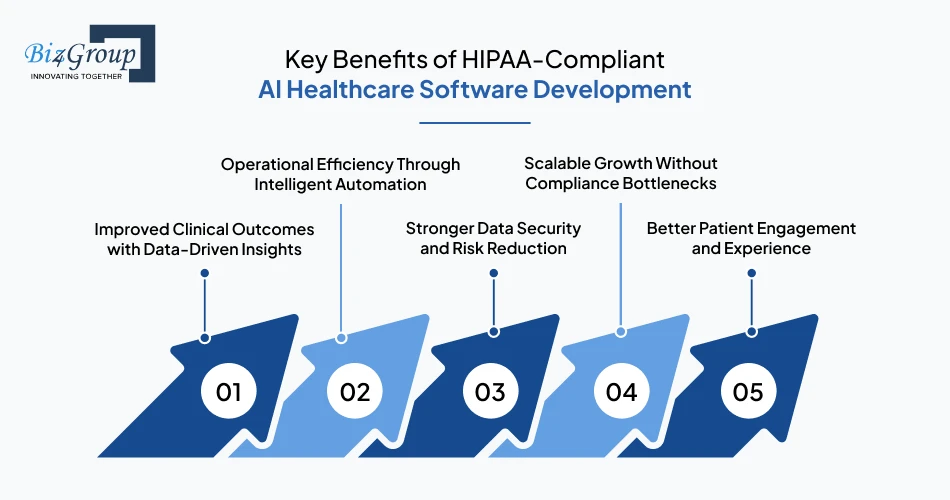
Investing in HIPAA-compliant AI healthcare software development brings more than regulatory peace of mind. It creates measurable business value. For healthcare startups, hospitals, and enterprises, the right approach can unlock efficiency, scalability, and long-term growth.
Let’s break down what you actually gain when you develop HIPAA-compliant AI healthcare software the right way.
Improved Clinical Outcomes with Data-Driven Insights
AI systems process vast amounts of structured and unstructured data to uncover patterns that clinicians may miss. When compliance is built in, this analysis happens securely without exposing sensitive patient information.
- Faster and more accurate diagnoses
- Early mental health diagnosis and detection of chronic conditions
- Personalized treatment recommendations
- Continuous patient monitoring
This is where AI software development for healthcare following HIPAA-compliant standards becomes a powerful differentiator for care providers.
Also read: How to build AI medical diagnosis app?
Operational Efficiency Through Intelligent Automation
Manual processes slow down healthcare systems. AI changes that by automating repetitive and time-consuming workflows while keeping compliance intact.
- Automated appointment scheduling and patient triage
- Smart medical documentation and transcription
- Claims processing and medical billing optimization
- Reduced administrative burden for staff
Businesses that integrate AI automation into their systems often see faster turnaround times and lower operational costs.
Also read: How to build AI scheduling assistant app?
Stronger Data Security and Risk Reduction
One of the biggest advantages of HIPAA-compliant systems is reduced business risk. Organizations can avoid costly penalties, minimize breach-related expenses, and operate with greater confidence in regulated environments. This also improves investor trust and long-term sustainability.
Scalable Growth Without Compliance Bottlenecks
As healthcare businesses grow, their systems must handle more users, more data, and more integrations. Compliance ensures that scaling does not introduce vulnerabilities.
- Easy integration with third-party healthcare systems
- Secure expansion across regions and facilities
- Support for advanced AI capabilities and analytics
- Future-ready infrastructure for evolving regulations
This is especially critical when you develop an AI product for healthcare that needs to scale across multiple markets.
Better Patient Engagement and Experience
Modern patients expect fast, personalized, and secure interactions. AI-powered systems deliver faster, more personalized interactions that improve overall patient satisfaction.
- Real-time responses through intelligent assistants
- Personalized health insights and reminders
- Improved communication between patients and providers
- Higher patient satisfaction and retention
The impact extends far beyond regulatory requirements. When done right, building a HIPAA-compliant AI healthcare software transforms how healthcare businesses operate, scale, and deliver care.
In the next section, we move from advantages to real-world implementation. You will see how these benefits translate into actual use cases through AI-driven healthcare solutions.
Still Running Healthcare on Manual Mode?
Over 30% of healthcare costs come from inefficiencies. AI can fix that. Are you leaving growth on the table?
Build Smart with Biz4GroupUse Cases of Developing a HIPAA-Compliant AI Healthcare Software
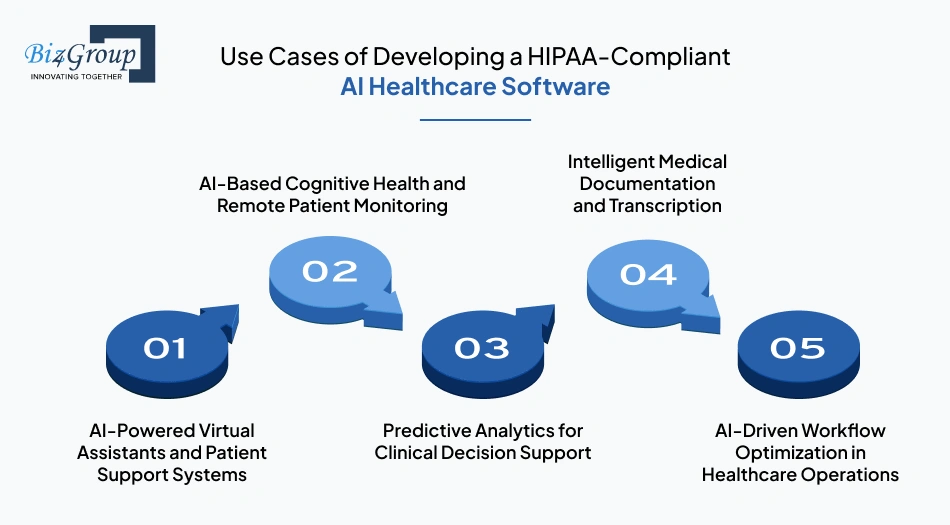
Understanding benefits is helpful. Seeing how they play out in real-world scenarios is what drives decisions. Businesses exploring HIPAA-compliant AI healthcare software development often look for proven applications that balance innovation with compliance.
Here are some of the most impactful use cases shaping modern healthcare systems.
1. AI-Powered Virtual Assistants and Patient Support Systems
Healthcare providers are increasingly adopting AI-driven assistants to handle patient queries, triage symptoms, and guide users toward the right care path. These systems operate round the clock and significantly reduce the workload on medical staff.
When you develop HIPAA-compliant AI healthcare software for virtual assistance, the system ensures secure conversations, encrypted data exchange, and compliant storage of patient interactions.
Project Spotlight: AI Chatbot for Personalized Support to Homeless and At-Risk Veterans
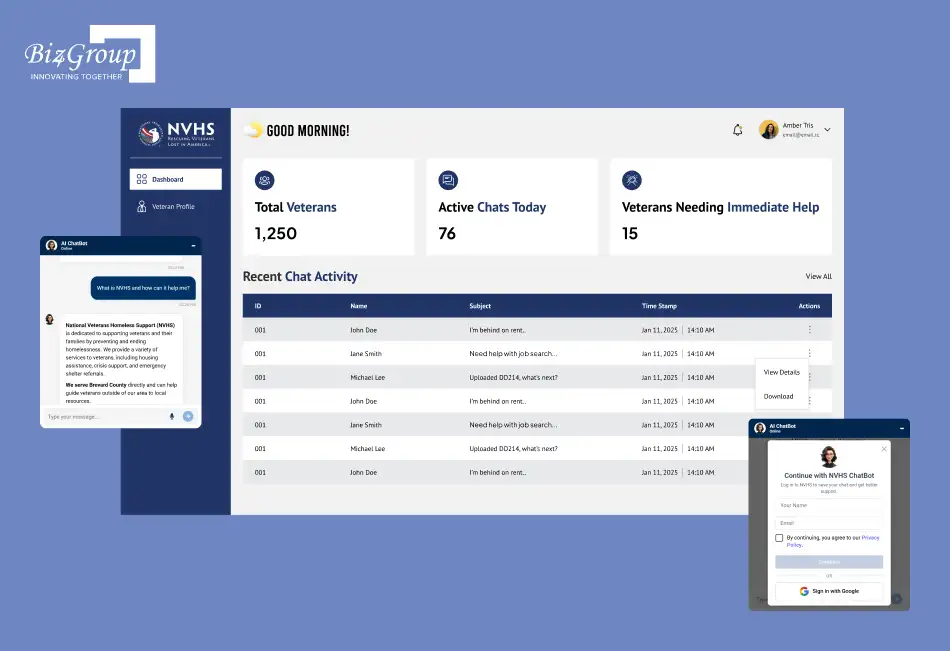
Built as an AI-driven support system for veterans, this solution highlights how compliant AI can deliver real impact.
- Conversational AI with voice and text interaction
- Real-time crisis detection and escalation
- Personalized action plans based on eligibility and location
- Secure login and chat history tracking
- Admin dashboard for monitoring high-risk cases
This project reflects how building a HIPAA-compliant AI healthcare software can bridge accessibility gaps while maintaining strict data privacy standards.
2. AI-Based Cognitive Health and Remote Patient Monitoring
AI is transforming how cognitive health conditions are tracked and managed. Systems can now monitor behavioral patterns, track memory performance, and provide personalized interventions over time.
For organizations aiming to create HIPAA-compliant AI healthcare software, this use case demonstrates how sensitive patient data can be analyzed securely while delivering continuous care.
Project Spotlight: AI-based Solution for Dementia Patients
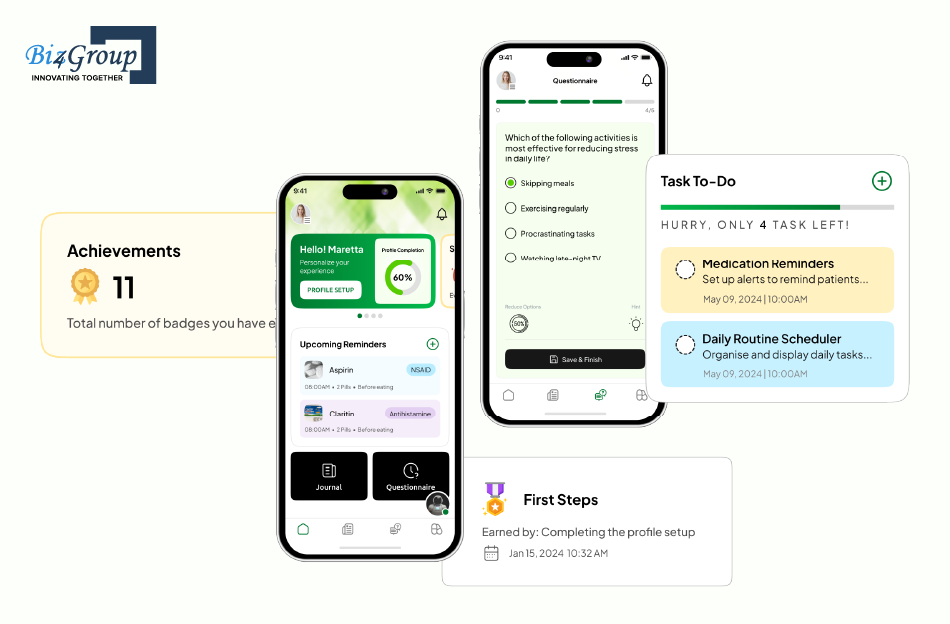
This AI-powered mobile application for dementia patients was designed to support the patients in their daily lives.
- Personalized memory-based quizzes tailored to user history
- Daily journaling to strengthen cognitive routines
- Voice-to-text journaling for accessibility
- Emotion-aware chatbot interactions
- Cognitive performance tracking using machine learning models
The solution demonstrates how developing a HIPAA-compliant AI healthcare software can enhance patient independence while maintaining data confidentiality and accuracy.
Also read: How to build a speech recognition system with AI?
3. Predictive Analytics for Clinical Decision Support
Hospitals and clinics use AI to analyze historical and real-time patient data to predict potential health risks. This allows doctors to make proactive decisions instead of reactive ones.
When you build HIPAA-compliant AI medical software for predictive analytics, it ensures that training data, model outputs, and recommendations are handled securely and transparently.
This is particularly valuable for chronic disease management, hospital readmission reduction, and resource optimization.
4. Intelligent Medical Documentation and Transcription
AI simplifies documentation by converting voice inputs into structured medical records. This reduces manual effort and improves accuracy across clinical workflows.
For healthcare businesses planning the development of HIPAA-compliant AI healthcare software, this use case highlights the importance of secure data capture, storage, and retrieval.
Also read: How to develop HIPAA-compliant AI medical transcription software?
5. AI-Driven Workflow Optimization in Healthcare Operations
Beyond patient care, AI plays a major role in optimizing backend operations. From scheduling to billing, automation improves efficiency across departments.
Organizations investing in HIPAA-compliant healthcare software development integrating AI can streamline operations without compromising compliance.
Emerging innovations like agentic AI development are further enhancing decision-making by enabling autonomous systems that adapt in real-time while adhering to strict data governance rules.
Quick Summary of Key Use Cases
|
Use Case |
Business Impact |
Compliance Importance |
|---|---|---|
|
Virtual Assistants |
Improved patient engagement |
Secure conversations and data storage |
|
Cognitive Health Monitoring |
Better long-term care |
Protection of sensitive behavioral data |
|
Predictive Analytics |
Proactive decision-making |
Secure model training and outputs |
|
Medical Documentation |
Reduced admin workload |
Safe handling of clinical records |
|
Workflow Automation |
Operational efficiency |
Controlled access and auditability |
These examples show one thing clearly. AI in healthcare delivers real value when compliance is built into the foundation. Whether you aim to create HIPAA-compliant AI healthcare software for patient engagement or operational efficiency, the right use case can define your product’s success.
Next, we will break down the essential features that make these systems secure, scalable, and truly compliant.
Essential Features of HIPAA-Compliant AI Healthcare Software Development
When businesses plan HIPAA-compliant AI healthcare software development, features define more than functionality. They determine how securely the system operates, how efficiently it scales, and how reliably it supports clinical and operational needs.
If you are looking to develop HIPAA-compliant AI healthcare software, the following features are critical for building a system that aligns with both regulatory and business expectations.
|
Feature |
What It Is |
What It Does |
|---|---|---|
|
Data Tokenization |
A method of replacing sensitive data with non-sensitive tokens |
Ensures that real patient data is never directly exposed during processing or AI model training |
|
Fine-Grained Access Policies |
Advanced permission systems beyond basic role-based access |
Controls access at a granular level, limiting who can view, edit, or process specific data points |
|
Secure Data Pipelines |
Structured workflows for moving data across systems securely |
Maintains data integrity and confidentiality throughout ingestion, processing, and storage stages |
|
AI Model Governance |
Framework for monitoring and managing AI model behavior |
Ensures transparency, accuracy, and compliance of AI decisions over time |
|
Differential Privacy Mechanisms |
Techniques that add noise to datasets to protect individual identities |
Allows AI models to learn from data without exposing sensitive patient information |
|
Real-Time Threat Detection |
Continuous monitoring using AI to detect anomalies |
Identifies suspicious activities and potential breaches before they escalate |
|
Compliance Reporting Dashboard |
Centralized interface for compliance tracking and reporting |
Provides visibility into audits, logs, and compliance status for regulators and stakeholders |
|
Secure API Gateways |
Controlled interfaces for system integrations |
Ensures safe communication between internal systems and third-party platforms |
|
Data Lifecycle Management |
Policies governing how data is stored, archived, and deleted |
Prevents unnecessary data retention and reduces compliance risks |
|
AI Explainability Engine |
Tools that interpret and justify AI decisions |
Helps clinicians and stakeholders understand how outcomes are generated, increasing trust |
|
Multi-Tenant Data Isolation |
Architecture that separates data across users or organizations |
Ensures that data from different entities remains isolated and secure in shared environments |
|
Automated Compliance Checks |
Built-in validation tools for continuous compliance monitoring |
Detects configuration issues and policy violations in real time |
|
Secure Model Training Environments |
Isolated environments for training AI models |
Protects sensitive datasets used during training from external exposure |
For organizations planning on building a HIPAA-compliant AI healthcare software, focusing on these capabilities early in the development lifecycle can significantly reduce risks and improve long-term performance.
Next, we will explore the technology stack that powers these features and enables secure, intelligent healthcare systems.
Also read: How to build a HIPAA compliant provider-to-provider telehealth platform?
Does Your Software Check All the Right Boxes?
Missing even one compliance feature can cost millions. Is your system built to pass or fail under pressure?
Book a Strategy Call TodayArchitecture and Tools Used in Developing a HIPAA-Compliant AI Healthcare Software
A strong system begins with the right architecture. The structure you choose determines how efficiently your platform performs, scales, and adapts to future requirements. When planning HIPAA-compliant AI healthcare software development, architecture and technology decisions must align with both performance and compliance goals from day one.
Before selecting tools, it is important to understand how the system is structured.
Architecture of HIPAA-Compliant AI Healthcare Software
Below is a practical breakdown of how modern healthcare AI systems are typically designed.
- User Interaction Layer
Handles patient and provider interfaces such as web apps, mobile apps, and dashboards. Focuses on usability and accessibility across devices. - Application Layer
Manages core business logic including scheduling, reporting, and workflow orchestration. Ensures smooth communication between frontend and backend systems. - AI Processing Layer
Processes data through machine learning models, NLP engines, and predictive systems. Generates insights, recommendations, and automation outputs. - Data Management Layer
Stores structured and unstructured healthcare data such as EHRs, imaging data, and patient records. Supports efficient querying and data organization. - Integration Layer
Connects with third-party systems like integrating AI with EHR platforms, insurance systems, and external APIs. Enables seamless data exchange across ecosystems. - Monitoring and Analytics Layer
Tracks system performance, user activity, and AI outputs. Helps stakeholders make informed decisions based on real-time insights. - Infrastructure Layer
Includes cloud environments, servers, and networking components that support deployment, scaling, and system availability.
This layered approach ensures flexibility and allows businesses to build HIPAA-compliant AI medical software that evolves with changing healthcare demands.
Technology Stack for HIPAA-Compliant AI Healthcare Software Development
Choosing the right stack is critical when you develop HIPAA-compliant AI healthcare software. Below are commonly used technologies across different layers of the system.
Frontend Technologies
|
Category |
Tools / Frameworks |
Purpose |
|---|---|---|
|
Web Development |
React.js, Angular, Vue.js |
Build responsive and interactive user interfaces |
|
Mobile Development |
Flutter, React Native, Swift |
Develop cross-platform or native healthcare apps |
|
UI Frameworks |
Bootstrap, Material UI |
Ensure consistent and accessible design systems |
Backend Technologies
|
Category |
Tools / Frameworks |
Purpose |
|
Backend Frameworks |
Node.js, Django, Spring Boot |
Handle server-side logic and API management |
|
API Development |
REST, GraphQL |
Enable communication between systems and services |
|
Authentication |
OAuth 2.0, JWT |
Manage secure user authentication and session handling |
AI and Machine Learning Technologies
|
Category |
Tools / Frameworks |
Purpose |
|---|---|---|
|
Machine Learning |
TensorFlow, PyTorch, Scikit-learn |
Build predictive and analytical models |
|
NLP Processing |
spaCy, NLTK, OpenAI APIs |
Process medical text, conversations, and clinical notes |
|
Model Deployment |
TensorFlow Serving, MLflow |
Deploy and manage AI models in production |
Data Storage and Management
|
Category |
Tools / Frameworks |
Purpose |
|---|---|---|
|
Relational Databases |
PostgreSQL, MySQL |
Store structured healthcare data |
|
NoSQL Databases |
MongoDB, Cassandra |
Handle unstructured and high-volume data |
|
Data Warehousing |
Snowflake, Amazon Redshift |
Support analytics and reporting at scale |
Cloud and Infrastructure
|
Category |
Tools / Frameworks |
Purpose |
|---|---|---|
|
Cloud Platforms |
AWS, Microsoft Azure, Google Cloud |
Provide scalable and secure infrastructure |
|
Containerization |
Docker, Kubernetes |
Enable flexible deployment and orchestration |
|
Monitoring Tools |
Prometheus, Grafana |
Track system performance and uptime |
Interoperability and Standards
|
Category |
Tools / Frameworks |
Purpose |
|---|---|---|
|
Healthcare Standards |
HL7, FHIR |
Enable standardized data exchange between systems |
|
Integration Engines |
Mirth Connect, Redox |
Facilitate seamless communication across healthcare platforms |
Architecture defines how your system behaves. The tech stack defines how efficiently it performs. Together, they form the backbone of any successful HIPAA-compliant AI healthcare software development initiative.
Next, we will walk through the exact step-by-step process to bring such a system from concept to deployment.
7 Steps to Build HIPAA-Compliant AI Healthtech Platform
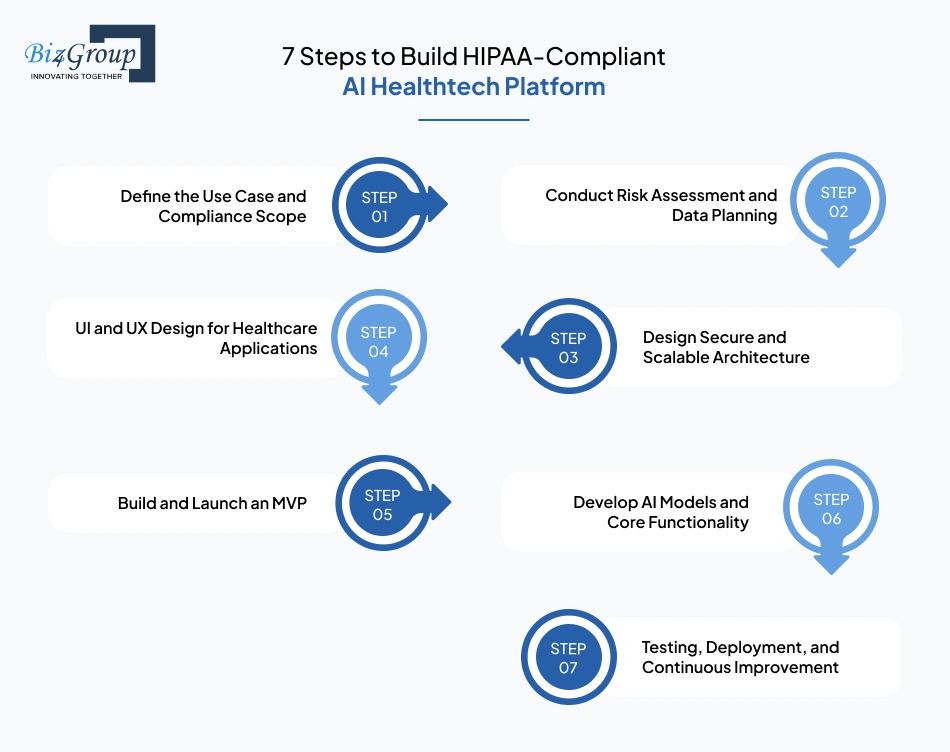
Building a healthcare AI solution demands a structured approach that aligns product vision, regulatory requirements, and user needs from the start.
If you are planning to develop HIPAA-compliant AI healthcare software, following a clear process can reduce risks, control costs, and accelerate time to market. Below is a practical roadmap for you.
Step 1. Define the Use Case and Compliance Scope
Every successful product begins with clarity. Start by identifying the exact problem your solution will solve.
- Who are your users?
- What type of data will be processed?
- Which HIPAA rules apply to your system?
This step lays the foundation for building a HIPAA-compliant AI healthcare software that aligns with real business needs rather than assumptions.
Step 2. Conduct Risk Assessment and Data Planning
Before development begins, map how data will flow through the system. This helps identify vulnerabilities early.
- Define data sources and formats
- Classify sensitive vs non-sensitive data
- Plan data storage and access flows
So, how do companies ensure HIPAA compliance in AI healthcare development? It starts with understanding data movement before writing a single line of code.
Step 3. Design Secure and Scalable Architecture
Now translate your requirements into a system blueprint. Focus on performance, scalability, and modular design.
- Choose architecture patterns that support growth
- Plan integrations with healthcare systems
- Define system boundaries and service layers
This ensures your solution is ready for long-term expansion as you create HIPAA-compliant AI healthcare software.
Step 4. UI and UX Design for Healthcare Applications
A healthcare product must be simple, intuitive, and accessible. Poor design can slow adoption, even if the technology is strong.
- Create user journeys for patients and providers
- Design interfaces that simplify complex workflows
- Ensure accessibility across devices and user groups
Working with experienced an UI/UX design company helps ensure your product meets both usability and healthcare standards.
Also read: Top 15 UI/UX design companies in USA
Step 5. Build and Launch an MVP
Instead of developing everything at once, start with a Minimum Viable Product. This allows you to test your idea quickly and gather real user feedback.
- Focus on core features only
- Validate functionality with early users
- Identify gaps and improvement areas
Leveraging MVP development strategies helps reduce initial investment and speed up product validation.
Also read: Top 12+ MVP development companies in USA
Step 6. Develop AI Models and Core Functionality
Once the foundation is validated, move to full-scale development. This includes building AI models, backend systems, and integrations.
- Train models using relevant datasets
- Implement business logic and workflows
- Integrate APIs and external systems
At this stage, teams focus on how to build HIPAA-compliant AI medical software that delivers accurate and reliable outputs while maintaining performance.
Step 7. Testing, Deployment, and Continuous Improvement
The final step ensures your system performs as expected in real-world conditions.
- Conduct functional and performance testing
- Validate system behavior across scenarios
- Deploy in a controlled environment
- Monitor usage and improve continuously
This phase completes the cycle of developing a HIPAA-compliant AI healthcare software, ensuring the product remains reliable, scalable, and ready for growth.
A structured process reduces uncertainty and improves outcomes. Whether you are an early-stage startup or an enterprise, following these steps provides clarity on how to build HIPAA-compliant AI software with data encryption and long-term scalability in mind.
Next, we will take a deeper look at the security and compliance mechanisms that protect these systems at every stage.
Also read: AI medical software development guide
Got the Idea but Not the Execution Plan?
Most healthcare AI projects fail before launch due to poor planning. Where does yours stand right now?
Talk to Biz4Group’s ExpertsHow Do Companies Ensure HIPAA Compliance in AI Healthcare Development?
Security and compliance form the backbone of any successful HIPAA-compliant AI healthcare software development initiative. While architecture and features define how the system works, compliance determines whether it can safely operate in real-world healthcare environments.
For organizations planning to develop HIPAA-compliant AI healthcare software, understanding the right safeguards is critical to avoid legal risks and ensure long-term reliability.
Core HIPAA Safeguards You Must Implement
HIPAA defines three major categories of safeguards. Each plays a distinct role in protecting healthcare data.
Administrative Safeguards
- Risk analysis and management policies
- Employee training and access management
- Incident response planning
Physical Safeguards
- Secure data centers and controlled facility access
- Device and workstation security
- Hardware disposal policies
Technical Safeguards
- Secure system access and authentication
- Data transmission protection
- Continuous system monitoring
These safeguards form the foundation for HIPAA-compliant healthcare software development integrating AI and ensure that security is addressed at every level.
Key Security Measures in AI Healthcare Systems
When you build HIPAA-compliant AI medical software, the following security practices must be embedded into the system design.
- End-to-end data encryption across all environments
- Multi-factor authentication for all user roles
- Secure API communication between systems
- Regular vulnerability assessments and penetration testing
- Data anonymization for AI training datasets
- Continuous logging and monitoring of system activity
These measures ensure that AI-driven systems can operate safely even while processing large volumes of sensitive healthcare data.
Security Controls and Their Purpose
|
Security Control |
What It Covers |
Business Impact |
|---|---|---|
|
Encryption Standards |
Protects data during storage and transmission |
Prevents unauthorized data access |
|
Identity and Access Management |
Controls user permissions and authentication |
Reduces insider threats |
|
Data Masking and Anonymization |
Protects patient identity in datasets |
Enables safe AI model training |
|
Audit Logging Systems |
Tracks system activities and user actions |
Supports compliance audits |
|
Incident Response Systems |
Detects and responds to breaches |
Minimizes damage and downtime |
|
Secure API Gateways |
Manages external integrations safely |
Protects data exchange across platforms |
Compliance Requirements Beyond HIPAA
Many organizations overlook that HIPAA is only one part of the compliance landscape. When working on the development of HIPAA-compliant AI healthcare software, additional considerations may include:
- GDPR for international patient data
- HITRUST certification for enhanced security frameworks
- SOC 2 compliance for enterprise-grade systems
This becomes especially important for companies planning to scale or operate across multiple regions.
Common Compliance Gaps to Avoid
Even well-funded projects can fail compliance due to avoidable mistakes.
- Treating compliance as a one-time activity
- Ignoring third-party vendor risks
- Lack of proper documentation and audit trails
- Misconfigured cloud environments
- Inadequate testing before deployment
Addressing these gaps early is essential when developing a HIPAA-compliant AI healthcare software that is both secure and scalable.
Security is not a feature that can be added later. It must be built into every layer of the system from day one. For businesses asking, how do companies ensure HIPAA compliance in AI healthcare development, the answer lies in consistent implementation, continuous monitoring, and proactive risk management.
Up next, we will explore the cost involved in building these systems.
Also read: HIPAA compliant AI app development for healthcare providers
How Much Does It Cost to Build HIPAA-Compliant AI Medical Software?
The cost of HIPAA-compliant AI healthcare software development typically ranges between $20,000 to $250,000+, depending on complexity, features, compliance requirements, and scalability goals.
If you are planning to develop HIPAA-compliant AI healthcare software, your investment will vary based on whether you are building a basic prototype or a full-scale enterprise solution. The more advanced the AI capabilities and integrations, the higher the cost.
Cost Breakdown Based on Development Stages
|
Development Level |
Estimated Cost |
What You Get |
|---|---|---|
|
MVP (Minimum Viable Product) |
$20,000 – $60,000 |
Core features, basic AI functionality, limited integrations, initial compliance setup |
|
Advanced Level Product |
$60,000 – $150,000 |
Enhanced AI models, multiple integrations, improved UI, stronger compliance implementation |
|
Enterprise-Level Solution |
$150,000 – $250,000+ |
Full-scale AI capabilities and security systems, large data handling, multi-system integrations, scalable infrastructure |
What Influences the Cost
When businesses evaluate the development of HIPAA-compliant AI healthcare software, several factors directly impact pricing.
- Complexity of AI models and algorithms
- Number of features and integrations
- Data storage and processing requirements
- Compliance and security implementation level
- UI and user experience requirements
- Scalability and infrastructure needs
These variables define whether you are simply prototyping or building a HIPAA-compliant AI healthcare software ready for large-scale deployment.
For a deeper understanding of pricing, feature-wise breakdowns, and timelines, you can explore the complete cost analysis in detail through our dedicated resource.
For a deeper understanding of pricing, feature-wise breakdowns, and timelines, you can explore the cost to develop HIPAA-compliant AI healthcare software in full detail.
Now that you have a clear idea of investment, the next logical step is understanding the roadblocks. Let’s look at the most common challenges businesses face and how to solve them effectively while creating a compliant AI healthcare solution.
Thinking This Might Be Expensive? Think Again
The cost of a data breach can exceed $10M. Building it right the first time is far cheaper. Ready to invest smartly?
Get Cost EstimateCommon HIPAA Compliance Challenges in AI Healthcare Software (and Solutions)
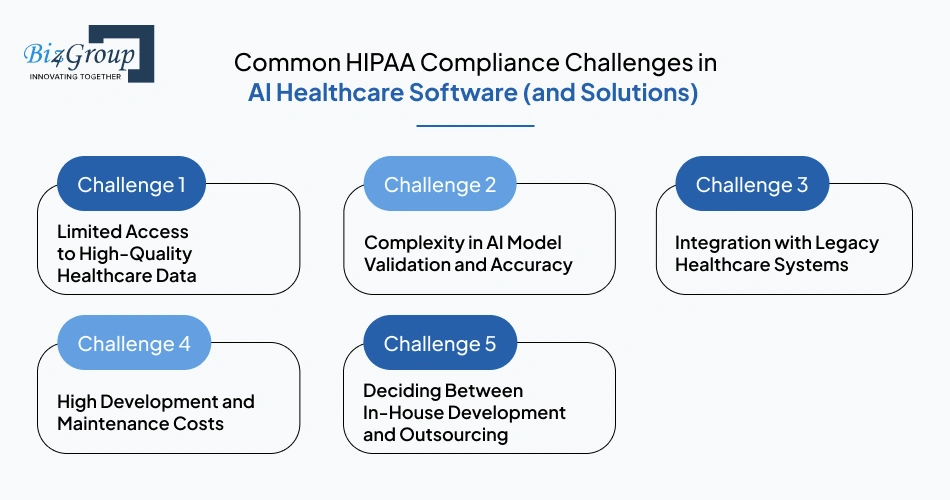
Building a secure and intelligent healthcare system comes with its own set of obstacles. Businesses often underestimate the complexity involved in HIPAA-compliant AI healthcare software development, especially when AI and compliance requirements intersect.
Understanding these challenges early helps teams make better decisions while planning to create HIPAA-compliant AI healthcare software that is scalable and reliable.
Challenge 1: Limited Access to High-Quality Healthcare Data
AI models depend on large datasets, but accessing compliant and high-quality healthcare data remains difficult. Strict regulations restrict data sharing, which can slow down model training and reduce accuracy.
Solutions
- Use synthetic datasets to simulate real-world scenarios
- Partner with compliant healthcare data providers
- Implement controlled environments for safe data usage
Challenge 2: Complexity in AI Model Validation and Accuracy
Ensuring that AI models deliver accurate and consistent results is a major challenge. In healthcare, even minor inaccuracies can lead to serious consequences.
Solutions
- Perform continuous model validation using real-world scenarios
- Use cross-validation techniques for better accuracy
- Collaborate with healthcare professionals for model evaluation
Challenge 3: Integration with Legacy Healthcare Systems
Many hospitals and clinics still rely on outdated systems. Integrating modern AI solutions with legacy infrastructure can create compatibility issues and delays.
Solutions
- Use middleware to bridge modern and legacy systems
- Adopt standardized protocols like FHIR for integration
- Plan phased integration instead of full system replacement
Challenge 4: High Development and Maintenance Costs
AI healthcare systems require continuous updates, monitoring, and improvements. Costs can increase quickly, especially when scaling the product. This becomes a major concern for startups looking for the best way to create AI healthcare software with HIPAA compliance without exceeding budgets.
Solutions
- Start with an MVP to validate the idea
- Optimize infrastructure costs through cloud services
- Plan long-term budgets for maintenance and upgrades
Also read: How to build a minimum viable product (MVP) for AI healthcare software?
Challenge 5: Deciding Between In-House Development and Outsourcing
Many organizations struggle to decide whether to build internally or outsource development. Each approach has its own advantages and limitations. This leads to you asking... Can I outsource HIPAA-compliant AI healthcare software development?
Solutions
- Evaluate project scope, timeline, and budget before deciding
- Hire AI developers who understand compliance requirements
- Explore options to outsource AI healthcare software development for faster execution and reduced overhead
Every challenge in developing a HIPAA-compliant AI healthcare software presents an opportunity to build a stronger, more resilient system. The key lies in identifying these roadblocks early and applying the right solutions at the right stage.
In the next section, we will focus on proven best practices that help businesses successfully navigate development and compliance with confidence.
What are the Best Practices to Create HIPAA-Compliant AI Medical Software?
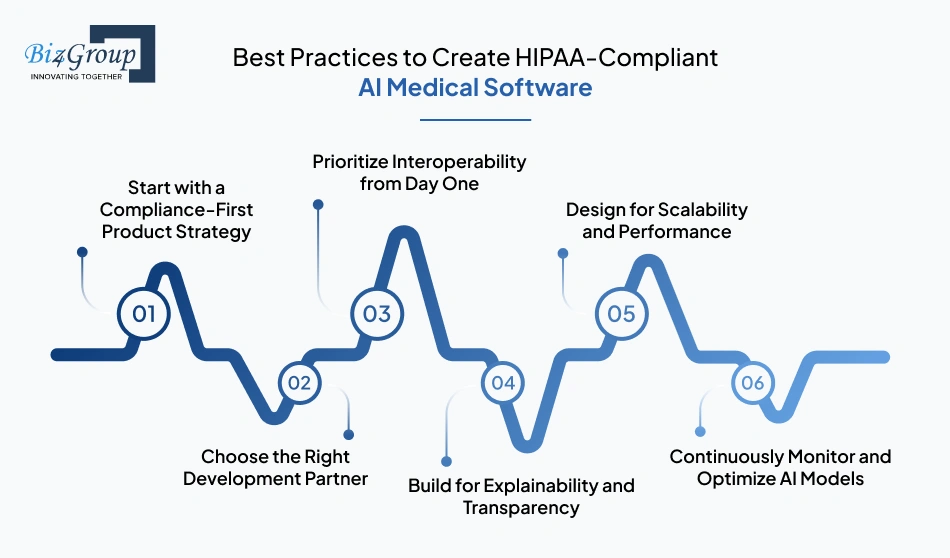
Building a successful healthcare AI system requires a proactive approach that aligns innovation with responsibility. These best practices help businesses streamline HIPAA-compliant AI healthcare software development while maintaining performance and scalability.
1. Start with a Compliance-First Product Strategy
Define compliance requirements alongside business goals from the beginning. This ensures that every decision made during the development of HIPAA-compliant AI healthcare software aligns with regulatory expectations and reduces rework later.
2. Choose the Right Development Partner
The success of your product often depends on who builds it. Working with experienced teams that understand healthcare and AI reduces risk and accelerates delivery.
Also read: Top 15 AI healthcare software development companies in USA
3. Prioritize Interoperability from Day One
Healthcare systems rarely operate in isolation. Plan your system to communicate effectively with EHRs, third-party tools, and external platforms. This approach ensures smoother scaling when you create HIPAA-compliant AI healthcare software that needs to function across multiple environments.
4. Build for Explainability and Transparency
Healthcare decisions require clarity. Ensure your AI models provide understandable outputs that clinicians and stakeholders can trust. This is especially important when you build HIPAA-compliant AI medical software used for diagnosis or decision support.
5. Design for Scalability and Performance
Your system should handle growth without performance issues. Focus on modular architecture and flexible infrastructure to support increasing data loads and user demand. This becomes critical when building a HIPAA-compliant AI healthcare software for enterprise-level use.
6. Continuously Monitor and Optimize AI Models
AI systems evolve over time. Regularly evaluate model performance, update datasets, and refine algorithms to maintain accuracy and relevance.
Following the right practices can significantly improve your chances of success. For businesses asking how can I develop HIPAA-compliant AI healthcare software for my business, the answer lies in combining the right strategy, expertise, and execution from the very beginning.
Now, for those of you wondering which company can build HIPAA-compliant AI healthcare software solutions? Here you go.
Ready to Build It the Right Way?
The difference between average and market leaders is execution. Are you building something that lasts or something that breaks?
Call Biz4Group NowBiz4Group LLC Delivering HIPAA-Compliant AI Healthcare Software Development in USA and Beyond
When healthcare businesses look for a reliable partner to execute HIPAA-compliant AI healthcare software development, they are searching for a team that understands compliance, technology, and real-world healthcare challenges at the same time.
Biz4Group LLC stands at that intersection. Based in the USA, the AI development company has built a strong reputation for delivering intelligent, secure, and scalable healthcare solutions tailored to startups, enterprises, and healthcare providers. With deep expertise in AI, cloud, and healthcare compliance, our team transforms complex ideas into practical, high-performing systems.
From AI-driven patient engagement platforms to advanced clinical support systems, Biz4Group has consistently demonstrated its ability to develop HIPAA-compliant AI healthcare software that performs in real-world environments. Our solutions are designed to handle sensitive healthcare data responsibly while delivering measurable business outcomes.
Our expertise extends across the full lifecycle of building a HIPAA-compliant AI healthcare software, from ideation and architecture to deployment and optimization. As a specialized AI healthcare software development company, we understand what it takes to deliver solutions that meet strict regulatory standards while staying competitive in a rapidly evolving market.
Why Businesses Choose Biz4Group LLC
- Proven experience in delivering HIPAA-compliant healthcare AI solutions
- Strong expertise in AI technologies including NLP, machine learning, and intelligent automation
- Deep understanding of healthcare regulations and compliance frameworks
- End-to-end development capabilities from MVP to enterprise-scale systems
- Focus on building scalable, secure, and future-ready platforms
- Transparent communication and client-first approach
- Ability to align technical solutions with business goals and ROI
Healthcare businesses often face challenges in aligning innovation with compliance, but Biz4Group bridges that gap with structured processes and deep technical expertise.
If you are planning to create HIPAA-compliant AI healthcare software that is secure, scalable, and built for long-term success, Biz4Group is the partner you can rely on.
To Summarize...
Building secure and intelligent healthcare solutions today demands a clear understanding of compliance, data responsibility, and real-world healthcare workflows. Today, we explored how HIPAA-compliant AI healthcare software development enables businesses to create systems that protect sensitive data while delivering measurable value through automation, analytics, and smarter decision-making.
From defining the right architecture to selecting the right technologies and following a structured development process, every step plays a role in shaping a reliable solution. Businesses that focus on developing a HIPAA-compliant AI healthcare software with the right strategy are better positioned to reduce risks, improve efficiency, and build long-term trust with patients and stakeholders.
This is where working with the right partner makes a difference. Biz4Group LLC, a USA-based software development company, brings together deep AI expertise, healthcare domain knowledge, and a compliance-first approach to help businesses turn complex ideas into scalable, secure solutions. Our experience across diverse healthcare projects ensures that every product is built with precision and regulatory alignment in mind.
If you are ready to move forward, now is the time to act. Partner with Biz4Group and take the next step toward building a future-ready healthcare solution that stands out in both innovation and compliance.
FAQs
1. Can AI healthcare software be fully HIPAA compliant?
Yes, AI healthcare software can meet HIPAA requirements when it is designed with strict data handling policies, secure infrastructure, and continuous monitoring. Compliance depends on how data is processed, stored, and accessed throughout the system lifecycle.
2. Do startups need HIPAA compliance from the early stages of development?
Yes, startups should consider compliance from the beginning if they plan to handle protected health information. Early alignment helps avoid costly redesigns and ensures smoother scaling as the product grows.
3. What type of data falls under HIPAA in AI healthcare systems?
HIPAA applies to Protected Health Information, which includes patient names, medical records, insurance details, biometric data, and any information that can be linked to an individual’s health condition or treatment.
4. Can AI models be trained without exposing sensitive patient data?
Yes, techniques like synthetic data generation, anonymization, and federated learning allow AI models to be trained while minimizing exposure to identifiable patient data.
5. What should you look for in a HIPAA-compliant AI development partner?
Businesses should evaluate technical expertise, healthcare domain experience, understanding of compliance frameworks, and the ability to deliver scalable and secure solutions aligned with long-term goals.
6. How often should HIPAA-compliant AI systems be updated or audited?
Regular updates and audits are essential. Most organizations conduct periodic reviews, including quarterly assessments and annual audits, to ensure systems remain compliant with evolving regulations and security standards.