 Location :
Orlando, FL, USA
Location :
Orlando, FL, USA +1 (407) 714-1616
 info@biz4group.com

- Healthcare AI avatar development helps clinics and hospitals improve patient engagement, automate interactions, and scale operations without adding staff.
- Healthcare AI avatar solutions for clinics and hospitals support real-world use cases such as onboarding, scheduling, follow-ups, wellness guidance, and multilingual assistance.
- Medical AI avatar software development costs typically range from $10,000-$150,000, with ROI driven by productivity gains and revenue enablement.
- Healthcare AI avatar vs human staff comparison shows the strongest outcomes come from hybrid models that combine automation with human oversight.
- Regulatory and compliance readiness is critical when developing patient-facing AI avatars for healthcare in the USA.
- Biz4Group LLC is a trusted US-based partner that helps healthcare organizations design, build, and scale high-impact healthcare AI avatar solutions with proven results.
Have you ever wondered how much better patient engagement and care delivery could be if healthcare systems could provide real-time, personalized interactions without adding to staff workload?
Not to sound too rude, but if your clinic or hospital still handles patient engagement and support the old-fashioned way, you may be missing a transformational shift that's underway.
The shift? Healthcare AI avatar development.
This is emerging as a force that helps clinics, hospitals, and digital health companies engage patients in real-time, reduce workload, and improve care outcomes.
The AI in healthcare market is growing fast, with the global conversational AI sector alone expected to reach nearly USD 106.67 billion by 2033, as more healthcare providers invest in smart systems that improve accessibility and support around the clock.
What does this expanding interest mean for your organization? By tapping into healthcare AI avatar development services today, you can enhance the overall patient experience. And this movement is not just an early-stage hype. Healthcare AI avatar solutions for clinics and hospitals redefine how care is delivered and how patients feel supported.
Before you begin brainstorming, we are here to help you assess why building healthcare AI avatars matters, how they function, and what real benefits they can bring to your bottom line. And of course, how you can create healthcare AI avatar solutions for your business in a systematic and hassle-free way.
Let's begin with the basics.
What Is Healthcare AI Avatar Development and How Does It Work?
Before talking about benefits, costs, or ROI, one question needs a clear answer. What exactly is a healthcare AI avatar, and why are so many organizations investing in it now?
Let's break it down in plain terms.
What Is Healthcare AI Avatar?
A healthcare AI avatar is a digital, human-like interface that communicates with patients using voice, text, or visuals. It understands questions, responds naturally, and guides users through healthcare-related interactions.
Think of it as a front-line digital representative that works around the clock.
But here's the important part. This is not a basic chatbot with scripted replies. Healthcare AI avatar development focuses on building intelligent systems that can:
- Understand patient intent
- Respond with context-aware guidance
- Personalize conversations over time
- Operate securely within healthcare regulations
So, what does that mean for your business? It means fewer repetitive tasks for staff and better engagement for patients.
How Does Healthcare AI Avatar Development Work?
At a high level, these systems follow a simple flow.
Input.
Understanding.
Response.
Learning.
Here's how it comes together behind the scenes.
|
Component |
What It Does |
Why It Matters |
|---|---|---|
|
Conversational AI |
Interprets patient questions and intent |
Enables natural, human-like dialogue |
|
Speech Recognition & Text Processing |
Converts voice or text into actionable data |
Supports voice-first and chat-based care |
|
Decision Logic |
Determines the best response or next step |
Keeps interactions accurate and relevant |
|
Visual or Voice Avatar Layer |
Presents responses through a digital persona |
Builds trust and familiarity |
|
System Integrations |
Connects with EHRs, CRMs, or care platforms |
Ensures real-time, personalized responses |
|
Learning Engine |
Improves answers based on interactions |
Makes the avatar smarter over time |
Each component plays a role, but together they create something powerful. A patient-facing experience that feels responsive, reliable, and scalable.
How Is This Different from Traditional Automation?
Let's address a common question... is this replacing staff?
No. It's reshaping how staff time is used.
Healthcare AI avatar development allows organizations to:
- Automate high-volume interactions
- Maintain consistency in patient communication
- Offer 24/7 availability without burnout
- Extend care access beyond clinic hours
In short, the avatar handles the routine. Your team focuses on care that requires human judgment.
Healthcare AI avatar development is about redesigning how patients interact with your brand, your services, and your care teams.
Now comes the bigger question. Why are so many healthcare organizations choosing to build these solutions today instead of waiting? Let's explore that next.
Also read: AI Avatars vs Traditional Chatbots
Why Develop Healthcare AI Avatars Today?
Innovation cycles in healthcare are not slow. They accelerate with pain, demand, and measurable value. Right now, three trends are forcing healthcare leaders to rethink workflows, staffing, and engagement.
Here's what leading data shows:
- The conversational AI in healthcare market is projected to reach USD 169.5 billion by 2035.
- 66% of physicians used health AI, a 78% increase from just 38% in 2023, showing rapid adoption.
- Nearly 22% of healthcare organizations have implemented domain-specific AI tools, a 7x increase over 2024.
Numbers like these matter. They tell us that healthcare leaders are not experimenting quietly. They are investing meaningfully.
What Healthcare Organizations Are Struggling With
Despite interest in digital transformation, healthcare systems are still facing heavy pressure in daily operations.
Here are the persistent pain points:
Staff Workload Overload
- Patient inquiries that flood call centers
- Scheduling bottlenecks
- Repetitive information requests
Operational Inefficiencies
- Manual follow-ups
- Lack of 24/7 engagement
- Disjointed patient communication channels
Patient Experience Gaps
- Patients expect modern digital experiences
- Tech fatigue when systems offer portals but no real engagement
These issues are not small. They hit the bottom line and patient satisfaction directly.
So here's the real question... what if your organization could automate routine conversations, support patients nonstop, and free up your teams for value-driven care?
That is the promise of building healthcare AI avatars.
The Real Pressure Points AI Avatars Relieve
AI avatars are not magic. They are leverage points. They address specific problems that traditional solutions struggle with.
Here's how they help:
- Constant Availability
Patients want help now, not when your office opens. AI avatars answer questions, schedule visits, share information, or triage basics around the clock. - Reduced Staff Burnout
Front desk teams are often overwhelmed with repetitive queries. AI avatars remove thousands of routine touchpoints from their plate. - Consistent Communication
Humans vary in tone, memory, and availability. AI avatars deliver consistent guidance every time. - Better Patient Engagement Metrics
Studies on conversational agents show high engagement rates when patients receive instant, personalized answers rather than delayed callbacks.
These systems allow healthcare providers to scale without proportionally increasing staff. They reduce friction at every interaction point.
Healthcare has always been about trust, access, and quality. Today, your patients judge quality by digital experience, not just clinical outcomes.
The question is not only "Can we build this?"
It's "Can we afford not to build this?"
In the next section, we will look at the business benefits of healthcare AI avatar development and how these systems can move the needle in measurable ways.
Healthcare Is Moving Fast. Are You?
AI adoption in healthcare has already crossed 20%. Early adopters are already locking in efficiency and patient loyalty. Waiting has a cost!
Contact Biz4Group TodayBusiness Benefits of Healthcare AI Avatar Development Services
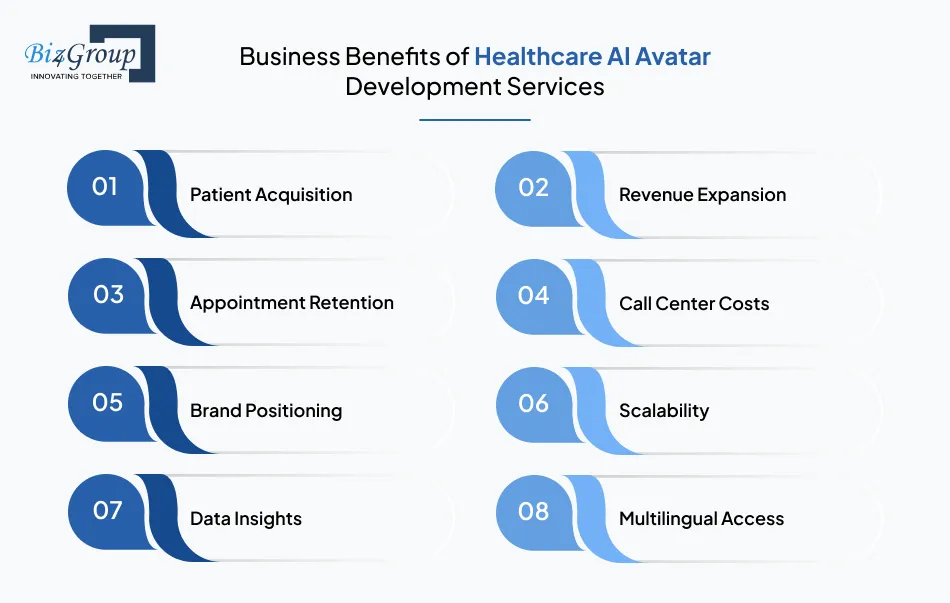
You've seen the market shift. You understand the pressure points. Now let's talk business.
What does healthcare AI avatar development services actually do for your revenue, operations, and long-term growth?
Below is a focused breakdown of measurable business outcomes that healthcare organizations experience when they implement healthcare AI avatar solutions for clinics and hospitals.
|
Business Area |
Challenge Faced by Providers |
How Healthcare AI Avatar Development Services Create Impact |
Business Outcome |
|---|---|---|---|
|
Patient Acquisition |
Low digital engagement and weak conversion from website visitors |
Interactive avatars guide users through services, insurance info, and next steps in real time |
Higher appointment bookings and stronger digital conversion rates |
|
Revenue Expansion |
Missed upsell opportunities for services, preventive programs, or wellness offerings |
Personalized recommendations based on patient data and interaction history |
Increased average patient lifetime value |
|
Appointment Retention |
No-shows and poor follow-up adherence |
Automated reminders, conversational rescheduling, and personalized nudges |
Improved show-up rates and reduced revenue leakage |
|
Call Center Costs |
High volume of repetitive inbound calls |
AI avatars handle FAQs, insurance queries, and scheduling tasks |
Lower staffing pressure and reduced call handling costs |
|
Brand Positioning |
Outdated perception in competitive healthcare markets |
Modern, interactive, patient-friendly digital presence |
Stronger brand differentiation in local and national markets |
|
Scalability |
Expansion to new locations increases staffing costs proportionally |
One AI avatar infrastructure serves multiple clinics and geographies |
Growth without equal headcount expansion |
|
Data Insights |
Limited visibility into patient intent and interaction patterns |
Real-time analytics on patient conversations and service interests |
Smarter strategic planning and service optimization |
|
Multilingual Access |
Difficulty serving diverse patient populations efficiently |
AI avatars communicate in multiple languages without hiring separate staff |
Expanded market reach and improved accessibility |
Healthcare executives are measured on efficiency, growth, and patient satisfaction. Healthcare AI avatar development services support all three without requiring a full operational overhaul.
Instead of adding layers of complexity, these systems simplify patient touchpoints while strengthening internal control.
In the next section, we'll move from business value to practical application.
Use Cases That Drive Adoption of Healthcare AI Avatar Solutions for Clinics and Hospitals
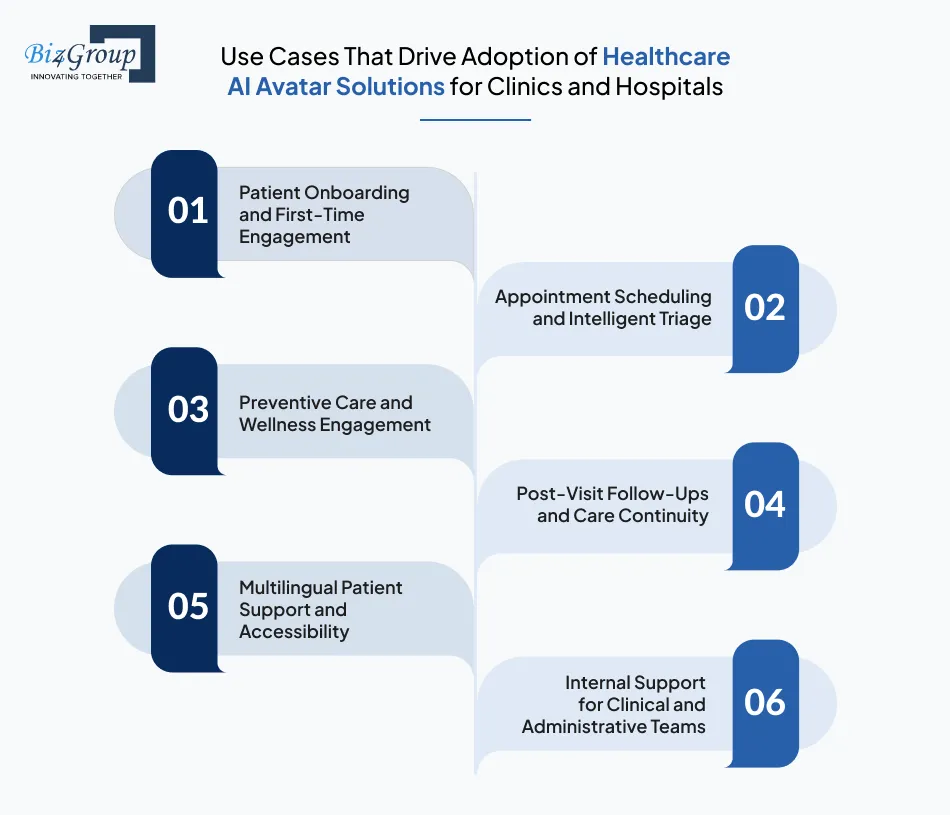
Once the business case is clear, the next logical question follows. Where exactly do healthcare AI avatars fit into day-to-day operations?
This is where theory turns into execution.
Below are the most impactful, real-world use cases where healthcare AI avatar solutions for clinics and hospitals are delivering value today. Each use case addresses a specific operational or patient experience gap.
1. Patient Onboarding and First-Time Engagement
First impressions matter in healthcare more than most industries. AI avatars greet new patients, explain services, guide them through registration, and answer common questions without delays.
What changes for your organization?
- Patients feel supported from the first interaction.
- Front-desk teams avoid repetitive explanations.
- Digital drop-offs reduce significantly.
This use case is especially valuable for clinics with high patient churn or strong online discovery channels.
Also read: How to create an AI medical agent for patient interaction & triage?
2. Appointment Scheduling and Intelligent Triage
Scheduling sounds simple. In reality, it drains staff time. Healthcare AI avatar development allows organizations to automate:
- Medical scheduling and rescheduling requests
- Basic patient triage
- Department routing
Instead of phone queues, patients interact instantly. Instead of staff juggling calendars, the system handles availability logic. The result is smoother scheduling workflows and faster patient access to care.
3. Preventive Care and Wellness Engagement
Care does not begin at diagnosis. AI avatars support preventive health by delivering medication reminders, lifestyle guidance, and educational content based on patient profiles.
For clinics and wellness-focused providers, this creates:
- Stronger ongoing engagement
- Better adherence to care plans
- Higher participation in wellness programs
It also positions your organization as proactive rather than reactive.
4. Post-Visit Follow-Ups and Care Continuity
Aftercare often gets overlooked due to time constraints. Healthcare AI avatars step in to:
- Share post-visit instructions
- Check symptom progression
- Answer recovery-related questions
- Escalate concerns when needed
Patients feel monitored. Providers gain peace of mind. Care continuity improves without increasing workload.
This use case is critical for chronic care, recovery programs, and outpatient services.
5. Multilingual Patient Support and Accessibility
Language barriers create friction and risk. AI avatars can communicate in multiple languages while maintaining consistency and accuracy. This expands access without requiring multilingual staffing across every shift.
For clinics serving diverse communities, this use case directly improves equity and patient satisfaction.
6. Internal Support for Clinical and Administrative Teams
Not all avatars face patients. Healthcare AI avatars also assist internal teams by answering policy questions, surfacing procedural information, and guiding staff through workflows.
This reduces training time and improves operational consistency across departments.
Also read: How to develop an AI avatar for clinical management?
Healthcare AI avatar solutions for clinics and hospitals are not tied to a single workflow. They adapt wherever interaction volume, response time, or consistency becomes a challenge.
The next step is deciding what features your avatar must include to support these use cases effectively.
Can Your Front Desk Handle 10,000 Conversations a Day?
AI avatars can. From onboarding to follow-ups, smart systems scale instantly while human teams stay focused on care.
Book a Strategy Call NowEssential Features to Have in Custom Healthcare AI Avatar Development
By now, one thing should be clear. A healthcare AI avatar is only as effective as the features behind it.
This section focuses on practical, execution-level features that directly influence usability, trust, and scalability. These are the functional capabilities that healthcare leaders should insist on before moving forward.
Below is a clean, feature-first breakdown designed for quick evaluation.
|
Feature |
What It Is |
What It Does |
|---|---|---|
|
Patient Identity Verification |
Secure patient validation through OTPs or secure login |
Prevents unauthorized access and protects sensitive health interactions |
|
Context Retention |
Ability to remember prior interactions within a session or over time |
Enables personalized and continuous conversations |
|
Consent Capture and Management |
Digital consent workflows embedded into conversations |
Ensures patients agree to data use and interaction scope |
|
Custom Conversation Flows |
Configurable dialogue paths based on services or specialties |
Aligns patient interactions with your care offerings |
|
Role-Based Response Control |
Differentiated responses for patients, caregivers, or staff |
Maintains relevance and prevents information overload |
|
Escalation to Human Staff |
Smart handoff logic when cases exceed automation limits |
Avoids frustration and ensures timely human intervention |
|
Analytics and Interaction Reporting |
Real-time insights into conversation trends and drop-offs |
Helps optimize engagement strategies and workflows |
|
Deployment Flexibility |
Ability to deploy across web, mobile apps, or kiosks |
Supports omnichannel patient engagement |
|
Branding and Persona Customization |
Visual, tone, and language customization |
Strengthens brand identity and patient trust |
|
Accessibility Support |
Voice navigation, text resizing, and assistive compatibility |
Improves usability for elderly and disabled patients |
Each feature above serves one purpose. To make your healthcare AI avatar usable, trustworthy, and scalable. Missing even a few of these can lead to low adoption, compliance risks, or poor patient experiences.
In the upcoming section, we will explore advanced capabilities in custom healthcare AI avatar development that help organizations stand out and future-proof their investment.
Advanced Capabilities in Medical AI Avatar Software Development
This is where healthcare AI avatar development shifts from operational efficiency to strategic differentiation. Advanced capabilities determine whether your avatar feels basic or transformative.
Let's explore the features that elevate custom healthcare AI avatar development from functional to exceptional.
1. Emotion Recognition and Sentiment Awareness
Healthcare conversations are rarely neutral. Advanced avatars can analyze sentiment, frustration, urgency, or track mood through voice modulation or language patterns.
What does that change?
The system adapts responses in real time. A stressed patient receives reassurance. A confused patient gets simplified guidance.
That subtle shift dramatically improves trust and satisfaction.
2. Predictive Patient Engagement Modeling
Instead of reacting to questions, advanced systems anticipate them. By analyzing interaction patterns, appointment histories, or behavioral signals, avatars can suggest preventive screenings, recommend follow-ups, and prompt medication reminders.
This moves your organization from reactive care to proactive engagement.
3. Dynamic Personalization Across Specialties
A dermatology clinic and a cardiology practice do not communicate the same way. Custom healthcare AI avatar development allows the avatar to dynamically adjust medical terminology depth, tone and language complexity, and service-specific workflows.
The experience feels tailored, not generic. Patients notice the difference.
4. Real-Time Clinical Data Synchronization
Advanced systems connect directly with live scheduling tools, patient records, or care management systems. This enables the avatar to confirm real-time availability, surface recent visit summaries, and personalize recommendations based on medical history.
Accuracy builds credibility. Credibility builds long-term adoption.
5. Intelligent Revenue Support Integration
Healthcare organizations are also businesses. Advanced avatars can support revenue by presenting membership plans, offering bundled wellness programs, explaining insurance coverage clearly, and guiding payment plan discussions.
These interactions feel helpful rather than transactional when executed properly.
6. Adaptive Learning for Workflow Optimization
Over time, interaction data reveals patterns. Advanced healthcare AI avatar development systems analyze drop-off points, common confusion areas, and high-frequency requests.
The avatar continuously refines its responses and routing logic. That means fewer bottlenecks and better efficiency without rebuilding the system.
7. Multi-Modal Interaction Experiences
Patients engage differently. Some prefer text, others prefer voice. Some respond better to visual guidance. Advanced avatars support seamless transitions between chat, voice interaction, visual avatars, and embedded educational content.
The flexibility expands accessibility and engagement simultaneously.
Advanced capabilities are not about showing off technology. They are about building resilience into your digital care ecosystem. The more intelligent and adaptive your avatar becomes, the more value it generates over time.
Now that we've covered capabilities, it's time to ground this discussion in reality.
Also read: A comprehensive guide to mental health AI avatar development for clinics, and remote therapy
Basic Automation or Intelligent Advantage?
Emotion-aware, predictive, and personalized AI avatars are separating leaders from laggards. Which side of the line are you on?
Build Smart with Biz4GroupHow to Develop Healthcare AI Avatars from Idea to Deployment in 8 Steps?
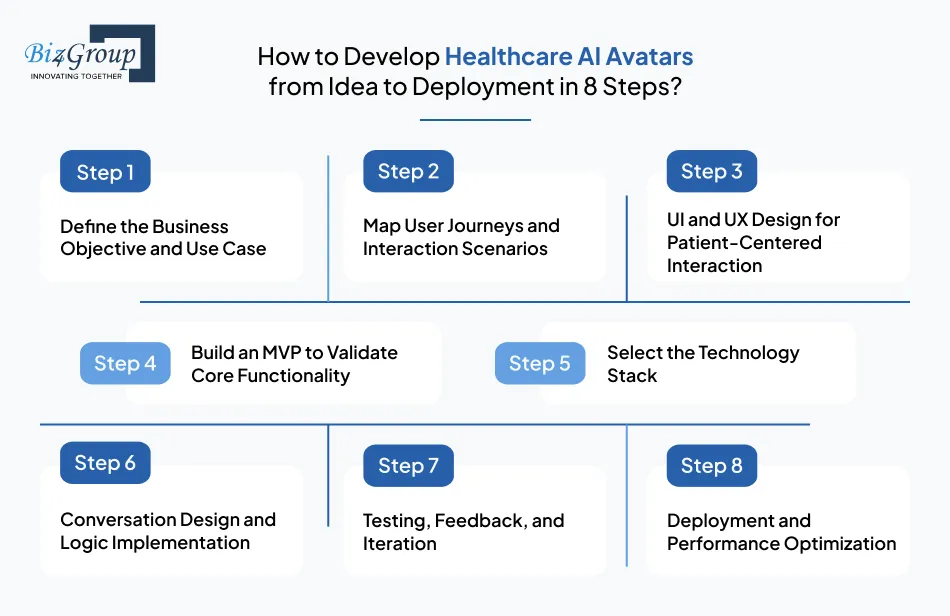
Building a healthcare AI avatar requires structure, clarity, and disciplined execution. Without a defined process, projects drift, budgets expand, and outcomes suffer.
Below is an 8-step development process for healthcare AI avatar that experienced teams follow to move with confidence.
Step 1. Define the Business Objective and Use Case
Every successful avatar starts with a sharp purpose. Clear objectives guide every design and technical decision that follows.
Is the goal to:
- reduce call volume?
- improve onboarding?
- support wellness programs?
- assist internal teams?
When the goal is vague, the avatar becomes confusing.
When the goal is focused, adoption improves naturally.
Step 2. Map User Journeys and Interaction Scenarios
Next comes understanding how users will actually interact with the avatar. This step involves:
- Identifying user types
- Listing common questions and tasks
- Mapping conversation paths
This clarity prevents feature overload and keeps interactions purposeful.
Step 3. UI and UX Design for Patient-Centered Interaction
Design shapes trust. In healthcare AI avatar development, UI and UX design determines whether patients feel supported or overwhelmed.
Key design priorities include:
- Clean, distraction-free interfaces
- Simple conversation prompts
- Clear visual cues and feedback
- Accessibility-friendly layouts
Strong design reduces learning curves and encourages repeat usage.
Also read: Top 15 UI/UX design companies in USA
Step 4. Build an MVP to Validate Core Functionality
This step separates strategic builders from risky spenders. An MVP focuses on 2 to 4 high-impact features rather than full-scale ambition.
Typical AI healthcare MVP goals include:
- Validating patient engagement
- Testing conversation accuracy
- Measuring response time and usability
Developing an MVP allows teams to gather feedback early and refine direction before scaling.
Also read: Top 12+ MVP development companies in USA
Step 5. Select the Technology Stack
Technology choices determine scalability, performance, and future flexibility.
Below is a simplified view of commonly used layers in healthcare AI avatar development and why they matter.
|
Layer |
Tools and Frameworks |
Why It Matters |
|---|---|---|
|
Frontend Interface |
React.js, Angular, Vue.js |
Enables responsive and interactive user experiences |
|
Backend Services |
Node.js, Python, Java |
Handles logic, workflows, and system integrations |
|
AI and NLP |
TensorFlow, PyTorch, spaCy |
Powers conversation understanding and responses |
|
Avatar Rendering |
WebGL, Three.js, Unity |
Creates realistic visual and interactive avatars |
|
Data Management |
PostgreSQL, MongoDB |
Stores interaction data and user context |
|
Cloud Infrastructure |
AWS, Google Cloud, Azure |
Supports scalability and availability |
The right stack supports growth without rebuilding from scratch.
Step 6. Conversation Design and Logic Implementation
This phase brings the avatar to life. Teams define:
- Response patterns
- Escalation triggers
- Context handling rules
Well-designed logic prevents robotic conversations and improves clarity.
Step 7. Testing, Feedback, and Iteration
Testing goes beyond functionality. It includes:
- Conversation accuracy
- Response timing
- User experience feedback
Iteration ensures the avatar evolves with real user behavior rather than assumptions.
Step 8. Deployment and Performance Optimization
Deployment is not the finish line. Post-launch optimization focuses on:
- Monitoring engagement trends
- Refining workflows
- Improving response relevance
This step ensures long-term success rather than short-term novelty.
Project Spotlight: Dr. Truman’s AI Avatar
Theory is useful. Real execution is better.
This is where healthcare AI avatar development proves its value.
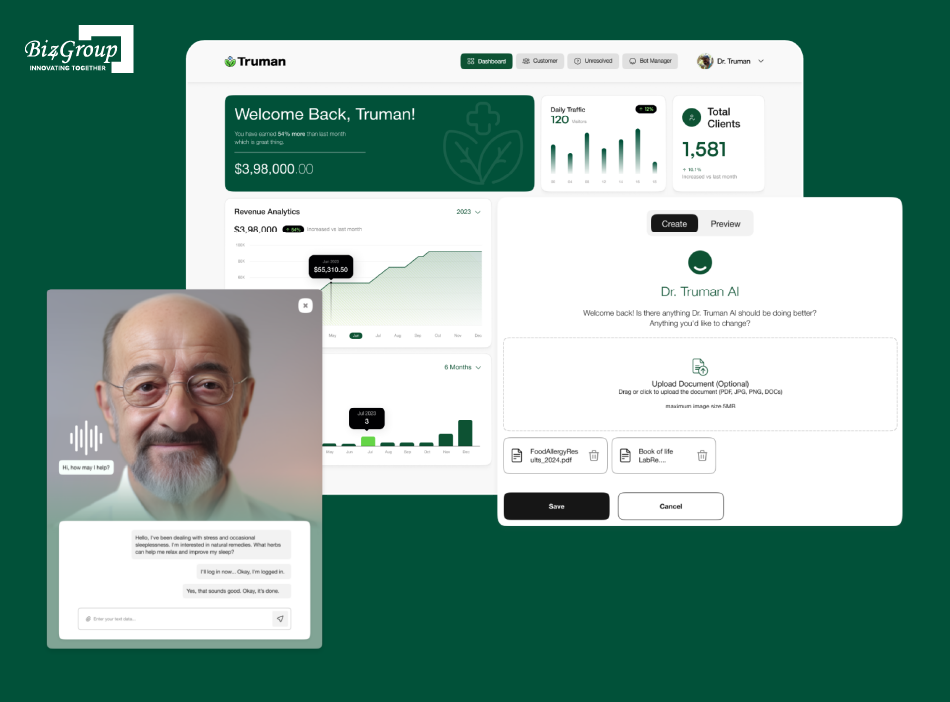
After following the exact step-by-step process outlined above, Biz4Group LLC delivered a high-impact, patient-facing AI avatar for Dr. Truman, focused on personalized wellness guidance and digital engagement.
What We Built
We developed an AI-powered avatar that acts as a digital health companion. Users can interact with the avatar for wellness guidance, receive personalized recommendations, and seamlessly move from consultation to action.
Key capabilities included:
- A lifelike AI avatar that communicates naturally through conversation
- Personalized health advice based on user inputs and history
- AI chatbot functionality aligned with the avatar experience
- Health history tracking and medical document uploads
- Integrated eCommerce experience for supplements and wellness products
- Membership plans with exclusive benefits and offers
Every interaction was designed to feel intuitive, supportive, and purposeful.
The Results That Matter
The impact was measurable and immediate:
- 40% increase in user engagement
- 30% increase in supplement sales
- 85% positive customer feedback
- 20% reduction in operational costs
- 25% improvement in marketing conversion rates
This project demonstrates what happens when healthcare AI avatar development is executed with clarity, discipline, and business intent.
The takeaway is simple. When the process is right, the outcomes speak for themselves.
Also read: Top 10 AI avatar development companies for healthcare industry in USA
Regulatory and Compliance Requirements in Healthcare AI Avatar Development
If you are building technology in healthcare, compliance is not a side task. It shapes architecture, workflows, and governance from day one.
Healthcare AI avatar development must align with strict federal and state regulations in the United States. When handled correctly, compliance strengthens trust. When ignored, it creates financial and reputational risk.
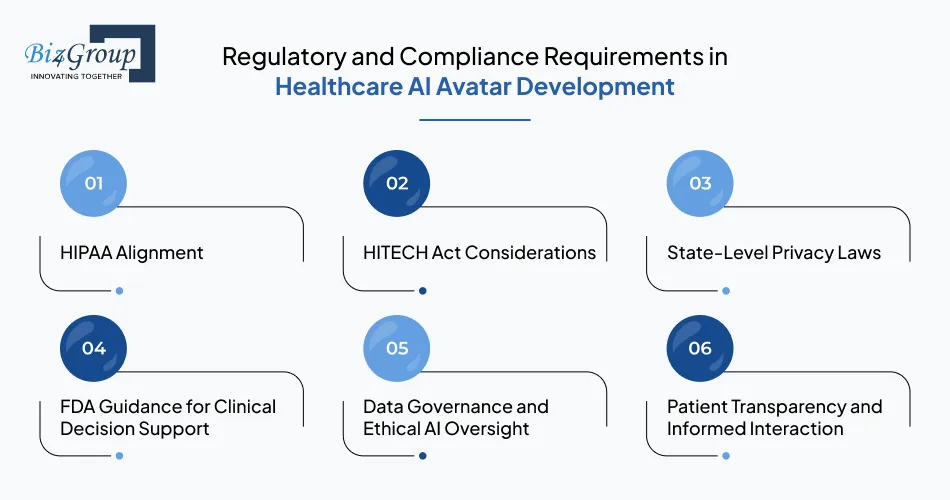
Below are the core compliance areas every organization must address when developing healthcare AI avatar solutions for clinics and hospitals.
HIPAA Alignment
- Ensure all protected health information is handled according to HIPAA Privacy and Security Rules
- Limit access to patient data based on user roles and job function
- Maintain complete activity logs of data access and interaction history
- Sign Business Associate Agreements when third-party vendors are involved
- Establish breach notification protocols in case of unauthorized access
Healthcare AI avatars frequently handle appointment data, health inquiries, and patient identifiers. HIPAA compliance protects both patients and providers.
Also read: HIPAA compliant AI app development for healthcare providers
HITECH Act Considerations
- Strengthen electronic health record protection requirements
- Implement audit controls and monitoring mechanisms
- Ensure data integrity across digital communication channels
- Document all safeguards for internal and external audits
The HITECH Act increases accountability for electronic health information. AI avatar interactions fall within this digital scope.
State-Level Privacy Laws
- Review applicable state privacy regulations such as CCPA where relevant
- Provide transparent data usage disclosures
- Allow patients to request data access or deletion where required
- Maintain clear consent mechanisms before collecting personal data
State laws increasingly regulate how digital systems collect and store personal information, even outside direct clinical use.
FDA Guidance for Clinical Decision Support
- Determine whether the AI avatar qualifies as a clinical decision support tool
- Avoid positioning the avatar as an autonomous diagnostic authority unless appropriately regulated
- Maintain human oversight for medical decision-making scenarios
If the avatar influences diagnosis or treatment recommendations, additional regulatory oversight may apply.
Data Governance and Ethical AI Oversight
- Establish internal AI governance committees
- Define acceptable use policies for patient-facing AI systems
- Regularly audit outputs for bias or inappropriate recommendations
- Document model updates and behavioral changes
Responsible AI deployment reduces legal exposure and strengthens organizational credibility.
Patient Transparency and Informed Interaction
- Clearly inform users they are interacting with an AI avatar
- Provide options to escalate to human staff
- Disclose how patient data is used and stored
- Avoid misleading claims about clinical authority
Transparency improves patient trust and reduces legal ambiguity.
Compliance in healthcare AI avatar development is not about slowing innovation. It is about building systems that scale responsibly. Organizations that treat compliance as foundational rather than reactive position themselves for sustainable growth.
Confident About Compliance or Hoping for the Best?
Healthcare regulations are strict, and digital systems must keep up. The right development partner builds innovation without risk.
Talk to Biz4Group’s ExpertsHow Much Does It Cost to Build AI Avatars for Healthcare Organizations?
Let's address the question every decision-maker asks early. How much does healthcare AI avatar development actually cost?
On average, healthcare AI avatar development projects range between $10,000-$150,000+, depending on scope, sophistication, and scale. The investment varies widely because no two healthcare organizations have the same goals or complexity.
Below is a quick snapshot of what that investment typically looks like across growth stages.
|
Development Level |
Scope Overview |
Typical Cost Range |
|---|---|---|
|
MVP |
Core interactions, limited workflows, basic personalization |
$10,000-$30,000 |
|
Advanced Level |
Multi-use cases, personalization, analytics |
$40,000-$80,000 |
|
Enterprise Level |
Multi-channel deployment, complex logic, scalability |
$100,000-$150,000+ |
This table sets the baseline. Now let's unpack where the money goes and what influences these numbers.
Key Cost Drivers in Healthcare AI Avatar Development
Understanding cost drivers helps avoid surprises later. Each factor below contributes directly to the final investment.
|
Cost Driver |
What It Covers |
Typical Cost Impact |
|---|---|---|
|
Cost Driver |
What It Covers |
Typical Cost Impact |
|
Avatar Complexity |
Visual realism, voice quality, animation depth |
$3,000-$20,000 |
|
Conversation Design |
Dialogue mapping, response logic, escalation flows |
$2,000-$15,000 |
|
AI Model Training |
Data preparation and intent recognition tuning |
$3,000-$25,000 |
|
Feature Scope |
Number of workflows and supported use cases |
$5,000-$30,000 |
|
Scheduling, CRM, internal systems |
$4,000-$20,000 |
|
|
Scalability Planning |
Performance optimization for high usage |
$5,000-$15,000 |
Each driver compounds with the others. A simple avatar stays affordable. A multi-department enterprise AI solution demands deeper investment.
Hidden Costs to Plan For
Not all expenses appear in the initial proposal. These hidden costs often surface post-launch.
- Ongoing model refinement can add $5,000-$15,000 annually depending on interaction volume.
- Third-party services may introduce recurring fees of $500-$3,000 per month.
- Post-launch enhancements and support typically require $1,500-$5,000 per month.
- Content updates and workflow changes can add $3,000-$10,000 annually.
Planning for these early prevents budget strain later.
Healthcare AI avatar development costs vary, but the investment scales with value. Organizations that start focused and expand strategically achieve better outcomes and stronger financial returns.
Speaking of returns...
Measuring ROI From Healthcare AI Avatar Development Services
Cost answers the "how much." ROI answers the question that actually matters.
Was it worth it?
Healthcare leaders investing in healthcare AI avatar development want clarity, not assumptions. ROI comes from a combination of cost savings, productivity gains, and revenue impact over time.
Let's break this down in a way that makes sense for decision-makers.
Where ROI Comes From in Healthcare AI Avatar Development
ROI does not appear from one source. It compounds across operations. Here are the primary contributors.
- Administrative Cost Reduction
AI avatars absorb a large volume of repetitive interactions. Common areas of savings include appointment scheduling, FAQs and basic patient guidance, and follow-up reminders.
For many clinics, this translates into:
- Lower call center load
- Reduced overtime
- Better staff utilization
Even a modest reduction in manual handling can free thousands of dollars annually.
- Productivity Gains for Clinical and Non-Clinical Teams
Time saved is value created. When teams spend less time on routine questions, they can focus on:
- Patient care
- Case resolution
- High-touch interactions
Healthcare AI avatar development services often deliver productivity gains in the range of 20%-40% across front-office and support functions, depending on usage volume and workflow coverage.
- Revenue Enablement Opportunities
AI avatars do more than save money. They help generate it. Revenue impact often comes from:
- Higher appointment booking rates
- Reduced no-shows
- Better follow-up adherence
- Promotion of wellness programs or memberships
For organizations offering paid services, these gains directly increase patient lifetime value.
Key Metrics to Track ROI
Measuring ROI requires tracking the right indicators. Below are metrics healthcare organizations commonly monitor after implementing healthcare AI avatar solutions for clinics and hospitals.
|
Metric |
What It Measures |
Why It Matters |
|---|---|---|
|
Cost Per Interaction |
Expense per patient interaction |
Shows efficiency gains |
|
Staff Hours Saved |
Time shifted from manual tasks |
Indicates productivity impact |
|
Appointment Conversion Rate |
Visits booked per interaction |
Reflects revenue influence |
|
No-Show Reduction |
Missed visits avoided |
Prevents revenue loss |
|
Patient Engagement Rate |
Interaction completion and return usage |
Signals adoption success |
|
Average Response Time |
Speed of patient assistance |
Impacts satisfaction |
Tracking these monthly provides a clear performance picture.
A Simple ROI Calculation Framework
Here is a straightforward way to estimate ROI.
- Calculate annual savings from reduced staff workload
- Add incremental revenue from improved bookings or services
- Subtract total development and maintenance costs
ROI Formula:
ROI (%) = [(Annual Financial Gains - Total Investment) / Total Investment] x 100
Many healthcare organizations begin seeing positive ROI within 6-12 months when deployment is aligned with high-volume workflows.
ROI from healthcare AI avatar development is measurable, repeatable, and scalable. When implemented with clear objectives and tracked against the right metrics, these systems move beyond efficiency gains and become growth enablers.
If It Pays for Itself in 6–12 Months, Why Wait?
Reduced workload, higher conversions, better engagement. The numbers make sense. The only question is timing.
Let’s Talk NumbersChallenges, Risks, and Mistakes in Healthcare AI Avatar Development
Healthcare AI avatar development delivers strong upside, but only when executed thoughtfully. Many projects struggle not because the idea is flawed, but because common risks are underestimated early.
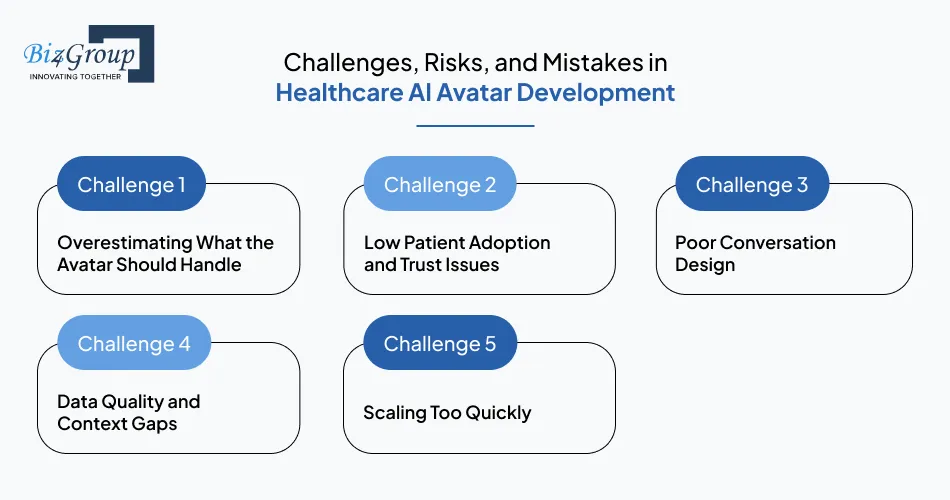
Below are the most frequent challenges organizations face, along with practical ways to mitigate them before they escalate.
Challenge 1: Overestimating What the Avatar Should Handle
One of the earliest mistakes is expecting the avatar to solve everything.
Healthcare interactions vary widely in complexity, and forcing automation where human judgment is required leads to frustration.
How to mitigate
- Clearly define boundaries for automated interactions
- Build escalation paths to human staff
- Start with high-volume, low-risk workflows
Challenge 2: Low Patient Adoption and Trust Issues
Patients may hesitate to engage if the avatar feels confusing or impersonal. Trust is earned through clarity and consistency.
How to mitigate
- Use simple, transparent language
- Clearly disclose AI involvement
- Offer easy access to human assistance
Challenge 3: Poor Conversation Design
Even powerful AI fails when conversations are poorly structured. Long, rigid flows discourage engagement.
How to mitigate
- Design short, guided interaction paths
- Test conversations with real users
- Continuously refine based on feedback
Challenge 4: Data Quality and Context Gaps
AI systems rely on accurate, relevant data. Incomplete or outdated information leads to unreliable responses.
How to mitigate
- Audit data sources before launch
- Limit early interactions to validated data sets
- Monitor response accuracy continuously
Challenge 5: Scaling Too Quickly
Rushing to expand features can backfire. Unstable performance damages credibility.
How to mitigate
- Validate performance at smaller scale first
- Monitor usage patterns closely
- Expand features incrementally
Most challenges in healthcare AI avatar development are preventable. The difference between success and frustration lies in preparation, clarity, and iteration.
Why Biz4Group LLC Leads Healthcare AI Avatar Development in the USA?
Choosing a development partner in healthcare is not a casual decision. It is a trust decision.
At Biz4Group LLC, we build software with one clear goal. Help businesses create technology that works in the real world, at scale, under pressure, and within the realities of the US healthcare system.
We are a US-based software development company with deep experience in healthcare AI solutions and patient-facing digital platforms. Our work sits at the intersection of strategy, design, and engineering. That matters, because healthcare AI avatar development fails when it is treated as a tech experiment instead of a business initiative.
What we do well is simple to explain and hard to execute. We translate complex healthcare needs into intelligent, secure, and scalable AI avatar solutions that patients actually use and teams actually trust.
We listen first. We question assumptions. Then we build solutions that align with operational goals, patient expectations, and long-term growth plans.
We are not here to push templates. We are here to build systems that fit your workflows, your brand, and your vision.
Why Businesses Choose Biz4Group LLC
- Proven experience in healthcare AI and patient-facing systems
- Strong understanding of US healthcare operations and constraints
- Custom healthcare AI avatar development services built from scratch
- Strategic mindset focused on ROI, not feature overload
- Cross-functional teams covering AI, UX, backend, and product strategy
- Transparent development process with clear milestones and outcomes
- Long-term partnership approach beyond launch and deployment
Healthcare organizations choose Biz4Group LLC because we do more than write code. We help them think clearly about where AI fits, how it scales, and how it delivers measurable value.
When you partner with Biz4Group LLC, you are not hiring a vendor. You are gaining a team that understands what it takes to build healthcare AI avatar solutions that stand up to growth, scrutiny, and time.
So, without wasting any time, let's discuss your goals and map a solution that moves your organization forward.
Let's talk.
Wrapping Up
Healthcare AI avatar development has quickly moved from an emerging idea to a practical growth lever for clinics, hospitals, and digital health companies across the USA. As patient expectations rise and operational pressure intensifies, organizations need smarter ways to engage, support, and scale care delivery without stretching their teams thin. AI avatars answer that need by streamlining interactions, improving accessibility, and creating consistent patient experiences that work around the clock.
What makes healthcare AI avatars compelling is not novelty. It's impact. From reducing administrative load to improving engagement and unlocking new revenue opportunities, these systems reshape how healthcare organizations operate at every touchpoint. When built thoughtfully, they blend AI automation services with empathy and deliver value that compounds over time.
This is where Biz4Group LLC comes in. As a US-based AI development company with deep expertise in healthcare and AI, we help organizations design, build, and scale healthcare AI avatar solutions that align with real business goals. Our approach combines strategy, engineering, and experience to ensure every solution delivers measurable outcomes, not empty promises.
If you're ready to move beyond traditional digital tools and build a healthcare AI avatar that truly works for your organization, let's make it happen.
Start the conversation with Biz4Group LLC and take the next confident step toward smarter healthcare innovation.
FAQs
1. Can healthcare AI avatars work alongside existing patient portals and apps?
Yes. Healthcare AI avatars are often layered on top of existing digital tools rather than replacing them. They act as an interactive interface that helps patients navigate portals, understand next steps, and complete actions faster, which increases adoption of systems you already have.
2. How long does it take for patients to get comfortable using an AI avatar?
Adoption typically happens faster than expected. When avatars are designed with clear language, guided prompts, and easy escalation to humans, many organizations see consistent usage within the first few weeks of launch. Familiar, conversational design plays a major role here.
3. Can healthcare AI avatars support multiple departments within the same organization?
Absolutely. A single AI avatar can be configured to support different departments such as billing inquiries, appointment coordination, wellness programs, or internal staff assistance. The experience changes based on context, not separate systems.
4. What happens if the AI avatar cannot answer a patient's question?
Well-designed avatars are built to recognize uncertainty. When a question exceeds predefined boundaries, the system can route the conversation to human staff, collect contact details, or schedule a follow-up. This avoids frustration and protects patient trust.
5. Can AI avatars be customized to reflect a healthcare brand's personality?
Yes. From visual appearance to tone of voice and communication style, AI avatars can be customized to align with your brand identity. This helps maintain consistency across digital touchpoints and strengthens brand recognition.
6. How do healthcare organizations measure success beyond ROI?
Beyond financial metrics, success is often measured through patient satisfaction scores, engagement completion rates, reduced response times, and internal staff feedback. These indicators show whether the avatar is improving experiences on both sides of care delivery.
