 Location :
Orlando, FL, USA
Location :
Orlando, FL, USA +1 (407) 714-1616
 info@biz4group.com
- AI healthcare speech recognition software development helps healthcare organizations reduce documentation time, improve clinical accuracy, and support day to day workflows.
- Healthcare teams build AI powered medical speech recognition systems for real clinical conversations and scale across clinics, hospitals, and care settings.
- The market is growing fast, with medical speech recognition adoption rising as providers look for practical ways to ease clinician burnout and improve documentation efficiency.
- Typical investment ranges from $15,000 to $150,000+, depending on whether teams start with an MVP, expand to multiple workflows, or roll out enterprise-level solutions.
- Organizations often choose to develop AI medical transcription solutions in phases, starting small and expanding as accuracy, trust, and adoption increase.
- Long term success depends on thoughtful planning, compliance readiness, and choosing the right approach to healthcare voice technology software development.
Healthcare conversations are happening all day long, but much of that valuable information still ends up as delayed notes, incomplete records, or extra work after clinic hours. For healthcare leaders trying to improve efficiency without adding pressure on clinicians, this gap between spoken care and written documentation is becoming a real problem. That is why AI healthcare speech recognition software development has now entered the scenario as a solution. At this point, a few natural questions tend to come up:
- What is AI healthcare speech recognition software development?
- What’s the best speech to text software for doctors and clinics?
- Can AI transcribe medical conversations accurately?
- Is AI voice recognition for clinical documentation beneficial?
- What is medical speech recognition system using AI?
The growing interest in this space is backed by clear market data.
- According to Grand View Research, the global medical speech recognition software market is expected to reach nearly USD 3.17 billion by 2030 as healthcare organizations adopt voice based documentation at scale.
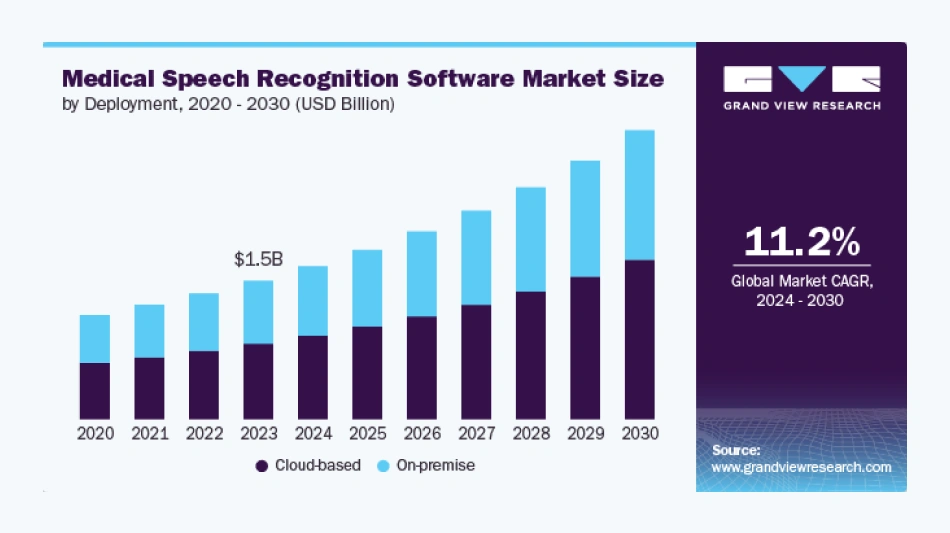
As adoption grows, the conversation inside healthcare organizations is changing. Leaders looking into healthcare speech recognition software development are no longer just curious about the technology. They are asking practical questions about fitting voice tools into daily clinical routines, reducing documentation delays, and whether it makes sense to build a speech recognition system with AI that aligns with how their teams actually work.
For some teams, that means modernizing documentation in phases. For others, it means working with a custom software development company to develop AI speech recognition software for healthcare that can scale across departments and settings. Either way, it starts with understanding how this technology works and where it delivers real, everyday value.
What Is AI Healthcare Speech Recognition Software?
AI healthcare speech recognition software turns spoken clinical conversations into structured, usable data within healthcare systems. It focuses on capturing medical language accurately while fitting naturally into clinical workflows without adding extra steps for care teams.
- Converts clinician speech into real time clinical documentation
- Understands medical terminology, accents, and conversational context
- Supports documentation across exams, consultations, and follow ups
- Integrates with EHRs and administrative systems
- Aligns with broader AI in healthcare administration automation initiatives
For healthcare leaders, AI healthcare speech recognition software development is about creating reliable systems that reduce documentation effort, improve data quality, and support scalable, technology driven care delivery.
Types Of Healthcare Speech Recognition Software
When teams start looking into AI healthcare speech recognition software development, one thing becomes clear quickly. Different clinical settings need different types of speech recognition systems, depending on how and when documentation happens.
|
Type |
What It Does |
Common Use |
|---|---|---|
|
Front End Speech Recognition |
Converts clinician speech into text while the patient interaction is happening |
Clinics, exam rooms, telehealth sessions |
|
Back End Speech Recognition |
Transcribes dictated audio after the visit for later review |
Hospitals, large practices, documentation teams |
|
Speaker Dependent Systems |
Learns the voice patterns of specific clinicians over time |
Solo providers, small teams |
|
Speaker Independent Systems |
Works across many users without prior voice training |
Large healthcare organizations |
|
Ambient Speech Recognition |
Listens in the background and captures relevant clinical information |
Workflows supported by AI integration services |
Understanding these options helps decision makers plan how they want to build AI powered medical speech recognition systems that fit daily workflows and support accurate, consistent documentation across care settings.
How AI Healthcare Speech Recognition Software Works?
At its core, AI healthcare speech recognition software development is about turning everyday clinical conversations into structured data that fits naturally into healthcare systems. The process follows a clear path, from capturing speech to producing usable documentation.
1. Voice Capture and Audio Processing
The system captures clinician speech through devices used during patient interactions and clinical tasks. It filters out background noise and balances audio levels to keep conversations clear. This step ensures the input is clean before any further processing happens.
2. Speech Recognition and Language Understanding
AI models convert spoken words into text using medical language patterns and context awareness. The system understands clinical intent rather than transcribing words in isolation. This layer depends heavily on AI model development to handle real world speech variations.
3. Structuring and Workflow Integration
The converted text is organized into notes, summaries, or fields that align with clinical documentation workflows. Data is prepared for compliance and accuracy before being shared with other systems. Many teams choose to integrate AI into an app already used by clinicians.
|
Stage |
What Happens |
Output |
|---|---|---|
|
Voice Input |
Speech is captured and cleaned |
Clear audio |
|
Speech To Text |
Audio becomes written content |
Accurate text |
|
Context Processing |
Clinical meaning is applied |
Structured data |
|
Workflow Output |
Data moves into systems |
Usable records |
With this foundation in place, healthcare organizations are better equipped to create healthcare speech to text software and build clinical speech recognition platforms that support efficient documentation while naturally leading into discussions around value, impact, and adoption.
Turn Clinical Conversations into Usable Data
Explore how AI healthcare speech recognition software development can reduce documentation effort and fit real clinical workflows.
Talk To Our AI TeamWhy Invest in AI Powered Healthcare Speech Recognition Software?
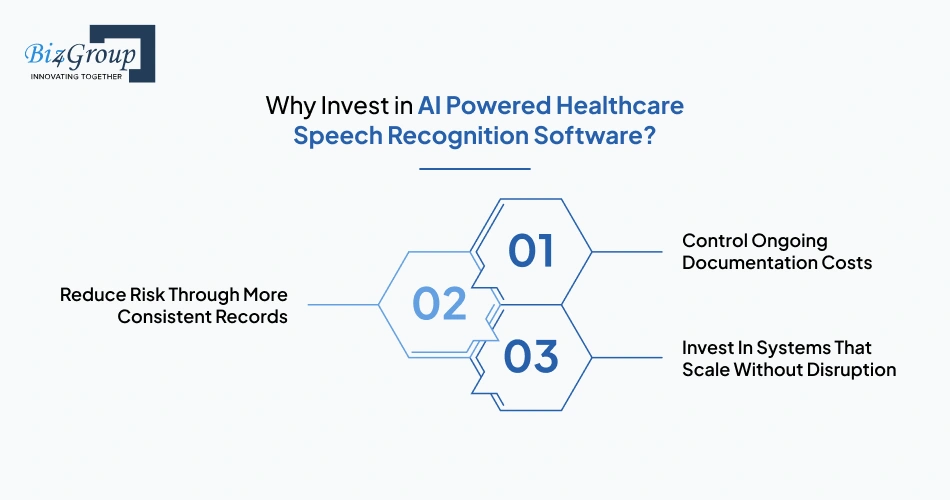
For leaders making budget and technology decisions, AI healthcare speech recognition software development is less about adopting something new and more about fixing problems that quietly add cost over time. Documentation delays, clinician burnout, and inconsistent records all have a measurable impact on operations.
1. Control Ongoing Documentation Costs
Speech driven documentation reduces the hours spent creating and correcting clinical notes. Less manual effort means lower long term administrative overhead. This is where custom healthcare speech recognition software development supports predictable cost control.
2. Reduce Risk Through More Consistent Records
Clear and structured documentation lowers the chance of missing details across clinical encounters. Consistency supports compliance, billing accuracy, and audit readiness. Many organizations rely on AI automation services to maintain this reliability at scale.
3. Invest In Systems That Scale Without Disruption
Speech recognition platforms grow across teams and locations without forcing workflow changes. They align well with broader digital strategies and enterprise AI solutions. This helps protect the investment as care models evolve.
Over time, organizations that develop AI medical transcription solutions are better positioned to improve productivity, retain clinicians, and build operational stability without adding unnecessary complexity.
Real World Applications of AI Driven Healthcare Voice Recognition Software
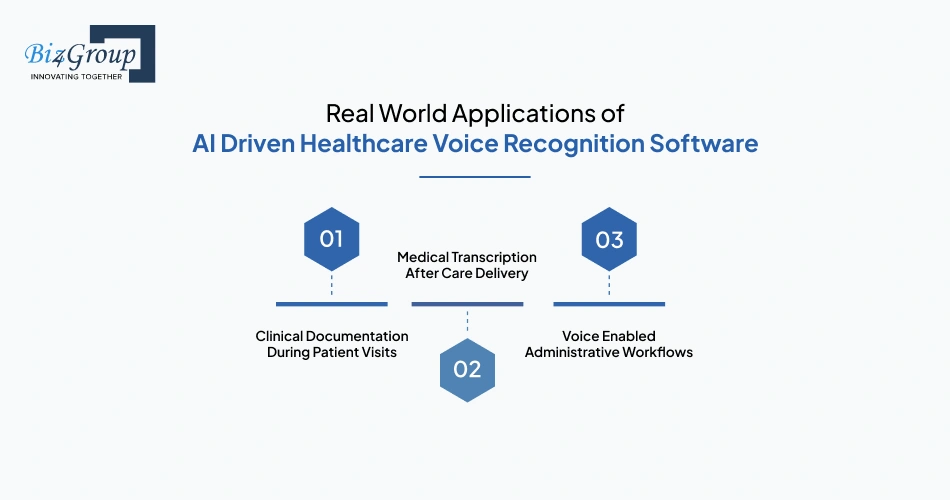
As healthcare teams look at AI healthcare speech recognition software development, the real question becomes where it fits into daily work. These systems are already being used in practical ways that reduce effort, save time, and support smoother clinical and administrative workflows, as shown below.
1. Clinical Documentation During Patient Visits
Speech recognition captures what clinicians say while they are with patients. Notes are created naturally without stopping to type or dictate later. This use case sits at the core of healthcare voice technology software development.
- Example: A physician speaks findings during an exam and the clinical note is ready before the next patient arrives.
2. Medical Transcription After Care Delivery
Clinicians record summaries or observations after visits, which are then converted into structured notes. This helps reduce documentation backlogs and review time. Many teams rely on AI consulting services to fine tune accuracy and workflows.
- Example: A specialist dictates post visit notes that appear in the system for quick approval.
3. Voice Enabled Administrative Workflows
Speech recognition also supports nonclinical tasks like referrals, discharge notes, and care coordination. These workflows often work alongside a conversational AI agent for guided input. Security controls make it easier to develop HIPAA compliant healthcare speech recognition systems.
- Example: Staff use voice input to complete referral documentation without switching screens.
|
Use Case |
Main Benefit |
Typical Setting |
|---|---|---|
|
Clinical Documentation |
Faster note creation |
Clinics and hospitals |
|
Medical Transcription |
Reduced backlog |
Specialty practices |
|
Administrative Tasks |
Less manual entry |
Care teams and staff |
Portfolio Spotlight
This AI powered chatbot for human-like communication was designed to understand intent, context, and conversational flow, creating interactions that feel natural and responsive. The same conversational grounding is critical when translating clinician speech into structured medical documentation with minimal friction or correction effort.
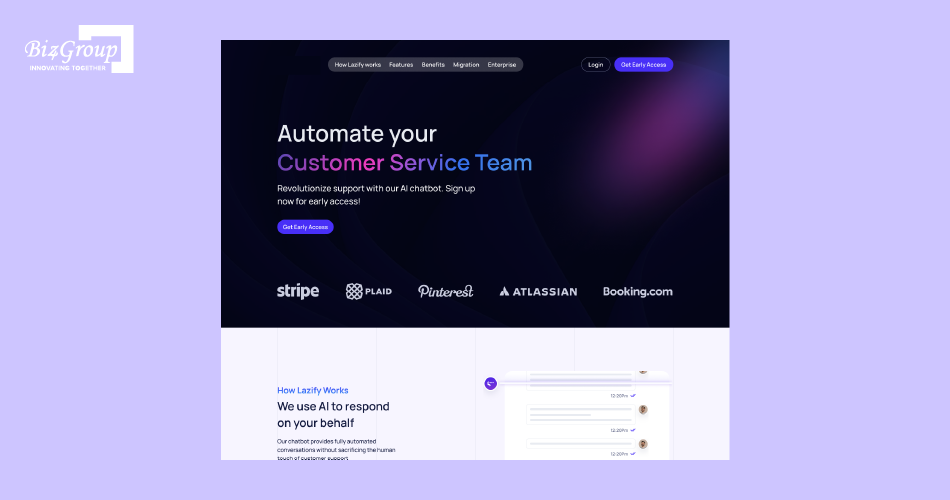
As more organizations create AI driven healthcare voice recognition tools, many turn to an AI chatbot development company to align voice workflows with broader digital systems, which naturally brings attention to the features that make these solutions reliable and effective in real world healthcare environments.
Core Features for AI Powered Medical Speech Recognition Systems
When planning AI healthcare speech recognition software development, the focus quickly turns to features that support accuracy, ease of use, and long term reliability. These core capabilities form the foundation of systems that clinicians can trust in everyday clinical settings:
|
Core Feature |
What It Supports |
Why It Matters |
|---|---|---|
|
Real Time Speech To Text |
Converts spoken words into text instantly |
Reduces documentation delays |
|
Medical Vocabulary Recognition |
Understands clinical terms and abbreviations |
Improves transcription accuracy |
|
Context Aware Transcription |
Interprets meaning beyond individual words |
Produces usable clinical notes |
|
Noise Filtering |
Removes background sounds |
Keeps recordings clear |
|
Speaker Identification |
Distinguishes between different voices |
Useful in multi speaker encounters |
|
Connects with existing clinical systems |
Fits into current workflows |
|
|
Editable Output |
Allows clinicians to review and adjust text |
Maintains clinical control |
|
Security And Access Controls |
Protects patient data |
Supports compliance needs |
|
Scalability |
Works across teams and locations |
Supports growth over time |
Together, these features make it possible to create AI healthcare voice recognition software for efficiency while keeping workflows simple and reliable. Many teams evaluate these essentials before exploring more advanced capabilities that build on this foundation and support broader clinical goals.
Advanced Features in AI Healthcare Speech Recognition Software
Once basic transcription works well, teams start looking for features that reduce effort even further. In AI healthcare speech recognition software development, advanced capabilities focus on making spoken data easier to work with and more useful across clinical workflows.
1. Ambient Clinical Listening
Instead of requiring a tap or command, the system listens quietly during clinical conversations. It captures medically relevant details while ignoring side talk. This approach often relies on generative AI to keep summaries accurate without adding extra steps.
2. Automatic Clinical Summaries
Long conversations can be condensed into visit summaries or structured notes. Clinicians spend less time reviewing transcripts and more time focusing on care. This has become a natural extension of mature healthcare speech recognition software development efforts.
3. Voice Based Workflow Actions
Clinicians can move through records or complete simple actions using voice. This reduces screen switching and supports more natural interactions with systems. In some environments, this works alongside an AI voice chatbot that guides routine tasks.
4. Multi Speaker Recognition
The system can tell who is speaking and apply context based on clinical roles. This matters in hospitals and team-based settings where conversations involve more than one provider. It is an important step when teams develop AI speech recognition software for healthcare beyond single user use cases.
5. Speech Data Insights
Over time, voice data reveals patterns around documentation gaps and workflow friction. These insights support quality improvement without adding reporting overhead. Many organizations view this as part of broader AI agent implementation initiatives.
Portfolio Spotlight
Biz4Group built a custom enterprise AI agent designed to handle complex, domain specific conversations across large organizations. It focuses on accuracy, secure data handling, and workflow alignment, which closely mirrors how clinical speech systems must interpret medical context without disrupting care delivery.
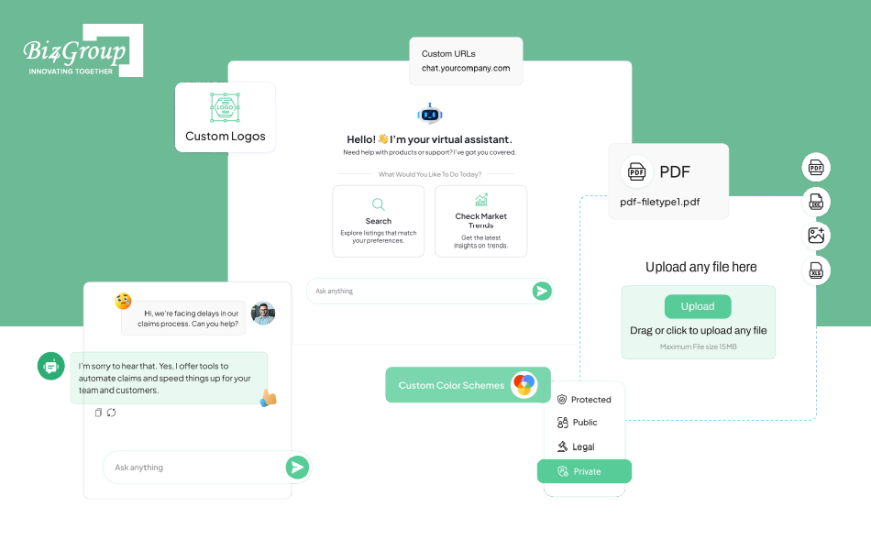
As teams begin to develop AI driven speech recognition solutions for healthcare organizations, these advanced features influence how the system is planned and built, naturally leading into questions about development steps and execution.
Build Speech Recognition That Clinicians Actually Use
Design and build AI powered medical speech recognition systems that feel natural during patient care, not disruptive.
Plan My Healthcare Speech SolutionHow To Build AI Powered Medical Speech Recognition Systems: Step by Step Process
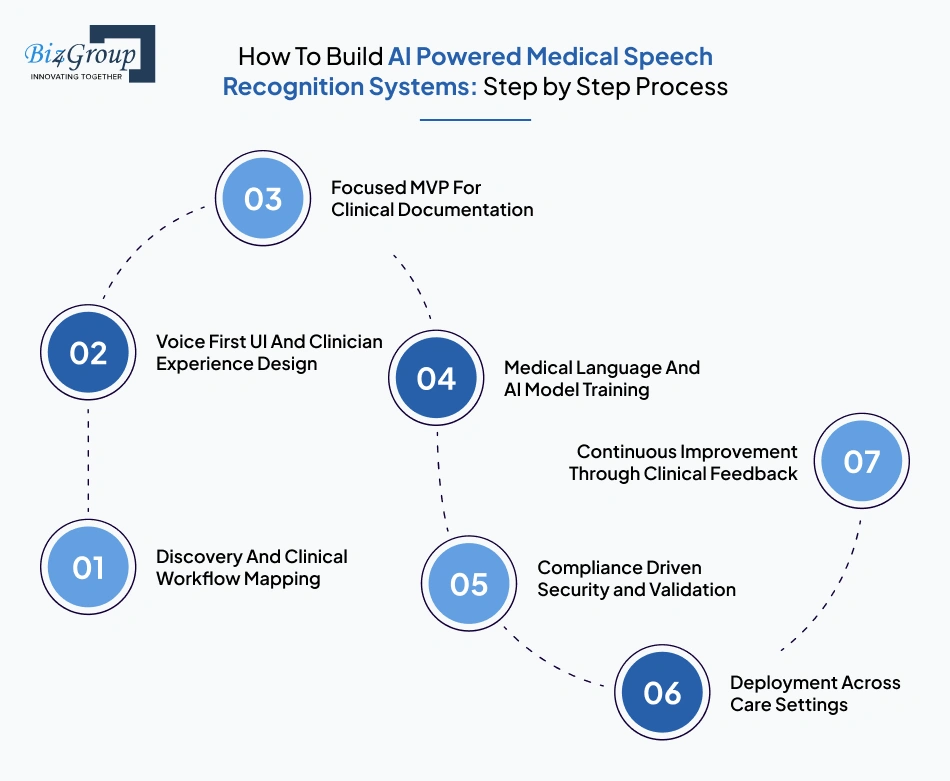
Healthcare organizations succeed with AI healthcare speech recognition software development when the process mirrors how clinicians speak, document, and deliver care. Each step below focuses on reducing documentation friction while protecting accuracy, trust, and compliance.
1. Discovery And Clinical Workflow Mapping
This step begins inside exam rooms, not meeting rooms. Teams observe how clinicians speak during visits, when notes are created, and where documentation breaks down after care delivery. The goal is to anchor development in real clinical behavior.
- Shadow clinicians during patient interactions
- Identify points where documentation is delayed or rushed
- Decide where to create healthcare speech to text software first
- Align goals with documentation time and accuracy improvements
2. Voice First UI And Clinician Experience Design
Speech recognition fails when clinicians feel forced to interact with screens. This phase focuses on UI/UX designs that stay out of the way while voice remains the primary input. The experience must feel natural during care, not like extra work.
- Design around spoken documentation, not typing
- Minimize on screen prompts during patient visits
- Support quick review and corrections post visit
- Ensure usability across specialties and care settings
Also Read: Top 15 UI/UX Design Companies in USA: 2026 Guide
3. Focused MVP For Clinical Documentation
Instead of covering every use case, teams opt for MVP development services that supports one documentation workflow extremely well. This could be outpatient visit notes or post visit dictation. Early success builds trust before expanding.
- Select a single clinical documentation scenario
- Build real time or post visit transcription
- Validate output quality with clinicians
- Prepare the system to scale gradually
This phase is central to custom healthcare speech recognition software development, where workflows vary widely between organizations.
Also Read: Top 12+ MVP Development Companies to Launch Your Startup in 2026
4. Medical Language And AI Model Training
Healthcare speech is complex, fast paced, and filled with abbreviations. This step focuses on training models to understand clinical language as it is spoken, not how it appears in textbooks.
- Train AI models on specialty specific terminology
- Handle accents, speed, and conversational overlap
- Learn from clinician corrections over time
- Improve accuracy without storing sensitive data
Here, teams actively develop AI medical transcription solutions that improve through real clinical use.
5. Compliance Driven Security and Validation
Speech data includes protected health information by default. This step ensures every part of the system meets compliance expectations while still performing well in busy clinical environments.
- Apply encryption during capture and storage
- Limit access based on clinical roles
- Test performance in noisy care settings
- Validate workflows against compliance requirements
Also Read: 15+ Software Testing Companies in USA in 2026
6. Deployment Across Care Settings
Healthcare environments vary widely between clinics, hospitals, and telehealth. Deployment must support different devices, usage patterns, and peak times without disrupting care delivery.
- Deploy on cloud infrastructure that scales safely
- Support mobile and workstation-based usage
- Monitor accuracy and latency across locations
- Enable updates without downtime
This is where organizations build clinical speech recognition platforms that work across diverse care environments.
7. Continuous Improvement Through Clinical Feedback
Speech recognition improves when it adapts to real usage. Post launch, teams focus on refining accuracy, expanding workflows, and responding to clinician feedback.
- Track documentation time and error rates
- Collect feedback from different specialties
- Retrain models with updated speech patterns
- Prioritize features based on clinical impact
Over time, this approach allows organizations to create AI driven healthcare voice recognition tools that stay accurate, trusted, and aligned with evolving care delivery needs.
Following this path helps teams confidently build AI powered medical speech recognition systems that clinicians rely on daily, without forcing workflow changes or compromising compliance. It also gives leadership clearer visibility into outcomes like documentation efficiency, clinician adoption, and long-term operational stability before scaling further.
Move From Ideas To Real Clinical Impact
Learn how to create healthcare speech to text software that supports accuracy, compliance, and day to day adoption.
Start With A Focused MVPTech Stack For AI Healthcare Speech Recognition Software Development
AI powered medical speech recognition systems depend on more than just AI models. They require a well-rounded stack that supports clinical workflows, integrations, compliance, and scale across healthcare settings.
|
Label |
Preferred Technologies |
Why It Matters |
|---|---|---|
|
Frontend Framework |
ReactJS, Vue.js |
Clinicians need fast, clean interfaces that do not interrupt care. Teams familiar with ReactJS development often favor it for responsive, low friction clinical screens. |
|
Server Side Rendering And SEO |
NextJS, Nuxt.js |
Admin dashboards and reporting views still benefit from structured rendering. Many healthcare platforms rely on NextJS development for predictable performance and routing. |
|
Backend Framework |
NodeJS, Python |
Speech requests, transcripts, and logic must process reliably under load. Systems built with NodeJS development often pair well with Python development for handling data intensive operations. |
|
API Development And Integration |
REST APIs, GraphQL |
Speech recognition only delivers value when it connects to EHRs and internal systems. Well designed APIs ensure secure and consistent data exchange across platforms. |
|
AI And Speech Processing |
Medical NLP Libraries, Speech Recognition Engines |
Clinical speech contains specialized language. These tools focus on medical accuracy rather than general speech use cases. |
|
Model Training And Optimization |
Custom ML Pipelines, Fine Tuning Frameworks |
Medical language evolves by specialty and workflow. This layer allows continuous refinement without disrupting live systems. |
|
EHR And Healthcare Standards |
HL7, FHIR |
Healthcare adoption depends on interoperability. These standards help speech output flow directly into clinical records. |
|
Data Security And Compliance |
Encryption Tools, Role Based Access Control |
Speech data is protected health information by default. Security layers support compliance and clinician trust. |
|
Cloud Infrastructure |
AWS, Azure, HIPAA Ready Cloud Services |
Healthcare usage varies by shift and location. Cloud platforms support scaling without affecting care delivery. |
Together, this stack supports scalable, compliant platforms built specifically for clinical environments. When teams align technology choices with workflow and compliance needs, AI healthcare speech recognition software development becomes easier to scale, maintain, and evolve over time.
Cost Of AI Healthcare Speech Recognition Software Development
The cost of AI healthcare speech recognition software development typically falls between $15,000 to $150,000+, and this should be treated as a ballpark figure rather than a fixed price. Actual investment depends on scope, accuracy requirements, compliance needs, and how deeply the system integrates into clinical workflows.
|
Cost Tier |
Estimated Cost Range |
What Is Included |
|---|---|---|
|
MVP-level AI Healthcare Speech Recognition Software |
$15,000 to $35,000 |
Basic speech to text for one clinical workflow with limited integrations |
|
Mid-Level AI Healthcare Speech Recognition Software |
$40,000 to $80,000 |
Multiple workflows, EHR integration, higher accuracy tuning |
|
Enterprise-grade AI Healthcare Speech Recognition Software |
$90,000 to $150,000+ |
System wide rollout, customization, scalability, long term support |
|
AI Model Training |
$10,000 to $30,000 |
Medical language tuning, specialty specific optimization |
|
Security And Compliance |
$8,000 to $20,000 |
HIPAA controls, encryption, access management, audits |
|
Ongoing Maintenance |
$5,000 to $25,000 annually |
Monitoring, updates, performance improvements |
For healthcare leaders, cost decisions often align with long term digital priorities. Teams planning healthcare voice technology software development usually balance initial build costs against gains in efficiency, clinician time saved, and operational consistency. Many organizations also evaluate whether to hire AI developers internally or partner externally based on speed and risk considerations.
Once cost expectations are clear, the next natural step is understanding how these systems can generate value and support sustainable revenue models over time.
Control Costs Without Cutting Corners
Understand how healthcare voice technology software development can be phased to match budget, growth, and ROI goals.
Estimate My Project ScopeRevenue Models for Healthcare Speech Recognition Software Development
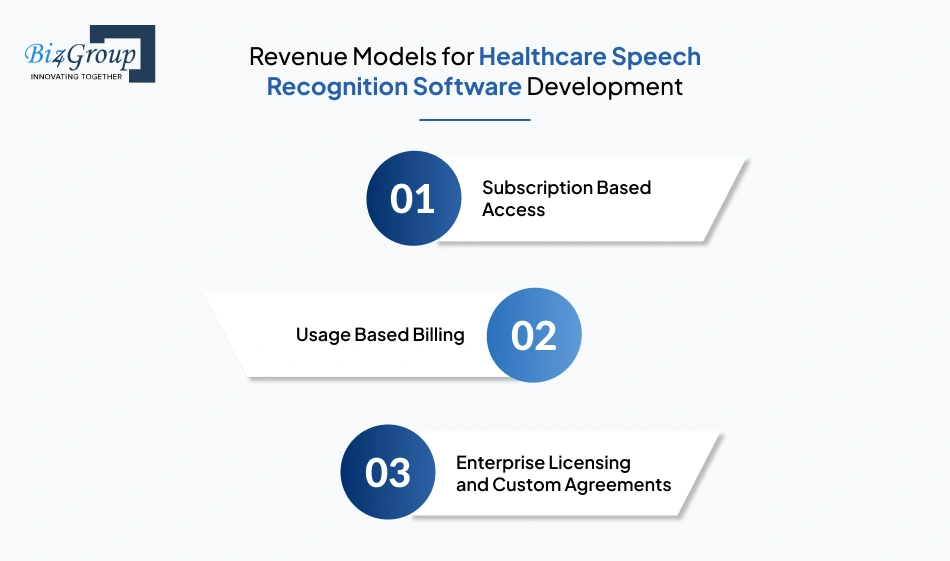
When organizations commit to AI healthcare speech recognition software development, revenue planning usually follows how deeply voice systems are embedded into daily clinical documentation. Pricing models tend to evolve alongside adoption, accuracy expectations, and long-term operational goals.
1. Subscription Based Access
Healthcare teams often prefer predictable pricing that aligns with staffing and budgeting cycles. Subscription models work best when voice documentation becomes part of routine clinical work rather than a short-term experiment.
- Example: A clinic group rolls out voice documentation across locations while working to develop HIPAA compliant healthcare speech recognition systems supported through an annual subscription.
2. Usage Based Billing
Some organizations start cautiously and prefer to pay only for what they use. Usage based pricing ties revenue to actual transcription volume or encounters processed, making early adoption feel lower risk.
- Example: A specialty provider tests voice documentation during a pilot phase using an AI agent POC before committing to wider rollout.
3. Enterprise Licensing and Custom Agreements
Large healthcare systems often choose fixed contracts that include customization, integrations, and long-term support. These models are common when speech recognition is part of broader digital transformation efforts.
- Example: A health system works with a software development company in Florida to create AI healthcare voice recognition software for efficiency across inpatient and outpatient departments.
Over time, organizations that develop AI driven speech recognition solutions for healthcare organizations often blend these models as usage stabilizes. Some also layer in complementary platforms like AI sentiment analysis tools to expand value without changing the core pricing structure.
Scale Voice Technology Across Care Settings
See how teams build clinical speech recognition platforms that work across clinics, hospitals, and telehealth environments.
Explore Scalable AI SolutionsBest Practices for AI Healthcare Speech Recognition Software Development
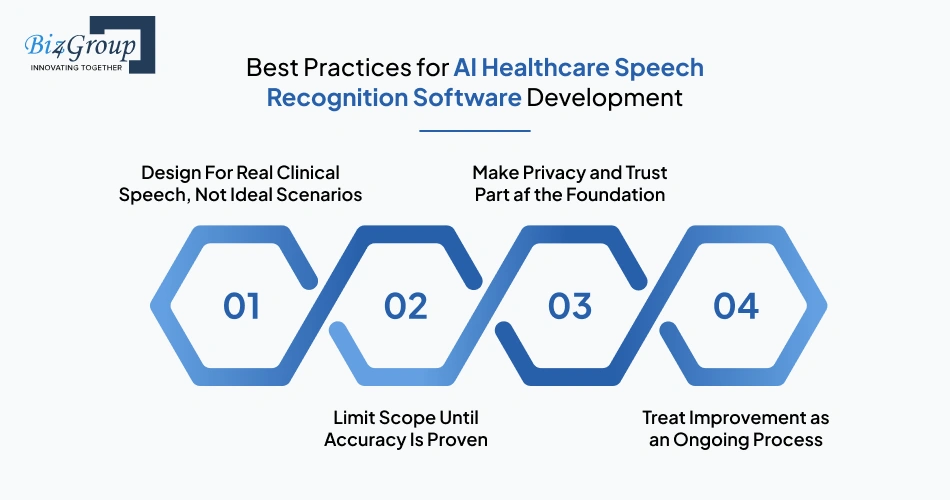
Strong outcomes in AI healthcare speech recognition software development usually come from making thoughtful choices early and sticking close to how care is actually delivered. Teams that keep things simple and clinician focused avoid many of the problems that slow adoption later.
1. Design For Real Clinical Speech, Not Ideal Scenarios
Clinicians speak quickly, jump between topics, and get interrupted often. Systems work better when they are trained on real exam room conversations instead of scripted audio. This mindset keeps healthcare speech recognition software development grounded in reality.
2. Limit Scope Until Accuracy Is Proven
Trying to cover every use case from day one often backfires. Teams that develop AI speech recognition software for healthcare usually start with one workflow and get it right before expanding. This approach is common in business app development using AI for regulated industries.
3. Make Privacy and Trust Part af the Foundation
Speech data always includes sensitive patient information. Security decisions should be made early, not added later. This level of discipline is expected across the chatbot development for healthcare industry and directly affects clinician trust.
4. Treat Improvement as an Ongoing Process
Clinical language and workflows change over time. Systems should learn from corrections and feedback without disrupting daily use. Teams that build AI software with this approach see steadier adoption and better long term results.
Following these practices makes it easier to build AI powered medical speech recognition systems that hold up under real clinical pressure, naturally leading into a discussion around the challenges teams encounter and how they work through them.
Top Hurdles in AI Healthcare Speech Recognition Software Development
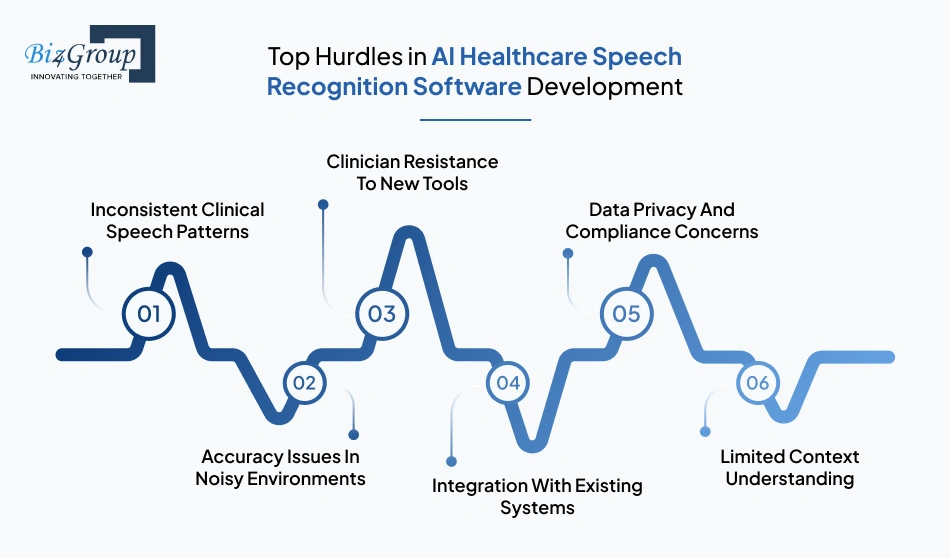
Even with clear benefits, teams often run into practical challenges during AI healthcare speech recognition software development. These hurdles are less about ambition and more about real world clinical complexity, which is where focused solutions make the biggest difference.
|
Top Challenges |
How To Solve Them |
|---|---|
|
Inconsistent Clinical Speech Patterns |
Train models on real clinical conversations across specialties and speaking styles instead of scripted data. |
|
Accuracy Issues In Noisy Environments |
Apply noise filtering and audio preprocessing tuned for exam rooms and busy care settings. |
|
Clinician Resistance To New Tools |
Design voice workflows that fit existing routines without adding steps or screen time. |
|
Integration With Existing Systems |
Use standards based APIs and plan integrations early to avoid workflow disruption. |
|
Data Privacy And Compliance Concerns |
Build security and access controls into the system from day one, not as an afterthought. |
|
Limited Context Understanding |
Combine speech recognition with contextual logic often supported by generative AI agents to improve usable output. |
Most of these challenges become manageable once teams acknowledge them early and design around clinical reality. With the right approach, it becomes easier to create healthcare speech to text software that clinicians trust and use consistently, naturally opening the door to conversations about where this technology is headed next.
The Future of AI Healthcare Speech Recognition Software Development
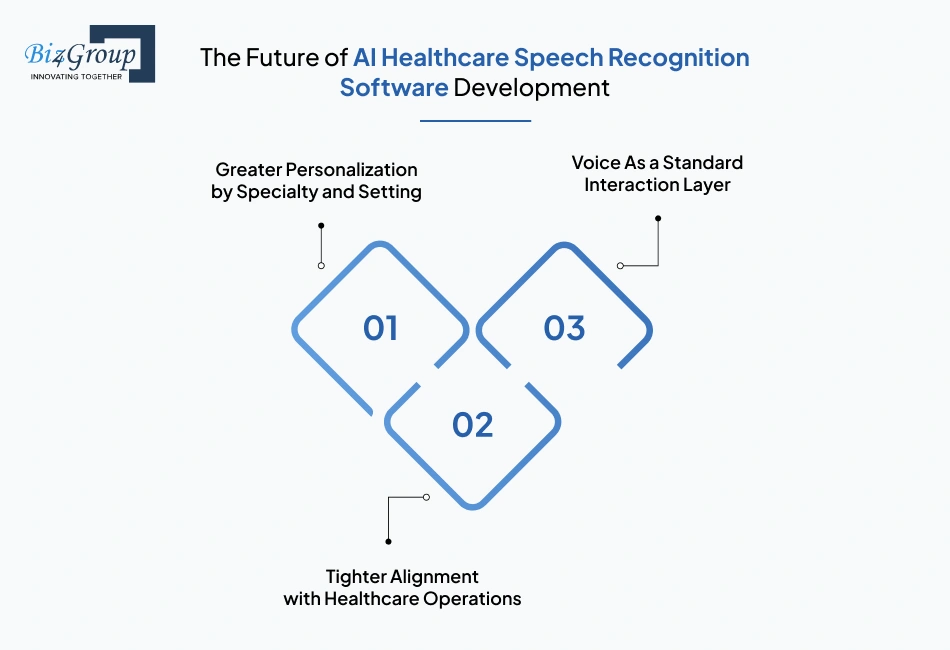
Looking ahead, AI healthcare speech recognition software development is moving beyond basic efficiency gains and into long term clinical strategy. The next phase is shaped by regulation, personalization, and how deeply voice technology becomes part of healthcare ecosystems, which shows up in a few clear directions.
1. Greater Personalization by Specialty and Setting
Future systems will reflect how different specialties speak and document care. Cardiology, primary care, and behavioral health will no longer share one generic model. This shift is driving more custom healthcare speech recognition software development across organizations.
2. Tighter Alignment with Healthcare Operations
Speech recognition will increasingly support operational decision making, not just documentation. Voice data will influence staffing, workflow design, and quality tracking. This pushes teams to build clinical speech recognition platforms that connect clinical and operational systems.
3. Voice As a Standard Interaction Layer
Voice will become a common way clinicians interact with software, similar to touch or typing. As this grows, tools like an AI conversation app will feel normal inside healthcare environments. Experiments with an AI voice cloning app will become more innovative and immersive.
As adoption matures, organizations that develop AI medical transcription solutions will focus less on novelty and more on long term value, trust, and governance. Now let’s find out how to choose the right development partner for this journey.
Prepare For Long Term Healthcare AI Adoption
Plan how to develop AI driven speech recognition solutions for healthcare organizations that stay reliable as needs evolve.
Talk Through The Next StepsWhy Choose Biz4Group LLC for AI Healthcare Speech Recognition Software Development?
Building healthcare voice systems means understanding how clinicians work, where documentation slows them down, and how AI behaves once it is part of everyday care. That is where Biz4Group LLC brings practical experience to the table.
We have built AI platforms that handle complex conversations and enterprise workflows, including custom AI agents and human like chatbots. The same thinking applies when working on AI healthcare speech recognition software development, where context, accuracy, and trust matter more than flashy features.
What Working With Biz4Group Feels Like
- A hands-on AI development company that focuses on real outcomes
- Experience building enterprise AI agents that manage nuanced conversations
- Strong understanding of conversational systems and contextual intelligence
- Early focus on compliance, security, and scalability
- A product mindset shaped by building and shipping real AI platforms
If you are exploring healthcare speech recognition as a long term capability, Biz4Group offers a grounded approach built on real AI delivery experience rather than promises.
Final Words
Healthcare speech recognition does not need to be loud or flashy to make an impact. When it works well, it simply fades into the background while clinicians focus on care. That is the real win. AI healthcare speech recognition software development succeeds when it respects clinical workflows, reduces effort, and grows quietly with the organization instead of fighting it.
The difference usually comes down to how the product is planned and built. Teams that approach this as a long term capability, not a quick feature, avoid rework and frustration later. That is where strong product development services and lessons learned from working alongside the top AI development companies in Florida tend to show up in small but meaningful ways.
Are you planning to create an AI speech recognition system for healthcare that feels natural on day one and still works years later.
FAQs On AI Healthcare Speech Recognition Software Development
1. How Long Does It Take To Implement Healthcare Speech Recognition Software?
Implementation timelines vary based on scope, integrations, and compliance needs. A focused pilot can take a few weeks, while broader rollouts take longer. Most teams approach healthcare speech recognition software development in phases to reduce disruption.
2. Can Speech Recognition Software Adapt To Different Medical Specialties?
Yes, but only when models are trained on specialty specific language and workflows. Systems built to develop AI speech recognition software for healthcare typically support customization so cardiology, behavioral health, and primary care are handled differently.
3. How Accurate Is AI Speech Recognition In Real Clinical Environments?
Accuracy depends on training data, noise handling, and clinician feedback loops. Platforms designed to build AI powered medical speech recognition systems improve over time as they learn from real usage instead of static datasets.
4. Does Healthcare Speech Recognition Replace Human Review Completely?
No. Most organizations keep clinicians in control of final documentation. Tools that develop AI medical transcription solutions are designed to assist and speed up documentation, not remove clinical accountability.
5. What Compliance Considerations Should Be Evaluated Before Adoption?
Healthcare speech tools must meet strict data protection and access standards. Teams planning to develop HIPAA compliant healthcare speech recognition systems usually review encryption, audit trails, and role based access before deployment.
6. How Much Does AI Healthcare Speech Recognition Software Typically Cost?
Costs generally range between $15,000 and $150,000, depending on scope and scale. Organizations investing in healthcare voice technology software development often start small and expand once value is proven.
