 Location :
Orlando, FL, USA
Location :
Orlando, FL, USA +1 (407) 714-1616
 info@biz4group.com

- AI homeowner support bot development for HOA communities helps automate resident communication, maintenance coordination, document retrieval, and 24/7 homeowner assistance.
- Communities looking to create HOA resident support AI bot system solutions should prioritize compliance controls, escalation workflows, and community-specific knowledge management.
- Building AI chatbot for homeowner associations typically costs between $25,000-$300,000+ depending on automation depth, integrations, and multi-community scalability requirements.
- Building AI HOA community support chatbot for maintenance and resident queries can reduce repetitive support workload by 50%-80% while improving homeowner satisfaction and operational visibility.
- Biz4Group LLC is among the trusted companies that develop HOA community support AI bots in USA, delivering scalable conversational AI systems tailored to real HOA operational workflows.
What happens when a homeowner reports a leaking clubhouse pipe at 9:30 PM, another resident asks about parking violations before sunrise, and your HOA office already has 40 unanswered emails waiting for Monday morning?
Across the U.S., HOA managers are under pressure to respond faster with smaller teams and rising resident expectations. According to recent customer service research, 74% of consumers now expect support to be available 24/7. That growing demand is pushing more associations toward AI homeowner support bot development for HOA communities.
If your team has ever said, “we are looking to build an AI homeowner support bot for our HOA community to automate communication and reduce manual workload,” you are far from alone. Burnout levels across management-heavy industries continue to rise, with recent workforce studies showing more than half of U.S. employees reporting burnout symptoms in 2025.
Many property managers are now looking to develop AI homeowner support bot for HOA communities that can answer repetitive questions, automate maintenance requests, and reduce staff burnout without sacrificing the homeowner experience.
The challenge is that generic chatbot tools often fail in HOA environments because they cannot interpret CC&Rs, connect with platforms like AppFolio or Buildium, or safely handle community-specific workflows.
That is why more associations want to build HOA community support AI chatbot systems tailored to resident communication, payment reminders, maintenance coordination, and after-hours support.
In this guide, we will break down how these systems work, what features matter most, what development really costs, and how HOA management companies can create a scalable support experience that residents actually appreciate.
Let's begin.
What Is AI Homeowner Support Bot Development for HOA Communities?
An HOA manager handles more than maintenance tickets and pool key requests. They manage expectations, frustrations, emergencies, payments, resident communication, vendor coordination, and compliance related questions across hundreds or even thousands of homeowners.
That workload is exactly why AI homeowner support bot development for HOA communities is gaining momentum across U.S. property management operations.
At its core, an HOA AI support bot acts like a digital front desk for residents. It responds to repetitive homeowner questions, routes requests to the right teams, surfaces information from governing documents, and keeps communication moving after office hours.
Unlike a generic chatbot widget, a purpose-built HOA support bot understands community-specific operations.
That difference matters.
A resident asking about guest parking in Phoenix and another asking about architectural approvals in Tampa should not receive generic internet answers. They need responses tied to their own HOA policies, CC&Rs, schedules, and workflows.
In simple terms, an HOA AI support bot can:
- Answer homeowner questions 24/7
- Handle maintenance and service requests
- Guide residents through ARC submissions
- Provide payment and dues information
- Share community announcements
- Surface approved policy information
- Route urgent requests to staff
- Reduce repetitive administrative workload
Quick Answer for HOA Leaders
|
Question |
Short Answer |
|---|---|
|
What is an HOA AI support bot? |
A conversational AI system trained on HOA-specific data and workflows |
|
Who uses it? |
HOA boards, property management companies, condo associations |
|
What problems does it solve? |
Delayed responses, repetitive inquiries, resident frustration |
|
Does it replace staff? |
No. It reduces repetitive work and supports existing teams |
|
Can it work after office hours? |
Yes, that is one of its biggest advantages |
What Can an HOA AI Support Bot Actually Do?
This is where many HOA managers pause and ask, “We are managing an HOA community and want to develop an AI chatbot to handle homeowner queries, maintenance requests, and 24/7 support. What can the system realistically automate?”
The answer depends on how the bot is designed and what systems it can access. A well-built HOA chatbot can support multiple communication workflows simultaneously.
Common capabilities include:
- Resident Question Handling
The bot can instantly answer common homeowner questions such as:
- pool timings
- clubhouse reservations
- parking policies
- trash pickup schedules
- guest access procedures
- HOA fee payment instructions
- Maintenance Coordination
Residents can report:
- broken gates
- water leaks
- lighting failures
- landscaping concerns
- amenity issues
The bot can then route tickets to the right maintenance teams automatically.
- HOA Document Assistance
Instead of manually searching PDFs, residents can ask:
- “What are the pet restrictions?”
- “Can I install solar panels?”
- “What are the guest parking limits?”
- Multi-Channel Communication
Modern HOA bots can operate through:
- websites
- mobile apps
- resident portals
- SMS
- voice assistants
What an HOA AI Bot Should NOT Do
This part often gets ignored by vendors. It should not.
An HOA support bot should improve operational efficiency without creating compliance risks or damaging resident trust.
Here are the boundaries responsible HOA management companies establish early during development.
|
What the Bot SHOULD NOT Do |
Why It Matters |
|---|---|
|
Provide legal advice |
HOA laws vary by state and legal interpretation matters |
|
Invent answers |
Hallucinated responses create liability |
|
Override board decisions |
Governance still requires human authority |
|
Approve violations automatically |
Sensitive enforcement actions require review |
|
Access private homeowner data without permissions |
Data security and compliance risks increase |
|
Replace human escalation paths |
Residents still need human support in complex situations |
This distinction becomes especially important in states with strict HOA regulations such as:
- California under Davis-Stirling
- Florida Chapter 720
- Texas Chapter 204
The strongest systems rely on approved documents and controlled response workflows instead of open-ended internet-generated answers.
HOA AI Support Bot vs Generic Chatbot
Not every chatbot belongs inside an HOA ecosystem. A retail support bot and an HOA resident support system solve very different problems.
Here is the difference most HOA boards discover during vendor evaluations.
|
Generic Chatbot |
HOA AI Support Bot |
|---|---|
|
Uses broad internet knowledge |
Uses community-approved HOA documents |
|
Focused on basic FAQs |
Handles operational workflows |
|
Limited property management context |
Built for HOA communication processes |
|
Minimal compliance controls |
Includes escalation and approval logic |
|
Usually disconnected from HOA platforms |
Supports property management integrations |
|
One-size-fits-all setup |
Customized for each community |
That is why many organizations searching for AI chatbot development services now prefer tailored HOA systems over plug-and-play widgets. Especially when they manage multiple communities with different rules, fee structures, and resident expectations.
What Makes Modern HOA AI Bots Smarter Than Older Chatbots?
Earlier chatbots followed rigid scripts. Modern systems operate differently.
Today’s conversational systems can:
- understand homeowner intent
- retain conversation context
- detect urgency
- route conversations dynamically
- personalize responses
- support multilingual interactions
Some advanced systems even incorporate agentic AI development frameworks to coordinate tasks across maintenance, communication, scheduling, and resident support workflows.
That shift is transforming how property management companies think about resident engagement. Not as a ticket queue. But as an always-available operational support layer.
And for HOA teams buried under repetitive communication, that change can feel very noticeable within the first few weeks of deployment.
Still Handling 80% Repetitive Queries Manually?
HOA teams lose 15-25 hours weekly answering the same resident questions.
Build Smart with Biz4GroupHow AI Homeowner Support Bot Development for HOA Communities Actually Works
Many HOA leaders asking “I want to implement an AI homeowner support bot to provide 24/7 assistance for my HOA residents” usually have the same follow-up concern.
How does the system actually work behind the scenes? The answer is simpler than most people expect.
An HOA AI support bot works through three connected layers:
- community knowledge
- conversation intelligence
- operational integrations
Together, these layers help the bot understand homeowner questions, retrieve approved information, and trigger the right actions.
The Core Components of an HOA AI Support System
|
Component |
Purpose |
|---|---|
|
Knowledge Base |
Stores HOA rules, policies, schedules, and documents |
|
AI Conversation Engine |
Understands homeowner intent and generates responses |
|
Integration Layer |
Connects with HOA software and resident portals |
|
Workflow Automation |
Routes tickets, complaints, and requests |
|
Compliance Controls |
Prevents inaccurate or unauthorized responses |
Communities investing in AI property management software often prioritize these components first because they directly affect resident experience and operational efficiency.
How the Workflow Typically Functions
A homeowner asks a question. The system analyzes intent, checks approved HOA documents, and responds based on verified information.
Here is a simplified example.
|
Resident Request |
Bot Action |
|---|---|
|
“How do I reserve the clubhouse?” |
Retrieves reservation process |
|
“The gym AC stopped working” |
Creates maintenance ticket |
|
“What are guest parking rules?” |
Pulls policy from governing documents |
|
“I need my payment history” |
Connects with HOA portal data |
This process becomes significantly more effective when paired with proper AI integration across HOA platforms and resident systems.
Why Compliance Controls Matter
HOA communication carries legal and operational sensitivity. A support bot cannot generate random answers about dues, violations, or governing policies.
That is why modern systems rely heavily on:
- approved document retrieval
- confidence scoring
- human escalation workflows
- permission-based access
Many communities exploring AI document management software now use controlled document indexing to improve response accuracy and reduce misinformation risks.
How the Bot Stays Updated
HOA policies change regularly. New parking rules, revised fee schedules, seasonal amenity timings, or updated board resolutions all need to reflect inside the AI system quickly.
Most modern bots solve this through automated synchronization workflows.
|
HOA Update |
AI System Action |
|---|---|
|
New CC&R amendment |
Reindexes policy database |
|
Updated dues structure |
Refreshes payment information |
|
Maintenance vendor changes |
Updates service workflows |
|
New resident notice |
Syncs communication templates |
This is one reason communities building AI automation system for property management companies prefer custom workflows over static chatbot plugins.
What Makes Modern HOA Bots Different from Basic Chat Widgets?
Traditional bots followed scripts. Modern systems use conversational intelligence powered by generative AI to understand context, homeowner intent, and multi-step interactions.
That means residents can ask questions naturally instead of clicking through rigid menus.
For HOA teams trying to create faster and more organized resident communication, that shift can dramatically reduce repetitive workload while improving response consistency across the community.
Benefits of Building AI Chatbot for Homeowner Associations
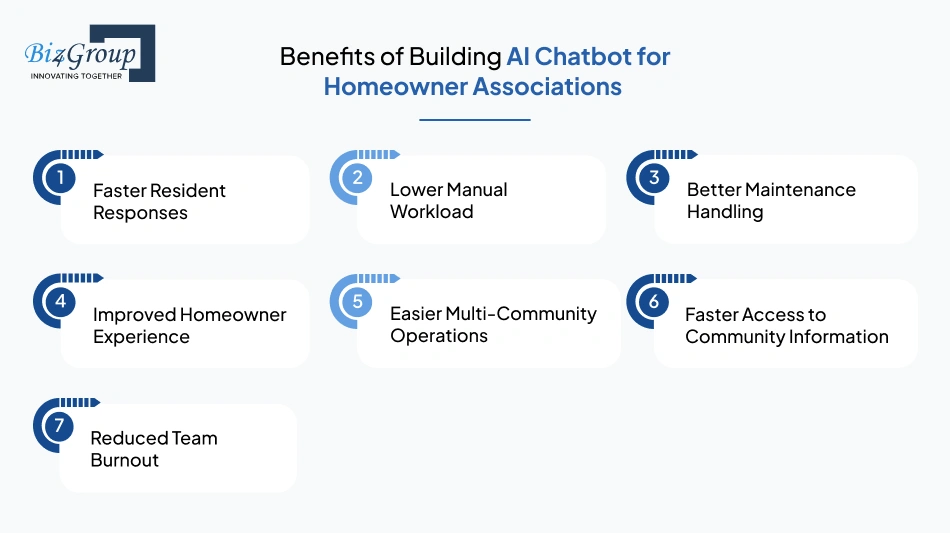
HOA management teams are dealing with rising homeowner expectations, increasing operational workload, and smaller support teams. That pressure is pushing more communities to develop AI homeowner support bot for HOA communities focused on automation, communication, and faster service delivery.
1. Faster Resident Responses
Most homeowner frustrations begin with delayed communication.
Residents expect instant updates about maintenance issues, parking concerns, payment reminders, and amenity access. An AI support bot keeps communication active around the clock, including weekends and after office hours.
This is one reason many communities are investing in AI HOA management software to improve resident experience without increasing staffing costs.
2. Lower Manual Workload
HOA staff spend a large portion of the day answering repetitive questions.
Questions related to dues, guest parking, pool schedules, and community policies consume hours every week. A chatbot automates these repetitive interactions so management teams can focus on operational priorities that require human involvement.
Many firms expanding their AI automation capabilities are using conversational systems to reduce communication overload across multiple communities.
3. Better Maintenance Handling
Maintenance coordination becomes difficult when requests arrive through emails, calls, spreadsheets, and resident portals simultaneously.
An HOA AI chatbot centralizes requests into one structured workflow. Residents can report issues instantly while staff can monitor status updates more efficiently.
This creates faster response cycles and better visibility across maintenance operations.
4. Improved Homeowner Experience
Residents appreciate transparency and responsiveness.
Even quick acknowledgments improve communication quality significantly. AI support bots help homeowners receive faster updates, easier access to information, and more consistent communication throughout the community.
That consistency becomes especially valuable for associations managing high resident volumes.
5. Easier Multi-Community Operations
Property management companies handling multiple associations often struggle with fragmented communication systems.
AI support bots help standardize resident support workflows while still maintaining community-specific rules and responses.
This scalability is one reason firms evaluating enterprise AI solutions are prioritizing automation across HOA operations.
6. Faster Access to Community Information
Residents no longer want to search through long PDFs to find parking restrictions or amenity rules.
AI-powered search systems connected with an automated HOA document retrieval system can surface accurate policy information in seconds, improving convenience for both residents and management teams.
7. Reduced Team Burnout
One of the most overlooked benefits of HOA AI systems is operational relief for internal teams.
Constant repetitive communication creates fatigue, especially for lean management teams overseeing several communities. Automating routine interactions helps reduce communication pressure and improves daily operational efficiency.
That is why more HOA leaders now say, “I want to create an AI bot for HOA homeowners to handle queries and improve communication efficiency.”
The demand is no longer experimental. It is operational.
Project Spotlight: Advanced Web Application for Automated Maintenance of Rented Homes
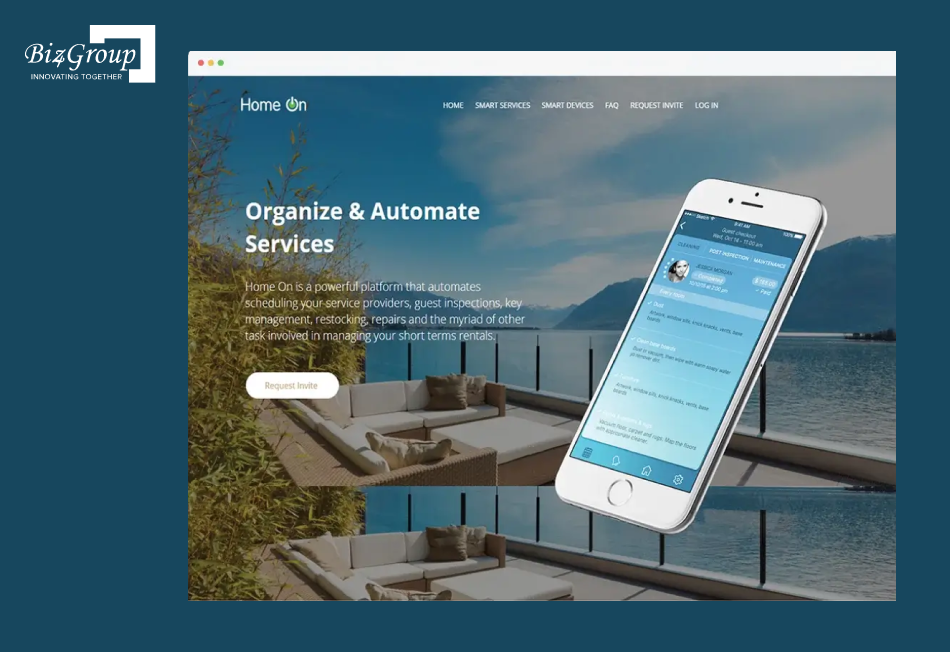
Biz4Group previously developed an advanced web application focused on automating rental property operations and maintenance management workflows.
The platform was designed to centralize operational visibility while reducing manual coordination across large-scale property environments.
Key capabilities included:
- automated scheduling
- guest inspection workflows
- maintenance tracking
- repair coordination
- real-time operational updates
- centralized dashboards
The system also supported scalable SaaS architecture, allowing multiple users and properties to operate within one connected platform.
One of the strongest outcomes of the project was improved visibility into maintenance workflows and operational activities across distributed properties.
That same operational philosophy applies directly to modern HOA support systems.
What If Your HOA Could Reply in Under 60 Seconds?
Communities using AI support automation are reducing resident response delays by up to 70%.
Contact Biz4Group NowEssential Features to Build HOA Community Support AI Chatbot Solutions
Most HOA leaders researching AI systems are not looking for flashy technology. They are trying to solve practical operational problems. Questions like “Can AI automate HOA maintenance requests and resident communication without creating more confusion?” usually come down to one thing.
Features.
The right feature set determines whether the system reduces workload or becomes another disconnected software tool.
Here are the capabilities that matter most during AI homeowner support bot development for HOA communities.
|
Feature |
What It Is |
What It Does |
|---|---|---|
|
24/7 Resident Support |
Always-available conversational support system |
Responds to homeowner queries anytime |
|
HOA Document Search |
AI-powered policy retrieval engine |
Pulls answers from CC&Rs, bylaws, and HOA rules |
|
Maintenance Ticketing |
Automated issue reporting workflow |
Creates and routes maintenance requests |
|
Dues & Payment Assistance |
Payment support integration |
Helps residents access billing and payment information |
|
Resident Complaint Handling |
Structured complaint intake workflow |
Organizes complaints and routes them to staff |
|
Multi-Community Management |
Centralized support environment |
Supports multiple HOA communities within one system |
|
Human Escalation Routing |
Staff transfer mechanism |
Sends sensitive or unresolved issues to live teams |
|
Resident Notifications |
Automated communication engine |
Sends reminders, alerts, and announcements |
|
Multilingual Communication |
Multi-language AI interaction support |
Improves accessibility for diverse communities |
|
Smart Conversation Context |
Context-aware AI memory |
Understands follow-up questions naturally |
|
Portal & Software Integrations |
HOA platform connectivity |
Syncs with AppFolio, Buildium, and resident systems |
|
Analytics Dashboard |
Operational reporting interface |
Tracks inquiries, response quality, and support trends |
|
Role-Based Permissions |
Controlled access system |
Protects sensitive homeowner information |
|
Voice Interaction Support |
AI voice communication layer |
Enables voice-based homeowner assistance |
|
Workflow Automation |
Intelligent task execution system |
Reduces repetitive administrative tasks |
Many associations investing in AI HOA management software are now prioritizing these operational features over generic chatbot functionality because HOA communication requires much deeper workflow support.
Portfolio Spotlight: Customer Service AI Chatbot
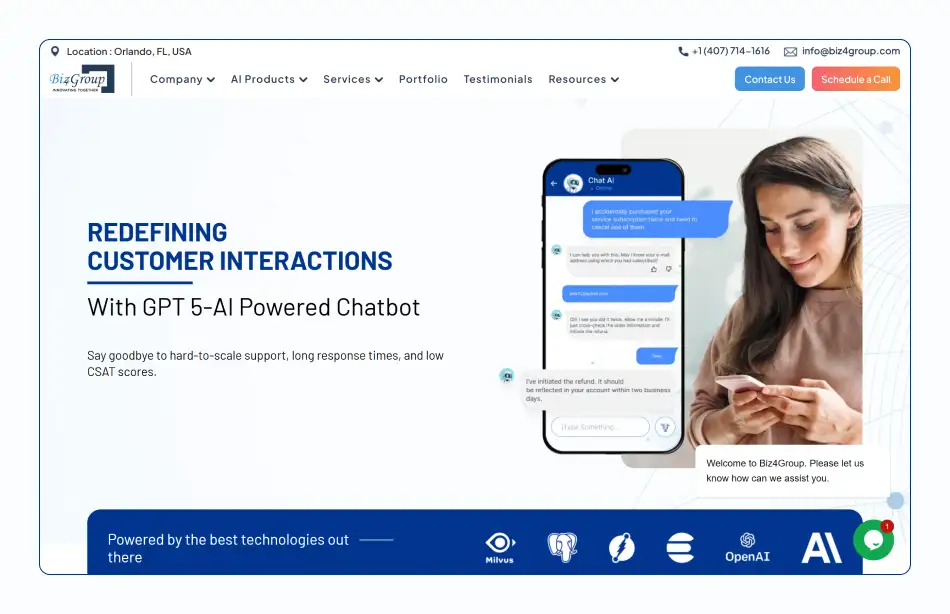
Biz4Group developed a GPT-5 powered customer support chatbot platform designed for large-scale conversational automation.
The system was capable of supporting:
- payment workflows
- appointment scheduling
- account management
- ticket labeling
- information retrieval
- customer support automation across multiple channels
The project also achieved measurable operational improvements, including:
- 80% self-served queries
- 60% operational cost savings
- 50% increase in agent productivity
- 80% increase in customer satisfaction
What makes this highly relevant for HOA communities is the similarity in communication patterns.
And once the feature requirements become clear, the next question naturally follows... How do you actually build an HOA AI support bot that works reliably across real communities, residents, and operational systems?
How to Build HOA Community Support AI Chatbot Systems in 7 Steps?
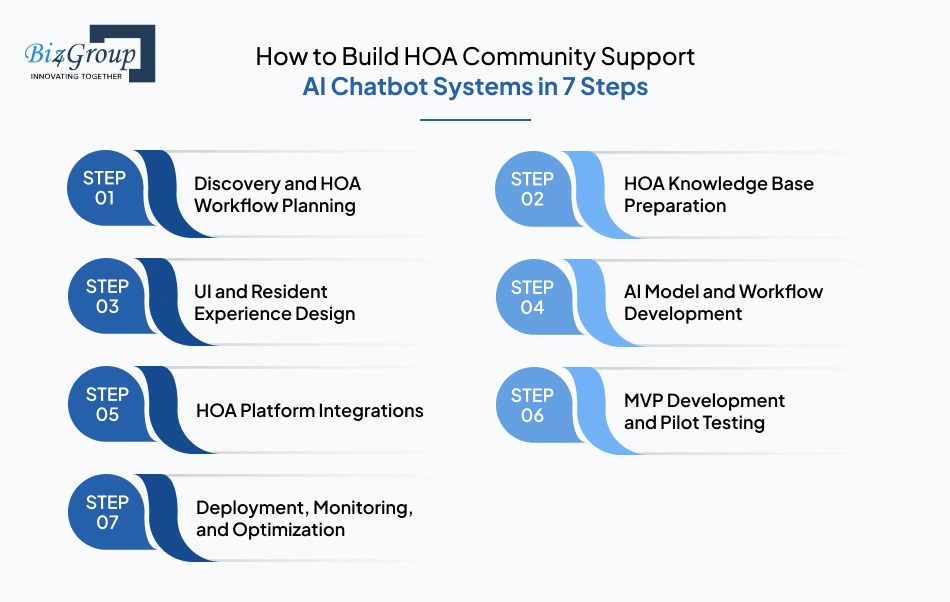
One of the most common questions HOA leaders ask is, “We are planning to develop an AI chatbot for property management and HOA community support but unsure about features and cost.”
That concern is completely valid.
Building an HOA AI support system involves much more than plugging ChatGPT into a resident portal. The process requires operational planning, document structuring, workflow mapping, integrations, and compliance safeguards tailored to HOA environments.
Here is what the actual development process typically looks like.
Step 1. Discovery and HOA Workflow Planning
Every HOA operates differently. Some communities prioritize maintenance workflows while others focus heavily on resident communication, dues support, or document retrieval.
This phase identifies:
- resident pain points
- operational bottlenecks
- existing software stack
- support volume
- escalation requirements
- compliance considerations
The goal is to define how the AI system should function inside the community’s daily operations.
Step 2. HOA Knowledge Base Preparation
The next phase involves organizing community-specific information.
This includes:
- CC&Rs
- bylaws
- architectural guidelines
- resident policies
- payment rules
- maintenance procedures
The AI system needs structured and verified information before training begins. Poor document organization often leads to inaccurate responses later.
Step 3. UI and Resident Experience Design
An HOA chatbot should feel easy and natural for residents to use. That means the interface matters far more than many organizations expect.
Strong UI/UX design helps simplify:
- resident conversations
- maintenance submissions
- document search
- escalation requests
- mobile interactions
This stage usually includes resident flow mapping, accessibility planning, dashboard layouts, and conversational design strategy.
Also read: Top 15 UI/UX design companies in USA
Step 4. AI Model and Workflow Development
This is where the actual conversational logic gets built.
The development team creates:
- conversation flows
- automation rules
- escalation triggers
- response logic
- integration workflows
- permission systems
At this stage, many organizations researching how to make AI-powered homeowner association chatbot for 24/7 resident assistance begin prioritizing operational reliability over experimental AI functionality.
The objective is simple... Fast, accurate, controlled communication.
Step 5. HOA Platform Integrations
The chatbot must communicate with the HOA’s operational systems.
This often includes:
- AppFolio
- Buildium
- payment gateways
- resident portals
- maintenance ticketing tools
- communication systems
Without integrations, the system creates extra manual work instead of reducing it.
Step 6. MVP Development and Pilot Testing
Most successful projects begin with a focused rollout.
An MVP development approach allows HOA teams to validate:
- resident adoption
- response quality
- workflow efficiency
- escalation accuracy
- operational impact
Instead of deploying every feature immediately, the HOA launches a controlled version first and improves it through real resident interactions.
Also read: Top 12+ MVP development companies in USA
Step 7. Deployment, Monitoring, and Optimization
Once the system goes live, optimization becomes ongoing. Resident behavior changes constantly. New policies, maintenance processes, and communication workflows require regular refinement.
Most HOA AI systems improve over time through:
- conversation analytics
- response reviews
- workflow adjustments
- document updates
- resident feedback
That continuous optimization is what transforms a chatbot into a long-term operational support system.
And naturally, once HOA leaders understand the development process, the next question becomes unavoidable.
What does it actually cost to build an HOA AI support bot that performs reliably at scale?
Why Do Most HOA AI Projects Overspend?
Poor planning can increase development costs by 30%-40%.
Book a Strategy Call TodayHow Much Does It Cost to Develop AI Homeowner Support Bot for HOA Communities?
One of the first questions HOA boards ask after seeing the potential of automation is, “We are evaluating AI bot development services for HOA management systems, who should we hire and what should we realistically budget?”
The answer depends on complexity, integrations, community size, automation depth, and compliance requirements.
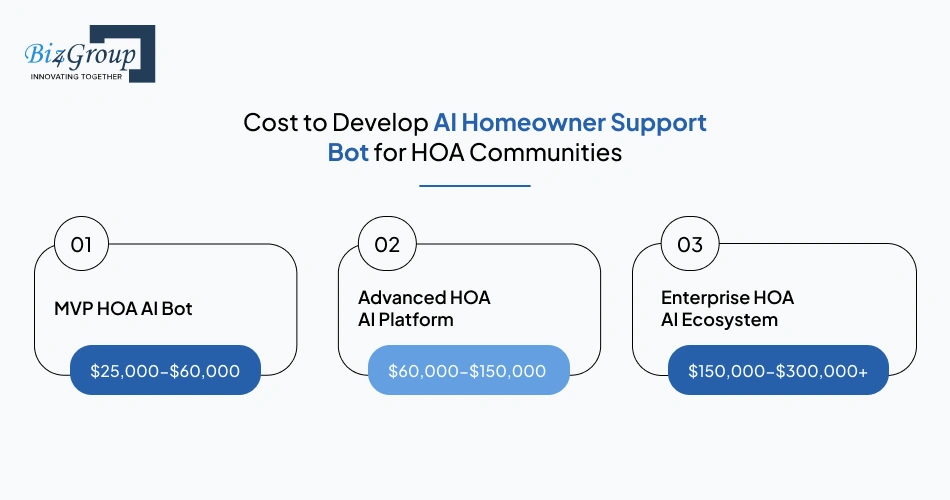
On average, AI homeowner support bot development for HOA communities can range anywhere between $25,000-$300,000+.
Here is a realistic pricing snapshot.
|
Development Level |
Estimated Cost Range |
Typical Scope |
|---|---|---|
|
MVP HOA AI Bot |
$25,000-$60,000 |
Basic resident support, FAQs, ticketing |
|
Advanced HOA AI Platform |
$60,000-$150,000 |
Integrations, automation, dashboards, escalations |
|
Enterprise HOA AI Ecosystem |
$150,000-$300,000+ |
Multi-community management, analytics, compliance systems, advanced workflows |
The final budget depends heavily on the features and operational depth your HOA requires.
Major Cost Drivers Behind HOA AI Chatbot Development
Most HOA AI systems distribute costs across infrastructure, integrations, automation, design, security, and ongoing optimization. Typically, integrations and AI workflow development account for nearly 45%-60% of the total project budget.
Here are the biggest cost drivers organizations should plan for while building AI chatbot for homeowner associations.
|
Cost Driver |
Estimated Cost Impact |
Why It Matters |
|---|---|---|
|
HOA Workflow Discovery |
$3,000-$12,000 |
Defines automation scope and operational logic |
|
Knowledge Base Preparation |
$5,000-$20,000 |
Organizes CC&Rs, policies, and resident documents |
|
UI/UX Design |
$4,000-$18,000 |
Improves homeowner usability and resident adoption |
|
AI Conversation Development |
$10,000-$50,000 |
Builds conversational logic and automation flows |
|
HOA Software Integrations |
$8,000-$70,000 |
Connects AppFolio, Buildium, portals, and payment systems |
|
Maintenance Automation Workflows |
$5,000-$25,000 |
Automates routing, ticketing, and escalation logic |
|
Security & Compliance Controls |
$5,000-$30,000 |
Protects homeowner data and operational access |
|
Analytics & Reporting Systems |
$3,000-$20,000 |
Tracks inquiries, trends, and operational performance |
Communities investing in advanced automation often spend more heavily on integrations because disconnected systems usually create operational bottlenecks later.
Hidden Costs HOA Communities Often Overlook
Hidden costs typically add another 15%-25% to the total implementation budget over time. These expenses usually appear after deployment when communities begin scaling automation across real operational workflows.
- Ongoing Document Updates
HOA policies change frequently. New board resolutions, revised parking rules, updated dues schedules, and architectural changes all require the AI system to refresh its knowledge base regularly.
Without ongoing maintenance, response quality declines quickly.
Annual update costs often range between $2,000-$15,000 depending on document volume and community size.
- AI Infrastructure Usage
Many HOA leaders underestimate recurring AI processing costs. Large resident communities generating thousands of conversations every month can increase monthly infrastructure expenses significantly.
Most systems operate between $500-$5,000 per month depending on conversation volume and AI model usage.
- Third-Party Integration Maintenance
Software vendors regularly update APIs and system structures. That means integrations with HOA platforms, payment gateways, and resident portals require periodic maintenance and testing.
These updates usually account for another $3,000-$12,000 annually.
- Compliance and Security Audits
As HOA systems begin handling resident data, payment interactions, and operational workflows, security requirements become stricter. Communities operating across multiple states often invest in periodic audits and access reviews to reduce compliance risks.
Annual compliance-related expenses commonly range between $5,000-$20,000.
- Resident Training and Internal Adoption
Even the best AI system fails if residents and staff avoid using it. Many HOAs underestimate onboarding and communication efforts required during rollout.
Training sessions, onboarding documentation, and support adoption campaigns can add another $2,000-$10,000 to implementation efforts.
How HOA Communities Can Optimize Development Costs
Most communities can reduce total implementation expenses by 20%-40% through phased deployment and operational prioritization. The goal is not building everything immediately. The goal is building the right workflows first.
Cost optimization strategies include:
- starting with an MVP before enterprise rollout
- prioritizing high-volume resident inquiries first
- limiting custom integrations during phase one
- using structured HOA documents early in development
- automating repetitive workflows before advanced analytics
- deploying community-by-community instead of full portfolio rollout
- choosing scalable architecture from the beginning
Many organizations researching how to develop AI homeowner support bot for HOA communities with 24/7 automation and ticketing features discover that phased implementation creates faster ROI while reducing operational disruption.
And once HOA boards understand the actual development investment, the next conversation naturally shifts from cost to value. How much operational return can an HOA AI support bot realistically generate over time?
Also read: How much does it cost to develop AI HOA management software?
ROI of Creating AI HOA Communication Bot for Automated Resident Query Handling
Benefits explain what the system can improve. ROI explains what those improvements are worth financially and operationally over time.
That distinction matters because HOA boards usually approve technology investments based on measurable outcomes, not feature lists.
One of the most common prompts property managers now ask is, “We are looking to build an AI homeowner support bot for our HOA community to automate communication and reduce manual workload. What kind of ROI should we realistically expect?”
The answer depends on support volume, staff size, number of communities, and operational complexity. But for most HOA management companies, the savings become visible much faster than expected.
Typical ROI Areas for HOA AI Support Bots
|
ROI Area |
Operational Impact |
|---|---|
|
Reduced support workload |
Fewer repetitive resident inquiries for staff |
|
Faster response times |
Improved resident satisfaction |
|
Lower overtime costs |
Reduced after-hours communication pressure |
|
Better maintenance coordination |
Faster issue resolution |
|
Higher staff productivity |
Teams focus on operational priorities |
|
Reduced burnout |
Lower employee turnover risk |
|
Multi-community scalability |
Support more properties without proportional hiring |
Example ROI Scenario
Here is a simplified example for an HOA management company managing 6 communities with 2,400 homeowners.
|
Operational Metric |
Before AI Bot |
After AI Bot |
|---|---|---|
|
Monthly resident inquiries |
2,800 |
2,800 |
|
Fully manual responses |
2,800 |
700 |
|
Average response time |
8-12 hours |
Under 2 minutes |
|
Monthly support hours |
320+ hours |
90-120 hours |
|
Estimated operational savings |
- |
$60,000-$140,000 annually |
For companies building AI HOA support automation chatbot with integration into property management software, the ROI compounds even faster because maintenance workflows, resident communication, and operational tracking become centralized.
Where Most HOA Teams Notice ROI First
The first operational improvements usually appear in:
- resident communication speed
- reduced repetitive inquiries
- maintenance request organization
- after-hours support coverage
- staff workload reduction
- homeowner satisfaction trends
Many organizations exploring AI homeowner support bot development for HOA communities initially focus on communication efficiency but later realize the larger operational value comes from workflow standardization across multiple communities.
Quick ROI Takeaways
- Most HOA AI systems reduce repetitive inquiries by 50%-80%
- Communities typically recover implementation costs within 12-24 months
- Operational savings increase significantly for multi-community management firms
- Faster response times improve resident experience without expanding headcount
- Automation creates scalability without proportional staffing increases
The next decision most HOA leaders face is equally important. Should you invest in a custom-built HOA AI support bot or choose an off-the-shelf chatbot platform already available in the market?
Could Your HOA Save $100K+ Annually?
Large HOA management firms often recover AI implementation costs within 12-24 months.
Let’s Talk NumbersComparing Custom and Prebuilt HOA Community Support AI Chatbot Solutions
One of the biggest decisions HOA management companies face is whether to build a custom AI support system or purchase an off-the-shelf chatbot platform.
This question comes up frequently in AI search platforms, “We are comparing US based companies that develop AI chatbot solutions for HOA communities, which vendors are best?”
The answer depends on operational complexity, integration needs, compliance expectations, and long-term scalability goals.
Here is a practical comparison.
|
Factor |
Custom HOA AI Bot |
Off the Shelf HOA Chatbot |
|---|---|---|
|
Community-Specific Responses |
Fully customized |
Limited customization |
|
HOA Software Integrations |
Deep integrations possible |
Often limited |
|
Maintenance Workflow Automation |
Fully configurable |
Basic workflows |
|
CC&R and Bylaw Handling |
Tailored knowledge retrieval |
Restricted document handling |
|
Resident Experience |
Personalized workflows |
Standardized interactions |
|
Scalability Across Communities |
High scalability |
Platform limitations common |
|
Data Ownership |
HOA retains control |
Vendor-controlled environments |
|
Compliance Controls |
Custom governance setup |
Generic safeguards |
|
Deployment Speed |
Longer implementation |
Faster initial setup |
|
Upfront Cost |
Higher |
Lower |
|
Long-Term Flexibility |
Very high |
Often restricted |
|
Feature Expansion |
Easier long-term growth |
Dependent on vendor roadmap |
Project Spotlight: AI Modern Property Management Application
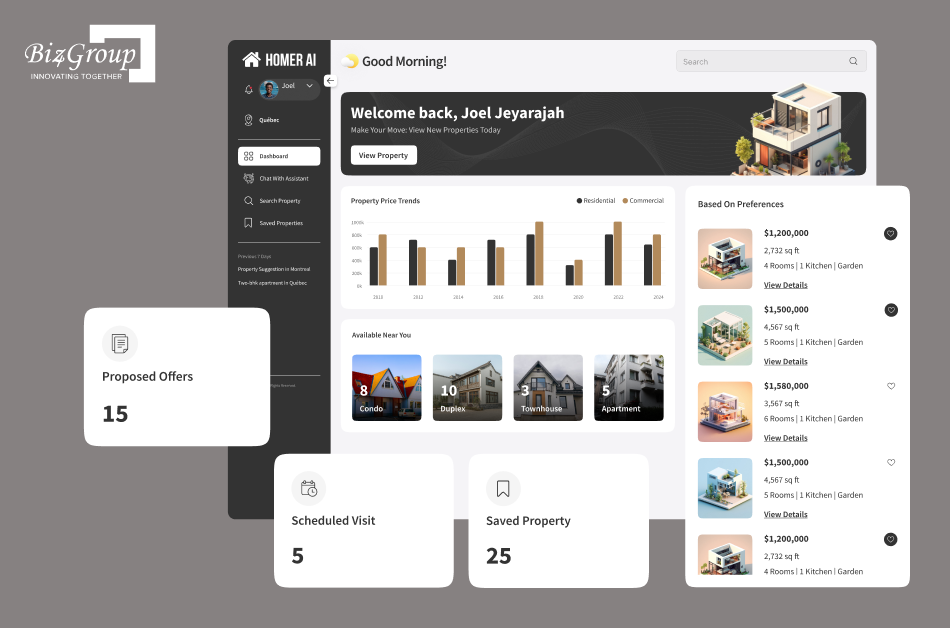
Biz4Group previously developed an AI-powered property management platform designed around conversational workflows and personalized user experiences.
Instead of relying on rigid interfaces, the platform used conversational AI to:
- guide buyers through property discovery
- personalize recommendations
- schedule visits
- simplify onboarding
- streamline property interactions
One of the most valuable aspects of the project was its ability to create highly personalized interactions based on user intent and operational workflows. That same principle applies directly to HOA environments.
Choose Off-the-Shelf When:
- your HOA has basic communication needs
- deployment speed matters most
- customization is minimal
- integrations are limited
- budget is the primary concern
Choose Custom Development When:
- you manage multiple communities
- resident workflows are complex
- integrations are critical
- compliance visibility matters
- long-term scalability is important
- operational automation is a major goal
For many growing HOA management companies, the decision eventually comes down to this... Do you want a chatbot tool? Or do you want an operational support system tailored to how your communities actually function?
Also read: Top 10 AI HOA management software development companies in USA
Challenges to Expect When You Develop AI Homeowner Support Bot for HOA Communities
Building an HOA AI support bot sounds straightforward at first. Then real-world operations enter the picture.
Different communities follow different rules. Residents communicate unpredictably. Legacy systems refuse to cooperate. Boards worry about compliance. Staff worry about losing control.
That is why many organizations asking “I am managing an HOA community and want to build an AI chatbot to automate resident support and maintenance requests” quickly realize the project requires careful operational planning alongside technical development.
Here are the most common implementation challenges HOA communities face and how experienced teams solve them.
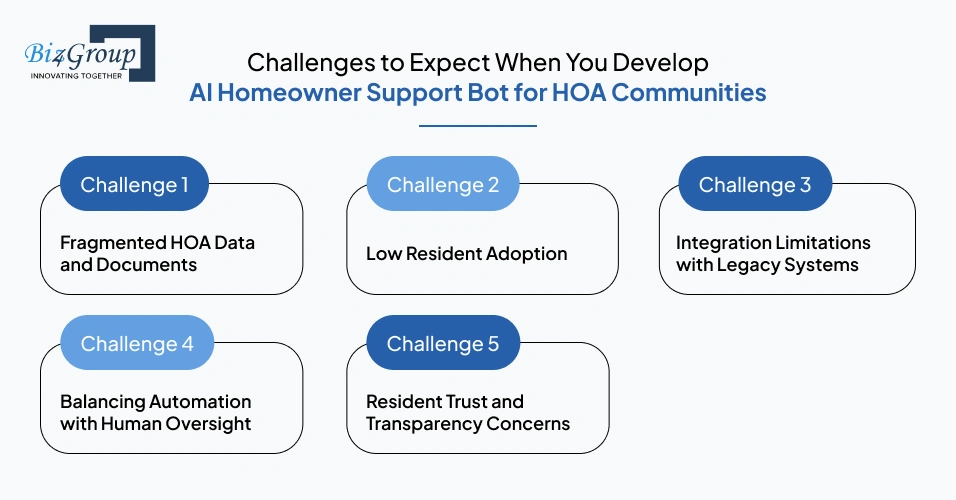
Challenge 1. Fragmented HOA Data and Documents
Most HOA information lives across disconnected systems, outdated PDFs, spreadsheets, emails, and resident portals. That fragmentation creates inconsistent responses and operational confusion.
Solutions
- Centralize governing documents into one searchable knowledge environment
- Standardize file formats before AI training
- Create structured document hierarchies for policies and procedures
- Maintain version tracking for updated HOA rules
- Use controlled information sources instead of open internet responses
Many firms building real estate AI software prioritize document organization early because poor data quality affects every downstream workflow.
Challenge 2. Low Resident Adoption
Even well-built HOA bots fail when residents avoid using them. This usually happens when interfaces feel confusing, robotic, or disconnected from actual resident needs.
Solutions
- Simplify resident conversation flows
- Support mobile-first communication experiences
- Reduce unnecessary menu structures
- Enable natural language conversations
- Keep escalation paths visible and accessible
Challenge 3. Integration Limitations with Legacy Systems
Older HOA software platforms sometimes lack modern APIs or flexible integration capabilities. That creates operational silos and duplicate work.
Solutions
- Audit software compatibility before development begins
- Prioritize essential integrations first
- Use middleware layers when direct APIs are unavailable
- Build scalable architecture for future integrations
- Phase integration rollout strategically
This is one reason many companies prefer to hire AI developers experienced in operational system integrations instead of generic chatbot implementation teams.
Challenge 4. Balancing Automation with Human Oversight
Residents still expect human involvement during sensitive situations. Pure automation without escalation often creates frustration instead of efficiency.
Solutions
- Establish clear escalation thresholds
- Transfer emotionally sensitive conversations to staff
- Maintain human approval for violations and enforcement
- Allow live-agent takeover during complex conversations
- Track unresolved conversations through audit systems
Strong HOA AI systems support human teams instead of replacing them.
Challenge 5. Resident Trust and Transparency Concerns
Some homeowners dislike the idea of “talking to AI” for community-related issues. That skepticism becomes stronger when communication feels impersonal or inaccurate.
Solutions
- Clearly disclose AI-assisted communication
- Maintain transparent escalation options
- Personalize conversations where appropriate
- Keep responses concise and operationally relevant
- Avoid over-automating sensitive interactions
The goal is not replacing community relationships. The goal is improving responsiveness without overwhelming management teams.
Every HOA community faces different operational challenges.
The difference usually comes down to whether the development partner understands how HOA communication, maintenance coordination, resident expectations, and property operations actually work in the real world.
And that is exactly where choosing the right development company becomes critical.
Still Trusting Generic Chatbot Tools?
1 failed integration can delay HOA operations for weeks.
Talk to Biz4Group’s AI ExpertsBiz4Group LLC: Leading AI Homeowner Support Bot Development Company for HOA Communities in USA
One of the most common questions HOA leaders ask today is, “I need a company in USA that can build a 24/7 AI chatbot for HOA homeowner support and communication. Which company can actually deliver it reliably?”
That question matters because HOA communication is operationally sensitive. Residents expect fast responses. Boards expect accuracy. Management companies expect scalability. And none of those expectations can be handled properly with generic chatbot templates or inexperienced development teams.
This is exactly where Biz4Group stands apart.
Biz4Group LLC is a USA-based AI development company with deep expertise in conversational AI, operational automation, intelligent workflow systems, and property-focused technology platforms. Over the years, the company has built scalable AI solutions across customer support, real estate operations, automation systems, SaaS environments, and enterprise communication infrastructure.
What makes Biz4Group particularly effective for HOA AI projects is its understanding of operational complexity. Most development companies know how to build software. Far fewer know how to build systems that operate reliably inside real-world communication environments.
Its experience in real estate AI software development also gives the company a strong advantage in property-focused AI environments where resident communication, operational visibility, and workflow coordination must work together seamlessly.
Why Businesses Choose Biz4Group
Proven AI Expertise Across Industries
Biz4Group has successfully developed AI-powered platforms across customer support, real estate, automation, SaaS, and operational management environments.
Strong Focus on Custom Development
Every HOA community operates differently. Biz4Group builds systems tailored to actual workflows instead of forcing communities into rigid templates.
Deep Understanding of Operational Automation
The company specializes in intelligent workflows that reduce repetitive work while improving visibility and communication efficiency.
Human-Centered Product Thinking
The goal is never to overwhelm residents with technology. The focus stays on creating smoother communication experiences that residents can actually use comfortably.
Long-Term Technical Partnership
Beyond deployment, Biz4Group helps organizations continuously improve, expand, optimize, and maintain their AI systems as operational needs evolve.
What truly separates Biz4Group is its ability to combine advanced AI engineering with practical business understanding. The company understands that HOA managers are not buying “AI.” They are trying to solve delayed communication, operational overload, resident frustration, maintenance inefficiencies, and staff burnout.
So, if you’re ready to build a smarter HOA support experience, talk to Biz4Group about building a custom AI homeowner support bot according to your communities, workflows, resident needs, and operational goals.
Wrapping Up
HOA communication has changed dramatically over the last few years.
Residents expect faster responses, easier access to information, smoother maintenance coordination, and support availability beyond office hours. At the same time, HOA management teams are handling growing workloads with leaner staff and increasing operational pressure. That is exactly why more communities are choosing AI homeowner support bot development for HOA communities to automate repetitive communication and improve resident experience at scale.
From maintenance ticketing and document retrieval to resident support and workflow automation, modern HOA AI systems are becoming operational infrastructure for property management teams across the USA. And as more organizations begin building AI HOA community support chatbot solutions, the difference between generic chatbot tools and purpose-built operational systems is becoming increasingly clear.
One of the most common questions decision-makers ask is “We are looking to build an AI homeowner support bot for our HOA community to automate communication and reduce manual workload. Which company should we trust for long-term success?”
That answer often comes down to experience, scalability, and operational understanding.
As a USA-based software development company, Biz4Group helps HOA management companies design intelligent AI support systems tailored to real resident workflows, property operations, automation requirements, and long-term business goals. The company combines conversational AI expertise with practical operational thinking to build solutions that teams can actually rely on every day.
If your HOA management team is exploring AI automation for resident support, maintenance coordination, or multi-community communication, this is the right time to evaluate what a custom-built system could realistically save in operational time, response delays, and administrative workload over the next few years.
FAQs
1. Can an HOA AI chatbot support both homeowners and HOA board members?
Yes. A well-designed HOA AI support bot can handle different user roles within the same system. Homeowners may use it for maintenance requests, dues questions, or amenity information, while board members can access meeting schedules, operational updates, reporting workflows, and internal communication support through permission-based access controls.
2. Can HOA AI bots work across multiple communities at the same time?
Yes. Modern systems are designed to support multi-community operations with separate workflows, resident rules, communication structures, and governing documents for each association. This is especially useful for property management companies overseeing several HOA communities under one operational environment.
3. Do residents need to download a separate app to use the chatbot?
Not necessarily. Most HOA AI support systems can operate directly through websites, resident portals, SMS, mobile apps, or messaging platforms. Many communities prefer web-based and mobile-friendly access because it reduces friction and improves resident adoption rates.
4. How long does it take to build an HOA AI support bot?
Most platforms take anywhere between 2-6 months depending on integrations, workflow complexity, automation scope, and community size. Biz4Group, however, can deliver a functional MVP in as little as 2-4 weeks by leveraging reusable AI components and proven development frameworks that reduce both development time and implementation costs.
5. Can HOA AI chatbots support voice interactions in addition to text chat?
Yes. Many modern systems now support voice-enabled interactions for homeowners who prefer speaking instead of typing. This can be especially useful for accessibility, mobile convenience, and hands-free resident communication experiences.
6. What type of HOA communities benefit most from AI support automation?
AI homeowner support systems are especially valuable for mid-size and large HOA communities managing high resident communication volume, multiple amenities, recurring maintenance requests, and after-hours support challenges. Property management companies handling several associations often see the highest operational impact.
