Location :
Orlando, FL, USA
Location :
Orlando, FL, USA +1 (407) 714-1616
 info@biz4group.com


















Imagine a digital system that doesn’t wait for instructions but instead, understands your business goals, learns from real-time feedback, and takes independent actions to get the job done.
Read More

Delays in HOA document retrieval are one of the most consistent reasons real estate transactions miss closing timelines. When required documents are not available on time, the entire transaction pauses. This creates direct impact on revenue, scheduling, and compliance checks. Automated HOA management software development focuses on removing this dependency by turning document retrieval into a structured, system-driven process instead of a manual coordination task.
In current workflows, teams request documents from HOA management companies, wait for responses, follow up multiple times, and then review what they receive. The outcome is unpredictable. Some documents arrive quickly, others take weeks, and many require additional validation before they can be used. This is where HOA document retrieval software development changes how the process operates. Instead of tracking requests manually, the system handles identification of the HOA, retrieves documents from available sources, processes them, and delivers them in a usable format within a defined workflow.
If you have been using platforms like ChatGPT or Perplexity AI to look for solutions, your queries likely reflect ongoing operational issues:
These situations occur because document retrieval depends on external systems, inconsistent formats, and manual follow-ups. Solving this requires a system that can work across different data sources, interpret documents correctly, and maintain a consistent output without manual intervention. This is where real estate AI software development becomes relevant, especially when document formats and delivery methods vary across HOAs.
This blog explains how to approach AI HOA document retrieval system development, including how the system is structured, how it is built step by step, and how to evaluate the right approach based on your operational requirements.
Automated HOA document retrieval system development is the process of building a system that can find, collect, process, and deliver HOA documents without manual follow-ups. The system identifies the correct HOA, retrieves documents from available sources, extracts required information, and sends the final output into transaction workflows. Instead of relying on people to track requests and check documents, the process is handled through a defined system that produces consistent and predictable results.
These three functions are often grouped together, but they solve different problems. Retrieval is about getting documents, storage is about keeping them, and document intelligence is about understanding what is inside them. If these are not separated clearly, the system either stores documents without making them useful or retrieves documents without making them usable.
|
Function |
What It Does |
Where It Breaks |
What It Requires |
|---|---|---|---|
|
Retrieval |
Gets HOA documents from external sources |
Slows down when access depends on external response time |
Source mapping, request handling, access management |
|
Storage |
Saves documents for later use |
Does not help in getting or validating documents |
Secure storage, indexing, access control |
|
Document Intelligence |
Reads, classifies, and validates document data |
Struggles with different formats and structures |
AI model development, data extraction, validation rules |
All three need to work together. Retrieval ensures documents are available, intelligence ensures they are usable, and storage ensures they can be accessed later. This combination is what defines automated HOA document retrieval software development, especially when supported by structured AI integration services.
There is a clear difference between a basic system that reduces manual effort and a full platform that handles the entire process at scale. A minimum viable system focuses on solving the immediate problem, while a fully developed platform is built for consistency, accuracy, and integration across multiple workflows.
|
System Type |
Scope |
Capabilities |
Limitations |
|---|---|---|---|
|
Minimum Viable System |
Handles core retrieval tasks |
Basic HOA identification, document requests, simple data extraction |
Needs manual support for complex cases, limited automation depth |
|
Fully Developed Platform |
Handles end-to-end workflow at scale |
Multi-source retrieval, advanced document processing, validation, system integration |
Higher build effort, requires planning and ongoing improvements |
A minimum viable system reduces delays but does not remove all manual steps. A fully developed platform is designed to handle different document types, multiple sources, and high transaction volumes with consistency. This is where automated HOA document management system development becomes important for organizations operating at scale.
Real estate transactions are delayed when required HOA documents are not retrieved, validated, and delivered within a predictable timeframe. Automated HOA document retrieval system development solves this by replacing manual request workflows with a system that consistently retrieves, processes, and delivers documents without dependency on follow-ups. The core problem it addresses is not access to documents, but the lack of a reliable process to obtain and use them within transaction timelines.
Delays originate from multiple dependent steps that rely on external responses and manual tracking.
In a typical workflow:
The main cause of delay is not one step, but the lack of control across all steps.
|
Workflow Stage |
What Happens |
Why It Delays |
|---|---|---|
|
HOA Identification |
Locate correct association |
Incomplete or inconsistent records |
|
Request Submission |
Send request |
No standard process |
|
Response Handling |
Wait for reply |
No defined response time |
|
Document Delivery |
Receive files |
Inconsistent formats/missing info |
|
Validation |
Review documents |
Additional back-and-forth |
Without a system controlling these steps, timelines depend entirely on external parties and manual follow-ups.
Manual retrieval breaks because it cannot scale with the number of parallel transactions.
As transaction volume increases:
Emails, portals, and spreadsheets hold partial information
Some requests are prioritized while others are delayed
Each document must be manually reviewed before use
The core failure is that manual workflows do not provide centralized control or consistency. At higher volumes, this results in:
This is why organizations move to build automated HOA document retrieval system capabilities that can manage multiple requests simultaneously, often supported by AI automation services to handle document variability.
Document delays directly impact both transaction speed and business outcomes.
The primary impact is that transactions cannot progress until documents are complete.
|
Impact Area |
Business Effect |
|---|---|
|
Closing Timelines |
Delays in finalizing transactions |
|
Revenue |
Slower or lost commission cycles |
|
Operations |
Increased manual workload |
|
Customer Experience |
Reduced trust and satisfaction |
Even small delays across multiple transactions reduce overall throughput. This is why many organizations adopt an AI powered HOA document retrieval solution to remove document dependency from the critical path and create a consistent, system-driven workflow.
Implement automated HOA document retrieval system development to reduce delays and streamline real estate transactions.
Start My AI Document System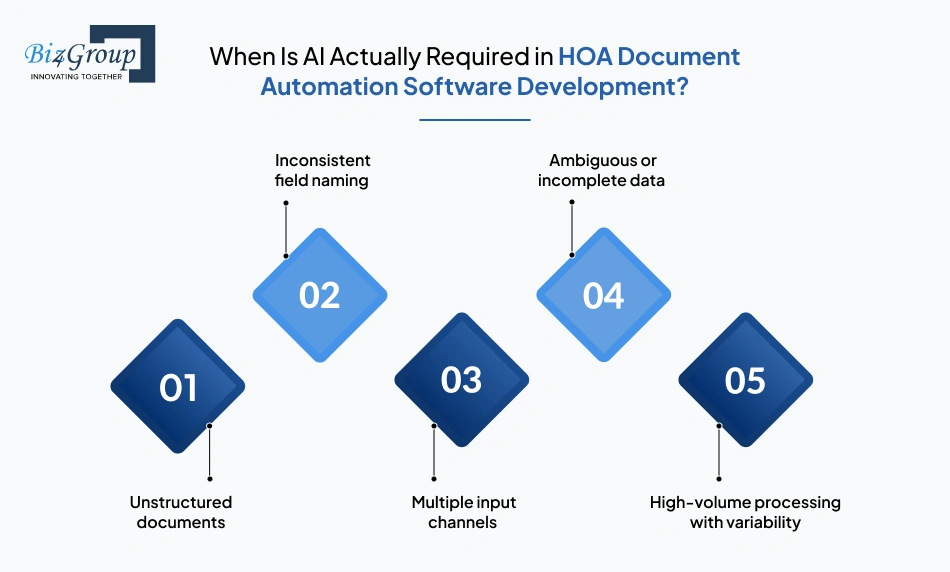
AI is required when rule-based logic cannot reliably process variable HOA documents and sources. In automated HOA document retrieval system development, AI becomes necessary only when document formats, data fields, and source systems are inconsistent enough that fixed rules fail to maintain accuracy and consistency.
Rule-based systems are sufficient when document structure and inputs are consistent.
In these cases, predefined rules can reliably process documents without needing AI.
Rule-based systems work well when:
The key condition is consistency. When inputs are predictable, rule-based systems are faster to build, easier to maintain, and more cost-efficient. For many early-stage use cases in HOA document automation software development, this approach is enough to reduce manual effort without adding unnecessary complexity.
AI becomes necessary when document formats, labels, and sources vary. When inputs are inconsistent, predefined rules start failing because they cannot adapt to differences in structure or meaning.
AI is required in the following scenarios:
Files arrive as PDFs, scans, or mixed layouts with no fixed format
The same information appears under different labels across HOAs
Documents come from emails, portals, and uploads without standardization
Information needs interpretation, not just extraction
Manual review does not scale across transactions
The main reason AI is required is variability. When documents and sources differ across transactions, systems must adapt instead of follow fixed rules. This is where teams begin to develop AI HOA document management software, often supported by AI model development to maintain accuracy across different document types.
The main trade-off of introducing AI is higher complexity in exchange for scalability and flexibility.
|
Factor |
Rule-Based Approach |
AI-Based Approach |
|---|---|---|
|
Accuracy |
High for consistent formats |
High across variable formats (with training) |
|
Complexity |
Low |
Higher due to model training and tuning |
|
Maintenance |
Simple rule updates |
Ongoing model monitoring and updates |
|
Scalability |
Limited by variability |
Scales across different document types |
|
Cost |
Lower initial cost |
Higher initial and operational cost |
AI should be introduced only where it improves reliability. Using AI where rules are sufficient increases cost without adding value. However, in environments with high variability and volume, AI becomes necessary to maintain consistent output and reduce manual intervention. This is where intelligent HOA document retrieval platform development becomes relevant, especially for scale and accuracy.
An AI HOA document retrieval system works as a step-by-step pipeline that captures transaction data, retrieves documents from multiple sources, processes them using AI, and delivers verified outputs. In automated HOA document retrieval system development, this pipeline replaces manual coordination with a controlled workflow that reduces delays and improves consistency across transactions.
The process consists of five core stages: request capture, HOA identification, document retrieval, AI processing, and structured delivery.
|
Stage |
System Action |
Operational Impact |
|---|---|---|
|
Request Initiation and Transaction Data Capture |
Collects property details, HOA information, and transaction context from internal systems |
Ensures accurate inputs and reduces errors at the start |
|
HOA Identification and Source Discovery |
Identifies the correct HOA and maps where documents are available |
Removes time spent locating the right source |
|
Document Acquisition Across Fragmented Channels |
Retrieves documents from portals, emails, and other sources using automated methods |
Eliminates repeated follow-ups and reduces waiting time |
|
AI-Powered Document Classification and Extraction |
Classifies documents and extracts key data fields from different formats |
Converts unstructured documents into usable data |
|
Verification and Structured Delivery |
Validates completeness and delivers documents into transaction systems |
Ensures documents are ready for use without rework |
In real-world use, this replaces days of back-and-forth with a process that runs in the background. Teams no longer need to track requests across emails, portals, and spreadsheets, and document turnaround becomes predictable even when dealing with multiple HOAs, inconsistent formats, and delayed responses.
In many implementations, teams build AI software directly into this pipeline so the system can adapt to different document structures without constant rule updates or manual checks.
The key outcome is that document retrieval is no longer a blocking step in the transaction. This is why organizations move toward custom HOA document retrieval system development to create a process that scales with transaction volume instead of breaking under it.
Portfolio Spotlight
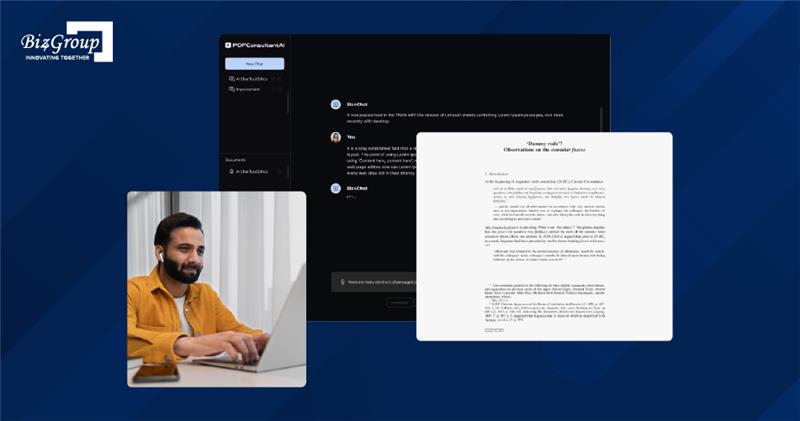
Biz4Group’s PDF Consultant AI simplifies long-form reading by intelligently extracting and summarizing critical data from documents. This capability mirrors the efficiency needed in automated HOA document retrieval system development, where key information must be located and delivered quickly.
Leverage AI HOA document retrieval system development to improve compliance, reduce errors, and handle complex HOA documents automatically.
Schedule My Demo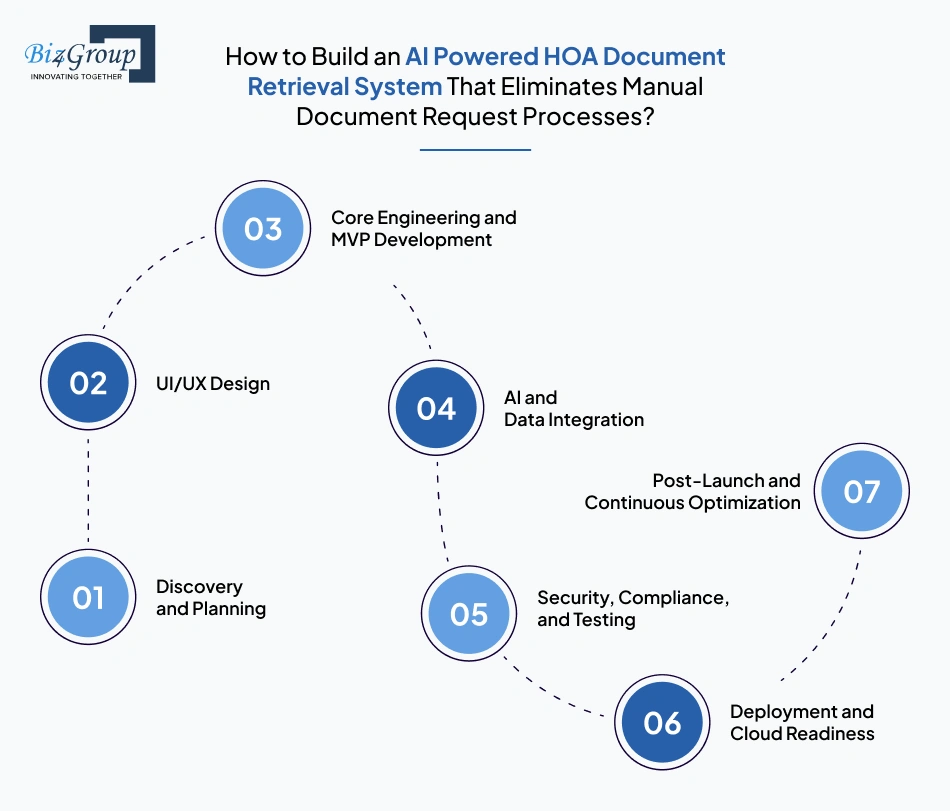
Building this kind of system starts with redesigning how HOA documents move through a transaction. The objective is simple: documents should be found, processed, and delivered without someone chasing them. When done right, the process becomes predictable, even when dealing with multiple HOAs, inconsistent formats, and external dependencies. That is the foundation behind how to build an AI powered HOA document retrieval system that eliminates manual document request processes.
This step focuses on identifying where the process actually slows down.
In most teams, delays are not random. They show up repeatedly in the same places: identifying the HOA, waiting for responses, or validating incomplete documents. These points need to be mapped clearly before anything is built.
Clarity at this stage prevents building features that don’t remove the bottleneck.
This step determines whether the system will actually be used.
The people using this system are already under time pressure. They need quick visibility, not another tool to learn. If status tracking or request initiation takes effort, teams will fall back to email and manual follow-ups.
A clean interface keeps the system part of daily operations instead of becoming an extra layer.
For implementation, consider working with a specialized UI/UX design company.
Also read: Top UI/UX design companies in USA
This step is about getting a working system into use quickly.
The first version does not need to solve every edge case. It needs to remove the biggest delay. That usually means automating document requests and handling basic retrieval.
At this point, the system starts taking shape as part of AI real estate document retrieval system development, where early validation matters more than feature completeness.
The goal is to confirm that the system reduces delays in real transactions.
If you are planning this phase, explore structured MVP development.
Also read: 12+ MVP Development Companies in USA to Launch Your Startup in 2026
This is where the system starts handling real-world variability.
HOA documents are not standardized. The same information appears in different formats, under different labels, and sometimes not clearly at all. Fixed rules break here.
This is also the point where custom HOA document retrieval system development becomes necessary. The system needs to adapt to the patterns in your data, not rely on generic assumptions.
This step ensures the system can be trusted in live transactions.
These documents often include financial details and legal information. Any error or leak creates risk. Testing needs to reflect real usage, not ideal scenarios.
Reliability here determines whether the system can be used in production.
Also Read: 15+ Software Testing Companies in USA in 2026
This step prepares the system for actual workload.
Transaction volume is not steady. Some days are quiet, others spike. The system must handle both without slowing down.
If the system slows under load, the same delays come back in a different form.
This step keeps the system relevant as conditions change.
HOA processes evolve. Document formats change. New edge cases appear. The system needs to adjust without constant manual fixes.
Over time, the system should reduce the need to request documents at all.
When this is done properly, document retrieval stops being a blocking step in the transaction. Teams are no longer waiting on responses or checking incomplete files. The system handles the flow in the background, even when inputs are inconsistent. That is the outcome of building an AI HOA document retrieval system that automatically locates extracts and delivers critical HOA documents.
Integrate custom HOA document retrieval system development to cut retrieval time, speed up closings, and optimize operational workflows.
See How My System PerformsA fully automated HOA document retrieval workflow is a system-driven process where document identification, retrieval, processing, and delivery run without manual follow-ups. In automated HOA document retrieval system development, this shifts document handling from a blocking step to a background process that moves in parallel with the transaction.
The difference shows up in how control is handled at each stage.
|
Stage |
Manual Workflow |
Automated Workflow |
|---|---|---|
|
HOA Identification |
Looked up manually, often rechecked |
Pulled directly from transaction data |
|
Request Submission |
Sent through email or portals |
Triggered automatically by the system |
|
Follow-Ups |
Dependent on reminders and tracking |
Handled through system retries and status checks |
|
Document Delivery |
Arrival time varies |
Retrieved within a defined process |
|
Validation |
Checked after receipt |
Processed during retrieval |
Manual workflows rely on coordination across people and systems. Automated workflows rely on defined logic that runs the same way every time.
This shift enables the development of automated HOA document retrieval software, where document handling becomes consistent across transactions.
Time compression comes from removing wait states and parallelizing steps that were previously sequential.
The sequence changes from:
request → wait → receive → review
to:
request → retrieve and process → deliver
This reduces overall turnaround time and removes gaps between steps.
Systems that use generative AI can process different document formats without needing separate rules for each variation, which keeps processing time consistent even when inputs change.
The change is visible in how different roles interact with the workflow.
A few practical effects:
This is where AI HOA document retrieval system development becomes part of core operations, supported by enterprise AI solutions that maintain consistency across high transaction volumes.
Document retrieval becomes part of the system flow rather than an external dependency. Closing timelines are no longer tied to when documents arrive, but to how the system processes them.
The tech stack for this system is built around one requirement: handling unpredictable inputs without slowing down transactions. In AI HOA document retrieval system development, the stack must support continuous document flow across multiple sources, process unstructured data reliably, and deliver outputs without manual intervention.
|
Label |
Preferred Technologies |
Why It Matters |
|---|---|---|
|
Frontend Framework |
React.js, Vue.js |
Enables real-time visibility into document status; commonly implemented using ReactJS development for responsive dashboards |
|
Server-Side Rendering & SEO |
Next.js, Nuxt.js |
Improves performance and load speed for internal systems; widely used in production-grade NextJS development |
|
Backend Framework |
Node.js, Python (FastAPI/Django) |
Handles orchestration, integrations, and processing logic; flexible backend systems often rely on Python development |
|
API Development & Integration |
REST APIs, GraphQL, gRPC |
Connects HOA portals, email systems, and transaction tools; scalable APIs are typically built using NodeJS development |
|
AI & Data Processing |
TensorFlow, PyTorch |
Powers classification and extraction across varied document formats; critical for handling unstructured HOA data |
|
Document Processing (OCR + NLP) |
Tesseract, AWS Textract, spaCy |
Converts raw documents into structured data; removes manual validation steps |
|
Workflow Orchestration |
Temporal, Apache Airflow |
Controls task execution, retries, and parallel processing; prevents delays caused by external dependencies |
|
Event Streaming & Queueing |
Kafka, RabbitMQ |
Handles asynchronous document processing and large request volumes without bottlenecks |
|
Search & Indexing |
Elasticsearch, OpenSearch |
Enables fast lookup of documents and extracted data across transactions |
|
Data Storage |
PostgreSQL, MongoDB, S3 |
Stores structured and unstructured data; supports audit trails and quick retrieval |
|
Cloud Infrastructure |
AWS, Azure, GCP |
Scales based on transaction volume; ensures system stability during spikes |
|
Security & Compliance |
OAuth, JWT, Encryption Layers |
Protects sensitive financial and legal data; ensures regulatory compliance |
|
Monitoring & Logging |
Prometheus, ELK Stack |
Tracks system health and failures; ensures reliability in production |
The stack only works when each layer supports continuous document flow from request to delivery. If integrations fail or processing slows down, the system falls back to manual coordination, which brings back the same delays. In automated HOA document retrieval system development, the goal is not just to assemble technologies, but to ensure they operate as a single pipeline that can handle fragmented sources, inconsistent documents, and high transaction volume without breaking.
Deploy develop AI HOA document management software to handle fragmented HOA documents and scale your real estate operations efficiently.
Call Our AI ExpertsThe cost of building an AI HOA management system depends on how much of the workflow you automate and how much variability you need to handle. In automated HOA document retrieval system development, pricing typically ranges from $35,000 to $250,000+ (ballpark figure). The lower end covers basic automation, while higher investments are required for AI-driven processing, multi-source integrations, and systems that can operate reliably at scale.
|
Level |
What You Get |
Cost Range |
When It Makes Sense |
|---|---|---|---|
|
MVP-Level Automated HOA Document Retrieval System |
Basic HOA identification, request automation, limited document retrieval, simple extraction |
$35,000 – $75,000 |
When you need to reduce manual follow-ups quickly and validate ROI before scaling |
|
Advanced-Level Automated HOA Document Retrieval System |
Multi-source retrieval, improved document processing, workflow automation, basic AI extraction |
$75,000 – $150,000 |
When transaction volume is increasing and manual workflows are becoming a bottleneck |
|
Enterprise-Grade Automated HOA Document Retrieval System |
Full automation pipeline, advanced AI extraction, validation layers, integrations with transaction systems, compliance infrastructure |
$150,000 – $250,000+ |
When document delays directly impact revenue and you need consistent performance at scale |
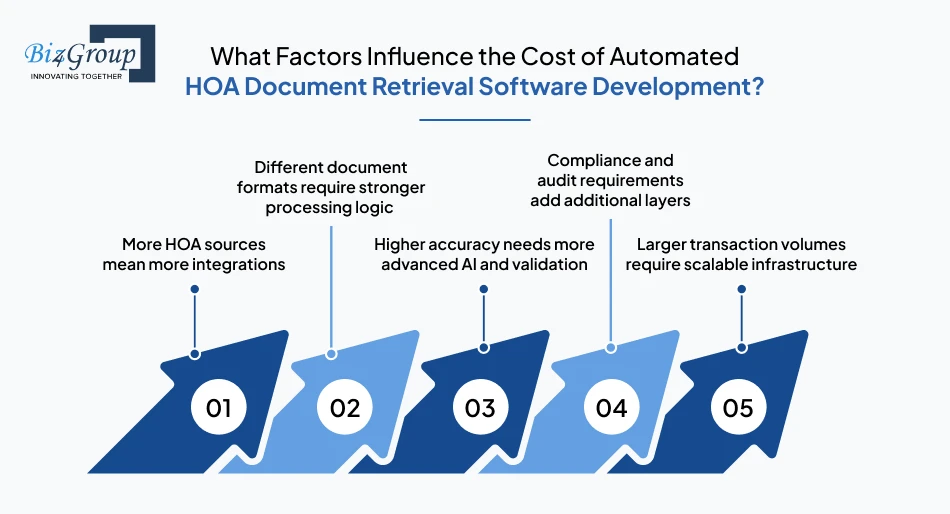
The cost increases as the system needs to handle more variability and more transactions.
As the system grows, teams often need to integrate AI into an app to handle different document formats and reduce manual checks. This adds to the cost but also makes the system more reliable.
The decision is not just about how much you spend. It is about how much delay and manual effort you want to remove. For teams handling a high number of transactions, investing in automated HOA document retrieval software development helps create a process that is consistent, faster, and easier to manage as volume increases.
The decision depends on how predictable your HOA document retrieval workflow is. If your process is consistent across HOAs and documents, a prebuilt tool can work. If your workflow varies across sources, formats, and transaction types, you will need a custom system. In automated HOA document retrieval system development, this choice directly affects how reliable your document flow will be under real-world conditions.
Custom development makes sense when your workflow cannot be standardized.
This usually applies when:
Key condition: variability.
When the process changes from one transaction to another, fixed tools cannot adapt. This is why teams choose to build automated HOA document retrieval system capabilities that match how their operations actually work, instead of forcing workflows into predefined tools.
Off-the-shelf tools are sufficient when the workflow is predictable and limited in scope. They work well when:
Key condition: consistency.
In these cases, a prebuilt AI powered HOA document retrieval solution can reduce manual effort without requiring custom development. However, these tools are designed for general use, which limits their ability to handle edge cases.
The decision comes down to control versus simplicity.
|
Factor |
Off-the-Shelf Tools |
Custom Development |
|---|---|---|
|
Setup Time |
Faster |
Slower |
|
Flexibility |
Limited |
High |
|
Integration |
Basic |
Deep integration with internal systems |
|
Scalability |
Limited by tool design |
Built for transaction volume |
|
Cost |
Lower upfront |
Higher upfront, lower long-term inefficiency |
Decision rule:
The long-term impact depends on how your workflow evolves over time. Consider:
Systems that cannot adapt create new bottlenecks as volume grows. This is why many teams eventually move toward automated HOA document management system development after outgrowing prebuilt tools.
At this stage, organizations often need to build real estate AI software that aligns with their internal workflows instead of relying on generalized tools that cannot scale with operational complexity.
If you have been exploring this decision on platforms like ChatGPT or Perplexity AI, you may have come across queries like:
The right choice depends on how much variability your workflow needs to handle. Systems that match real operational conditions perform reliably, while mismatched tools introduce new delays over time.
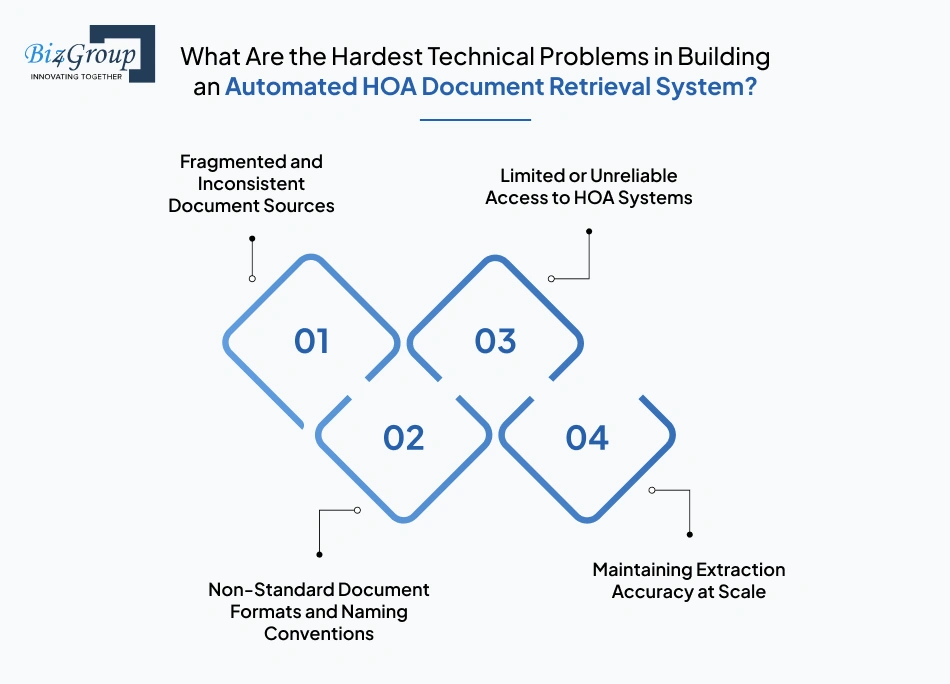
The hardest technical problems are handling fragmented document sources, inconsistent formats, unreliable access, and maintaining accuracy at scale. In automated HOA document retrieval system development, these issues make it difficult to build a system that works consistently across all transactions without manual intervention.
The key challenge is consistency in an environment where inputs are not consistent.
|
Problem Area |
Core Challenge |
System Requirement |
|---|---|---|
|
Fragmented and Inconsistent Document Sources |
Documents are spread across portals, emails, and manual responses with no standard access |
The system must identify sources, connect across channels, and retrieve documents without relying on a single method |
|
Non-Standard Document Formats and Naming Conventions |
The same document type appears in different layouts and naming styles |
The system must classify documents correctly and extract data even when structure varies |
|
Limited or Unreliable Access to HOA Systems |
Some HOAs have restricted portals or delayed responses |
The system must handle retries, partial access, and fallback mechanisms without breaking the workflow |
|
Maintaining Extraction Accuracy at Scale |
Accuracy drops as volume and variability increase |
The system must maintain consistent extraction quality across high transaction volumes |
Each of these problems increases complexity as transaction volume grows. What works for a small number of cases breaks quickly at scale.
To handle this, teams move beyond basic automation and start to develop AI HOA document management software that can adapt to different document types and improve accuracy over time. In many cases, this requires working with an experienced AI development company that can design systems capable of handling real-world variability without constant manual fixes.
The outcome to aim for is a system that delivers consistent results even when inputs are inconsistent.
The key to handling edge cases and failure scenarios in automated HOA document retrieval system development is to design the system to detect exceptions, apply automated fallback processes, and allow human intervention when needed. This ensures document retrieval continues smoothly even when HOAs are unresponsive, documents are incomplete, or systems are restricted.
Some HOAs may take too long to respond or may not respond at all. The system should detect unresponsiveness and trigger automated follow-ups or escalation rules. This prevents delays from stalling the transaction while reducing manual tracking.
Documents can arrive incomplete or be missing entirely. The workflow must flag gaps and automatically request the remaining items. This ensures agents and title teams always receive complete documentation without manually checking every transaction.
Certain HOA portals require credentials or fees. The system must securely handle these cases and use fallback methods when needed. This keeps retrieval predictable even under restricted access conditions.
Automation cannot solve every scenario. The system should allow manual intervention or escalation when it cannot complete a request. Clear rules for human overrides maintain continuity without slowing the overall workflow. This often involves partnering with a product development services team to implement robust exception handling and escalation workflows.
By anticipating these challenges, teams can deploy an AI powered HOA document retrieval solution that stays reliable under real-world conditions. Organizations that implement these strategies effectively can build automated HOA document retrieval system capabilities that combine automation with human oversight, ensuring consistent performance across all transactions.
Use HOA document automation software development to anticipate missing documents, ensure timely delivery, and maintain workflow consistency.
Start My AI-Driven WorkflowAccuracy, compliance, and reliability in automated HOA document retrieval system development are achieved by combining automated verification, human oversight, auditing, and recovery mechanisms. These measures ensure that every document is correct, compliant, and delivered reliably, even when sources are inconsistent or formats vary.
System-level verification ensures documents are complete and accurate before reaching users. Automated checks validate file types, cross-reference transaction data, and confirm document classification. This reduces errors and prevents incorrect or missing documents from slowing transactions.
Human oversight catches anomalies that automation cannot handle.
This approach is a key part of develop AI HOA document management software, balancing automation with accuracy. Many teams hire AI developers to implement human-in-the-loop workflows effectively.
|
Feature |
Purpose |
Benefit |
|---|---|---|
|
Detailed Logs |
Track every retrieval, classification, and delivery |
Ensures accountability and compliance |
|
Version Control |
Record document changes |
Provides historical reference and prevents errors |
|
Access Monitoring |
Track user interactions |
Supports regulatory audits and data security |
Errors are unavoidable at scale. The system should detect issues and recover automatically.
These mechanisms prevent small errors from becoming workflow delays, which is essential in HOA document automation software development.
By combining automated checks, human review, auditing, and recovery, teams can create an intelligent HOA document retrieval platform development that is accurate, compliant, and reliable. These safeguards keep transactions moving smoothly, even at high volume, while maintaining trust in the system.
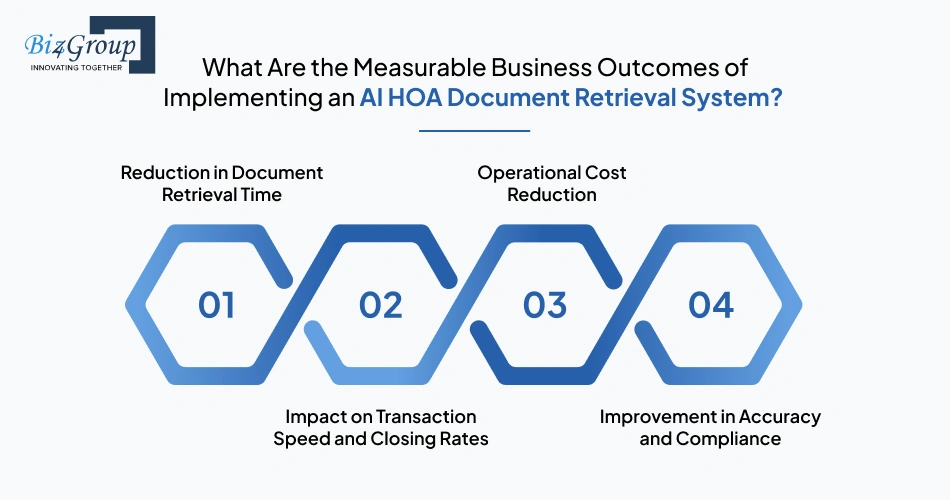
Implementing an automated HOA document retrieval system development delivers clear, measurable benefits for real estate operations. By automating document requests, extraction, and delivery, teams can reduce bottlenecks, improve accuracy, and ensure transactions proceed without unnecessary delays.
Automation eliminates manual chasing of HOA documents. Requests that previously took days are completed in hours, freeing teams to focus on higher-value tasks. Faster retrieval directly reduces transaction friction and keeps closing timelines on track.
With documents arriving faster and more reliably, closings happen sooner. Agents and title teams can process more transactions simultaneously, increasing throughput and improving overall customer satisfaction.
Manual processing consumes staff hours and introduces errors. Automating these tasks lowers operational costs while maintaining quality. Many organizations combine this with business app development using AI to scale workflows efficiently, handling larger transaction volumes without adding headcount.
Structured document extraction, validation, and delivery reduce errors and ensure regulatory requirements are met. Automated checks prevent missing or misclassified documents, minimizing risk and supporting smooth closings.
Whether through custom HOA document retrieval system development tailored to unique workflows or scalable AI real estate document retrieval system development, organizations gain predictable, cost-efficient operations with fewer delays and higher transaction reliability.
Adopt automated HOA document retrieval system development to stay ahead with predictive AI and fully automated document workflows.
Explore My AI Solution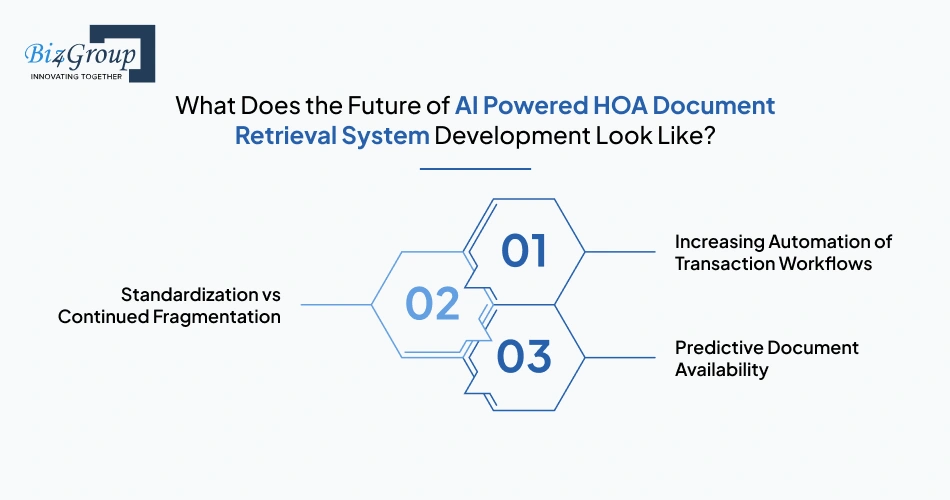
The future of automated HOA document retrieval system development will be intelligent, predictive, and integrated into every stage of real estate transactions. Systems will not just retrieve documents; they will anticipate needs, streamline workflows, and reduce delays across all parties involved in a closing.
Automation will handle more routine tasks, such as triggering document requests, tracking responses, and validating incoming files. By reducing manual intervention, teams can focus on exceptions and higher-value work, making the workflow faster and more reliable.
Some HOAs are moving toward standardized digital systems, while many remain fragmented. Future systems will need to handle both scenarios efficiently. AI will process standard inputs quickly while adapting to irregular formats, which is why investing in develop AI HOA document management software now positions organizations to manage both predictable and unpredictable workflows.
AI will predict which documents are likely to be delayed or missing, enabling teams to act before delays occur. Predictive analytics will prioritize critical documents for faster closings and more consistent transaction timelines. This will be a central feature of next-generation HOA document automation software development, helping reduce risk and improve planning.
The overall trend points to fully integrated, intelligent systems that combine automation, predictive insights, and real-time monitoring. Organizations that adopt these solutions early can gain faster closings, fewer errors, and more scalable operations while leveraging AI in real estate development to optimize workflows and reduce manual bottlenecks.
Biz4Group LLC combines deep AI expertise with practical real estate experience to deliver reliable, scalable, and intelligent solutions. As an AI app development company, we focus on creating systems that reduce manual bottlenecks, improve accuracy, and accelerate transaction workflows.
Our proven approach is reflected in multiple AI-powered real estate platforms we’ve developed:
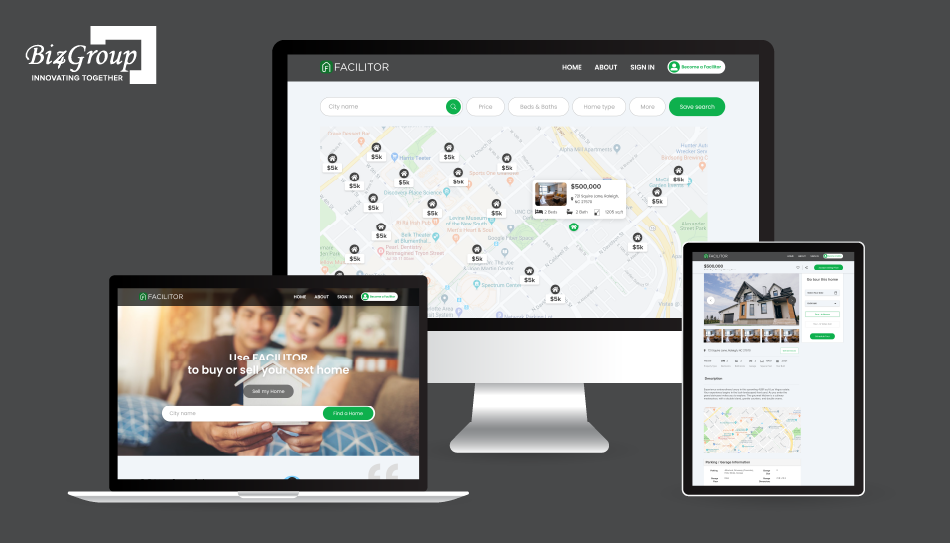
Facilitor is an AI-powered real estate solution that streamlines communication between agents, clients, and property managers. Its workflow automation demonstrates how AI HOA document automation can reduce manual follow-ups and ensure timely document delivery.
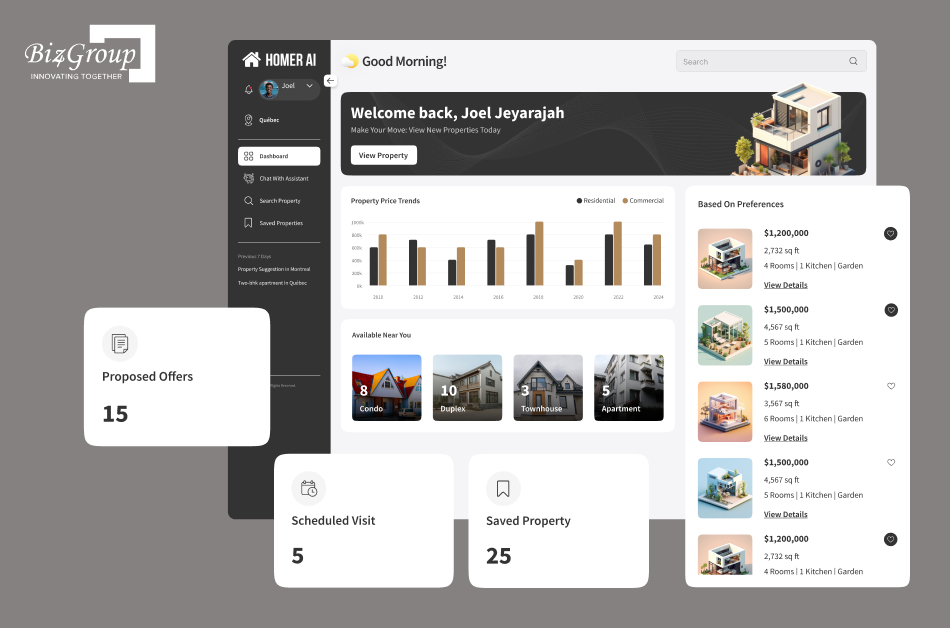
HomerAI offers smart property management by using AI to track maintenance, documentation, and compliance tasks. These predictive and adaptive features align with AI HOA document management, ensuring accurate and timely document retrieval in complex real estate operations.
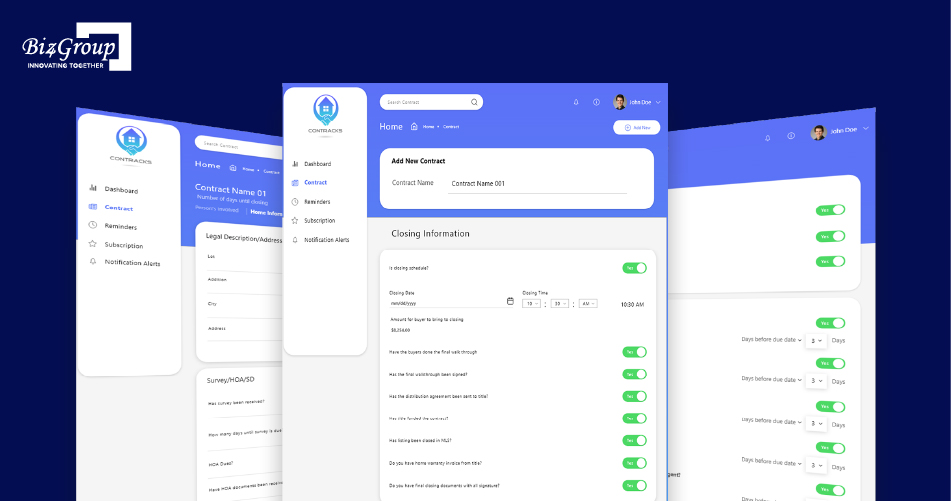
Contracks is a platform for managing real estate contracts interactively, with automated tracking, reminders, and validation. Its structure illustrates how a custom HOA document retrieval system can integrate compliance and auditability while reducing human error.
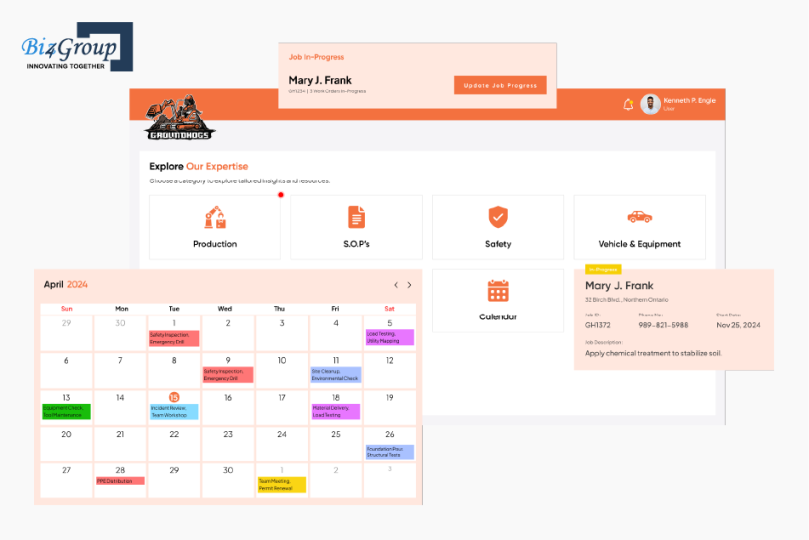
Ground Hogs provides AI-powered construction and property management solutions, offering real-time updates and document status tracking. These capabilities translate directly to AI real estate document retrieval solutions, supporting seamless data collection and operational efficiency.
Many organizations exploring automation for HOA document workflows often have questions like:
Key reasons to partner with Biz4Group:
With Biz4Group LLC, you gain an experienced partner that transforms HOA document management from a bottleneck into a streamlined, AI-driven process.
Manual HOA document requests are a thing of the past. With automated HOA document retrieval system development, real estate transactions can finally move at the speed they should. From faster closings and fewer errors to predictive document handling, AI transforms chaos into clarity.
Partnering with a custom software development company like Biz4Group, backed by strong AI consulting services, ensures your workflow stays smart, scalable, and almost annoyingly reliable.
Get a Custom Quote - Let us design a solution tailored to your HOA document needs.
Implementation time varies depending on workflow complexity, the number of HOA sources, and AI integration requirements. Basic systems can be deployed in a few weeks, while enterprise-grade solutions may take several months to fully configure, integrate, and test.
AI-powered systems can handle common HOA documents including CC&Rs, bylaws, meeting minutes, financial statements, and compliance reports. Advanced platforms can classify and extract key data from unstructured formats like PDFs, scanned images, and portal exports.
Modern systems use encryption, role-based access, and audit logs to protect sensitive information. Many also integrate with compliance frameworks to ensure that document access, storage, and sharing adhere to legal and industry standards.
Deployment costs typically range from $35,000 to $250,000+, depending on features, the number of integrated HOA sources, AI sophistication, and scalability requirements. Basic setups cover core automation, while enterprise solutions include predictive workflows, validation layers, and full transaction system integration.
Yes, AI systems can detect missing data, flag inconsistencies, and trigger automated follow-ups. Some platforms also use predictive logic to anticipate missing documents or delays, minimizing disruptions to closing timelines.
AI systems validate document completeness, track changes, and maintain audit logs. This reduces human errors, ensures that all required documentation is included, and helps meet regulatory standards for real estate transactions.

with Biz4Group today!
Our website require some cookies to function properly. Read our privacy policy to know more.