Location :
Orlando, FL, USA
Location :
Orlando, FL, USA +1 (407) 714-1616
 info@biz4group.com


















Imagine a digital system that doesn’t wait for instructions but instead, understands your business goals, learns from real-time feedback, and takes independent actions to get the job done.
Read More

Are your HOA operations truly under control, or are they being held together by spreadsheets, emails, and constant follow-ups behind the scenes?
If you’re managing one community, you might still be able to keep things organized. But once you start handling multiple HOAs, things get complicated quickly.
Now consider the scale of what you’re dealing with.
According to research, the U.S. is projected to have up to 377,000 community associations in 2026, housing nearly 80 million residents.
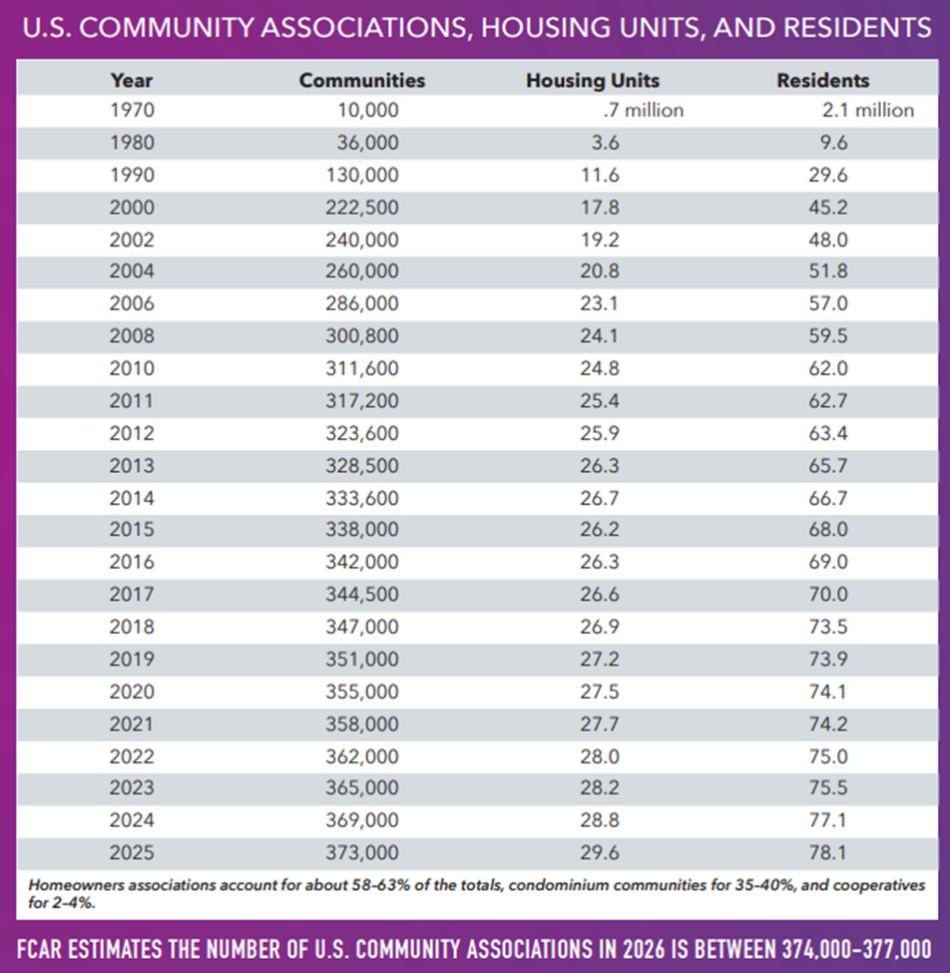
That’s nearly one-third of all U.S. housing and yet, a significant number of these communities still rely on manual processes or outdated systems.
So, here’s the real question: How are you supposed to manage growing complexity without creating more chaos?
You’re likely dealing with:
And when you’re managing multiple HOAs, the cracks start to show even faster.
You may have already thought: “We are struggling with manual HOA processes and need a system to automate billing, maintenance, and communication.”
Or maybe: “We need a centralized platform to manage multiple HOAs efficiently.”
This is exactly where AI HOA management software development is starting to reshape the industry.
Instead of relying on disconnected tools, companies are now investing in HOA management software development integrating AI to automate operations, reduce manual errors, and scale without constantly increasing headcount.
But what does that actually mean for you?
If you’re already exploring ways to modernize, solutions like AI property management software are shaping how forward-thinking companies operate today. The bigger question is not whether AI will impact HOA management. It already is.
The real question is: Are you going to keep patching manual processes, or are you ready to build AI HOA management software that actually scales with your business?
In the next section, we’ll break down what this technology really is and why traditional HOA systems are no longer keeping up.
If you’re still relying on manual processes to manage billing, maintenance, and communication, the limitations show up quickly as your portfolio grows.
So what exactly changes when you move to AI?
AI HOA management software development is the process of building a centralized platform that uses AI to automate and manage core HOA operations such as billing, maintenance workflows, resident communication, compliance, and reporting across multiple communities.
Instead of tracking tasks manually, the system executes them.
With HOA management software development integrating AI, routine operations like invoicing, request handling, and communication are handled automatically, reducing dependency on manual coordination.
This is how companies develop AI HOA management system for residential communities that can operate consistently even as the number of communities increases.
If your goal is to streamline operations end to end, this approach aligns closely with building an AI automation system for property management companies, where workflows are designed to run without constant human input.
Traditional systems are designed to store information, they are not designed to run operations. That limitation becomes clear when you start managing multiple HOAs.
|
Area |
Traditional HOA Systems |
AI-Based HOA Systems |
|---|---|---|
|
Billing |
Manual invoicing, delays, reconciliation errors |
Automated billing with real-time tracking |
|
Maintenance |
Requests handled manually, no prioritization |
Automated routing and tracking of requests |
|
Communication |
Emails and calls, slow response cycles |
Automated and structured communication workflows |
|
Data |
Information spread across tools |
Centralized system with unified data |
|
Scaling |
Workload increases with each new HOA |
Operations scale without proportional workload increase |
The problem is not sudden failure, it is gradual loss of control.
At this stage, adding more tools does not solve the issue. You need a system built around how AI transforms HOA management and community administration systems and reduces manual workload across operations.
That is where custom AI HOA management software development becomes necessary.
Next, let’s look at how these systems actually work and manage operations behind the scenes.
If your operations are growing faster than your systems, it may be time to rethink how your HOA workflows actually run.
Contact Our AI ExpertsMost HOA teams already use software in some form. The real difference with AI is that the system does not wait for someone to manually manage every task.
Instead, it collects operational data, automates workflows, processes requests, and helps your team handle multiple communities with far less manual effort. This is what makes smart HOA management system development different from traditional HOA tools.
If you’ve ever thought, “we are struggling with manual HOA administration and want to develop an automated property management platform,” this is the operational structure that makes that transition possible.
Let’s break down how the system actually works behind the scenes.
The first step is bringing all operational data into one centralized platform. This includes resident records, payment history, maintenance requests, HOA documents, vendor details, compliance records, and communication logs. Instead of switching between disconnected systems, your team gets one unified operational view.
The platform typically organizes:
This centralized structure is essential for AI HOA management software development because AI systems depend on organized data to automate operations accurately. For companies managing large volumes of files and records, solutions like AI document management software also help streamline document-heavy workflows.
Once the data is centralized, AI models begin processing operational patterns and automating repetitive tasks. The objective is simple: reduce manual workload while improving operational consistency. This is how AI improves HOA management efficiency and reduces manual workload becomes measurable inside daily operations.
AI models can automate:
As more operational data flows through the platform, automation becomes smarter and more accurate over time. For companies building broader operational ecosystems, integrating these capabilities often overlaps with real estate AI software designed for large-scale property operations.
This is where the platform starts functioning as an operational system instead of just a management tool. Every process triggers the next action automatically. For example, when a resident submits a maintenance request, the system can instantly assign the request, notify vendors, track completion status, and update residents automatically. This is the operational layer behind how to automate HOA operations using AI-based solutions.
Typical automations include:
This is why many companies now choose custom AI HOA management system development instead of relying on disconnected software that still requires constant manual oversight.
Once workflows are automated, the platform continuously monitors operations and highlights issues that need attention. Instead of waiting for manual reports, managers can track operational performance in real time across all communities.
The system can monitor:
This visibility becomes critical when building scalable HOA management platform for real estate companies that need centralized operational control. Platforms using real estate AI predictive analytics software can also forecast operational risks before they become larger problems.
AI systems improve as more operational data becomes available. Over time, the platform identifies recurring issues, workflow inefficiencies, and operational patterns that can be optimized automatically.
This allows companies to:
That is the long-term advantage of HOA management software development integrating AI. The system does not just automate operations once. It continuously improves how those operations are managed.
Next, let’s look at the real-world use cases where AI is creating measurable impact across HOA operations.
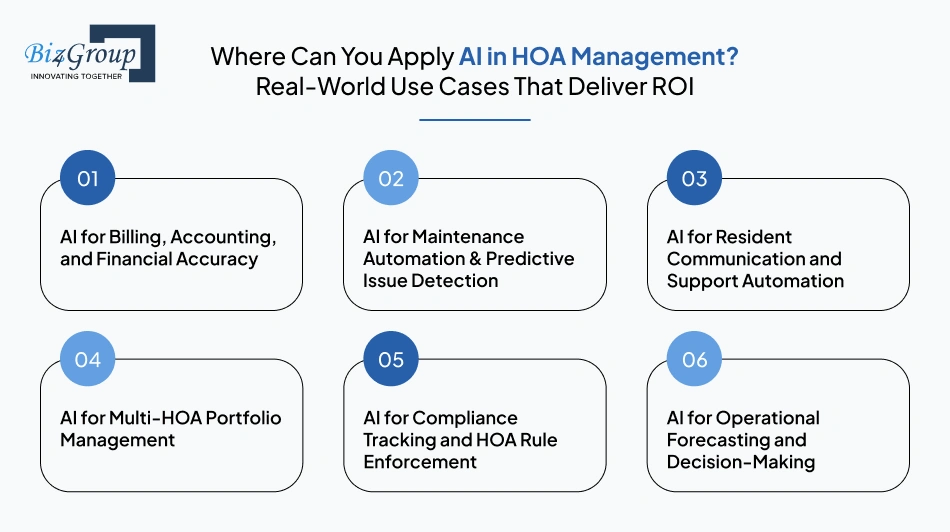
The biggest reason companies invest in AI HOA management software development is simple. They want to remove operational friction without compromising service quality. And the impact becomes visible quickly when AI is applied to the areas that consume the most time, coordination, and manual effort.
Here’s where AI is creating the biggest operational improvements for modern HOA management companies.
Managing HOA finances manually becomes difficult when multiple communities, payment schedules, and financial records are involved. AI-powered systems automate invoicing, payment reminders, late fee calculations, reconciliation, and financial reporting from one centralized platform. This reduces accounting errors while improving payment consistency across communities. This is one of the most common reasons companies start exploring AI HOA software for billing, maintenance, and resident communication automation.
Example:
Companies like AppFolio use AI-driven accounting automation to help property managers handle recurring payments, owner statements, and financial tracking across large property portfolios with minimal manual intervention.
Maintenance management is one of the most time-consuming parts of HOA operations. AI systems can automatically categorize requests, prioritize urgent issues, assign vendors, track completion status, and even predict recurring maintenance problems before they escalate. This reduces delays and improves resident satisfaction significantly. This becomes especially valuable for teams saying, “we are struggling with manual HOA processes and need a system to automate billing, maintenance, and communication.”
Example:
Buildium uses automated maintenance workflows that allow property managers to manage repair requests, vendor coordination, and status tracking from a centralized system.
Resident communication often becomes fragmented across emails, phone calls, portals, and support tickets. AI-powered systems centralize communication and automate responses for common requests, updates, reminders, and announcements. This helps property management teams respond faster without increasing operational workload. This is where smart HOA management system development creates measurable improvements in resident experience.
Example:
Platforms like Yardi use AI-enabled communication tools and resident portals to streamline updates, notifications, payment reminders, and support interactions across residential communities.
For companies looking to expand conversational capabilities further, solutions like real estate AI assistant are also becoming part of modern HOA ecosystems.
As property management companies grow, operational visibility becomes harder to maintain. AI-powered platforms help centralize operations across multiple HOAs, allowing managers to track financials, maintenance activity, resident issues, and compliance from one dashboard. This improves coordination while reducing operational overhead. This is a major reason companies choose custom AI HOA management software development instead of relying on disconnected systems.
Example:
CINC Systems provides centralized association management tools that help property management companies oversee accounting, communication, and operations across multiple communities from a single platform.
Tracking HOA compliance manually often leads to inconsistent enforcement, missed notices, and administrative overload. AI systems can monitor violations, automate notices, track deadlines, and maintain digital compliance records without constant manual supervision. This creates a more structured and consistent operational process. This is especially useful for companies thinking, “I manage multiple housing communities and want to develop AI HOA management software to automate operations and reduce errors.”
Example:
Enumerate offers automation tools that help HOA management teams monitor violations, manage compliance records, and streamline administrative workflows.
One of the biggest advantages of HOA management software development integrating AI is the ability to identify operational patterns before they become larger problems. AI can analyze payment trends, maintenance frequency, vendor performance, and resident behavior to help management teams make faster and more informed decisions. This allows property management companies to shift from reactive operations to proactive planning.
Example:
Companies using real estate AI predictive analytics software are already leveraging forecasting models to optimize operational planning, budgeting, and long-term maintenance strategies across property portfolios.
Next, let’s look at the core features every modern AI HOA management platform should include.
The strength of any AI HOA management software development project depends on the features built into the platform. The right features reduce manual effort, improve visibility, and help property management companies handle multiple communities without operational chaos.
Here are the core features every modern HOA platform should include.
A centralized dashboard gives managers a single place to monitor billing, maintenance requests, resident updates, compliance issues, and operational activity across communities. Instead of switching between multiple tools, everything stays connected in one system. This is one of the most important parts of smart HOA management system development because it improves visibility and operational control as portfolios grow. A clean and intuitive dashboard also depends heavily on strong design to keep operations easy to manage.
Financial management becomes difficult when invoices, dues, and reporting are handled manually. AI-powered accounting modules automate billing cycles, payment reminders, reconciliation, and financial reporting while reducing human errors. This is a core requirement for companies investing in AI HOA software for billing, maintenance, and resident communication automation. Many companies also use broader AI automation services to streamline repetitive accounting workflows.
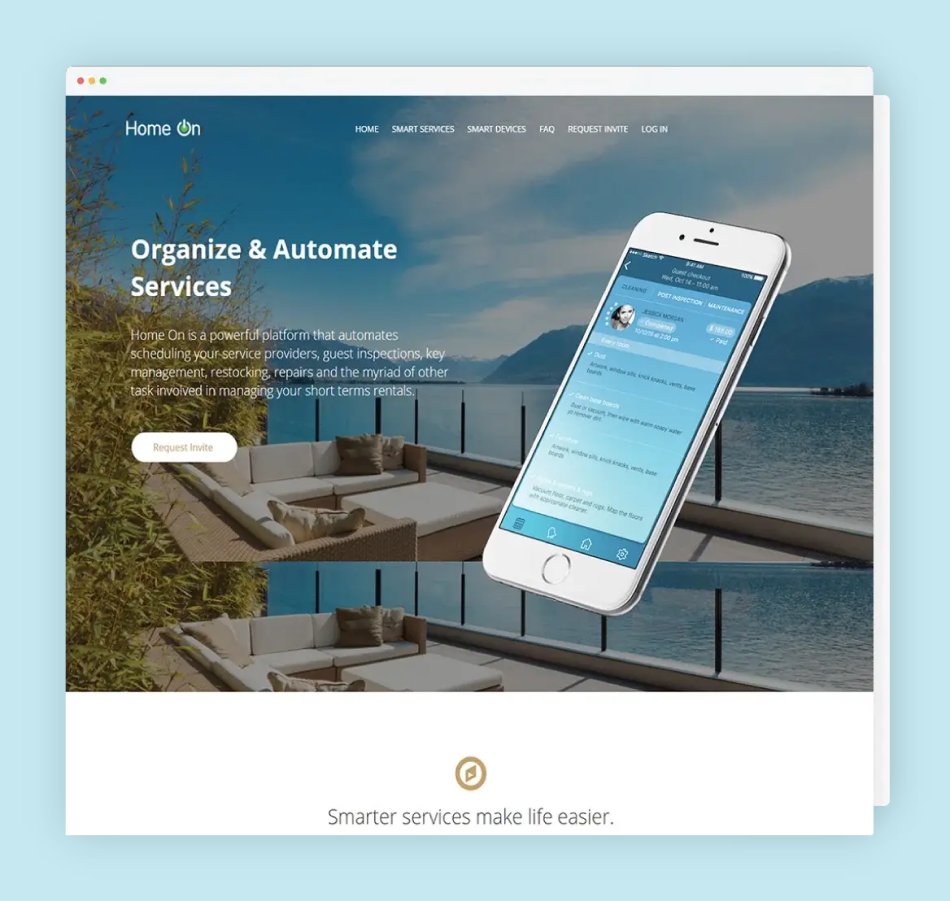
An AI-powered maintenance system helps automate ticket creation, vendor assignment, request tracking, and issue prioritization from one platform. This prevents delays and improves response times across communities. It also reduces the back-and-forth coordination that usually slows maintenance operations. This feature is essential when companies want to develop AI HOA management system for residential communities that can scale efficiently.
A good example is HomeOn , a property management platform developed by Biz4Group that helps streamline property operations through centralized management, smart workflows, and AI-driven user interactions. The platform focuses on improving coordination between buyers, sellers, and property stakeholders while simplifying day-to-day operational processes.
Residents should be able to submit requests, access documents, receive updates, and make payments without depending entirely on manual support. AI-powered communication systems automate responses, notifications, and follow-ups to improve resident experience while reducing support workload. This is a major part of how AI improves HOA management efficiency and reduces manual workload for growing HOA operations. Modern platforms are also integrating AI agent capabilities to handle resident interactions more efficiently.
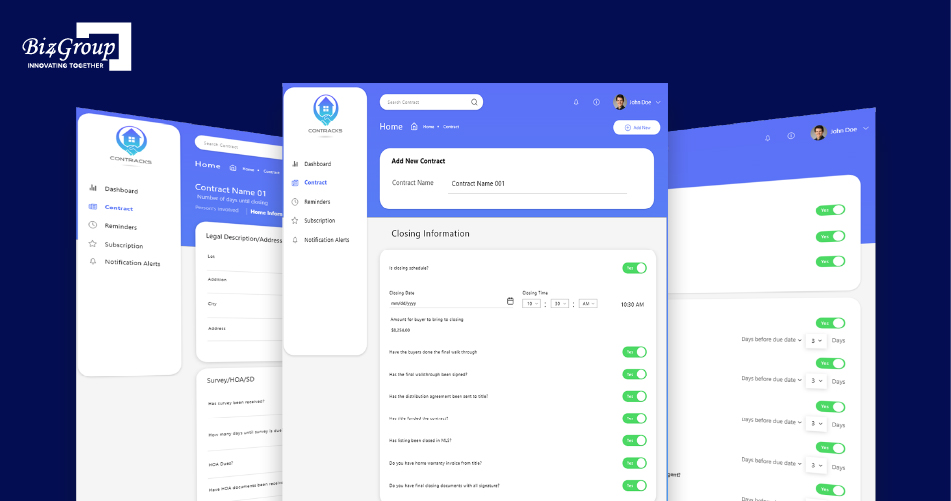
HOA operations involve large volumes of notices, compliance records, approvals, and governing documents. A centralized system helps organize records while automating reminders, violation notices, and compliance tracking. This improves consistency and reduces administrative burden across communities. This feature is especially important for custom AI HOA management software development projects focused on long-term scalability.
A strong example is ConTracks, developed by Biz4Group to simplify real estate contract and document management. The platform helps users manage property contracts, track important dates, automate notifications, and monitor contract progress through web and mobile applications, reducing paperwork and improving compliance visibility.
AI-powered analytics help property managers track payments, maintenance performance, operational bottlenecks, and resident activity from one dashboard. Instead of reacting to issues late, teams can identify patterns and make faster decisions using real-time insights. This becomes critical when building scalable HOA management platform for real estate companies managing multiple communities. Businesses adopting enterprise AI solutions are already using centralized analytics to improve operational planning.
HOA platforms handle sensitive resident, financial, and operational data, making secure access control essential. Role-based permissions ensure that managers, board members, vendors, and residents only access relevant information. This improves security while keeping workflows organized across departments. As more companies adopt HOA management software development integrating AI, access management becomes a necessary feature rather than an optional add-on.
These core features create the operational foundation of the platform. But as HOA systems become more advanced, companies are now adding AI capabilities that go far beyond basic automation.
Let’s look at the advanced features that are transforming modern HOA management platforms in 2026.
From billing and maintenance to resident communication, the right AI system can reduce manual workload across every community you manage.
Schedule a Free CallCore features help manage operations, advanced AI capabilities help optimize, predict, and automate them at scale.
This is where custom AI HOA management software development starts creating a real competitive advantage for property management companies handling multiple communities.
If you’re questioning, “I need a development company to build a scalable HOA management platform with AI features,” these are the capabilities that separate standard software from intelligent HOA systems.
|
Advanced AI Feature |
How It Helps HOA Operations |
|---|---|
|
Predictive Maintenance Monitoring |
AI analyzes maintenance history, vendor activity, and recurring repair patterns to predict issues before they become expensive problems. This helps reduce downtime, emergency repair costs, and delayed maintenance responses. |
|
AI-Powered Resident Support |
AI chatbots and virtual assistants can answer resident questions, provide payment reminders, share HOA policies, and handle common requests 24/7 without manual support intervention. |
|
Smart Financial Forecasting |
AI models analyze payment trends, expenses, and operational patterns to improve budgeting, reserve planning, and financial decision-making across communities. |
|
Automated Compliance Monitoring |
AI systems can detect rule violations, monitor compliance patterns, automate notices, and maintain digital records without requiring constant manual supervision. |
|
Intelligent Workflow Automation |
Advanced workflow engines automatically trigger approvals, escalations, notifications, and task assignments based on operational activity and predefined rules. |
|
AI-Based Risk and Fraud Detection |
AI can identify unusual financial activity, duplicate transactions, payment anomalies, or suspicious operational behavior before they create larger issues. |
|
Voice-Enabled HOA Assistance |
Voice-enabled systems allow residents and managers to interact with the platform using natural language for payments, maintenance updates, or community information requests. |
|
Predictive Operational Analytics |
AI continuously analyzes operational data to identify delays, inefficiencies, vendor performance issues, and resident service bottlenecks across communities. |
|
Personalized Resident Experience |
AI systems can personalize notifications, reminders, announcements, and communication based on resident behavior, preferences, and interaction history. |
|
AI-Driven Vendor Performance Tracking |
The platform can automatically evaluate vendor response times, work quality, recurring complaints, and completion efficiency to improve vendor management decisions. |
Advanced capabilities like these are becoming increasingly common in companies investing in agentic AI development, where AI systems are designed to make operational decisions and execute workflows with minimal manual intervention.
As more companies look to build AI HOA management software, the focus is no longer just on automation. The focus is on creating systems that can actively improve operations over time.
Now that we’ve covered the features, the next question is obvious: How do you actually build a platform like this from the ground up?
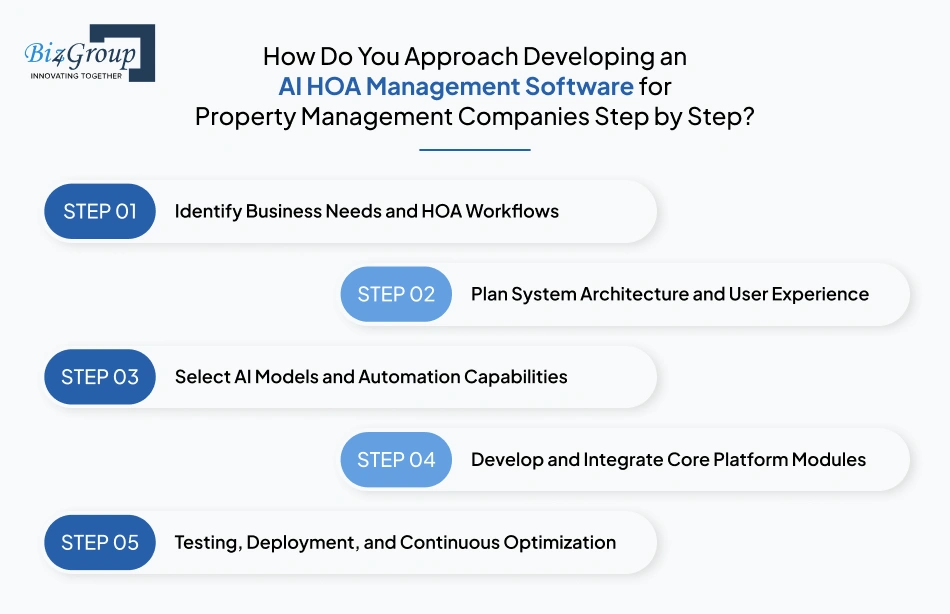
Building a successful HOA platform is not just about adding automation features. The goal is to create a system that can streamline operations, reduce manual workload, and support multiple communities without operational bottlenecks.
If you’re thinking, “I want to find a company that can build custom HOA management software for my real estate business,” this is the process most companies follow for AI HOA management software development.
The first step is understanding how your current operations function and where inefficiencies exist. This includes reviewing billing processes, maintenance workflows, resident communication, compliance handling, and reporting systems across communities. This stage helps define the foundation for custom AI HOA management software development aligned with your operational goals.
Key focus areas include:
Many companies start with MVP development to validate automation workflows before investing in a full-scale platform.
Once workflows are finalized, the platform architecture, user roles, integrations, and interface structure are planned. This stage determines how efficiently the system will perform as operations expand. For smart HOA management system development, user experience becomes critical because managers, residents, accounting teams, and vendors all interact with the platform differently.
Planning areas usually include:
A strong UI/UX design strategy helps simplify complex operational workflows for different user groups.
After architecture planning, AI capabilities are selected based on operational needs. Different AI models are used for communication automation, predictive maintenance, operational analytics, billing automation, and workflow optimization. This is one of the most important stages in HOA management software development integrating AI because the AI layer directly impacts system efficiency and scalability.
Key AI capabilities often include:
Companies looking to build AI HOA management software at scale often need structured strategies to integrate AI models into development workflow.
Once planning is complete, development begins for the core HOA modules including accounting, maintenance management, resident communication, reporting, compliance tracking, and automation systems. This is where companies start turning operational requirements into a working platform designed for building scalable HOA management platform for real estate companies.
Core development areas include:
Many businesses partner with a specialized custom software development company to manage complex integrations and custom workflows.
Before launch, the platform is tested across workflows, automation systems, integrations, performance, and security layers to ensure stable operations. Once deployed, the system continues improving based on operational usage and workflow data. This ongoing optimization process is essential for companies investing in Developing an AI HOA management software for property management companies that can evolve with operational growth.
The final stage typically includes:
As operations scale, many companies continue using AI integration services to expand automation capabilities and improve system performance over time.
Next, let’s look at the technology stack required to support a scalable AI HOA management platform.
The technology stack behind your platform directly impacts performance, scalability, automation capabilities, and long-term maintenance. Choosing the right technologies is critical for companies investing in AI HOA management software development because HOA platforms need to handle real-time operations, large datasets, multiple integrations, and AI-driven workflows efficiently.
Here’s a commonly used tech stack for building scalable HOA management platform for real estate companies.
|
Technology Layer |
Recommended Technologies |
Purpose in AI HOA Management Software |
|---|---|---|
|
Frontend Development |
React.js, Angular, Vue.js |
Builds responsive dashboards, resident portals, maintenance interfaces, and management panels across web platforms |
|
Flutter, React Native, Swift, Kotlin |
Supports mobile apps for residents, HOA managers, vendors, and maintenance teams |
|
|
Backend Development |
Handles business logic, workflow automation, APIs, and operational processing |
|
|
Database Management |
PostgreSQL, MongoDB, MySQL |
Stores resident records, financial data, maintenance logs, compliance documents, and operational activity |
|
AI & Machine Learning |
TensorFlow, OpenAI APIs, PyTorch |
Powers automation, predictive maintenance, resident communication, analytics, and intelligent workflows |
|
Cloud Infrastructure |
AWS, Microsoft Azure, Google Cloud |
Supports scalability, real-time processing, cloud storage, backups, and system availability |
|
Workflow Automation |
Apache Airflow, Zapier, n8n |
Automates billing, notifications, maintenance routing, approvals, and operational workflows |
|
Communication Systems |
Twilio, SendGrid, Firebase |
Enables email alerts, SMS notifications, push notifications, and resident communication automation |
|
Security & Access Control |
OAuth 2.0, JWT, Okta |
Protects financial, resident, and operational data with secure authentication and role-based access |
|
Analytics & Reporting |
Power BI, Tableau, Google Looker |
Generates operational dashboards, financial reports, and performance insights across communities |
|
Document Management |
AWS S3, DocuSign APIs |
Handles digital records, compliance documents, contracts, approvals, and file storage |
|
AI Assistants & Chatbots |
Dialogflow, LangChain, OpenAI |
Supports automated resident communication and AI-driven support systems |
As platforms become more advanced, companies are also investing in AI product strategies to build scalable systems tailored for long-term operational growth.
Next, let’s break down the actual cost of building AI HOA management software in the USA and the factors that influence development budgets.
Also Read: Next JS Development Company
One of the first questions property management companies ask is simple: How much does it actually cost to build a modern HOA platform with AI capabilities?
The answer depends on what you’re trying to build.
A basic platform with limited automation will cost far less than a fully scalable system with predictive analytics, AI-driven workflows, resident automation, and multi-community management capabilities.
In most cases, the cost of AI HOA management software development ranges between $30,000 to $200,000+.
If you’re asking, “I need a development company to build a scalable HOA management platform with AI features,” understanding the cost structure early helps avoid unnecessary overspending later.
Next, let’s look at the biggest challenges companies face during Developing an AI HOA management software for property management companies and how to solve them effectively.
Get a realistic roadmap, feature breakdown, and development estimate based on your operational goals and community size.
Get a Custom Cost Estimate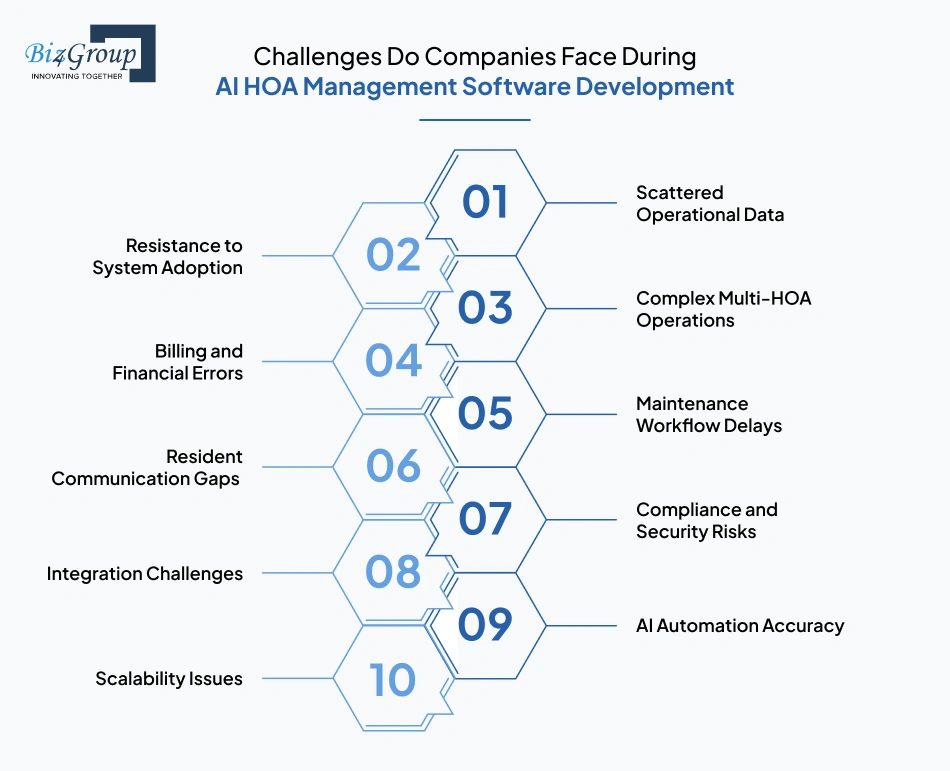
Building an AI-powered HOA platform comes with operational, technical, and adoption challenges, especially for companies managing multiple communities with existing manual workflows.
If you’re thinking, “we are struggling with manual HOA administration and want to develop an automated property management platform,” understanding these challenges early can help prevent costly implementation issues later.
Here are the most common challenges companies face during AI HOA management software development and the best ways to solve them.
|
Challenge |
Why It Happens |
Solution |
|---|---|---|
|
Scattered Operational Data |
HOA data is often spread across spreadsheets, emails, accounting systems, and disconnected tools |
Centralize operational data into one platform before implementing automation workflows |
|
Resistance to System Adoption |
HOA managers, board members, and staff may resist changing existing workflows |
Introduce automation gradually and provide role-based onboarding and training |
|
Complex Multi-HOA Operations |
Different communities follow different workflows, rules, and reporting structures |
Build flexible workflows and customizable operational modules |
|
Billing and Financial Errors |
Manual invoicing and payment tracking create inconsistencies across communities |
Implement automated accounting and real-time financial tracking systems |
|
Maintenance Workflow Delays |
Maintenance requests often depend on manual coordination and vendor follow-ups |
Use AI-driven maintenance routing and automated vendor assignment systems |
|
Resident Communication Gaps |
Communication across emails and calls becomes difficult to manage at scale |
Implement centralized communication portals and automated notifications |
|
Compliance and Security Risks |
HOA platforms handle sensitive resident and financial information |
Use role-based access control, encryption, and secure cloud infrastructure |
|
Integration Challenges |
Existing accounting systems, CRMs, and payment gateways may not connect easily |
Plan API integrations early during platform architecture design |
|
AI Automation Accuracy |
Poor-quality operational data can reduce automation accuracy |
Clean and structure data before training automation workflows |
|
Scalability Issues |
Platforms built without scalable architecture struggle as communities grow |
Use cloud-native infrastructure and modular system architecture |
Companies investing in hire AI developers services often reduce implementation delays by bringing experienced AI and workflow automation expertise into the project early.
For businesses evaluating companies that develop AI HOA management software in USA, the ability to solve these operational challenges is often more important than simply adding AI features.
Once these challenges are addressed correctly, the platform becomes much easier to scale, optimize, and expand over time.
Next, let’s look at what the future of AI HOA management software development will look like beyond 2026.
The future of AI HOA management software development is moving far beyond basic automation. The next generation of platforms will focus on autonomous operations, predictive decision-making, connected community ecosystems, and self-learning workflows that continuously improve over time.
For companies investing in building scalable HOA management platform for real estate companies, the focus is no longer just operational efficiency. The focus is creating intelligent systems that can manage growing communities with minimal manual intervention.
Here’s where the industry is heading next.
Future platforms will automatically optimize workflows based on operational behavior, maintenance patterns, resident activity, and recurring issues. Instead of manually adjusting processes, the system will continuously improve task routing, approvals, and communication flows on its own. This is how AI improves HOA management efficiency and reduces manual workload becomes significantly more advanced than traditional automation.
Digital twin technology will allow HOA managers to simulate operational decisions before applying them in real communities. Property managers will be able to test maintenance planning, infrastructure upgrades, parking allocation, and budgeting strategies inside virtual operational models. This will become an important part of smart HOA management system development for large residential communities.
Future HOA platforms will personalize notifications, support responses, announcements, and payment reminders based on resident behavior and interaction history. Communication will feel more contextual and less transactional across communities. This shift will play a major role in AI HOA software for billing, maintenance, and resident communication automation over the next few years.
HOA systems will increasingly connect with IoT devices, smart security systems, access controls, parking infrastructure, and energy monitoring platforms. Instead of functioning as standalone software, they will become centralized operational ecosystems for entire residential communities. This level of integration will reshape how AI transforms HOA management and community administration systems at scale.
Future systems will automatically monitor operational activity against HOA policies and community rules in real time. AI-driven governance layers will help standardize compliance handling, approvals, notices, and operational enforcement across multiple HOAs. This will become a core capability in custom AI HOA management system development focused on operational consistency.
Voice-enabled interaction will become more common for residents, vendors, and HOA managers. Tasks like payment updates, maintenance tracking, visitor access, and community requests will increasingly be handled through conversational AI systems. This evolution is already influencing broader AI real estate lease management software platforms across the real estate industry.
AI systems will forecast maintenance demand, staffing requirements, operational bottlenecks, and vendor performance before issues occur. This will help management companies shift from reactive operations to proactive planning across communities. For companies planning to build AI HOA management software, predictive operational intelligence will become a major competitive advantage in the coming years.
As more companies adopt HOA management software development integrating AI, future platforms will become increasingly autonomous, connected, and operationally intelligent.
The companies investing early in custom AI HOA management software development will be far better positioned to scale efficiently, improve resident experience, and manage increasingly complex community operations.
Building a successful HOA platform takes more than development resources. You need a technology partner that understands automation, AI workflows, scalability, and the operational complexity behind managing multiple communities.
That is where Biz4Group stands out.
As an experienced AI development company, Biz4Group helps businesses build scalable and intelligent HOA platforms tailored to real operational challenges. From workflow automation and AI-driven communication systems to predictive analytics and centralized community management, the focus stays on building solutions that reduce manual workload and improve operational efficiency.
Biz4Group has also worked on real estate and property-focused platforms like HomeOn and ConTracks, delivering solutions focused on property operations, workflow management, document handling, and user-centric digital experiences.
For companies looking for companies that develop AI HOA management software in USA, Biz4Group combines AI expertise, custom software development capabilities, and real-world experience in building scalable operational platforms for modern property management businesses.
Let’s turn your operational bottlenecks into automated workflows with AI-driven HOA software built around your growth goals.
Talk to UsAs HOA operations become more complex, relying on manual coordination, disconnected systems, and outdated workflows only creates more operational pressure over time. Billing delays, maintenance bottlenecks, communication gaps, and compliance issues become harder to manage as communities grow.
That is exactly why more property management companies are investing in AI HOA management software development and HOA management software development integrating AI to streamline operations, improve visibility, and reduce manual workload across multiple communities.
If you’re thinking, “we are struggling with manual HOA administration and want to develop an automated property management platform,” the right technology strategy can completely change how your operations scale moving forward.
At Biz4Group, we help businesses build AI HOA management software tailored to real operational challenges through scalable architecture, intelligent automation, and custom workflow development. With experience building property-focused platforms like HomeOn and ConTracks, our team understands what it takes to create systems that actually support long-term growth.
So if your current HOA operations still depend on spreadsheets, emails, and constant follow-ups, maybe the real question is not whether AI will become part of HOA management. It is whether your business will lead that shift or struggle to catch up later.
Let’s talk and build an AI HOA management software today.
AI HOA management software development is the process of building intelligent platforms that automate HOA operations such as billing, maintenance management, resident communication, compliance tracking, and reporting. Instead of relying on manual coordination, AI systems help property management companies streamline workflows and manage multiple communities more efficiently.
AI reduces repetitive operational tasks by automating workflows that normally require manual follow-ups. This includes automated invoicing, maintenance request routing, resident communication, and operational reporting. It helps HOA teams respond faster, reduce errors, and manage larger community portfolios without significantly increasing staff workload.
The cost of custom AI HOA management software development usually ranges between $30,000 to $200,000+ depending on the number of features, AI capabilities, integrations, scalability requirements, and platform complexity. Basic HOA systems cost much less than enterprise-grade platforms designed for multi-community operations and advanced automation.
The most important features include automated billing, maintenance management, resident communication portals, compliance tracking, centralized dashboards, operational analytics, and AI-powered workflow automation. Companies planning to develop AI HOA management system for residential communities should focus first on features that solve operational bottlenecks and reduce manual coordination.
Development timelines depend on platform complexity, integrations, and AI functionality. A basic MVP can take around 2 to 4 weeks, while a fully scalable platform with advanced AI workflows and multi-HOA management capabilities can take 6 to 8 weeks or longer.
Off-the-shelf software may work for smaller operations with basic requirements. However, companies managing multiple communities usually prefer HOA management software development integrating AI because custom platforms offer better scalability, workflow flexibility, integrations, and operational control tailored to their processes.
The right development partner should have experience with AI automation, real estate workflows, scalable architecture, and custom software development. Businesses evaluating companies that develop AI HOA management software in USA should also look for experience in workflow automation, cloud infrastructure, compliance systems, and multi-community operational platforms.

with Biz4Group today!
Our website require some cookies to function properly. Read our privacy policy to know more.