 Location :
Orlando, FL, USA
Location :
Orlando, FL, USA +1 (407) 714-1616
 info@biz4group.com

- AI identity threat software development helps businesses detect identity misuse, fraud, and insider threats by analyzing behavior continuously, not just at login.
- Modern identity security relies on AI identity security software development to protect workforce, customer, API, and document-based identities across cloud and enterprise systems.
- Effective platforms combine real-time monitoring, behavioral analytics, automated response, and explainable alerts to reduce false positives and improve security outcomes.
- The AI identity threat software development cost typically ranges from $35,000 to $250,000+, depending on features, scale, and enterprise requirements.
- Partnering with Biz4Group LLC in custom AI identity threat software development helps organizations build scalable, secure systems that adapt as identity threats evolve.
Let’s start with a quick question - When was the last time a security incident started with someone breaking into your network?
For most organizations today, breaches begin with identity. A valid login. A trusted user. Access that looks normal until it causes damage.
In 2025, identity-based threats account for nearly 30 percent of all cyber intrusions, according to IBM. Attackers are increasingly using stolen or misused credentials instead of malware.
The business impact is hard to ignore. According to another report that almost 60 percent of U.S. companies saw higher fraud losses in 2025, largely driven by identity abuse that slips past traditional controls.
You may already use MFA and endpoint security. So why does risk still feel high?
That question is exactly why AI identity threat software development matters. Instead of relying on static rules, AI focuses on behavior and context. It helps you spot identity threats early, before fraud spreads.
We see this challenge often while working as an AI development company building security-focused platform for growing businesses.
This guide will help you understand what changes when identity becomes the perimeter and how AI identity security software development helps you protect it.
What Is AI Identity Threat Software Development and Why Identity Is the New Perimeter in Cybersecurity
Let’s slow this down and make it practical.
Security used to focus on networks. Then it shifted to the devices. Today, it revolves around identity. Every user, service account, API, and application identity now represents a potential entry point.
That is exactly what AI identity threat software development is built to address.
At its core, it is the process of designing and building systems that continuously monitor identity behavior across your environment. These systems go beyond login checks. They analyze patterns, context, and intent across sessions, applications, and time.
Instead of asking only “Is this user authenticated?”, AI-driven identity systems ask a better question - Does this behavior make sense for this identity right now?
That shift is why AI identity security software development has become central to modern cybersecurity strategies, especially for organizations operating at scale.
Why Identity Is the New Perimeter in Cybersecurity
Here is what has changed, and why identity now sits at the center of risk:
- Cloud and SaaS have dissolved the traditional perimeter
Users log in from anywhere, across multiple tools, making identity the only consistent control point. - Attackers prefer valid credentials over exploits
Stolen or misused identities allow threats to blend in and avoid detection. - Machine and API identities now outnumber human users
These identities often have persistent access and limited oversight. - Remote and hybrid work expanded access surface overnight
Identity now stretches far beyond office walls. - Static rules cannot keep up with dynamic behavior
Identity risk changes minute by minute, not just at login.
This is why many organizations approach identity protection as part of broader enterprise AI solutions rather than treating it as a standalone security feature.
AI enables identity systems to adapt as environments grow more complex. Behavior baselines update automatically. Risk is scored in real time. Responses adjust based on context, not assumptions.
Automation is what makes this sustainable. AI-powered identity platforms can trigger step-up authentication, restrict access, or alert security teams without manual intervention. That alignment with AI automation services helps reduce response time while avoiding unnecessary friction for legitimate users.
In simple terms, identity is now the front door to your business. And AI identity threat software development gives you a way to watch that door intelligently, continuously, and at scale.
Still Trusting Logins More Than Behavior?
Nearly 30 percent of breaches now involve valid credentials, not malware. If identity is your new perimeter, your defenses should think beyond passwords.
Talk to Our AI Security ExpertsThe Brain Behind the Defense: Core Components of Identity Threat Software Development Integrating AI
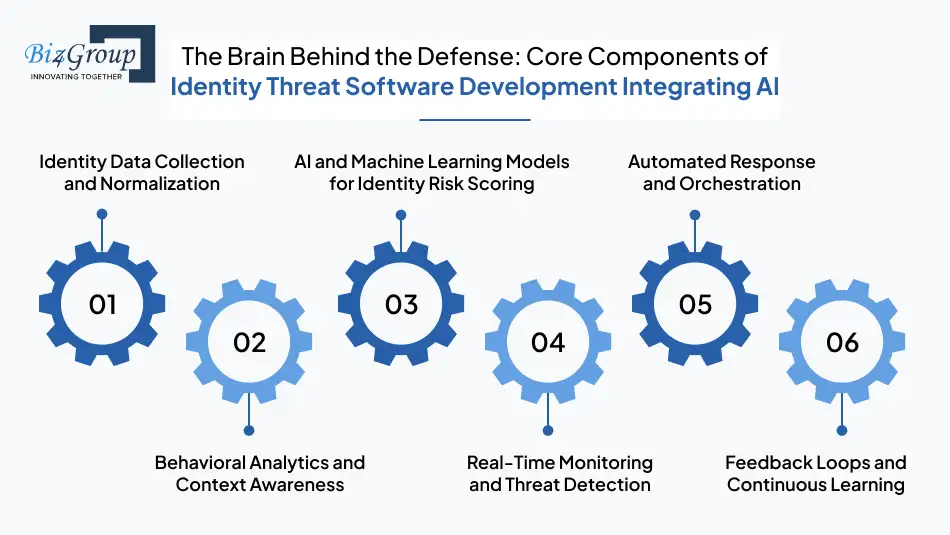
When you look under the hood of an effective identity threat platform, you will not find a single model doing all the work. What you will see instead is a set of connected components, each responsible for a specific decision.
Here is how identity threat software development integrating AI works in practice.
1. Identity Data Collection and Normalization
Everything starts with data. If identity signals are incomplete or fragmented, detection will always fall short.
- Collects identity events from logins, access requests, APIs, cloud platforms, and applications
- Pulls data from IAM, PAM, SIEM, SaaS tools, and custom systems
- Normalizes inconsistent formats into a unified identity activity stream
- Builds a single behavioral profile for each identity
This layer is critical for organizations using AI integration services to connect identity data across complex environments.
2. Behavioral Analytics and Context Awareness
Once data is unified, behavior becomes the strongest signal.
- Establishes baseline behavior for users, roles, devices, and services
- Monitors changes in access patterns, timing, location, and usage
- Adds context such as device trust, role sensitivity, and historical access
- Detects anomalies that rules-based tools often miss
This capability is essential when teams develop AI identity threat detection software that can adapt to real-world behavior.
3. AI and Machine Learning Models for Identity Risk Scoring
This is where intelligence shapes security decisions.
- Scores identity activity in real time using machine learning models
- Prioritizes threats based on risk and potential impact
- Continuously learns as identity behavior evolves
- Reduces false positives over time
This component sits at the core of AI identity security software development and enables teams to build AI powered identity threat solutions that scale.
4. Real-Time Monitoring and Threat Detection
Identity threats move quickly. Detection must move faster.
- Processes identity events as they occur
- Flags suspicious behavior before access is abused further
- Supports continuous evaluation, not just one-time checks
- Helps teams build AI identity threat software with real time monitoring across cloud and hybrid systems
5. Automated Response and Orchestration
Detection without action still leaves risk on the table.
- Triggers step-up authentication or access restrictions
- Automates containment based on risk severity
- Routes critical incidents to security teams with full context
- Coordinates actions across systems using intelligent workflows
Many modern platforms rely on decision logic powered by an AI agent to respond without delay.
6. Feedback Loops and Continuous Learning
Identity threats evolve constantly. Your system must evolve with them.
- Learns from confirmed incidents and analyst feedback
- Refines models based on outcomes and false alerts
- Adjusts thresholds as environments change
- Improves accuracy over time
This is what transforms detection into long-term protection.
When these components work together, identity security becomes proactive instead of reactive. That is the advantage of custom AI identity threat software development built for modern environments.
Designed for Different Environments: Types of AI Identity Threat Software Development
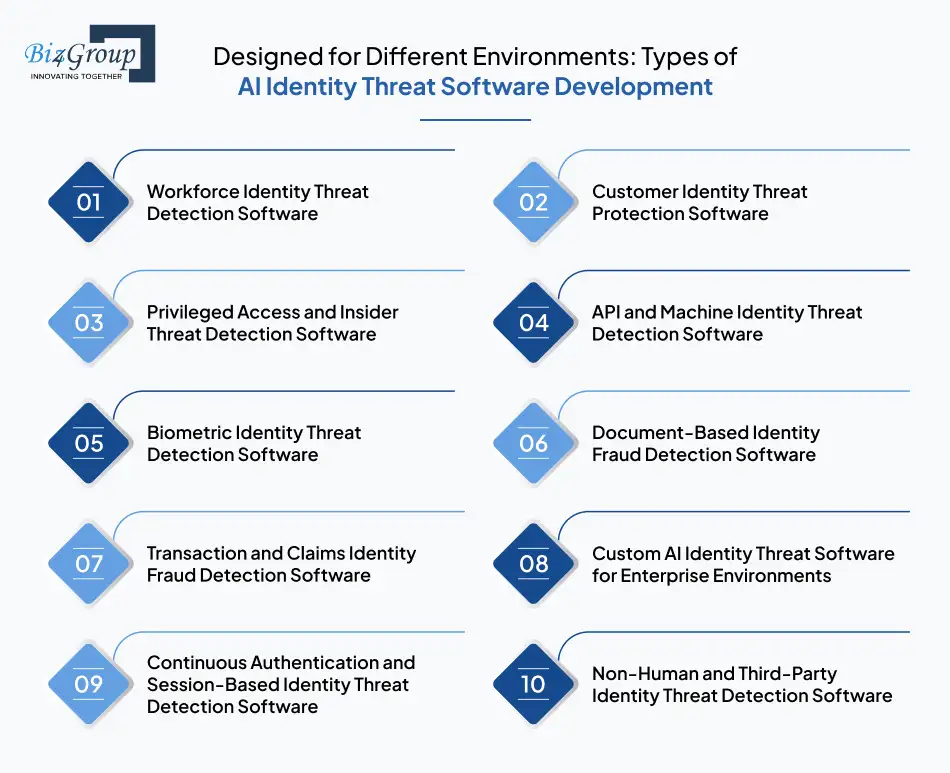
Different identity risks require different solutions. That is why AI identity threat software development for enterprises usually spans multiple system types. Each type focuses on a specific identity surface, while sharing the same AI-driven foundation.
1. Workforce Identity Threat Detection Software
This type protects employee and contractor identities across internal systems. It continuously analyzes login behavior, access patterns, and privilege usage to detect compromised accounts and insider misuse. Many organizations use this approach when they develop AI-driven identity threat software for secure operations across distributed teams.
2. Customer Identity Threat Protection Software
Customer-facing platforms deal with high volumes of identity activity. These systems monitor sessions, device behavior, and access patterns to detect account takeover and impersonation attempts. They are often part of identity threat detection software development initiatives aimed at balancing security with seamless user experience.
3. Privileged Access and Insider Threat Detection Software
Privileged identities create outsized risk due to their level of access. This software focuses on admin accounts, role changes, and privilege escalation. AI models help teams build AI identity fraud prevention systems that catch abuse early without blocking legitimate operational activity.
4. API and Machine Identity Threat Detection Software
Machine identities now outnumber human users in many environments. This type of system monitors API calls, service accounts, and automated processes to identify abnormal behavior. It is essential when organizations build AI identity threat software with real time monitoring for cloud-native and microservices architectures.
5. Biometric Identity Threat Detection Software
Biometric identity systems rely on physical traits such as facial recognition to verify users. An AI face recognition app uses AI models to detect spoofing and impersonation attempts in real time. Many teams also evaluate top facial recognition software's when they create AI identity protection platforms that include biometric verification.
6. Document-Based Identity Fraud Detection Software
Document-based identity systems validate users through IDs, licenses, and official records. Using AI document fraud detection software along with an AI-based OCR system allows businesses to extract data, verify authenticity, and reduce onboarding fraud. This approach supports teams that develop AI identity threat detection software for regulated workflows.
7. Transaction and Claims Identity Fraud Detection Software
Transaction-heavy industries rely on identity validation beyond login. Systems built for AI insurance fraud detection analyze identity behavior alongside transaction patterns. This helps organizations make AI identity threat software to reduce fraud across payments, claims, and high-risk workflows.
8. Custom AI Identity Threat Software for Enterprise Environments
Many enterprises need tailored solutions due to compliance, scale, or legacy infrastructure. Custom AI identity threat software development enables teams to design detection logic, integrations, and workflows that fit their environment. Partnering with a custom software development company makes it easier to build AI powered identity threat solutions that grow with the business.
9. Continuous Authentication and Session-Based Identity Threat Detection Software
This type focuses on identity risk after access is granted. Instead of trusting a single login event, it continuously evaluates behavior throughout an active session. Teams use this approach to create AI powered identity threat prevention system capabilities that adapt in real time as user behavior changes.
10. Non-Human and Third-Party Identity Threat Detection Software
This software monitors identities that operate outside traditional user accounts, including vendors, partners, and service integrations. AI models track how these identities interact with systems and flag abnormal access patterns. It is especially valuable for organizations that develop AI driven identity threat software for secure operations across complex ecosystems.
Each of these types addresses a different identity challenge, but all rely on continuous learning and contextual analysis. Together, they form the backbone of modern AI identity security software development.
Where It Hits Home: Industry Use Cases for AI Identity Threat Software Development
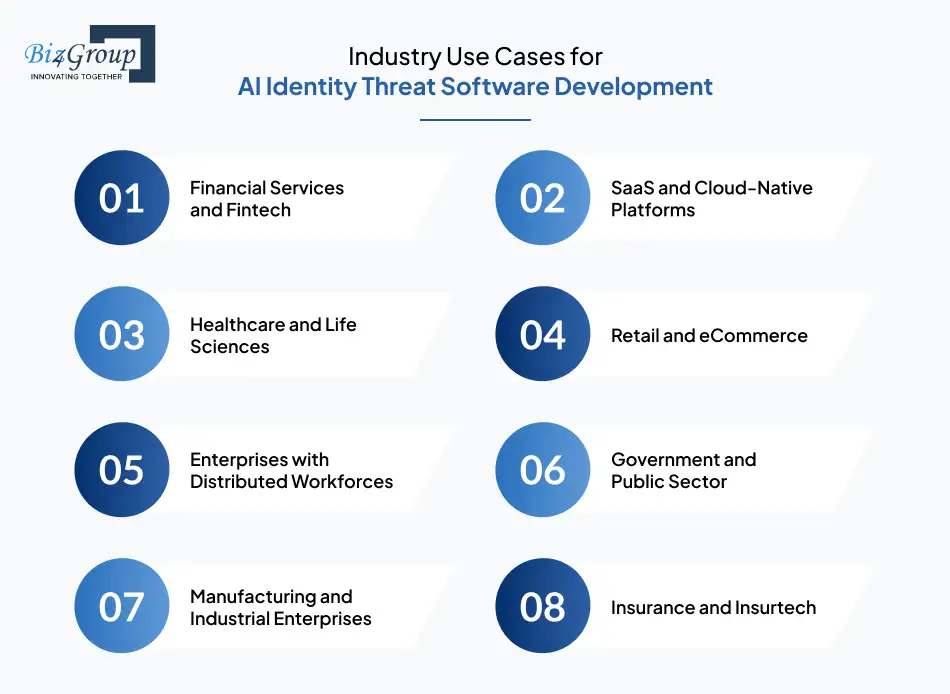
Identity risk plays out differently across industries. The access patterns, compliance pressures, and fraud tactics change, but the underlying challenge remains the same. Valid identities are being misused.
Here is how AI identity threat software development for enterprises applies across real-world industries.
1. Financial Services and Fintech
Financial platforms must secure customer identities across logins, transactions, and account changes. AI-driven identity systems analyze behavior continuously to detect fraud that bypasses traditional controls.
Example
A customer logs in from a new device and immediately initiates a high-value transfer. The system detects unusual behavior, triggers step-up verification, and pauses the transaction before funds are moved.
This is a common scenario where teams build AI identity fraud prevention systems to reduce losses without blocking legitimate activity.
2. SaaS and Cloud-Native Platforms
SaaS companies manage large volumes of users and permissions across applications. AI identity threat software monitors access behavior, feature usage, and session activity to spot abuse early.
Example
A standard user account suddenly begins accessing admin-level features it has never used before. The system flags the anomaly and alerts security teams before data exposure occurs.
This enables teams to build AI identity threat software with real time monitoring while maintaining a smooth user experience.
3. Healthcare and Life Sciences
Healthcare environments require strict control over patient data while supporting flexible access for clinicians and staff. AI identity systems track access behavior across roles and locations.
Example
A staff account accesses patient records outside assigned shifts and without a treatment-related reason. The system flags the activity for immediate review.
This allows organizations to develop AI identity threat detection software that supports compliance without slowing care delivery.
4. Retail and eCommerce
Retail platforms face constant threats from account takeover, bot activity, and loyalty fraud. AI identity software analyzes behavior across login, browsing, and checkout flows.
Example
An account rapidly changes shipping addresses, payment methods, and order volume within minutes. The system identifies the pattern and blocks checkout before fraud completes.
This is how businesses make AI identity threat software to reduce fraud without hurting conversion rates.
5. Enterprises with Distributed Workforces
Remote and hybrid work have expanded identity exposure. AI identity threat software tracks how employees normally access systems, tools, and data.
Example
An employee account begins accessing systems unrelated to their role or geography. The system detects the deviation and automatically restricts access.
This is a common use case for organizations that develop AI driven identity threat software for secure operations across global teams.
6. Government and Public Sector
Public sector organizations manage sensitive citizen data across multiple departments and legacy systems. AI identity threat detection helps identify compromised or misused accounts.
Example
An internal user attempts to access large volumes of citizen records outside normal workflows. The system flags the behavior before data is exposed.
This approach strengthens trust and reduces large-scale breach risk.
7. Manufacturing and Industrial Enterprises
Manufacturing environments combine IT and operational access. AI identity threat software monitors identities that interact with production systems and supplier portals.
Example
A service account accesses production systems outside scheduled maintenance windows. The system flags the activity before operational disruption occurs.
This supports teams that create AI identity protection platforms across digital and physical environments.
8. Insurance and Insurtech
Insurance organizations rely on identity verification across onboarding, claims, and policy changes. AI systems analyze behavior throughout these workflows.
Example
A claim submission shows identity behavior that deviates from historical patterns for similar cases. The system flags it for review before payout.
This is a key driver behind AI identity security software development focused on fraud prevention and compliance.
Features That Actually Matter in AI Identity Threat Detection Software Development
When you develop AI identity threat detection software, features should solve real security problems, not just look good on a slide. The table below outlines the capabilities that consistently show up in successful AI identity threat software development for enterprises.
| Feature | What It Does | Why It Matters |
|---|---|---|
|
Continuous Identity Monitoring |
Observes identity behavior across sessions, applications, and systems |
Detects threats that occur after login, not just during authentication |
|
Behavioral Analytics |
Builds behavior baselines for users, devices, and services |
Enables teams to build AI powered identity threat solutions with fewer false alerts |
|
Identity Risk Scoring |
Assigns dynamic risk scores to identity activity |
Helps prioritize incidents instead of reacting to every alert |
|
Real-Time Threat Detection |
Analyzes identity events as they occur |
Supports teams that build AI identity threat software with real time monitoring |
|
Context-Aware Access Control |
Adjusts access based on behavior, role, and environment |
Prevents misuse without disrupting legitimate work |
|
Automated Response and Remediation |
Triggers step-up authentication or access restrictions automatically |
Critical for create AI powered identity threat prevention system initiatives |
|
Privileged Identity Monitoring |
Closely tracks admin and high-risk accounts |
Reduces damage from insider threats and credential compromise |
|
API and Machine Identity Visibility |
Monitors service accounts and non-human identities |
Essential for identity threat software development integrating AI in cloud environments |
|
Explainable AI Alerts |
Shows why activity was flagged as risky |
Builds trust and speeds up investigations |
|
Centralized Risk Dashboards |
Displays identity threats in one view |
Improves operational efficiency for security teams |
|
Analyst Workflow Integration |
Connects detection with investigation and response tools |
Helps teams develop intelligent identity security applications |
|
Scalable Architecture |
Handles growth in users, identities, and data |
Required for AI identity threat software development for enterprises |
|
Compliance and Audit Reporting |
Logs identity activity and response actions |
Supports regulatory and audit requirements |
|
Continuous Learning Loops |
Improves detection accuracy over time |
Keeps AI identity security software development effective as threats evolve |
|
Usable Security Interfaces |
Makes alerts and actions easy to understand |
Often supported by strong UI/UX design |
|
Guided Human Interaction |
Helps analysts understand and act on alerts |
Some platforms enable this using conversational flows built by an AI chatbot development company |
For organizations planning custom AI identity threat software development, these features form a practical evaluation baseline. Missing any of them usually means higher noise, slower response, or increased risk.
Do Your Security Features Reduce Risk or Just Create Noise?
If alerts overwhelm your team and real threats still slip through, it may be time to rethink how your AI identity threat detection software development is designed.
Let's TalkFrom Idea to Production: Steps to Develop AI Identity Threat Detection Software
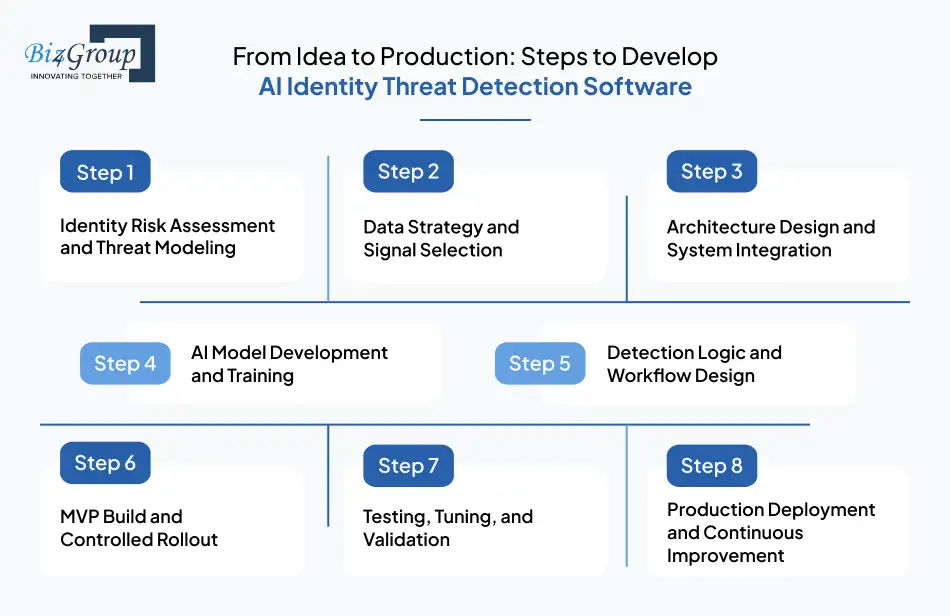
Building identity protection software is not about rushing into models or tools. It is about following a structured path that aligns security goals, data, and engineering decisions. Below is how organizations typically develop AI identity threat detection software that works in real environments.
Step 1: Identity Risk Assessment and Threat Modeling
This step defines what you are protecting and why. Teams analyze how identities interact with systems and where misuse could cause real damage. It ensures AI identity threat software development is grounded in business risk, not assumptions.
- Identify high-risk users, roles, and service accounts
- Map identity-based attack paths
- Prioritize risks based on impact
Step 2: Data Strategy and Signal Selection
AI-driven systems depend on the right signals. This step focuses on selecting identity data that reflects real behavior and risk. It forms the backbone of identity threat software development integrating AI.
- Select authentication logs, access events, and session data
- Normalize signals across tools and platforms
- Define data quality and retention policies
Step 3: Architecture Design and System Integration
Here, teams design how identity data moves through the system. Decisions made at this stage affect performance, scalability, and security. This is critical for custom AI identity threat software development efforts.
- Design secure data pipelines
- Integrate IAM, cloud, and security platforms
- Plan for low-latency processing
Step 4: AI Model Development and Training
This is where intelligence enters the system. Teams train models to understand identity behavior and spot anomalies that rules miss. Many organizations follow proven practices to build AI software that improves over time.
- Select ML techniques suited for identity data
- Train models on historical behavior
- Validate accuracy and minimize false alerts
Step 5: Detection Logic and Workflow Design
Models alone do not stop threats. This step defines how risk scores translate into actions. It ensures detection supports operational reality and enables teams to build AI powered identity threat solutions.
- Define thresholds and escalation logic
- Design automated and manual response flows
- Align workflows with SOC processes
Step 6: MVP Build and Controlled Rollout
Rather than deploying everything at once, teams start small. A focused release helps validate assumptions and reduce disruption. Many enterprises approach this through structured MVP development.
- Deploy detection in a limited scope
- Observe system behavior and impact
- Collect feedback from security teams
Step 7: Testing, Tuning, and Validation
Once live, tuning becomes continuous. This step improves accuracy and reliability as real-world behavior surfaces. It is essential for teams that develop intelligent identity security applications.
- Review false positives and missed threats
- Adjust models and thresholds
- Test against known identity attack scenarios
Step 8: Production Deployment and Continuous Improvement
Identity threats evolve constantly. This final step focuses on long-term performance and resilience. It is where AI identity threat software development for enterprises delivers sustained value.
- Monitor system health and performance
- Retrain models as behavior changes
- Continuously reduce risk and alert noise
Following these steps helps organizations build AI identity threat solutions that are practical, scalable, and resilient.
Choosing the Right Stack: Tech Stack for AI Identity Threat Software Development
A strong AI identity threat software development stack is not just about AI models. It spans frontend experiences, backend logic, data pipelines, and infrastructure that work together in real time.
Here is a clearer breakdown of the full stack used to develop AI-driven identity threat software for secure operations.
| Layer | Technologies / Components | Why It Matters |
|---|---|---|
|
Identity Data Sources |
IAM systems, PAM tools, cloud access logs, SaaS audit logs, API gateways |
Supplies raw identity signals needed for detection |
|
Data Ingestion and Streaming |
Kafka, Kinesis, Pub/Sub, message queues |
Enables near real-time processing of identity events |
|
Data Processing and Normalization |
Spark, Flink, custom ETL pipelines |
Standardizes identity data across multiple sources |
|
Backend Services and APIs |
Hosts detection logic, workflows, and integrations |
|
|
AI and ML Frameworks |
TensorFlow, PyTorch, Scikit-learn |
Powers behavioral modeling and anomaly detection |
|
Graph and Behavioral Analytics |
Graph databases, behavior modeling engines |
Identifies relationships between identities and access patterns |
|
Real-Time Risk Scoring Engine |
Custom scoring services, ML inference APIs |
Supports teams that build AI identity threat software with real time monitoring |
|
AI as a Service Layer |
Prebuilt AI models and inference APIs |
Many teams accelerate delivery using AI as a service APIs |
|
Frontend and Analyst Dashboards |
React, Angular, dashboards, visualization libraries |
Allows SOC teams to investigate and respond quickly |
|
User Experience Layer |
Alert flows, investigation views, guided actions |
Often refined through strong UI/UX design |
|
Automation and Orchestration |
Workflow engines, policy engines, automation scripts |
Enables automated response and remediation |
|
Security and Access Controls |
Encryption, secrets management, zero trust controls |
Protects sensitive identity and behavioral data |
|
Observability and Monitoring |
Logging, metrics, tracing, alerting tools |
Maintains reliability and performance |
|
Cloud and Infrastructure |
AWS, Azure, GCP, containers, Kubernetes |
Required for AI identity threat software development for enterprises |
|
Compliance and Audit Layer |
Audit logs, reporting engines, policy controls |
Supports governance and regulatory needs |
n practice, these layers must work together seamlessly. That is why many organizations partner with an experienced AI app development company to align frontend usability, backend performance, and AI accuracy from the start.
A well-structured stack makes it easier to create AI identity threat detection tools for cybersecurity teams that scale with users, data, and evolving threats.
What It Really Costs: AI Identity Threat Software Development Cost Breakdown
Before getting into line items, let’s set expectations clearly.
For most organizations, AI identity threat software development cost typically ranges from $35,000 to $250,000+. The final number depends on scope, feature depth, data complexity, and enterprise requirements. A lightweight MVP for identity threat detection sits at the lower end, while enterprise-grade platforms with real-time monitoring, automation, and compliance land on the higher end.
Now let’s break down where that budget actually goes and why.
Feature-Level Cost Breakdown in AI Identity Threat Software Development
| Feature Area | Estimated Cost Range | What Drives the Cost |
|---|---|---|
|
Identity Data Ingestion and Normalization |
$5,000 to $20,000 |
Number of identity sources, data volume, custom integrations |
|
Behavioral Analytics Engine |
$8,000 to $30,000 |
Complexity of behavior models and baseline creation |
|
AI and ML Model Development |
$10,000 to $60,000 |
Model type, training data quality, tuning effort |
|
Real-Time Risk Scoring and Monitoring |
$7,000 to $35,000 |
Latency requirements and streaming architecture |
|
Automated Response and Orchestration |
$6,000 to $25,000 |
Workflow complexity and system integrations |
|
Privileged and Machine Identity Coverage |
$5,000 to $20,000 |
Scope of identities and access depth |
|
Dashboards and Analyst Interfaces |
$4,000 to $15,000 |
Visualization depth and usability requirements |
|
Compliance and Audit Reporting |
$3,000 to $12,000 |
Regulatory scope and reporting detail |
|
Testing, Validation, and Tuning |
$4,000 to $18,000 |
False-positive reduction and scenario coverage |
These ranges are common for teams looking to build AI powered identity threat solutions that are production-ready, not experimental.
Key Factors That Affect AI Identity Threat Software Development Cost
Several variables push cost up or down during custom AI identity threat software development:
- Number of identity sources such as IAM tools, cloud platforms, APIs, and SaaS apps
- Real-time requirements for detection and response
- Volume and velocity of identity data
- Security and compliance requirements such as SOC 2, HIPAA, or financial regulations
- Level of automation expected in response workflows
- Enterprise scalability needs across regions and business units
Organizations building AI identity threat software development for enterprises typically invest more upfront to avoid limitations later.
Hidden Costs Most Teams Overlook
Hidden costs often surface after initial deployment and can impact ROI if not planned early.
- Ongoing AI model retraining as identity behavior changes
- False-positive management and analyst time
- Cloud infrastructure costs driven by real-time data processing
- Maintenance of integrations as tools evolve
- Security reviews and compliance audits
These costs are not obvious during early planning but are unavoidable when you develop AI driven identity threat software for secure operations.
How to Optimize AI Identity Threat Software Development Cost
Cost control does not mean cutting features. It means building smart.
- Start with a focused scope and expand gradually
- Prioritize high-risk identity use cases first
- Use modular architecture to avoid rebuilds
- Leverage prebuilt components where appropriate
- Validate assumptions early through staged releases
Many organizations manage this effectively by following proven frameworks for AI software development cost planning rather than estimating blindly.
When planned correctly, AI identity threat software development is not just a security expense. It is an investment in fraud reduction, operational efficiency, and business trust.
Wondering What AI Identity Threat Software Will Actually Cost You?
Budgets vary, but surprises should not. Understanding scope, hidden costs, and ROI early helps you build smarter and spend better on AI identity threat software development for enterprises.
Get a realistic cost estimateThe Hard Parts and How to Beat Them: Challenges in AI Identity Threat Software Development
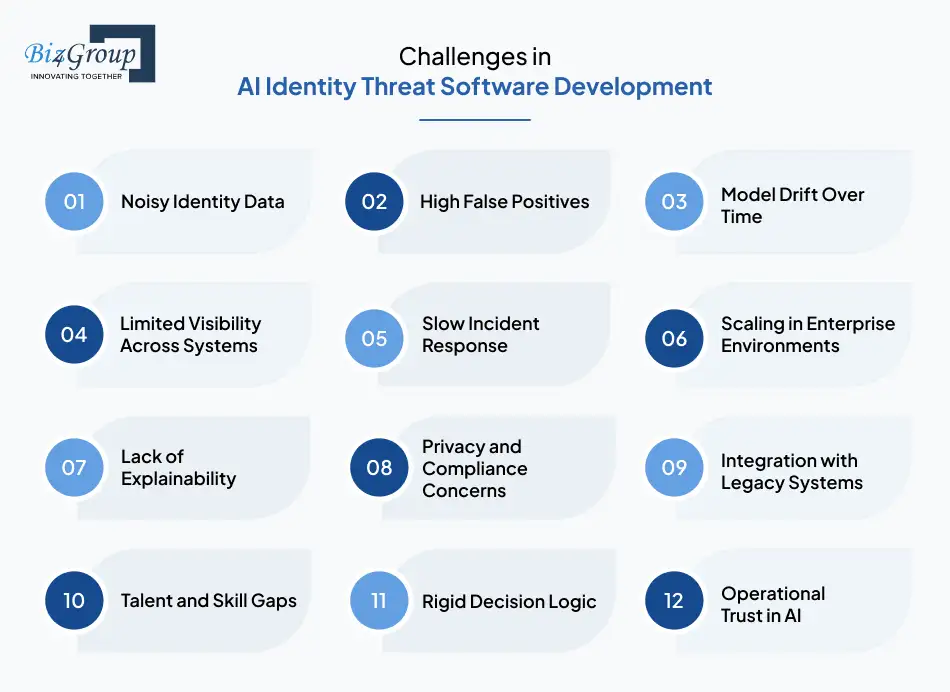
Building and scaling identity protection with AI comes with real obstacles. The table below outlines the most common challenges teams face during AI identity threat software development, along with practical ways organizations address them.
| Challenge | Why It Happens | How to Solve It |
|---|---|---|
|
Noisy Identity Data |
Identity signals come from many systems with inconsistent formats |
Normalize data early and prioritize high-signal identity events |
|
High False Positives |
Static thresholds cannot handle dynamic behavior |
Use behavioral baselines and adaptive risk scoring |
|
Model Drift Over Time |
Identity behavior changes as systems and users evolve |
Retrain models regularly and add continuous learning loops |
|
Limited Visibility Across Systems |
Identity data is siloed across tools |
Centralize identity signals during identity threat software development integrating AI |
|
Slow Incident Response |
Manual investigation delays containment |
Automate response workflows and escalation paths |
|
Scaling in Enterprise Environments |
Data volume and identity count grow rapidly |
Design for horizontal scaling and modular expansion |
|
Lack of Explainability |
AI decisions feel like black boxes |
Use explainable alerts with clear context and reasoning |
|
Privacy and Compliance Concerns |
Identity data is sensitive and regulated |
Apply data minimization, encryption, and audit controls |
|
Integration with Legacy Systems |
Older IAM and security tools were not built for AI |
Use adaptable integration layers and phased rollouts |
|
Talent and Skill Gaps |
AI security expertise is hard to find |
Partner strategically or hire AI developers with identity and ML experience |
|
Rigid Decision Logic |
Rule-based systems cannot adapt in real time |
Introduce adaptive decision-making using agentic AI development |
|
Operational Trust in AI |
Teams hesitate to rely on automated decisions |
Start with human-in-the-loop workflows and expand gradually |
These challenges are common, even for mature organizations. The difference lies in how early they are addressed. Teams that plan for them upfront are more successful when they develop intelligent identity security applications and scale them across the enterprise.
Solving these challenges turns AI identity threat software from an experimental project into a dependable security capability. That is what enables long-term success with AI identity threat software development for enterprises.
Why You Should Join the Journey of Building AI Identity Threat Software with Biz4Group LLC?
When you decide to develop cutting-edge identity threat detection systems, choosing the right partner matters. You need a team that understands security, data complexity, AI integration, and enterprise-grade delivery. That is exactly where Biz4Group LLC stands out.
Biz4Group is a Custom Software Development Company with deep expertise in secure, scalable, and intelligent platform builds. Our work spans AI-powered enterprise solutions that help businesses automate complex processes while enhancing user experience and operational safety. These capabilities directly translate to building reliable AI identity threat software, especially in document-based identity risk scenarios.
Project in Action: PDF Consultant AI

PDF Consultant AI is an intelligent document analysis platform built by Biz4Group. It allows users to upload documents and interact with them using AI-powered search, summarization, and contextual question answering. While designed for document intelligence, the underlying architecture closely aligns with document-based identity threat detection systems.
This project demonstrates how Biz4Group builds AI systems that process sensitive documents accurately, securely, and at scale.
Key Highlights:
- Unstructured document data extraction
AI models analyze and extract meaningful information from complex PDFs, similar to how identity threat systems inspect documents for manipulation or fraud. - Context-aware intelligence
The system understands intent and context, a critical capability when detecting forged documents, mismatched identity details, or suspicious patterns. - Secure data handling
Sensitive documents are processed with strict controls, which is essential for identity verification and compliance-driven workflows. - Scalable AI architecture
Built to support growing data volumes and users, reflecting the same requirements seen in enterprise identity threat platforms.
Why This Matters for Document-Based Identity Threats
Document fraud remains a major entry point for identity abuse. The same AI techniques used in PDF Consultant AI are foundational for:
- Detecting forged or altered identity documents
- Validating extracted identity attributes
- Reducing onboarding and verification fraud
Biz4Group’s experience with document intelligence gives you a proven starting point for building AI-powered identity threat solutions that handle real-world data, not idealized inputs.
Ready to Build Identity Security That Thinks Ahead?
From document intelligence to enterprise AI platforms, Biz4Group helps teams turn complex identity risks into secure, scalable solutions.
Contact UsWhat This Really Adds Up To!
Identity threats are no longer edge cases. They sit at the center of modern security risk, affecting customers, employees, partners, APIs, and documents. As identities multiply and environments become more dynamic, traditional controls fall short.
This is exactly why AI identity threat software development has shifted from a security upgrade to a business necessity. When done right, it helps you detect fraud earlier, reduce alert fatigue, protect digital trust, and scale securely. Organizations that develop AI identity threat detection software gain visibility into identity behavior that static tools simply cannot provide.
What truly makes the difference is execution.
Biz4Group LLC brings hands-on experience in custom AI identity threat software development, building secure, enterprise-ready platforms that handle sensitive data and complex workflows. From document intelligence to real-time behavioral analysis, we help businesses build AI powered identity threat solutions that are practical, scalable, and resilient. As an AI product development company, we focus on long-term value, not quick fixes.
Our work in AI identity security software development places us among the top custom AI software development companies in USA trusted by enterprises looking to strengthen cybersecurity and reduce identity-based risk.
If you are planning AI identity threat software development for enterprises, the smartest time to act is before identity abuse turns into business disruption.
Let’s build security that thinks ahead, together.
FAQ
1. What is AI identity threat software development and how is it different from traditional identity security?
AI identity threat software development focuses on continuous behavior analysis instead of static rules. Traditional identity security checks credentials at login, while AI-driven identity threat systems monitor behavior throughout sessions. This allows organizations to detect misuse of valid identities, insider threats, and fraud that legacy tools often miss.
2. Why do enterprises need AI identity threat software development now?
Enterprises operate across cloud platforms, remote workforces, APIs, and third-party systems. Identity has become the primary attack surface. AI identity threat software development for enterprises helps detect identity abuse in real time, reduce fraud, and scale security without slowing business operations.
3. How does AI identity threat detection software reduce fraud and false positives?
AI models learn normal behavior patterns for users, devices, and systems. When organizations develop AI identity threat detection software, they rely on behavioral baselines and contextual risk scoring instead of rigid rules. This significantly reduces false alerts while catching high-risk activity earlier.
4. What are the core features to look for in AI identity threat software development services?
Key features include continuous identity monitoring, behavioral analytics, real-time risk scoring, automated response, explainable alerts, and scalability. Strong AI identity threat software development services also support integration with IAM, SIEM, and cloud platforms to ensure full visibility.
5. Can AI identity threat software integrate with existing IAM and security tools?
Yes. Most organizations choose identity threat software development integrating AI so it works alongside existing IAM, PAM, SIEM, and cloud security tools. Integration allows teams to enhance detection without replacing current systems, reducing disruption and cost.
6. How much does AI identity threat software development cost?
The AI identity threat software development cost typically ranges from $35,000 to $250,000+, depending on scope, features, data complexity, and enterprise requirements. MVPs focused on a few identity risks cost less, while full platforms with real-time monitoring and automation cost more.
7. Should businesses build or buy AI identity threat software?
It depends on flexibility and long-term goals. Off-the-shelf tools work for basic needs, but many enterprises choose custom AI identity threat software development to fit their environment, compliance needs, and risk profile. Custom solutions offer better control, scalability, and differentiation over time.
