Location :
Orlando, FL, USA
Location :
Orlando, FL, USA +1 (407) 714-1616
 info@biz4group.com


















Imagine a digital system that doesn’t wait for instructions but instead, understands your business goals, learns from real-time feedback, and takes independent actions to get the job done.
Read More

Be honest for a moment. Have you looked at your current platform and thought it should be doing more by now? Maybe it feels clunky. Maybe your team is spending hours on work that should already be automated. Or maybe your customers expect smarter experiences while your system still behaves like it did three years ago. If any of this hits close to home, you’re not the only one feeling that pressure.
The numbers tell the same story. 95 percent of companies now use AI driven capabilities across their software, and teams rely on an average of seven AI enabled SaaS tools in 2025. And with the AI SaaS market climbing past 22 billion dollars in 2025, the gap between modern platforms and outdated ones keeps getting wider.
This is why conversations around AI SaaS website platform development have become impossible to ignore. Companies want to develop AI SaaS website for businesses that can evolve quickly instead of waiting for the next big rebuild. They want to create intelligent SaaS website platforms for businesses that personalize experiences, automate day to day tasks and support growth without adding more stress to the team.
We see this shift every day. When teams start working with an AI development company early on, they begin to see what their platform could be, not just what it currently is. And once they anchor their roadmap around a modern AI SaaS product, the entire development process becomes clearer. Suddenly, scaling feels doable. Feature updates feel faster. Users feel more satisfied. And the business moves from reacting to leading.
Think of this guide as your roadmap. We will break down what these platforms actually are, why they matter and how you can build one without stumbling through guesswork. By the end, you will know exactly what steps to take to build a platform that grows with you instead of holding you back.
Ready to jump in and see what a future ready platform looks like? Let’s dive in.
Let’s start with the basics. Before you can shape a smarter product, it helps to understand what traditional SaaS brings to the table and where it starts falling short. Many teams today rely heavily on SaaS because it is simple to launch, easy to manage and designed to scale. You access the software through the web, the provider handles maintenance and your team focuses on using the tool rather than supporting it.
Over time though, most companies notice the same pattern. A classic SaaS platform works well in the beginning but becomes harder to personalize as the user needs to evolve. It does not adjust to new behaviors on its own. Your team ends up making manual updates again and again just to keep the experience relevant.
This is where AI powered platforms step in.
AI SaaS builds on the traditional model but adds intelligence at the core. Instead of relying on static rules or fixed workflows, the platform learns from patterns, streamlines routine tasks and adapts to how people actually use the product. This is the foundation of AI SaaS website platform development, and it is why more organizations are shifting toward creating smarter digital ecosystems instead of maintaining outdated ones.
As companies aim to develop AI SaaS website for businesses that can grow with their customers, they also want tools that reduce operational friction. When your system can guide users, personalize content or automate multi step workflows without manual supervision, your team gets the breathing room it needs to focus on higher level priorities.
To reach this level of intelligence, your platform must connect smoothly with data, tools and processes. Many businesses start with AI automation services to simplify repetitive tasks that slow down operations. Others lean on AI integration services when they want a platform that communicates cleanly across multiple systems. Both support the broader goal of creating intelligent SaaS website platforms for businesses that operate efficiently from the inside out.
If you have ever wished your product could keep up with customer needs without constant manual effort, AI SaaS solves that problem directly. Companies find themselves exploring building an AI SaaS web platform when they want more adaptability and fewer operational headaches.
Here are the advantages that stand out most.
Key Advantages of AI SaaS Platforms
Once these pieces come together, the value becomes obvious. AI SaaS gives you a platform that supports growth instead of resisting it. Your team spends less time fixing issues and more time building momentum.
Now that we have the foundation covered, let’s look at the types of industry ready platforms companies are building in 2026 and where AI driven SaaS delivers the biggest impact.
Partner with our team to create intelligent SaaS website platforms for businesses that automate workflows, personalize experiences, and scale effortlessly.
Get Started Now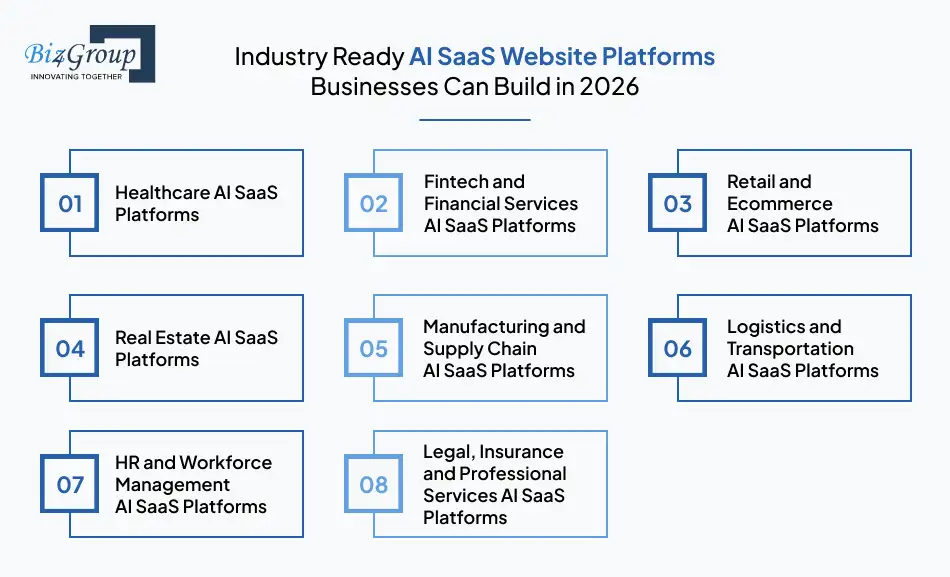
As more companies look to build an AI SaaS website platform, one thing stands out. Different industries expect very different capabilities. A healthcare platform focuses on patient accuracy. A retail platform focuses on personalization. A logistics platform focuses on speed. This is why AI SaaS website platform development works best when it reflects the specific problems of the industry it serves.
Below are the sectors where intelligent platforms create the strongest impact for businesses that want to make AI driven SaaS website solutions that truly improve performance.
Healthcare teams often feel overwhelmed with manual entry, long queues and disconnected data. When you create an AI SaaS website for subscription-based software products in this space, you help care teams deliver faster, safer and more consistent patient experiences.
Use cases
Benefits
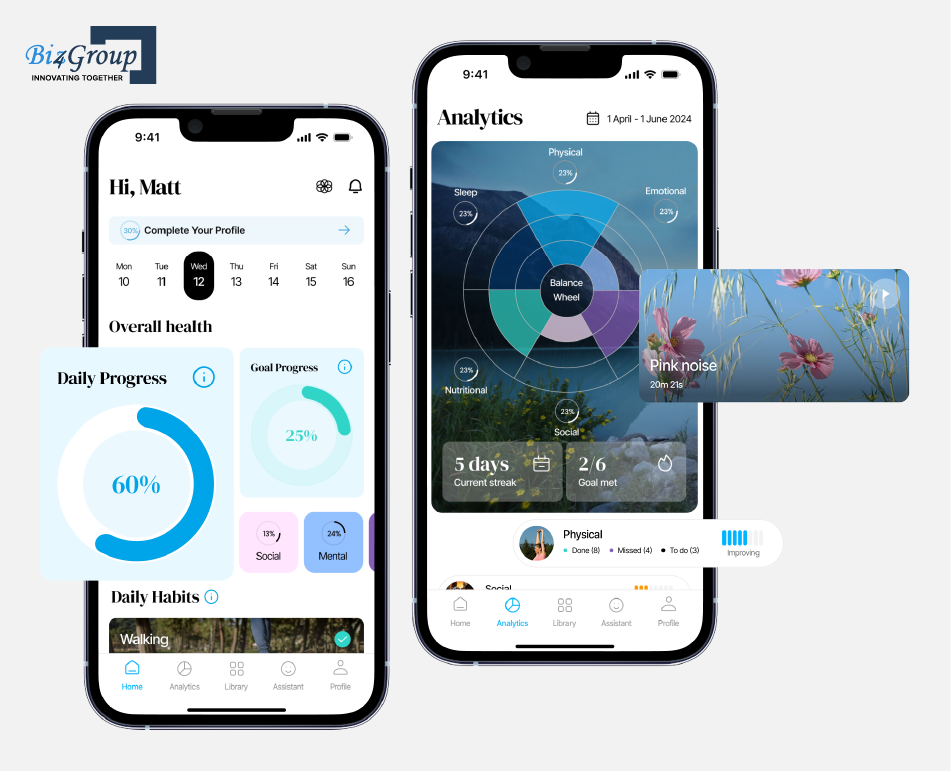
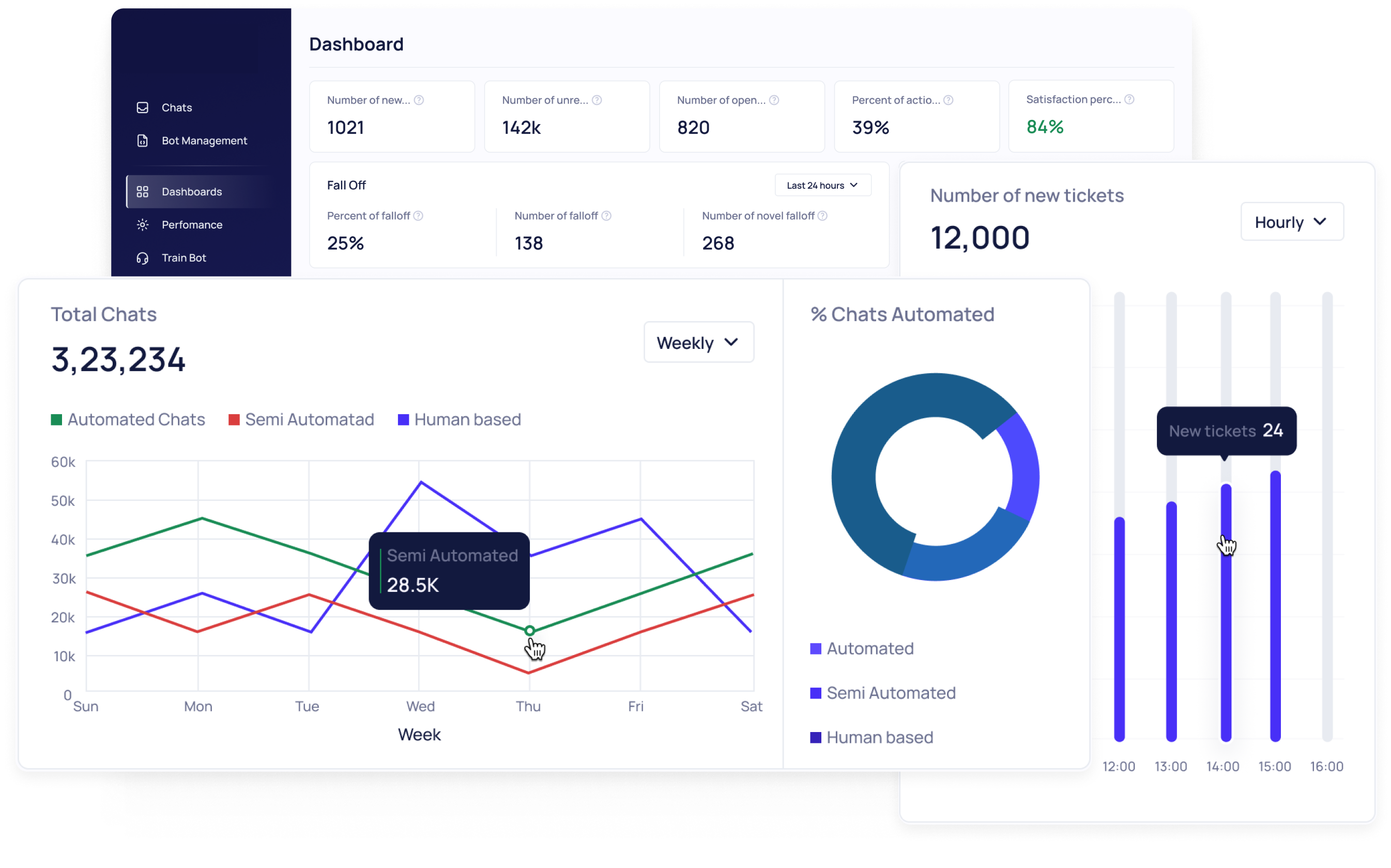
One practical example of these capabilities in action is Quantum Fit, a fitness and wellness platform built by Biz4Group LLC.
While it focuses on personal health and performance, it uses many of the same principles that modern healthcare platforms rely on. It shows how a well-built AI SaaS website platform can adapt, guide and support users through data-driven insights.
Key highlights
Quantum Fit demonstrates how automation, personalization and intelligent design come together to support healthier, more informed decision making for users. The same structure applies beautifully to clinical and wellness platforms.
Financial operations depend on accuracy and compliance. Static tools rarely keep up with new patterns, which is why teams adopt scalable systems backed by enterprise AI solutions to reinforce decision making.
Use cases
Benefits
Retail and Ecommerce platforms that adapt to customer behavior instantly. Modern systems that create AI powered SaaS website platforms help brands stay ahead of shifting demand.
Use cases
Benefits
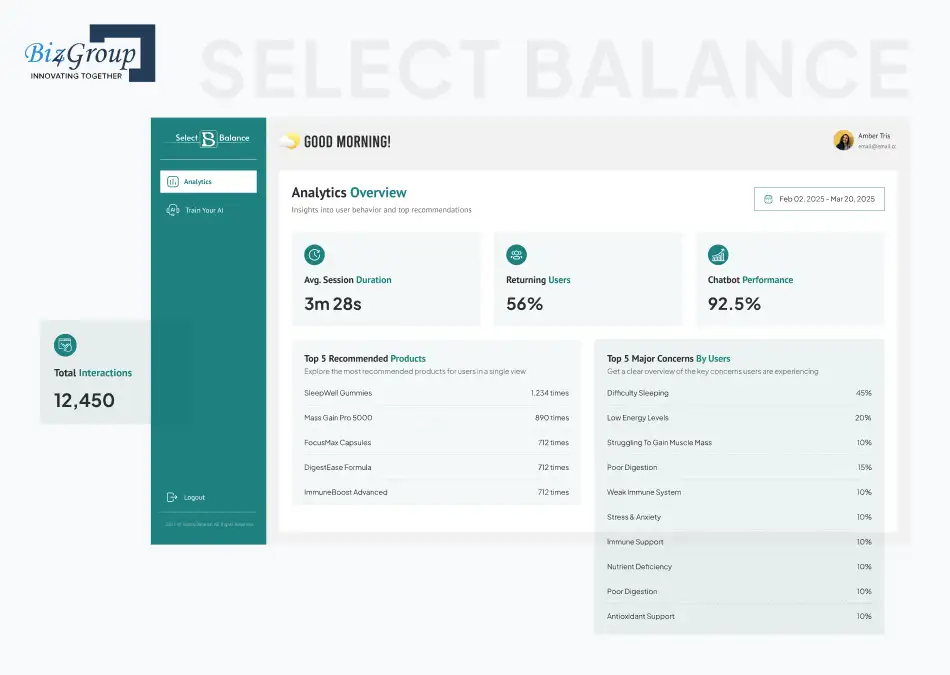
A strong example of how these capabilities play out in retail is Select Balance, a wellness and lifestyle ecommerce platform created by Biz4Group LLC.
Select Balance shows how a modern ecommerce brand can use the principles of AI SaaS website platform development to deliver a smoother shopping experience and more relevant product discovery.
Key highlights
Select Balance demonstrates how personalization, automation and a well-structured interface can transform typical ecommerce challenges into high value opportunities.
Real estate professionals deal with mountains of data. Intelligent platforms simplify their workflow. Many turn to an AI real estate SaaS product when they want a more modern, streamlined system.
Use cases
Benefits
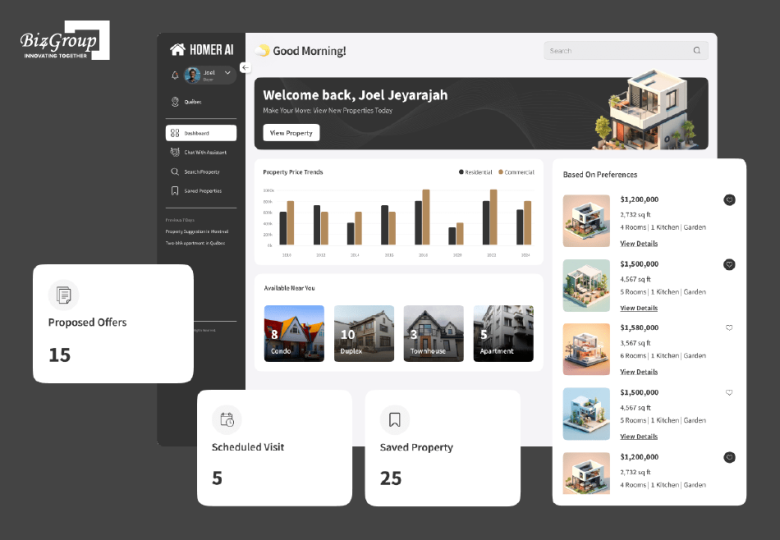
A great example of how these capabilities come together is Homer AI, a real estate intelligence platform designed to simplify home discovery and streamline decision making.
Homer AI shows how thoughtful AI SaaS website platform development can help buyers, sellers and agents navigate information more easily while reducing manual workload on both sides.
Key highlights
Homer AI demonstrates how a well-built real estate platform can bring clarity, speed and intelligence to one of the most complex buying processes customers experience.
Manufacturers need systems that prevent delays, not just report them. Teams often begin building an AI SaaS web platform when they want real time visibility.
Use cases
Benefits
Logistics companies rely heavily on precision. Intelligent systems help you develop cloud-based AI SaaS website operations that run smoother with fewer manual steps.
Use cases
Benefits
HR teams need clarity, not more spreadsheets. Intelligent tools help companies make customizable AI SaaS website solutions that support people centric operations.
Use cases
Benefits
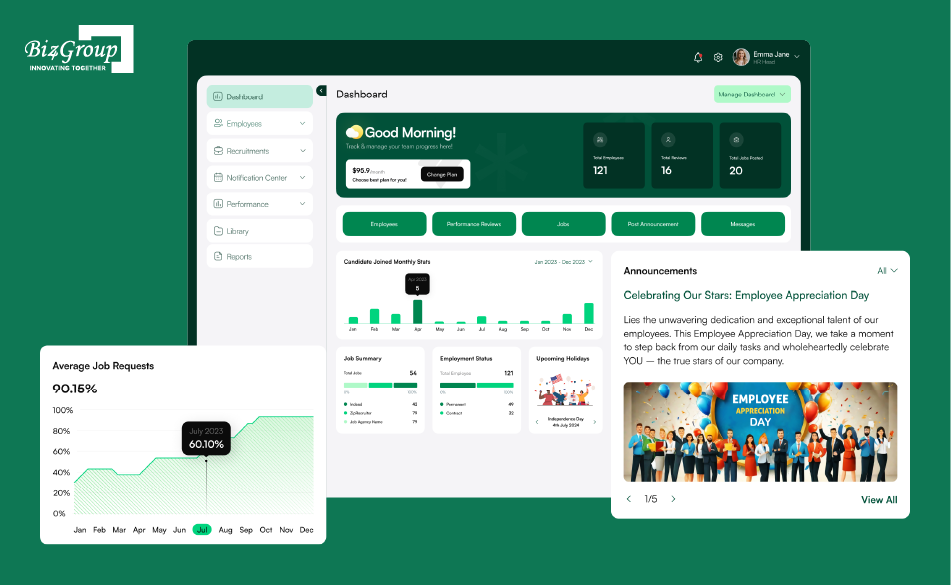
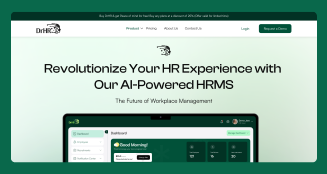
A strong example in this space is DrHR, a modern HR and recruitment platform created by Biz4Group LLC.
DRHR is designed to simplify hiring, boost team visibility and help HR departments create a smoother experience for both candidates and employees. It showcases how thoughtful AI SaaS website platform development can solve common HR bottlenecks and improve overall talent management.
Key highlights
DRHR shows how HR platforms become far more effective when automation, intelligent analysis and user-friendly design work in harmony.
These industries depend on accuracy and document heavy work. Intelligent systems help firms create a scalable AI SaaS web platform for businesses that manage risk and paperwork efficiently.
Use cases
Benefits
As you can see, every industry benefits differently when you make AI driven SaaS website solutions that match real world needs. Once you understand the use cases and strengths across sectors, it becomes much easier to shape your own roadmap and decide what features your platform should prioritize.
Now that you know where AI delivers the strongest value, let’s move into the next section and break down the must have features that separate average platforms from high performing ones.
When you decide to build an AI SaaS website platform, the features you choose early on determine how well your product performs, how quickly it scales and how satisfied your users feel. Many founders start by listing everything they want, but the real difference lies in choosing the essentials that make the platform intelligent, predictable and easy to use.
Below is a simplified table that explains each core feature in plain language, so you can decide what your platform must include from day one.
|
Feature |
What It Actually Means and Does |
|
Adaptive UI with intelligent personalization |
Your platform responds to user behavior instead of staying static. Navigation adjusts, recommendations shift and workflows feel smoother. Strong personalization usually begins with thoughtful UI/UX design, which ensures users get an intuitive experience from the first click. |
|
Automated user workflows |
Repetitive tasks such as onboarding, follow ups, request approvals and notifications run automatically. This helps you make AI driven SaaS website systems that save time and reduce errors without adding operational overhead. |
|
Smart recommendations and predictive insights |
The platform studies trends, past actions and real time usage to guide users toward the next step. This could mean product suggestions, recommended content or operational insights for your team. It strengthens engagement and decisions across the board. |
|
Instead of relying only on support tickets, your system can chat with users directly. Solutions from an AI chatbot development company help users get instant answers, request help, complete actions or navigate your platform effortlessly. |
|
|
AI agent driven automation |
Autonomous assistants, supported by an AI agent, can take actions on behalf of the user. They can monitor data, schedule tasks, send reminders or manage workflows automatically. These agents reduce manual oversight and make your platform feel truly intelligent. |
|
Multitenancy and secure access management |
One platform supports multiple businesses or user groups while keeping each dataset fully isolated. This is essential when you create intelligent SaaS website platforms for businesses that serve many clients at once. |
|
Real time analytics and dashboards |
Your platform continuously collects and processes live data, giving you immediate visibility into performance, customer behavior and system health. This helps teams refine features, optimize operations and make decisions backed by real information. |
|
Flexible integrations and API friendly structure |
Your platform connects smoothly with other tools such as CRMs, payment systems, communication apps or data services. This allows you to create AI powered SaaS website platforms that fit naturally into your customer’s existing workflows. |
|
Subscription billing and automated payments |
Your platform supports multiple revenue models such as monthly subscriptions, usage based pricing or tiered access. Billing, invoicing and renewal cycles run without manual handling, giving you predictable recurring revenue. |
|
Scalable cloud foundation |
Your system expands as your user base grows. When you develop cloud-based AI SaaS website platforms, you reduce downtime, improve performance and ensure your application can handle spikes in traffic without breaking. |
|
Role based permissions and controlled access |
Each user sees only what they need. Admins, managers and end users get personalized visibility and access levels. This improves platform security and keeps workflows clean and organized. |
When these features work together, they create a platform that feels smart, responsive and genuinely helpful for users. More importantly, they form the foundation of scalable AI SaaS website platform development so your product stays future ready instead of needing a rebuild every year.
Next, let’s walk through the step-by-step process of building your platform so you can move forward with clarity.
If you are planning to create intelligent SaaS website platforms for businesses, we can help you design and develop the right foundation from day one.
Let's Talk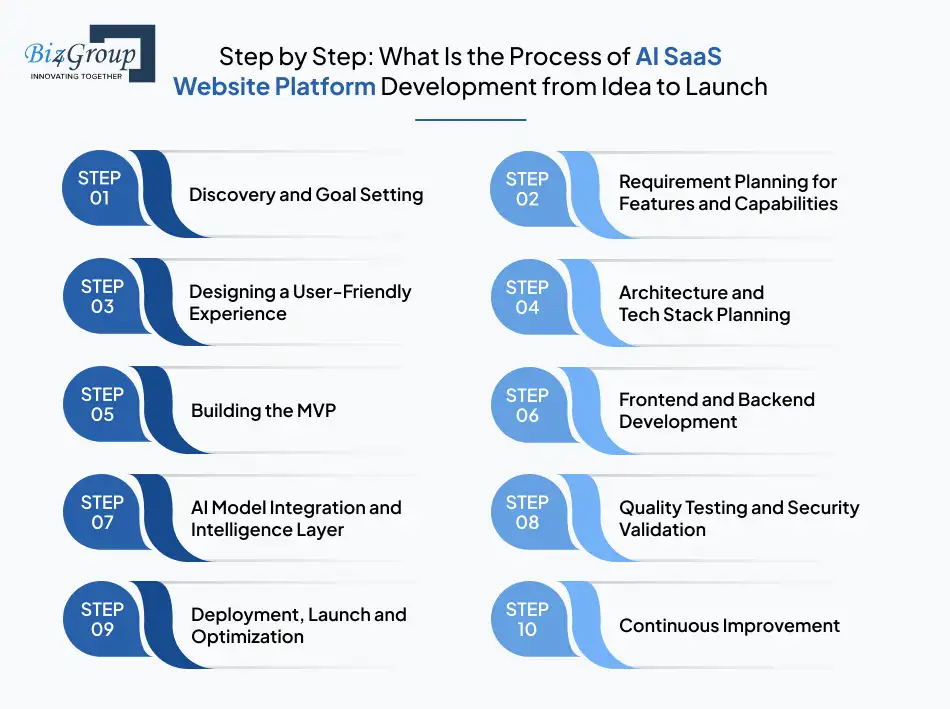
Creating an AI SaaS website platform becomes far less overwhelming when you follow a clear, phased roadmap. These steps help you move from concept to launch with confidence while making sure your product supports automation, personalization and scalability from the start. Whether your goal is to build intelligent SaaS website with multitenancy and AI agents or develop AI SaaS website for businesses, this framework keeps your progress structured and predictable.
This stage helps you understand the purpose behind your platform. You uncover real user pain points, explore business goals, and decide what your product must accomplish. Clear discovery prevents wasted effort later.
What to focus on
Once your goals are clear, you list all essential features your platform needs. This step sets expectations for product behavior and the intelligence layer that will later support automation.
What to focus on
Design plays a huge role in adoption. A clean, intuitive interface helps users understand your platform without confusion. Many teams partner with a Custom software development company to ensure their layouts and flows support long term growth.
What to focus on
Your platform needs a strong foundation to support intelligence, automation and scalability. This is where you choose backend systems, databases, cloud environments and other tools for AI SaaS website platform development.
What to focus on
Before you commit to a full build, you create a simplified version of your product. An MVP helps you validate user behavior early and refine your direction before adding intelligence. This is where MVP development becomes essential.
What to focus on
Now you have built the complete system. Developers implement the visual interface, core backend logic and database structures. A clean foundation helps you create an AI SaaS website for subscription based software products that can grow without breaking.
What to focus on
Also Read: How to Integrate AI into an App
This is the stage where your platform becomes truly intelligent. You add predictive insights, personalized experiences and automation. Teams often use agentic AI development to support tasks, workflows and decision making.
What to focus on
Your platform should feel polished and reliable. Testing ensures your workflows run smoothly, your AI behaves properly and your system stays secure.
What to focus on
This is where your platform goes live. You deploy to a secure cloud environment, monitor user activity and make improvements based on real behavior. This helps you create a scalable AI SaaS web platform for businesses that adapts as usage grows.
What to focus on
AI powered platforms grow smarter over time. Regular updates help your product stay relevant and competitive.
What to focus on
When you follow these steps, you reduce guesswork and build a platform that evolves with your customers rather than holding your business back. This approach gives you a strong foundation for building an AI SaaS web platform that performs well today and scales confidently into the future.
Up next, let’s look at how to choose the right tech stack so your platform has the power, flexibility and intelligence it needs from day one.
Your tech stack shapes everything from performance to scalability. Choosing the right layers early on prevents expensive rebuilds later and ensures you can build SaaS websites with AI automation that grow smoothly as your user base expands. Below is a clear, practical breakdown of the stack you should consider for modern AI SaaS website platform development.
|
Layer |
Tools / Tech |
Description |
|
Frontend Frameworks |
React, Next.js, Vue, Angular |
These tools help you build fast and intuitive user interfaces. A strong frontend is essential when you want to make AI driven SaaS website platforms that personalize content, adjust layouts and respond to user behavior instantly. |
|
Backend Frameworks |
Your backend handles business logic, data workflows and system communication. A reliable backend ensures your AI insights appear quickly, making your platform feel seamless and dependable. |
|
|
Databases |
PostgreSQL, MongoDB, DynamoDB |
Modern databases store structured and unstructured data efficiently. This is important when you create AI powered SaaS website platforms that depend on behavior tracking, forecasting and real time updates. |
|
AI and Machine Learning Tools |
TensorFlow, PyTorch, LangChain, Azure OpenAI, Google Vertex |
These tools power predictions, automation and personalization. Many teams use AI as a service APIs to accelerate development. Founders also learn from how startups using AI as a service (AIaaS) scale fast without building everything from scratch. |
|
Cloud Platforms |
AWS, Google Cloud, Azure |
Cloud providers help you develop cloud based AI SaaS website products that scale globally, handle traffic spikes and maintain high uptime. Cloud environments also simplify deployment and resource management. |
|
DevOps and CI/CD |
Docker, Kubernetes, GitHub Actions, Jenkins |
These tools automate deployment, testing and updates. They help you release features faster and maintain stability as you create a scalable AI SaaS web platform for businesses. |
|
MLOps Tools |
MLflow, Kubeflow, SageMaker |
MLOps tools let you monitor AI models, track performance and retrain when needed. This keeps your platform accurate, reliable and future ready. |
|
APIs and Third-Party Integrations |
REST APIs, GraphQL, Webhooks |
Integrations help your platform connect with CRMs, payment gateways, eCommerce tools and more. Flexible APIs allow you to create intelligent SaaS website platforms for businesses that fit naturally into existing tech stacks. |
|
Security & Compliance Tools |
IAM, OAuth, JWT, encryption libraries |
These tools keep your data safe and ensure compliance with standards like HIPAA, SOC 2 and GDPR. Strong security is non-negotiable for any modern platform. |
|
Analytics & Tracking |
Mixpanel, Segment, Google Analytics |
These tools help you understand usage patterns, measure engagement and refine your product roadmap. They are crucial for long-term optimization. |
A well-chosen tech stack gives your platform the strength it needs to grow without breaking. When each layer supports automation, scalability and intelligence, you set the foundation for building a reliable and future ready AI SaaS website platform that your customers can trust.
Also Read: React JS Development Services
If you’re exploring AI SaaS website platform development, one of the first questions on your mind is probably the cost. Most founders and tech leaders want a realistic estimate before committing resources. While every project is unique, most platforms fall in the range of $40,000 to $250,000+, depending on complexity, integrations, AI depth and scalability requirements. Your actual investment may differ because several factors influence pricing, which we’ll break down clearly below.
To help you understand these numbers better, this section covers the cost of building an AI SaaS web platform, the elements that increase or decrease pricing, the hidden expenses teams often overlook, and how you can optimize your budget without compromising quality. For deeper insights, you can also reference the guide on AI SaaS product development cost and the breakdown for AI B2B website development cost.
The table below outlines the primary cost components involved in building an AI SaaS web platform along with typical price ranges.
|
Cost Component |
Estimated Cost Range |
What It Includes |
|
Discovery and Planning |
$3,000 to $15,000 |
Market research, requirement documentation, feature prioritization, early user journey mapping |
|
UI and UX Design |
$5,000 to $25,000 |
Wireframes, visual layouts, interactive prototypes, branding alignment and accessible design |
|
Core Platform Development |
$20,000 to $120,000 |
Frontend, backend, databases, APIs, dashboards, multitenancy setup, subscription features |
|
AI Features and Intelligence Layer |
$10,000 to $80,000 |
Integrating models, training data pipelines, automations, recommendations, predictions |
|
Cloud Setup and Infrastructure |
$3,000 to $20,000 |
Hosting, cloud configuration, scalability planning, DevOps pipelines |
|
Testing and Quality Assurance |
$5,000 to $20,000 |
Functional testing, performance checks, data validation, security review |
|
Deployment and Launch |
$2,000 to $10,000 |
Cloud deployment, environment setup, analytics integration, monitoring tools |
|
Ongoing Maintenance and Improvements |
$2,000 to $15,000 per month |
Support, bug fixes, feature updates, AI retraining, security patches |
These figures reflect typical ranges for companies looking to make AI driven SaaS website platforms with solid fundamentals and room to scale.
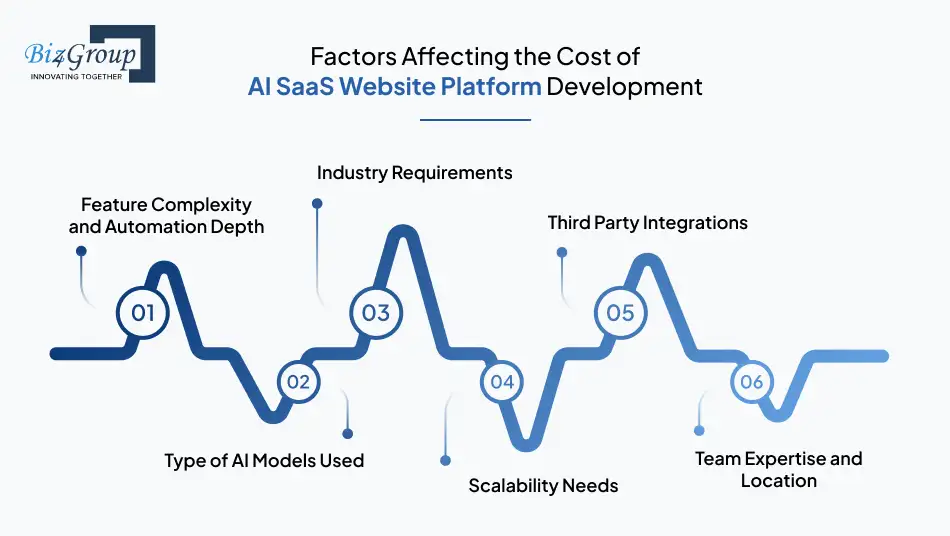
The final price depends on several factors tied to complexity, team size, industry needs and long-term goals. Here are the biggest cost drivers.
Platforms with more automation, personalization or advanced intelligence naturally cost more to build.
Cost influencers
Choosing between pretrained APIs and custom models has a major impact.
Pretrained models = lower cost
Custom trained models = higher cost but more accuracy
Industries like healthcare, fintech and legal require higher security and compliance, leading to increased development effort.
If you want to create a scalable AI SaaS web platform for businesses, cloud infrastructure and multitenancy planning will increase cost upfront but reduce expenses later.
CRMs, payment gateways, logistics systems, ERPs and communication tools add time and cost depending on their complexity.
US based teams tend to cost more but deliver better quality and security.
These expenses are easy to underestimate when planning to develop cloud based AI SaaS website products.
If you want to optimize your investment while building an intelligent platform, focus on these core tactics.
Whether your budget leans toward a focused MVP or a full-scale solution, we will help you plan, prioritize and make AI driven SaaS website platforms without overspending.
Get Your Quotes Today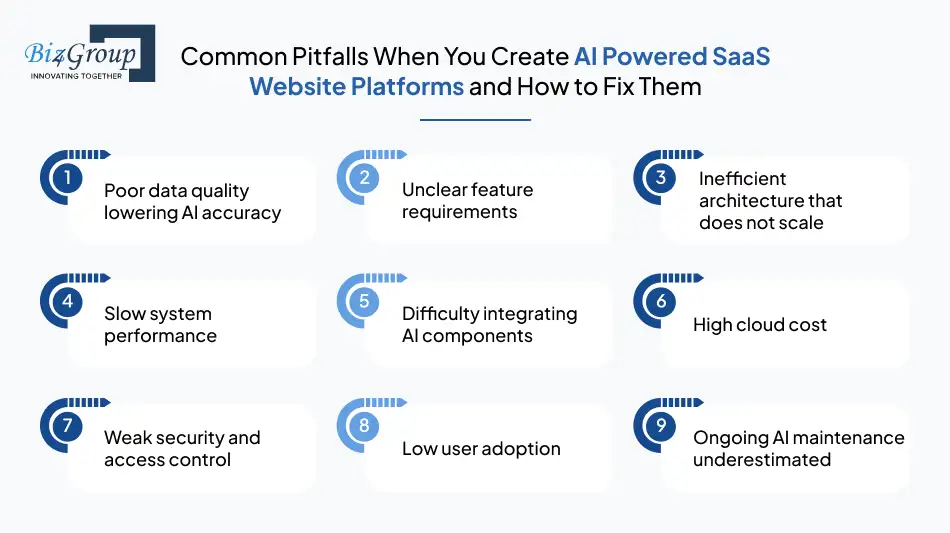
Even with a solid plan, building an AI SaaS website platform comes with challenges that can slow development or impact quality. These issues appear often during AI SaaS website platform development, especially when teams try to make AI driven SaaS website features without proper structure. Below is a clear table outlining the most common obstacles and how to solve them effectively. If a project requires specialized skills, teams sometimes choose to hire AI developers handle complex tasks with accuracy.
|
Challenges |
What Causes It |
Practical Solution |
|
Poor data quality lowering AI accuracy |
Inconsistent, outdated or unstructured data affecting predictions |
Clean and map data early, set up validation rules, prepare structured datasets for reliable AI outcomes |
|
Unclear feature requirements |
Teams jump into development without defining expectations for automation or intelligence |
Document core workflows, prioritize features that support AI SaaS website platform development, refine user journeys |
|
Inefficient architecture that does not scale |
Choosing short term solutions that cannot support growth |
Use modular design, plan multitenancy, prepare cloud structure to create a scalable AI SaaS web platform for businesses |
|
Slow system performance |
Heavy AI calls, unoptimized backend or low-grade infrastructure |
Optimize queries, use caching, refine model triggers and prepare efficient cloud resources |
|
Difficulty integrating AI components |
Selecting tools or models without considering compatibility |
Start with smaller pretrained models, expand gradually, use frameworks built for develop AI SaaS website for businesses |
|
High cloud cost |
Overprovisioned services or inefficient resource usage |
Monitor usage, right size servers, plan early cloud optimization for developing cloud-based AI SaaS website solutions |
|
Weak security and access control |
Missing encryption, unclear permissions or poor storage practices |
Implement strong authentication, encrypt sensitive data and create role-based access |
|
Low user adoption |
Complex UI or unclear value in intelligent features |
Simplify workflows, make onboarding easier, adjust interface to support create AI powered SaaS website platforms |
|
Ongoing AI maintenance underestimated |
Assuming AI is a one-time setup |
Plan regular retraining, track model drift, prepare MLOps routines so intelligence stays accurate |
When you understand these challenges early, you avoid major setbacks and build faster. A strong strategy, clean architecture and clear requirements make AI SaaS website platform development far smoother, whether you want to make customizable AI SaaS website products or scale an existing solution.
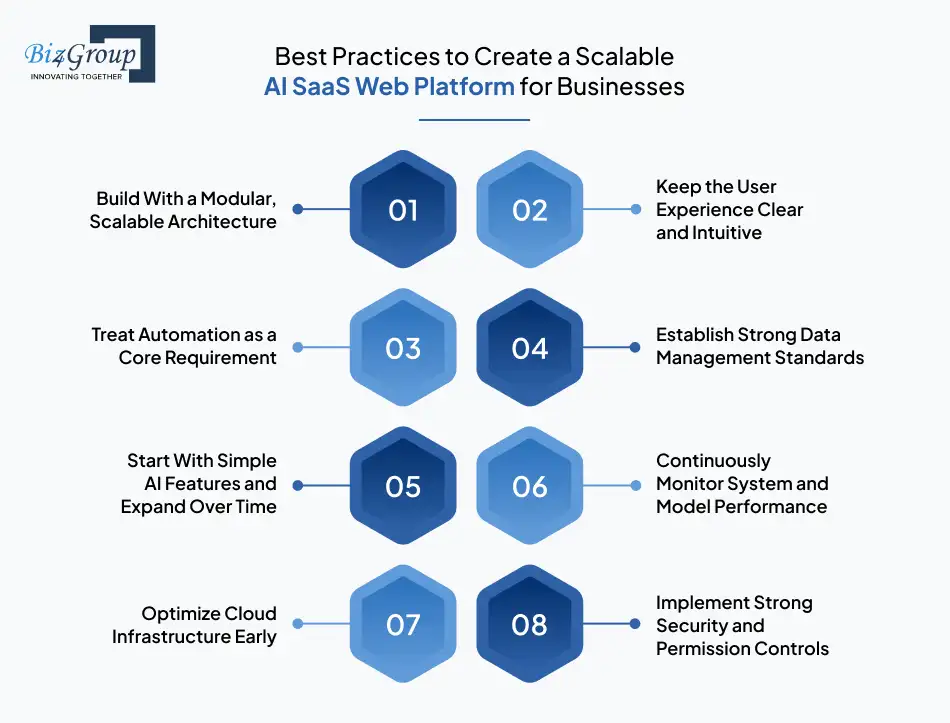
These best practices help you design, build and refine a reliable, high performing platform. Each one supports the core goal of AI SaaS website platform development and ensures you can grow smoothly as you add new features, users and intelligence over time.
A modular architecture helps you update features independently and scale your system without interruptions. This practice is essential when you make AI driven SaaS website platforms that must evolve continuously. It reduces technical debt and keeps your development cycles predictable as your product grows.
A clean interface helps users understand your intelligent features quickly. Intuitive navigation increases adoption and reduces support requests. Many teams collaborate with an AI app development company to design user flows that feel simple while still supporting advanced capabilities.
Automation should be designed into the system early, not added after launch. When workflows are automated from the beginning, your platform becomes easier to manage and more efficient for end users. This strengthens the foundation for long term AI SaaS website platform development.
Data quality directly affects prediction accuracy, personalization and recommendations. Clear rules for collection, cleaning and storage help you maintain reliable outputs. Strong data governance also prepares your platform for industry specific compliance requirements.
Launching smaller, high impact models allows you to validate results before scaling into more advanced intelligence. This phased approach reduces risk and gives you time to refine data pipelines. Many teams partner with an AI product development company to build AI layers methodically and avoid unnecessary complexity.
AI models lose accuracy over time if not supervised. Regular monitoring, performance tracking and retraining help you keep results consistent. This ensures your platform remains dependable as user behavior evolves.
Unoptimized cloud resources can drive up costs quickly. Planning for efficient compute, storage and scaling helps you maintain performance while managing expenses. This is especially important when you develop cloud based AI SaaS website platforms expected to grow rapidly.
Your platform must protect user data and support secure access. Using encryption, role-based permissions and regular security testing helps you prevent risks and maintain trust. This foundation becomes more important as your user base and data volume expand.
Following these best practices allows you to create a scalable AI SaaS web platform for businesses that performs reliably, adapts smoothly and supports long term growth. With the right structure and discipline, your product stays strong even as new features and intelligence are added.
The next phase of AI SaaS website platform development is defined by smarter automation, real time intelligence and platforms that adapt faster than ever. Many teams look at what the best AI SaaS development companies in USA are implementing today to understand how to position their own products for long term relevance. These trends will shape how businesses create AI powered SaaS website platforms moving forward.
Automation will expand into multi-step processes that adjust themselves based on outcomes. This helps companies make AI driven SaaS website systems that reduce manual operations and improve efficiency.
AI agents will handle proactive insights, scheduling, pattern detection and guided actions. This shift empowers teams to build intelligent SaaS website with multitenancy and AI agents that operate with minimal supervision.
Future platforms will rely on seamless integrations with CRMs, ERPs, financial tools and communication apps. These connections strengthen how companies develop AI SaaS website for businesses that require smooth data flow and unified experiences.
Users will expect platforms to adjust instantly based on behavior, goals and context. Real-time personalization will be a requirement for anyone planning to create intelligent SaaS website platforms for businesses.
With AI powering more decisions, platforms must adopt stronger encryption, identity controls and compliance first frameworks. Security will become a major factor in SaaS purchasing decisions.
Teams will increasingly develop cloud based AI SaaS website solutions using serverless tools, distributed compute and optimized data pipelines to manage cost and performance.
Industry specific SaaS products will outperform general ones. Healthcare, retail, finance and logistics will prefer solutions tailored to their workflows. Brands wanting to launch new products or build an AI website will see faster adoption when the platform is designed for a specific market.
By preparing for these shifts, you position your platform to stay competitive and resilient. The future belongs to solutions that automate deeply, integrate smoothly and deliver real time intelligence without adding complexity.
When businesses plan to invest in AI SaaS website platform development, they look for a partner with deep technical expertise, strong product thinking and a proven ability to deliver intelligent, scalable systems. As a leading AI development company in USA, Biz4Group brings the knowledge and engineering strength needed to create AI powered SaaS website platforms that perform reliably and grow with your business.
Our experience spans multiple industries, and our team understands how to develop AI SaaS website for businesses that require automation, security and long-term scalability. We also help companies implement high value intelligence using enterprise AI solutions that streamline operations and improve decision making.
Biz4Group LLC has successfully delivered AI driven products such as Quantum Fit, Select Balance, Homer AI, and DRHR, each demonstrating our ability to make AI driven SaaS website solutions that are user centric and future ready. These platforms reflect our commitment to quality, innovation and practical results.
If you want to create intelligent SaaS website platforms for businesses or build a new AI powered product from the ground up, Biz4Group LLC has the experience, process and technology stack to make it happen.
If you are ready to work with a team that knows how to create intelligent SaaS website platforms for businesses, we would love to help bring your idea to life.
Schedule a Free CallAI powered platforms are no longer optional. They are becoming the backbone of how modern businesses operate, automate and scale. Whether your goal is to make AI driven SaaS website solutions, streamline internal operations or launch a new digital product, the opportunity ahead is enormous for teams willing to innovate with intention.
Biz4Group LLC has spent years helping organizations create intelligent SaaS website platforms for businesses that blend automation, personalization and scalable cloud architecture. Our approach is built on real world experience, a refined development process and a commitment to delivering products that generate measurable impact. When you work with a team that understands both the technical landscape and your business priorities, your platform becomes stronger, more adaptable and far more competitive.
If you are ready to bring a smarter platform to life, our team is here to help you take the next step with confidence
Let’s build something intelligent together!
AI SaaS website platform development refers to building cloud-based software that uses intelligence, automation and data driven insights to improve user experiences and business workflows. These platforms learn from behavior, automate tasks and scale easily, making them far more powerful than traditional SaaS setups when you want to create intelligent SaaS website platforms for businesses.
Most teams can build an MVP for AI SaaS web platform within 3 to 4 weeks and advance in 6 to 10 weeks, depending on the number of features, integrations, level of automation and AI model complexity. Projects that include multitenancy and predictive features take longer, while simple MVPs can launch faster. The timeline varies based on how early you define workflows for AI SaaS website platform development.
When you develop AI SaaS website for businesses, you gain several advantages, including:
These benefits make AI SaaS a strong foundation for companies that want to deliver smarter digital products.
The cost to make AI driven SaaS website solutions typically ranges from $40,000 to $250,000+, depending on system size, feature set, AI depth and industry requirements. Complex platforms that rely on automation, forecasting and advanced personalization fall on the higher end. Actual pricing varies for every AI SaaS website platform development project.
Traditional SaaS platforms offer static features, while AI SaaS systems adapt and improve over time. When you create AI powered SaaS website platforms, your system can personalize content, automate decisions and learn from user behavior. This allows AI SaaS products to stay competitive and deliver higher value with fewer manual updates.
Industries like healthcare, real estate, ecommerce, logistics, HR and finance gain significant value from platforms that develop cloud-based AI SaaS website systems. They rely on predictive analytics, automated workflows, intelligent search, smart recommendations and real time insights to support high performance operations across multiple teams.
Yes. Starting with an MVP helps you create a scalable AI SaaS web platform for businesses without overspending early. An MVP validates your idea; helps you test essential features and shows you which AI capabilities matter most before committing to full development. It also improves your long-term roadmap and reduces risk.

with Biz4Group today!
Our website require some cookies to function properly. Read our privacy policy to know more.