 Location :
Orlando, FL, USA
Location :
Orlando, FL, USA +1 (407) 714-1616
 info@biz4group.com

- AI medical coding automation system development helps healthcare organizations reduce claim denials, improve coding accuracy, strengthen compliance, and streamline revenue cycle operations.
- Healthcare coding automation software development integrating AI enables hospitals to automate ICD-10, CPT, and payer-rule validation workflows before claims are submitted.
- Development of AI medical coding automation system platforms typically costs between $35,000-$250,000+ depending on integrations, AI capabilities, compliance needs, and deployment scale.
- Medical coding automation system development with AI supports EHR integration, denial prediction, audit tracking, and human-in-the-loop coding workflows for safer automation.
- Biz4Group LLC helps healthcare organizations build secure, scalable, and intelligent AI medical coding automation platforms tailored to real-world hospital and revenue cycle workflows.
What happens when a hospital loses millions in reimbursements because one modifier was missed or an ICD-10 code lacked specificity? That scenario has become alarmingly common across US healthcare systems.
According to HFMA’s 2025 denial analysis, initial claim denial rates climbed close to 12% in 2024 and continue rising through 2026, putting enormous pressure on revenue cycle teams already stretched thin. This growing financial strain is one reason healthcare leaders are actively investing in AI medical coding automation system development to improve coding accuracy, reduce rework, and accelerate reimbursements.
The bigger issue sits beneath the denial numbers. Manual coding teams are trying to keep pace with evolving payer rules, CMS updates, prior authorization requirements, and rising claim complexity at the same time.
A recent Experian Health survey found that 68% of providers say submitting clean claims has become harder than a year ago. As a result, healthcare coding automation software development integrating AI has moved from a future initiative to an urgent operational priority for hospitals and physician groups trying to protect cash flow.
Many healthcare executives are saying, “We are managing revenue cycle operations and want to build an AI-based medical coding system to reduce errors and speed up reimbursements.” That demand is reshaping how providers approach revenue cycle management, denial prevention, and compliance readiness across multi-specialty environments.
Now here lies a larger opportunity. Organizations that invest in building AI medical coding automation software are creating smarter workflows that identify coding gaps before claims are submitted.
Want to know how? Let’s begin with the basics first.
Why Healthcare Organizations Need Building AI System for Automated ICD CPT Coding and Healthcare Billing Accuracy
Every denied claim tells the same story. Something was missed, mismatched, delayed, or documented incorrectly before submission. For healthcare organizations handling thousands of claims every week, these small coding issues grow into major revenue cycle disruptions.
The problem becomes harder when coders, billers, compliance teams, and providers operate across disconnected systems. One outdated payer rule or incomplete note can stall reimbursements for weeks.
Healthcare leaders are starting to recognize that revenue cycle problems rarely begin at claim submission. Most begin much earlier during documentation, coding validation, and payer rule interpretation.
The Pressure on Revenue Cycle Teams Has Reached a Breaking Point
According to the 2025 CAQH Index, providers still spend billions annually managing administrative inefficiencies tied to claims, eligibility verification, and prior authorization workflows. Manual intervention remains one of the largest cost drivers in healthcare billing operations.
That operational pressure shows up in several ways.
|
Revenue Cycle Challenge |
Operational Impact |
Financial Consequence |
|---|---|---|
|
ICD-10 specificity errors |
Incorrect diagnosis mapping |
Claim denials and delayed reimbursements |
|
CPT bundling mistakes |
Non-compliant procedure combinations |
Increased payer scrutiny |
|
Missing modifiers |
Claims processed incorrectly |
Payment reductions |
|
Incomplete documentation |
Medical necessity concerns |
Audit exposure |
|
Manual claim review |
Slower processing time |
Increased AR days |
|
Payer policy changes |
Outdated coding logic |
Higher denial rates |
For many hospitals, the issue is no longer isolated coding mistakes. The entire workflow struggles to scale with modern payer complexity. That is why organizations searching for AI automation services are increasingly focusing on denial prevention before claims ever leave the system.
Why Experienced Coding Teams Still Struggle with Accuracy?
Even highly trained coding professionals face an impossible environment. Consider the daily variables they manage:
- Thousands of ICD-10-CM codes
- Annual CPT revisions
- Payer-specific LCD and NCD rules
- Prior authorization dependencies
- Specialty-specific documentation standards
- Modifier sequencing requirements
Now multiply that across cardiology, oncology, behavioral health, orthopedics, and primary care. Manual review processes cannot consistently maintain high first-pass claim accuracy at that scale.
Healthcare operators often say, “We are facing frequent claim denials due to manual medical coding errors and want to develop an AI automation system to solve this.”
That concern is valid. Denials are no longer isolated billing events. They directly affect:
- Cash flow predictability
- Staffing efficiency
- Patient billing timelines
- Payer relationships
- Compliance readiness
The Hidden Cost of Delayed Reimbursements
Many healthcare organizations calculate denial losses incorrectly. They only measure the denied amount.
The larger cost often comes from:
- Rework labor
- Delayed collections
- Increased follow-ups
- Resubmission cycles
- Compliance investigations
- Productivity slowdowns
The financial leakage compounds quickly.
|
Denial-Related Activity |
Average Operational Burden |
|---|---|
|
Claim rework time |
20 to 45 minutes per claim |
|
Reimbursement delay |
30 to 90 days |
|
Administrative touchpoints |
3 to 5 staff interactions |
|
Appeal documentation effort |
High for specialty claims |
|
Compliance review escalation |
Increased audit risk |
This explains why healthcare providers investing in enterprise AI solutions are prioritizing revenue cycle optimization as a core business objective rather than a back-office upgrade.
Payer Rules Change Faster Than Manual Workflows Can Adapt
Commercial insurers continuously update:
- Reimbursement policies
- Modifier requirements
- Prior authorization protocols
- Coverage limitations
- Medical necessity standards
CMS updates create another layer of complexity every year. Most manual workflows rely on spreadsheets, fragmented payer portals, static rule references, and delayed internal updates. That creates dangerous gaps between coding operations and real-time payer expectations.
Hospitals exploring AI medical claim processing software are often trying to solve this exact issue by introducing automated validation and rule-aware workflows directly into claim processing pipelines.
Documentation Gaps Continue to Weaken Coding Accuracy
A coder can only code what the documentation supports. Unfortunately, clinical documentation often arrives with:
- Incomplete encounter details
- Missing diagnosis specificity
- Unclear treatment rationale
- Inconsistent physician terminology
This forces coding teams into constant clarification cycles... The result:
- Slower claim turnaround
- Provider frustration
- Higher coding inconsistency
- Elevated denial risk
Healthcare organizations pursuing AI integration services are increasingly integrating intelligent documentation support into broader billing and coding ecosystems to close these operational gaps earlier in the workflow.
The challenge is no longer whether healthcare organizations need automation. The real question becomes how quickly they can modernize revenue cycle workflows before denial rates, staffing costs, and compliance exposure become financially unsustainable.
How Medical Coding Automation System Development with AI Improves Billing Accuracy?
Coding automation has become an operational necessity for organizations dealing with growing denial volumes, staffing shortages, and stricter payer scrutiny.
An AI medical coding automation system works by analyzing clinical documentation, identifying diagnoses and procedures, validating payer-specific requirements, and detecting claim risks before submission. The goal is simple. Reduce manual errors while improving reimbursement speed and compliance consistency.
For healthcare operators asking, “We are looking to create an AI medical coding automation platform to integrate with our EHR and improve healthcare billing efficiency,” the focus has shifted from basic automation to intelligent decision support embedded directly into revenue cycle workflows.
What an AI Medical Coding Automation System Actually Does
Traditional billing systems mainly store and process information. AI-powered coding systems actively interpret and validate data before claims move downstream.
Here is where the difference becomes visible.
|
Traditional Coding Workflow |
AI-Assisted Coding Workflow |
|---|---|
|
Manual chart review |
Automated clinical note analysis |
|
Static code lookup |
Intelligent ICD-10 and CPT suggestions |
|
Reactive denial handling |
Predictive denial detection |
|
Human-only validation |
Real-time payer rule checks |
|
Delayed coding feedback |
Instant coding confidence scoring |
|
Separate documentation review |
Integrated documentation gap detection |
Organizations investing in AI medical coding software are increasingly prioritizing systems that help coders make faster and more accurate decisions rather than replacing coding teams entirely.
Core Benefits Healthcare Organizations Are Seeing
Faster Claim Processing
AI systems reduce the time spent manually reviewing repetitive coding scenarios. That improves coding throughput across high-volume specialties.
Lower Denial Rates
The system flags
- missing modifiers
- invalid code combinations
- documentation inconsistencies
- payer-specific conflicts
before claims are submitted.
Better Compliance Visibility
Coding recommendations can be tied directly to supporting clinical documentation. This creates stronger audit readiness for healthcare organizations managing OIG and RAC exposure.
Improved Staff Efficiency
Coders spend less time searching through documentation and more time reviewing complex cases that require human judgment.
AI Coding Systems Also Improve the Provider Experience
One overlooked benefit of automation is physician collaboration. When coding systems identify missing documentation in real time:
- Providers receive faster clarification requests
- Coders avoid repeated back-and-forth communication
- Charts move through the billing cycle faster
That improves operational alignment between clinical and administrative teams.
Organizations exploring AI medical web development are increasingly designing unified healthcare platforms where coding intelligence, documentation workflows, and billing operations function together instead of operating in silos.
Key Outcomes Providers Aim to Achieve
|
Operational Goal |
Expected Impact |
|---|---|
|
Improve clean claim rate |
Fewer payer rejections |
|
Reduce denial rework |
Lower administrative costs |
|
Accelerate reimbursements |
Improved cash flow |
|
Standardize coding accuracy |
Reduced compliance variation |
|
Minimize documentation gaps |
Stronger audit readiness |
|
Improve coder productivity |
Better scaling capacity |
The healthcare organizations gaining the most value from coding automation are not treating AI as a standalone tool. They are building connected revenue cycle ecosystems designed to improve accuracy, speed, compliance, and long-term scalability together.
Still Losing Revenue to Preventable Coding Errors?
Even a 5% denial rate can quietly drain hundreds of thousands every year from large healthcare organizations.
Build Smart with Biz4GroupHow Healthcare Coding Automation Software Development Integrating AI Actually Works
Many healthcare leaders understand the value of automation. What they want next is clarity.
How does the system actually process medical records, identify coding risks, and support billing teams without disrupting existing workflows? The answer lies in a connected workflow where AI models, payer logic engines, and EHR integrations work together in real time.
Healthcare organizations often say, “We want end-to-end development of AI healthcare coding automation system to reduce claim denials and improve compliance.” The system needs to understand clinical context, payer rules, documentation quality, and coding standards simultaneously.
Step-By-Step Workflow of an AI Medical Coding Automation System
Step 1. Clinical Documentation Intake
The platform pulls structured and unstructured data from:
- EHR systems
- Physician notes
- Discharge summaries
- Lab reports
- Encounter documentation
This creates a centralized coding-ready data layer.
Step 2. Clinical NLP Processing
Natural language processing models analyze the medical context inside patient records. The engine identifies diagnoses, procedures, symptoms, treatment details, and medication references.
Organizations working with a generative AI development company often use advanced clinical NLP models trained specifically on healthcare terminology and coding logic.
Step 3. ICD-10 and CPT Code Mapping
The AI engine suggests:
- ICD-10-CM codes
- CPT procedure codes
- HCPCS Level II codes
- modifier combinations
based on clinical evidence inside the documentation.
Step 4. Payer Rule Validation
The system checks claims against payer-specific rules, authorization requirements, LCD and NCD policies, bundling logic, and coverage limitations.
This step helps catch errors before submission.
Step 5. Coding Confidence Scoring
Each coding recommendation receives a confidence score. Low-confidence scenarios automatically route to certified coders for review instead of applying risky automation.
Step 6. Claim Scrubbing and Risk Detection
The platform scans for
- missing documentation
- invalid combinations
- modifier conflicts
- incomplete encounters
- high denial probability
before claims move to billing.
Step 7. Continuous Learning and Optimization
Over time, the system learns from denial outcomes, coder corrections, payer responses, and approval trends. This helps improve future coding recommendations.
Healthcare providers exploring build an AI medical billing software are increasingly prioritizing adaptive workflows that improve operational accuracy continuously instead of relying on static rule libraries.
Core Components Behind the System
|
Component |
Primary Function |
|---|---|
|
Clinical NLP Engine |
Extracts diagnoses and procedures from documentation |
|
Coding Recommendation Engine |
Suggests ICD-10, CPT, and HCPCS codes |
|
Payer Rules Engine |
Validates claims against payer policies |
|
Denial Prediction Layer |
Detects high-risk claim patterns |
|
EHR Integration Layer |
Connects with Epic, Cerner, athenahealth, and billing systems |
|
Human Review Module |
Routes uncertain cases to coders |
|
Audit Trail System |
Tracks every coding recommendation and change |
|
Analytics Dashboard |
Monitors denial trends and coding performance |
Why Human Review Still Matters
AI performs best when paired with experienced coding teams.
Complex specialties, unclear documentation, and rare procedures still require expert oversight. The goal is not full replacement. The goal is reducing repetitive workload while improving consistency and visibility.
That is why many providers are searching for teams capable of building human-in-the-loop healthcare automation systems instead of rigid black-box platforms.
The next question healthcare organizations usually ask is straightforward. What features should an AI medical coding automation platform include to support real-world hospital operations at scale?
Features Healthcare Organizations Need in Medical Coding Automation System Development with AI
Healthcare organizations evaluating coding automation platforms want intelligent systems capable of handling coding complexity, payer variation, and operational scale without slowing down billing teams.
That is why many providers now say, “We are evaluating vendors for healthcare AI coding systems to improve revenue cycle management efficiency.”
The features below often determine whether the platform improves operational performance or creates additional administrative friction.
|
Feature |
What It Does |
Business Impact |
|---|---|---|
|
Clinical NLP Processing |
Extracts diagnoses, procedures, and treatment details from physician documentation |
Reduces manual chart review effort |
|
ICD-10 and CPT Code Suggestions |
Recommends accurate billing codes based on clinical context |
Improves coding consistency |
|
Real-Time Claim Scrubbing |
Detects missing modifiers, invalid combinations, and incomplete claims before submission |
Reduces denial risk |
|
Payer Rule Validation |
Checks claims against payer-specific coverage policies and authorization rules |
Improves clean claim rates |
|
Coding Confidence Scoring |
Flags uncertain coding scenarios for human review |
Supports safer automation |
|
Multi-Specialty Coding Support |
Handles specialty-specific workflows for cardiology, oncology, orthopedics, behavioral health, and more |
Improves scalability across departments |
|
EHR and Billing Platform Integration |
Connects with Epic, Cerner, athenahealth, eClinicalWorks, and billing systems |
Eliminates disconnected workflows |
|
Audit Trail Tracking |
Maintains documentation history for every coding action and recommendation |
Strengthens compliance visibility |
|
Denial Prediction Engine |
Identifies claims with high denial probability before processing |
Prevents costly rework cycles |
|
Analytics and Reporting Dashboard |
Tracks coding trends, denial patterns, coder productivity, and operational KPIs |
Improves revenue cycle decision-making |
|
Human-In-The-Loop Workflow |
Routes low-confidence cases to certified coders instead of applying full automation |
Balances efficiency with oversight |
|
Role-Based Access Controls |
Restricts PHI access based on user roles and permissions |
Supports HIPAA compliance requirements |
Healthcare organizations pursuing healthcare coding automation software development integrating AI are increasingly prioritizing flexible architectures that adapt to evolving payer and operational requirements instead of relying on static automation models.
Providers exploring advanced healthcare automation ecosystems through an AI chatbot development company are also integrating conversational support features into coding and billing operations to simplify provider communication and claims assistance workflows.
As feature requirements continue growing, the next challenge becomes equally important. What technologies, infrastructure layers, and integration frameworks are required to build a secure and scalable AI medical coding automation system for enterprise healthcare environments?
Your Billing Team Deserves Better Than Manual Chaos
Coders lose 15-20 hours weekly switching between disconnected billing and payer systems.
Upgrade My Coding WorkflowTechnology Stack Required for AI Medical Coding Automation System Development
Healthcare organizations frequently ask, “I need a company that can build an AI medical coding automation platform integrated with EHR and billing systems.”
That requirement makes integration architecture one of the most critical parts of the entire system.
Integration Architecture Behind AI Medical Coding Platforms
Most healthcare organizations already operate within a complex ecosystem of:
- EHR systems
- Billing software
- Payer portals
- Documentation platforms
- Practice management systems
- Clearinghouses
An AI coding platform must connect with these systems without disrupting existing workflows.
A typical architecture includes:
EHR Integration Layer
The coding engine connects with Epic, Cerner, athenahealth, and eClinicalWorks through:
- HL7 APIs
- FHIR APIs
- Secure middleware connectors
This enables real-time access to clinical documentation and encounter data.
Organizations investing in AI EMR/EHR software are increasingly prioritizing interoperability-ready systems capable of supporting connected healthcare operations at scale.
AI Processing Layer
This layer handles NLP analysis, code prediction, payer validation, denial detection, and workflow orchestration. The engine processes both structured and unstructured clinical data continuously.
Billing and Claims Integration
The platform communicates with billing systems, clearinghouses, denial management tools, and payment workflows to streamline coding validation before claims move downstream.
Healthcare providers planning to integrate AI with EHR/EMR systems are increasingly focusing on architectures that reduce operational silos between clinical and billing environments.
Security and Compliance Layer
Every interaction involving PHI requires:
- Encrypted communication
- Audit logging
- Role-based access controls
- Secure cloud infrastructure
- HIPAA-compliant storage
This layer protects sensitive healthcare data across the entire workflow.
Recommended Tech Stack for AI Medical Coding Automation Platforms
|
Technology Layer |
Recommended Technologies |
Purpose |
|---|---|---|
|
Frontend Development |
React.js, Next.js, Angular |
Provider dashboards and coder interfaces |
|
Backend Development |
Node.js, Python, FastAPI |
Workflow management and API orchestration |
|
AI And Machine Learning |
TensorFlow, PyTorch, Hugging Face |
NLP processing and code prediction |
|
Clinical NLP Models |
BioBERT, ClinicalBERT, MedPaLM |
Medical terminology understanding |
|
Database Systems |
PostgreSQL, MongoDB |
Structured and unstructured data storage |
|
Vector Databases |
Pinecone, Weaviate |
Semantic search and contextual retrieval |
|
Cloud Infrastructure |
AWS HealthLake, Azure Health Data Services |
HIPAA-ready cloud deployment |
|
API Integration Frameworks |
HL7 FHIR APIs, REST APIs |
EHR and billing interoperability |
|
Security Frameworks |
OAuth 2.0, JWT, AES-256 Encryption |
Secure authentication and PHI protection |
|
Analytics and Monitoring |
Power BI, Grafana, Kibana |
Reporting and operational visibility |
|
Workflow Automation |
Apache Airflow, Temporal |
Workflow orchestration and task management |
Healthcare organizations planning to integrate healthcare platforms with AI EHRs are increasingly investing in modular architectures that allow coding automation, clinical workflows, and billing systems to operate as one connected ecosystem instead of separate applications.
Technology alone, however, does not determine project success.
The development process, implementation sequence, and rollout strategy play an equally important role in how effectively healthcare organizations adopt AI medical coding automation systems across real-world billing environments.
Also read: Top 10 AI EHR software development companies in USA
How To Develop AI Medical Coding Automation System in 7 Steps?
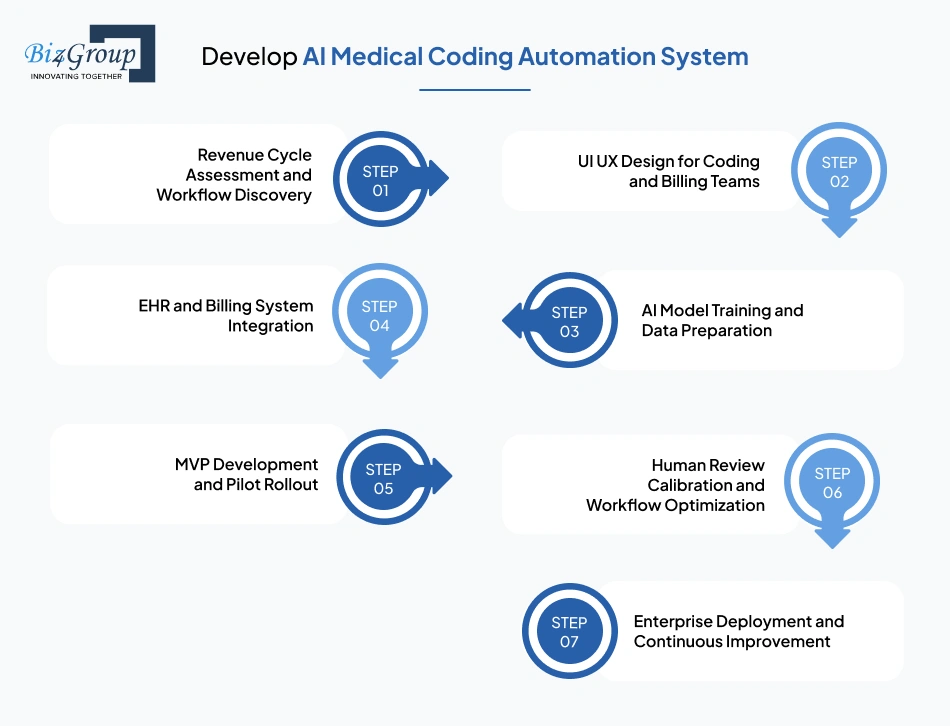
Building a coding automation platform for healthcare operations requires careful planning across workflows, integrations, security, compliance, and user adoption. A rushed implementation often creates more operational friction than efficiency.
That is why healthcare leaders frequently say, “We are comparing companies that develop AI medical coding automation systems and want to choose the best vendor in USA.”
The right development process helps healthcare organizations avoid integration failures, poor adoption, and inaccurate automation outcomes.
Step 1. Revenue Cycle Assessment and Workflow Discovery
The first phase focuses on understanding:
- Denial patterns
- Coding bottlenecks
- Payer mix complexity
- Specialty-specific workflows
- EHR dependencies
- Compliance requirements
This stage helps define where automation will create the highest operational impact. Healthcare organizations exploring AI product development services often begin with workflow audits before selecting AI models or infrastructure components.
Step 2. UI UX Design for Coding and Billing Teams
A coding platform can have advanced AI capabilities and still fail operationally if the interface slows down coders. The UI and UX layer should support:
- Faster chart navigation
- Coding visibility
- Denial alerts
- Workflow prioritization
- Audit tracking
- Minimal screen switching
Healthcare organizations increasingly partner with a specialized UI/UX design company to design coding interfaces optimized for healthcare operations instead of generic enterprise dashboards.
Also read: Top UI/UX design companies in USA
Step 3. AI Model Training and Data Preparation
At this stage, developers train the platform using historical claims data, coding records, payer rules, clinical documentation, and denial outcomes.
The AI models learn:
- ICD-10 patterns
- CPT mapping logic
- Modifier relationships
- Denial triggers
- Specialty-specific coding behavior
This training stage heavily influences long-term coding accuracy.
Step 4. EHR and Billing System Integration
The platform is then connected with:
- EHR systems
- Practice management software
- Clearinghouses
- Billing systems
- Payer validation tools
The goal is uninterrupted workflow continuity across departments. Organizations planning to often integrate coding automation capabilities directly into larger healthcare ecosystems during this phase.
Step 5. MVP Development and Pilot Rollout
Before full deployment, healthcare organizations usually launch an MVP in one specialty or department first. This allows teams to test:
- Coding accuracy
- Denial reduction performance
- Workflow compatibility
- User adoption
- Integration stability
Healthcare providers investing in MVP development services often reduce implementation risks significantly by validating operational performance early.
Also read: Top MVP development companies in USA
Step 6. Human Review Calibration and Workflow Optimization
Certified coders review:
- Low-confidence predictions
- Specialty-specific recommendations
- Edge-case scenarios
- Documentation conflicts
Healthcare organizations implementing conversational workflows through AI chatbot development for healthcare industry often extend similar human-review models into support operations and provider communication systems.
Step 7. Enterprise Deployment and Continuous Improvement
After validation, the platform expands across specialties, provider groups, hospital departments, and payer environments.
The system continues learning from:
- Coding corrections
- Payer responses
- Denial outcomes
- Documentation trends
Healthcare organizations asking, “We are evaluating vendors for healthcare AI coding systems to improve revenue cycle management efficiency,” should pay close attention to how vendors manage post-deployment optimization, workflow monitoring, and long-term system adaptability.
The next major concern for healthcare organizations becomes equally critical. Can the platform operate securely within HIPAA, CMS, OIG, and payer compliance requirements without increasing audit exposure?
Most Healthcare AI Projects Fail Before Deployment
Nearly 70% of healthcare automation rollouts struggle because workflows were never planned properly.
Talk to an AI ArchitectHIPAA and CMS Requirements for Developing Intelligent Medical Coding System for Hospitals and Insurance Claims
Healthcare organizations cannot afford automation systems that create compliance risks while solving coding problems. That is why providers often say, “We want end-to-end development of AI healthcare coding automation system to reduce claim denials and improve compliance.”
A compliant AI medical coding automation system should include:
- HIPAA-compliant PHI handling across all workflows
- End-to-end encryption for data storage and transmission
- Role-based access controls for coders, auditors, and administrators
- Audit trails for every coding recommendation and modification
- Support for CMS coding updates including ICD-10-CM and CPT revisions
- LCD and NCD validation for payer-specific coding accuracy
- Secure API integrations with EHR and billing systems
- Business Associate Agreements for third-party vendors and cloud providers
- OIG and RAC audit readiness through explainable coding logic
- Human review workflows for low-confidence coding scenarios
- HIPAA-ready cloud infrastructure such as AWS HealthLake or Azure Health Data Services
- Continuous monitoring for coding anomalies and compliance gaps
Healthcare organizations pursuing development of AI medical coding automation system platforms should prioritize compliance architecture from day one instead of treating it as a post-development requirement.
Now, let’s discuss how much does it actually cost to build and maintain an AI medical coding automation platform for enterprise healthcare operations?
How Much Does Medical Coding Automation System Development with AI Cost?
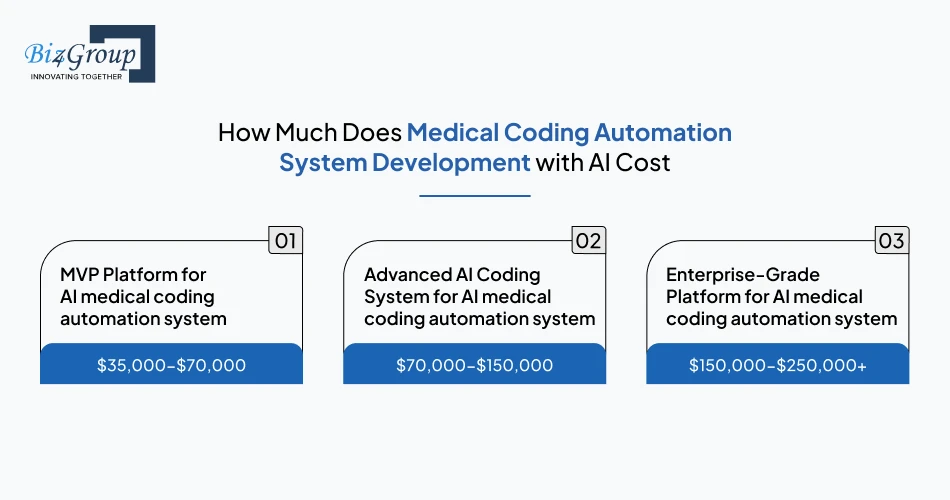
The cost of AI medical coding automation system development depends heavily on workflow complexity, EHR integrations, AI model depth, compliance requirements, and specialty coverage.
For most healthcare organizations, the average investment ranges between $35,000-$250,000+.
Healthcare leaders often say, “I want to find a reliable company to develop AI medical coding and billing automation software for my hospital.” But first, clarify whether your organization needs:
- An MVP for pilot testing
- An advanced automation platform
- A fully integrated enterprise ecosystem
Estimated Development Cost by Project Scale
|
Project Scope |
Estimated Cost Range |
Best Fit |
|---|---|---|
|
MVP Platform for AI medical coding automation system |
$35,000-$70,000 |
Single specialty clinics and pilot programs |
|
Advanced AI Coding System for AI medical coding automation system |
$70,000-$150,000 |
Mid-sized hospitals and multi-location provider groups |
|
Enterprise-Grade Platform for AI medical coding automation system |
$150,000-$250,000+ |
Large hospital systems with complex payer environments |
Healthcare organizations pursuing automated medical coding system development for hospitals often begin with MVP validation before expanding into enterprise-wide deployment.
Major Cost Drivers in AI Medical Coding Automation System Development
Several technical and operational factors influence overall project cost. Most enterprise healthcare builds fall within a combined implementation range of $80,000-$250,000+ depending on customization depth.
|
Cost Driver |
Estimated Cost Impact |
Why It Matters |
|---|---|---|
|
Clinical NLP Model Development |
$15,000-$50,000 |
Improves coding accuracy across unstructured clinical documentation |
|
EHR and Billing Integrations |
$10,000-$40,000 |
Connects with Epic, Cerner, athenahealth, and billing systems |
|
Payer Rule Engine Development |
$8,000-$25,000 |
Supports LCD, NCD, and payer-specific validation |
|
AI Training and Data Preparation |
$10,000-$35,000 |
Trains models on coding logic and denial trends |
|
UI UX Design |
$5,000-$20,000 |
Simplifies coder workflows and dashboard usability |
|
Compliance and Security Setup |
$8,000-$30,000 |
Covers HIPAA safeguards, audit logs, and encryption |
|
Analytics and Reporting Modules |
$5,000-$18,000 |
Tracks denial trends and coding performance |
|
Cloud Infrastructure Setup |
$5,000-$15,000 |
Supports scalable and secure healthcare deployment |
|
Human Review Workflow Development |
$4,000-$12,000 |
Adds coder approval and escalation logic |
Organizations exploring development of AI medical coding automation system platforms with multi-specialty support typically see higher implementation costs because of payer variation and specialty-specific coding complexity.
Hidden Costs Healthcare Organizations Often Overlook
Many providers budget for development but underestimate operational expansion costs. These hidden expenses can collectively add another $15,000-$60,000+ over time if not planned early.
Commercial insurers continuously update coding requirements, authorization logic, and coverage policies. Keeping those validation engines current may cost around $2,000-$8,000 annually depending on payer volume.
EHR APIs, billing systems, and clearinghouse workflows evolve frequently. Long-term integration monitoring and upgrades can require $5,000-$20,000 annually.
Internal training programs, documentation alignment, and operational transition support may add another $3,000-$10,000 during rollout.
As claim volume grows, cloud storage, GPU usage, analytics processing, and AI inference workloads can increase operational costs by 20%-35% annually for enterprise deployments.
How Healthcare Organizations Optimize Development Costs
Healthcare providers can reduce implementation costs by 25%-40% with the right rollout strategy and architecture planning.
Some of the most effective cost optimization approaches include:
- Starting with an MVP deployment in one specialty before expanding organization-wide. This often reduces initial investment by $30,000-$80,000.
- Prioritizing API-ready EHR integrations instead of custom middleware development. Savings typically range between $5,000-$20,000.
- Using pre-trained healthcare NLP models instead of building AI models entirely from scratch. This can lower AI training costs by 35%-50%.
- Deploying modular workflows that allow phased feature expansion over time instead of building every feature simultaneously.
- Implementing human-in-the-loop coding review during early deployment phases to reduce costly automation errors and retraining cycles.
Healthcare leaders mentioning, “We are dealing with revenue leakage in hospital billing and want to build an AI system to fix coding errors,” often discover that phased implementation strategies provide faster operational value with lower financial risk.
So, what kind of ROI can healthcare organizations realistically expect from AI medical coding automation systems over time?
Wondering If the Investment Actually Pays Off?
Reducing claim rework by even 30% can create six-figure annual operational savings.
Let’s Talk NumbersBusiness ROI Of Medical Coding Automation System Development With AI
Healthcare organizations investing in AI coding automation expect measurable operational returns. Most providers implementing AI medical coding automation system development solutions typically see improvements within the first 3-6 months after deployment.
Healthcare leaders often say, “I am managing hospital billing operations and want to develop an AI medical coding automation system to reduce claim denials.”
The ROI below explains why demand continues growing across hospitals and multi-specialty provider groups.
Example ROI Scenario for a Mid-Sized Hospital Group
|
Metric |
Before AI Automation |
After AI Automation |
|---|---|---|
|
First-Pass Denial Rate |
11% |
4%-6% |
|
Average Claim Rework Cost |
$68 per claim |
$20-$30 per claim |
|
Coding Productivity |
100 charts/day |
150-180 charts/day |
|
Days In AR |
45-60 days |
30-40 days |
|
Manual Coding Review Volume |
100% |
35%-50% |
|
Documentation Query Delays |
Frequent |
Reduced significantly |
Estimated Annual Financial Impact
|
Operational Area |
Estimated Savings |
|---|---|
|
Reduced Denial Rework |
$250,000-$1M+ annually |
|
Faster Claim Processing |
20%-40% operational improvement |
|
Lower Administrative Burden |
25%-45% reduction |
|
Improved Coding Efficiency |
30%-60% productivity gain |
|
Reduced Compliance Risk Exposure |
Significant long-term savings |
Where The Biggest ROI Usually Comes From
- Preventing avoidable claim denials before submission
- Reducing repetitive manual coding tasks
- Improving coder throughput without expanding staff
- Detecting documentation gaps earlier in the workflow
- Reducing payer-related correction cycles
- Improving clean claim rates across specialties
Healthcare organizations pursuing healthcare coding automation software development integrating AI often generate stronger long-term ROI when the platform integrates directly with existing EHR and billing systems.
What Impacts ROI The Most
|
High ROI Factor |
Operational Impact |
|---|---|
|
Multi-specialty deployment |
Greater denial reduction coverage |
|
Real-time payer validation |
Fewer coding conflicts |
|
Strong EHR integration |
Faster workflow adoption |
|
Human review workflows |
Lower automation risk |
|
Continuous AI learning |
Better long-term coding accuracy |
For enterprise healthcare organizations, the larger value often comes from operational scalability rather than staff reduction alone.
The next part will answer should organizations build a custom AI medical coding automation system tailored to their workflows or purchase an off-the-shelf platform with fixed capabilities.
Choosing Between Custom and Off-the-Shelf Automated Medical Coding System Development for Hospitals
Healthcare organizations evaluating automation platforms often reach the same crossroads... Should they invest in a custom-built platform tailored to their workflows or purchase an off-the-shelf product with predefined capabilities?
CEOs frequently say, “We are comparing companies that develop AI medical coding automation systems and want to choose the best vendor in USA.”
Organizations pursuing development of AI medical coding automation system platforms for enterprise healthcare operations often prefer custom solutions because billing workflows vary significantly across provider groups.
Custom Vs Off-The-Shelf Comparison
|
Factor |
Custom AI Medical Coding System |
Off-The-Shelf Platform |
|---|---|---|
|
Workflow Flexibility |
Fully tailored to hospital operations |
Limited customization |
|
EHR And Billing Integrations |
Built around existing infrastructure |
Standard integrations only |
|
Specialty-Specific Coding Support |
Highly adaptable |
Often generalized |
|
Payer Rule Customization |
Supports complex payer logic |
Restricted configuration |
|
Scalability |
Easier long-term expansion |
Dependent on vendor limitations |
|
AI Model Training |
Trained on organization-specific data |
Shared generalized models |
|
Compliance Controls |
Customized audit and access workflows |
Fixed compliance structure |
|
Ownership And Control |
Full platform ownership |
Vendor-controlled ecosystem |
|
Deployment Timeline |
Longer implementation |
Faster initial launch |
|
Upfront Investment |
Higher initial cost |
Lower starting cost |
|
Long-Term Operational Value |
Stronger for enterprise healthcare systems |
Better for smaller practices |
|
Competitive Differentiation |
Unique operational workflows |
Similar to competitor systems |
When Custom Development Makes More Sense
Custom development is often the better choice for:
- Multi-specialty healthcare systems
- Large provider groups
- Organizations with complex payer environments
- Hospitals requiring advanced compliance visibility
- Enterprises needing deep EHR integrations
When Off-the-Shelf Platforms Work Well
Prebuilt platforms may work well for:
- Smaller clinics
- Low-volume practices
- Organizations with standardized workflows
- Teams needing rapid deployment
- Short-term operational pilots
The decision becomes easier when healthcare organizations evaluate their denial complexity, specialty requirements, integration dependencies, and future scalability goals before selecting a platform strategy.
Now that you know pretty much everything about development, here is the most important part. What questions should healthcare organizations ask before selecting an AI medical coding automation development partner or vendor?
Off-The-Shelf Tools Know General Workflows. Your Hospital Is Not General.
Hospitals using custom healthcare AI platforms often see faster adoption and lower denial volumes long term.
Call Our AI Healthcare Experts TodayVendor Evaluation Questions for Medical Coding Automation System Development with AI
Choosing the wrong development partner can create integration issues, compliance gaps, and operational slowdowns that take years to fix.
For founders asking, “We are evaluating vendors for healthcare AI coding systems to improve revenue cycle management efficiency,” these are the questions you should ask before selecting a vendor.
- How does the platform handle ICD-10-CM, CPT, and HCPCS coding updates?
- Does the system support payer-specific LCD and NCD validation?
- Can the platform integrate directly with Epic, Cerner, athenahealth, and existing billing systems?
- How are low-confidence coding predictions handled?
- What audit logs and compliance tracking capabilities are included?
- Does the system support multi-specialty coding environments?
- How is PHI secured across APIs, cloud infrastructure, and workflows?
- What denial reduction benchmarks have previous healthcare clients achieved?
- Can the AI models learn continuously from denial outcomes and coder corrections?
- What level of human review exists before claims move downstream?
- How long does implementation usually take for enterprise healthcare organizations?
- Does the platform support modular rollout and MVP deployment?
- Who owns the trained AI models and operational data after deployment?
- What post-launch optimization and monitoring services are included?
Healthcare organizations pursuing how to develop AI medical coding automation system strategies should prioritize long-term workflow compatibility over short-term feature demonstrations.
Organizations requiring dedicated healthcare AI engineering support increasingly hire AI developers with experience in HIPAA-compliant healthcare systems, EHR integrations, and medical workflow automation.
Also read: Top 15 AI healthcare software development companies in USA
So, how is Biz4Group the right vendor for your company?
Biz4Group LLC’s Expertise in Developing Intelligent Medical Coding Systems for Hospitals
Healthcare organizations searching for reliable AI partners need technology teams that understand payer complexity, healthcare compliance, EHR ecosystems, and operational billing challenges at an enterprise level.
That is where Biz4Group LLC stands apart.
As a US-based AI development company, Biz4Group builds custom AI medical coding automation platforms tailored to real healthcare workflows. We engineer complete healthcare automation ecosystems designed around coding accuracy, denial prevention, payer validation, workflow intelligence, and scalable integration architecture.
Healthcare leaders often approach us saying, “We are looking for a reliable company to develop AI medical coding and billing automation software for our hospital.” What they usually need is intelligent infrastructure built around their operational realities.
Our healthcare AI expertise also extends beyond coding automation. We have built conversational healthcare platforms, AI-powered patient engagement systems, intelligent support workflows, and secure medical data ecosystems for healthcare businesses across the USA.
As a HIPAA-compliant AI healthcare software development company, compliance architecture is embedded into every layer we build, from API security and PHI protection to audit visibility and role-based access controls.
Why Businesses Choose Biz4Group LLC
- Deep understanding of healthcare billing and operational workflows.
- Expertise in AI medical coding automation system development for complex healthcare environments.
- Strong experience integrating with EHR, EMR, billing, and payer systems.
- Human-centered AI workflows designed for real coding teams.
- Enterprise-grade HIPAA and compliance architecture.
- Custom-built solutions instead of restrictive one-size-fits-all products.
- Scalable AI infrastructure built for long-term operational growth.
- Dedicated US-based project coordination and transparent delivery processes.
Healthcare organizations pursuing healthcare coding automation software development integrating AI often struggle because many vendors understand AI but not healthcare operations. Others understand healthcare but lack advanced AI engineering expertise.
Biz4Group brings both together.
If denied claims, coding backlogs, and payer inconsistencies are slowing down your revenue cycle, this is the right time to fix the problem at its source. Schedule a strategy session with Biz4Group today.
To Summarize...
Healthcare revenue cycles are becoming harder to manage with manual coding workflows, fragmented payer rules, growing documentation complexity, and rising denial volumes. What once worked for smaller billing environments now creates operational slowdowns, compliance gaps, and significant revenue leakage for hospitals and multi-specialty provider groups.
That is why more healthcare organizations are investing in AI medical coding automation system development to improve coding accuracy, reduce denial rates, strengthen compliance visibility, and accelerate revenue cycle performance. From clinical NLP and payer-rule validation to denial prediction and EHR integration, modern coding automation platforms are helping healthcare teams operate with greater speed, consistency, and confidence.
Businesses often say, “We are managing revenue cycle operations and want to build an AI-based medical coding system to reduce errors and speed up reimbursements.”
The organizations seeing the strongest results are choosing partners that understand both AI engineering and healthcare operations deeply. As a USA-based software development company, Biz4Group builds secure, scalable, and compliance-focused AI healthcare systems designed around real billing environments, payer complexity, and long-term operational growth.
Your claims workflow should not depend on outdated processes struggling to keep up with modern healthcare demands. Build a smarter revenue cycle with Biz4Group and turn coding accuracy into a competitive advantage.
FAQs
1. What types of healthcare organizations benefit most from AI medical coding automation systems?
AI medical coding automation systems are highly effective for multi-specialty physician groups, hospitals, outpatient clinics, behavioral health centers, and healthcare providers handling large claim volumes. Organizations dealing with complex payer contracts and recurring denial issues typically see the highest operational gains.
2. Can AI medical coding systems handle specialty-specific coding requirements?
Yes. Advanced platforms can support specialty-specific workflows for cardiology, oncology, orthopedics, radiology, behavioral health, and other departments. The AI models can be trained to recognize specialty terminology, procedure logic, modifier usage, and payer-specific coding variations unique to each clinical area.
3. How accurate are AI medical coding automation platforms?
Accuracy depends on AI training quality, payer-rule validation logic, integration depth, and human review workflows. Well-developed systems significantly improve coding consistency and reduce avoidable coding mistakes, especially for repetitive high-volume encounters.
4. How long does it take to develop an AI medical coding automation system?
Most platforms take several months depending on integration complexity, feature scope, and compliance requirements. Biz4Group, however, can deliver a functional MVP in 2-4 weeks by using reusable healthcare AI components that reduce both development time and overall implementation cost.
5. What data is required to train an AI medical coding automation platform?
The system typically learns from historical claims data, coding records, denial outcomes, physician documentation, payer policies, and billing workflows. High-quality historical healthcare data improves coding intelligence, prediction accuracy, and long-term operational performance.
6. Can AI medical coding systems work alongside existing billing teams?
Yes. Most healthcare organizations use AI coding systems as operational support tools rather than replacement systems. Certified coders continue reviewing complex encounters, specialty-specific scenarios, and low-confidence recommendations while the platform handles repetitive validation tasks.
