 Location :
Orlando, FL, USA
Location :
Orlando, FL, USA +1 (407) 714-1616
 info@biz4group.com

- AI medical surgery recording app development helps hospitals capture, analyze, and structure surgical data for better documentation, training, and decision-making.
- Systems designed to build AI-powered surgery recording app workflows focus on real-time capture, AI tagging, and automated reporting to reduce manual effort.
- A well-planned architecture includes capture devices, AI processing (edge or cloud), secure storage, and user-facing dashboards.
- The cost typically ranges between $50,000 to $400,000+, depending on system complexity, AI features, and scalability requirements.
- Hospitals adopting AI in clinical workflows report improvements in documentation accuracy and operational efficiency, supporting better outcomes over time.
- Teams looking to develop scalable AI healthcare recording app platform solutions should plan for long-term data storage, compliance, and system maintenance.
Hospitals and clinics need reliable ways to document surgical procedures without interrupting clinical work. Traditional methods rely on manual notes, disconnected recording tools, and delayed updates, which often result in incomplete or inconsistent records. AI medical surgery recording app development addresses this by enabling structured, real-time capture of surgical data within a single workflow.
Modern systems organize video, audio, and timestamps into clear, searchable records. This improves documentation accuracy, simplifies post-surgery review, and reduces manual effort for surgical teams. As part of broader AI healthcare solutions, the focus is on making documentation consistent while keeping the workflow simple for clinicians.
Teams that plan to develop AI medical surgery recording app solutions need to define how recording fits into surgical workflows, how data is processed, and how systems integrate with existing infrastructure. Many organizations work with an AI healthcare software development company to build solutions that align with usability, security, and compliance requirements.
From a system perspective, AI healthcare recording app development requires careful planning of how data moves across capture, processing, storage, and access layers. These decisions directly affect system performance, reliability, and long-term scalability in clinical settings.
This guide explains how these systems function, what decisions matter during implementation, and how different components fit together in real environments. It is intended to give decision-makers a clear understanding of both technical structure and operational impact.
What Is AI Medical Surgery Recording App Development and What Problems Does It Solve?
AI medical surgery recording app development is the process of building systems that record surgical procedures and turn them into structured, usable data.
In a basic recording setup, you get a long video file. In an AI-based system, that same recording is broken into meaningful parts. The system captures video, audio, and timestamps, then organizes them into clear outputs such as:
- Key surgical steps
- Time-based markers
- Searchable segments
You can think of it as a system that not only records but also organizes what happened during the procedure.
This is where systems that integrate AI into an app are useful. The goal is to make recorded data easier to use, not just store it.
How Surgical Recording Works Without AI
Without AI, surgical recording is simple but limited.
The system records the entire procedure as a continuous video. It does not understand what is happening inside the video.
After the surgery:
- Doctors or staff write notes manually
- Important steps are recalled from memory
- Videos are stored but rarely explored in detail
Here is how that process typically looks:
|
Step |
What Happens |
|---|---|
|
Recording |
Full procedure is captured as one video |
|
Documentation |
Notes are written separately |
|
Storage |
Videos are saved without structure |
|
Review |
Requires manual searching or full playback |
This creates a gap between recorded data and usable information.
What Changes When AI Is Introduced Into Recording Systems
When AI is added, the system starts organizing the recording automatically.
Instead of one long video, the procedure is divided into smaller, meaningful parts. The system identifies when key steps happen and links them with timestamps.
This changes how the system is used:
- During Surgery: Important moments can be marked automatically or with minimal input.
- After Surgery: Documentation is easier because part of the information is already structured.
- During Review: Users can jump directly to specific steps instead of watching the entire video.
A simple comparison:
- Without AI: Record → Store → Manually Review
- With AI: Record → Organize → Search → Review
During AI medical surgery recording mobile app development, these features are built to work smoothly in real operating environments.
What Problem Does This Solve in Practice?
The main issue is not recording surgeries. It is making those recordings useful. In real settings, this leads to:
- Time spent writing or correcting documentation
- Difficulty finding specific moments in long videos
- Limited use of recordings for training or analysis
AI-based systems help by making surgical data easier to access and understand. Organizations that plan to build AI-powered surgery recording app systems focus on improving how surgical data is captured, organized, and used, without changing how medical teams perform procedures.
Why Hospitals and Clinics Invest in AI Medical Surgery Recording App Development?
Hospitals and clinics need accurate surgical records, but current methods often require extra time and effort from medical staff. Recording, documentation, and review are handled separately, which creates delays and inconsistencies. AI medical surgery recording app development is used to simplify this process by bringing recording and documentation into one system.
1. Operational Inefficiencies in Traditional Documentation
A. Manual Documentation Takes Extra Time
After surgery, doctors or staff write notes based on memory or brief references. This adds workload and can delay record updates.
B. Systems Are Not Connected
Recording tools and documentation systems usually work separately. Switching between them slows down the process.
C. Recorded Videos Are Hard to Use
Even when procedures are recorded, finding specific parts takes time. Systems built to build AI clinical recording systems app workflows help organize recordings so they are easier to access and use.
2. Clinical Risks Caused by Incomplete Records
A. Details Can Be Missed
Manual documentation may not capture every step of a procedure, especially in complex cases.
B. Reviewing Procedures Is Difficult
Without structured data, teams may need to watch full recordings to understand what happened.
C. Tracking Events Is Not Easy
It is hard to follow the sequence of actions during surgery when records are incomplete. Using AI integration services helps match recorded data with actual events, making records clearer.
3. Training and Knowledge-Sharing Limitations
A. Learning from Recordings Takes Time
Long videos are not easy to use for training because key moments are not clearly marked.
B. No Consistent Format for Training Content
Each recording is stored differently, which makes it harder to create standard learning material.
C. Experience Is Hard to Share
Important surgical techniques are not easily captured in a reusable way. Systems that create AI surgical video recording mobile app workflows help organize recordings into smaller sections that are easier to use for training.
Hospitals and clinics invest in these systems to make surgical data easier to manage and use. When organizations plan to create AI surgical video recording mobile app solutions, the goal is to reduce manual work, improve record quality, and make surgical information more accessible for both daily use and training.
How AI Is Transforming Surgical Recording and Documentation Workflows
Surgical recording is changing from simple video capture to structured workflows. In older systems, recording and documentation are separate tasks. With AI medical surgery recording app development, these tasks are connected, so data is captured and organized at the same time.
1. From Passive Recording to Active Analysis
In traditional systems, recording is passive. The system records everything but does not understand what is happening.
With AI, the system starts identifying changes during the procedure. For example, it can detect when tools move, when a step begins or ends, or when there is a pause. These changes are used to divide the procedure into smaller, meaningful parts.
|
Aspect |
Passive Recording |
Active Analysis |
|---|---|---|
|
Data Handling |
Stored as full video |
Split into smaller segments |
|
Context |
Not available |
Linked with events and timestamps |
|
Documentation |
Done later |
Supported during recording |
This is possible through AI model development, where systems learn patterns from surgical data. In simple terms, the system:
- Detects changes during surgery
- Marks those points as events
- Uses those events to organize the recording
2. Real-Time vs Post-Operative Insights
AI systems can process data during the procedure or after it is complete. The choice depends on what the hospital needs.
|
Aspect |
Real-Time Insights |
Post-Operative Insights |
|---|---|---|
|
Timing |
During surgery |
After surgery |
|
Purpose |
Quick tagging and support |
Detailed review and reports |
|
Accuracy |
Limited by live context |
Higher due to full data |
|
Speed |
Immediate |
Delayed but more complete |
Systems focused on building an AI surgery recording app with real-time video capture are used when immediate tagging or visibility is needed. Post-operative analysis is used when detailed and accurate documentation is required.
Many systems use both. Real-time processing creates a basic structure, and post-operative processing improves it later.
3. Role of Computer Vision and Speech Processing
AI systems use two main types of inputs to understand a procedure.
A. Computer Vision
This looks at the video and detects:
- Movement of tools
- Changes in steps
- Visual transitions during surgery
B. Speech Processing
This listens to audio and captures:
- Instructions
- Confirmations
- Key verbal inputs during the procedure
These two inputs work better together. A visual event can be supported by what is said at the same time, which makes the record more accurate. In larger setups, this is part of enterprise AI solutions, where multiple data sources are combined to create a clear and structured output.
Portfolio Spotlight
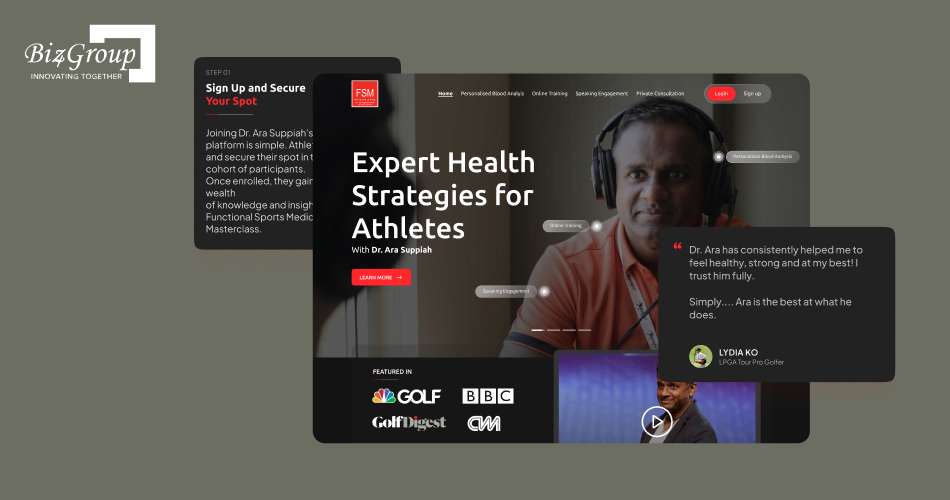
Dr Ara is an AI-powered health platform built to support athletes with real-time insights, injury tracking, and performance analysis. It combines data capture, AI-driven evaluation, and structured reporting to improve decision-making. This kind of system reflects how intelligent recording and analysis can also be applied in surgical environments.
Understanding Architecture in AI Medical Surgery Recording App Development
Every surgical recording system is built in layers, where each layer handles a specific part of the workflow. In AI medical surgery recording app development, this layered structure ensures that data is captured, processed, stored, and presented in a way that is reliable and easy to use in clinical environments.
|
Layer |
What It Includes |
How It Works |
Why It Matters |
|---|---|---|---|
|
Capture Layer |
Cameras, microphones, operating room inputs |
Records video and audio during surgery in real time |
Ensures clear and consistent data for further processing |
|
Processing Layer |
Edge systems, cloud infrastructure |
Analyzes data, detects events, and adds structure to recordings |
Converts raw data into meaningful information |
|
Storage Layer |
Cloud storage, databases |
Stores both raw video and structured outputs like timestamps and tags |
Allows quick access without reviewing full recordings |
|
Application Layer |
Dashboards, user interfaces |
Displays recordings, timelines, and searchable data to users |
Makes the system usable for clinicians and staff |
Each layer depends on the others. If one layer is weak, the overall system becomes harder to use or scale. For example, poor capture quality affects processing accuracy, and weak storage design slows down retrieval.
In real-world implementations, teams often rely on AI consulting services to design these layers so they work together smoothly. When evaluating top companies that develop AI medical recording apps, organizations usually focus on how well this architecture is designed, since it directly impacts performance, usability, and long-term scalability.
Make Surgical Data Work Smarter
Start your AI medical surgery recording app development journey with systems designed for real-time accuracy and structured outputs.
Build My AI Recording AppKey Features in AI Medical Surgery Recording Mobile App Development
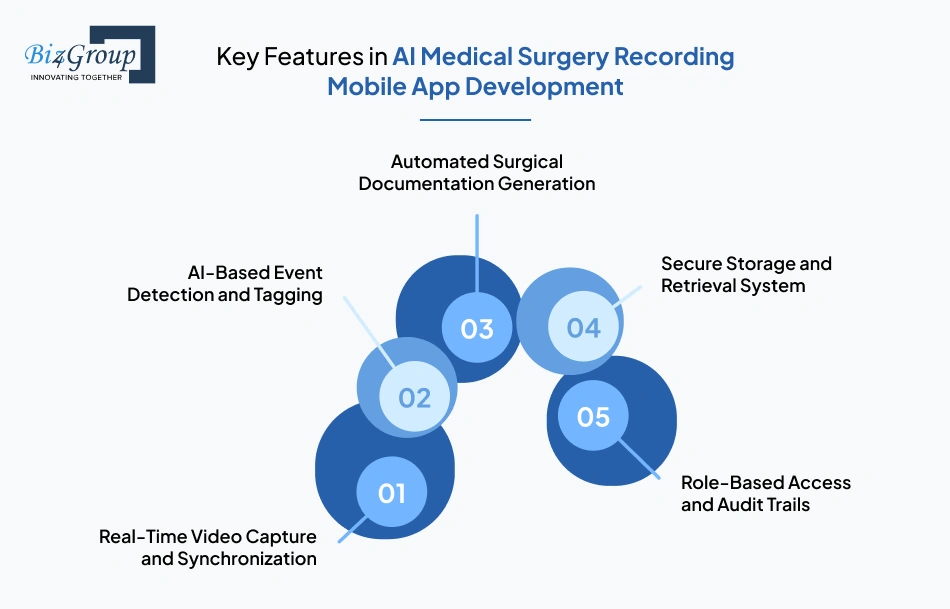
Surgical recording systems today are expected to capture procedures, organize data, and support documentation without adding extra steps for clinicians. In AI medical surgery recording app development, the focus is on building features that fit naturally into surgical workflows while making data easier to use.
1. Real-Time Video Capture and Synchronization
The system records video and audio together during the procedure. Proper synchronization ensures that actions, conversations, and timestamps stay aligned, which is important for accurate review and documentation.
2. AI-Based Event Detection and Tagging
The system detects changes during the procedure, such as transitions between steps or movement of instruments. These points are marked automatically, allowing users to find specific moments without scanning the full recording.
3. Automated Surgical Documentation Generation
Captured data is used to create structured documentation. Instead of writing everything manually, clinicians can review and finalize records that are already organized based on the procedure timeline. In some implementations, elements of AI in healthcare administration automation are used to streamline how this information is prepared and finalized.
4. Secure Storage and Retrieval System
All recordings and related data are stored in a way that allows quick access while maintaining security. Designing this layer requires careful planning around access, encryption, and system performance, especially when considering how to build secure AI surgery recording mobile app solutions.
5. Role-Based Access and Audit Trails
The system controls who can view or edit data based on defined roles. It also keeps a record of all access and changes, which helps maintain accountability and supports compliance requirements.
These features work together to make surgical data easier to capture, manage, and review. Organizations that aim to make AI-powered surgery recording app systems typically focus on keeping the experience simple for users while ensuring the system remains secure, reliable, and scalable.
Critical Choices When You Develop AI Medical Surgery Recording App
Building a surgical recording system requires a few key decisions. These decisions affect how the system works during surgery, how data is processed, and how easy it is to use. In AI medical surgery recording app development, getting these choices right helps avoid performance and usability issues later.
1. Real-Time Processing vs Batch Processing
This choice decides when the system processes data.
|
Factor |
Real-Time Processing |
Batch Processing |
|---|---|---|
|
Timing |
During surgery |
After surgery |
|
Speed |
Immediate |
Delayed |
|
Detail |
Limited |
More complete |
|
Use |
Live tagging |
Reports and summaries |
Real-time processing is used when quick updates are needed during surgery. Batch processing is used when the full procedure needs to be reviewed for better accuracy.
Many systems use both. Real-time gives quick structure, and batch processing improves it later.
2. Edge AI vs Cloud AI Deployment
This decision is about where the data is processed.
- Edge AI works close to the operating room. It reduces delay and works even if the network is not stable.
- Cloud AI works on remote systems. It handles larger workloads and is easier to scale.
Most systems combine both:
- Edge handles quick processing
- Cloud handles deeper analysis
This setup is common when developing an AI surgery apps with compliance and data security, where both speed and control are important.
3. Video Quality vs Storage Efficiency Trade-Offs
Video quality affects how useful the recording is.
Higher quality gives better detail but takes more storage and processing power. Lower quality saves space but may miss important details.
A practical approach:
- Use high quality where detail matters
- Compress older or less important data
- Keep important segments easy to access
The goal is to balance clarity and storage without slowing down the system.
4. Build vs Integrate Third-Party AI Components
This decision is about how much control the system needs versus how quickly it needs to be built. Building AI components from scratch gives more flexibility, while integrating existing tools can reduce development time. The choice depends on clinical requirements, compliance needs, and available resources.
|
Factor |
Build |
Integrate |
|---|---|---|
|
Control |
Full control over features and data handling |
Limited control based on third-party capabilities |
|
Development Time |
Longer due to custom development |
Faster using pre-built components |
|
Customization |
High, tailored to specific workflows |
Limited to available configurations |
|
Compliance |
Easier to align with strict internal policies |
Depends on third-party standards |
|
Maintenance |
Requires internal expertise |
Managed partly by external providers |
In most cases, systems use a combination of both approaches. Core features are built to match clinical workflows, while supporting components are integrated to save time.
Teams working on creating an AI medical recording app for surgical documentation often mix both. They build core features and integrate supporting ones. Working with a custom software development company can help manage this balance without adding complexity.
Turn Surgical Recording into Actionable Data
Plan to develop AI medical surgery recording app solutions that simplify workflows and reduce manual documentation.
Explore My App StrategyData Management Strategies for AI-Powered Surgery Recording App Systems
Surgical recording systems generate a large amount of video and related data. Managing this data is an important part of AI medical surgery recording app development, because it affects how fast the system works and how easy it is to use. A good data strategy helps store recordings properly and makes them easy to access when needed.
1. Storage Strategies for High-Volume Video Data
A. Tiered Storage
Recent or frequently used recordings are stored in faster systems. Older data is moved to lower-cost storage. This helps manage both speed and cost.
B. Segment-Based Storage
Instead of working with full-length videos, the system stores smaller parts linked to specific steps. This makes it easier to access only the required section.
C. Video Compression
Video files are reduced in size to save storage space. The system balances file size and quality so that recordings remain useful.
2. Indexing and Search Optimization Using AI
A. Event-Based Indexing
The system marks important moments during a procedure, such as step changes. These markers help users find specific parts quickly.
B. Search by Keywords or Steps
Users can search recordings using terms related to the procedure. This removes the need to watch full videos.
C. Metadata Creation
The system stores extra information like timestamps and labels along with the video. This improves search and understanding. This is one way how AI app is transforming surgical recording and documentation into a more usable format.
3. Data Lifecycle and Archival Policies
A. Active and Archived Data
New recordings are kept easy to access. Older recordings are moved to archive storage to save space.
B. Data Retention Rules
Hospitals define how long data should be stored. The system follows these rules automatically.
C. Secure Storage and Access
Archived data is kept secure and can be accessed when required. In some systems, AI automation services are used to manage data movement and storage without manual effort.
Good data management makes surgical recordings easier to use and maintain. It also explains why are hospitals using AI application to record surgical procedures, as structured data helps with faster access, better documentation, and more efficient workflows.
Portfolio Spotlight
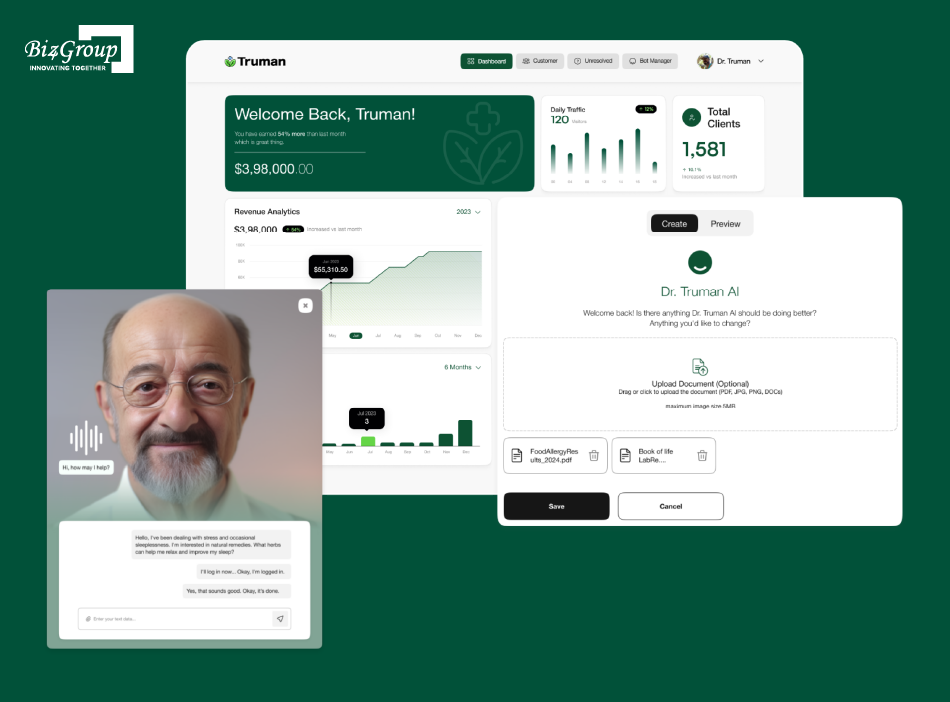
Truman is an AI-enabled wellness platform designed to provide personalized health insights, tracking, and recommendations through continuous data analysis. It shows how structured health data and AI models can work together, a concept that directly connects to how surgical recordings are processed, analyzed, and used in clinical systems.
How to Develop AI Medical Surgery Recording Mobile App? Step-by-Step Process
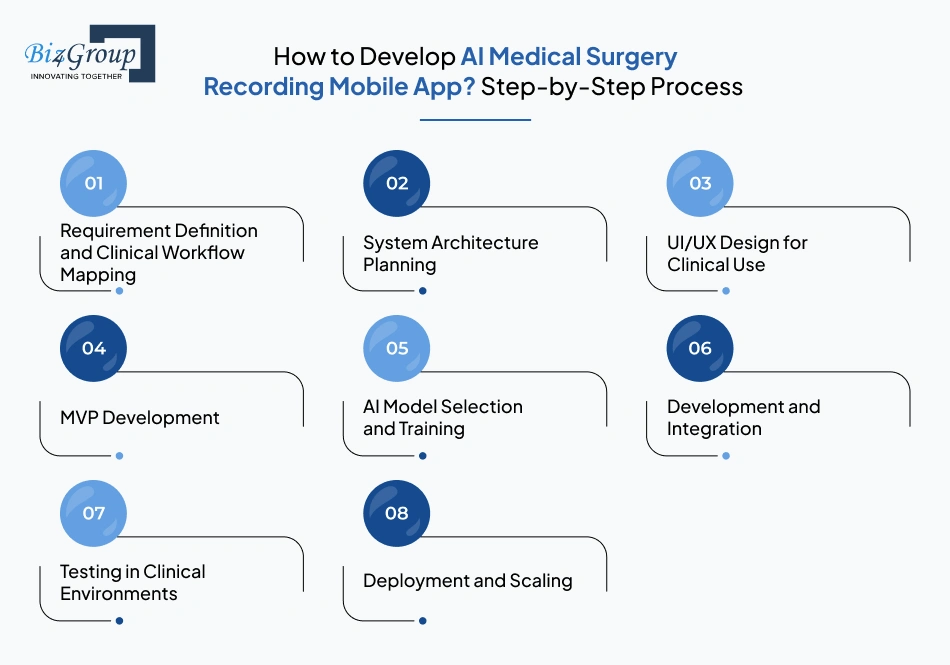
Developing a surgical recording system requires more than standard app development. The system must align with operating room workflows, handle continuous video streams, and support accurate documentation. In AI medical surgery recording app development, each step is shaped by how surgeries are performed and how data is used after the procedure.
So, for everyone asking “how can I develop an AI surgery recording app for my hospital?,” here’s all you need to know:
1. Requirement Definition and Clinical Workflow Mapping
Start by understanding how recording and documentation currently happen during surgeries. This helps define what the system should capture and how it should behave.
- Identify who controls recording during procedures
- Define which surgical steps need to be marked or tracked
- Understand how post-surgery documentation is created
- Capture compliance, consent, and audit requirements
2. System Architecture Planning
The system must handle high data volumes while staying stable in clinical environments. Planning the architecture early avoids performance issues later.
- Define how video and audio will be captured and synced
- Decide where processing will happen based on latency needs
- Plan storage for large video files and structured outputs
- Align architecture with long-term scalability in AI healthcare recording app development
3. UI/UX Design for Clinical Use
The UI/UX design should support quick actions without distracting clinical staff. Simplicity is critical in operating room conditions.
- Design controls for starting, stopping, and tagging recordings
- Reduce the need for manual input during procedures
- Ensure clear visibility of key actions and statuses
- Support fast navigation during post-surgery review
Also Read: Top 15 UI/UX Design Companies in USA (2026 Edition)
4. MVP Development
Build a basic version that reflects actual surgical workflows. This helps validate whether the system fits into real usage before expanding further.
- Enable stable recording and playback
- Include basic tagging or timestamp marking
- Provide simple storage and retrieval
- Test usability in controlled clinical scenarios
Also Read: Top 12+ MVP Development Companies to Launch Your Startup in 2026
5. AI Model Selection and Training
Models should focus on identifying surgical patterns and events. Their performance depends on how well they are trained on relevant data.
- Select models for video and audio analysis
- Train AI models using data that reflects real procedures
- Validate outputs against expected surgical steps
- Ensure compatibility with AI medical surgery recording mobile app development needs
6. Development and Integration
At this stage, all components are connected into a working system. The focus is on smooth data flow and system reliability.
- Integrate capture, processing, and storage layers
- Connect AI outputs with documentation workflows
- Ensure secure handling of medical data
- Support system design goals when teams build AI clinical recording systems app platforms
7. Testing in Clinical Environments
Testing should reflect real operating conditions, including long procedures and variable network performance.
- Run tests during full-length surgical recordings
- Check accuracy of event detection and timestamps
- Evaluate system performance under load
- Validate compliance and data handling processes
Also Read: 15+ Software Testing Companies in USA in 2026
8. Deployment and Scaling
Deployment should be gradual, with continuous monitoring and improvement based on real usage.
- Roll out in selected departments first
- Monitor storage usage and system performance
- Optimize based on user feedback
- Prepare infrastructure as teams build AI-powered surgery recording app systems at scale
A structured approach helps ensure the system works reliably in clinical settings. Teams that plan to develop AI medical surgery recording app solutions should focus on workflow alignment, data handling, and gradual scaling to avoid operational issues later.
Cost Breakdown for Developing AI-Powered Surgery Recording App
The cost of AI medical surgery recording app development depends on how complex the system is and how much it needs to scale. In most cases, the cost ranges between $50,000 to $400,000+, which is a ballpark figure. Simpler systems cost less, while systems with advanced AI and large data handling cost more.
|
Development Level |
What It Includes |
Estimated Cost Range |
|---|---|---|
|
MVP-level AI-Powered Surgery Recording App |
Basic video recording, simple storage, basic interface, limited AI features like tagging |
$50,000 – $120,000 |
|
Advanced-Level AI-Powered Surgery Recording App |
Real-time recording, AI-based tagging, better UI, structured data handling, secure storage |
$120,000 – $250,000 |
|
Enterprise-Grade AI-Powered Surgery Recording App |
Full AI features, large-scale video storage, multi-device support, compliance systems, high scalability |
$250,000 – $400,000+ |
As the system becomes more advanced, the cost increases because of AI, storage, and infrastructure needs. Teams that plan to develop scalable AI healthcare recording app platform solutions should also consider ongoing costs like maintenance, updates, and data storage over time.
Improve Documentation Efficiency by Up to 30%
Use AI healthcare recording app development to reduce manual effort and improve accuracy across surgical workflows.
See How It WorksBuild or Outsource the Development of AI-Powered Surgery Recording App Systems?
Choosing between building in-house or outsourcing depends on resources, timelines, and control requirements. In AI medical surgery recording app development, this decision affects how quickly the system is delivered and how much flexibility the team retains over features, data handling, and long-term scalability.
|
Factor |
Build In-House |
Outsource Development |
|---|---|---|
|
Control Over System |
Full control over features, workflows, and data handling |
Control depends on vendor capabilities and contracts |
|
Development Speed |
Slower due to hiring, setup, and internal alignment |
Faster with pre-built expertise and delivery processes |
|
AI Expertise |
Requires hiring or training internal AI and domain experts |
Access to experienced teams with prior implementations |
|
Customization |
High, can match exact clinical workflows and compliance needs |
Limited by vendor frameworks and predefined solutions |
|
Compliance Handling |
Easier to enforce internal policies and data governance |
Depends on vendor’s compliance standards and practices |
|
Upfront Cost |
Higher due to team building and infrastructure setup |
Lower initial cost but may increase over time |
|
Long-Term Cost |
More predictable after setup |
Ongoing vendor fees and potential scaling costs |
|
Maintenance and Updates |
Fully managed internally |
Dependent on vendor timelines and support |
|
Knowledge Retention |
Internal teams retain full system understanding |
Knowledge may remain with external team |
|
Scalability |
Requires internal planning and resources |
Often supported by vendor infrastructure and experience |
Building in-house works well when control and customization are important. Outsourcing is useful when speed and access to expertise are the main priorities. Teams planning to create AI surgical video recording mobile app solutions usually decide based on their internal capabilities and deadlines.
Risks and Control Trade-Offs related to AI Medical Surgery Recording App Development
Both approaches have trade-offs that need to be considered early.
- Outsourcing can create dependency on external teams for updates and changes
- Custom workflows may be harder to achieve with pre-built solutions
- In-house development requires hiring and managing technical teams
- Internal teams need time to gain system knowledge and experience
- Scaling can become difficult if the system is not planned properly
- Vendor timelines may not always match internal priorities
Some organizations work with a software development company in Florida to balance speed and control while keeping development aligned with technical and compliance needs.
The right choice depends on how much control you want and how quickly you need to move. Teams working on building an AI surgery recording app with real-time video capture often use a mix of both approaches to manage risk and maintain flexibility.
Compliance and Data Security in AI Surgery Recording Apps
Surgical recordings contain sensitive patient data, so they must be handled carefully. In AI medical surgery recording app development, compliance and security are part of the system design from the beginning. The goal is to keep data safe while allowing authorized users to access it when needed.
Regulatory Frameworks and Requirements
Healthcare systems must follow rules that define how patient data is collected, stored, and shared. These rules usually require:
- Secure storage and data encryption
- Controlled access based on user roles
- Clear patient consent before recording
The exact regulations depend on location, but the purpose is the same: protect patient information and ensure proper use of data. In some cases, teams that build AI software for healthcare include these requirements directly into system workflows to avoid compliance gaps.
Data Anonymization and Masking Techniques
Sensitive information is often removed or hidden to reduce risk. This can include:
- Blurring faces or removing identifying visuals
- Removing names or identifiers from data
- Limiting access to raw recordings
These steps allow data to be used for review or training without exposing personal details. This becomes more important when systems are built to develop scalable AI healthcare recording app platform solutions, where more users and data are involved.
Auditability and Traceability Mechanisms
The system should track how data is used at all times. This includes:
- Who accessed a recording
- When it was accessed
- What changes were made
These records help maintain transparency and make it easier to review system activity when needed. Features inspired from AI assistant app design can also help users track and understand system actions without adding complexity.
Strong compliance and security practices help protect patient data and maintain trust. Organizations that evaluate top companies that develop AI medical recording apps often focus on how well these controls are implemented, since they affect both safety and system reliability
Risks in AI Medical Surgery Recording App Development You Should Know
Every system has limitations, especially in clinical environments where accuracy and reliability matter. In AI medical surgery recording app development, risks are not only technical but also related to compliance and real-world usage. Understanding these early helps avoid issues during deployment.
1. Technical Limitations of AI Models
AI systems depend on patterns learned from data. In surgical settings, this creates a few challenges.
Models may not detect every step correctly, especially when procedures vary or conditions change. Lighting, camera angles, and tool visibility can also affect accuracy. Outputs may look structured, but they still need review before being used in documentation.
Some systems use generative AI to create summaries or structured outputs. These can help reduce effort, but they are not always reliable on their own.
In practice, AI works best as a support layer. It helps organize data, but final validation still depends on clinical review.
2. Legal and Ethical Considerations
Surgical recording involves sensitive patient data, which makes compliance a key concern.
Patient consent must be clearly defined before recording begins. Data must be stored and accessed in line with healthcare regulations. There must also be clarity on who owns the recorded data and how it can be used.
Another important factor is data usage. Recordings used for training or analysis should not expose patient identity. Systems designed around how to build secure AI surgery recording mobile app principles usually include controls for consent, access, and data handling from the start.
These requirements are not optional. They directly affect whether the system can be used in real clinical environments.
4. Adoption Challenges Among Medical Staff
Even if the system works well technically, adoption can still be a challenge.
- Surgical teams may be cautious about relying on automated systems
- Extra steps during procedures can slow down workflows
- Learning new tools takes time and training
- Trust in AI outputs doesn’t build immediately, it’s gradual
To address this, systems need to fit into existing workflows rather than change them. In some cases, teams hire AI developers and product specialists to refine the system based on feedback from clinical users.
Understanding these risks helps teams make better decisions during planning and development. Organizations that aim to make AI-powered surgery recording app systems successful focus not only on building the technology, but also on ensuring it is reliable, compliant, and easy for medical teams to use.
Design Systems That Capture More Than Video
Move beyond recording and build AI-powered surgery recording app platforms that deliver insights and structured outputs.
Start Building TodayHow to Select a Partner to Build AI-Powered Surgery Recording App?
Selecting a development partner is not just about technical delivery. The partner will shape how the system performs in clinical settings, how secure it is, and how well it scales over time. In AI medical surgery recording app development, the right choice depends on both technical depth and understanding of healthcare workflows.
1. Technical Capabilities to Assess
The partner should be able to handle video-heavy systems, real-time processing, and AI-driven workflows. This includes working with large data volumes and integrating multiple system layers.
- Look for clarity in how they approach:
- Video capture and processing pipelines
- AI model integration and accuracy handling
- System performance under long surgical procedures
Experience in developing an AI surgery apps with compliance and data security is important here, as it shows they can balance performance with data protection.
A simple check: ask how their system behaves during a full-length surgery. If the answer is vague, that’s a risk.
2. Compliance and Healthcare Experience
Technical skills alone are not enough. The partner must understand how healthcare environments operate. A strong partner will:
- Design systems around consent and access control from the start
- Align with how documentation is actually created in hospitals
- Anticipate audit and compliance requirements early
More than certifications, it’s about practical experience that a partner holds. Teams that have worked on healthcare systems tend to make fewer assumptions and require fewer corrections later.
In some cases, experience in areas like business app development using AI helps, but only if it is combined with real healthcare exposure.
3. Scalability and Support Models
This is where many decisions go wrong. The system may work initially but fail when usage increases. The partner should clearly explain:
- How the system handles growing video data
- How performance is maintained over time
- What happens when new features or updates are needed
This is also where outsourcing decisions become practical.
If you are asking can I outsource AI healthcare recording app development?, the real question is about long-term ownership. Who maintains the system? Who handles scaling issues? How quickly can changes be made?
Some teams choose outsourcing for faster delivery, then move critical parts in-house later. Others keep a hybrid model where core systems are controlled internally.
Mostly, teams partner with the top AI development companies in Florida to balance speed, expertise, and regulatory alignment.
Quick Evaluation Checklist
|
Evaluation Area |
What to Check |
Why It Matters |
|---|---|---|
|
Technical Capability |
Can they handle long-duration video processing and real-time workflows? |
Ensures system stability during surgeries |
|
AI Expertise |
Do they explain how models are trained and validated? |
Impacts accuracy of detection and documentation |
|
Healthcare Experience |
Have they worked with clinical workflows before? |
Reduces implementation friction |
|
Compliance Readiness |
Do they address consent, access control, and audits early? |
Avoids legal and operational risks |
|
Scalability Plan |
How do they handle increasing data and users? |
Ensures long-term system performance |
|
Support Model |
What happens after deployment? |
Determines system reliability over time |
|
Outsourcing Fit |
How much control do you retain? |
Affects flexibility and ownership |
The right partner is one who can explain their decisions clearly, not just build the system. Teams that plan to can I outsource AI healthcare recording app development? should focus on long-term reliability, not just initial delivery speed.
Plan Your Next Healthcare AI System with Clarity
Work with experts to develop scalable AI healthcare recording app platform solutions aligned with your clinical workflows.
Talk to Our AI ExpertsTrends Shaping AI-Powered Surgery Recording App Development
Surgical recording systems are changing from simple recording tools to systems that help during and after procedures. In AI medical surgery recording app development, the focus is on making data more useful, easier to access, and better connected with other clinical systems.
1. Real-Time Surgical Assistance
AI systems are starting to support surgeons during the procedure. The system can track steps, mark events, and organize data as the surgery happens. This reduces the need for manual work later and helps keep records more accurate.
In some systems, AI chatbot integration is used to quickly access information or review data without interrupting the workflow. This keeps the interaction simple while still making data available when needed.
2. Predictive Analytics in Operating Rooms
AI systems can analyze data from multiple procedures to find patterns over time. This helps teams understand how surgeries are performed and where improvements can be made.
These insights can be used to identify delays, highlight common variations, and support better planning. This approach is often part of systems designed to build AI clinical recording systems app platforms, where data is continuously used to improve outcomes.
3. Integration with Robotic Surgery Systems
Recording systems are being connected with robotic and assisted surgery tools. This allows direct capture of actions performed by machines along with video and audio data.
The result is a more complete and synchronized record of the procedure. As systems become more connected, references like a healthcare conversational AI guide can help teams design workflows that remain simple while combining multiple technologies.
These trends show that surgical recording is becoming more active and connected. Teams that plan to create AI surgical video recording mobile app solutions are focusing on systems that are easy to use while supporting better data and decision-making.
Simplify Surgical Recording and Documentation
Take the next step to create AI surgical video recording mobile app solutions that improve data access and usability.
Get Started NowWhy Choose Biz4Group LLC to Develop AI Medical Surgery Recording App?
Building healthcare systems requires clear thinking around data, workflows, and system reliability. As an AI app development company, Biz4Group focuses on building solutions that are simple to use, secure, and built for real clinical environments. This approach is central to AI medical surgery recording app development.
Work across platforms like Dr Ara and Truman shows how AI can handle data capture, processing, and structured outputs in real-world use. The same thinking applies when building surgical recording systems that need accuracy and consistency.
What makes Biz4Group LLC a great choice:
- Experience working with AI-based healthcare platforms
- Strong focus on handling video and large data systems
- Clear approach to security and compliance needs
- Ability to build and scale systems over time
- Focus on simple and reliable system design
Biz4Group LLC builds systems that are easy to use and work well in day-to-day clinical operations.
Wrapping Up
Surgical recording is no longer just about storing videos. It is becoming a system that captures, understands, and organizes what happens inside the operating room. That shift makes these platforms more useful for documentation, training, and ongoing improvement.
For teams exploring this space, the real challenge is not just building the system, but building it in a way that works reliably in clinical settings. This is where thoughtful custom healthcare software development becomes important, especially when workflows and data handling need to align closely with real use.
Working with an AI product development company can also help bring structure to the process, from planning to scaling, without overcomplicating the system.
In simple terms, better recording leads to better data, and better data leads to better decisions. The rest comes down to how well the system is designed and built.
Looking to build an AI surgical recording system that actually works in real environments? Let’s map it out.
FAQs
1. How Long Does It Take to Build an AI Surgery Recording App?
Development timelines usually range from 3 to 9 months, depending on complexity. A basic version can be built faster, while systems with real-time AI, integrations, and compliance requirements take longer due to testing and validation.
2. What Type of Hardware Is Required for Surgical Recording Systems?
Most systems require high-resolution cameras, microphones, and secure capture devices. In some setups, edge devices are used for local processing before data is sent to cloud systems for storage and analysis.
3. Can AI Surgery Recording Apps Integrate with Existing Hospital Systems?
Yes, these apps can integrate with systems like EHR, EMR, and hospital management platforms. Integration depends on API availability and data standards used by the hospital’s existing infrastructure.
4. How Do AI Models Improve Over Time in Surgical Recording Systems?
AI models improve by learning from new data. As more surgical recordings are processed, models can be updated to improve accuracy in tagging, detection, and documentation, provided proper validation and retraining processes are in place.
5. What Are the Biggest Challenges in Implementing AI Surgery Recording Apps?
Common challenges include handling large video data, ensuring compliance, maintaining system performance, and getting staff adoption. These factors often impact how smoothly the system works in real environments.
6. How Much Does It Cost to Develop an AI Surgery Recording App?
The cost typically ranges from $50,000 to $400,000+, depending on features, AI complexity, and scalability requirements. Basic systems cost less, while enterprise-grade platforms with advanced AI and infrastructure fall on the higher end.
