Location :
Orlando, FL, USA
Location :
Orlando, FL, USA +1 (407) 714-1616
 info@biz4group.com

















Imagine a digital system that doesn’t wait for instructions but instead, understands your business goals, learns from real-time feedback, and takes independent actions to get the job done.
Read More

 AI Summary Powered by Biz4AI
Quick question before we get into it. When was the last time your hospital's systems actually talked to each other without someone manually bridging the gap?
If you paused to think about that, you're not alone. Most healthcare leaders we talk to are running five or six different platforms that were never built to work together. Patient records in one place. Scheduling in another. Billing somewhere else entirely. And somebody on your team is stuck stitching it all together by hand, every single day.
That's the exact problem AI hospital management software development is built to solve, and healthcare organizations are catching on fast. The global hospital management software market is sitting at $30.53 billion in 2026 and is expected to climb past $82 billion by 2035. Nearly 58% of hospitals are already integrating AI-driven analytics into how they run daily operations, according to the same report. In the US alone, the hospital management solutions market is projected to hit $3.54 billion in 2026, and it's not slowing down anytime soon. If you want a broader read on where healthcare technology is heading this year, it's worth looking at the top healthcare IT trends shaping decisions like this one across the industry.
So, here's the real question. Is your hospital going to lead that shift, or spend the next few years playing catch-up?
We've built AI systems for healthcare organizations that were exactly where you might be right now. Frustrated with legacy software. Unsure whether hospital management AI is worth the investment. Nervous about compliance, cost, and getting it wrong.
This guide walks you through everything you actually need to know, from what AI-powered hospital management software really does, to how hospital management system development using AI works step by step, to what it costs, to the mistakes that quietly sink these projects. No recycled feature lists. No vague promises. Just what we've learned from doing this work for real hospitals, real health systems, and real decision-makers like you.
If you're a founder, CTO, or healthcare tech leader trying to figure out whether now is the right time to build an AI hospital management system, keep reading. This one's written for you.
Let's start with a clear answer.
AI hospital management software is a digital platform that runs a hospital's daily operations, patient records, scheduling, billing, staffing, and resource allocation, while using artificial intelligence to predict problems, automate repetitive work, and support faster decisions. It's the difference between a system that simply stores information and one that actually acts on it.
A traditional hospital management system tells you what already happened. The bed was filled. The shift ended late. A claim got denied. Artificial intelligence in hospital management flips that. It tells you what's about to happen, so your team can act before the problem shows up on someone's desk.
Think of it this way. If your current system is a filing cabinet, an AI-powered one is closer to a colleague who never sleeps, constantly watching patterns across your hospital and flagging what needs attention before it becomes urgent.
So why are CTOs, founders, and hospital administrators moving on this now instead of waiting for another budget cycle? A few reasons keep coming up in almost every conversation we have with healthcare leaders.
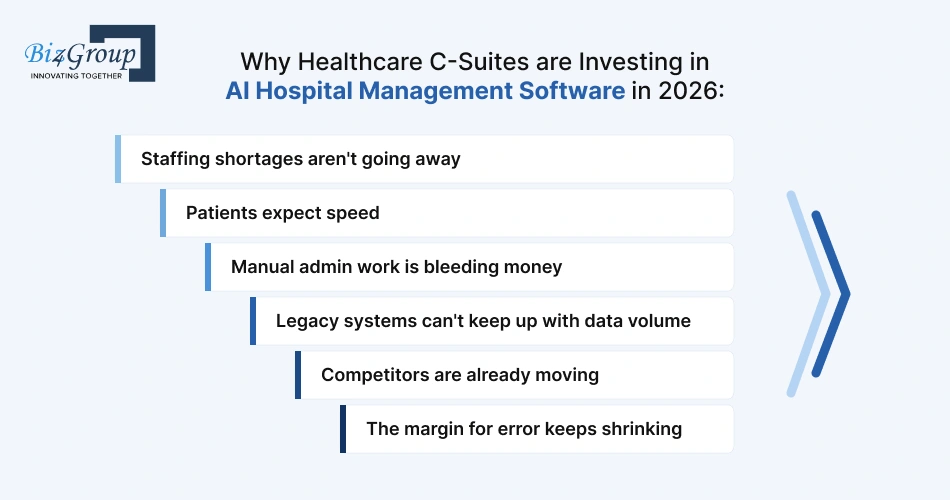
Why Healthcare C-Suites are Investing in AI Hospital Management Software in 2026:
None of this is about chasing a trend. It's about staying operational in a healthcare environment that isn't going to slow down and wait for anyone. If you want to see how this plays out in practice, it's worth looking at a few top AI healthcare case studies where hospitals made this exact shift and measured the results.
The hospitals moving fastest right now aren't necessarily the biggest ones. They're the ones whose leadership stopped asking "should we do this" and started asking "how do we do this right."
That second question is what the rest of this guide answers.
Let's figure out what an AI hospital management system would actually look like for your hospital, no commitment, just clarity.
Talk to Our Healthcare AI Team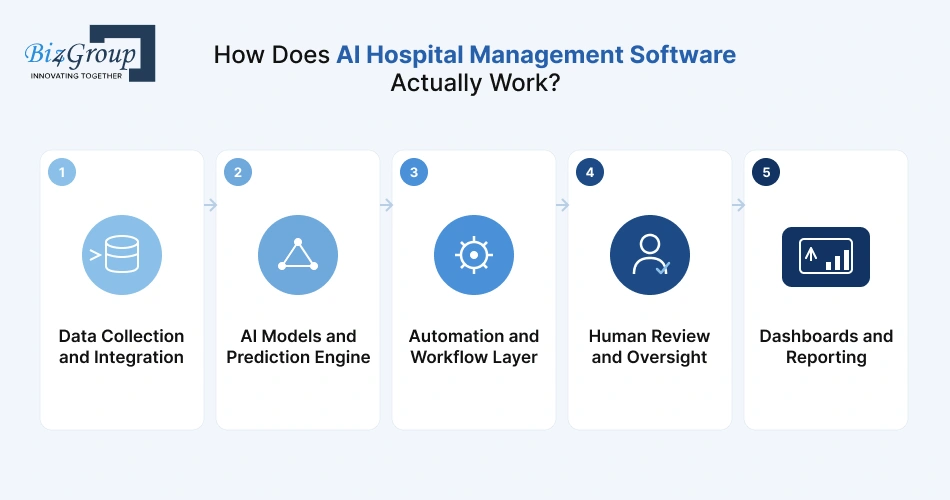
Here's what a lot of vendors won't tell you plainly. AI hospital management software isn't one single tool. It's a layered system, where each layer does a specific job, and together they turn raw hospital data into action.
Let's break down how hospital management software with AI actually works, layer by layer.
Every part of your hospital generates data constantly. Admissions, lab results, staff schedules, billing records, equipment usage. This layer pulls all of that together from your existing systems instead of forcing you to abandon them.
This is usually done through AI integration services that connect your current EHR, scheduling, and billing tools into a single data flow, so nothing sits isolated in its own silo anymore.
Once the data is flowing into one place, machine learning models start doing what humans can't do at scale. They spot patterns across thousands of data points and predict what's coming next.
A model trained on historical admission data can flag that your ER is likely to get busier by Thursday afternoon. Another can predict which patients are at higher risk of readmission before they're even discharged, a core part of what makes AI for hospital resource management genuinely useful instead of just a buzzword on a sales deck.
This is where predictions turn into real action instead of sitting in a report nobody reads. The system automatically reassigns staff, reorders supplies, or adjusts scheduling based on what the prediction engine just flagged.
A healthcare AI agent can handle a lot of this automation directly, working through routine tasks like appointment reminders, intake forms, or triage routing without a human needing to trigger every single step.
No matter how good the automation gets, the system is built to keep people in control of decisions that actually matter. Clinical judgment calls, discharge decisions, and anything touching patient safety route back to your staff for review, not full automation.
This layer is what keeps the software trustworthy instead of just fast. It's a core part of what we cover under AI governance in healthcare, and we'll go deeper on exactly where this line should sit later in this guide.
Everything the system learns and automates gets surfaced back to your team in a way that's actually usable. Real-time dashboards show bed availability, staff workload, and financial performance without anyone digging through five different reports.
This is also where AI healthcare analytics software earns its keep, turning raw operational data into decisions your leadership team can act on the same day.
Here's how it looks in practice, start to finish:
A patient is admitted → data flows into the system automatically → the prediction engine flags a likely bed shortage in six hours → the automation layer reassigns available beds and notifies staff → a nurse manager reviews and confirms the reassignment → the dashboard updates in real time so leadership sees the full picture instantly.
That's the loop. Data in, prediction out, action taken, human confirms, insight delivered. Every AI hospital management platform worth building follows some version of this flow, whether it's managing patient queues, staff schedules, or hospital resources.
Theory is easy to nod along to. Real scenarios are what actually convince a CTO or hospital administrator to move forward. So, before we get into features, let's look at where AI hospital management system capabilities are already changing how hospitals operate day to day.
ERs rarely get busy without warning. Patterns build up over hours, sometimes days, based on weather, local events, or seasonal illness trends. AI models trained on historical admission data catch these patterns early and alert staff before the waiting room fills up.
Examples
A 2026 study published in Nature Communications by researchers Ryu, Ayanian, and Qian tested an AI tool that predicts hospital admissions directly from the emergency department in real clinical settings. The tool improved clinical workflow efficiency by giving staff advance notice of incoming admissions instead of reacting once patients were already backed up in the waiting room.
Nobody enjoys sitting in a waiting room with no idea how long it'll take. AI-driven queue systems track real-time patient flow and give accurate wait time estimates instead of a vague guess at the front desk.
This is where hospitals actively working to build hospital queue management software with AI see the fastest, most visible improvement in patient satisfaction scores.
Examples
Published research on AI-driven patient flow management found that hospitals using machine learning models for scheduling and resource allocation reduced patient waiting times by 37.5% and improved bed occupancy efficiency by 29%, with prediction accuracy for patient stay duration reaching 87.2%.
A 300-bed hospital doesn't run on guesswork, or at least it shouldn't. AI systems track bed turnover, cleaning schedules, and incoming admissions together, then recommend the fastest safe path to free up capacity.
The same logic applies to equipment and supplies. If ICU ventilator usage is trending up, the system flags it before your team runs short.
Examples
Johns Hopkins Hospital's Judy Reitz Capacity Command Center, built with GE Healthcare Partners, tracks every bed across the hospital in real time and uses predictive modeling to anticipate when the next ICU bed or operating room will open. The results are documented and specific. Patients are transferred 26% faster once assigned a bed, operating room transfer delays dropped 70%, and the hospital gained the equivalent of 16 additional beds in capacity without adding a single square foot of physical space.
Scattered patient history across multiple systems slows everyone down and increases the risk of missed information. AI patient management software consolidates records, flags drug interactions, and surfaces relevant history the moment a clinician opens a chart, instead of it living in a system nobody checks in time.
Examples
The Mayo Clinic Platform integrates multi-modal AI, pulling together imaging, genomics, and EHR data into real bedside workflows so clinicians see a complete patient picture in one place rather than piecing it together from separate systems.
Shift changes are where communication gaps quietly hurt patient care. AI-powered coordination tools route tasks to the right team member automatically and make sure nothing falls through the cracks between one shift ending and another starting.
Examples
Inha University Hospital in Korea deployed an AI nursing scheduling system called IH-NASS across 14 hospital wards. A published study comparing it to traditional manual scheduling found it significantly improved how nurses were matched to shifts based on experience level, placing fewer novice nurses on day shifts during major treatment periods and directly supporting patient safety and nurse job satisfaction.
Claims processing, coding, and documentation eat up hours that should go toward patient care instead. AI in healthcare administration automation handles the repetitive parts of this work directly, catching errors before a claim gets denied and freeing up your admin staff for higher value work.
Examples
Allina Health, a Minneapolis-based hospital system, deployed an AI system built by UnitedHealth Group that analyzes claims data to catch errors before submission. The result was fewer claim denials and faster reimbursement timelines. Separately, Schneck Medical Center reported an average monthly denial reduction of 4.6% after adopting real-time AI claim scrubbing.
The biggest wins we've seen happen when AI doesn't just work within one department but connects several. A single agentic AI in healthcare workflow can trigger a chain reaction across departments, updating bed availability, notifying the pharmacy, and adjusting staff schedules all from one patient admission event, without a single manual handoff.
Examples
That same Johns Hopkins Capacity Command Center brings together physician referral lines, ambulance retrieval, admitting, and bed management into one coordinated system. It processes roughly 500 messages per minute from 14 different hospital IT systems, applying dozens of algorithms to detect bottlenecks and trigger action across departments in real time instead of leaving each team to react on its own.
These aren't hypothetical use cases. They're backed by documented results from real hospitals, and they're the exact problems healthcare organizations bring to us before we even start talking about a build. If any of these sound familiar, you already know why the next section matters.
By now you've seen what this software actually does in practice. Let's get specific about the features that make it possible, organized the way your hospital actually operates, not as a random list a vendor threw together to look impressive.
Here's the complete breakdown of what a genuinely capable AI hospital management system development should include.
|
Category |
Feature |
What It Does |
|---|---|---|
|
Patient Management |
Consolidates history, medications, and allergies into a single view, pulled from every connected system |
|
|
Patient Management |
Predictive patient risk scoring |
Flags high-risk patients before discharge to reduce readmission rates |
|
Patient Management |
Personalized care recommendations |
Surfaces relevant history and alerts the moment a clinician opens a chart |
|
Scheduling and Queue Management |
Smart appointment scheduling |
Reduces no-shows by predicting which patients are likely to miss appointments |
|
Scheduling and Queue Management |
Real-time queue management |
Gives patients accurate wait time estimates instead of a vague front-desk guess |
|
Scheduling and Queue Management |
Directs patients to the right department or provider based on urgency and symptoms |
|
|
Resource and Bed Management |
Predictive bed allocation |
Forecasts bed availability hours in advance and recommends the fastest safe turnover path |
|
Resource and Bed Management |
Inventory and supply forecasting |
Tracks usage trends and flags shortages before they become a problem |
|
Resource and Bed Management |
Equipment tracking |
Monitors location and usage of critical equipment across departments |
|
Staff Coordination |
AI-driven shift scheduling |
Matches staff experience level to shift demands and reduces scheduling conflicts |
|
Staff Coordination |
Task routing and handoffs |
Assigns tasks to the right team member automatically during shift changes |
|
Staff Coordination |
Workload balancing |
Prevents burnout by distributing patient loads evenly across available staff |
|
Administrative and Billing Automation |
Catches coding errors and missing documentation before a claim is submitted |
|
|
Administrative and Billing Automation |
Scores claims for denial risk and flags high-risk submissions for review |
|
|
Administrative and Billing Automation |
Insurance eligibility verification |
Confirms coverage in real time instead of relying on manual checks |
|
Clinical Decision Support |
Analyzes patient data alongside medical literature to support, not replace, clinician judgment |
|
|
Clinical Decision Support |
Drug interaction alerts |
Flags potential medication conflicts at the point of prescribing |
|
Clinical Decision Support |
Early warning systems |
Detects early signs of deterioration, sepsis, or other critical conditions |
|
Analytics and Reporting |
Real-time operational dashboards |
Shows bed availability, staff workload, and financial performance in one place |
|
Analytics and Reporting |
Predictive demand forecasting |
Anticipates patient volume trends by department, shift, and season |
|
Analytics and Reporting |
Performance and outcome tracking |
Measures the impact of AI-driven changes against clear operational benchmarks |
|
Compliance and Security |
HIPAA-compliant data handling |
Protects PHI across every layer of the system, not just at the storage level |
|
Compliance and Security |
Role-based access control |
Limits who can view or act on sensitive patient and operational data |
|
Compliance and Security |
Audit trails and model logging |
Keeps a record of AI-driven decisions for compliance review and accountability |
|
Integration and Interoperability |
HL7/FHIR-based integration |
Connects with EHR, LIS, pharmacy, and payer systems without duplicate data entry |
|
Integration and Interoperability |
Multi-system data sync |
Keeps patient records, billing, and scheduling data consistent across every connected platform |
|
Integration and Interoperability |
API-first architecture |
Makes it easier to add new tools or integrations as your hospital's needs grow |
A few things worth calling out beyond the table.
None of these features exist in isolation. A predictive bed allocation feature is only as useful as the staff scheduling system it talks to. A denial prevention feature is only as strong as the patient record it's pulling data from. This is why we always push clients to think about their system as one connected platform, not a checklist of separate tools bolted together.
It's also worth saying plainly that not every hospital needs every feature on day one. A phased rollout, prioritized around your biggest operational pain points, almost always outperforms trying to launch everything at once. We'll get into exactly how that phased approach works in the development section coming up.
One more thing that gets overlooked constantly. None of these features matter if the people using them every day find the system confusing or clunky. Good UI/UX design is what determines whether your staff actually adopts the system or quietly finds workarounds to avoid it, and that adoption gap is where a lot of otherwise well-built platforms fail.
We'll help you prioritize the ones that solve your biggest bottleneck, not the ones that look best on a features list.
Map Out Your Feature PrioritiesThis is usually where we lose people in a wall of technical jargon, so let's not do that. What matters here isn't every possible tool available. It's understanding what each layer of your system needs and why, so you can actually have an informed conversation with whoever builds this for you.
Here's the tech stack breakdown for a genuinely capable AI hospital management software development project.
|
Layer |
Common Technologies |
Why It Matters |
|---|---|---|
|
Frontend |
React, Angular, Vue.js |
Powers the dashboards and interfaces your staff interact with every day, so speed and clarity here directly affect adoption |
|
Backend |
Handles the core logic, business rules, and communication between every part of the system |
|
|
AI/ML Frameworks |
TensorFlow, PyTorch, Scikit-learn |
Powers the prediction engine behind bed forecasting, patient risk scoring, and resource planning |
|
Natural Language Processing |
spaCy, Hugging Face Transformers, medical NLP models |
Extracts usable data from clinical notes, physician documentation, and unstructured records |
|
Database |
PostgreSQL, MongoDB, MySQL |
Stores structured patient, billing, and operational data reliably at scale |
|
Data Warehousing |
Snowflake, Amazon Redshift, Google BigQuery |
Centralizes data from every connected system for analytics and reporting |
|
Cloud Infrastructure |
AWS (HIPAA-eligible services), Microsoft Azure, Google Cloud |
Provides the scalable, compliant hosting environment hospital data actually requires |
|
Interoperability Standards |
HL7, FHIR, DICOM |
Makes sure your system can actually talk to existing EHR, LIS, and pharmacy platforms |
|
API Architecture |
REST APIs, GraphQL |
Connects internal modules and external systems without forcing duplicate data entry |
|
Security and Compliance |
OAuth 2.0, AES-256 encryption, role-based access control (RBAC) |
Protects PHI and keeps the system aligned with HIPAA requirements at every layer |
|
DevOps and Deployment |
Docker, Kubernetes, CI/CD pipelines |
Keeps deployments stable and makes updates and scaling far less painful down the line |
|
Monitoring and Model Management |
MLflow, Prometheus, Grafana |
Tracks model performance over time and flags drift before it affects decision accuracy |
There's no single correct stack for every hospital. It depends on your patient volume, existing systems, and compliance requirements, and anyone who hands you a fixed stack before understanding your environment is guessing, not architecting.
Cloud infrastructure needs extra scrutiny here. Not every cloud service is HIPAA-eligible by default, and choosing convenience over compliance is one of the most common early mistakes, usually one that means rebuilding later at a much higher cost.
The AI layer is where experience matters more than the tools themselves. Two teams can use identical frameworks and get wildly different results depending on how the models are trained and monitored after launch. If your team hasn't done this before, it's faster and safer to hire AI developers who already know how to build an AI hospital management system in a regulated environment, rather than learning compliance the hard way.
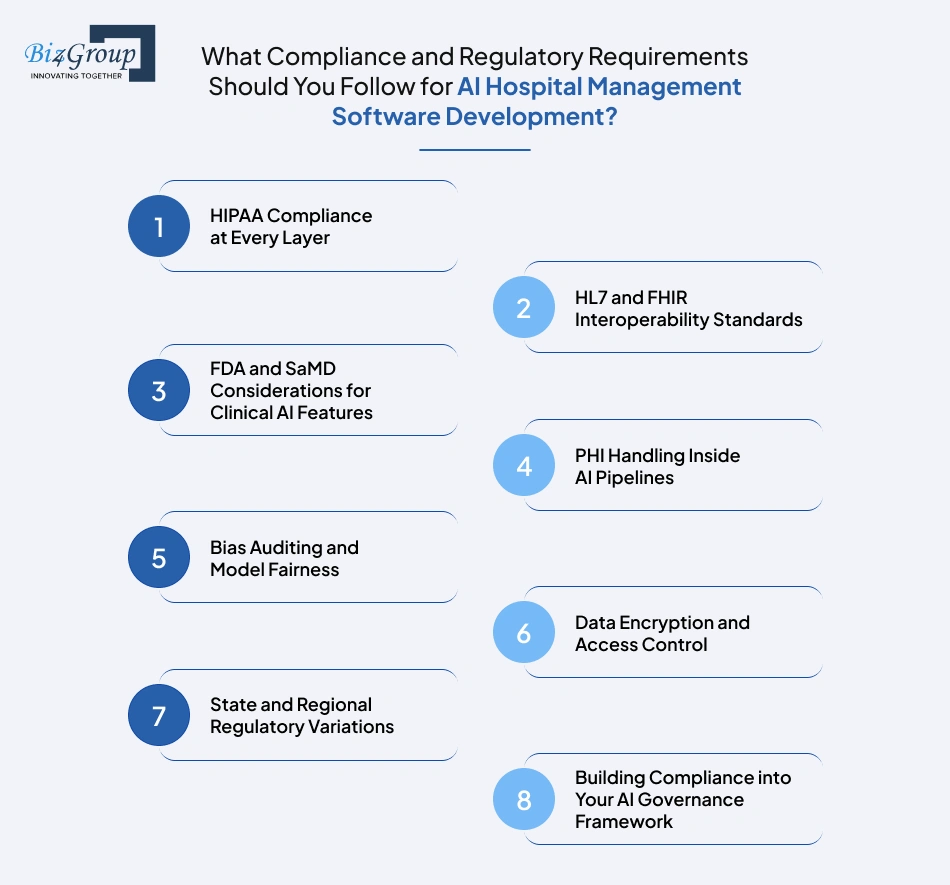
This is the section most vendors skip past with a single sentence, and it's exactly why we're not doing that here. Getting compliance right isn't a checkbox at the end of AI hospital management software development. It shapes your architecture, your data pipelines, and your AI models from day one.
Here's what actually needs to be on your radar when you develop hospital management software using AI.
HIPAA doesn't just apply to where you store patient data. It applies to every system that touches, processes, or moves that data, including your AI models. This means encryption, access controls, and audit logging need to exist at the data layer, the AI layer, and the application layer, not just one of them.
Getting this wrong is one of the fastest ways to derail a project, which is why HIPAA compliance has to be built into the architecture from the first line of code, not bolted on before launch. Any serious custom AI hospital management software development effort treats this as a foundational requirement, not an afterthought.
Your AI system needs a common language to communicate with existing EHR, LIS, pharmacy, and payer systems. HL7 and FHIR are industry standards that make this possible without forcing duplicate data entry or mismatched records across platforms.
Skipping proper HL7/FHIR implementation is one of the most common reasons an AI-powered hospital management system fails to integrate cleanly with what a hospital already has running.
If any part of your system makes or influences a clinical decision, like flagging a diagnosis risk or recommending treatment paths, it may fall under FDA regulation as Software as a Medical Device. This isn't automatic for every feature, but it needs to be evaluated early, not discovered after launch.
Getting this classification wrong can mean rebuilding entire features or delaying deployment while regulatory review catches up to a system that's already built. This is exactly the kind of detail that separates a rushed build from genuine AI hospital management software development services.
Protected health information doesn't stop being sensitive once it enters a machine learning pipeline. Training data, model outputs, and even the logs generated during inference all need the same protection as the original patient record.
This is where a lot of otherwise well-built systems quietly create risk, treating the AI layer as separate from the compliance obligations that apply everywhere else in the hospital management AI platform.
An AI model trained on incomplete or unrepresentative data can quietly disadvantage certain patient populations, whether that's by geography, age, or demographic group. Regular bias audits catch this before it becomes a patient safety issue or a regulatory one.
This isn't a one-time check either. Models need to be re-evaluated as new data flows in and hospital populations shift over time, which is a core part of responsible artificial intelligence in hospital management.
Patient data needs to be encrypted both at rest and in transit, with role-based access control determining exactly who can view or act on specific information. A billing clerk and an attending physician should never have the same level of system access.
This layer is also where audit trails matter most, since every action taken on patient data needs to be traceable back to a specific user and timestamp.
HIPAA sets the federal baseline, but individual states often layer on additional requirements around data privacy, breach notification timelines, and patient consent. A hospital operating across multiple states needs a system built to handle these differences, not a single rigid ruleset.
This is one of the most overlooked parts of planning when you build custom AI hospital management software, and it's exactly why generic, one-size-fits-all platforms tend to struggle once a health system expands beyond its original footprint.
Compliance and governance aren't the same thing, but they need to work together. Governance defines who's accountable for AI decisions, while compliance defines the legal and regulatory guardrails those decisions have to operate within.
A mature AI compliance framework brings both together, giving your organization clear documentation, audit readiness, and a defensible position if a regulator or auditor ever asks how a specific AI-driven decision was made. This is table stakes for any hospital management system development company with AI expertise worth hiring.
None of this is meant to scare you off the idea of building. It's meant to save you from the expensive version of learning these lessons, which is discovering a compliance gap after your system is already in production and patient data is already flowing through it.
Get this right from the start, and everything else in this guide, the features, the development process, the cost, becomes far more predictable to plan around.
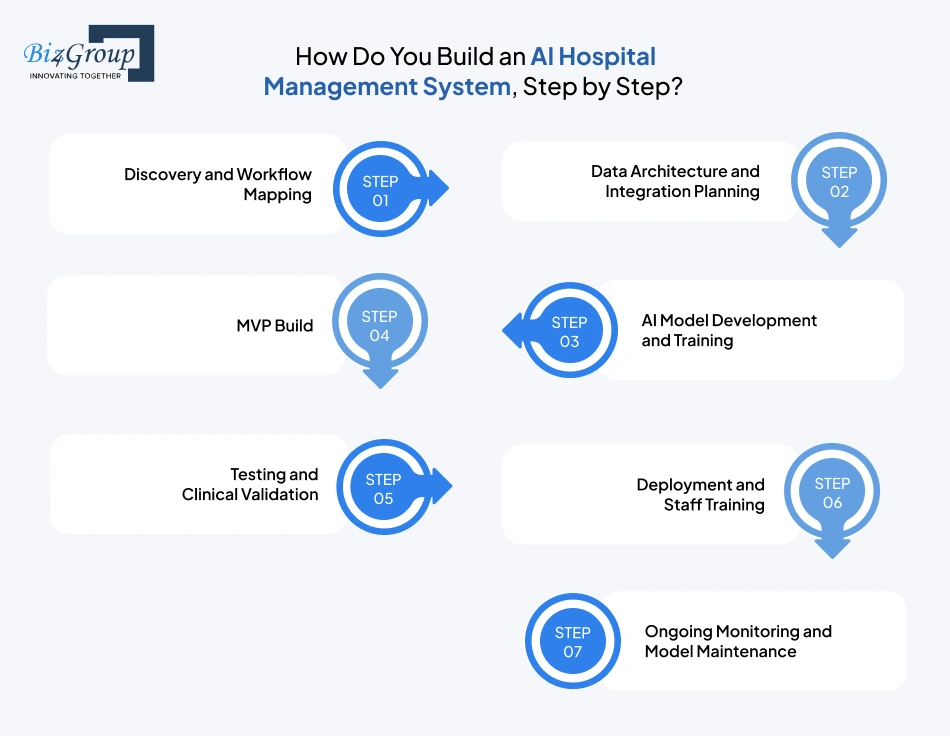
This is the part most guides gloss over with four vague steps and call it a process. The real AI software development process for hospital management system work is more deliberate than that, and every step here exists because skipping it causes expensive problems later.
If you've been searching for how to make AI hospital management system software the right way, here's exactly how it works.
Before a single line of code gets written, we map how your hospital actually operates. Departmental workflows, patient journeys, staff handoffs, and existing pain points all get documented, so the software fits your hospital instead of forcing your hospital to adapt to it. This step alone prevents most of the costly redesigns that happen later in a build.
Your AI is only as good as the data feeding it, so this step decides how information flows between your EHR, billing, scheduling, and staffing systems. Getting this AI program management health system architecture right early avoids the painful rework of retrofitting integrations after the system is already built.
This is where prediction engines for bed forecasting, patient risk scoring, and resource planning actually get built and trained on your hospital's historical data. The quality of this step depends entirely on data quality and the experience of the team training the models, not just the frameworks used.
Proper AI model development here is the difference between a hospital management software with AI system staff actually trust and one they quietly ignore.
Rather than building every feature at once, we start with a focused version of the platform that solves your highest-priority problem first. This gets real feedback from real staff early, while the cost and risk of getting something wrong stays low. This phased approach is central to how any credible AI hospital management software development company actually delivers results instead of overpromising.
A properly scoped MVP for AI healthcare software also gives you a much clearer, more accurate cost picture before committing to the full build an AI hospital management system roadmap.
Before anything touches a real patient workflow, the system goes through rigorous testing, including validation with clinical staff who'll actually be using it daily. This step is non-negotiable in healthcare, where a bug or a bad prediction has real consequences.
A technically perfect system still fails if your staff doesn't know how to use it or doesn't trust it. This step is about rollout, training, and giving people a real channel to raise concerns as they adjust to the new workflow.
Launch is the beginning, not the finish line. AI models drift as hospital data patterns shift over time, so the system needs continuous monitoring to stay accurate and useful months and years down the road.
This is what genuine healthcare software product development looks like when it's done by a team that's actually built for hospitals before, not adapted from generic enterprise software patterns. Each step here protects the next one, and skipping any of them is usually where projects quietly go over budget or fail to gain staff adoption after launch.
Let's get straight to the number you actually came here for. AI hospital management software development typically costs between $40,000 and $300,000, depending on scope, features, and how deep the AI integration goes.
That range is wide on purpose. A focused MVP solving one workflow sits at the lower end, while a full-scale, multi-department platform with advanced predictive AI, deep EHR integration, and multi-facility support sits at the higher end. No two hospitals need the exact same build, so no honest quote should ever be a flat number without first understanding your specific requirements.
Here's how that cost actually breaks down by feature, so you can see where your budget goes instead of just trusting a lump sum.
Feature-Wise Cost Breakdown
|
Feature |
Complexity Level |
Estimated Cost Range |
|---|---|---|
|
Patient records and EHR integration |
Medium |
$8,000 to $25,000 |
|
Appointment scheduling and queue management |
Low to Medium |
$6,000 to $18,000 |
|
AI-powered bed and resource allocation |
High |
$15,000 to $40,000 |
|
Predictive patient risk scoring |
High |
$12,000 to $35,000 |
|
Staff scheduling and coordination tools |
Medium |
$8,000 to $20,000 |
|
Billing and claims automation |
Medium to High |
$10,000 to $30,000 |
|
Clinical decision support (CDSS) |
High |
$15,000 to $45,000 |
|
Real-time analytics dashboards |
Medium |
$7,000 to $20,000 |
|
HL7/FHIR interoperability layer |
High |
$10,000 to $28,000 |
|
Compliance, security, and access control |
Medium to High |
$8,000 to $22,000 |
|
AI model training and validation |
High |
$15,000 to $50,000 |
|
UI/UX design across the platform |
Medium |
$6,000 to $18,000 |
These ranges assume a custom build. If you're evaluating custom AI hospital management software development against off-the-shelf options, that comparison table is coming up shortly.
|
Factor |
Off-the-Shelf Software |
Custom AI Hospital Management System |
|---|---|---|
|
Upfront cost |
Lower initial cost |
Higher upfront investment |
|
Fit to your workflows |
Generic, requires you to adapt |
Built around how your hospital actually operates |
|
Integration with existing systems |
Often limited or rigid |
Designed to integrate with what you already have |
|
Scalability |
Limited by vendor's roadmap |
Scales with your hospital's actual growth |
|
Long-term cost |
Recurring licensing fees add up over time |
Higher ownership, but no vendor lock-in |
|
Competitive advantage |
Same system your competitors may also use |
Built specifically around your differentiators |
|
Compliance control |
Dependent on vendor's compliance posture |
Full control over compliance and data handling |
|
Best fit for |
Smaller hospitals with straightforward needs |
Hospitals and health systems ready to invest in a long-term platform |
If you're still weighing this decision, it usually comes down to timeline and differentiation. Off-the-shelf software gets you running faster, but a genuine AI hospital management software development company builds something that actually reflects how your hospital works, not the other way around. For most mid-size to large hospitals planning to scale, the long-term cost of forcing operations to fit generic software ends up higher than the upfront investment in a custom build.
Skip the guesswork. Get a real, itemized quote based on your hospital's actual workflows, not a generic estimate.
Get Your Custom Cost Estimate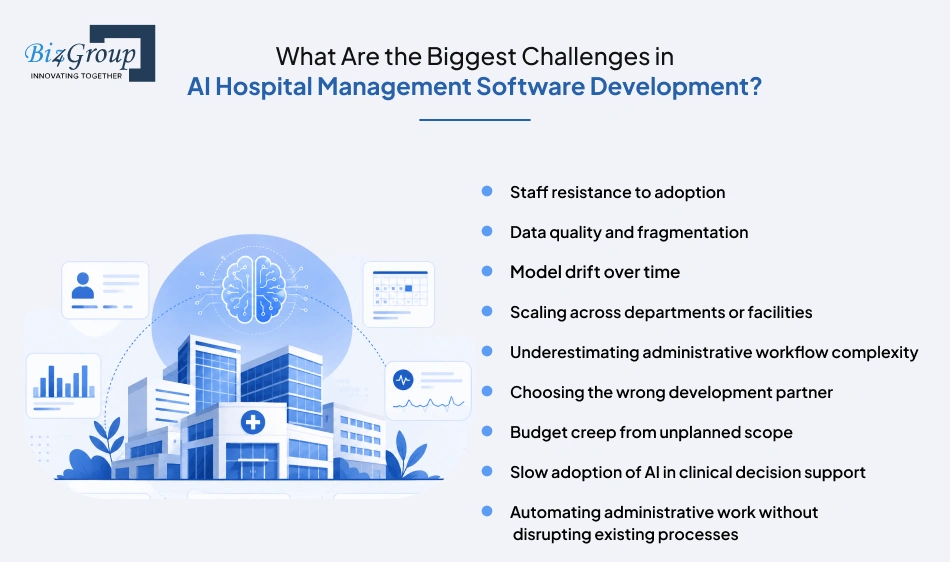
Every hospital we've worked with hits friction somewhere in this process. That's not a failure, it's the nature of building AI into a regulated, high-stakes environment. What matters is knowing these challenges in advance instead of discovering them mid-build.
This is the question we get asked most, and it deserves a direct answer. Not every decision your AI system makes should happen without a human checking it first. Operational tasks like bed forecasting or supply reordering can run with light oversight, but anything touching clinical judgment, discharge timing, or triage priority needs a person confirming the call before it takes effect.
The hospitals that get this right build clear rules into the system itself, defining exactly which workflows run autonomously and which route back to staff for review. This isn't a limitation on your AI hospital management system, it's what makes staff actually trust it enough to use it daily. We go much deeper on where to draw this line in our breakdown of AI governance in healthcare.
Nobody wants to rip out systems that already work just to add AI capabilities. The good news is you usually don't have to. A well-architected integration layer using HL7/FHIR standards connects your AI platform to existing EHR, billing, and scheduling systems without forcing a full replacement.
The real challenge is usually messy or inconsistent data across those existing systems, not the AI itself. Cleaning up data quality before integration saves significant rework later, and it's one of the first things we assess before writing a single line of code for hospital management system development using AI.
Beyond oversight and integration, a handful of other challenges show up consistently across almost every hospital AI project. Here's what they are and how to actually solve them.
|
Challenge |
Why It Happens |
How to Solve It |
|---|---|---|
|
Staff resistance to adoption |
Clinicians and admin staff don't trust a system they didn't help shape |
Involve frontline staff early, run a phased rollout, and train around real scenarios instead of generic demos |
|
Data quality and fragmentation |
Years of siloed systems create inconsistent, incomplete patient and operational data |
Run a data cleanup and standardization phase before AI model training begins |
|
Model drift over time |
Hospital patterns shift, and models trained on old data slowly lose accuracy |
Build in ongoing monitoring and scheduled retraining, not a one-time launch and forget approach |
|
Scaling across departments or facilities |
A system built for one department often breaks under multi-site complexity |
Architect for scale from day one using enterprise AI solutions built to handle multi-facility demands |
|
Underestimating administrative workflow complexity |
Billing, coding, and claims processes vary more than most teams expect |
Map these workflows in detail during discovery, not after the system is already built |
|
Choosing the wrong development partner |
Many vendors know software, but not healthcare-specific compliance and clinical nuance |
Evaluate based on real healthcare experience, not just general software development history |
|
Budget creep from unplanned scope |
Features get added mid-project without revisiting cost and timeline |
Lock a clear MVP scope early and treat additional features as a separate phase |
|
Slow adoption of AI in clinical decision support |
Clinicians are cautious about trusting AI medical software with diagnostic influence |
Position AI as decision support, not decision-maker, and make its reasoning visible and explainable |
|
Automating administrative work without disrupting existing processes |
Departments fear losing control over workflows they've relied on for years |
Roll out AI in healthcare administration automation gradually, department by department, with clear ownership at each stage |
None of these challenges are reasons to avoid building. They're reasons to build with a team that's actually seen them before. Every one of these problems is solvable when it's planned for early instead of discovered halfway through development, which is exactly why choosing the right partner matters as much as the technology itself.
This decision matters more than any single feature or line item on your cost sheet. The right partner determines whether your platform actually gets adopted by staff, stays compliant, and scales as your hospital grows. The wrong one turns into a expensive lesson you're still paying for two years later.
Here's what to actually evaluate before you sign anything.
Healthcare-specific experience isn't optional here. A team that's built e-commerce platforms and CRM tools can write good code, but they haven't lived through the specific problems that come with PHI handling, clinical workflows, or HIPAA-grade architecture. Ask to see real healthcare projects, not general software portfolios padded with unrelated work.
The answers to these questions will tell you more than any pitch deck.
We're not going to make this a sales pitch. We're going to show you why this matters and let the work speak for itself.
Biz4Group, an AI development company, has spent over 20 years building software across regulated, complex industries, with a portfolio that includes real, deployed healthcare AI projects, not case studies written after the fact to sound impressive. We built an AI-powered athletic health platform handling blood test analysis, patient and admin portals, and appointment scheduling, all working together as one connected system rather than separate tools bolted on top of each other. We developed an AI-driven IVR and support platform for a third-party healthcare administrator, handling real-time call escalation and bilingual patient support at scale. We built a healthcare appointment booking platform with a dedicated patient portal and enrollment system, and an AI-powered HRMS that helped a staffing agency cut operational costs by 25%, the same resource and staff coordination logic that powers hospital workforce management.
That range matters. Hospital management software isn't one feature, it's dozens of connected systems working as one, and that's exactly the kind of complexity we've built before.
You can see this work directly in our full portfolio, where the projects speak louder than anything we could say about ourselves here.
What C-suite healthcare leaders consistently tell us matters most isn't just technical skill. It's a team that understands compliance isn't a checkbox, that staff adoption determines whether a platform actually succeeds, and that a hospital's operations can't be forced into a generic software template. That's the standard we build to on every healthcare engagement, and it's why healthcare leaders come back to us for their next phase of AI investment instead of starting over with someone new.
You've seen the work. Let's put that same experience behind your hospital's AI platform, starting with a conversation, not a contract.
Book a Free ConsultationBuilding an AI hospital management system isn't a small decision, and it shouldn't feel like one you're making alone.
Every section in this guide, from the features and tech stack to compliance, cost, and the challenges nobody else talks about, exists because we've watched healthcare leaders navigate these exact decisions before. The hospitals that get this right treat AI hospital management software development as a long-term operational partnership, not a one-time software purchase. They plan for governance, they budget for the hidden costs, and they choose a development partner who understands healthcare before they understand code.
That's the standard we hold ourselves to at Biz4Group. Our team includes dedicated AI data scientists and AI research analysts working alongside our development team, not generalist engineers picking up healthcare as they go. Every engagement starts with an NDA, moves at a pace built around your timeline, and comes without the sales pressure that usually follows a first call with a vendor. Whether you're ready to build an AI hospital management system from the ground up or looking to develop AI hospital management system capabilities on top of what you already run, it's worth seeing how we stack up among the top AI healthcare software development companies in USA before making that call.
Your hospital doesn't need more software. It needs a system that finally works the way your staff, your patients, and your operations actually do.
Let's build the one that does.
An AI hospital management system is software that runs a hospital's daily operations, patient records, scheduling, billing, and staffing, while using artificial intelligence to predict problems and automate repetitive work. Unlike a traditional hospital management system that just stores and reports data, an AI-powered one actively flags issues like bed shortages or staffing gaps before they happen.
A traditional HMS tells you what already happened. Hospital management software with AI tells you what's about to happen. It uses predictive models trained on historical hospital data to forecast admissions, patient flow, and resource needs, giving your team time to act instead of reacting after the fact.
Custom AI hospital management software development typically ranges from $40,000 to $300,000. The exact number depends on the number of features, depth of AI integration, compliance requirements, and how many existing systems need to be connected. A focused MVP costs far less than a full, multi-department platform.
Most AI hospital management software development projects take anywhere from 2 to 8 weeks, depending on scope. An MVP focused on one or two workflows can launch in 2 to 4 weeks, while a full-scale platform with deep AI integration and multiple system connections takes considerably longer.
Yes. A well-built AI-powered hospital management system uses HL7/FHIR interoperability standards to connect with your existing EHR, billing, pharmacy, and scheduling systems without forcing a rip-and-replace. The integration layer is one of the most critical parts of the entire build, and skipping it properly is one of the most common reasons hospital AI projects run into trouble.
AI should support clinical decisions, not replace them. A properly built system flags risks, predicts outcomes, and surfaces relevant patient data, but keeps a human reviewing anything that touches diagnosis, treatment, or discharge decisions. This human-in-the-loop approach is a core part of responsible artificial intelligence in hospital management, not an optional extra.
At minimum, look for AI-powered patient records, predictive bed and resource management, smart scheduling and queue management, staff coordination tools, automated billing and claims processing, clinical decision support, and HIPAA-compliant security. The strongest AI hospital management system development teams build these as one connected platform rather than separate bolt-on tools.

Our website require some cookies to function properly. Read our privacy policy to know more.