Location :
Orlando, FL, USA
Location :
Orlando, FL, USA +1 (407) 714-1616
 info@biz4group.com

- AI automation for healthcare center operations helps reduce manual workload, streamline workflows, and improve patient experiences while maintaining compliance.
- AI solutions for healthcare center automation deliver measurable benefits including faster turnaround times, better staff productivity, and improved operational visibility.
- AI solutions for healthcare center automation typically require an average investment of $50,000-$200,000+, depending on scope, integrations, and long-term automation goals.
- Understanding how to implement AI automation in healthcare center operations helps reduce risk, control costs, and achieve faster ROI.
- Biz4Group LLC helps healthcare organizations across the USA design, build, and scale secure, high-impact AI automation solutions that deliver real business results.
Ever watched clinical team drowning in paperwork while patients wait in crowded lobbies? So have us.
Many healthcare leaders juggle manual tasks, scheduling chaos, and piles of administrative work instead of focusing on patient care. It is no surprise that 57% of healthcare organizations now see reducing administrative workload through intelligent task automation as the most important opportunity for future transformation.
This blog explores how AI automation for healthcare center operations is changing everything from front-desk workflows to back-office processes. Healthcare center workflow automation with AI brings measurable improvements to staff productivity and patient experiences.
You will learn about real-world AI solutions for healthcare center automation that shave hours off repetitive tasks. These solutions are not reserved for large hospital systems alone. Smaller practices can benefit from workflow designs that accelerate tasks like scheduling or record-keeping while maintaining high standards of care.
As you read on, keep in mind that AI driven automation to reduce healthcare center administrative burden is a practical strategy many decision makers are actively planning and investing in. The goal here is to free up healthcare professionals to do what they entered the field to do... focus on patients and improve outcomes.
Now, let’s begin with the basics.
What Is AI Automation for Healthcare Center Operations?
Running a healthcare center has traditionally depended on people, paperwork, and disconnected software.
Phones ring nonstop. Staff manually enter patient data. Schedulers work around constant cancellations.
These manual workflows slow teams down and increase the risk of errors.
AI automation for healthcare center workflows introduces intelligence into everyday operations. Instead of relying on fixed rules or human memory, AI systems analyze data, understand patterns, and take action in real time. This shift marks a clear departure from manual processes that require constant supervision and repetitive effort.
AI Automation vs Manual Healthcare Center Workflows
| Aspect | Manual Workflows | AI Automation |
|---|---|---|
|
Scheduling |
Phone calls and spreadsheets |
Predictive scheduling with real-time updates |
|
Patient intake |
Paper forms and re-entry |
Automated digital intake with data validation |
|
Administrative tasks |
Staff-driven and time-intensive |
Autonomous task execution |
|
Error handling |
Reactive |
Proactive and predictive |
This comparison highlights why AI automation vs manual healthcare center workflows has become a central conversation for healthcare leaders.
Core Components of AI Automation for Healthcare Centers
AI automation works because several technologies operate together behind the scenes.
- Natural language processing to understand patient queries and staff inputs
- Machine learning models to recognize trends and predict outcomes
- Workflow orchestration engines that automate multi-step processes
- Integrations with EHR and billing systems to keep data consistent
These components enable healthcare center workflow automation with AI that adapts instead of breaking when conditions change. A good example of this approach can be seen in modern AI healthcare app solutions that combine patient engagement with back-office automation in a single platform.
How AI Automation Differs from Rule-Based Automation
Rule-based automation follows predefined instructions. If X happens, then do Y. While helpful, it fails when scenarios become complex.
AI solutions for healthcare center automation go further.
- They learn from historical data
- They adjust responses based on context
- They improve accuracy over time
This makes AI especially effective for tasks like patient triage, appointment optimization, and administrative routing.
Healthcare centers that adopt AI automation early position themselves for scale, resilience, and better patient experiences. In the next section, we will explore why so many organizations are prioritizing this shift now and what pressures are driving adoption.
Still Managing Healthcare Like It's 2015?
Healthcare organizations report up to 30%-40% reduction in manual workload after adopting AI automation.
Automate Smart with Biz4GroupWhy AI Automation for Healthcare Center Operations Critical Today?
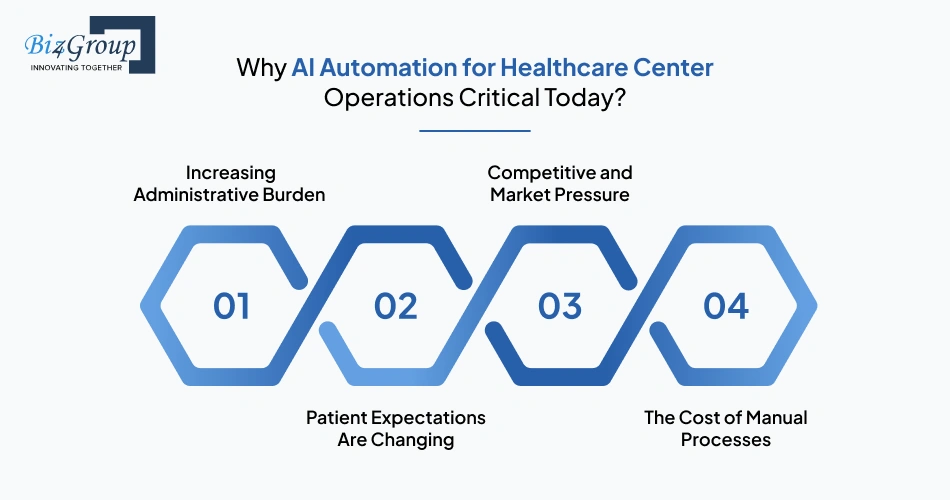
Healthcare is under pressure on multiple fronts. Patient expectations are rising. Staff shortages persist. Costs climb every year. The question for leaders is not whether to automate but why automate now?
Here are the most urgent reasons to adopt automation now.
Increasing Administrative Burden
Healthcare professionals spend a lot of their day on tasks that are not clinical:
- Manual patient registration
- Insurance verification
- Billing and claims follow-ups
- Scheduling changes
These tasks consume time that could be spent on care delivery. That is where AI driven automation to reduce healthcare center administrative burden pays off.
Patient Expectations Are Changing
Patients expect quick, seamless service when they interact with a healthcare center. Long wait times. Confusing phone menus. Lost records. These are no longer acceptable.
AI automation helps:
- Shorten wait times
- Provide instant engagement
- Deliver accurate responses
When healthcare center workflow automation with AI is in place, patient satisfaction improves because care begins sooner and interactions feel more responsive.
Competitive and Market Pressure
Healthcare organizations that embrace automation gain a competitive edge. They attract more patients. They retain staff who can focus on high-value work. They reduce operational risk.
This trend is visible across the industry. According to a survey, by 2030, only 34% of healthcare activities will be done mostly by humans.
The Cost of Manual Processes
Manual processes are expensive in hidden ways:
- Staff time
- Errors and rework
- Lost revenue from billing delays
- Overhead for coordination
AI automation reshapes your cost structure. It removes bottlenecks and gives you clarity.
AI solutions are not a future idea. They are here, practical, and delivering measurable results. In the next section, we will explore the benefits healthcare centers can expect once they begin automating key workflows.
Key Benefits of AI Automation for Healthcare Center Administration and Operations
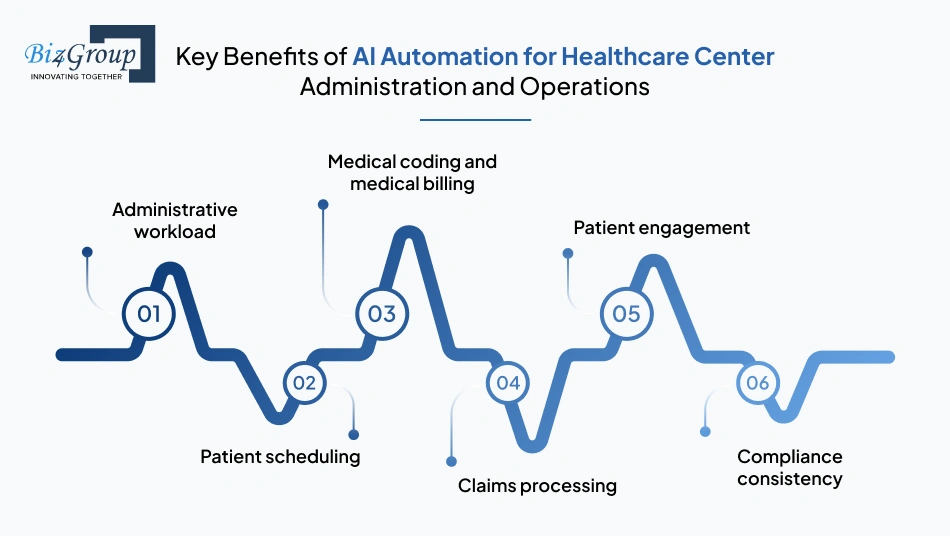
Once AI automation for healthcare center operations is in place, the impact becomes visible across departments. Benefits show up quickly in daily workflows, staff morale, and financial performance.
Instead of listing abstract advantages, the table below maps real healthcare problems to practical outcomes. This helps decision makers visualize how automation improves both administration and care delivery.
| Area of Impact | Challenge in Manual Workflows | How AI Automation Helps | Business Outcome |
|---|---|---|---|
|
Administrative workload |
Staff spend hours on data entry, follow-ups, and coordination |
AI automation handles repetitive tasks automatically |
Lower overhead costs and reduced burnout |
|
Missed appointments and overbooked calendars |
Predictive scheduling and automated reminders |
Higher patient attendance and smoother operations |
|
|
Coding errors and delayed reimbursements |
AI-powered validation and automation |
Faster payments and fewer claim denials |
|
|
Manual review slows down revenue cycles |
Intelligent claim routing and processing |
Improved cash flow and revenue visibility |
|
|
Patient engagement |
Long wait times and limited availability |
Conversational AI and automated responses |
Better patient satisfaction and retention |
|
Compliance consistency |
Human error leads to documentation gaps |
AI-driven checks and standardized workflows |
Reduced compliance risk |
Many healthcare leaders start with administrative use cases because results appear quickly. A deeper look at AI in healthcare administration automation shows how centers streamline back-office operations without disrupting care delivery.
In the next section, we will explore specific AI automation use cases.
What Would Your Team Do With 10 Extra Hours a Week?
Administrative automation can reclaim 8-12 hours per staff member weekly. That time could be redirected to patient care and growth.
Unlock Operational Gains with Biz4GroupAI Automation Use Cases for Healthcare Center
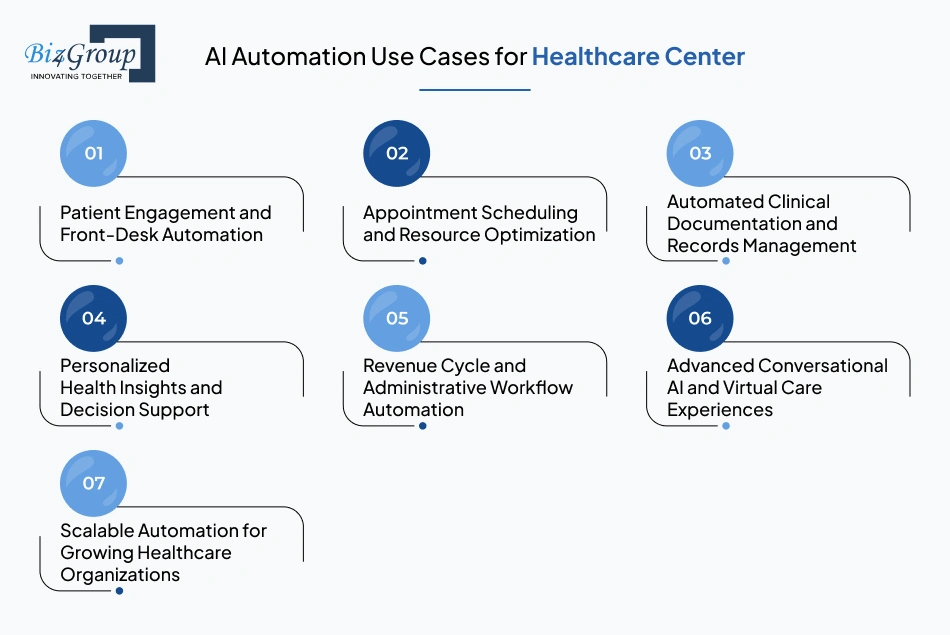
AI automation for healthcare center operations shows the strongest results when applied to high-volume, repeatable workflows. Below are the most impactful use cases healthcare leaders are prioritizing today.
1. Patient Engagement and Front-Desk Automation
Patient engagement is often the first area where healthcare centers apply AI automation. Manual call handling, appointment reminders, and intake forms create friction for both patients and staff. AI automates these touchpoints by managing conversations, capturing intent, and routing requests in real time.
Project Spotlight: AI Chatbot for Personalized Support to Homeless and At-Risk Veterans
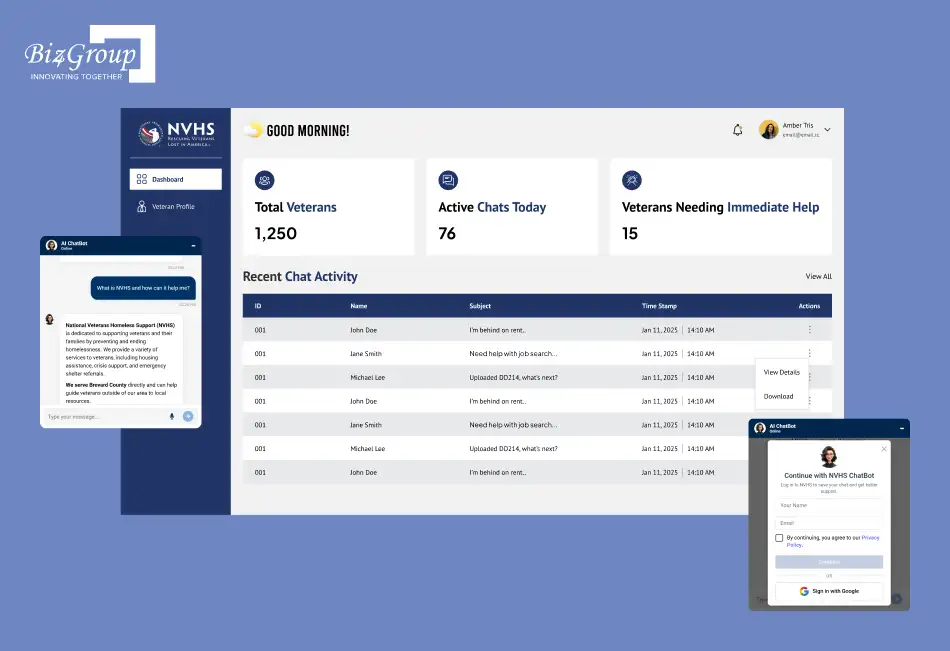
Using exceptional AI chatbot development services, Biz4group developed an AI chatbot focused on providing immediate, personalized support to homeless and at-risk veterans across the U.S. The solution automated access to healthcare and crisis services through natural conversations.
Key Features
- Voice and text-based conversational support
- Real-time crisis detection with staff alerts
- Location-based healthcare and service matching
- Secure, HIPAA-compliant data handling
The platform demonstrates how AI automation for healthcare center engagement can reduce response time while improving continuity of care for vulnerable populations.
Also read: AI virtual healthcare assistant development guide
2. Appointment Scheduling and Resource Optimization
Scheduling remains a major operational bottleneck for many healthcare centers. Manual processes lead to overbooking, cancellations, and inefficient staff utilization. AI automation predicts demand, adjusts schedules dynamically, and sends timely reminders.
By applying AI solutions for healthcare center automation, organizations reduce no-shows and improve patient flow. When combined with thoughtful interface design from a healthcare-focused UI/UX design company, these systems are easier for patients and staff to adopt.
Also read: Top 15 UI/UX design companies in USA
3. Automated Clinical Documentation and Records Management
Documentation consumes significant clinician time. AI automates record creation by capturing structured data from interactions and syncing it across systems. This improves accuracy while reducing duplication.
Healthcare centers often integrate these tools directly with existing platforms. The ability to integrate AI with EHR and EMR systems ensures records stay consistent and compliant across departments.
4. Personalized Health Insights and Decision Support
AI analyzes lab results, patient history, and ongoing metrics to surface actionable insights. This supports clinicians and empowers patients with clearer guidance. Unlike static reports, AI systems adapt recommendations as new data arrives.
Healthcare centers often build custom AI healthcare software solutions to match specific clinical goals and data requirements.
Project Spotlight: AI-Powered Athletic Health Solution
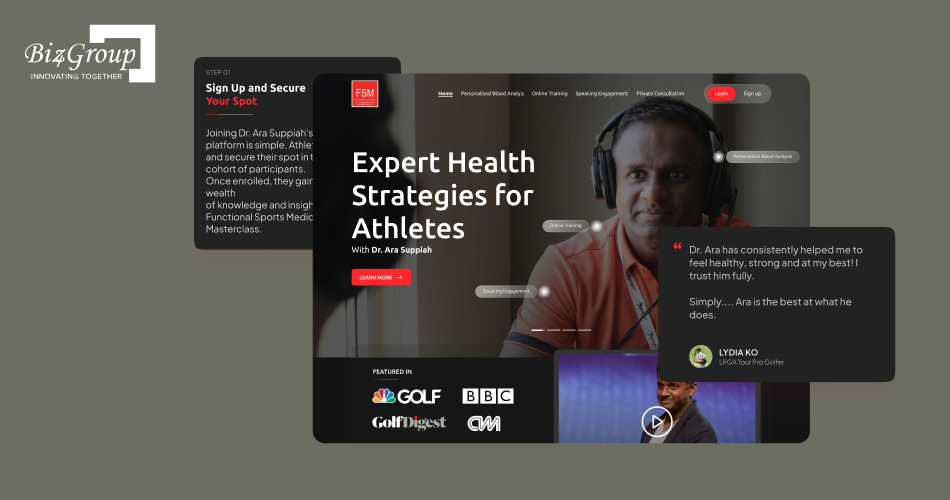
This AI athletic health solution was built to deliver personalized health insights through automated analysis of blood test data. The platform supports performance optimization and long-term health tracking.
Key Features
- Automated blood test analysis
- Personalized diet and performance recommendations
- Appointment scheduling and private consultations
- Secure storage of sensitive health data
This solution shows how AI automation for healthcare center analytics improves outcomes without increasing clinician workload.
5. Revenue Cycle and Administrative Workflow Automation
Administrative inefficiencies directly impact revenue. AI automates tasks such as insurance verification, billing workflows, and claims routing. This reduces delays and minimizes errors caused by manual handling.
Pro tip: When exploring this path, evaluate the cost of implementing AI in healthcare alongside potential revenue recovery and operational savings (we’ve covered these below, don’t worry).
6. Advanced Conversational AI and Virtual Care Experiences
Some healthcare centers go beyond chatbots and introduce immersive conversational experiences. AI avatars and intelligent agents engage patients in ongoing wellness programs, education, and follow-ups.
This category increasingly overlaps with agentic AI in healthcare, where systems take autonomous actions across workflows rather than responding to single prompts.
Project Spotlight: Dr. Truman AI Avatar
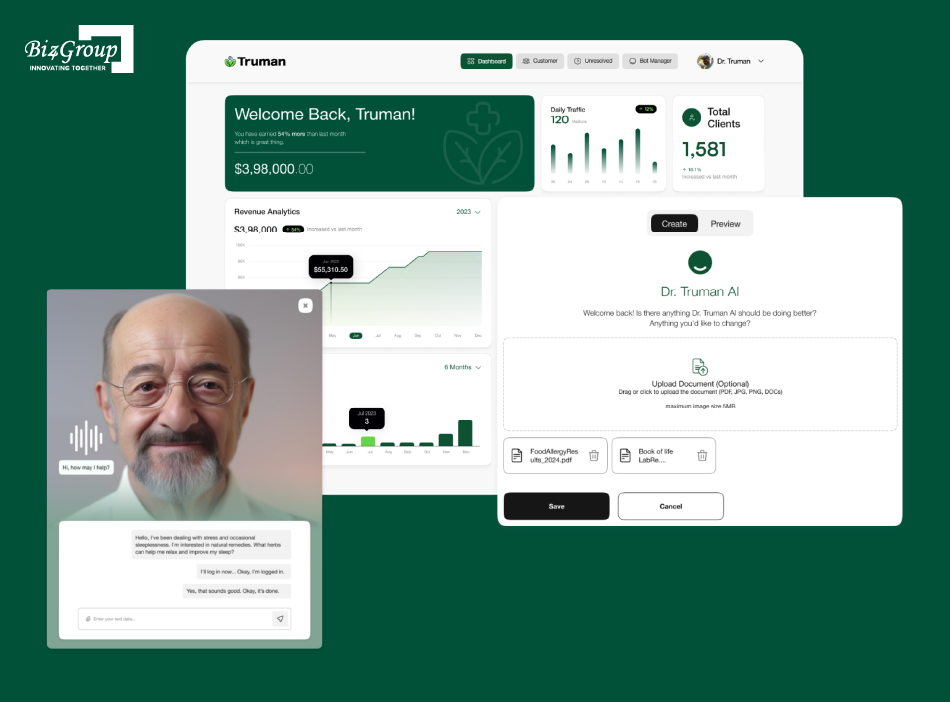
As a seasoned AI avatar development company, Biz4Group built delivered an AI-powered health companion that blends personalized consultations with wellness recommendations and digital commerce.
Key Features
- AI avatar with natural conversation
- Personalized health and supplement recommendations
- Secure health history and document uploads
- Integrated membership and eCommerce workflows
The results highlight how agentic process AI automation for healthcare center engagement can drive higher retention and operational efficiency.
7. Scalable Automation for Growing Healthcare Organizations
As healthcare centers expand, manual processes fail to scale. AI automation supports growth by standardizing workflows across locations while allowing local flexibility.
Organizations often partner with an experienced AI app development company to ensure scalability, security, and long-term support.
In the next section, we will break down a clear, step-by-step process on how to implement AI automation in healthcare center workflows without disrupting daily operations or compliance requirements.
How to Implement AI Automation in Healthcare Center in 7 Steps?
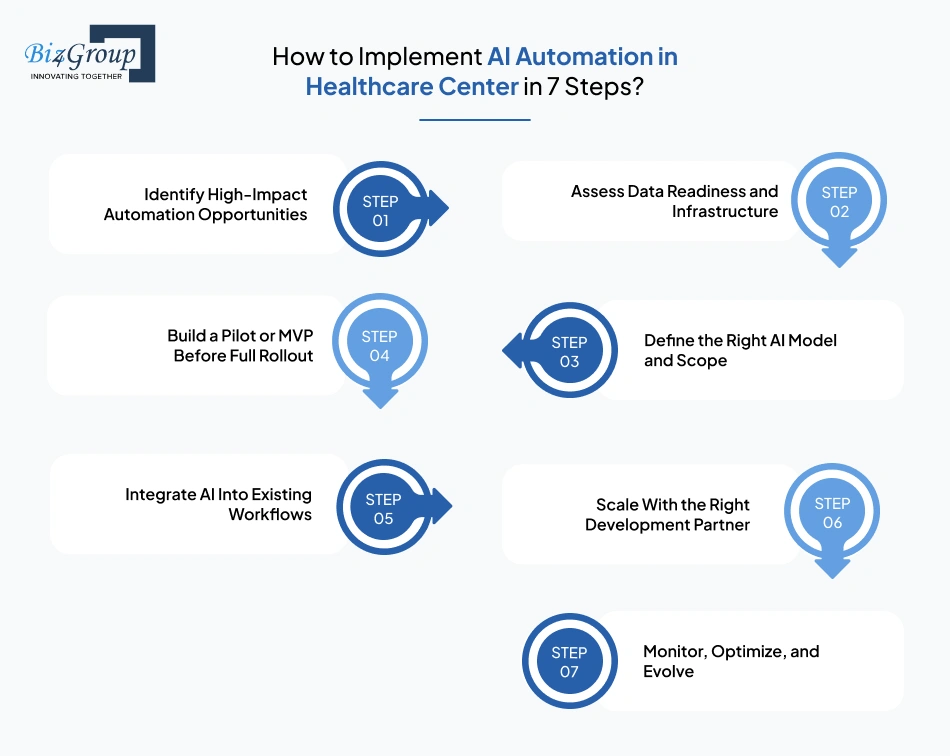
Implementing AI automation for healthcare center operations requires structure and clarity. Successful projects follow a phased approach that balances speed with safety. Below is a practical roadmap healthcare leaders can follow.
Step 1. Identify High-Impact Automation Opportunities
Start with workflows that are repetitive, time-consuming, and prone to error. These areas deliver faster value and easier adoption.
Common starting points include:
- Appointment scheduling
- Patient intake and registration
- Billing and administrative coordination
- Record management and follow-ups
This step ensures AI automation aligns with real operational needs, not assumptions.
Step 2. Assess Data Readiness and Infrastructure
AI relies on clean, accessible data. Before implementation, review how patient data, scheduling records, and administrative information are stored.
Focus on:
- Data accuracy and consistency
- Access permissions and security
- Integration points with existing systems
Pro tip: Only rely on professional AI integration services to ensure automation layers work smoothly with current platforms.
Step 3. Define the Right AI Model and Scope
Not every problem needs the same type of AI. Some workflows benefit from predictive models, while others require conversational or autonomous systems.
At this stage, decision makers evaluate:
- Task complexity
- Volume of interactions
- Need for adaptability
Solutions may include predictive analytics, conversational systems, or even generative AI models for content and documentation workflows.
Step 4. Build a Pilot or MVP Before Full Rollout
Launching everything at once increases risk. A controlled pilot validates assumptions and reveals gaps early.
A focused MVP helps:
- Test usability and performance
- Gather staff feedback
- Measure early ROI
Healthcare leaders often partner with teams offering MVP development services to move quickly without long-term commitment.
Also read: Top 12+ MVP development companies in USA
Step 5. Integrate AI Into Existing Workflows
Automation works best when it blends into daily operations. AI systems should support staff rather than forcing new processes overnight.
This step includes:
- Connecting AI to EHR and administrative systems
- Aligning automation with existing SOPs
- Training teams on usage and escalation
Step 6. Scale With the Right Development Partner
As automation expands, technical expertise becomes critical. Healthcare centers often choose to outsource AI healthcare software development to accelerate delivery and reduce internal strain.
Whether building a platform, integrating automation, or launching an AI product, working with an experienced development team ensures security, compliance, and scalability.
Step 7. Monitor, Optimize, and Evolve
AI automation improves over time when monitored correctly. Continuous optimization keeps workflows aligned with changing patient needs and operational goals.
Key activities include:
- Reviewing performance metrics
- Updating models and rules
- Expanding automation into new areas
In advanced scenarios, healthcare centers collaborate with an agentic AI development company to deploy systems capable of managing multi-step workflows autonomously.
This structured approach reduces risk and maximizes ROI. In the next section, we will address compliance and ethical considerations that healthcare leaders must account for when deploying AI automation.
70% of AI Projects Fail Due to Poor Execution
A structured rollout increases success rates dramatically.
Contact Biz4Group TodayCompliance and Ethical Considerations in AI Solutions for Healthcare Center Automation
AI automation for healthcare center operations brings efficiency and scale. It also introduces responsibility. Healthcare leaders must balance innovation with compliance, patient trust, and ethical use of data.
This section outlines the core areas decision makers need to address before and during implementation.
Regulatory Compliance Requirements
Key compliance areas include:
- HIPAA requirements for patient data protection
- Secure storage and transmission of health information
- Role-based access controls for staff and systems
- Audit trails for automated decisions and actions
Also read: HIPAA compliant AI app development for healthcare providers
Data Privacy and Security
Strong privacy practices include:
- Encryption of data at rest and in transit
- Secure authentication and authorization
- Controlled access to training data
- Ongoing security testing and monitoring
Transparency and Explainability
Decision makers should ensure:
- Clear explanations for AI-driven recommendations
- Visibility into automated workflows
- Human oversight for critical decisions
- Documentation of model behavior and limitations
Bias and Fairness in AI Systems
To mitigate risk:
- Use diverse and representative training data
- Regularly review outputs for unintended patterns
- Adjust models as patient demographics change
- Include ethical review processes during development
Human Oversight and Accountability
Best practices include:
- Clear escalation paths from AI to human staff
- Defined accountability for automated actions
- Staff training on AI-supported workflows
Ethical Use of Automation
Healthcare leaders should ask:
- Does automation improve patient experience?
- Does it reduce staff burnout?
- Does it align with organizational values?
When implemented thoughtfully, AI automation for healthcare center systems strengthens trust, improves outcomes, and supports sustainable growth.
In the next section, we will break down the cost of implementing AI automation and what healthcare organizations should budget for across different stages.
Cost of AI Automation for Healthcare Center Implementation and Scaling
Before moving forward, healthcare leaders want clarity on budget. On average, the cost of AI automation for healthcare center implementation typically ranges between $50,000-$200,000+, depending on scope, complexity, and long-term goals.
This range covers everything from focused workflow automation in a single department to multi-system automation across clinical and administrative functions. Understanding where the money goes helps decision makers plan realistically and avoid surprises.
Let’s break the cost structure down step by step.
Core Cost Drivers of AI Automation for Healthcare Centers
The table below outlines the primary factors that influence total investment. Each healthcare center will see a different mix based on size, maturity, and automation goals.
| Cost Driver | What It Covers | Typical Cost Impact |
|---|---|---|
|
Use case scope |
Number of workflows being automated |
$10,000-$40,000 |
|
Data preparation |
Cleaning, structuring, and validating data |
$5,000-$25,000 |
|
AI model development |
Predictive, conversational, or agent-based systems |
$15,000-$60,000 |
|
System integrations |
Connecting AI with EHR, billing, scheduling tools |
$10,000-$50,000 |
|
Security and compliance |
Encryption, access control, audit logging |
$5,000-$20,000 |
|
Deployment and testing |
Pilot rollout and validation |
$5,000-$15,000 |
|
Ongoing maintenance |
Monitoring, updates, and optimization |
$1,500-$5,000 per month |
These drivers apply whether you are building healthcare center workflow automation with AI for a small clinic or deploying AI solutions for healthcare center automation across multiple locations.
Hidden Costs Healthcare Leaders Often Overlook
Beyond core development, several indirect costs influence the true investment. Ignoring them can lead to delays or underperformance.
Change Management and Training
AI automation changes how teams work. Training staff and updating standard operating procedures often adds $5,000-$15,000 depending on team size and complexity.
Data Quality Issues
Incomplete or inconsistent records slow AI performance. Fixing historical data problems may require additional effort costing $3,000-$12,000.
Workflow Redesign
AI exposes inefficiencies in existing processes. Redesigning workflows to align with automation can add $5,000-$20,000, especially in administrative-heavy environments.
Scaling Costs
Expanding automation to new departments or locations introduces incremental costs of $10,000-$30,000 per expansion phase.
While these costs increase upfront investment, they directly support long-term ROI and system reliability.
Cost Optimization Techniques for AI Automation Projects
Healthcare centers can control spending without sacrificing quality by applying proven optimization strategies.
- Start with high-impact use cases that show ROI within 3-6 months
- Pilot automation in one department before scaling organization-wide
- Reuse existing infrastructure where possible
- Prioritize modular AI components that expand over time
- Align automation goals with measurable KPIs early
These techniques make AI automation for healthcare center initiatives more predictable and financially sustainable.
Cost alone should not drive decisions. The real question is value. When designed correctly, AI driven automation to reduce healthcare center administrative burden lowers long-term operating expenses, improves staff productivity, and supports growth without proportional cost increases.
Manual Processes Cost More Than You Think
Healthcare centers lose $200,000+ annually to inefficiencies tied to scheduling, billing, and admin delays. Automation shifts that curve.
Let's Talk NumbersMeasuring Business Value of AI Automation for Healthcare Center Workflows
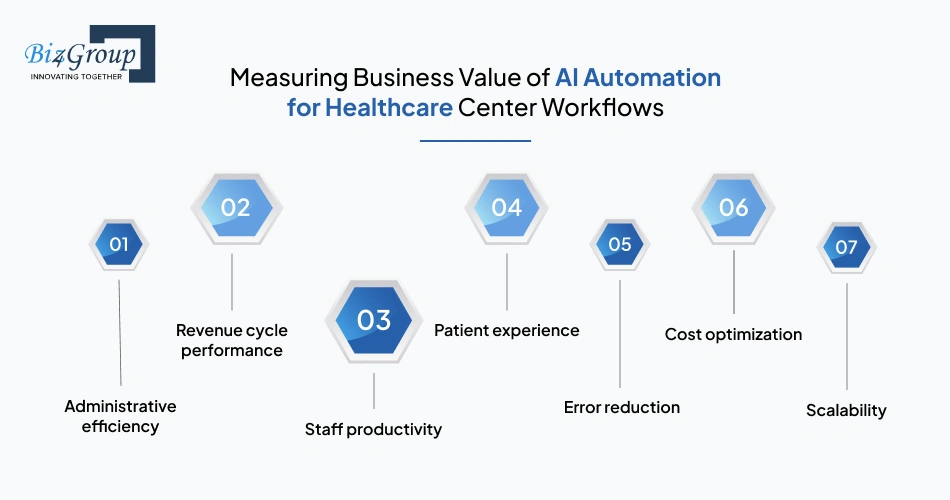
Return on investment is the lens through which healthcare leaders evaluate AI initiatives. AI automation for healthcare center operations delivers value across cost reduction, productivity, patient experience, and scalability.
The table below outlines the most important KPIs used to measure success. These indicators help leaders connect AI investments with tangible business outcomes.
| KPI Category | Metric | What It Measures | Typical Impact Range |
|---|---|---|---|
|
Administrative efficiency |
Time spent on manual tasks |
Reduction in non-clinical workload |
25%-45% decrease |
|
Revenue cycle performance |
Claim processing time |
Speed of reimbursement |
20%-40% faster |
|
Staff productivity |
Tasks completed per staff member |
Operational output |
15%-30% increase |
|
Patient experience |
Appointment wait time |
Access and responsiveness |
20%-35% reduction |
|
Error reduction |
Documentation and billing errors |
Accuracy and compliance |
30%-50% fewer errors |
|
Cost optimization |
Operational overhead |
Expense control |
10%-25% savings |
|
Scalability |
Cost per patient served |
Efficiency at scale |
15%-30% improvement |
Healthcare center administrative automation with AI allows organizations to see gains quickly because repetitive tasks are the first to be optimized. As automation expands into more complex workflows, ROI continues to improve.
Short-Term vs Long-Term ROI
AI automation generates value in phases.
- Short-term gains appear within the first 3-6 months through reduced administrative effort and faster turnaround times.
- Mid-term gains emerge as workflows stabilize and staff productivity improves.
- Long-term gains come from scalability, consistency, and data-driven decision making.
Without defined KPIs, automation success becomes subjective. Clear metrics ensure AI automation for healthcare center initiatives stay aligned with organizational goals.
When tracked consistently, these KPIs provide leadership with confidence that automation investments support sustainable growth rather than short-term efficiency alone.
In the next section, we will examine common challenges, risks, and mistakes healthcare centers face during AI automation projects and how to mitigate them effectively.
Challenges, Risks, and Mistakes in AI Automation for Healthcare Center Projects
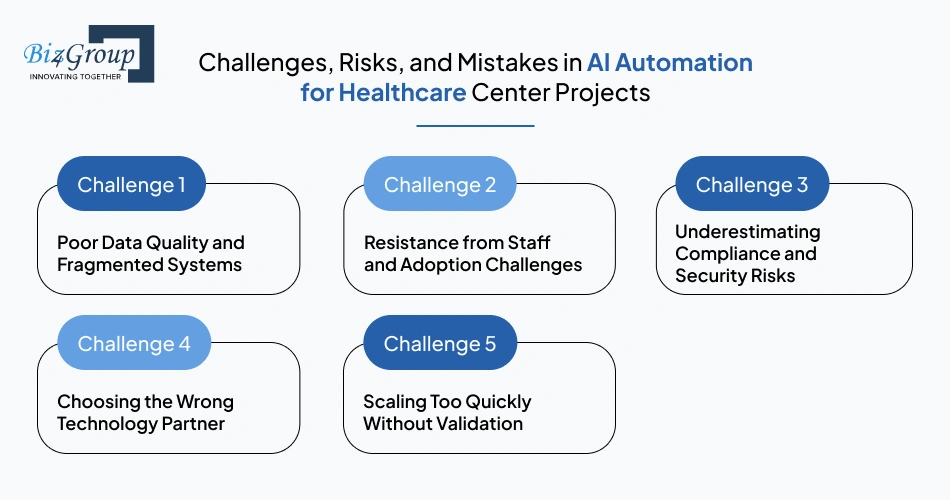
AI automation for healthcare center initiatives delivers strong results when implemented correctly. However, many projects struggle due to planning gaps, technical missteps, or unrealistic expectations. Understanding these challenges early helps leaders avoid costly setbacks.
Below are the most common issues healthcare organizations face, along with proven mitigation strategies.
Challenge 1. Poor Data Quality and Fragmented Systems
AI systems rely on consistent, accurate data. In many healthcare centers, data lives across disconnected platforms.
Solutions
- Audit data sources before implementation
- Clean and standardize historical records
- Use enterprise AI solutions to unify automation across departments
Challenge 2. Resistance from Staff and Adoption Challenges
Staff may view automation as disruptive or fear loss of control. This slows adoption and limits impact.
Solutions
- Involve staff early in planning
- Provide role-based training
- Position AI as a support tool, not a replacement
Challenge 3. Underestimating Compliance and Security Risks
Automating sensitive workflows without proper safeguards creates compliance exposure.
Solutions
- Embed security controls into AI workflows
- Maintain audit logs for automated actions
- Assign clear ownership for compliance oversight
Challenge 4. Choosing the Wrong Technology Partner
Limited healthcare experience or under-skilled teams often lead to rework and instability.
Solutions
- Partner with teams experienced in healthcare automation
- Hire AI developers with domain expertise and compliance awareness
Challenge 5. Scaling Too Quickly Without Validation
Expanding automation before validating results increases operational risk.
Solutions
- Pilot solutions in controlled environments
- Track KPIs before scaling
- Refine workflows based on real-world usage
Most challenges tied to AI automation for healthcare center projects are avoidable. Clear planning, strong data foundations, staff engagement, and the right technical expertise turn risk into opportunity.
Avoid Costly Mistakes Before They Happen
Healthcare automation fails when expertise is missing. The right partner turns risk into confidence.
Talk to Biz4Group's Automation ExpertsWhy Biz4Group LLC Leads AI Automation for Healthcare Centers Across the USA?
Biz4Group LLC is a USA-based software development company with a deep focus on building intelligent, scalable, and secure AI solutions for healthcare organizations.
What sets us apart is not only technical expertise of more than two decades but also our understanding of how healthcare actually works. We provide AI automation services for healthcare center environments with a clear view of clinical workflows, administrative realities, compliance requirements, and business goals. Our teams do not build generic products. We engineer solutions that fit real-world healthcare operations.
Biz4Group delivers end-to-end AI healthcare solutions that scale. We combine strategy, design, development, and integration under one roof, ensuring healthcare organizations across the globe move from idea to impact without fragmentation or guesswork.
Our portfolio speaks for itself. We have built AI chatbots supporting vulnerable populations, intelligent health analysis platforms handling sensitive medical data, and advanced AI avatars driving engagement and revenue. Each solution reflects our ability to balance innovation with responsibility, speed with stability, and automation with human-centered design.
Why Businesses Choose Biz4Group LLC
- Proven experience delivering AI automation for healthcare center operations
- Strong expertise in compliance-driven and data-sensitive environments
- Ability to design scalable solutions for both small clinics and large healthcare systems
- Deep technical knowledge across AI, automation, and cloud platforms
- Transparent communication and collaborative project execution
- Focus on ROI, not experimentation
When you work with Biz4Group, you gain an AI development partner that thinks like a healthcare operator, builds like a product company, and delivers like a trusted advisor.
We help organizations move confidently into the future of AI automation with clarity, control, and confidence. And we’d love to do all that (and more) for you.
Final Thoughts
Healthcare organizations are under constant pressure to do more with fewer resources, deliver better patient experiences, and maintain compliance without increasing operational strain. AI automation replaces manual workflows, reduces administrative burden, and creates smoother, more reliable healthcare operations.
From patient engagement and scheduling to records management and revenue workflows, AI solutions for healthcare center automation offer measurable improvements across every layer of care delivery. When implemented with the right strategy, automation improves efficiency while preserving the human touch that healthcare depends on. The result is a healthcare center that runs smarter, adapts faster, and scales without sacrificing quality.
This is where Biz4Group LLC stands out. As a custom software development company with deep expertise in AI automation for healthcare center environments, we help organizations turn complex challenges into streamlined, secure, and scalable solutions. Our experience across real-world healthcare projects allows us to design automation that works in practice, not just on paper.
If you are ready to reduce operational friction, empower your teams, and future-proof your healthcare center, now is the time to act. Partner with Biz4Group LLC and take the first step toward building intelligent healthcare operations that deliver real impact.
FAQs
How long does it take to see results after implementing AI automation in a healthcare center?
Most healthcare centers begin noticing operational improvements within the first few months. Early gains often appear in areas like response time, task completion speed, and scheduling efficiency, while deeper benefits such as improved decision-making and scalability emerge as systems mature.
Can AI automation work alongside legacy healthcare software systems?
Yes. Modern AI automation solutions are designed to coexist with legacy systems. They act as intelligent layers that connect, orchestrate, and enhance existing software rather than replacing it outright, which minimizes disruption.
What level of internal technical expertise is required to manage AI automation?
Healthcare centers do not need large in-house AI teams. Most systems are built to be managed by operational and IT staff with basic training. Ongoing optimization and advanced tuning can be handled by external partners when needed.
How does AI automation handle exceptions and unexpected scenarios?
AI systems are designed to recognize anomalies and escalate them to human staff. Instead of forcing rigid outcomes, automation adapts to context and flags situations that require judgment, ensuring safety and reliability.
Is AI automation suitable for non-clinical healthcare centers and specialty practices?
Absolutely. AI automation applies to a wide range of healthcare environments, including specialty clinics, outpatient centers, wellness practices, and administrative service providers. Use cases can be tailored to each setting’s unique workflows.
How customizable are AI automation solutions for healthcare centers?
AI automation platforms are highly customizable. Workflows, rules, and models can be adapted to reflect organizational policies, patient demographics, and operational priorities without rebuilding the system from scratch.
What happens if regulations or healthcare policies change after implementation?
Well-designed AI automation systems are flexible. They can be updated to reflect new regulations, documentation requirements, or reporting standards without major redevelopment, protecting long-term investment.