 Location :
Orlando, FL, USA
Location :
Orlando, FL, USA +1 (407) 714-1616
 info@biz4group.com

 AI Summary Powered by Biz4AI
- Pet insurance app development succeeds when every decision supports faster claims, flexible policy management, and a better experience for pet owners.
- A successful AI pet insurance app development strategy combines practical AI capabilities with insurance workflows that improve accuracy, efficiency, and customer satisfaction.
- Planning features, technology choices, and costs together helps reduce rework while preparing your platform for long-term business growth.
- Future-ready platforms stay competitive by supporting changing coverage rules, evolving customer expectations, and continuous AI improvements without frequent redevelopment.
- The cost to develop an AI pet insurance app typically ranges from $25,000 to $250,000+, depending on AI capabilities, insurance workflows, integrations, compliance, and overall product complexity.
- Biz4Group LLC helps insurers and startups transform pet insurance ideas into scalable AI-powered platforms with practical strategies built for sustainable business growth.
Why are pet insurance claims still taking days when customers expect answers in hours?
For many insurers, the challenge isn't selling pet insurance; it's delivering a fast, accurate, and seamless claims experience without increasing operational costs or compliance risks.
As customer expectations continue to rise, outdated workflows, manual document reviews, and disconnected systems create bottlenecks that slow every stage of the insurance journey. It's no surprise that more insurance leaders are evaluating pet insurance app development as a long-term business investment rather than just another digital initiative.
The opportunity is growing just as quickly.
The global pet insurance market is expected to grow from $25.7 billion in 2026 to $79.6 billion by 2033 at a 17.5% CAGR. Scaling alongside that demand requires intelligent platforms that simplify operations while improving customer satisfaction.
Insurers already using AI in claims have reduced average claim processing time from 10 days to 36 hours, demonstrating the operational impact AI can deliver when implemented strategically.
If you're CTO at insurance company and asking, "How can AI-powered pet insurance app development reduce claim processing time while ensuring compliance?", you're already focusing on the right challenge.
Well, the answer goes beyond adding AI features. It starts with designing the right platform, selecting the right workflows, and knowing how to build an AI app for pet insurance that supports long-term business growth.
And, this guide walks you through every stage of that journey. Let's start by understanding the basics.
What is an AI Pet Insurance App?
An AI pet insurance app is a digital platform that helps insurers, InsurTech startups, and pet insurance providers manage the complete insurance journey through a single, connected system. It combines traditional insurance functions such as policy management, claims handling, and customer support with AI capabilities that make these processes faster, more accurate, and easier to manage.
Instead of treating AI as an add-on, the platform uses it to improve decision-making across everyday insurance operations while creating a smoother experience for both customers and insurance teams.
A modern AI insurance app for pets:
- Allow customers to purchase, renew, and manage pet insurance policies digitally.
- Create and maintain detailed pet profiles, including medical history and policy information.
- Enable policyholders to submit claims by uploading veterinary bills and supporting documents.
- Speed up claim reviews using AI-assisted document processing and verification.
- Detect unusual claim patterns that may indicate potential fraud.
- Recommend suitable coverage options based on a pet's profile and insurance needs.
- Provide instant policy information and claim updates through AI-powered customer support.
- Give insurance teams a centralized dashboard to manage policies, claims, customers, and business performance.
Why Investing in Pet Insurance App Development with AI Is Becoming a Strategic Decision in the Insurance Industry
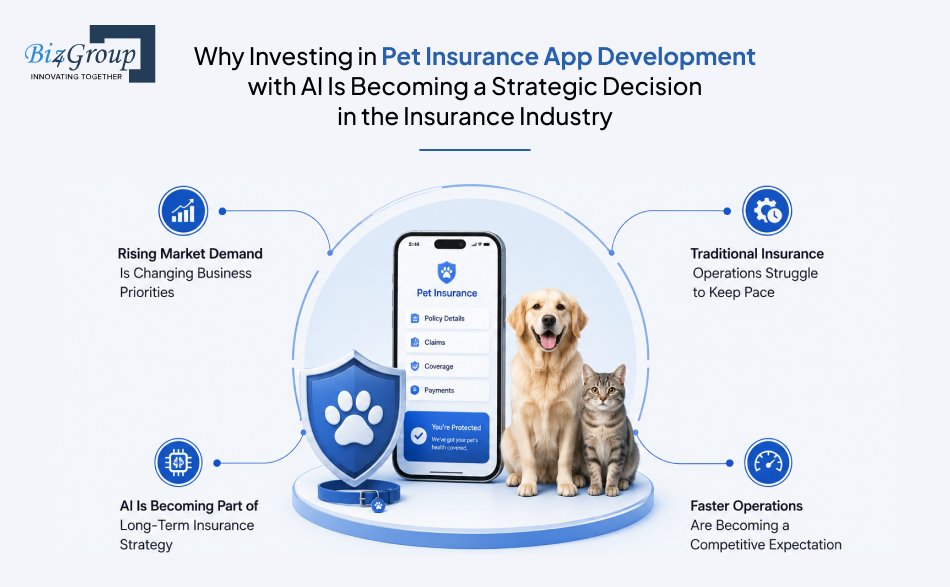
The answer is simple: insurers are under growing pressure to handle higher policy volumes, process claims faster, and scale operations without adding unnecessary complexity. That shift is pushing AI pet insurance app development from a technology initiative to a business decision.
The factors below explain why industry leaders are accelerating this investment.
1. Rising Market Demand Is Changing Business Priorities
Pet ownership continues to expand, bringing more policies, claims, and customer interactions for insurers to manage. 95 million U.S. households owned at least one pet in 2025, while spending on pet care is expected to reach $165 billion in 2026.
That growth is encouraging insurance companies expanding into pet insurance to prepare their operations for increasing demand as:
- Growing policy volumes require systems that can scale efficiently.
- Customer expectations are raising the standard for digital insurance experiences.
- Expansion plans depend on technology that supports long-term operational growth.
2. Traditional Insurance Operations Struggle to Keep Pace
The opportunity is significant, yet there is still room for growth. Only 4.27% of U.S. pets are currently insured, while NAPHIA reported U.S. gross written premiums increased 20.8% to $5.2 billion. For entrepreneurs building insurance platforms, this highlights the need to establish operational foundations that can support future market expansion as:
- Manual workflows make it difficult to manage growing policy volumes.
- Disconnected systems create delays across the insurance lifecycle.
- Scaling operations requires more than adding larger teams.
3. AI Is Becoming Part of Long-Term Insurance Strategy
The industry's direction is shifting beyond digitization toward intelligent operations. The AI in animal health market is projected to reach $2.06 billion in 2026, growing at a 19.5% CAGR, reflecting broader investment in data-driven decision making.
This is also why insurers are evaluating technology partners capable of delivering enterprise grade AI solutions that support sustainable business growth as:
- Technology investments are increasingly tied to operational efficiency.
- AI adoption is becoming part of long-term modernization strategies.
- Intelligent platforms support future business expansion without constant process redesign.
4. Faster Operations Are Becoming a Competitive Expectation
Speed is influencing customer satisfaction as much as pricing and coverage. Insurers using intelligent automation already process 50% of eligible pet claims instantly, while most remaining claims are completed within 5 days.
Early adopters combining blockchain-backed AI have also reduced fraud losses by up to 33% and shortened claim handling time by 42%, reinforcing why operational modernization has become a strategic priority as:
- Faster processing strengthens customer confidence.
- Reducing operational delays improves overall business performance.
- Modern insurance operations increasingly depend on intelligent automation.
The direction of the industry is becoming increasingly clear. As demand grows and operational expectations continue to rise, investing in modern insurance technology is shifting from a competitive advantage to a strategic business requirement.
Ready to Turn Market Demand into Growth?
Let's identify the AI opportunities that fit your insurance business before the market moves even faster
Discuss My Product StrategyHow an AI-Powered Pet Insurance App Works from Policy Purchase to Claim Settlement
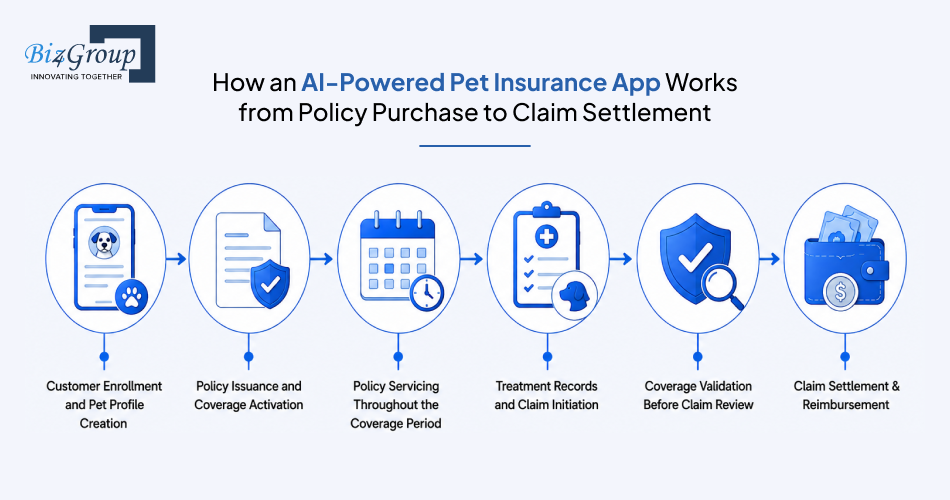
The AI app for pets works as a connected insurance ecosystem where every action creates the foundation for the next one. Customer information, pet records, policy details, veterinary documents, and claim data stay linked throughout the journey, giving insurers a complete operational view instead of disconnected records.
For founders seeking AI-powered insurance solutions, understanding this workflow is the first step toward designing a platform that reflects real insurance operations.
1. Customer Enrollment and Pet Profile Creation
- The journey begins when customers register their account and verify their identity.
- A detailed pet profile is created with species, breed, age, vaccination history, medical records, microchip details, and ownership information.
- These records become the reference point for underwriting, policy administration, future claims, and renewals.
- Every profile is assigned a unique customer and pet record to maintain data consistency throughout the insurance lifecycle.
Also Read: AI Insurance Underwriting Software Development
2. Policy Issuance and Coverage Activation
- Customers review available plans by comparing coverage limits, deductibles, reimbursement percentages, annual benefit limits, waiting periods, and policy exclusions.
- After selecting a suitable policy and completing payment, coverage becomes active according to the policy terms.
- Policy documents, digital ID cards, premium schedules, and coverage details are stored within the customer account for future access.
- The issued policy establishes the rules that govern every claim submitted afterward.
3. Policy Servicing Throughout the Coverage Period
- Customers can access policy documents, premium history, renewal dates, and coverage information from a centralized dashboard.
- Eligible updates such as contact information, beneficiary details, additional pets, or policy endorsements are recorded within the active policy.
- Every modification is logged to maintain an accurate policy history, creating a reliable audit trail for future verification and regulatory reporting.
- The platform continuously keeps customer, pet, and policy information synchronized.
4. Treatment Records and Claim Initiation
- When veterinary care is received, customers submit a claim by uploading treatment invoices, prescriptions, diagnostic reports, discharge summaries, and payment receipts.
- Each submission is automatically mapped to the corresponding pet profile, policy number, treatment date, and claim reference.
- Before moving forward, the system verifies that all mandatory documents have been received to reduce incomplete submissions.
- This creates a structured claim file for the insurer's review process.
5. Coverage Validation Before Claim Review
- Every claim is evaluated against the active policy to verify coverage eligibility before reimbursement decisions are made.
- The review considers waiting periods, covered treatments, policy exclusions, deductible requirements, annual benefit limits, reimbursement percentages, and previous claim history.
- Missing information or policy mismatches are identified before the claim progresses further.
- Only validated claims move to the final assessment stage.
Also Read: AI Medical Claim Processing Software Development Guide
6. Claim Settlement & Reimbursement
- After policy validation is complete, the reimbursement amount is calculated according to the approved treatment cost, deductible, reimbursement rate, and remaining policy limits.
- Approved claims move to payment processing using the customer's selected reimbursement method.
- The completed settlement, payment status, and claim outcome are permanently recorded within the policy history.
- These records become part of future renewals, customer servicing, audits, and policy administration.
Also Read: How AI in Payments is Changing the Digital Payments Landscape?
When every stage connects seamlessly, an AI pet insurance app with AI reflects the way pet insurance is administered in practice, giving insurers a structured workflow that carries accurate information from enrollment through final claim settlement.
Core Modules That Power a Modern AI Pet Insurance App Development
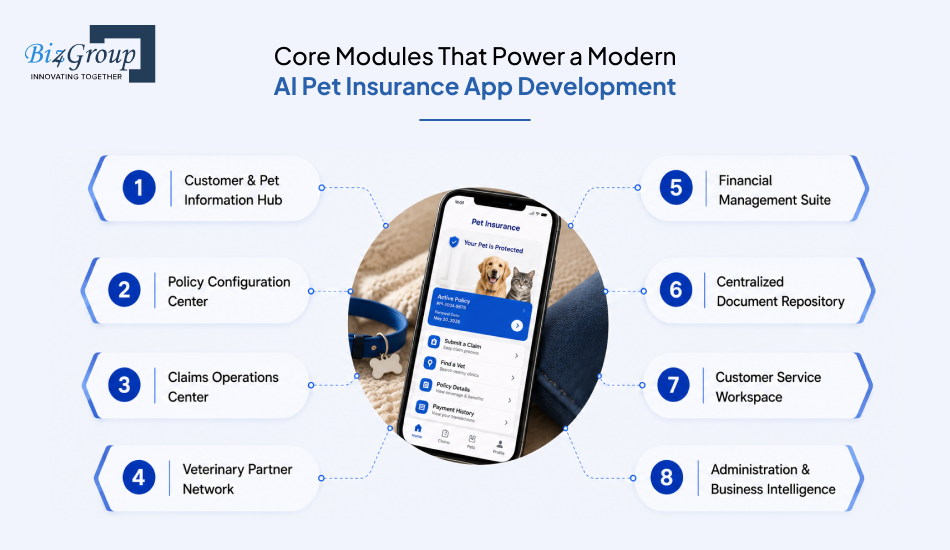
A pet insurance platform is much more than a customer-facing product. Behind every policy sits a group of business modules that keep insurance operations connected. Defining these modules during InsurTech app development for pets early prevents scope gaps later and gives your product a stronger foundation.
Let's take a look:
1. Customer & Pet Information Hub
Reliable insurance decisions begin with accurate records. Customer identities, pet profiles, breed details, vaccination history, ownership information, and linked policies are maintained here in one place. This ensures that every insurance process starts with consistent and trustworthy data.
2. Policy Configuration Center
Every insurer offers different products, coverage rules, and reimbursement models. Policy structures, waiting periods, deductibles, exclusions, benefit limits, endorsements, and renewal rules are configured here, allowing insurers to manage changing business requirements without restructuring the entire platform.
3. Claims Operations Center
Claims generate documents, financial records, communication history, and settlement information that must remain connected. This module brings every claim into a single operational workspace and helps insurers maintain complete records while keeping each case organized from submission through closure.
4. Veterinary Partner Network
A modern insurance platform depends on structured provider relationships. Veterinary clinics, hospitals, licensing details, service locations, billing arrangements, and partnership records stay organized here. This makes provider management part of everyday insurance operations rather than a separate administrative task.
5. Financial Management Suite
Insurance transactions continue long after a policy is purchased. Premium schedules, recurring collections, reimbursement payments, invoices, refunds, payment reconciliation, and financial ledgers are maintained together in this module, giving finance teams a complete picture of policy-related transactions.
6. Centralized Document Repository
Insurance records continue to grow throughout the policy lifecycle. This module securely organizes contracts, invoices, prescriptions, treatment reports, consent forms, renewal documents, supporting evidence, and regulatory records, making document retrieval straightforward whenever information is required.
7. Customer Service Workspace
Customer support extends beyond answering policy questions. Service requests, renewal discussions, account updates, communication history, policy correspondence, and interaction records stay connected in the module. This allows support teams to work with complete customer context instead of fragmented information.
8. Administration & Business Intelligence
Business growth depends on visibility across the entire insurance operation. Policy performance, claim volumes, renewal trends, compliance records, financial summaries, operational reports, and workforce activity come together here. This helps leadership monitor performance from one centralized environment.
Together, these modules define the operational structure of a modern pet insurance platform. Once this foundation is clearly established, every future capability has a logical place within the product instead of becoming another disconnected business component.
How AI Enhances Every Stage of the Pet Insurance Lifecycle
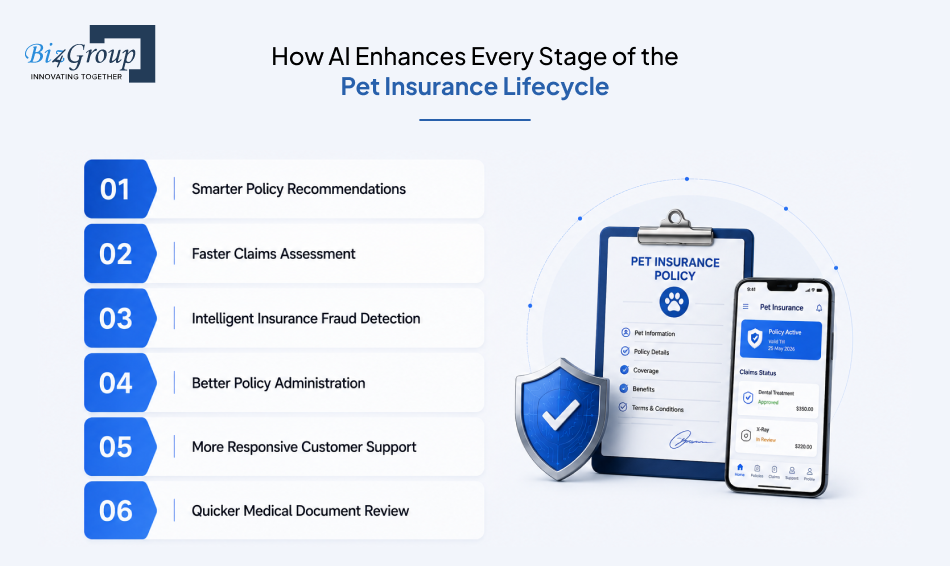
AI enhances every stage of the pet insurance lifecycle by making insurance decisions faster, more consistent, and far less dependent on manual effort.
That's exactly why many insurers ask, "We're modernizing our insurance platform. How can AI improve customer experience, fraud detection, and policy management in a pet insurance app?"
The answer lies in applying intelligence where routine decisions consume the most time. Have a look:
1. Smarter Policy Recommendations
Not every pet requires identical coverage, and AI helps insurers reflect that reality. By evaluating factors such as breed, age, medical history, lifestyle, and previous policy activity, AI recommends coverage options that better match each pet's insurance profile. It:
- Suggests suitable coverage tiers instead of generic plans
- Identifies policy gaps before enrollment
- Supports personalized premium recommendations
2. Faster Claims Assessment
Claim reviews often involve checking multiple documents before a reimbursement decision is made. AI speeds up that evaluation by reading veterinary invoices, treatment records, prescriptions, and policy terms together, reducing manual review without changing established claim procedures. It:
- Extracts information from uploaded claim documents
- Matches treatments against policy coverage
- Flags incomplete submissions before human review
3. Intelligent Insurance Fraud Detection
Every insurer deals with suspicious claim activity, but reviewing every case manually slows operations. AI strengthens insurance fraud detection by identifying unusual medical billing patterns, duplicate claims, altered invoices, inconsistent treatment histories, and abnormal reimbursement requests that deserve closer investigation. It:
- Detects duplicate or repeated claim submissions
- Identifies unusual provider or claimant behaviour
- Prioritizes high-risk claims for further review
Also Read: How to Build an AI Medical Billing Software
4. Better Policy Administration
Insurance portfolios evolve continuously as customers renew policies, update pet information, or modify coverage. AI helps insurers manage these ongoing changes by monitoring policy data, identifying inconsistencies, and supporting more accurate policy administration throughout the coverage period. It:
- Highlights incomplete policy information
- Detects renewal risks before expiration
- Supports accurate policy record maintenance
5. More Responsive Customer Support
Policyholders expect quick answers without waiting for business hours. AI assists customer support by understanding policy questions, explaining coverage details, tracking claim status, and guiding customers through routine requests while allowing service teams to focus on more complex conversations. It:
- Answers common policy-related questions instantly
- Provides real-time claim progress updates
- Guides customers through routine service requests
6. Quicker Medical Document Review
Veterinary records often arrive in different formats and contain large amounts of clinical information. AI reviews prescriptions, diagnostic reports, laboratory results, treatment summaries, and discharge notes much faster. This helps insurers complete prior authorization of insurance claims with greater consistency.
- Reads structured and unstructured veterinary documents
- Highlights missing clinical information
- Organizes treatment data for faster evaluation
AI delivers the greatest value when it strengthens existing insurance operations instead of replacing them. Applied at the right stages, it helps insurers make better decisions, reduce manual effort, and keep the entire pet insurance lifecycle running more efficiently.
Also Read: A Guide to AI Medical Records Management Software Development for Hospitals, Clinics, and Labs
Essential Features Every Modern Pet Insurance App Should Include in 2026
Modern pet insurance platforms are expected to do much more than issue policies or process claims. Every feature should solve a specific business need while improving everyday operations.
If you're also thinking along the lines, "We're launching a pet insurance startup. What features should an AI-powered pet insurance app include to compete with established providers?"
Well, the answer starts with prioritizing the right feature set instead of adding everything at once.
1. Customer Experience Features
These features shape how policyholders interact with the platform throughout their insurance journey. They simplify everyday tasks, reduce support dependency, and create a smoother digital experience without adding unnecessary operational complexity.
|
Feature |
Purpose |
|---|---|
|
Secure Customer Registration |
Creates verified customer accounts for policy management. |
|
Pet Profile Management |
Stores pet details, medical history, breed, age, and vaccination records. |
|
Digital Policy Wallet |
Gives instant access to active policies and insurance documents. |
|
Coverage Comparison |
Helps customers evaluate available plans before purchasing coverage. |
|
Premium Calculator |
Estimates premium costs based on selected policy options. |
|
Renewal Reminders |
Notifies customers before policy expiration dates. |
2. Claims & Reimbursement Features
Claim processing defines much of the customer experience in pet insurance. These capabilities help insurers manage claim submissions, reimbursement activities, and supporting documentation through one structured process.
|
Feature |
Purpose |
|---|---|
|
Digital Claim Submission |
Allows customers to submit claims electronically. |
|
Veterinary Document Upload |
Supports invoices, prescriptions, diagnostic reports, and receipts. |
|
Real-Time Claim Tracking |
Displays claim progress from submission to settlement. |
|
Reimbursement Status Updates |
Keeps policyholders informed about payment progress. |
|
Claim History |
Maintains previous claim records for future reference. |
|
Settlement Notifications |
Confirms reimbursement decisions and completed payments. |
3. AI-Powered Decision Support
Artificial intelligence delivers the greatest value when it assists insurance teams with faster decision-making instead of replacing established processes. Features backed by predictive analysis help insurers respond more accurately while handling growing policy volumes.
|
Feature |
Purpose |
|---|---|
|
AI Coverage Recommendations |
Suggests suitable policy plans based on pet profiles. |
|
Intelligent Claim Review |
Identifies missing or inconsistent claim information. |
|
Fraud Risk Scoring |
Detects suspicious claim patterns before approval. |
|
Medical Document Analysis |
Extracts relevant treatment information from veterinary records. |
|
Renewal Prediction |
Identifies policies with higher renewal or lapse probability. |
|
Answers routine policy and claim-related questions instantly. |
4. Administration & Business Operations
A growing insurance business depends on efficient internal operations as much as customer-facing services. These features help insurance teams manage policies, monitor performance, and keep business activities organized from one environment.
|
Feature |
Purpose |
|---|---|
|
Policy Administration Dashboard |
Manages policy lifecycle and coverage updates. |
|
Customer Management Console |
Centralizes customer account administration. |
|
Veterinary Partner Management |
Maintains provider profiles and partnership records. |
|
Billing & Payment Management |
Tracks premiums, reimbursements, refunds, and payment history. |
|
Reporting Dashboard |
Monitors policy, claim, and financial performance. |
|
Audit Log Management |
Maintains activity records for compliance and internal reviews. |
A successful custom pet insurance app is defined by how well these features work together rather than how many are included. Prioritizing the right capabilities creates a platform that remains practical today and scalable as business requirements evolve.
Too Many Features to Prioritize?
Let's build a roadmap around the features your customers need instead of everything that sounds impressive
Plan My Product RoadmapHow to Build an AI-Powered Pet Insurance App from Scratch: A Step-By-Step Process
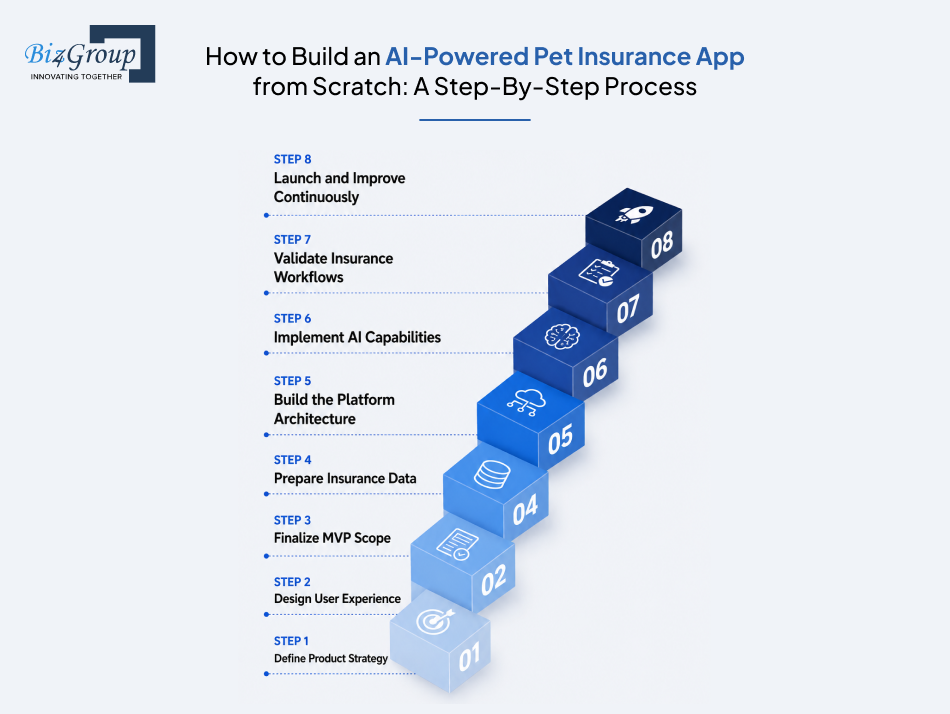
Every successful AI pet insurance platform follows a structured development roadmap instead of jumping straight into coding. The right sequence reduces rework, keeps business priorities clear, and helps every stakeholder stay aligned.
Many insurers eventually ask, "Our insurance business wants to automate pet insurance claims using computer vision and AI. What is the best development approach?"
The answer is a structured roadmap that turns business requirements into a scalable insurance platform.
Step 1: Define Product Strategy
A clear product strategy sets the direction for the entire project. Before writing code, finalize the insurance products, reimbursement model, waiting periods, deductible rules, wellness benefits, claim eligibility, and regulatory requirements.
Using reliable AI integration services at this stage ensures business objectives translate into practical technical requirements from the beginning. It should conclude with:
- Product vision and business goals
- Policy and underwriting requirements
- AI implementation priorities
Step 2: Design User Experience
Once the business model is finalized, focus on how customers, veterinarians, claims teams, and administrators will use the platform. An experienced UI/UX design company helps transform operational workflows into intuitive user journeys.
This reduces friction before development begins and prevents expensive design changes later in the project. The design phase should produce:
- User journey maps
- Wireframes for key workflows
- Interactive design prototypes
Also Read: Top UI/UX Design Companies in USA
Step 3: Finalize MVP Scope
Trying to deliver every feature in the first release usually delays product launch. Instead, identify the minimum functionality needed to support policy purchase, pet registration, claim submission, and reimbursement tracking.
Many insurers begin with MVP development services to validate customer adoption before expanding into advanced capabilities. Your MVP should clearly include:
- Core policy management
- Digital claims functionality
- Secure customer accounts
Also Read: Top MVP Development Companies in USA
Step 4: Prepare Insurance Data
Artificial intelligence depends on high-quality insurance data rather than assumptions. Before AI model development begins, organize veterinary invoices, treatment summaries, prescriptions, claim history, breed-specific health records, reimbursement outcomes, and policy documents.
These datasets become the foundation for the training of AI models used throughout the platform. The preparation stage should organize:
- Historical insurance claims
- Veterinary medical records
- Policy and coverage datasets
Also Read: How to Seamlessly Integrate AI Models into Development Workflow?
Step 5: Build the Platform Architecture
With the product scope finalized, the next step is engineering a scalable architecture that supports policy administration, claims processing, customer management, payment workflows, and third-party integrations.
A well-planned foundation makes future feature releases easier without disrupting day-to-day insurance operations. The architecture should define:
- System components and API connectivity
- Database structure
- Security framework
Also Read: Adopt An API-First Architecture For Business Agility
Step 6: Implement AI Capabilities
Once the platform foundation is ready, introduce AI where it delivers measurable business value. AI computer vision can read veterinary invoices and treatment reports, while machine learning supports claim assessment, policy recommendations, fraud detection, and customer assistance without changing existing insurance workflows.
The implementation phase should include:
- Computer vision models
- Intelligent claim validation
- AI-powered customer assistance
Also Read: Top 10+ Computer Vision Software Development Companies in USA
Step 7: Validate Insurance Workflows
Before production release, every insurance workflow should be tested using realistic policy and claim scenarios. Validate reimbursement calculations, deductible rules, waiting periods, policy exclusions, claim approvals, and payment processing to ensure the platform performs consistently under real operating conditions.
Testing should verify:
- End-to-end claim lifecycle
- Policy rule accuracy
- Performance and security
Step 8: Launch and Improve Continuously
Product launch marks the beginning of continuous improvement rather than the end of development. Monitor customer behaviour, claim processing time, AI prediction accuracy, policy renewals, and operational performance.
These insights help prioritize future enhancements while supporting long-term business growth. Continue improving through:
- Customer feedback analysis
- Operational performance monitoring
- Regular feature releases
A structured development process keeps technology aligned with insurance goals from the first planning session to long-term product evolution. Following these steps helps insurers launch a scalable platform that is ready for growth, operational efficiency, and future AI innovation.
Best Technology Stack for AI-Powered Pet Insurance App Development
Every technology decision affects how efficiently your insurance platform performs today and how easily it scales tomorrow. Whether you're planning AI pet insurance app development or modernizing existing systems, the right tech stack lays the foundation for long-term success.
The table below outlines the technologies commonly used by teams delivering enterprise-grade mobile app development services.
|
Architecture Layer |
Recommended Tools |
Purpose |
|---|---|---|
|
Mobile Application |
Flutter, React Native |
Speeds up cross-platform delivery from a single codebase while maintaining a native-like experience across Android and iOS devices. |
|
Customer Web Portal |
React.js, Next.js |
Delivers responsive customer experiences through ReactJS development, while improving page rendering, routing, and organic search performance with NextJS development. |
|
Backend Services |
Node.js, NestJS |
Handles thousands of concurrent API requests through scalable NodeJS development, while keeping business logic modular as policy, claims, and underwriting services continue to grow. |
|
AI & Machine Learning |
Python, TensorFlow, PyTorch |
Supports Python development for fraud detection, risk scoring, claim intelligence, and predictive analytics, while enabling efficient model training and production deployment. |
|
Computer Vision & OCR System |
OpenCV, Google Vision AI, Amazon Textract |
Detects information from veterinary invoices, prescriptions, handwritten notes, and medical documents, reducing manual data entry during claim reviews. |
|
Database & Caching |
PostgreSQL, MongoDB, Redis |
Maintains reliable transactional records, stores flexible medical datasets, and improves application response times by reducing repeated database queries. |
|
Cloud Infrastructure & Storage |
AWS, Microsoft Azure, Amazon S3 |
Provides elastic computing resources, secure object storage, automated backups, and high availability for enterprise insurance workloads. |
|
API & Third-Party Integrations |
REST APIs, GraphQL |
Connects payment gateways, veterinary software, CRM platforms, and external insurance services while transferring only the data required for each request. |
|
Authentication & Security |
OAuth 2.0, AWS Cognito |
Protects customer identities with secure authentication, centralized access control, and token-based authorization across connected services. |
|
DevOps & Monitoring |
Docker, Kubernetes, GitHub Actions, Prometheus |
Automates deployments, simplifies infrastructure management, and continuously monitors application health to identify issues before they affect users. |
|
Payments & Notifications |
Stripe, Firebase Cloud Messaging, SendGrid |
Processes premium payments securely while delivering instant claim updates, renewal reminders, and policy communications that support AI insurance claims automation. |
A well-planned technology stack supports both today's business goals and tomorrow's product roadmap. Backed by experienced full stack development, these technologies help insurers build pet insurance app with AI that remain reliable, secure, and ready to scale as customer expectations continue to evolve.
Also Read: Why to Choose the Full Stack Development for Modern Business
What is the Cost to Develop a Custom Pet Insurance App with AI
The cost of developing a custom AI-powered pet insurance platform typically ranges from $25,000 to $250,000+, depending on the product scope, AI capabilities, third-party integrations, security requirements, and scalability goals. Rather than focusing only on the budget, it helps to understand what each investment level delivers.
Here's a practical breakdown to help you estimate the right fit for your business.
|
Development Level |
Estimated Cost Range |
Scope |
|---|---|---|
|
MVP Level AI Pet Insurance App |
$25,000–$70,000 |
Pet onboarding, policy purchase, claims submission, OCR-based document capture, reimbursement tracking, admin dashboard, and basic customer notifications. |
|
Mid-Level AI Pet Insurance App |
$70,000–$140,000 |
AI-powered claim assessment, fraud detection, veterinary system integrations, payment gateway, policy renewals, analytics dashboard, and role-based admin controls. |
|
Advanced Level AI Pet Insurance App |
$140,000–$250,000+ |
Computer vision, predictive risk scoring, multilingual support, real-time analytics, cloud scalability, compliance, enterprise integrations, and automated claims workflows. |
Factors That Influence AI Pet Insurance App Development Cost
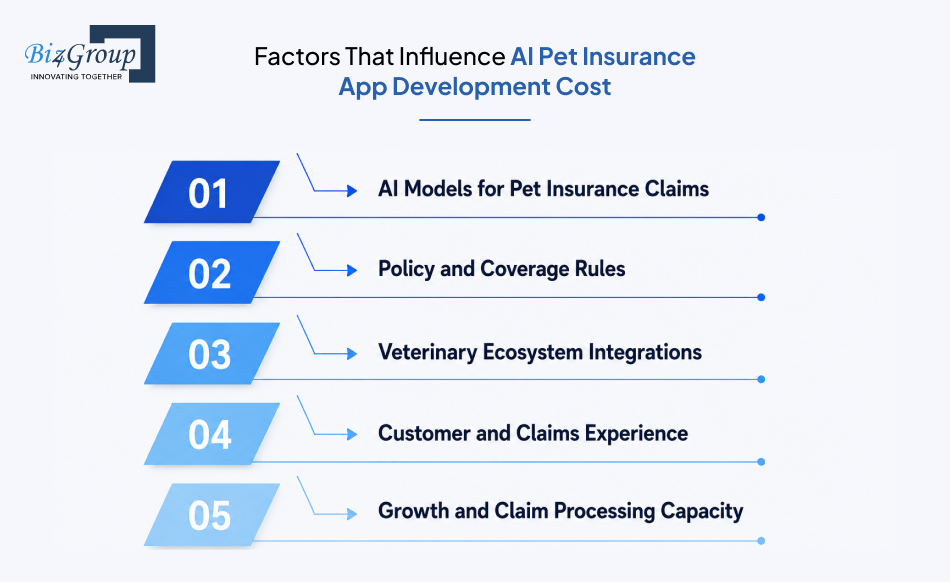
A few technical decisions have a much bigger impact on your budget than others. Understanding them early helps you plan a realistic investment with fewer surprises.
1. AI Models for Pet Insurance Claims
Training AI to interpret veterinary invoices, reimbursement calculations, breed-specific conditions, and claim adjudication requires additional validation which increases the overall AI integrations cost.
Estimated Cost Impact: +$10,000–$25,000
2. Policy and Coverage Rules
Supporting waiting periods, deductibles, wellness riders, annual reimbursement limits, and coverage exclusions requires custom insurance logic and additional development effort.
Estimated Cost Impact: +$8,000–$30,000
3. Veterinary Ecosystem Integrations
Connecting veterinary practice software, payment gateways, pet medical records, identity verification, and policy systems requires custom integrations and ongoing maintenance.
Estimated Cost Impact: +$10,000–$35,000
4. Customer and Claims Experience
Designing separate journeys for pet owners, veterinarians, claims adjusters, and administrators takes additional planning which increases the UI/UX design cost during the development.
Estimated Cost Impact: +$5,000–$20,000
5. Growth and Claim Processing Capacity
Supporting higher policy volumes, simultaneous claim submissions, policy renewals, and faster reimbursement processing requires stronger cloud infrastructure and scalable architecture.
Estimated Cost Impact: +$15,000–$50,000
Every cost decision shapes AI pet insurance app differently. Focusing on the right priorities from the beginning helps you invest wisely and avoid expensive surprises as your platform grows.
Need a Budget Built Around Your Vision?
Let's estimate your investment based on your insurance goals not generic development averages
Get My Custom Cost EstimateBest Practices to Follow for Building Future-Ready AI Pet Insurance Platforms
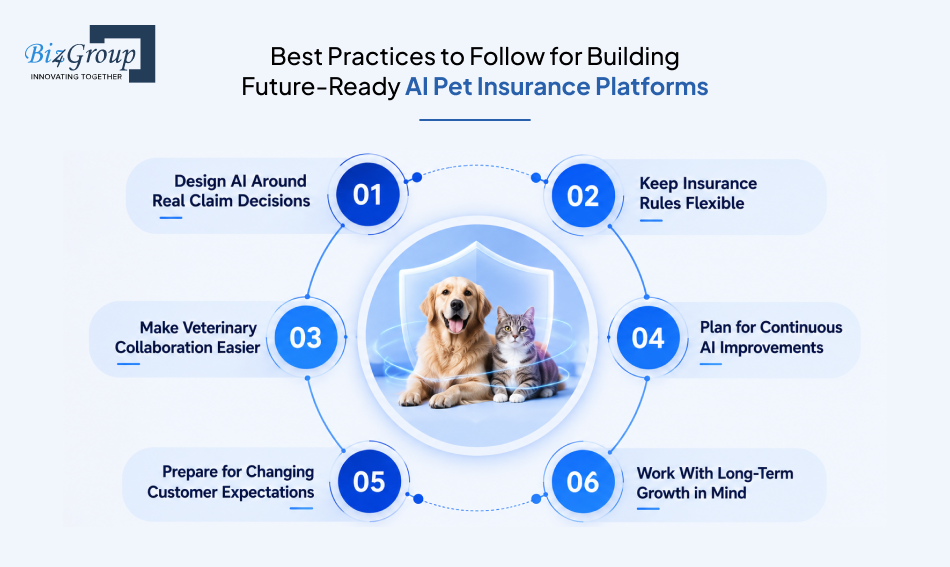
The answer is simple. Think beyond today's requirements because pet insurance continues to evolve with new customer expectations, veterinary technology, and regulations. A future-ready platform adapts to these changes without requiring a complete rebuild. The following practices will help you make smarter long-term decisions while planning your AI pet insurance app development project.
1. Design AI Around Real Claim Decisions
Your AI should solve practical insurance challenges instead of trying to automate everything. Focus on helping adjusters review claims faster, identify incomplete submissions, and support consistent reimbursement decisions.
- Prioritize claim accuracy before adding advanced AI capabilities
- Train AI using real veterinary documents instead of generic datasets
- Keep human reviewers involved for complex or high-value claims
- Continuously improve AI models as new claim scenarios emerge
2. Keep Insurance Rules Flexible
Pet insurance products change over time. Your platform should make it easy to update reimbursement percentages, waiting periods, wellness coverage, or breed-specific exclusions without rebuilding core workflows.
- Separate policy rules from application logic wherever possible
- Support multiple insurance plans from a single platform
- Allow business teams to update coverage rules quickly
- Prepare for future policy offerings without major redevelopment
3. Make Veterinary Collaboration Easier
Claims move faster when insurers and veterinary clinics exchange information smoothly. Reducing manual follow-ups improves customer satisfaction while helping internal teams process requests more efficiently.
- Support digital claim documents from veterinary clinics
- Simplify document uploads for pet owners
- Reduce duplicate data entry across claim workflows
- Keep communication transparent throughout claim reviews
4. Plan for Continuous AI Improvements
AI performs better when it learns from new data and business feedback. Working with an experienced AI development company also makes it easier to expand capabilities as your business grows.
- Monitor AI recommendations regularly
- Retrain models using validated claim outcomes
- Measure accuracy instead of relying only on automation
- Add new AI capabilities in planned phases
Also Read: Top 29+ AI Development Companies in USA
5. Prepare for Changing Customer Expectations
Pet owners expect faster responses and more personalized services every year. Combining practical AI automation services with regular product improvements helps your platform stay relevant as customer needs continue to change.
- Collect customer feedback after every claim journey
- Review user behavior before releasing new features
- Introduce improvements through smaller product updates
- Expand personalization based on real customer usage
6. Work With Long-Term Growth in Mind
Future-ready platforms are easier to expand because every technology decision supports long-term business goals. Early guidance through AI consulting services also helps you identify the right opportunities before you integrate AI into app workflows at scale.
- Define measurable business outcomes before adding new AI features
- Build a roadmap for future insurance products
- Review platform performance on a regular schedule
- Align technology investments with long-term business growth
Planning for tomorrow is just as important as solving today's challenges. Following these best practices helps your pet insurance platform remain adaptable, valuable, and ready for future business opportunities without constant redevelopment.
Final Thoughts
Building a successful pet insurance app takes much more than bringing AI into the picture. It comes from making thoughtful decisions at every stage, whether you're planning core features, defining claims workflows, estimating costs, or preparing the platform for future growth. Those decisions shape the experience your customers receive and the efficiency your teams achieve every day.
As you move ahead with AI pet insurance app development, keep your focus on solving real insurance challenges instead of simply adding new technology. When every investment supports a clear business objective, your platform is better prepared to grow alongside your customers and your operations.
That is exactly how businesses build a smarter pet insurance app with AI that continues to deliver value over time. Reaching that point becomes much easier by hiring the right AI development team with proven insurance expertise. At Biz4Group LLC, we help insurers and startups turn practical ideas into scalable AI solutions, and we'd be glad to discuss how we can do the same for your business.
FAQ’s
1. As a product manager, how much does it cost to build a custom pet insurance app with AI-driven underwriting and claims automation?
The cost typically ranges from $25,000 to $250,000+, depending on the product scope, AI capabilities, insurance workflows, third-party integrations, and compliance requirements. An MVP with essential policy management and claims features costs significantly less than an enterprise platform that includes AI underwriting, automated claims processing, fraud detection, and advanced analytics.
2. How long does AI pet insurance app development typically take from planning to launch?
Most projects take 4 to 10 months, depending on complexity. A basic MVP usually requires around 4–5 months, while a feature-rich platform with AI-powered claims automation, policy management, veterinary integrations, and admin portals may take 8–10 months or longer.
3. Can an AI pet insurance platform support multiple insurance products from a single system?
Yes. A well-designed platform can manage accident-only plans, accident and illness coverage, wellness plans, multi-pet policies, and customized insurance products through one centralized administration system. This makes it easier to launch new offerings without rebuilding the platform every time.
4. How can insurers improve claim accuracy without slowing down approvals?
The best approach combines AI with human oversight. AI can review veterinary documents, identify missing information, and prioritize straightforward claims for faster processing. Claims that involve complex medical histories, or unusual reimbursement requests can then be reviewed by experienced adjusters before approval.
5. What should insurers prepare before starting an AI pet insurance app development project?
Start with clear business goals, policy requirements, claim workflows, customer journeys, and integration priorities. Having these requirements documented before development begins reduces unnecessary revisions, shortens delivery timelines, and helps the project stay within budget.
6. What should I look for before partnering with a company for AI pet insurance software development?
Look beyond technical expertise. Evaluate their experience with insurance products, AI implementation, regulatory understanding, scalable architecture, and long-term product support. A team that understands insurance operations can recommend practical solutions that align with your business goals instead of simply delivering requested features.
