 Location :
Orlando, FL, USA
Location :
Orlando, FL, USA +1 (407) 714-1616
 info@biz4group.com
- The top computer vision software development companies in the USA help enterprises automate visual workflows using image recognition, video analytics, and real-time monitoring solutions aligned with operational goals.
- Industries such as manufacturing, healthcare, logistics, retail, and security benefit most from computer vision through improved accuracy, safety monitoring, and faster decision-making.
- Selecting the right partner depends on clear use cases, deployment readiness, scalability planning, and long-term maintenance strategies rather than experimental AI capabilities.
- Businesses evaluating computer vision software companies in United States should prioritize production experience, security compliance, and proven enterprise deployment models to reduce implementation risks.
- Biz4Group LLC stands out as an enterprise-focused computer vision software development company in the USA delivering custom computer vision solutions designed around real workflows, scalable architecture, and measurable business outcomes.
What if business decisions no longer depended only on reports but on systems that could instantly understand what cameras see? Enterprises are already moving in this direction, using visual intelligence to make faster operational decisions without adding manual effort.
The shift is backed by strong market momentum:
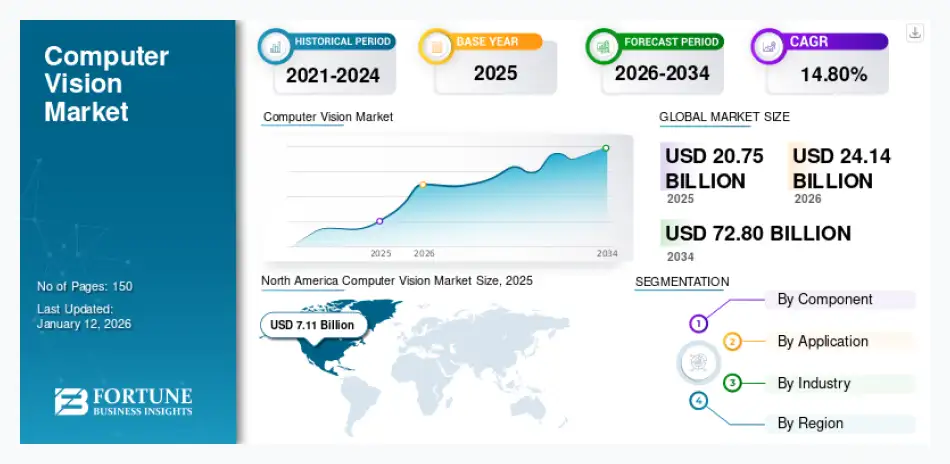
- The global computer vision market is projected to grow from USD 24.14 billion in 2026 to USD 72.80 billion by 2034, exhibiting a CAGR of 14.80% during the forecast period.
- North America dominated the market with a share of 34.30%, reflecting how strongly organizations across the region are investing in vision-driven automation.
- Advances in generative AI are making computer vision systems easier to train by enabling realistic image creation and stronger data augmentation.
Common enterprise priorities driving adoption include:
- Detecting defects automatically in manufacturing environments
- Monitoring safety conditions through real-time visual analysis
- Understanding in-store customer movement patterns
- Accelerating image interpretation in healthcare workflows
As a result, businesses increasingly are evaluating top computer vision software development companies in the USA. As a reliable custom software development company will help them align these capabilities with existing platforms instead of deploying isolated solutions.
This guide will help you evaluate vendors, compare capabilities, and choose partners delivering AI computer vision development services in the USA.
What Is Computer Vision Software?
Computer vision software is a technology that enables computers to understand and interpret images and videos in a way similar to human visual perception. It:
- analyzes visual inputs from cameras or stored media
- identifies patterns or objects
- converts visual information into actionable data
Businesses use computer vision software to automate observation-based tasks, improve monitoring accuracy, and gain insights without relying on constant human supervision.
In real-world environments, computer vision software works through AI integration with existing systems such as surveillance cameras, mobile devices, or enterprise platforms. This allows organizations to introduce intelligent visual analysis into daily operations without disrupting established workflows or requiring deep technical expertise.
Core capabilities typically included in computer vision software are:
- Image Recognition: Identifies objects, products, or environments within static images. Businesses use it to classify visuals automatically and reduce manual review efforts across large image datasets.
- Object Detection: Detects and tracks multiple objects or movements in real time. This helps organizations monitor activities, count items, or trigger alerts when predefined conditions occur.
- Video Analytics: Examines live or recorded video to identify patterns and unusual activities. It supports continuous monitoring without requiring teams to watch footage manually.
- Facial recognition: Confirms identities or manages access control using visual features. It is commonly applied in secure environments where fast identity verification improves operational efficiency.
- Optical Character Recognition: OCR extracts readable text from images, documents, or labels automatically. This capability reduces manual data entry and improves accuracy in document-heavy workflows.
- Edge AI Vision: Processes visual data directly on devices for faster responses and reduced dependency on cloud processing. This approach improves performance in environments where real-time decisions are critical.
Understanding these capabilities helps businesses evaluate solutions more effectively and engage with computer vision software companies in the United States that deliver practical, deployment-ready visual intelligence aligned with operational needs.
Why Computer Vision Is Becoming a Core Enterprise Technology
Enterprise operations today generate more visual data than teams can manually monitor or interpret. Organizations need systems that continuously observe environments and provide instant insights, which is why computer vision is moving into core operational technology stacks.
The Problem: Limited Visibility Slows Operations
Many business processes still depend on manual observation and delayed reporting. Human monitoring creates gaps in accuracy and response time, especially across large facilities or distributed operations. As workloads increase, teams struggle to maintain consistent oversight, leading to higher operational risk and slower decisions.
The Solution: Visual Intelligence Integrated into Daily Workflows
Organizations should adopt AI automation to convert visual inputs into actionable signals that support everyday operations. Intelligent systems analyze live feeds and trigger responses automatically. Businesses that build AI software around operational workflows move beyond pilot programs and deploy production-ready solutions designed for reliability and measurable performance.
Also Read: 10 AI Automation Use Cases for Enterprises to Scale Faster
Key Business Drivers Accelerating Adoption
- Automation: AI automation tools reduce manual inspection workloads by up to 60%. Continuous monitoring ensures consistent performance regardless of staffing availability.
- Cost Reduction: Minimizes losses caused by defects, downtime, and delayed incident detection. Early visual alerts prevent operational disruptions before they escalate.
- Real-Time Decision-Making: Enables instant alerts that allow teams to respond within seconds. Faster reactions improve operational continuity and workplace safety outcomes.
- Workforce Optimization: AI process automation shifts employees away from repetitive monitoring toward analytical and supervisory responsibilities. Organizations scale operations without proportional workforce expansion.
- Compliance Monitoring: Tracks safety conditions and procedural adherence continuously through automation tools embedded into operational environments. Automated records simplify audits and reporting processes.
The Outcome: From Pilot Experiments to Enterprise Infrastructure
As adoption matures, companies are increasingly engaging with leading computer vision development firms in USA transitioning computer vision initiatives from experimentation into long-term production systems.
CV is becoming a core enterprise technology and top computer vision software development companies in the USA are transforming visual data into continuous operational awareness, deploying stable solutions at scale.
Still Relying on Manual Visibility?
If operations depend on humans watching screens, you are already behind. Let's map where visual intelligence can remove friction inside your workflows.
Talk to an AI Strategy ExpertWhich Industries Can Use Computer Vision Solutions?
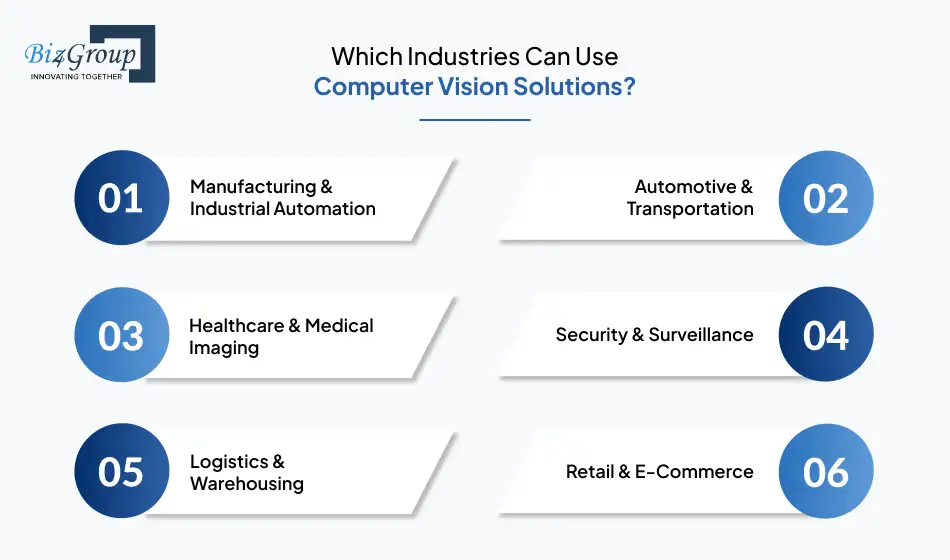
As organizations explore practical AI adoption, custom computer vision software development in USA is helping enterprises address visual operational challenges, enabling automation across industries where accuracy, monitoring, and efficiency directly impact performance.
1. Manufacturing & Industrial Automation
- Industry Context: Manufacturing environments rely on continuous visual inspection across assembly lines and quality checkpoints. Maintaining consistent output requires accurate monitoring without slowing production.
- Practical Use Case: Factories use computer vision with AI image recognition to inspect components and detect defects during production. Cameras verify assembly accuracy and identify inconsistencies in real time.
- Benefits: Automation replaces repetitive manual inspection and reduces variability caused by operator fatigue. Manufacturers lower waste and improve consistency across production batches.
- Outcome: Operations achieve stable quality control while sustaining efficient manufacturing throughput.
Also Read: AI Use Cases in Manufacturing
2. Automotive & Transportation
- Industry Context: Transportation systems depend on visual monitoring across vehicles and infrastructure to maintain operational safety. Teams must continuously evaluate changing driving and equipment conditions.
- Practical Use Case: Computer vision in automotive supports driver assistance systems, automated vehicle inspections, and traffic monitoring workflows. Visual analysis helps identify hazards and assess vehicle condition during routine operations.
- Benefits: Automation reduces manual oversight and improves consistency in safety monitoring processes. Fleet operators reduce downtime while strengthening compliance and operational reliability.
- Outcome: Transportation networks operate with improved safety visibility and controlled operational risk.
Also Read: Auto Parts Inventory Software Development for Dealerships
3. Healthcare & Medical Imaging
- Industry Context: Healthcare organizations manage large volumes of diagnostic imagery requiring accurate and timely interpretation. Radiology teams must review scans efficiently while maintaining clinical consistency.
- Practical Use Case: Computer vision assists clinicians by highlighting abnormalities and prioritizing urgent imaging cases. Hospitals integrate visual analysis into established diagnostic review workflows.
- Benefits: Automation reduces repetitive screening work and supports faster report preparation. Providers improve turnaround times while maintaining consistent diagnostic evaluation quality.
- Outcome: Clinical operations deliver timely insights supported by efficient imaging workflows.
Also Read: Healthcare Software Product Development
4. Security & Surveillance
- Industry Context: Security operations require continuous observation across facilities where manual monitoring often becomes inefficient. Teams must identify risks quickly across multiple surveillance feeds.
- Practical Use Case: Computer vision analyzes live video streams to detect unauthorized access and unusual activity patterns. Organizations deploy visual monitoring across offices and industrial environments.
- Benefits: Automation reduces monitoring fatigue and improves detection reliability without constant supervision. Security teams receive prioritized alerts instead of reviewing extensive footage manually.
- Outcome: Organizations maintain stronger protection through scalable monitoring operations.
5. Logistics & Warehousing
- Industry Context: Logistics environments depend on visual verification to manage inventory movement across distribution workflows. Accuracy directly affects fulfillment speed and operational efficiency.
- Practical Use Case: Computer vision tracks packages, validates shipping labels, and monitors sorting operations within warehouses. AI in Logistics supports visual systems workflow visibility during high-volume fulfillment processes.
- Benefits: Automation removes manual scanning bottlenecks and reduces shipment errors caused by misidentification. Logistics teams improve throughput while maintaining accurate inventory tracking.
- Outcome: Supply chains achieve faster fulfillment supported by reliable operational accuracy.
Also Read: Developing a Courier and Logistics App: Your Ultimate Guide
6. Retail & E-Commerce
- Industry Context: Retail businesses manage visual data across stores and digital catalogs where accuracy influences purchasing decisions. Maintaining inventory visibility requires continuous operational monitoring.
- Practical Use Case: Retailers deploy computer vision within broader enterprise AI solutions to monitor shelves and organize product imagery online. Visual analysis supports merchandising and catalog management workflows.
- Benefits: Automation reduces manual stock auditing and simplifies large-scale catalog updates. Retail teams minimize discrepancies while improving operational efficiency across sales channels.
- Outcome: Retail operations maintain consistent inventory control and smoother customer purchasing experiences.
Also Read: Generative AI in Retail Business
Businesses seeking proven implementation outcomes increasingly partner with top computer vision software development companies in the USA to deploy solutions aligned with operational workflows, compliance requirements, and long-term digital transformation strategies.
How We Selected the Best Computer Vision Software Development Companies in USA?
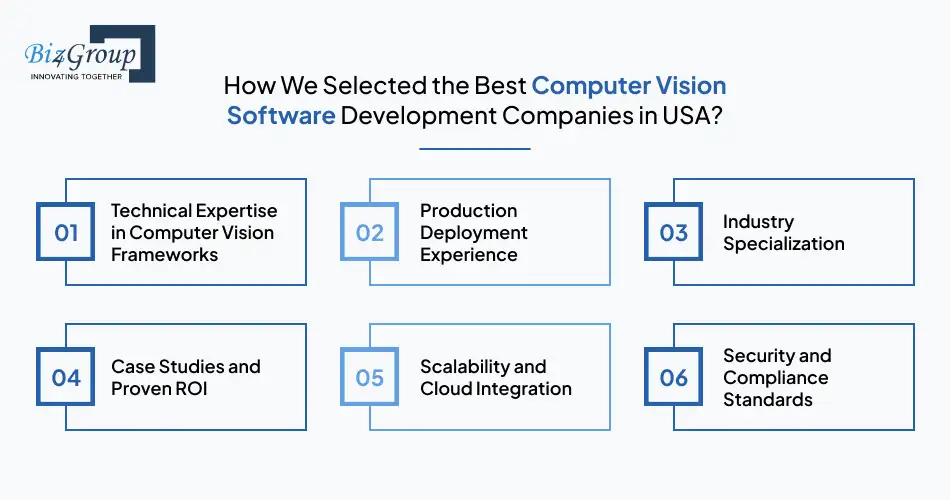
Identifying the top computer vision software development companies in the USA requires a structured evaluation approach focused on measurable delivery capability, not marketing claims. The following methodology explains how providers were assessed using transparent and practical enterprise criteria.
1. Technical Expertise in Computer Vision Frameworks
Strong vendors demonstrate real experience working with widely adopted computer vision frameworks and model architectures. We evaluated how effectively teams handle AI model development aligned with real business environments rather than experimental prototypes.
- Ability to design and train vision AI models for real operational data
- Experience handling image and video processing workflows at scale
- Proven capability in developing AI image recognition systems tailored to industry needs
2. Production Deployment Experience
Enterprise value depends on successful deployment, not proof-of-concept demonstrations. We prioritized companies that consistently move projects into live environments.
- Evidence of production deployments across enterprise systems
- Integration of AI with existing operational platforms and workflows
- Long-term maintenance and performance optimization support
3. Industry Specialization
Domain familiarity improves implementation speed and reduces operational risk. We assessed whether providers understand industry workflows before proposing solutions.
- Experience delivering solutions within manufacturing, healthcare, retail, or logistics environments
- Ability to adapt solutions to regulatory and operational realities
- Demonstrated understanding of sector-specific visual challenges
4. Case Studies and Proven ROI
Real outcomes provide stronger validation than capability claims. Companies were evaluated based on measurable results achieved for clients.
- Documented case studies showing efficiency or accuracy improvements
- Evidence of cost reduction or productivity gains after deployment
- Clear business impact rather than technology-focused storytelling
5. Scalability and Cloud Integration
Enterprise systems must grow with operational demand without performance degradation. We reviewed how computer vision AI development company in USA design scalable architectures.
- Support for cloud-based processing and hybrid deployment models
- Ability to scale workloads across distributed environments
- Performance stability during increased data volumes
6. Security and Compliance Standards
Handling visual data requires responsible governance and protection measures. Evaluation focused on operational security readiness.
- Data protection practices aligned with enterprise compliance requirements
- Secure handling of sensitive visual information
- Access control and monitoring safeguards built into solutions
7. Client Reviews and Market Reputation
Market credibility reflects delivery consistency over time. Feedback from enterprise clients played an important role in final evaluation.
- Verified client testimonials and long-term partnerships
- Industry recognition and reputation signals
- Consistent delivery performance reported across engagements
This structured evaluation framework helps readers understand how the best computer vision software development companies USA were identified, ensuring selections reflect proven execution capability, enterprise reliability, and practical business outcomes rather than subjective rankings.
Top 10+ Computer Vision Software Development Companies in USA (2026)
Identifying the right development partner requires more than brand recognition. The following list highlights leading computer vision development firms in the USA based on practical expertise and enterprise delivery capability.
1. Biz4Group LLC
Location: Orlando, Florida, USA
Website: biz4group.com
Hourly Rate: $50 - $99/hr
Minimum Project Size: $10,000+
Clutch Rating: 4.9/5
Biz4Group LLC is a US-based AI computer vision development company delivering enterprise-focused solutions designed for real operational environments. It helps businesses transform visual data into actionable insights across industries such as healthcare, automotive, manufacturing, logistics, security, retail and e-commerce.
The company focuses on practical implementation, scalable architecture, and seamless integration of AI models with existing systems. Its delivery approach emphasizes measurable outcomes and long-term usability. This positions Biz4Group LLC among the top computer vision software development companies in the USA supporting production-ready enterprise deployments rather than experimental initiatives.
Core Computer Vision Services
- Custom Computer Vision Development: Designs tailored computer vision solutions aligned with business workflows, enabling automation of inspections, monitoring, and analytics while ensuring scalability and smooth integration into existing enterprise systems.
- Image Recognition Solutions: Develops custom AI image recognition software that identify objects, patterns, or visual elements within images to support quality checks, asset tracking, and operational visibility across real-world environments.
- Object Detection and Tracking: Builds solutions that detect and track objects or activities in video streams, enabling automated monitoring, movement analysis, and operational alerts without continuous human supervision.
- Video Analytics Solutions: Creates video analytics platforms that analyze live or recorded footage to generate actionable insights, helping organizations monitor operations, improve safety oversight, and reduce manual video review workloads.
- AI Model Training and Optimization: Trains AI models and refines computer vision models using business-specific datasets to improve accuracy, adapt to changing environments, and maintain reliable performance after deployment.
- Computer Vision Integration Services: Integrates vision solutions with enterprise software, IoT systems, and operational platforms to ensure seamless deployment and consistent performance within existing digital ecosystems.
Notable Strengths
- Emphasizes production-ready solutions aligned with operational workflows and measurable business outcomes.
- Experience delivering computer vision solutions across multiple enterprise sectors with practical implementation understanding.
- Covers strategy, development, deployment, and optimization within a unified delivery framework.
- Builds systems prepared for growing data volumes and evolving enterprise requirements.
- Focuses on aligning computer vision capabilities directly with business processes to ensure solutions deliver sustained operational value beyond initial deployment.
Portfolio Spotlight:
1. AI-Powered Cannabis Grading & Pricing: Kalix QC
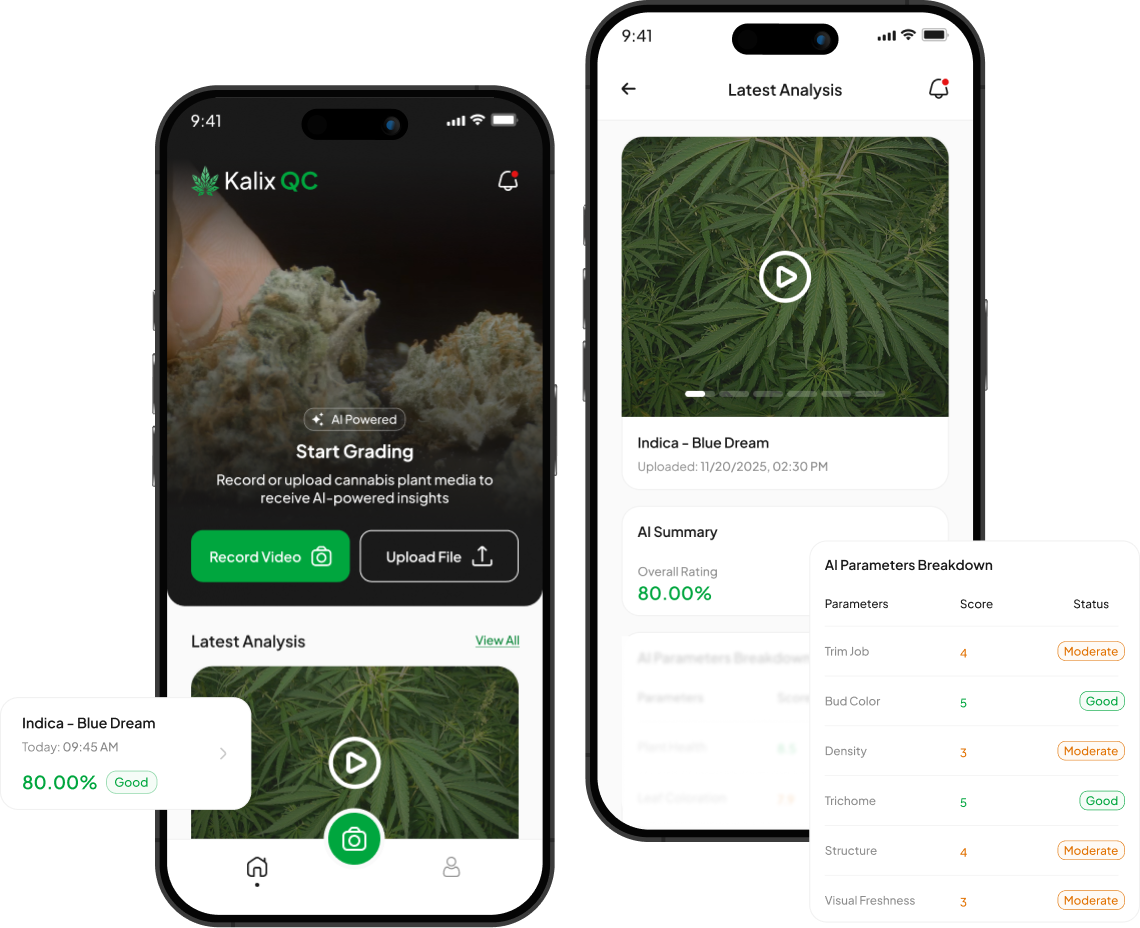
Biz4Group built an AI-powered cannabis grading solution to automate product evaluation, improve consistency, and reduce manual inspection effort. The platform used computer vision to support accurate grading, streamline quality checks, and improve operational efficiency across cannabis processing workflows.
Project Highlights
- AI-powered cannabis grading
- Automated quality inspection
- Real-time visual analysis
- Consistent grading outcomes
- Manual review reduction
- Workflow optimization
- Operational efficiency improvement
- Scalable inspection support
2. IoT Heat Cable Management System – Powered by AI Image Recognition

Biz4Group developed an AI-powered computer vision and IoT solution for automated heat cable monitoring and energy optimization. The system used smart cameras and real-time visual monitoring to detect operational issues, reduce unnecessary power consumption, and improve winter infrastructure management efficiency.
Project Highlights
- AI-enabled visual monitoring
- Smart heat cable automation
- Real-time anomaly detection
- IoT device integration
- Automated alert system
- Energy consumption optimization
- Remote operational monitoring
- Predictive maintenance support
Curious What AI Could Actually Fix in Your Operations?
Not every AI project needs reinvention. Sometimes the biggest gains come from solving one operational bottleneck the right way.
Discuss Your Use Case2. Verkada
Location: San Mateo, California, USA
Website: verkada.com
Verkada is a cloud-based physical security technology provider delivering computer vision-powered video security and smart building monitoring solutions. Its platform combines AI analytics with connected hardware to help organizations monitor facilities, manage access, and investigate incidents through centralized cloud software. Enterprises use Verkada to improve operational visibility and streamline security management across distributed locations using intelligent visual data analysis.
Core Computer Vision Services
- AI Video Security Analytics
- Intelligent Video Search
- People and Vehicle Detection
- License Plate Recognition
- Cloud-Based Video Monitoring
Notable Strengths
- Cloud-native enterprise video security platform with centralized management capabilities
- Integrated hardware and software ecosystem designed for unified physical security operations
- AI-powered video analytics enabling rapid search and investigation workflows
- Delivers computer vision capabilities through a fully cloud-native physical security ecosystem combining analytics, devices, and centralized management.
3. Samsara
Location: San Francisco, California, USA
Website: samsara.com
Samsara provides connected operations technology that combines IoT devices, video systems, and AI-powered analytics to help organizations monitor fleets, equipment, and physical operations. Its platform uses computer vision to improve safety, operational visibility, and compliance across transportation and industrial environments. Businesses use Samsara to analyze real-world activity through intelligent video insights integrated into a unified cloud dashboard designed for large-scale operational management.
Core Computer Vision Services
- AI Dash Cam Video Analytics
- Driver Behavior Detection
- Fleet Safety Monitoring
- Video-Based Incident Detection
- Real-Time Vehicle and Asset Visibility
Notable Strengths
- AI-driven fleet safety platform combining video intelligence with operational telematics data
- Strong focus on transportation and logistics operational visibility through connected device ecosystems
- Cloud-based dashboard enabling centralized monitoring across distributed fleets and field operations
- Integrated hardware and software approach supporting scalable deployment across enterprise mobility environments
- Combines computer vision with IoT telematics data to deliver operational intelligence tailored specifically for fleet and physical operations management.
4. Cognex
Location: Natick, Massachusetts, USA
Website: cognex.com
Cognex specializes in machine vision systems used for industrial automation and manufacturing quality inspection. The company develops computer vision technologies that help manufacturers automate visual inspection, identify defects, and guide robotic processes with high precision. Its solutions are widely used across electronics, automotive, and logistics industries where consistent visual accuracy supports production efficiency and operational reliability.
Core Computer Vision Services
- Machine Vision Inspection Systems
- Industrial Image-Based Barcode Reading
- Vision-Guided Robotics
- Automated Defect Detection
- Deep Learning Vision Software
Notable Strengths
- Strong industrial machine vision expertise built through decades of manufacturing automation experience
- Specialized hardware and software optimized for high-speed production inspection environments
- Deep learning vision tools designed for complex defect detection and quality assurance workflows
- Global deployment footprint across manufacturing and logistics automation ecosystems
- Focuses exclusively on industrial machine vision, combining specialized hardware and deep learning software for high-precision manufacturing automation.
5. Veritone
Location: Irvine, California, USA
Website: veritone.com
Veritone delivers AI-powered analytics platforms that apply computer vision and machine learning to analyze large volumes of video and audio content. Its technology helps enterprises, media organizations, and public sector agencies extract insights from visual data for monitoring, compliance, and content intelligence. The platform centralizes AI models within a unified environment designed for scalable data analysis and operational decision support.
Core Computer Vision Services
- Video Content Analysis
- Facial Recognition Analytics
- Visual Data Intelligence
- AI Media Monitoring
Notable Strengths
- Unified AI platform supporting large-scale video and media intelligence analysis workflows
- Strong presence across media, public sector, and compliance-driven enterprise environments
- Scalable AI orchestration enabling multiple vision models within a single operational platform
- Focus on data intelligence and analytics rather than standalone computer vision tooling
- Provides an AI operating system that orchestrates multiple AI models for large-scale visual and media intelligence analysis.
6. Voxel51
Location: Ann Arbor, Michigan, USA
Website: voxel51.com
Voxel51 develops computer vision software focused on improving how teams build, evaluate, and manage vision datasets and models. Its platform helps organizations analyze visual data, test model performance, and refine computer vision systems before deployment. Companies use Voxel51 tools to streamline dataset understanding and improve accuracy across real-world vision applications, supporting scalable computer vision development workflows for enterprise and research environments.
Core Computer Vision Services
- Visual Dataset Management
- Computer Vision Model Evaluation
- Image and Video Data Analysis
- Dataset Visualization Tools
- Vision Model Debugging
Notable Strengths
- Specialized platform designed specifically for computer vision dataset analysis and model evaluation workflows
- Strong adoption among AI teams building and optimizing large-scale visual intelligence systems
- Enables deep visibility into model performance through interactive visual dataset exploration tools
- Focused tooling supporting efficient iteration during computer vision development lifecycle stages
- Provides dedicated tooling for understanding and improving computer vision datasets rather than building end-user vision applications.
7. Roboflow
Location: Des Moines, Iowa, USA
Website: roboflow.com
Roboflow offers developer-focused computer vision tools that simplify building, training, and deploying vision models using image and video datasets. The platform supports dataset preparation, annotation, and deployment workflows that help teams operationalize computer vision applications faster. Organizations use Roboflow to manage visual data pipelines and accelerate development of production-ready computer vision solutions across industries.
Core Computer Vision Services
- Image Annotation and Labeling
- Dataset Management and Versioning
- Computer Vision Model Training
- Vision Model Deployment Tools
- Image Dataset Augmentation
Notable Strengths
- Developer-centric platform simplifying end-to-end computer vision model development workflows
- Strong tooling for dataset preparation and annotation supporting scalable vision model training
- Cloud-based infrastructure enabling rapid experimentation and deployment of visual AI applications
- Designs for fast iteration cycles during computer vision solution development processes
- Focuses on simplifying computer vision development pipelines through integrated dataset management and deployment tooling for developers.
8. LeewayHertz
Location: San Francisco, California, USA
Website: leewayhertz.com
LeewayHertz provides AI and computer vision development services that help enterprises build custom visual intelligence applications aligned with operational workflows. The company develops solutions for image recognition, video analytics, and automated visual inspection across industries. Its approach emphasizes custom implementation, system integration, and scalable deployment tailored to enterprise use cases requiring computer vision-driven automation.
Core Computer Vision Services
- Image Recognition Solutions
- Video Analytics Development
- Object Detection Systems
- Visual Inspection Automation
Notable Strengths
- Enterprise-focused custom computer vision development aligned with industry-specific operational requirements
- Experience delivering tailored visual intelligence applications across multiple enterprise business domains
- Strong emphasis on integrating vision solutions into existing enterprise software ecosystems
- Supports scalable deployment of custom-built computer vision applications for operational automation
- Delivers fully customized enterprise computer vision solutions designed around specific operational workflows instead of standardized platforms.
9. Simform
Location: Orlando, Florida, USA
Website: simform.com
Simform delivers enterprise computer vision engineering services focused on building production-ready visual intelligence systems. The company works with organizations to design and deploy vision-powered applications that automate monitoring, visual validation, and image-based decision workflows. Its computer vision engagements emphasize scalable deployment, model optimization, and integration with enterprise platforms supporting operational automation through visual data analysis.
Core Computer Vision Services
- Vision Model Engineering
- Real-Time Video Processing Solutions
- Image Classification Systems
- AI-Based Visual Quality Inspection
- Edge Vision Application Development
Notable Strengths
- Engineering-led delivery model supporting scalable enterprise computer vision system implementation
- Strong focus on production deployment rather than experimental visual AI prototypes
- Deep integration expertise connecting vision systems with enterprise operational platforms
- Structured development workflows ensuring reliability across large-scale visual data environments
- Builds computer vision systems through embedded engineering teams aligned closely with enterprise product development cycles.
10. Metropolis
Location: Los Angeles, California, USA
Website: metropolis.io
Metropolis develops computer vision software designed to interpret real-world environments through camera perception systems. Its platform applies vision intelligence to physical infrastructure, enabling automated vehicle identification and environment understanding. Organizations use Metropolis technology to automate access and operational workflows using continuous visual recognition instead of manual verification processes.
Core Computer Vision Services
- Vehicle Detection Algorithms
- Automated Parking Vision Systems
- License Plate Recognition Technology
- Camera-Based Space Occupancy Analysis
- Vision-Driven Access Automation
Notable Strengths
- Specialized computer vision platform built exclusively for real-world physical infrastructure environments
- Strong expertise in vehicle perception and automated access decision systems
- Real-time visual processing optimized for large-scale camera network deployments
- Vision-first architecture replacing manual infrastructure monitoring workflows with automated perception
- Applies computer vision as a perception layer for physical infrastructure rather than traditional enterprise analytics software.
11. Vention
Location: New York, New York, USA
Website: vention.teams
Vention provides custom computer vision engineering services supporting companies building visual intelligence products and platforms. The company collaborates with enterprise teams to design image and video analysis systems tailored to specific operational requirements. Its work focuses on developing scalable vision applications that support automation, monitoring, and advanced visual data processing within enterprise software ecosystems.
Core Computer Vision Services
- Visual Intelligence Application Engineering
- Image Analysis Pipeline Development
- Video Stream Processing Systems
- Object Tracking Implementations
- Vision Algorithm Customization
Notable Strengths
- Dedicated engineering teams supporting long-term computer vision product development initiatives
- Flexible collaboration model aligned with enterprise software and product engineering workflows
- Strong experience delivering customized visual intelligence systems for complex environments
- Emphasis on scalable architecture supporting evolving computer vision application requirements
- Embeds specialized computer vision engineers directly into enterprise product teams for continuous development collaboration.
12. Algoscale
Location: Newark, Delaware, USA
Website: algoscale.com
Algoscale develops computer vision solutions focused on extracting actionable insights from visual datasets. The company builds image and video analysis systems that support automation, monitoring, and analytics workflows. Its computer vision work centers on applying data-driven modeling techniques to help organizations operationalize visual intelligence across business processes requiring accurate visual interpretation.
Core Computer Vision Services
- Visual Pattern Recognition Systems
- Image-Based Analytics Solutions
- Video Event Detection Models
- Visual Data Intelligence Platforms
- Custom Vision Model Development
Notable Strengths
- Data-focused approach improving computer vision accuracy through structured dataset engineering practices
- Strong capability in building analytics-driven visual intelligence applications for enterprise workflows
- Experience handling large-scale image and video datasets for operational automation use cases
- Emphasis on measurable outcomes through applied computer vision model optimization strategies
- Combines data engineering discipline with computer vision modeling to improve performance on real operational datasets.
Comparison Table: Top Computer Vision Software Companies in United States
To simplify evaluation, the following comparison highlights operational focus, deployment approaches, and industry alignment across the top computer vision software companies in United States for enterprise decision-makers.
|
Company |
Headquarters |
Industries Focused |
Deployment Model |
|---|---|---|---|
|
Biz4Group LLC |
Orlando, Florida |
Healthcare, Manufacturing Retail, Logistics, Security |
Cloud, On-Premise, Enterprise Integration |
|
Verkada |
San Mateo, CA |
Physical Security, Enterprise Facilities, Education, Corporate Infrastructure |
Cloud-Native |
|
Samsara |
San Francisco, CA |
Transportation, Logistics, Field Operations, Industrial |
Cloud-Based |
|
Cognex |
Natick, Massachusetts, |
Manufacturing, Automotive, Electronics, Logistics |
Edge and On-Premise |
|
Veritone |
Irvine, CA |
Media, Public Sector, Legal, Enterprise Compliance |
Cloud-Based |
|
Voxel51 |
Ann Arbor, Michigan |
AI Development Teams, Technology Companies, Research |
Cloud and Local Deployment |
|
Roboflow |
Des Moines, Iowa |
Technology Startups, Robotics, Manufacturing, Retail |
Cloud-Based |
|
LeewayHertz |
San Francisco, CA |
Manufacturing, Healthcare, Retail, Logistics |
Cloud and Enterprise Integration |
|
Simform |
Orlando, Florida |
Healthcare, Retail, Logistics, SaaS Platforms |
Cloud and Hybrid |
|
Metropolis |
Los Angeles, CA |
Mobility, Parking Infrastructure, Smart Cities |
Cloud and Edge |
|
Vention |
New York, NY |
FinTech, HealthTech, SaaS, Enterprise Platforms |
Cloud and Dedicated Engineering Deployment |
|
Algoscale |
Newark, Delaware |
Retail, Finance, Logistics, Enterprise Analytics |
Cloud-Based |
|
InData Labs |
Miami, Florida |
Retail, Marketing, Healthcare, Logistics |
Cloud and Hybrid |
This structured comparison helps organizations quickly assess capability alignment, enabling informed shortlisting based on deployment needs, industry focus, and real-world computer vision implementation priorities.
Shortlisted a Few Companies Now What?
The real decision comes from aligning technology with your operational reality. Let's help you validate the right direction.
Get Expert GuidanceHow To Choose the Right Computer Vision Software Development Company in USA?
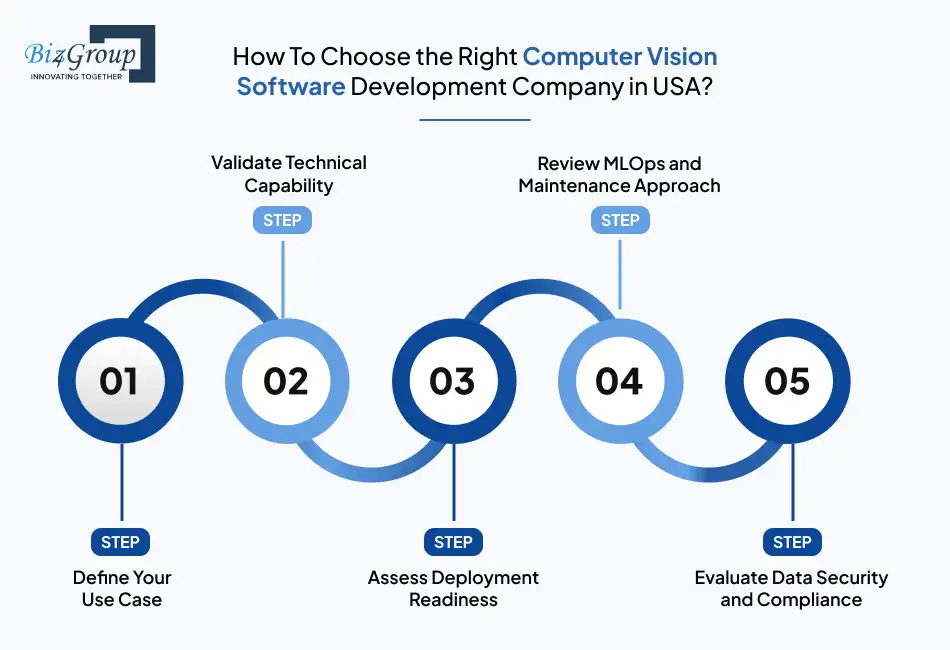
Evaluating the top computer vision software development companies in the USA requires a structured process focused on operational fit rather than vendor positioning. The following steps help enterprises assess partners using practical decision criteria aligned with real deployment outcomes.
Step 1: Define Your Use Case
Start by identifying the operational workflow where visual analysis creates measurable value. Clearly define the problem, expected improvement, and success metrics before engaging vendors. Many organizations use AI consulting services at this stage to validate feasibility and avoid unclear project scope.
- Identify the workflow being automated
- Define measurable business outcomes
- Confirm data availability and environment conditions
- Align internal teams around shared objectives
Step 2: Validate Technical Capability
Evaluate whether the provider has delivered solutions under real operating conditions rather than controlled demonstrations. Review relevant projects and assess how teams adapt systems to practical challenges. When enterprises hire AI developers, communication clarity becomes critical because teams must explain technical decisions in simple operational terms.
- Review production implementation examples
- Assess handling of real-world visual data
- Evaluate testing and validation practices
- Confirm collaboration and reporting approach
Step 3: Assess Deployment Readiness
Deployment success depends on how smoothly solutions integrate into existing workflows. Vendors should demonstrate structured rollout planning and operational onboarding support. Enterprise computer vision software development companies typically emphasize deployment reliability as strongly as development capability.
- Integration with existing infrastructure
- Clear rollout and adoption strategy
- Performance monitoring after launch
- Ongoing operational support plans
Step 4: Review MLOps and Maintenance Approach
Computer vision systems require continuous improvement because environments and data conditions evolve. Evaluate how vendors monitor performance, manage updates, and maintain accuracy over time. A structured maintenance approach ensures systems remain reliable without constant manual intervention.
- Continuous performance monitoring
- Scheduled model updates and retraining
- Version control and rollback capability
- Defined maintenance response timelines
Step 5: Evaluate Data Security and Compliance
Computer vision applications often process sensitive operational data. Security evaluation should focus on governance practices and compliance readiness before implementation begins. Vendors must clearly explain how data is stored, accessed, and protected throughout the lifecycle.
- Data encryption and access controls
- Compliance alignment with regulations
- Secure data storage and processing workflows
- Incident response preparedness
Following this structured framework helps organizations confidently identify enterprise computer vision software development companies capable of delivering scalable, secure solutions aligned with operational needs and long-term business performance goals.
Key Questions Enterprises Should Ask Before Hiring a Computer Vision Partner
Before engaging vendors from the top computer vision software development companies in the USA, enterprises should evaluate practical execution capability through focused questions. The following questions help decision-makers assess delivery maturity, operational readiness, and long-term reliability.
1. What production computer vision deployments have you completed?
Ask for real examples operating in live environments rather than pilot demonstrations. Production deployments reveal how the partner handles scale, unexpected conditions, and operational challenges that typically appear after systems move beyond testing phases.
2. How do you handle model drift over time?
Computer vision accuracy can decline as environments change. Partners should explain monitoring practices, retraining schedules, and performance tracking methods that maintain system reliability without interrupting daily operations or requiring constant manual intervention.
3. What is your data annotation process?
Accurate training data determines system performance. Providers should describe how images are labeled, validated, and reviewed for quality. Clear annotation workflows reduce bias, improve accuracy, and ensure models learn from realistic operational scenarios.
4. How do you ensure scalability as data volumes grow?
Enterprises should understand how solutions handle increasing camera feeds or image processing demands. Vendors must demonstrate infrastructure planning that supports growth without performance drops or expensive system redesign later.
5. How do you AI integrate solutions with existing systems?
Computer vision tools must fit into current workflows. Ask how integrations work with enterprise software, dashboards, and operational platforms to ensure adoption happens smoothly without disrupting existing processes.
6. What ongoing maintenance and monitoring do you provide?
Reliable partners describe structured monitoring, updates, and support processes. Continuous maintenance ensures systems remain accurate and aligned with evolving business environments instead of becoming outdated after deployment.
7. How do you measure project success after deployment?
Evaluation should include measurable outcomes such as reduced errors, faster inspections, or operational savings. Clear success metrics demonstrate accountability and confirm that solutions deliver business value beyond technical implementation.
8. What security measures protect visual data?
Vendors should explain how data is stored, accessed, and protected throughout the system lifecycle. Strong governance practices reduce compliance risks and help organizations maintain trust when handling sensitive operational information.
9. How do you manage implementation timelines and risks?
Partners must outline realistic delivery phases, testing milestones, and risk mitigation strategies. Transparent planning helps enterprises anticipate challenges and maintain operational continuity during deployment.
10. What internal expertise will support our project?
Understanding team structure clarifies accountability. Ask who designs models, manages deployment, and provides support to ensure consistent communication and responsible ownership throughout the engagement.
11. How do you support long-term scalability and expansion?
Leading computer vision application development companies in USA should explain how solutions evolve with new use cases, locations, or operational requirements without requiring complete redevelopment.
Asking structured evaluation questions helps organizations move beyond marketing claims. This allows you to identify trusted computer vision software development partners in USA capable of delivering dependable systems aligned with real enterprise operations and long-term performance expectations.
Asking the Right Questions Is Half the Decision
If vendors struggle to answer clearly, that's already an answer. Bring your questions — we'll help you evaluate options with practical clarity.
Connect With Our TeamRed Flags to Avoid When Choosing a Computer Vision Company
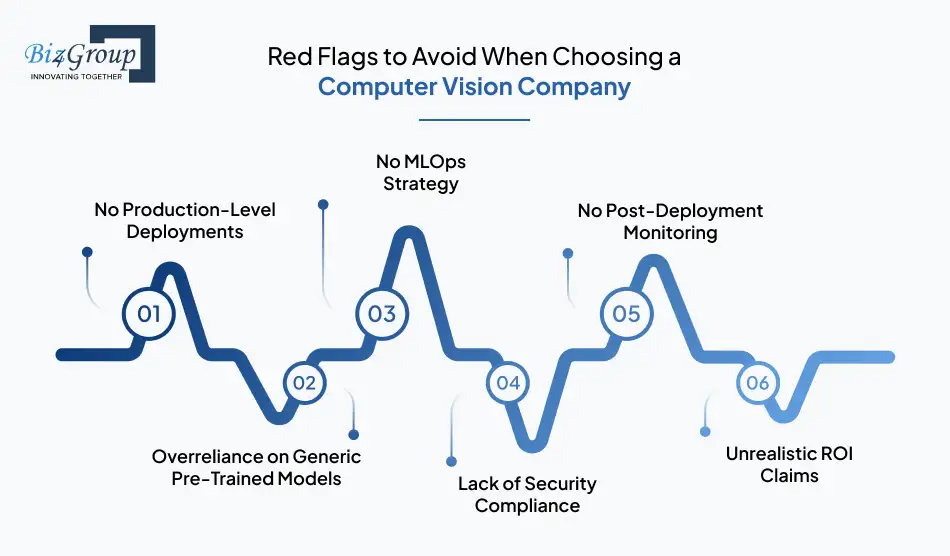
Even while evaluating the top computer vision software development companies in the USA, enterprises must also recognize warning signs that indicate delivery risk. Identifying these issues early helps prevent costly implementation setbacks and long-term operational challenges.
1. No Production-Level Deployments
Vendors without real production deployments often rely on demonstrations instead of operational proof. Lack of live implementation experience increases execution risk because real environments introduce complexity that prototypes rarely reveal during early discussions.
2. Overreliance on Generic Pre-Trained Models
Some providers depend heavily on ready-made models without adapting them to business workflows. Without customization, systems struggle with real operational conditions and fail to support meaningful enterprise AI integration across changing environments.
3. No MLOps Strategy
A missing maintenance or monitoring approach signals long-term reliability concerns. Systems may perform well initially but gradually lose accuracy without structured updates, creating hidden AI automation pitfalls that appear months after deployment.
4. Lack of Security Compliance
Providers unable to explain data protection practices expose organizations to regulatory and operational risks. Enterprise environments require clear governance policies, especially when visual data includes sensitive operational or customer information.
5. No Post-Deployment Monitoring
Deployment is not the final stage of a computer vision project. Vendors that lack monitoring support leave enterprises responsible for performance tracking, increasing operational burden, and reducing long-term system reliability.
6. Unrealistic ROI Claims
Promises of immediate cost savings or guaranteed results often indicate weak understanding of operational complexity. Enterprise grade computer vision development firms in USA typically present measured expectations supported by realistic adoption timelines and validated outcomes.
Recognizing these warning signs helps organizations avoid risky engagements and focus on affordable computer vision software development companies in USA that demonstrate operational maturity, transparent delivery practices, and sustainable implementation strategies aligned with enterprise goals.
Conclusion
Enterprise adoption of computer vision is driven more by operational clarity than technology trends. Organizations evaluating a software development company in Florida or vendors across the country should focus on delivery experience, deployment readiness, scalability planning, and long-term maintenance capability. The objective is not just implementation but sustained operational value supported by reliable execution and realistic expectations.
Understanding how to choose a computer vision software development company in USA requires a structured evaluation approach grounded in business outcomes. Enterprises benefit from clearly defined use cases, validated technical capability, strong deployment processes, and consistent security governance. These elements reduce uncertainty and help teams move forward with greater confidence during vendor selection.
Careful evaluation helps organizations identify the top computer vision software development companies in the USA that align with operational priorities. If you are planning your next step, connecting with experienced experts can help clarify requirements and move initiatives forward with confidence.
FAQ’S
1. What do computer vision software development companies in United States actually do?
Computer vision software companies design systems that analyze images and videos to automate visual tasks. These solutions help businesses detect objects, monitor environments, extract visual data, and support operational decisions using real-time visual insights integrated into existing workflows.
2. How long does it take to build a custom computer vision software development USA solution?
Development timelines usually range from three to nine months depending on data readiness, system complexity, and deployment scope. Projects involving multiple integrations or large datasets often require additional validation and testing before production rollout.
3. What industries benefit most from leading computer vision development firms in USA?
Manufacturing, healthcare, logistics, retail, transportation, and security sectors commonly adopt computer vision. These industries rely heavily on visual monitoring and inspection processes where automation improves accuracy, reduces manual workload, and enables faster operational decision-making.
4. How do enterprises evaluate enterprise computer vision software development companies?
Organizations assess vendors based on deployment experience, scalability, industry expertise, and long-term support capability. Evaluation also includes security practices, integration readiness, and measurable business outcomes rather than focusing only on technical demonstrations or feature claims.
5. How to choose computer vision software development company in USA for enterprise projects?
Enterprises should begin with a defined use case and measurable goals. Evaluating real deployment experience, maintenance strategy, and operational alignment helps ensure the partner can deliver sustainable solutions that scale with evolving business requirements.
6. Why compare trusted computer vision software development partners in USA before selecting one?
Comparing providers helps organizations understand differences in specialization, delivery maturity, and long-term support models. A structured computer vision software development companies comparison USA approach reduces risk and helps enterprises select partners aligned with operational priorities and growth plans.
