 Location :
Orlando, FL, USA
Location :
Orlando, FL, USA +1 (407) 714-1616
 info@biz4group.com

- AI medical records management software development enables healthcare organizations to manage data intelligently, reduce manual documentation, and improve clinical and operational outcomes.
- AI medical records software development services support automation, intelligent search, predictive insights, and unified patient records across healthcare systems.
- Developing HIPAA compliant AI medical records management platforms ensures patient data privacy, regulatory adherence, and audit readiness.
- Cost to develop AI medical records management systems typically ranges from $30,000-$200,000+, depending on scope, AI complexity, and scalability needs.
- Biz4Group LLC is a trusted USA-based partner and the best company to develop AI medical records management systems that are scalable, compliant, and built for real healthcare operations.
Have you ever watched your clinical staff shuffle between screens, typing the same patient details over and over, while the day slips away? You are not alone.
Healthcare leaders everywhere are asking the same question... can medical records work harder so teams can focus more on patient care?
Here is a telling number. Nearly 85% of healthcare organizations reported higher adoption of artificial intelligence solutions across clinical and operational tasks. This tells you that the future of medical data management is shifting fast from mundane manual documentation to software that actually understands context and patterns.
The shift is why AI medical records management software development is no longer a theoretical topic. It is now part of the digital transformation roadmap for hospitals, clinics, and labs.
Leaders are asking not only if they should innovate but how they should innovate. They are searching for answers on AI medical records software development services, practical impact, and the business value of intelligent workflows.
If your goal is to develop AI medical records management systems that deliver accuracy, efficiency, and better insights without disrupting care teams, you are in the right place. This guide will walk you through what matters most from benefits to build process, cost, compliance, risks, and real use cases.
Let’s begin.
Understanding the Basics of Healthcare Medical Records Software Development with AI
What does AI actually do inside a medical records system?
Does it replace doctors or automate decisions without oversight?
The short answer is no.
AI works behind the scenes to organize, interpret, and surface healthcare data faster and more accurately.
At its core, AI medical records software development services focus on making sense of massive volumes of structured and unstructured data. Think physician notes, lab reports, medical imaging summaries, discharge instructions, and patient histories. AI helps connect these data points in ways traditional systems cannot.
How AI Functions Inside Medical Records Platforms
AI operates through a combination of intelligent technologies, each solving a specific problem.
- Natural Language Processing reads clinical notes and extracts key medical terms
- Machine Learning models identify patterns across patient histories
- Predictive algorithms highlight risks, trends, and anomalies
- Automation engines reduce repetitive administrative work
These capabilities allow healthcare teams to develop intelligent health records management platforms that adapt over time.
Traditional EMR vs AI Powered Medical Records Systems
|
Area |
Traditional EMR |
AI Powered System |
|---|---|---|
|
Data entry |
Manual and time consuming |
Automated and assisted |
|
Search |
Keyword based |
Context aware |
|
Insights |
Limited reporting |
Predictive analytics |
|
Error detection |
Reactive |
Proactive |
|
Scalability |
Rigid |
Flexible and adaptive |
Why does this difference matter? Because hospitals and clinics no longer need static systems. They need tools that learn and evolve.
When organizations build AI-powered medical records software, they gain speed, accuracy, and clarity. More importantly, they create systems that support both clinical and operational decisions without overwhelming staff.
AI does not replace healthcare professionals. It supports them. And that shift changes everything.
Why Build AI Powered Medical Records Software Today?
Why now? Hasn’t healthcare always needed better records and faster data retrieval? Yes, but today the pressure is higher than ever.
Healthcare leaders face skyrocketing data volume, rising expectations, and complex workflows. At the same time, clinicians are burned out from manual documentation and redundant administrative work.
Many hospitals and clinics are seeing AI adoption go from experimentation to operational necessity. According to Menlo Ventures research, implementation of domain-specific AI tools in 2025 saw a 7x increase over 2024. That means this trend is not slowing down.
If you are thinking about AI medical records management software development, this is the moment to act. Market demand for AI applications in healthcare has broadened beyond imaging and diagnostics. Speech recognition, generative workflows, and machine learning are now among the top adopted tools.
In 2025, leading healthcare organizations report the top five AI applications include generative AI and speech tools at over 70% usage rate.
But what exactly are the pain points that drive this urgency? Here is a clear picture.
Common Pain Points and How AI Solves Them
|
Pain Point in Healthcare Records |
How AI Addresses It |
|---|---|
|
Manual documentation eats clinician time |
Automated note generation, AI scribing tools reduce repetitive typing |
|
Data fragmentation across systems |
Intelligent indexing and semantic search unify patient histories |
|
Slow retrieval of past records |
Context aware search improves speed and accuracy |
|
Clinical errors and duplication |
Predictive analytics and validation alerts reduce risks |
|
Administrative overhead and costs |
Workflow automation cuts processing time and error rates |
This table shows how AI applications shift work from manual and slow to fast and insight-driven.
Business Benefits That Matter
What happens when you take action now?
- Improved clinician productivity with less time spent charting and more time with patients
- Reduced manual errors through intelligent data extraction and validation
- Faster data retrieval that accelerates decision-making
- Lower operational costs by automating repetitive tasks
- Better patient experience because records are safer and easier to access
In short, healthcare providers that develop AI medical records management systems for healthcare operations have a strategic edge. They streamline workflows, reduce burnout, and create systems that support better care delivery.
Ready to see how this can change your organization’s performance? The next section breaks down real world scenarios where this transformation is already happening.
Also read: How to develop AI patient software?
Still Relying on Manual Records in 2026?
Healthcare leaders using AI cut documentation time by up to 40%. What could your team do with those hours back?
Build Smart with Biz4GroupUse Cases of Developing AI Medical Records Management Systems for Healthcare Operations
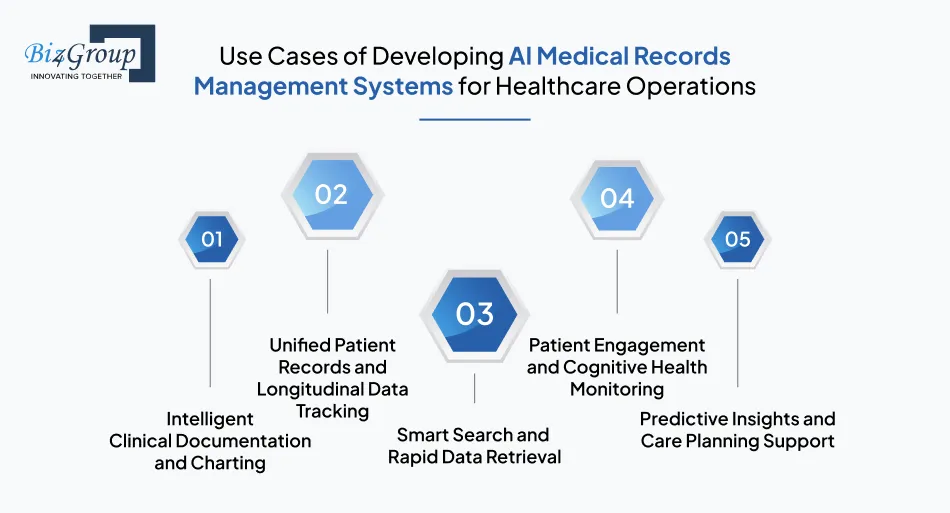
How do healthcare organizations actually use AI inside medical records systems? Where does the real value show up day to day? The answer depends on the setting, but the outcome remains the same.
Faster workflows.
Cleaner data.
Better decisions.
Below are the most common and high impact use cases seen when organizations develop AI medical records management systems for healthcare operations.
1. Intelligent Clinical Documentation and Charting
Can AI reduce the time clinicians spend on documentation? Yes, significantly.
AI models process physician notes, discharge summaries, and visit transcripts in real time. They convert unstructured text into structured medical records. This helps hospitals and clinics build electronic medical records software using AI that stays accurate without adding workload.
Doctors spend less time typing. Records remain complete and searchable.
Also read: How to develop HIPAA-compliant AI medical transcription software?
2. Unified Patient Records and Longitudinal Data Tracking
Why do care teams struggle to see the full patient picture? Because data lives across systems.
AI powered records platforms unify historical data from multiple sources. Labs, imaging, notes, and treatment plans become part of a single timeline. This is essential when healthcare leaders create AI EHR management software that supports continuity of care.
Also read: How to develop AI-enabled patient triage software?
3. Smart Search and Rapid Data Retrieval
How quickly can staff find the right information today? Often slower than expected.
AI enables semantic search instead of keyword matching. Clinicians can search using natural language and retrieve relevant records instantly. This improves efficiency across hospitals and diagnostic labs using AI healthcare data management software development practices.
4. Patient Engagement and Cognitive Health Monitoring
How can AI powered records support vulnerable patient populations? One of our projects provides a clear answer.
Project Spotlight: AI Solution for Dementia Patients
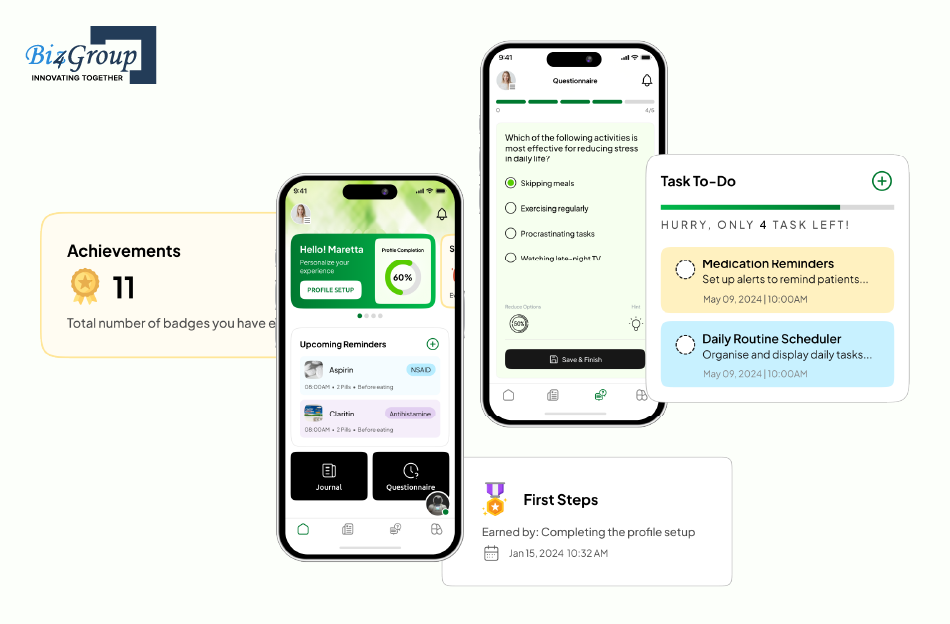
Biz4Group built an AI based solution to support early to mid-stage dementia patients. It focuses on structured data storage, cognitive tracking, and emotional insights while maintaining privacy and usability.
The platform demonstrates how organizations can build AI-powered medical records software that goes beyond storage and actively supports patient care.
Key highlights of the project include:
- Personalized storage of patient background, daily routines, and family information
- Daily journaling supported by voice-to-text for ease of use
- Cognitive performance monitoring through algorithm-based analysis
- Emotional checkpoints using conversational interfaces
- Secure handling of large volumes of sensitive patient data
This platform shows how custom AI medical records software development can address complex healthcare needs while ensuring data accuracy, accessibility, and patient dignity.
Also read: AI remote patient monitoring app development guide
5. Predictive Insights and Care Planning Support
Can medical records do more than store data? Yes, when powered by AI.
Predictive models analyze historical records to identify trends and potential risks. Care teams receive insights that support early intervention and better planning. This is especially valuable for healthcare providers looking to develop intelligent health records management platforms that scale across departments.
Each of these use cases shows one thing clearly. AI medical records systems are no longer passive databases. They are active participants in healthcare operations. Next, we will explore the core features every AI powered medical records platform must include to deliver these outcomes consistently.
Also read: How to develop an AI-powered patient management software?
Important Features in Custom AI Medical Records Software Development
What separates a usable medical records system from a high performing one? Features that reduce friction, improve accuracy, and support decision making. When healthcare organizations invest in custom AI medical records software development, these capabilities define success.
Below is a clear breakdown of essential features every organization should include when they develop AI medical records management systems.
|
Feature |
What It Is |
What It Does |
|---|---|---|
|
Automated Clinical Documentation |
Reduces clinician documentation time and errors |
|
|
Natural Language Processing |
Technology that understands clinical language |
Extracts medical terms from unstructured notes |
|
Intelligent Search |
Context aware medical record retrieval |
Finds relevant patient data faster |
|
Unified Patient Records |
Longitudinal patient data consolidation |
Creates a complete patient history |
|
AI models analyzing historical data |
Identifies risks and trends early |
|
|
Role Based Access Control |
Permission based data access |
Protects sensitive information |
|
Audit Trails and Logging |
Automated activity tracking |
Supports compliance and accountability |
|
Interoperability Support |
Data exchange via standards |
Enables seamless system integration |
|
Patient and Provider Portals |
Secure user access interfaces |
Improves engagement and transparency |
|
Workflow Automation |
Automated administrative tasks |
Lowers operational overhead |
|
Data Validation and Error Detection |
AI driven anomaly detection |
Reduces duplication and inconsistencies |
|
Reporting and Dashboards |
Visual data insights |
Supports operational decisions |
Each feature contributes to reliability, efficiency, and compliance. Together, they allow healthcare leaders to build scalable AI medical records software for healthcare organizations.
How do these features work together in real life? The Truman project demonstrates this clearly.
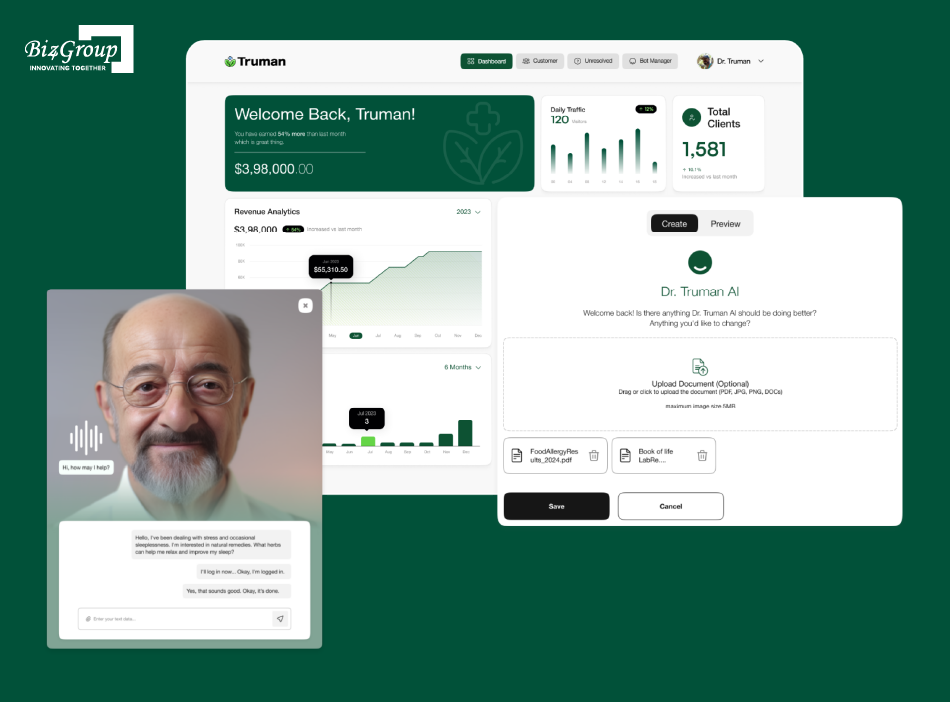
Truman is an AI-enabled health platform developed by Biz4Group that combines intelligent data handling with conversational interfaces. It showcases how AI can elevate medical records from storage tools to interactive health companions.
Key takeaways from the Truman implementation:
- Secure storage and retrieval of user health history and medical documents
- AI powered conversational interfaces for personalized health guidance
- Intelligent recommendations based on user data and behavior
- Seamless AI integration between records, insights, and user engagement tools
Truman highlights the value of designing features that serve both operational efficiency and end user experience.
With the right features in place, the next critical question becomes technical execution. That begins with selecting the right technology stack and ensuring smooth integration with existing systems.
A Lot of Features Look Good on Paper. But Do They Work in Practice?
The right features reduce errors, not add complexity. Let's map what your healthcare operations actually need.
Book a Strategy Call TodayRecommended Technology Stack for AI Healthcare Data Management Software Development
What technology choices actually support performance, security, and scalability? How do healthcare teams avoid overengineering while keeping systems future ready? The answer lies in a layered, purpose-driven tech stack.
When organizations build electronic medical records software using AI, every layer must work together. From user interfaces to AI models and cloud infrastructure, each component has a clear role.
Frontend Layer
This layer ensures clinicians and staff interact with records quickly and intuitively.
|
Layer Purpose |
What It Handles |
Tools and Frameworks |
|---|---|---|
|
User Interface |
Dashboards, forms, portals |
React.js, Next.js |
|
Accessibility |
Responsive and mobile access |
HTML5, CSS3 |
|
User Experience |
Fast navigation and usability |
Tailwind CSS |
Backend and API Layer
This layer powers performance and secure communication across systems.
|
Layer Purpose |
What It Handles |
Tools and Frameworks |
|---|---|---|
|
Business Logic |
Core application workflows |
Node.js, Python |
|
API Services |
Secure data exchange |
FastAPI, REST APIs |
|
Authentication |
Access and identity control |
OAuth 2.0, JWT |
Data and Storage Layer
A strong data layer is essential when teams develop AI medical records management systems for healthcare operations.
|
Layer Purpose |
What It Handles |
Tools and Frameworks |
|---|---|---|
|
Structured Data |
Patient records, metadata |
PostgreSQL |
|
Unstructured Data |
Notes, reports, documents |
AWS S3 |
|
Data Processing |
Query optimization |
Redis, Elasticsearch |
AI and Machine Learning Layer
This layer transforms raw data into actionable insights.
|
Layer Purpose |
What It Handles |
Tools and Frameworks |
|---|---|---|
|
NLP Processing |
Clinical text analysis |
spaCy, Hugging Face |
|
Machine Learning |
Pattern recognition |
TensorFlow, PyTorch |
|
Model Deployment |
Scalable inference |
Docker, Kubernetes |
Integration and Interoperability Layer
Interoperability ensures AI platforms work with existing hospital and lab systems rather than replacing them.
|
Layer Purpose |
What It Handles |
Tools and Frameworks |
|---|---|---|
|
Standards Compliance |
Healthcare data exchange |
HL7, FHIR |
|
System Integration |
Legacy EMR connectivity |
API Gateways |
|
Data Normalization |
Format consistency |
ETL Pipelines |
Cloud and Infrastructure Layer
This layer supports growth and compliance at scale.
|
Layer Purpose |
What It Handles |
Tools and Frameworks |
|---|---|---|
|
Cloud Hosting |
Scalable deployment |
AWS, Azure |
|
Monitoring |
Performance tracking |
CloudWatch |
|
Security |
Data protection |
AWS IAM, KMS |
How does this stack perform in a real world healthcare environment? This project of Biz4Group provides a strong example.
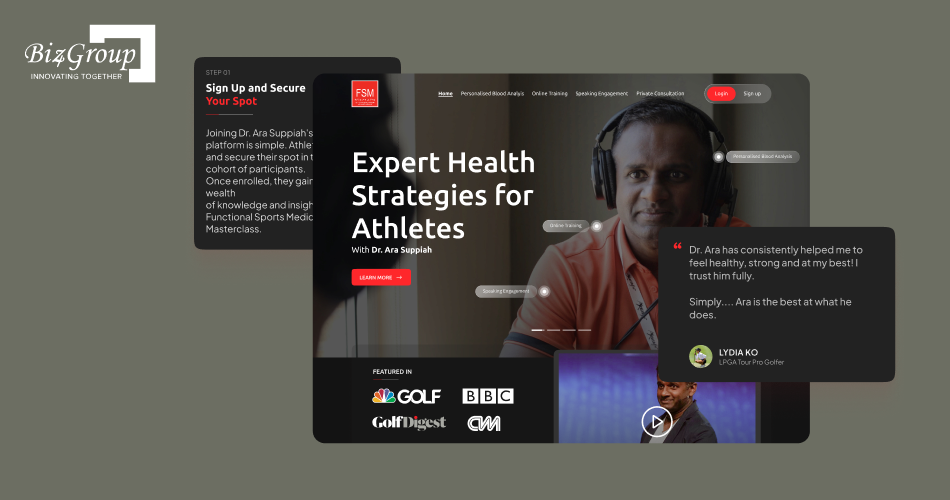
Biz4Group built an AI-powered athletic health solution that processes large volumes of sensitive health data while delivering real-time insights. The platform demonstrates how to build scalable AI medical records software for healthcare organizations without compromising speed or security.
Key technical highlights include:
- PostgreSQL for managing complex health datasets
- FastAPI for high performance and secure APIs
- AWS S3 and Amplify for secure cloud storage and management
- js and Next.js for responsive, user-friendly interfaces
- AI models that analyze uploaded health reports in near real time
This project shows how thoughtful tech stack selection enables scalability, reliability, and compliance. With the right foundation in place, the next step is execution. That means following a clear, step by step development process that turns strategy into working software.
7-Step Process to Develop AI Medical Records Management Systems
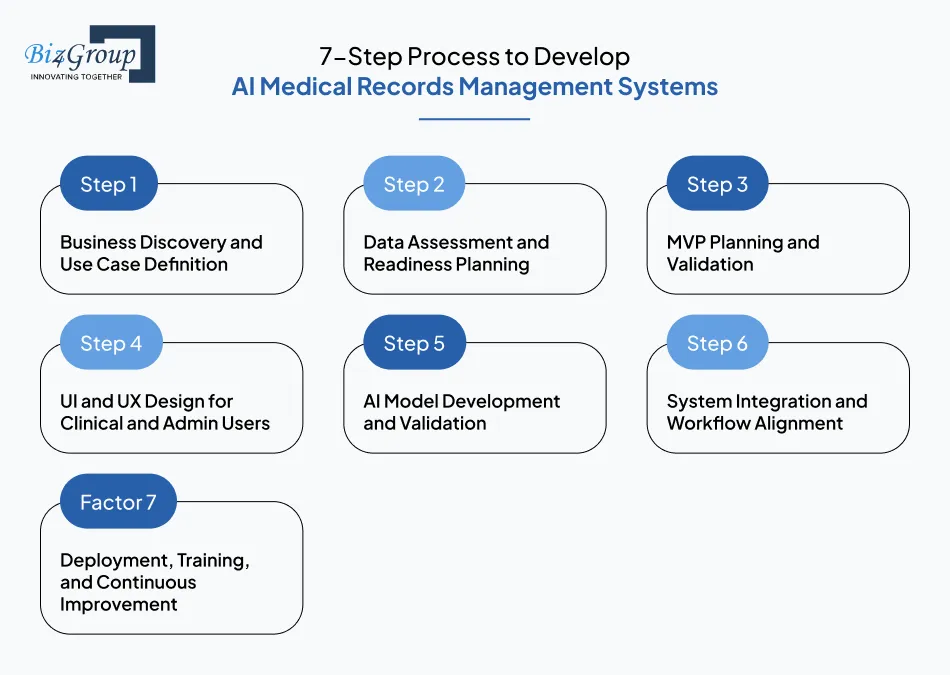
How do healthcare organizations move from an idea to a fully functional AI medical records platform? What steps ensure the system delivers value without disrupting care delivery? Look for a structured development process for your convenience.
Below is a proven seven step approach used to develop AI medical records management systems for healthcare operations.
Step 1. Business Discovery and Use Case Definition
What problem needs solving first? Every successful project begins here.
This phase focuses on understanding workflows, data gaps, and stakeholder expectations. Hospitals, clinics, and labs each have unique needs. Clear prioritization prevents scope creep and ensures alignment.
Key activities include:
- Stakeholder interviews and workflow analysis
- Identification of high impact AI use cases
- Success metrics and outcome definition
Step 2. Data Assessment and Readiness Planning
A question determines project feasibility... Is the data usable and reliable?
Healthcare data often exists in multiple formats. This step evaluates data quality, accessibility, and governance readiness. It also defines how records will be structured and labeled for AI usage.
Core outcomes include:
- Data source mapping
- Data quality validation
- Standardization planning
Step 3. MVP Planning and Validation
Should everything be built at once? Rarely.
Developing an MVP means focusing on essential functionality that delivers immediate value. This allows organizations to test assumptions, validate workflows, and collect feedback early.
During MVP planning:
- Core features are prioritized
- User roles and access flows are defined
- Success benchmarks are established
This step reduces risk while accelerating time to value for teams seeking custom AI medical records software development.
Also read: Top 12+ MVP development companies in USA
Step 4. UI and UX Design for Clinical and Admin Users
Will clinicians actually enjoy using the system? Pay attention to your design.
Healthcare platforms must balance speed, clarity, and ease of use. This step focuses on designing intuitive interfaces that minimize cognitive load.
A great UI/UX design company considers:
- Simple navigation and screen layouts
- Role specific dashboards
- Accessibility and usability testing
Strong design increases adoption and reduces training effort.
Also read: Top 15 UI/UX design companies in USA
Step 5. AI Model Development and Validation
How does intelligence get embedded into records management? Through carefully trained models.
This phase involves selecting AI models, training them on validated data, and testing outputs against real world scenarios. Accuracy and explainability remain top priorities.
Activities include:
- AI model training and tuning
- Performance benchmarking
- Continuous refinement based on feedback
Step 6. System Integration and Workflow Alignment
The system must fit into existing operations.
This step ensures the AI solution aligns with real workflows rather than forcing new ones. Testing focuses on how users interact with the platform during daily tasks.
Outcomes include:
- Workflow simulation
- User acceptance testing
- Iterative refinements
This is critical for teams that build AI powered medical records software for active healthcare environments.
Step 7. Deployment, Training, and Continuous Improvement
Success depends on ongoing support.
Deployment includes user onboarding, documentation, and training. Post launch monitoring captures performance insights and user feedback for future updates.
This step includes:
- User training programs
- Performance monitoring
- Feature optimization over time
Following this process ensures healthcare organizations develop intelligent health records management platforms that grow with their needs. With development complete, the next priority becomes compliance and regulatory readiness.
Also read: How to integrate AI with EHR/EMR systems to transform healthcare operations?
Seven Steps Sound Simple. Execution Makes the Difference.
A clear process reduces rework, delays, and wasted spend. See how your AI medical records project would unfold.
Get in TouchSecurity and Compliance in Developing HIPAA Compliant AI Medical Records Software
How do healthcare organizations protect sensitive patient data while adopting AI? How do they stay compliant without slowing innovation? These questions sit at the center of every successful healthcare technology initiative.
When organizations develop HIPAA compliant AI medical records management platforms, security and compliance must be embedded from day one. Retrofitting controls later increases risk and cost.
Core Regulatory Frameworks to Consider
- HIPAA for patient data privacy and security in the United States
- HITECH Act for breach notification and enforcement
- State level health data laws that add additional safeguards
- GDPR when handling data from international patients
Data Protection and Privacy Controls
- Encryption of data at rest and in transit
- Secure authentication and role-based access control
- Regular vulnerability assessments and penetration testing
- Data masking for non-production environments
Access Control and Auditability
- Role-based permissions aligned with job functions
- Automated audit trails that log every interaction
- Tamper resistant activity logs for compliance reviews
AI Governance and Responsible Use
- Clear documentation of model behavior and limitations
- Regular bias assessments and performance reviews
- Human oversight for critical decisions
- Defined escalation paths for anomalies
Data Retention and Disaster Recovery
- Defined data retention policies
- Automated backups and redundancy
- Disaster recovery and business continuity plans
Organizations that treat compliance as a foundation rather than a constraint move faster with confidence. Secure systems gain user trust, pass audits smoothly, and scale across departments and locations.
With compliance addressed, the next major consideration becomes financial planning. Understanding cost structures helps decision makers align budgets with long term value.
Also read: HIPAA compliant AI app development for healthcare providers
How Much Does It Cost to Build Electronic Medical Records Software Using AI?
Budget planning often becomes the biggest blocker when healthcare leaders consider AI adoption. Cost uncertainty creates hesitation. The reality is more straightforward when broken down correctly.
On average, AI medical records management software development costs range between $30,000-$200,000+, depending on scope, complexity, and scale. A small MVP for a clinic looks very different from an enterprise grade AI platform used by hospitals or lab networks.
Before diving into cost drivers, here is a high-level view of how investment typically scales.
MVP to Enterprise Cost Overview
|
Product Stage |
Scope Overview |
Typical Cost Range |
|---|---|---|
|
MVP |
Core features, limited AI use cases |
$30,000-$60,000 |
|
Advanced Level |
Multiple AI workflows, integrations |
$60,000-$120,000 |
|
Enterprise Level |
Full scale AI, compliance, scalability |
$120,000-$200,000+ |
This table sets expectations. The sections below explain where this investment goes and why.
Key Cost Drivers in AI Medical Records Software Development
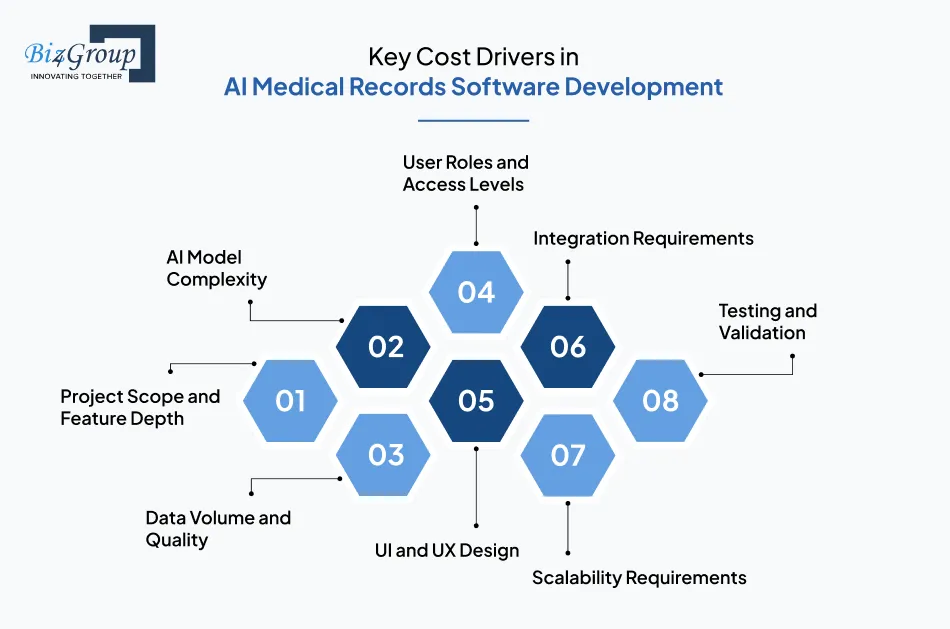
Cost varies because every healthcare organization operates differently. The following factors influence how much it costs to develop AI medical records management systems for healthcare operations.
|
Cost Driver |
What It Covers |
Estimated Impact |
|---|---|---|
|
Project Scope and Feature Depth |
Number of workflows, dashboards, AI use cases |
$8,000-$40,000 |
|
AI Model Complexity |
NLP, predictive analytics, AI automation |
$10,000-$50,000 |
|
Data Volume and Quality |
Data preparation, structuring, validation |
$5,000-$25,000 |
|
User Roles and Access Levels |
Clinicians, admins, patients, labs |
$3,000-$15,000 |
|
UI and UX Design |
Clinical and admin interface design |
$4,000-$20,000 |
|
Integration Requirements |
Existing EMR, lab systems, APIs |
$6,000-$30,000 |
|
Scalability Requirements |
Performance tuning, multi-tenant setup |
$8,000-$35,000 |
|
Testing and Validation |
Functional and workflow testing |
$4,000-$15,000 |
Each of these drivers compounds as scope increases. MVPs usually limit these variables. Enterprise platforms expand across all of them.
Understanding Hidden Costs That Affect Budget Planning
Upfront estimates rarely tell the full story. Hidden costs often appear after development begins. Planning for them early prevents budget overruns.
Data Preparation and Cleanup
Healthcare data often arrives fragmented and inconsistent. Normalizing and validating data before AI training can add $3,000-$15,000, depending on volume and quality.
Model Retraining and Tuning
AI models require refinement as usage grows. Ongoing tuning based on real world data can cost $2,000-$10,000 annually.
User Onboarding and Training
Even intuitive systems require training. Preparing materials and conducting onboarding sessions may add $2,000-$8,000.
Change Management and Adoption Support
Workflow changes impact staff behavior. Supporting adoption across departments can require $3,000-$12,000.
Post Launch Enhancements
Feature requests often emerge after real usage. Enhancements and optimizations typically add $5,000-$20,000 over time.
Hidden costs are not failures. They are signs of a growing and evolving system.
Cost Optimization Strategies That Reduce Long Term Spend
High quality systems do not need uncontrolled budgets. The right strategies lower cost without sacrificing outcomes.
- Start with a focused MVP that delivers measurable value before scaling
- Prioritize high impact AI workflows instead of building everything at once
- Reuse existing data sources and avoid unnecessary duplication
- Design modular features that scale incrementally
- Choose experienced AI development partner to avoid rework
Organizations that apply these techniques often reduce total cost by 20%-35% across the project lifecycle.
The goal is not to build the cheapest system. The goal is to build the right one. A clear cost breakdown brings confidence. It allows stakeholders to align budgets with outcomes and move forward with clarity rather than hesitation.
Next, we will examine the challenges and risks that can impact timelines, adoption, and success, along with practical ways to mitigate them early.
Wondering Where that $30,000-$200,000 Really Goes?
Smart planning can cut total development cost by up to 35%!
Let's Talk NumbersChallenges in AI Medical Records Management Software Development and How to Avoid Them
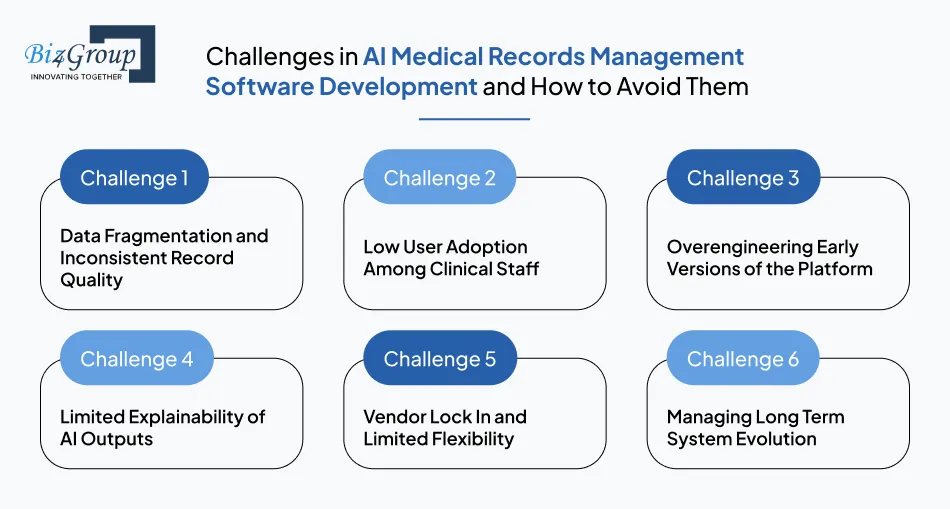
Even well-planned initiatives face obstacles. AI medical records projects are no exception. What separates successful implementations from stalled ones is how early these challenges are anticipated and addressed.
Below are the most common risks healthcare organizations encounter when they develop AI medical records management systems, along with practical mitigation strategies.
Challenge 1: Data Fragmentation and Inconsistent Record Quality
Medical data often lives in silos. Different departments store information differently. Inconsistent formats reduce AI effectiveness.
Mitigation approaches
- Conduct a data discovery phase before development begins
- Define clear data standards across departments
- Establish ownership and accountability for data quality
Challenge 2: Low User Adoption Among Clinical Staff
Even powerful systems fail if clinicians resist using them. Poor adoption often stems from workflow disruption or usability issues.
Mitigation approaches
- Involve clinicians early during requirement gathering
- Align system workflows with existing clinical routines
- Provide ongoing feedback loops during rollout
Challenge 3: Overengineering Early Versions of the Platform
Trying to solve every problem at once increases complexity and cost. Many projects stall because initial scope becomes unmanageable.
Mitigation approaches
- Focus early releases on high impact use cases
- Validate assumptions through controlled rollouts
- Expand functionality based on real usage insights
Challenge 4: Limited Explainability of AI Outputs
Healthcare professionals must trust system outputs. When AI recommendations lack transparency, confidence erodes.
Mitigation approaches
- Document how AI outputs are generated
- Present insights with supporting context
- Ensure humans remain in decision making loops
Challenge 5: Vendor Lock In and Limited Flexibility
Some solutions restrict future customization or scaling. This limits long-term adaptability.
Mitigation approaches
- Favor modular system designs
- Maintain clear ownership of data and models
- Choose partners with custom software development expertise (ahem, Biz4Group)
Challenge 6: Managing Long Term System Evolution
Healthcare operations evolve. Systems that cannot adapt lose relevance.
Mitigation approaches
- Design for scalability and configurability
- Plan enhancement cycles from the start
- Allocate budget for continuous improvement
Addressing these challenges early does more than reduce risk. It creates clarity. Healthcare organizations that plan for adoption, evolution, and scale avoid reactive fixes later. They move forward with confidence instead of caution.
Once these risks are understood and managed, attention naturally shifts to what comes next. That brings us to the future of AI medical records management software and how it will reshape healthcare operations in the years ahead.
Most AI Projects Fail Before Launch. Want to Know Why?
The difference is not technology. It's planning, adoption, and the right partner from day one.
Talk to Biz4Group's ExpertsFuture Trends in AI Medical Records Management Software Development
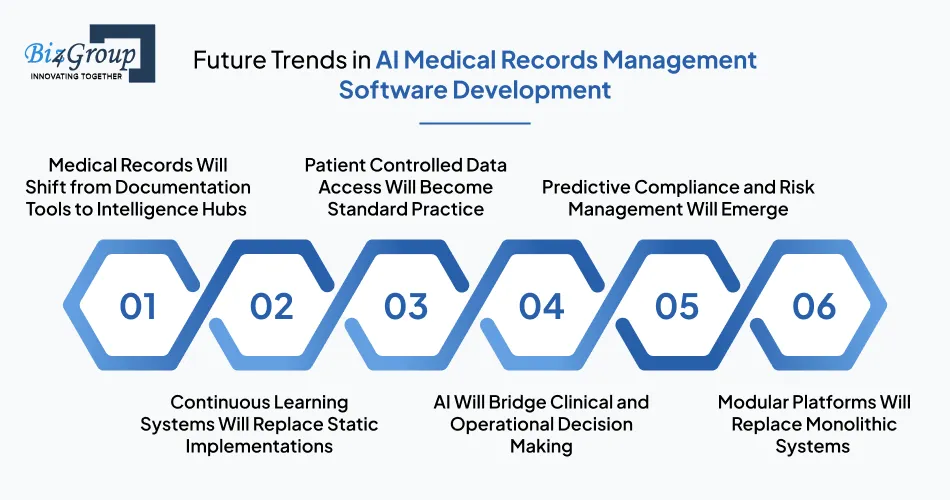
Healthcare technology does not stand still, and medical records systems are no exception. As data volumes grow and care models evolve, the role of AI in records management is shifting rapidly. What works today will not be enough tomorrow.
The trends below highlight how medical records platforms will evolve next, and what healthcare organizations should be ready for as AI becomes deeply embedded into everyday healthcare operations.
1. Medical Records Will Shift from Documentation Tools to Intelligence Hubs
Medical records are evolving beyond storage and retrieval. Future systems will function as intelligence hubs that continuously interpret patient data and operational signals. Instead of responding to events, healthcare teams will anticipate them.
AI medical records management software development will focus on surfacing insights automatically. Care gaps, workflow inefficiencies, and patient risks will be highlighted without manual queries. This shift will redefine how decisions are made across hospitals and clinics.
2. Continuous Learning Systems Will Replace Static Implementations
Today, many systems require manual updates to improve performance. That approach will fade. Future platforms will learn continuously from new data while maintaining governance controls.
Healthcare organizations that develop AI medical records management systems will expect models to adapt to evolving clinical patterns, documentation styles, and operational workflows. This reduces long term rework and keeps systems relevant without frequent redevelopment cycles.
3. Patient Controlled Data Access Will Become Standard Practice
Ownership of medical records is changing. Patients are demanding transparency and control. Future AI powered records platforms will embed dynamic consent and access controls directly into data workflows.
Rather than static permissions, patients will manage who sees what, when, and for how long. This evolution will push organizations to create AI-driven medical records management solutions that balance personalization with trust.
4. AI Will Bridge Clinical and Operational Decision Making
Medical records have traditionally served clinicians first. The next phase expands their role.
Future platforms will connect clinical data with operational metrics such as staffing, medical scheduling, and capacity planning. Healthcare leaders will rely on AI healthcare data management software development to align patient outcomes with operational efficiency across departments.
5. Predictive Compliance and Risk Management Will Emerge
Compliance has always been reactive. That will change.
AI systems will proactively flag potential compliance risks, documentation gaps, and audit concerns before they escalate. Healthcare organizations that build AI-powered medical records software will use predictive monitoring to reduce regulatory exposure and administrative burden.
6. Modular Platforms Will Replace Monolithic Systems
Large, rigid platforms limit adaptability. The future favors modular architectures.
Organizations will prefer systems that evolve feature by feature rather than through full replacements. This trend supports healthcare teams looking to build scalable AI medical records software for healthcare organizations that can grow without disruption.
Future focused organizations are not waiting for these trends to become standard. They are preparing now. This is why you need the right development partner for your software.
Speaking of the right development partner...
Why Biz4Group LLC Is the Trusted USA Partner for AI Medical Records Management Software Development
When healthcare organizations invest in AI, they are not buying software alone. They are choosing a long-term technology partner. One that understands healthcare complexity, regulatory responsibility, and real world operational pressure. This is where Biz4Group enters the picture.
Biz4Group LLC is an AI healthcare software development company with a strong track record of building intelligent, scalable, and compliant digital solutions for healthcare innovators. Our work sits at the intersection of AI engineering, healthcare operations, and business strategy. That combination is what sets us apart.
We specialize in AI medical records management software development for hospitals, clinics, labs, and digital health startups that want more than generic platforms. What truly defines our approach is execution. Our experience across AI healthcare data management, patient engagement platforms, and intelligent records systems gives us deep insight into what works and what fails in production.
Why Businesses Across the Globe Choose Biz4Group LLC
- Proven experience delivering complex AI healthcare platforms
- Deep understanding of medical data workflows and operational realities
- Strong focus on compliance, privacy, and responsible AI practices
- Custom built solutions tailored to specific healthcare needs
- Transparent communication and collaborative delivery model
- Ability to scale solutions from pilot to enterprise without disruption
When healthcare leaders hire AI developers, they want clarity, not confusion.
They want systems that support clinicians, empower administrators, and earn patient trust.
They want a partner who thinks beyond launch day and plans for what comes next.
We are that partner.
Get in touch with Biz4Group and build something marvelous. Let's talk.
Wrapping Up
AI medical records management software development has moved from a promising idea to a practical necessity for healthcare organizations. Hospitals, clinics, and labs are managing more data than ever, and traditional systems struggle to keep pace.
Intelligent platforms bring structure, speed, and clarity to healthcare data, helping teams reduce administrative burden, improve accuracy, and support better care delivery. Healthcare organizations that invest thoughtfully in AI powered medical records systems gain a lasting competitive advantage.
This is where Biz4Group LLC stands out. As a USA based software development company, we help healthcare innovators turn complex requirements into reliable, compliant, and scalable AI solutions. Our experience building intelligent healthcare platforms allows us to deliver systems that work in real environments and evolve with changing needs.
If you are planning to build or modernize your medical records platform, now is the time to act. Connect with Biz4Group and let’s build an AI medical records solution that moves your healthcare operations forward.
FAQs
1. How long does it typically take to develop AI medical records management software?
Most MVPs in this space take 5-6 weeks to reach a functional stage. Biz4Group, however, can deliver a working MVP in 2-3 weeks. We achieve this by using proven reusable components, pre-built AI modules, and healthcare ready frameworks that significantly reduce development time and cost without compromising quality or scalability.
2. Can AI medical records software be customized for different specialties?
Yes. Customization is one of the biggest advantages of AI based systems. Medical records platforms can be tailored for specialties like cardiology, mental health, diagnostics, or sports medicine by adapting data models, workflows, and intelligence layers to specialty specific needs.
3. Can AI medical records platforms support multi-location healthcare organizations?
Yes. These platforms are well suited for healthcare groups operating across multiple clinics, hospitals, or labs. They centralize records while maintaining location specific access controls, workflows, and reporting structures.
4. How do AI medical records systems support clinical audits and reviews?
AI systems improve audit readiness by maintaining structured records, consistent documentation, and detailed activity logs. They help surface missing information, inconsistencies, and documentation gaps early, reducing audit preparation time.
5. What level of internal technical expertise is needed to run AI medical records software?
Very little. Most AI powered platforms are built to be managed by healthcare and operations teams rather than technical staff. Ongoing support, updates, and optimization are typically handled by the development partner.
6. How do healthcare leaders evaluate the success of AI medical records initiatives?
Success is measured through operational efficiency, reduced documentation effort, improved data accuracy, and better workflow visibility. Long term value also comes from scalability, adaptability, and the ability to support evolving healthcare models.
