Location :
Orlando, FL, USA
Location :
Orlando, FL, USA +1 (407) 714-1616
 info@biz4group.com









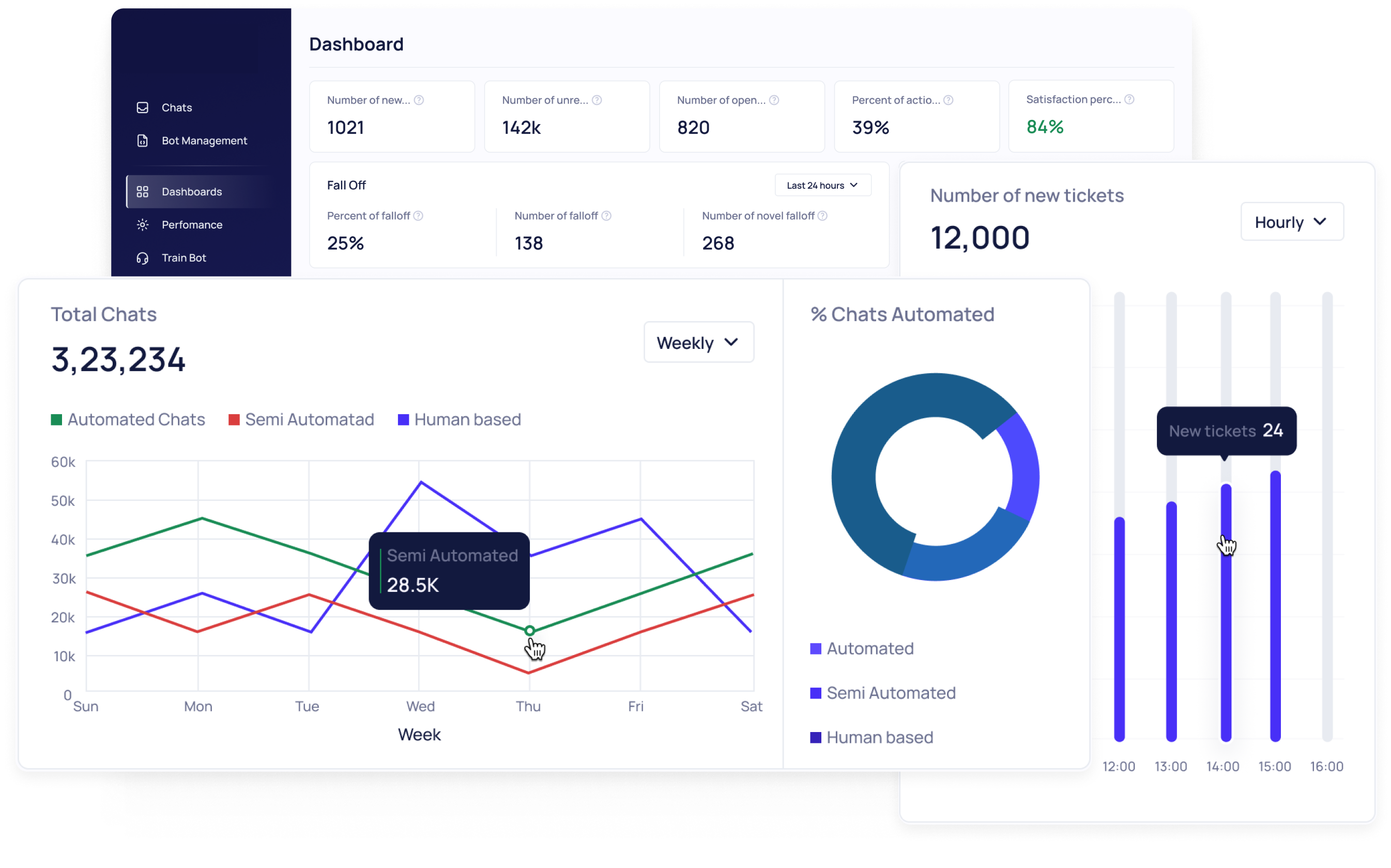









Imagine a digital system that doesn’t wait for instructions but instead, understands your business goals, learns from real-time feedback, and takes independent actions to get the job done.
Read More

Every business today is flooded with reports, research papers, and market updates. Teams read more than ever, yet clarity feels harder to reach. Important insights hide in plain sight. Decisions slow down. Leaders feel the pressure to move faster without missing what matters.
This is where AI research intelligence platform development starts to change how organizations think, analyze, and act.
The shift toward intelligent research systems is already underway. According to McKinsey, more than 75% of companies now use artificial intelligence in at least one business function, with many expanding AI into core decision making workflows.
This signals that research and strategy teams are no longer satisfied with static tools.
They want systems that work at scale and keep pace with change.
As expectations rise, organizations aim to develop AI research intelligence software that can process large volumes of structured and unstructured data. These platforms combine machine learning, semantic search, and analytics to surface trends early. They reduce manual effort. They help teams focus on insights rather than information overload.
For enterprises planning to build AI-powered research intelligence software, the challenge goes beyond technology.
The real goal is smarter decisions, faster research cycles, and sustained competitive advantage.
This guide explores how modern platforms are built, what capabilities matter most, and how businesses can design research systems that support long-term growth.
Let’s begin with the basics.
Many teams confuse research intelligence with analytics or reporting. That confusion often leads to poor platform choices and wasted investment.
This section clears that gap and sets the foundation for everything that follows.
AI research intelligence platform development focuses on building systems that continuously collect, analyze, and interpret large volumes of research data.
The goal is not reporting. The goal is insight.
These platforms are designed to help teams understand what is changing, why it matters, and what actions to take next. They work across massive datasets and evolving information streams.
Typical inputs include:
Outputs are not static charts. They are insights that evolve with new data.
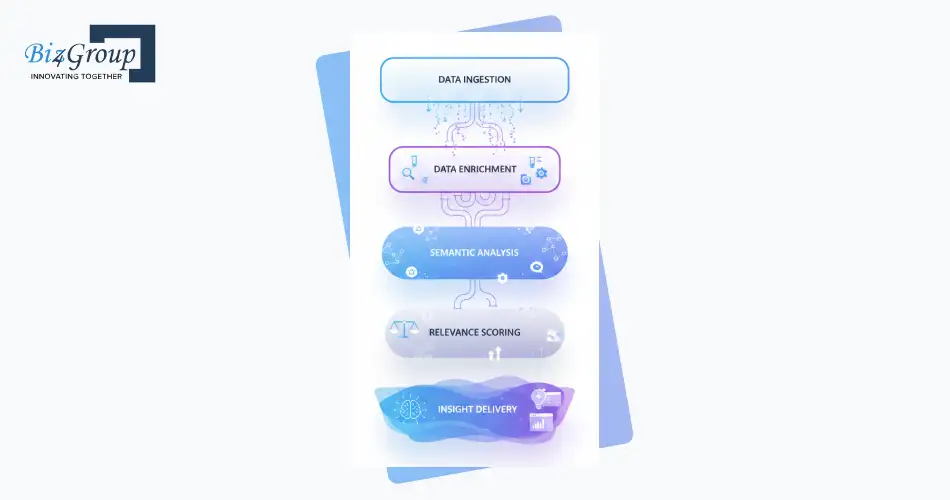
At a practical level, these platforms follow a layered intelligence flow. Each layer builds context and meaning.
Core working layers include:
This approach allows organizations to develop data-driven research intelligence platforms that improve over time as more data and feedback are introduced.
This distinction matters more than most teams realize.
|
Traditional Analytics Tools |
AI Research Intelligence Platforms |
|---|---|
|
Focus on historical data |
Focus on evolving knowledge |
|
Manual querying |
Context aware discovery |
|
Static dashboards |
Dynamic insight generation |
|
Limited unstructured data handling |
Built for unstructured research data |
|
Answers known questions |
Surfaces unknown patterns |
This is why many enterprises move away from dashboards when they need strategic clarity. They choose to build AI research intelligence platforms for enterprise decision making instead.
Understanding how these platforms work helps leaders ask better questions. It also helps teams avoid treating research intelligence as another reporting tool.
In the next section, we shift from structure to urgency. We will explore why organizations are investing now and what business problems these platforms solve at scale.
Teams using intelligent research platforms reach insights faster and miss fewer signals.
Begin Building with Biz4GroupBefore you decide where to invest, let’s understand the urgency. Traditional research methods take time, and time costs money. Businesses are moving fast. They need reliable insight as soon as new information arrives. Static dashboards and dashboards alone do not deliver that agility.
Today’s leaders want systems that speed up understanding. They want tools that help them develop AI research intelligence software that captures signals from diverse sources. This helps teams stay strategic instead of reactive.
Here are major pain points that AI research intelligence platforms address:
These challenges affect competitiveness and strategic clarity.
When enterprises build AI powered research intelligence software they get clear advantages.
|
Benefit |
What It Means |
|---|---|
|
Faster insights |
Get answers in hours instead of days |
|
Improved focus |
Reduce busy work for analysts |
|
Deeper understanding |
Identify patterns and relationships automatically |
|
Better competitive awareness |
Track rivals and industry shifts continuously |
|
Actionable outputs |
Clear summaries and insights teams can act on |
AI research intelligence platforms help decision makers move from reacting to planning. They support business leaders with timely information.
The world of research has changed. The volume and velocity of information will not slow down. Tomorrow’s winners are organizations that develop data driven research intelligence platforms that deliver insight quickly and reliably.
In the next section we will explore use cases and key capabilities that show where these systems make the biggest difference.
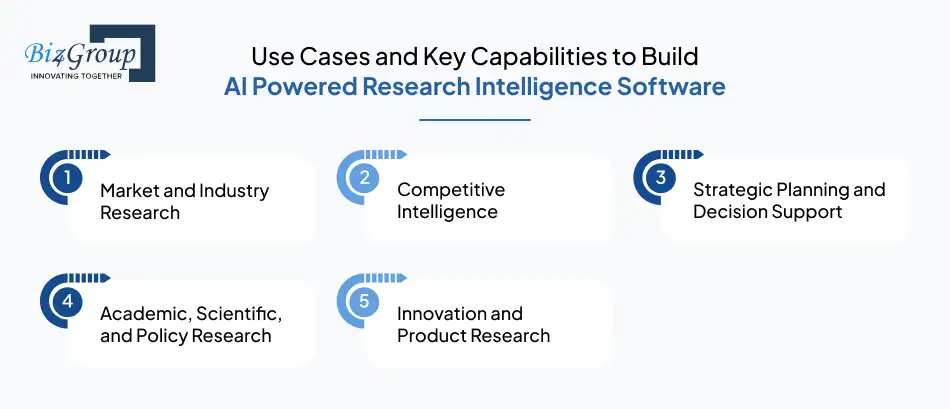
Understanding use cases helps leaders connect technology with outcomes. This section focuses on where organizations apply research intelligence platforms in real situations. Each use case reflects how teams use AI to move faster, reduce noise, and gain clarity.
Companies rely on research to understand where markets are heading. AI platforms help teams monitor industry shifts continuously. They analyze reports, news, and publications in real time. Patterns emerge early. Decisions become proactive rather than reactive.
Organizations that invest in market research intelligence software development with AI gain visibility across fragmented data sources. They spot trends before competitors do. This helps with planning, positioning, and long term strategy.
Tracking competitors manually is slow and incomplete. AI systems change that. They scan public data, announcements, product updates, and thought leadership. Insights are ranked by relevance. Signals that matter rise to the surface.
Teams that build competitive intelligence software using AI gain a living view of the competitive landscape. They understand moves, risks, and opportunities as they happen. Strategy discussions become grounded in facts, not assumptions.
Executives need clarity when making high impact decisions. Research intelligence platforms support scenario analysis and insight generation. They combine internal data with external research. Context becomes clearer.
This is why many organizations choose to develop AI research intelligence software for strategic planning. It allows leaders to evaluate options quickly and act with confidence.
Researchers deal with massive volumes of papers and publications. AI platforms organize, summarize, and connect information across disciplines. They reduce the time spent reading and sorting material.
Teams that create AI powered research and insights platforms can stay updated without feeling overwhelmed. Knowledge discovery becomes efficient and structured.
Innovation teams track emerging ideas, technologies, and research directions. AI helps identify patterns across domains. It highlights white spaces and early signals.
Organizations that create AI driven insights and analytics software can guide product strategy with evidence. They reduce guesswork and increase alignment between research and execution.

This AI-powered research intelligence platform is a strong example of how research intelligence platforms perform in real environments.
What the Platform Delivers
This project demonstrates Biz4Group’s ability to build AI-powered research intelligence software that handles scale, relevance, and usability. It shows how thoughtful architecture and AI integration services turn complex research workflows into streamlined experiences.
Also read: AI legal research platform development guide
These use cases mirror real challenges teams face every day. The difference lies in how they are solved!
Book a Strategy Call NowBefore advanced capabilities come into play, every successful platform must get the basics right. These features determine whether users adopt the system or abandon it. They form the foundation of reliable AI research intelligence software development and support long-term usability.
|
Feature |
What It Does |
Why It Matters |
|---|---|---|
|
Centralized research hub |
Brings all research content into one workspace |
Reduces tool switching and improves focus |
|
Personalized content feeds |
Tailors insights based on user interests |
Keeps research relevant and timely |
|
Semantic search |
Finds meaning, not keywords |
Improves discovery across large datasets |
|
AI summaries |
Condenses long documents into key points |
Saves time and speeds understanding |
|
PDF interaction |
Allows users to query and explore documents |
Enhances deep research workflows |
|
Citation management |
Exports references in standard formats |
Supports academic and professional use |
|
Data aggregation |
Pulls data from multiple trusted sources |
Ensures broader and richer insights |
Platforms fail when they attempt too much too early. A disciplined feature set improves adoption and trust. These capabilities help teams develop AI research intelligence platforms for enterprise decision making without overwhelming users.
Once these essentials are in place, teams can safely move toward advanced intelligence layers. That is where real differentiation begins.
Also read: Building smart applications with AI as a service APIs
Once the core features are stable, advanced capabilities shape how powerful the platform becomes. These features help organizations move from information access to real intelligence. They define how well teams can scale research, uncover patterns, and act with confidence.
This capability scores research content based on context, behavior, and intent. It ensures that the most meaningful information appears first. Over time, relevance improves as the system learns from user interaction.
Vector embeddings allow platforms to understand meaning rather than keywords. Related concepts surface even when exact terms are missing. This is critical when teams create AI-driven insights and analytics software for large, unstructured datasets.
Knowledge graphs connect entities, topics, and relationships across research data. This reveals hidden connections between papers, trends, and concepts. Strategic insights emerge that traditional tools cannot surface.
The platform adapts suggestions based on user behavior, topics, and recent activity. This reduces noise and improves discovery. Teams gain timely insights without constant searching.
AI models generate summaries, reports, and contextual explanations from research data. This supports faster decision making. Organizations that develop AI research intelligence software for strategic planning benefit from clearer outputs.
User feedback improves ranking, recommendations, and accuracy. The platform evolves with usage patterns. This capability supports teams that want to develop scalable AI research intelligence software solutions over time.
These advanced capabilities turn research platforms into strategic assets. They enable organizations to move faster, think deeper, and plan smarter.
Advanced capabilities work only when they align with how people research and decide.
Talk to Biz4Group’s ExpertsA strong platform depends on a well-balanced technology stack. Every layer must support scale, performance, and future expansion. This section breaks down the stack required to build AI powered research intelligence software that performs reliably in real business environments.
The frontend defines how users experience the platform. It must support heavy data interaction while remaining fast and intuitive.
|
Component |
Purpose |
Typical Technologies |
|---|---|---|
|
Web interface |
Enables research discovery and interaction |
React, Vue |
|
State management |
Handles dynamic data flows |
Redux, Zustand |
|
Visualization layer |
Displays insights and trends |
D3.js, Chart.js |
The backend manages logic, workflows, and communication across services. It ensures smooth data flow between users, models, and databases.
|
Component |
Purpose |
Typical Technologies |
|---|---|---|
|
Application server |
Handles business logic |
Node.js, Python |
|
API framework |
Enables fast service communication |
FastAPI, REST |
|
Authentication |
Manages secure access |
OAuth, JWT |
This layer turns raw data into understanding. It powers relevance, summarization, and insight generation.
|
Component |
Purpose |
Typical Technologies |
|---|---|---|
|
NLP models |
Understand language and context |
Transformer based models |
|
Embedding models |
Enable semantic similarity |
Sentence embeddings |
|
Ranking algorithms |
Prioritize meaningful content |
ML ranking models |
Research platforms handle massive volumes of information. Storage and retrieval must be optimized for speed and scale.
|
Component |
Purpose |
Typical Technologies |
|---|---|---|
|
Relational databases |
Store structured data |
PostgreSQL |
|
Vector databases |
Support semantic search |
Pinecone, FAISS |
|
Search engines |
Enable fast indexing |
OpenSearch |
Data quality defines insight quality. Platforms must support diverse research inputs from trusted sources.
|
Data Type |
Examples |
Purpose |
|---|---|---|
|
Academic data |
Research papers, journals |
Deep domain knowledge |
|
Market data |
Reports, surveys |
Trend analysis |
|
News and web data |
Articles, blogs |
Real time signals |
Infrastructure choices affect scalability, reliability, and cost control.
|
Component |
Purpose |
Typical Technologies |
|---|---|---|
|
Cloud services |
Host applications |
AWS, Azure |
|
Containerization |
Enable portability |
Docker |
|
Orchestration |
Manage scaling |
Kubernetes |
A thoughtful tech stack creates balance between performance, flexibility, and intelligence. Each layer supports the next. Together, they form the backbone of successful AI research intelligence platform development.
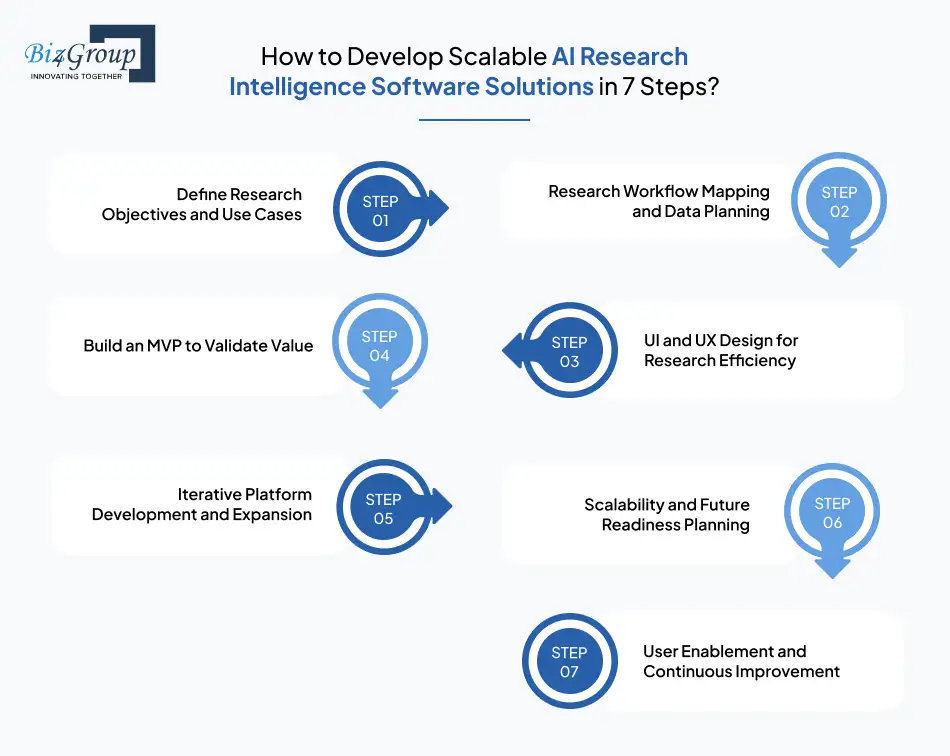
Building a research intelligence platform requires more than technical execution. It demands clarity of purpose, thoughtful design, and a roadmap that supports growth. Below is a seven-step process followed by teams that successfully develop AI research intelligence platform solutions aligned with business goals.
Every platform starts with questions.
What insights matter most?
Who will use the platform?
What decisions will it support?
Clear answers guide scope, features, and prioritization. This step helps teams develop AI research intelligence software that solves real problems instead of generic ones.
Research workflows differ across organizations. Mapping how users discover, analyze, and act on information is critical.
This step ensures the platform fits natural behavior. It also supports teams that want to develop data driven research intelligence platforms tailored to their domain.
Design shapes adoption. Researchers need clarity, not clutter.
UI and UX design focuses on readability, navigation, and flow. A good UI/UX design company reduces cognitive load and helps teams move faster when they create AI-powered research and insights platforms.
Also read: Top 15 UI/UX design companies in USA
Developing an MVP brings ideas into the real world quickly. It includes only essential features tied to core use cases.
This step allows teams to test assumptions, gather feedback, and adjust direction early. It is a smart approach when organizations build AI-powered research intelligence software with long-term vision.
Also read: Top 12+ MVP development companies in USA
Once the MVP proves value, features are expanded in phases. Feedback drives refinement.
This approach supports teams that want to develop scalable AI research intelligence software solutions without overbuilding upfront.
Growth brings new challenges. More users. More data. More complexity.
Planning for scalability ensures the platform handles rising demand. Future readiness allows easy integration of new data sources and intelligence layers as needs evolve.
A platform succeeds when users trust it. Training, onboarding, and iteration matter.
Continuous improvement keeps insights relevant. It helps organizations build AI research intelligence platforms for enterprise decision making that remain valuable over time.
A structured development process reduces risk and accelerates results. It ensures research intelligence platforms grow with the business.
Next, we will address security and regulatory compliance, which plays a critical role in enterprise adoption and trust.
With Biz4Group, your MVP can go live in 2 to 3 weeks and start proving value fast.
Schedule a Call TodaySecurity and compliance are not optional for research intelligence platforms. These systems handle sensitive data, proprietary research, and strategic insights. Enterprises expect strong safeguards from day one when they invest in AI research intelligence platform development.
Below are the core security and compliance requirements that platforms must address.
For organizations that develop AI research intelligence software, these measures build trust across teams and stakeholders. They also reduce risk during audits and enterprise onboarding.
Security directly impacts adoption. When users trust the platform, they engage more deeply and rely on insights with confidence.
Cost is often one of the first questions leaders ask. While every project differs, most organizations want a clear starting point before planning deeper.
For AI research intelligence platform development, the average cost typically falls between $30,000 and $250,000+. This range covers MVP builds as well as more mature platforms designed for enterprise scale.
If you are looking for a detailed breakdown, cost drivers, and planning guidance, we have covered that in a dedicated blog.
You can explore the full AI research intelligence platform development cost here.
This decision shapes long-term outcomes. Many teams rush into tools without evaluating fit. Others invest in custom builds without clarity. A structured comparison helps leaders choose what aligns with their goals, timelines, and growth plans.
The table below compares both paths clearly for organizations evaluating AI research intelligence software development.
|
Aspect |
Buy |
Build |
|---|---|---|
|
Time to launch |
Faster initial rollout |
Longer development cycle |
|
Customization |
Limited to vendor options |
Fully tailored to workflows |
|
Differentiation |
Similar to competitors |
Unique competitive advantage |
|
Scalability control |
Dependent on vendor roadmap |
Owned and planned internally |
|
Data ownership |
Shared or restricted |
Full ownership |
|
Integration flexibility |
Often limited |
Designed around existing systems |
|
Long term cost control |
Subscription based |
Investment driven |
|
Strategic alignment |
General purpose |
Business specific |
Buying works when speed matters more than uniqueness. Building works when intelligence drives strategy.
Buy when
You need a solution quickly.
Your use cases are common.
Customization needs are limited.
Build when
Research workflows are unique.
Data sources are complex.
Long-term intelligence is a competitive asset.
Hybrid when
You start with existing tools.
You plan to expand with custom intelligence later.
Organizations that develop AI research intelligence platform solutions gain flexibility and strategic advantage over time. The choice should always align with where the business wants to go next.
Next, we will look at challenges, risks, and common mistakes, along with ways to reduce them during development.
The choice you make today shapes how flexible your research becomes tomorrow.
Build Smart with Biz4Group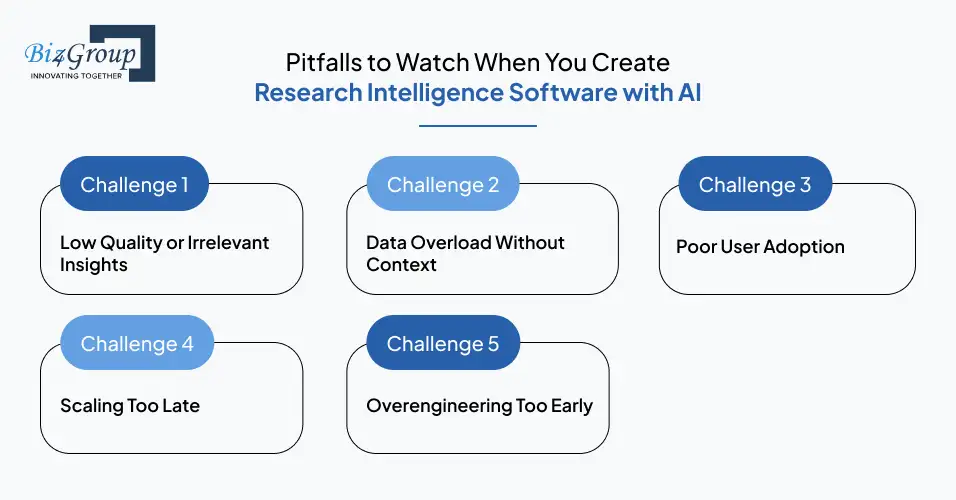
Even well-planned initiatives face obstacles. Research intelligence platforms deal with scale, relevance, and trust. Recognizing risks early helps teams avoid costly missteps while they develop AI research intelligence platform solutions for long term use.
When platforms surface too much noise, users lose trust quickly. Poor relevance weakens adoption and reduces value.
Solutions
Large datasets can overwhelm users instead of helping them. Raw information without explanation slows decisions.
Solutions
Even powerful systems fail when users find them hard to navigate. Adoption gaps reduce ROI.
Solutions
Platforms built for small datasets struggle when usage grows. Performance issues erode confidence.
Solutions
Adding advanced features before proving core value delays launch and increases risk.
Solutions
Challenges are part of the journey. Teams that approach them proactively can build AI research intelligence platforms for enterprise decision making that scale with confidence and clarity.
Speaking of high-performing teams...
Biz4Group LLC is a USA-based software development company built for helping businesses turn complex ideas into scalable software products. We work with entrepreneurs, enterprises, and innovation teams that want clarity, speed, and results.
Not experiments. Not prototypes that stall.
Real platforms that create measurable value.
Our strength lies in building enterprise AI solutions that handle complexity without passing it on to users. We specialize in custom AI research intelligence software development that supports decision makers who depend on accuracy, relevance, and speed.
From research heavy industries to strategy driven enterprises, as a custom AI EdTech software development company, we design platforms that convert large volumes of data into clear, usable insight.
What sets Biz4Group apart is our ability to connect business goals with execution. We do not treat AI research intelligence software development as a technical exercise. Every platform we build is aligned with how teams think, research, and decide.
Handling massive datasets, supporting personalized research workflows, and delivering insight driven experiences requires architecture discipline, domain understanding, and a long-term product mindset. This is where Biz4Group consistently delivers.
Businesses partner with Biz4Group because they want confidence.
Confidence that their platform will scale.
Confidence that insights will stay relevant.
Confidence that their investment will support growth, not rework.
We bring clarity to complex problems and turn them into systems leaders rely on every day.
If your organization is planning to build AI research intelligence platforms for enterprise decision making, choosing the right development partner matters.
So, get in touch with Biz4Group today and turn your research into a competitive advantage.
AI research intelligence platforms are redefining how organizations understand information, trends, and opportunities. As data volumes grow and decision windows shrink, relying on manual research or static analytics no longer works. Businesses need systems that connect signals across sources, surface relevance, and support confident action. That is exactly what well-planned research intelligence platforms deliver.
From architecture and capabilities to development process and adoption strategy, success depends on building with clarity and purpose. Platforms that align with real research workflows help teams move faster, reduce noise, and focus on insights that drive outcomes. Organizations that invest thoughtfully gain a lasting advantage in strategy, innovation, and competitive awareness.
This is where Biz4Group plays a critical role. As an AI app development company, Biz4Group helps enterprises and startups design and build AI research intelligence platforms that scale with ambition. Our experience in developing AI products, generative AI, AI chatbots, reflects our ability to turn complex challenges into streamlined, insight focused systems.
If you are ready to move beyond fragmented tools and slow research cycles, now is the time to act.
Partner with Biz4Group or hire AI developers to build a research intelligence platform that helps your business lead with confidence.
Most projects take 8 to 16 weeks, depending on complexity. Biz4Group accelerates this by using reusable components and proven frameworks, enabling us to deliver an MVP in 2 to 3 weeks while reducing both time and development cost.
Yes. Most platforms are designed to connect with internal databases, CRMs, BI tools, and research systems. Integration planning early in the project reduces friction later.
Relevance is maintained through continuous updates, adaptive ranking logic, and feedback loops. This allows insights to evolve as new information enters the system.
Search tools retrieve information. BI tools analyze structured data. Research intelligence platforms connect context, meaning, and patterns across diverse sources to support decision making.
ROI is often measured through time saved, faster decision cycles, improved research quality, and better strategic outcomes rather than direct cost reduction alone.

with Biz4Group today!
Our website require some cookies to function properly. Read our privacy policy to know more.