 Location :
Orlando, FL, USA
Location :
Orlando, FL, USA +1 (407) 714-1616
 info@biz4group.com

- White-label AI real estate mobile apps help businesses launch faster, save costs, and enhance customer engagement with branded, AI-driven property solutions.
- Choosing white-label vs custom development depends on speed, flexibility, and scalability needs; white-label offers quicker market entry and lower investment.
- The process of creating white-label AI real estate mobile app involves research, UX design, MVP building, and scalable AI integration for property automation.
- Core features like predictive analytics, virtual tours, chatbots, and personalized dashboards make these apps smarter and more user-friendly.
- Partnering with experts like Biz4Group, a leading white-label AI real estate app development company, ensures end-to-end success from strategy to launch.
You’ve probably noticed how the real estate market has turned into a fast-moving, tech-intensive space. Buyers expect instant results on their phones. Brokers need to keep up. Meanwhile, agencies and property management firms are under pressure to deliver mobile, AI-powered experiences without rebuilding from scratch.
That’s why deciding to build a white-label AI real estate mobile app makes strategic sense. When you opt for a ready-to-brand, scalable platform you avoid reinventing the wheel and get to market faster with stronger tech.
The global PropTech market reached USD 35.4 billion in 2024 and is projected to hit USD 114.8 billion by 2033.
So if you’re leading the technology stack for a real estate agency, broker network, property management firm, or franchise, this is the moment. A tailored solution to create white-label AI real estate mobile app gives you the competitive edge with faster rollout, branded experiences, AI-enabled functionality, and scalability across your network.
If you’ve already explored AI real estate mobile app development, you know how demanding it can be to build and maintain everything from the ground up while still keeping up with client expectations. A white-label AI real estate app development approach can change that completely.
In this guide, we’ll walk through everything you need to know about how to build a white-label AI real estate mobile app, when to choose it, how it compares to custom builds, business models and monetization, benefits, key features, the process, tech stack, cost breakdown, how to select the best partner, and how to solve common challenges.
By the end, you’ll have the clarity to move from idea to execution confidently.
When Should Your Business Consider a White-Label AI Real Estate Mobile App Solution
Timing matters when you decide to build a white-label AI real estate mobile app. Not every company needs one right away, but there comes a point where scaling, consistency, and customer experience start to outweigh the cost of waiting.
Think about your current challenges. Are you:
- Managing multiple agencies, franchises, or property brands that all need their own mobile presence?
- Spending too much time and budget on repetitive real estate mobile app development?
- Trying to integrate AI-powered features into existing apps but struggling to align everything?
If that sounds like you, it may be the right moment to create white-label AI real estate mobile app solutions tailored to your brand and clients.
Situations Where a White-Label Model Makes Perfect Sense
- You need faster scalability
Launching multiple branded apps from one shared codebase lets you expand into new regions or markets effortlessly. A ready-made white-label AI real estate app development platform ensures every agency or branch gets a consistent, high-performing experience. - You want to focus on business, not engineering
Instead of hiring a large in-house team, you can partner with a trusted AI development company to handle ongoing upgrades and innovation. This lets your leadership focus on clients, growth, and revenue instead of infrastructure. - You want advanced intelligence without starting from zero
With ready AI modules like chatbots, property recommendations, and predictive insights, you can easily deliver smarter experiences. Many firms also collaborate with experts in AI automation services to enhance workflows and decision-making. - You’re aiming for higher ROI with faster time-to-market
Building from scratch can take months or even a year. White-label frameworks cut that time dramatically while reducing development costs. You start seeing measurable results sooner. - You want future-ready architecture
The real-estate industry is evolving quickly with intelligent search, voice interfaces, and personalized experiences. Choosing to develop AI-powered white-label real estate application solutions gives you a foundation built for tomorrow’s demands.
If your goal is to scale smartly, save costs, and deliver AI-driven innovation faster, the decision to build a white-label AI real estate mobile app is one of the most strategic moves your business can make right now.
Ready to turn your real-estate idea into a smart AI-powered app?
Let's help you build a white-label AI real estate mobile app that speaks your brand language.
Contact UsWhite-Label vs Custom-Made: Which Approach Fits Your AI Real Estate Strategy
When you decide to build a white-label AI real estate mobile app, one of the first questions to answer is whether to go with a white-label AI real estate app development approach or invest in a custom AI-powered white-label real estate application. Both are valid paths, but they cater to different business goals.
If you’re looking for speed, scalability, and lower upfront investment, the white-label route is a great fit. If you’re focused on creating something entirely unique for your brand with deep control over architecture and AI logic, custom development might be better.
Here’s a clear comparison to help you choose the right direction for your business.
| Aspect | White-Label AI Real Estate Mobile App | Custom-Made AI Real Estate App |
|---|---|---|
|
Development Time |
The foundation already exists, so you can launch quickly. Agencies and brokers can deploy their branded app in weeks using pre-tested systems. |
It takes more time since everything is built from scratch. Development can extend to several months or longer depending on complexity and integrations. |
|
Cost Efficiency |
Lower investment since you’re using an existing framework. Ideal for scaling multiple brands or franchises quickly. |
Costs are higher because each feature, workflow, and design element is customized. You may collaborate with a custom software development company to build everything from the ground up. |
|
Scalability |
Designed for multi-tenant use. You can deploy branded apps for different agencies or offices while managing them from one admin system. |
Scaling is slower and requires additional infrastructure and development for each version. |
|
AI Capabilities |
Comes with built-in modules such as property recommendations, chat assistants, and predictive insights. These can be expanded easily through AI integration services or enhanced using AI automation services. |
Offers full flexibility to design and train proprietary AI models, but it requires more time, resources, and technical expertise to implement. |
|
Customization Level |
Moderate. You can tailor branding, colors, and features, but the core structure remains the same for all brands on the platform. |
Total customization. Everything (from UI and workflows to AI models) is designed around your unique business logic. |
|
Maintenance & Support |
Managed by your white-label provider. Updates and AI improvements are handled automatically for all clients on the platform. |
Maintenance is managed internally or through an experienced AI app development company, which can increase long-term costs. |
|
Best For |
Real estate agencies, brokers, and property management firms that want to scale fast and maintain consistent branding across markets. |
Enterprises or proptech startups that need unique functionality or specialized building of white-label AI real estate mobile app solutions. |
How to Choose the Right Model
If your goal is to create white-label AI real estate mobile app solutions that get to market quickly, save money, and still deliver advanced capabilities, the white-label model is your best move. It’s especially effective for multi-agency rollouts, broker networks, or property management firms that value speed and consistency.
But if your company handles complex workflows, unique AI pipelines, or needs full control over architecture and data, developing a custom AI-powered white-label real estate application is a stronger long-term investment.
In simple terms, white-label focuses on efficiency and scale, while custom-made focuses on exclusivity and ownership. The right choice depends on how fast you want to grow, how much you can invest, and how deeply you need to personalize your technology.
Business Models and Monetization Strategies for White-Label AI Real Estate Mobile Apps
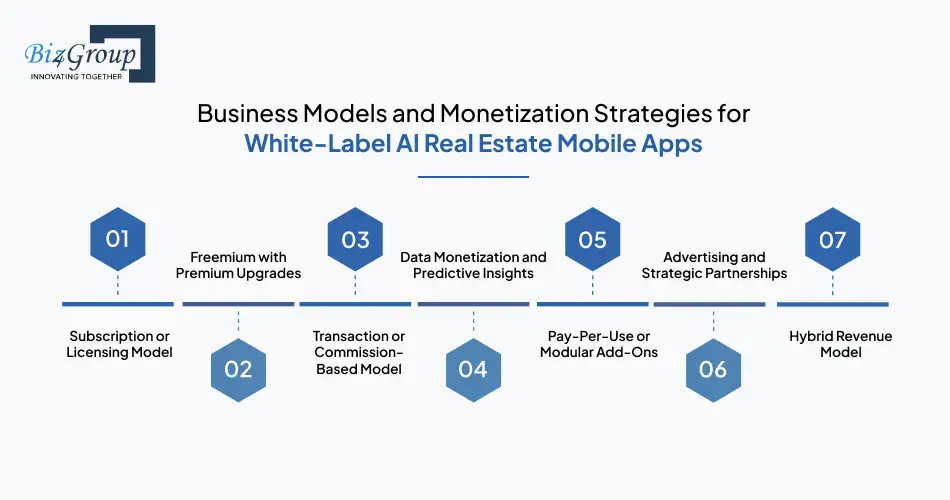
When you build a white-label AI real estate mobile app, you’re not just creating software; you’re building a revenue engine. Real estate agencies, brokers, and property management firms can generate continuous income if their monetization model is structured strategically.
Let’s explore the most effective ways to turn white-label AI real estate app development into a profitable, scalable business model.
1. Subscription or Licensing Model
If predictable income is your goal, this model is ideal. Each agency, franchise, or brokerage pays a recurring monthly or yearly fee for their branded app. The setup ensures long-term client retention and recurring revenue.
For larger portfolios, the building of white-label AI real estate mobile app platform simplifies tiered pricing and multi-agency billing without losing efficiency or performance.
2. Freemium with Premium Upgrades
A freemium model helps you attract users fast. Offer basic property searches and filters for free, then charge for premium AI capabilities such as smart recommendations, market insights, or lead analytics.
It’s an effective way to create white-label AI real estate mobile app solutions that encourage upgrades once users experience value firsthand.
3. Transaction or Commission-Based Model
This model aligns revenue with results. You earn commissions on successful leads, property listings, or closed transactions made through your app.
This strategy performs best when the app is powered by advanced real estate AI software development, which streamlines property discovery, automates deal workflows, and enhances buyer–seller engagement.
4. Data Monetization and Predictive Insights
Your develop AI-powered white-label real estate application collects valuable real-time market and user behavior data. You can sell insights, predictive analytics, or data reports to real estate consultants, investors, or marketing agencies.
This data can also power pricing forecasts and trend predictions, creating a recurring, insight-driven income source.
5. Pay-Per-Use or Modular Add-Ons
A flexible approach where clients pay only for what they need. For example, agencies can purchase chatbot features, predictive dashboards, or AR property tours individually.
This model makes the process of creating white-label AI real estate mobile app cost-effective for smaller firms while still providing growth options for larger ones.
6. Advertising and Strategic Partnerships
Advertising turns your app into an ecosystem. Partner with mortgage lenders, moving services, or home insurance companies and offer them targeted ad placement.
When combined with white-label AI real estate app development for brokers and agents, this strategy enhances user experience while generating consistent ad-based revenue.
7. Hybrid Revenue Model
You can combine subscription, commission, and data models to diversify revenue streams. It helps maintain stability while allowing flexibility to scale with demand.
If you’re exploring multiple ways to generate income from your app, take inspiration from this guide on how to monetize AI apps. Mixing models ensures your create white-label AI real estate mobile app remains profitable across different markets and use cases.
By structuring your revenue model early, your white-label AI real estate mobile app development project becomes more than just a tech investment, it becomes a long-term growth engine for your business.
Benefits of Building a White-Label AI Real Estate Mobile App
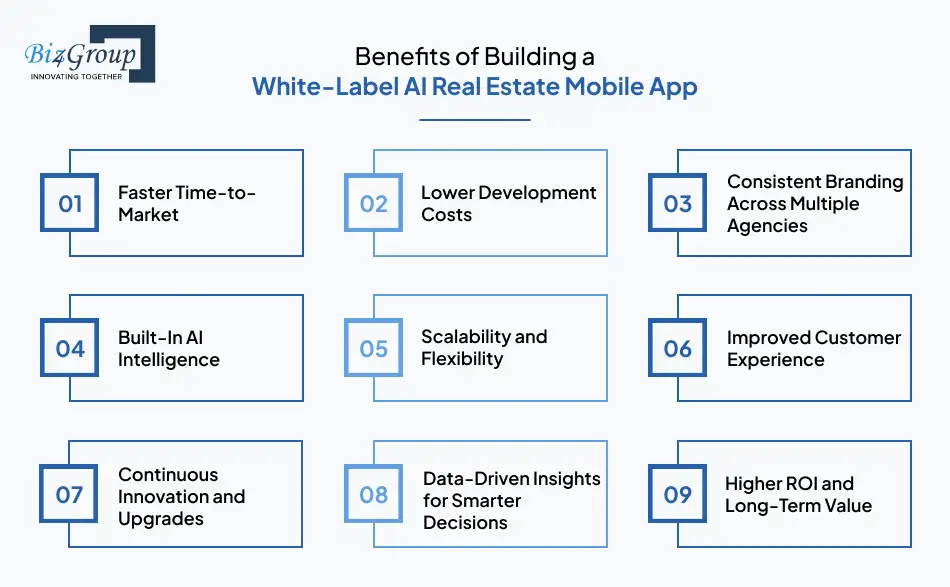
When you build a white-label AI real estate mobile app, you combine speed, scalability, and intelligence into a single platform. It gives agencies, brokers, and property management firms the flexibility to brand their own AI-driven product while cutting costs and development time.
Let’s explore how white-label AI real estate app development gives your business an advantage and why so many companies are investing in this approach.
1. Faster Time-to-Market
If you need to get your product out fast, building of white-label AI real estate mobile app model is your shortcut. You start with a pre-built framework, integrate your branding, and go live in weeks rather than months.
Why it matters:
- Quickly validate your app idea with an AI real estate app MVP
- Capture early adopters before competitors
- Launch faster with lower technical complexity
2. Lower Development Costs
The process of creating white-label AI real estate mobile app solutions eliminates unnecessary groundwork. Instead of building everything from scratch, you focus on customization and branding while your base platform handles the rest.
Why it matters:
- Reduces initial investment by 50–60%
- Cuts ongoing maintenance costs
- Ideal for startups and agencies with limited budgets
3. Consistent Branding Across Multiple Agencies
If you operate several franchises or property groups, maintaining brand identity can be a challenge. A white-label AI real estate mobile app lets each agency have its own customized version without losing consistency.
Why it matters:
- Keeps brand experience unified
- Builds trust across markets
- Simplifies marketing for every agency under your network
4. Built-In AI Intelligence
With developing AI-powered white-label real estate application capabilities, you don’t just offer listings, you deliver insights. The platform comes equipped with AI-driven modules for automation, personalization, and prediction.
Why it matters:
- Smarter property search and recommendations
- Intelligent chat assistance for instant responses
- Predictive analytics for pricing and investment trends
5. Scalability and Flexibility
As your network grows, a white-label AI real estate mobile app easily scales to accommodate new brands, regions, or partners. You control everything from one backend without compromising performance.
Why it matters:
- Seamless multi-tenant architecture
- Faster expansion across geographies
- Centralized control with local flexibility
6. Improved Customer Experience
Clients and users expect convenience and personalization. A white-label AI real estate app development framework delivers both by using intelligent matching and real-time insights.
Why it matters:
- Creates a smooth and intuitive search experience
- Boosts engagement and lead conversion
- Enhances client satisfaction and retention
7. Continuous Innovation and Upgrades
Partnering with a trusted AI product development company ensures your app evolves with technology. Regular updates keep your system fresh, secure, and aligned with user expectations.
Why it matters:
- Constant improvement without rebuilding
- Access to the latest AI tools and trends
- Long-term competitive advantage
8. Data-Driven Insights for Smarter Decisions
Every interaction on your app generates valuable data. With the right analytics, you can uncover trends, buyer intent, and performance insights that guide strategy.
Why it matters:
- Provides visibility into user behavior
- Helps agencies tailor their marketing
- Enables real-time business intelligence
9. Higher ROI and Long-Term Value
A white-label AI real estate mobile app isn’t a one-time project, it’s an evolving business asset. You can license it, scale it, or even resell it to generate additional income.
Why it matters:
- Ensures recurring revenue potential
- Delivers faster ROI compared to full custom builds
- Creates a lasting digital foundation for your business
In short, investing in white-label AI real estate app development gives you faster growth, lower costs, and continuous innovation. It’s one of the smartest ways to modernize operations, delight clients, and strengthen your brand in a competitive market.
Want these benefits working for your agency too?
Start your journey with expert white-label AI real estate app development designed to scale.
Talk to Our ExpertsKey Features Your White-Label AI Real Estate Mobile App Must Have
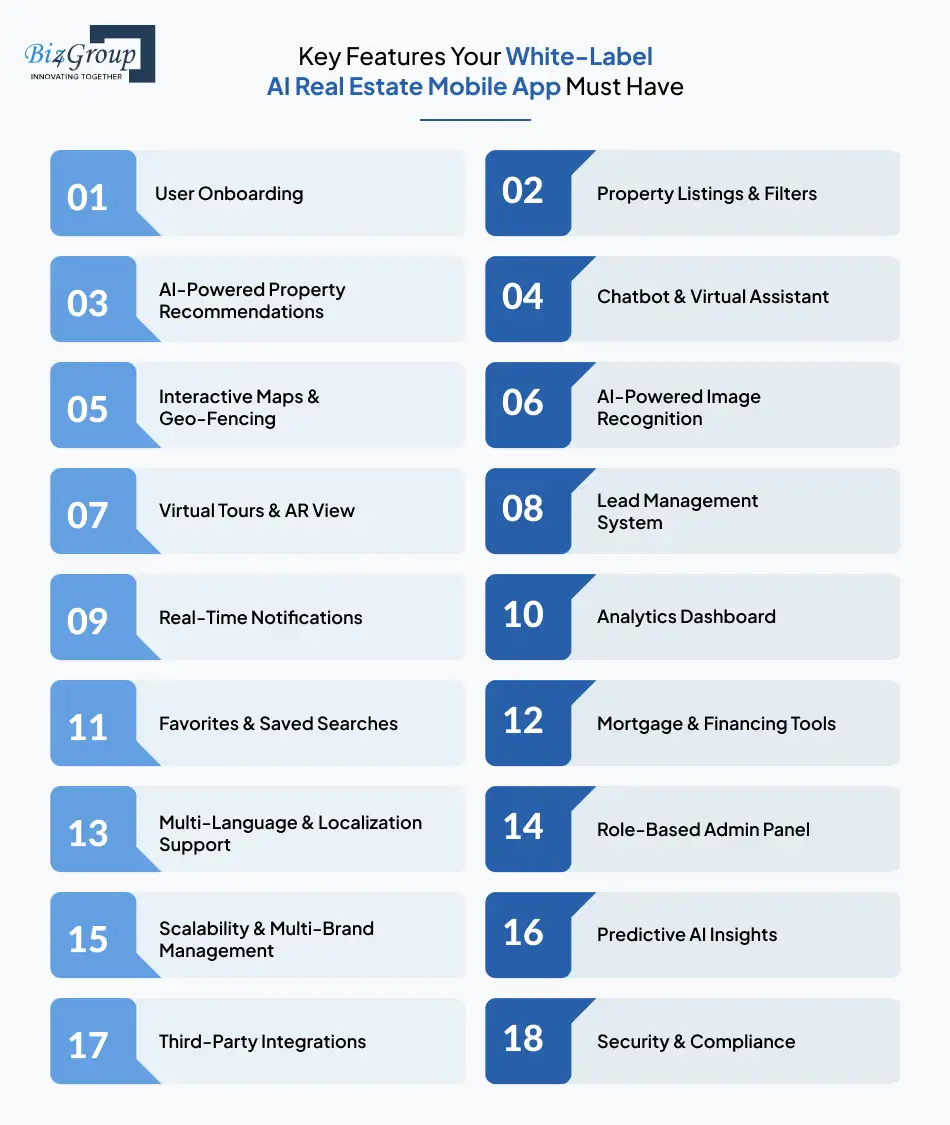
A powerful white-label AI real estate mobile app is more than just a listing platform. It’s your business hub, marketing channel, and digital assistant combined into one intelligent product. When you invest in white-label AI real estate app development, you create a seamless ecosystem that connects buyers, sellers, and agents through automation, data, and personalization.
Here’s a detailed look at the must-have features that make your app a market leader.
| Feature Category | Key Features | Why It Matters / How It Helps |
|---|---|---|
|
User Onboarding |
- Simple registration through social login, email, or phone number - Secure authentication with OTP and biometrics |
Quick onboarding keeps user acquisition smooth. A clean process ensures users start browsing listings immediately, improving engagement and conversions. |
|
Property Listings & Filters |
- Smart search powered by AI filters - Advanced sorting based on price, type, amenities, or location |
Users can find relevant listings instantly. The process of creating white-label AI real estate mobile app solutions should prioritize intuitive search for a superior experience. |
|
AI-Powered Property Recommendations |
- Personalized recommendations based on user preferences, search history, and engagement - Predictive suggestions for similar properties |
An essential capability inspired by an AI property recommendation app. This feature boosts engagement by showing users exactly what they’re looking for faster. |
|
Chatbot & Virtual Assistant |
- AI-driven chatbot for inquiries and support - Lead nurturing through conversational automation |
Partnering with an AI chatbot development company adds interactive communication that runs 24/7. It builds trust, captures leads, and provides instant responses. |
|
Interactive Maps & Geo-Fencing |
- Map-based navigation - Geo-fencing alerts for nearby properties |
Enhances usability by allowing buyers to visualize locations and receive alerts when new listings appear in their preferred areas. |
|
AI-Powered Image Recognition |
- Upload property photos to find similar listings - AI-based tagging of features like pool, garage, or balcony |
Makes search more intuitive. It helps users discover similar properties visually, adding innovation to your develop AI-powered white-label real estate application. |
|
Virtual Tours & AR View |
- 360-degree tours and virtual walkthroughs |
Enables potential buyers to experience properties remotely. This feature improves conversion rates while reducing the time agents spend on in-person visits. |
|
Lead Management System |
- Automatic lead capture, categorization, and scoring |
Centralizes all your leads, helping agencies follow up effectively. It ensures no opportunity is missed and improves sales velocity. |
|
Real-Time Notifications |
- Alerts for new listings, price changes, or inquiries - Personalized push notifications powered by AI |
Keeps users updated and re-engaged, increasing retention rates and repeat visits. |
|
Analytics Dashboard |
- Centralized dashboard with AI-powered insights - Predictive analytics for user engagement, lead quality, and market trends |
This transforms raw data into actionable intelligence. It helps agents and business owners optimize campaigns and property pricing strategies. |
|
Favorites & Saved Searches |
- Save listings and searches - AI suggests new options based on favorites |
Creates personalized experiences that encourage repeat visits and build user loyalty. |
|
Mortgage & Financing Tools |
- EMI and affordability calculators - Integration with financial service providers |
Simplifies the buyer’s decision-making process by providing instant affordability insights. |
|
Multi-Language & Localization Support |
- Support for multiple languages and currencies - Localized listings based on region |
Expands your reach into international and diverse domestic markets while offering personalized user experiences. |
|
Role-Based Admin Panel |
- Separate roles for agents, admins, and super admins - Permission-based access and controls |
Enhances security and simplifies large-scale operations for enterprises managing multiple agencies. |
|
Scalability & Multi-Brand Management |
- Centralized backend for multiple branded apps - Synchronization of listings and analytics |
Perfect for agencies or brokers managing several branches. The building of white-label AI real estate mobile app architecture makes scaling effortless. |
|
Predictive AI Insights |
- Forecasts property demand, optimal pricing, and lead potential - AI analyzes data for better strategy planning |
Helps real estate teams make proactive decisions and stay ahead of trends in a competitive market. |
|
Third-Party Integrations |
- Connect with CRM, ERP, or MLS systems - Integrate payment gateways, chat, and analytics APIs |
Expands your app’s functionality without heavy development, making your platform more connected and valuable. |
|
Security & Compliance |
- Data encryption, GDPR compliance, and SSL security - Role-based authentication |
Ensures user trust and meets data protection standards, a key factor in long-term success. |
A robust white-label AI real estate mobile app isn’t just about aesthetics or speed it’s about user experience, intelligence, and growth. Each feature serves a purpose: to automate workflows, personalize experiences, and generate actionable insights.
These capabilities together create a full-service platform where real estate agencies, property management companies, and brokers can grow faster and deliver more value. With advanced white-label AI real estate app development, you future-proof your business and stay at the forefront of real estate innovation.
Homer AI – Smart Features That Transform White-Label AI Real Estate Mobile Apps
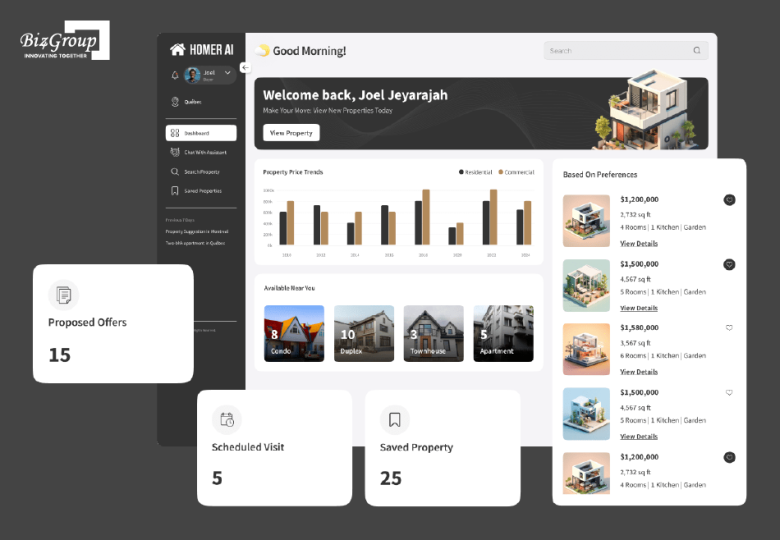
Homer AI is an intelligent property-management platform developed by Biz4Group to help property owners, agents, and residents manage properties efficiently. The system uses advanced analytics and automation to reduce operational effort, improve communication, and enhance tenant satisfaction.
Key Features:
- AI-Driven Property Insights: Generates smart analytics for occupancy, maintenance, and financial tracking.
- Predictive Maintenance Alerts: Uses machine learning to identify potential maintenance issues before they escalate.
- Tenant and Owner Dashboards: Centralizes lease management, payments, and communications for all users.
- Voice-Enabled Assistance: Allows users to access property data or initiate maintenance tasks through voice commands.
- Real-Time Communication Hub: Streamlines messages between tenants, owners, and property managers for faster resolution.
- Automation Tools: Simplifies routine workflows like scheduling, billing, and report generation.
The Homer AI project shows how to build a white-label AI real estate mobile app that combines automation, predictive analytics, and voice-based control to elevate the entire property-management experience.
Process of Creating a White-Label AI Real Estate Mobile App
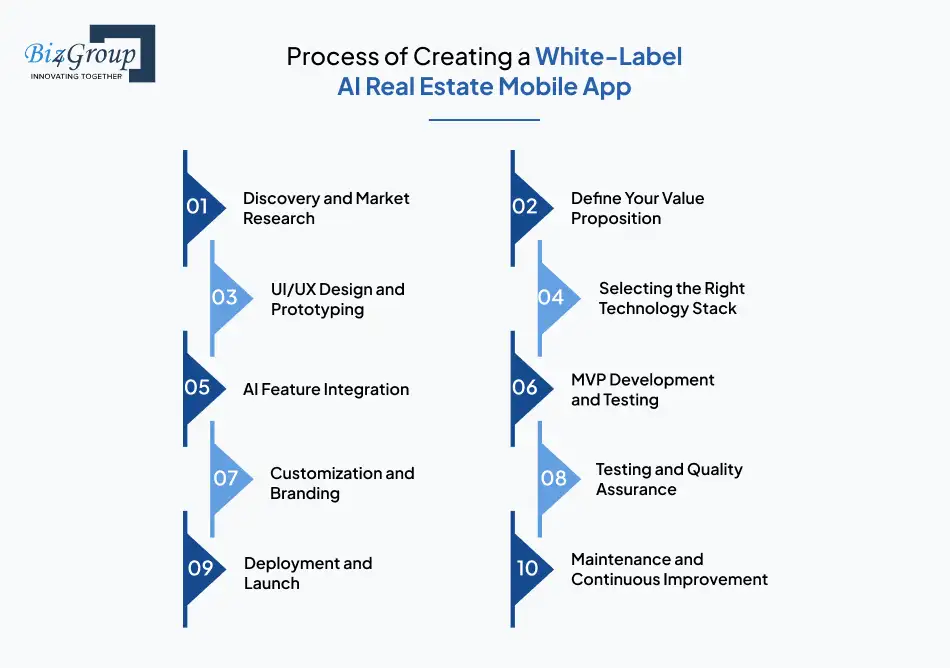
Developing a successful white-label AI real estate mobile app involves a clear, structured process that ensures every detail aligns with your business goals. Whether you are an agency, brokerage, or property management firm, this roadmap will help you build a white-label AI real estate mobile app that’s scalable, reliable, and optimized for user experience.
1. Discovery and Market Research
The first step in the process of creating white-label AI real estate mobile app solutions is understanding your audience and market dynamics. This stage helps define what problems your app will solve and which AI features will deliver the most value.
Key tasks include:
- Studying top competitors and existing real estate platforms
- Defining user personas and customer needs
- Setting measurable goals for success
2. Define Your Value Proposition
Your app should have a unique reason to exist. When you create white-label AI real estate mobile app solutions, you need a strong value proposition that highlights what sets your product apart in functionality, speed, and user experience.
Key tasks include:
- Identifying your app’s core differentiator
- Outlining your unique AI-driven features
- Clarifying your business model and market fit
3. UI/UX Design and Prototyping
A great design ensures a seamless experience from the first tap. Collaborating with a professional UI/UX design team helps transform your vision into a product users love to interact with.
Key tasks include:
- Creating wireframes and user flows for clarity
- Designing intuitive layouts and navigation paths
- Focusing on responsive design for all devices
4. Selecting the Right Technology Stack
The building of white-label AI real estate mobile app requires a solid technical foundation. A scalable and flexible tech stack ensures your app performs smoothly and adapts easily to new features.
Key tasks include:
- Choosing reliable frameworks such as React Native or Flutter
- Using robust backends like Node.js or Python
- Integrating APIs and databases for scalability
5. AI Feature Integration
AI brings automation and intelligence into your platform. Adding these capabilities allows you to develop AI-powered white-label real estate application solutions that provide smarter recommendations and predictive insights.
Key tasks include:
- Implementing AI modules for property search and lead scoring
- Adding chatbots and automation tools for user assistance
- Using predictive analytics for market trends and pricing
6. MVP Development and Testing
Before a full rollout, it’s smart to create an MVP development version of your app. This allows you to test real-world performance, gather feedback, and refine your idea before investing more resources.
Key tasks include:
- Building a feature-limited prototype
- Testing user engagement and functionality
- Using insights to improve the final product
7. Customization and Branding
White-label products shine through flexibility. A white-label AI real estate mobile app should support full customization for branding, themes, and workflows across different agencies or clients.
Key tasks include:
- Applying custom logos, colors, and visuals for each client
- Personalizing app layouts and dashboards
- Maintaining consistent quality across all versions
8. Testing and Quality Assurance
Testing ensures that your created white-label AI real estate mobile app meets performance, security, and usability standards. Each component should be validated before launch to ensure reliability.
Key tasks include:
- Conducting functional and performance testing
- Running security and compatibility checks
- Fixing issues identified during QA cycles
9. Deployment and Launch
With testing complete, your app is ready to go live. Launching strategically ensures a smooth rollout while monitoring early user feedback for quick improvements.
Key tasks include:
- Setting up deployment pipelines for faster releases
- Publishing on app stores and private platforms
- Tracking downloads and usage metrics
10. Maintenance and Continuous Improvement
The post-launch phase is about growth and optimization. Continuous updates help your white-label AI real estate app development stay competitive, secure, and aligned with evolving user needs.
Key tasks include:
- Regular updates for new AI features and security patches
- Monitoring performance with analytics tools
- Incorporating user feedback into future releases
Following these steps helps you build a white-label AI real estate mobile app that not only performs flawlessly but also drives measurable business outcomes. From concept to launch, each phase adds structure, efficiency, and intelligence to your real estate solution.
Curious how your app idea moves from concept to launch?
Our proven process makes creating white-label AI real estate mobile apps simple and strategic.
Let's Build TogetherTech Stack for White-Label AI Real Estate Mobile App Development
Choosing the right technology stack is crucial for performance, scalability, and future innovation. The right combination of tools helps you build a white-label AI real estate mobile app that’s fast, secure, and adaptable to client needs. It also ensures your white-label AI real estate app development can evolve with the latest trends in automation and user experience.
Below is the ideal stack for developing a develop AI-powered white-label real estate application that stands out in a competitive market.
| Layer | Technologies / Tools | Purpose / Benefits |
|---|---|---|
|
Frontend Development |
React Native, Flutter, Angular, Vue.js |
Enables cross-platform development for iOS and Android. These tools make the building of white-label AI real estate mobile app visually appealing, fast, and responsive. |
|
Backend Development |
Manages data processing, APIs, and authentication. Ideal for handling multiple agencies and property listings in real time. |
|
|
Database Management |
PostgreSQL, MongoDB, Firebase |
Efficiently stores listings, user data, and analytics. Supports growth as more clients and users join your platform. |
|
AI and Machine Learning |
TensorFlow, PyTorch, OpenAI API, Scikit-learn |
Powers automation and personalization. When guided by an expert AI agent team, these tools bring precision and intelligence to search, recommendations, and insights. |
|
Cloud Infrastructure |
AWS, Google Cloud, Microsoft Azure |
Ensures reliable hosting, secure storage, and faster scaling for multi-client deployments. |
|
APIs and Integrations |
RESTful APIs, GraphQL, MLS APIs |
Connects external data sources and services like payment gateways, CRM, and mapping. |
|
Automation and AI Tools |
Dialogflow, LangChain, IBM Watson |
Adds conversational support, predictive recommendations, and automated workflows. Perfect for real estate businesses adopting white-label AI real estate app development to enhance engagement. |
|
UI/UX Design Tools |
Figma, Adobe XD, Sketch |
Helps create beautiful, user-centric interfaces that align with your branding. Enhances navigation and retention. |
|
Analytics & Monitoring |
Google Analytics, Firebase Analytics, Mixpanel |
Tracks key metrics like property views, conversions, and engagement, enabling data-driven optimization. |
|
Testing & QA Tools |
Selenium, Appium, Jest, Postman |
Validates you create white-label AI real estate mobile app across devices to ensure it runs smoothly and without bugs. |
|
Security & Compliance |
SSL, OAuth 2.0, JWT, GDPR tools |
Protects sensitive user data and ensures full compliance with privacy laws. |
|
DevOps & CI/CD |
Docker, Jenkins, Kubernetes, GitHub Actions |
Automates deployment, scaling, and updates for continuous performance improvement. |
|
Enterprise Integrations |
CRM, ERP, and MLS data feeds |
Integrates enterprise-grade tools and enterprise AI solutions for large real estate networks and property management systems. |
When you build a white-label AI real estate mobile app, the technology stack becomes the backbone of your success. It determines how fast your app loads, how well it scales, and how securely it handles data.
A well-structured tech stack reduces development time, supports seamless AI integration, and keeps your app ready for the next wave of digital transformation in real estate.
Also Read: React JS Development Services
Cost Breakdown of Building a White-Label AI Real Estate Mobile App
When you decide to build a white-label AI real estate mobile app, the overall cost typically falls between $35,000 and $100,000+. This range depends on the complexity of features, technology stack, integrations, and customization level. The actual investment may differ based on your business goals and the type of agency you run.
For more details on budget planning, you can explore this AI real estate app development cost resource.
A well-planned white-label AI real estate app development project combines user-centric design, scalable architecture, and intelligent automation, all of which influence the total cost.
Feature-Wise Cost Breakdown for White-Label AI Real Estate App Development
| Feature Category | Core Elements | Estimated Cost Range (USD) |
|---|---|---|
|
User Onboarding & Authentication |
Email and social login, OTP verification, secure user access |
$2,000–$5,000 |
|
Property Listings & Filters |
Smart property search, AI-driven filters, location sorting |
$4,000–$8,000 |
|
AI-Powered Property Recommendations |
Predictive algorithms, personalization engine, real-time suggestions |
$6,000–$12,000 |
|
Chatbot & Virtual Assistant |
AI chatbot, automated lead capture, query handling |
$3,000–$7,000 |
|
Map & Geo-Fencing Features |
Map view, area insights, neighborhood data |
$3,000–$6,000 |
|
Virtual Tours & AR Integration |
360° walkthroughs, AR interior view |
$5,000–$10,000 |
|
Lead Management & CRM |
Smart CRM integration, automated workflows, lead analytics |
$4,000–$9,000 |
|
AI Analytics Dashboard |
Predictive insights, property performance metrics, engagement tracking |
$3,000–$6,000 |
|
UI/UX Design |
Interactive wireframes, intuitive layouts, brand customization |
$2,000–$5,000 |
|
Testing & Quality Assurance |
Functional, usability, and security testing |
$2,000–$4,000 |
|
App Deployment & Launch |
App store submission, configuration, optimization |
$1,000–$3,000 |
|
Maintenance & Updates |
Feature upgrades, bug fixes, AI model retraining |
$1,500–$3,000 per month |
Factors Affecting the Cost to Build a White-Label AI Real Estate Mobile App
Several variables influence the total investment needed to develop AI-powered white-label real estate application solutions. Knowing these in advance helps you make strategic budget decisions.
Key factors include:
- Feature Complexity: More advanced capabilities like predictive AI, automation, or chat integration raise development costs.
- Customization Requirements: Each agency or franchise may need unique branding or user flows, affecting cost.
- Platform Choice: Creating both Android and iOS versions increases development time and expense.
- Integration with AI Tools: Using APIs from real estate AI software or data-driven systems adds extra implementation cost.
- Data Processing & Hosting: Real-time property updates and cloud services impact ongoing infrastructure expenses.
- Team Expertise: Partnering with a specialized AI development team often increases upfront costs but ensures long-term quality and ROI.
Hidden Costs in White-Label AI Real Estate Mobile App Development
While estimating the building of white-label AI real estate mobile app, many companies overlook hidden costs that can impact the final budget. Planning for these upfront prevents surprises later.
Hidden costs to consider:
- Cloud Hosting Fees: Scalable infrastructure costs grow with user traffic.
- AI Licensing or Model Training: Pre-trained AI models or third-party APIs may have licensing charges.
- Data Labeling & Optimization: Custom AI models often require domain-specific data preparation.
- Regular Maintenance: Bug fixes, updates, and security upgrades add recurring costs.
- Customer Support Operations: Ongoing user assistance and backend monitoring require additional resources.
Cost Optimization Strategies for White-Label AI Real Estate App Development
You can significantly reduce your white-label AI real estate app development expenses by focusing on smart prioritization and lean execution.
Practical ways to save costs:
- Start with an MVP: Build an initial version with essential features and scale gradually.
- Use Modular Development: Reuse components across different branded versions of the app.
- Adopt Cloud Infrastructure: Choose scalable hosting so you only pay for what you use.
- Focus on High-Impact AI Features: Prioritize modules like chatbots and property recommendations that enhance engagement.
- Collaborate with Experts: A reliable AI partner ensures fewer revisions and better long-term performance.
The cost to create white-label AI real estate mobile app solutions varies depending on scale, AI depth, and business goals. However, the value it delivers through automation, branding flexibility, and faster go-to-market makes it a strategic investment for any real estate firm.
By understanding your AI real estate app development cost early, you can plan budgets efficiently and align your resources to achieve maximum ROI. A well-optimized, data-driven app becomes not just a tool, but a long-term asset for growth.
Thinking about budget before you build?
We'll help you balance innovation and ROI while keeping your AI real estate app development cost optimized.
Get a Custom QuoteHow to Choose the Best Partner for White-Label AI Real Estate App Development
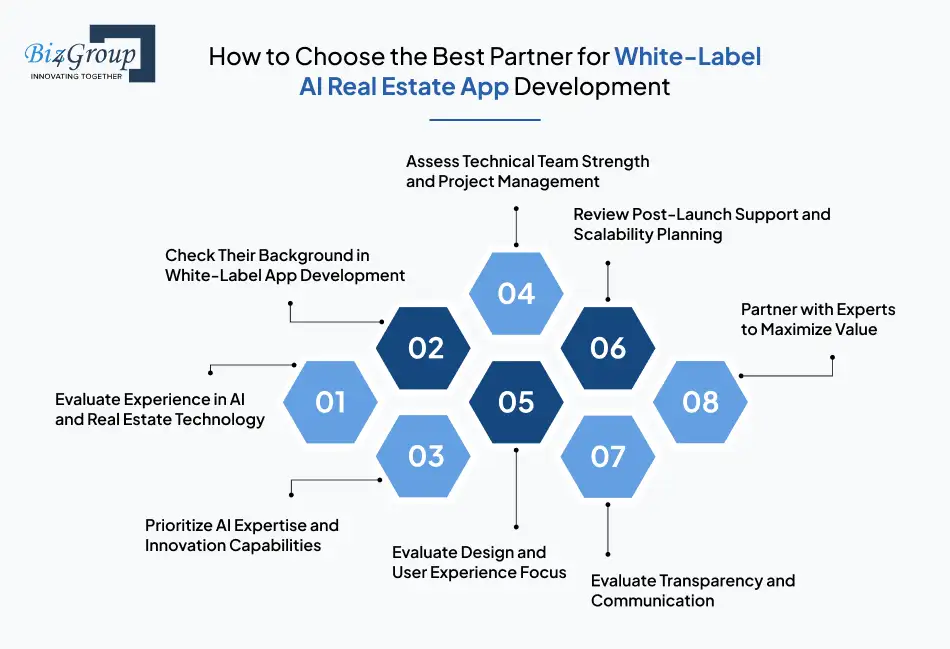
Choosing the right partner to build a white-label AI real estate mobile app can make or break your success. The ideal development partner combines technical mastery with real estate industry expertise, ensuring your white-label AI real estate app development process is seamless, innovative, and built for scalability.
A reliable partner helps you align business goals with technology, integrate AI effectively, and deliver a product that grows with your company.
1. Evaluate Experience in AI and Real Estate Technology
Your partner should have deep expertise in develop AI-powered white-label real estate application solutions. They must understand how AI transforms property discovery, customer engagement, and predictive analysis for better decision-making.
What to check:
- Proven portfolio of AI-driven real estate apps
- Experience in automation, predictive analytics, and personalization
- Ability to merge domain knowledge with advanced technology
2. Check Their Background in White-Label App Development
A team experienced in white-label solutions ensures faster delivery and customization flexibility. They understand how to create white-label AI real estate mobile app products that can be easily branded and resold to multiple clients.
What to check:
- Expertise in multi-tenant architecture and modular coding
- Experience with scalable platforms for different real estate agencies
- Proven ability to manage multiple branded versions under one framework
3. Prioritize AI Expertise and Innovation Capabilities
Look for a development partner skilled in next-generation AI tools and automation. The team should understand agentic AI development, where AI agents perform intelligent tasks autonomously to enhance user experience and operational efficiency.
What to check:
- Proficiency in natural language processing, chatbots, and machine learning
- Ability to build self-learning AI systems for smarter property matching
- Knowledge of frameworks that support evolving AI technologies
4. Assess Technical Team Strength and Project Management
A strong development team ensures efficiency, communication, and accountability. When you build a white-label AI real estate mobile app, every role (from developers to AI engineers) plays a part in timely delivery and performance.
What to check:
- Dedicated team for backend, frontend, and AI integration
- Transparent workflows and agile development practices
- Use of collaboration tools for real-time project tracking
5. Evaluate Design and User Experience Focus
Great design builds trust and user retention. Your partner should have strong UI and UX expertise to ensure your building of white-label AI real estate mobile app looks polished, loads quickly, and feels intuitive.
What to check:
- Focus on mobile-first, intuitive designs
- Experience designing real estate apps with strong brand consistency
- Emphasis on accessibility and usability
6. Review Post-Launch Support and Scalability Planning
Launching your app is only the start. Your partner should offer long-term support, continuous optimization, and scalability planning to adapt to market growth.
What to check:
- Maintenance services and version updates
- Quick issue resolution and uptime monitoring
- Capability to scale infrastructure as your client base expands
7. Evaluate Transparency and Communication
Clear communication keeps your project aligned with expectations. A good partner maintains transparency about timelines, deliverables, and costs throughout the process of creating white-label AI real estate mobile app solutions.
What to check:
- Detailed proposals with defined milestones
- Regular progress reports and review sessions
- Clear ownership terms for source code and intellectual property
8. Partner with Experts to Maximize Value
A great partner focuses on value, not just pricing. Collaborating with AI specialists helps you innovate faster and reduce long-term costs. If you want in-house support, you can hire AI developers to strengthen your internal team while keeping the project under your control.
What to check:
- Strong track record in AI project delivery
- Flexible engagement models for development or consulting
- Proven ability to align technical solutions with business ROI
The right partner does more than write code. They act as a technology ally who understands your goals, suggests smarter approaches, and brings your vision to life through innovation and AI intelligence.
Choosing a team with proven expertise in white-label AI real estate app development, agentic AI, and scalable architecture ensures you create a future-ready platform that grows with your business. The right collaboration sets your company up for lasting success in the rapidly evolving property technology landscape.
Challenges in White-Label AI Real Estate App Development and How to Solve Them
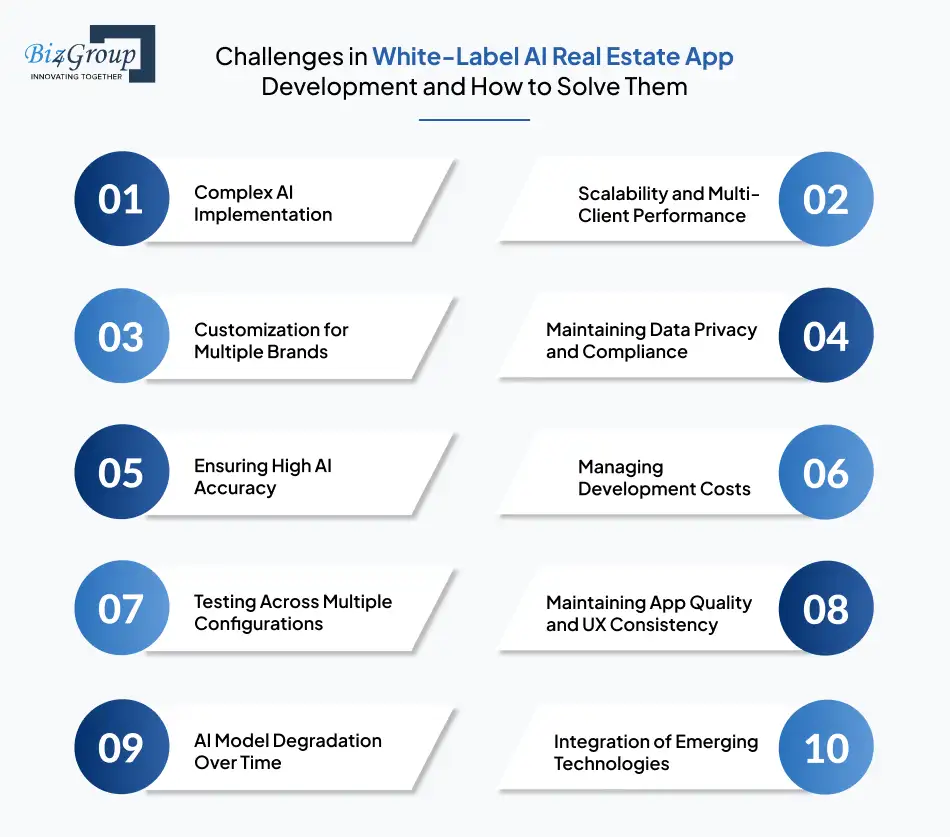
Developing a white-label AI real estate mobile app can be rewarding but also challenging. The complexity lies in balancing scalability, customization, and advanced AI functionality while maintaining quality across multiple client deployments.
Here’s a breakdown of the most common challenges faced in white-label AI real estate app development and how to overcome them effectively.
| Challenges | Impact on Development | Effective Solutions |
|---|---|---|
|
Complex AI Implementation |
Integrating multiple intelligent features like chatbots, virtual tours, and smart property recommendations can lead to compatibility issues. |
Use modular AI architectures and APIs to simplify integration. Learn from proven use cases like the AI property management app that blend automation with efficiency. |
|
Scalability and Multi-Client Performance |
As the building of white-label AI real estate mobile app scales to multiple agencies, data load and API response times can degrade. |
Implement cloud-based architecture with auto-scaling, caching, and optimized load balancing to maintain consistent performance. |
|
Customization for Multiple Brands |
Supporting unique branding, features, and UI for several clients without duplicating code can slow down releases. |
Build modular components and use centralized configuration systems that allow quick visual and feature customizations. |
|
Maintaining Data Privacy and Compliance |
Managing sensitive property and user data across multiple agencies increases security risks. |
Use encryption, secure APIs, and follow global privacy standards such as GDPR and CCPA to safeguard user trust. |
|
Ensuring High AI Accuracy |
AI predictions and property matches can fail if models are not trained on updated or region-specific data. |
Regularly retrain your AI models using new datasets and property trends to improve recommendation accuracy. |
|
Managing Development Costs |
Over-customization and repeated testing can increase your white-label AI real estate app development costs. |
Adopt a lean development strategy with clear feature prioritization and continuous feedback loops. |
|
Testing Across Multiple Configurations |
White-label apps must work across brands, devices, and data sets, which multiplies QA efforts. |
Automate testing with cloud-based tools and integrate quality assurance at every sprint cycle. |
|
Maintaining App Quality and UX Consistency |
Different agencies may request unique designs, making it hard to maintain a uniform experience. |
Use a shared design system and cross-brand UX guidelines similar to those applied in AI virtual property tour app projects. |
|
AI Model Degradation Over Time |
AI models may lose accuracy as data patterns change, affecting property recommendations and insights. |
Set up continuous model monitoring, retraining, and validation pipelines to ensure your develop AI-powered white-label real estate application remains reliable. |
|
Integration of Emerging Technologies |
Adapting new trends like generative AI, AR, or virtual staging can create architectural challenges. |
Keep your tech stack flexible to accommodate upgrades and align them with your long-term innovation roadmap. |
Each challenge in create white-label AI real estate mobile app projects can be solved through strategic planning, advanced AI tools, and proactive testing. Businesses that anticipate these issues early can reduce costs, improve performance, and deliver consistent results for all their clients.
Whether it’s scaling across markets, integrating automation, or refining user experience, every improvement strengthens your ability to lead in proptech innovation.
How Biz4Group Tackled Complex Workflows in White-Label AI Real Estate App Development – Contracks Case Study
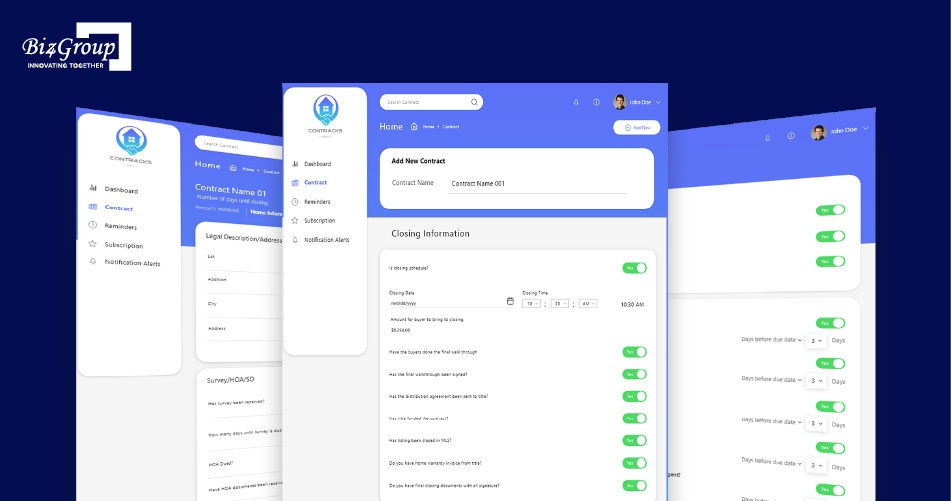
Biz4Group built Contracks, a smart real estate platform that simplifies contract management for agents, buyers, and lenders. The solution automates workflows, enhances visibility, and supports faster deal closures through AI-driven process tracking.
Key Challenges and Solutions:
- Challenge: Managing multi-role access and contract dependencies within a single system.
Solution: Implemented modular architecture and role-based access to streamline operations. - Challenge: Ensuring secure payments and compliance during real estate transactions.
Solution: Integrated encrypted APIs and reliable payment gateways for smooth operations. - Challenge: Delivering real-time performance across mobile and web versions.
Solution: Optimized backend processes and created a responsive UI for consistent performance.
This project highlights how to build a white-label AI real estate mobile app that balances scalability, compliance, and seamless collaboration across multiple user types.
Why Biz4Group is the Right Partner to Build a White-Label AI Real Estate Mobile App
Choosing Biz4Group to build a white-label AI real estate mobile app means partnering with a team that understands technology, scalability, and real estate business goals. We specialize in white-label AI real estate app development that helps agencies, brokers, and property managers deliver powerful, branded solutions faster.
Projects like Homer AI and Contracks show our ability to turn complex ideas into intelligent, user-friendly platforms. These real-world applications highlight how we create AI-driven products that automate workflows, enhance collaboration, and boost ROI.
Whether you want to develop AI-powered white-label real estate applications or explore new real estate AI app ideas, our expert team provides end-to-end support, from strategy to launch. With proven experience in AI, automation, and app scalability, Biz4Group is the trusted partner you need to stay ahead in today’s proptech market.
Looking for a tech team that just gets real estate?
Work with Biz4Group, your partner to develop AI-powered white-label real estate applications that win markets.
Schedule a CallConclusion: Building the Future of Real Estate with White-Label AI Solutions
In the fast-moving proptech landscape, businesses that build a white-label AI real estate mobile app position themselves for faster growth, smarter automation, and a stronger competitive edge. These solutions simplify operations, enhance customer engagement, and help agencies deliver value at scale.
Biz4Group stands as a trusted leader in white-label AI real estate app development, known for its technical excellence, strategic insight, and consistent delivery of high-performing AI-driven platforms. Our proven experience in real estate innovation allows us to help clients transform ideas into scalable, revenue-generating solutions.
If you are ready to create a white-label AI real estate mobile app that empowers your brand and accelerates success, connect with Biz4Group today to start building your next breakthrough.
FAQ
1. How much does it cost to build a white-label AI real estate mobile app?
The cost to build a white-label AI real estate mobile app often falls between $35,000 and $100,000+, depending on features, integrations, and customization. If you include advanced AI modules, multi-platform support, or multi-tenant architecture the investment may increase. Planning for these elements early helps align your budget and avoid surprises.
2. When should a business consider a white-label AI real estate app solution?
You should consider a white-label AI real estate app development strategy when you need fast rollout, consistent branding across multiple agencies or franchises, and built-in AI capabilities. If you are streamlining operations, scaling regionally, or entering new markets a white-label model offers speed and cost advantages. It allows you to focus on business growth instead of rebuilding infrastructure.
3. What are the key features of a successful white-label AI real estate mobile app?
When you create white-label AI real estate mobile app solutions, essential features include personalized property search, AI-driven recommendations, chatbots, analytics dashboards, and brand-customized UI. These features drive user engagement, support agents and brokers, and support your revenue goals. Prioritizing them helps differentiate your platform in a competitive real-estate market.
4. How can real-estate companies monetize a white-label AI real-estate app?
Monetization strategies for white-label AI real estate app development include subscription or licensing fees, commission on leads or transactions, premium features, and data-insights services. By aligning your business model with how agencies use the app you create recurring income. Smart monetization ensures the app becomes a growth engine rather than just a product.
5. What technology stack works best for AI-driven white-label real-estate app development?
To develop AI-powered white-label real estate application platforms effectively, use cross-platform frameworks like React Native or Flutter, backend technologies such as Node.js or Python, and AI frameworks like TensorFlow or PyTorch. Utilizing cloud infrastructure supports scalability and performance. A well-chosen stack positions your app for growth and long-term success.
6. What are the common challenges in white-label AI real estate app development and how can they be addressed?
Businesses building white-label AI real estate mobile apps often face challenges around AI integration, scalability, data security, and brand customization for multiple clients. These issues can be solved by adopting modular architecture, strong data practices, and flexible white-label frameworks. Early planning and expert partner support help you avoid roadblocks and deliver reliably.
7. How do I choose the right partner to create a white-label AI real-estate mobile app?
Choosing the right partner ensures successful build a white-label AI real estate mobile app projects. Look for developers with proven experience in real-estate, AI integration, white-label platforms, and scalability. The right team helps align technology with your business goals, supports ongoing updates, and ensures your branded solution delivers measurable results.
