 Location :
Orlando, FL, USA
Location :
Orlando, FL, USA +1 (407) 714-1616
 info@biz4group.com

- Build an AI case outcome prediction tool for law firms to move from intuition-based decisions to data-backed litigation strategy and clearer risk assessment.
- AI case outcome prediction tool development combines legal data, predictive analytics software, and probability modeling to forecast outcomes and support smarter legal decisions.
- Core and advanced capabilities help firms build AI powered legal outcome prediction tools that deliver outcome probabilities, risk scores, and strategic insights attorneys trust.
- A structured roadmap, the right architecture, and a scalable tech stack make it easier to develop AI case outcome prediction software that fits real legal workflows.
- Costs typically range from $25,000 to $200,000+, and experienced teams like Biz4Group help create AI case outcome prediction solutions for small and large law firms without adding complexity.
You’ve probably been in this situation before.
A client asks, “What are our chances?”
Your team reviews precedent, past experience, and gut instinct.
The answer is informed, but still uncertain.
That uncertainty is exactly where many law firms feel stuck today.
- Litigation has become more complex.
- Clients are more cost-conscious.
- And decisions are expected to be backed by data, not just confidence.
At the same time, legal teams are sitting on years of valuable case data that rarely gets used beyond basic reporting. That gap between what you know and what your data could tell you is where AI changes the game.
According to recent industry findings, nearly 79% of law firms now use technology-driven tools in everyday workflows, showing how legal practices are embracing smarter systems to improve outcomes.
And analysts predict that the legal AI market will be valued at over USD 2.1 billion in 2025, growing rapidly as firms invest in predictive analytics and decision tools.
We’re seeing forward-thinking firms move beyond intuition and toward predictive insights powered by enterprise AI solutions. Not because they want to replace lawyers, but because they want better visibility into risk, outcomes, and strategy before committing time and resources.
An AI case outcome prediction tool helps you do exactly that. It turns historical case data into probability-based insights you can actually use. Not in theory, but in real conversations with clients, partners, and internal stakeholders.
If you’re a founder, CTO, or legal tech decision-maker, you’re likely asking a practical question right now.
How do you build something like this without adding complexity or compliance risk?
That’s what this guide is here for.
We’ve worked with legal and enterprise teams as an AI development company, helping them move from ideas to production-ready systems that lawyers actually trust and use. In the sections ahead, we’ll break this down step by step, in plain language, with real-world considerations.
No hype, no guesswork, just a clear path to building an AI case outcome prediction tool that supports smarter legal decisions.
Let’s start with the basics and build from there.
What Is an AI Case Outcome Prediction Tool for Law Firms and How AI Is Changing the Legal Playbook?
Let’s level set before going deeper.
An AI case outcome prediction tool for law firms is not a crystal ball. It does not promise certainty. What it gives you is something far more useful. Probability, patterns, and perspective based on real legal data.
At its core, this type of solution analyzes historical case outcomes, court behavior, judge tendencies, jurisdictional nuances, and key case attributes. It then turns that information into outcome likelihoods that support real decisions. This is the foundation of AI case outcome prediction tool development and why it is gaining traction across modern legal teams.
Think of it as a strategic layer added on top of your legal expertise, not a replacement for it.
If you have already explored or invested in a legal AI app, this will feel like a natural next step. While many legal apps focus on productivity, prediction tools focus on judgment. They help you move from faster work to smarter decisions.
This is where firms start to build AI powered legal outcome prediction tools that directly influence litigation planning and client strategy.
Instead of only answering questions after a case progresses, these tools help you ask better questions earlier, such as:
- How strong is this case based on similar outcomes?
- What litigation risk are we really taking on?
- Does settlement make more sense given this judge and jurisdiction?
- How should we position this case with the client?
That shift is changing how legal teams operate.
Traditionally, legal technology centered on efficiency. Document handling. Research workflows. Case tracking. Today, AI is moving into strategic territory through AI legal prediction software development.
For example, platforms like an AI legal consultation platform help guide users through legal options and next steps. An AI case outcome prediction tool goes further. It supports decision making by quantifying risk and outcome probability before major resources are committed.
The same contrast applies when you look at an AI legal research platform. Research tools help you find relevant precedent. Prediction tools help you understand how that precedent is likely to influence results in a specific court, under specific conditions.
This is why more firms are choosing to create AI-driven case outcome analysis tools as part of their broader legal analytics strategy.
- Instead of reacting late in the process, you can assess litigation risk early.
- Instead of relying solely on instinct, you can validate strategy with data.
- Instead of giving clients wide outcome ranges, you can offer clearer, more confident guidance.
For law firms, this means stronger strategy, better client trust, and smarter use of time and resources. It also opens the door to creating AI case prediction platforms for law firms that scale across practice areas and jurisdictions.
Next, let’s walk through how these systems actually work behind the scenes, from data ingestion to prediction output, without drowning in technical complexity.
Also Read: How to Build an AI-Powered Medical–Legal Expert Platform: Features, Cost & Tech Stack
Still guessing case outcomes in a data-driven world?
Over 75% of law firms now use AI in daily workflows, yet most still rely on instinct for litigation strategy. You do not have to.
Talk to Our AI Legal ExpertsFrom Historical Data to Courtroom Foresight: How an AI Case Outcome Prediction Tool for Law Firms Actually Works
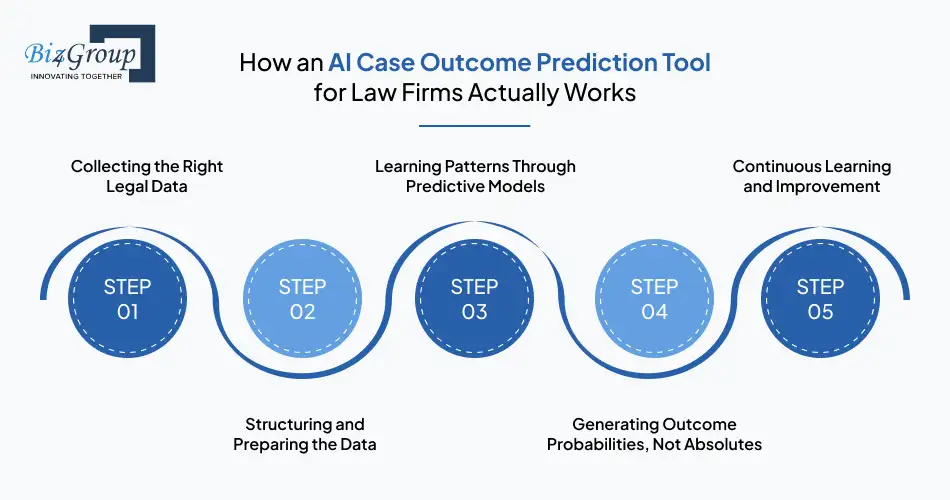
If you are considering AI case outcome prediction tool development, you are probably wondering what really happens behind the scenes. Let’s walk through it step by step in a way that makes sense, even if you are not deep into AI.
Step 1: Collecting the Right Legal Data
Every prediction starts with data. Not just any data, but the kind that reflects how cases actually unfold.
This typically includes:
- Past case filings and judgments
- Case types, claims, and defenses
- Judge and court history
- Jurisdiction-specific trends
- Settlement vs trial outcomes
When firms create AI case outcome prediction systems for legal teams, this step often determines success or failure. Poor data leads to weak predictions.
This is where AI automation services become essential. Automation helps ingest, clean, and structure large volumes of legal data without overwhelming your team.
Step 2: Structuring and Preparing the Data
Legal data is messy. Different formats. Inconsistent language. Missing details.
Before any prediction happens, the system standardizes and labels this data so machines can understand it. Think of this as teaching the system what matters and what does not.
This preparation phase is a core part of legal analytics software development with AI. It ensures the model compares similar cases instead of mixing unrelated ones.
Step 3: Learning Patterns Through Predictive Models
Once the data is ready, machine learning models analyze it to find patterns humans would struggle to spot at scale.
These models learn things like:
- How certain judges rule in specific scenarios
- How outcomes shift based on jurisdiction
- Which factors influence settlement vs trial success
This is the same foundation used in predictive analytics software, adapted specifically for legal decision making rather than general business forecasting.
When firms develop AI powered legal outcome prediction software for enterprises, this is where the system starts delivering real strategic value.
Step 4: Generating Outcome Probabilities, Not Absolutes
A well-built system does not say you will win or lose.
Instead, it provides:
- Probability ranges
- Risk scores
- Confidence levels
- Scenario comparisons
This approach is critical when you build AI-powered case outcome prediction software for litigation. Lawyers need insight, not rigid answers.
You remain in control. The system supports your judgment instead of overriding it.
Step 5: Continuous Learning and Improvement
Legal environments change. New rulings. New precedents. New behaviors.
That is why modern teams develop intelligent legal prediction applications that learn over time. As new cases and outcomes are added, the model recalibrates and improves.
This ongoing learning loop ensures predictions stay relevant and reliable.
Why This Working Model Matters to You
Understanding how this works helps you make better decisions as a leader.
You can:
- Set realistic expectations internally
- Build trust with attorneys using the tool
- Explain results clearly to clients
- Scale prediction across practice areas
And most importantly, you avoid building a black box no one trusts.
Next, we will move into the core features law firms expect from AI case outcome prediction software, so you can clearly define what your solution must deliver from day one.
Core Features Law Firms Expect from AI Case Outcome Prediction Software
When you build an AI case outcome prediction tool for law firms, features are not about looking impressive on a product sheet. They decide whether attorneys actually trust the system and use it in real cases.
Below are the must-have features every serious AI case outcome prediction software should include, explained clearly and practically.
1. Case Outcome Probability Forecasting
This is the heart of the platform. The system should estimate the likelihood of winning, losing, or settling a case based on historical data, jurisdiction, and case attributes. Instead of vague predictions, you get percentage-based outcomes that support strategy discussions and client conversations. This capability is central to AI case outcome prediction tool development.
2. Judge, Court, and Jurisdiction Intelligence
Legal outcomes vary widely depending on where and who hears the case. A strong solution analyzes judge behavior, court trends, and jurisdiction-specific patterns to surface meaningful insights. This allows firms to make AI case outcome prediction software for law firm strategy rather than relying on generalized assumptions.
3. Similar Case Matching and Precedent Comparison
The system should automatically identify cases that closely resemble the current matter in terms of facts, claims, and outcomes. This helps attorneys ground predictions in real precedent rather than abstract theory. It is a critical capability when firms create AI-driven case outcome analysis tools that attorneys actually trust.
4. Litigation Risk Scoring
Beyond predicting outcomes, the platform should quantify risk. Risk scores help legal teams weigh cost, time, and reputational exposure before proceeding. This feature is especially valuable when firms create AI legal prediction tools to assess litigation risk across multiple cases or portfolios.
5. Scenario Analysis and Strategy Comparison
Law firms rarely pursue a single path. The tool should allow teams to compare outcomes across different strategies, such as early settlement versus trial. This empowers legal leaders to build AI powered legal outcome prediction tools that support proactive, not reactive, decision making.
6. Integration With Existing Legal Systems
Prediction tools should not live in isolation. Seamless integration with AI legal case management software ensures attorneys can access insights directly within their existing workflows. This reduces friction and increases adoption across legal teams.
7. Client-Ready Reporting and Visualization
Clear charts, outcome summaries, and visual insights make predictions easier to explain to non-legal stakeholders. Whether shared internally or through an AI website for law firms, this feature helps firms communicate strategy with confidence and transparency.
8. Explainability and Confidence Indicators
Lawyers need to understand why a prediction was made. The system should highlight key factors influencing outcomes and display confidence levels. This transparency is essential when firms develop AI case outcome prediction software that must stand up to scrutiny from partners, clients, and regulators.
9. Role-Based Access and Data Security Controls
Not every user needs the same level of access. Role-based permissions protect sensitive case data while ensuring the right stakeholders see the right insights. This is a baseline requirement for custom AI case outcome prediction development, especially for firms handling high-stakes litigation.
Together, these features form the foundation of a reliable, scalable platform. Without them, even the most advanced models struggle to gain traction inside law firms.
Advanced Features That Turn AI Case Outcome Prediction Tools into Strategic Assets
Once the core features are in place, advanced AI capabilities are what separates a basic prediction tool from a system that truly influences firm-wide strategy.
These features help you move from insight to action, scale across teams, and future-proof your investment. When firms build AI powered legal outcome prediction tools, this is where long-term value shows up.
|
Advanced Feature |
What It Does |
Why It Matters for Law Firms |
|---|---|---|
|
Explainable AI Decision Paths |
Shows which data points and factors influence a prediction, such as judge behavior or case type weighting. |
Builds trust with attorneys and clients by making predictions transparent and defensible. |
|
Autonomous Scenario Simulation |
Automatically tests multiple litigation paths like settlement timing or trial strategy using predictive modeling. |
Helps firms plan proactively instead of reacting late in the process. |
|
Agent-Based Legal Reasoning |
Use intelligent agents to analyze cases, surface risks, and recommend next steps based on goals. |
This is where agentic AI development adds value by enabling systems to reason, not just predict. |
|
AI-Powered Litigation Assistants |
Acts as an internal assistant that answers case-related questions using prediction data and context. |
An embedded AI agent improves adoption by meeting lawyers where they work. |
|
Dynamic Risk Adjustment Engine |
Updates outcome probabilities in real time as new filings, rulings, or evidence appear. |
Keeps strategy aligned with reality instead of outdated assumptions. |
|
Cross-Case Portfolio Intelligence |
Analyze outcomes and risk across multiple cases, clients, or practice areas at once. |
Enables leadership to optimize resources and prioritize high-impact matters. |
|
Custom Strategy Weighting Models |
Allows firms to adjust how different factors influence predictions based on internal priorities. |
Supports custom AI legal prediction tool development services tailored to each firm’s philosophy. |
|
Bias Detection and Fairness Audits |
Monitors predictions for bias related to jurisdiction, demographics, or historical imbalance. |
Critical for ethical use and long-term credibility of AI legal prediction software development. |
|
Multi-Jurisdiction and Multi-Practice Learning |
Trains models to adapt across states, courts, and practice areas without rebuilding from scratch. |
Essential when firms develop AI powered legal outcome prediction software for enterprises. |
|
Client-Facing Predictive Dashboards |
Secure dashboards that share outcome insights with clients in a controlled way. |
Strengthens transparency and trust while supporting data-driven legal advice. |
These advanced features are not about complexity for its own sake. They are about control, clarity, and confidence at scale.
When designed correctly, they help law firms move beyond isolated predictions and toward intelligent systems that support every stage of litigation planning.
What if your case strategy came with probabilities, not assumptions?
Core and advanced AI features can turn past cases into actionable insight your attorneys actually trust.
Build My AI Prediction ToolHow to Build an AI Case Outcome Prediction Tool for Law Firms Step by Step?
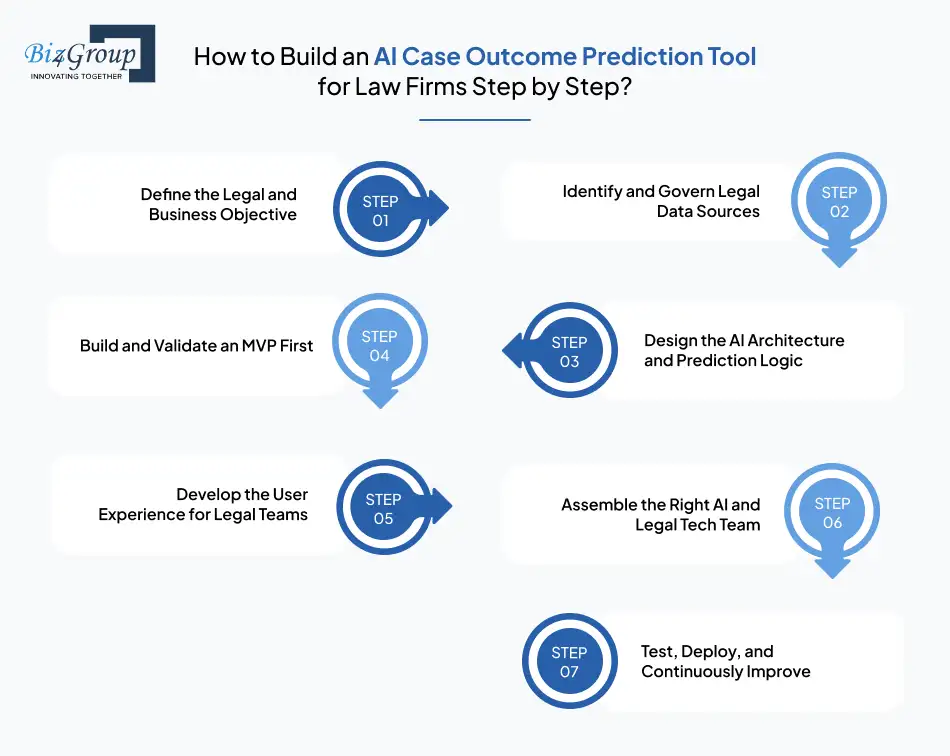
Building a reliable system is not about rushing into algorithms. It is about structuring the work so legal accuracy, business value, and AI capability grow together. This is the foundation of custom AI case outcome prediction development that actually works in real law firm environments.
Step 1: Define the Legal and Business Objective
You start by clarifying what the tool must solve. Some firms want to assess litigation risk early, others want to improve settlement strategy or portfolio decisions. This clarity shapes how you build an AI case outcome prediction tool for law firms that delivers measurable value.
Key focus areas:
- Practice areas and case types to include
- Decisions the prediction software should support
- Internal users such as partners, litigators, or legal ops
Step 2: Identify and Govern Legal Data Sources
Strong predictions depend on relevant and compliant data. This step defines which historical cases, court records, and outcomes can be used safely and accurately. It is a critical phase when firms develop AI case outcome prediction software for regulated legal environments.
Key focus areas:
- Internal case history and outcomes
- External court, judge, and jurisdiction data
- Data privacy, access control, and audit readiness
Step 3: Design the AI Architecture and Prediction Logic
Here, data turns into intelligence. You define how models process legal signals and produce outcome probabilities. This stage underpins AI legal prediction software development and determines how scalable and explainable the system will be.
Many firms collaborate with an AI product development company to ensure the architecture supports long-term growth and compliance.
Key focus areas:
- Machine learning and statistical modeling approach
- Explainability and confidence scoring
- Integration with legal analytics systems
Step 4: Build and Validate an MVP First
Instead of betting everything on a full rollout, smart teams start small. An MVP allows you to test assumptions, validate accuracy, and refine workflows before scaling. This approach reduces risk when firms create AI case prediction platforms for law firms.
This phase aligns closely with structured MVP development for AI-driven legal products.
Key focus areas:
- Limited jurisdiction or case type scope
- Early prediction benchmarks
- Feedback from practicing attorneys
Step 5: Develop the User Experience for Legal Teams
Adoption depends on usability. Lawyers need clarity, not clutter. The interface should clearly explain predictions, risks, and confidence without technical complexity. This is essential when firms make AI case outcome prediction software for law firm strategy.
Key focus areas:
- Clear outcome probabilities and explanations
- Visual risk indicators and summaries
- Seamless fit into existing legal workflows
Step 6: Assemble the Right AI and Legal Tech Team
Legal prediction tools require specialized expertise. You need professionals who understand machine learning and legal reasoning equally well. Many firms choose to hire AI developers experienced in building AI case outcome prediction solutions for small and large law firms.
Key focus areas:
- AI engineers and data scientists
- Legal domain specialists
- Security and compliance experts
Step 7: Test, Deploy, and Continuously Improve
Once live, the work does not stop. Models must evolve as new cases, rulings, and behaviors emerge. Continuous improvement ensures you develop AI powered legal outcome prediction software for enterprises that stay accurate and trusted over time.
Key focus areas:
- Ongoing model performance monitoring
- Bias detection and validation checks
- Continuous data and feature updates
Following these steps helps you build AI litigation outcome prediction systems that lawyers trust, clients respect, and firms can scale with confidence.
Choosing the Right Tech Stack for AI Case Outcome Prediction Software Development
The tech stack you choose has a direct impact on performance, scalability, security, and long-term flexibility. When you build AI case outcome prediction software for law firms, each layer should support accuracy, compliance, and smooth adoption by legal teams.
Below is a practical, industry-tested tech stack layout used in AI legal prediction software development.
|
Layer |
Tools and Technologies |
Description |
|---|---|---|
|
Frontend (Web Interface) |
Used to build intuitive dashboards that display predictions, risk scores, and explanations clearly for attorneys and partners. |
|
|
Frontend (Mobile Interface) |
React Native, Flutter |
Enables mobile access to case insights for lawyers who need predictions on the go. |
|
UI and Experience Design |
Focuses on clarity, trust, and usability so legal teams can interpret predictions without confusion. |
|
|
Backend Application Layer |
Handles business logic, user authentication, and secure communication between frontend and AI models. |
|
|
AI and Machine Learning Layer |
Python, TensorFlow, PyTorch, Scikit-learn |
Powers outcome prediction models, probability scoring, and continuous learning workflows. |
|
Natural Language Processing Layer |
SpaCy, Hugging Face Transformers, NLTK |
Processes legal text such as judgments, filings, and briefs for feature extraction and analysis. |
|
Data Processing and Pipelines |
Apache Airflow, Pandas, Spark |
Automates ingestion, cleaning, and transformation of large legal datasets. |
|
Database (Structured Data) |
PostgreSQL, MySQL |
Stores structured case data, metadata, and prediction outputs securely. |
|
Database (Unstructured Data) |
MongoDB, Elasticsearch |
Manages legal documents, court opinions, and searchable text data. |
|
AI Integration Layer |
Connects the prediction engine with case management systems and external legal tools. |
|
|
Conversational Interface |
Enables lawyers to query predictions and case insights using natural language. |
|
|
Cloud Infrastructure |
AWS, Azure, Google Cloud |
Supports scalable deployment, secure storage, and high availability for enterprise use cases. |
|
Security and Compliance |
OAuth 2.0, JWT, Encryption (AES, TLS) |
Ensures role-based access, data protection, and compliance with legal confidentiality standards. |
|
Monitoring and Model Management |
MLflow, Prometheus, Grafana |
Tracks model performance, system health, and prediction accuracy over time. |
|
Deployment and DevOps |
Docker, Kubernetes, CI/CD Pipelines |
Enables smooth updates, version control, and reliable scaling across environments. |
This layered approach helps firms develop intelligent legal prediction applications that are secure, scalable, and ready for real-world legal workflows.
Cost Breakdown: What It Takes to Build an AI Case Outcome Prediction Tool for Law Firms
If you are planning to build an AI case outcome prediction tool for law firms, cost is usually the first hard question. The short answer is this: most projects fall between $25,000 and $200,000+, depending on scope, data complexity, and feature depth. This range varies because no two law firms, datasets, or compliance requirements are the same.
Understanding where that budget goes helps you plan smarter and avoid surprises while developing AI case outcome prediction software, especially when the product must scale securely and meet legal standards similar to enterprise systems built by a custom software development company.
|
Feature Area |
What’s Included |
Estimated Cost Range |
|---|---|---|
|
Data Ingestion and Preparation |
Historical case data collection, cleaning, normalization, labeling, and governance setup |
$6,000 – $25,000 |
|
Core Prediction Engine |
Model training, outcome probability scoring, validation, and explainability logic |
$10,000 – $45,000 |
|
Litigation Risk Analysis Module |
Risk scoring, scenario comparison, and confidence indicators |
$5,000 – $20,000 |
|
Judge and Jurisdiction Analytics |
Court behavior modeling, trend analysis, and outcome correlations |
$6,000 – $22,000 |
|
User Interface and Dashboards |
Attorney-friendly screens, reports, and visualization |
$5,000 – $18,000 |
|
System Integration |
Integration with existing legal tools and workflows |
$4,000 – $15,000 |
|
Security and Compliance Layer |
Role-based access, encryption, audit logging |
$4,000 – $12,000 |
|
Testing and Validation |
Accuracy testing, bias checks, and legal review cycles |
$3,000 – $10,000 |
Together, these components define the real investment behind AI case outcome prediction tool development for law firms that want accuracy and reliability, not surface-level predictions.
Key Factors That Affect the Cost of AI Case Outcome Prediction Software Development
Several variables determine whether your project sits closer to the lower or upper end of the range when you create AI case outcome prediction platforms for law firms.
Primary cost drivers include:
- Volume, structure, and quality of historical legal data
- Number of jurisdictions, courts, and practice areas covered
- Accuracy thresholds and explainability expectations
- Degree of customization versus reusable components
- Security, privacy, and regulatory compliance needs
Projects that require deep tailoring and long-term scalability typically fall under custom AI case outcome prediction development, which demands more upfront planning and engineering.
Hidden Costs Law Firms Often Overlook
Budgets often focus on development alone. In practice, long-term success depends on accounting for ongoing costs tied to AI legal prediction software development.
Common hidden costs include:
- Continuous AI model retraining as new cases emerge
- Monitoring prediction accuracy and bias drift
- Cloud infrastructure usage and data storage growth
- Periodic legal, security, and compliance audits
- Internal onboarding and user training efforts
These costs become more visible as firms build AI litigation outcome prediction systems that expand across teams and jurisdictions.
Cost Optimization Strategies Without Sacrificing Accuracy
Smart cost control does not mean cutting corners. It means sequencing development correctly. Many firms reduce risk and spend by starting with a focused build, often supported by an AI app development company experienced in regulated industries.
Proven cost optimization approaches:
- Launch an MVP for one practice area or jurisdiction
- Reuse existing internal legal data where possible
- Prioritize prediction features tied to immediate ROI
- Use modular architecture for future expansion
- Plan early for scalability instead of retrofitting later
This approach works well for both boutique practices and enterprises delivering AI case outcome prediction solutions for small and large law firms.
A clear cost structure allows leadership to move forward with confidence. Whether your goal is to make AI case outcome prediction software for law firm strategy or deploy a large-scale platform aligned with broader enterprise AI solutions, understanding cost early keeps expectations aligned across legal, technical, and executive teams.
Wondering where your project fits between $25,000 and $200,000+?
The right scope and roadmap can save cost without sacrificing accuracy or adoption.
Get a Cost BreakdownChallenges in AI Case Outcome Prediction Tool Development and How to Solve Them
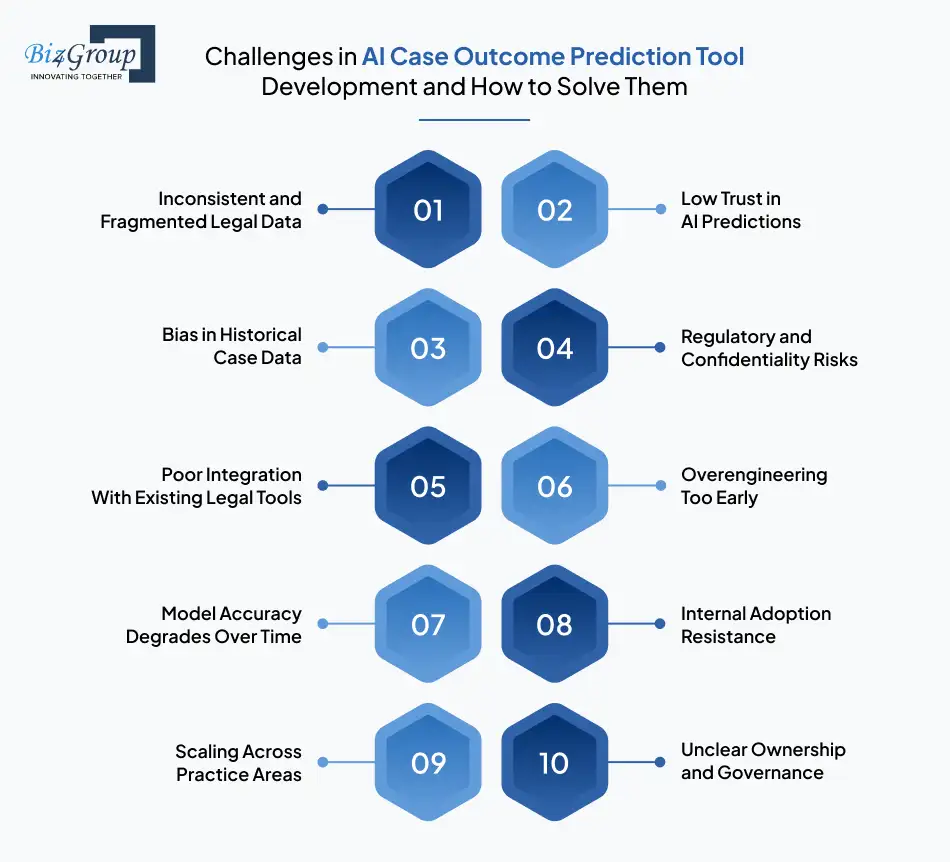
When you build an AI case outcome prediction tool for law firms, challenges are inevitable. Legal data is complex, regulations are strict, and trust is non-negotiable. The difference between a stalled project and a successful one lies in how early you anticipate these risks and how clearly you address them.
Below is a practical, decision-maker friendly view of the most common challenges in AI case outcome prediction tool development, along with proven ways to solve them.
|
Challenge |
Why It Happens |
How to Solve It Effectively |
|---|---|---|
|
Inconsistent and Fragmented Legal Data |
Case data lives across multiple systems, formats, and jurisdictions, often with gaps and inconsistencies. |
Standardize data pipelines early, use structured ingestion workflows, and apply legal-specific data normalization. |
|
Low Trust in AI Predictions |
Lawyers hesitate to rely on black-box outputs that lack clear reasoning or confidence indicators. |
Build explainability into the model and clearly surface influencing factors, similar to how trust is handled in an AI virtual lawyer app. |
|
Bias in Historical Case Data |
Past decisions may reflect systemic bias across courts or jurisdictions. |
Introduce bias detection, fairness audits, and controlled weighting during AI legal prediction software development. |
|
Regulatory and Confidentiality Risks |
Legal data includes privileged and sensitive information that cannot be exposed or mishandled. |
Apply strict access control, encryption, and compliance reviews from day one when you develop AI case outcome prediction software. |
|
Poor Integration With Existing Legal Tools |
Standalone systems disrupt workflows and reduce adoption. |
Design APIs and integrations aligned with existing platforms so prediction insights feel native to daily legal work. |
|
Overengineering Too Early |
Teams attempt to solve every use case at once, driving up cost and complexity. |
Start with a focused MVP and expand iteratively using phased development practices. |
|
Model Accuracy Degrades Over Time |
Legal behavior, precedents, and rulings evolve continuously. |
Implement continuous monitoring, retraining, and performance reviews to keep predictions reliable. |
|
Internal Adoption Resistance |
Attorneys are cautious about changing how decisions are made or advised. |
Position the tool as decision support, not authority, much like adoption patterns seen with an AI lawyer app. |
|
Scaling Across Practice Areas |
Models trained on one domain do not automatically generalize to others. |
Use modular models and domain-specific tuning when you build AI litigation outcome prediction systems. |
|
Unclear Ownership and Governance |
No defined accountability for model decisions or updates. |
Establish clear governance, review checkpoints, and leadership oversight from the start. |
Ignoring these challenges often leads to tools that look impressive but fail in real-world use. Addressing them upfront helps you create AI legal prediction tools to assess litigation risk that lawyers trust, leadership supports, and clients value.
Why Law Firms Trust Biz4Group LLC to Build Custom AI Case Outcome Prediction Tools (and Beyond)?
When you decide to develop AI case outcome prediction software for your firm, you want a partner that understands legal workflows, data complexity, user experience, and real-world ROI. Biz4Group LLC has a track record of helping law firms and enterprises with intelligent systems that support smarter legal decision making. We combine domain expertise with practical engineering know-how so you don’t just build software you end up with solutions that deliver value.
At Biz4Group, we offer a full-spectrum approach from strategy to deployment. Whether it is integrating predictive insights into your existing systems or building new platforms that elevate legal analytics, our team is built for it. We provide AI automation services and AI integration services that help firms unlock data value quickly. We also provide agentic AI development and custom systems tailored to your firm’s needs.
Below are some of our projects that demonstrate our experience in legal tech and data-driven systems that align perfectly with building powerful legal outcome prediction tools.
Featured Legal Tech Projects by Biz4Group
1. Integral Ledger
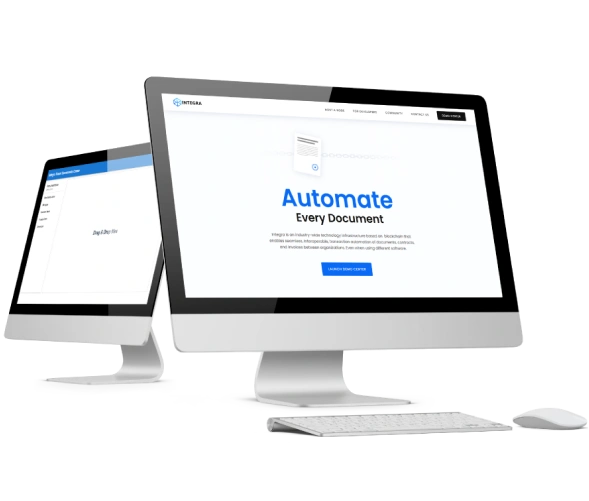
Integral Ledger is a secure, blockchain-based platform designed to manage sensitive legal workflows and data. Its underlying design principles are directly applicable when building systems that forecast outcomes while maintaining data integrity and auditability.
Key Highlights
- Secure data architecture that guards legal records and history
- Immutable logs that support explainability and trust in prediction tools
- Modular design that can integrate with predictive models for outcomes
Integral Ledger's data governance foundation shows how structured, compliant databases can feed high-quality data into AI case outcome prediction systems for legal teams.
2. Trial Proofer

Trial Proofer is built to assist litigation teams with trial preparation, strategy recording, and performance metrics. It brings structured case insights to attorneys in a user-friendly interface.
Key Highlights
- Case strategy dashboards that summarize key litigation metrics
- Personalized insights that guide legal decision making
- Rich reporting features for outcomes comparison
The UI/UX principles and analytics backbone of Trial Proofer set a strong precedent for building build AI powered legal outcome prediction tools that attorneys actually use in practice.
3. Compare Legal Platform

Compare Legal is a comprehensive case management and legal operations platform designed to optimize case workflows. It goes beyond simple task tracking to provide analytical insights on case performance.
Key Highlights
- End-to-end case lifecycle visibility
- Automated alerts and analytics
- Scalability for mid to large law firms
The system’s analytics components and workflow automation bring important lessons on how legal analytics software development with AI can change firm operations.
4. Court Calendar Management System

Court Calendar organizes and automates court schedules, deadlines, and key filing dates. It is built for accuracy and reliability ensuring legal teams never miss procedural triggers.
Key Highlights
- Automated scheduling with conflict resolution
- Notifications and milestone tracking
- Integration-ready with external legal data feeds
High-quality timeline and procedural data are critical inputs for outcome prediction algorithms. This project showcases Biz4Group’s ability to handle time series and event data critical for creating AI case prediction platforms for law firms.
Biz4Group’s Strength in Legal Tech Innovation
When you choose Biz4Group LLC for custom AI case outcome prediction development, you get:
- A team experienced in building compliant, scalable legal systems that handle sensitive data.
- Expertise in custom software development company practices with legal domain focus.
- User-centric UI/UX crafted by our UI/UX design specialists ensuring adoption by attorneys and legal staff.
- Access to deep talent when you hire AI developers who understand machine learning, natural language processing, and legal workflows.
- A partner that can guide your MVP and beyond through our MVP development approach so you validate early and optimize quickly.
- Ability to scale from predictive modules to full-blown analytics ecosystems using enterprise AI solutions tailored for law firms of all sizes.
These capabilities make Biz4Group not only a technology provider but a strategic partner for law firms that want to lead with data, not guesswork.
Ready to build legal AI that lawyers will actually use?
From legal platforms to predictive systems, Biz4Group builds AI products that deliver clarity, not complexity.
Start My AI Legal ProjectConclusion: Turning Legal Data into Confident Case Strategies With AI
Building an AI case outcome prediction tool for law firms is no longer an experimental idea. It is a practical move toward smarter litigation planning, clearer risk assessment, and stronger client conversations. When done right, these tools help you make AI case outcome prediction software for law firm strategy that supports real decisions without adding operational complexity.
The difference lies in how you execute AI case outcome prediction tool development. Legal data is nuanced, accuracy expectations are high, and trust cannot be compromised. This is where experience matters. Biz4Group LLC has consistently delivered AI legal prediction software development projects that balance data intelligence, compliance, and usability. Our work across legal platforms, analytics systems, and enterprise-grade AI products gives us the depth required to develop AI powered legal outcome prediction software for enterprises as well as growing firms.
From early discovery to long-term scaling, Biz4Group helps law firms build AI powered legal outcome prediction tools, create AI driven case outcome analysis tools, and deploy AI case outcome prediction solutions for small and large law firms with confidence. Our focus stays on business value, adoption, and measurable outcomes, not just technology.
If your firm is ready to stop guessing and start predicting, let’s build a legal prediction system that works where it matters most.
FAQ
1. What does it mean to build an AI case outcome prediction tool for law firms
To build an AI case outcome prediction tool for law firms means creating a system that analyzes historical case data, court behavior, judge tendencies, and litigation patterns to forecast possible outcomes. This approach helps firms move beyond intuition and use data to guide strategy. It is a core use case of AI case outcome prediction tool development focused on real decision making.
2. How does AI case outcome prediction tool development improve litigation strategy
AI case outcome prediction tool development helps you evaluate litigation risk earlier and more objectively. By using probability-based insights, law firms can refine case strategy, plan settlement timing, and allocate resources more effectively. Many firms use this approach to build AI-powered case outcome prediction software for litigation that supports confident client advice.
3. How accurate is AI legal prediction software development in real cases
AI legal prediction software development can deliver strong directional accuracy when trained on high quality legal data. While it does not guarantee outcomes, it provides statistically grounded insights that often outperform gut instinct alone. Firms that develop AI case outcome prediction software with continuous validation and explainability see more reliable and trusted results.
4. What is the difference between legal analytics software development with AI and outcome prediction tools
Legal analytics software development with AI typically focuses on analyzing past data and trends, while outcome prediction tools focus on forecasting future case results. When you create AI-driven case outcome analysis tools, the system actively estimates probabilities and risk instead of only presenting historical insights. This forward-looking capability is what makes prediction tools strategically valuable.
5. What data is required to create AI case prediction platforms for law firms
To create AI case prediction platforms for law firms, you need structured historical case records, outcomes, court and judge metadata, jurisdiction details, and relevant legal filings. The quality and consistency of this data directly impact prediction accuracy. Strong data preparation is essential for custom AI case outcome prediction development.
6. How much does it cost to build an AI case outcome prediction tool for law firms
The cost to build an AI case outcome prediction tool for law firms typically ranges from $25,000 to $200,000+, depending on features, data complexity, integrations, and compliance requirements. A focused MVP sits closer to the lower end, while enterprise-grade solutions with advanced analytics fall on the higher end. This range is common for AI case outcome prediction solutions for small and large law firms.
7. How long does it take to develop AI powered legal outcome prediction software
The timeline to develop AI-powered legal outcome prediction software depends on scope and data readiness. A basic implementation can take a few months, while advanced systems with multiple jurisdictions and integrations take longer. Firms that follow a phased approach can build AI litigation outcome prediction systems faster while validating value early.
