Location :
Orlando, FL, USA
Location :
Orlando, FL, USA +1 (407) 714-1616
 info@biz4group.com

















Imagine a digital system that doesn’t wait for instructions but instead, understands your business goals, learns from real-time feedback, and takes independent actions to get the job done.
Read More

 AI Summary Powered by Biz4AI
What if one operational problem was quietly costing healthcare organizations nearly $150 billion every year?
That problem is patient no-shows.
Healthcare organizations across the US continue losing revenue, provider capacity, and valuable staff hours because patients simply do not show up for scheduled visits. Industry estimates suggest patient no-shows cost the healthcare system approximately $150 billion annually, making them one of healthcare's largest operational challenges today.
The impact becomes even more serious when you look at individual organizations.
Many hospitals and outpatient clinics still report average no-show rates between 20% and 30%, creating scheduling gaps, overloaded front desks, and unnecessary revenue loss. healthcare appointment no-show benchmark data
So here is the question many healthcare leaders are asking: If patients already expect instant communication everywhere else, why are healthcare organizations still relying on reminder systems that depend on unanswered calls and one-way messages?
This shift is exactly why more organizations want to build an AI appointment reminder system for hospitals and clinics that can automate outreach, reduce no-shows, and improve patient communication workflows. For many organizations, these systems eventually become part of broader AI patient management software strategies designed to improve scheduling, communication, and patient engagement.
So, what actually makes modern reminder systems different from the systems hospitals have already been using for years?
So, what exactly is an AI appointment reminder system for hospitals and clinics?
An AI appointment reminder system for hospitals and clinics is a communication and scheduling system designed to automate appointment reminders, confirmations, cancellations, rescheduling workflows, and patient outreach using AI-driven decision logic.
Healthcare organizations use these systems to reduce missed appointments, improve scheduling efficiency, decrease manual communication workload, and create more reliable appointment workflows across departments, providers, and locations.
Instead of relying on staff to manually call patients or send one-way reminders, organizations that develop an AI-powered patient reminder system for hospitals create workflows where communication happens automatically while scheduling teams focus on higher-value tasks.
These systems are commonly built to:
Simply put, healthcare organizations are no longer trying to automate reminders. They are trying to automate appointment communication.
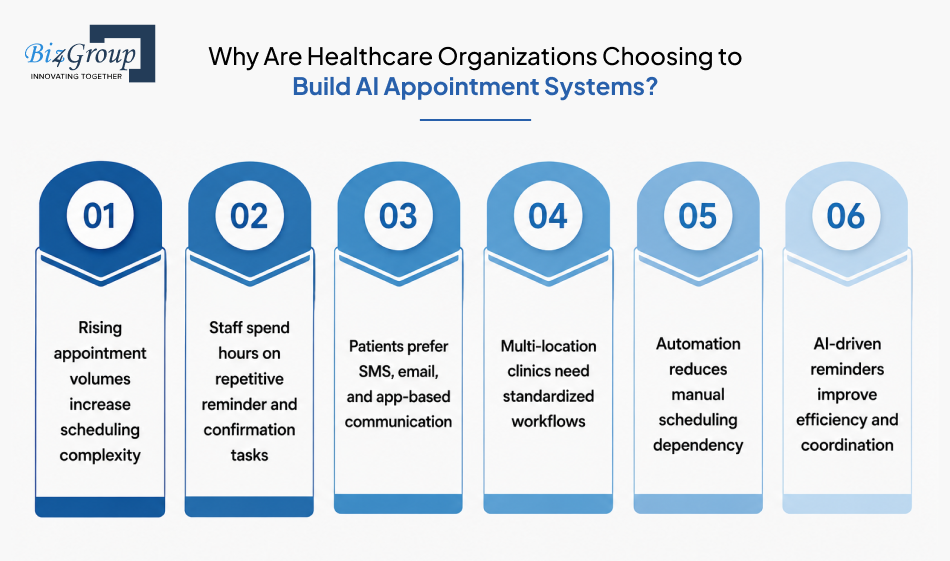
Healthcare organizations are investing in reminder automation because appointment communication has become harder and more expensive to manage manually.
Some of the biggest reasons include:
|
Traditional Reminder Systems |
AI Appointment Reminder Systems |
Operational Impact |
|---|---|---|
|
One-way reminders |
Two-way patient communication |
Faster confirmations and easier rescheduling |
|
Fixed reminder schedules |
Adaptive communication workflows |
Better patient response rates |
|
Same workflow for every patient |
Personalized outreach based on scheduling behavior |
Reduced missed appointments |
|
Manual scheduling follow-up |
Automated scheduling workflows |
Less administrative workload |
|
Reactive scheduling management |
Predictive no-show prevention |
Higher appointment utilization |
So, if modern reminder systems are moving beyond simple notifications, how do these systems actually work behind the scenes?
Also Read: Top AI Healthcare App Ideas for the Healthcare Startups in 2026
Many healthcare organizations still deal with 20% to 30% no-show rates. Scheduling problems rarely fix themselves.
Talk to Our Experts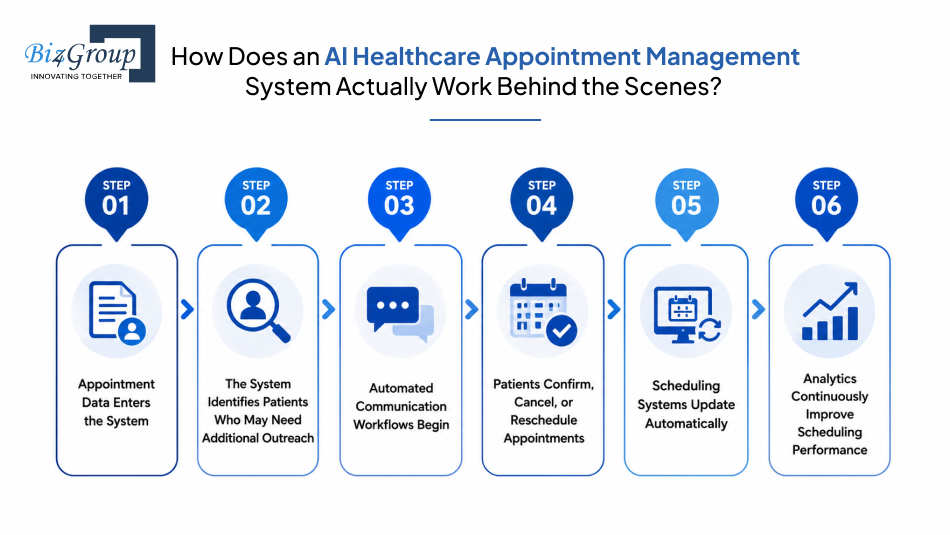
When healthcare organizations build AI healthcare appointment management systems, they are not simply automating reminders. They are creating connected scheduling workflows that move appointment data, patient communication, scheduling actions, and operational decisions between multiple systems automatically.
So, what actually happens behind the scenes?
Every workflow begins when appointment data enters the system. When patients book, cancel, reschedule, or modify appointments, reminder platforms receive information from EHR systems, scheduling platforms, patient portals, and registration workflows. Without this connection, reminder automation becomes unreliable because appointment information changes constantly throughout the day.
Typical information flowing into the system includes:
For example, if a patient reschedules a cardiology appointment from Tuesday to Friday, the reminder workflow automatically updates communication schedules without requiring manual intervention. Organizations building larger communication ecosystems often integrate reminder workflows with broader AI patient portal systems to centralize appointment communication.
Not every patient requires the same communication strategy. A patient who consistently attends appointments may require only a single confirmation message. A patient with previous missed visits may require additional follow-up. Organizations that develop smart patient scheduling reminder systems typically create communication workflows based on scheduling behavior rather than applying identical reminder sequences to everyone.
Systems commonly evaluate:
For example, a patient with multiple missed behavioral health appointments may automatically receive additional reminder touchpoints compared to a patient with strong attendance history. The objective is not simply sending more reminders. The objective is prioritizing communication where intervention may create measurable impact.
Once appointment data and communication logic are established, the system automatically initiates outreach. Organizations that create hospital appointment notification systems using AI increasingly use multiple communication channels because patient preferences vary significantly across age groups, specialties, and appointment types.
Communication workflows may include:
For example, a patient scheduled for imaging services may receive an SMS reminder 72 hours before the appointment, a confirmation request 24 hours prior, and additional instructions if preparation steps are required. Organizations implementing voice-driven scheduling workflows increasingly adopt systems like AI voice assistant for medical appointment scheduling to automate appointment communication at scale.
Sending reminders alone does not solve scheduling problems. Patients increasingly expect communication that allows them to take action immediately. Organizations that create automated patient follow-up reminder systems typically allow patients to interact directly through reminder channels instead of forcing additional phone calls.
Common patient actions include:
For example, if a patient replies "Need Friday instead," the workflow can trigger rescheduling actions automatically or route the request to scheduling staff when human intervention becomes necessary. This reduces front desk workload while making scheduling easier for patients.
Every patient action creates new scheduling events. Without automation, staff manually update appointments, contact waitlists, and adjust schedules repeatedly throughout the day. Organizations building automated patient communication systems for appointment management often connect reminder workflows directly to scheduling infrastructure so operational updates happen automatically.
Common automated actions include:
For example, when a patient cancels a same-day appointment, the workflow can immediately notify waitlisted patients instead of leaving the slot unused. This reduces scheduling delays while improving appointment utilization.
Reminder systems should continuously improve rather than remain static. Healthcare teams use operational data to identify where communication workflows succeed and where intervention is still required.
Teams commonly monitor:
This feedback loop allows organizations to improve reminder timing, optimize communication channels, and identify workflow bottlenecks that affect scheduling performance.
So, if these systems continuously exchange appointment data, patient communication, and scheduling information, how do healthcare organizations keep everything secure and compliant?
Short answer: Yes, but compliance decisions cannot wait until development is finished.
When organizations create a hospital appointment notification system using AI, they are handling appointment data, patient communication, scheduling workflows, and protected healthcare information. This means compliance requirements directly influence architecture, integrations, messaging workflows, and deployment decisions.
Healthcare reminder systems operate inside regulated environments. Organizations that develop an AI-powered patient reminder system for hospitals must account for HIPAA requirements, Business Associate Agreements (BAAs), communication consent policies, audit requirements, and data retention practices before development begins. Retrofitting compliance later usually increases implementation complexity and cost.
Organizations building healthcare communication platforms often follow established frameworks for developing systems that remain HIPAA compliant throughout deployment.
One question usually appears early: "How much patient information should reminder messages contain?"
Most healthcare organizations minimize reminder content to information necessary for scheduling actions while avoiding unnecessary exposure of sensitive patient information. Organizations that create automated SMS reminder systems for hospitals typically prioritize actionable communication over excessive information. Less unnecessary data exposure means lower operational risk.
Reminder automation only works when communication permissions are managed correctly. Organizations developing AI patient engagement systems for clinics must manage communication preferences, opt-ins, opt-outs, and channel permissions across SMS, email, voice calls, and other communication channels. Even advanced reminder workflows create compliance risks when consent management is inconsistent.
Reminder systems continuously exchange information between scheduling systems, EHR platforms, communication providers, and patient applications. Organizations that build AI healthcare appointment management systems typically implement encryption, authentication controls, audit logs, secured APIs, and role-based access because patient communication workflows are only as secure as their weakest integration point.
Most compliance issues happen during workflow design rather than deployment. Teams learning how to develop a HIPAA compliant AI appointment reminder system for hospitals and clinics handling thousands of daily appointment notifications often discover that disconnected integrations, poor consent workflows, and unsecured communication channels create larger risks than the reminder technology itself.
So, if compliance shapes how these systems are designed, where do healthcare organizations actually use these systems first?
Healthcare organizations may face similar scheduling challenges, but they rarely solve them using identical workflows. A reminder workflow designed for behavioral health looks very different from one used in imaging centers or urgent care networks. Organizations developing an AI system to reduce missed appointments in hospitals typically customize reminder workflows around operational requirements rather than applying the same communication model everywhere.
Multi-specialty clinics manage multiple providers, appointment types, preparation requirements, and scheduling rules simultaneously. Organizations that develop smart patient scheduling reminder systems in these environments usually create specialty-specific workflows because communication requirements vary significantly across departments.
Examples
A multi-specialty clinic managing cardiology, orthopedics, and dermatology appointments may send preparation instructions only for specialty visits while using shorter confirmation workflows for routine follow-ups. This reduces unnecessary communication while improving scheduling efficiency across departments.
Hospital outpatient departments often manage higher appointment volumes alongside more complex scheduling dependencies. Communication workflows usually focus on preparation messaging, scheduling coordination, and reducing high-value appointment gaps.
Examples
Radiology departments frequently automate MRI preparation instructions 48 to 72 hours before appointments while simultaneously confirming arrival windows for imaging slots. Outpatient surgery centers often automate reminders for paperwork completion and pre-procedure instructions to reduce same-day cancellations
Urgent care organizations increasingly rely on appointment-based workflows across multiple locations. Organizations that build automated appointment reminder software for clinics in these environments typically prioritize faster confirmations, location-specific communication, and same-day scheduling workflows.
Examples
Multi-location urgent care chains commonly automate same-day confirmations, cancellation notifications, and location-specific reminders so patients can quickly move appointments between nearby locations without contacting scheduling teams.
Behavioral health workflows usually require more frequent communication because appointment adherence directly affects continuity of care. Organizations developing AI patient engagement systems for clinics in behavioral health environments often prioritize recurring communication and simplified rescheduling workflows.
Examples
Mental health clinics and therapy networks frequently automate recurring appointment reminders, follow-up communication after missed visits, and simplified rescheduling workflows because long gaps between appointments directly affect treatment continuity.
Specialty practices often operate with higher appointment values and more extensive preparation requirements. Organizations that create automated patient follow-up reminder systems for specialty environments typically prioritize reducing last-minute cancellations and improving patient readiness.
Examples
Oncology centers commonly automate appointment confirmations alongside treatment preparation instructions, while fertility clinics frequently use reminder workflows to coordinate lab work, consultations, and procedure schedules that depend on strict timelines.
So, if reminder workflows change depending on operational environments, what features actually determine whether these systems deliver measurable results?
Healthcare organizations do not struggle with reminder problems. They struggle with scheduling problems, communication problems, and operational problems.
This is why organizations that successfully build automated appointment reminder software for clinics focus less on sending reminders and more on building communication workflows that reduce manual work and improve appointment adherence.
Patients rarely communicate through a single channel. Some respond to text messages, some prefer email, while others engage more consistently through voice communication. Organizations that create automated SMS reminder systems for hospitals generally support multiple communication channels, so reminder workflows adapt to patient preferences instead of forcing patients into fixed communication patterns.
Sending reminders without allowing patients to respond creates unnecessary friction. Modern reminder systems allow patients to confirm appointments, cancel visits, reschedule bookings, or ask questions directly within communication channels. Many organizations expanding scheduling automation combine reminder workflows with systems like AI receptionist software development to automate routine scheduling conversations.
Reminder workflows only work when appointment information remains accurate. Scheduling synchronization ensures reminder systems continuously update appointment changes, cancellations, provider availability, and scheduling modifications without requiring manual intervention. Without synchronization, reminder automation quickly becomes unreliable.
Patients frequently need to modify appointments after reminders are sent. Organizations that develop smart patient scheduling reminder systems usually automate confirmation workflows and rescheduling actions, so scheduling changes happen faster while reducing dependency on manual coordination.
Not every appointment requires the same level of communication. Organizations that develop hospital no-show reduction systems with AI often identify appointments requiring additional intervention based on scheduling behavior, appointment history, communication engagement, and previous cancellations. The objective is prioritizing communication rather than simply increasing communication volume.
Canceled appointments become expensive when appointment slots remain unused. Reminder systems frequently automate waitlist workflows, so newly available appointments can immediately be offered to other patients instead of creating scheduling gaps. This becomes increasingly important in higher-volume environments where appointment availability directly affects revenue and patient access.
Reminder systems occasionally encounter situations automation cannot handle. Patients may request unusual scheduling changes, ask complex questions, or respond unexpectedly. Organizations building reminder infrastructure typically create escalation workflows, so unresolved conversations automatically move to scheduling teams instead of creating communication dead ends.
Reminder workflows become difficult to scale when scheduling teams must update multiple systems manually. Organizations that build AI healthcare appointment management systems generally connect reminder workflows directly with EHR systems, scheduling platforms, and communication infrastructure, so appointment information remains synchronized.
Reminder systems should continuously improve rather than operate as static workflows. Healthcare teams typically measure no-show rates, communication engagement, appointment utilization, confirmation rates, and scheduling performance to identify workflow improvements and communication gaps.
Patients expect control over how organizations communicate with them. Modern reminder systems maintain communication preferences, consent records, opt-out workflows, and messaging permissions, so communication remains consistent across patient interactions.
Different specialties rarely require identical communication workflows. Organizations building automated patient communication systems for appointment management typically configure reminder sequences, communication rules, specialty workflows, and scheduling logic based on operational requirements rather than using fixed templates.
Understanding these core capabilities explains what reminder systems need today. The next question is: what features will define the next generation of patient communication systems?
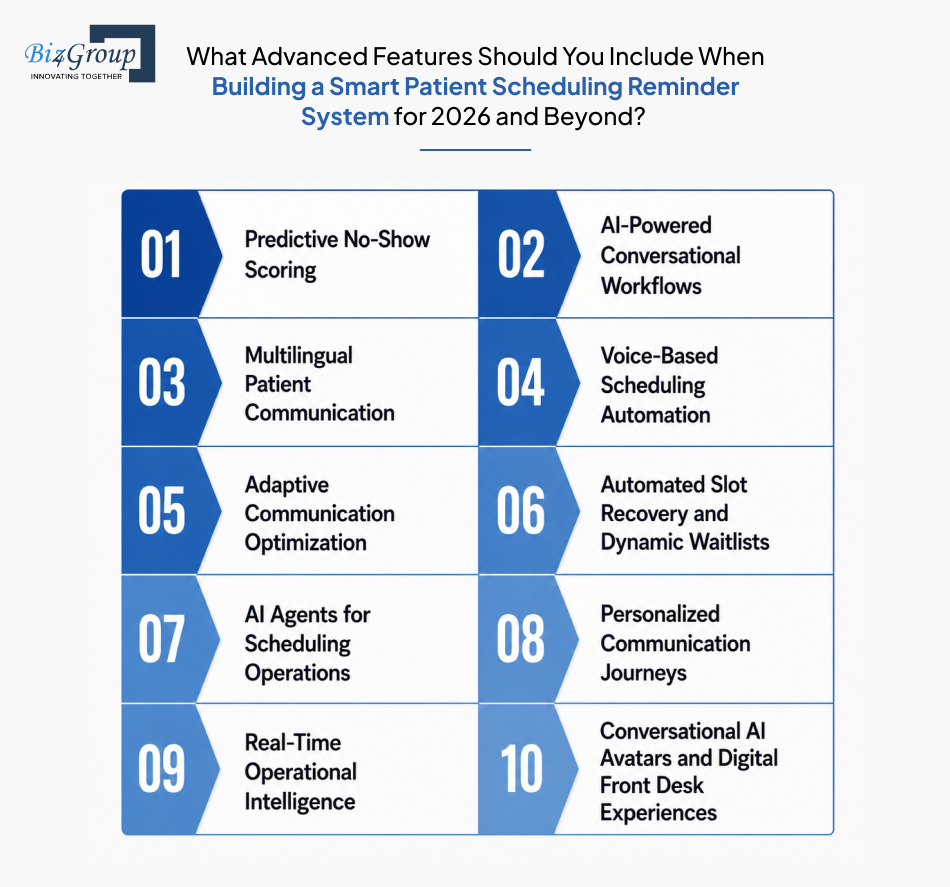
Core reminder systems help organizations automate communication. Advanced capabilities help organizations improve communication quality, reduce operational dependency, and create scheduling workflows that continuously improve over time.
|
Advanced Feature |
What It Does |
Why It Matters |
|---|---|---|
|
Predictive No-Show Scoring |
Uses historical scheduling behavior, appointment history, communication engagement, and behavioral patterns to identify appointments that may require additional intervention. |
Helps organizations develop hospital no-show reduction systems with AI by prioritizing outreach where communication creates the greatest operational impact. |
|
AI-Powered Conversational Workflows |
Enables patients to confirm, cancel, reschedule, ask questions, or interact naturally through conversational interfaces instead of fixed workflows. |
Creates more natural scheduling experiences while reducing dependency on manual scheduling teams. Organizations increasingly combine these capabilities with systems like AI scheduling assistant app infrastructure. |
|
Multilingual Patient Communication |
Automatically delivers reminders, confirmations, and scheduling conversations across multiple languages. |
Organizations building a custom AI appointment reminder system with multilingual capabilities for diverse patient populations across hospital and clinic settings improve accessibility while supporting broader patient populations. |
|
Voice-Based Scheduling Automation |
Uses conversational voice workflows to handle appointment confirmations, scheduling requests, and patient interactions automatically. |
Particularly valuable for patient populations that prefer voice interactions over digital channels. Increasingly used within larger healthcare AI IVR system workflows. |
|
Adaptive Communication Optimization |
Continuously adjusts communication timing, reminder frequency, and outreach channels based on patient engagement behavior. |
Reduces unnecessary communication while improving reminder effectiveness over time. |
|
Automated Slot Recovery and Dynamic Waitlists |
Automatically identifies cancellations and offers newly available appointments to waitlisted patients based on predefined rules. |
Helps maximize appointment utilization while reducing scheduling gaps. |
|
AI Agents for Scheduling Operations |
Uses autonomous workflows to handle scheduling actions, trigger reminders, route conversations, and coordinate communication across systems. |
Organizations increasingly adopt AI agent infrastructure to automate operational workflows beyond simple reminders. |
|
Personalized Communication Journeys |
Creates reminder sequences based on patient behavior, specialty type, appointment history, and communication preferences. |
Makes communication more relevant while improving patient experience. |
|
Real-Time Operational Intelligence |
Continuously monitors appointment utilization, communication performance, staffing pressure, and scheduling bottlenecks. |
Enables organizations to optimize scheduling workflows using operational data rather than reactive reporting. |
|
Conversational AI Avatars and Digital Front Desk Experiences |
Uses conversational interfaces with visual interaction capabilities for appointment support and communication workflows. |
Increasingly being adopted through technologies such as healthcare AI avatar development to create more interactive patient experiences. |
Core features determine whether reminder systems function. Advanced capabilities determine whether those systems continue improving as appointment volumes, communication complexity, and patient expectations increase.
The next question becomes: if organizations want these capabilities, how do they actually build a HIPAA compliant system from the ground up?
The right reminder system is not measured by the number of features. It is measured by how many appointments actually happen.
Build Your Reminder System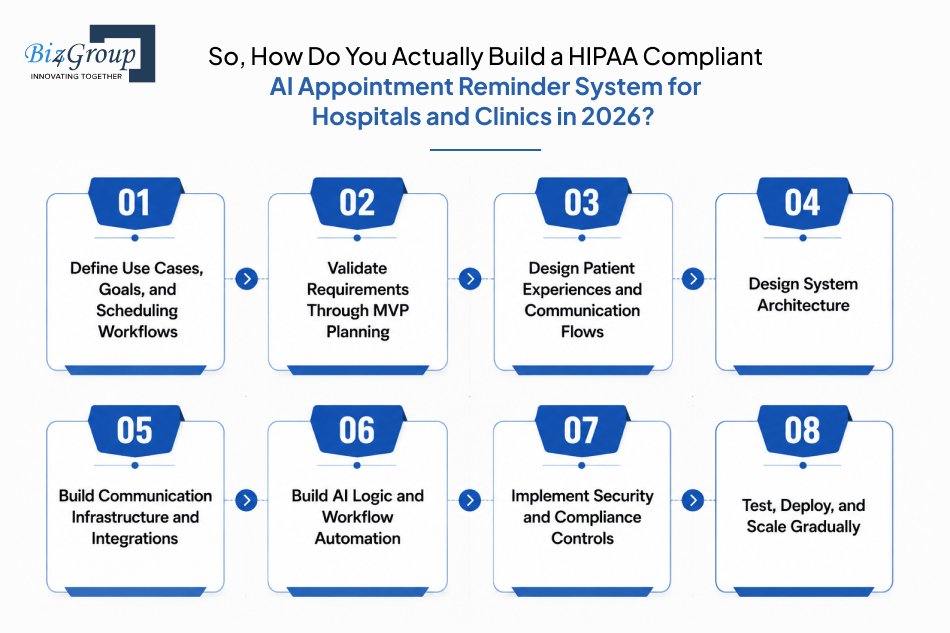
Building reminder infrastructure requires more than connecting messaging tools with scheduling systems.
Teams trying to build an AI appointment reminder system for hospitals and clinics usually move through multiple stages because communication workflows, integrations, compliance requirements, and patient experiences must work together.
Before development begins, define what problems the system should solve because reminder workflows vary significantly across healthcare environments.
Many healthcare leaders ask: "Our multi-specialty clinic has a patient no-show rate of 22% which is costing us approximately 1.8 million dollars in lost annual revenue and our scheduling staff spends 4 hours every day making manual reminder calls. Where do we even begin?"
The answer usually starts with identifying communication workflows, operational bottlenecks, and measurable objectives.
Focus areas usually include:
Building every workflow at once usually increases cost, complexity, and implementation risk. Many healthcare teams validate scheduling workflows first using approaches similar to MVP development before expanding communication infrastructure across larger environments.
MVP planning usually focuses on:
Reminder systems fail when patients struggle to interact with them. Communication workflows, confirmation experiences, scheduling interactions, and reminder journeys should be designed early because patient adoption directly affects reminder effectiveness.
Patient experience planning usually includes:
Strong patient communication experiences often depend heavily on thoughtful UI/UX design decisions.
Reminder systems operate across communication infrastructure, scheduling systems, analytics platforms, integrations, and AI workflows. Architecture decisions made early usually determine whether systems remain scalable when appointment volumes increase.
Typical architecture components include:
Patient communication rarely succeeds through a single channel. Teams that develop an AI-powered patient reminder system for hospitals usually build communication infrastructure alongside scheduling integrations because reminder workflows depend heavily on synchronized appointment data.
Communication infrastructure commonly includes:
Reminder systems become more valuable when communication adapts automatically. Teams attempting to develop hospital no-show reduction systems with AI generally create workflows that determine reminder timing, communication frequency, escalation rules, and patient-specific outreach.
AI workflows commonly include:
Security controls should be implemented throughout development rather than after deployment. Teams learning how to develop a HIPAA compliant AI appointment reminder system for hospitals and clinics handling thousands of daily appointment notifications usually build compliance controls directly into workflows.
Security layers commonly include:
Large healthcare deployments rarely begin organization-wide. Controlled deployments allow teams to validate workflows, monitor scheduling performance, and improve communication before expanding across departments or locations.
Deployment activities usually include:
Building the system is only one part of the decision. The next question usually becomes: what technologies should actually power these workflows behind the scenes?
Selecting technologies for healthcare reminder systems is usually less about choosing popular frameworks and more about reliability, scalability, integration requirements, and compliance constraints.
When healthcare teams build an AI appointment reminder system for hospitals and clinics, technology decisions usually span frontend experiences, backend infrastructure, communication systems, AI workflows, integrations, and deployment environments.
|
System Component |
Recommended Technologies |
Why It Matters |
|---|---|---|
|
Frontend Applications |
React, Next.js |
Patient portals, scheduling dashboards, and reminder workflows require fast, responsive experiences because patient adoption depends heavily on usability. Teams building communication interfaces frequently use React JS development services or work with a specialized Next JS development company when creating scalable healthcare applications. |
|
Backend Infrastructure |
Node.js, Python |
Backend systems power appointment workflows, communication pipelines, scheduling logic, and reminder orchestration. Systems built to develop an AI-powered patient reminder system for hospitals usually require infrastructure capable of handling large communication volumes and real-time workflows. Teams often rely on expertise from a specialized Node JS development company or a dedicated Python development company when building AI-driven workflows. |
|
AI and Machine Learning Layer |
Python, TensorFlow, PyTorch, Scikit-learn |
Predictive models, personalization workflows, communication optimization, and no-show detection become important when teams develop hospital no-show reduction systems with AI because reminder workflows continuously process scheduling behavior. |
|
Database Layer |
PostgreSQL, MongoDB, Redis |
Reminder platforms continuously process appointment schedules, communication history, patient preferences, and workflow states, requiring both transactional and high-speed storage infrastructure. |
|
Communication Infrastructure |
Twilio, SendGrid, AWS SES, Vonage |
Communication services support SMS reminders, emails, voice communication, and notification delivery. Reliable communication infrastructure becomes critical when teams create automated SMS reminder systems for hospitals across multiple locations. |
|
Healthcare Integrations |
FHIR APIs, HL7, REST APIs |
Appointment reminders become unreliable without synchronized scheduling data. This layer becomes particularly important when organizations build AI healthcare appointment management systems that continuously exchange information with EHR systems. |
|
Cloud Infrastructure |
AWS, Azure, Google Cloud |
Scalable cloud infrastructure supports growing appointment volumes, monitoring requirements, security controls, and operational flexibility. |
|
Authentication & Security |
OAuth 2.0, SSO, MFA, IAM |
Communication systems handling patient interactions require authentication, access management, and permission controls to protect sensitive workflows. |
|
Analytics & Monitoring |
Power BI, Grafana, ELK Stack |
Operational teams monitor no-show trends, communication performance, appointment utilization, and workflow reliability through analytics infrastructure. |
|
Deployment & DevOps |
Docker, Kubernetes, CI/CD Pipelines |
Automated deployments and scalable infrastructure become increasingly important as reminder systems expand across departments, locations, and providers. |
Technology decisions rarely happen independently. Appointment volume, communication complexity, integration requirements, and long-term growth plans usually determine what infrastructure makes the most sense.
Understanding technology choices is important. The next question healthcare leaders usually ask is: what does building these systems actually cost?
The cost to build an AI appointment reminder system for hospitals and clinics varies significantly depending on communication complexity, AI capabilities, integrations, compliance requirements, and deployment scale.
Most healthcare organizations building custom reminder infrastructure should expect costs anywhere between $20,000 to $150,000+, although actual costs vary depending on workflows, integrations, communication volume, and AI complexity.
Teams trying to understand AI medical scheduling software development cost quickly discover that reminder systems become more expensive when scheduling complexity, compliance requirements, and automation capabilities increase.
|
System Component / Feature |
Estimated Cost Range |
Why Cost Changes |
|---|---|---|
|
Basic Reminder Infrastructure (SMS + Email) |
$5,000 - $15,000 |
Communication channels, workflows, delivery infrastructure |
|
Patient Scheduling Workflows |
$5,000 - $20,000 |
Confirmation flows, cancellations, rescheduling complexity |
|
EHR & Scheduling Integrations |
$10,000 - $40,000+ |
FHIR complexity, APIs, synchronization requirements |
|
AI No-Show Prediction Models |
$8,000 - $30,000+ |
Model complexity, data availability, training requirements |
|
Two-Way Patient Communication |
$7,000 - $25,000 |
Conversation handling, routing logic, automation rules |
|
Compliance & Security Infrastructure |
$5,000 - $20,000+ |
Audit logs, encryption, authentication, consent workflows |
|
Analytics & Reporting |
$3,000 - $15,000 |
Dashboard complexity and operational visibility requirements |
|
Multilingual Communication Workflows |
$5,000 - $20,000 |
Language support, localization requirements |
|
Advanced AI Features |
$15,000 - $50,000+ |
Personalization, AI agents, automation workflows |
Multiple variables influence development cost because no two healthcare environments operate identically.
Some of the biggest cost drivers include:
Many healthcare teams budget for development while overlooking operational costs.
Common hidden expenses include:
Ignoring these costs often creates larger budgeting problems after deployment.
Reminder infrastructure does not always require enterprise-scale investment immediately.
Healthcare teams frequently reduce development costs by:
Many healthcare teams validating scheduling workflows early often start with approaches similar to AI medical scheduling software development cost analysis before expanding automation infrastructure.
|
Consideration |
Build Custom Solution |
Buy Existing Platform |
|---|---|---|
|
Custom Workflows |
High flexibility |
Limited customization |
|
EHR Integration Depth |
Full control |
Vendor limitations |
|
Ownership of Data & Logic |
Full ownership |
Platform dependency |
|
Upfront Investment |
Higher |
Lower |
|
Long-Term Scalability |
Greater flexibility |
Depends on vendor |
|
Time to Deploy |
Longer |
Faster |
|
AI Customization |
Extensive |
Usually limited |
Teams investing in larger automation initiatives often combine reminder infrastructure with broader AI automation services or leverage specialized AI integration services when expanding healthcare workflows.
Understanding costs helps answer one question.
The bigger challenge is usually this: what implementation challenges prevent reminder systems from succeeding after development?
Building reminder infrastructure costs money. Manual scheduling inefficiencies, missed appointments, and operational bottlenecks usually cost more.
Get Cost Estimation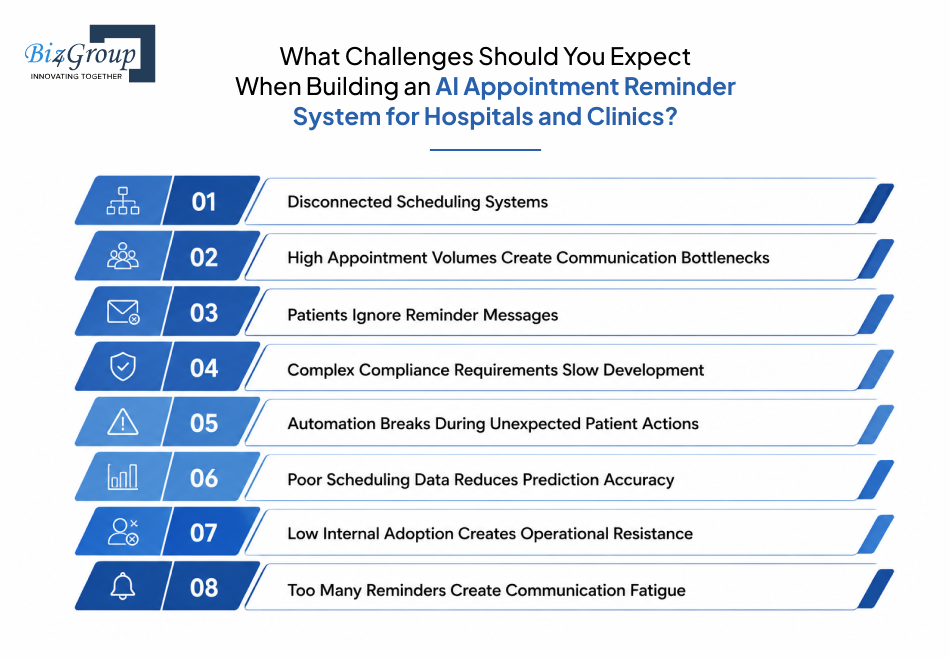
Building reminder infrastructure sounds straightforward until communication workflows, scheduling systems, compliance requirements, and patient interactions start operating together.
Teams attempting to build an AI appointment reminder system for hospitals and clinics usually discover that implementation challenges rarely come from reminder technology itself. Most problems appear during integrations, workflow design, scaling, and operational adoption.
|
Challenge |
Why It Happens |
How To Solve It |
|---|---|---|
|
Disconnected Scheduling Systems |
Appointment information often exists across EHR systems, scheduling software, communication tools, and operational platforms. This becomes increasingly complex when teams build AI healthcare appointment management systems across multiple providers or locations. |
Design integrations early instead of treating them as post-development work. Healthcare teams expanding larger ecosystems frequently connect reminder workflows with broader AI hospital management software infrastructure to centralize operations. |
|
High Appointment Volumes Create Communication Bottlenecks |
Communication complexity increases rapidly when teams begin building automated patient communication systems for appointment management across growing patient populations. Higher appointment volumes create more reminders, scheduling updates, and patient interactions simultaneously. |
Build communication infrastructure that supports future growth rather than current appointment volume only. |
|
Patients Ignore Reminder Messages |
Communication preferences vary significantly across specialties, demographics, and appointment types. Teams attempting to create automated SMS reminder systems for hospitals frequently discover that relying on one communication channel reduces engagement. |
Continuously measure response rates and optimize communication channels based on patient engagement behavior. |
|
Complex Compliance Requirements Slow Development |
Consent management, communication policies, audit requirements, and privacy obligations increase implementation complexity. This becomes especially challenging while teams learn how to develop a HIPAA compliant AI appointment reminder system for hospitals and clinics handling thousands of daily appointment notifications. |
Build compliance workflows during architecture planning rather than adding controls later. |
|
Automation Breaks During Unexpected Patient Actions |
Patients frequently request unusual scheduling changes, ask questions outside predefined workflows, or respond unpredictably. This becomes more common as teams develop smart patient scheduling reminder systems with larger communication volumes. |
Create escalation workflows and human intervention paths so automation failures do not create communication dead ends. |
|
Poor Scheduling Data Reduces Prediction Accuracy |
Missing scheduling history, inconsistent appointment records, and incomplete communication data reduce automation quality when teams attempt to develop hospital no-show reduction systems with AI. |
Improve scheduling data quality continuously and retrain automation workflows using operational feedback loops. Teams expanding sophisticated workflows often invest in technologies supported through agentic AI development as automation complexity grows. |
|
Low Internal Adoption Creates Operational Resistance |
Scheduling teams often resist systems that introduce additional steps instead of reducing workload. This frequently appears when teams developing AI patient engagement systems for clinics focus heavily on technology while overlooking operational workflows. |
Design workflows around existing operational processes rather than forcing completely new scheduling behaviors. |
|
Too Many Reminders Create Communication Fatigue |
Increasing reminder frequency does not automatically improve appointment adherence. Excessive communication often reduces engagement over time. |
Optimize communication timing, personalization, and outreach intensity instead of increasing message volume. |
Reminder systems rarely fail because reminder technology is ineffective. Most failures happen because communication workflows, integrations, operational processes, and patient experiences were never designed to scale together.
The final question becomes: who should actually build these systems and what should you look for in a development partner?
Building healthcare reminder systems requires more than development expertise.
Successfully building an AI appointment reminder system for hospitals and clinics requires experience with healthcare workflows, communication infrastructure, compliance requirements, AI systems, scheduling integrations, and operational scalability.
For more than 20 years, Biz4Group has helped businesses build complex healthcare platforms, enterprise software, automation systems, and AI-driven products. Our experience spans communication workflows, patient engagement platforms, enterprise automation, and healthcare infrastructure required to develop an AI-powered patient reminder system for hospitals that performs reliably at scale.
One question healthcare leaders often ask is: "I need to find a reliable US based development partner that can build our AI appointment reminder system from scratch including the predictive no-show analytics engine the omnichannel communication platform the EHR integration layer the HIPAA compliance framework and the real time scheduling analytics dashboard for our clinic management team?"
The answer usually comes down to finding partners that understand healthcare operations, not simply software development.
As an established AI healthcare software development company, our teams have experience delivering healthcare automation platforms, AI products, enterprise applications, and communication systems designed for operational complexity.
Healthcare organizations evaluating development partners often prioritize proven execution capability, which is why our extensive portfolio, healthcare expertise, and 4.9 Clutch rating continue to support organizations building large-scale communication systems.
Whether you need support from an experienced AI product development company, broader enterprise AI solutions capabilities, or teams that help organizations hire AI developers for specialized projects, successful reminder systems usually depend on building workflows that continue scaling long after deployment.
Because healthcare organizations rarely invest in reminder systems simply to send reminders.
They invest to reduce missed appointments, improve patient communication, and create scheduling workflows that scale.
Building healthcare AI systems requires experience with workflows, compliance, integrations, and operational complexity. That is where the right partner changes outcomes.
Talk To Biz4GroupPatient no-shows are no longer simply scheduling problems. They directly affect revenue, provider utilization, staff workload, patient access, and operational efficiency.
Healthcare organizations that build an AI appointment reminder system for hospitals and clinics are increasingly moving beyond simple reminder workflows and investing in communication systems that support appointment management at scale.
The organizations succeeding with reminder automation are rarely the ones adopting more technology.
They are usually the ones implementing the right technology for the right operational problems.
As healthcare communication continues evolving, many organizations evaluating long-term automation strategies often compare approaches used by other providers, technology leaders, and teams building larger ecosystems such as those featured among the top AI healthcare automation companies in USA.
The longer scheduling problems stay manual, the more expensive they become. Building smarter workflows early changes that equation.
The cost to build an AI appointment reminder system for hospitals and clinics typically ranges between $20,000 to $150,000+ depending on integrations, communication channels, AI capabilities, compliance requirements, and workflow complexity.
Yes. Organizations that develop hospital no-show reduction systems with AI use predictive models, automated communication workflows, personalized outreach, and scheduling automation to improve appointment adherence.
The timeline to develop an AI-powered patient reminder system for hospitals depends heavily on complexity. A limited MVP may require approximately 2 to 4 weeks, while larger deployments involving integrations, AI workflows, compliance requirements, and enterprise scheduling infrastructure may require 8 to 16+ weeks.
Most healthcare organizations combine SMS, email, voice communication, mobile notifications, and conversational workflows because patient communication preferences vary significantly. Teams that create automated SMS reminder systems for hospitals usually avoid relying on one channel alone.
Most reminder platforms integrate using APIs, FHIR standards, HL7 protocols, or custom integration layers. Teams that build AI healthcare appointment management systems typically prioritize real-time synchronization because reminder workflows depend heavily on accurate appointment data.
Teams learning how to develop a HIPAA compliant AI appointment reminder system for hospitals and clinics handling thousands of daily appointment notifications usually focus on encryption, audit logging, authentication, consent management, and secured integrations throughout development.
Organizations with complex workflows, large communication volumes, or extensive integrations often prefer custom solutions. Simpler environments sometimes choose existing platforms for faster deployment.

Our website require some cookies to function properly. Read our privacy policy to know more.