 Location :
Orlando, FL, USA
Location :
Orlando, FL, USA +1 (407) 714-1616
 info@biz4group.com

- AI Healthcare App Ideas are gaining traction in 2026 because startups can solve urgent care workflow gaps with clear revenue potential.
- The best AI healthcare app ideas for startups in 2026 focus on diagnostics, virtual care, monitoring, documentation, and patient retention.
- Profitability improves when the product solves a high-frequency healthcare pain point tied to an existing provider or payer budget.
- Startup success depends on workflow fit, clean data access, compliance readiness, and fast provider adoption before scaling beyond pilot use.
- Biz4Group LLC helps healthcare founders turn Ai healthcare app validated ideas into scalable products with practical workflows, secure architecture, and rollout clarity.
- The strongest AI healthcare startup app ideas for entrepreneurs begin small, prove measurable outcomes quickly, and expand into broader healthcare ecosystems.
What happens when hospitals have data, patients need faster answers, and care teams still struggle with delays every day? For healthcare startups, that gap opens the door to AI healthcare app ideas built around real operational pressure. The strongest opportunities begin where delayed diagnosis, missed follow-ups, and staff overload directly affect care quality and business efficiency.
The next decade is expected to redirect $1 trillion in annual healthcare spending into AI-enabled digital care ecosystems, giving startups a rare window to build solutions around proactive and personalized care. That opportunity becomes even more practical as 95%+ hospital EHR penetration continues to support faster AI workflow deployment, allowing new products to fit naturally into existing provider systems.
As founders start asking what are the best AI healthcare app ideas to start a business? The answer often lies in high-friction workflows that healthcare teams deal with every day. Some of the most promising opportunities are emerging across areas such as:
- AI-powered radiology review tools, where actionable finding detection improved by 8 points, making faster triage products commercially viable.
- Virtual care coordination apps that reduce patient drop-offs between consultation, follow-up, and medication adherence.
- Predictive monitoring solutions built for chronic care, readmission prevention, and risk alerts.
- Smart workflow apps designed for hospitals looking to reduce documentation pressure and care delays.
Now, with that on table the real opportunity lies in identifying which ideas can scale fastest, and that is exactly what the rest of this blog unpacks. Let’s dive in together for more insights about top AI app ideas for healthcare in 2026.
Why Are AI Healthcare App Ideas Becoming High-Growth Startup Opportunities in 2026?
If your team is evaluating which AI app ideas are trending in healthcare startups? The answer starts with where healthcare money, workflows, and patient demand are heading next.
The strongest startup opportunities are forming around products that reduce operational friction, improve care speed, and fit naturally into provider systems. That is why every serious AI healthcare app strategy now begins with market readiness before feature planning.
That readiness is already visible in the numbers. The global AI healthcare market is projected to grow from USD 21.66 billion in 2025 to USD 110.61 billion by 2030, expanding at a 38.6% CAGR. For founders, this is a strong validation signal. It shows rising willingness across hospitals, clinics, and digital health companies to invest in solutions that solve real care delivery problems at scale.
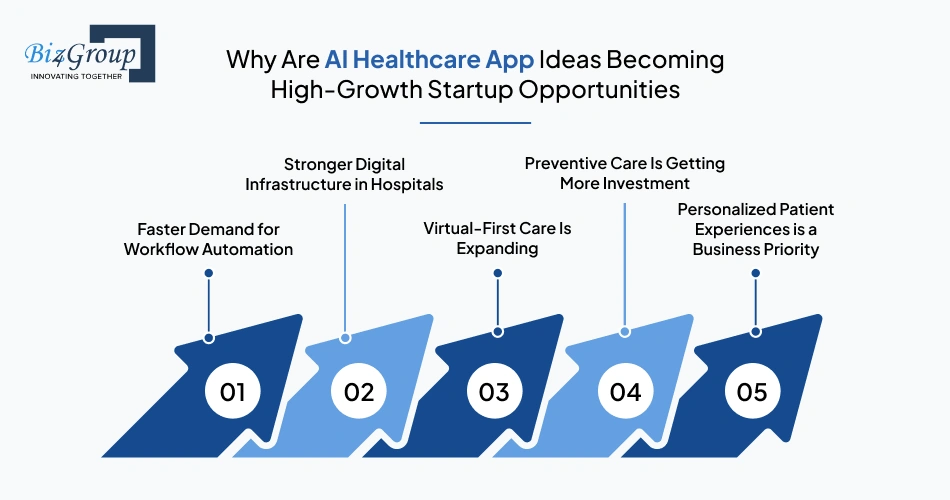
But still the bigger question is what is making this growth so startup-friendly in 2026. So here are five practical reasons that stand out:
1. Faster Demand for Workflow Automation
Healthcare teams are under constant pressure to reduce manual coordination work. Startups entering this space can build around high-frequency tasks that teams already want automated. The fastest traction usually comes from workflows that directly reduce staff response time and patient delays by:
- appointment routing
- documentation support
- patient follow-up workflows
2. Stronger Digital Infrastructure in Hospitals
Hospitals now have the digital foundation needed to adopt smarter products faster. This makes it easier for startups to launch AI healthcare apps that fit existing systems without disrupting clinical routines through: through:
- mature EHR software environments
- easier integration pathways
- better data continuity
3. Virtual-First Care Is Expanding
Patients increasingly expect care beyond hospital walls. This is creating steady demand for products that support continuous care journeys instead of one-time consultations through:
- remote monitoring
- virtual triage
- chronic care engagement
4. Preventive Care Is Getting More Investment
Providers want earlier risk detection instead of delayed intervention. That gives startups room to build products around measurable cost savings and better patient continuity with
- readmission alerts
- chronic risk scoring
- medication adherence support
5. Personalized Patient Experiences is a Business Priority
Retention now matters as much as treatment quality. For startups, this opens stronger monetization potential through long-term engagement and care adherence products by
- personalized care reminders
- behavior-based nudges
- multilingual patient communication
Together, these factors explain that the strongest growth is happening where products solve daily care delivery friction, fit existing hospital systems, and support measurable patient outcomes. The next step is understanding what separates a good idea from one that can generate revenue, which is exactly what the next section covers.
Will Your ROI Start with One Workflow?
See how the right use case can shorten payback cycles and strengthen budget confidence early
Talk to Our TeamWhat Makes the Best AI Healthcare App Ideas Profitable for Startups?
What turns one healthcare app idea into a scalable business while another struggles after launch? The answer usually comes down to how closely the product ties revenue potential with real care delivery pressure.
The top profitable healthtech startup app ideas using AI solve recurring workflow pain that providers, patients, or payers are already willing to spend on.
- AI app ideas tied to daily clinical or operational workflows usually monetize faster because they solve repeat problems teams face every day.
- Ideas that reduce staffing pressure, missed follow-ups, or delayed diagnosis often show clearer ROI for hospitals and clinics.
- AI healthcare apps built around recurring usage models, such as monitoring or engagement, create stronger monthly revenue opportunities.
- Startup healthcare app ideas that fit existing EHR, telehealth, or care coordination systems face fewer adoption barriers after launch.
- Patient-facing AI apps with measurable adherence, retention, or preventive care outcomes often attract payer and provider partnerships.
- Concepts built around chronic care, mental wellness, or virtual triage usually support longer customer lifetime value.
- AI healthcare application ideas with direct compliance readiness and secure data workflows build faster trust with enterprise healthcare buyers.
The real profitability signal is not the idea itself, but how naturally it fits an existing healthcare spending behavior. As you move into the next section, the focus shifts from profitability logic to the exact app ideas that can turn that business potential into real startup opportunities.
Top 10+ AI Healthcare App Ideas for the Healthcare Startups
The right AI healthcare app idea is the one that improves care delivery while fitting existing workflows and business realities. Startups that prioritize domain-specific execution, integration readiness, and monetization from day one will be better positioned to scale faster in the evolving digital health market.
Now let’s walk through the top AI healthcare app ideas for healthcare startups in 2026:
1. AI Remote Patient Monitoring App
An AI remote patient monitoring app helps you track patients outside hospital settings without losing clinical visibility. Instead of depending on periodic visits, you get continuous health data from wearables and home devices. The app processes this data in real time and flags any abnormal patterns that need attention. This makes it easier to intervene early and avoid complications that often lead to readmissions.
The app also supports better care coordination when patients are being managed across multiple touchpoints. In many setups, this connects naturally with systems like an AI patient portal, where patient data and communication already flow in one place. This makes it a practical AI healthcare app idea for providers aiming to extend care beyond hospital walls.
Key Features
- Real-Time Vital Tracking: Continuously monitors metrics like heart rate, blood pressure, and oxygen levels
- Intelligent Alert System: Flags abnormal readings and sends timely notifications to care teams
- Patient Data Dashboard: Displays trends, history, and risk indicators in a simple view
- Device Integration: Connects with wearables and home-based medical devices
- Care Plan Monitoring: Tracks adherence to prescribed treatments and routines
Use Cases
- Managing chronic conditions such as diabetes and hypertension
- Monitoring recovery after hospital discharge
- Supporting elderly patients living independently
- Detecting early signs of health deterioration
- Reducing avoidable hospital readmissions
Estimated Cost of Development: $40,000 – $200,000+
Revenue Streams: Subscription-based pricing for healthcare providers, per-patient monitoring fees, enterprise licensing for hospitals, API access fees for device integrations, white-label solutions for clinics, premium analytics add-on.
Example: UTM Remote Patient Monitoring- It tracks vitals from connected devices, compares them against patient baselines, and enables real-time alerts and secure care team messaging after discharge.
Also Read: How to Develop AI Remote Patient Monitoring Software?
2. AI Medical Billing Error Detection App
Billing errors are more common than most teams expect, and they directly impact revenue. An AI medical billing error detection app reviews claims before submission and flags issues that usually lead to rejections or delays. Instead of relying on manual checks, you get a system that scans codes, amounts, and patient details with consistency. This helps reduce back-and-forth with insurers and speeds up the entire billing cycle.
It also fits naturally into workflows where an AI medical billing software is already handling claim creation and submission. This makes it a practical AI healthcare mobile app idea for providers looking to tighten their revenue cycle without adding more administrative load.
Key Features
- Automated Error Detection: Identifies incorrect codes, duplicate entries, and missing details
- Pre-Submission Validation: Reviews claims before they are sent to insurers
- Billing Pattern Analysis: Detects recurring issues across claims
- Real-Time Alerts: Notifies staff about errors that need immediate correction
- Audit Trail Tracking: Maintains records of detected and corrected errors
Use Cases
- Reducing claim rejections before submission
- Improving billing accuracy in hospitals and clinics
- Supporting billing teams with faster validation
- Identifying repeated billing mistakes across departments
- Streamlining insurance claim workflows
Estimated Cost of Development: $45,000 – $200,000+
Revenue Streams: Subscription-based pricing for healthcare providers, per-claim processing fees, enterprise licensing for hospitals, API access fees for billing system integrations, white-label solutions for billing companies, premium analytics add-ons
Also Read: Building an AI Invoicing Platform: A Complete Guide
3. AI Lab Report Interpreter App
Lab reports often contain critical information, but the way they are presented makes quick interpretation difficult across care teams. An AI lab report interpreter app converts raw lab data into structured insights that highlight abnormalities, trends, and possible clinical concerns. Instead of scanning multiple reports manually, this innovative AI medical app idea helps you get a clear summary that supports faster clinical review and follow-up decisions.
This becomes especially useful in environments where AI medical diagnosis workflows are already being explored, as lab data plays a central role in early detection. It also aligns with broader efforts around predictive diagnosis and disease forecasting, where historical report patterns can indicate future risks. As an AI healthcare application idea, this approach focuses on improving how clinical data is consumed and acted upon.
Key Features
- Automated Report Analysis: Identifies abnormal values and flags key concerns
- Trend Visualization: Shows changes across multiple reports over time
- Clinical Insight Generation: Converts lab values into simple, actionable summaries
- Multi-Format Support: Processes reports from different labs and formats
- Integration Capability: Connects with EHR systems for seamless data flow
Also Read: AI EHR App Development for Hospitals and Clinics
Use Cases
- Supporting faster clinical review of lab reports
- Identifying early signs of chronic conditions
- Monitoring patient progress across repeated tests
- Assisting care teams in prioritizing critical cases
- Reducing manual effort in report interpretation
Estimated Cost of Development: $45,000 – $250,000+
Revenue Streams: Tiered subscription plans for healthcare providers, per-report processing fees, enterprise deployment for hospitals and labs, API licensing for EHR integrations, white-label solutions for diagnostic centers, premium analytics modules for advanced insights
Biz4Group LLC has already delivered a healthcare solution in this space which is built around blood marker analysis and guided health optimization.
Portfolio Spotlight: Dr Ara- AI-Powered Athletic Health Solution
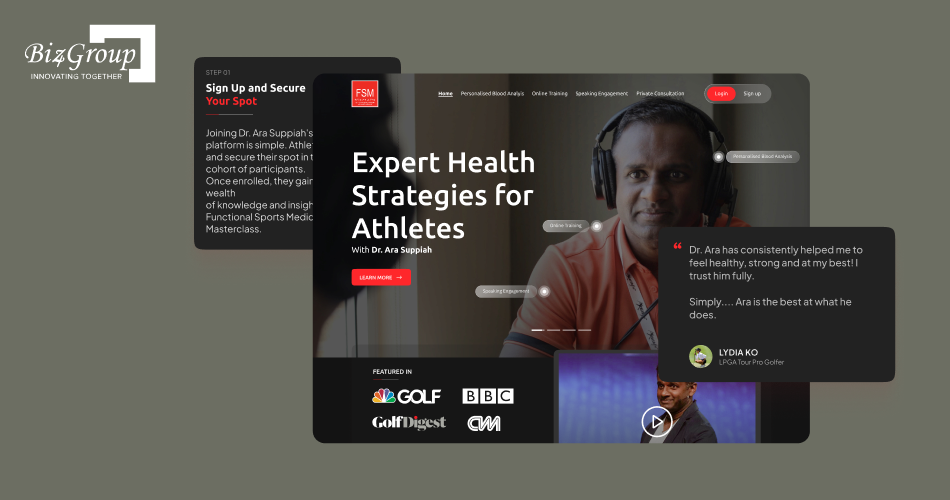
Dr. Ara is an AI-powered Athletic health platform that allows uploaded blood reports to be analyzed into personalized insights around hydration, cholesterol, oxygen levels, recovery, and nutrition.
- Blood report upload with automated biomarker analysis
- Personalized diet, sleep, and hydration recommendations
- One-on-one expert consultation scheduling
- Ongoing health condition monitoring and progress tracking
The solution goes beyond one-time report reading by supporting expert consultations and long-term progress visibility, which makes diagnostic data more actionable across care and wellness workflows.
4. AI Health Expense Tracker App
Healthcare spending is often scattered across bills, prescriptions, and test reports, which makes it hard to track where the money actually goes. An AI health expense tracker app brings everything into one place and organizes it in a way that is easy to understand. Instead of manually noting expenses, you get a clear breakdown of costs across treatments, medications, and visits. Over time, the app highlights spending patterns so you can make better decisions before costs become difficult to manage, making it one of the most profitable AI healthcare app ideas.
In setups where hospital administrators already rely on an AI health tracking to monitor daily health data, combining expense visibility adds a more complete view of overall wellbeing. This also fits well as an AI healthcare app idea for users who want more control over their healthcare finances.
Key Features
- Automated Expense Capture: Extracts and categorizes costs from bills and prescriptions
- Spending Insights View: Shows how expenses are distributed across treatments and time
- Smart Alerts: Notifies users when healthcare spending increases beyond usual patterns
- Centralized Bill Storage: Keeps all expense-related documents in one place
- Cost Prediction: Estimates future medical expenses based on past trends
Use Cases
- Managing personal and family healthcare budgets
- Tracking long-term treatment expenses
- Identifying frequent or high-cost medical activities
- Planning ahead for recurring medical needs
- Supporting informed financial decisions before treatments
Estimated Cost of Development: $40,000 – $200,000+
Revenue Streams: Freemium access with paid advanced insights, subscription plans for detailed expense analytics, premium budgeting tools, partnerships with insurers for cost data services, white-label offerings for healthcare providers, in-app financial advisory add-ons.
Example: Medical Expenses Log- It helps families record bills, prescriptions, and treatment costs in one place, with multi-member tracking, CSV exports, and organized records for tax-ready expense management.
Also Read: How to Build an AI Health Management App Like Noom
Can Better Visibility Reduce Care Costs?
Turn fragmented medical spending into smarter user decisions and stronger retention-driven monetization
Talk To us5. AI Medical Transcription App
Clinical conversations carry important details but capturing them accurately in real time is still a challenge for many care teams. An AI medical transcription app focuses on converting spoken interactions into clean, readable text without interrupting the consultation flow. It captures discussions as they happen and turns them into usable records that can be reviewed or stored later. This reduces dependency on manual notetaking and ensures nothing important is missed during patient interactions. In workflows that already rely on AI medical transcription software to handle documentation at scale, bringing this capability closer to the point of care improves speed and consistency.
By using speech to text capabilities, the app brings consistency to documentation while keeping the process simple for care teams. This also reflects how AI in healthcare apps is being used to reduce administrative effort without disrupting clinical workflows. As an AI healthcare app idea, it directly supports faster and more reliable documentation across different care settings.
Also Read: How to Build a Speech Recognition System With AI?
Key Features
- Real-Time Speech Capture: Converts live conversations into accurate text
- Healthcare Speech Recognition Accuracy: Identifies medical terms and speaker inputs clearly
- Medical Context Recognition: Understands clinical terms and structures them properly
- Editable Transcripts: Allows quick review and correction before finalizing records
- Multi-Speaker Identification: Distinguishes between doctor and patient inputs
- Secure Data Storage: Ensures all transcriptions are stored safely for future access
Use Cases
- Documenting outpatient consultations
- Supporting telemedicine session records
- Reducing manual documentation workload
- Maintaining accurate clinical records across visits
- Assisting medical staff in faster documentation workflows
Estimated Cost of Development: $50,000 – $250,000+
Revenue Streams: Usage-based pricing per transcription minute, subscription plans for clinics and hospitals, enterprise licensing for large healthcare networks, API-based access for integration with existing systems, white-label offerings for healthtech platforms, premium accuracy and customization tiers
Example: Augnito- It converts doctor dictation into accurate medical text with specialty-ready speech recognition, mobile dictation, templates, and secure records that fit existing hospital workflows.
6. AI Memory Companion App
Managing memory-related conditions requires consistent support, not just occasional check-ins. An AI memory companion app assists care teams in maintaining structured daily engagement for individuals experiencing memory decline. It helps track routines, recall important information, and reinforce familiar patterns through guided interactions. Instead of relying only on manual supervision, the app creates a continuous support layer that adapts to behavioral changes over time.
It also strengthens cognitive memory by reinforcing recognition through repeated prompts, familiar names, and contextual reminders. For organizations working in elderly care or long-term support programs, this serves as a practical AI healthcare app idea that focuses on improving daily functioning without adding operational complexity.
Also Read: AI Companion App Development: Features, Steps and Cost
Key Features
- Context-Based Reminders: Provides prompts for daily tasks, events, and routines
- Recognition Support: Assists with identifying people, places, and activities
- Behavior Tracking: Monitors changes in memory patterns over time
- Interactive Engagement: Uses guided conversations to reinforce familiarity
- Caregiver Dashboard: Offers visibility into daily activity and memory trends
Use Cases
- Supporting individuals with early-stage dementia
- Assisting memory care programs in assisted living facilities
- Maintaining structured daily routines for patients
- Reducing dependency on constant manual supervision
- Monitoring gradual cognitive decline over time
Estimated Cost of Development: $40,000 – $250,000+
Revenue Streams: Subscription plans for care providers and senior living facilities, per-patient licensing models, enterprise partnerships with healthcare organizations, white-label deployment for memory care services, premium features for advanced monitoring and reporting
Biz4Group LLC has delivered a dementia-focused mobile application in this space, which is designed to support daily memory reinforcement and routine stability.
Portfolio Spotlight: CogniHelp- AI-based Solution for Dementia Patients
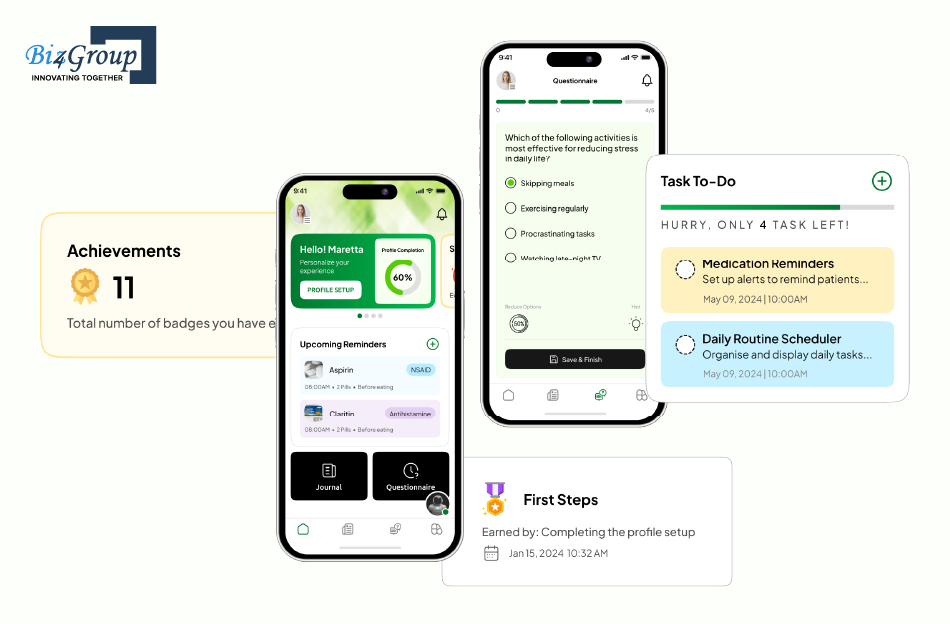
CogniHelp is a mobile application created for early to mid-stage dementia support, where daily engagement is built around memory recall, journaling, reminders, and cognitive performance tracking. The app helps maintain orientation through personalized quizzes based on life history and guided routine reinforcement, while also giving caregivers visibility into gradual cognitive changes over time.
- Personalized brainstorming quizzes from user history
- Voice-to-text journaling for daily memory recall
- Medication and task reminders for routine stability
- Cognitive performance scoring and progress visibility
Also Read: How to Develop a Mental Health AI Assistant?
7. AI Medical Scribe App
Documentation is not just about recording conversations; it is about capturing the right clinical context in a structured way. An AI medical scribe app handles this by converting consultations into decision-ready notes that align with clinical workflows. Instead of spending time organizing scattered information, care teams get properly structured outputs that reflect symptoms, assessments, and next steps. This improves consistency across records and supports faster clinical review.
In hospital setups where documentation workflows are already supported by AI medical scribe software adding an app layer, allow care teams to generate structured notes directly during consultations without breaking their flow. This positions it as a smart healthcare application idea for organizations aiming to improve documentation quality while keeping clinical workflows efficient.
Key Features
- Clinical Context Understanding: Captures symptoms, assessments, and treatment intent accurately
- Structured Note Generation: Organizes information into standardized clinical formats like SOAP
- Decision-Ready Summaries: Highlights key findings for quick clinical review
- Workflow Alignment: Fits directly into existing documentation and record systems
- Consistency Engine: Ensures uniform documentation across providers and departments
Use Cases
- Structuring clinical notes during consultations
- Supporting standardized documentation across care teams
- Reducing cognitive load on doctors during patient interactions
- Improving clarity in multi-provider care environments
- Enhancing documentation quality for compliance and audits
Estimated Cost of Development: $50,000 – $250,000+
Revenue Streams: Provider-based licensing plans, per-consultation processing fees, enterprise agreements with hospital systems, integration charges for clinical software, white-label deployment for digital health platforms, advanced documentation modules as premium offerings
Example: ScribeMD- It listens during consultations and turns conversations into structured clinical notes with faster charting, better note consistency, and less manual documentation work for doctors.
Also Read: A Step-by-Step Guide for AI Medical Software Development
8. AI Medical Image Pre-Screening App
Medical imaging volumes continue to grow, and reviewing every scan quickly without missing early signs is a constant challenge. An AI medical imaging pre-screening app helps care teams identify potential abnormalities before detailed analysis begins. It scans images such as X-rays, CT scans, or MRIs and highlights areas that may require closer attention. This allows radiology teams to prioritize cases more effectively and reduce delays in critical reviews.
In workflows connected with a radiology information system, this kind of pre-screening support helps organize incoming scans based on urgency rather than sequence. It fits well as a smart healthcare application idea for organizations that want to improve diagnostic workflows without adding pressure on radiology teams.
Also Read: How to Develop AI Radiology Software
Key Features
- Automated Image Scanning: Reviews medical images and detects potential abnormalities
- Priority Flagging: Marks high-risk cases for faster review
- Visual Highlighting: Points out specific areas that need attention
- Multi-Format Support: Works with different imaging types like X-rays and MRIs
- Workflow Integration: Aligns with existing radiology systems for smooth data flow
Use Cases
- Prioritizing critical imaging cases in radiology departments
- Supporting faster initial screening of large imaging volumes
- Assisting radiologists in identifying early-stage abnormalities
- Reducing delays in urgent diagnosis workflows
- Improving efficiency in diagnostic imaging pipelines
Estimated Cost of Development: $50,000 – $300,000+
Revenue Streams: Per-scan analysis pricing, subscription plans for diagnostic centers, enterprise contracts with hospital networks, integration fees for imaging systems, white-label deployment for radiology providers, advanced detection modules as premium offerings
Example: MedScan AI- It analyzes X-rays, CTs, MRIs, and ultrasounds to deliver instant scan insights, helping radiology teams review images faster and prioritize abnormal findings.
9. Avatar Based AI Personalized Wellness App
Personalized wellness often fails because guidance is not consistent or engaging enough. An avatar based AI personalized wellness app changes this by offering a continuous, interactive layer that adapts to daily routines, health patterns, and behavioral signals. Instead of static recommendations, the avatar guides actions in real time, whether it is improving sleep habits, managing stress, or maintaining activity levels.
In structured care environments, this setup can support follow-ups and adherence through an avatar for clinical management, where care teams track engagement without adding manual effort. It also fits well in programs focused on emotional wellbeing, where a mental health avatar can guide daily check-ins and reinforce stable habits. This positions it as a top AI healthcare app development idea for organizations that want to improve long-term engagement. It also works as an AI healthcare mobile app idea where continuous interaction drives better wellness outcomes.
Key Features
- Adaptive Wellness Guidance: Delivers daily recommendations based on behavior and routine data
- Avatar Interaction Layer: Engages through guided conversations and visual prompts
- Routine Monitoring: Tracks sleep, activity, and stress-related patterns
- Behavior Insights Engine: Identifies habits that impact overall wellness
- Goal Adjustment System: Updates plans based on consistency and progress
Use Cases
- Supporting corporate wellness initiatives
- Managing lifestyle-related health programs
- Improving adherence to long-term wellness routines
- Enabling continuous engagement in preventive care programs
- Supporting mental wellbeing through guided daily interactions
Estimated Cost of Development: $40,000 – $200,000+
Revenue Streams: Subscription-based access for wellness providers, enterprise licensing for healthcare organizations, pay-per-user pricing for corporate wellness programs, white-label deployment for digital health platforms, premium personalization features, revenue sharing with wellness service partners
Biz4Group LLC has already built a real-world avatar-led wellness application in this space which is focused on personalized health guidance and sustained engagement.
Portfolio Spotlight: Dr. Truman: Bringing Personalized Wellness to Life with AI
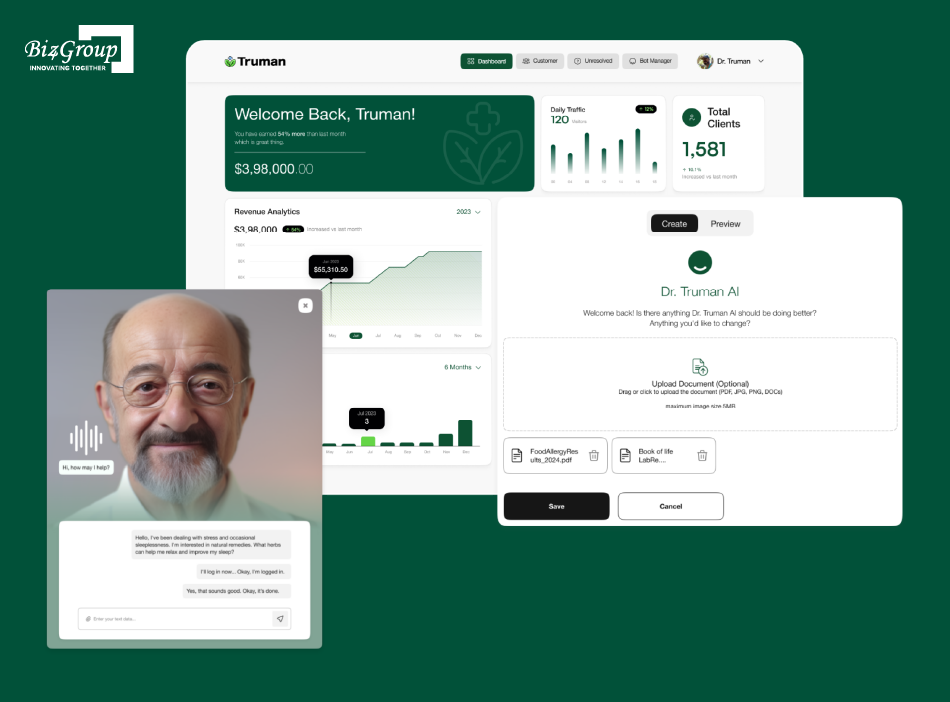
Dr. Truman’s Avatar is an AI-powered avatar wellness application where a lifelike avatar delivers personalized health consultations, tracks health history, and keeps wellness engagement active through conversational support. The app has:
- AI avatar-driven personalized health consultations
- Tailored supplement and herbal product suggestions
- Membership plans with health tips and discounts
- Medical report uploads with health history visibility
The experience extends beyond guidance by allowing medical report uploads, membership-based health perks, and continuity in daily wellness decisions, making the journey more structured and easier to sustain.
Also Read: Healthcare AI Avatar Development
10. AI Post-Discharge Recovery Monitoring App
Care does not end when a patient leaves the hospital, but visibility often does. An AI post-discharge recovery monitoring app helps care teams stay connected with recovery progress without requiring frequent in-person visits. It tracks key recovery indicators such as symptoms, activity levels, and adherence to discharge instructions. This allows early identification of complications that may otherwise go unnoticed until they become serious.
In care models that already focus on patient management using AI, extending monitoring beyond discharge improves continuity and reduces avoidable readmissions. This fits well within AI app ideas for hospitals and clinics that aim to improve outcomes while managing operational load more effectively.
Key Features
- Recovery Tracking: Monitors symptoms, vitals, and daily progress after discharge
- Alert System: Flags signs of complications or delayed recovery
- Care Plan Monitoring: Tracks adherence to prescribed post-discharge instructions
- Progress Dashboard: Provides a clear view of recovery trends over time
- Communication Support: Enables structured follow-up between care teams and patients
Use Cases
- Monitoring recovery after surgery
- Managing post-treatment care for chronic conditions
- Reducing hospital readmissions through early intervention
- Supporting remote follow-up care programs
- Improving visibility into patient recovery outside clinical settings
Estimated Cost of Development: $40,000 – $250,000+
Revenue Streams: Subscription-based pricing for hospitals and clinics, per-patient monitoring fees, enterprise agreements for healthcare networks, integration charges for existing care systems, white-label solutions for digital health providers, premium features for advanced recovery analytics.
Example: Post Discharge Care- It helps doctors remotely monitor recovery, review lab reports, send caregiver questionnaires, manage medications, and schedule follow-up visits after discharge.
Also Read: Develop Chronic Disease Management Software with AI
What If Recovery Stayed Visible Daily?
Reduce preventable readmissions with recovery tracking that keeps providers proactive after discharge
Start the Conversation11. AI Telemedicine App
Remote consultations are now a core part of healthcare delivery, but managing them efficiently still requires better coordination and support. An AI telemedicine app brings consultation, triage, and follow-up into a single workflow that care teams can manage without added complexity. It helps organize virtual visits, capture patient inputs before consultations, and ensure that interactions remain structured. This reduces delays and improves how care is delivered across distributed setups.
In many implementations, a telemedicine chatbot in app can handle initial queries and basic intake, allowing providers to focus on more critical interactions. This makes it a practical AI telemedicine app idea for organizations looking to scale virtual care while maintaining consistency in patient engagement.
Key Features
- Virtual Consultation Management: Enables secure video and audio consultations
- Pre-Consultation Intake: Collects patient details and symptoms before sessions
- AI Chat Support: Handles initial queries and basic triage
- Session Documentation: Captures and organizes consultation details
- Follow-Up Coordination: Schedules and manages post-consultation interactions
Use Cases
- Managing remote consultations across multiple locations
- Supporting telehealth services for primary and specialty care
- Reducing wait times through structured patient intake
- Handling high consultation volumes efficiently
- Improving access to care in remote or underserved areas
Estimated Cost of Development: $400,000 – $300,000+
Revenue Streams: Subscription plans for healthcare providers, per-consultation service fees, enterprise licensing for hospital networks, integration charges for existing systems, white-label platforms for telehealth providers, premium features for advanced patient engagement
Example: MDFlow TeleMedicine- It enables real-time face-to-face virtual consultations, helping providers connect with patients faster and manage remote follow-ups more efficiently.
Also Read: How to Develop an AI Telehealth Automation System in 2026
12. AI Supplement Tracker App
Supplement usage often remains untracked across care plans, which leads to gaps in understanding how they impact overall health outcomes. An AI supplement tracker app brings structure by recording intake, monitoring consistency, and linking supplement usage with ongoing health data. This helps care teams identify patterns and ensure that supplements align with treatment goals. AI supplement tracker app also reduces the risk of overuse or conflicting intake across multiple sources.
Care teams can also guide supplement intake more effectively by incorporating supplement recommendation AI chatbot functionality, which uses existing usage data and health inputs to support informed decisions. This positions it as an innovative AI healthcare app for organizations that want better visibility into supplement usage while maintaining coordinated care.
Key Features
- Supplement Intake Tracking: Records daily supplement usage with time and dosage details
- Consistency Monitoring: Tracks adherence to recommended supplement routines
- Interaction Alerts: Flags potential conflicts between supplements and treatments
- Usage Insights: Highlights patterns linked to health outcomes
- Guided Recommendations: Suggests adjustments based on tracked data
Use Cases
- Monitoring supplement usage in chronic care programs
- Supporting nutrition and wellness management plans
- Reducing risks of incorrect or excessive supplement intake
- Improving coordination between supplements and treatments
- Providing visibility into long-term supplement adherence
Estimated Cost of Development: $50,000 – $150,000+
Revenue Streams: Subscription plans for healthcare providers and wellness platforms, per-user tracking fees, enterprise licensing for healthcare organizations, API access pricing for integration with health systems, white-label deployment for nutrition and wellness providers, premium recommendation and analytics features
A live implementation from Biz4Group LLC shows how guided supplement decision-making can be transformed into an interactive recommendation workflow.
Portfolio Spotlight: Select Balance- AI Chatbot for Personalized Supplement Recommendations
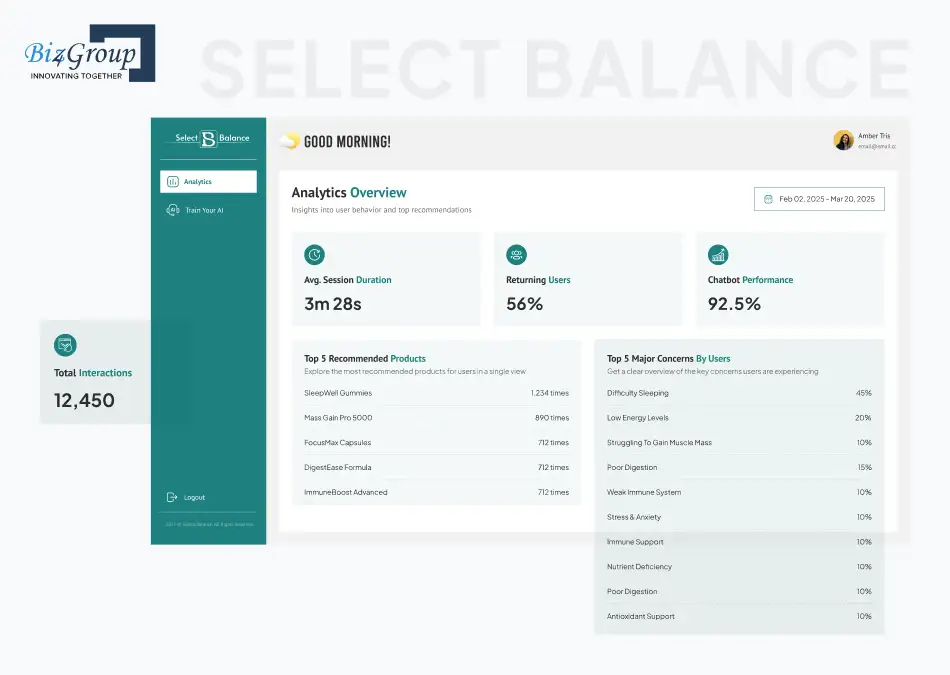
The AI chatbot captures health goals and symptom inputs through a guided quiz or conversational chat, then turns that context into instant supplement suggestions with direct purchase-ready product cards. It keeps the recommendation journey structured from intake to action while making supplement decisions easier to manage across growing wellness workflows. The chatbot has:
- Guided quiz and conversational health intake
- Instant product matching based on symptom context
- Product cards with direct buy links
- Admin panel for training and recommendation updates
Select Balance a AI chatbot for personalized supplement recommendations, also gives internal teams direct control over refining recommendation logic through training updates and keyword improvements.
Also Read: How to Develop Health Supplement eCommerce Platform
13. AI Health Literacy Simplifier App
Medical information is often difficult to interpret, which creates gaps between diagnosis and understanding. An AI health literacy simplifier app converts complex reports, prescriptions, and clinical notes into clear and structured explanations that care teams can share easily. This improves communication across providers, patients, and support staff without requiring additional time during consultations. It also helps standardize how medical information is explained across different care settings.
As healthcare trends continue to move toward more informed and engaged care delivery, simplifying medical language becomes essential for better outcomes. In systems that already rely on data in health tracking workflows, adding a simplification layer ensures that information is not only collected but also understood. This positions it as a strong AI app idea for healthcare where clarity directly impacts care quality.
Key Features
- Report Simplification: Converts complex medical reports into easy-to-understand summaries
- Prescription Breakdown: Explains dosage, usage, and precautions clearly
- Context-Based Explanation: Adapts explanations based on condition and treatment type
- Multi-Language Support: Delivers simplified information in different languages
- Structured Output Format: Presents information in a consistent and readable format
Use Cases
- Improving communication during patient consultations
- Supporting care teams in explaining treatment plans
- Reducing confusion around prescriptions and reports
- Enhancing patient engagement in treatment processes
- Standardizing information delivery across healthcare systems
Estimated Cost of Development: $40,000 – $200,000+
Revenue Streams: Subscription-based access for healthcare providers, per-document processing fees, enterprise licensing for hospitals and clinics, integration charges for EHR systems, white-label solutions for digital health platforms, premium multilingual and customization features
14. AI Symptom Checker App
Initial symptom assessment often depends on manual inputs and inconsistent interpretation, which can delay the next step in care. An AI symptom checker app structures this process by guiding inputs and narrowing down possible conditions based on patterns. It helps standardize how early-stage assessments are captured and reduces dependency on unstructured descriptions. The accuracy of such systems depends on trained AI models that can interpret symptoms in a clinically relevant way without oversimplifying the context.
This also allows smoother AI integrations with consultation workflows, where pre-assessment data can be used before a clinical interaction begins. It works well as an AI healthcare mobile app idea for organizations aiming to improve triage efficiency and reduce unnecessary consultation load.
Key Features
- Guided Symptom Input: Collects structured symptom data through step-by-step prompts
- Pattern-Based Assessment: Matches inputs with known symptom patterns
- Adaptive Question Flow: Adjusts questions based on previous responses
- Pre-Consultation Summary: Generates structured input for clinical review
- Integration Support: Connects with consultation and care management systems
Use Cases
- Supporting initial patient triage before consultations
- Reducing unnecessary clinic visits
- Improving intake efficiency in telehealth workflows
- Standardizing symptom data collection
- Assisting care teams in prioritizing cases
Estimated Cost of Development: $40,000 – $220,000
Revenue Streams: Subscription-based access for healthcare providers, per-assessment pricing models, enterprise licensing for hospital networks, API usage fees for integrations, white-label deployment for digital health platforms, premium analytics and customization features
Example: Symptomate- It runs a guided symptom interview and suggests likely conditions, urgency level, and the right specialist before a consultation begins.
Also Read: A Guide to AI Chatbot Development for Medical Diagnosis
15. AI Medical Claim Processing App
Medical claim workflows often involve multiple validation steps, which increases processing time and error rates. An AI medical claim processing app helps streamline this by reviewing claims, verifying details, and preparing them for faster approval. It reduces dependency on manual checks and improves consistency across submissions. Claims teams can review, validate, and process submissions from a single interface, which reduces delays and keeps the workflow consistent from intake to approval.
The app also supports insurance fraud detection by identifying unusual patterns in billing data and flagging them early. This makes it a strong AI healthcare app development idea for organizations looking to improve claim accuracy while reducing operational delays.
Also Read: How to Develop an AI Health Insurance App
Key Features
- Automated Claim Validation: Reviews claims for missing or incorrect information
- Error Detection Engine: Identifies inconsistencies in billing and documentation
- Fraud Pattern Analysis: Detects suspicious claim activity based on data patterns
- Workflow Management: Tracks claim status from submission to approval
- Integration Support: Connects with billing and insurance systems
Use Cases
- Reducing claim rejection rates
- Improving claim processing efficiency in hospitals
- Supporting insurance teams in fraud detection
- Streamlining billing workflows across departments
- Enhancing accuracy in insurance claim submissions
Estimated Cost of Development: $50,000 – $300,000+
Revenue Streams: Per-claim processing fees, subscription plans for healthcare organizations, enterprise agreements with insurers and hospital networks, API-based pricing for system integrations, white-label deployment for billing service providers, premium fraud detection modules
A live Biz4Group implementation in the medical insurance domain also demonstrates how claim-related communication can be automated across high-volume support operations.
Portfolio Spotlight: AI IVR Platform for Medical Claim
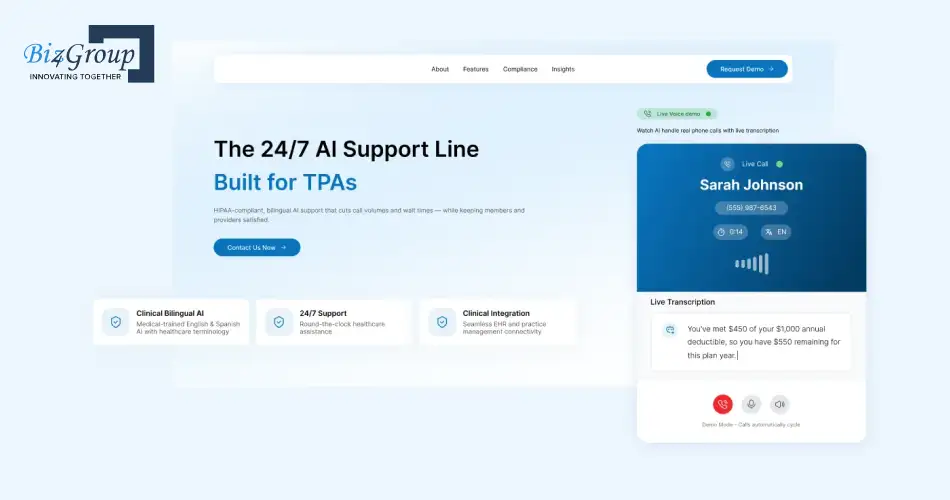
AI-driven IVR solution for medical claims is a healthcare third party administrator to handle repetitive claims and policy inquiries with faster response cycles. The workflow automates caller intent capture, routes requests intelligently, supports bilingual conversations, and escalates complex claim-related cases to live agents when required.
- AI-powered IVR for claim and policy inquiries
- Intelligent routing with live escalation support
- Bilingual voice workflows for broader accessibility
- Secure handling of PHI-sensitive insurance interactions
The platform gives medical insurance operations teams a more consistent way to manage policy, eligibility, and claim-status communication without increasing manual support load.
Also Read: AI-Powered Insurance Automation Software Solutions
16. AI Sleep Disorder Detection App
Sleep disorders often go unnoticed until they begin to affect overall physical health, mental health impacting daily functioning. An AI sleep disorder detection app helps identify irregular sleep patterns by analyzing behavioral and physiological signals over time. It uses structured data inputs and predictive analysis to detect signs of conditions such as insomnia or sleep apnea without requiring constant clinical supervision.
The effectiveness of such systems depends on strong AI model development, where sleep-related patterns are trained and validated against real-world data. As these systems mature, integrated AI models can connect sleep insights with broader care workflows, allowing early intervention before conditions worsen. This makes it a relevant AI healthcare mobile app idea for improving long-term health monitoring through continuous sleep analysis.
Key Features
- Sleep Pattern Analysis: Tracks and evaluates sleep cycles and disruptions
- Anomaly Detection: Identifies irregular sleep behavior and potential disorders
- Data Integration: Uses inputs from wearables and monitoring devices
- Insight Generation: Provides clear summaries of sleep quality and trends
- Alert Mechanism: Flags patterns that may require further clinical evaluation
Use Cases
- Detecting early signs of sleep disorders
- Supporting long-term sleep health monitoring
- Assisting care teams in preventive health programs
- Reducing dependency on manual sleep tracking methods
- Improving patient outcomes through early intervention
Estimated Cost of Development: $40,000 – $240,000
Revenue Streams: Subscription-based access for healthcare providers, per-user monitoring fees, enterprise licensing for healthcare networks, API access pricing for wearable integrations, white-label deployment for digital health platforms, premium analytics and reporting features
Example: Sleep Monitor- It tracks sleep cycles, records snoring patterns, and shows long-term sleep trends to help detect irregular sleep behavior early.
The strongest opportunities in 2026 will come from healthcare apps that solve specific workflow gaps, not broad innovation themes. From diagnostics to recovery, each idea above maps to measurable operational value, giving healthcare startups clearer paths toward adoption, differentiation, and long-term recurring revenue.
How to Choose the Right AI Healthcare App Idea for Your Startup?
If your team is evaluating multiple healthcare directions, the right choice usually becomes clear when you test each idea against workflow urgency, buyer demand, and real-world adoption effort. For founders reviewing top AI healthcare app development ideas, the goal is to narrow your shortlist to ideas that solve an urgent care problem and can scale with practical demand.
1. Shortlist Ideas Around High-Frequency Care Problems
Start by filtering ideas around problems that happen every day inside hospitals, clinics, or patient journeys. Triage delays, missed follow-ups, documentation pressure, and chronic care drop-offs are stronger opportunities because healthcare teams already feel the operational cost. When the problem is frequent, the need for your solution is easier to validate.
2. Filter by Immediate Revenue Potential
The right idea should connect to an existing healthcare budget before feature planning expands. Hospitals may pay for workflow efficiency; clinics may invest in patient retention, and payers may fund preventive outcomes. When the revenue path is visible early, it becomes easier to prioritize one startup direction over another.
3. Narrow Down by Existing Workflow Compatibility
The most practical ideas fit naturally into systems providers already use. Solutions aligned with EHR workflows, telehealth routines, remote monitoring, or documentation processes usually face less resistance during rollout. A smoother fit improves both adoption speed and long-term product retention.
4. Remove Ideas with Heavy Adoption Friction
Some ideas look attractive until compliance effort; provider onboarding, or process disruption becomes difficult to manage. The better choice is the one providers can trust quickly and teams can use without major training. Practical adoption often decides which startup idea succeeds.
The right idea usually stands out when it solves a frequent healthcare problem, connects to a clear budget, and fits naturally into existing care workflows without adding friction.
Is Your Best Idea Already On The List?
Pressure-test your shortlist against revenue fit, workflow urgency, and adoption readiness with us
Validate My IdeaAI Healthcare App Development Challenges Startups Must Solve
A promising idea can still fail when execution runs into healthcare-specific roadblocks that slow adoption, trust, or scalability. In AI healthcare startup app ideas for entrepreneurs, the real challenge is not just product vision. It is identifying the practical issues that can affect rollout, compliance, and long-term usage before they become expensive mistakes.
|
Challenge |
Practical Solution |
|---|---|
|
Limited access to clean clinical data |
Start with narrow workflows where data quality is already stronger, such as radiology, documentation, or remote monitoring. |
|
EHR and hospital system integration delays |
Work with an experienced AI app development company that understands healthcare workflows and interoperability planning early. |
|
Slow provider adoption due to workflow disruption |
Design the product around existing routines, so teams do not need to change how they already deliver care. |
|
Compliance and patient data privacy risks |
Involve legal, security, and product teams early while planning the development of AI app workflows around protected data. |
|
Inconsistent AI model accuracy in real care settings |
Validate performance using real clinical edge cases instead of relying only on ideal training datasets. |
|
Long enterprise sales cycles |
Prioritize use cases with visible ROI so hospitals can justify budget decisions faster. |
|
Patient trust and low engagement |
Keep patient experiences simple, transparent, and directly tied to visible care benefits. |
|
Scaling infrastructure cost after MVP |
Partnering with an AI development company helps plan cloud usage, model cost, and scale architecture from day one. |
The startups that scale successfully are usually the ones that solve these challenges before product expansion begins. Strong execution in healthcare comes from reducing friction early, protecting trust, and making adoption feel practical for both providers and patients.
Why Healthcare Startups Choose Biz4Group LLC to Build AI Healthcare Apps
Turning an AI healthcare application idea into a reliable product depends on how well it performs inside real care workflows, not just in product planning. Many startup concepts look promising early, but they often face delays around usability, compliance, data flow, and provider adoption. That is where Biz4Group LLC bring practical clarity and execution depth.
As an AI healthcare software development company, we work closely with founders to shape products around real clinical and operational use cases instead of disconnected feature sets. Our experience with healthcare-focused solutions and projects like Truman, Select Balance, Dr. Ara, and CogniHelp helps us guide product decisions using patterns that already work in live environments.
We keep our approach grounded in what helps startups move faster without creating long-term product debt. That means we focus on:
- workflow-first product planning that fits hospitals, clinics, and patient journeys
- scalable architecture that supports future integrations and feature growth
- secure data handling built around healthcare trust requirements
- practical rollout strategies that improve provider and patient adoption
- business app development using AI with clear commercial outcomes from day one
What founders value most about us is that we stay involved from validation to deployment, helping every product decision stay aligned with real healthcare usage, growth goals, and long-term scalability.
Ready To Turn Validation into Velocity?
Move from founder vision to healthcare-ready execution with a team that understands real workflows
Book a Strategy CallConclusion
The real opportunity behind the best AI healthcare app ideas for startups in 2026 lies in solving one care delivery problem with clear business value. The ideas that scale are the ones grounded in workflow practicality, patient trust, and measurable outcomes. That is exactly where strong AI product development services make the difference between an interesting concept and a usable healthcare product.
As you move from idea validation to execution, the focus should stay on real provider workflows, adoption ease, and long-term product fit. At Biz4Group LLC, we have seen startup success come from simple, focused solutions that solve expensive operational gaps instead of trying to solve everything at once.
If your vision is to build something meaningful in healthcare tech, the strongest next step is to validate one urgent problem and move forward with execution clarity. When you are ready to turn that direction into a scalable product, let’s connect to make it a practical, reliable, and growth-ready healthcare app.
FAQ’s
1) What are the best AI healthcare app product ideas with faster enterprise sales cycles in 2026?
The most viable AI healthcare app ideas for faster enterprise sales are products tied to compliance reporting, revenue-cycle optimization, provider productivity, and care coordination dashboards. These solve budgeted hospital problems, making procurement easier than patient-facing wellness concepts.
2) Which AI healthcare app development ideas are attracting the most investor interest in 2026?
Investors are leaning toward AI healthcare startup app ideas for entrepreneurs that improve operational margins, automate clinical admin workflows, and create reusable hospital data layers. Products with clear recurring B2B revenue models and integration depth stand out during seed evaluation.
3) What makes the best AI healthcare app ideas easier to integrate into existing hospital systems?
The strongest AI healthcare application ideas fit directly into EHR, claims, radiology, and telehealth workflows without forcing behavior change. Hospitals adopt faster when the product works inside existing systems and reduces training requirements for clinical or admin teams.
4) Which top AI healthcare app ideas have the strongest white-label potential for digital health companies?
Smart healthcare applications ideas focused on care navigation, provider workflows, insurance communication, and patient engagement often have strong white-label demand. These products scale well across clinics, hospital groups, and digital health vendors without rebuilding the core workflow.
5) What are the most profitable AI healthcare app ideas beyond direct hospital sales?
Some of the most profitable AI healthcare app ideas expand through pharma enablement, employer health programs, insurer partnerships, device integrations, and API-based licensing. This reduces dependence on single-provider sales cycles and improves long-term revenue diversification.
6) Which AI apps ideas are trending in healthcare startups for multi-market expansion?
The best AI healthcare mobile app ideas for expansion are those built around localization-ready workflows, multilingual patient communication, compliance flexibility, and modular integrations. These allow startups to adapt faster across US providers, GCC hospital groups, and European digital health markets.
